GOOD
MORNING
CLASS II
MALOCCLUSION
GUIDED BY:
DR. SURESH KANGNE
DR. ANAND AMBEKAR
DR. PRAVINKUMAR MARURE
DR. YATISHKUMAR JOSHI
DR. CHAITANYA KHANAPURE
PRESENTED BY:
ABHIDNYA
MADANSURE
CONTENT
• Introduction
• Classification
• Aetiology
• Clinical features
• Treatment modalities
• Conclusion
• Reference
INTRODUCTION
• E.H. ANGLE, in 1899 described
normal occlusion as an
• “Evenly placed row of teeth
arranged in a graceful curve
with harmony between the
upper and lower arches.”
Textbook of orthodontics by Dr. Samir Bishara
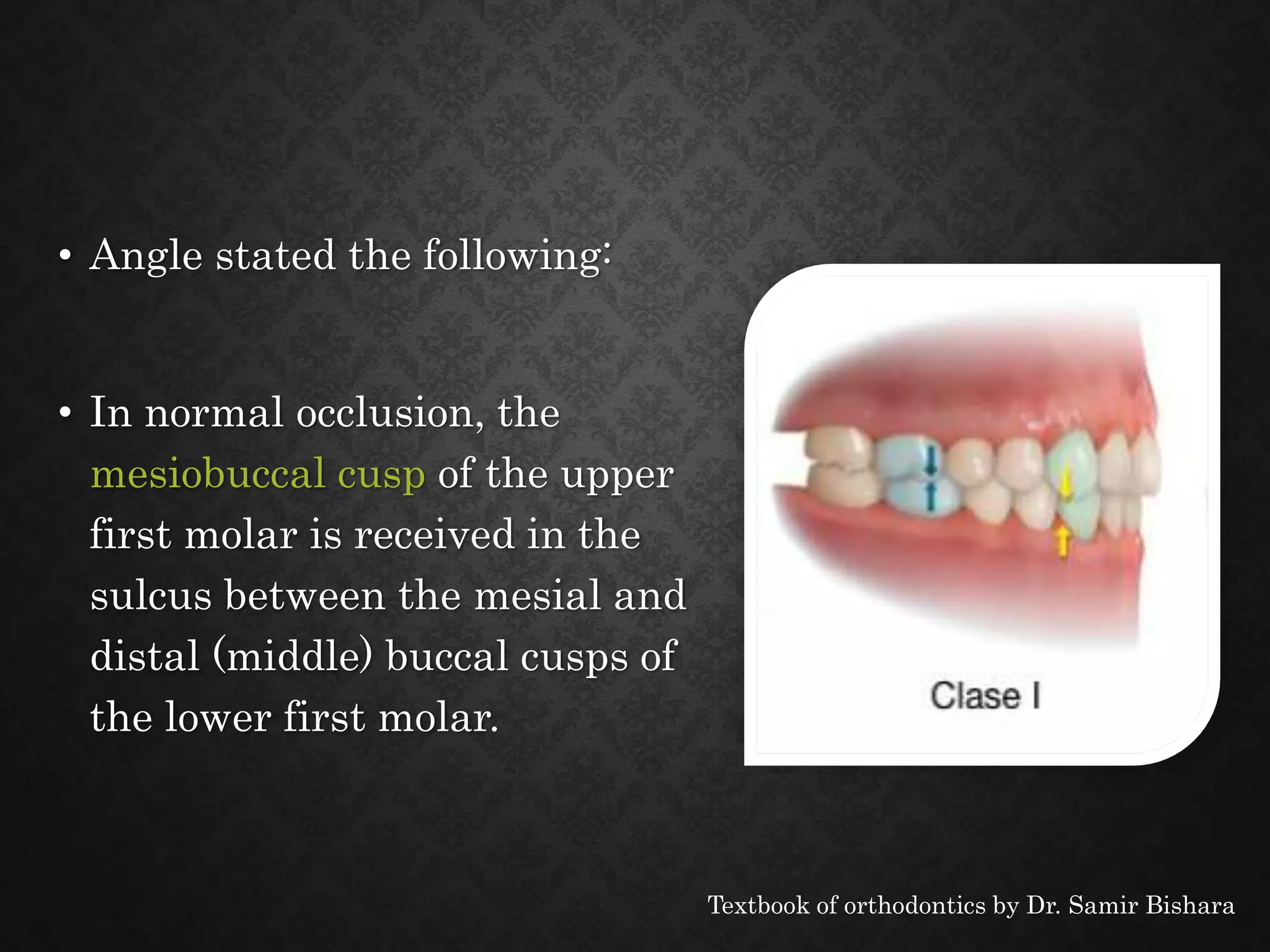
• Angle stated the following:
• In normal occlusion, the
mesiobuccal cusp of the upper
first molar is received in the
sulcus between the mesial and
distal (middle) buccal cusps of
the lower first molar.
Textbook of orthodontics by Dr. Samir Bishara
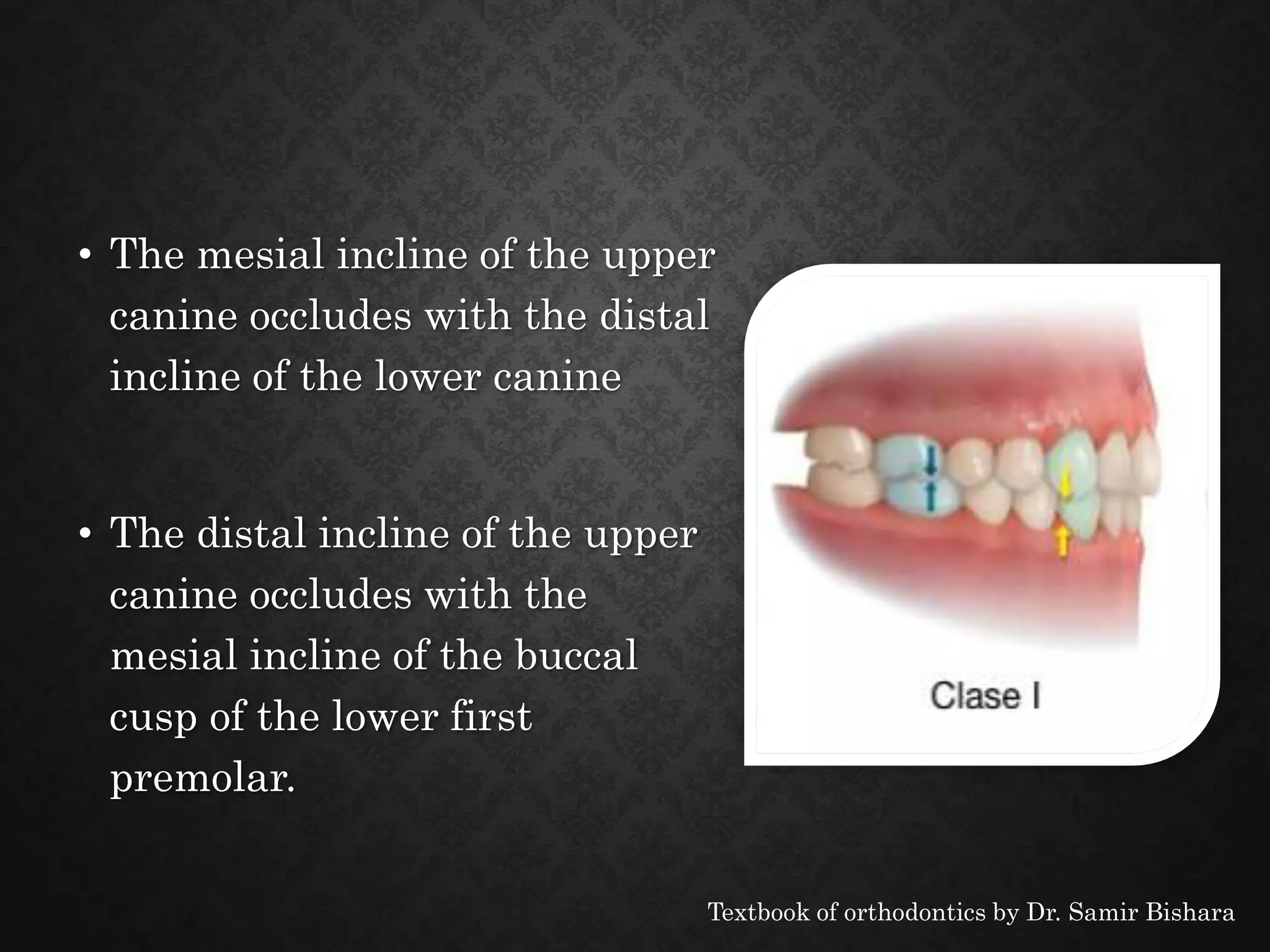
• The mesial incline of the upper
canine occludes with the distal
incline of the lower canine
• The distal incline of the upper
canine occludes with the
mesial incline of the buccal
cusp of the lower first
premolar.
Textbook of orthodontics by Dr. Samir Bishara
CLASS II
MALOCCLUSIONS
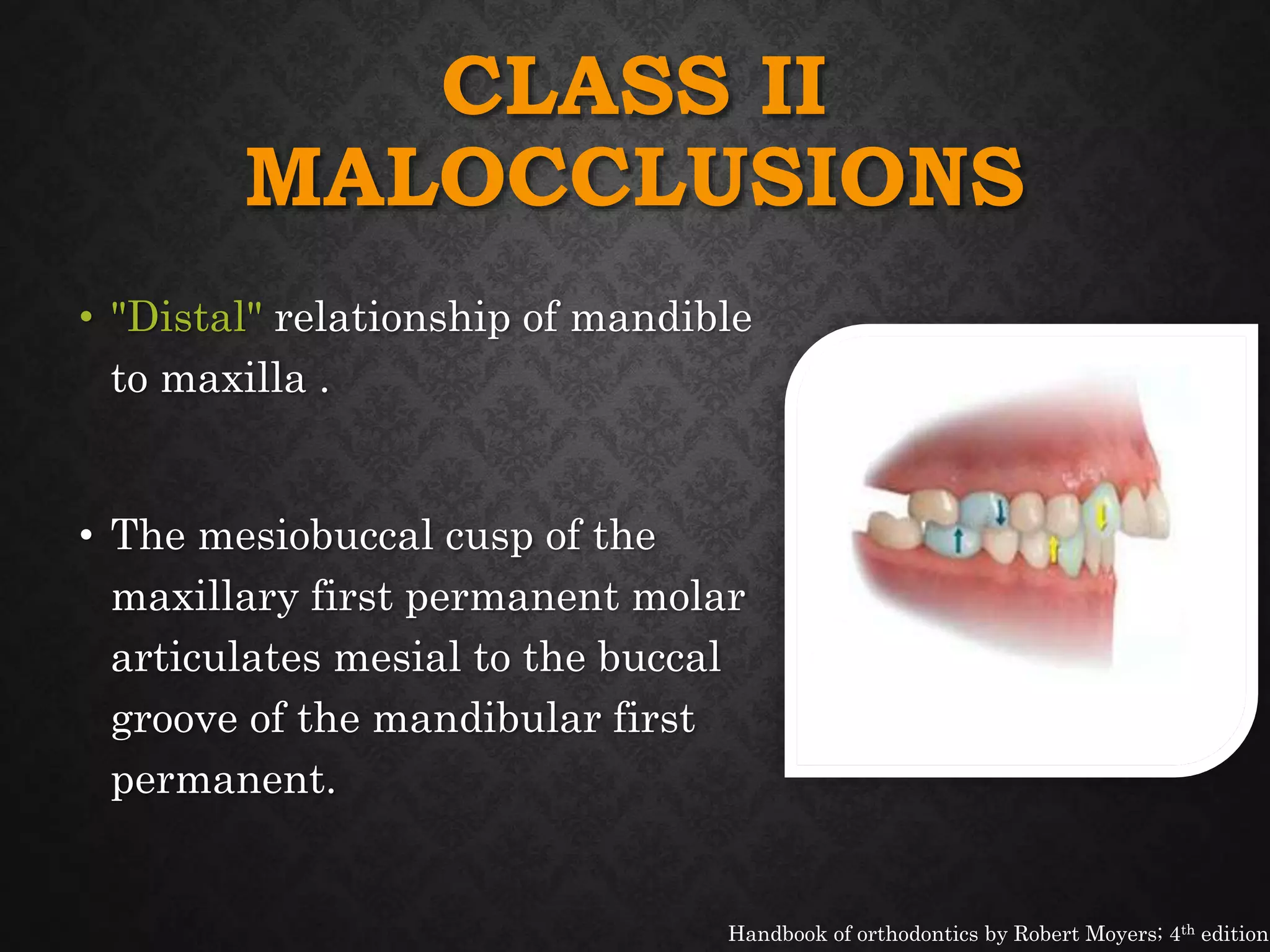
• "Distal" relationship of mandible
to maxilla .
• The mesiobuccal cusp of the
maxillary first permanent molar
articulates mesial to the buccal
groove of the mandibular first
permanent.
Handbook of orthodontics by Robert Moyers; 4th edition
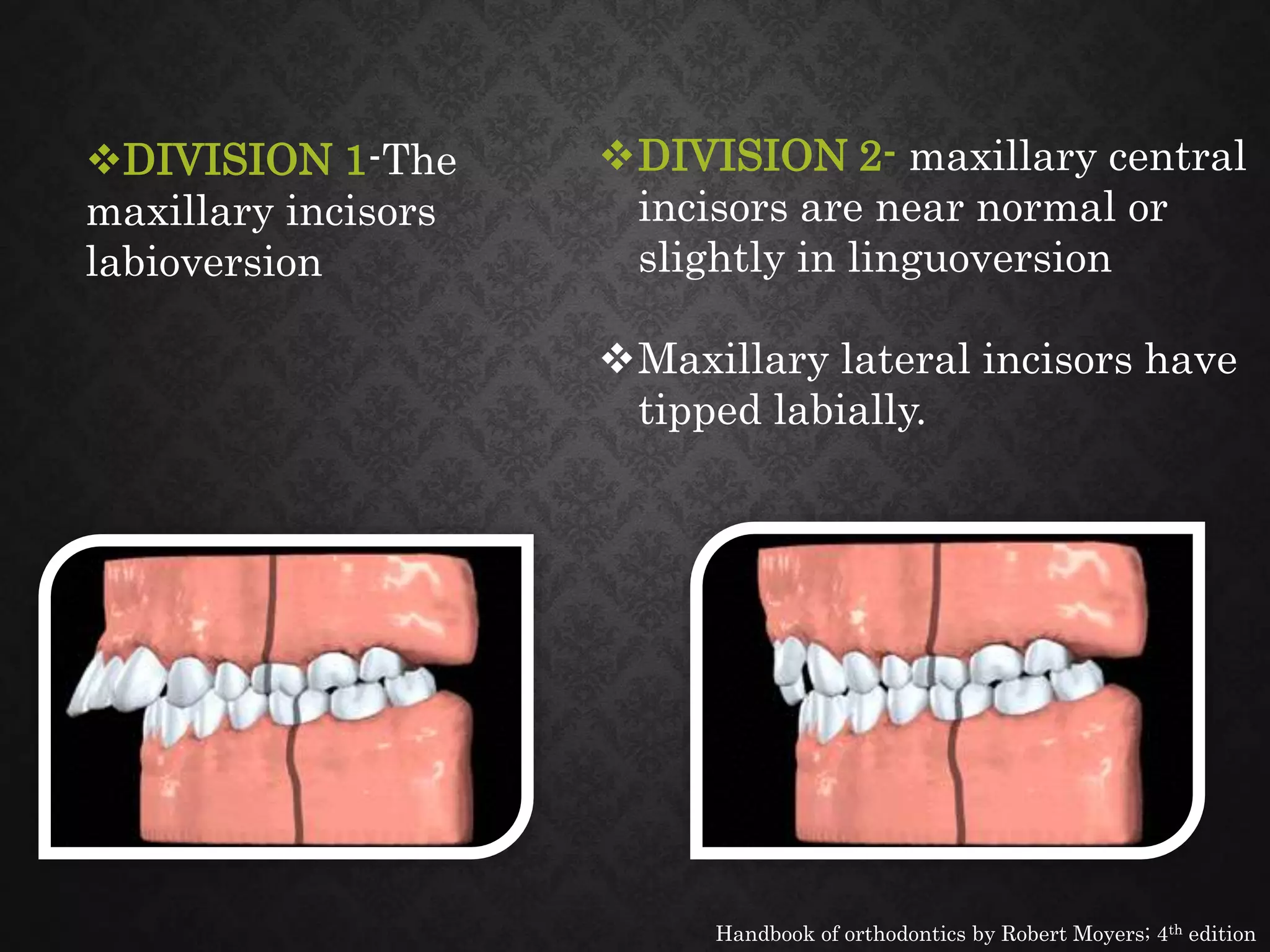
DIVISION 1-The
maxillary incisors
labioversion
DIVISION 2- maxillary central
incisors are near normal or
slightly in linguoversion
Maxillary lateral incisors have
tipped labially.
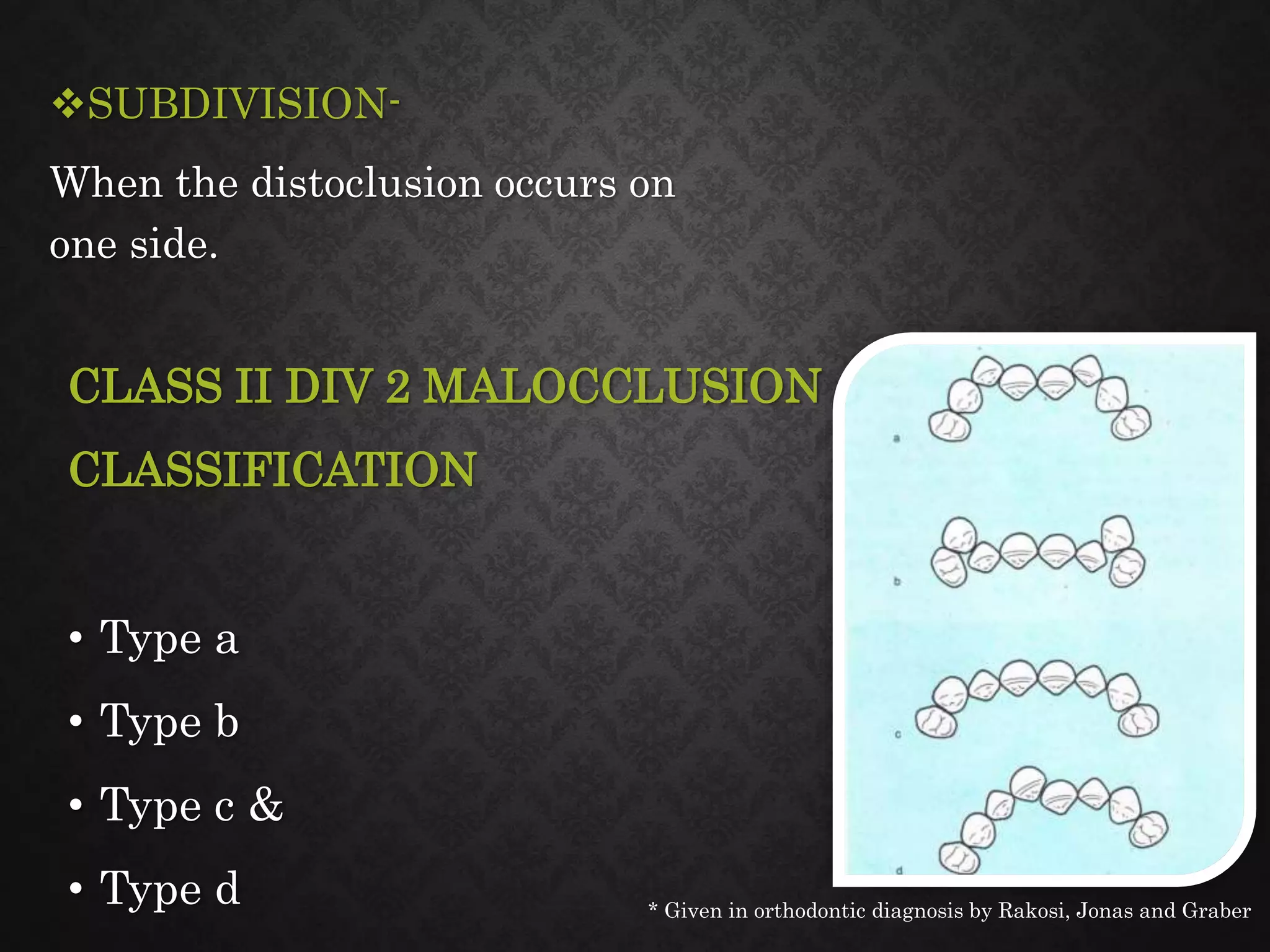
CLASS II DIV 2 MALOCCLUSION
CLASSIFICATION
• Type a
• Type b
• Type c &
• Type d * Given in orthodontic diagnosis by Rakosi, Jonas and Graber
SUBDIVISION-
When the distoclusion occurs on
one side.
SKELETAL CLASS II
MALOCCLUSIONS
• Skeletal discrepancies are often associated with
dental Class II malocclusions.
A] Mandibular Deficiency
B] Maxillary Excess
Textbook of orthodontics by Dr. Samir Bishara
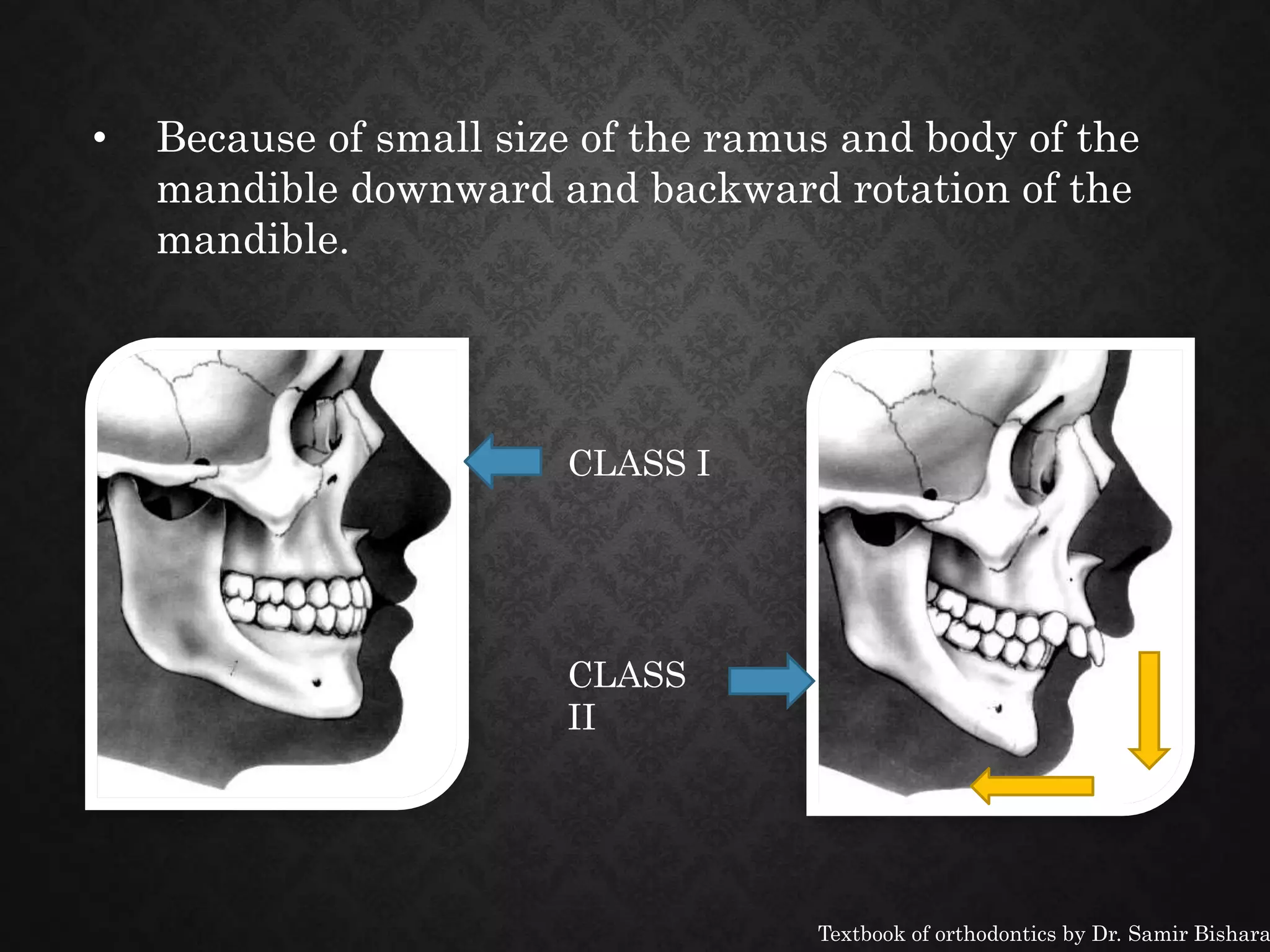
• Because of small size of the ramus and body of the
mandible downward and backward rotation of the
mandible.
CLASS I
CLASS
II
Natural dental compensation:
• Protrusive mandibular incisors.
• Narrow or constricted maxillary arch.
• Mesiolingual rotation of the maxillary first molars.
*Textbook of orthodontics by Dr. Samir Bishara
MOYER’S CLASSIFICATION
OF CLASS II
Vertical
Class II
Class II
Horizontal
Class II
A B C D E F 1 2 43 5
Handbook of orthodontics by Robert Moyers; 4th edition
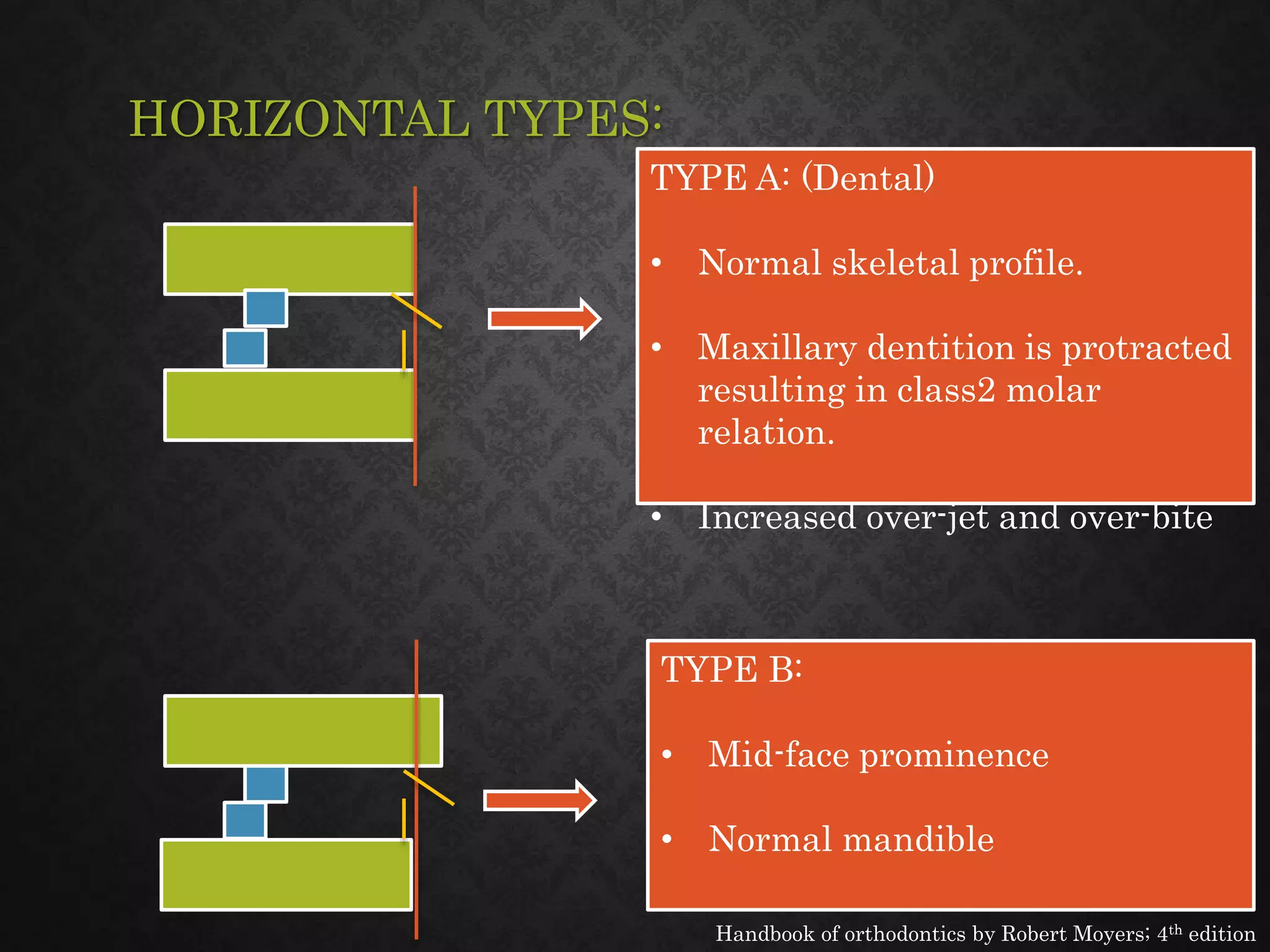
HORIZONTAL TYPES:
TYPE A: (Dental)
• Normal skeletal profile.
• Maxillary dentition is protracted
resulting in class2 molar
relation.
• Increased over-jet and over-bite
TYPE B:
• Mid-face prominence
• Normal mandible
Handbook of orthodontics by Robert Moyers; 4th edition
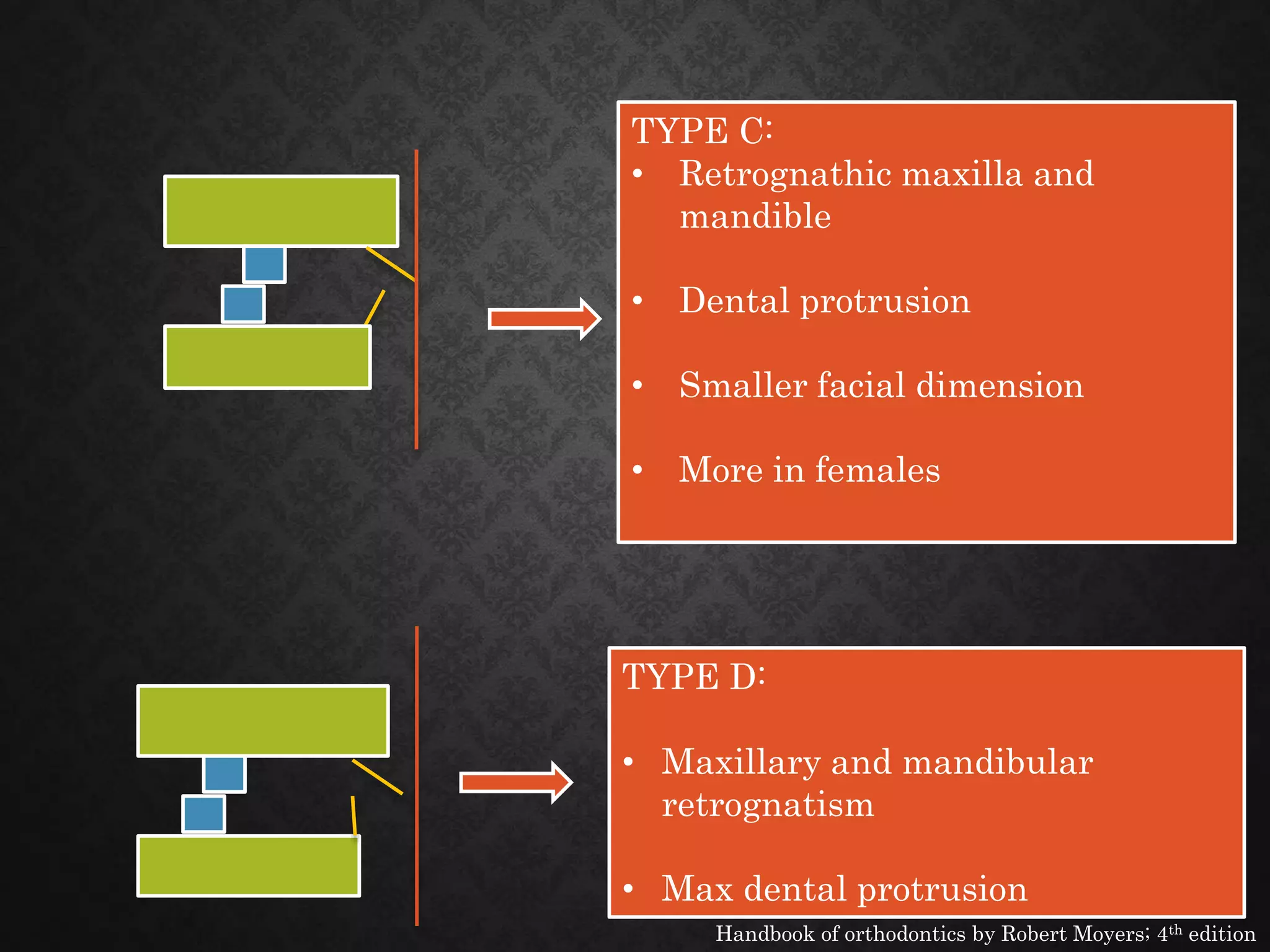
TYPE C:
• Retrognathic maxilla and
mandible
• Dental protrusion
• Smaller facial dimension
• More in females
TYPE D:
• Maxillary and mandibular
retrognatism
• Max dental protrusion
Handbook of orthodontics by Robert Moyers; 4th edition
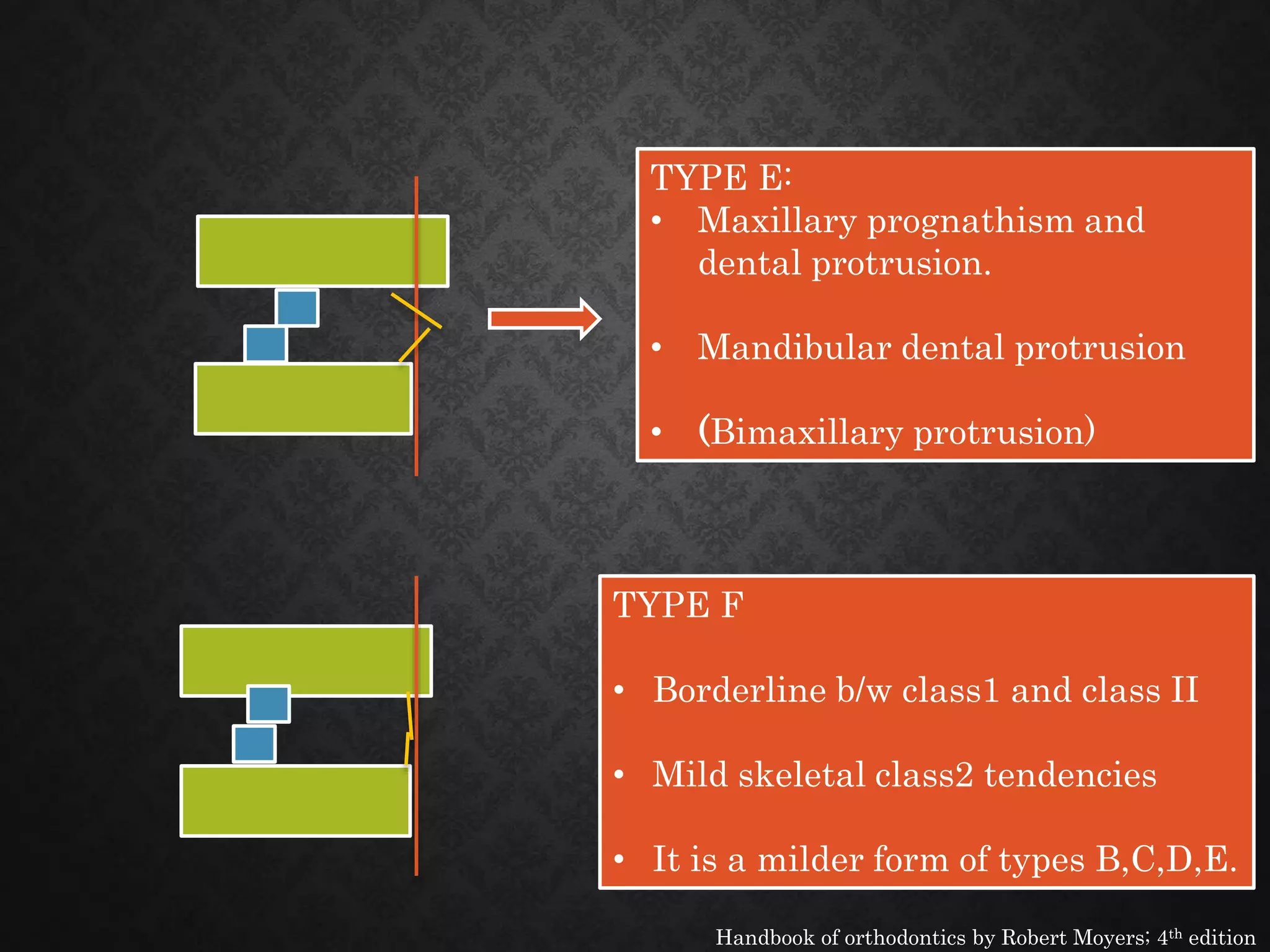
TYPE E:
• Maxillary prognathism and
dental protrusion.
• Mandibular dental protrusion
• (Bimaxillary protrusion)
TYPE F
• Borderline b/w class1 and class II
• Mild skeletal class2 tendencies
• It is a milder form of types B,C,D,E.
Handbook of orthodontics by Robert Moyers; 4th edition
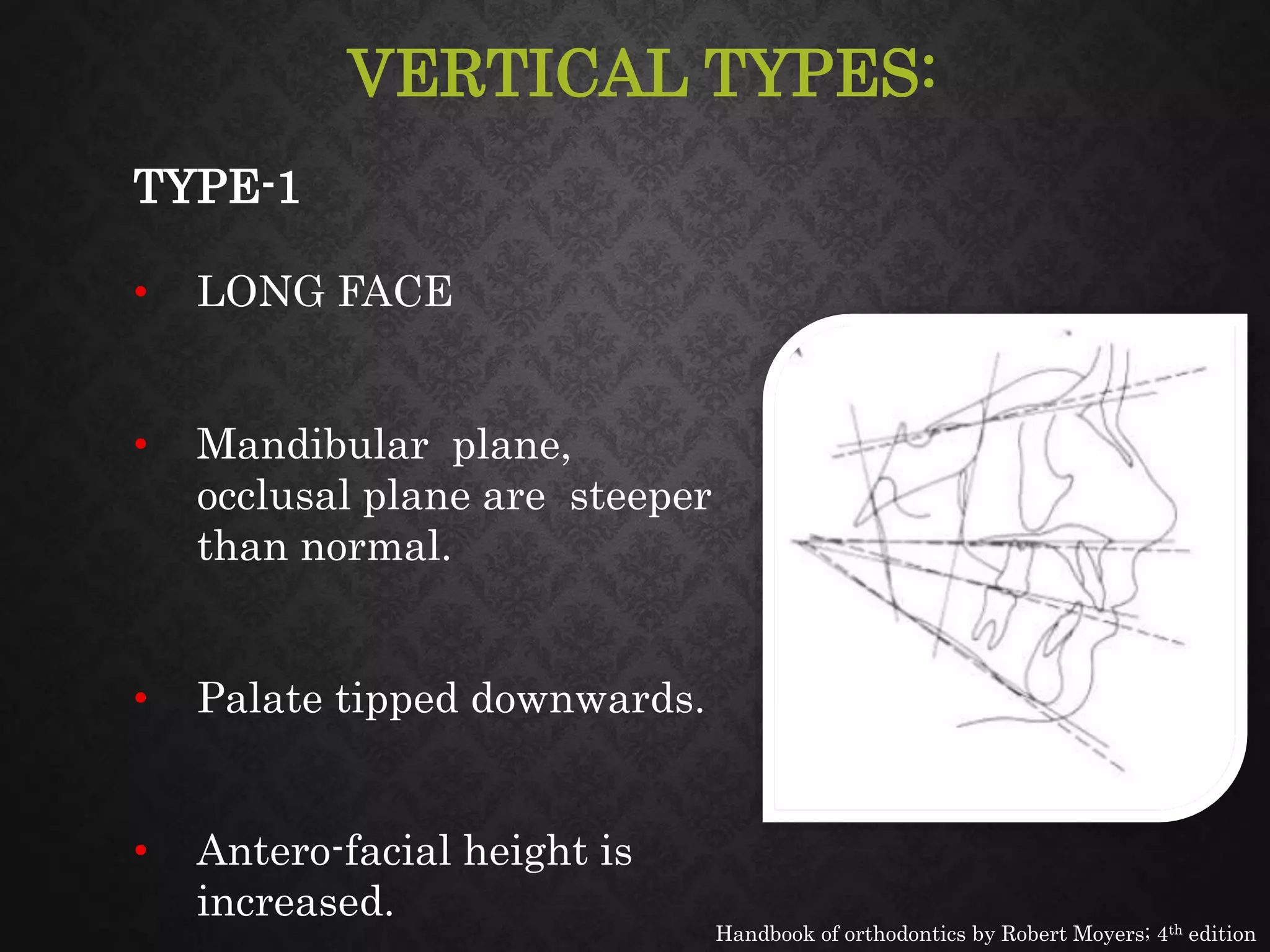
• LONG FACE
• Mandibular plane,
occlusal plane are steeper
than normal.
• Palate tipped downwards.
• Antero-facial height is
increased.
TYPE-1
VERTICAL TYPES:
Handbook of orthodontics by Robert Moyers; 4th edition
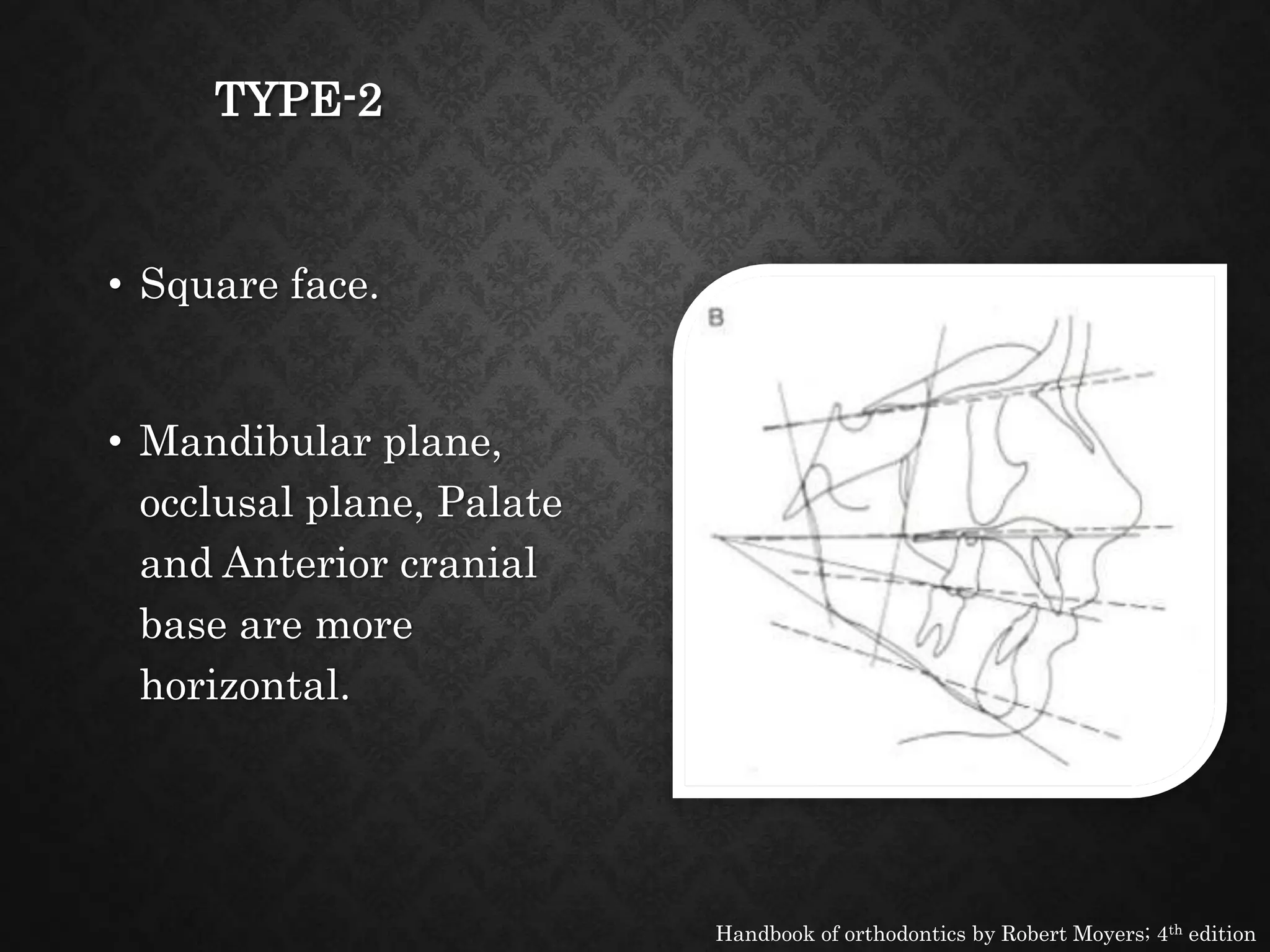
TYPE-2
• Square face.
• Mandibular plane,
occlusal plane, Palate
and Anterior cranial
base are more
horizontal.
Handbook of orthodontics by Robert Moyers; 4th edition
TYPE-3
• Palate tipped up
anteriorly.
• Decreased upper
anterior facial height
• Open bite
Handbook of orthodontics by Robert Moyers; 4th edition
TYPE-4
• Palatal plane,
Mandibular Plane,
Occlusal Plane all are
tipped downwards.
Handbook of orthodontics by Robert Moyers; 4th edition
TYPE-5
• PP tipped down
anteriorly
• Deep bite
Handbook of orthodontics by Robert Moyers; 4th edition
AETIOLOGY
1. Heredity
2. Developmental defects
3. Trauma
4. Physical agents
Handbook of orthodontics by Robert Moyers; 4th edition
a) Prenatal trauma and birth injuries
b) Postnatal trauma
a) Premature extraction of primary teeth
b) Nature of food
a) Thumb-sucking
b) Tongue-thrusting
c) Lip-sucking and lip-biting
d) Nail-biting
a) Systemic diseases
b) Endocrine disorders
c) Local diseases
5. Habits
6. Disease
7. Malnutrition
Handbook of orthodontics by Robert Moyers; 4th edition
CLINICAL FEATURES
OF CLASS II DIV 1
EXTRAORAL FEATURES
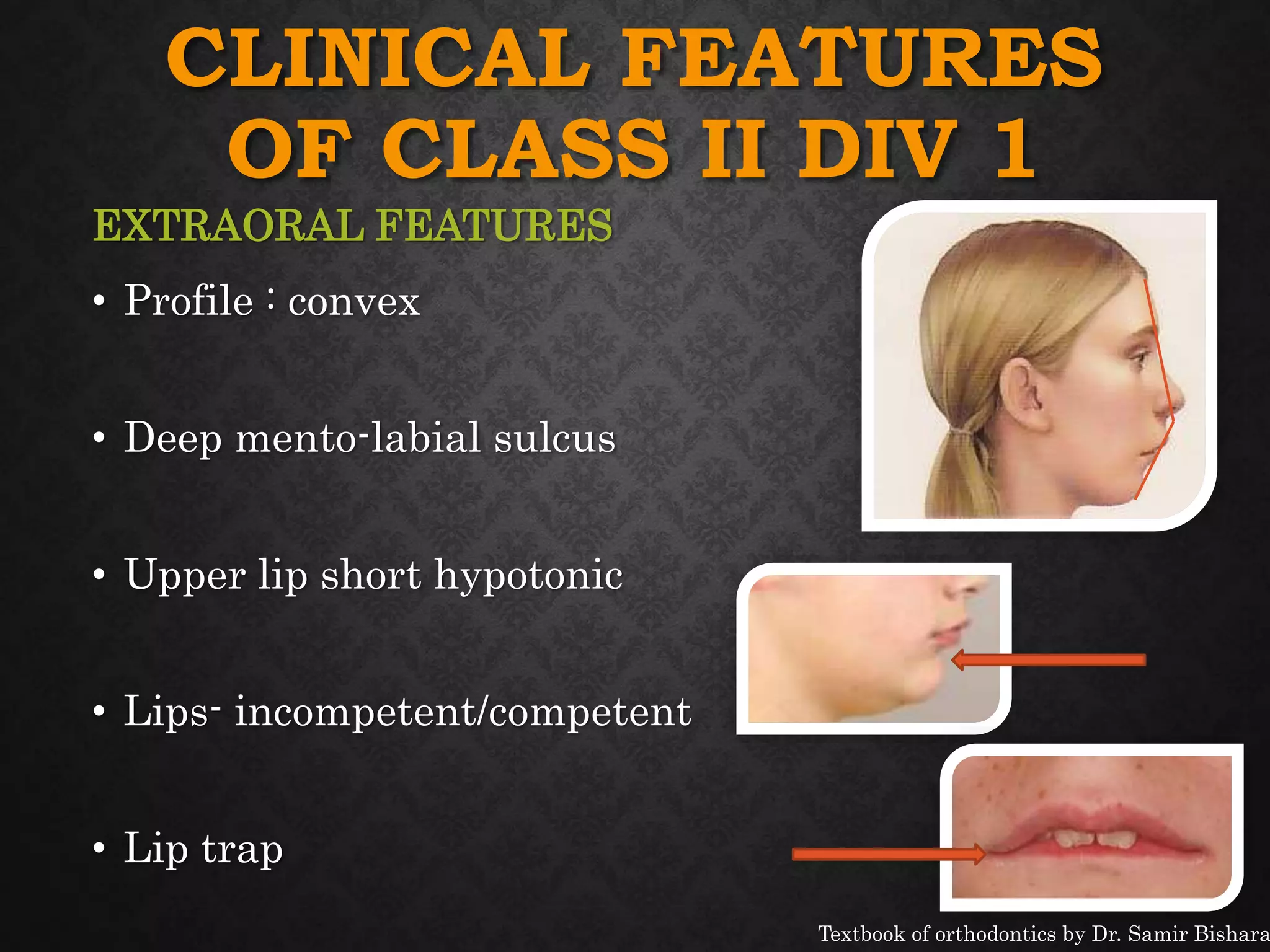
• Profile : convex
• Deep mento-labial sulcus
• Upper lip short hypotonic
• Lips- incompetent/competent
• Lip trap
Textbook of orthodontics by Dr. Samir Bishara
INTRAORAL FEATURES:
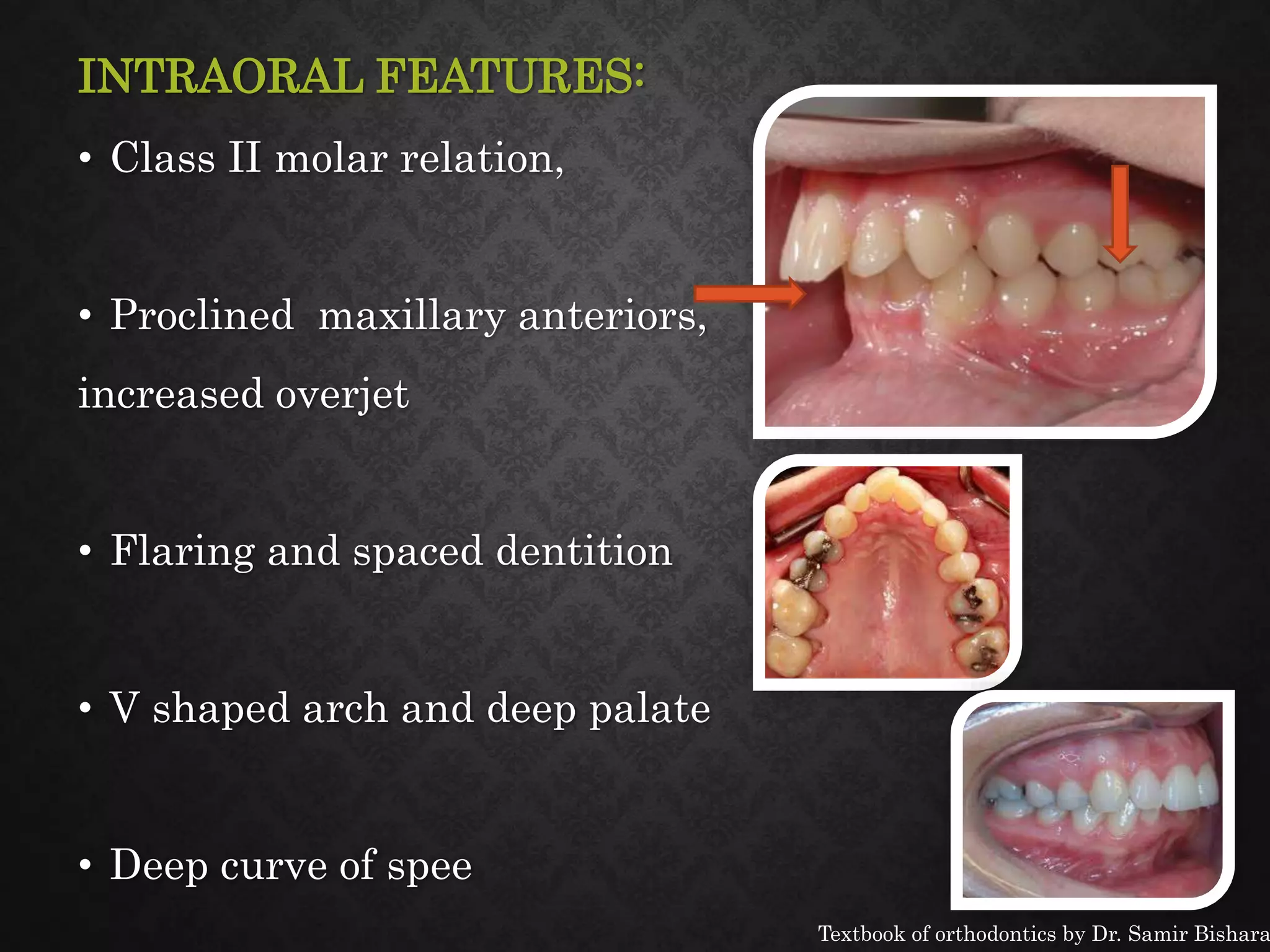
• Class II molar relation,
• Proclined maxillary anteriors,
increased overjet
• Flaring and spaced dentition
• V shaped arch and deep palate
• Deep curve of spee
Textbook of orthodontics by Dr. Samir Bishara
Abnormal muscle activities
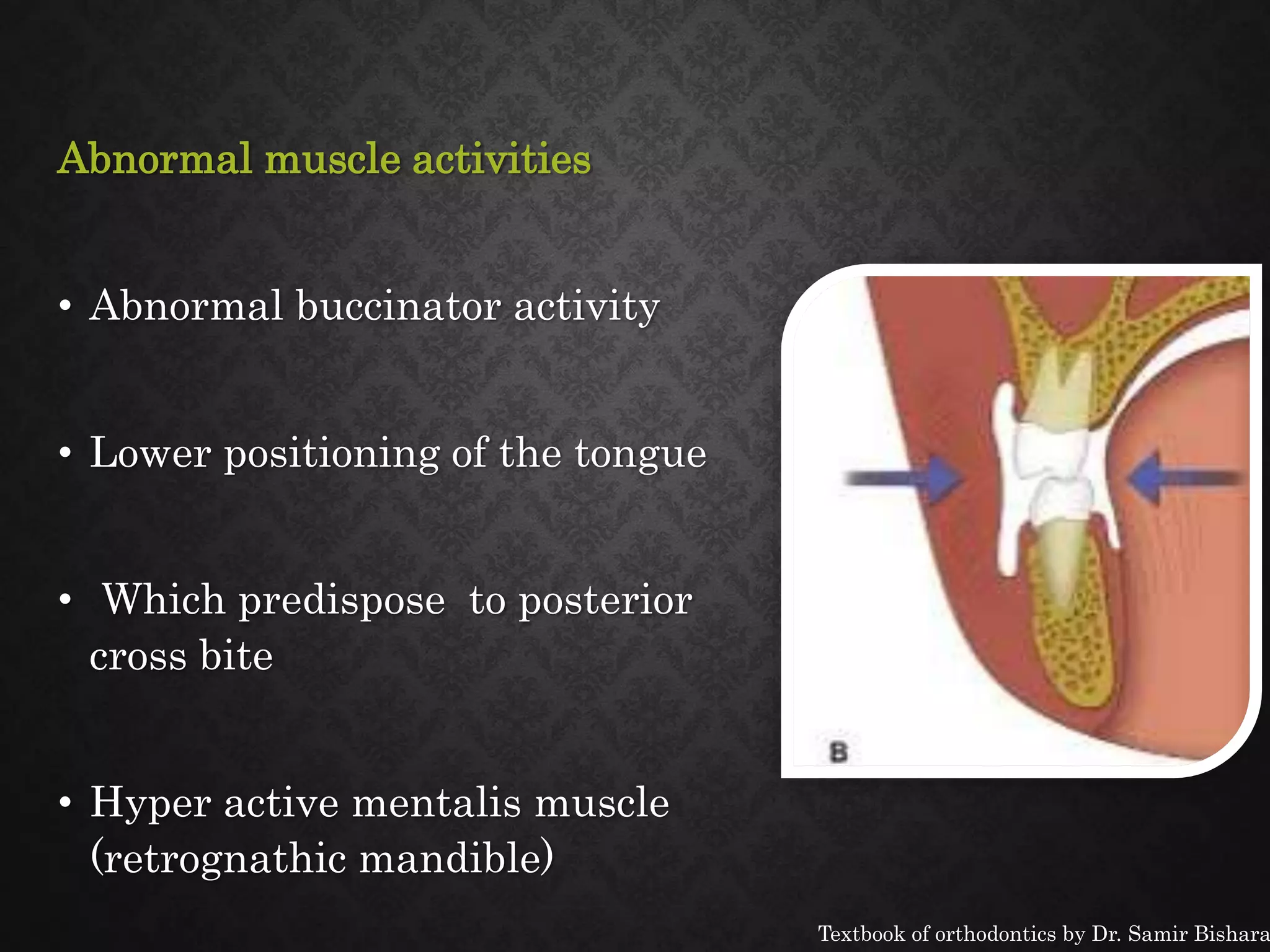
• Abnormal buccinator activity
• Lower positioning of the tongue
• Which predispose to posterior
cross bite
• Hyper active mentalis muscle
(retrognathic mandible)
Textbook of orthodontics by Dr. Samir Bishara
CLINICAL FEATURES OF CLASS
II DIV2
EXTRAORAL FEATURES
• Profile: straight/convex
• Reduced lower facial height
• Mento labial sulcus : normal/ deep
• Path of closure- backward
Textbook of orthodontics by Dr. Samir Bishara
INTRAORAL FEATURES:
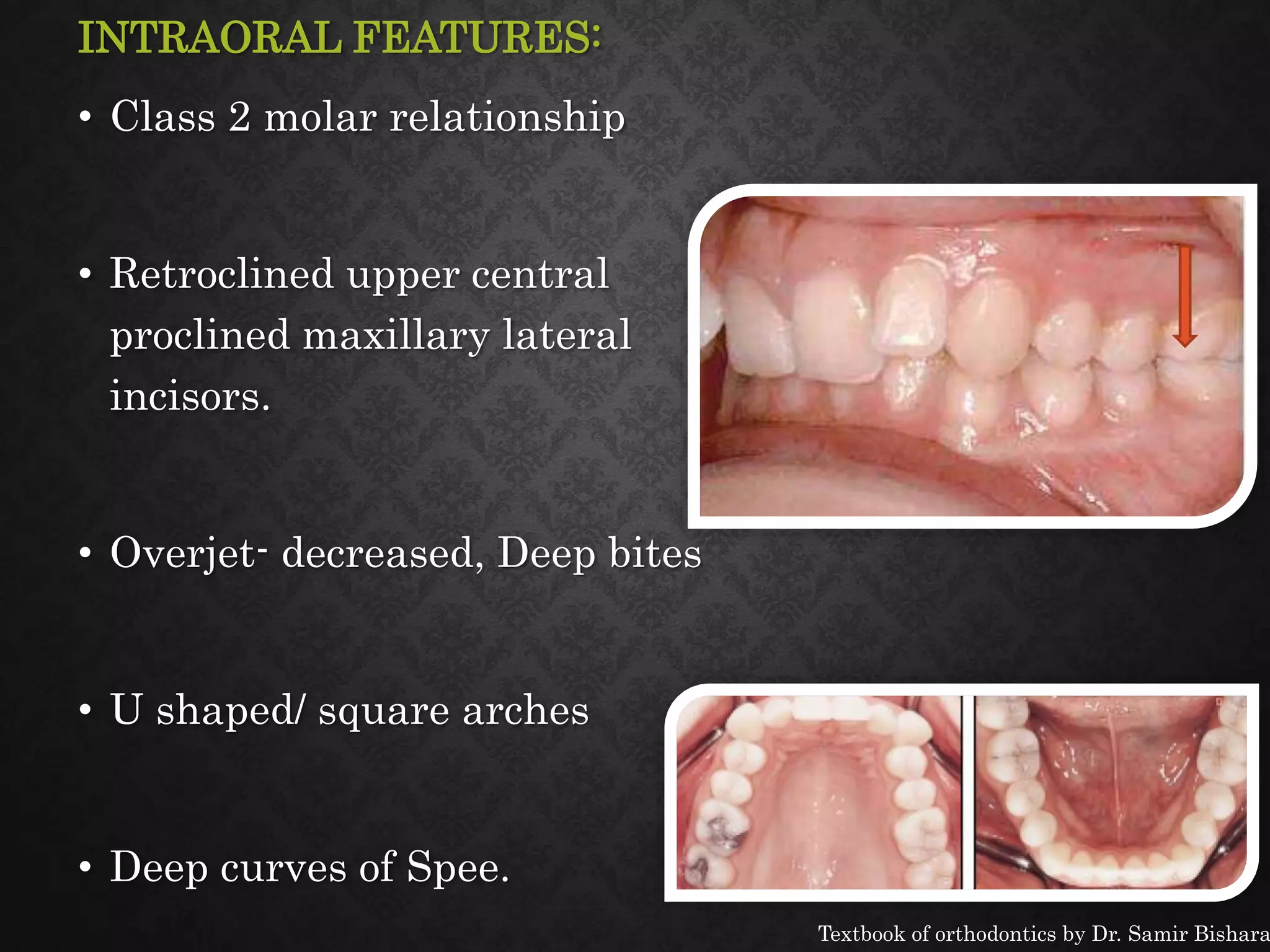
• Class 2 molar relationship
• Retroclined upper central
proclined maxillary lateral
incisors.
• Overjet- decreased, Deep bites
• U shaped/ square arches
• Deep curves of Spee.
Textbook of orthodontics by Dr. Samir Bishara
DIAGNOSIS
• History.
• Extra & Intraoral examination.
• Study models.
• Orthodontic photographs.
• Cephalometrics.
STUDY MODELS
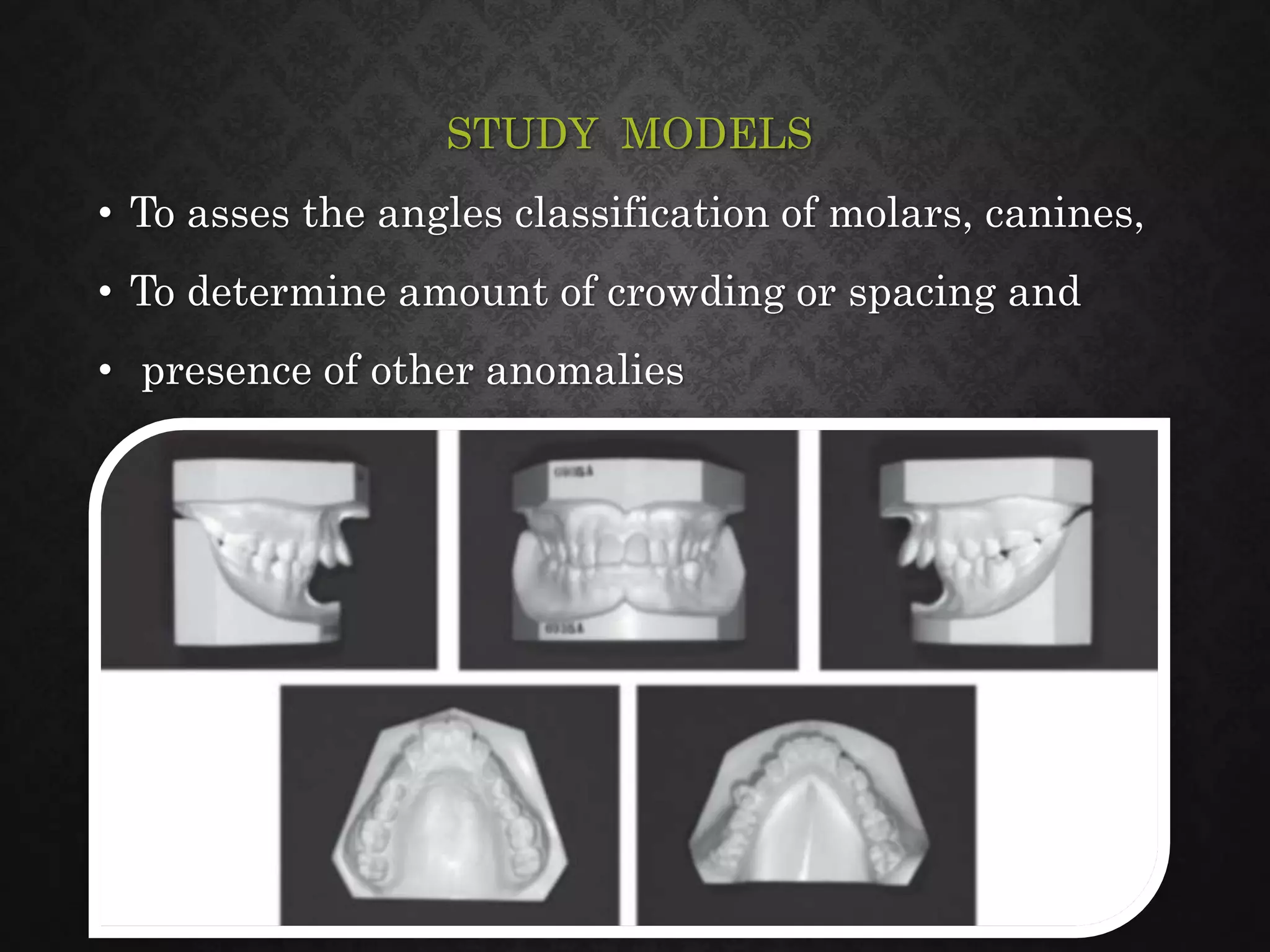
• To asses the angles classification of molars, canines,
• To determine amount of crowding or spacing and
• presence of other anomalies
PHOTOGRAPHS
• Extraoral and intraoral.
• Extraoral_- used to asses patient’s profile facial
asymmetry and smile lines.
• Intraoral photographs are taken to maintain a
visual record of all findings.
PANTOMOGRAPH (OPG)
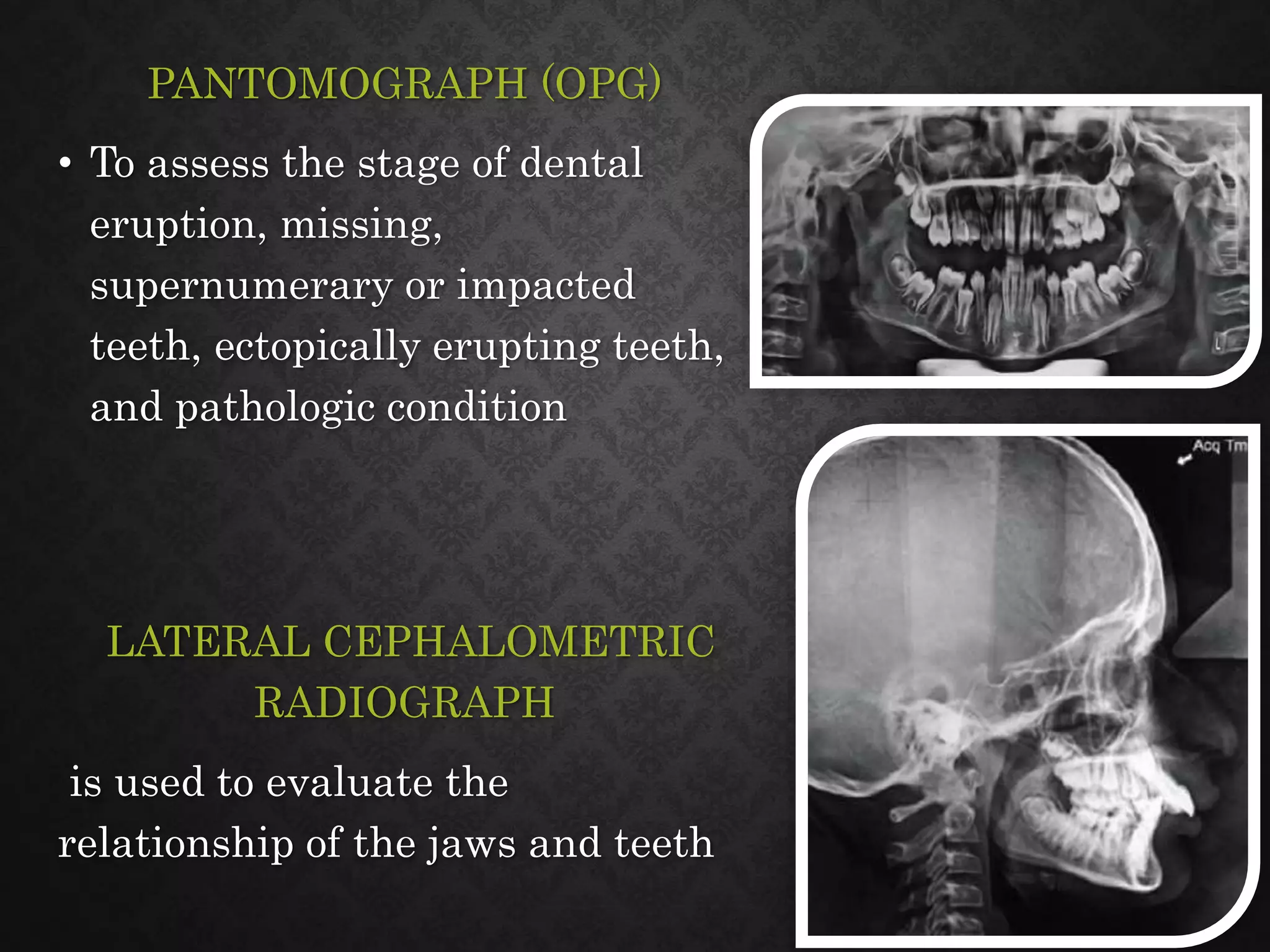
• To assess the stage of dental
eruption, missing,
supernumerary or impacted
teeth, ectopically erupting teeth,
and pathologic condition
LATERAL CEPHALOMETRIC
RADIOGRAPH
is used to evaluate the
relationship of the jaws and teeth
CEPHALOMETRICS
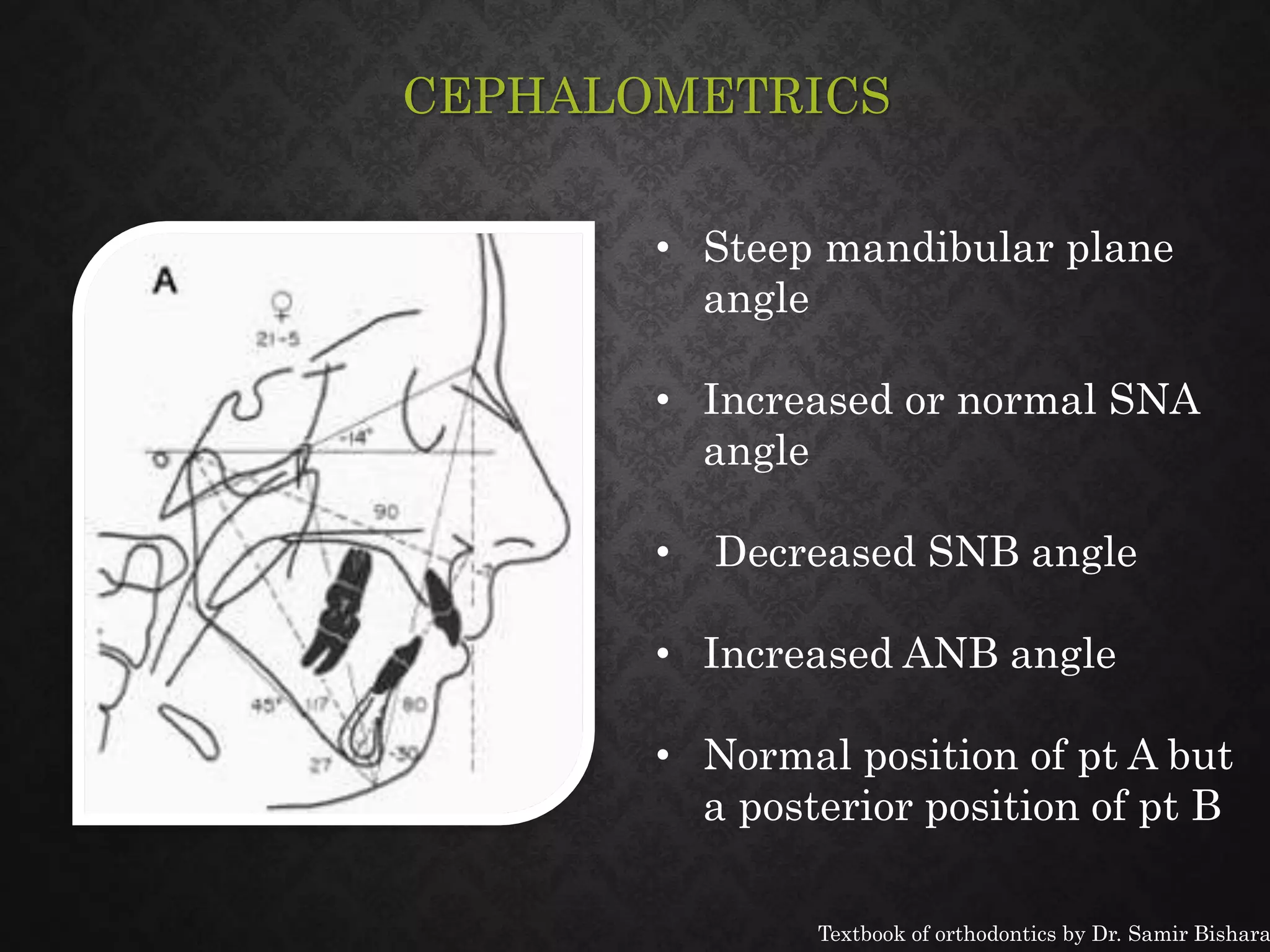
• Steep mandibular plane
angle
• Increased or normal SNA
angle
• Decreased SNB angle
• Increased ANB angle
• Normal position of pt A but
a posterior position of pt B
Textbook of orthodontics by Dr. Samir Bishara
TREATMENT
MODALITIES
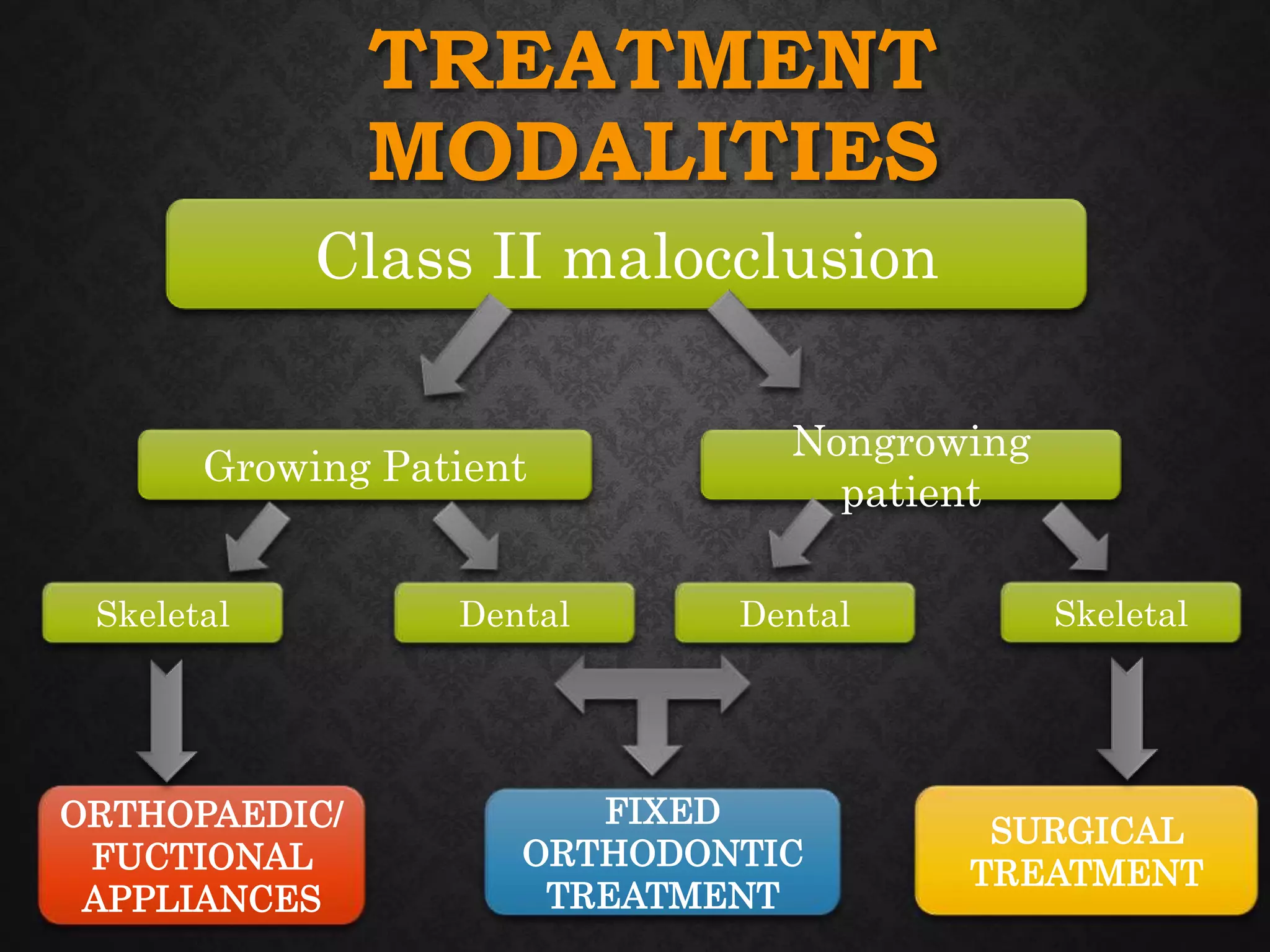
Class II malocclusion
Growing Patient
Nongrowing
patient
Skeletal DentalDental Skeletal
FIXED
ORTHODONTIC
TREATMENT
SURGICAL
TREATMENT
ORTHOPAEDIC/
FUCTIONAL
APPLIANCES
HEADGEAR
• Used in cases of maxillary excess.
• Designed to deliver adequate
extraoral orthopaedic force to
compress the maxillary sutures.
TYPES OF HEADGEAR
a) Facebow b) J-hook headgear
ORTHOPAEDIC APPLIANCES
Textbook of orthodontics by Dr. Samir Bishara
FACEBOW
• Consists of :
outer bow for extraoral
attachment
Inner bow for intraoral
attachment
Textbook of orthodontics by Dr. Samir Bishara
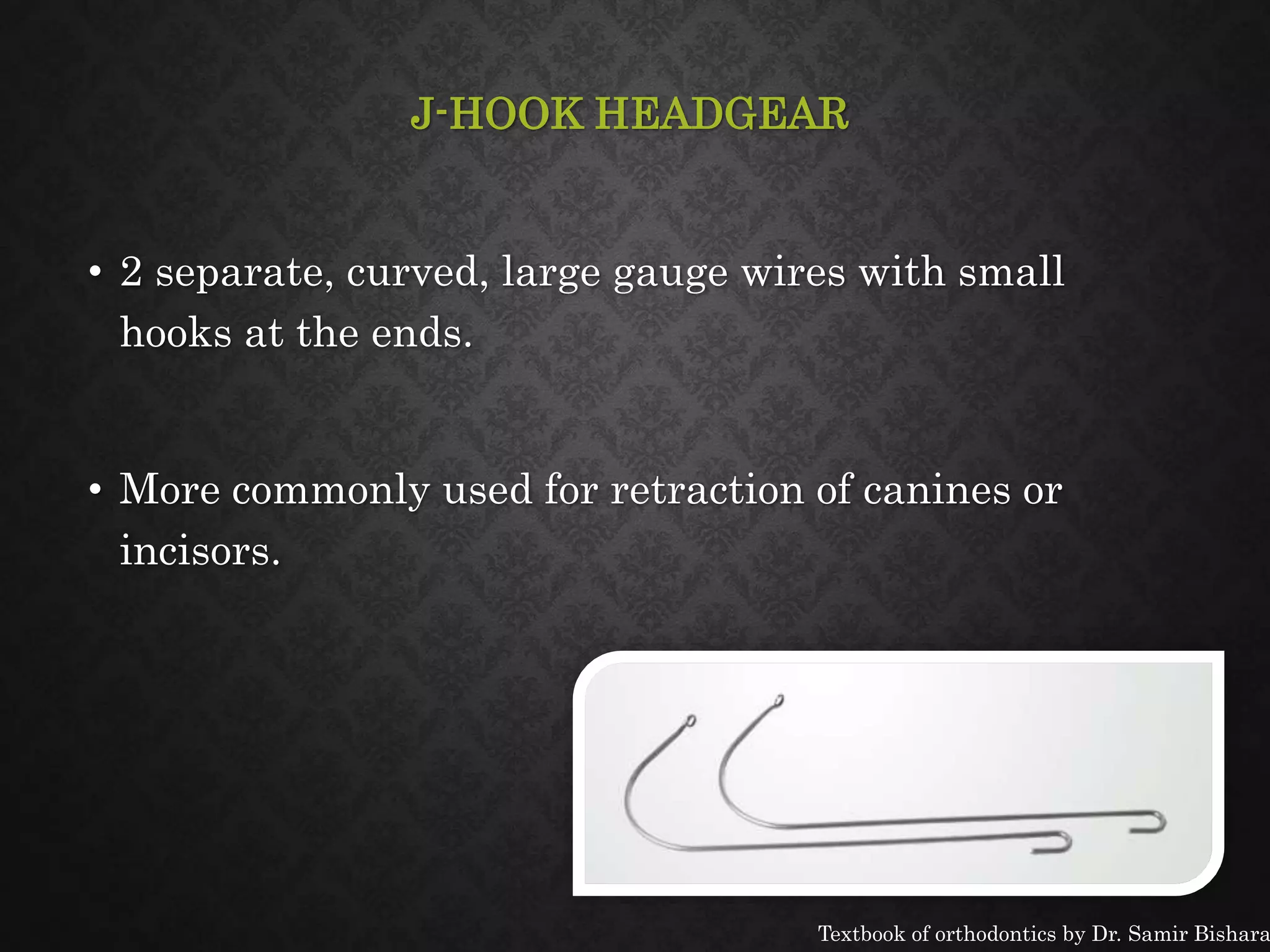
J-HOOK HEADGEAR
• 2 separate, curved, large gauge wires with small
hooks at the ends.
• More commonly used for retraction of canines or
incisors.
Textbook of orthodontics by Dr. Samir Bishara
• Point of attachment is usually below
the occlusal plane- the extraoral force
is directed inferiorly and posteriorly.
• Extrude molars.
• Cannot be used in patients with
vertical growth pattern.
• Used in cases in which an increase in
facial vertical dimension is desired.
Contemporary orthodontics, William Proffit
1. CERVICAL ATTACHMENT OR NECK
STRAP
• The point of attachment well above
the occlusal plane.
• Extraoral force is directed
superiorly and posteriorly.
• Intrude molars & steepen occlusal
plane.
• Correction of not only
anteroposterior maxillary excess,
but also to vertical maxillary excess
Contemporary orthodontics, William Proffit
OCCIPITAL ATTACHMENT OR HEADCAP
Magnitude of force:
• Orthopaedic forces to modify bone growth ranges from
400-600 g.
Duration
• 12-16 hours per day.
Timing of treatment:
• Most active period of growth is before eruption of
permanent teeth.
• The 2nd active growth phase is ‘adolescence’
• Result obtained would be good and relapse chances are
minimal.
• Headgear should be worn in the night as active growth
occurs at this time. Textbook of orthodontics by Dr. Samir Bishara
SKELETAL EFFECTS
• Compresses maxillary sutures
• Restricts downward & forward maxillary growth.
• Allows normal mandibular growth.
• Studies have shown- small increase in mandibular
growth with headgear.
Textbook of orthodontics by Dr. Samir Bishara
DENTAL EFFECTS
• Prevents downward & forward eruption of maxillary
molar indirectly enhancing mandibular growth.
• High pull headgear -Intrusive effect on molar.
• cervical pull headgear- to extrude molar;
• If continues arch wire from molar to incisors- distal
movement of molar can result in lingual movement of
maxillary incisors.
Textbook of orthodontics by Dr. Samir Bishara
REMOVABLE:
• Activator
• Bionator
• Functional regulator
• Twin block
FUNCTIONAL APPLIANCES
FIXED:
• Herbst appliance
• Jasper jumper
• MARA
INDICATIONS OF FUNCTIONAL APPLIANCE
• Active mandibular growth.
• Mandibular deficiency.
• Normal maxillary development.
• Normal or mildly decreased face height.
• Slightly protrusive maxillary incisors and slightly
retrusive mandibular incisors.
Textbook of orthodontics by Dr. Samir Bishara
ACTIVATOR
Developed by Viggo Andresen, Denmark and Karl Haupl
Norway. In1908
Introduces new way mandibular closure.
• EFFECTS:
1)Controls the downward and forward growth of
mandible.
2) Prevents forward growth of the maxillary
dentoalveolar process.
3) Distal movement of maxillary dentoalveolar process.
*Removable orthodontics, by Graber & Newman
CONSTRUCTION:
1) wire component:
labial bow 2)Acrylic portion:
BITE REGISTRATION:
• Mandibular advancement of 4 to 6 mm
• 5 to 6 mm opening in the molar region.
Textbook of orthodontics by Dr. Samir Bishara
MODIFICATIONS:
• Modifications by Harvold includs an increased
mandibular opening for improved retention and
increased soft tissue stretch.
• Posterior facets were replaced with interocclusal
acrylic to prevent eruption of the maxillary posterior
teeth and to leave space for eruption of the
mandibular posterior teeth.
Textbook of orthodontics by Dr. Samir Bishara
• Acrylic capping over the mandibular incisal edges is
done to minimize their protraction.
• The maxillary wire crossing the palate was replaced
with palatal acrylic.
• Springs were embedded in the acrylic to displace the
appliance forward, forcing the patient to actively
"function" to maintain the appliance in place.
Textbook of orthodontics by Dr. Samir Bishara
BIONATOR
• Developed by Balters in the early 1950’s,
Mode of action
• Equilibrium between tongue and the circumoral
muscles is attained.
• Establish a normal posture of the tongue
• Screen the hyperactive buccinator : passive
expansion.
*Removable orthodontics, by Graber & Newman
• Less bulky compared to Activator
• Smaller mandibular lingual flange
• A transpalatal wire in place of palatal acrylic
• Modified labial bow with buccal extensions that
minimize cheek pressure on the teeth.
• The bionator can incorporate either posterior facets or
interocclusal acrylic to prevent or selectively guide
eruption.
*Removable orthodontics, by Graber & Newman
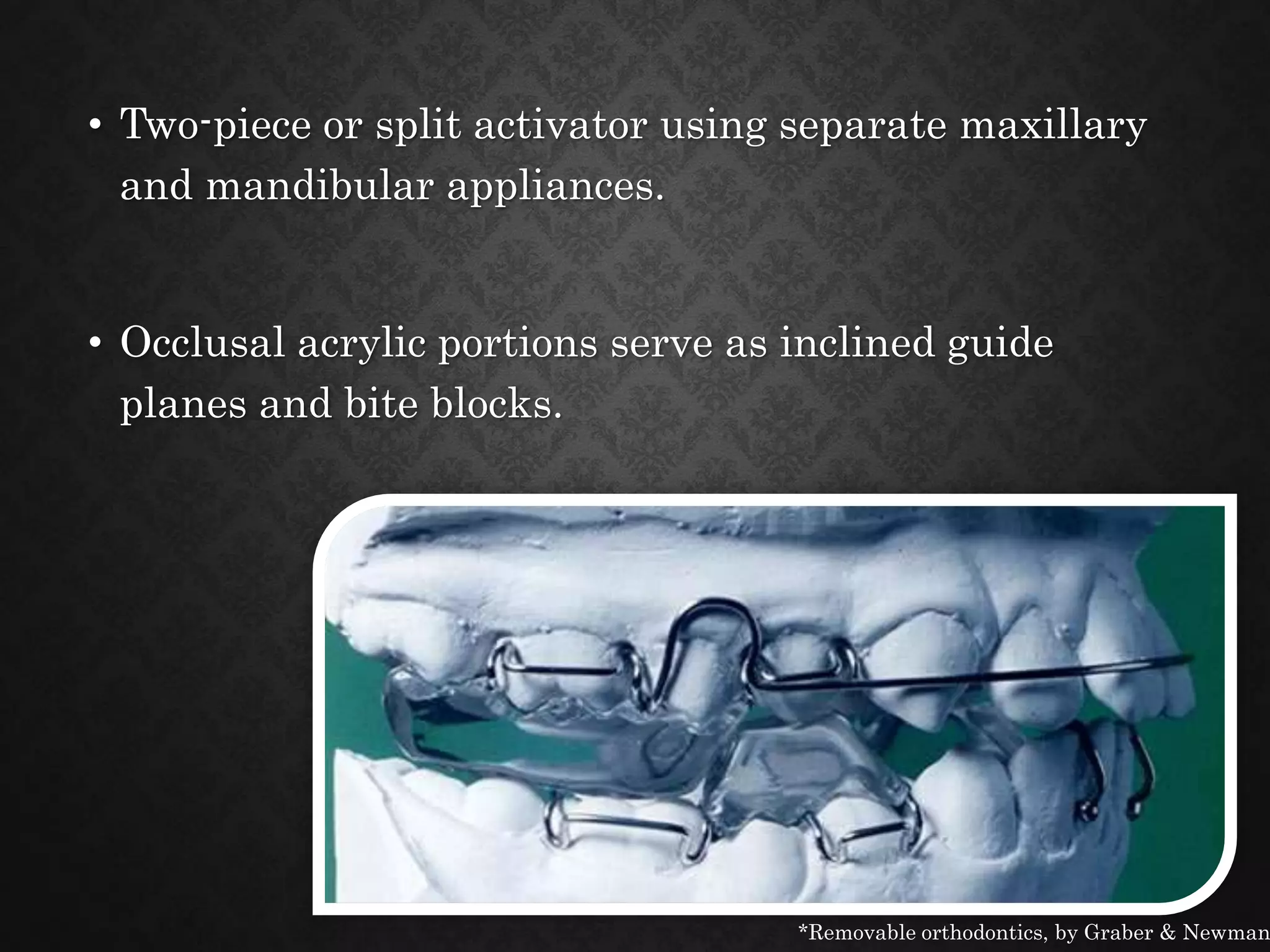
TWIN BLOCK
• The twin block appliance was introduced by a
Scottish orthodontist, William Clark, in 1977.
• More range of mandibular movement.
*Removable orthodontics, by Graber & Newman
• Two-piece or split activator using separate maxillary
and mandibular appliances.
• Occlusal acrylic portions serve as inclined guide
planes and bite blocks.
*Removable orthodontics, by Graber & Newman
FUNCTIONAL REGULATOR
• Rolf Frankel
• Also called as Frankel’s
appliance
• Recontours the facial soft
tissue adjacent to the
teeth.
Textbook of orthodontics by Dr. Samir Bishara
MODE OF ACTION :
• Vestibular arena of operation.
• Withholds muscle pressure from the developing jaws and
dentoalveolar area.
• Relief of forces from neuromuscular envelope.
• Increase in sagittal and transverse intraoral space.
• Intermittent outward pull creates outward movement of
alveolodental structures.
Textbook of orthodontics by Dr. Samir Bishara
Appliances for class II correction:
FR Ib : Class II Div 1 with deep bite and overjet not
exceeding 7 mm.
FR Ic: Class II Div 1 with overjet greater than 7 mm
FR II : Class II Div 1 and Div 2
The FR II is the most frequently used appliance.
Textbook of orthodontics by Dr. Samir Bishara
HERBST APPLIANCE:
• In 1905 Emil Herbst introduced a fixed appliance in
Germany
• Consists of a rigid maxillary and mandibular framework.
• The mandible is maintained in a
forward position by means of a
metal rod and tube telescopic
mechanism that is attached from
the maxillary first molars to the
mandibular first premolars.
Textbook of orthodontics by Dr. Samir Bishara
JASPER JUMPER
• An American orthodontist, James Jasper, has replaced
the rigid telescopic mechanism with a flexible plastic
covered open coil spring.
• Attached directly to auxiliary wires with a complete or
partial fixed appliance in place.
Textbook of orthodontics by Dr. Samir Bishara
MARA APPLIANCE
• Mandibular advancing repositioning appliance
• This appliance was introduced by Ralph M Clements
and Alex Jacobson.1982
• Composed of a pair of telescopic struts
Textbook of orthodontics by Dr. Samir Bishara
• Indicated in older adolescents or adults.
• When the skeletal Class II problems are mild to
moderate.
FIXED ORTHODONTIC
TREATMENT
* Contemporary Orthodontics 4th edition by William Profitt
• In order to create a class I molar relation in class II
cases, adequate space should be present in the
dental arches.
• This space is absent in many cases.
• Dental camouflage without extraction
• Dental camouflage with extraction
* Contemporary Orthodontics 4th edition by William Profitt
DENTAL CAMOUFLAGE WITHOUT
EXTRACTIONS
• Space is required in the maxillary arch - to retract the
incisors and eliminate overjet
• In the mandibular arch - to protract the mandibular
teeth.
• To gain the space- distalization of maxillary molars.
* Contemporary Orthodontics 4th edition by William Profitt
DISTALIZATION OF MOLAR
• De-rotation of maxillary 1st molar.
• Headgear
• Class II elastics
• Palatal anchorage devices
* Contemporary Orthondontics 4th edition by William Profitt
DE-ROTATION OF MOLARS
• In patients with mild to moderate skeletal Class II
malocclusion, the upper molars are likely to be rotated
mesially.
• Transpalatal lingual arch or an auxiliary labial arch or
the inner bow of a facebow.
* Contemporary Orthodontics 4th edition by William Profitt
• HEADGEAR
• It is now clear that significant distal positioning of the
upper molar with headgear occurs primarily in patients
who have vertical growth.
• Maximum 2 to 3 mm of distal movement occurs in such
cases unless the upper second molars are extracted.
* Contemporary Orthodontics 4th edition by William Profitt
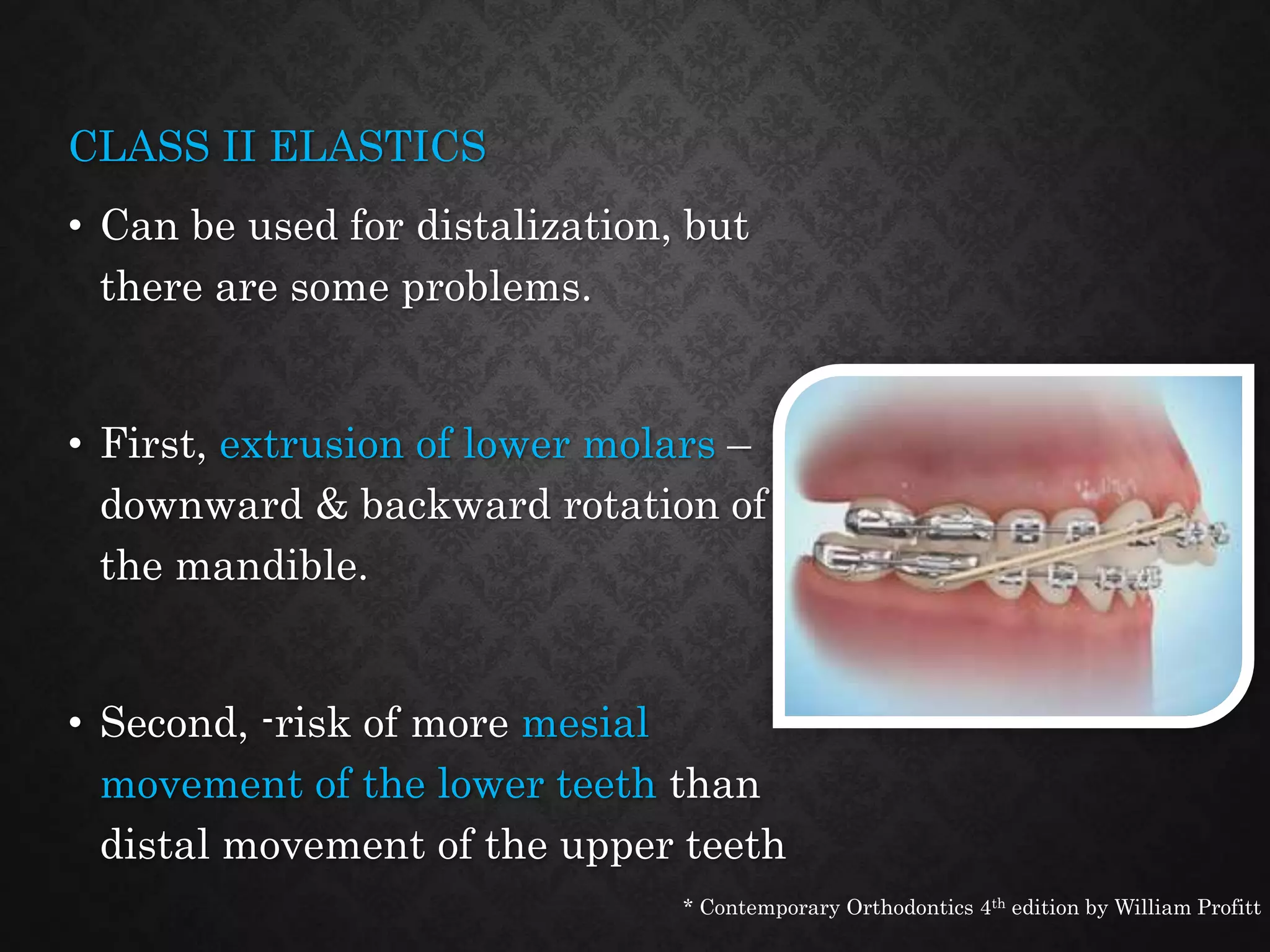
CLASS II ELASTICS
• Can be used for distalization, but
there are some problems.
• First, extrusion of lower molars –
downward & backward rotation of
the mandible.
• Second, -risk of more mesial
movement of the lower teeth than
distal movement of the upper teeth
* Contemporary Orthodontics 4th edition by William Profitt
PALATAL ANCHORAGE SYSTEMS FOR DISTAL
MOVEMENT OF MOLARS
• Mesial movement of teeth is easier than distal
movement.
• Successful distal movement of molars, therefore,
requires more anchorage than that is supplied by just
teeth.
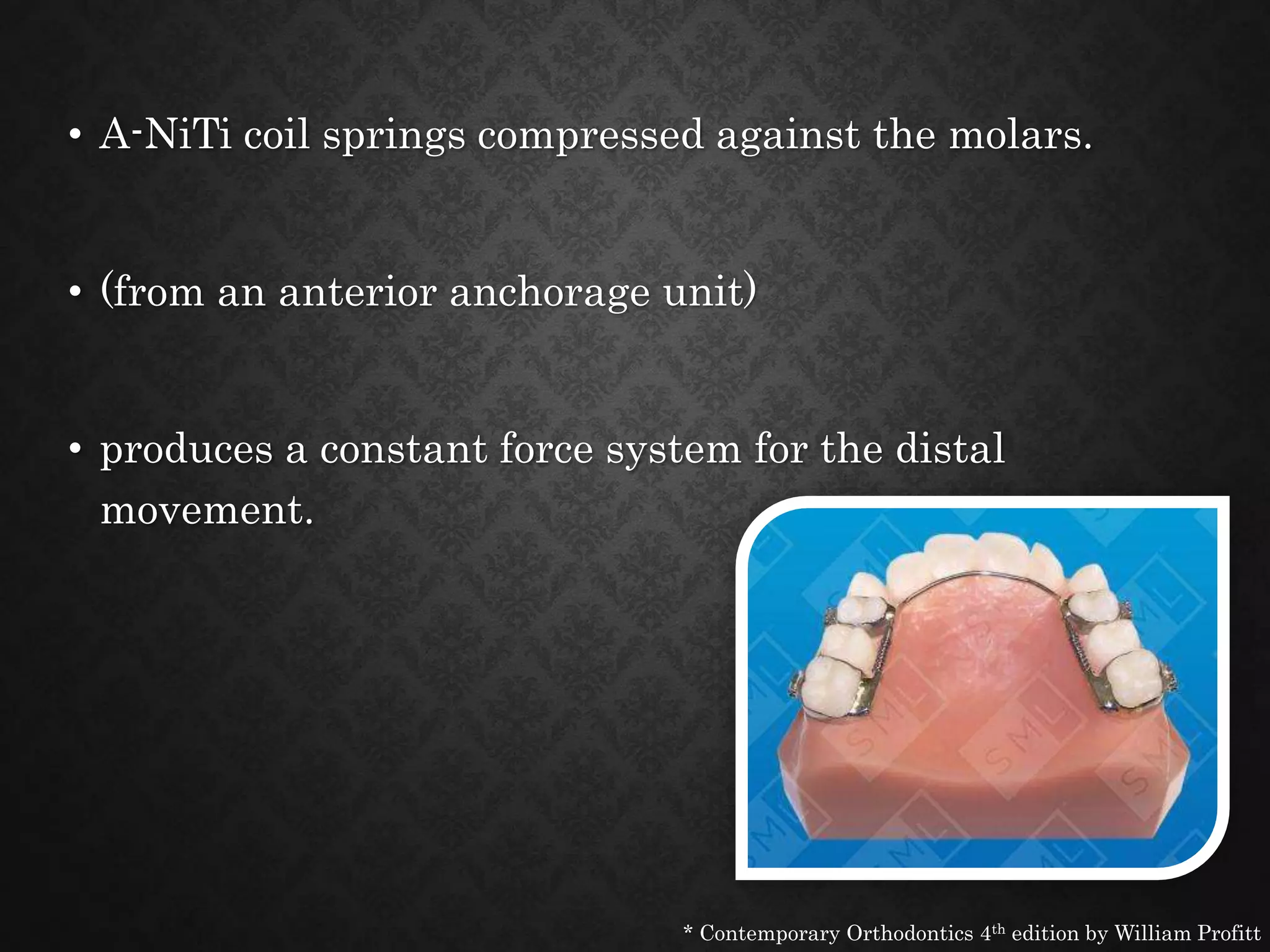
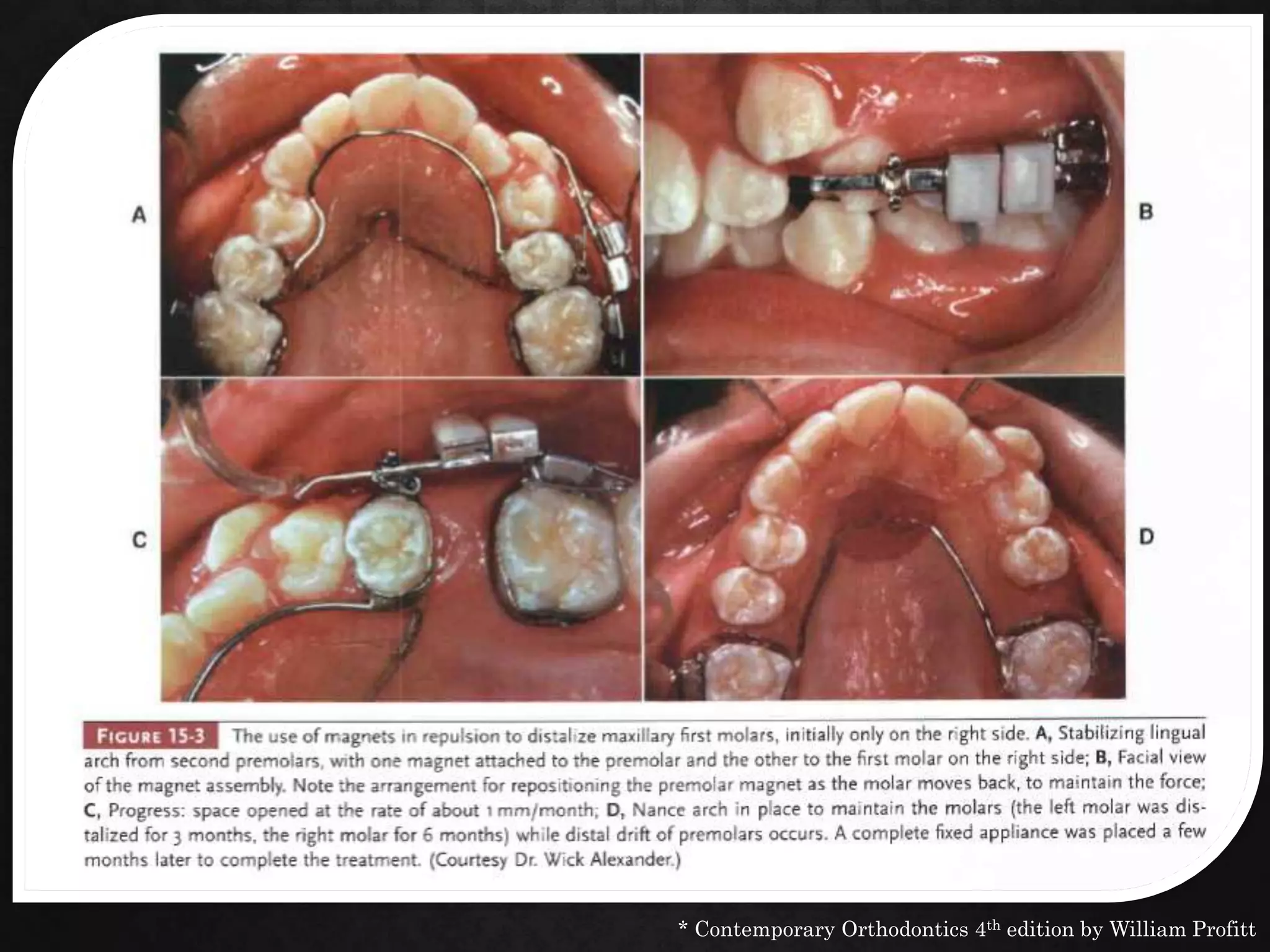
a) NiTi coil springs b)Magnets c)Pendulum appliance
* Contemporary Orthodontics 4th edition by William Profitt
• A-NiTi coil springs compressed against the molars.
• (from an anterior anchorage unit)
• produces a constant force system for the distal
movement.
* Contemporary Orthodontics 4th edition by William Profitt
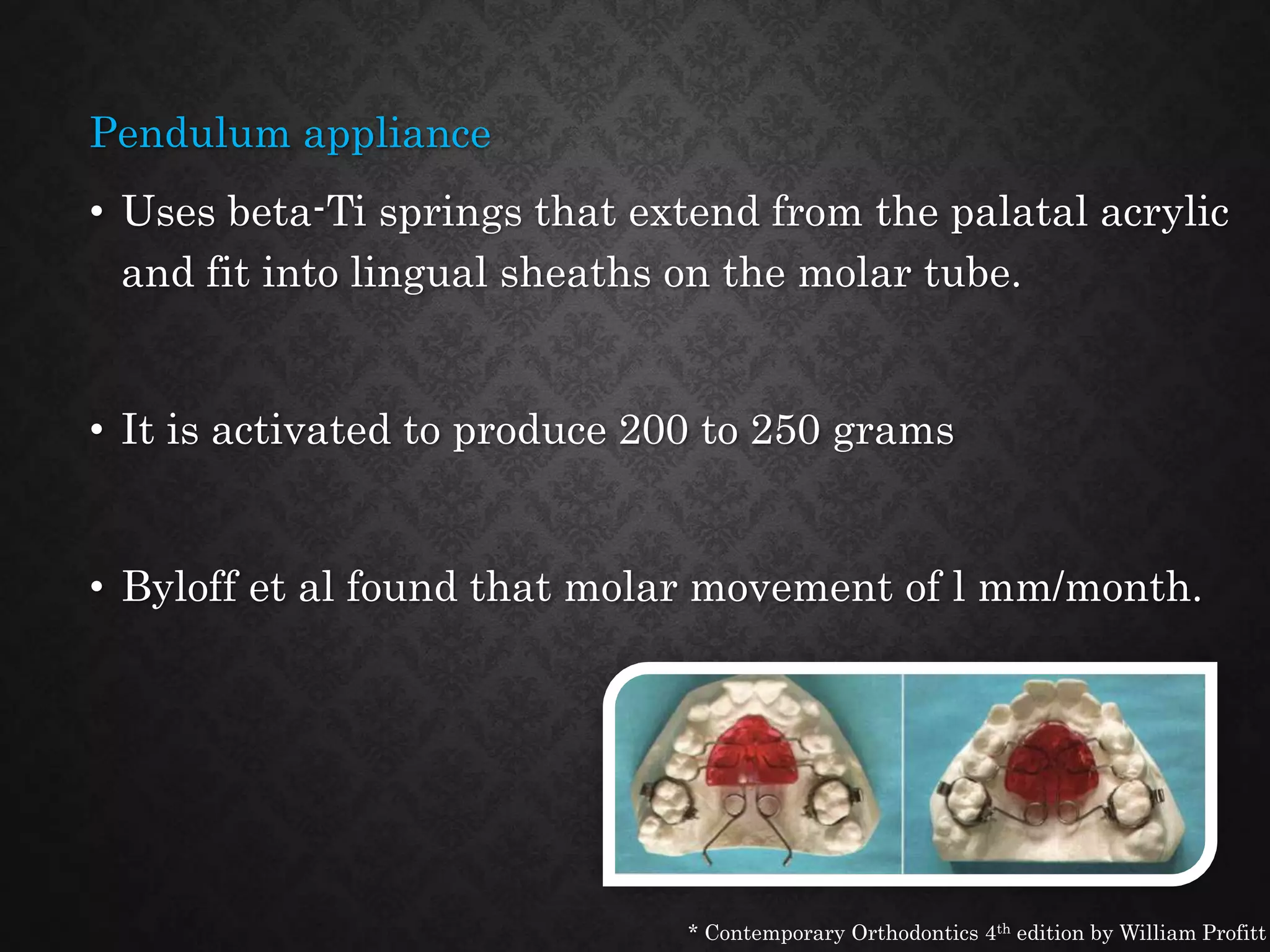
Pendulum appliance
• Uses beta-Ti springs that extend from the palatal acrylic
and fit into lingual sheaths on the molar tube.
• It is activated to produce 200 to 250 grams
• Byloff et al found that molar movement of l mm/month.
* Contemporary Orthodontics 4th edition by William Profitt
DENTAL CAMOUFLAGE WITH
EXTRACTIONS
• Extraction of
1. Maxillary 2nd Molars
2. Maxillary First Premolars Only Or
3. Maxillary And Mandibular First Premolars.
* Contemporary Orthodontics 4th edition by William Profitt
Extraction Of The Upper Second Molars
• Class 1 molar relation is created by distal
movement of maxillary 1st molar.
• Distalization of 1st molar is much easier if space is
created by extracting the upper second molars.
• Distalization is carried out by using headgear,
pendulum appliance as explained previously.
* Contemporary Orthodontics 4th edition by William Profitt
EXTRACTION OF UPPER FIRST
PREMOLARS
• With this approach, the objective during orthodontic
treatment is to maintain the existing Class II molar
relationship &
• Closing the first premolar extraction space entirely
by retracting the protruding incisor teeth.
• Anchorage used to prevent mesial migration of molars
are:
• Extraoral anchorage
• Transpalatal arch or nance holding arch
• Class II elastics
• Segmental retraction of anteriors.
* Contemporary Orthodontics 4th edition by William Profitt
EXTRACTION OF MAXILLARY AND
MANDIBULAR PREMOLARS
• The mandibular posterior segments will be moved
anteriorly.
• At the same time, the protruding maxillary anterior
teeth will be retracted.
• Class II elastics will be used to close the extraction
sites.
* Contemporary Orthodontics 4th edition by William Profitt
When To Schedule Extraction If It Is Indicated?
• If space is required to eliminate crowding or protrusion
extractions at the onset of treatment.
• Otherwise, extraction should be done
after leveling and alignment.
• Older Extraction - resorbed alveolar bone with constricted facial
and lingual cortical plates that inhibit effective space closure.
• New Extraction Sites - precludes this possibility and have
highly active osseous turnover, offering an ideal environment
for efficient space closure.
Textbook of orthodontics by Dr. Samir Bishara
• Skeletal Class II problems with little or no remaining
growth potential that cannot be treated with orthodontic
treatment alone.
• In preparation for orthognathic surgery, it is necessary to
remove any dental compensations present and to place
the teeth in a favourable position with their supporting
bone.
• Maxillary protraction and mandibular retraction.
SURGICAL CORRECTION
Textbook of orthodontics by Dr. Samir Bishara
MANDIBULAR ADVANCEMENT
• Done in mandibular deficiency cases
BILATERAL SAGITTAL SPLIT OSTEOTOMY
• Developed by Richard Trauner, and Hugo Obwegeser.
• Popularly used.
• The mandible can be moved forward or back as
desired, and the tooth-bearing segment can be rotated
down anteriorly when additional anterior face height
is desired
Textbook of orthodontics by Dr. Samir Bishara
MANDIBULAR TOTAL SUBAPICAL ADVANCEMENT
• less common
• The goal of this surgery is to advance the entire
dentoalveolar segment.
• Eliminates excessive overjet without significantly
changing face height or overbite.
Textbook of orthodontics by Dr. Samir Bishara
MAXILLARY IMPACTION
• Indicated in vertical maxillary excess.
• May include either:
• total maxillary osteotomy – maxillary excess in
anterior as well as posterior region .
• bilateral posterior segmental maxillary osteotomies -
excess is more in the posterior region.
Textbook of orthodontics by Dr. Samir Bishara
• Complete levelling of the mandibular arch before
surgery.
• Bone is removed at the osteotomy site to permit superior
repositioning of the maxilla.
• As the maxilla moves up, the mandible rotates upward
and forward around the condylar axis, correcting the
anteroposterior occlusal discrepancy.
• Narrow maxilla - the maxillary osteotomy needs to be in
2 or 3 segments to permit expansion of the maxilla.
Textbook of orthodontics by Dr. Samir Bishara
• Postsurgical orthodontic treatment includes light
continuous arch wires and light vertical elastics.
• Placement of a maxillary full-dimension nickel-
titanium arch wire is recommended
• Maintains anterior torque while completing root
parallelism in the osteotomy sites.
Textbook of orthodontics by Dr. Samir Bishara
ANTERIOR MAXILLARY
SUBAPICAL SETBACK
• In rare situations in which the skeletal Class II
malocclusion is caused by a maxillary excess limited to
the anteroposterior dimension only.
• Midface protrusion is characteristic of this condition
• The treatment goal is to use the maxillary first
premolar space for surgical retraction of the maxillary
anterior teeth, maintaining the Class II molar
relationship and achieving a Class I canine
relationship while reducing overjet.
Textbook of orthodontics by Dr. Samir Bishara
CONCLUSION
• Class II malocclusions are very common malocclusions with
characteristic features.
• Clinical features, x-rays and cephalometrics are useful aids for the
diagnosis of such class II malocclusion.
• The treatment of the class II malocclusion depends upon the age
of the patient, his/her skeletal discrepancy if any and other dental
factors.
• Which should be taken into consideration before starting with the
treatment.
REFERENCES
• Textbook of orthodontics by Dr. Samir Bishara
• Orthodontic diagnosis by Rakosi, Jonas and Graber
• Handbook of orthodontics by Robert Moyers; 4th edition
• Removable orthodontics, by Graber & Newman
• Contemporary Orthodontics 4th edition by William Profitt
Class ii malocclusion

Class ii malocclusion

  • 1.
  • 2.
    CLASS II MALOCCLUSION GUIDED BY: DR.SURESH KANGNE DR. ANAND AMBEKAR DR. PRAVINKUMAR MARURE DR. YATISHKUMAR JOSHI DR. CHAITANYA KHANAPURE PRESENTED BY: ABHIDNYA MADANSURE
  • 3.
    CONTENT • Introduction • Classification •Aetiology • Clinical features • Treatment modalities • Conclusion • Reference
  • 4.
    INTRODUCTION • E.H. ANGLE,in 1899 described normal occlusion as an • “Evenly placed row of teeth arranged in a graceful curve with harmony between the upper and lower arches.” Textbook of orthodontics by Dr. Samir Bishara
  • 5.
    • Angle statedthe following: • In normal occlusion, the mesiobuccal cusp of the upper first molar is received in the sulcus between the mesial and distal (middle) buccal cusps of the lower first molar. Textbook of orthodontics by Dr. Samir Bishara
  • 6.
    • The mesialincline of the upper canine occludes with the distal incline of the lower canine • The distal incline of the upper canine occludes with the mesial incline of the buccal cusp of the lower first premolar. Textbook of orthodontics by Dr. Samir Bishara
  • 7.
    CLASS II MALOCCLUSIONS • "Distal"relationship of mandible to maxilla . • The mesiobuccal cusp of the maxillary first permanent molar articulates mesial to the buccal groove of the mandibular first permanent. Handbook of orthodontics by Robert Moyers; 4th edition
  • 8.
    Handbook of orthodonticsby Robert Moyers; 4th edition DIVISION 1-The maxillary incisors labioversion DIVISION 2- maxillary central incisors are near normal or slightly in linguoversion Maxillary lateral incisors have tipped labially.
  • 9.
    CLASS II DIV2 MALOCCLUSION CLASSIFICATION • Type a • Type b • Type c & • Type d * Given in orthodontic diagnosis by Rakosi, Jonas and Graber SUBDIVISION- When the distoclusion occurs on one side.
  • 10.
    SKELETAL CLASS II MALOCCLUSIONS •Skeletal discrepancies are often associated with dental Class II malocclusions. A] Mandibular Deficiency B] Maxillary Excess Textbook of orthodontics by Dr. Samir Bishara
  • 11.
    Textbook of orthodonticsby Dr. Samir Bishara • Because of small size of the ramus and body of the mandible downward and backward rotation of the mandible. CLASS I CLASS II
  • 12.
    Natural dental compensation: •Protrusive mandibular incisors. • Narrow or constricted maxillary arch. • Mesiolingual rotation of the maxillary first molars. *Textbook of orthodontics by Dr. Samir Bishara
  • 13.
    MOYER’S CLASSIFICATION OF CLASSII Vertical Class II Class II Horizontal Class II A B C D E F 1 2 43 5 Handbook of orthodontics by Robert Moyers; 4th edition
  • 14.
    HORIZONTAL TYPES: TYPE A:(Dental) • Normal skeletal profile. • Maxillary dentition is protracted resulting in class2 molar relation. • Increased over-jet and over-bite TYPE B: • Mid-face prominence • Normal mandible Handbook of orthodontics by Robert Moyers; 4th edition
  • 15.
    TYPE C: • Retrognathicmaxilla and mandible • Dental protrusion • Smaller facial dimension • More in females TYPE D: • Maxillary and mandibular retrognatism • Max dental protrusion Handbook of orthodontics by Robert Moyers; 4th edition
  • 16.
    TYPE E: • Maxillaryprognathism and dental protrusion. • Mandibular dental protrusion • (Bimaxillary protrusion) TYPE F • Borderline b/w class1 and class II • Mild skeletal class2 tendencies • It is a milder form of types B,C,D,E. Handbook of orthodontics by Robert Moyers; 4th edition
  • 17.
    • LONG FACE •Mandibular plane, occlusal plane are steeper than normal. • Palate tipped downwards. • Antero-facial height is increased. TYPE-1 VERTICAL TYPES: Handbook of orthodontics by Robert Moyers; 4th edition
  • 18.
    TYPE-2 • Square face. •Mandibular plane, occlusal plane, Palate and Anterior cranial base are more horizontal. Handbook of orthodontics by Robert Moyers; 4th edition
  • 19.
    TYPE-3 • Palate tippedup anteriorly. • Decreased upper anterior facial height • Open bite Handbook of orthodontics by Robert Moyers; 4th edition
  • 20.
    TYPE-4 • Palatal plane, MandibularPlane, Occlusal Plane all are tipped downwards. Handbook of orthodontics by Robert Moyers; 4th edition
  • 21.
    TYPE-5 • PP tippeddown anteriorly • Deep bite Handbook of orthodontics by Robert Moyers; 4th edition
  • 22.
    AETIOLOGY 1. Heredity 2. Developmentaldefects 3. Trauma 4. Physical agents Handbook of orthodontics by Robert Moyers; 4th edition a) Prenatal trauma and birth injuries b) Postnatal trauma a) Premature extraction of primary teeth b) Nature of food
  • 23.
    a) Thumb-sucking b) Tongue-thrusting c)Lip-sucking and lip-biting d) Nail-biting a) Systemic diseases b) Endocrine disorders c) Local diseases 5. Habits 6. Disease 7. Malnutrition Handbook of orthodontics by Robert Moyers; 4th edition
  • 24.
    CLINICAL FEATURES OF CLASSII DIV 1 EXTRAORAL FEATURES • Profile : convex • Deep mento-labial sulcus • Upper lip short hypotonic • Lips- incompetent/competent • Lip trap Textbook of orthodontics by Dr. Samir Bishara
  • 25.
    INTRAORAL FEATURES: • ClassII molar relation, • Proclined maxillary anteriors, increased overjet • Flaring and spaced dentition • V shaped arch and deep palate • Deep curve of spee Textbook of orthodontics by Dr. Samir Bishara
  • 26.
    Abnormal muscle activities •Abnormal buccinator activity • Lower positioning of the tongue • Which predispose to posterior cross bite • Hyper active mentalis muscle (retrognathic mandible) Textbook of orthodontics by Dr. Samir Bishara
  • 27.
    CLINICAL FEATURES OFCLASS II DIV2 EXTRAORAL FEATURES • Profile: straight/convex • Reduced lower facial height • Mento labial sulcus : normal/ deep • Path of closure- backward Textbook of orthodontics by Dr. Samir Bishara
  • 28.
    INTRAORAL FEATURES: • Class2 molar relationship • Retroclined upper central proclined maxillary lateral incisors. • Overjet- decreased, Deep bites • U shaped/ square arches • Deep curves of Spee. Textbook of orthodontics by Dr. Samir Bishara
  • 29.
    DIAGNOSIS • History. • Extra& Intraoral examination. • Study models. • Orthodontic photographs. • Cephalometrics.
  • 30.
    STUDY MODELS • Toasses the angles classification of molars, canines, • To determine amount of crowding or spacing and • presence of other anomalies
  • 31.
    PHOTOGRAPHS • Extraoral andintraoral. • Extraoral_- used to asses patient’s profile facial asymmetry and smile lines. • Intraoral photographs are taken to maintain a visual record of all findings.
  • 32.
    PANTOMOGRAPH (OPG) • Toassess the stage of dental eruption, missing, supernumerary or impacted teeth, ectopically erupting teeth, and pathologic condition LATERAL CEPHALOMETRIC RADIOGRAPH is used to evaluate the relationship of the jaws and teeth
  • 33.
    CEPHALOMETRICS • Steep mandibularplane angle • Increased or normal SNA angle • Decreased SNB angle • Increased ANB angle • Normal position of pt A but a posterior position of pt B Textbook of orthodontics by Dr. Samir Bishara
  • 34.
    TREATMENT MODALITIES Class II malocclusion GrowingPatient Nongrowing patient Skeletal DentalDental Skeletal FIXED ORTHODONTIC TREATMENT SURGICAL TREATMENT ORTHOPAEDIC/ FUCTIONAL APPLIANCES
  • 35.
    HEADGEAR • Used incases of maxillary excess. • Designed to deliver adequate extraoral orthopaedic force to compress the maxillary sutures. TYPES OF HEADGEAR a) Facebow b) J-hook headgear ORTHOPAEDIC APPLIANCES Textbook of orthodontics by Dr. Samir Bishara
  • 36.
    FACEBOW • Consists of: outer bow for extraoral attachment Inner bow for intraoral attachment Textbook of orthodontics by Dr. Samir Bishara
  • 37.
    J-HOOK HEADGEAR • 2separate, curved, large gauge wires with small hooks at the ends. • More commonly used for retraction of canines or incisors. Textbook of orthodontics by Dr. Samir Bishara
  • 38.
    • Point ofattachment is usually below the occlusal plane- the extraoral force is directed inferiorly and posteriorly. • Extrude molars. • Cannot be used in patients with vertical growth pattern. • Used in cases in which an increase in facial vertical dimension is desired. Contemporary orthodontics, William Proffit 1. CERVICAL ATTACHMENT OR NECK STRAP
  • 39.
    • The pointof attachment well above the occlusal plane. • Extraoral force is directed superiorly and posteriorly. • Intrude molars & steepen occlusal plane. • Correction of not only anteroposterior maxillary excess, but also to vertical maxillary excess Contemporary orthodontics, William Proffit OCCIPITAL ATTACHMENT OR HEADCAP
  • 40.
    Magnitude of force: •Orthopaedic forces to modify bone growth ranges from 400-600 g. Duration • 12-16 hours per day. Timing of treatment: • Most active period of growth is before eruption of permanent teeth. • The 2nd active growth phase is ‘adolescence’ • Result obtained would be good and relapse chances are minimal. • Headgear should be worn in the night as active growth occurs at this time. Textbook of orthodontics by Dr. Samir Bishara
  • 41.
    SKELETAL EFFECTS • Compressesmaxillary sutures • Restricts downward & forward maxillary growth. • Allows normal mandibular growth. • Studies have shown- small increase in mandibular growth with headgear. Textbook of orthodontics by Dr. Samir Bishara
  • 42.
    DENTAL EFFECTS • Preventsdownward & forward eruption of maxillary molar indirectly enhancing mandibular growth. • High pull headgear -Intrusive effect on molar. • cervical pull headgear- to extrude molar; • If continues arch wire from molar to incisors- distal movement of molar can result in lingual movement of maxillary incisors. Textbook of orthodontics by Dr. Samir Bishara
  • 43.
    REMOVABLE: • Activator • Bionator •Functional regulator • Twin block FUNCTIONAL APPLIANCES FIXED: • Herbst appliance • Jasper jumper • MARA
  • 44.
    INDICATIONS OF FUNCTIONALAPPLIANCE • Active mandibular growth. • Mandibular deficiency. • Normal maxillary development. • Normal or mildly decreased face height. • Slightly protrusive maxillary incisors and slightly retrusive mandibular incisors. Textbook of orthodontics by Dr. Samir Bishara
  • 45.
    ACTIVATOR Developed by ViggoAndresen, Denmark and Karl Haupl Norway. In1908 Introduces new way mandibular closure. • EFFECTS: 1)Controls the downward and forward growth of mandible. 2) Prevents forward growth of the maxillary dentoalveolar process. 3) Distal movement of maxillary dentoalveolar process. *Removable orthodontics, by Graber & Newman
  • 46.
    CONSTRUCTION: 1) wire component: labialbow 2)Acrylic portion: BITE REGISTRATION: • Mandibular advancement of 4 to 6 mm • 5 to 6 mm opening in the molar region. Textbook of orthodontics by Dr. Samir Bishara
  • 47.
    MODIFICATIONS: • Modifications byHarvold includs an increased mandibular opening for improved retention and increased soft tissue stretch. • Posterior facets were replaced with interocclusal acrylic to prevent eruption of the maxillary posterior teeth and to leave space for eruption of the mandibular posterior teeth. Textbook of orthodontics by Dr. Samir Bishara
  • 48.
    • Acrylic cappingover the mandibular incisal edges is done to minimize their protraction. • The maxillary wire crossing the palate was replaced with palatal acrylic. • Springs were embedded in the acrylic to displace the appliance forward, forcing the patient to actively "function" to maintain the appliance in place. Textbook of orthodontics by Dr. Samir Bishara
  • 49.
    BIONATOR • Developed byBalters in the early 1950’s, Mode of action • Equilibrium between tongue and the circumoral muscles is attained. • Establish a normal posture of the tongue • Screen the hyperactive buccinator : passive expansion. *Removable orthodontics, by Graber & Newman
  • 50.
    • Less bulkycompared to Activator • Smaller mandibular lingual flange • A transpalatal wire in place of palatal acrylic • Modified labial bow with buccal extensions that minimize cheek pressure on the teeth. • The bionator can incorporate either posterior facets or interocclusal acrylic to prevent or selectively guide eruption. *Removable orthodontics, by Graber & Newman
  • 51.
    TWIN BLOCK • Thetwin block appliance was introduced by a Scottish orthodontist, William Clark, in 1977. • More range of mandibular movement. *Removable orthodontics, by Graber & Newman
  • 52.
    • Two-piece orsplit activator using separate maxillary and mandibular appliances. • Occlusal acrylic portions serve as inclined guide planes and bite blocks. *Removable orthodontics, by Graber & Newman
  • 54.
    FUNCTIONAL REGULATOR • RolfFrankel • Also called as Frankel’s appliance • Recontours the facial soft tissue adjacent to the teeth. Textbook of orthodontics by Dr. Samir Bishara
  • 55.
    MODE OF ACTION: • Vestibular arena of operation. • Withholds muscle pressure from the developing jaws and dentoalveolar area. • Relief of forces from neuromuscular envelope. • Increase in sagittal and transverse intraoral space. • Intermittent outward pull creates outward movement of alveolodental structures. Textbook of orthodontics by Dr. Samir Bishara
  • 56.
    Appliances for classII correction: FR Ib : Class II Div 1 with deep bite and overjet not exceeding 7 mm. FR Ic: Class II Div 1 with overjet greater than 7 mm FR II : Class II Div 1 and Div 2 The FR II is the most frequently used appliance. Textbook of orthodontics by Dr. Samir Bishara
  • 57.
    HERBST APPLIANCE: • In1905 Emil Herbst introduced a fixed appliance in Germany • Consists of a rigid maxillary and mandibular framework. • The mandible is maintained in a forward position by means of a metal rod and tube telescopic mechanism that is attached from the maxillary first molars to the mandibular first premolars. Textbook of orthodontics by Dr. Samir Bishara
  • 58.
    JASPER JUMPER • AnAmerican orthodontist, James Jasper, has replaced the rigid telescopic mechanism with a flexible plastic covered open coil spring. • Attached directly to auxiliary wires with a complete or partial fixed appliance in place. Textbook of orthodontics by Dr. Samir Bishara
  • 59.
    MARA APPLIANCE • Mandibularadvancing repositioning appliance • This appliance was introduced by Ralph M Clements and Alex Jacobson.1982 • Composed of a pair of telescopic struts Textbook of orthodontics by Dr. Samir Bishara
  • 61.
    • Indicated inolder adolescents or adults. • When the skeletal Class II problems are mild to moderate. FIXED ORTHODONTIC TREATMENT * Contemporary Orthodontics 4th edition by William Profitt
  • 62.
    • In orderto create a class I molar relation in class II cases, adequate space should be present in the dental arches. • This space is absent in many cases. • Dental camouflage without extraction • Dental camouflage with extraction * Contemporary Orthodontics 4th edition by William Profitt
  • 63.
    DENTAL CAMOUFLAGE WITHOUT EXTRACTIONS •Space is required in the maxillary arch - to retract the incisors and eliminate overjet • In the mandibular arch - to protract the mandibular teeth. • To gain the space- distalization of maxillary molars. * Contemporary Orthodontics 4th edition by William Profitt
  • 64.
    DISTALIZATION OF MOLAR •De-rotation of maxillary 1st molar. • Headgear • Class II elastics • Palatal anchorage devices * Contemporary Orthondontics 4th edition by William Profitt
  • 65.
    DE-ROTATION OF MOLARS •In patients with mild to moderate skeletal Class II malocclusion, the upper molars are likely to be rotated mesially. • Transpalatal lingual arch or an auxiliary labial arch or the inner bow of a facebow. * Contemporary Orthodontics 4th edition by William Profitt
  • 66.
    • HEADGEAR • Itis now clear that significant distal positioning of the upper molar with headgear occurs primarily in patients who have vertical growth. • Maximum 2 to 3 mm of distal movement occurs in such cases unless the upper second molars are extracted. * Contemporary Orthodontics 4th edition by William Profitt
  • 67.
    CLASS II ELASTICS •Can be used for distalization, but there are some problems. • First, extrusion of lower molars – downward & backward rotation of the mandible. • Second, -risk of more mesial movement of the lower teeth than distal movement of the upper teeth * Contemporary Orthodontics 4th edition by William Profitt
  • 68.
    PALATAL ANCHORAGE SYSTEMSFOR DISTAL MOVEMENT OF MOLARS • Mesial movement of teeth is easier than distal movement. • Successful distal movement of molars, therefore, requires more anchorage than that is supplied by just teeth. a) NiTi coil springs b)Magnets c)Pendulum appliance * Contemporary Orthodontics 4th edition by William Profitt
  • 69.
    • A-NiTi coilsprings compressed against the molars. • (from an anterior anchorage unit) • produces a constant force system for the distal movement. * Contemporary Orthodontics 4th edition by William Profitt
  • 70.
    * Contemporary Orthodontics4th edition by William Profitt
  • 71.
    Pendulum appliance • Usesbeta-Ti springs that extend from the palatal acrylic and fit into lingual sheaths on the molar tube. • It is activated to produce 200 to 250 grams • Byloff et al found that molar movement of l mm/month. * Contemporary Orthodontics 4th edition by William Profitt
  • 73.
    DENTAL CAMOUFLAGE WITH EXTRACTIONS •Extraction of 1. Maxillary 2nd Molars 2. Maxillary First Premolars Only Or 3. Maxillary And Mandibular First Premolars. * Contemporary Orthodontics 4th edition by William Profitt
  • 74.
    Extraction Of TheUpper Second Molars • Class 1 molar relation is created by distal movement of maxillary 1st molar. • Distalization of 1st molar is much easier if space is created by extracting the upper second molars. • Distalization is carried out by using headgear, pendulum appliance as explained previously. * Contemporary Orthodontics 4th edition by William Profitt
  • 75.
    EXTRACTION OF UPPERFIRST PREMOLARS • With this approach, the objective during orthodontic treatment is to maintain the existing Class II molar relationship & • Closing the first premolar extraction space entirely by retracting the protruding incisor teeth.
  • 76.
    • Anchorage usedto prevent mesial migration of molars are: • Extraoral anchorage • Transpalatal arch or nance holding arch • Class II elastics • Segmental retraction of anteriors. * Contemporary Orthodontics 4th edition by William Profitt
  • 77.
    EXTRACTION OF MAXILLARYAND MANDIBULAR PREMOLARS • The mandibular posterior segments will be moved anteriorly. • At the same time, the protruding maxillary anterior teeth will be retracted. • Class II elastics will be used to close the extraction sites. * Contemporary Orthodontics 4th edition by William Profitt
  • 78.
    When To ScheduleExtraction If It Is Indicated? • If space is required to eliminate crowding or protrusion extractions at the onset of treatment. • Otherwise, extraction should be done after leveling and alignment. • Older Extraction - resorbed alveolar bone with constricted facial and lingual cortical plates that inhibit effective space closure. • New Extraction Sites - precludes this possibility and have highly active osseous turnover, offering an ideal environment for efficient space closure. Textbook of orthodontics by Dr. Samir Bishara
  • 79.
    • Skeletal ClassII problems with little or no remaining growth potential that cannot be treated with orthodontic treatment alone. • In preparation for orthognathic surgery, it is necessary to remove any dental compensations present and to place the teeth in a favourable position with their supporting bone. • Maxillary protraction and mandibular retraction. SURGICAL CORRECTION Textbook of orthodontics by Dr. Samir Bishara
  • 80.
    MANDIBULAR ADVANCEMENT • Donein mandibular deficiency cases BILATERAL SAGITTAL SPLIT OSTEOTOMY • Developed by Richard Trauner, and Hugo Obwegeser. • Popularly used. • The mandible can be moved forward or back as desired, and the tooth-bearing segment can be rotated down anteriorly when additional anterior face height is desired Textbook of orthodontics by Dr. Samir Bishara
  • 82.
    MANDIBULAR TOTAL SUBAPICALADVANCEMENT • less common • The goal of this surgery is to advance the entire dentoalveolar segment. • Eliminates excessive overjet without significantly changing face height or overbite. Textbook of orthodontics by Dr. Samir Bishara
  • 83.
    MAXILLARY IMPACTION • Indicatedin vertical maxillary excess. • May include either: • total maxillary osteotomy – maxillary excess in anterior as well as posterior region . • bilateral posterior segmental maxillary osteotomies - excess is more in the posterior region. Textbook of orthodontics by Dr. Samir Bishara
  • 84.
    • Complete levellingof the mandibular arch before surgery. • Bone is removed at the osteotomy site to permit superior repositioning of the maxilla. • As the maxilla moves up, the mandible rotates upward and forward around the condylar axis, correcting the anteroposterior occlusal discrepancy. • Narrow maxilla - the maxillary osteotomy needs to be in 2 or 3 segments to permit expansion of the maxilla. Textbook of orthodontics by Dr. Samir Bishara
  • 85.
    • Postsurgical orthodontictreatment includes light continuous arch wires and light vertical elastics. • Placement of a maxillary full-dimension nickel- titanium arch wire is recommended • Maintains anterior torque while completing root parallelism in the osteotomy sites. Textbook of orthodontics by Dr. Samir Bishara
  • 86.
    ANTERIOR MAXILLARY SUBAPICAL SETBACK •In rare situations in which the skeletal Class II malocclusion is caused by a maxillary excess limited to the anteroposterior dimension only. • Midface protrusion is characteristic of this condition • The treatment goal is to use the maxillary first premolar space for surgical retraction of the maxillary anterior teeth, maintaining the Class II molar relationship and achieving a Class I canine relationship while reducing overjet. Textbook of orthodontics by Dr. Samir Bishara
  • 87.
    CONCLUSION • Class IImalocclusions are very common malocclusions with characteristic features. • Clinical features, x-rays and cephalometrics are useful aids for the diagnosis of such class II malocclusion. • The treatment of the class II malocclusion depends upon the age of the patient, his/her skeletal discrepancy if any and other dental factors. • Which should be taken into consideration before starting with the treatment.
  • 88.
    REFERENCES • Textbook oforthodontics by Dr. Samir Bishara • Orthodontic diagnosis by Rakosi, Jonas and Graber • Handbook of orthodontics by Robert Moyers; 4th edition • Removable orthodontics, by Graber & Newman • Contemporary Orthodontics 4th edition by William Profitt

Editor's Notes

  • #5 Angle stressed on the importance of cuspal interdigitation to the establishment of normal occlusion.
  • #8 Those malocclusions in which there is a
  • #11 Angle's original dental classification was extended to describe anteroposterior disproportion in size & position of the jaws.
  • #12 the resulting anteroposterior dental relationship is usually Class II.
  • #13 2. because it is in occlusion with a narrower part of the mandibular dental arch.
  • #24 Local dis-I) Nasopharyngeal diseases and disturbed respiratory function 2) Gingival and periodontal diseases 3) Tumours 4) Caries
  • #26 Molar reln -- that may vary from end on to fully fledged class II Increased overbite some cases
  • #28 Hypo active upper lip :present/ absent
  • #30 HISTORY : Why did the patient seek treatment? If there are health issues Consultation with the patient's physician may be necessary Extraoral--Those having convex profiles have an increased probability of having a Class II malocclusion Facial profiles can also reveal growth problems in the vertical dimension. Intraoral examination should be done in detail to asses the dental abnormalities in shape, size and position also surface texture of teeth Soft tissue should be examined carefully as it can influence orthodontic problems
  • #31 Also helps in keeping the physical record of the patients dentition.
  • #34 Cephalometrics is useful especially in skeletal class 2 cases
  • #36 The goal of the treatment is to restrain the maxillary growth while forward mandibular growth ‘catches up’.
  • #37 Fitted to maxillary 1st molar.
  • #39 two types of extraoral attachments. .
  • #40  COMBINATION HEADGEAR a combination of the cervical and occipital attachments. Advantage increased force distribution. Disadvantage it increases the number of parts that the patient has to wear, manage, and possibly lose. Thus cooperation becomes more challenging.
  • #41 1..But due to presence of growth potential after the completion of treatment, relapse may occur or condition may get worstened. 2.. Patient cooperation is a problem in this period
  • #42 Mand growth- but there are still controversies regarding this theory.
  • #44 The most popular functional appliance,
  • #47 but always should be comfortable for the patient and doesn't move the incisor in edge-to edge incisor relationship
  • #52 Although this appliance provides for more range of mandibular movement and is adjusted and modified more easily than other functional appliances, it has a greater tendency to protract mandibular incisors.
  • #56 Bodily movement of teeth observed.
  • #61  The ends of telescopic truts are attached to the upper and lower archwires of a multi-banded fixed appliance by means of locking device.
  • #62 who no longer have adequate facial growth potential for growth modification.
  • #63  3 treatment options are available.
  • #64 Distal bodily movement of maxillary molars is a formidable challenge with traditional orthodontic biomechanical method.
  • #68 1,, will occur unless the patient has some vertical growth during the period of treatment
  • #69 one possibility to obtain additional anchorage is from anterior palate, both the soft tissue rugae and the cortical bone beneath them
  • #71 Magnets in repulsion also can be used quite effectively but the A-NiTi springs –less bulky and better choice.
  • #79 The appropriate time to extract teeth to provide space for dental camouflage treatment can depend on the presence or absence of dental crowding or protrusion.
  • #81 mandibular deficiency