Does Happiness Pay?
DECEMBER 5TH 2023 | KATIE DEMAIN
How does
happiness at work
(or the lack of)
show up?
What are the behaviours that you see in …?
Someone who is
happy J at work
Someone who is
unhappy L at work
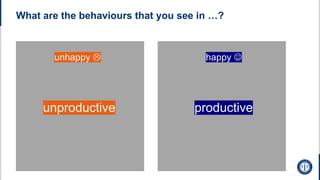
What are the behaviours that you see in …?
happy J
unhappy L
productive
unproductive
Cost of Misery
Happiness at Work
&
Happiness
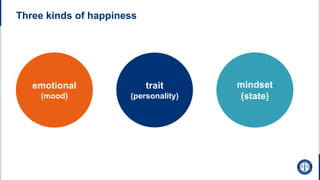
Happiness: 3 types
Three kinds of happiness
emotional
(mood)
trait
(personality)
mindset
(state)
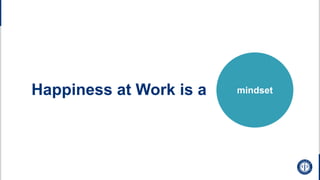
mindset
Happiness at Work is a
D E F I N I T I O N
Happiness at Work is a mindset that enables action
to optimise your performance and
to achieve your potential
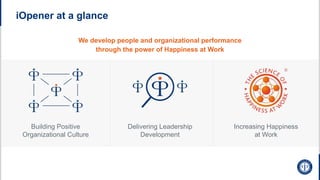
iOpener at a glance
Building Positive
Organizational Culture
Delivering Leadership
Development
Increasing Happiness
at Work
We develop people and organizational performance
through the power of Happiness at Work
S E S S I O N O B J E C T I V E
To:
• Understand what Happiness & Happiness at Work are
• Consider why they matter
• Answer the question “How can we develop more Happiness at Work?”
• as individuals
• as teams
• as organisations
Today’s Agenda
To:
1. Contextualise & define Happiness at Work
2. Unpack the Performance Happiness Model™
3. Learn how to read your H@W report and decide what to do as a result
4. Consider the competencies/behaviours/rituals of leading a happy team
5. Ask how you as Leader/Manager can increase H@W in your organisation/team
Your Individual Happiness
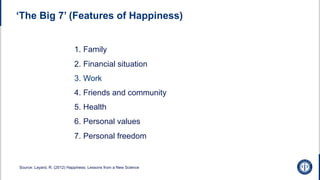
‘The Big 7’ (Features of Happiness)
1. Family
2. Financial situation
3. Work
4. Friends and community
5. Health
6. Personal values
7. Personal freedom
Source: Layard, R. (2012) Happiness: Lessons from a New Science
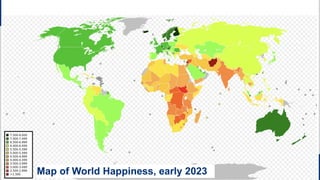
Map of World Happiness, early 2023
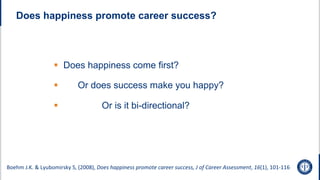
Does happiness promote career success?
§ Does happiness come first?
§ Or does success make you happy?
§ Or is it bi-directional?
Boehm J.K. & Lyubomirsky S, (2008), Does happiness promote career success, J of Career Assessment, 16(1), 101-116
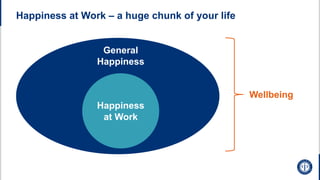
Happiness at Work – a huge chunk of your life
Happiness
at Work
General
Happiness
Wellbeing
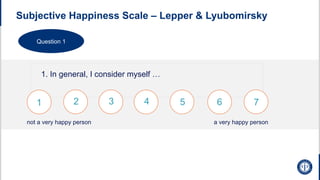
Subjective Happiness Scale – Lepper & Lyubomirsky
1. In general, I consider myself …
1 2 3 4 5 6 7
not a very happy person a very happy person
Question 1
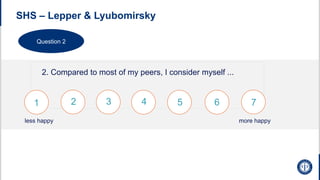
SHS – Lepper & Lyubomirsky
2. Compared to most of my peers, I consider myself ...
1 2 3 4 5 6 7
less happy more happy
Question 2
SHS – Lepper & Lyubomirsky
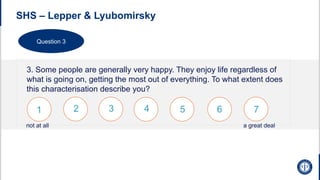
3. Some people are generally very happy. They enjoy life regardless of
what is going on, getting the most out of everything. To what extent does
this characterisation describe you?
1 2 3 4 5 6 7
not at all a great deal
Question 3
SHS – Lepper & Lyubomirsky
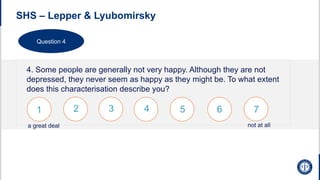
4. Some people are generally not very happy. Although they are not
depressed, they never seem as happy as they might be. To what extent
does this characterisation describe you?
1 2 3 4 5 6 7
not at all
a great deal
Question 4
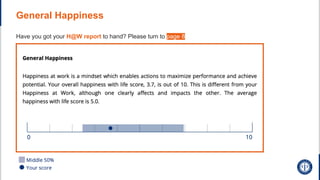
General Happiness
Have you got your H@W report to hand? Please turn to page 8
How happiness at work
impacts you & your team
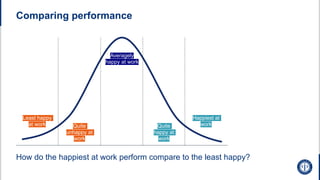
Comparing performance
Averagely
happy at work
Quite
unhappy at
work
Quite
happy at
work
Happiest at
work
Least happy
at work
How do the happiest at work perform compare to the least happy?
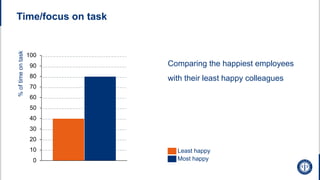
Time/focus on task
0
10
20
30
40
50
60
70
80
90
100
%
of
time
on
task
Comparing the happiest employees
with their least happy colleagues
Most happy
Least happy
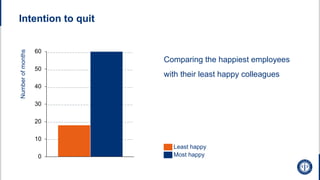
Comparing the happiest employees
with their least happy colleagues
Intention to quit
0
10
20
30
40
50
60
Most happy
Least happy
Number
of
months
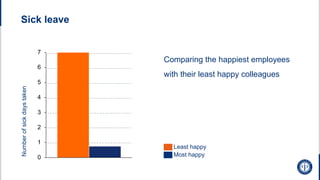
Sick leave
0
1
2
3
4
5
6
7
Number
of
sick
days
taken
Comparing the happiest employees
with their least happy colleagues
Most happy
Least happy
0
10
20
30
40
50
60
70
80
90
100
%
of
time
feeling
energized
at
work
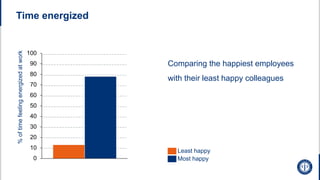
Time energized
Comparing the happiest employees
with their least happy colleagues
Most happy
Least happy
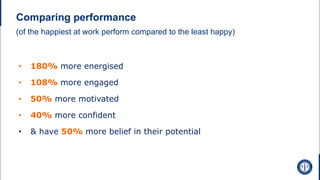
Comparing performance
(of the happiest at work perform compared to the least happy)
• 180% more energised
• 108% more engaged
• 50% more motivated
• 40% more confident
• & have 50% more belief in their potential
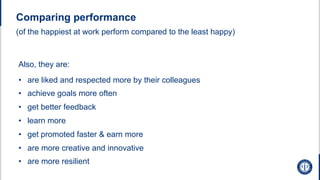
Also, they are:
• are liked and respected more by their colleagues
• achieve goals more often
• get better feedback
• learn more
• get promoted faster & earn more
• are more creative and innovative
• are more resilient
Comparing performance
(of the happiest at work perform compared to the least happy)
Exercise: 5 things
(For themselves and for others)
• Exercise
• Ask yourself: What do happy, high performing colleagues in your teams
routinely do to ensure their own happiness at work and high performance, and
that of others?
• Shortlist 5 things that you think matter the most
What do happy, high performers routinely do?
Performance Happiness Model™
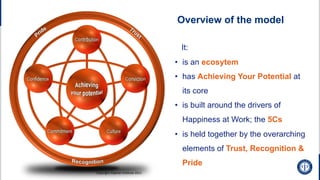
It:
• is an ecosytem
• has Achieving Your Potential at
its core
• is built around the drivers of
Happiness at Work; the 5Cs
• is held together by the overarching
elements of Trust, Recognition &
Pride
Overview of the model
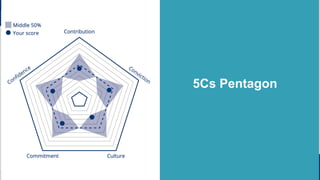
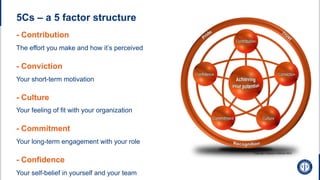
- Contribution
The effort you make and how it’s perceived
- Conviction
Your short-term motivation
- Culture
Your feeling of fit with your organization
- Commitment
Your long-term engagement with your role
- Confidence
Your self-belief in yourself and your team
5Cs – a 5 factor structure
Performance Happiness Model: showing factors and items
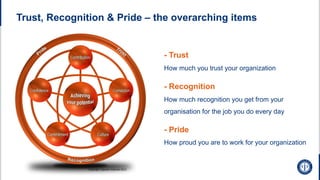
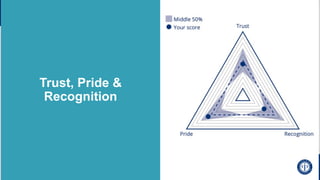
Trust, Recognition & Pride – the overarching items
- Trust
How much you trust your organization
- Recognition
How much recognition you get from your
organisation for the job you do every day
- Pride
How proud you are to work for your organization
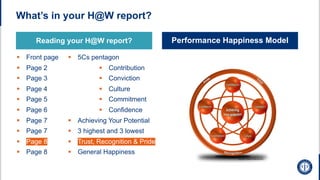
Your H@W report
What’s in your H@W report?
§ Front page
§ Page 2
§ Page 3
§ Page 4
§ Page 5
§ Page 6
§ Page 7
§ Page 7
§ Page 8
§ Page 8
Performance Happiness Model
Reading your H@W report?
§ 5Cs pentagon
§ Achieving Your Potential
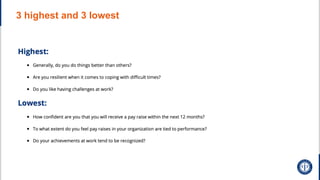
§ 3 highest and 3 lowest
§ Trust, Recognition & Pride
§ General Happiness
§ Contribution
§ Conviction
§ Culture
§ Commitment
§ Confidence
Trust, Pride &
Recognition
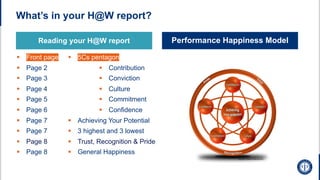
What’s in your H@W report?
§ Front page
§ Page 2
§ Page 3
§ Page 4
§ Page 5
§ Page 6
§ Page 7
§ Page 7
§ Page 8
§ Page 8
Performance Happiness Model
Reading your H@W report
§ 5Cs pentagon
§ Achieving Your Potential
§ 3 highest and 3 lowest
§ Trust, Recognition & Pride
§ General Happiness
§ Contribution
§ Conviction
§ Culture
§ Commitment
§ Confidence
5Cs Pentagon
3 highest and 3 lowest
Positive Psychology
Take a Positive Psychology approach
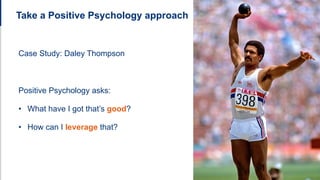
Case Study: Daley Thompson
Positive Psychology asks:
• What have I got that’s good?
• How can I leverage that?
Individual Reflection Time
Highlight your report as you read through: What stands out to you?
Make notes in your journal:
1. What’s working well?
2. What isn’t working well?
3. What are you going to action?
- To leverage what’s good
- To address what’s not so good
Why?
H@W is a personal resource
H@W drives engaged
behaviours
How can H@W influence
higher team performance?
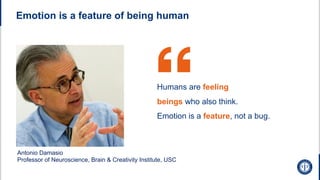
Emotion is a feature of being human
Antonio Damasio
Professor of Neuroscience, Brain & Creativity Institute, USC
Humans are feeling
beings who also think.
Emotion is a feature, not a bug.
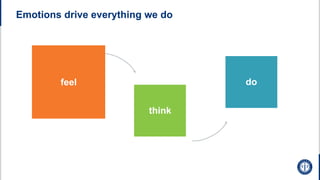
Emotions drive everything we do
feel
think
do
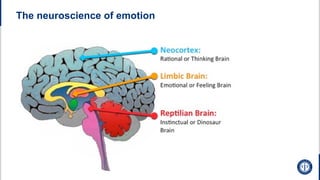
The neuroscience of emotion
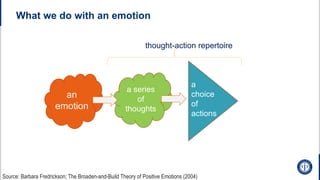
What we do with an emotion
an
emotion
a series
of
thoughts
a
choice
of
actions
thought-action repertoire
Source: Barbara Fredrickson; The Broaden-and-Build Theory of Positive Emotions (2004)
narrowed
mindset
and a
specific
action
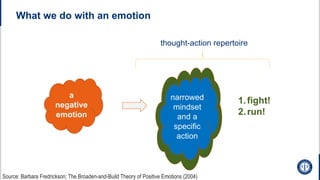
What we do with an emotion
Source: Barbara Fredrickson; The Broaden-and-Build Theory of Positive Emotions (2004)
a
negative
emotion
narrowed
mindset
and a
specific
action
1.fight!
2.run!
thought-action repertoire
What we do with an emotion
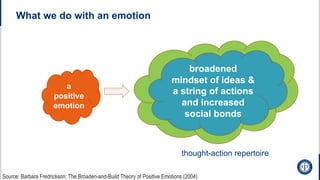
Source: Barbara Fredrickson; The Broaden-and-Build Theory of Positive Emotions (2004)
thought-action repertoire
a
positive
emotion
broadened mindset of
ideas & a string of
actions and increased
social bonds
broadened
mindset of ideas &
a string of actions
and increased
social bonds
How?
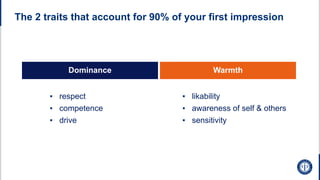
The 2 traits that account for 90% of your first impression
Dominance Warmth
▪ likability
▪ awareness of self & others
▪ sensitivity
▪ respect
▪ competence
▪ drive
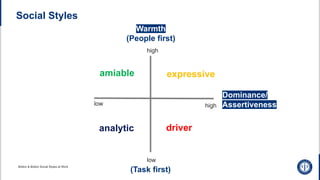
high
low
high
low
amiable
analytic
expressive
driver
Warmth
(People first)
Dominance/
Assertiveness
Social Styles
(Task first)
Bolton & Bolton Social Styles at Work
63
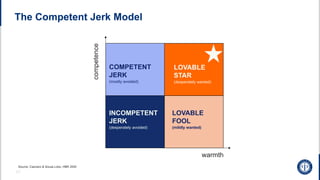
COMPETENT
JERK
(mostly avoided)
LOVABLE
STAR
(desperately wanted)
LOVABLE
FOOL
(mildly wanted)
INCOMPETENT
JERK
(desperately avoided)
warmth
competence
Source: Casciaro & Sousa Lobo, HBR 2005
The Competent Jerk Model
• Focus on people as well as task (build camaraderie)
• Stay in tune with your team’s Happiness at Work (measure it)
• Encourage a candid voice climate, for feedback, issues that matter and
healthy conflict
• Link what you do to organisational vision / team vision (join the dots)
• Remember the positivity ratio 3:1
• Listen more
• Ask more questions
Consider the following to increase team Happiness at Work
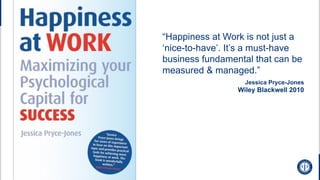
Jessica Pryce-Jones
Wiley Blackwell 2010
“Happiness at Work is not just a
‘nice-to-have’. It’s a must-have
business fundamental that can be
measured & managed.”
Does Happiness Pay?
iOpener Institute for People and Performance
Prama House | 267 Banbury Road | Oxford OX2 7HT UK
+44 (0)1865 511522 | info@iopener.com
katie.demain@iopener.com

APM Does Happiness Pay slidedeck.pdf

  • 1.
    Does Happiness Pay? DECEMBER5TH 2023 | KATIE DEMAIN
  • 2.
    How does happiness atwork (or the lack of) show up?
  • 3.
    What are thebehaviours that you see in …? Someone who is happy J at work Someone who is unhappy L at work
  • 4.
    What are thebehaviours that you see in …? happy J unhappy L productive unproductive
  • 5.
  • 6.
  • 7.
  • 8.
    Three kinds ofhappiness emotional (mood) trait (personality) mindset (state)
  • 9.
  • 10.
    D E FI N I T I O N Happiness at Work is a mindset that enables action to optimise your performance and to achieve your potential
  • 12.
    iOpener at aglance Building Positive Organizational Culture Delivering Leadership Development Increasing Happiness at Work We develop people and organizational performance through the power of Happiness at Work
  • 14.
    S E SS I O N O B J E C T I V E To: • Understand what Happiness & Happiness at Work are • Consider why they matter • Answer the question “How can we develop more Happiness at Work?” • as individuals • as teams • as organisations
  • 15.
    Today’s Agenda To: 1. Contextualise& define Happiness at Work 2. Unpack the Performance Happiness Model™ 3. Learn how to read your H@W report and decide what to do as a result 4. Consider the competencies/behaviours/rituals of leading a happy team 5. Ask how you as Leader/Manager can increase H@W in your organisation/team
  • 16.
  • 17.
    ‘The Big 7’(Features of Happiness) 1. Family 2. Financial situation 3. Work 4. Friends and community 5. Health 6. Personal values 7. Personal freedom Source: Layard, R. (2012) Happiness: Lessons from a New Science
  • 18.
    Map of WorldHappiness, early 2023
  • 19.
    Does happiness promotecareer success? § Does happiness come first? § Or does success make you happy? § Or is it bi-directional? Boehm J.K. & Lyubomirsky S, (2008), Does happiness promote career success, J of Career Assessment, 16(1), 101-116
  • 20.
    Happiness at Work– a huge chunk of your life Happiness at Work General Happiness Wellbeing
  • 21.
    Subjective Happiness Scale– Lepper & Lyubomirsky 1. In general, I consider myself … 1 2 3 4 5 6 7 not a very happy person a very happy person Question 1
  • 22.
    SHS – Lepper& Lyubomirsky 2. Compared to most of my peers, I consider myself ... 1 2 3 4 5 6 7 less happy more happy Question 2
  • 23.
    SHS – Lepper& Lyubomirsky 3. Some people are generally very happy. They enjoy life regardless of what is going on, getting the most out of everything. To what extent does this characterisation describe you? 1 2 3 4 5 6 7 not at all a great deal Question 3
  • 24.
    SHS – Lepper& Lyubomirsky 4. Some people are generally not very happy. Although they are not depressed, they never seem as happy as they might be. To what extent does this characterisation describe you? 1 2 3 4 5 6 7 not at all a great deal Question 4
  • 25.
    General Happiness Have yougot your H@W report to hand? Please turn to page 8
  • 26.
    How happiness atwork impacts you & your team
  • 27.
    Comparing performance Averagely happy atwork Quite unhappy at work Quite happy at work Happiest at work Least happy at work How do the happiest at work perform compare to the least happy?
  • 28.
    Time/focus on task 0 10 20 30 40 50 60 70 80 90 100 % of time on task Comparingthe happiest employees with their least happy colleagues Most happy Least happy
  • 29.
    Comparing the happiestemployees with their least happy colleagues Intention to quit 0 10 20 30 40 50 60 Most happy Least happy Number of months
  • 30.
    Sick leave 0 1 2 3 4 5 6 7 Number of sick days taken Comparing thehappiest employees with their least happy colleagues Most happy Least happy
  • 31.
    0 10 20 30 40 50 60 70 80 90 100 % of time feeling energized at work Time energized Comparing thehappiest employees with their least happy colleagues Most happy Least happy
  • 32.
    Comparing performance (of thehappiest at work perform compared to the least happy) • 180% more energised • 108% more engaged • 50% more motivated • 40% more confident • & have 50% more belief in their potential
  • 33.
    Also, they are: •are liked and respected more by their colleagues • achieve goals more often • get better feedback • learn more • get promoted faster & earn more • are more creative and innovative • are more resilient Comparing performance (of the happiest at work perform compared to the least happy)
  • 34.
  • 35.
    (For themselves andfor others) • Exercise • Ask yourself: What do happy, high performing colleagues in your teams routinely do to ensure their own happiness at work and high performance, and that of others? • Shortlist 5 things that you think matter the most What do happy, high performers routinely do?
  • 36.
  • 37.
    It: • is anecosytem • has Achieving Your Potential at its core • is built around the drivers of Happiness at Work; the 5Cs • is held together by the overarching elements of Trust, Recognition & Pride Overview of the model
  • 38.
    - Contribution The effortyou make and how it’s perceived - Conviction Your short-term motivation - Culture Your feeling of fit with your organization - Commitment Your long-term engagement with your role - Confidence Your self-belief in yourself and your team 5Cs – a 5 factor structure
  • 39.
    Performance Happiness Model:showing factors and items
  • 40.
    Trust, Recognition &Pride – the overarching items - Trust How much you trust your organization - Recognition How much recognition you get from your organisation for the job you do every day - Pride How proud you are to work for your organization
  • 41.
  • 42.
    What’s in yourH@W report? § Front page § Page 2 § Page 3 § Page 4 § Page 5 § Page 6 § Page 7 § Page 7 § Page 8 § Page 8 Performance Happiness Model Reading your H@W report? § 5Cs pentagon § Achieving Your Potential § 3 highest and 3 lowest § Trust, Recognition & Pride § General Happiness § Contribution § Conviction § Culture § Commitment § Confidence
  • 43.
  • 44.
    What’s in yourH@W report? § Front page § Page 2 § Page 3 § Page 4 § Page 5 § Page 6 § Page 7 § Page 7 § Page 8 § Page 8 Performance Happiness Model Reading your H@W report § 5Cs pentagon § Achieving Your Potential § 3 highest and 3 lowest § Trust, Recognition & Pride § General Happiness § Contribution § Conviction § Culture § Commitment § Confidence
  • 45.
  • 46.
    3 highest and3 lowest
  • 47.
  • 48.
    Take a PositivePsychology approach Case Study: Daley Thompson Positive Psychology asks: • What have I got that’s good? • How can I leverage that?
  • 49.
    Individual Reflection Time Highlightyour report as you read through: What stands out to you? Make notes in your journal: 1. What’s working well? 2. What isn’t working well? 3. What are you going to action? - To leverage what’s good - To address what’s not so good
  • 50.
  • 51.
    H@W is apersonal resource
  • 52.
  • 53.
    How can H@Winfluence higher team performance?
  • 54.
    Emotion is afeature of being human Antonio Damasio Professor of Neuroscience, Brain & Creativity Institute, USC Humans are feeling beings who also think. Emotion is a feature, not a bug.
  • 55.
    Emotions drive everythingwe do feel think do
  • 56.
  • 57.
    What we dowith an emotion an emotion a series of thoughts a choice of actions thought-action repertoire Source: Barbara Fredrickson; The Broaden-and-Build Theory of Positive Emotions (2004)
  • 58.
    narrowed mindset and a specific action What wedo with an emotion Source: Barbara Fredrickson; The Broaden-and-Build Theory of Positive Emotions (2004) a negative emotion narrowed mindset and a specific action 1.fight! 2.run! thought-action repertoire
  • 59.
    What we dowith an emotion Source: Barbara Fredrickson; The Broaden-and-Build Theory of Positive Emotions (2004) thought-action repertoire a positive emotion broadened mindset of ideas & a string of actions and increased social bonds broadened mindset of ideas & a string of actions and increased social bonds
  • 60.
  • 61.
    The 2 traitsthat account for 90% of your first impression Dominance Warmth ▪ likability ▪ awareness of self & others ▪ sensitivity ▪ respect ▪ competence ▪ drive
  • 62.
  • 63.
    63 COMPETENT JERK (mostly avoided) LOVABLE STAR (desperately wanted) LOVABLE FOOL (mildlywanted) INCOMPETENT JERK (desperately avoided) warmth competence Source: Casciaro & Sousa Lobo, HBR 2005 The Competent Jerk Model
  • 64.
    • Focus onpeople as well as task (build camaraderie) • Stay in tune with your team’s Happiness at Work (measure it) • Encourage a candid voice climate, for feedback, issues that matter and healthy conflict • Link what you do to organisational vision / team vision (join the dots) • Remember the positivity ratio 3:1 • Listen more • Ask more questions Consider the following to increase team Happiness at Work
  • 65.
    Jessica Pryce-Jones Wiley Blackwell2010 “Happiness at Work is not just a ‘nice-to-have’. It’s a must-have business fundamental that can be measured & managed.”
  • 66.
  • 67.
    iOpener Institute forPeople and Performance Prama House | 267 Banbury Road | Oxford OX2 7HT UK +44 (0)1865 511522 | info@iopener.com katie.demain@iopener.com