








THE 12
THINGS YOU
NEED TO
KNOW ABOUT
HAPPINESS
AT WORK
Gea Peper - Fennande van der Meulen - Maartje Wolff
22 3
HAPPINESS AT WORK
Happy people are more productive,
both in everyday life and at work. Paying
attention to a happy work environment
generates many benefits for employees,
as well as the organisation itself.
Research shows that happiness at
work results in less absence, fewer
workplace accidents, reduced stress,
more gratification, happier clients and a
higher quality of service. Reasons enough
to put happiness on the agenda of every
organisation. However one question
arises: ‘How do you accomplish this?’ In
this concise booklet, HappinessBureau
and Happy Office will look at twelve
topics that delve into the answer to
this question. We provide a number
of tools to achieve happiness at work.
There is no definite formula of success
that could be applied to every business.
Each company has their own unique
qualities. Our advice: bring one or more
topics into practise and experience how
the organisation, team or just a single
employee reacts to it.
We wish you all the best in your future
endeavours. Good luck!
Fennande van der Meulen, Gea Peper en
Maartje Wolff
2 3
8 Purpose
What motivates us? Having
a goal!
12 Measure
Measurable happiness
16 Approach
Using the ‘agile method’ to
create a happy organisation
20 Culture
Happy habits
26 Connection
Good relationships at work
30 Self-steering
Letting go is not the same
as letting it drop
34	 Attention
Give compliments
38 Fun
Fun and optimism
Organisa on Teams
44 Personal leadership
Know thyself
48 Passion
The added value of
passionate employees
52 Results
Utilizing talents and getting
results
56 Wholeness
Lose the professional mask
62	 Getting	started
Getting started! Create
happiness at work
Employees Get ng started
And more...
68 Reference list
70 About us
Table of contents
66 7
ORGANISATION
6 7
8 9
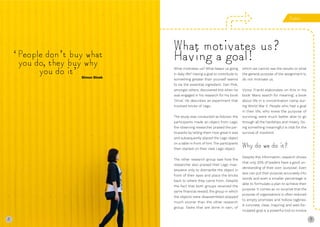
‘People don’t buy what
you do, they buy why
you do it’ What motivates us? What keeps us going
in daily life? Having a goal to contribute to
something greater than yourself seems
to be the essential ingredient. Dan Pink,
amongst others, discovered this when he
was engaged in his research for his book
‘Drive’. He describes an experiment that
involved bricks of Lego.
The study was conducted as follows: the
participants made an object from Lego,
the observing researcher praised the par-
ticipants by telling them how great it was
and subsequently placed the Lego object
on a table in front of him. The participants
then started on their next Lego object.
The other research group saw how the
researcher also praised their Lego mas-
terpiece only to dismantle the object in
front of their eyes and place the bricks
back to where they came from. Despite
the fact that both groups received the
same financial reward, the group in which
the objects were disassembled stopped
much sooner than the other research
group. Tasks that are done in vain, of
which we cannot see the results or what
the general purpose of the assignment is,
do not motivate us.
Victor Frankl elaborates on this in his
book ‘Mans search for meaning’, a book
about life in a concentration camp dur-
ing World War II. People who had a goal
in their life, who knew the purpose of
surviving, were much better able to go
through all the hardships and misery. Do-
ing something meaningful is vital for the
survival of mankind.
Why do we do it?
Despite this information, research shows
that only 20% of leaders have a good un-
derstanding of their own ‘purpose’. Even
less can put their purpose accurately into
words and even a smaller percentage is
able to formulate a plan to achieve their
purpose. It comes as no surprise that the
purpose of organisations is often reduced
to empty promises and hollow taglines.
A concrete, clear, inspiring and well-for-
mulated goal is a powerful tool to involve
What motivates us?
Having a goal!
Purpose
Simon Sinek
8
10 11
people and to create happier employ-
ees. Financial targets and profit are of
course necessary to keep a company up
and running. However, a purpose serves
a higher goal than just financial gain. It
is about added value. It is about what
you can give to the world. Let’s face it:
a target such as ‘increase profit for the
shareholders’ is not going to get employ-
ees out of their beds in the morning.
The why
Simon Sinek describes in his book ‘Start
with the Why’ how Apple states its pur-
pose as: ‘challenge the status quo’. It is
much more fun to work for a company
that defies conventions, rather than just
building and selling computers. The pur-
pose says it all.
NOTES
Tips & tricks:
How do you formulate the purpose
of your company?
• Take your current mission and
vision statements and inspect
them thoroughly and critically.
• Is this what drives your company
and connects the employees? A
purpose surpasses the financial
target.
• Involve employees from every
rank. Working together will im-
prove results.
• How do you visualize your pur-
pose? What kind of images and
symbols do you associate the
purpose with?
• Think about its meaning. What
effects could it have on cus-
tomer service, the product range
and how we treat each other?
Reading list:
• 'Start with why' - Simon Sinek
• 'Drive' - Dan Pink
12 13
‘I aim for a happiness index so
good that a fall of 2% causes the
same panic as a fall of 2% in GDP’
Measure
Can you measure happiness? That is a question that we often get from our clients
when we address happiness at work. From our own experience, we can finally say:
“Yes, you can.” Professors such as Robert Cummins (Deakin University - Australia)
and Daniel Gilbert (Harvard - United States) share that opinion.
Measurable happiness
For better or worse
According to Robert Cummins you can
measure happiness if you regard happi-
ness as a state of being that is more or
less a constant. Every human being is
born with a genetically determined val-
ue of happiness. You can measure this
by asking: ‘How happy do you feel at X
moment?’ Professor of Psychology, Dan-
iel Gilbert, also claims that happiness is
measurable. In the article ‘The science
behind the smile’ he explains the princi-
ple: “It is no different than fitting a pair of
glasses. The optician places a glass lens
in front of someone’s eye and asks: ‘bet-
ter or worse?’ By doing so, the optician
collects subjective data with which he is
able to judge the strength of the glasses
or lenses objectively. The same goes for
happiness. By asking regularly, you will be
able to get a good image of someone’s
state of happiness.
If this is the case, then how can you im-
prove someone’s feeling of happiness?
According to Gilbert, you can achieve this
in the same manner as one might lose
weight: “by structurally working on it for a
prolonged length of time, in practical little
steps, that you can repeat and measure.
By doing this, you can see results and
that motivates to continue.”
Happiness and work
One of his conclusions states that there
is a significant connection between work
performance of employees and the op-
portunities they get within the company
to flourish. Conditions that contribute to
a better work culture can influence the
performance considerably. He concludes
that the actual work of happy and un-
happy employees is not fundamentally
different. There is, however, a connection
between the performances of employees
Maurits Bruel
12
14 15
NOTESand the opportunities that they get. These
are conditions that actually contribute to
a better company culture and thus in-
fluence someone achievements at work.
Methods to measure
happiness at work
Research bureau Soffos measures, with
the aid of a questionnaire, how happy
someone feels at work. The questions
are based on seven dimensions: talent
development, work satisfaction, mental
fitness, work climate, relationships with
colleagues, productivity & meaning and
personal leadership. For more informa-
tion see: soffos.eu.
Does someone experience their work
as boring or stressful? How proud and
fit are the employees? How content is
someone about the guidance they re-
ceive? The Happiness at Work survey re-
searches how organisations score on the
forty elements that are most influential
on happiness at work. The results are
then compared with the Dutch bench-
mark. For more information see: haws.
nl.
Onno Hamburger and Ad Bergsma explain
in their book ‘Happy Work’ how you can
enhance happiness at work based on the
so-called ‘Happiness Compass’. Work is
divided into three aspects: pleasure, sat-
isfaction and meaning. Based on several
statements you can find out on which
points you are content with and which
points need more work. For more infor-
mation about the ‘Happiness Scan’ see:
gelukkigwerken.nl
Happy Apps
There are different apps and digital hap-
piness meters that give you an insight
into someone’s happy feeling, in their
private life as well as at work.
• Happy app from HSK Groep (hsk.
nl)
• HappyWe and HappyWeWork
from Multiply Happiness
(multiplyhappiness.nl)
• Moodicious from Squarevibe
(squarevi.be)
• Gelukswijzer from Erasmus uni-
versiteit (gelukswijzer.nl)
• Happy@work app from Happy@
productions limited (happyat.me)
• Limbi (limbi.com)
Read on!
• Neem de temperatuur op - Robert A.
Cummins in Geluk
• The World Book of Happiness - Leo
Bormans
• Blog 'Meetbaar Geluk' at www.happyof-
fice.nl
• Het rendement van Geluk - Professor
Ruut Veenhoven e.a.
• Measuring Flourishing - the impact of
Operational definition of the prevalence of
high levels of wellbeing (Lucy C Hone e.a.)
• World Happiness Reportn www.scp.nl/
Geluk
16 17
Every year, companies implement large
transformations. Research shows that
more than half of these companies won’t
reach their set targets. Almost 20% of
these targets are missed completely
or the company is even worse off than
before. Because of this, the strategy of
planning massive changes all at once in
an organisation is questionable.
Smaller improvements are more favour-
able and will no doubt make you a lot
happier. By learning from the software
industry, we can improve the work envi-
ronment. The method is called ‘the ag-
ile-method’.
From big and slow to
small and nimble
Whenever Microsoft develops a newer
version of Windows, you can be sure that
a team has been working on it for sev-
eral years. When the product is finished
and tested, it will be officially launched.
However, if Facebook wants to add a new
functionality to its website, this will be
developed quickly and will be tested on
a small number of Facebook-users. After
the first feedback and necessary altera-
tions, it will then be deployed globally.
Microsoft uses the ‘Waterfall-method’ in
which there is a long thought process and
then one big change will be implement-
ed all at once. Facebook, however, works
according to the ‘agile-method’. They con-
tinually make small improvements over
a period of time. This is exactly the ap-
proach that increases the happiness of a
team, an organisation or yourself.
What is the agile
method?
Working with the agile method allows a
company to anticipate needs and react
swiftly to problems. This way of develop-
ing improvements is increasing in popu-
larity (see: Facebook, Twitter and Google).
The agile philosophy can be adapted to
create happier work environments. To
Using the ‘agile method’ to
create a happy organisation
‘Learn from
yesterday, live for
today, hope for
tomorrow. The
important thing is
not to stop
questioning’
Albert Einstein
Approach
16
18 19
summarize, the core philosophy of agile
working is:
Step 1: Constant improvement
Step 2: Quick evaluation and then back
to step one.
You can apply this technique by working
towards one single target as an organi-
sation, team or employee. This method
is most effective when the target affects
all involved.
Next, you think of a way to change the
obstacles that are in the way of your goal.
After a short period, evaluate the results.
If it turns out that changes have improved
the work environment, you continue on to
the next aspect that is need of change. Is
the change ineffective? Think of another
way to approach the problem. You don’t
have to change the whole company to
achieve improvements.
NOTES
Tips for agile working
1. Keep the team small
With a small team you can work more agilely and you are able to react
flexibly.
2. Quit all regular meetings
Keep track of time and see how much you lose with regular meetings.
Stop meeting and start doing things!
3. Get some fresh perspective
You need fresh perspective in your team. Young professionals, for in-
stance, can add a lot of value.
4. Seek innovative and flexible partners
If you have a small team you need innovative and flexible partners.
5. Do not aim for perfection
Keep moving and do not strive for a perfect solution.
Source: T. Haak (2015) ‘Seven tips for ‘agile’ HR’
20 21
Mostly everyone within an organisation has a pretty sound idea of what the general
culture and acceptable behaviour is. Trying to describe it can be quite tricky though,
let alone consciously working on it. To achieve a happier workplace requires a happier
organisational culture. It will only be created if everyone, from all levels, pitches in
and takes ownership.
Happy habits
‘Culture eats
strategy for
breakfast’
Peter Drucker
Working on a better company culture
starts with formulating a comprehensive
purpose. What do we stand for? Why are
we here? Where do we want to go and
how are we going to achieve this? When
the purpose of a company is formulat-
ed and shared with everyone within the
company, then you can start develop-
ing behavioural values that fit within the
purpose.
Closeness
Changing behaviour starts with deter-
mining the collective values. Despite
the fact that many companies are
living their values, there are countless
more who are totally disconnected
from them. This is often because the
established values are meaningless,
unknown or too far removed from the
experience of the employees. Core
values lead to habitual behaviours only
when they are clearly actionable and
they resonate with the employees.
Involve employees
Allowing the employees to be actively
involved in formulating the collective val-
ues will ensure that the corresponding
behaviour will be easier to understand
and implement. Examples and real situ-
ations can make this process more spe-
cific, realistic and measurable. Only then
can people be responsible. To make sure
it says relevant, write it down in a pro-
tocol, a manual or a ‘culture’ book. New
colleagues coming on board will have
these readily available as well.
Cul re
20
22 23
NOTES
The Zappos way
The online shoe store Zappos is an organisation that successfully created a happy
work culture. How did they do it and more importantly, how did they seem to
maintain this?
Zappos’ core values in ten steps
• Tony Hsieh made the decision that he wanted to commit to a value-based
organisation. This means being patient about revenues and profit.
• Subsequently, Tony set out to find out what his personal values actually were.
It was harder than he initially thought. Being honest, looking into personal
milestones as well as life changing situations and reading the book ‘Tribal
Leadership’ written by Dave Logan, helped him find his personal values.
• Next, Tony asked key figures (partners, managers, influencers) about their own
personal values. He asked: ‘On which four or five values do you base your life?
Could you describe this in one word or sentence?’
• With the help of a small committee, he collected and assembled all the an-
swers.
• After this, Tony tested the values by asking managers for feedback. He re-
quested them to think specifically about the employees that were compatible
with these values.
• The next step was to ask for the commitment of the managers. ‘Are you will-
ing to hire for fire people based on these values?’
• After this process, the whole organisation was asked to give feedback on the
values.
• Tony came back together with his small committee to analyse the feedback
and blend everything together.
• The time was ripe to finally implement all the values throughout the organisa-
tion and everything that Zappos does.
Culture book
An important tool for a strong
organisational culture is a culture
book. In this book, employees
describe on a yearly basis what
the Zappos-culture is, according to
them. These stories are published
without editing. By doing so, an
image is formed about their work
and what needs to be improved.
This culture book also forms a tool
for recruitment. Zappos only hires
people who fit the organisational
culture and the core values.
Want to read more?
• ‘Delivering Happiness’ - Tony
Hsieh
• ‘Tribal Leadership’ - Dave Logan
24 25
TEAMS
24 25
26 27
According to the familiar Maslow’s hier-
archy of needs, the fundamental require-
ments are: eating, sleeping, safety etc.
After this, comes the need to be loved
and to be included.
A human being is part of a group or a
community. There are only a few who can
be truly happy without being included in
some kind of social network. It has been
demonstrated that having this support
lowers the chance of heart disease and
mental deterioration as we get older.
If you ask employees what makes them
happy, the following answers score high:
• Nice colleagues;
• A good manager;
• Fun in the work place.
These are all signs of stable relationships
in which people like and communicate
with each other. These contacts do not
necessarily stop at colleagues and man-
agers but can also be applied to clients,
suppliers, stockholders and the larger
organisational community.
Good relationships at
work
The amount of happiness at work is not
limited. An excess of happiness in others
will not lead to a shortage of happiness
for you.
• To make others happy will make you
happy as well.
• Happiness is contagious. The more
happy people, the more one will ex-
perience happiness for themselves.
• If you make others happy, there is
a good chance that they will try to
make you happy in return.
Get to know people at work. You don’t
have to become friends with everyone,
but positive relationships are essential to
a happy workplace. You don’t need a lot
to build good relationships and to sustain
Good relationships
at work
‘Individually,
we are one drop.
Together we are
an ocean’
Ryunosuke Satoro
Connec on
26
28 29
them, but you need to take it seriously.
The following list can help you do this:
• Do something nice for a colleague.
• Say good morning and goodbye.
• Show interest in others.
• Try to help your co-workers.
• Try to create a good vibe in the
workplace.
Let connection be the basis for your
work. These things might seem trivial
and quite simple but it makes all the
difference for relationships at the office.
People feel more connected and will
communicate better.
Source: A. Kjerulf (2008), ‘Happy Hour is
from 9 to 5’
Southwest Airlines
An organisation that identifies the importance of connection between people is
Southwest Airlines. They are also known as ‘The Love Airline’. This airline will only
hire people if they have a friendly personality. Their skills come second: ‘Hire for
attitude, train for skill.’ For Southwest Airlines, a positive and sunny disposition is
of greater value than degrees of skills. Because of this, Southwest is a great em-
ployer to work for and more importantly, an efficient and profitable organisation.
NOTES‘If you want
to go fast, go
alone. If you
want to go far,
go together’
African saying
30 31
In the start-up phase, every organisa-
tion starts with self-organisation. Then,
over time, processes are established
and policies implemented to ensure
that everything and everyone is kept
under control. This is a shame really,
since organisation structures, job de-
scriptions and hierarchy do not always
make offices a better place. The choice
for self-steering teams gives a chance
to break the mould and provide a bet-
ter alternative.
Success
A self-steering team involves a group
of employees responsible for the total
process in which products and services
will develop. The team plans and pro-
tects the product process, solves daily
obstacles and improves processes and
methods without continually calling
on supervision or supporting services.
Companies are increasingly interest-
ed in the possibilities of self-steering
teams. As research shows, it leads to
higher quality services, happier clients
and professionals who are proud of
their achievements. This way of work-
ing is a better fit with current society,
which asks for methods such as ‘agile’,
SCRUM and lean.
Mutual trust
We can learn a lot from the success of
organisations such as Buurtzorg, BSO/
Origin, Van Hutten Catering, Patagonia
and Morning Star. The pillar of these
organisations is mutual trust. There is
a deep belief that people are intrinsi-
cally motivated and capable of acting
responsibly. When this is the case,
managers and directors can finally let
go of control, which is not the same as
dropping everything. Even self-steering
teams need some guidance. Europe-
an research shows that self-steer-
ing teams need more support than
initially thought. Placing responsibility
through to the lowest levels, or steer-
ing towards results, asks for a certain
Letting go is not the
same as letting it drop
‘Self-steering is no miracle, it
is the way in which the world
has created itself’
Margaret Wheatley and
MyronKellner-Rogers
Self-steering
30
32 33
kind of leadership. One which places
the professional first, from out of the
vision, culture and clear boundaries of
the organisation. So where do you start
with creating a self-steering organisa-
tion and what are the conditions for
success?
14 Golden rules to
self-steering teams
• Mutual trust.
• Managers and directors need to
dare to let go.
• A clear framework (vision, course,
identity, goals, values and expect-
ed results).
• Good communication: self-steer-
ing teams arise from tuning into
each other.
• Collective responsibility, the focus
is on the team, not the individual.
• The team is a ‘process-owner’
and has the power to steer this
process.
• Supervisors and staff support the
team.
• The decision-making process in
the lower ranks of the organisation
is focused on the demand of the
client.
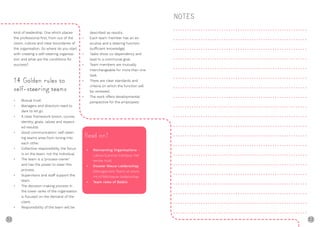
• Responsibility of the team will be
described as results.
• Each team member has an ex-
ecutive and a steering function
(sufficient knowledge).
• Tasks show co-dependency and
lead to a communal goal.
• Team members are mutually
interchangeable for more than one
task.
• There are clear standards and
criteria on which the function will
be reviewed.
• The work offers developmental
perspective for the employees.
Read on!
• Reinventing Organisations –
Laloux (Lannoo Campus, het
eerste huis)
• Dossier Nieuw Leiderschap
(Managament Team) at www.
mt.nl/581/nieuw-leiderschap
• Team roles of Belbin
NOTES
34 35
Giving compliments might be one of
the easiest and most effective ways to
make people happy at work. Everyone
can do it, it doesn’t cost any money
and it hardly takes any time. The cor-
rect way to give a compliment:
• Is relevant and sincere. Do not
express your appreciation just be-
cause you have to. There needs to
be a reason.
• Is not bound by time. Do show
your appreciation when it is fitting.
• Is personal. Make sure that the
compliment is tailor-made for that
person.
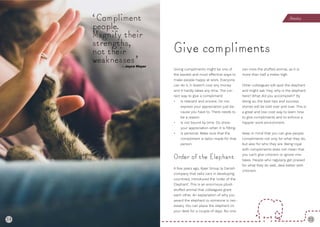
Order of the Elephant
A few years ago, Kjaer Group (a Danish
company that sells cars in developing
countries), introduced the ‘order of the
Elephant’. This is an enormous plush
stuffed animal that colleagues grant
each other. An explanation of why you
award the elephant to someone is nec-
essary. You can place the elephant on
your desk for a couple of days. No-one
can miss the stuffed animal, as it is
more than half a meter high.
Other colleagues will spot the elephant
and might ask ‘Hey, why is the elephant
here? What did you accomplish?’ By
doing so, the best tips and success
stories will be told over and over. This is
a great and low-cost way to learn how
to give compliments and to enforce a
happier work environment.
Keep in mind that you can give people
compliments not only for what they do,
but also for who they are. Being royal
with compliments does not mean that
you can’t give criticism or ignore mis-
takes. People who regularly get praised
for what they do well, deal better with
criticism.
Give compliments
‘Compliment
people.
Magnify their
strengths,
not their
weaknesses’
Atten on
34
- Joyce Meyer
36 37
Ways to give compliments
Below you will find some excellent ways to give compliments:
• Personal. Don’t make it too big, just make a move towards a colleague,
give the compliment and return to your desk. Don’t wait until someone
returns the praise. Don’t add something like “...but you still need to work
on...” This is a sure way of ruining the compliment.
• Use a symbol such as the elephant at the Kjaer Group. A symbol is
something that is universally recognized and it helps with the develop-
ment of ‘praise-culture’. Preferably something that has a connection with
the organisation.
• Use the walls. The walls in the reception and the meeting rooms of the
London-based innovative company ‘What if?’ are full of compliments to
employees. Colleagues can nominate each other for their good deed. The
best compliments can be immortalized in bold, colourful letters on the
walls and ceilings of the busiest places in the office.
• The poncho. Give everyone a paper from a flip-over. Make a hole in the
middle and wear the paper like you would a poncho. Let everyone write
on the back of each colleague. Preferably something nice. For example,
why you appreciate them, why you like them or what they excel in. Give
people the time to read the compliments in silence, so they can enjoy
them on their own.
Source: A. Kjerulf (2008), ‘Happy Hour is from 9 to 5’
NOTES
Want to read more?
Article: ‘Een compliment geven? Dat werkt beter dan een bonus’.
http://www.nrcq.nl/2015/10/12/complimenten
38 39
‘Spend more time smiling
than frowning and more time
praising than criticising’
It is striking that companies have a strong
focus on the negative. What goes right
is often ignored or given little attention.
Meetings are directed at problems, emails
are about misunderstandings, a call of-
ten means a dissatisfied customer and
conversations are usually about conflicts.
There is a constant feeling that nothing
goes as it should and there is nothing you
can do about it. In the end, people will
just give up.
Positive psychology
Research from Seligman about positive
psychology shows clearly that positive
and optimistic people are more likely
to succeed than negative people. Facts
about optimistic people:
• They have a higher quality of life.
• They live longer.
• They achieve more at work.
• They are less prone to depression.
• They have more friends and a better
social life.
These are excellent reasons to choose to
be positive. Seligman’s research not only
shows how easy it is to learn negativity
and pessimism, it also shows that you
can learn to be positive. In a work exper-
iment, Seligman convinced an insurance
company to hire a group of people who
did not have the right credentials, but did
score high on positivity and optimism.
This group of employees performed
better than their less positive but better
qualified counterparts.
Fun and optimism- Richard Branson
Fun
38
‘Pleasure in the job
puts perfection
in the work’
- Aristotle
40 41
Tips to increase
positivity
Below you will find a few simple things
to do to increase your own and other
people’s positivity.
• Give a compliment to someone.
(see page: 35)
• Keep a ‘Happiness-at-work’ log. You
are prone to forget positive things.
At the end of your workday, right before
you head home, write five things that
made your day or made you grateful
about your work. These can be either
big or small things. If it made your day
better, write it down. Talked to a nice
colleague? Meatball-day in the canteen?
Everything is acceptable. Most people
will remember the negative things better
than the positive. Therefore it is wise
to give a little bit more attention to the
good experiences in life and at work. The
happiness-at-work log offers a simple
and effective approach.
Positive meetings
A lot of meetings often start with a
round of current news. This often results
in a big list of complaints and problems
which set the tone of the rest of the
meeting in a negative way. Instead, begin
the meeting with a round of answers to
the following questions:
• What is something you are proud of
since the last meeting?
• Name someone that helped you
out since the last meeting.
• What are you looking forward to
next week/month?
• What is the funniest that you heard
last week?
The atmosphere in the meeting will be
much better after starting it with some-
thing positive.
Have fun
Having a great time at work is important.
Each job can be fun or you can make
it fun. Even in the most serious situa-
tions it is possible to have a sense of
humour. Make space for entertainment
at work. Let go of the idea that you, as a
professional, cannot have fun at work.
If you are not in the mood for fun and
games, than don’t take it away from col-
leagues who might feel different. Just as
important, don’t force happiness upon
anybody. Don’t worry too much about
what is acceptable and what is not. Fun
can be spontaneous, if you don’t think
about it too much.
Source: A. Kjerulf (2008), ‘Happy Hour is
from 9 to 5’
NOTES
Movie-time
Check out this video from a
Southwest Airlines flight at-
tendant that raps the safety
instructions in the airplane.
‘Rapping Flight Attendant’
‘Rapping	Flight	Attendant’	
www.youtube.com/
watch?v=U_yW1zdQzaY
42 43
COLLEAGUES
42 43
44 45
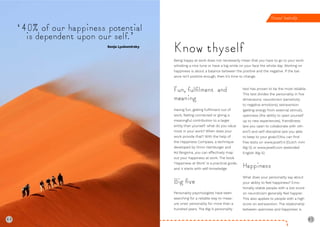
‘40% of our happiness potential
is dependent upon our self.’
Sonja Lyubomirsky
Know thyself
Being happy at work does not necessarily mean that you have to go to your work
whistling a nice tune or have a big smile on your face the whole day. Working on
happiness is about a balance between the positive and the negative. If the bal-
ance isn’t positive enough, then it’s time to change.
Personal leadership
Fun, fulfilment and
meaning
Having fun, getting fulfilment out of
work, feeling connected or giving a
meaningful contribution to a larger
entity than yourself: what do you value
most in your work? When does your
work provide that? With the help of
the Happiness Compass, a technique
developed by Onno Hamburger and
Ad Bergsma, you can effectively map
out your happiness at work. The book
‘Happiness at Work’ is a practical guide,
and it starts with self-knowledge.
Big five
Personality psychologists have been
searching for a reliable way to meas-
ure ones’ personality for more than a
hundred years. The Big-5 personality
test has proven to be the most reliable.
This test divides the personality in five
dimensions: neuroticism (sensitivity
to negative emotions), extraversion
(getting energy from external stimuli),
openness (the ability to open yourself
up to new experiences), friendliness
(are you open to collaborate with oth-
ers?) and self-discipline (are you able
to keep to your goals?).You can find
free tests on www.jezelf.nl (Dutch mini
Big-5) or www.jezelf.com (extended
English Big-5).
Happiness
What does your personality say about
your ability to feel happiness? Emo-
tionally stable people with a low score
on neuroticism generally feel happier.
This also applies to people with a high
score on extraversion. The relationship
between openness and happiness is
44
46 47
‘Disturbing’ situationChoice
Own leadership
Thinking in possibilties
Victimization
Accept/connect
What are the
possibilities?
I have influence
Source of strength
qualities
ffective behaviour
Ineffective behaviour
Resistance
(internal/external)
I haven’t got any
influence
udge
Compared with
past or ideal
Blame
Stories
Complaints
Head in the sand
Resistance
Norms
Perfectionism
Automatism
Pleasure
Energy
Happiness
Satisfaction
The Circle of 8weaker, but in the end, being open to
new experiences helps improve general
happiness, especially if you are keen
on living an exciting life. People that
score higher on friendliness connect to
others easier and feel more involved,
which in turn make them feel happi-
er. Finally, ‘reaching targets’ leads to
more happiness, so people who score
high on self-control are generally more
happy.
Source: O. Hamburger, A. Bergsma (2011),
‘Gelukkig Werken’
The 9 thinking
patterns of happy
people
Scientific research conducted by
Sonja Lyubomirsky shows that genetic
circumstances determine our happi-
ness for approximately 50%. External
circumstances such as relationships,
income, health and environment deter-
mine it for 10%. Our own behaviour and
thinking patterns determine it for 40%.
Lyubomirksy found that the following
nine thinking and behavioural patterns
are common with happy people.
• They dedicate a lot of time to
friends and family.
• They cherish and enjoy their rela-
tionships.
• They express gratitude for what
they have.
• They are optimistic about the
future
• They are seriously dedicating
themselves to their goals.
• They enjoy life and try to live in the
‘now’ as much as they can.
• They try to keep a balance during
difficult situations.
• They are often the first to react to
help others.
• They exercise regularly.
Source: D. Haijtema (2015), ‘Leve het Grote
Geluk’
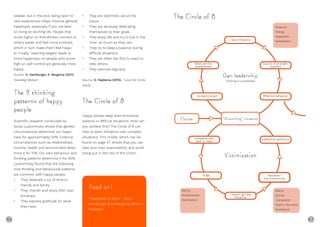
The Circle of 8
Happy people keep their emotional
balance in difficult situations. How can
you achieve this? The Circle of 8 can
help to exert influence over complex
situations. This model, which can be
found on page 47, shows that you can
take your own responsibility and avoid
being put in the role of the victim.
Read on!
‘Happiness at Work’ - Onno
Hamburger & Ad Bergsma (Boom/
Nelissen)
48 49
People often state that passion is an im-
portant factor in a company. Why is this?
Passion is a word that describes an em-
ployee who has a ‘heart for the job’. When
someone is passionate, there is a greater
intrinsic motivation to perform. Wanting
to do the job right leads to an increase
in quality. You continually search for im-
provement. This contributes to growth.
And not unimportantly, if you have pas-
sion for what you do, you tend to enjoy
it more.
Research from Gallup shows that passion
has all kinds of positive side-effects such
as lower absenteeism (-37%), fewer acci-
dents (-49%), less quality defects (-60%),
improved client satisfaction (+12%), great-
er productivity (+18%) and higher profit
(+16%). The effects of positive and pas-
sionate employees are not only positive
for general productivity but it also radiates
happiness onto other employees and cli-
ents.
Ten aspects that posi-
tively influence passion
How can you determine how passionate
employees are? Research conducted by
Effectory shows that the following ten
aspects most influence your employ-
ees. The extent in which you:
• Are happy with your work.
• Do the thing that you are good at.
• Find your job challenging.
• Are proud of the organisation you
work for.
• Have responsibility at work.
• Receive praise you get from your
organisation.
• Have space to deploy your own
initiatives.
• Feel vital and healthy?
• Receive space to attend to the
wishes of your clients.
• Are able to work efficiently.
The added value of
passionate employees
‘Customers will
never love your
company until the
employees love it
first’
Simon Sinek
Enthusiasm
48
50 51
How can the experience
of the workplace be
enhanced?
Below you will find a few practical tips on
improving the workplace experience and
employee engagement.
Create a match between employees and
activities. Take action when it seems like
the match does not fit. In some cases,
the mismatch can be solved by extra
attention, supervision and / or training.
Sometimes another job needs to be
found either within or outside the or-
ganisation.
Give attention to your employees and
make sure they continue to develop
themselves. This can be done by increas-
ing challenges, providing development
opportunities and function changes. En-
sure there is a path for growth.
Discuss the biggest frustrations that em-
ployees face at work and check which
solutions they envision. These frustra-
tions often destroy all pleasure in their
work. When these are removed the re-
sults are immediate.
Discuss which tasks, projects and chal-
lenges give or drain energy for each team
member. Take this into account when
assigning roles and tasks. Sometimes,
someone gets energy from a task that
might cost someone else a lot. When
this is the case, check if there is a pos-
sibility of switching tasks.
Make sure you have a good work environ-
ment and atmosphere. Make clear-cut
agreements about behaviour and invest
in teambuilding (such as: trips, a lunch,
or a mutual training).
How can you make sure that employees and
managers stay positive about their jobs?
Professor of Work and Organisational psychology, Wilmar Schnaufeli has, backed
by years of scientific study, put together a number of practical tips for managers
and employees.
• Follow your dreams and passions where you can.
• Make use of your talents.
• Make sure there is a good balance between work and private life.
• Focus not only on results but also on personal development.
• Be optimistic, think in possibilities instead of problems.
• Help and support others at work, be co-operative.
• Regularly ask feedback from others, stay in conversation with your boss.
• Take care of your body: exercise, sleep and relax.
• Form challenging targets but keep them realistic.
• Take initiative; take the possibilities that work offers.
• Keep the job exciting, now as well as in the future.
Effectory (2015), ‘Het Verborgen Potentieel van Werkend Nederland’
MT (2015), ‘Bevlogen Werken Leer Dan van deze 5 Tips uit de Wetenschap’
NOTES
51
52 53
We all want to achieve something. We
want to know that our job results in
something fulfilling. We want to do
something of which we are proud. One
of our deepest psychological needs is the
need to control our environment. If we’re
placed in a situation where we have no
control, where nothing we do matters, we
feel terrible. On the other hand, we love to
do great work and to make a difference.
Accomplishment feels great.
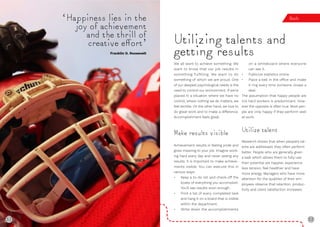
Make results visible
Achievement results in feeling pride and
gives meaning to your job. Imagine work-
ing hard every day and never seeing any
results. It is important to make achieve-
ments visible. You can execute this in
various ways:
• Keep a to-do list and check-off the
boxes of everything you accomplish.
You’ll see results soon enough.
• Print a list of every completed task
and hang it on a board that is visible
within the department.
• Write down the accomplishments
on a whiteboard where everyone
can see it.
• Publicize statistics online.
• Place a bell in the office and make
it ring every time someone closes a
deal.
The assumption that happy people are
not hard workers is predominant. How-
ever the opposite is often true. Most peo-
ple are only happy if they perform well
at work.
Utilize talent
Research shows that when people’s tal-
ents are addressed, they often perform
better. People who are generally given
a task which allows them to fully use
their potential are happier, experience
less tension, feel healthier and have
more energy. Managers who have more
attention for the qualities of their em-
ployees observe that retention, produc-
tivity and client satisfaction increases.
Utilizing talents and
getting results
‘Happiness lies in the
joy of achievement
and the thrill of
creative effort’
Franklin D. Roosevelt
Results
52
54 55
Employee in action
Not every job can be adapted to the qualities of the employees. That doesn’t mean
there isn’t any space to accommodate the employee. It is the responsibility of the
manager, as well as the employee, to actively think of how to maximize the utilization
of their talents. This is called ‘Job Crafting’. When the employee does what he or
she is actually best at, then motivation and happiness at work is the obvious result.
Source: A. Kjerulf (2008), ‘Happy Hour is from 9 to 5’
C. Schenk (2015), ‘Mensen Beter Laten Presteren? Spreek ze aan op hun Kwaliteiten’
Job Crafting: how does it work?
• Make a top ten list of your assignments;
• Number one on your list describes what takes up the most of your time;
• Describe per task, how much time it takes to do it. Has it increased, de-
creased or been stable since you started?
• Finally, describe per task which you enjoy doing and which one you least like.
Write down which of your talents is underused.
The next step is to start a conversation about job crafting (a performance review
is a great option) with your coach or manager. Tackle the (small) adjustments you
can make to make your work meaningful again (‘The What’). That can be achieved
by changing the tasks to something you enjoy more. Or switch colleagues so you’ll
never have to work with someone you cannot stand (‘The How’). If you realize
that an assignment that does not demand a lot of you (‘The Why’) is actually a fun
challenge for someone else, try to switch tasks (unless it is actually something
you were hired to do). Finally, a way to enhance happiness at work could be by
changing the work environment.
Source: J. van den Berg (2016), ‘Jobcrafting een Betere Baan Zonder Weg te Gaan’
NOTES
56 57
Most people go to work wearing a mask.
Literally. Think of the robe of a pastor or
priest, the uniform of a soldier or officer,
the suit of a representative or director, the
white coat of a doctor. Of course, there
are practical reasons for these outfits but
they also function as a symbol. With a
‘mask’ or ‘uniform’ you don’t have to be-
have like you would at home, but as is
required of you at work.
Be yourself
When employees put on their suits or
other ‘work’ garments and head to work,
they leave a part of themselves at home.
They leave their concerns, vulnerability,
emotions, intuitions and spirituality at
home. This is a shame, as these are im-
portant factors when it comes to making
connections, creating genuine involve-
ment and listening to each other. Why
can’t people take their ‘whole’ self to
work? Why are people hesitant to do so?
Fear
An important reason is fear. Organisations
are afraid that, when people are them-
selves, it becomes total chaos. After all,
how do you deal with all these emotions?
Employees are, in turn, afraid that if they
are completely themselves, they are vul-
nerable to criticism and ridicule. There-
fore, it is more comfortable and safer to
keep that professional mask on. The only
downside is that the same mask leads to
disconnection, envy, political games and
even malice. When people are allowed
and encouraged to be themselves, they
can feel more connected which enhances
collaboration. They become self-directed
and that makes for an excellent organ-
isation.
Lose the professional
mask
‘Extraordinary things begin to
happen when we dare to bring
all of who we are to work’
Frederic Laloux
Wholeness
56
58 59
Take it step by step
There are different ways to invite employ-
ees to be themselves in an organisation.
For instance, you can start with a round
of thanks at a meeting or with a min-
ute of silence. Performance reviews are
perfect to ‘being yourself’. Show respect
for a person’s ‘mission’ or highlight their
personal development. You can invite
all employees for an event that allows
people to think about what it means to
be your ‘whole’ self at work. Questions
such as: ‘Think of a moment in your work
where you have been truly yourself’; ‘Tell
us more about this and how you felt’;
‘How was the atmosphere and how did
that change what you were working on?’;
‘What were the circumstances that made
it so you could be yourself?’. By record-
ing their answers either in a book or a
drawing, the employee keeps the mem-
ory alive.
Source: Laloux, F. (2015), Reinventing Orga-
niations
NOTES
Wholeness in your organisation
Wholeness is about being yourself completely in the workplace. How does this reflect
itself in your organisation? You can use the following points to check your progress:
• My behaviour is the same at home as it is in the workplace.
• I feel comfortable.
• My colleagues and I are encouraged to put aside our differences.
• People who think differently are thriving in the organisation.
• Passion is stimulated, even if it can result in conflict.
• Our organisation has room for more than one type of person.
Source: Harvard Business Review (2015), ‘Creating the Best Workplace on Earth, The Dream
Company Diagnostic’
‘You can judge an organisation based on the
amount of lies you have to tell to fit in’
Parker Palmer
60 61
GETTING
STARTED
60 61
62 63
Get ng started
Lower absenteeism, more fun and a
higher quality of service. It is clear that
happiness at work has demonstrable
results. Still, there is not one specific
formula for a successful approach. If we
look at different companies that prac-
tice ‘happiness at work’, we can observe
that almost all of them have their own
method.
Top down
At some companies, the highest level of
management believes in happiness as
a business model. It is a central theme
at all levels of the organisation. In other
words, it is not all talk. The company is
actively seeking to improve happiness.
Bottom-up
In some other organisations HR or a
group of enthusiastic employees put
happiness at work on the agenda. This
often starts with a pilot, so that a small
group of people can work on it and
experience it in the organisation.
Chief Happiness
Officer
Some companies have invested in happi-
ness at work by creating a new function:
‘The Chief Happiness Officer’. Despite
the fact that every company utilizes this
function in their own way, almost every
‘CHO’s’ main task is to increase happiness
at work. This role may be internal, or the
CHO may be hired in as an independ-
ent advisor or coach. There is no all-em-
bracing success formula that enhances
happiness at work. The twelve topics that
were described in this booklet, all play
an important role. The next steps gives
you examples of how you can implement
happiness at work in your organisation.
Put it on the agenda
Place ‘happiness at work’ on the agenda
of HR or the board of directors who can
take the lead to improve the process.
Make room for enthusiastic employees
who can take the initiative as well.
Getting started! Create
happiness at work
62
64 65
Measure happiness in the organisation
To gain insight on how happy people are
in your organisation, measure it according
to tips given on page 13. As soon as you
know where you stand on the happiness
level, you can define how you want to
increase happiness at work in the future.
Regular measurements give great insight
in the progress and which actions should
be next.
Start small
Start small with a group of passionate
people. Launch the pilot so the group
can experience what the effect is on a
smaller scale. Check what works and
what doesn’t. Add and delete actions
based on these results. After a while, the
effects will be noticeable and all teams
and employees will improve their happi-
ness and results at work.
HR and happiness at work
HR is well positioned to introduce happi-
ness at work within the organisation. This
demands that HR focus on improving the
happiness of colleagues. This must res-
onate in every aspect of HR. You can, for
instance, not only hire those who are best
qualified but also those who are happiest
to work in this position. Furthermore, you
can train employees to understand what
makes them happy in the workplace.
Management and happiness at work
You can improve happiness at work by
selecting a management team who sup-
ports employees to get the best results
and to solidify relations at work. This may
mean firing certain employees when an
employee is not the right fit for the po-
sition and infect others with their own
unhappiness.
NOTES
And finally...
Keep in mind that happiness at
work is something you do. Start
with baby steps to improve
happiness at work and don’t be
afraid to experiment with ideas
that might seem strange in the
beginning. See what fits in your
organisation.
66 67
NOTES
68 69
REFERENCE LIST
Achor, S. (2010), The Happiness Advan-
tage: The Seven Principles of Positive
Psychology that Fuel Success and Per-
formance at Work
Blanchard, K. (1997), Gung Ho! Turn On
the People in Any Organization
Bormans, L. (2010), Geluk, The World
Book of Happiness
Frankl, Viktor E. (1959), Man’s search
for meaning
Bruel, M. & Colsen, C. (1998), De ge-
luksfabriek. Over het binden en boeien
van mensen in organisaties
Haan, de E. (2009), Kookboek voor
teams
Haan, de E. & Beerends, E. (2012), Or-
ganisatieontwikkeling met Theory U
Hamburger, O. & Bergsma, A. (2011),
Gelukkig Werken. Versterk je persoonlijk
leiderschap
Hsieh, T. (2010), Delivering Happiness.
A Path to Profits, Passions and Purpose
Kjerulf, A. (2014), Happy Hour is 9 to 5:
How to Love Your Job, Love Your Life,
and Kick Butt at Work’
Laloux, F. (2015), Reinventing Organiza-
tions
Lyobumirsky, S. (2008), De maakbaar-
heid van het geluk
Logan, D. & King, J. & Fischer-Wright,
H. (2008), Tribal Leadership. Leverag-
ing Natural Groups to Build a Thriving
Organization
Pink, D. (2009), Drive. The Surprising
Truth About What Motivates Us
Pryce-Jones, J. (2010), Happiness at
Work. Maximizing your Psychological
Capital for Success
Rath, T. & Harter, J. (2010), Well being,
the Five Essential Elements
Reimer, C. (2015), Happywork, A
Business Parable About the Journey to
Teamwork, Profit and Purpose
Rubin, G. (2010), Het Geluk Project, een
gelukkiger leven binnen 12 maanden
Seal, A. (2003), Soul mission, Life
Vision. Recognize your true gifts and
make more mark in the world
Seligman, M. (2011), Flourish. A new
Understanding of Happiness and
Well-being – and How to Achieve Them
Semler, R. (2013), Semco-Stijl
Sinek, S. (2009), Begin met het waar-
om. De Gouden Cirkel van Ondernemen
Schmidt, E. & Rosenberg, J. (2014),
Google – hoe Google werkt
Toch, H. (2014), Happy Profit. Ga voor
winst en wees er trots op.
Veenhoven, R. (2014), Het Rendement
van Geluk. Inzichten uit wetenschap en
praktijk
HAPPINESS AT WORK
70 71
About us...
Gea Peper of HappinessBureau and Maartje Wolff and Fennande van der Meulen
of Happy Office work intensively together. They completed the executive program
‘The ROI of Happiness’ at the Erasmus University of Rotterdam and the program
‘Happiness at Work Coach’ from Onno Hamburger. Furthermore, they are experi-
enced in guiding organizations to a happier workplace.
Happiness at work is important for everyone. It leads to more fun, higher produc-
tivity and more return on investments. Do you want to know how you can steer
your organization towards a happier business? Happy Office and HappinessBureau
are looking forward to help with more information, creating the right conditions
and translating scientific insights into practice. From measuring and analysing the
situation, giving presentations, workshops and training to creating a plan of action
and developing matching tools.
Gea Peper: “It is my personal mission to
contribute to a world where happiness at
work is the norm and not the exception.
On the one hand, I help improve hap-
piness at work in organisations. On the
other hand, I want to spread ideas and
concepts through the HappinessBureau
about happiness at work by publishing
articles, doing research and organising
events about this topic.
Gea Peper has over twenty-five years of
(international) experience as a change
management consultant and HR manag-
er. In 2015 she started her own company,
the HappinessBureau (www.happiness-
bureau.nl).
Maartje Wolff and Fennande van der
Meulen have years of experience in
strategic communication and advice
for organisations (www.lemon-lab.nl).
“Lots of organisations steer towards
financial results. That is a shame, as
focusing on happiness at work is just
as profitable. Happy people are better
at their work. We see it as our mis-
sion to place happiness at work on as
many corporate agendas as possible.
This starts with finding and naming
what makes a company different. Next,
we make the purpose clear through
content and collateral, internally as
well as externally. A powerful mission
and vision should not be put in some
drawer somewhere, it should inspire all
involved. This is an important step to a
happier workplace.”
Maartje Wolff
Fennande van der Meulen
Maartje@happyoffice.nl
06 28 67 85 44
Fennande@happyoffice.nl
06 55 1 784 08
Gea Peper
Gea@HappinessBureau.nl
06 12 49 80 35
GeaFennande Maartje
COLOFON
This booklet is published by the HappinessBureau and Happy Office.
Fennande van der Meulen (fennande@happyoffice.nl)
Gea Peper (gea@happinessbureau.nl)
Maartje Wolff (maartje@happyoffice.nl)
Design: Lemonlab Strategic Communication
Sanne Klink (www.lemon-lab.nl)
2016

Happiness at work

  • 1.
    THE 12 THINGS YOU NEEDTO KNOW ABOUT HAPPINESS AT WORK Gea Peper - Fennande van der Meulen - Maartje Wolff
  • 2.
    22 3 HAPPINESS ATWORK Happy people are more productive, both in everyday life and at work. Paying attention to a happy work environment generates many benefits for employees, as well as the organisation itself. Research shows that happiness at work results in less absence, fewer workplace accidents, reduced stress, more gratification, happier clients and a higher quality of service. Reasons enough to put happiness on the agenda of every organisation. However one question arises: ‘How do you accomplish this?’ In this concise booklet, HappinessBureau and Happy Office will look at twelve topics that delve into the answer to this question. We provide a number of tools to achieve happiness at work. There is no definite formula of success that could be applied to every business. Each company has their own unique qualities. Our advice: bring one or more topics into practise and experience how the organisation, team or just a single employee reacts to it. We wish you all the best in your future endeavours. Good luck! Fennande van der Meulen, Gea Peper en Maartje Wolff 2 3
  • 3.
    8 Purpose What motivatesus? Having a goal! 12 Measure Measurable happiness 16 Approach Using the ‘agile method’ to create a happy organisation 20 Culture Happy habits 26 Connection Good relationships at work 30 Self-steering Letting go is not the same as letting it drop 34 Attention Give compliments 38 Fun Fun and optimism Organisa on Teams 44 Personal leadership Know thyself 48 Passion The added value of passionate employees 52 Results Utilizing talents and getting results 56 Wholeness Lose the professional mask 62 Getting started Getting started! Create happiness at work Employees Get ng started And more... 68 Reference list 70 About us Table of contents
  • 4.
  • 5.
    8 9 ‘People don’tbuy what you do, they buy why you do it’ What motivates us? What keeps us going in daily life? Having a goal to contribute to something greater than yourself seems to be the essential ingredient. Dan Pink, amongst others, discovered this when he was engaged in his research for his book ‘Drive’. He describes an experiment that involved bricks of Lego. The study was conducted as follows: the participants made an object from Lego, the observing researcher praised the par- ticipants by telling them how great it was and subsequently placed the Lego object on a table in front of him. The participants then started on their next Lego object. The other research group saw how the researcher also praised their Lego mas- terpiece only to dismantle the object in front of their eyes and place the bricks back to where they came from. Despite the fact that both groups received the same financial reward, the group in which the objects were disassembled stopped much sooner than the other research group. Tasks that are done in vain, of which we cannot see the results or what the general purpose of the assignment is, do not motivate us. Victor Frankl elaborates on this in his book ‘Mans search for meaning’, a book about life in a concentration camp dur- ing World War II. People who had a goal in their life, who knew the purpose of surviving, were much better able to go through all the hardships and misery. Do- ing something meaningful is vital for the survival of mankind. Why do we do it? Despite this information, research shows that only 20% of leaders have a good un- derstanding of their own ‘purpose’. Even less can put their purpose accurately into words and even a smaller percentage is able to formulate a plan to achieve their purpose. It comes as no surprise that the purpose of organisations is often reduced to empty promises and hollow taglines. A concrete, clear, inspiring and well-for- mulated goal is a powerful tool to involve What motivates us? Having a goal! Purpose Simon Sinek 8
  • 6.
    10 11 people andto create happier employ- ees. Financial targets and profit are of course necessary to keep a company up and running. However, a purpose serves a higher goal than just financial gain. It is about added value. It is about what you can give to the world. Let’s face it: a target such as ‘increase profit for the shareholders’ is not going to get employ- ees out of their beds in the morning. The why Simon Sinek describes in his book ‘Start with the Why’ how Apple states its pur- pose as: ‘challenge the status quo’. It is much more fun to work for a company that defies conventions, rather than just building and selling computers. The pur- pose says it all. NOTES Tips & tricks: How do you formulate the purpose of your company? • Take your current mission and vision statements and inspect them thoroughly and critically. • Is this what drives your company and connects the employees? A purpose surpasses the financial target. • Involve employees from every rank. Working together will im- prove results. • How do you visualize your pur- pose? What kind of images and symbols do you associate the purpose with? • Think about its meaning. What effects could it have on cus- tomer service, the product range and how we treat each other? Reading list: • 'Start with why' - Simon Sinek • 'Drive' - Dan Pink
  • 7.
    12 13 ‘I aimfor a happiness index so good that a fall of 2% causes the same panic as a fall of 2% in GDP’ Measure Can you measure happiness? That is a question that we often get from our clients when we address happiness at work. From our own experience, we can finally say: “Yes, you can.” Professors such as Robert Cummins (Deakin University - Australia) and Daniel Gilbert (Harvard - United States) share that opinion. Measurable happiness For better or worse According to Robert Cummins you can measure happiness if you regard happi- ness as a state of being that is more or less a constant. Every human being is born with a genetically determined val- ue of happiness. You can measure this by asking: ‘How happy do you feel at X moment?’ Professor of Psychology, Dan- iel Gilbert, also claims that happiness is measurable. In the article ‘The science behind the smile’ he explains the princi- ple: “It is no different than fitting a pair of glasses. The optician places a glass lens in front of someone’s eye and asks: ‘bet- ter or worse?’ By doing so, the optician collects subjective data with which he is able to judge the strength of the glasses or lenses objectively. The same goes for happiness. By asking regularly, you will be able to get a good image of someone’s state of happiness. If this is the case, then how can you im- prove someone’s feeling of happiness? According to Gilbert, you can achieve this in the same manner as one might lose weight: “by structurally working on it for a prolonged length of time, in practical little steps, that you can repeat and measure. By doing this, you can see results and that motivates to continue.” Happiness and work One of his conclusions states that there is a significant connection between work performance of employees and the op- portunities they get within the company to flourish. Conditions that contribute to a better work culture can influence the performance considerably. He concludes that the actual work of happy and un- happy employees is not fundamentally different. There is, however, a connection between the performances of employees Maurits Bruel 12
  • 8.
    14 15 NOTESand theopportunities that they get. These are conditions that actually contribute to a better company culture and thus in- fluence someone achievements at work. Methods to measure happiness at work Research bureau Soffos measures, with the aid of a questionnaire, how happy someone feels at work. The questions are based on seven dimensions: talent development, work satisfaction, mental fitness, work climate, relationships with colleagues, productivity & meaning and personal leadership. For more informa- tion see: soffos.eu. Does someone experience their work as boring or stressful? How proud and fit are the employees? How content is someone about the guidance they re- ceive? The Happiness at Work survey re- searches how organisations score on the forty elements that are most influential on happiness at work. The results are then compared with the Dutch bench- mark. For more information see: haws. nl. Onno Hamburger and Ad Bergsma explain in their book ‘Happy Work’ how you can enhance happiness at work based on the so-called ‘Happiness Compass’. Work is divided into three aspects: pleasure, sat- isfaction and meaning. Based on several statements you can find out on which points you are content with and which points need more work. For more infor- mation about the ‘Happiness Scan’ see: gelukkigwerken.nl Happy Apps There are different apps and digital hap- piness meters that give you an insight into someone’s happy feeling, in their private life as well as at work. • Happy app from HSK Groep (hsk. nl) • HappyWe and HappyWeWork from Multiply Happiness (multiplyhappiness.nl) • Moodicious from Squarevibe (squarevi.be) • Gelukswijzer from Erasmus uni- versiteit (gelukswijzer.nl) • Happy@work app from Happy@ productions limited (happyat.me) • Limbi (limbi.com) Read on! • Neem de temperatuur op - Robert A. Cummins in Geluk • The World Book of Happiness - Leo Bormans • Blog 'Meetbaar Geluk' at www.happyof- fice.nl • Het rendement van Geluk - Professor Ruut Veenhoven e.a. • Measuring Flourishing - the impact of Operational definition of the prevalence of high levels of wellbeing (Lucy C Hone e.a.) • World Happiness Reportn www.scp.nl/ Geluk
  • 9.
    16 17 Every year,companies implement large transformations. Research shows that more than half of these companies won’t reach their set targets. Almost 20% of these targets are missed completely or the company is even worse off than before. Because of this, the strategy of planning massive changes all at once in an organisation is questionable. Smaller improvements are more favour- able and will no doubt make you a lot happier. By learning from the software industry, we can improve the work envi- ronment. The method is called ‘the ag- ile-method’. From big and slow to small and nimble Whenever Microsoft develops a newer version of Windows, you can be sure that a team has been working on it for sev- eral years. When the product is finished and tested, it will be officially launched. However, if Facebook wants to add a new functionality to its website, this will be developed quickly and will be tested on a small number of Facebook-users. After the first feedback and necessary altera- tions, it will then be deployed globally. Microsoft uses the ‘Waterfall-method’ in which there is a long thought process and then one big change will be implement- ed all at once. Facebook, however, works according to the ‘agile-method’. They con- tinually make small improvements over a period of time. This is exactly the ap- proach that increases the happiness of a team, an organisation or yourself. What is the agile method? Working with the agile method allows a company to anticipate needs and react swiftly to problems. This way of develop- ing improvements is increasing in popu- larity (see: Facebook, Twitter and Google). The agile philosophy can be adapted to create happier work environments. To Using the ‘agile method’ to create a happy organisation ‘Learn from yesterday, live for today, hope for tomorrow. The important thing is not to stop questioning’ Albert Einstein Approach 16
  • 10.
    18 19 summarize, thecore philosophy of agile working is: Step 1: Constant improvement Step 2: Quick evaluation and then back to step one. You can apply this technique by working towards one single target as an organi- sation, team or employee. This method is most effective when the target affects all involved. Next, you think of a way to change the obstacles that are in the way of your goal. After a short period, evaluate the results. If it turns out that changes have improved the work environment, you continue on to the next aspect that is need of change. Is the change ineffective? Think of another way to approach the problem. You don’t have to change the whole company to achieve improvements. NOTES Tips for agile working 1. Keep the team small With a small team you can work more agilely and you are able to react flexibly. 2. Quit all regular meetings Keep track of time and see how much you lose with regular meetings. Stop meeting and start doing things! 3. Get some fresh perspective You need fresh perspective in your team. Young professionals, for in- stance, can add a lot of value. 4. Seek innovative and flexible partners If you have a small team you need innovative and flexible partners. 5. Do not aim for perfection Keep moving and do not strive for a perfect solution. Source: T. Haak (2015) ‘Seven tips for ‘agile’ HR’
  • 11.
    20 21 Mostly everyonewithin an organisation has a pretty sound idea of what the general culture and acceptable behaviour is. Trying to describe it can be quite tricky though, let alone consciously working on it. To achieve a happier workplace requires a happier organisational culture. It will only be created if everyone, from all levels, pitches in and takes ownership. Happy habits ‘Culture eats strategy for breakfast’ Peter Drucker Working on a better company culture starts with formulating a comprehensive purpose. What do we stand for? Why are we here? Where do we want to go and how are we going to achieve this? When the purpose of a company is formulat- ed and shared with everyone within the company, then you can start develop- ing behavioural values that fit within the purpose. Closeness Changing behaviour starts with deter- mining the collective values. Despite the fact that many companies are living their values, there are countless more who are totally disconnected from them. This is often because the established values are meaningless, unknown or too far removed from the experience of the employees. Core values lead to habitual behaviours only when they are clearly actionable and they resonate with the employees. Involve employees Allowing the employees to be actively involved in formulating the collective val- ues will ensure that the corresponding behaviour will be easier to understand and implement. Examples and real situ- ations can make this process more spe- cific, realistic and measurable. Only then can people be responsible. To make sure it says relevant, write it down in a pro- tocol, a manual or a ‘culture’ book. New colleagues coming on board will have these readily available as well. Cul re 20
  • 12.
    22 23 NOTES The Zapposway The online shoe store Zappos is an organisation that successfully created a happy work culture. How did they do it and more importantly, how did they seem to maintain this? Zappos’ core values in ten steps • Tony Hsieh made the decision that he wanted to commit to a value-based organisation. This means being patient about revenues and profit. • Subsequently, Tony set out to find out what his personal values actually were. It was harder than he initially thought. Being honest, looking into personal milestones as well as life changing situations and reading the book ‘Tribal Leadership’ written by Dave Logan, helped him find his personal values. • Next, Tony asked key figures (partners, managers, influencers) about their own personal values. He asked: ‘On which four or five values do you base your life? Could you describe this in one word or sentence?’ • With the help of a small committee, he collected and assembled all the an- swers. • After this, Tony tested the values by asking managers for feedback. He re- quested them to think specifically about the employees that were compatible with these values. • The next step was to ask for the commitment of the managers. ‘Are you will- ing to hire for fire people based on these values?’ • After this process, the whole organisation was asked to give feedback on the values. • Tony came back together with his small committee to analyse the feedback and blend everything together. • The time was ripe to finally implement all the values throughout the organisa- tion and everything that Zappos does. Culture book An important tool for a strong organisational culture is a culture book. In this book, employees describe on a yearly basis what the Zappos-culture is, according to them. These stories are published without editing. By doing so, an image is formed about their work and what needs to be improved. This culture book also forms a tool for recruitment. Zappos only hires people who fit the organisational culture and the core values. Want to read more? • ‘Delivering Happiness’ - Tony Hsieh • ‘Tribal Leadership’ - Dave Logan
  • 13.
  • 14.
    26 27 According tothe familiar Maslow’s hier- archy of needs, the fundamental require- ments are: eating, sleeping, safety etc. After this, comes the need to be loved and to be included. A human being is part of a group or a community. There are only a few who can be truly happy without being included in some kind of social network. It has been demonstrated that having this support lowers the chance of heart disease and mental deterioration as we get older. If you ask employees what makes them happy, the following answers score high: • Nice colleagues; • A good manager; • Fun in the work place. These are all signs of stable relationships in which people like and communicate with each other. These contacts do not necessarily stop at colleagues and man- agers but can also be applied to clients, suppliers, stockholders and the larger organisational community. Good relationships at work The amount of happiness at work is not limited. An excess of happiness in others will not lead to a shortage of happiness for you. • To make others happy will make you happy as well. • Happiness is contagious. The more happy people, the more one will ex- perience happiness for themselves. • If you make others happy, there is a good chance that they will try to make you happy in return. Get to know people at work. You don’t have to become friends with everyone, but positive relationships are essential to a happy workplace. You don’t need a lot to build good relationships and to sustain Good relationships at work ‘Individually, we are one drop. Together we are an ocean’ Ryunosuke Satoro Connec on 26
  • 15.
    28 29 them, butyou need to take it seriously. The following list can help you do this: • Do something nice for a colleague. • Say good morning and goodbye. • Show interest in others. • Try to help your co-workers. • Try to create a good vibe in the workplace. Let connection be the basis for your work. These things might seem trivial and quite simple but it makes all the difference for relationships at the office. People feel more connected and will communicate better. Source: A. Kjerulf (2008), ‘Happy Hour is from 9 to 5’ Southwest Airlines An organisation that identifies the importance of connection between people is Southwest Airlines. They are also known as ‘The Love Airline’. This airline will only hire people if they have a friendly personality. Their skills come second: ‘Hire for attitude, train for skill.’ For Southwest Airlines, a positive and sunny disposition is of greater value than degrees of skills. Because of this, Southwest is a great em- ployer to work for and more importantly, an efficient and profitable organisation. NOTES‘If you want to go fast, go alone. If you want to go far, go together’ African saying
  • 16.
    30 31 In thestart-up phase, every organisa- tion starts with self-organisation. Then, over time, processes are established and policies implemented to ensure that everything and everyone is kept under control. This is a shame really, since organisation structures, job de- scriptions and hierarchy do not always make offices a better place. The choice for self-steering teams gives a chance to break the mould and provide a bet- ter alternative. Success A self-steering team involves a group of employees responsible for the total process in which products and services will develop. The team plans and pro- tects the product process, solves daily obstacles and improves processes and methods without continually calling on supervision or supporting services. Companies are increasingly interest- ed in the possibilities of self-steering teams. As research shows, it leads to higher quality services, happier clients and professionals who are proud of their achievements. This way of work- ing is a better fit with current society, which asks for methods such as ‘agile’, SCRUM and lean. Mutual trust We can learn a lot from the success of organisations such as Buurtzorg, BSO/ Origin, Van Hutten Catering, Patagonia and Morning Star. The pillar of these organisations is mutual trust. There is a deep belief that people are intrinsi- cally motivated and capable of acting responsibly. When this is the case, managers and directors can finally let go of control, which is not the same as dropping everything. Even self-steering teams need some guidance. Europe- an research shows that self-steer- ing teams need more support than initially thought. Placing responsibility through to the lowest levels, or steer- ing towards results, asks for a certain Letting go is not the same as letting it drop ‘Self-steering is no miracle, it is the way in which the world has created itself’ Margaret Wheatley and MyronKellner-Rogers Self-steering 30
  • 17.
    32 33 kind ofleadership. One which places the professional first, from out of the vision, culture and clear boundaries of the organisation. So where do you start with creating a self-steering organisa- tion and what are the conditions for success? 14 Golden rules to self-steering teams • Mutual trust. • Managers and directors need to dare to let go. • A clear framework (vision, course, identity, goals, values and expect- ed results). • Good communication: self-steer- ing teams arise from tuning into each other. • Collective responsibility, the focus is on the team, not the individual. • The team is a ‘process-owner’ and has the power to steer this process. • Supervisors and staff support the team. • The decision-making process in the lower ranks of the organisation is focused on the demand of the client. • Responsibility of the team will be described as results. • Each team member has an ex- ecutive and a steering function (sufficient knowledge). • Tasks show co-dependency and lead to a communal goal. • Team members are mutually interchangeable for more than one task. • There are clear standards and criteria on which the function will be reviewed. • The work offers developmental perspective for the employees. Read on! • Reinventing Organisations – Laloux (Lannoo Campus, het eerste huis) • Dossier Nieuw Leiderschap (Managament Team) at www. mt.nl/581/nieuw-leiderschap • Team roles of Belbin NOTES
  • 18.
    34 35 Giving complimentsmight be one of the easiest and most effective ways to make people happy at work. Everyone can do it, it doesn’t cost any money and it hardly takes any time. The cor- rect way to give a compliment: • Is relevant and sincere. Do not express your appreciation just be- cause you have to. There needs to be a reason. • Is not bound by time. Do show your appreciation when it is fitting. • Is personal. Make sure that the compliment is tailor-made for that person. Order of the Elephant A few years ago, Kjaer Group (a Danish company that sells cars in developing countries), introduced the ‘order of the Elephant’. This is an enormous plush stuffed animal that colleagues grant each other. An explanation of why you award the elephant to someone is nec- essary. You can place the elephant on your desk for a couple of days. No-one can miss the stuffed animal, as it is more than half a meter high. Other colleagues will spot the elephant and might ask ‘Hey, why is the elephant here? What did you accomplish?’ By doing so, the best tips and success stories will be told over and over. This is a great and low-cost way to learn how to give compliments and to enforce a happier work environment. Keep in mind that you can give people compliments not only for what they do, but also for who they are. Being royal with compliments does not mean that you can’t give criticism or ignore mis- takes. People who regularly get praised for what they do well, deal better with criticism. Give compliments ‘Compliment people. Magnify their strengths, not their weaknesses’ Atten on 34 - Joyce Meyer
  • 19.
    36 37 Ways togive compliments Below you will find some excellent ways to give compliments: • Personal. Don’t make it too big, just make a move towards a colleague, give the compliment and return to your desk. Don’t wait until someone returns the praise. Don’t add something like “...but you still need to work on...” This is a sure way of ruining the compliment. • Use a symbol such as the elephant at the Kjaer Group. A symbol is something that is universally recognized and it helps with the develop- ment of ‘praise-culture’. Preferably something that has a connection with the organisation. • Use the walls. The walls in the reception and the meeting rooms of the London-based innovative company ‘What if?’ are full of compliments to employees. Colleagues can nominate each other for their good deed. The best compliments can be immortalized in bold, colourful letters on the walls and ceilings of the busiest places in the office. • The poncho. Give everyone a paper from a flip-over. Make a hole in the middle and wear the paper like you would a poncho. Let everyone write on the back of each colleague. Preferably something nice. For example, why you appreciate them, why you like them or what they excel in. Give people the time to read the compliments in silence, so they can enjoy them on their own. Source: A. Kjerulf (2008), ‘Happy Hour is from 9 to 5’ NOTES Want to read more? Article: ‘Een compliment geven? Dat werkt beter dan een bonus’. http://www.nrcq.nl/2015/10/12/complimenten
  • 20.
    38 39 ‘Spend moretime smiling than frowning and more time praising than criticising’ It is striking that companies have a strong focus on the negative. What goes right is often ignored or given little attention. Meetings are directed at problems, emails are about misunderstandings, a call of- ten means a dissatisfied customer and conversations are usually about conflicts. There is a constant feeling that nothing goes as it should and there is nothing you can do about it. In the end, people will just give up. Positive psychology Research from Seligman about positive psychology shows clearly that positive and optimistic people are more likely to succeed than negative people. Facts about optimistic people: • They have a higher quality of life. • They live longer. • They achieve more at work. • They are less prone to depression. • They have more friends and a better social life. These are excellent reasons to choose to be positive. Seligman’s research not only shows how easy it is to learn negativity and pessimism, it also shows that you can learn to be positive. In a work exper- iment, Seligman convinced an insurance company to hire a group of people who did not have the right credentials, but did score high on positivity and optimism. This group of employees performed better than their less positive but better qualified counterparts. Fun and optimism- Richard Branson Fun 38 ‘Pleasure in the job puts perfection in the work’ - Aristotle
  • 21.
    40 41 Tips toincrease positivity Below you will find a few simple things to do to increase your own and other people’s positivity. • Give a compliment to someone. (see page: 35) • Keep a ‘Happiness-at-work’ log. You are prone to forget positive things. At the end of your workday, right before you head home, write five things that made your day or made you grateful about your work. These can be either big or small things. If it made your day better, write it down. Talked to a nice colleague? Meatball-day in the canteen? Everything is acceptable. Most people will remember the negative things better than the positive. Therefore it is wise to give a little bit more attention to the good experiences in life and at work. The happiness-at-work log offers a simple and effective approach. Positive meetings A lot of meetings often start with a round of current news. This often results in a big list of complaints and problems which set the tone of the rest of the meeting in a negative way. Instead, begin the meeting with a round of answers to the following questions: • What is something you are proud of since the last meeting? • Name someone that helped you out since the last meeting. • What are you looking forward to next week/month? • What is the funniest that you heard last week? The atmosphere in the meeting will be much better after starting it with some- thing positive. Have fun Having a great time at work is important. Each job can be fun or you can make it fun. Even in the most serious situa- tions it is possible to have a sense of humour. Make space for entertainment at work. Let go of the idea that you, as a professional, cannot have fun at work. If you are not in the mood for fun and games, than don’t take it away from col- leagues who might feel different. Just as important, don’t force happiness upon anybody. Don’t worry too much about what is acceptable and what is not. Fun can be spontaneous, if you don’t think about it too much. Source: A. Kjerulf (2008), ‘Happy Hour is from 9 to 5’ NOTES Movie-time Check out this video from a Southwest Airlines flight at- tendant that raps the safety instructions in the airplane. ‘Rapping Flight Attendant’ ‘Rapping Flight Attendant’ www.youtube.com/ watch?v=U_yW1zdQzaY
  • 22.
  • 23.
    44 45 ‘40% ofour happiness potential is dependent upon our self.’ Sonja Lyubomirsky Know thyself Being happy at work does not necessarily mean that you have to go to your work whistling a nice tune or have a big smile on your face the whole day. Working on happiness is about a balance between the positive and the negative. If the bal- ance isn’t positive enough, then it’s time to change. Personal leadership Fun, fulfilment and meaning Having fun, getting fulfilment out of work, feeling connected or giving a meaningful contribution to a larger entity than yourself: what do you value most in your work? When does your work provide that? With the help of the Happiness Compass, a technique developed by Onno Hamburger and Ad Bergsma, you can effectively map out your happiness at work. The book ‘Happiness at Work’ is a practical guide, and it starts with self-knowledge. Big five Personality psychologists have been searching for a reliable way to meas- ure ones’ personality for more than a hundred years. The Big-5 personality test has proven to be the most reliable. This test divides the personality in five dimensions: neuroticism (sensitivity to negative emotions), extraversion (getting energy from external stimuli), openness (the ability to open yourself up to new experiences), friendliness (are you open to collaborate with oth- ers?) and self-discipline (are you able to keep to your goals?).You can find free tests on www.jezelf.nl (Dutch mini Big-5) or www.jezelf.com (extended English Big-5). Happiness What does your personality say about your ability to feel happiness? Emo- tionally stable people with a low score on neuroticism generally feel happier. This also applies to people with a high score on extraversion. The relationship between openness and happiness is 44
  • 24.
    46 47 ‘Disturbing’ situationChoice Ownleadership Thinking in possibilties Victimization Accept/connect What are the possibilities? I have influence Source of strength qualities ffective behaviour Ineffective behaviour Resistance (internal/external) I haven’t got any influence udge Compared with past or ideal Blame Stories Complaints Head in the sand Resistance Norms Perfectionism Automatism Pleasure Energy Happiness Satisfaction The Circle of 8weaker, but in the end, being open to new experiences helps improve general happiness, especially if you are keen on living an exciting life. People that score higher on friendliness connect to others easier and feel more involved, which in turn make them feel happi- er. Finally, ‘reaching targets’ leads to more happiness, so people who score high on self-control are generally more happy. Source: O. Hamburger, A. Bergsma (2011), ‘Gelukkig Werken’ The 9 thinking patterns of happy people Scientific research conducted by Sonja Lyubomirsky shows that genetic circumstances determine our happi- ness for approximately 50%. External circumstances such as relationships, income, health and environment deter- mine it for 10%. Our own behaviour and thinking patterns determine it for 40%. Lyubomirksy found that the following nine thinking and behavioural patterns are common with happy people. • They dedicate a lot of time to friends and family. • They cherish and enjoy their rela- tionships. • They express gratitude for what they have. • They are optimistic about the future • They are seriously dedicating themselves to their goals. • They enjoy life and try to live in the ‘now’ as much as they can. • They try to keep a balance during difficult situations. • They are often the first to react to help others. • They exercise regularly. Source: D. Haijtema (2015), ‘Leve het Grote Geluk’ The Circle of 8 Happy people keep their emotional balance in difficult situations. How can you achieve this? The Circle of 8 can help to exert influence over complex situations. This model, which can be found on page 47, shows that you can take your own responsibility and avoid being put in the role of the victim. Read on! ‘Happiness at Work’ - Onno Hamburger & Ad Bergsma (Boom/ Nelissen)
  • 25.
    48 49 People oftenstate that passion is an im- portant factor in a company. Why is this? Passion is a word that describes an em- ployee who has a ‘heart for the job’. When someone is passionate, there is a greater intrinsic motivation to perform. Wanting to do the job right leads to an increase in quality. You continually search for im- provement. This contributes to growth. And not unimportantly, if you have pas- sion for what you do, you tend to enjoy it more. Research from Gallup shows that passion has all kinds of positive side-effects such as lower absenteeism (-37%), fewer acci- dents (-49%), less quality defects (-60%), improved client satisfaction (+12%), great- er productivity (+18%) and higher profit (+16%). The effects of positive and pas- sionate employees are not only positive for general productivity but it also radiates happiness onto other employees and cli- ents. Ten aspects that posi- tively influence passion How can you determine how passionate employees are? Research conducted by Effectory shows that the following ten aspects most influence your employ- ees. The extent in which you: • Are happy with your work. • Do the thing that you are good at. • Find your job challenging. • Are proud of the organisation you work for. • Have responsibility at work. • Receive praise you get from your organisation. • Have space to deploy your own initiatives. • Feel vital and healthy? • Receive space to attend to the wishes of your clients. • Are able to work efficiently. The added value of passionate employees ‘Customers will never love your company until the employees love it first’ Simon Sinek Enthusiasm 48
  • 26.
    50 51 How canthe experience of the workplace be enhanced? Below you will find a few practical tips on improving the workplace experience and employee engagement. Create a match between employees and activities. Take action when it seems like the match does not fit. In some cases, the mismatch can be solved by extra attention, supervision and / or training. Sometimes another job needs to be found either within or outside the or- ganisation. Give attention to your employees and make sure they continue to develop themselves. This can be done by increas- ing challenges, providing development opportunities and function changes. En- sure there is a path for growth. Discuss the biggest frustrations that em- ployees face at work and check which solutions they envision. These frustra- tions often destroy all pleasure in their work. When these are removed the re- sults are immediate. Discuss which tasks, projects and chal- lenges give or drain energy for each team member. Take this into account when assigning roles and tasks. Sometimes, someone gets energy from a task that might cost someone else a lot. When this is the case, check if there is a pos- sibility of switching tasks. Make sure you have a good work environ- ment and atmosphere. Make clear-cut agreements about behaviour and invest in teambuilding (such as: trips, a lunch, or a mutual training). How can you make sure that employees and managers stay positive about their jobs? Professor of Work and Organisational psychology, Wilmar Schnaufeli has, backed by years of scientific study, put together a number of practical tips for managers and employees. • Follow your dreams and passions where you can. • Make use of your talents. • Make sure there is a good balance between work and private life. • Focus not only on results but also on personal development. • Be optimistic, think in possibilities instead of problems. • Help and support others at work, be co-operative. • Regularly ask feedback from others, stay in conversation with your boss. • Take care of your body: exercise, sleep and relax. • Form challenging targets but keep them realistic. • Take initiative; take the possibilities that work offers. • Keep the job exciting, now as well as in the future. Effectory (2015), ‘Het Verborgen Potentieel van Werkend Nederland’ MT (2015), ‘Bevlogen Werken Leer Dan van deze 5 Tips uit de Wetenschap’ NOTES 51
  • 27.
    52 53 We allwant to achieve something. We want to know that our job results in something fulfilling. We want to do something of which we are proud. One of our deepest psychological needs is the need to control our environment. If we’re placed in a situation where we have no control, where nothing we do matters, we feel terrible. On the other hand, we love to do great work and to make a difference. Accomplishment feels great. Make results visible Achievement results in feeling pride and gives meaning to your job. Imagine work- ing hard every day and never seeing any results. It is important to make achieve- ments visible. You can execute this in various ways: • Keep a to-do list and check-off the boxes of everything you accomplish. You’ll see results soon enough. • Print a list of every completed task and hang it on a board that is visible within the department. • Write down the accomplishments on a whiteboard where everyone can see it. • Publicize statistics online. • Place a bell in the office and make it ring every time someone closes a deal. The assumption that happy people are not hard workers is predominant. How- ever the opposite is often true. Most peo- ple are only happy if they perform well at work. Utilize talent Research shows that when people’s tal- ents are addressed, they often perform better. People who are generally given a task which allows them to fully use their potential are happier, experience less tension, feel healthier and have more energy. Managers who have more attention for the qualities of their em- ployees observe that retention, produc- tivity and client satisfaction increases. Utilizing talents and getting results ‘Happiness lies in the joy of achievement and the thrill of creative effort’ Franklin D. Roosevelt Results 52
  • 28.
    54 55 Employee inaction Not every job can be adapted to the qualities of the employees. That doesn’t mean there isn’t any space to accommodate the employee. It is the responsibility of the manager, as well as the employee, to actively think of how to maximize the utilization of their talents. This is called ‘Job Crafting’. When the employee does what he or she is actually best at, then motivation and happiness at work is the obvious result. Source: A. Kjerulf (2008), ‘Happy Hour is from 9 to 5’ C. Schenk (2015), ‘Mensen Beter Laten Presteren? Spreek ze aan op hun Kwaliteiten’ Job Crafting: how does it work? • Make a top ten list of your assignments; • Number one on your list describes what takes up the most of your time; • Describe per task, how much time it takes to do it. Has it increased, de- creased or been stable since you started? • Finally, describe per task which you enjoy doing and which one you least like. Write down which of your talents is underused. The next step is to start a conversation about job crafting (a performance review is a great option) with your coach or manager. Tackle the (small) adjustments you can make to make your work meaningful again (‘The What’). That can be achieved by changing the tasks to something you enjoy more. Or switch colleagues so you’ll never have to work with someone you cannot stand (‘The How’). If you realize that an assignment that does not demand a lot of you (‘The Why’) is actually a fun challenge for someone else, try to switch tasks (unless it is actually something you were hired to do). Finally, a way to enhance happiness at work could be by changing the work environment. Source: J. van den Berg (2016), ‘Jobcrafting een Betere Baan Zonder Weg te Gaan’ NOTES
  • 29.
    56 57 Most peoplego to work wearing a mask. Literally. Think of the robe of a pastor or priest, the uniform of a soldier or officer, the suit of a representative or director, the white coat of a doctor. Of course, there are practical reasons for these outfits but they also function as a symbol. With a ‘mask’ or ‘uniform’ you don’t have to be- have like you would at home, but as is required of you at work. Be yourself When employees put on their suits or other ‘work’ garments and head to work, they leave a part of themselves at home. They leave their concerns, vulnerability, emotions, intuitions and spirituality at home. This is a shame, as these are im- portant factors when it comes to making connections, creating genuine involve- ment and listening to each other. Why can’t people take their ‘whole’ self to work? Why are people hesitant to do so? Fear An important reason is fear. Organisations are afraid that, when people are them- selves, it becomes total chaos. After all, how do you deal with all these emotions? Employees are, in turn, afraid that if they are completely themselves, they are vul- nerable to criticism and ridicule. There- fore, it is more comfortable and safer to keep that professional mask on. The only downside is that the same mask leads to disconnection, envy, political games and even malice. When people are allowed and encouraged to be themselves, they can feel more connected which enhances collaboration. They become self-directed and that makes for an excellent organ- isation. Lose the professional mask ‘Extraordinary things begin to happen when we dare to bring all of who we are to work’ Frederic Laloux Wholeness 56
  • 30.
    58 59 Take itstep by step There are different ways to invite employ- ees to be themselves in an organisation. For instance, you can start with a round of thanks at a meeting or with a min- ute of silence. Performance reviews are perfect to ‘being yourself’. Show respect for a person’s ‘mission’ or highlight their personal development. You can invite all employees for an event that allows people to think about what it means to be your ‘whole’ self at work. Questions such as: ‘Think of a moment in your work where you have been truly yourself’; ‘Tell us more about this and how you felt’; ‘How was the atmosphere and how did that change what you were working on?’; ‘What were the circumstances that made it so you could be yourself?’. By record- ing their answers either in a book or a drawing, the employee keeps the mem- ory alive. Source: Laloux, F. (2015), Reinventing Orga- niations NOTES Wholeness in your organisation Wholeness is about being yourself completely in the workplace. How does this reflect itself in your organisation? You can use the following points to check your progress: • My behaviour is the same at home as it is in the workplace. • I feel comfortable. • My colleagues and I are encouraged to put aside our differences. • People who think differently are thriving in the organisation. • Passion is stimulated, even if it can result in conflict. • Our organisation has room for more than one type of person. Source: Harvard Business Review (2015), ‘Creating the Best Workplace on Earth, The Dream Company Diagnostic’ ‘You can judge an organisation based on the amount of lies you have to tell to fit in’ Parker Palmer
  • 31.
  • 32.
    62 63 Get ngstarted Lower absenteeism, more fun and a higher quality of service. It is clear that happiness at work has demonstrable results. Still, there is not one specific formula for a successful approach. If we look at different companies that prac- tice ‘happiness at work’, we can observe that almost all of them have their own method. Top down At some companies, the highest level of management believes in happiness as a business model. It is a central theme at all levels of the organisation. In other words, it is not all talk. The company is actively seeking to improve happiness. Bottom-up In some other organisations HR or a group of enthusiastic employees put happiness at work on the agenda. This often starts with a pilot, so that a small group of people can work on it and experience it in the organisation. Chief Happiness Officer Some companies have invested in happi- ness at work by creating a new function: ‘The Chief Happiness Officer’. Despite the fact that every company utilizes this function in their own way, almost every ‘CHO’s’ main task is to increase happiness at work. This role may be internal, or the CHO may be hired in as an independ- ent advisor or coach. There is no all-em- bracing success formula that enhances happiness at work. The twelve topics that were described in this booklet, all play an important role. The next steps gives you examples of how you can implement happiness at work in your organisation. Put it on the agenda Place ‘happiness at work’ on the agenda of HR or the board of directors who can take the lead to improve the process. Make room for enthusiastic employees who can take the initiative as well. Getting started! Create happiness at work 62
  • 33.
    64 65 Measure happinessin the organisation To gain insight on how happy people are in your organisation, measure it according to tips given on page 13. As soon as you know where you stand on the happiness level, you can define how you want to increase happiness at work in the future. Regular measurements give great insight in the progress and which actions should be next. Start small Start small with a group of passionate people. Launch the pilot so the group can experience what the effect is on a smaller scale. Check what works and what doesn’t. Add and delete actions based on these results. After a while, the effects will be noticeable and all teams and employees will improve their happi- ness and results at work. HR and happiness at work HR is well positioned to introduce happi- ness at work within the organisation. This demands that HR focus on improving the happiness of colleagues. This must res- onate in every aspect of HR. You can, for instance, not only hire those who are best qualified but also those who are happiest to work in this position. Furthermore, you can train employees to understand what makes them happy in the workplace. Management and happiness at work You can improve happiness at work by selecting a management team who sup- ports employees to get the best results and to solidify relations at work. This may mean firing certain employees when an employee is not the right fit for the po- sition and infect others with their own unhappiness. NOTES And finally... Keep in mind that happiness at work is something you do. Start with baby steps to improve happiness at work and don’t be afraid to experiment with ideas that might seem strange in the beginning. See what fits in your organisation.
  • 34.
  • 35.
    68 69 REFERENCE LIST Achor,S. (2010), The Happiness Advan- tage: The Seven Principles of Positive Psychology that Fuel Success and Per- formance at Work Blanchard, K. (1997), Gung Ho! Turn On the People in Any Organization Bormans, L. (2010), Geluk, The World Book of Happiness Frankl, Viktor E. (1959), Man’s search for meaning Bruel, M. & Colsen, C. (1998), De ge- luksfabriek. Over het binden en boeien van mensen in organisaties Haan, de E. (2009), Kookboek voor teams Haan, de E. & Beerends, E. (2012), Or- ganisatieontwikkeling met Theory U Hamburger, O. & Bergsma, A. (2011), Gelukkig Werken. Versterk je persoonlijk leiderschap Hsieh, T. (2010), Delivering Happiness. A Path to Profits, Passions and Purpose Kjerulf, A. (2014), Happy Hour is 9 to 5: How to Love Your Job, Love Your Life, and Kick Butt at Work’ Laloux, F. (2015), Reinventing Organiza- tions Lyobumirsky, S. (2008), De maakbaar- heid van het geluk Logan, D. & King, J. & Fischer-Wright, H. (2008), Tribal Leadership. Leverag- ing Natural Groups to Build a Thriving Organization Pink, D. (2009), Drive. The Surprising Truth About What Motivates Us Pryce-Jones, J. (2010), Happiness at Work. Maximizing your Psychological Capital for Success Rath, T. & Harter, J. (2010), Well being, the Five Essential Elements Reimer, C. (2015), Happywork, A Business Parable About the Journey to Teamwork, Profit and Purpose Rubin, G. (2010), Het Geluk Project, een gelukkiger leven binnen 12 maanden Seal, A. (2003), Soul mission, Life Vision. Recognize your true gifts and make more mark in the world Seligman, M. (2011), Flourish. A new Understanding of Happiness and Well-being – and How to Achieve Them Semler, R. (2013), Semco-Stijl Sinek, S. (2009), Begin met het waar- om. De Gouden Cirkel van Ondernemen Schmidt, E. & Rosenberg, J. (2014), Google – hoe Google werkt Toch, H. (2014), Happy Profit. Ga voor winst en wees er trots op. Veenhoven, R. (2014), Het Rendement van Geluk. Inzichten uit wetenschap en praktijk HAPPINESS AT WORK
  • 36.
    70 71 About us... GeaPeper of HappinessBureau and Maartje Wolff and Fennande van der Meulen of Happy Office work intensively together. They completed the executive program ‘The ROI of Happiness’ at the Erasmus University of Rotterdam and the program ‘Happiness at Work Coach’ from Onno Hamburger. Furthermore, they are experi- enced in guiding organizations to a happier workplace. Happiness at work is important for everyone. It leads to more fun, higher produc- tivity and more return on investments. Do you want to know how you can steer your organization towards a happier business? Happy Office and HappinessBureau are looking forward to help with more information, creating the right conditions and translating scientific insights into practice. From measuring and analysing the situation, giving presentations, workshops and training to creating a plan of action and developing matching tools. Gea Peper: “It is my personal mission to contribute to a world where happiness at work is the norm and not the exception. On the one hand, I help improve hap- piness at work in organisations. On the other hand, I want to spread ideas and concepts through the HappinessBureau about happiness at work by publishing articles, doing research and organising events about this topic. Gea Peper has over twenty-five years of (international) experience as a change management consultant and HR manag- er. In 2015 she started her own company, the HappinessBureau (www.happiness- bureau.nl). Maartje Wolff and Fennande van der Meulen have years of experience in strategic communication and advice for organisations (www.lemon-lab.nl). “Lots of organisations steer towards financial results. That is a shame, as focusing on happiness at work is just as profitable. Happy people are better at their work. We see it as our mis- sion to place happiness at work on as many corporate agendas as possible. This starts with finding and naming what makes a company different. Next, we make the purpose clear through content and collateral, internally as well as externally. A powerful mission and vision should not be put in some drawer somewhere, it should inspire all involved. This is an important step to a happier workplace.” Maartje Wolff Fennande van der Meulen Maartje@happyoffice.nl 06 28 67 85 44 Fennande@happyoffice.nl 06 55 1 784 08 Gea Peper Gea@HappinessBureau.nl 06 12 49 80 35 GeaFennande Maartje
  • 37.
    COLOFON This booklet ispublished by the HappinessBureau and Happy Office. Fennande van der Meulen (fennande@happyoffice.nl) Gea Peper (gea@happinessbureau.nl) Maartje Wolff (maartje@happyoffice.nl) Design: Lemonlab Strategic Communication Sanne Klink (www.lemon-lab.nl) 2016