Obafemi Awolowo University
Electronic And Electrical Department
EEE 502
In Public Address Systems
ADEDAPO ADEDAMOLA OLUWABUKUNMI
EEG/2014/005
Howling Noise
Control
PA SYSTEM?
DISCUSS BRIEFLY
A public address system (PA system) is an electronic
system comprising microphones, amplifiers, loudspeakers,
and related equipment. It increases the apparent volume
(loudness) of a human voice, musical instrument, or other
acoustic sound source or recorded sound or music.
HOWLING?
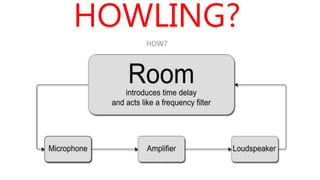
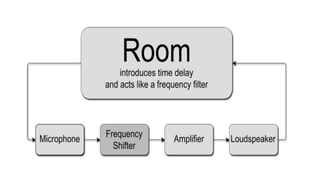
Howling occurs when there is an acoustic coupling
between a microphone and a speaker, whereby
already amplified sound finds its way back into the
amplifier through the microphone repeatedly, by
making a positive feedback loop that in a way
amplifies itself.
WHAT?
HOWLING?
HOW?
Goal
Design and Simulate a
howling suppression circuit
using the frequency shifting
method.
objectives
The aim is to design and simulate howling
suppressing circuit in a PA system, before it occurs.
Objectives:
• Design the circuit
• Simulate the circuit
• Test
METHOD USED
Frequency shifting
The frequency shifter makes sure to even out
the loudest frequency peaks, so the gain can
be turned up more, before feedback occur.
THEORY
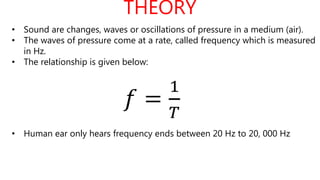
𝑓 =
1
𝑇
• Sound are changes, waves or oscillations of pressure in a medium (air).
• The waves of pressure come at a rate, called frequency which is measured
in Hz.
• The relationship is given below:
• Human ear only hears frequency ends between 20 Hz to 20, 000 Hz
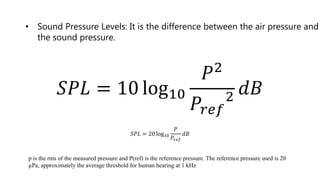
𝑆𝑃𝐿 = 10 log10
𝑃2
𝑃𝑟𝑒𝑓
2 𝑑𝐵
• Sound Pressure Levels: It is the difference between the air pressure and
the sound pressure.
𝑆𝑃𝐿 = 20 log10
𝑃
𝑃𝑟𝑒𝑓
𝑑𝐵
p is the rms of the measured pressure and P(ref) is the reference pressure. The reference pressure used is 20
µPa, approximately the average threshold for human hearing at 1 kHz
• SPL takes into account sound of all frequencies,
including both infra- and ultrasound, there is usually a
weighting of the different frequency bands involved
when measuring sound pressure level. If no weighting
is applied, the SPL measured will not reflect what we
humans perceive. Many different weighting curves
exists, and common for all of them is that frequencies
are suppressed outside the hearing range, 20 - 20,000
Hz.
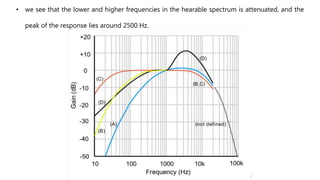
• we see that the lower and higher frequencies in the hearable spectrum is attenuated, and the
peak of the response lies around 2500 Hz.
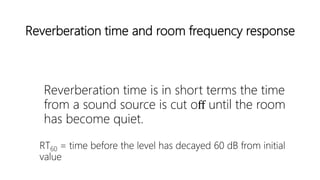
Reverberation time and room frequency response
Reverberation time is in short terms the time
from a sound source is cut off until the room
has become quiet.
RT60 = time before the level has decayed 60 dB from initial
value
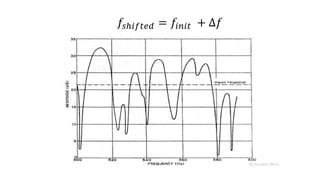
𝑓𝑠ℎ𝑖𝑓𝑡𝑒𝑑 = 𝑓𝑖𝑛𝑖𝑡 + ∆𝑓
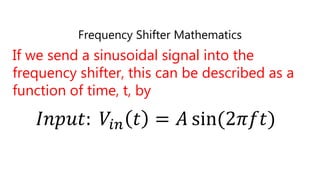
Frequency Shifter Mathematics
If we send a sinusoidal signal into the
frequency shifter, this can be described as a
function of time, t, by
𝐼𝑛𝑝𝑢𝑡: 𝑉𝑖𝑛 𝑡 = 𝐴 sin(2𝜋𝑓𝑡)
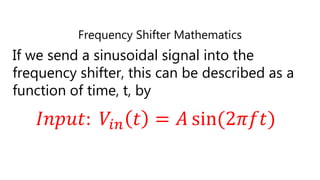
Frequency Shifter Mathematics
If we send a sinusoidal signal into the
frequency shifter, this can be described as a
function of time, t, by
𝐼𝑛𝑝𝑢𝑡: 𝑉𝑖𝑛 𝑡 = 𝐴 sin(2𝜋𝑓𝑡)
Frequency Shifter Mathematics
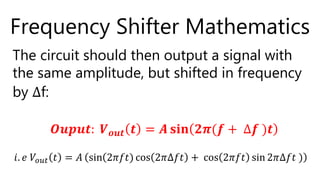
𝑶𝒖𝒑𝒖𝒕: 𝑽 𝒐𝒖𝒕 𝒕 = 𝑨 𝐬𝐢𝐧 𝟐𝝅(𝒇 + ∆𝒇 )𝒕
The circuit should then output a signal with
the same amplitude, but shifted in frequency
by ∆f:
𝑖. 𝑒 𝑉𝑜𝑢𝑡 𝑡 = 𝐴 (sin 2𝜋𝑓𝑡) cos 2𝜋∆𝑓𝑡 + cos 2𝜋𝑓𝑡 sin 2𝜋∆𝑓𝑡 )
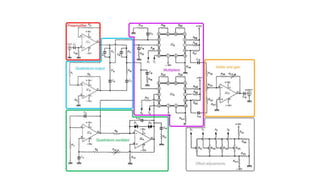
The Frequency Shifting Circuit
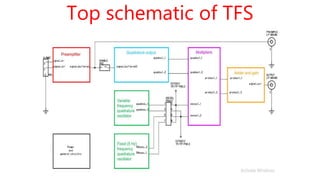
Top schematic of TFS
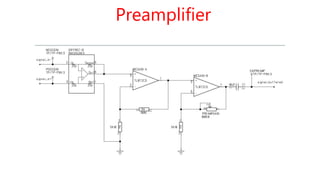
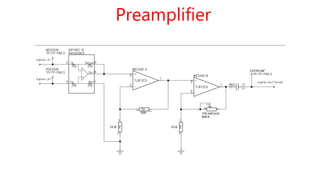
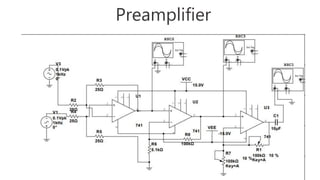
Preamplifier
Preamplifier is a sub-circuit of TFS, which two
functions:
• Convert the signal incoming balanced from the
microphone to a more manageable single
ended signal.
• Amplify input signal to match the operating
signal from the quadrature oscillator.
Preamplifier
Preamplifier
Preamplifier
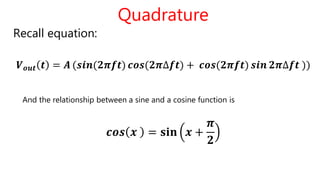
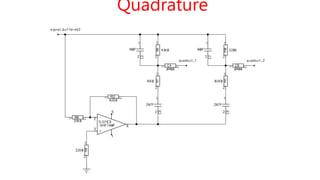
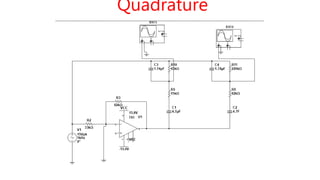
Quadrature
Recall equation:
𝑽 𝒐𝒖𝒕 𝒕 = 𝑨 (𝒔𝒊𝒏(𝟐𝝅𝒇𝒕) 𝒄𝒐𝒔(𝟐𝝅∆𝒇𝒕) + 𝒄𝒐𝒔(𝟐𝝅𝒇𝒕) 𝒔𝒊𝒏 𝟐𝝅∆𝒇𝒕 ))
𝒄𝒐𝒔 𝒙 = 𝐬𝐢𝐧 𝒙 +
𝝅
𝟐
And the relationship between a sine and a cosine function is
Quadrature
Quadrature
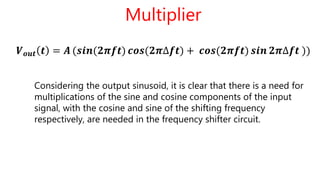
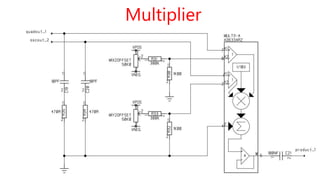
Multiplier
𝑽 𝒐𝒖𝒕 𝒕 = 𝑨 (𝒔𝒊𝒏(𝟐𝝅𝒇𝒕) 𝒄𝒐𝒔(𝟐𝝅∆𝒇𝒕) + 𝒄𝒐𝒔(𝟐𝝅𝒇𝒕) 𝒔𝒊𝒏 𝟐𝝅∆𝒇𝒕 ))
Considering the output sinusoid, it is clear that there is a need for
multiplications of the sine and cosine components of the input
signal, with the cosine and sine of the shifting frequency
respectively, are needed in the frequency shifter circuit.
Multiplier
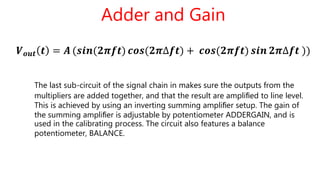
Adder and Gain
𝑽 𝒐𝒖𝒕 𝒕 = 𝑨 (𝒔𝒊𝒏(𝟐𝝅𝒇𝒕) 𝒄𝒐𝒔(𝟐𝝅∆𝒇𝒕) + 𝒄𝒐𝒔(𝟐𝝅𝒇𝒕) 𝒔𝒊𝒏 𝟐𝝅∆𝒇𝒕 ))
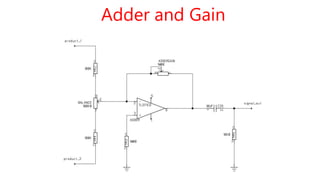
The last sub-circuit of the signal chain in makes sure the outputs from the
multipliers are added together, and that the result are amplified to line level.
This is achieved by using an inverting summing amplifier setup. The gain of
the summing amplifier is adjustable by potentiometer ADDERGAIN, and is
used in the calibrating process. The circuit also features a balance
potentiometer, BALANCE.
Adder and Gain
Problems and Future
works
• Expertise: There is a lot of knowledge to comfortably execute the project, and a lot were filled in
the course of the project.
• Software
• Electronics
• Slow design of project
• Test
• Implementation
Thank You,
for listening.

Howling noise control in public address systems

  • 1.
    Obafemi Awolowo University ElectronicAnd Electrical Department EEE 502 In Public Address Systems ADEDAPO ADEDAMOLA OLUWABUKUNMI EEG/2014/005 Howling Noise Control
  • 2.
    PA SYSTEM? DISCUSS BRIEFLY Apublic address system (PA system) is an electronic system comprising microphones, amplifiers, loudspeakers, and related equipment. It increases the apparent volume (loudness) of a human voice, musical instrument, or other acoustic sound source or recorded sound or music.
  • 3.
    HOWLING? Howling occurs whenthere is an acoustic coupling between a microphone and a speaker, whereby already amplified sound finds its way back into the amplifier through the microphone repeatedly, by making a positive feedback loop that in a way amplifies itself. WHAT?
  • 4.
  • 5.
    Goal Design and Simulatea howling suppression circuit using the frequency shifting method.
  • 6.
    objectives The aim isto design and simulate howling suppressing circuit in a PA system, before it occurs. Objectives: • Design the circuit • Simulate the circuit • Test
  • 7.
    METHOD USED Frequency shifting Thefrequency shifter makes sure to even out the loudest frequency peaks, so the gain can be turned up more, before feedback occur.
  • 9.
    THEORY 𝑓 = 1 𝑇 • Soundare changes, waves or oscillations of pressure in a medium (air). • The waves of pressure come at a rate, called frequency which is measured in Hz. • The relationship is given below: • Human ear only hears frequency ends between 20 Hz to 20, 000 Hz
  • 10.
    𝑆𝑃𝐿 = 10log10 𝑃2 𝑃𝑟𝑒𝑓 2 𝑑𝐵 • Sound Pressure Levels: It is the difference between the air pressure and the sound pressure. 𝑆𝑃𝐿 = 20 log10 𝑃 𝑃𝑟𝑒𝑓 𝑑𝐵 p is the rms of the measured pressure and P(ref) is the reference pressure. The reference pressure used is 20 µPa, approximately the average threshold for human hearing at 1 kHz
  • 11.
    • SPL takesinto account sound of all frequencies, including both infra- and ultrasound, there is usually a weighting of the different frequency bands involved when measuring sound pressure level. If no weighting is applied, the SPL measured will not reflect what we humans perceive. Many different weighting curves exists, and common for all of them is that frequencies are suppressed outside the hearing range, 20 - 20,000 Hz.
  • 12.
    • we seethat the lower and higher frequencies in the hearable spectrum is attenuated, and the peak of the response lies around 2500 Hz.
  • 13.
    Reverberation time androom frequency response Reverberation time is in short terms the time from a sound source is cut off until the room has become quiet. RT60 = time before the level has decayed 60 dB from initial value
  • 14.
  • 15.
  • 16.
    Frequency Shifter Mathematics Ifwe send a sinusoidal signal into the frequency shifter, this can be described as a function of time, t, by 𝐼𝑛𝑝𝑢𝑡: 𝑉𝑖𝑛 𝑡 = 𝐴 sin(2𝜋𝑓𝑡)
  • 17.
    Frequency Shifter Mathematics Ifwe send a sinusoidal signal into the frequency shifter, this can be described as a function of time, t, by 𝐼𝑛𝑝𝑢𝑡: 𝑉𝑖𝑛 𝑡 = 𝐴 sin(2𝜋𝑓𝑡)
  • 18.
    Frequency Shifter Mathematics 𝑶𝒖𝒑𝒖𝒕:𝑽 𝒐𝒖𝒕 𝒕 = 𝑨 𝐬𝐢𝐧 𝟐𝝅(𝒇 + ∆𝒇 )𝒕 The circuit should then output a signal with the same amplitude, but shifted in frequency by ∆f: 𝑖. 𝑒 𝑉𝑜𝑢𝑡 𝑡 = 𝐴 (sin 2𝜋𝑓𝑡) cos 2𝜋∆𝑓𝑡 + cos 2𝜋𝑓𝑡 sin 2𝜋∆𝑓𝑡 )
  • 19.
  • 20.
  • 22.
    Preamplifier Preamplifier is asub-circuit of TFS, which two functions: • Convert the signal incoming balanced from the microphone to a more manageable single ended signal. • Amplify input signal to match the operating signal from the quadrature oscillator.
  • 23.
  • 24.
  • 25.
  • 26.
    Quadrature Recall equation: 𝑽 𝒐𝒖𝒕𝒕 = 𝑨 (𝒔𝒊𝒏(𝟐𝝅𝒇𝒕) 𝒄𝒐𝒔(𝟐𝝅∆𝒇𝒕) + 𝒄𝒐𝒔(𝟐𝝅𝒇𝒕) 𝒔𝒊𝒏 𝟐𝝅∆𝒇𝒕 )) 𝒄𝒐𝒔 𝒙 = 𝐬𝐢𝐧 𝒙 + 𝝅 𝟐 And the relationship between a sine and a cosine function is
  • 27.
  • 28.
  • 29.
    Multiplier 𝑽 𝒐𝒖𝒕 𝒕= 𝑨 (𝒔𝒊𝒏(𝟐𝝅𝒇𝒕) 𝒄𝒐𝒔(𝟐𝝅∆𝒇𝒕) + 𝒄𝒐𝒔(𝟐𝝅𝒇𝒕) 𝒔𝒊𝒏 𝟐𝝅∆𝒇𝒕 )) Considering the output sinusoid, it is clear that there is a need for multiplications of the sine and cosine components of the input signal, with the cosine and sine of the shifting frequency respectively, are needed in the frequency shifter circuit.
  • 30.
  • 31.
    Adder and Gain 𝑽𝒐𝒖𝒕 𝒕 = 𝑨 (𝒔𝒊𝒏(𝟐𝝅𝒇𝒕) 𝒄𝒐𝒔(𝟐𝝅∆𝒇𝒕) + 𝒄𝒐𝒔(𝟐𝝅𝒇𝒕) 𝒔𝒊𝒏 𝟐𝝅∆𝒇𝒕 )) The last sub-circuit of the signal chain in makes sure the outputs from the multipliers are added together, and that the result are amplified to line level. This is achieved by using an inverting summing amplifier setup. The gain of the summing amplifier is adjustable by potentiometer ADDERGAIN, and is used in the calibrating process. The circuit also features a balance potentiometer, BALANCE.
  • 32.
  • 33.
    Problems and Future works •Expertise: There is a lot of knowledge to comfortably execute the project, and a lot were filled in the course of the project. • Software • Electronics • Slow design of project • Test • Implementation
  • 34.