Cotton Fiber
Properties
Azmir Latif
Cotton Fiber Properties
Cotton fiber possesses a variety of distinct
properties, and we know there are plenty of
people who want to dig a little deeper. That’s
why we’ve packed as much technical
information onto this page as humanly
possible. If you have a technical mind, then
this is probably the page you’ve been
searching for, and dreaming about.
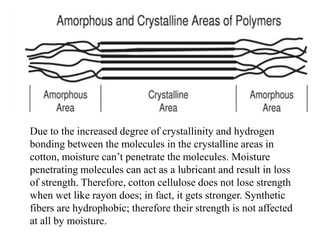
Due to the increased degree of crystallinity and hydrogen
bonding between the molecules in the crystalline areas in
cotton, moisture can’t penetrate the molecules. Moisture
penetrating molecules can act as a lubricant and result in loss
of strength. Therefore, cotton cellulose does not lose strength
when wet like rayon does; in fact, it gets stronger. Synthetic
fibers are hydrophobic; therefore their strength is not affected
at all by moisture.
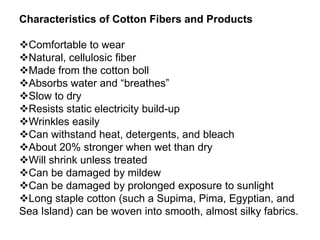
Characteristics of Cotton Fibers and Products
Comfortable to wear
Natural, cellulosic fiber
Made from the cotton boll
Absorbs water and “breathes”
Slow to dry
Resists static electricity build-up
Wrinkles easily
Can withstand heat, detergents, and bleach
About 20% stronger when wet than dry
Will shrink unless treated
Can be damaged by mildew
Can be damaged by prolonged exposure to sunlight
Long staple cotton (such a Supima, Pima, Egyptian, and
Sea Island) can be woven into smooth, almost silky fabrics.
Fiber Properties
Physical And Chemical Properties of Cotton:
Cotton fiber is a cellulosic fiber. It has
worldwide popularity for its variety of use.
Cotton fiber is the most used fibers for
producing various types of fabric through all
over the world. Cotton Fabrics are comfortable
to wear than the other fibers product. It is
comfort to wear in all the season.
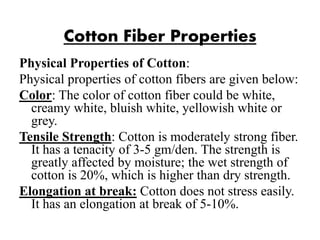
Cotton Fiber Properties
Physical Properties of Cotton:
Physical properties of cotton fibers are given below:
Color: The color of cotton fiber could be white,
creamy white, bluish white, yellowish white or
grey.
Tensile Strength: Cotton is moderately strong fiber.
It has a tenacity of 3-5 gm/den. The strength is
greatly affected by moisture; the wet strength of
cotton is 20%, which is higher than dry strength.
Elongation at break: Cotton does not stress easily.
It has an elongation at break of 5-10%.
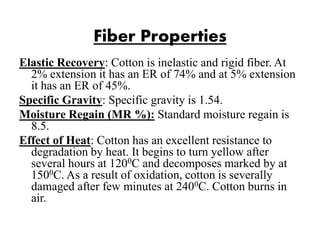
Fiber Properties
Elastic Recovery: Cotton is inelastic and rigid fiber. At
2% extension it has an ER of 74% and at 5% extension
it has an ER of 45%.
Specific Gravity: Specific gravity is 1.54.
Moisture Regain (MR %): Standard moisture regain is
8.5.
Effect of Heat: Cotton has an excellent resistance to
degradation by heat. It begins to turn yellow after
several hours at 1200C and decomposes marked by at
1500C. As a result of oxidation, cotton is severally
damaged after few minutes at 2400C. Cotton burns in
air.
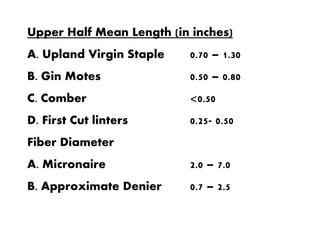
Upper Half Mean Length (in inches)
A. Upland Virgin Staple 0.70 – 1.30
B. Gin Motes 0.50 – 0.80
C. Comber <0.50
D. First Cut linters 0.25- 0.50
Fiber Diameter
A. Micronaire 2.0 – 7.0
B. Approximate Denier 0.7 – 2.5
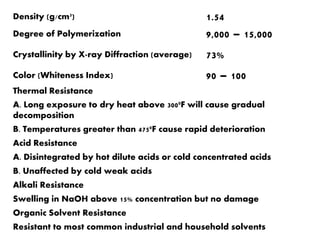
Density (g/cm3) 1.54
Degree of Polymerization 9,000 – 15,000
Crystallinity by X-ray Diffraction (average) 73%
Color (Whiteness Index) 90 – 100
Thermal Resistance
A. Long exposure to dry heat above 3000F will cause gradual
decomposition
B. Temperatures greater than 4750F cause rapid deterioration
Acid Resistance
A. Disintegrated by hot dilute acids or cold concentrated acids
B. Unaffected by cold weak acids
Alkali Resistance
Swelling in NaOH above 15% concentration but no damage
Organic Solvent Resistance
Resistant to most common industrial and household solvents
Fiber Properties
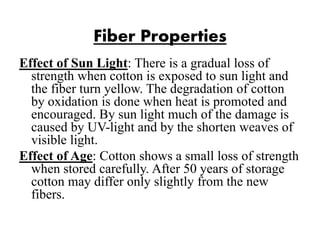
Effect of Sun Light: There is a gradual loss of
strength when cotton is exposed to sun light and
the fiber turn yellow. The degradation of cotton
by oxidation is done when heat is promoted and
encouraged. By sun light much of the damage is
caused by UV-light and by the shorten weaves of
visible light.
Effect of Age: Cotton shows a small loss of strength
when stored carefully. After 50 years of storage
cotton may differ only slightly from the new
fibers.
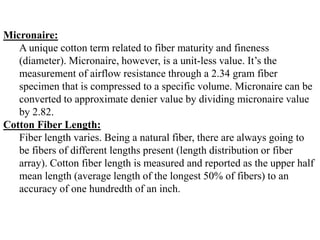
Micronaire:
A unique cotton term related to fiber maturity and fineness
(diameter). Micronaire, however, is a unit-less value. It’s the
measurement of airflow resistance through a 2.34 gram fiber
specimen that is compressed to a specific volume. Micronaire can be
converted to approximate denier value by dividing micronaire value
by 2.82.
Cotton Fiber Length:
Fiber length varies. Being a natural fiber, there are always going to
be fibers of different lengths present (length distribution or fiber
array). Cotton fiber length is measured and reported as the upper half
mean length (average length of the longest 50% of fibers) to an
accuracy of one hundredth of an inch.
Cotton Fiber Strength:
Fiber strength is measured by breaking the fibers
held between clamp jaws. It’s reported as grams per
tex, which is the force in grams required to break a
bundle of fibers one tex unit in size. A tex unit is
equal to the weight in grams of 1000 meters of
fiber.
Nep:
A nep is small tangled knot of cotton fibers. They
are produced from mechanical processing of cotton,
starting with the equipment used to pick the cotton
from the plant.
Chemical Properties of Cotton Fibre:
The main chemical characteristics of cotton fiber have
presented in the following:
Action with alkali:
Here, preventive power is good. Alkali does not damage
cotton fibre.
Action with acid:
Strong acid damage the fibres. Concentrated sulphuric acid
and hydrochloric acid damage the fibre. But weak acid does
not damage the fibre.
Action with bleaching:
No damaging event is occurred here. Cotton is converted
into oxi-cellulose in strong oxidizing bleaching.
Action with organic solvent:
Resistance so dry is possible here.
Sunlight preventive power:
Ultraviolet ray converts the cotton into oxi-
cellulose.
Mildew preventive power:
Untreated not easy. There is possibility to be
affected.
Dye ability:
Affinity to color is good. Direct, reactive, sulphur and vat
dyes are used.
Insects preventive power:
Not affected by moth.
Heat:
Conductive ironing temperature is 150°C where decompose
is 2400°C and ignition temperature is 390°C.
Cotton Fiber Properties

Cotton Fiber Properties

  • 1.
  • 2.
    Cotton Fiber Properties Cottonfiber possesses a variety of distinct properties, and we know there are plenty of people who want to dig a little deeper. That’s why we’ve packed as much technical information onto this page as humanly possible. If you have a technical mind, then this is probably the page you’ve been searching for, and dreaming about.
  • 4.
    Due to theincreased degree of crystallinity and hydrogen bonding between the molecules in the crystalline areas in cotton, moisture can’t penetrate the molecules. Moisture penetrating molecules can act as a lubricant and result in loss of strength. Therefore, cotton cellulose does not lose strength when wet like rayon does; in fact, it gets stronger. Synthetic fibers are hydrophobic; therefore their strength is not affected at all by moisture.
  • 5.
    Characteristics of CottonFibers and Products Comfortable to wear Natural, cellulosic fiber Made from the cotton boll Absorbs water and “breathes” Slow to dry Resists static electricity build-up Wrinkles easily Can withstand heat, detergents, and bleach About 20% stronger when wet than dry Will shrink unless treated Can be damaged by mildew Can be damaged by prolonged exposure to sunlight Long staple cotton (such a Supima, Pima, Egyptian, and Sea Island) can be woven into smooth, almost silky fabrics.
  • 6.
    Fiber Properties Physical AndChemical Properties of Cotton: Cotton fiber is a cellulosic fiber. It has worldwide popularity for its variety of use. Cotton fiber is the most used fibers for producing various types of fabric through all over the world. Cotton Fabrics are comfortable to wear than the other fibers product. It is comfort to wear in all the season.
  • 7.
    Cotton Fiber Properties PhysicalProperties of Cotton: Physical properties of cotton fibers are given below: Color: The color of cotton fiber could be white, creamy white, bluish white, yellowish white or grey. Tensile Strength: Cotton is moderately strong fiber. It has a tenacity of 3-5 gm/den. The strength is greatly affected by moisture; the wet strength of cotton is 20%, which is higher than dry strength. Elongation at break: Cotton does not stress easily. It has an elongation at break of 5-10%.
  • 8.
    Fiber Properties Elastic Recovery:Cotton is inelastic and rigid fiber. At 2% extension it has an ER of 74% and at 5% extension it has an ER of 45%. Specific Gravity: Specific gravity is 1.54. Moisture Regain (MR %): Standard moisture regain is 8.5. Effect of Heat: Cotton has an excellent resistance to degradation by heat. It begins to turn yellow after several hours at 1200C and decomposes marked by at 1500C. As a result of oxidation, cotton is severally damaged after few minutes at 2400C. Cotton burns in air.
  • 9.
    Upper Half MeanLength (in inches) A. Upland Virgin Staple 0.70 – 1.30 B. Gin Motes 0.50 – 0.80 C. Comber <0.50 D. First Cut linters 0.25- 0.50 Fiber Diameter A. Micronaire 2.0 – 7.0 B. Approximate Denier 0.7 – 2.5
  • 10.
    Density (g/cm3) 1.54 Degreeof Polymerization 9,000 – 15,000 Crystallinity by X-ray Diffraction (average) 73% Color (Whiteness Index) 90 – 100 Thermal Resistance A. Long exposure to dry heat above 3000F will cause gradual decomposition B. Temperatures greater than 4750F cause rapid deterioration Acid Resistance A. Disintegrated by hot dilute acids or cold concentrated acids B. Unaffected by cold weak acids Alkali Resistance Swelling in NaOH above 15% concentration but no damage Organic Solvent Resistance Resistant to most common industrial and household solvents
  • 11.
    Fiber Properties Effect ofSun Light: There is a gradual loss of strength when cotton is exposed to sun light and the fiber turn yellow. The degradation of cotton by oxidation is done when heat is promoted and encouraged. By sun light much of the damage is caused by UV-light and by the shorten weaves of visible light. Effect of Age: Cotton shows a small loss of strength when stored carefully. After 50 years of storage cotton may differ only slightly from the new fibers.
  • 12.
    Micronaire: A unique cottonterm related to fiber maturity and fineness (diameter). Micronaire, however, is a unit-less value. It’s the measurement of airflow resistance through a 2.34 gram fiber specimen that is compressed to a specific volume. Micronaire can be converted to approximate denier value by dividing micronaire value by 2.82. Cotton Fiber Length: Fiber length varies. Being a natural fiber, there are always going to be fibers of different lengths present (length distribution or fiber array). Cotton fiber length is measured and reported as the upper half mean length (average length of the longest 50% of fibers) to an accuracy of one hundredth of an inch.
  • 13.
    Cotton Fiber Strength: Fiberstrength is measured by breaking the fibers held between clamp jaws. It’s reported as grams per tex, which is the force in grams required to break a bundle of fibers one tex unit in size. A tex unit is equal to the weight in grams of 1000 meters of fiber. Nep: A nep is small tangled knot of cotton fibers. They are produced from mechanical processing of cotton, starting with the equipment used to pick the cotton from the plant.
  • 14.
    Chemical Properties ofCotton Fibre: The main chemical characteristics of cotton fiber have presented in the following: Action with alkali: Here, preventive power is good. Alkali does not damage cotton fibre. Action with acid: Strong acid damage the fibres. Concentrated sulphuric acid and hydrochloric acid damage the fibre. But weak acid does not damage the fibre. Action with bleaching: No damaging event is occurred here. Cotton is converted into oxi-cellulose in strong oxidizing bleaching.
  • 15.
    Action with organicsolvent: Resistance so dry is possible here. Sunlight preventive power: Ultraviolet ray converts the cotton into oxi- cellulose. Mildew preventive power: Untreated not easy. There is possibility to be affected.
  • 16.
    Dye ability: Affinity tocolor is good. Direct, reactive, sulphur and vat dyes are used. Insects preventive power: Not affected by moth. Heat: Conductive ironing temperature is 150°C where decompose is 2400°C and ignition temperature is 390°C.