1
VoWLAN: Call Quality
September 2015
Brendan Kearns
2
Eir is former incumbent in Ireland
Quad Play Operator, number 1 in fixed and two in mobile
IMS in place for Enterprise
SIP Trunking & Hosted Office
Next is VoWLAN and VoLTE
Our aim is to maximise voice quality where we can
We are considering implementation VoWLAN QOS in the home network
We have tested VoWLAN quality in the Lab and field
My own perspective
M.ENG Thesis on VoWLAN in 2006
First experimental study on the effectiveness of 802.11e
Context: VoWLAN Eir
2
3
How good can VoWLAN quality be and what degrades it?
Describe WLAN contention and its problems
Does QOS on WLAN work? experiments in the Lab and the
home
WLAN QOS design
Conclusions
Contents
3
4
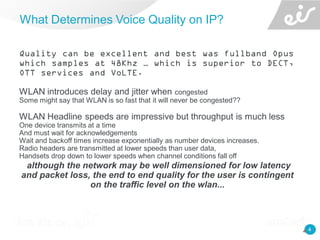
Quality can be excellent and best was fullband Opus
which samples at 48Khz … which is superior to DECT,
OTT services and VoLTE.
WLAN introduces delay and jitter when congested
Some might say that WLAN is so fast that it will never be congested??
WLAN Headline speeds are impressive but throughput is much less
One device transmits at a time
And must wait for acknowledgements
Wait and backoff times increase exponentially as number devices increases.
Radio headers are transmitted at lower speeds than user data,
Handsets drop down to lower speeds when channel conditions fall off
What Determines Voice Quality on IP?
4
although the network may be well dimensioned for low latency
and packet loss, the end to end quality for the user is contingent
on the traffic level on the wlan...
5
802.11 Operation no
QOS
And With QOS
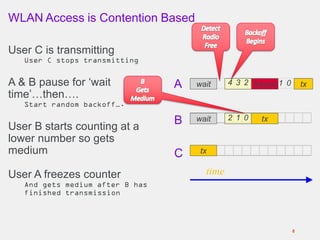
WLAN Access is Contention Based
User C is transmitting
User C stops transmitting
A & B pause for ‘wait
time’…then….
Start random backoff….
User B starts counting at a
lower number so gets
medium
User A freezes counter
And gets medium after B has
finished transmission
6
tx
wait
wait
tx
freeze 1 0 tx
2
4
1
3
0
2
time
A
B
C
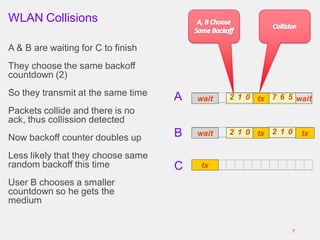
WLAN Collisions
A & B are waiting for C to finish
They choose the same backoff
countdown (2)
So they transmit at the same time
Packets collide and there is no
ack, thus collission detected
Now backoff counter doubles up
Less likely that they choose same
random backoff this time
User B chooses a smaller
countdown so he gets the
medium
7
tx
wait
wait
tx tx
2 1 0
2 1 0
tx 7 6 5
2 1 0
waitA
B
C
8
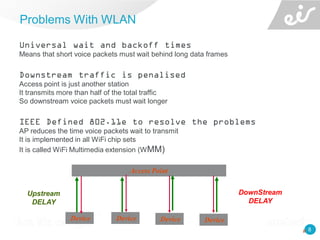
Universal wait and backoff times
Means that short voice packets must wait behind long data frames
Downstream traffic is penalised
Access point is just another station
It transmits more than half of the total traffic
So downstream voice packets must wait longer
IEEE Defined 802.11e to resolve the problems
AP reduces the time voice packets wait to transmit
It is implemented in all WiFi chip sets
It is called WiFi Multimedia extension (WMM)
Problems With WLAN
8
Upstream
DELAY
DownStream
DELAY
Device
Access Point
Device Device Device
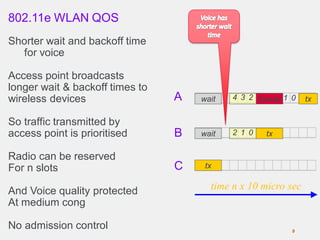
802.11e WLAN QOS
Shorter wait and backoff time
for voice
Access point broadcasts
longer wait & backoff times to
wireless devices
So traffic transmitted by
access point is prioritised
Radio can be reserved
For n slots
And Voice quality protected
At medium cong
No admission control 9
tx
wait
wait
tx
freeze 1 0 tx
2
4
1
3
0
2
time n x 10 micro sec
A
B
C
1
0
Experiments in the LAB
Simulated RTP Flows with background UDP & TCP Load
Extremly Accurate Latency, Jitter, Packet Loss Measurement
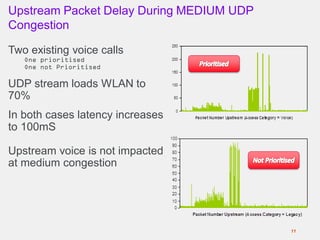
Upstream Packet Delay During MEDIUM UDP
Congestion
Two existing voice calls
One prioritised
One not Prioritised
UDP stream loads WLAN to
70%
In both cases latency increases
to 100mS
Upstream voice is not impacted
at medium congestion
11
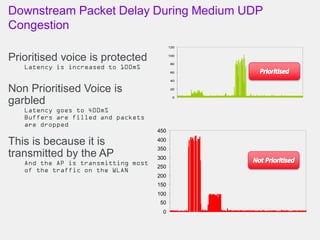
Downstream Packet Delay During Medium UDP
Congestion
Prioritised voice is protected
Latency is increased to 100mS
Non Prioritised Voice is
garbled
Latency goes to 400mS
Buffers are filled and packets
are dropped
This is because it is
transmitted by the AP
And the AP is transmitting most
of the traffic on the WLAN
0
50
100
150
200
250
300
350
400
450
0
20
40
60
80
100
120
1
3
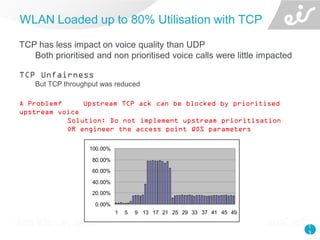
TCP has less impact on voice quality than UDP
Both prioritised and non prioritised voice calls were little impacted
TCP Unfairness
But TCP throughput was reduced
A Problem? Upstream TCP ack can be blocked by prioritised
upstream voice
Solution: Do not implement upstream prioritisation
OR engineer the access point QOS parameters
WLAN Loaded up to 80% Utilisation with TCP
0.00%
20.00%
40.00%
60.00%
80.00%
100.00%
1 5 9 13 17 21 25 29 33 37 41 45 49
1
4
WLAN QOS in the Home
Inject known audio stream into active call
Audio received compared with original
Gives accurate quality score
UDP, TCP load generated with iPerf or torrent
1
5
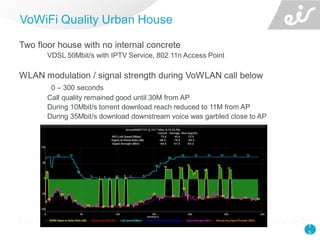
Two floor house with no internal concrete
VDSL 50Mbit/s with IPTV Service, 802.11n Access Point
WLAN modulation / signal strength during VoWLAN call below
0 – 300 seconds
Call quality remained good until 30M from AP
During 10Mbit/s torrent download reach reduced to 11M from AP
During 35Mbit/s download downstream voice was garbled close to AP
VoWiFi Quality Urban House
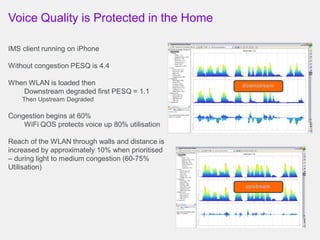
Voice Quality is Protected in the Home
IMS client running on iPhone
Without congestion PESQ is 4.4
When WLAN is loaded then
Downstream degraded first PESQ = 1.1
Then Upstream Degraded
Congestion begins at 60%
WiFi QOS protects voice up 80% utilisation
Reach of the WLAN through walls and distance is
increased by approximately 10% when prioritised
– during light to medium congestion (60-75%
Utilisation)
downstream
upstream
1
7
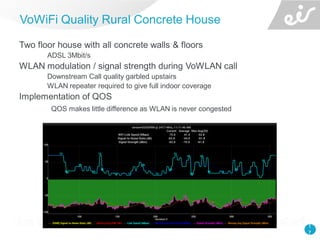
Two floor house with all concrete walls & floors
ADSL 3Mbit/s
WLAN modulation / signal strength during VoWLAN call
Downstream Call quality garbled upstairs
WLAN repeater required to give full indoor coverage
Implementation of QOS
QOS makes little difference as WLAN is never congested
VoWiFi Quality Rural Concrete House
1
8
Deployment of QOS in
The Home
1
9
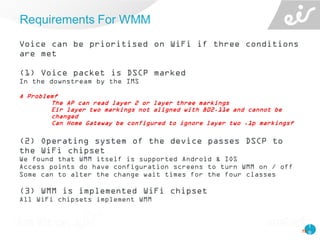
Voice can be prioritised on WiFi if three conditions
are met
(1) Voice packet is DSCP marked
In the downstream by the IMS
A Problem?
The AP can read layer 2 or layer three markings
Eir layer two markings not aligned with 802.11e and cannot be
changed
Can Home Gateway be configured to ignore layer two .1p markings?
(2) Operating system of the device passes DSCP to
the WiFi chipset
We found that WMM itself is supported Android & IOS
Access points do have configuration screens to turn WMM on / off
Some can to alter the change wait times for the four classes
(3) WMM is implemented WiFi chipset
All WiFi chipsets implement WMM
Requirements For WMM
19
2
0
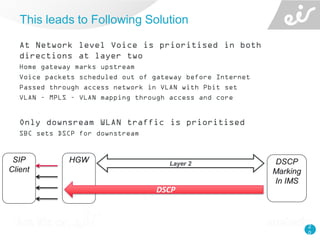
At Network level Voice is prioritised in both
directions at layer two
Home gateway marks upstream
Voice packets scheduled out of gateway before Internet
Passed through access network in VLAN with Pbit set
VLAN – MPLS – VLAN mapping through access and core
Only downsream WLAN traffic is prioritised
SBC sets DSCP for downstream
This leads to Following Solution
HGW
7750
7750
DSCP
Marking
In IMS
Layer 2
DSCP
SIP
Client
2
1
Conclusion
2
2
Turning on WMM at access point provides significant
protection for voice traffic against competing wireless
data traffic
Turning on WMM at the client makes only a small
difference where there are a small number of clients on
the wireless LAN. This plus the “TCP Unfairness”
problem means that it can be omitted.
All Home gateways support WMM but their firmware may
need to be altered to prioritise on DSCP rather than
layer two
Conclusion
22
2
3
Extra Slides
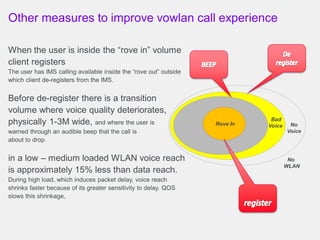
Other measures to improve vowlan call experience
When the user is inside the “rove in” volume
client registers
The user has IMS calling available inside the “rove out” outside
which client de-registers from the IMS.
Before de-register there is a transition
volume where voice quality deteriorates,
physically 1-3M wide, and where the user is
warned through an audible beep that the call is
about to drop.
in a low – medium loaded WLAN voice reach
is approximately 15% less than data reach.
During high load, which induces packet delay, voice reach
shrinks faster because of its greater sensitivity to delay. QOS
slows this shrinkage,
Rove In
Bad
Voice No
Voice
No
WLAN

VoWLAN: Call Quality

  • 1.
  • 2.
    2 Eir is formerincumbent in Ireland Quad Play Operator, number 1 in fixed and two in mobile IMS in place for Enterprise SIP Trunking & Hosted Office Next is VoWLAN and VoLTE Our aim is to maximise voice quality where we can We are considering implementation VoWLAN QOS in the home network We have tested VoWLAN quality in the Lab and field My own perspective M.ENG Thesis on VoWLAN in 2006 First experimental study on the effectiveness of 802.11e Context: VoWLAN Eir 2
  • 3.
    3 How good canVoWLAN quality be and what degrades it? Describe WLAN contention and its problems Does QOS on WLAN work? experiments in the Lab and the home WLAN QOS design Conclusions Contents 3
  • 4.
    4 Quality can beexcellent and best was fullband Opus which samples at 48Khz … which is superior to DECT, OTT services and VoLTE. WLAN introduces delay and jitter when congested Some might say that WLAN is so fast that it will never be congested?? WLAN Headline speeds are impressive but throughput is much less One device transmits at a time And must wait for acknowledgements Wait and backoff times increase exponentially as number devices increases. Radio headers are transmitted at lower speeds than user data, Handsets drop down to lower speeds when channel conditions fall off What Determines Voice Quality on IP? 4 although the network may be well dimensioned for low latency and packet loss, the end to end quality for the user is contingent on the traffic level on the wlan...
  • 5.
  • 6.
    WLAN Access isContention Based User C is transmitting User C stops transmitting A & B pause for ‘wait time’…then…. Start random backoff…. User B starts counting at a lower number so gets medium User A freezes counter And gets medium after B has finished transmission 6 tx wait wait tx freeze 1 0 tx 2 4 1 3 0 2 time A B C
  • 7.
    WLAN Collisions A &B are waiting for C to finish They choose the same backoff countdown (2) So they transmit at the same time Packets collide and there is no ack, thus collission detected Now backoff counter doubles up Less likely that they choose same random backoff this time User B chooses a smaller countdown so he gets the medium 7 tx wait wait tx tx 2 1 0 2 1 0 tx 7 6 5 2 1 0 waitA B C
  • 8.
    8 Universal wait andbackoff times Means that short voice packets must wait behind long data frames Downstream traffic is penalised Access point is just another station It transmits more than half of the total traffic So downstream voice packets must wait longer IEEE Defined 802.11e to resolve the problems AP reduces the time voice packets wait to transmit It is implemented in all WiFi chip sets It is called WiFi Multimedia extension (WMM) Problems With WLAN 8 Upstream DELAY DownStream DELAY Device Access Point Device Device Device
  • 9.
    802.11e WLAN QOS Shorterwait and backoff time for voice Access point broadcasts longer wait & backoff times to wireless devices So traffic transmitted by access point is prioritised Radio can be reserved For n slots And Voice quality protected At medium cong No admission control 9 tx wait wait tx freeze 1 0 tx 2 4 1 3 0 2 time n x 10 micro sec A B C
  • 10.
    1 0 Experiments in theLAB Simulated RTP Flows with background UDP & TCP Load Extremly Accurate Latency, Jitter, Packet Loss Measurement
  • 11.
    Upstream Packet DelayDuring MEDIUM UDP Congestion Two existing voice calls One prioritised One not Prioritised UDP stream loads WLAN to 70% In both cases latency increases to 100mS Upstream voice is not impacted at medium congestion 11
  • 12.
    Downstream Packet DelayDuring Medium UDP Congestion Prioritised voice is protected Latency is increased to 100mS Non Prioritised Voice is garbled Latency goes to 400mS Buffers are filled and packets are dropped This is because it is transmitted by the AP And the AP is transmitting most of the traffic on the WLAN 0 50 100 150 200 250 300 350 400 450 0 20 40 60 80 100 120
  • 13.
    1 3 TCP has lessimpact on voice quality than UDP Both prioritised and non prioritised voice calls were little impacted TCP Unfairness But TCP throughput was reduced A Problem? Upstream TCP ack can be blocked by prioritised upstream voice Solution: Do not implement upstream prioritisation OR engineer the access point QOS parameters WLAN Loaded up to 80% Utilisation with TCP 0.00% 20.00% 40.00% 60.00% 80.00% 100.00% 1 5 9 13 17 21 25 29 33 37 41 45 49
  • 14.
    1 4 WLAN QOS inthe Home Inject known audio stream into active call Audio received compared with original Gives accurate quality score UDP, TCP load generated with iPerf or torrent
  • 15.
    1 5 Two floor housewith no internal concrete VDSL 50Mbit/s with IPTV Service, 802.11n Access Point WLAN modulation / signal strength during VoWLAN call below 0 – 300 seconds Call quality remained good until 30M from AP During 10Mbit/s torrent download reach reduced to 11M from AP During 35Mbit/s download downstream voice was garbled close to AP VoWiFi Quality Urban House
  • 16.
    Voice Quality isProtected in the Home IMS client running on iPhone Without congestion PESQ is 4.4 When WLAN is loaded then Downstream degraded first PESQ = 1.1 Then Upstream Degraded Congestion begins at 60% WiFi QOS protects voice up 80% utilisation Reach of the WLAN through walls and distance is increased by approximately 10% when prioritised – during light to medium congestion (60-75% Utilisation) downstream upstream
  • 17.
    1 7 Two floor housewith all concrete walls & floors ADSL 3Mbit/s WLAN modulation / signal strength during VoWLAN call Downstream Call quality garbled upstairs WLAN repeater required to give full indoor coverage Implementation of QOS QOS makes little difference as WLAN is never congested VoWiFi Quality Rural Concrete House
  • 18.
  • 19.
    1 9 Voice can beprioritised on WiFi if three conditions are met (1) Voice packet is DSCP marked In the downstream by the IMS A Problem? The AP can read layer 2 or layer three markings Eir layer two markings not aligned with 802.11e and cannot be changed Can Home Gateway be configured to ignore layer two .1p markings? (2) Operating system of the device passes DSCP to the WiFi chipset We found that WMM itself is supported Android & IOS Access points do have configuration screens to turn WMM on / off Some can to alter the change wait times for the four classes (3) WMM is implemented WiFi chipset All WiFi chipsets implement WMM Requirements For WMM 19
  • 20.
    2 0 At Network levelVoice is prioritised in both directions at layer two Home gateway marks upstream Voice packets scheduled out of gateway before Internet Passed through access network in VLAN with Pbit set VLAN – MPLS – VLAN mapping through access and core Only downsream WLAN traffic is prioritised SBC sets DSCP for downstream This leads to Following Solution HGW 7750 7750 DSCP Marking In IMS Layer 2 DSCP SIP Client
  • 21.
  • 22.
    2 2 Turning on WMMat access point provides significant protection for voice traffic against competing wireless data traffic Turning on WMM at the client makes only a small difference where there are a small number of clients on the wireless LAN. This plus the “TCP Unfairness” problem means that it can be omitted. All Home gateways support WMM but their firmware may need to be altered to prioritise on DSCP rather than layer two Conclusion 22
  • 23.
  • 24.
    Other measures toimprove vowlan call experience When the user is inside the “rove in” volume client registers The user has IMS calling available inside the “rove out” outside which client de-registers from the IMS. Before de-register there is a transition volume where voice quality deteriorates, physically 1-3M wide, and where the user is warned through an audible beep that the call is about to drop. in a low – medium loaded WLAN voice reach is approximately 15% less than data reach. During high load, which induces packet delay, voice reach shrinks faster because of its greater sensitivity to delay. QOS slows this shrinkage, Rove In Bad Voice No Voice No WLAN