Horror movie opening sequence
audience research
We had 50 responses to our 10
questions, these are our results
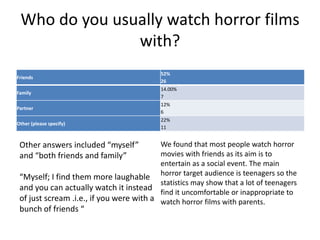
Who do you usually watch horror films
with?
Friends
52%
26
Family
14.00%
7
Partner
12%
6
Other (please specify)
22%
11
Other answers included “myself”
and “both friends and family”
“Myself; I find them more laughable
and you can actually watch it instead
of just scream .i.e., if you were with a
bunch of friends “
We found that most people watch horror
movies with friends as its aim is to
entertain as a social event. The main
horror target audience is teenagers so the
statistics may show that a lot of teenagers
find it uncomfortable or inappropriate to
watch horror films with parents.
What is more important in a horror
film?
Thrill
24%
12
Storyline
30%
15
Characters
4%
2
Music
0%
0
Tension
34%
17
Gore & violence
2%
1
Other (please specify)
6%
3
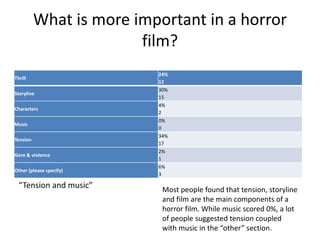
“Tension and music” Most people found that tension, storyline
and film are the main components of a
horror film. While music scored 0%, a lot
of people suggested tension coupled
with music in the “other” section.
Who do you usually expect to be the
protagonist of a horror film?
Boy
52%
26
Girl
48%
24
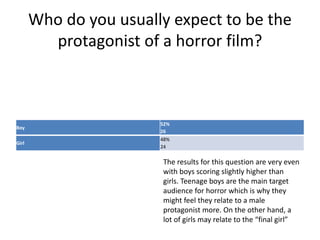
The results for this question are very even
with boys scoring slightly higher than
girls. Teenage boys are the main target
audience for horror which is why they
might feel they relate to a male
protagonist more. On the other hand, a
lot of girls may relate to the “final girl”
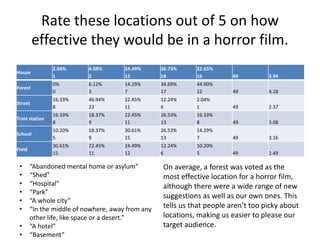
Rate these locations out of 5 on how
effective they would be in a horror film.
House
2.04%
1
4.08%
2
24.49%
12
36.73%
18
32.65%
16 49 3.94
Forest
0%
0
6.12%
3
14.29%
7
34.69%
17
44.90%
22 49 4.18
Street
16.33%
8
46.94%
23
22.45%
11
12.24%
6
2.04%
1 49 2.37
Train station
16.33%
8
18.37%
9
22.45%
11
26.53%
13
16.33%
8 49 3.08
School
10.20%
5
18.37%
9
30.61%
15
26.53%
13
14.29%
7 49 3.16
Field
30.61%
15
22.45%
11
24.49%
12
12.24%
6
10.20%
5 49 2.49
• “Abandoned mental home or asylum”
• “Shed”
• “Hospital”
• “Park”
• “A whole city”
• “In the middle of nowhere, away from any
other life, like space or a desert.”
• “A hotel”
• “Basement”
On average, a forest was voted as the
most effective location for a horror film,
although there were a wide range of new
suggestions as well as our own ones. This
tells us that people aren’t too picky about
locations, making us easier to please our
target audience.
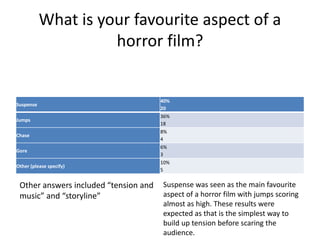
What is your favourite aspect of a
horror film?
Suspense
40%
20
Jumps
36%
18
Chase
8%
4
Gore
6%
3
Other (please specify)
10%
5
Other answers included “tension and
music” and “storyline”
Suspense was seen as the main favourite
aspect of a horror film with jumps scoring
almost as high. These results were
expected as that is the simplest way to
build up tension before scaring the
audience.
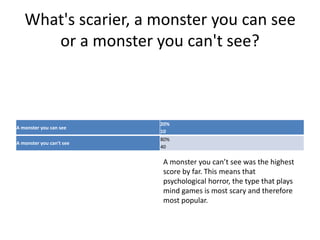
What's scarier, a monster you can see
or a monster you can't see?
A monster you can see
20%
10
A monster you can't see
80%
40
A monster you can’t see was the highest
score by far. This means that
psychological horror, the type that plays
mind games is most scary and therefore
most popular.
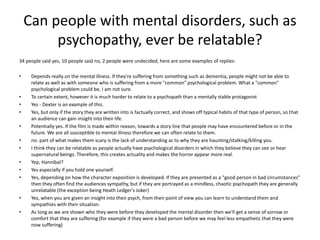
Can people with mental disorders, such as
psychopathy, ever be relatable?
34 people said yes, 10 people said no, 2 people were undecided, here are some examples of replies:
• Depends really on the mental illness. If they're suffering from something such as dementia, people might not be able to
relate as well as with someone who is suffering from a more "common" psychological problem. What a "common"
psychological problem could be, I am not sure.
• To certain extent, however it is much harder to relate to a psychopath than a mentally stable protagonist
• Yes - Dexter is an example of this.
• Yes, but only if the story they are written into is factually correct, and shows off typical habits of that type of person, so that
an audience can gain insight into their life.
• Potentially yes. If the film is made within reason, towards a story line that people may have encountered before or in the
future. We are all susceptible to mental illness therefore we can often relate to them.
• no. part of what makes them scary is the lack of understanding as to why they are haunting/stalking/killing you.
• I think they can be relatable as people actually have psychological disorders in which they believe they can see or hear
supernatural beings. Therefore, this creates actuality and makes the horror appear more real.
• Yep, Hannibal?
• Yes especially if you hold one yourself.
• Yes, depending on how the character exposition is developed. If they are presented as a "good person in bad circumstances"
then they often find the audiences sympathy, but if they are portrayed as a mindless, chaotic psychopath they are generally
unrelatable (the exception being Heath Ledger's Joker)
• Yes, when you are given an insight into their psych, from their point of view you can learn to understand them and
sympathies with their situation.
• As long as we are shown who they were before they developed the mental disorder then we'll get a sense of sorrow or
comfort that they are suffering (for example if they were a bad person before we may feel less empathetic that they were
now suffering)
What scares you the most?
Here are some examples of replies:
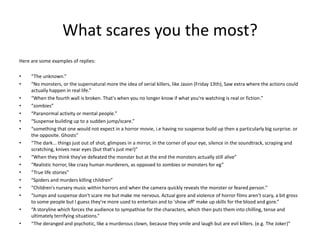
• “The unknown.”
• “No monsters, or the supernatural more the idea of serial killers, like Jason (Friday 13th), Saw extra where the actions could
actually happen in real life.”
• “When the fourth wall is broken. That's when you no longer know if what you're watching is real or fiction.”
• “zombies”
• “Paranormal activity or mental people.”
• “Suspense building up to a sudden jump/scare.”
• “something that one would not expect in a horror movie, i.e having no suspense build up then a particularly big surprise. or
the opposite. Ghosts”
• “The dark... things just out of shot, glimpses in a mirror, in the corner of your eye, silence in the soundtrack, scraping and
scratching, knives near eyes (but that's just me!)”
• “When they think they've defeated the monster but at the end the monsters actually still alive”
• “Realistic horror, like crazy human murderers, as opposed to zombies or monsters for eg”
• “True life stories”
• “Spiders and murders killing children”
• “Children's nursery music within horrors and when the camera quickly reveals the monster or feared person.”
• “Jumps and suspense don't scare me but make me nervous. Actual gore and violence of horror films aren't scary, a bit gross
to some people but I guess they're more used to entertain and to 'show off' make up skills for the blood and gore.”
• “A storyline which forces the audience to sympathise for the characters, which then puts them into chilling, tense and
ultimately terrifying situations.”
• “The deranged and psychotic, like a murderous clown, because they smile and laugh but are evil killers. (e.g. The Joker)”
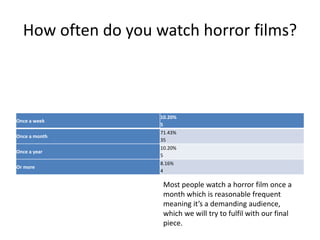
How often do you watch horror films?
Once a week
10.20%
5
Once a month
71.43%
35
Once a year
10.20%
5
Or more
8.16%
4
Most people watch a horror film once a
month which is reasonable frequent
meaning it’s a demanding audience,
which we will try to fulfil with our final
piece.

Horror movie audience research

  • 1.
    Horror movie openingsequence audience research We had 50 responses to our 10 questions, these are our results
  • 2.
    Who do youusually watch horror films with? Friends 52% 26 Family 14.00% 7 Partner 12% 6 Other (please specify) 22% 11 Other answers included “myself” and “both friends and family” “Myself; I find them more laughable and you can actually watch it instead of just scream .i.e., if you were with a bunch of friends “ We found that most people watch horror movies with friends as its aim is to entertain as a social event. The main horror target audience is teenagers so the statistics may show that a lot of teenagers find it uncomfortable or inappropriate to watch horror films with parents.
  • 3.
    What is moreimportant in a horror film? Thrill 24% 12 Storyline 30% 15 Characters 4% 2 Music 0% 0 Tension 34% 17 Gore & violence 2% 1 Other (please specify) 6% 3 “Tension and music” Most people found that tension, storyline and film are the main components of a horror film. While music scored 0%, a lot of people suggested tension coupled with music in the “other” section.
  • 4.
    Who do youusually expect to be the protagonist of a horror film? Boy 52% 26 Girl 48% 24 The results for this question are very even with boys scoring slightly higher than girls. Teenage boys are the main target audience for horror which is why they might feel they relate to a male protagonist more. On the other hand, a lot of girls may relate to the “final girl”
  • 5.
    Rate these locationsout of 5 on how effective they would be in a horror film. House 2.04% 1 4.08% 2 24.49% 12 36.73% 18 32.65% 16 49 3.94 Forest 0% 0 6.12% 3 14.29% 7 34.69% 17 44.90% 22 49 4.18 Street 16.33% 8 46.94% 23 22.45% 11 12.24% 6 2.04% 1 49 2.37 Train station 16.33% 8 18.37% 9 22.45% 11 26.53% 13 16.33% 8 49 3.08 School 10.20% 5 18.37% 9 30.61% 15 26.53% 13 14.29% 7 49 3.16 Field 30.61% 15 22.45% 11 24.49% 12 12.24% 6 10.20% 5 49 2.49 • “Abandoned mental home or asylum” • “Shed” • “Hospital” • “Park” • “A whole city” • “In the middle of nowhere, away from any other life, like space or a desert.” • “A hotel” • “Basement” On average, a forest was voted as the most effective location for a horror film, although there were a wide range of new suggestions as well as our own ones. This tells us that people aren’t too picky about locations, making us easier to please our target audience.
  • 6.
    What is yourfavourite aspect of a horror film? Suspense 40% 20 Jumps 36% 18 Chase 8% 4 Gore 6% 3 Other (please specify) 10% 5 Other answers included “tension and music” and “storyline” Suspense was seen as the main favourite aspect of a horror film with jumps scoring almost as high. These results were expected as that is the simplest way to build up tension before scaring the audience.
  • 7.
    What's scarier, amonster you can see or a monster you can't see? A monster you can see 20% 10 A monster you can't see 80% 40 A monster you can’t see was the highest score by far. This means that psychological horror, the type that plays mind games is most scary and therefore most popular.
  • 8.
    Can people withmental disorders, such as psychopathy, ever be relatable? 34 people said yes, 10 people said no, 2 people were undecided, here are some examples of replies: • Depends really on the mental illness. If they're suffering from something such as dementia, people might not be able to relate as well as with someone who is suffering from a more "common" psychological problem. What a "common" psychological problem could be, I am not sure. • To certain extent, however it is much harder to relate to a psychopath than a mentally stable protagonist • Yes - Dexter is an example of this. • Yes, but only if the story they are written into is factually correct, and shows off typical habits of that type of person, so that an audience can gain insight into their life. • Potentially yes. If the film is made within reason, towards a story line that people may have encountered before or in the future. We are all susceptible to mental illness therefore we can often relate to them. • no. part of what makes them scary is the lack of understanding as to why they are haunting/stalking/killing you. • I think they can be relatable as people actually have psychological disorders in which they believe they can see or hear supernatural beings. Therefore, this creates actuality and makes the horror appear more real. • Yep, Hannibal? • Yes especially if you hold one yourself. • Yes, depending on how the character exposition is developed. If they are presented as a "good person in bad circumstances" then they often find the audiences sympathy, but if they are portrayed as a mindless, chaotic psychopath they are generally unrelatable (the exception being Heath Ledger's Joker) • Yes, when you are given an insight into their psych, from their point of view you can learn to understand them and sympathies with their situation. • As long as we are shown who they were before they developed the mental disorder then we'll get a sense of sorrow or comfort that they are suffering (for example if they were a bad person before we may feel less empathetic that they were now suffering)
  • 9.
    What scares youthe most? Here are some examples of replies: • “The unknown.” • “No monsters, or the supernatural more the idea of serial killers, like Jason (Friday 13th), Saw extra where the actions could actually happen in real life.” • “When the fourth wall is broken. That's when you no longer know if what you're watching is real or fiction.” • “zombies” • “Paranormal activity or mental people.” • “Suspense building up to a sudden jump/scare.” • “something that one would not expect in a horror movie, i.e having no suspense build up then a particularly big surprise. or the opposite. Ghosts” • “The dark... things just out of shot, glimpses in a mirror, in the corner of your eye, silence in the soundtrack, scraping and scratching, knives near eyes (but that's just me!)” • “When they think they've defeated the monster but at the end the monsters actually still alive” • “Realistic horror, like crazy human murderers, as opposed to zombies or monsters for eg” • “True life stories” • “Spiders and murders killing children” • “Children's nursery music within horrors and when the camera quickly reveals the monster or feared person.” • “Jumps and suspense don't scare me but make me nervous. Actual gore and violence of horror films aren't scary, a bit gross to some people but I guess they're more used to entertain and to 'show off' make up skills for the blood and gore.” • “A storyline which forces the audience to sympathise for the characters, which then puts them into chilling, tense and ultimately terrifying situations.” • “The deranged and psychotic, like a murderous clown, because they smile and laugh but are evil killers. (e.g. The Joker)”
  • 10.
    How often doyou watch horror films? Once a week 10.20% 5 Once a month 71.43% 35 Once a year 10.20% 5 Or more 8.16% 4 Most people watch a horror film once a month which is reasonable frequent meaning it’s a demanding audience, which we will try to fulfil with our final piece.