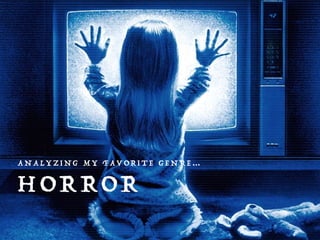
HOR R OR
A NA LY Z I NG M Y FAVOR I T E G E N R E …
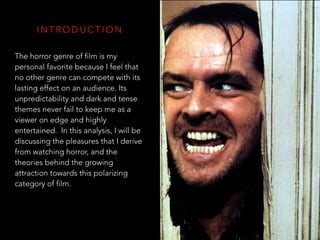
I N T R O D U C T I O N
The horror genre of film is my
personal favorite because I feel that
no other genre can compete with its
lasting effect on an audience. Its
unpredictability and dark and tense
themes never fail to keep me as a
viewer on edge and highly
entertained. In this analysis, I will be
discussing the pleasures that I derive
from watching horror, and the
theories behind the growing
attraction towards this polarizing
category of film.
There is something about horror that directly addresses and reaches out to the instinctive human animal. Since
the dawn of man the instinct of survival has been ingrained into our evolutionary psychology, resulting in
hundreds of fear triggers - some general, some more personal. Research done by Nobuo Masataka show that
children as young as 3 have an easier time spotting snakes on a computer screen than they do spotting flowers.
This study indicates the natural enthrallment of fear and awareness of danger. Common instinctive fears are the
building blocks of the horror movie spectrum and they include;
• Fear of the unknown - incorporated by darkness and silence. An example

in the media being the scene in Insidious 2 when the main protagonist

ravels into ‘The Further’, a mysterious parallel world that holds the wan-

derers deepest and darkest fears lurking in the shadows.
• Fear of competitors - incorporated by larger, stronger animals or a higher

power. An example of this being the possession of Regan MacNeil in the

1973 hit - The Exorcist. The demon inside of Regan transforms her into a

savage and evil beast and a threat to those around her.
• Fear of physical and emotional pain - incorporated by slasher and

psychologically disturbing horror scenes. An example of this in a horror film

being the backbone of the Saw franchise, which revolves around the main 

antagonist’s (Jigsaw’s) prisoners having to perform unspeakable acts of 

violence upon themselves to get out of his grasp alive.
OUR FASCINATION WITH FRIGHT
Before horror fans like myself can begin to understand why we find this genre so
attractive, we must establish what the allure of horror fundamentally is. Psychologist
Dr. Glenn D. Walters identifies three prime factors of the horror allure as:
• Tension - created through mystery, suspense, shock and terror. This is the basic
elements of horror films usually conveyed from the textual feature of misé-en-scene.
• Relevance - created through capturing universal subjects like death, cultural and social
issues. This allows the audience to receive the gratification of Personal Identification,
meaning they can relate to the plot and see themselves reflected in the characters.
• Unrealism - often referred to as Escapism within the Audience Uses and Gratifications
model. This is created through fantasy worlds and inhuman monsters and offers an
immersive feature to the audience allowing them to escape the existing reality of
everyday issues.
WHAT MAKES A HORROR FILM?
T Y P E S O F H O R R O R - WAT C H I N G
In todays society we have learnt not to generalize everyone’s motives and
preferences. This 1995 study by Deirdre D. Johnston intrigued me as it studied
students from the ages of 15-19, and I fall into this age category. The
conclusion of this study was that horror-watching fell into 4 categories:
• Gore Watching - characterized by ruthless, low-empathy violence and serial
murders, often with male viewers identifying with the antagonist.
• Thrill Watching - viewers are sensation seeking, often follow the suspense
of the plot more than the characters.
• Independant Watching - high empathy for the victim and a gratification of
overcoming fear without help.
• Problem Watching - also high empathy for the victim but characterized by
a negative effect of helplessness and isolation.
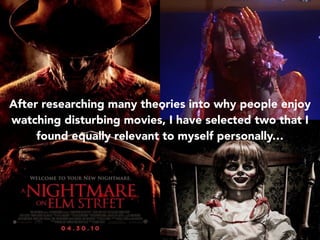
After researching many theories into why people enjoy
watching disturbing movies, I have selected two that I
found equally relevant to myself personally…
1 ) T H E G E N D E R 

S O C I A L I Z AT I O N T H E O RY.
The Gender Socialization theory written in 1986 by Zillman, Weaver,
Mundorf and Aust considers horror films as sort of a gateway to
traditional gender roles. Experiments with adolescent boys found that
they enjoyed a horror film more when their female companion was
visibly scared. The opposite was true with adolescent girls who found
horror films less enjoyable when the boys they were with were physically
scared. The girls enjoyed the film more when their boys were brave and
handled their fear.
This may be one shade of how horror films play in our culture and relates
to me at my age and the gratification I get from social interaction with
my friends when we watch horror, but it doesn’t explain why some
people go to horror films alone or wether this theory stands after the
teenage years.
2 ) T H E ‘ C U R I O S I T Y A N D
FA S C I N AT I O N ’ T H E O RY
Film Scholar Noël Carroll put out the idea that horror films are the product of
curiosity and fascination. Horror exists outside of the bubble of everyday
existence of ‘normal’ behavior. Studies by theorists such as Tamborini, Stiff and
Zillmann have shown that there is a significant correlation between people who
are accepting of unusual behavior and interest in horror movies.
Furthermore, the “enjoyment” of the punishment and murder of those that
deserves it reflects the Dispositional Alignment Theory. I like when horror
movies show the people on screen getting killed because they deserve it. a
A movie example of this being one of my favorite horror franchises - Saw. All of
Jigaw’s prisoners are made to take part in Jigsaw’s games because they have
done something wrong previously in life. This can include fraud, rape, drug
abuse and distribution, domestic violence and more. This gives us insight into
why the audiences want to see some violence, but it’s not a clear picture of why
we stay hooked to horror when we see kind, innocent families as victims.
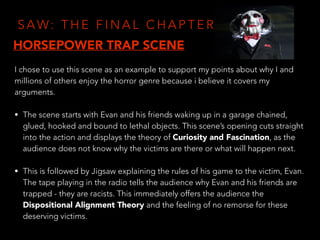
S A W: T H E F I N A L C H A P T E R
I chose to use this scene as an example to support my points about why I and
millions of others enjoy the horror genre because i believe it covers my
arguments.
• The scene starts with Evan and his friends waking up in a garage chained,
glued, hooked and bound to lethal objects. This scene’s opening cuts straight
into the action and displays the theory of Curiosity and Fascination, as the
audience does not know why the victims are there or what will happen next.
• This is followed by Jigsaw explaining the rules of his game to the victim, Evan.
The tape playing in the radio tells the audience why Evan and his friends are
trapped - they are racists. This immediately offers the audience the
Dispositional Alignment Theory and the feeling of no remorse for these
deserving victims.
HORSEPOWER TRAP SCENE
• The entire tape recording giving an insight to what is about to occur and why
allows Thrill Watching, as at this point, it is all about the plot. As the scene
builds the tension rises and when the countdown begins there is a definite shift
into pure Gore Watching.
• The textual features of misé-en-scene, camerawork, editing and sound are
all vital in adding to the brutal scene and enhance the pleasures and
gratifications that the audience receive. As an example for me, the barbaric
and un-clean nature of this kill shown by the props and special effects, the
extreme close up shots of tearing skin and panic-stricken emotive faces
alongside the fast paced rock music all reinforce the gratification of Personal
Identification in the form of finding reinforcement for personal values. By this, I
mean that this extremely vulgar atmosphere and scene created allows me as a
viewer to reinforce my personal values of not being racist or prejudice - though
these consequences may be a little intense.
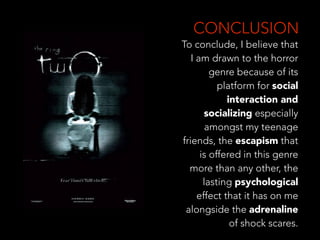
CONCLUSION
To conclude, I believe that
I am drawn to the horror
genre because of its
platform for social
interaction and
socializing especially
amongst my teenage
friends, the escapism that
is offered in this genre
more than any other, the
lasting psychological
effect that it has on me
alongside the adrenaline
of shock scares.
- A R T H U R C O N A N D O Y L E
“Where there is no imagination – there is no
horror!”

Favourite Genre - Horror Analysis

  • 1.
    HOR R OR ANA LY Z I NG M Y FAVOR I T E G E N R E …
  • 2.
    I N TR O D U C T I O N The horror genre of film is my personal favorite because I feel that no other genre can compete with its lasting effect on an audience. Its unpredictability and dark and tense themes never fail to keep me as a viewer on edge and highly entertained. In this analysis, I will be discussing the pleasures that I derive from watching horror, and the theories behind the growing attraction towards this polarizing category of film.
  • 3.
    There is somethingabout horror that directly addresses and reaches out to the instinctive human animal. Since the dawn of man the instinct of survival has been ingrained into our evolutionary psychology, resulting in hundreds of fear triggers - some general, some more personal. Research done by Nobuo Masataka show that children as young as 3 have an easier time spotting snakes on a computer screen than they do spotting flowers. This study indicates the natural enthrallment of fear and awareness of danger. Common instinctive fears are the building blocks of the horror movie spectrum and they include; • Fear of the unknown - incorporated by darkness and silence. An example
 in the media being the scene in Insidious 2 when the main protagonist
 ravels into ‘The Further’, a mysterious parallel world that holds the wan-
 derers deepest and darkest fears lurking in the shadows. • Fear of competitors - incorporated by larger, stronger animals or a higher
 power. An example of this being the possession of Regan MacNeil in the
 1973 hit - The Exorcist. The demon inside of Regan transforms her into a
 savage and evil beast and a threat to those around her. • Fear of physical and emotional pain - incorporated by slasher and
 psychologically disturbing horror scenes. An example of this in a horror film
 being the backbone of the Saw franchise, which revolves around the main 
 antagonist’s (Jigsaw’s) prisoners having to perform unspeakable acts of 
 violence upon themselves to get out of his grasp alive. OUR FASCINATION WITH FRIGHT
  • 4.
    Before horror fanslike myself can begin to understand why we find this genre so attractive, we must establish what the allure of horror fundamentally is. Psychologist Dr. Glenn D. Walters identifies three prime factors of the horror allure as: • Tension - created through mystery, suspense, shock and terror. This is the basic elements of horror films usually conveyed from the textual feature of misé-en-scene. • Relevance - created through capturing universal subjects like death, cultural and social issues. This allows the audience to receive the gratification of Personal Identification, meaning they can relate to the plot and see themselves reflected in the characters. • Unrealism - often referred to as Escapism within the Audience Uses and Gratifications model. This is created through fantasy worlds and inhuman monsters and offers an immersive feature to the audience allowing them to escape the existing reality of everyday issues. WHAT MAKES A HORROR FILM?
  • 5.
    T Y PE S O F H O R R O R - WAT C H I N G In todays society we have learnt not to generalize everyone’s motives and preferences. This 1995 study by Deirdre D. Johnston intrigued me as it studied students from the ages of 15-19, and I fall into this age category. The conclusion of this study was that horror-watching fell into 4 categories: • Gore Watching - characterized by ruthless, low-empathy violence and serial murders, often with male viewers identifying with the antagonist. • Thrill Watching - viewers are sensation seeking, often follow the suspense of the plot more than the characters. • Independant Watching - high empathy for the victim and a gratification of overcoming fear without help. • Problem Watching - also high empathy for the victim but characterized by a negative effect of helplessness and isolation.
  • 6.
    After researching manytheories into why people enjoy watching disturbing movies, I have selected two that I found equally relevant to myself personally…
  • 7.
    1 ) TH E G E N D E R 
 S O C I A L I Z AT I O N T H E O RY. The Gender Socialization theory written in 1986 by Zillman, Weaver, Mundorf and Aust considers horror films as sort of a gateway to traditional gender roles. Experiments with adolescent boys found that they enjoyed a horror film more when their female companion was visibly scared. The opposite was true with adolescent girls who found horror films less enjoyable when the boys they were with were physically scared. The girls enjoyed the film more when their boys were brave and handled their fear. This may be one shade of how horror films play in our culture and relates to me at my age and the gratification I get from social interaction with my friends when we watch horror, but it doesn’t explain why some people go to horror films alone or wether this theory stands after the teenage years.
  • 8.
    2 ) TH E ‘ C U R I O S I T Y A N D FA S C I N AT I O N ’ T H E O RY Film Scholar Noël Carroll put out the idea that horror films are the product of curiosity and fascination. Horror exists outside of the bubble of everyday existence of ‘normal’ behavior. Studies by theorists such as Tamborini, Stiff and Zillmann have shown that there is a significant correlation between people who are accepting of unusual behavior and interest in horror movies. Furthermore, the “enjoyment” of the punishment and murder of those that deserves it reflects the Dispositional Alignment Theory. I like when horror movies show the people on screen getting killed because they deserve it. a A movie example of this being one of my favorite horror franchises - Saw. All of Jigaw’s prisoners are made to take part in Jigsaw’s games because they have done something wrong previously in life. This can include fraud, rape, drug abuse and distribution, domestic violence and more. This gives us insight into why the audiences want to see some violence, but it’s not a clear picture of why we stay hooked to horror when we see kind, innocent families as victims.
  • 9.
    S A W:T H E F I N A L C H A P T E R I chose to use this scene as an example to support my points about why I and millions of others enjoy the horror genre because i believe it covers my arguments. • The scene starts with Evan and his friends waking up in a garage chained, glued, hooked and bound to lethal objects. This scene’s opening cuts straight into the action and displays the theory of Curiosity and Fascination, as the audience does not know why the victims are there or what will happen next. • This is followed by Jigsaw explaining the rules of his game to the victim, Evan. The tape playing in the radio tells the audience why Evan and his friends are trapped - they are racists. This immediately offers the audience the Dispositional Alignment Theory and the feeling of no remorse for these deserving victims. HORSEPOWER TRAP SCENE
  • 10.
    • The entiretape recording giving an insight to what is about to occur and why allows Thrill Watching, as at this point, it is all about the plot. As the scene builds the tension rises and when the countdown begins there is a definite shift into pure Gore Watching. • The textual features of misé-en-scene, camerawork, editing and sound are all vital in adding to the brutal scene and enhance the pleasures and gratifications that the audience receive. As an example for me, the barbaric and un-clean nature of this kill shown by the props and special effects, the extreme close up shots of tearing skin and panic-stricken emotive faces alongside the fast paced rock music all reinforce the gratification of Personal Identification in the form of finding reinforcement for personal values. By this, I mean that this extremely vulgar atmosphere and scene created allows me as a viewer to reinforce my personal values of not being racist or prejudice - though these consequences may be a little intense.
  • 11.
    CONCLUSION To conclude, Ibelieve that I am drawn to the horror genre because of its platform for social interaction and socializing especially amongst my teenage friends, the escapism that is offered in this genre more than any other, the lasting psychological effect that it has on me alongside the adrenaline of shock scares.
  • 12.
    - A RT H U R C O N A N D O Y L E “Where there is no imagination – there is no horror!”