Distribution Management

           Yashpal Ghate   (M-11-16)
Distribution Management
• Distribution can be defined as –the channel structure
  used to transfer products from an organization to its
  customer
• Getting the right product to the right place at the right
  time.
• Distribution decision has significant implication on:
     1.   Product margins and profits
     2.   Marketing Budgets
     3.   Final retail pricing
     4.   Sales management practices.
Distribution Strategies
•   Cross Docking
•   Milk Runs
•   Direct Shipping
•   Hub and spoke Model
•   Pool Distribution
FedEx
• FedEx Supply Chain provides centralized, multi-client global
  distribution centers with scalable warehouse and order
  management capabilities.
• When integrated into customer operations, FedEx Critical
  Inventory Logistics and Fulfillment Services execute as a
  seamless extension of business, providing late order cut-off
  times that extend customer's
  service day and an end-to-end supply chain designed to meet
  your specific needs.
Cross Docking

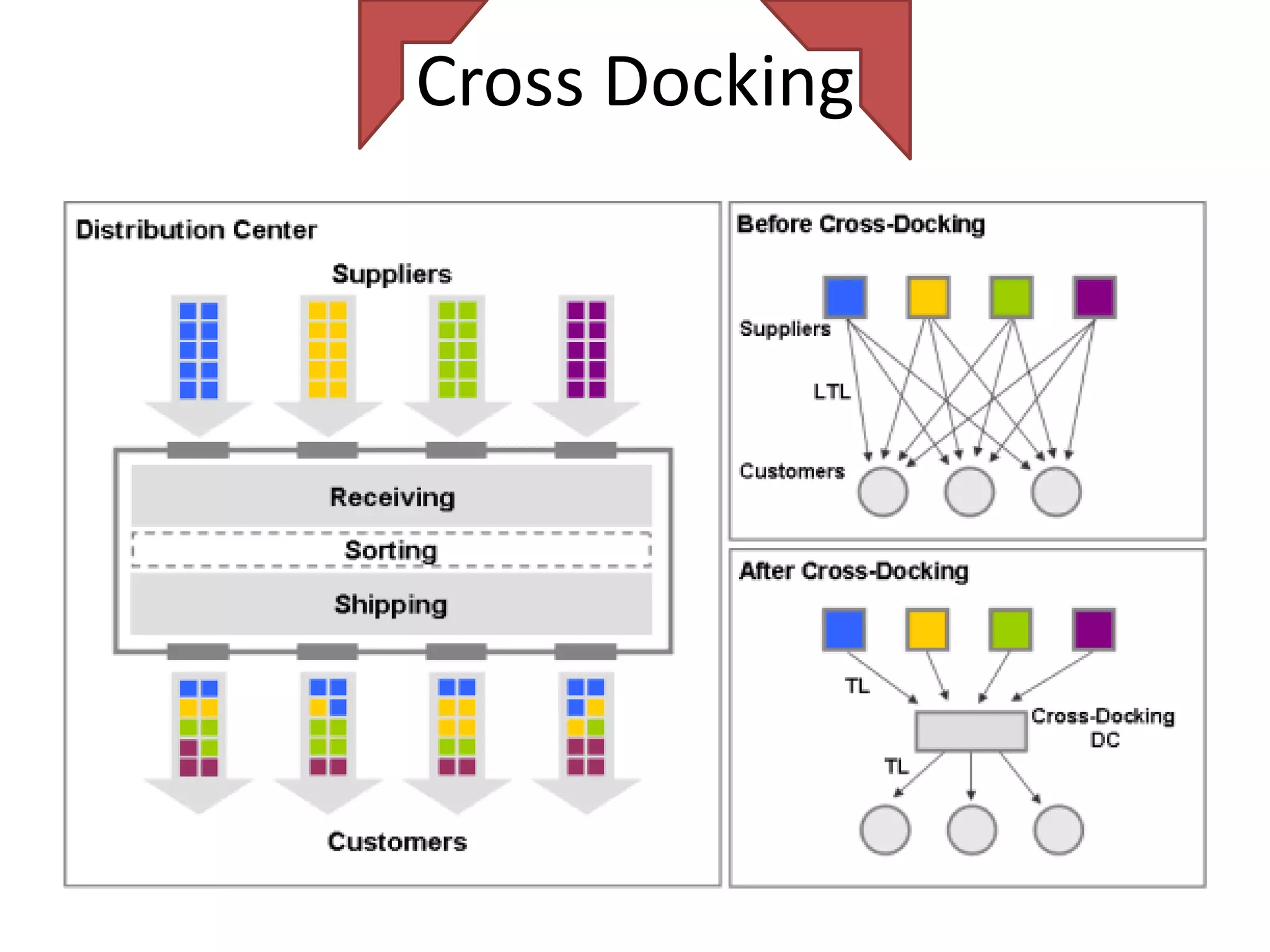
• Cross docking is the movement of materials from the
  receiving docks directly to the shipping dock
• Goods do not need to be placed in storage, creating
  a significant cost savings in inventory and material
  handling
• Reduces direct cost associated with excess inventory
• Reduces product damages and product obsolescence
Cross Docking
• Two basic form of Cross Docking
1. Basic cross dock:
 The packages are moved directly from the arriving vehicles to the
   departing ones.
 This form of cross docking does not need a warehouse and a
   simple transfer point is enough.
2. Flow Through cross Dock.
   When material arrive and they are in large packages , these
   packages are opened and broken into smaller quantities , sorted
   consolidated to deliver them to different customer and
   transferred to vehicles
Cross Docking
Cross Docking

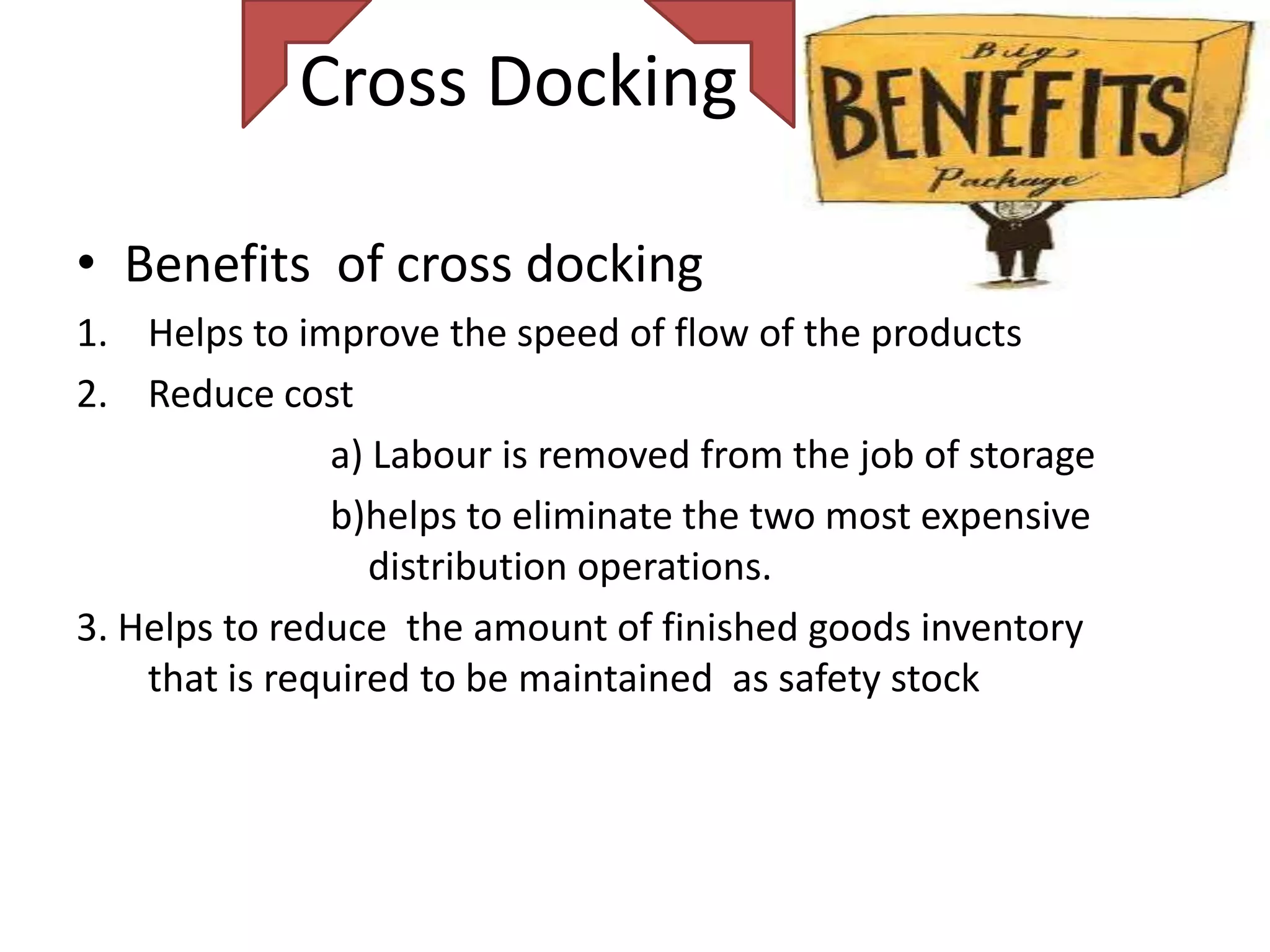
• Benefits of cross docking
1. Helps to improve the speed of flow of the products
2. Reduce cost
               a) Labour is removed from the job of storage
               b)helps to eliminate the two most expensive
                  distribution operations.
3. Helps to reduce the amount of finished goods inventory
    that is required to be maintained as safety stock
Cross Docking


                          Constraints
• Cross docking requires a strong IT base and real time
  information sharing facilities
• Is appropriate for appropriate for products with large
  predictable demands
• Requires a great degree of coordination and synchronization
  between the incoming and outgoing shipments which ,in turn
  relies on better information and planning
•
Milk Run

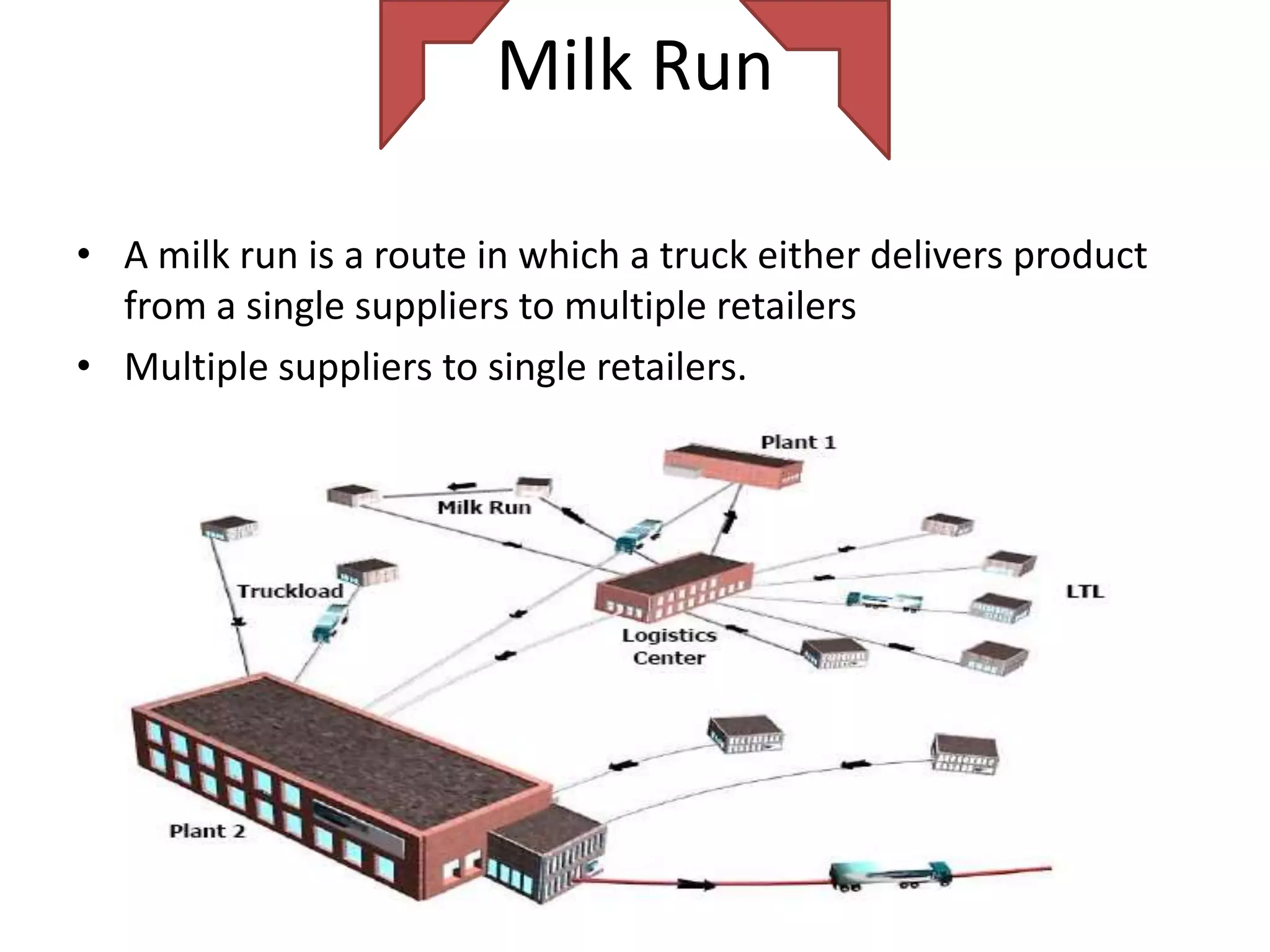
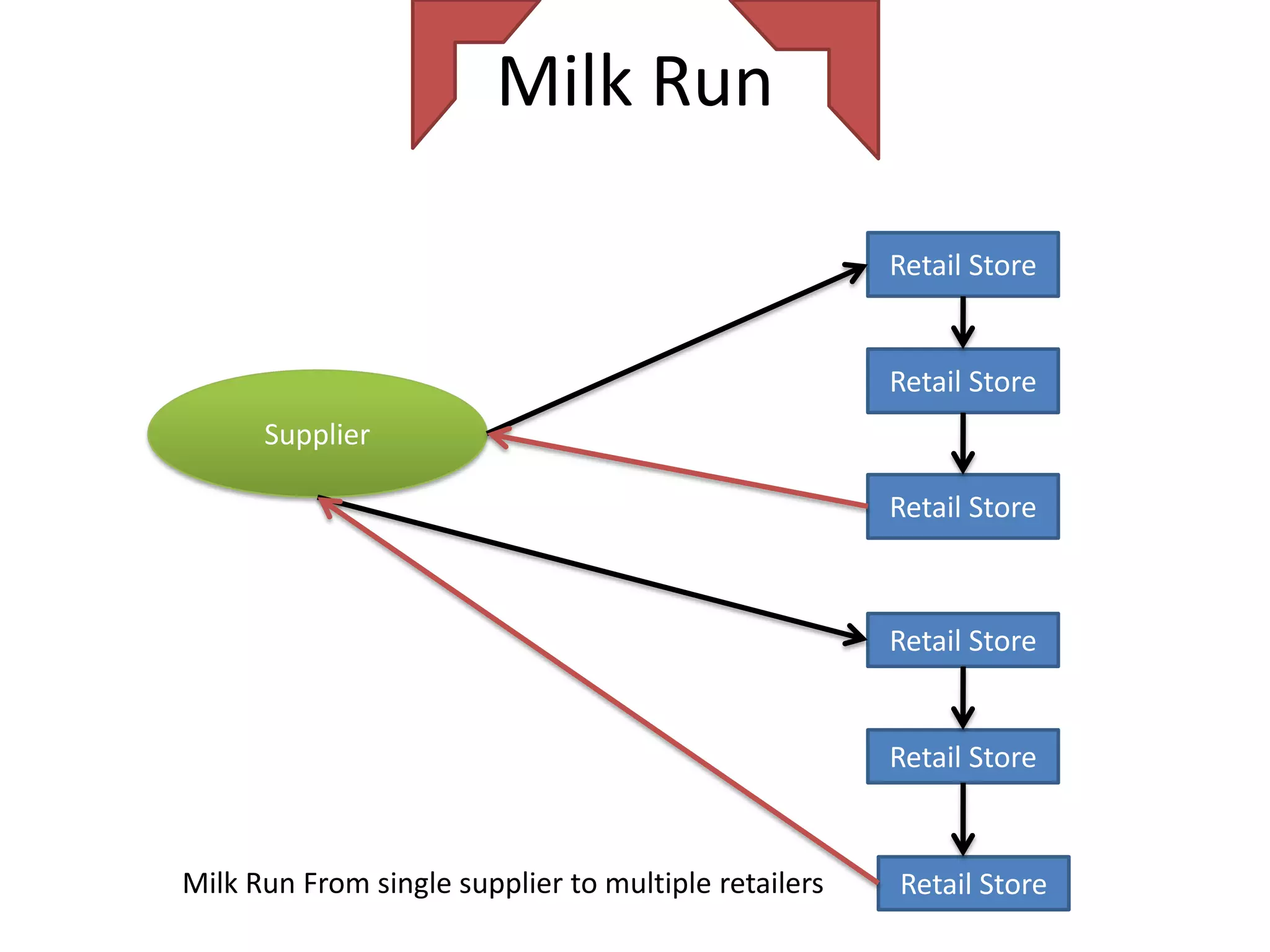
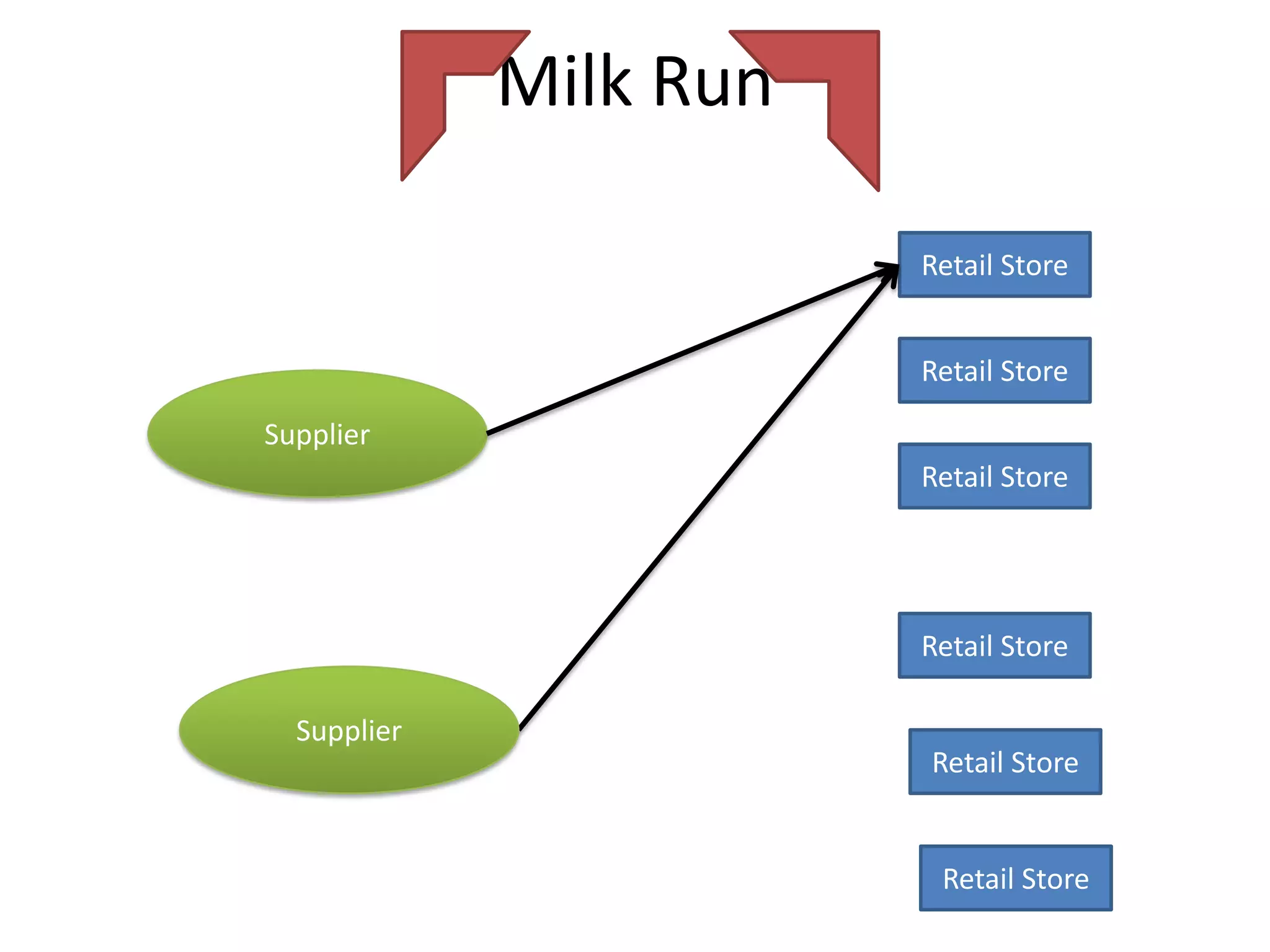
• A milk run is a route in which a truck either delivers product
  from a single suppliers to multiple retailers
• Multiple suppliers to single retailers.
Milk Run

                                                      Retail Store


                                                      Retail Store
      Supplier

                                                      Retail Store


                                                      Retail Store


                                                      Retail Store


Milk Run From single supplier to multiple retailers   Retail Store
Milk Run

                        Retail Store


                        Retail Store

Supplier
                        Retail Store


                        Retail Store

  Supplier
                        Retail Store


                         Retail Store
Milk Run

• Benefits of Milk runs
1. Reduces cost
2. Proximity to suppliers
3. Reduces inventory
Direct Shipping

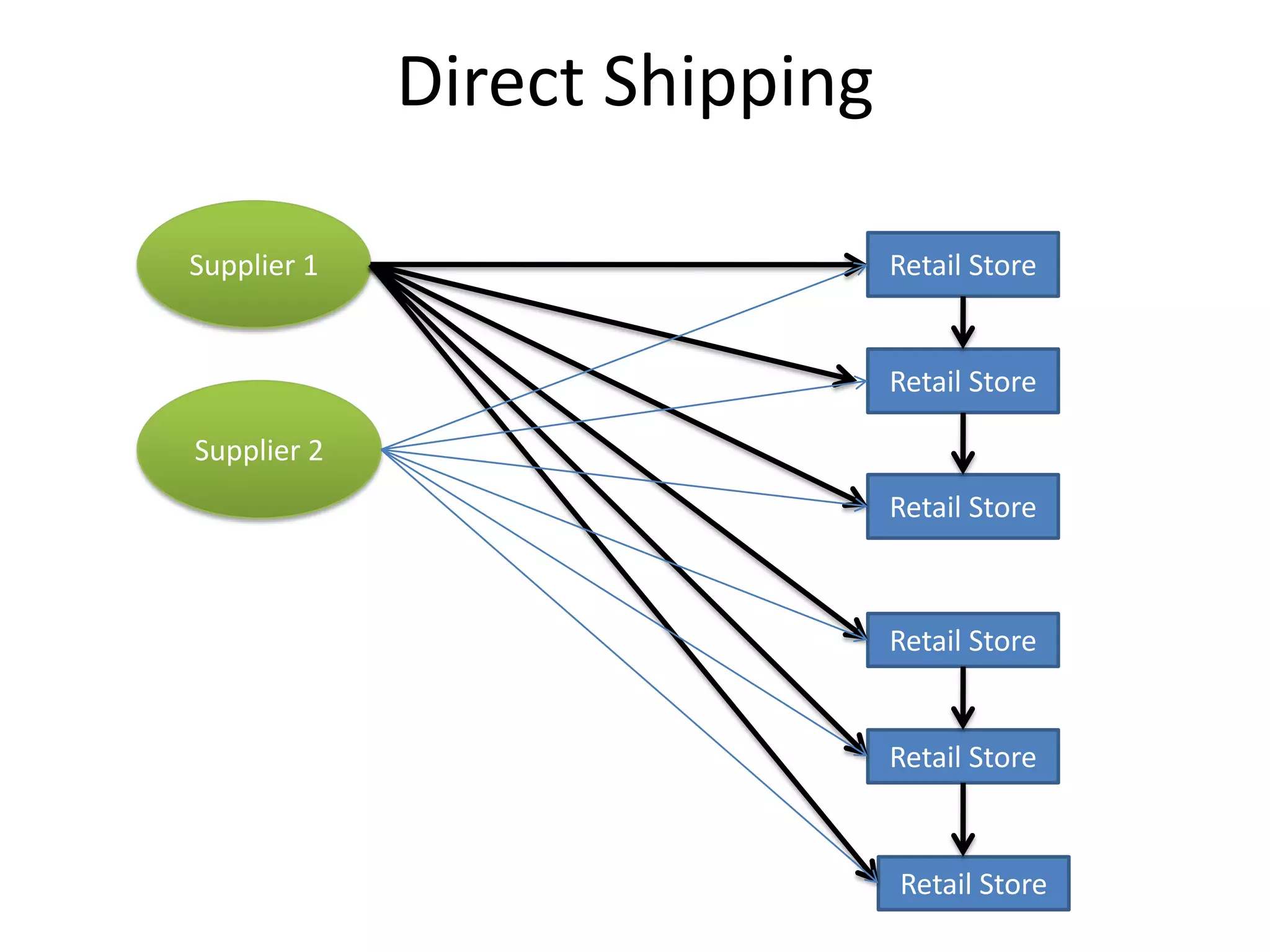
• Method of distribution in which goods come
  directly from suppliers to retail stores.
• The routing of each shipment & manager only
  need to decide on quantity to ship & mode of
  transportation to use.
• It eliminates need of intermediate facilities
  e.g. warehouses & distribution centres.
Direct Shipping

Supplier 1                     Retail Store


                               Retail Store

Supplier 2
                               Retail Store


                               Retail Store


                               Retail Store


                               Retail Store
Direct Shipping

• ADVANTAGES :
Elimination of intermediaries
Saves time
Less Damage
Improved accuracy
Direct Shipping

Challenges
• Large retail stores : It is justified if the retail stores are large
  enough. With small size of retail stores cost increases.

• Higher costs : Due to system of direct distribution the costs of
  transporting the goods may be higher than other systems of
  distribution.
Direct Shipping

Challenges
• Hassle for store personnel : e.g. more
  deliveries,paperwork,loading & unloading.
• No safety stock
Hub & Spoke Model

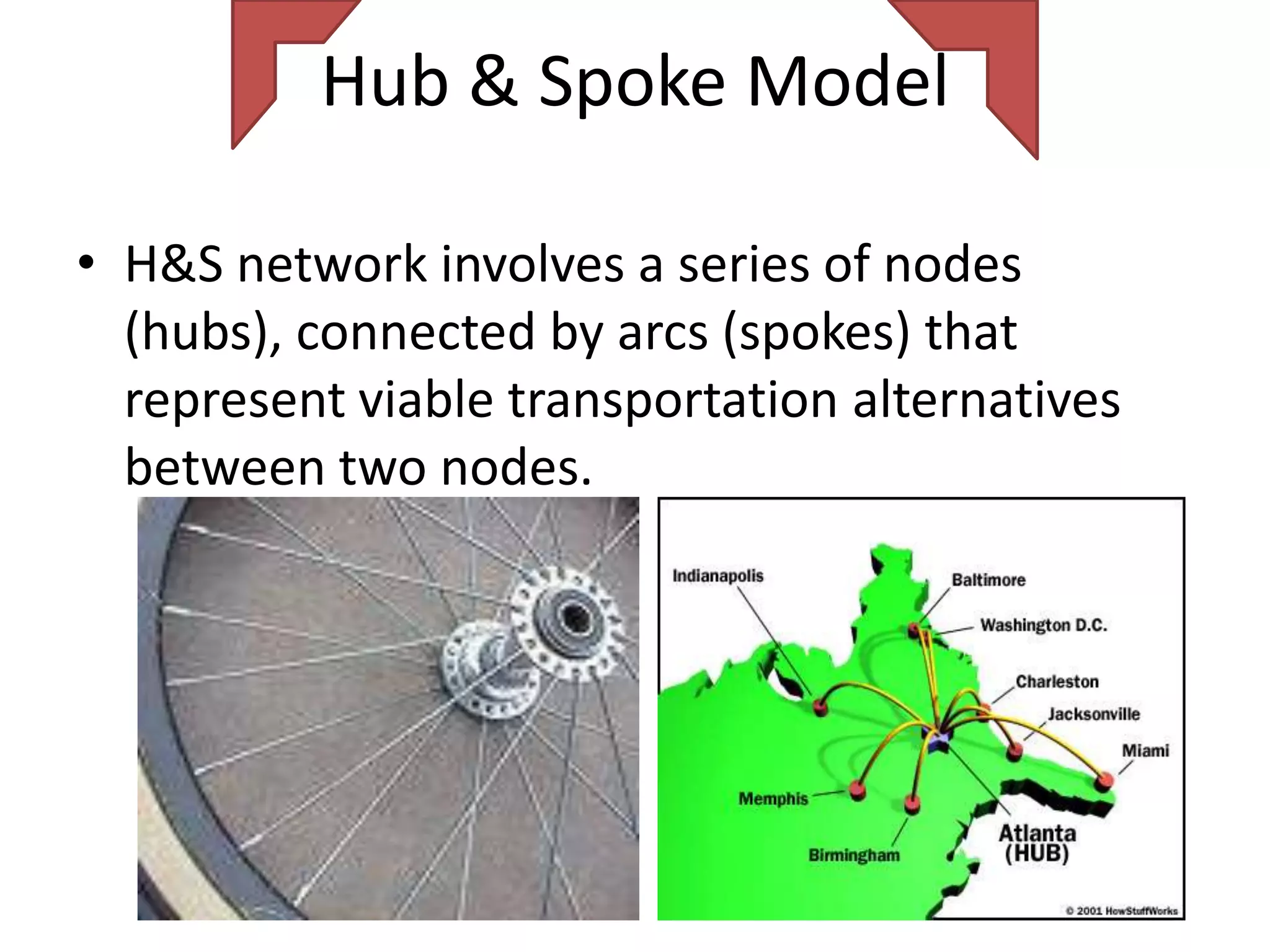
• H&S network involves a series of nodes
  (hubs), connected by arcs (spokes) that
  represent viable transportation alternatives
  between two nodes.
Hub & Spoke Model

• Companies centralize large distribution
  centers which essentially do three things
  – receive goods/information coming from many
    suppliers
  – consolidate goods/information according to the
    location where they are to be shipped
  – ship them individually to their final destination.
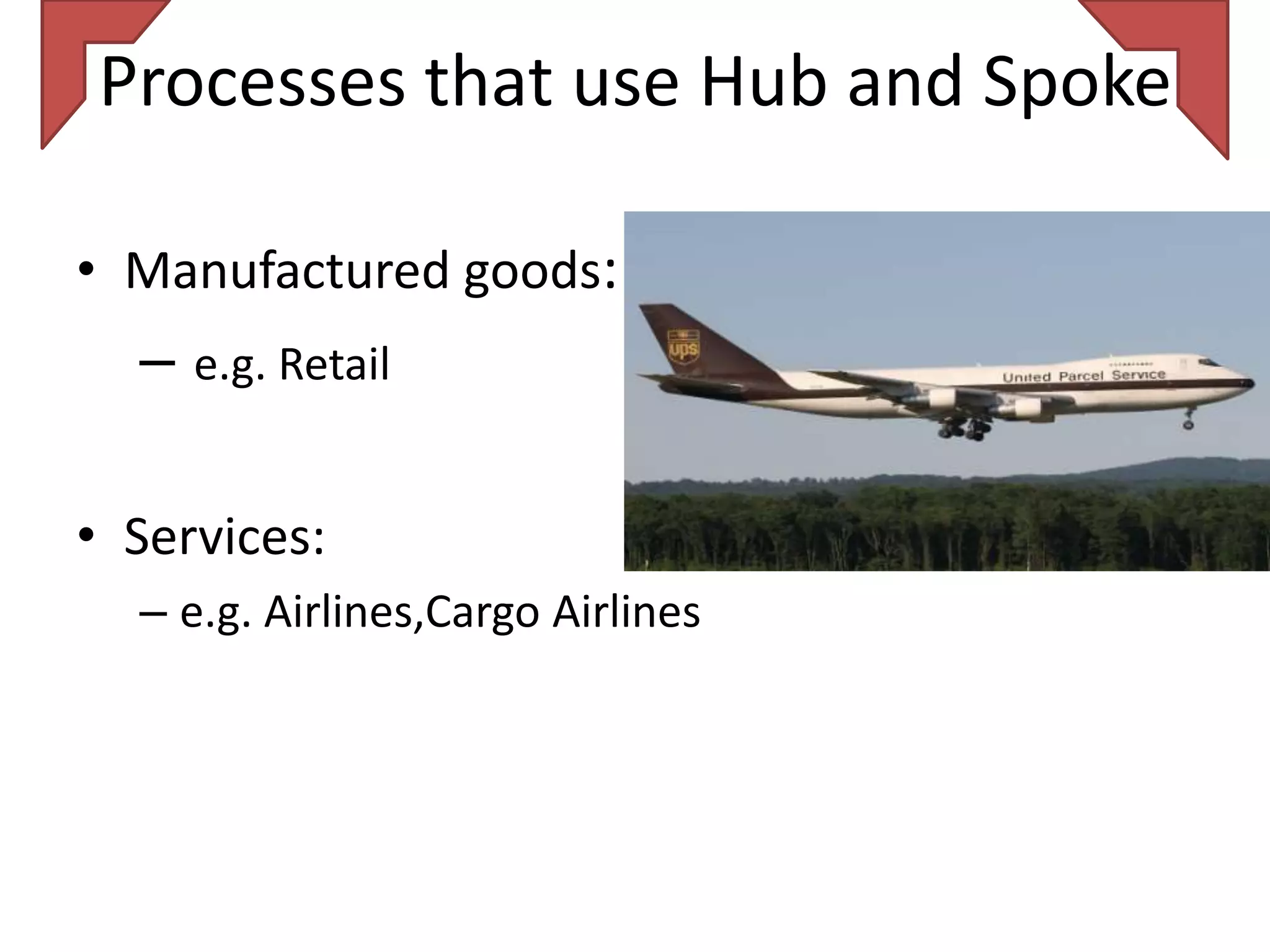
Processes that use Hub and Spoke

• Manufactured goods:
  – e.g. Retail

• Services:
  – e.g. Airlines,Cargo Airlines
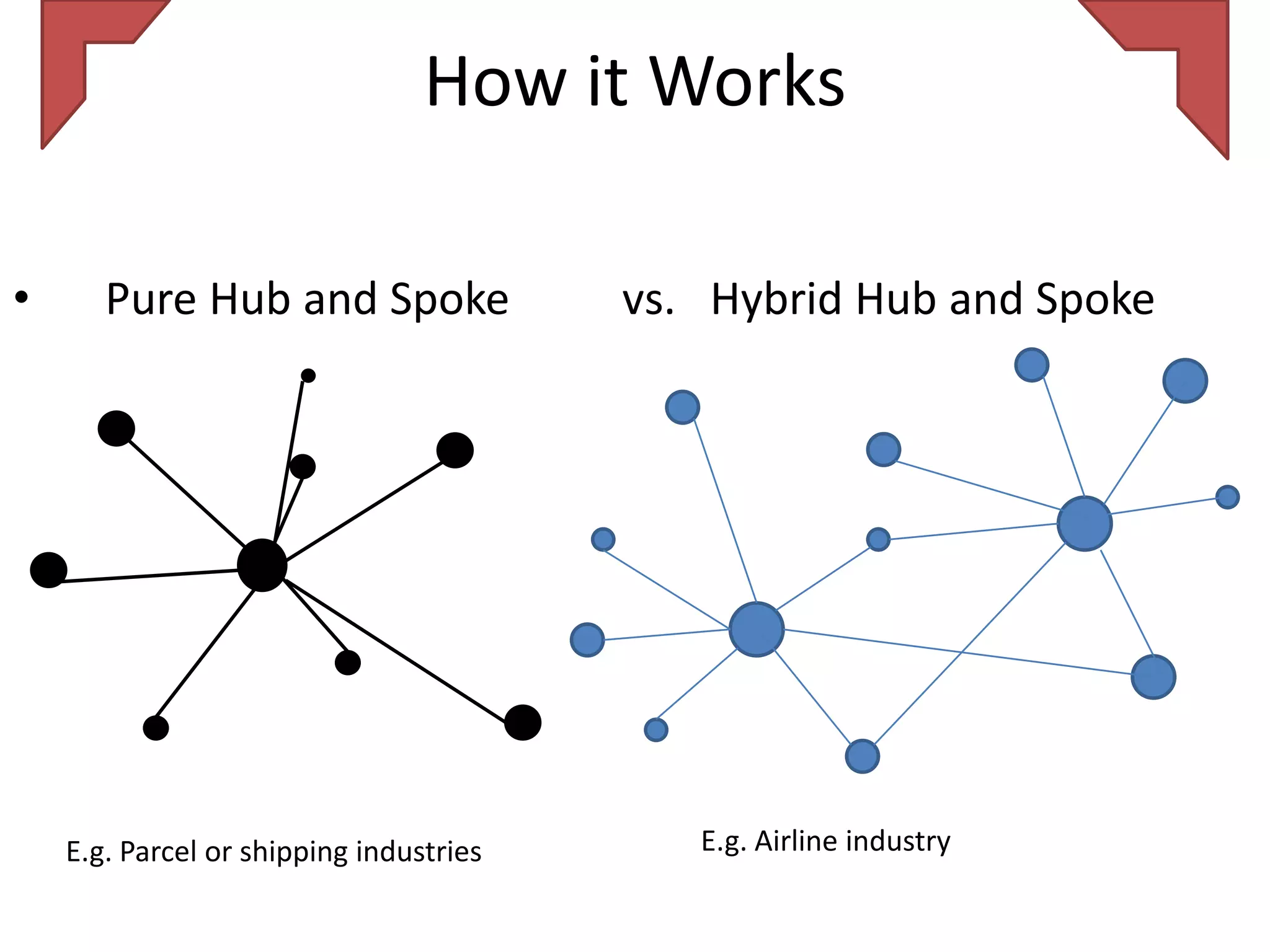
How it Works

•      Pure Hub and Spoke                vs. Hybrid Hub and Spoke


    E.g. Parcel or shipping industries      E.g. Airline industry
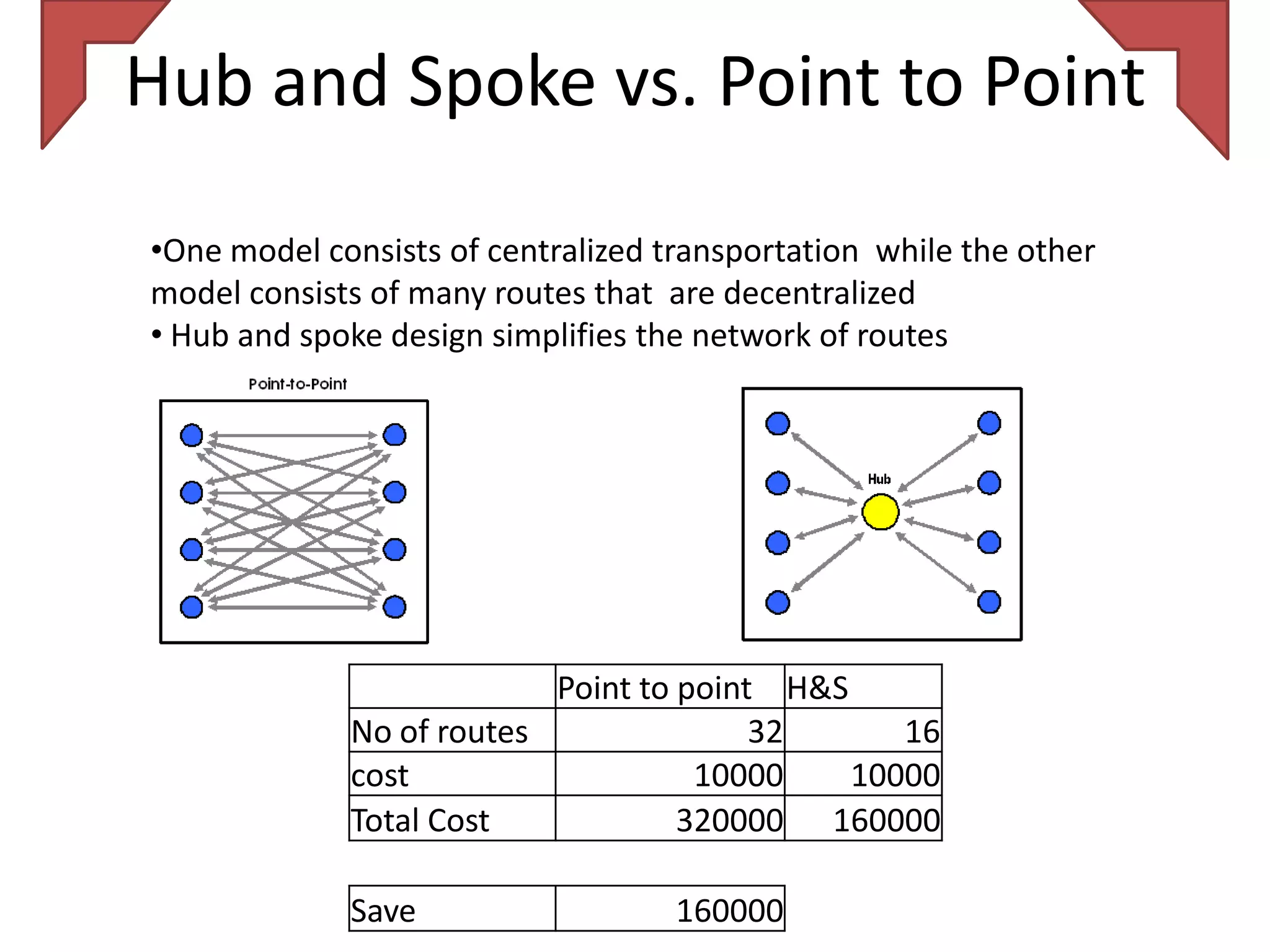
Hub and Spoke vs. Point to Point

•One model consists of centralized transportation while the other
model consists of many routes that are decentralized
• Hub and spoke design simplifies the network of routes


                          Point to point H&S
             No of routes               32      16
             cost                   10000    10000
             Total Cost            320000 160000

             Save                   160000
Benefits

• Having a hub and spoke can decrease the
  complexity of distribution.
• Transportation cost reduced
  • There is less time spent in transport which directly reduces
    the cost of the activity
• Management costs
  • Management specialists generally focus on one location
    for distribution logistics
Benefits

• Economies of scale
  – By having larger loads, you take advantage of
    lower per unit costs
• Proximity to customer.
   -- Goal being to supply to a maximum
  amount of customers in a minimum amount
  of time.
Drawbacks

• Disruption at the hub

• Bound by hub capacity

• Cargo must pass through the hub before reaching
  its destination, results in longer journey.

• Inflexible, changes at the hub, or even in a single
  route affects the whole network.
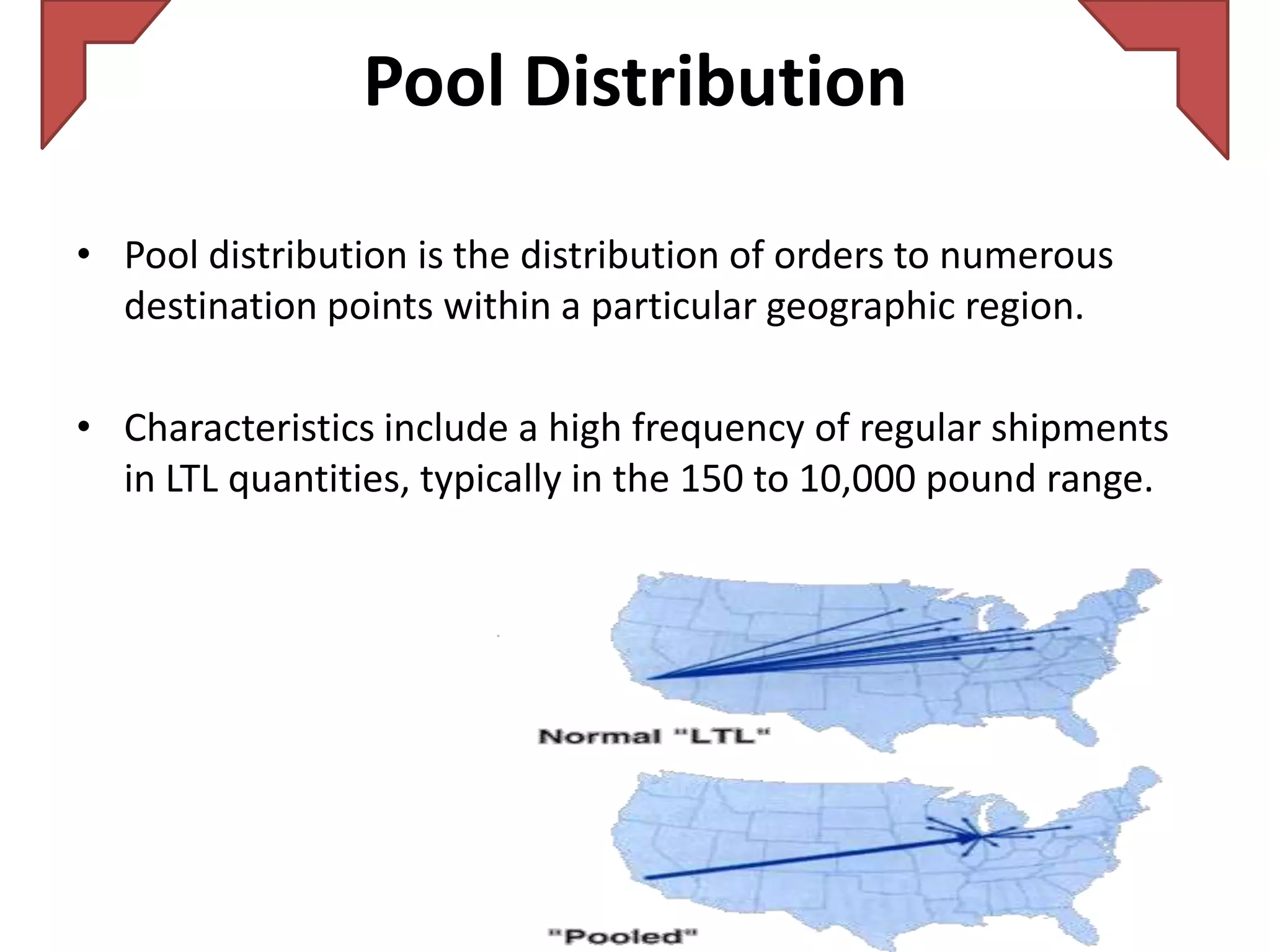
Pool Distribution

• Pool distribution is the distribution of orders to numerous
  destination points within a particular geographic region.

• Characteristics include a high frequency of regular shipments
  in LTL quantities, typically in the 150 to 10,000 pound range.
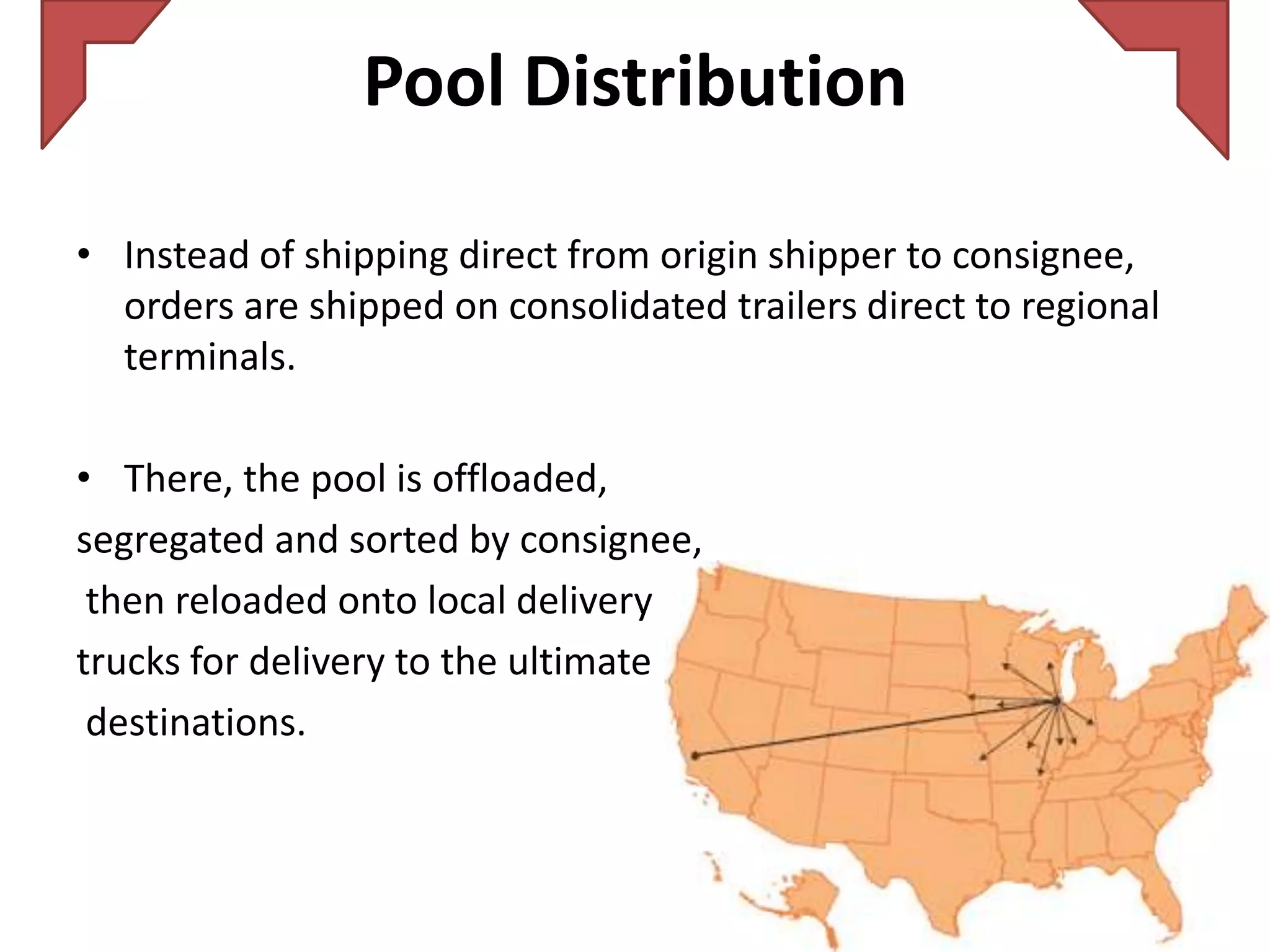
Pool Distribution

• Instead of shipping direct from origin shipper to consignee,
  orders are shipped on consolidated trailers direct to regional
  terminals.

• There, the pool is offloaded,
segregated and sorted by consignee,
 then reloaded onto local delivery
trucks for delivery to the ultimate
 destinations.
Benefits

• When manufactures have multiple shipments bound for a
  specific region, it is simple, cost effective alternative to LTL.
• Speed merchandise to retail outlets.
• Meet customer delivery requirements.
• Reduce delivery cost to customers.
SULZER CORPORATION
• Sulzer ltd. Is a Swiss industrial engineering and manufacturing firm

• Founded by Salomon sulzer-bernet in 1775 and established as sulzer
   brothers ltd. In 1834 in Switzerland.

• Sulzer pumps - pumping systems (it produces centrifugal pumps
   and mixers for the oil, hydrocarbon and fertilizer industries at a
   global scale)

• Sulzer metro - turbine & transmission components

• Sulzer chemtech - components and services for separation
   columns and static mixing

• Sulzer turbo services - manufactures spares for turbines and
   rotating electrical equipment.
VISION AND VALUES
•   Vision

    Our customers recognize us for our leading technologies and services,
    delivering innovative and sustainable solutions.

•   Strategic priorities

     – Technology leadership

     – Outstanding services

     – Continuous operational improvements

     – Cross-divisional cooperation

•   Values

     – Customer partnership

     – Committed people
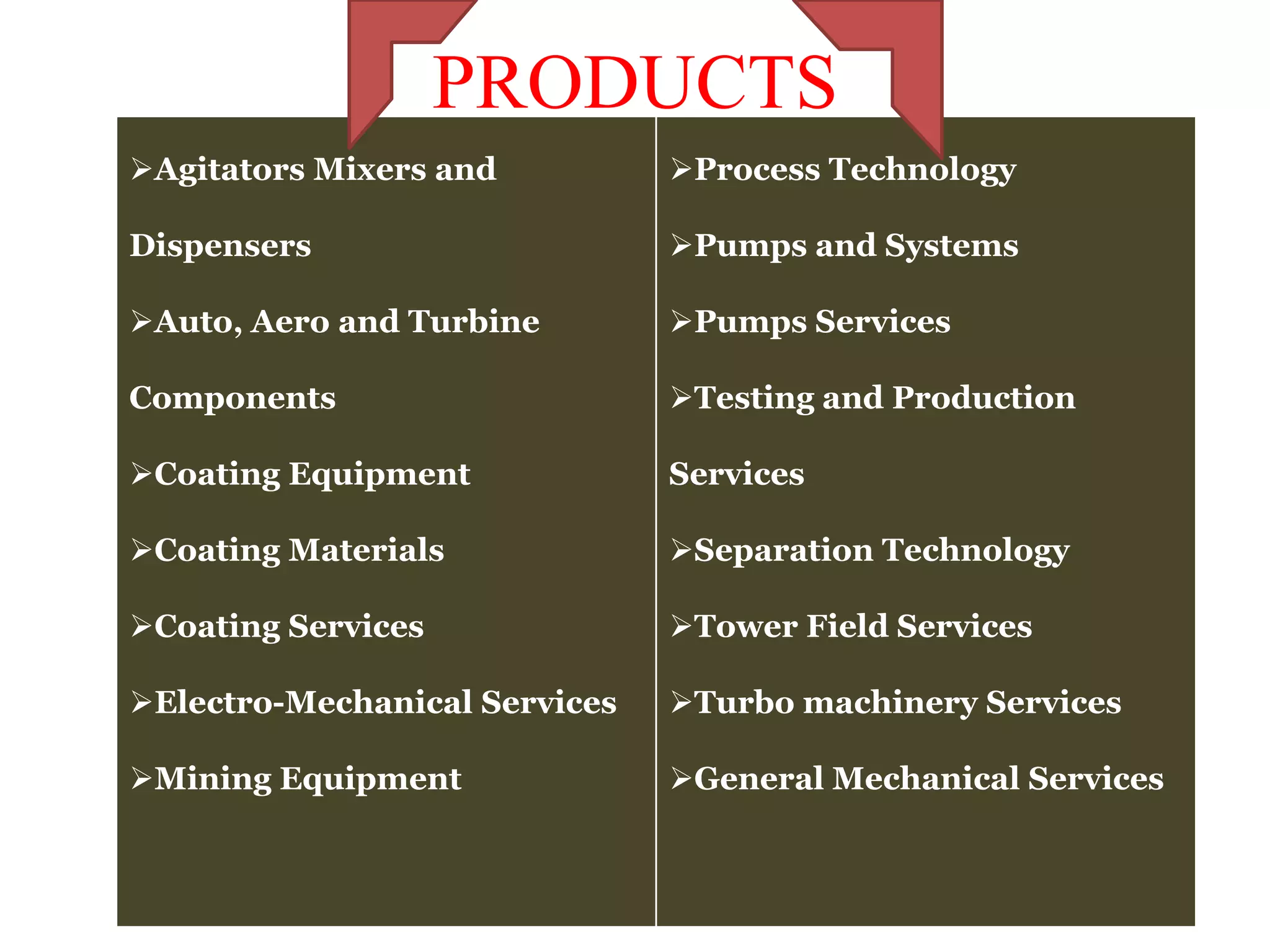
PRODUCTS
Agitators Mixers and          Process Technology

Dispensers                     Pumps and Systems

Auto, Aero and Turbine        Pumps Services

Components                     Testing and Production

Coating Equipment             Services

Coating Materials             Separation Technology

Coating Services              Tower Field Services

Electro-Mechanical Services   Turbo machinery Services

Mining Equipment              General Mechanical Services
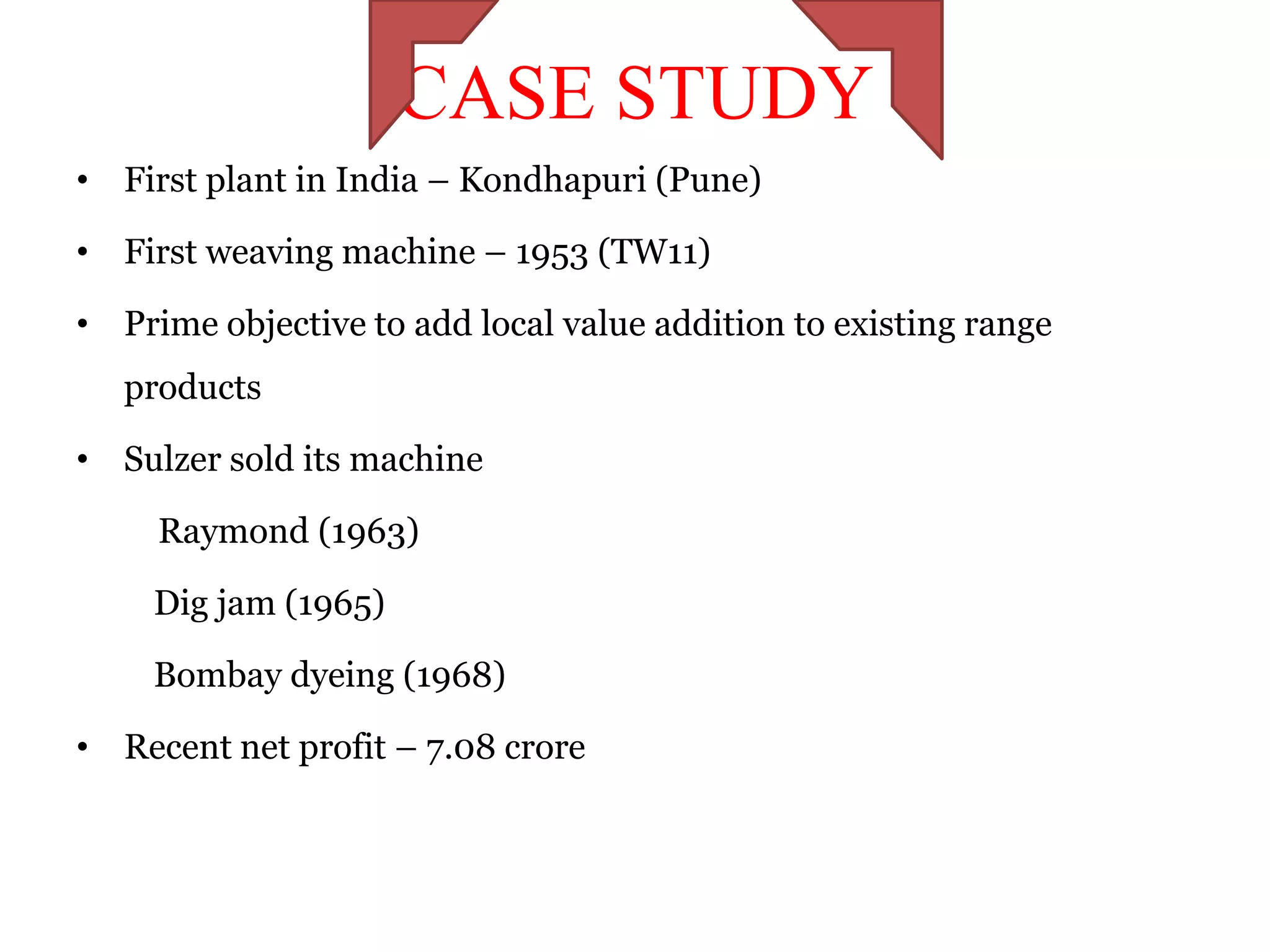
CASE STUDY
• First plant in India – Kondhapuri (Pune)

• First weaving machine – 1953 (TW11)

• Prime objective to add local value addition to existing range
   products

• Sulzer sold its machine

     Raymond (1963)

    Dig jam (1965)

    Bombay dyeing (1968)

• Recent net profit – 7.08 crore
SULZRE INDIA LTD. -
    PRODUCTS
TECHNOLOGY
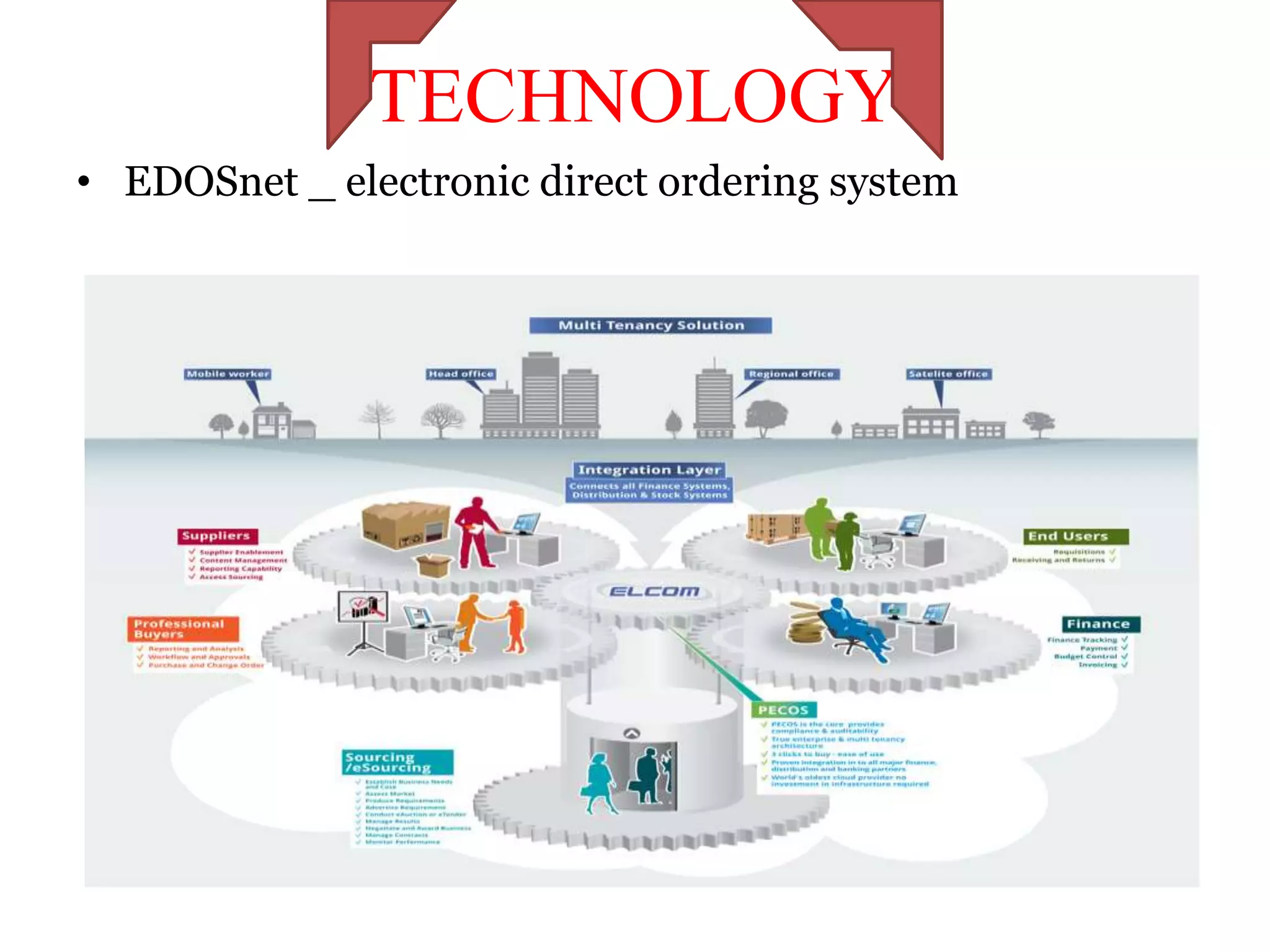
• EDOSnet _ electronic direct ordering system
BENEFITS OF EDOSnet
• Continuous supervision

• Services open for 24hours

• Track the status of the consignment

• Continuous updating of data

• Communication cost reduction

• Multi-lingual

• Number of queries reduction
DISTRIBUTION NETWORK
•   Invested 50-60 crore on distribution system

•   Storage- 23 million spare part

•   Storage consist of various sections and sections has been divided into 8

    rack

•   Mainframe developed between 2 racks

•   Use of robot for picking the material

•   Conveyor belt with sensors

•   Main distributors- DHL, FedEx, Panel pina
DISTRIBUTION NETWORK
   Courier service

– Though the cost associated with this distribution system are high, the
  customer gets the delivery of the goods at the doorstep.

– This system of distribution is especially useful when the spare parts
  are urgently required as the production has stopped due to the
  failure of a particular part.

   Air freight service

– Cheaper system as custom clearance is handled by customer itself

– It provide faster service in comparison with other modes of
  transportation
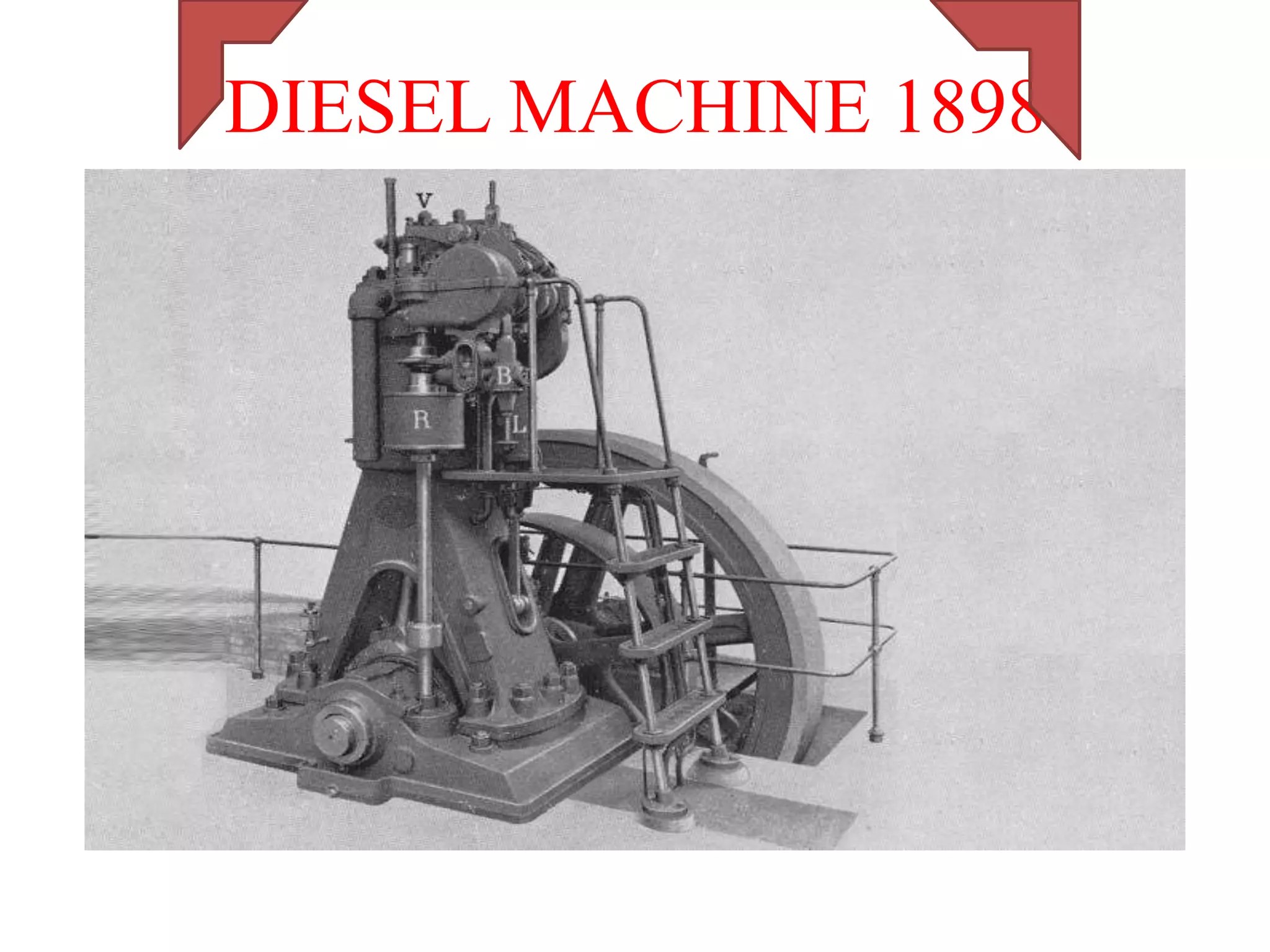
DIESEL MACHINE 1898
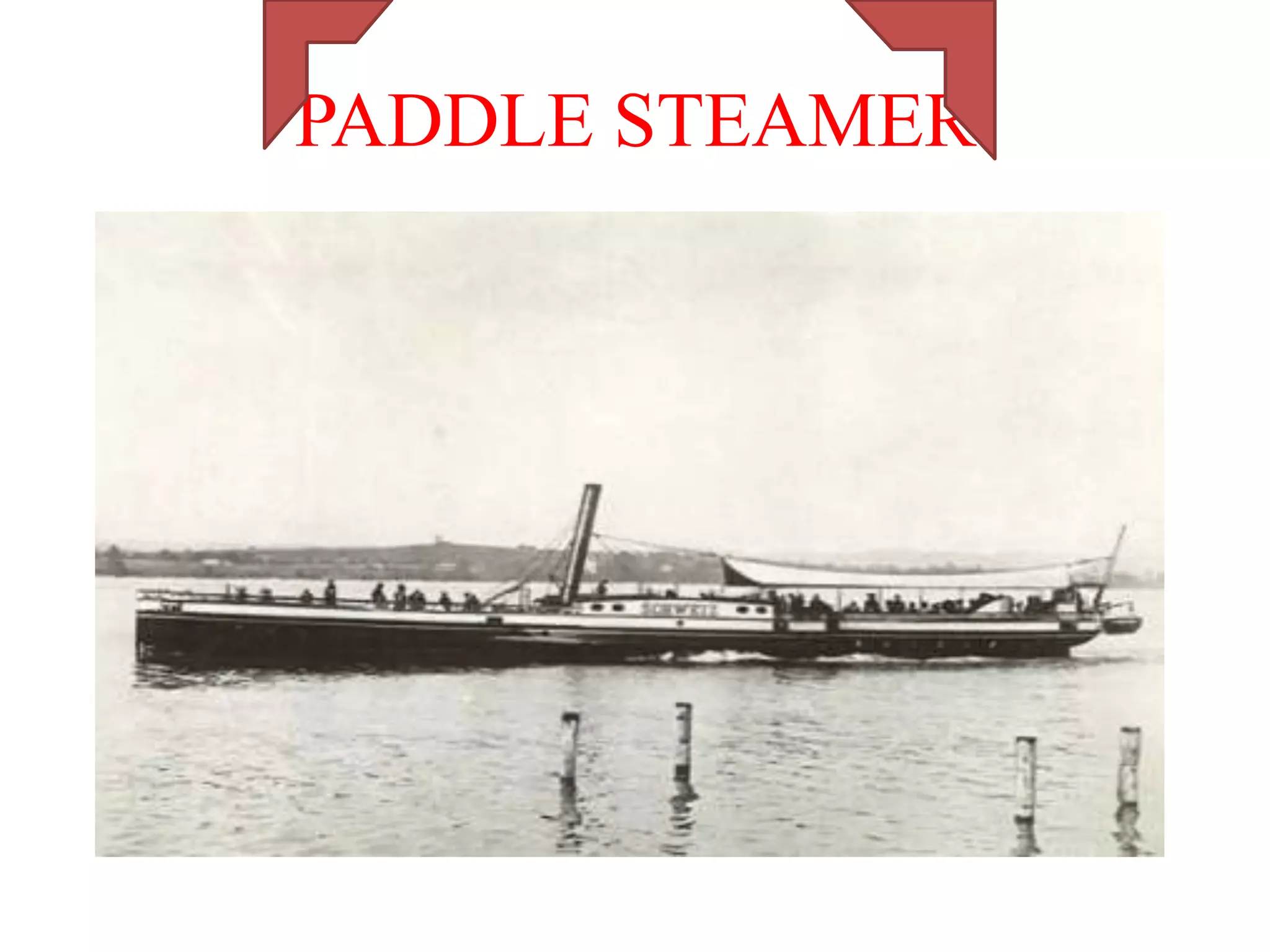
PADDLE STEAMER
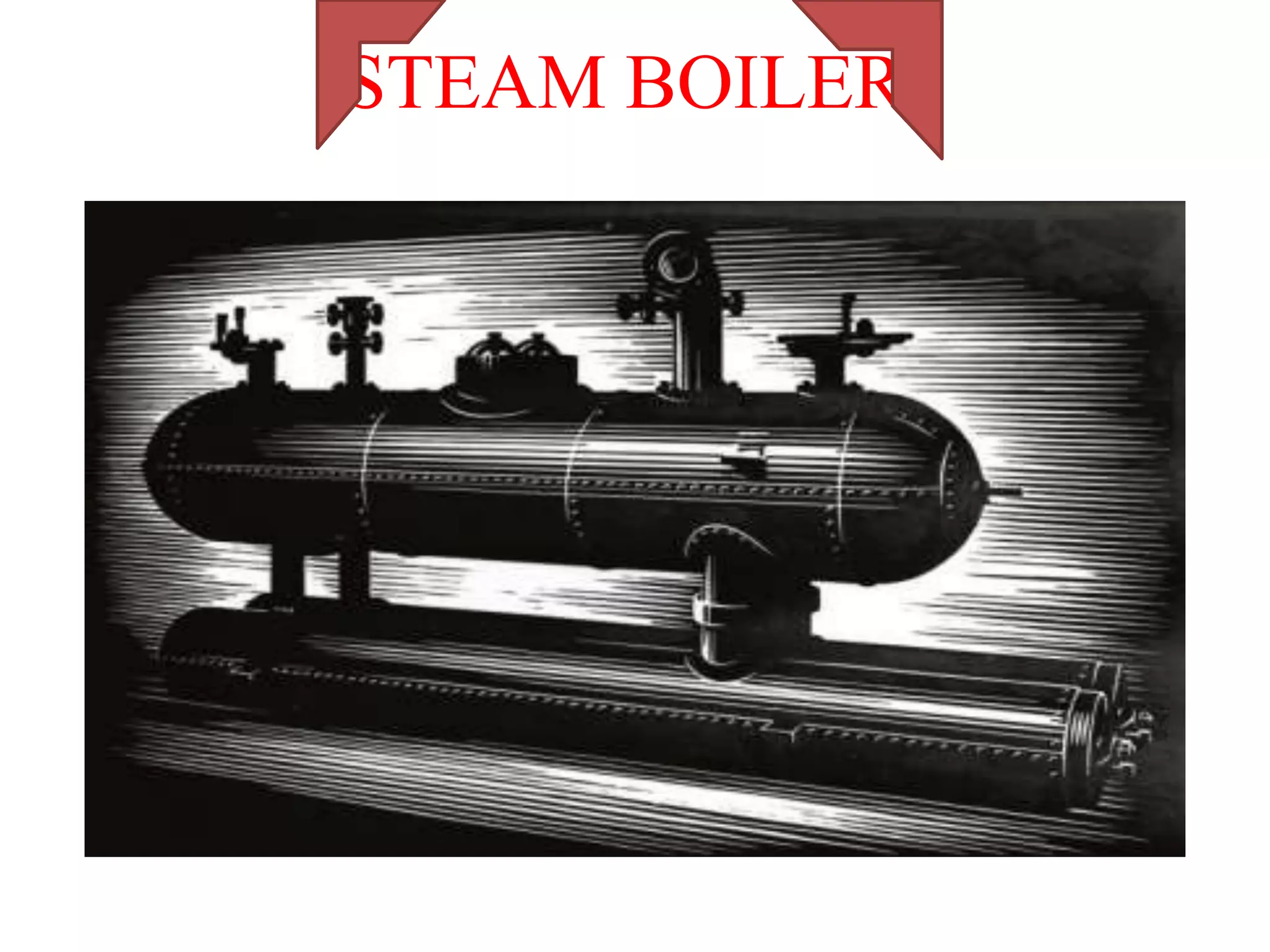
STEAM BOILER
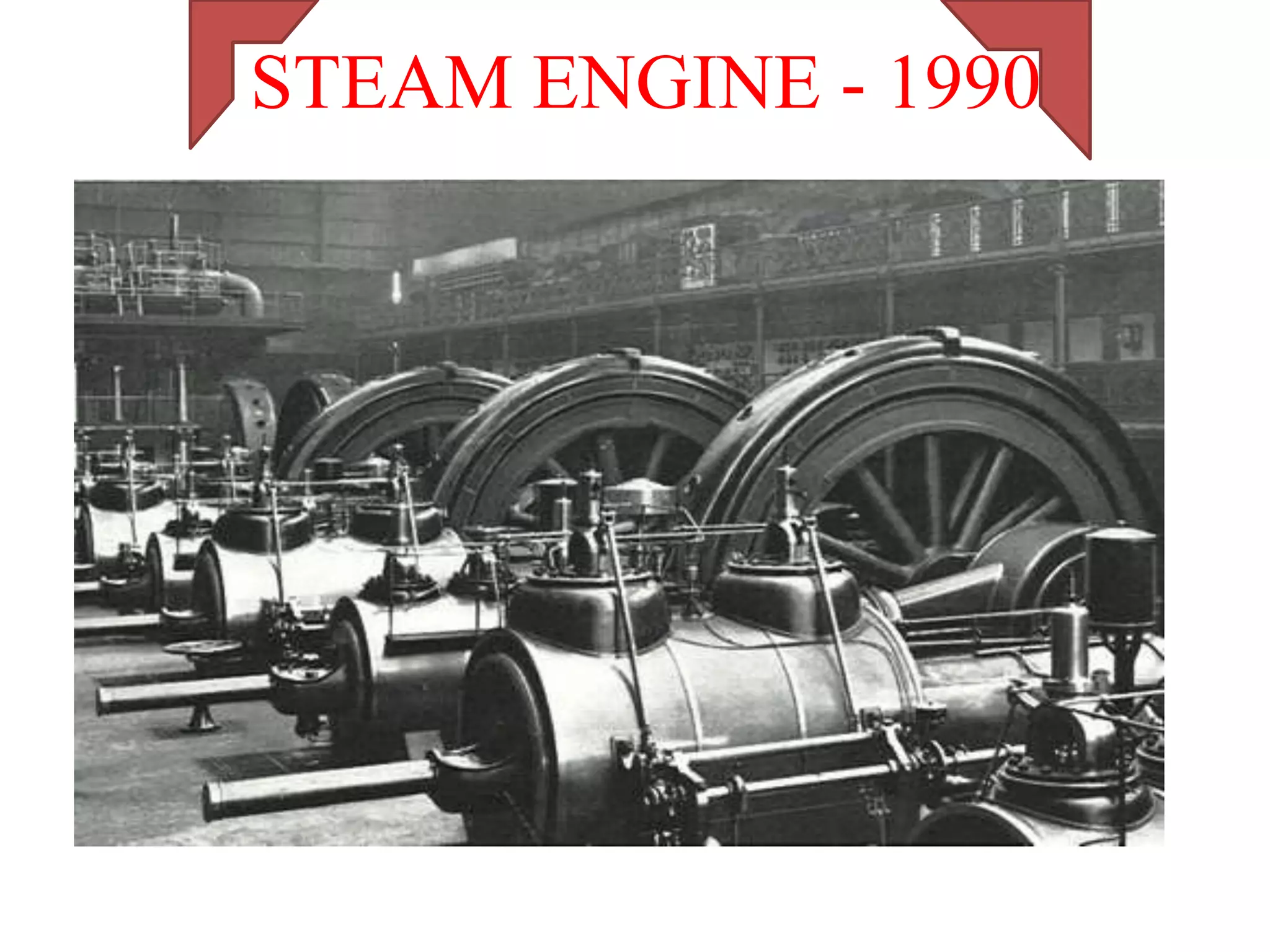
STEAM ENGINE - 1990
Distribution strategies with case study

Distribution strategies with case study

  • 1.
    Distribution Management Yashpal Ghate (M-11-16)
  • 2.
    Distribution Management • Distributioncan be defined as –the channel structure used to transfer products from an organization to its customer • Getting the right product to the right place at the right time. • Distribution decision has significant implication on: 1. Product margins and profits 2. Marketing Budgets 3. Final retail pricing 4. Sales management practices.
  • 3.
    Distribution Strategies • Cross Docking • Milk Runs • Direct Shipping • Hub and spoke Model • Pool Distribution
  • 4.
    FedEx • FedEx SupplyChain provides centralized, multi-client global distribution centers with scalable warehouse and order management capabilities. • When integrated into customer operations, FedEx Critical Inventory Logistics and Fulfillment Services execute as a seamless extension of business, providing late order cut-off times that extend customer's service day and an end-to-end supply chain designed to meet your specific needs.
  • 5.
    Cross Docking • Crossdocking is the movement of materials from the receiving docks directly to the shipping dock • Goods do not need to be placed in storage, creating a significant cost savings in inventory and material handling • Reduces direct cost associated with excess inventory • Reduces product damages and product obsolescence
  • 6.
    Cross Docking • Twobasic form of Cross Docking 1. Basic cross dock: The packages are moved directly from the arriving vehicles to the departing ones. This form of cross docking does not need a warehouse and a simple transfer point is enough. 2. Flow Through cross Dock. When material arrive and they are in large packages , these packages are opened and broken into smaller quantities , sorted consolidated to deliver them to different customer and transferred to vehicles
  • 7.
  • 8.
    Cross Docking • Benefitsof cross docking 1. Helps to improve the speed of flow of the products 2. Reduce cost a) Labour is removed from the job of storage b)helps to eliminate the two most expensive distribution operations. 3. Helps to reduce the amount of finished goods inventory that is required to be maintained as safety stock
  • 9.
    Cross Docking Constraints • Cross docking requires a strong IT base and real time information sharing facilities • Is appropriate for appropriate for products with large predictable demands • Requires a great degree of coordination and synchronization between the incoming and outgoing shipments which ,in turn relies on better information and planning •
  • 10.
    Milk Run • Amilk run is a route in which a truck either delivers product from a single suppliers to multiple retailers • Multiple suppliers to single retailers.
  • 11.
    Milk Run Retail Store Retail Store Supplier Retail Store Retail Store Retail Store Milk Run From single supplier to multiple retailers Retail Store
  • 12.
    Milk Run Retail Store Retail Store Supplier Retail Store Retail Store Supplier Retail Store Retail Store
  • 13.
    Milk Run • Benefitsof Milk runs 1. Reduces cost 2. Proximity to suppliers 3. Reduces inventory
  • 14.
    Direct Shipping • Methodof distribution in which goods come directly from suppliers to retail stores. • The routing of each shipment & manager only need to decide on quantity to ship & mode of transportation to use. • It eliminates need of intermediate facilities e.g. warehouses & distribution centres.
  • 15.
    Direct Shipping Supplier 1 Retail Store Retail Store Supplier 2 Retail Store Retail Store Retail Store Retail Store
  • 16.
    Direct Shipping • ADVANTAGES: Elimination of intermediaries Saves time Less Damage Improved accuracy
  • 17.
    Direct Shipping Challenges • Largeretail stores : It is justified if the retail stores are large enough. With small size of retail stores cost increases. • Higher costs : Due to system of direct distribution the costs of transporting the goods may be higher than other systems of distribution.
  • 18.
    Direct Shipping Challenges • Hasslefor store personnel : e.g. more deliveries,paperwork,loading & unloading. • No safety stock
  • 19.
    Hub & SpokeModel • H&S network involves a series of nodes (hubs), connected by arcs (spokes) that represent viable transportation alternatives between two nodes.
  • 20.
    Hub & SpokeModel • Companies centralize large distribution centers which essentially do three things – receive goods/information coming from many suppliers – consolidate goods/information according to the location where they are to be shipped – ship them individually to their final destination.
  • 21.
    Processes that useHub and Spoke • Manufactured goods: – e.g. Retail • Services: – e.g. Airlines,Cargo Airlines
  • 22.
    How it Works • Pure Hub and Spoke vs. Hybrid Hub and Spoke E.g. Parcel or shipping industries E.g. Airline industry
  • 23.
    Hub and Spokevs. Point to Point •One model consists of centralized transportation while the other model consists of many routes that are decentralized • Hub and spoke design simplifies the network of routes Point to point H&S No of routes 32 16 cost 10000 10000 Total Cost 320000 160000 Save 160000
  • 24.
    Benefits • Having ahub and spoke can decrease the complexity of distribution. • Transportation cost reduced • There is less time spent in transport which directly reduces the cost of the activity • Management costs • Management specialists generally focus on one location for distribution logistics
  • 25.
    Benefits • Economies ofscale – By having larger loads, you take advantage of lower per unit costs • Proximity to customer. -- Goal being to supply to a maximum amount of customers in a minimum amount of time.
  • 26.
    Drawbacks • Disruption atthe hub • Bound by hub capacity • Cargo must pass through the hub before reaching its destination, results in longer journey. • Inflexible, changes at the hub, or even in a single route affects the whole network.
  • 27.
    Pool Distribution • Pooldistribution is the distribution of orders to numerous destination points within a particular geographic region. • Characteristics include a high frequency of regular shipments in LTL quantities, typically in the 150 to 10,000 pound range.
  • 28.
    Pool Distribution • Insteadof shipping direct from origin shipper to consignee, orders are shipped on consolidated trailers direct to regional terminals. • There, the pool is offloaded, segregated and sorted by consignee, then reloaded onto local delivery trucks for delivery to the ultimate destinations.
  • 29.
    Benefits • When manufactureshave multiple shipments bound for a specific region, it is simple, cost effective alternative to LTL. • Speed merchandise to retail outlets. • Meet customer delivery requirements. • Reduce delivery cost to customers.
  • 30.
    SULZER CORPORATION • Sulzerltd. Is a Swiss industrial engineering and manufacturing firm • Founded by Salomon sulzer-bernet in 1775 and established as sulzer brothers ltd. In 1834 in Switzerland. • Sulzer pumps - pumping systems (it produces centrifugal pumps and mixers for the oil, hydrocarbon and fertilizer industries at a global scale) • Sulzer metro - turbine & transmission components • Sulzer chemtech - components and services for separation columns and static mixing • Sulzer turbo services - manufactures spares for turbines and rotating electrical equipment.
  • 31.
    VISION AND VALUES • Vision Our customers recognize us for our leading technologies and services, delivering innovative and sustainable solutions. • Strategic priorities – Technology leadership – Outstanding services – Continuous operational improvements – Cross-divisional cooperation • Values – Customer partnership – Committed people
  • 32.
    PRODUCTS Agitators Mixers and Process Technology Dispensers Pumps and Systems Auto, Aero and Turbine Pumps Services Components Testing and Production Coating Equipment Services Coating Materials Separation Technology Coating Services Tower Field Services Electro-Mechanical Services Turbo machinery Services Mining Equipment General Mechanical Services
  • 33.
    CASE STUDY • Firstplant in India – Kondhapuri (Pune) • First weaving machine – 1953 (TW11) • Prime objective to add local value addition to existing range products • Sulzer sold its machine Raymond (1963) Dig jam (1965) Bombay dyeing (1968) • Recent net profit – 7.08 crore
  • 34.
  • 35.
    TECHNOLOGY • EDOSnet _electronic direct ordering system
  • 36.
    BENEFITS OF EDOSnet •Continuous supervision • Services open for 24hours • Track the status of the consignment • Continuous updating of data • Communication cost reduction • Multi-lingual • Number of queries reduction
  • 37.
    DISTRIBUTION NETWORK • Invested 50-60 crore on distribution system • Storage- 23 million spare part • Storage consist of various sections and sections has been divided into 8 rack • Mainframe developed between 2 racks • Use of robot for picking the material • Conveyor belt with sensors • Main distributors- DHL, FedEx, Panel pina
  • 38.
    DISTRIBUTION NETWORK Courier service – Though the cost associated with this distribution system are high, the customer gets the delivery of the goods at the doorstep. – This system of distribution is especially useful when the spare parts are urgently required as the production has stopped due to the failure of a particular part. Air freight service – Cheaper system as custom clearance is handled by customer itself – It provide faster service in comparison with other modes of transportation
  • 39.
  • 40.
  • 41.
  • 42.