Chapter 12
Analyzing “Spaghetti Processes”

 prof.dr.ir. Wil van der Aalst
 www.processmining.org
Overview
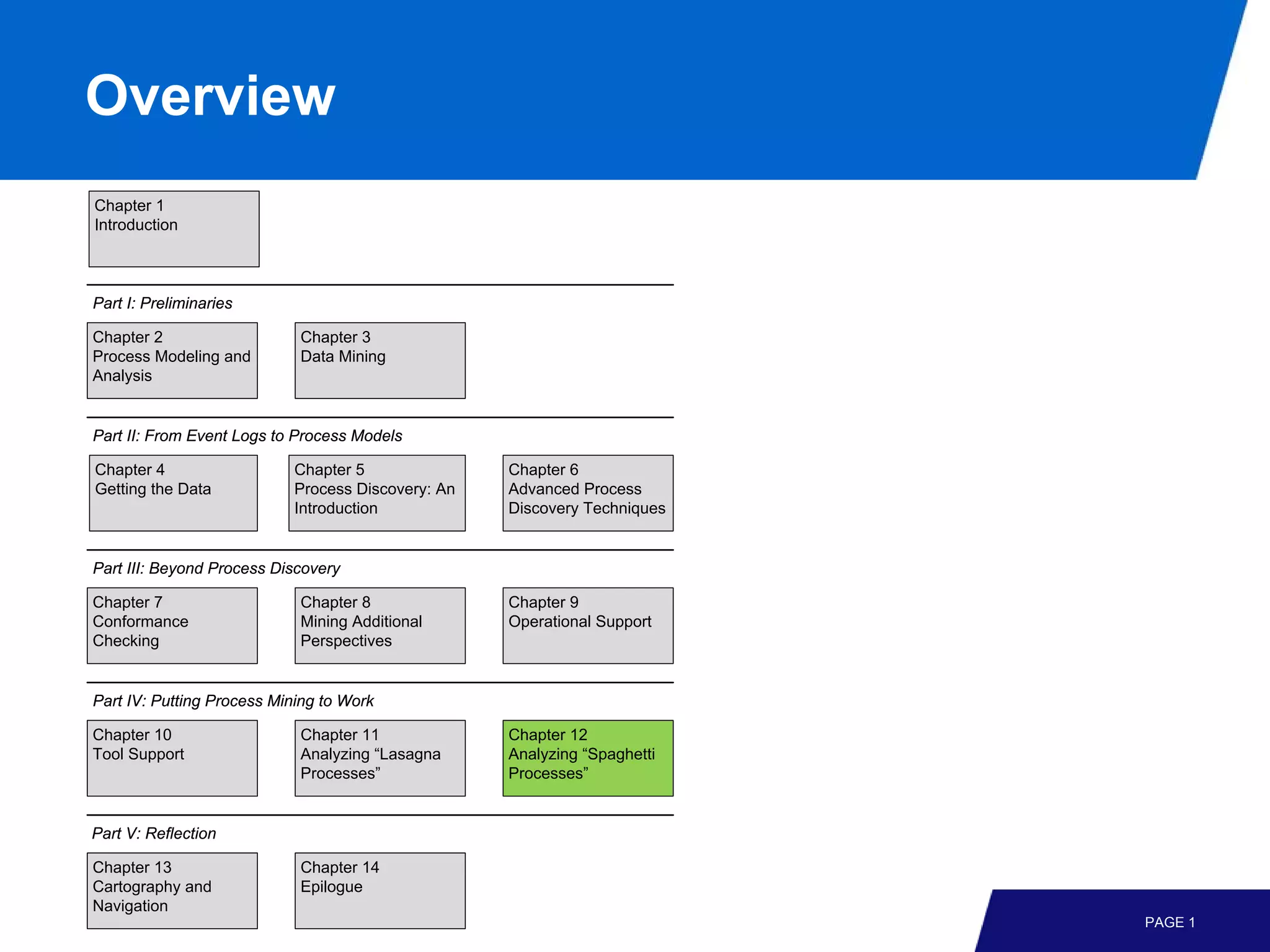
Chapter 1
Introduction


Part I: Preliminaries

Chapter 2                   Chapter 3
Process Modeling and        Data Mining
Analysis


Part II: From Event Logs to Process Models

Chapter 4                  Chapter 5               Chapter 6
Getting the Data           Process Discovery: An   Advanced Process
                           Introduction            Discovery Techniques


Part III: Beyond Process Discovery

Chapter 7                   Chapter 8              Chapter 9
Conformance                 Mining Additional      Operational Support
Checking                    Perspectives


Part IV: Putting Process Mining to Work

Chapter 10                  Chapter 11             Chapter 12
Tool Support                Analyzing “Lasagna     Analyzing “Spaghetti
                            Processes”             Processes”


Part V: Reflection

Chapter 13                  Chapter 14
Cartography and             Epilogue
Navigation
                                                                          PAGE 1
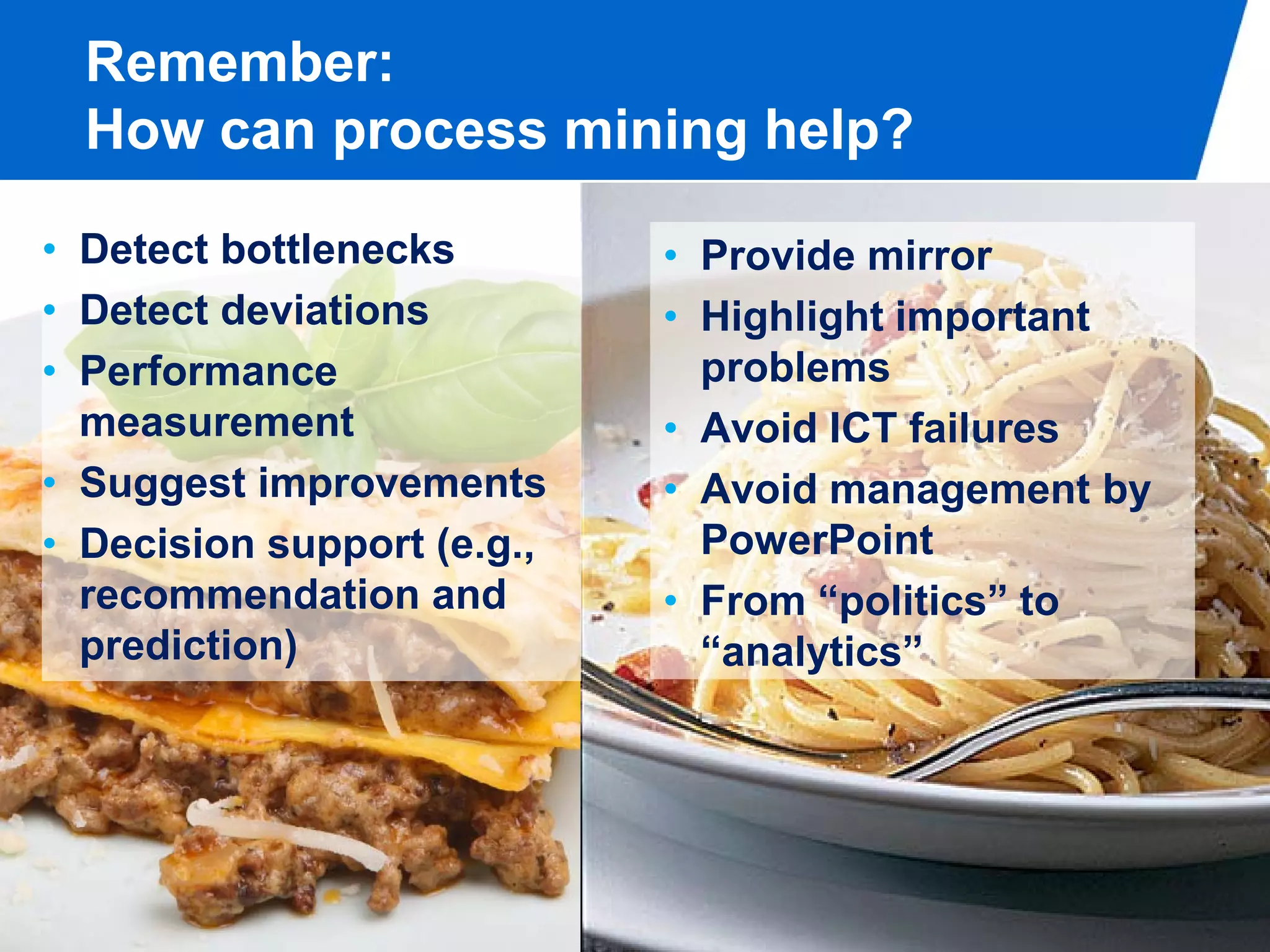
Remember:
  How can process mining help?

• Detect bottlenecks        • Provide mirror
• Detect deviations         • Highlight important
• Performance                 problems
  measurement               • Avoid ICT failures
• Suggest improvements      • Avoid management by
• Decision support (e.g.,     PowerPoint
  recommendation and        • From “politics” to
  prediction)                 “analytics”


                                                PAGE 2
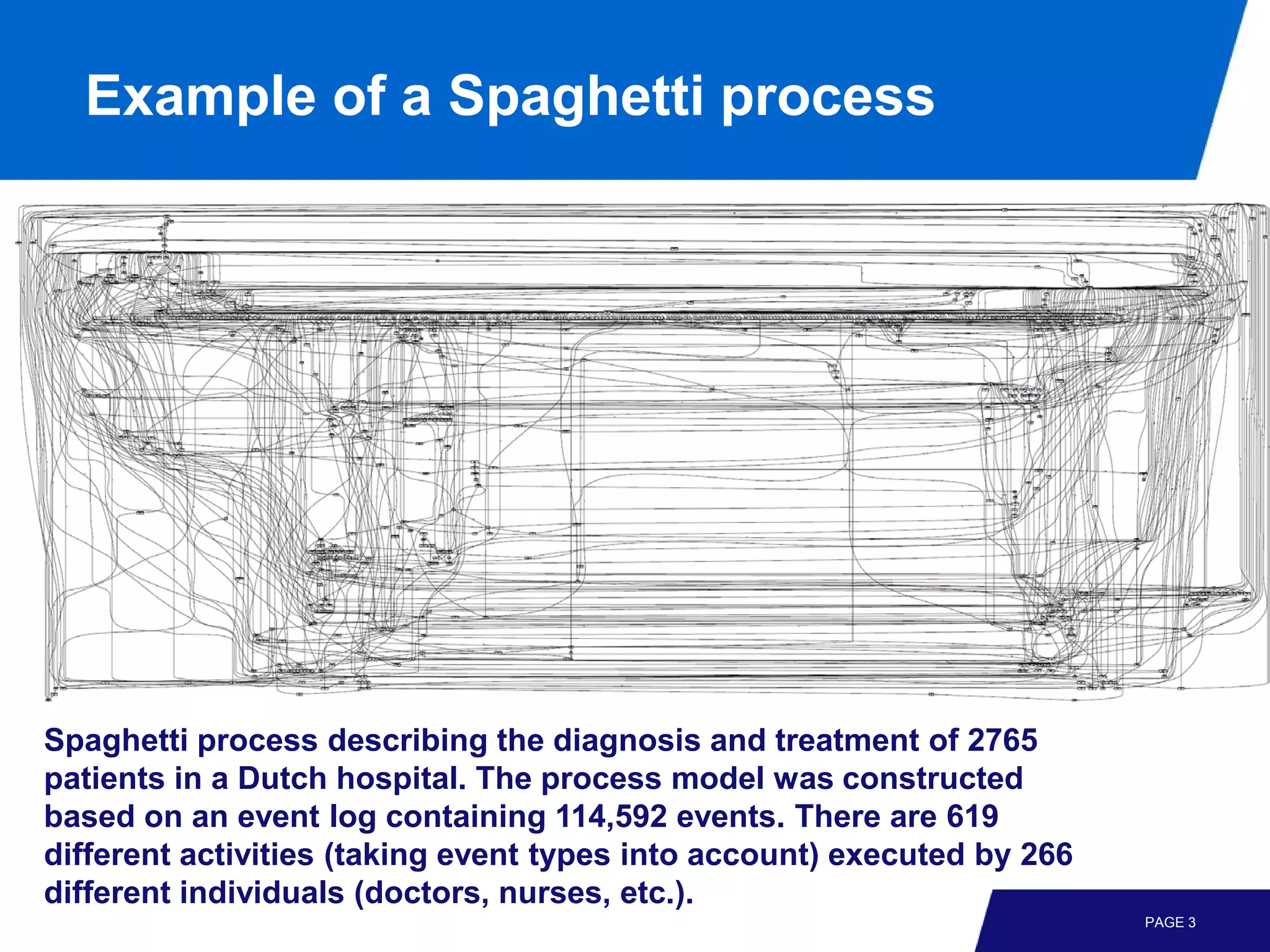
Example of a Spaghetti process


Spaghetti process describing the diagnosis and treatment of 2765
patients in a Dutch hospital. The process model was constructed
based on an event log containing 114,592 events. There are 619
different activities (taking event types into account) executed by 266
different individuals (doctors, nurses, etc.).
                                                                         PAGE 3
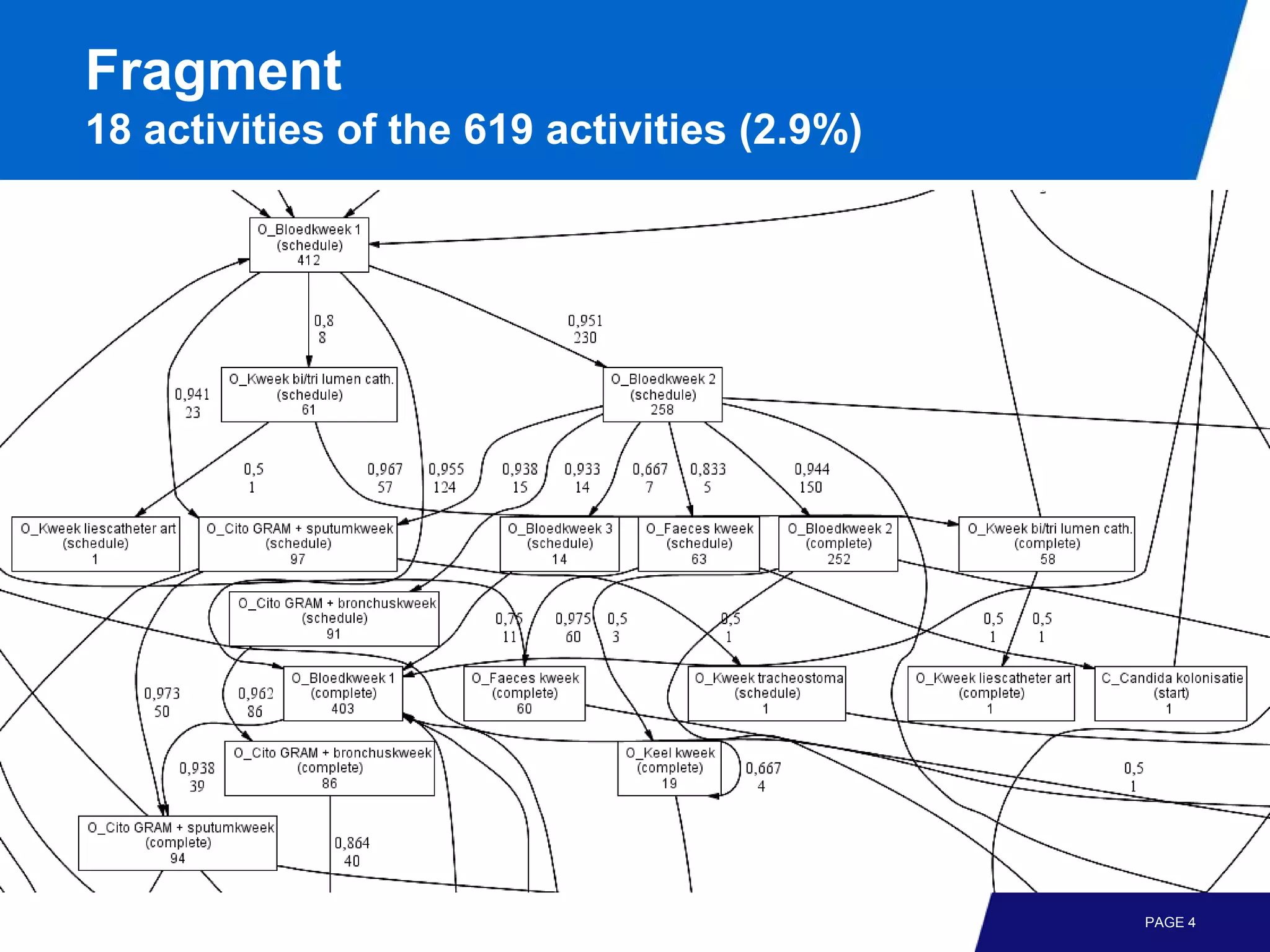
Fragment
18 activities of the 619 activities (2.9%)


                                             PAGE 4
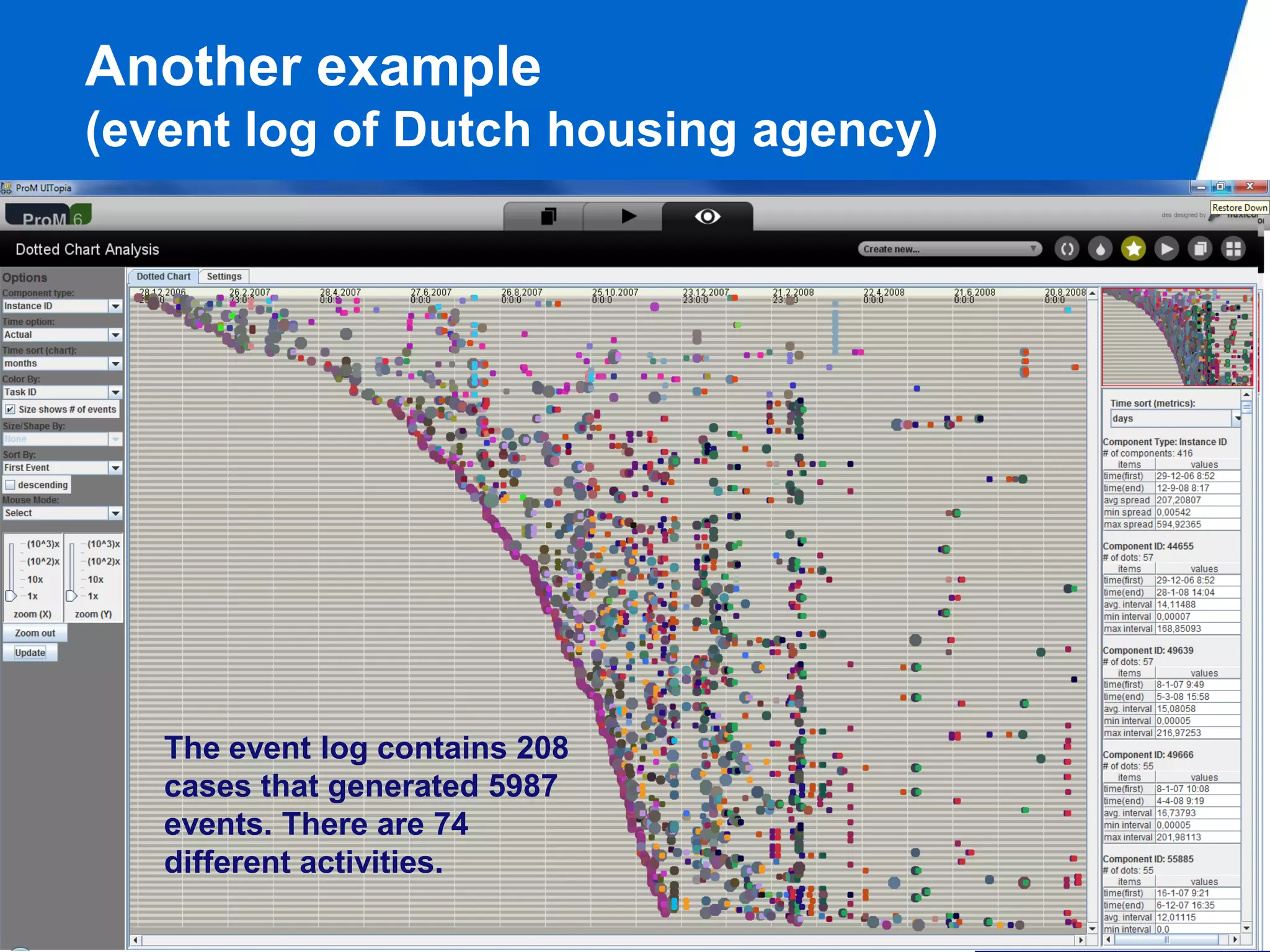
Another example
(event log of Dutch housing agency)


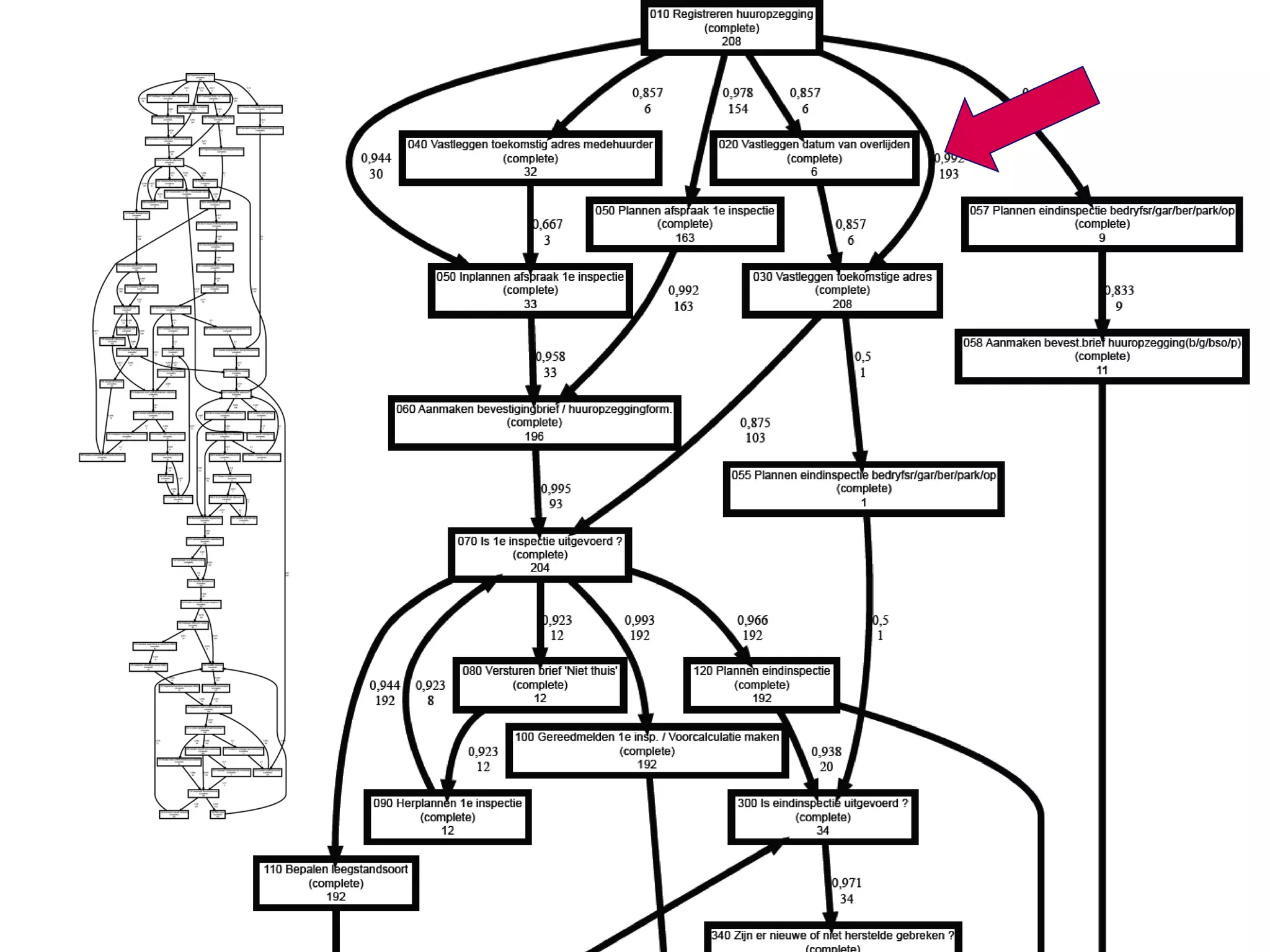
   The event log contains 208
   cases that generated 5987
   events. There are 74
   different activities.
                                      PAGE 5
PAGE 6
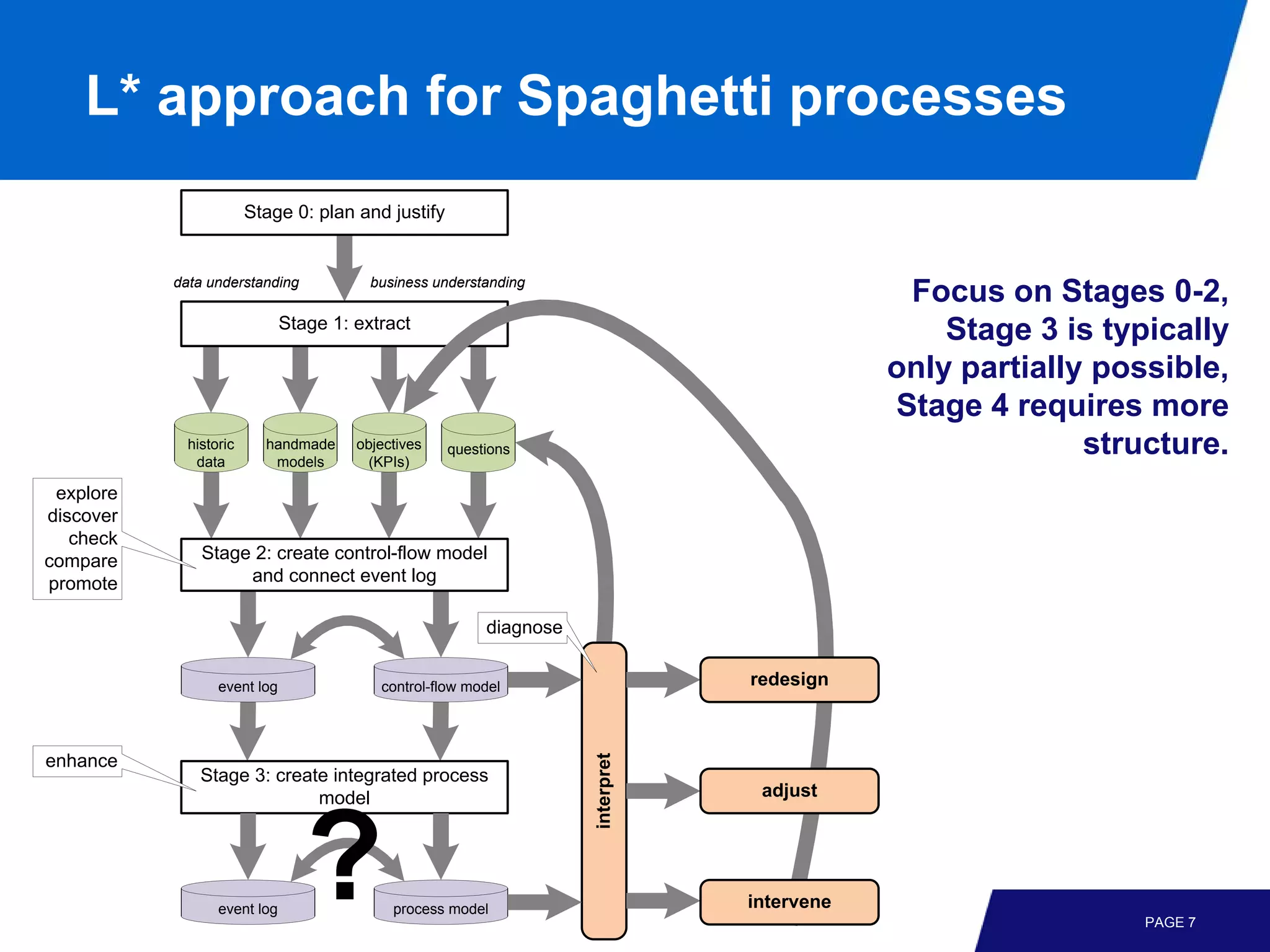
L* approach for Spaghetti processes
                        Stage 0: plan and justify


           data understanding            business understanding
                                                                                             Focus on Stages 0-2,
                              Stage 1: extract
                                                                                                Stage 3 is typically
                                                                                            only partially possible,
                                                                                            Stage 4 requires more
             historic
              data
                          handmade
                           models
                                       objectives
                                         (KPIs)
                                                    questions                                             structure.
 explore
discover
   check
compare        Stage 2: create control-flow model
promote             and connect event log

                                                         diagnose


                  event log               control-flow model                    redesign
                                                                    interpret


enhance
               Stage 3: create integrated process
                             model                                               adjust


                  event log
                                 ?          process model                       intervene
                                                                                                              PAGE 7
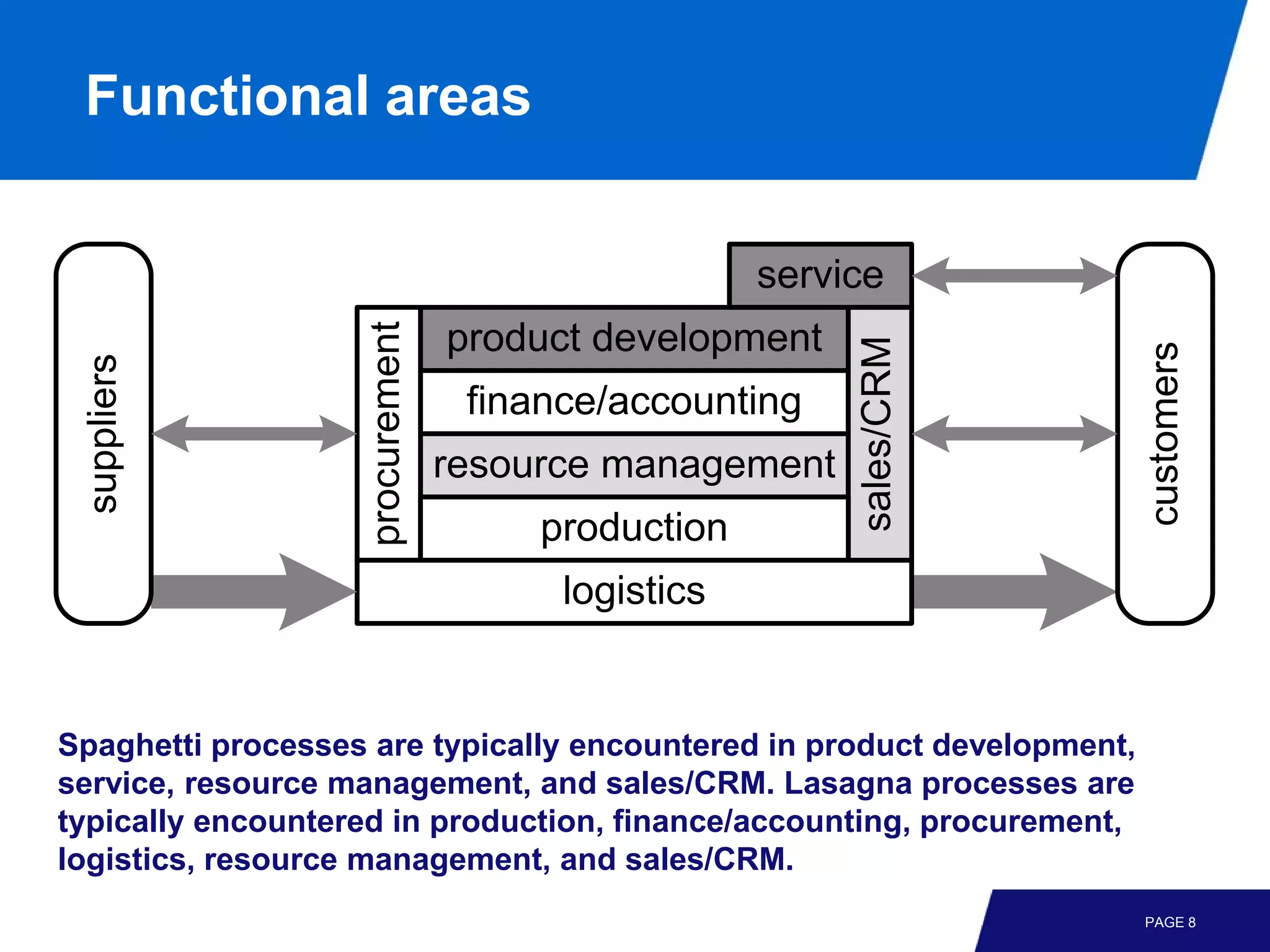
Functional areas


                                                   service

                   procurement
                                 product development


                                                        sales/CRM


                                                                        customers
 suppliers


                                  finance/accounting
                                 resource management
                                      production
                                       logistics


Spaghetti processes are typically encountered in product development,
service, resource management, and sales/CRM. Lasagna processes are
typically encountered in production, finance/accounting, procurement,
logistics, resource management, and sales/CRM.
                                                                        PAGE 8
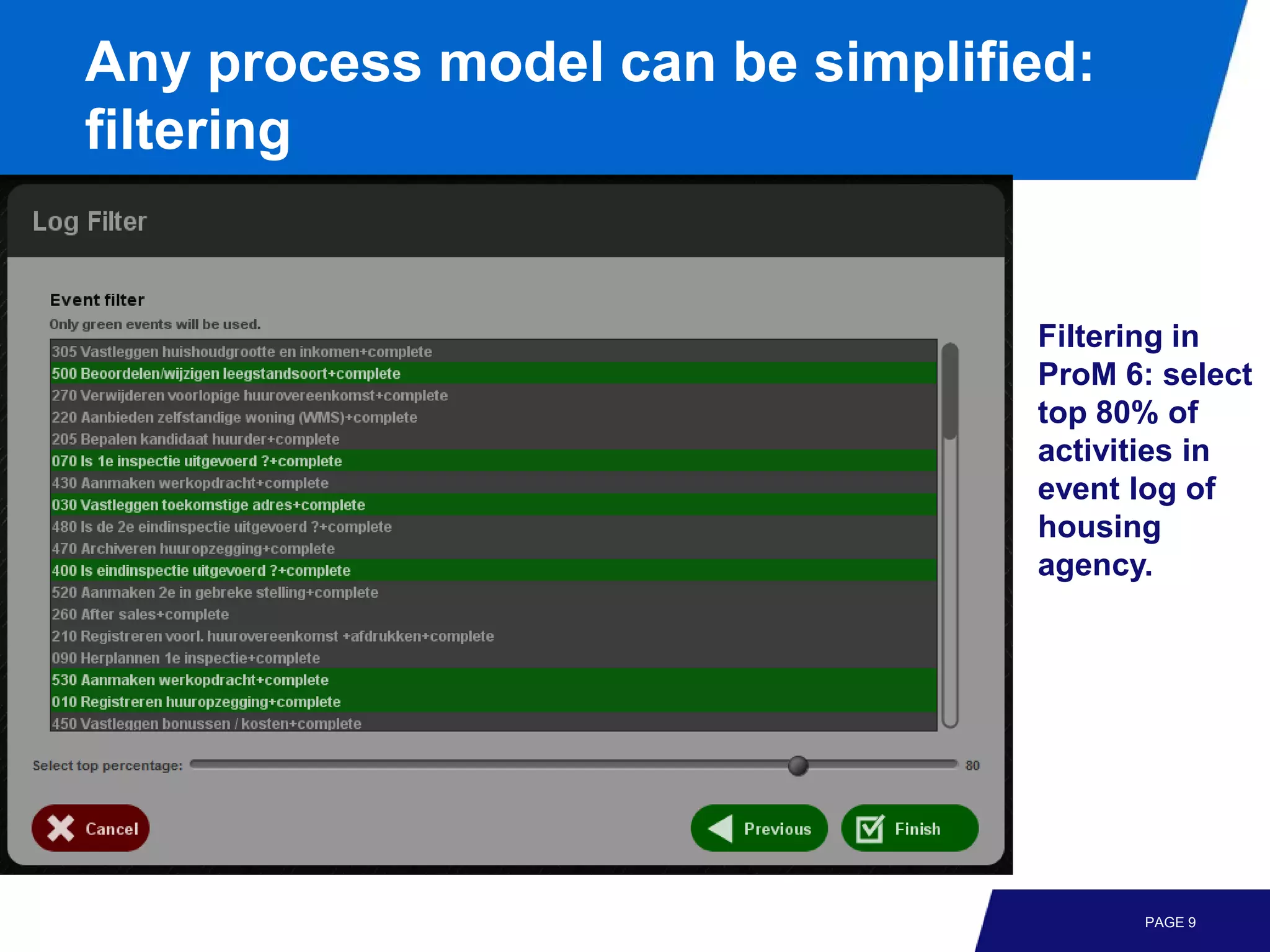
Any process model can be simplified:
filtering


                                 Filtering in
                                 ProM 6: select
                                 top 80% of
                                 activities in
                                 event log of
                                 housing
                                 agency.


                                       PAGE 9
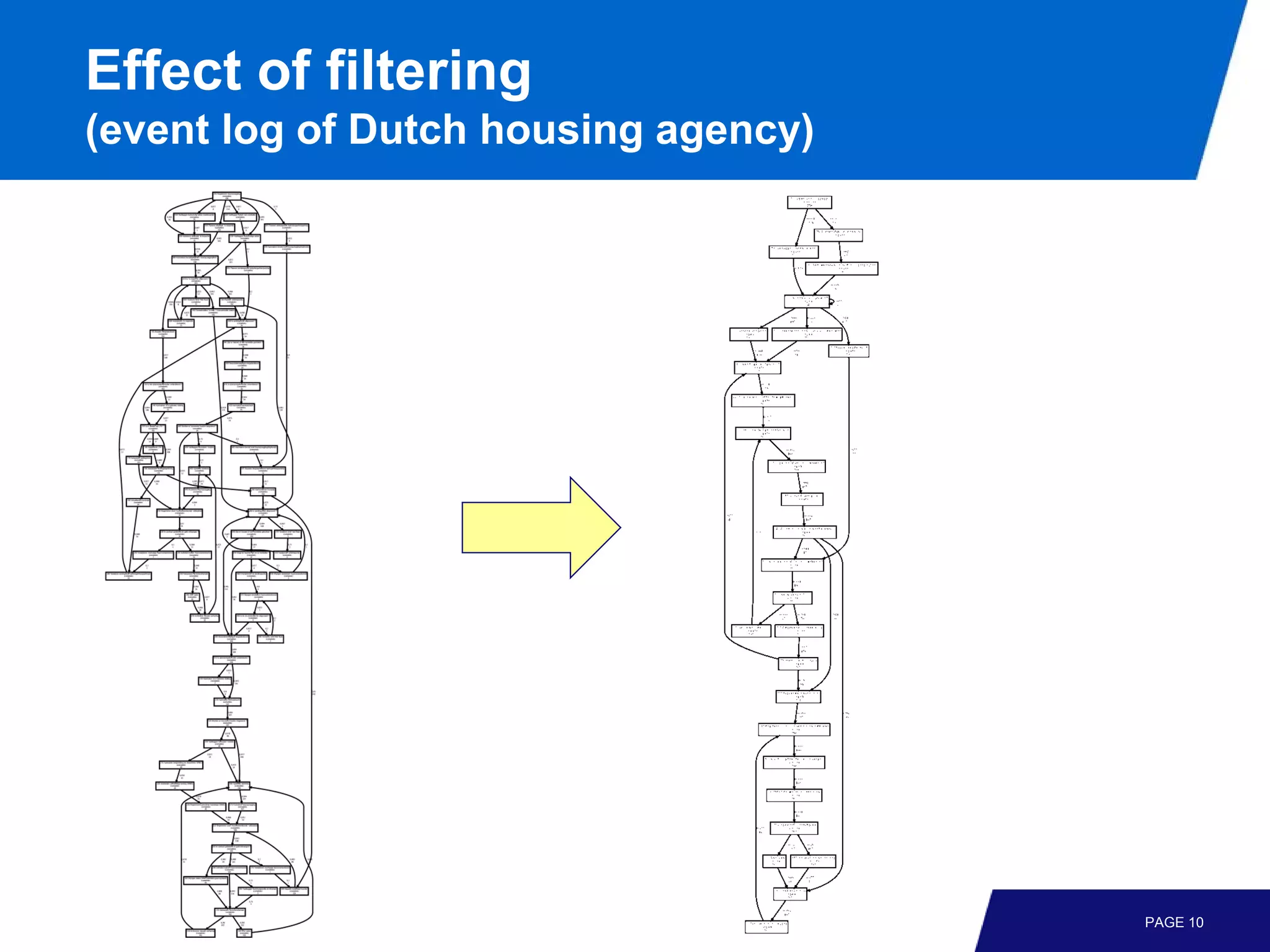
Effect of filtering
(event log of Dutch housing agency)


                                      PAGE 10
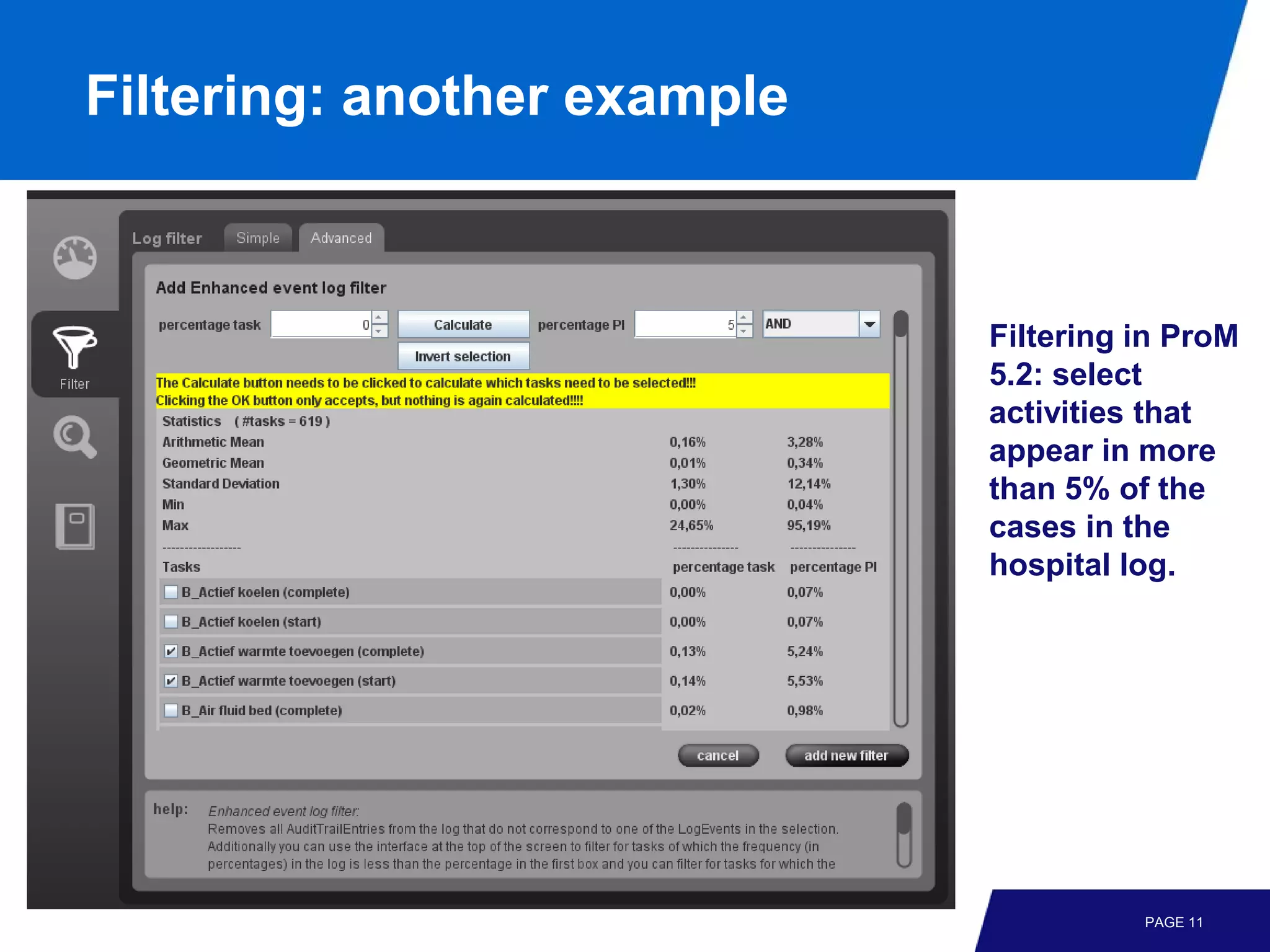
Filtering: another example


                             Filtering in ProM
                             5.2: select
                             activities that
                             appear in more
                             than 5% of the
                             cases in the
                             hospital log.


                                       PAGE 11
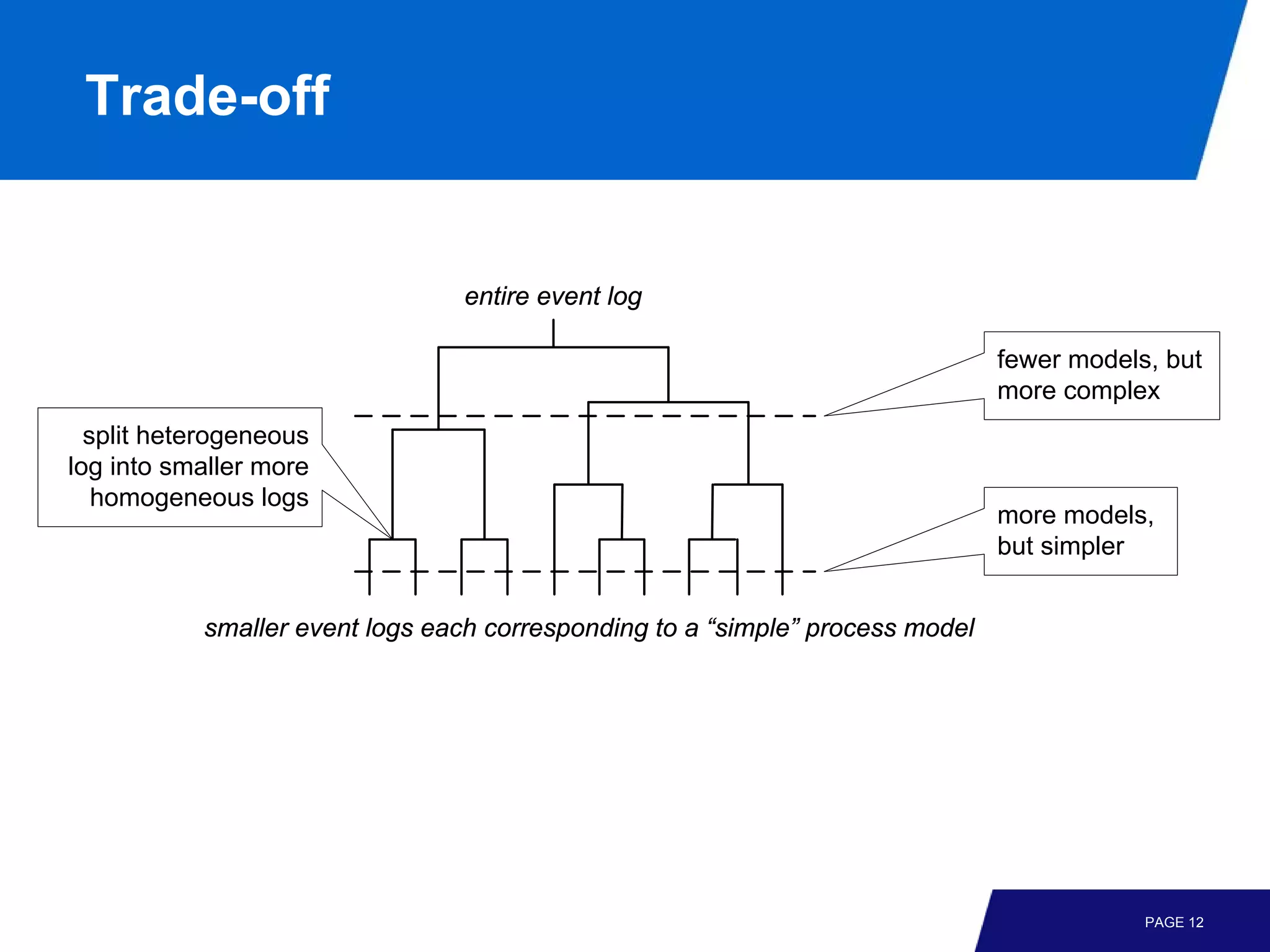
Trade-off


                                entire event log

                                                                               fewer models, but
                                                                               more complex
  split heterogeneous
log into smaller more
   homogeneous logs
                                                                               more models,
                                                                               but simpler


           smaller event logs each corresponding to a “simple” process model


                                                                                           PAGE 12
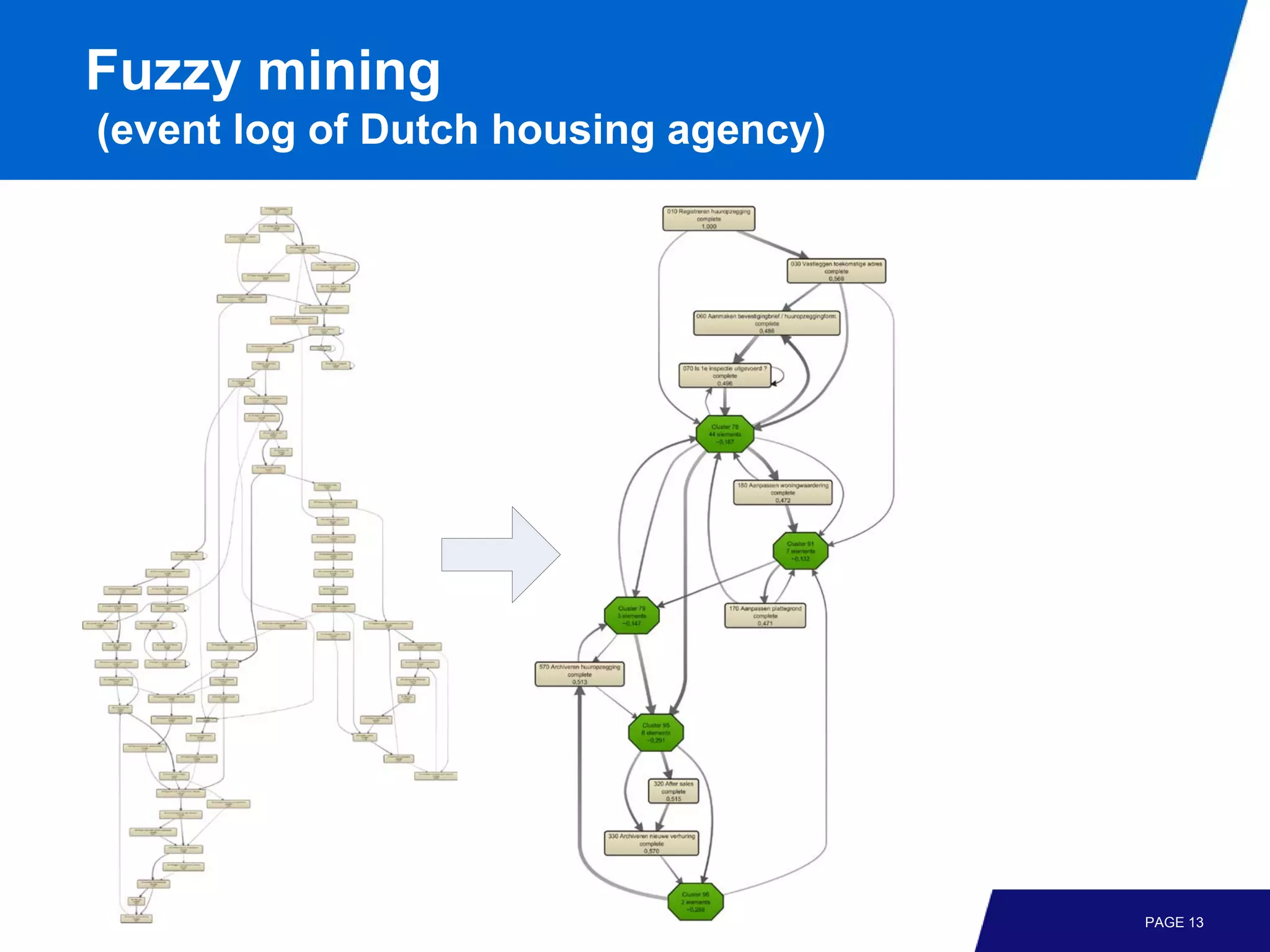
Fuzzy mining
(event log of Dutch housing agency)


                                      PAGE 13
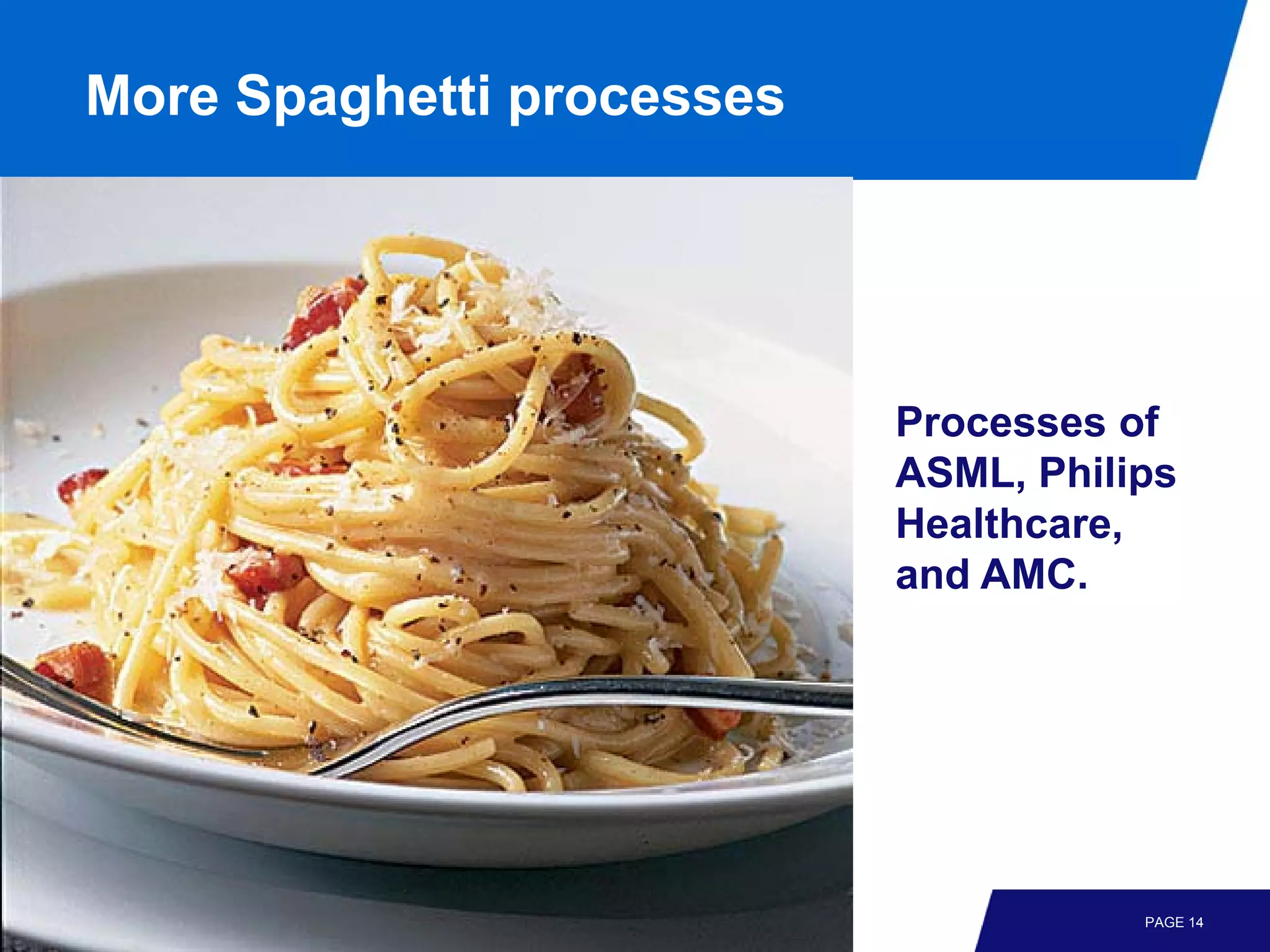
More Spaghetti processes


                           Processes of
                           ASML, Philips
                           Healthcare,
                           and AMC.


                                      PAGE 14
Test process ASML

• ASML is the world’s leading manufacturer of chip-
  making equipment and a key supplier to the chip
  industry.
• The testing of manufactured wafer scanners is an
  important, but also time-consuming, process.
• Every wafer scanner is tested in the factory of ASML.
  When it passes all tests, the wafer scanner is
  disassembled and shipped to the customer where
  the system is re-assembled (and tested again).


                                                    PAGE 15
About the example log

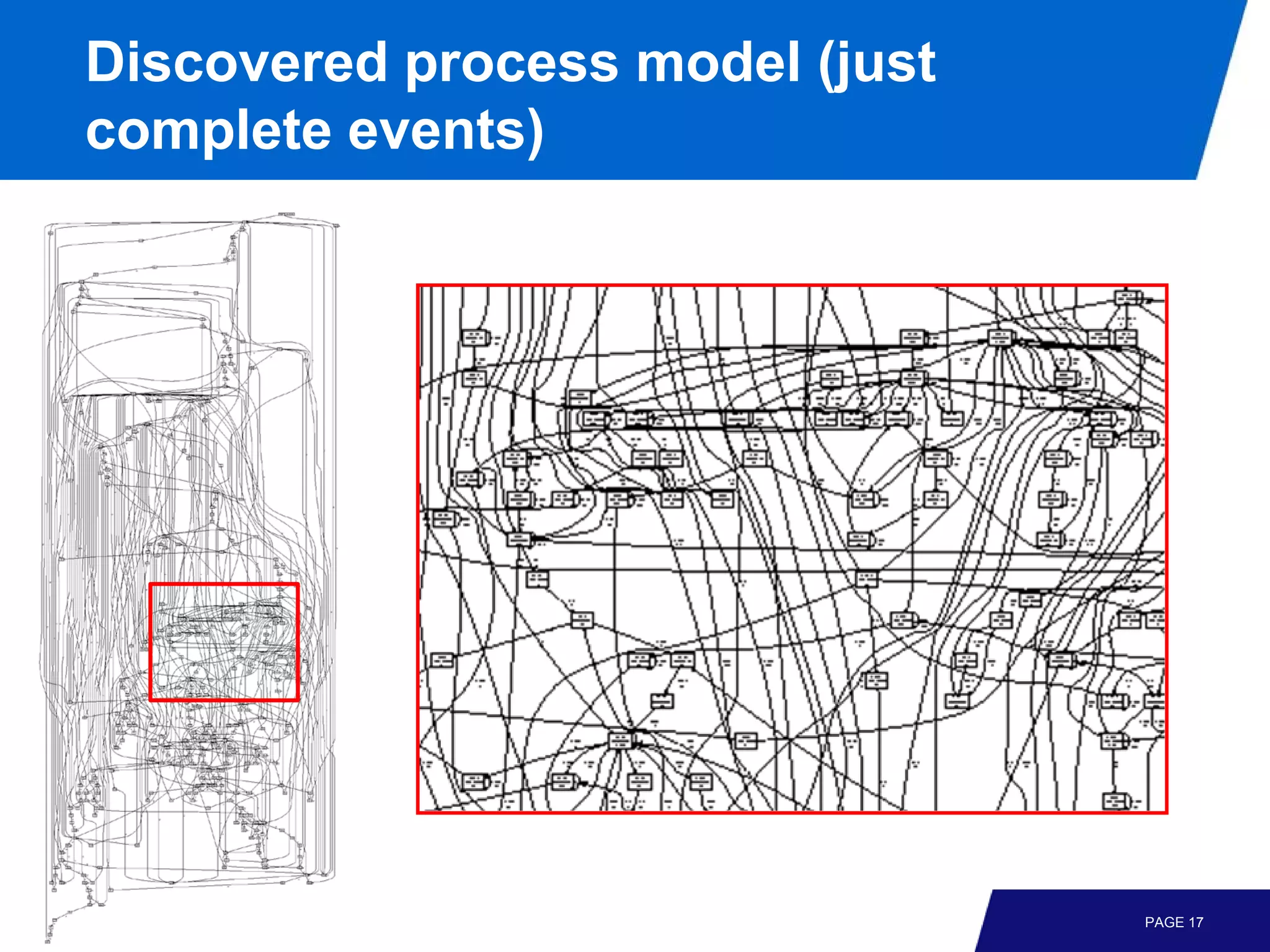
• The event log containing 154,966 events.
• The event log contained information about 24
  carefully chosen wafer scanners (same type, same
  circumstances, and having complete logs).
• The number of events per case (i.e., the length of the
  executed test sequence) in this event log ranges
  from 2820 to 16250 events.
• There are 360 different activities, all identified by four
  letter test codes.
• Each instance of these 360 activities has a start
  event and complete event.

                                                         PAGE 16
Discovered process model (just
complete events)


                                 PAGE 17
Conformance checking

• ASML also had a so-called reference model describing the way
  that machines should be tested.
• This reference model is at the level of job steps rather than test
  codes. However, ASML maintains a mapping from the lower level
  codes to these higher level activities. Comparing the reference
  model and our discovered model (both at the job step and test
  code level) revealed interesting differences.
• Moreover, using the ProM’s conformance checker we could
  show that the average fitness was only 0.375, i.e., less than half
  of the events can be explained by the model.
• When replaying, we discovered many activities that had
  occurred but that should not have happened according to the
  reference model and activities that should have happened but
  did not.

                                                                 PAGE 18
Philips Healthcare: Allura Xper systems

• Philips Healthcare is one of the leading manufacturers of
  medical devices, offering diagnosing imaging systems,
  healthcare information technology solutions, patient
  monitoring systems, and cardiac devices.
• Philips Remote Services (PRS) is a system for the active
  monitoring of systems via the Internet. PRS has been
  established to deliver remote technical support,
  monitoring, diagnostics, application assistance, and other
  added value services.
• We analyzed the event logs of Allura Xper systems. These
  are X-ray systems designed to diagnose and possibly
  assist in the treatment of all kinds of diseases, like heart
  or lung diseases, by generating images of the internal
  body.                                                  PAGE 19
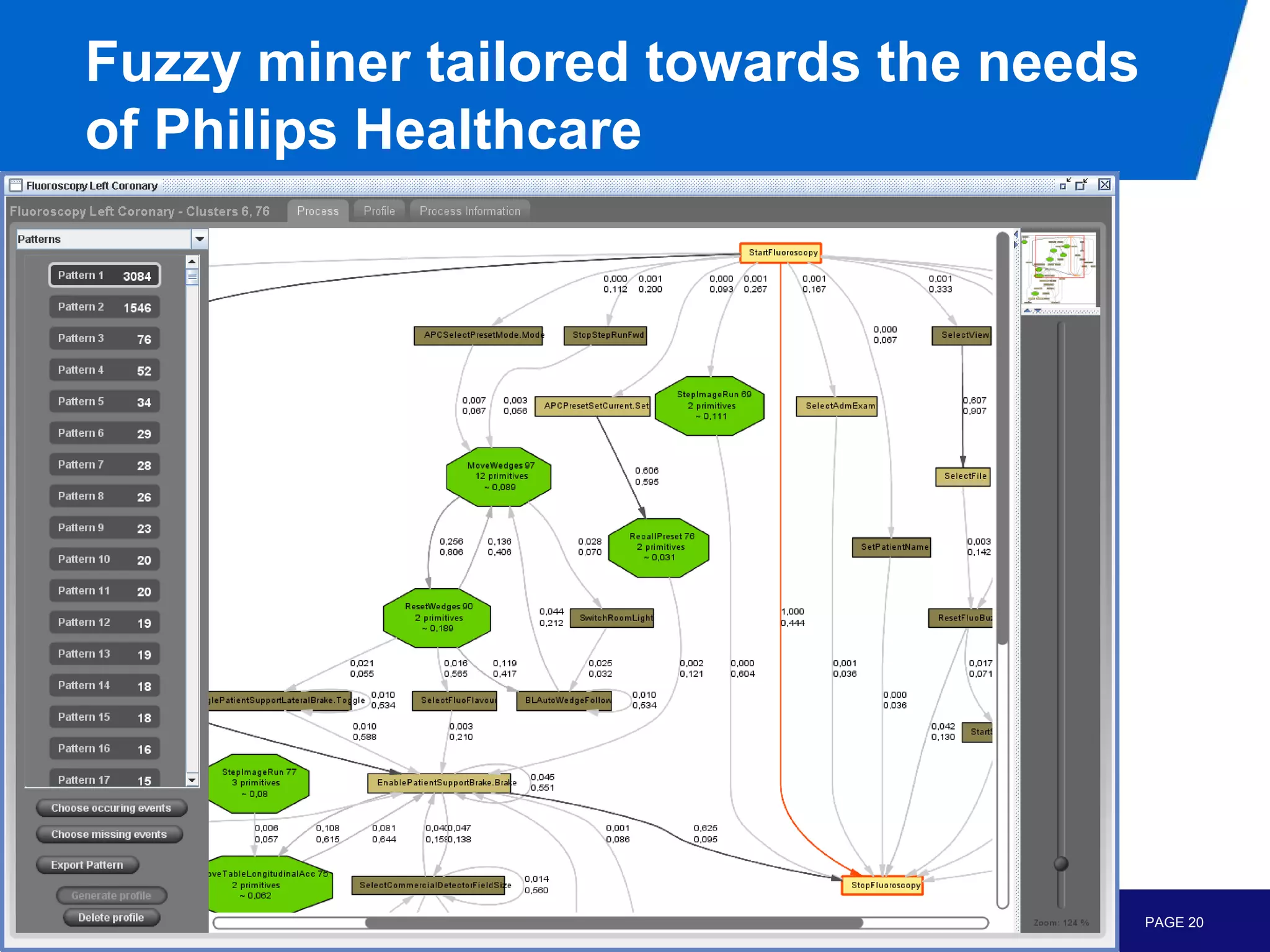
Fuzzy miner tailored towards the needs
of Philips Healthcare


                                         PAGE 20
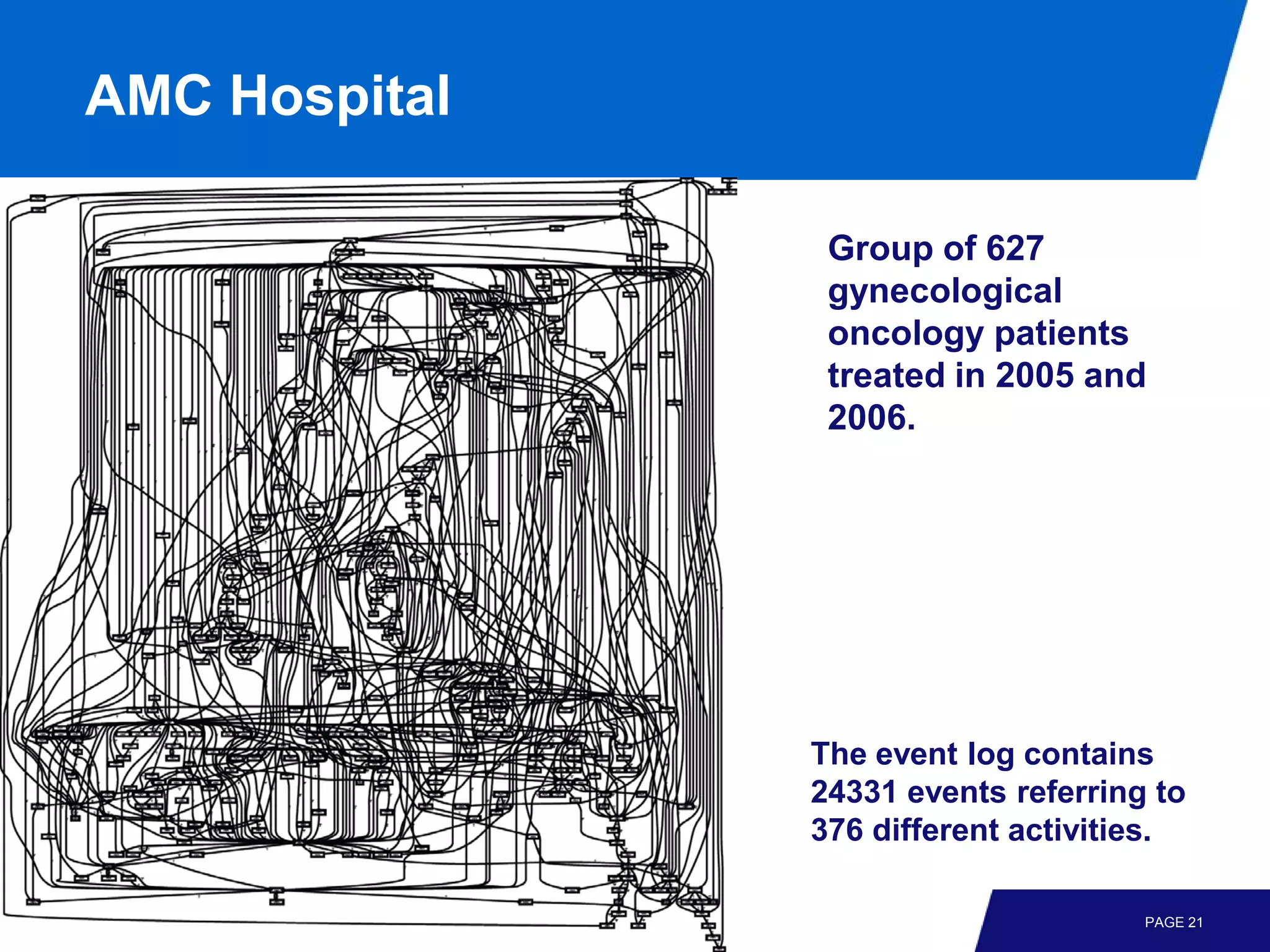
AMC Hospital

                Group of 627
                gynecological
                oncology patients
                treated in 2005 and
                2006.


               The event log contains
               24331 events referring to
               376 different activities.

                                     PAGE 21
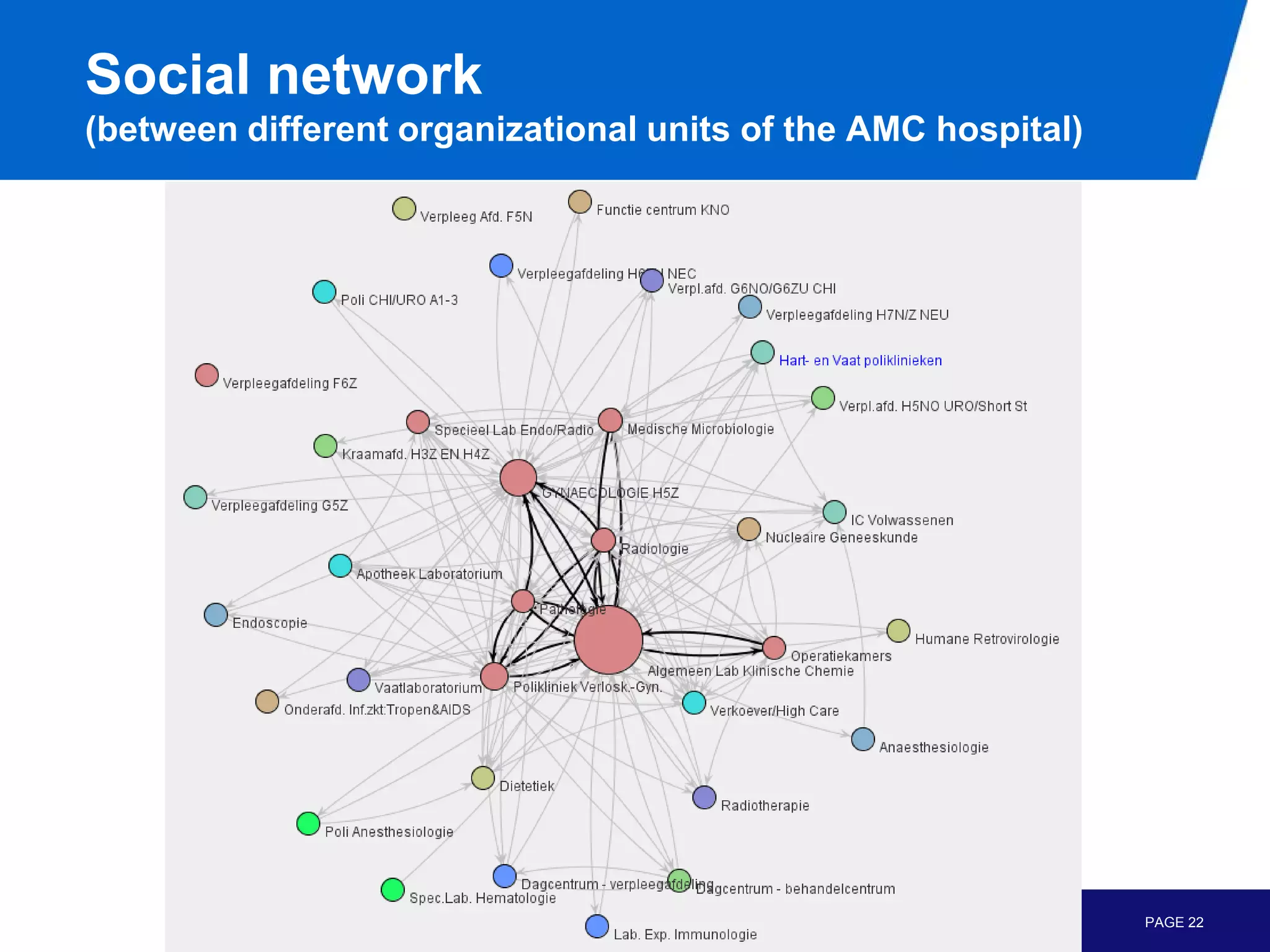
Social network
(between different organizational units of the AMC hospital)


                                                               PAGE 22
Analyzing “Spaghetti Processes”


More difficult, but …

the potential gains are also more substantial.


                                                 PAGE 23

Process Mining - Chapter 12 - Analyzing Spaghetti Processes

  • 1.
    Chapter 12 Analyzing “SpaghettiProcesses” prof.dr.ir. Wil van der Aalst www.processmining.org
  • 2.
    Overview Chapter 1 Introduction Part I:Preliminaries Chapter 2 Chapter 3 Process Modeling and Data Mining Analysis Part II: From Event Logs to Process Models Chapter 4 Chapter 5 Chapter 6 Getting the Data Process Discovery: An Advanced Process Introduction Discovery Techniques Part III: Beyond Process Discovery Chapter 7 Chapter 8 Chapter 9 Conformance Mining Additional Operational Support Checking Perspectives Part IV: Putting Process Mining to Work Chapter 10 Chapter 11 Chapter 12 Tool Support Analyzing “Lasagna Analyzing “Spaghetti Processes” Processes” Part V: Reflection Chapter 13 Chapter 14 Cartography and Epilogue Navigation PAGE 1
  • 3.
    Remember: Howcan process mining help? • Detect bottlenecks • Provide mirror • Detect deviations • Highlight important • Performance problems measurement • Avoid ICT failures • Suggest improvements • Avoid management by • Decision support (e.g., PowerPoint recommendation and • From “politics” to prediction) “analytics” PAGE 2
  • 4.
    Example of aSpaghetti process Spaghetti process describing the diagnosis and treatment of 2765 patients in a Dutch hospital. The process model was constructed based on an event log containing 114,592 events. There are 619 different activities (taking event types into account) executed by 266 different individuals (doctors, nurses, etc.). PAGE 3
  • 5.
    Fragment 18 activities ofthe 619 activities (2.9%) PAGE 4
  • 6.
    Another example (event logof Dutch housing agency) The event log contains 208 cases that generated 5987 events. There are 74 different activities. PAGE 5
  • 7.
  • 8.
    L* approach forSpaghetti processes Stage 0: plan and justify data understanding business understanding Focus on Stages 0-2, Stage 1: extract Stage 3 is typically only partially possible, Stage 4 requires more historic data handmade models objectives (KPIs) questions structure. explore discover check compare Stage 2: create control-flow model promote and connect event log diagnose event log control-flow model redesign interpret enhance Stage 3: create integrated process model adjust event log ? process model intervene PAGE 7
  • 9.
    Functional areas service procurement product development sales/CRM customers suppliers finance/accounting resource management production logistics Spaghetti processes are typically encountered in product development, service, resource management, and sales/CRM. Lasagna processes are typically encountered in production, finance/accounting, procurement, logistics, resource management, and sales/CRM. PAGE 8
  • 10.
    Any process modelcan be simplified: filtering Filtering in ProM 6: select top 80% of activities in event log of housing agency. PAGE 9
  • 11.
    Effect of filtering (eventlog of Dutch housing agency) PAGE 10
  • 12.
    Filtering: another example Filtering in ProM 5.2: select activities that appear in more than 5% of the cases in the hospital log. PAGE 11
  • 13.
    Trade-off entire event log fewer models, but more complex split heterogeneous log into smaller more homogeneous logs more models, but simpler smaller event logs each corresponding to a “simple” process model PAGE 12
  • 14.
    Fuzzy mining (event logof Dutch housing agency) PAGE 13
  • 15.
    More Spaghetti processes Processes of ASML, Philips Healthcare, and AMC. PAGE 14
  • 16.
    Test process ASML •ASML is the world’s leading manufacturer of chip- making equipment and a key supplier to the chip industry. • The testing of manufactured wafer scanners is an important, but also time-consuming, process. • Every wafer scanner is tested in the factory of ASML. When it passes all tests, the wafer scanner is disassembled and shipped to the customer where the system is re-assembled (and tested again). PAGE 15
  • 17.
    About the examplelog • The event log containing 154,966 events. • The event log contained information about 24 carefully chosen wafer scanners (same type, same circumstances, and having complete logs). • The number of events per case (i.e., the length of the executed test sequence) in this event log ranges from 2820 to 16250 events. • There are 360 different activities, all identified by four letter test codes. • Each instance of these 360 activities has a start event and complete event. PAGE 16
  • 18.
    Discovered process model(just complete events) PAGE 17
  • 19.
    Conformance checking • ASMLalso had a so-called reference model describing the way that machines should be tested. • This reference model is at the level of job steps rather than test codes. However, ASML maintains a mapping from the lower level codes to these higher level activities. Comparing the reference model and our discovered model (both at the job step and test code level) revealed interesting differences. • Moreover, using the ProM’s conformance checker we could show that the average fitness was only 0.375, i.e., less than half of the events can be explained by the model. • When replaying, we discovered many activities that had occurred but that should not have happened according to the reference model and activities that should have happened but did not. PAGE 18
  • 20.
    Philips Healthcare: AlluraXper systems • Philips Healthcare is one of the leading manufacturers of medical devices, offering diagnosing imaging systems, healthcare information technology solutions, patient monitoring systems, and cardiac devices. • Philips Remote Services (PRS) is a system for the active monitoring of systems via the Internet. PRS has been established to deliver remote technical support, monitoring, diagnostics, application assistance, and other added value services. • We analyzed the event logs of Allura Xper systems. These are X-ray systems designed to diagnose and possibly assist in the treatment of all kinds of diseases, like heart or lung diseases, by generating images of the internal body. PAGE 19
  • 21.
    Fuzzy miner tailoredtowards the needs of Philips Healthcare PAGE 20
  • 22.
    AMC Hospital Group of 627 gynecological oncology patients treated in 2005 and 2006. The event log contains 24331 events referring to 376 different activities. PAGE 21
  • 23.
    Social network (between differentorganizational units of the AMC hospital) PAGE 22
  • 24.
    Analyzing “Spaghetti Processes” Moredifficult, but … the potential gains are also more substantial. PAGE 23