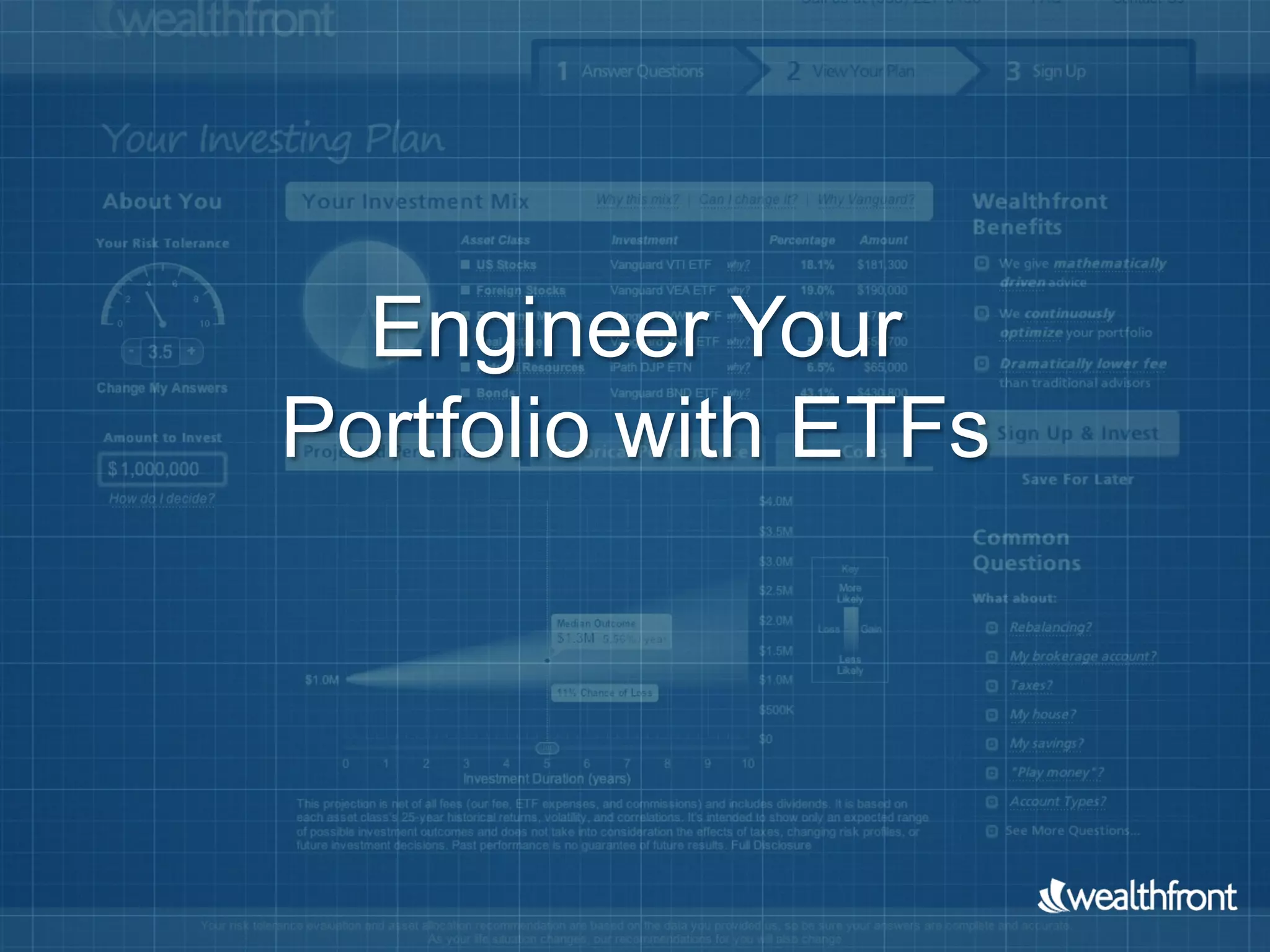
Engineer Your
Portfolio with ETFs
By the end of November 2011, there
 were more than 1,400 different
  exchange traded funds (ETFs)
        accounting for over
$1 trillion dollars invested.
You’ve heard a lot about ETFs. They’re an easy and
convenient way to “diversify your portfolio,” but how
about the real questions…


                            Which should I buy
                             and how much?
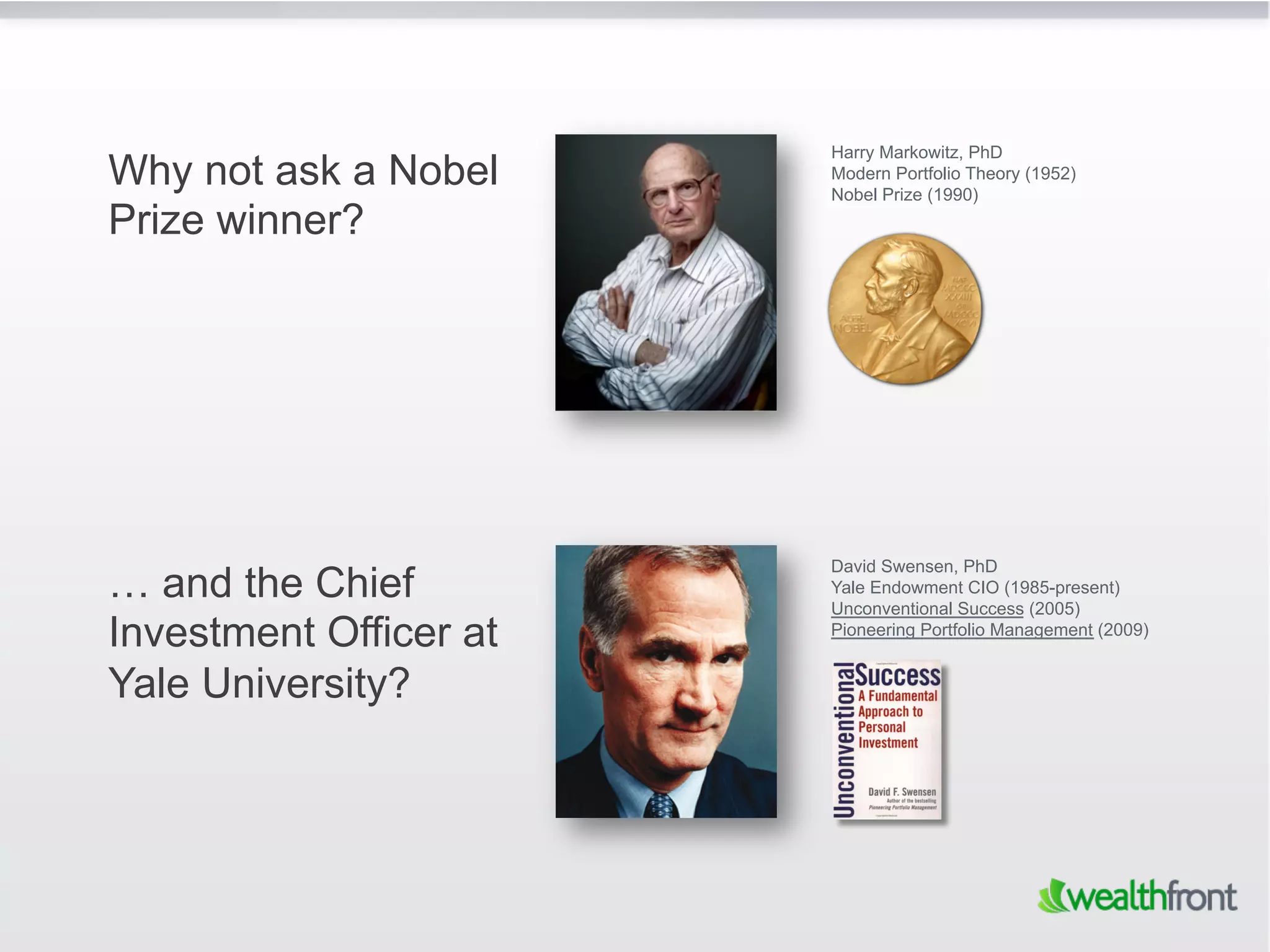
Harry Markowitz, PhD
Why not ask a Nobel     Modern Portfolio Theory (1952)
                        Nobel Prize (1990)
Prize winner?


                        David Swensen, PhD
… and the Chief         Yale Endowment CIO (1985-present)
                        Unconventional Success (2005)
Investment Officer at   Pioneering Portfolio Management (2009)


Yale University?
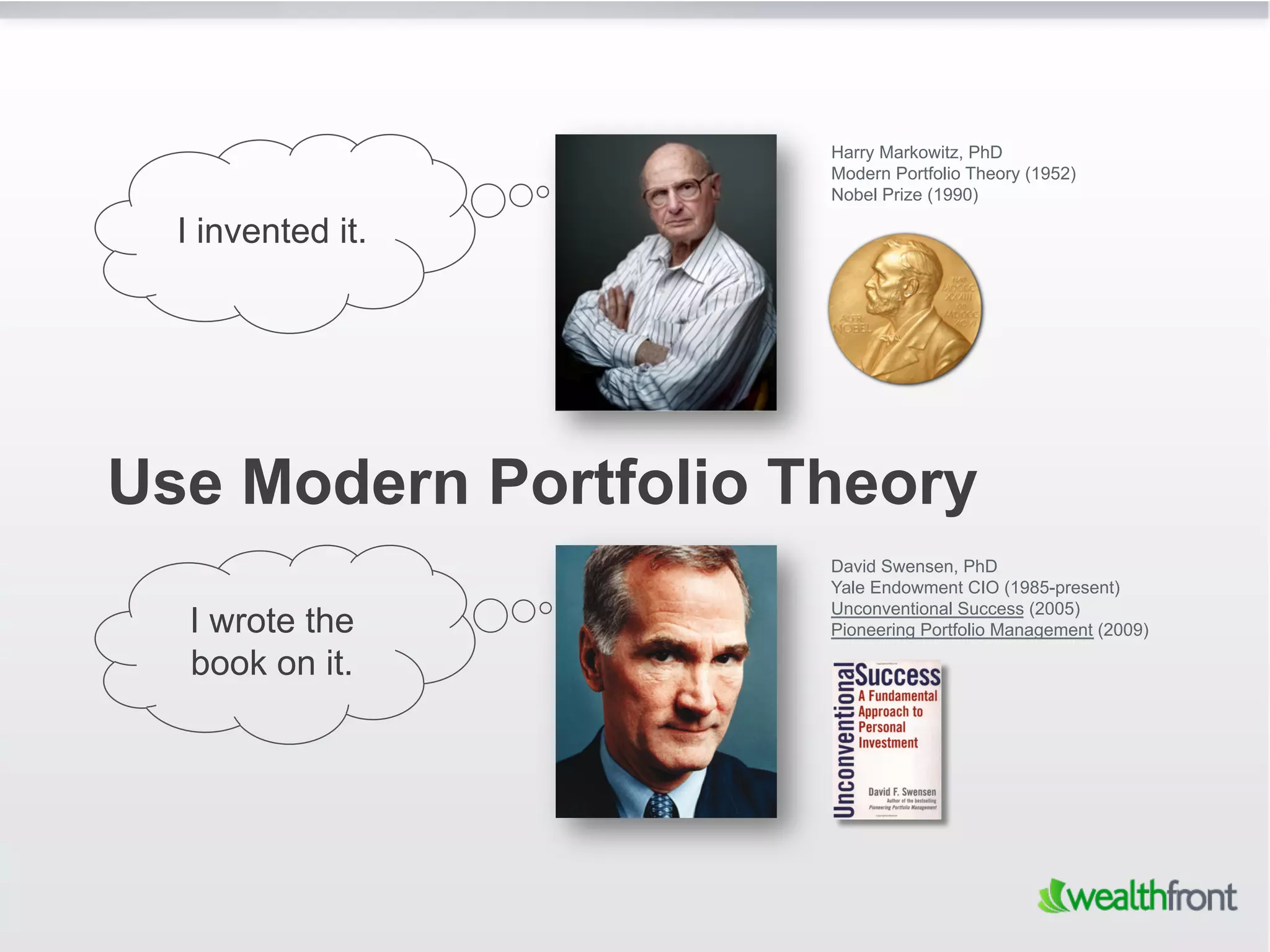
Harry Markowitz, PhD
                      Modern Portfolio Theory (1952)
                      Nobel Prize (1990)

  I invented it.


Use Modern Portfolio Theory
                      David Swensen, PhD
                      Yale Endowment CIO (1985-present)
                      Unconventional Success (2005)
  I wrote the         Pioneering Portfolio Management (2009)

  book on it.
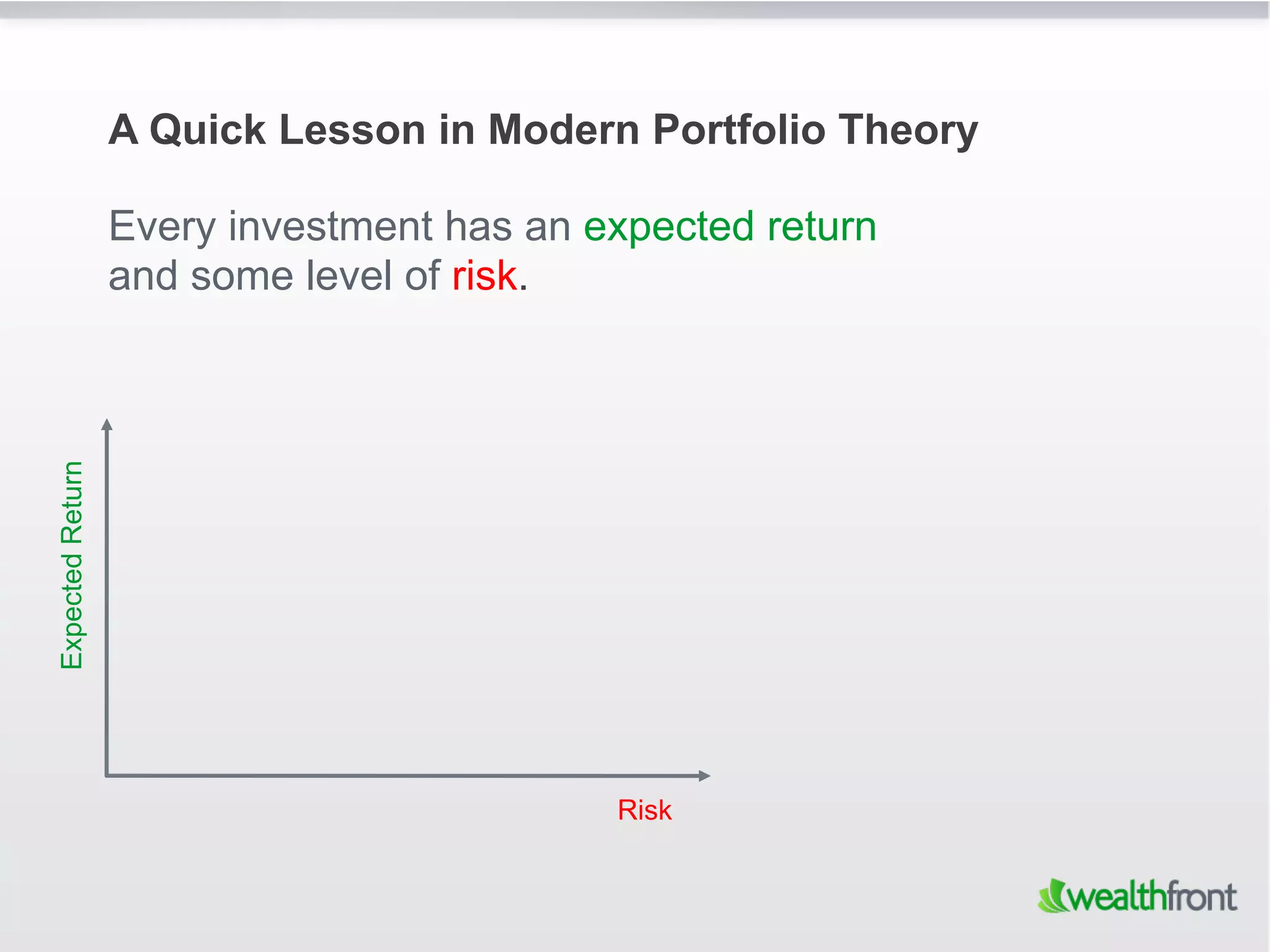
A Quick Lesson in Modern Portfolio Theory

                  Every investment has an expected return
                  and some level of risk.
Expected Return


                                           Risk
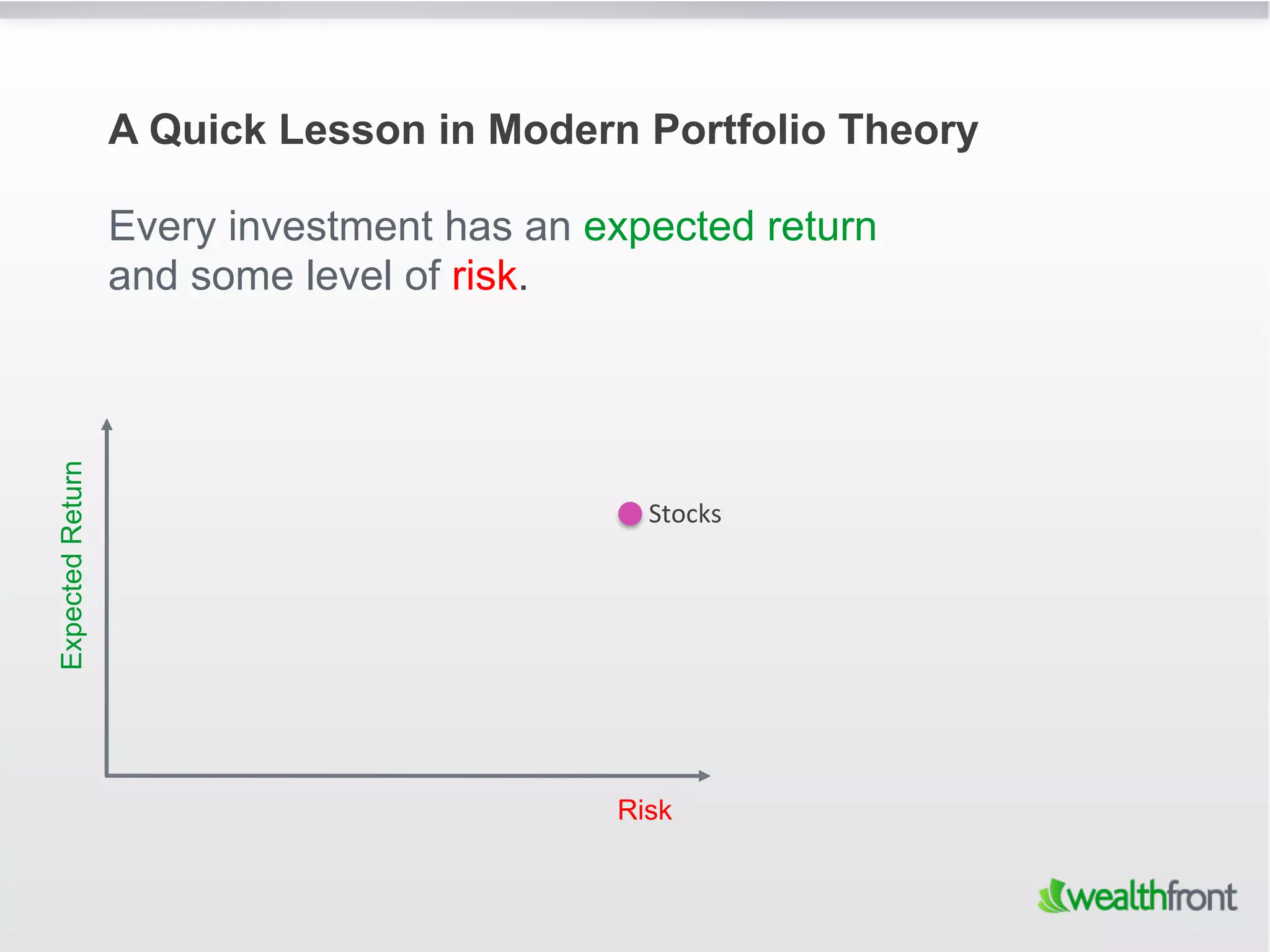
A Quick Lesson in Modern Portfolio Theory

                  Every investment has an expected return
                  and some level of risk.
Expected Return


                                             Stocks	


                                           Risk
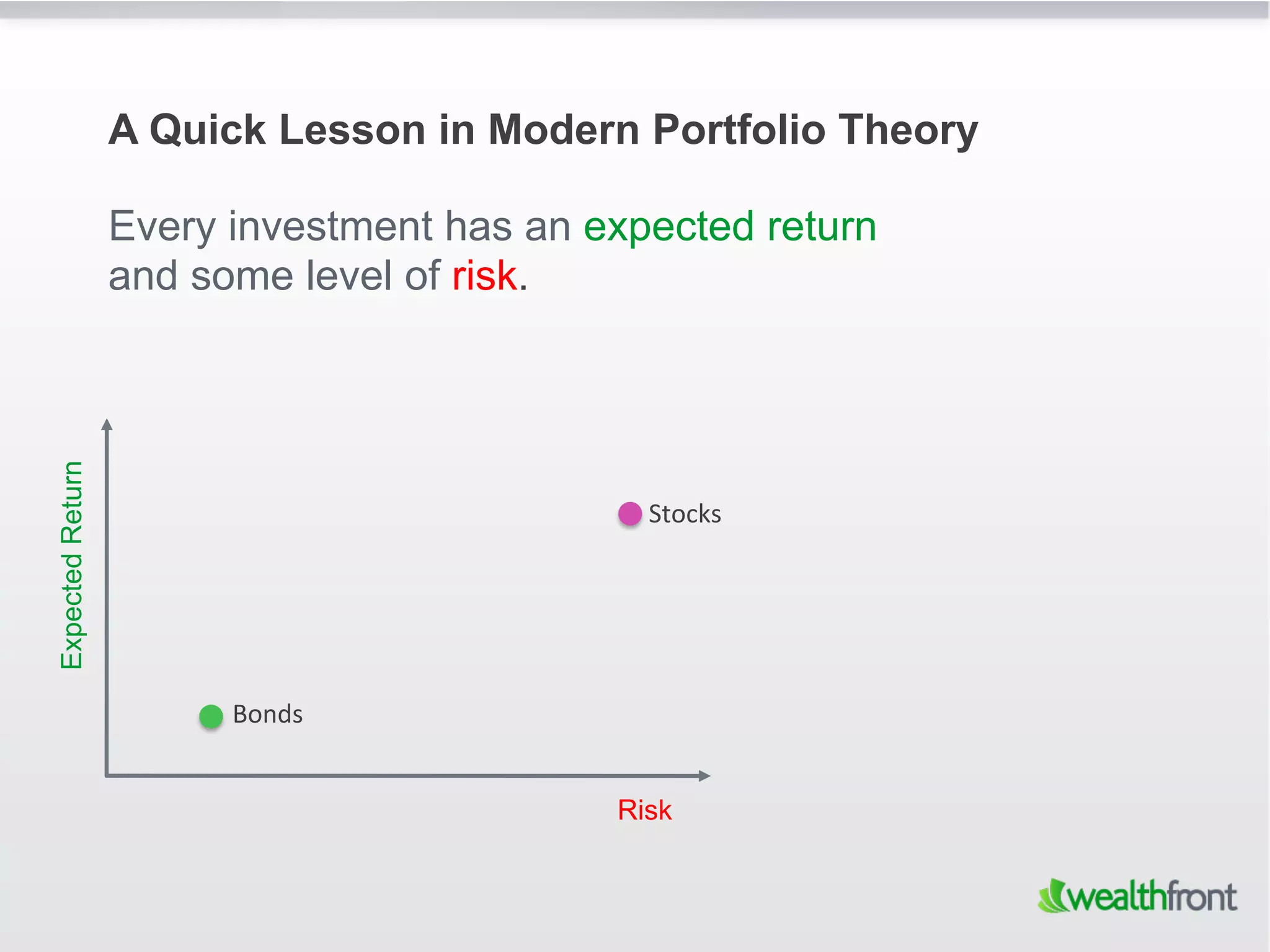
A Quick Lesson in Modern Portfolio Theory

                  Every investment has an expected return
                  and some level of risk.
Expected Return


                                             Stocks	


                        Bonds	


                                           Risk
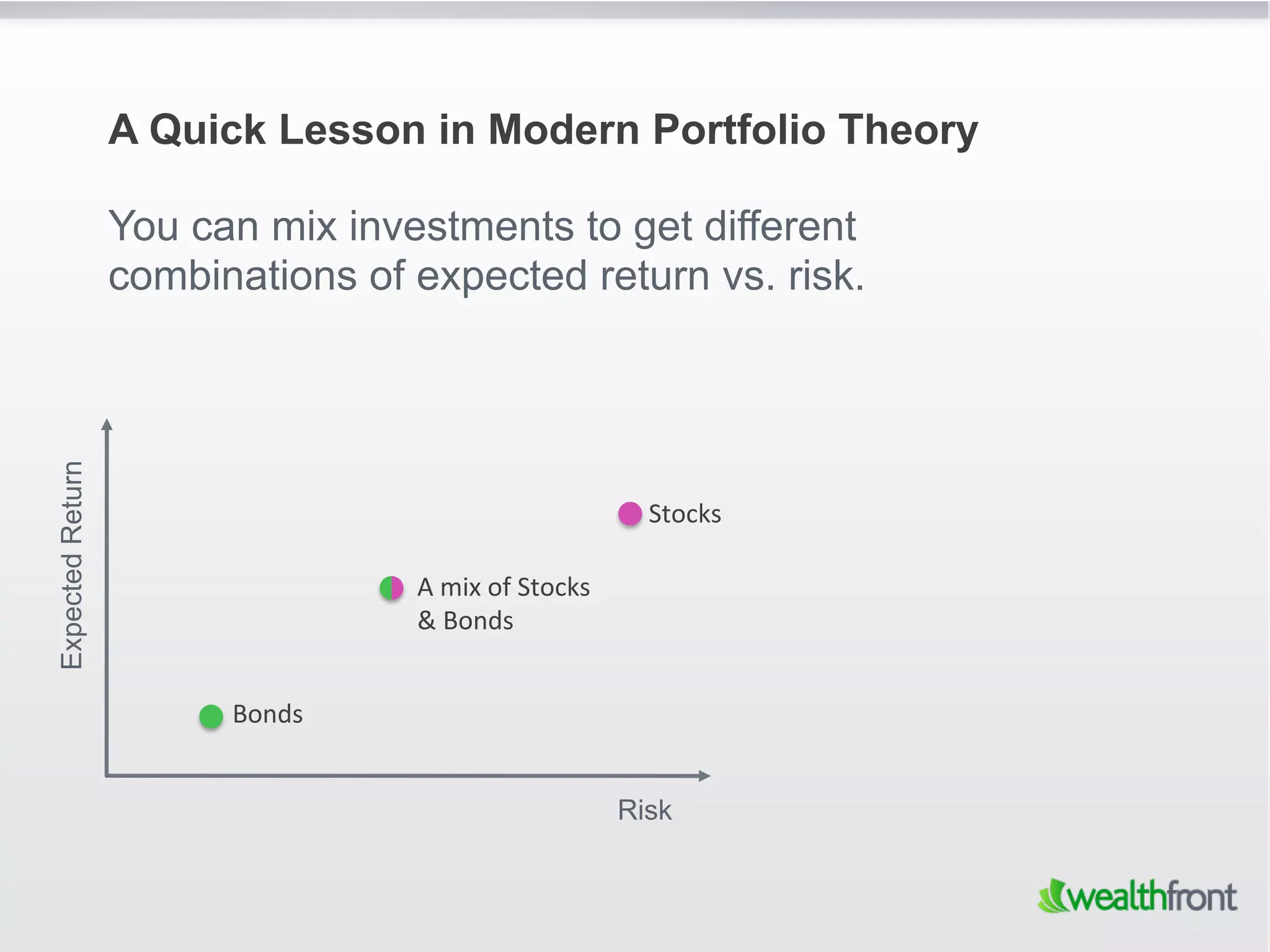
A Quick Lesson in Modern Portfolio Theory

                  You can mix investments to get different
                  combinations of expected return vs. risk.
Expected Return


                                                                     Stocks	
  

                                    A	
  mix	
  of	
  Stocks	
  
                                    &	
  Bonds	


                        Bonds	


                                                                   Risk
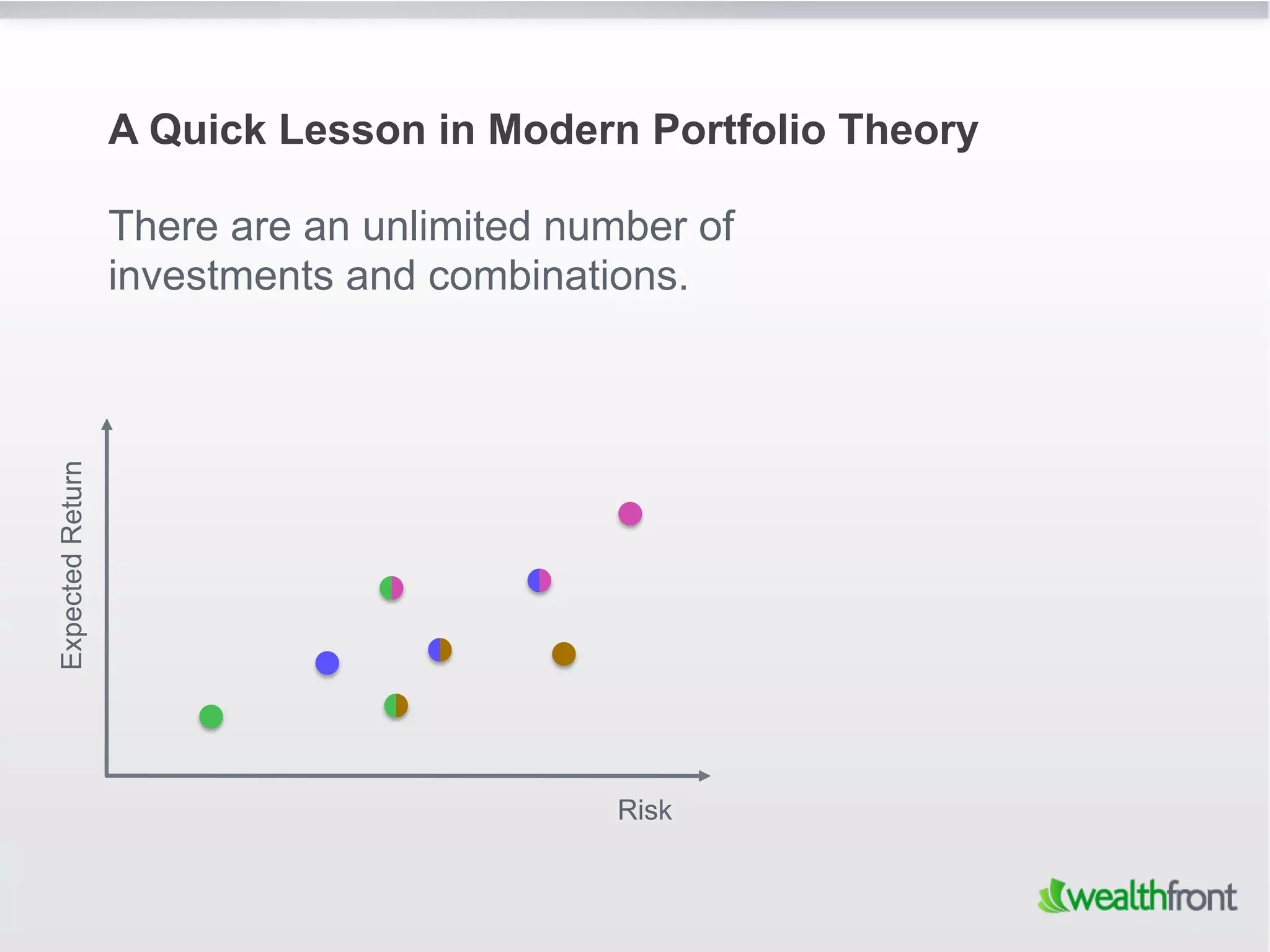
A Quick Lesson in Modern Portfolio Theory

                  There are an unlimited number of
                  investments and combinations.
Expected Return


                                            Risk
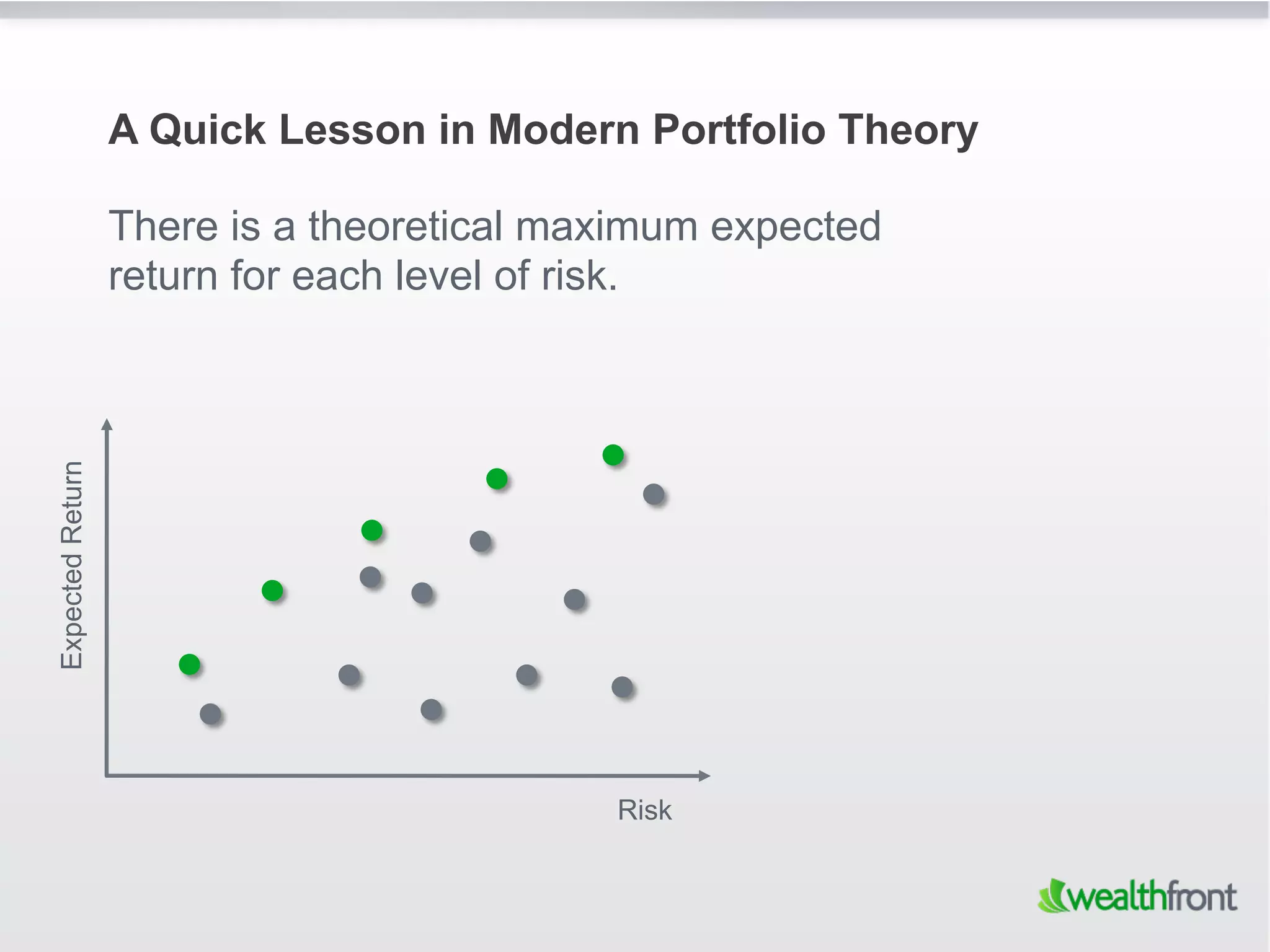
A Quick Lesson in Modern Portfolio Theory

                  There is a theoretical maximum expected
                  return for each level of risk.
Expected Return


                                           Risk
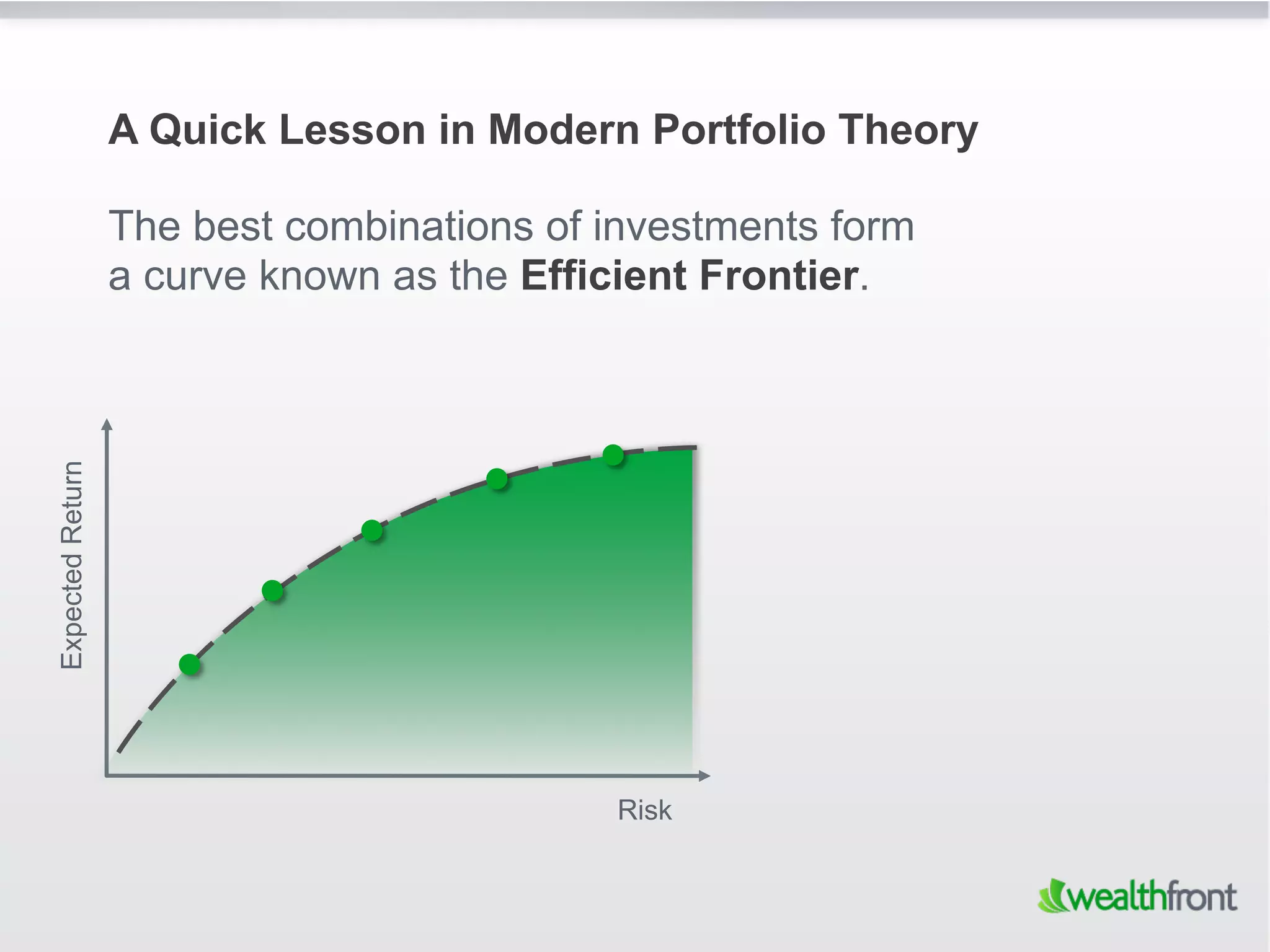
A Quick Lesson in Modern Portfolio Theory

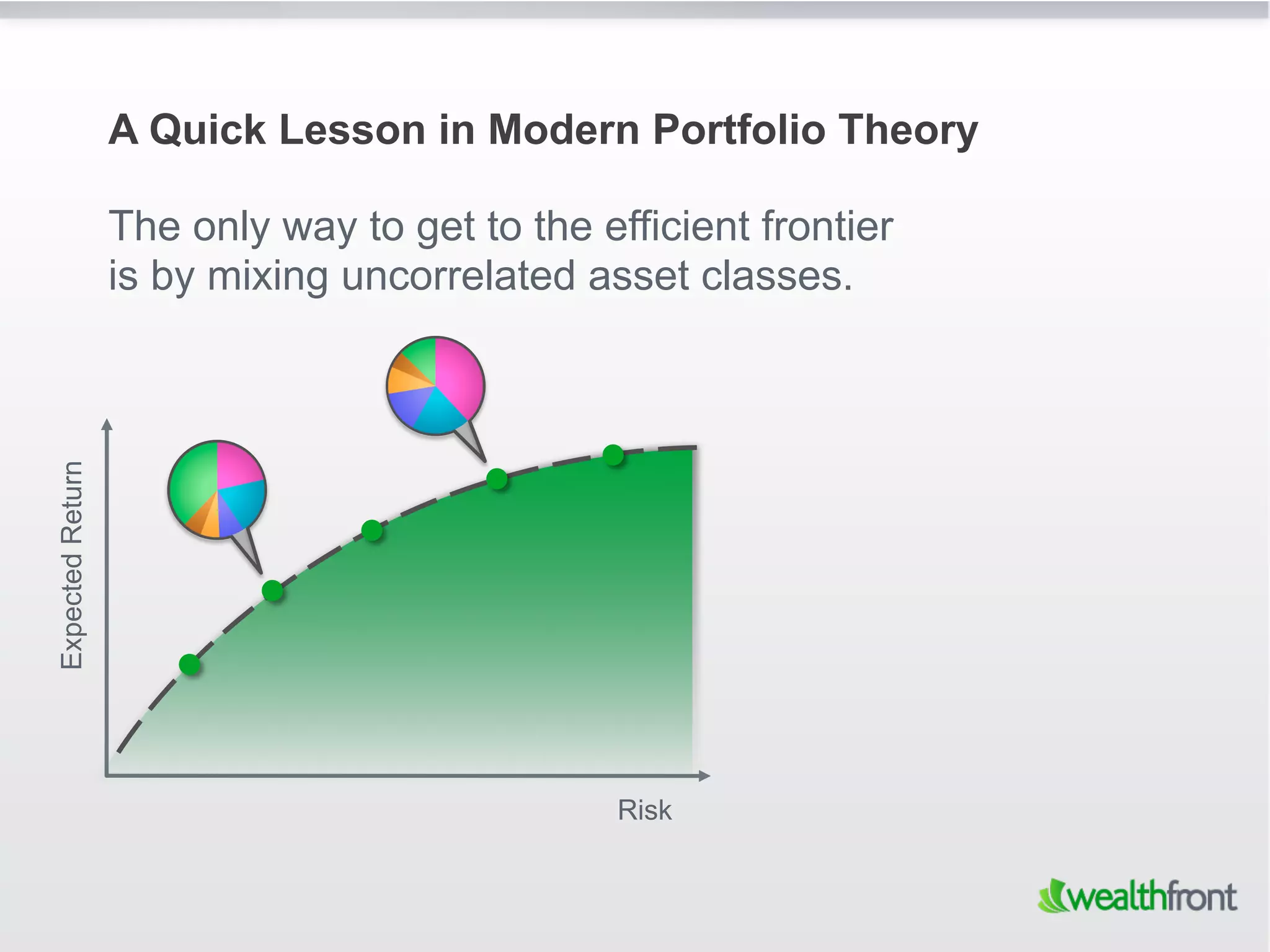
                  The best combinations of investments form
                  a curve known as the Efficient Frontier.
Expected Return


                                           Risk
A Quick Lesson in Modern Portfolio Theory

                  The only way to get to the efficient frontier
                  is by mixing uncorrelated asset classes.
Expected Return


                                               Risk
Modern Portfolio Theory
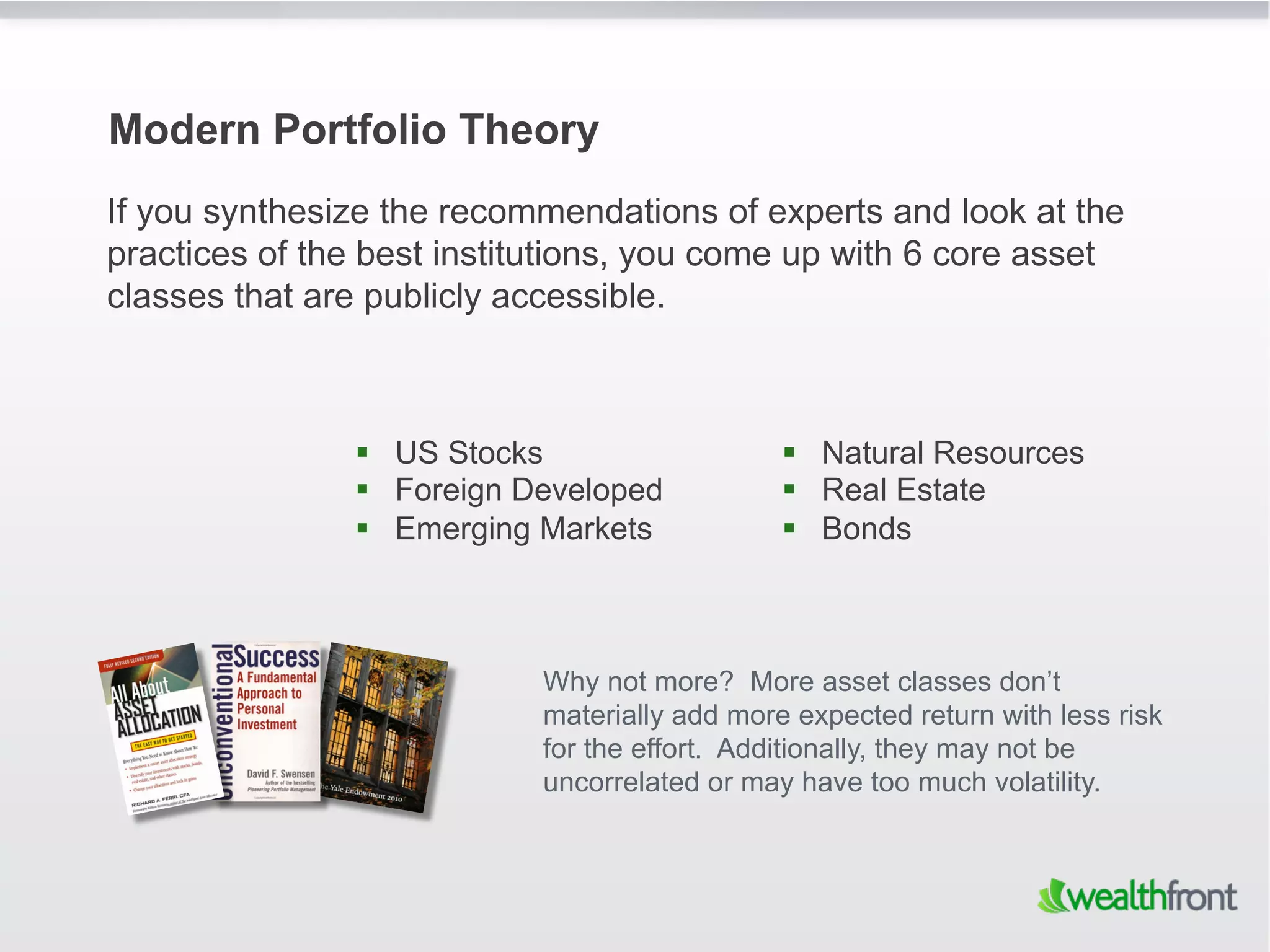
If you synthesize the recommendations of experts and look at the
practices of the best institutions, you come up with 6 core asset
classes that are publicly accessible.


                 US Stocks                     Natural Resources
                 Foreign Developed             Real Estate
                 Emerging Markets              Bonds


                           Why not more? More asset classes don’t
                           materially add more expected return with less risk
                           for the effort. Additionally, they may not be
                           uncorrelated or may have too much volatility.
Modern Portfolio Theory
Expected Return


                                                                                    Risk


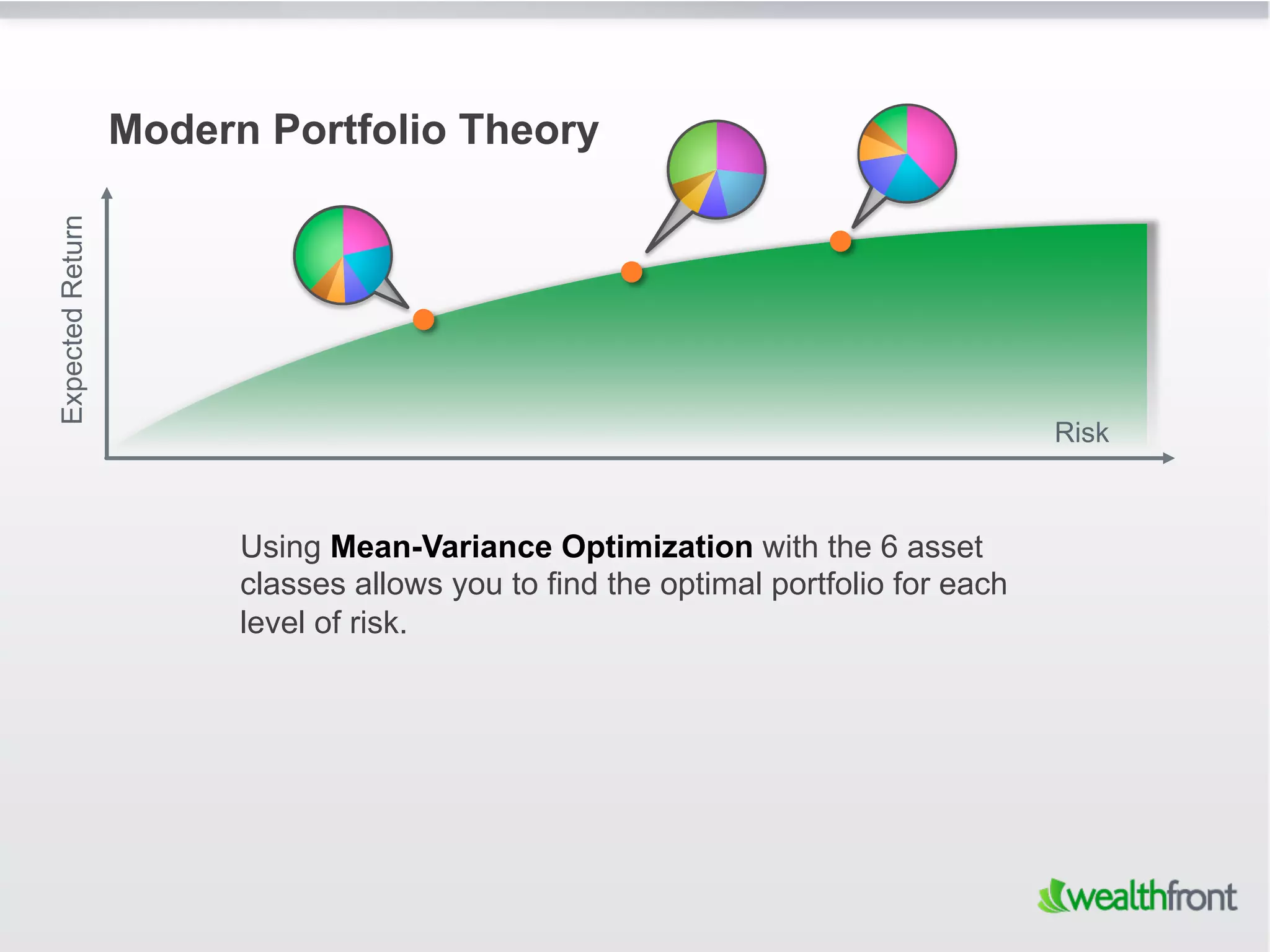
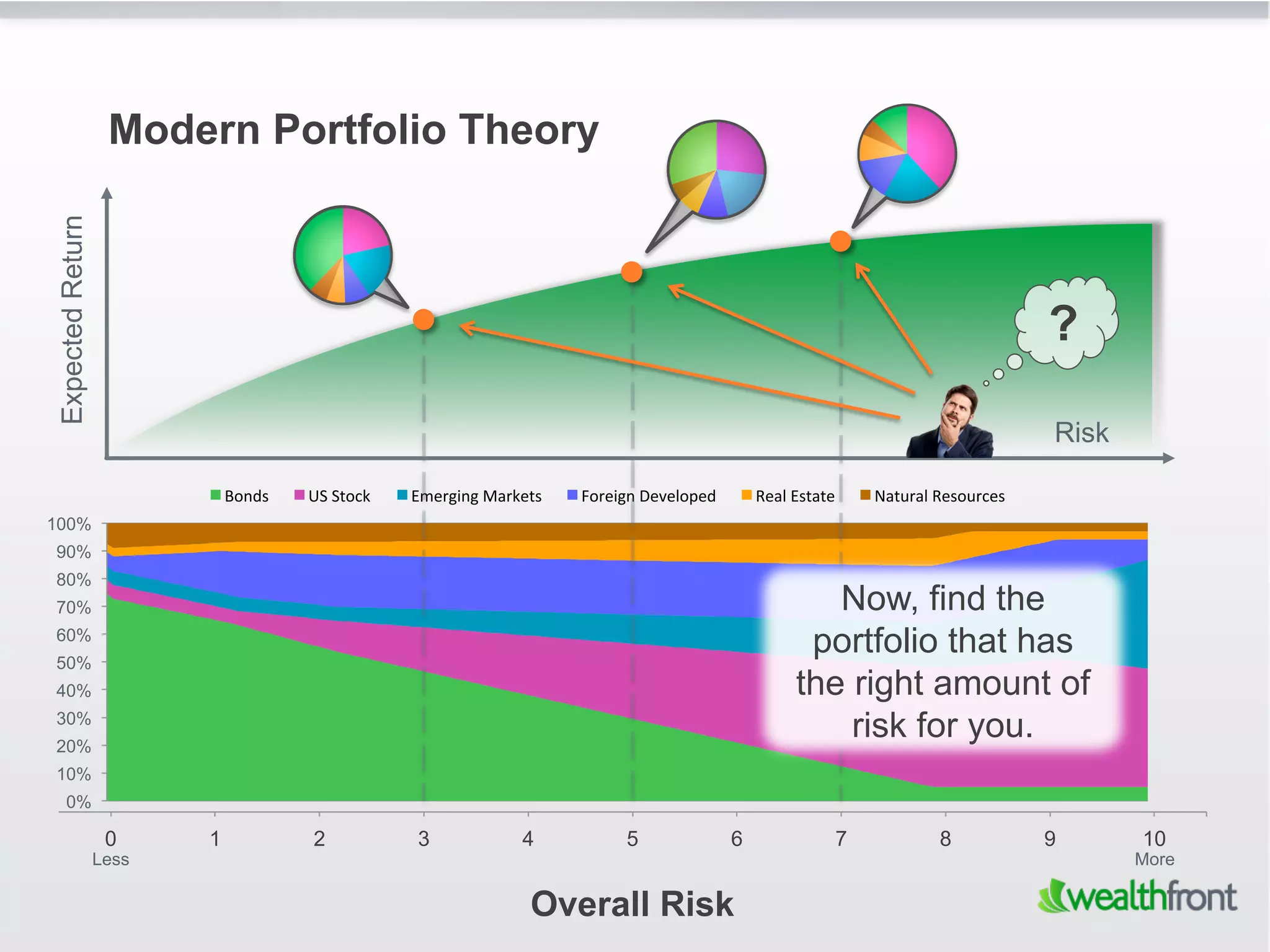
                        Using Mean-Variance Optimization with the 6 asset
                        classes allows you to find the optimal portfolio for each
                        level of risk.
Modern Portfolio Theory
Expected Return


                                                                                                                                                          Risk

                       Bonds	
     US	
  Stock	
     Emerging	
  Markets	
     Foreign	
  Developed	
     Real	
  Estate	
     Natural	
  Resources	
  
100%
90%
80%
70%
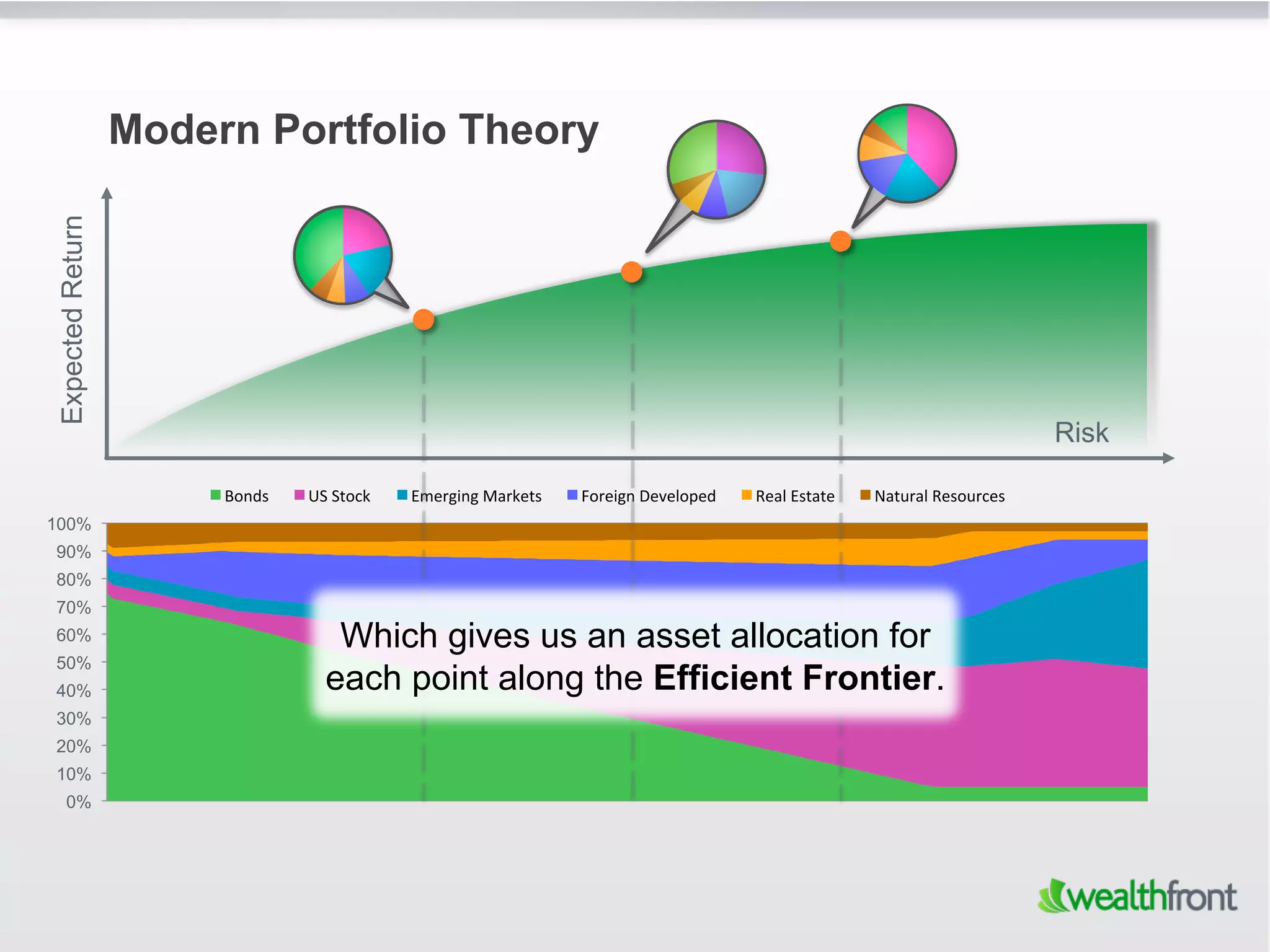
60%                                    Which gives us an asset allocation for
50%
40%                                   each point along the Efficient Frontier.
30%
20%
10%
    0%
Modern Portfolio Theory
Expected Return


                                                                                                                                                                    ?

                                                                                                                                                                    Risk

                             Bonds	
     US	
  Stock	
     Emerging	
  Markets	
     Foreign	
  Developed	
         Real	
  Estate	
     Natural	
  Resources	
  
100%
90%
80%
70%                                                                                                                            Now, find the
60%
50%
                                                                                                                             portfolio that has
40%                                                                                                                         the right amount of
30%
20%
                                                                                                                                risk for you.
10%
    0%

                   0     1                2                 3                4              5                   6                    7              8               9      10
                  Less                                                                                                                                                     More

                                                                               Overall Risk
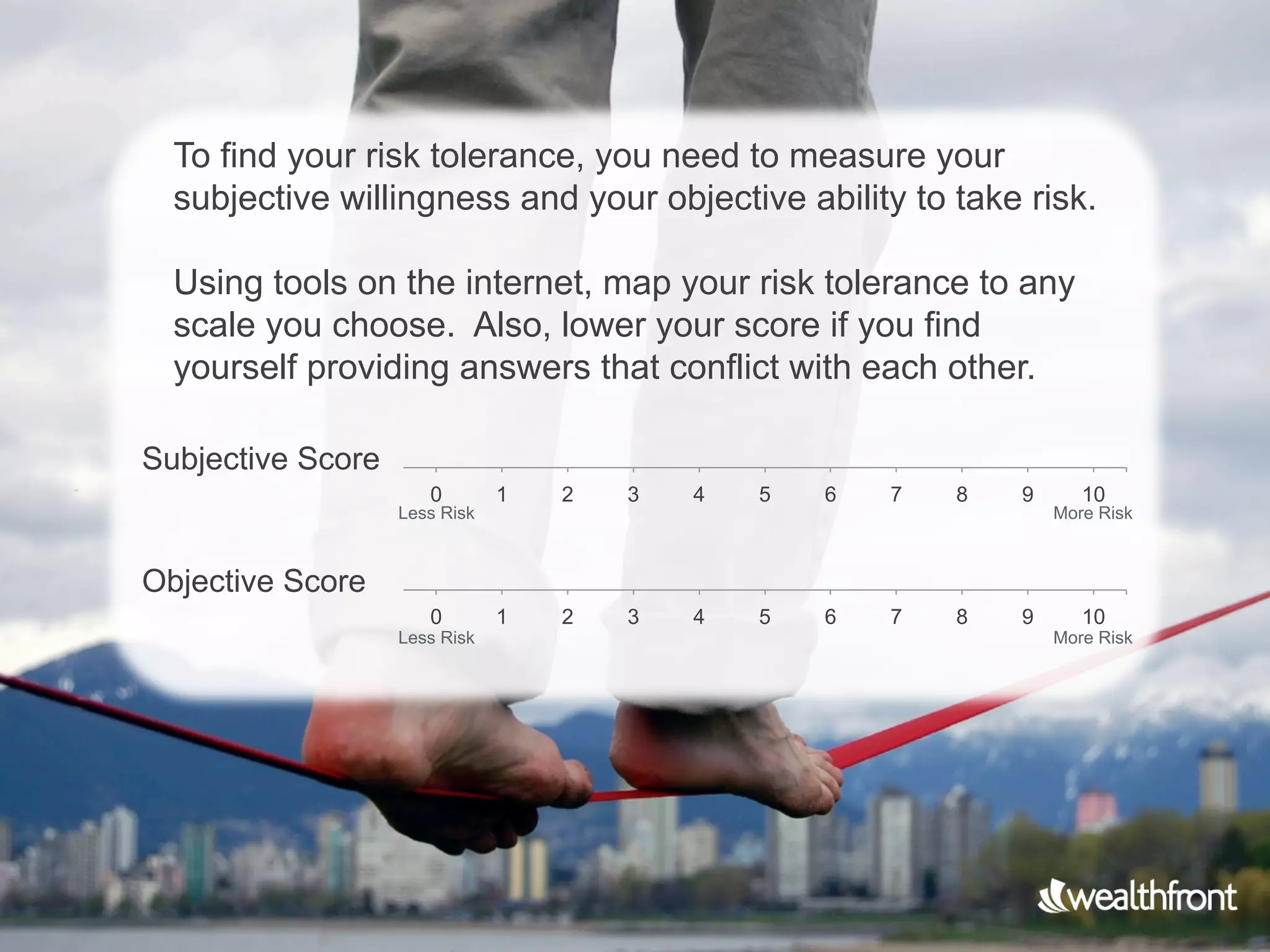
To find your risk tolerance, you need to measure your
  subjective willingness and your objective ability to take risk.

  Using tools on the internet, map your risk tolerance to any
  scale you choose. Also, lower your score if you find
  yourself providing answers that conflict with each other.

Subjective Score
                      0        1   2   3   4   5   6   7   8   9      10
                   Less Risk                                       More Risk


Objective Score
                      0        1   2   3   4   5   6   7   8   9      10
                   Less Risk                                       More Risk
Subjective Risk Tolerance


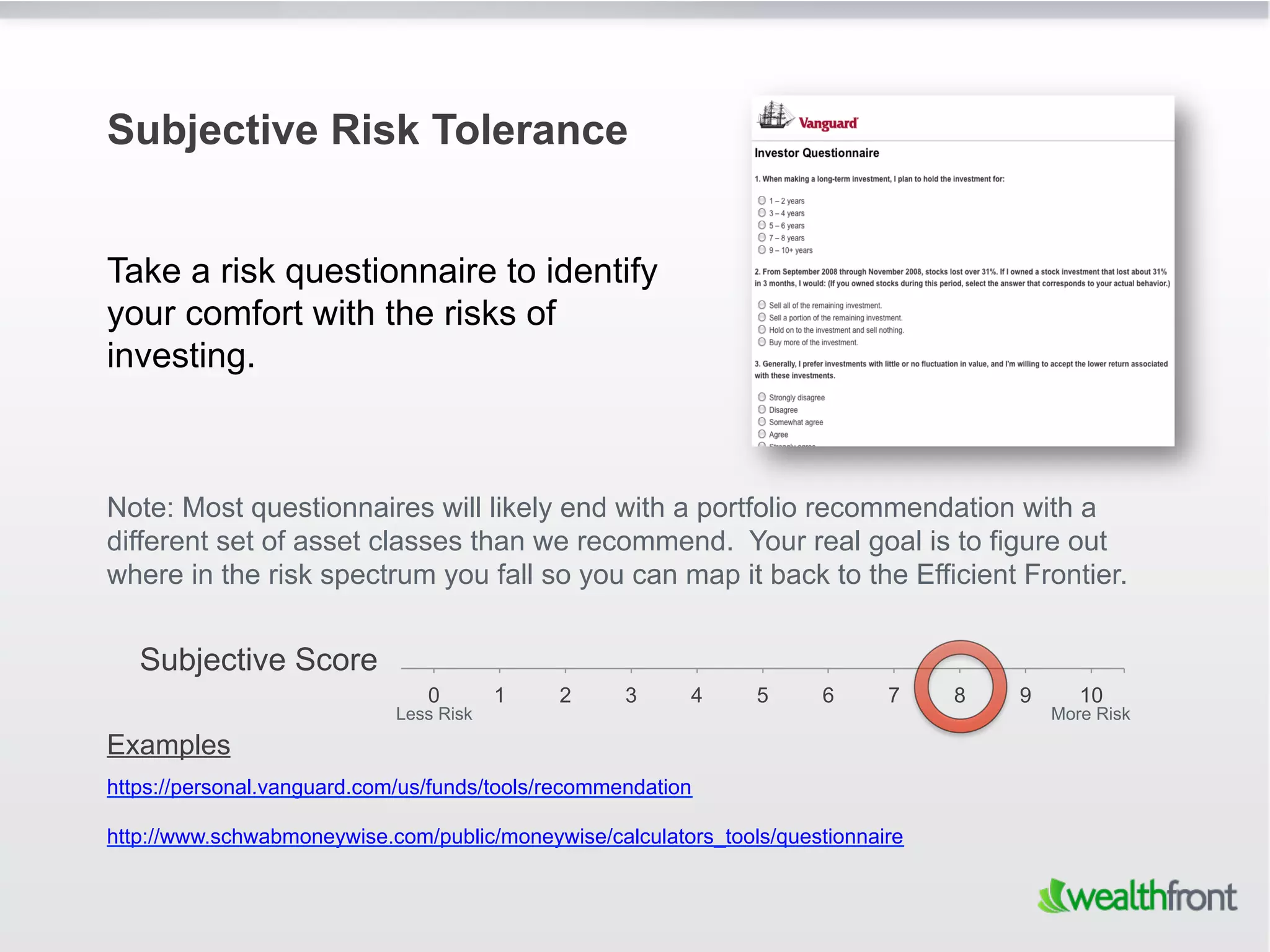
Take a risk questionnaire to identify
your comfort with the risks of
investing.


Note: Most questionnaires will likely end with a portfolio recommendation with a
different set of asset classes than we recommend. Your real goal is to figure out
where in the risk spectrum you fall so you can map it back to the Efficient Frontier.


   Subjective Score
                                0        1   2      3     4     5     6      7    8   9      10
                             Less Risk                                                    More Risk
Examples
https://personal.vanguard.com/us/funds/tools/recommendation

http://www.schwabmoneywise.com/public/moneywise/calculators_tools/questionnaire
Objective Risk Tolerance


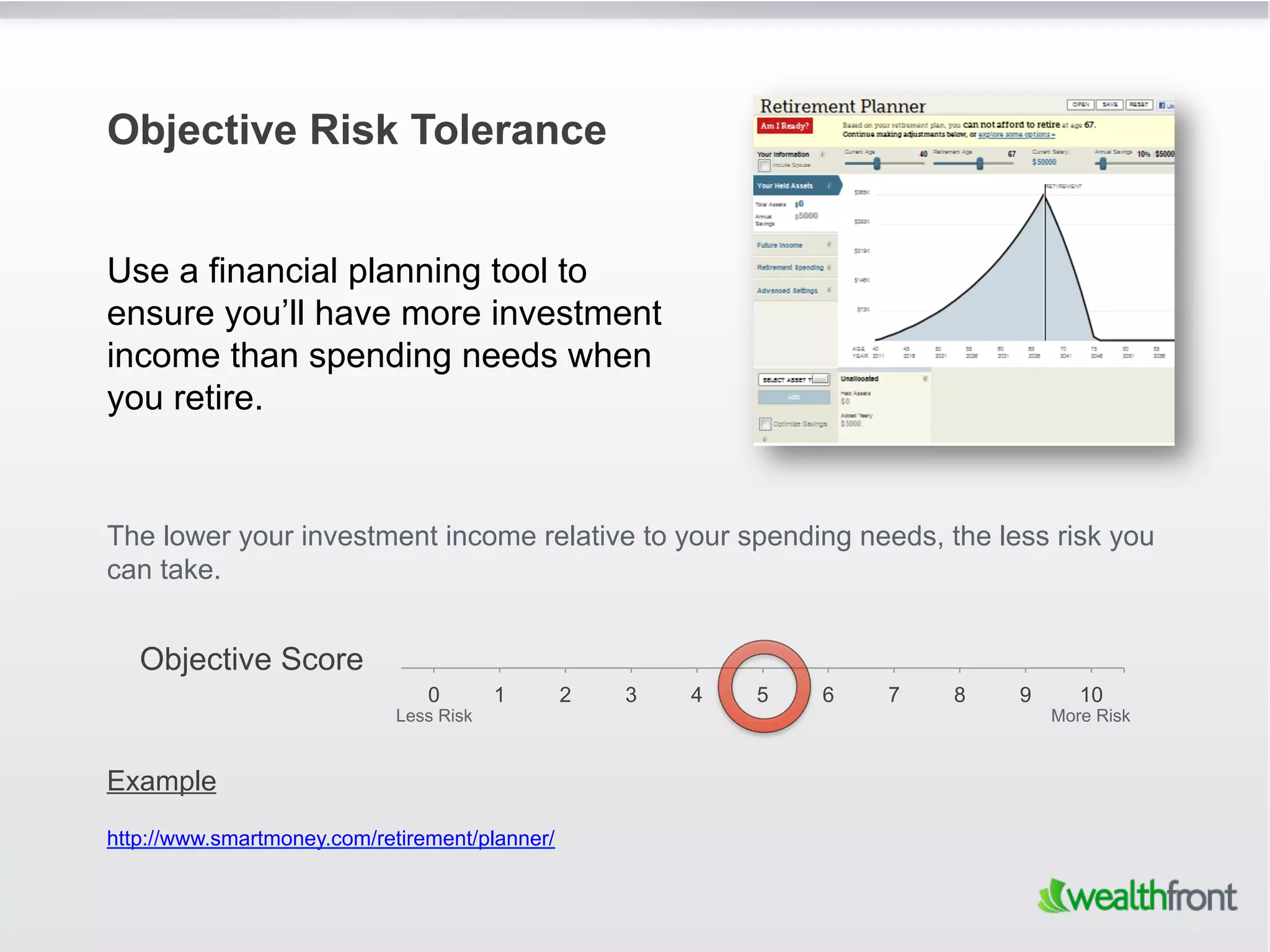
Use a financial planning tool to
ensure you’ll have more investment
income than spending needs when
you retire.


The lower your investment income relative to your spending needs, the less risk you
can take.


   Objective Score
                                0        1      2   3   4   5   6   7   8   9      10
                             Less Risk                                          More Risk


Example
http://www.smartmoney.com/retirement/planner/
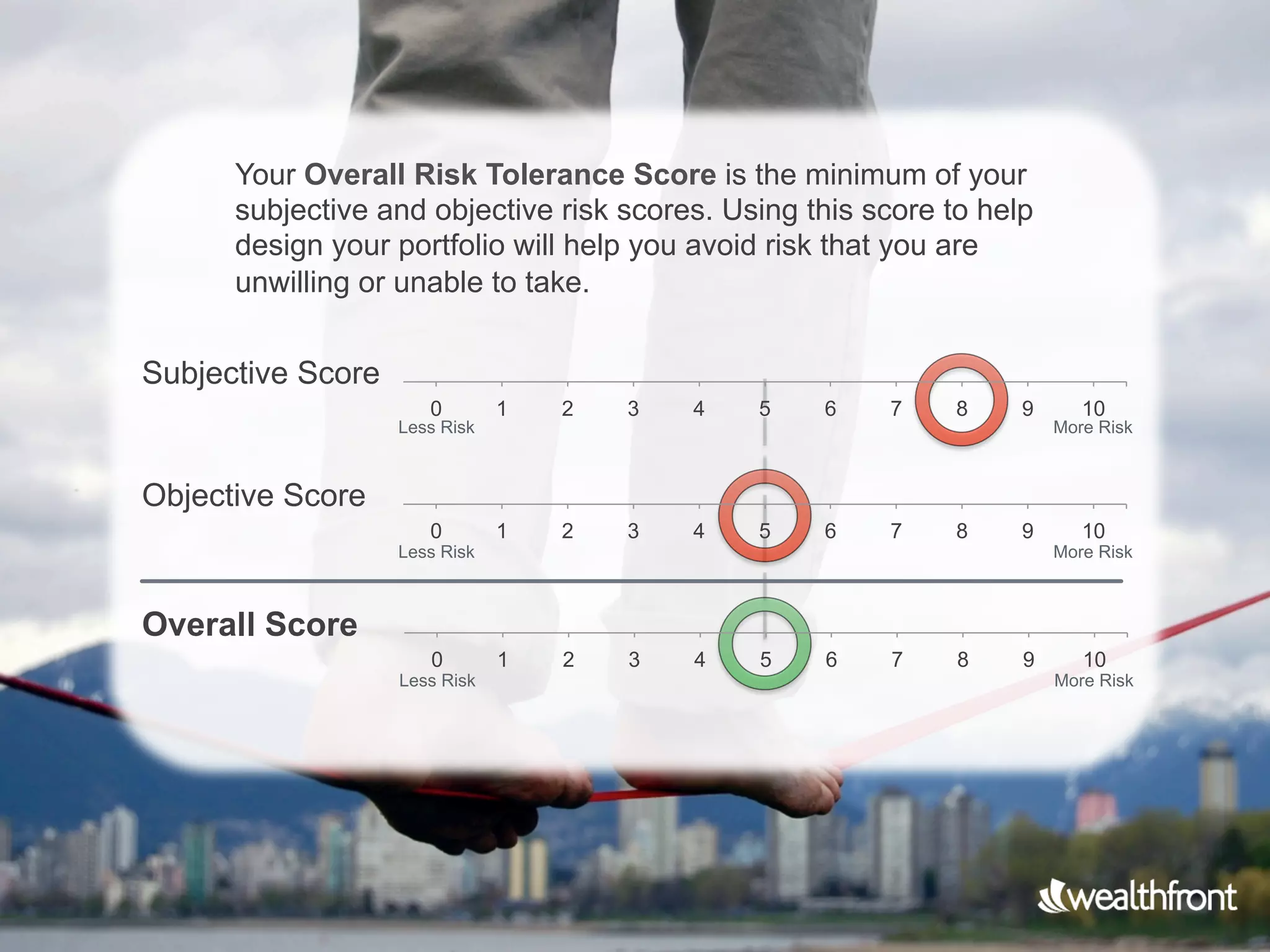
Your Overall Risk Tolerance Score is the minimum of your
      subjective and objective risk scores. Using this score to help
      design your portfolio will help you avoid risk that you are
      unwilling or unable to take.


Subjective Score
                      0        1   2   3   4   5   6    7     8    9      10
                   Less Risk                                           More Risk


Objective Score
                      0        1   2   3   4   5   6    7     8    9      10
                   Less Risk                                           More Risk


Overall Score
                      0        1   2   3   4   5   6    7     8    9      10
                   Less Risk                                           More Risk
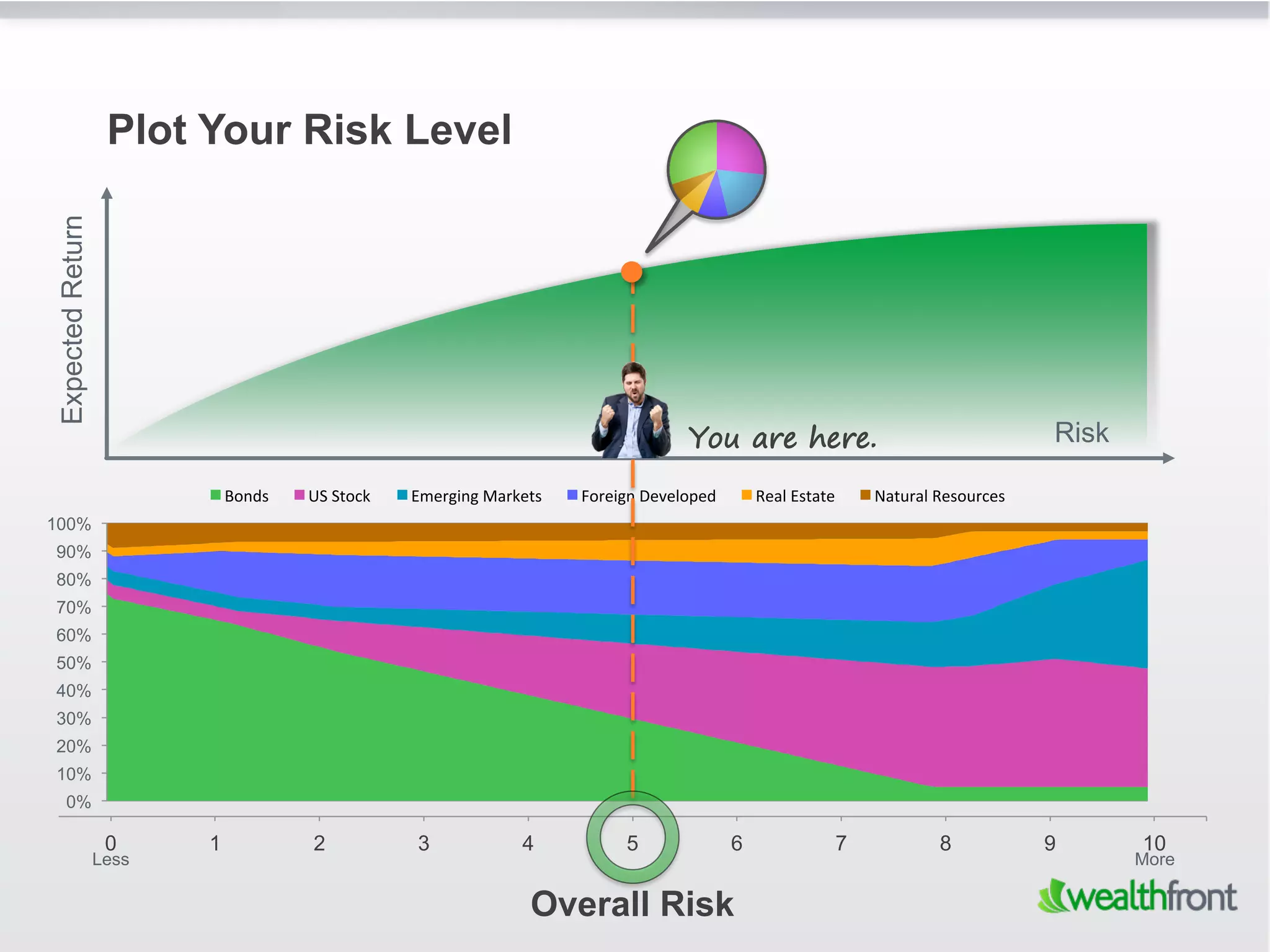
Plot Your Risk Level
Expected Return


                                                                                                       You are here.                                                Risk

                             Bonds	
     US	
  Stock	
     Emerging	
  Markets	
     Foreign	
  Developed	
         Real	
  Estate	
     Natural	
  Resources	
  
100%
90%
80%
70%
60%
50%
40%
30%
20%
10%
    0%

                   0     1                2                 3                4              5                   6                    7              8               9      10
                  Less                                                                                                                                                     More

                                                                               Overall Risk
Back to choosing ETFs…

We need to pick ETFs that represent each of the 6 core
asset classes and buy them in percentages dictated by your
risk tolerance.


                                 Now which ETFs
                                  should I buy?
Selecting ETFs


                 Filtering the universe of all ETFs only
                 to candidates that represent the core
                 asset classes gives you about 100 to
                 choose from.


                 The rest will be ranked by
                 three important characteristics.
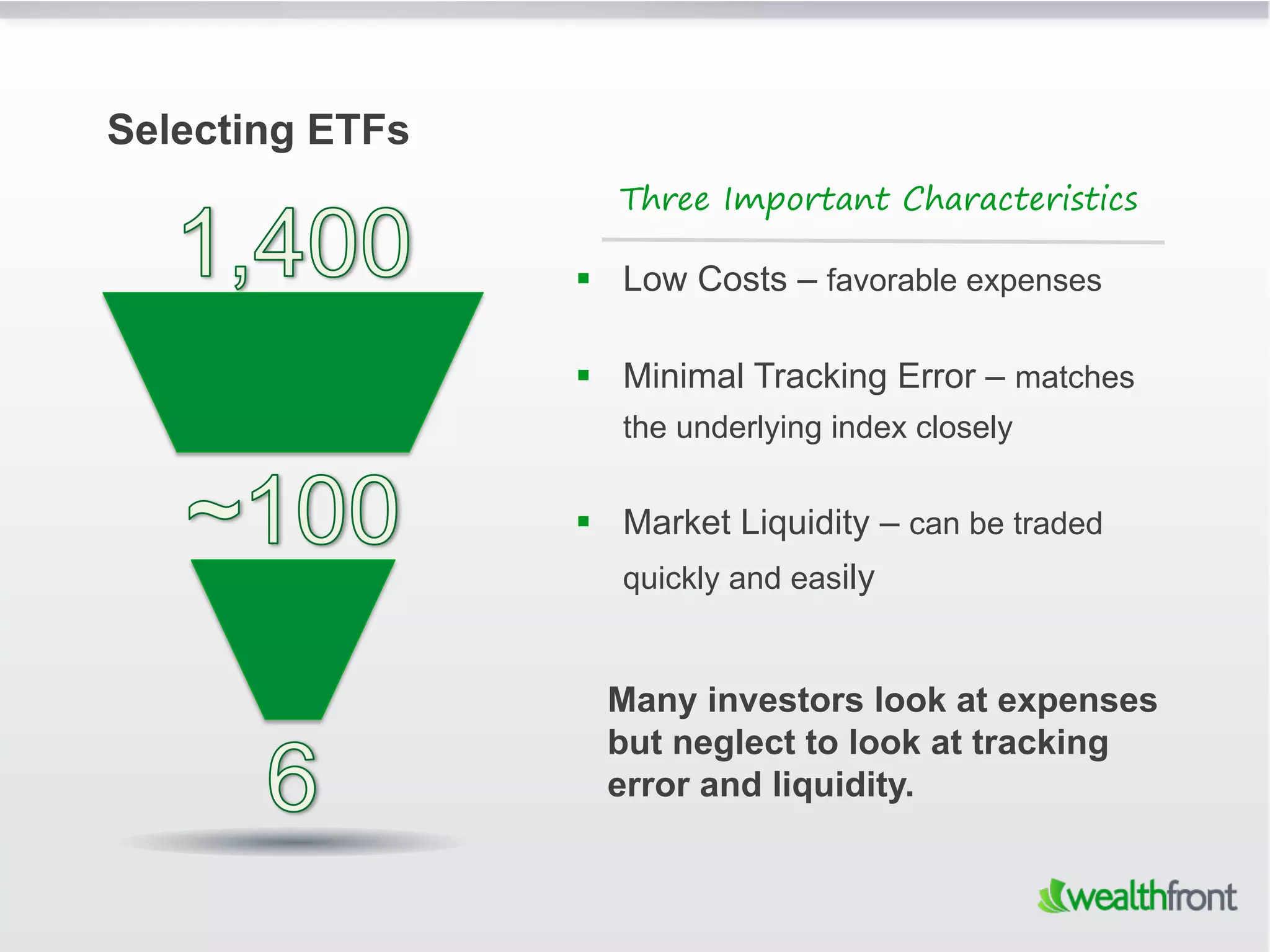
Selecting ETFs
                   Three Important Characteristics

                   Low Costs – favorable expenses

                   Minimal Tracking Error – matches
                    the underlying index closely


                   Market Liquidity – can be traded
                    quickly and easily


                   Many investors look at expenses
                   but neglect to look at tracking
                   error and liquidity.
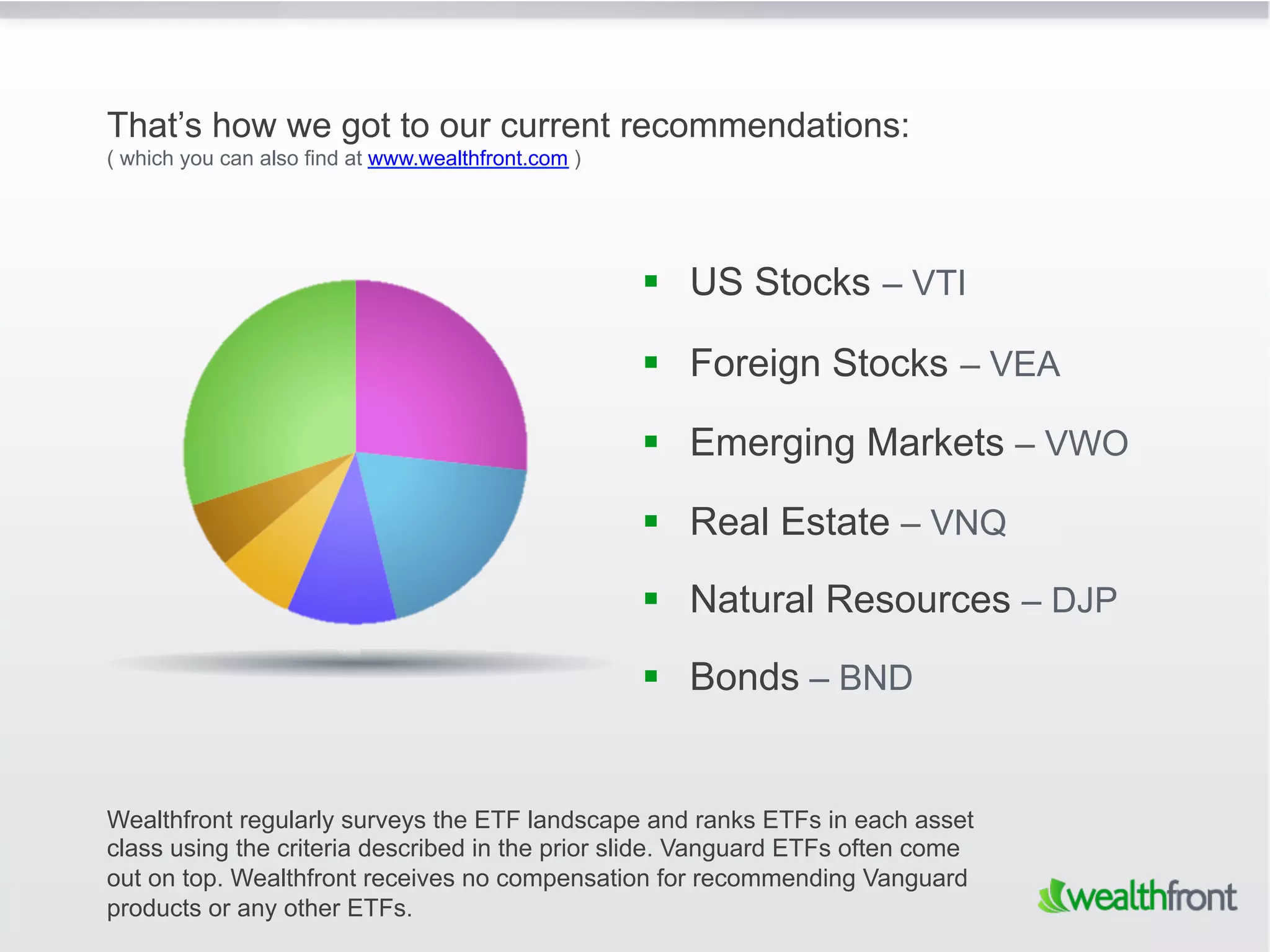
That’s how we got to our current recommendations:
( which you can also find at www.wealthfront.com )


                                                       US Stocks – VTI

                                                       Foreign Stocks – VEA

                                                       Emerging Markets – VWO

                                                       Real Estate – VNQ

                                                       Natural Resources – DJP

                                                       Bonds – BND


Wealthfront regularly surveys the ETF landscape and ranks ETFs in each asset
class using the criteria described in the prior slide. Vanguard ETFs often come
out on top. Wealthfront receives no compensation for recommending Vanguard
products or any other ETFs.
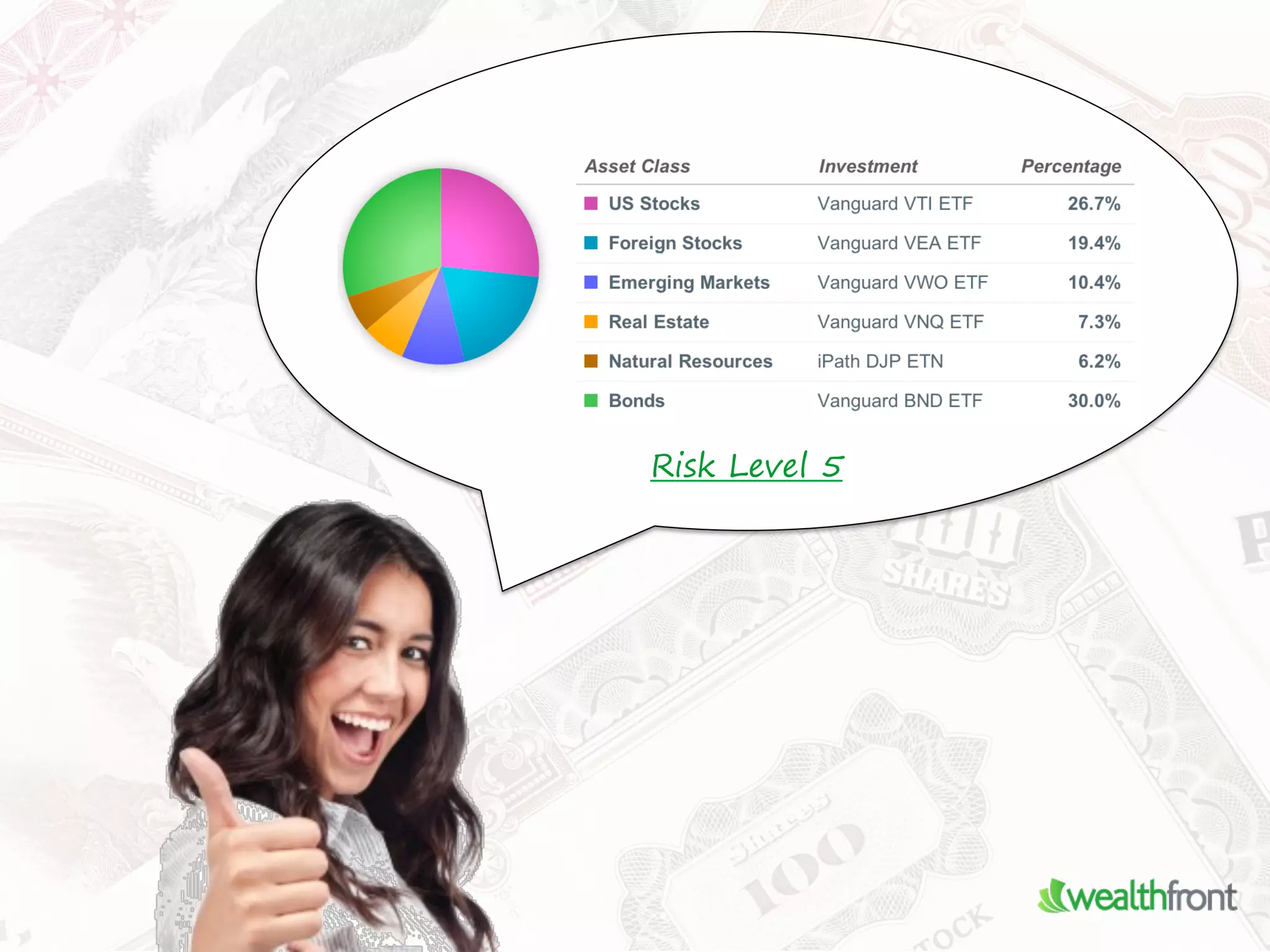
Risk Level 5
	
  
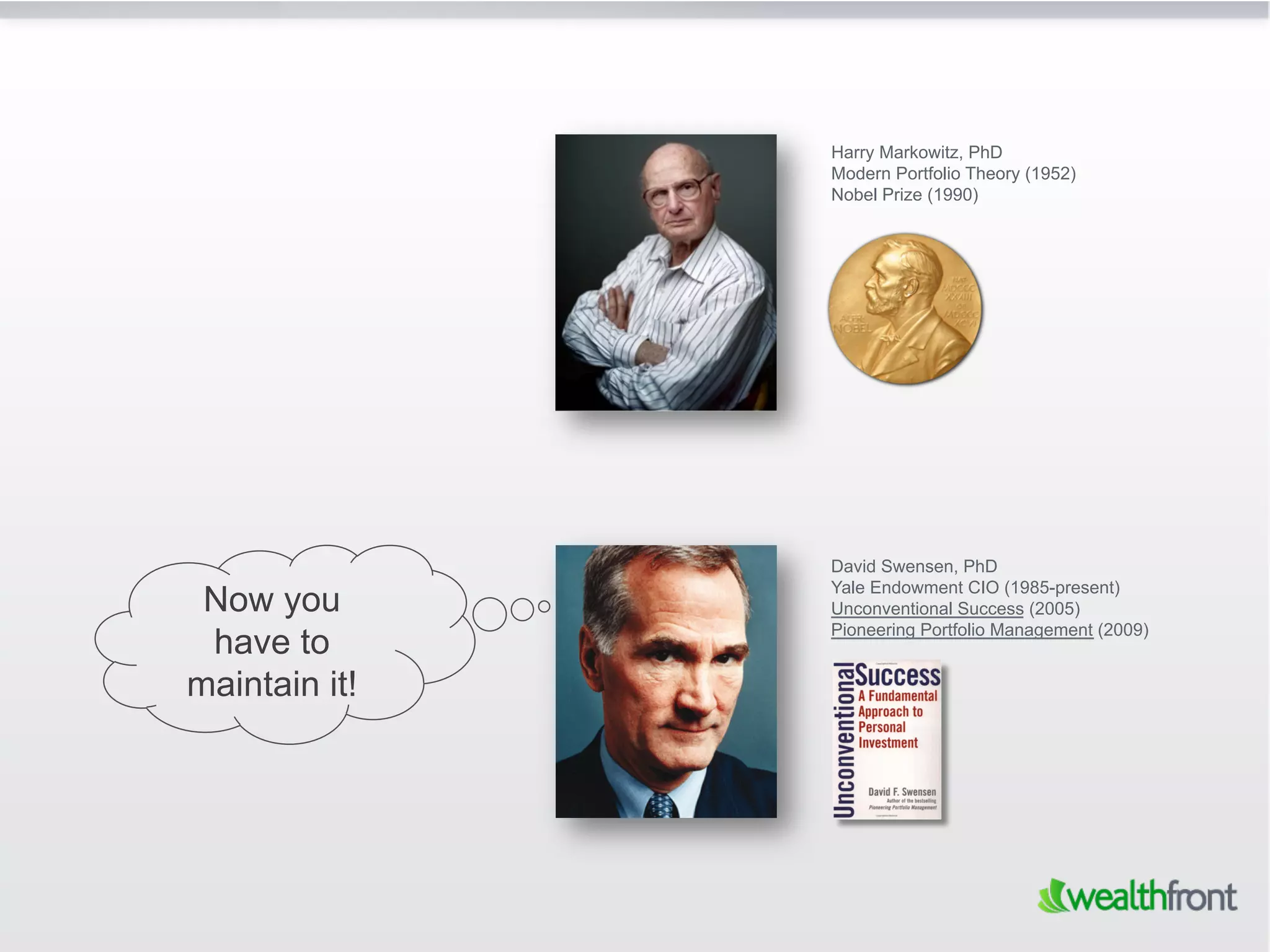
Harry Markowitz, PhD
               Modern Portfolio Theory (1952)
               Nobel Prize (1990)


               David Swensen, PhD
               Yale Endowment CIO (1985-present)
 Now you       Unconventional Success (2005)
               Pioneering Portfolio Management (2009)
 have to
maintain it!
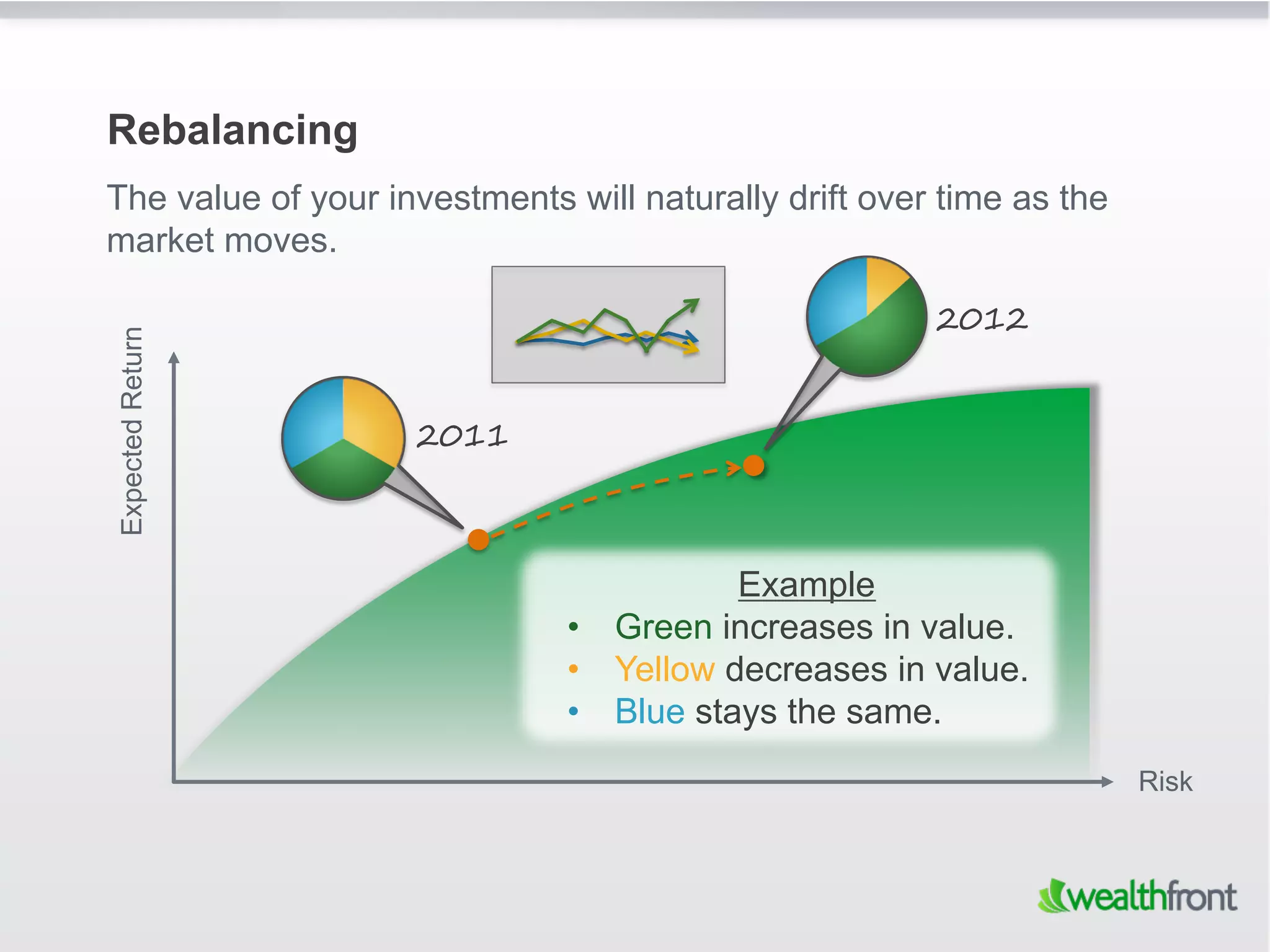
Rebalancing
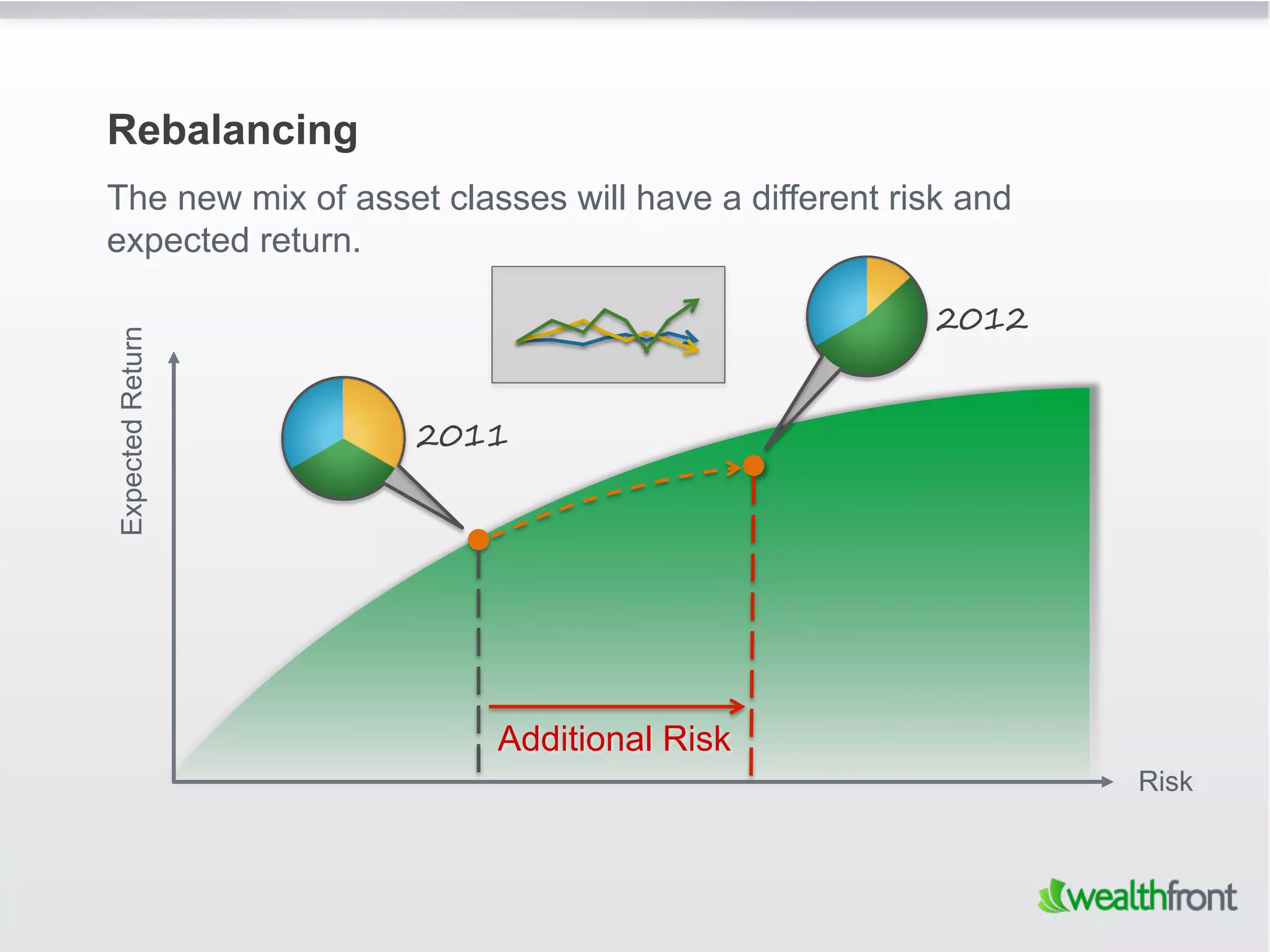
The value of your investments will naturally drift over time as the
market moves.

                                                       2012
Expected Return


                    2011


                                         Example
                              •  Green increases in value.
                              •  Yellow decreases in value.
                              •  Blue stays the same.
                                                                      Risk
Rebalancing
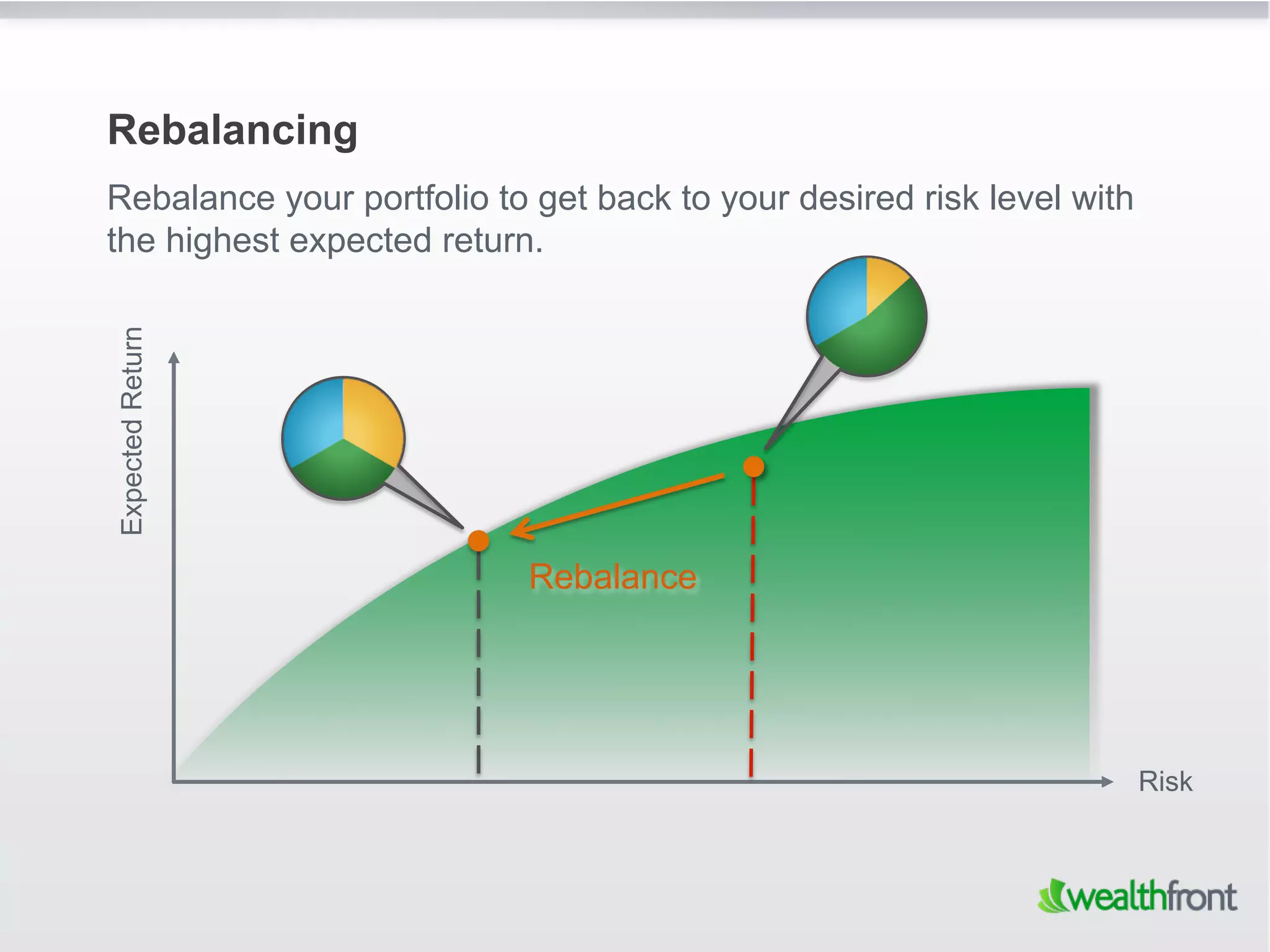
The new mix of asset classes will have a different risk and
expected return.

                                                      2012
Expected Return


                    2011


                         Additional Risk
                                                              Risk
Rebalancing
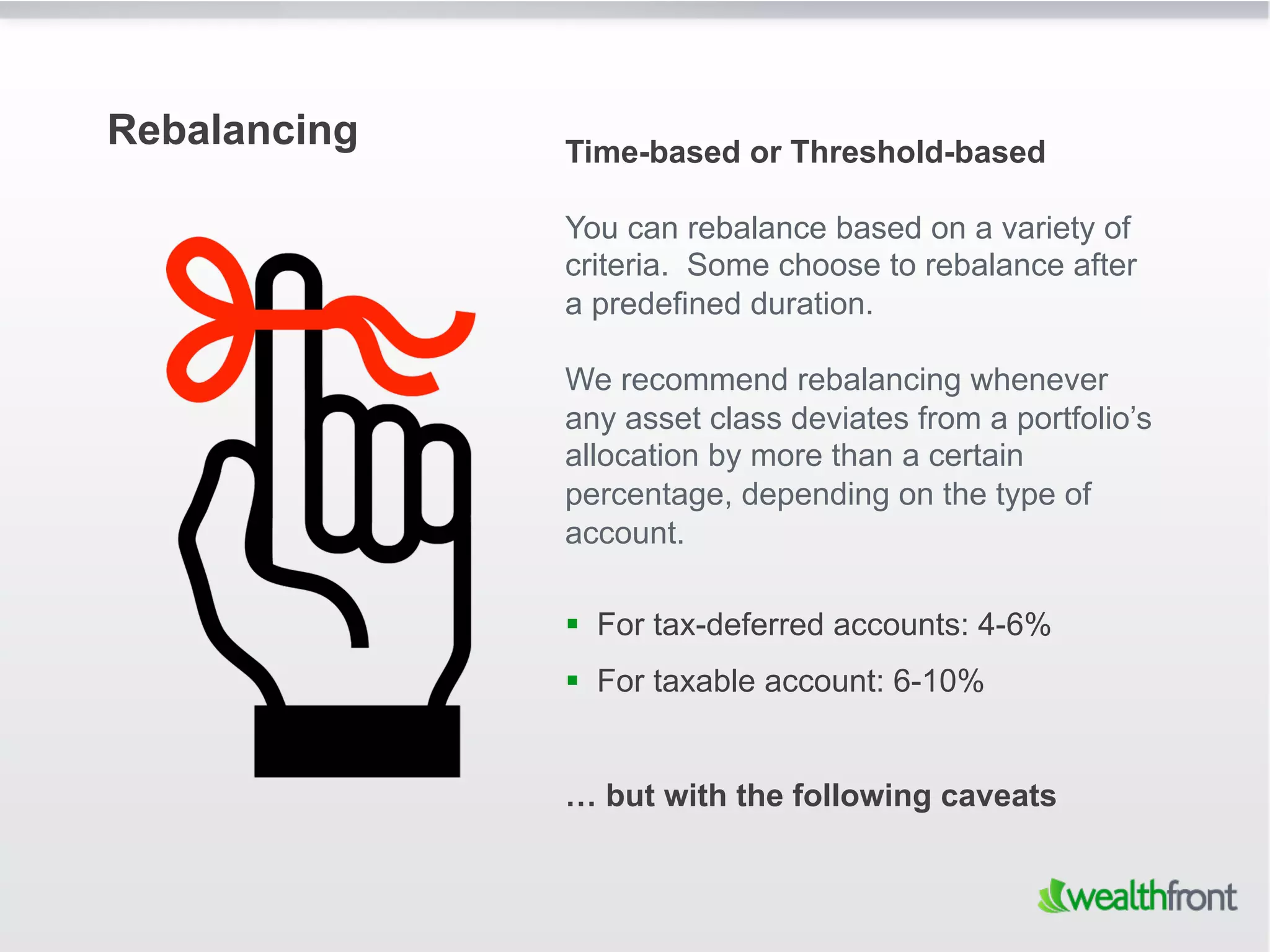
Rebalance your portfolio to get back to your desired risk level with
the highest expected return.
Expected Return


                           Rebalance


                                                                       Risk
Rebalancing   Time-based or Threshold-based

              You can rebalance based on a variety of
              criteria. Some choose to rebalance after
              a predefined duration.

              We recommend rebalancing whenever
              any asset class deviates from a portfolio’s
              allocation by more than a certain
              percentage, depending on the type of
              account.

                For tax-deferred accounts: 4-6%
                For taxable account: 6-10%


              … but with the following caveats
Rebalancing Considerations


                        Keep in mind…

                          Tax implications

                          Impact of commissions

                          Changes in your risk profile

                        Most individual investors don’t
                        rebalance because they struggle
                        with these issues.
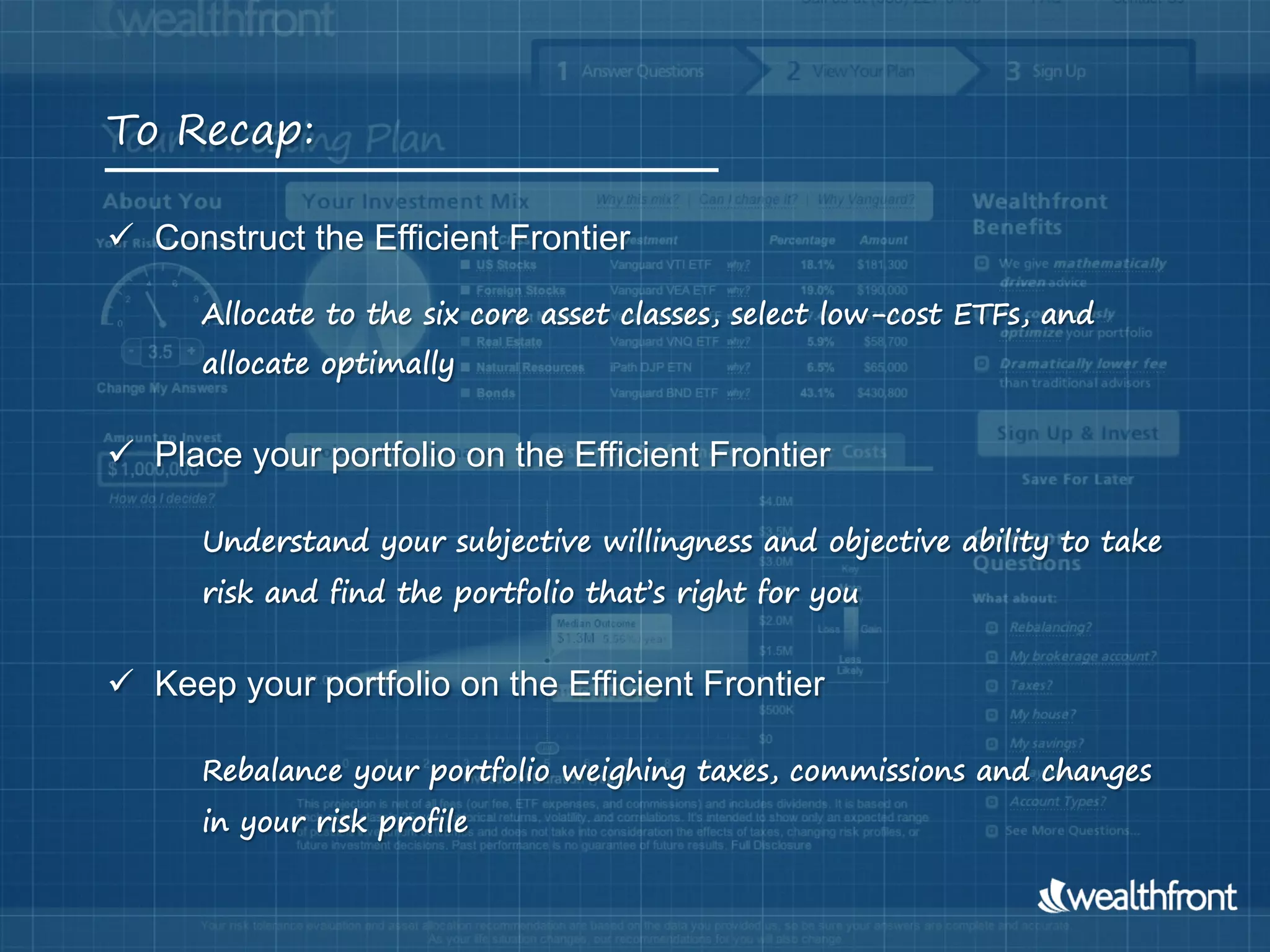
To Recap:

  Construct the Efficient Frontier

      Allocate to the six core asset classes, select low-cost ETFs, and
      allocate optimally


  Place your portfolio on the Efficient Frontier

      Understand your subjective willingness and objective ability to take
      risk and find the portfolio that’s right for you


  Keep your portfolio on the Efficient Frontier

      Rebalance your portfolio weighing taxes, commissions and changes
      in your risk profile
Want us to do this for you?


Visit         .com to get started.
Disclosures
Nothing in this presentation should be construed as a solicitation or offer, or
recommendation, to buy or sell any security. Photographs do not depict actual
Wealthfront clients. Financial advisory services are only provided to investors who
become Wealthfront clients pursuant to a written agreement, which investors are
urged to read and carefully consider in determining whether such agreement is
suitable for their individual facts and circumstances.

Past performance is no guarantee of future results, and any hypothetical
returns, expected returns, or probability projections may not reflect actual
future performance. Investors should review Wealthfront’s website for additional
information about advisory services.

Engineer Your Portfolio with ETFs

  • 1.
  • 2.
    By the endof November 2011, there were more than 1,400 different exchange traded funds (ETFs) accounting for over $1 trillion dollars invested.
  • 3.
    You’ve heard alot about ETFs. They’re an easy and convenient way to “diversify your portfolio,” but how about the real questions… Which should I buy and how much?
  • 4.
    Harry Markowitz, PhD Whynot ask a Nobel Modern Portfolio Theory (1952) Nobel Prize (1990) Prize winner? David Swensen, PhD … and the Chief Yale Endowment CIO (1985-present) Unconventional Success (2005) Investment Officer at Pioneering Portfolio Management (2009) Yale University?
  • 5.
    Harry Markowitz, PhD Modern Portfolio Theory (1952) Nobel Prize (1990) I invented it. Use Modern Portfolio Theory David Swensen, PhD Yale Endowment CIO (1985-present) Unconventional Success (2005) I wrote the Pioneering Portfolio Management (2009) book on it.
  • 6.
    A Quick Lessonin Modern Portfolio Theory Every investment has an expected return and some level of risk. Expected Return Risk
  • 7.
    A Quick Lessonin Modern Portfolio Theory Every investment has an expected return and some level of risk. Expected Return Stocks   Risk
  • 8.
    A Quick Lessonin Modern Portfolio Theory Every investment has an expected return and some level of risk. Expected Return Stocks   Bonds   Risk
  • 9.
    A Quick Lessonin Modern Portfolio Theory You can mix investments to get different combinations of expected return vs. risk. Expected Return Stocks   A  mix  of  Stocks   &  Bonds   Bonds   Risk
  • 10.
    A Quick Lessonin Modern Portfolio Theory There are an unlimited number of investments and combinations. Expected Return Risk
  • 11.
    A Quick Lessonin Modern Portfolio Theory There is a theoretical maximum expected return for each level of risk. Expected Return Risk
  • 12.
    A Quick Lessonin Modern Portfolio Theory The best combinations of investments form a curve known as the Efficient Frontier. Expected Return Risk
  • 13.
    A Quick Lessonin Modern Portfolio Theory The only way to get to the efficient frontier is by mixing uncorrelated asset classes. Expected Return Risk
  • 14.
    Modern Portfolio Theory Ifyou synthesize the recommendations of experts and look at the practices of the best institutions, you come up with 6 core asset classes that are publicly accessible.   US Stocks   Natural Resources   Foreign Developed   Real Estate   Emerging Markets   Bonds Why not more? More asset classes don’t materially add more expected return with less risk for the effort. Additionally, they may not be uncorrelated or may have too much volatility.
  • 15.
    Modern Portfolio Theory ExpectedReturn Risk Using Mean-Variance Optimization with the 6 asset classes allows you to find the optimal portfolio for each level of risk.
  • 16.
    Modern Portfolio Theory ExpectedReturn Risk Bonds   US  Stock   Emerging  Markets   Foreign  Developed   Real  Estate   Natural  Resources   100% 90% 80% 70% 60% Which gives us an asset allocation for 50% 40% each point along the Efficient Frontier. 30% 20% 10% 0%
  • 17.
    Modern Portfolio Theory ExpectedReturn ? Risk Bonds   US  Stock   Emerging  Markets   Foreign  Developed   Real  Estate   Natural  Resources   100% 90% 80% 70% Now, find the 60% 50% portfolio that has 40% the right amount of 30% 20% risk for you. 10% 0% 0 1 2 3 4 5 6 7 8 9 10 Less More Overall Risk
  • 18.
    To find yourrisk tolerance, you need to measure your subjective willingness and your objective ability to take risk. Using tools on the internet, map your risk tolerance to any scale you choose. Also, lower your score if you find yourself providing answers that conflict with each other. Subjective Score 0 1 2 3 4 5 6 7 8 9 10 Less Risk More Risk Objective Score 0 1 2 3 4 5 6 7 8 9 10 Less Risk More Risk
  • 19.
    Subjective Risk Tolerance Takea risk questionnaire to identify your comfort with the risks of investing. Note: Most questionnaires will likely end with a portfolio recommendation with a different set of asset classes than we recommend. Your real goal is to figure out where in the risk spectrum you fall so you can map it back to the Efficient Frontier. Subjective Score 0 1 2 3 4 5 6 7 8 9 10 Less Risk More Risk Examples https://personal.vanguard.com/us/funds/tools/recommendation http://www.schwabmoneywise.com/public/moneywise/calculators_tools/questionnaire
  • 20.
    Objective Risk Tolerance Usea financial planning tool to ensure you’ll have more investment income than spending needs when you retire. The lower your investment income relative to your spending needs, the less risk you can take. Objective Score 0 1 2 3 4 5 6 7 8 9 10 Less Risk More Risk Example http://www.smartmoney.com/retirement/planner/
  • 21.
    Your Overall RiskTolerance Score is the minimum of your subjective and objective risk scores. Using this score to help design your portfolio will help you avoid risk that you are unwilling or unable to take. Subjective Score 0 1 2 3 4 5 6 7 8 9 10 Less Risk More Risk Objective Score 0 1 2 3 4 5 6 7 8 9 10 Less Risk More Risk Overall Score 0 1 2 3 4 5 6 7 8 9 10 Less Risk More Risk
  • 22.
    Plot Your RiskLevel Expected Return You are here. Risk Bonds   US  Stock   Emerging  Markets   Foreign  Developed   Real  Estate   Natural  Resources   100% 90% 80% 70% 60% 50% 40% 30% 20% 10% 0% 0 1 2 3 4 5 6 7 8 9 10 Less More Overall Risk
  • 23.
    Back to choosingETFs… We need to pick ETFs that represent each of the 6 core asset classes and buy them in percentages dictated by your risk tolerance. Now which ETFs should I buy?
  • 24.
    Selecting ETFs Filtering the universe of all ETFs only to candidates that represent the core asset classes gives you about 100 to choose from. The rest will be ranked by three important characteristics.
  • 25.
    Selecting ETFs Three Important Characteristics   Low Costs – favorable expenses   Minimal Tracking Error – matches the underlying index closely   Market Liquidity – can be traded quickly and easily Many investors look at expenses but neglect to look at tracking error and liquidity.
  • 26.
    That’s how wegot to our current recommendations: ( which you can also find at www.wealthfront.com )   US Stocks – VTI   Foreign Stocks – VEA   Emerging Markets – VWO   Real Estate – VNQ   Natural Resources – DJP   Bonds – BND Wealthfront regularly surveys the ETF landscape and ranks ETFs in each asset class using the criteria described in the prior slide. Vanguard ETFs often come out on top. Wealthfront receives no compensation for recommending Vanguard products or any other ETFs.
  • 27.
  • 28.
    Harry Markowitz, PhD Modern Portfolio Theory (1952) Nobel Prize (1990) David Swensen, PhD Yale Endowment CIO (1985-present) Now you Unconventional Success (2005) Pioneering Portfolio Management (2009) have to maintain it!
  • 29.
    Rebalancing The value ofyour investments will naturally drift over time as the market moves. 2012 Expected Return 2011 Example •  Green increases in value. •  Yellow decreases in value. •  Blue stays the same. Risk
  • 30.
    Rebalancing The new mixof asset classes will have a different risk and expected return. 2012 Expected Return 2011 Additional Risk Risk
  • 31.
    Rebalancing Rebalance your portfolioto get back to your desired risk level with the highest expected return. Expected Return Rebalance Risk
  • 32.
    Rebalancing Time-based or Threshold-based You can rebalance based on a variety of criteria. Some choose to rebalance after a predefined duration. We recommend rebalancing whenever any asset class deviates from a portfolio’s allocation by more than a certain percentage, depending on the type of account.   For tax-deferred accounts: 4-6%   For taxable account: 6-10% … but with the following caveats
  • 33.
    Rebalancing Considerations Keep in mind…   Tax implications   Impact of commissions   Changes in your risk profile Most individual investors don’t rebalance because they struggle with these issues.
  • 34.
    To Recap:   Constructthe Efficient Frontier Allocate to the six core asset classes, select low-cost ETFs, and allocate optimally   Place your portfolio on the Efficient Frontier Understand your subjective willingness and objective ability to take risk and find the portfolio that’s right for you   Keep your portfolio on the Efficient Frontier Rebalance your portfolio weighing taxes, commissions and changes in your risk profile
  • 35.
    Want us todo this for you? Visit .com to get started.
  • 36.
    Disclosures Nothing in thispresentation should be construed as a solicitation or offer, or recommendation, to buy or sell any security. Photographs do not depict actual Wealthfront clients. Financial advisory services are only provided to investors who become Wealthfront clients pursuant to a written agreement, which investors are urged to read and carefully consider in determining whether such agreement is suitable for their individual facts and circumstances. Past performance is no guarantee of future results, and any hypothetical returns, expected returns, or probability projections may not reflect actual future performance. Investors should review Wealthfront’s website for additional information about advisory services.

Editor's Notes

  • #33 Add the thresholds for accounts