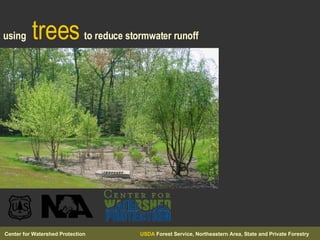
Using Trees To Reduce Stormwater Runoff

Loading...

Flash Player 9 (or above) is needed to view presentations.
We have detected that you do not have it on your computer. To install it, go here.

0 comments

Post a comment

    Post a comment
    Embed Video
    Edit your comment Cancel

    1 Favorite

    Using Trees To Reduce Stormwater Runoff - Presentation Transcript

    1. using trees to reduce stormwater runoff
    2. stormwater runoff is the number one factor in the decline of urban streams and decreasing urban water quality !
    3. old news
      • The first models for predicting runoff appeared in the 1800s and used runoff coefficients to account for different land use and land covers.
        • The Rational Method (Mulvaney 1851)
          • Peak Discharge = Runoff Coefficient x Rainfall x Basin Area
          • Runoff Coefficients:
            • Forested ground is typically assigned a value of near 0.
            • Pavement is given values approaching 100 percent
      • But why emphasize trees in particular versus other
      • stormwater practices?
        • save energy
        • improve air quality
        • provide habitat
        • better quality of life
        • neighborhood stability
        • aesthetic values
        • increase property value
        • reduce noise
        • good for business
      trees are the original “multi-taskers”
    4. ?? so if trees and forests provide so many benefits beyond reducing stormwater …shouldn’t they be more of a priority consideration in site design. ??
        • … yes, but only if trees are given credit for their work…and to give credit, we must be able to provide numbers!
        • (How else can engineers calculate credits?)
    5. don’t trees get some credit already?
        • not in most municipalities
        • not enough to matter to most developers.
        • not enough to equal their true value
      Source: CWP
    6. trees & stormwater: some conclusions
      • Watershed health is linked to the amount of forest in the watershed and its distribution.
      • Increases in tree cover and tree size will result in reduced total runoff and peak runoff rates (10% = 2-5%)
      • Tree canopy has a greater effect on small storm events than on large storm events (2 year storm frequency)
      • Effects on runoff are greatest when urban trees are large and well-established (site quality).
      • Trees and stormwater management practices can coexist if planned and designed from the start.
    7. Approaches to use trees for stormwater management
      • Incorporate trees into stormwater practices
      • Pursue site opportunities for stormwater forestry
      • Make stormwater practices an amenity
    8. incorporating trees into stormwater practices
      • Traditionally not a celebrated union
      • Some engineers don’t want trees in STPs
      • Foresters want to know where are all the trees?
      • Most of our practices end up losing trees due to poor maintenance
    9. challenges… Urban Foresters Engineers/ Planners Now remember, you have to work together Leftover disturbed areas are not the only place for trees We can retain valuable trees that improve watershed functions We can use trees in SW practices if we design it differently We need wider streets and curbs Keep the trees in the park, we need the tax revenue Don’t worry, we’ll come back and plant trees later.
    10. potential engineering conflicts
      • Tree litter may clog pipes/outlets
      • Maintenance may be more difficult
      • Tree roots may puncture underdrains/filter fabric
      • Trees can reduce storage capacity
      • Limited maintenance access
      • Trees may compromise embankment stability
      Source: Tim Schueler
    11. conditions that limit tree growth in stormwater/urban practices
      • Compacted soils/limited soil volume
      • High temperatures/drought
      • High winds
      • Physical damage from mowers/browsers
      • Too much/too frequent inundation
      • Urban pollutants (metals, chloride)
      • Ice damage/scour
    12. most stormwater projects are…
      • built on the least valuable land
      • constructed at the lowest cost
      • designed only to manage quantity
      • not intended for people
      • UGLY!!!
    13. Historic Approach to Stormwater Management: move water off the site as quickly as possible
    14. typical stormwater pond with no trees More recent approach is to temporarily detain runoff to control peak flows – this does not reduce the volume of runoff or mimic pre-development hydrology
    15. What opportunities are we missing?
    16. Why integrate trees and stormwater?
      • Potential benefits of trees in stormwater treatment practices: infiltration, pollutant removal, stabilization, habitat, reduced mowing costs, landscaping value
      • Implementation of stormwater forestry practices has been limited - lack of collaboration among foresters and stormwater engineers
      • Use of trees (non-structural practices) is more cost-effective than use of structural practices
    17. Stormwater projects can reduce water quantity, improve water quality…and be beautiful.
    18.  
    19. Stormwater practices can be amenities for people…
      • Good Stormwater Practices = Water Amenities
    20. how do we get there?
    21. stormwater forestry practice concept designs…what if?
      • Wooded wetland
      • Bioretention and bioinfiltration
      • Tree check dam
      • Alternating side slope plantings
      • Multi-zone filter strip
      • Forested filter strip
      • Linear stormwater tree pit
      • Stormwater dry pond
    22. Wooded Wetland Third Generation The Forested Wetland—water quality + tree benefits
    23. Tree Clusters in Stormwater Ponds and Wetlands
    24. Bioretention with trees
    25. tree check dams tree check dam section tree check dam axon
    26. Alternating side slope plantings
    27. Multi-zone filter strip
    28. Forested filter strip
    29. linear stormwater tree pits
    30. stormwater drypond
    31.  
    32. stormwater drypond
    33. Stormwater forestry opportunities in a watershed
      • Schools
      • Parks
      • Highway rights-of-way
      • Vacant lots
      • Streams and shorelines
      • Utility corridors
      • Street medians and roadways
      • Parking lots
      • Home lawns (education and incentives are key)
      Opportunities to build urban tree canopy that can enhance stormwater treatment and improve watershed health
    34. schools
    35. parks
    36. forest cover in parks limits runoff
    37. highway right of way
    38.  
    39. vacant lots are a good opportunity for reforestation and neighborhood beautification
    40. Combining Reforestation and Soil Compost Amendments to Restore a Vacant Urban Lot
    41. Reforesting stream buffers provides stream shading, bank stabilization, pollutant removal and other benefits
    42. planting under utilities
    43. Plant Trees During Development/Redevelopment
    44. More shade means more time between repaving. 20% shade on a street improves pavement condition by 11%, which is a 60% savings for resurfacing over 30 years. Planting along local roads
    45. local roads median planting
    46. Trees planted in a median strip
    47. A typical cul-de-sac is a large expanse of pavement with no vegetation
    48. Trees can be incorporated into cul-de-sac islands
    49. No infiltration of rainfall & limited soil volume Parking Lots
    50. Trees in parking lots perimeter
    51. What opportunities are we missing?
    52. So what’s with turf cover? fastest growing land cover in the US! Sources: MTC (1996), VASS (1998) and PTC (1989) (% of total turf cover)
    53. the truth about turf
      • Turf is fastest growing urban land cover in United States
      • High compaction of urban soils produces more urban runoff, particularly at edges
      • Lawns have highest nitrogen and phosphorous concentrations of any urban source area
      See Urban Watershed Forestry Manual Part 1
    54. Trees planted on home lawns provide shade and other benefits at maturity
    55. Use trees to: block winter winds, shade summer sun, accent important views, and screen private areas Residential landscapes can be functional and beautiful
    56. Stormwater Design Amenities, Emerging Discoveries
      • Visible water trail that intrigues and Engages
      • Character of Water Design that responds to context
      • Information systems that educate
      • Design for Maintenance that shows intention
      • Physical Accessibility
      • Multiple Use
      • Public Support
      • Perceived Value
      • Municipal Support
      Source: Echols, Pennypacker 06
    57. 12th street green street, portland oregon
    58. Stormwater runoff from 8000 square feet flows downhill along the existing curb unit. Stormwater planter system reduces intensity of a 25 year storm event by 70% or more.
    59.  
    60. Infiltration = 4 inches per hours
    61.  
    62.  
    63.  
    64. Seattle SEA Streets Seattle SEA (Street Edge Alternatives) Streets Project uses graded swales to reduce impervious cover by 11% over traditional streets. Project has decreased stormwater volume by 97 percent.
    65. A concept drawing of the $800,000 street edge alternative (SEA) project shows 14-foot-wide curved street, swales, additional trees, vegetation and diagonal parking areas for cars.
    66. SEA Streets
    67. The Cascade Prototype project at N. 110th St. after most of the construction has been completed and before planting.
      • Stephen Epler Hall, Portland State
      Visible water trail that intrigues and Engages
    68.  
    69. “ beckoning cistern” by buster simpson Growing Vine, Seattle Washington
    70.  
    71. alternative sidewalk design Traditional sidewalk designs utilize individual tree pits (left) which confine roots; alternative designs cluster trees (right), which allows them to share rooting space. This reduces the need for tree roots to grow under pavement.
    72. alternative sidewalk materials
      • Reinforced or thicker concrete slabs
      • Pervious concrete
      • Decomposed granite and compacted gravel
      • Permeable pavers
      • Recycled rubber
      • Other ideas?
      *Goal is to allow tree roots to grow under sidewalks without causing damage
    73. so what if we…
      • create watershed projects that target areas and actions needed to protect, expand, reforest and integrate tree cover with other development, stormwater, and landscaping activities?
      • create plans that facilitate goal setting and allows tracking of progress?
      • What opportunities can you identify to integrate urban forestry, watershed forestry, engineering and design?
      • What if….?

    + watershedprotectionwatershedprotection, 2 years ago

    custom

    1614 views, 1 favs, 3 embeds more stats

    More info about this document

    © All Rights Reserved

    Go to text version

    • Total Views 1614
      • 1440 on SlideShare
      • 174 from embeds
    • Comments 0
    • Favorites 1
    • Downloads 48
    Most viewed embeds
    • 167 views on http://www.forestsforwatersheds.org
    • 6 views on http://forestrytoolkit.squarespace.com
    • 1 views on http://203.208.37.132

    more

    All embeds
    • 167 views on http://www.forestsforwatersheds.org
    • 6 views on http://forestrytoolkit.squarespace.com
    • 1 views on http://203.208.37.132

    less

    Flagged as inappropriate Flag as inappropriate
    Flag as inappropriate

    Select your reason for flagging this presentation as inappropriate. If needed, use the feedback form to let us know more details.

    Cancel
    File a copyright complaint
    Having problems? Go to our helpdesk?

    Categories