Swarm Intelligence   ~ Swarm Robotics ~ Vasile Vancea Universidad Politécnica de Madrid (UPM) TÉCNICAS DE INTELIGENCIA ARTIFICIAL APLICADAS A PROCESAMIENTO DE SEÑAL
Intro What  is  S warm  I ntelligence ? What  is  S warm  R obotics ? Why  Swarm in  AI  field? E xperiment ( partial ) C onclusions Vasile Vancea
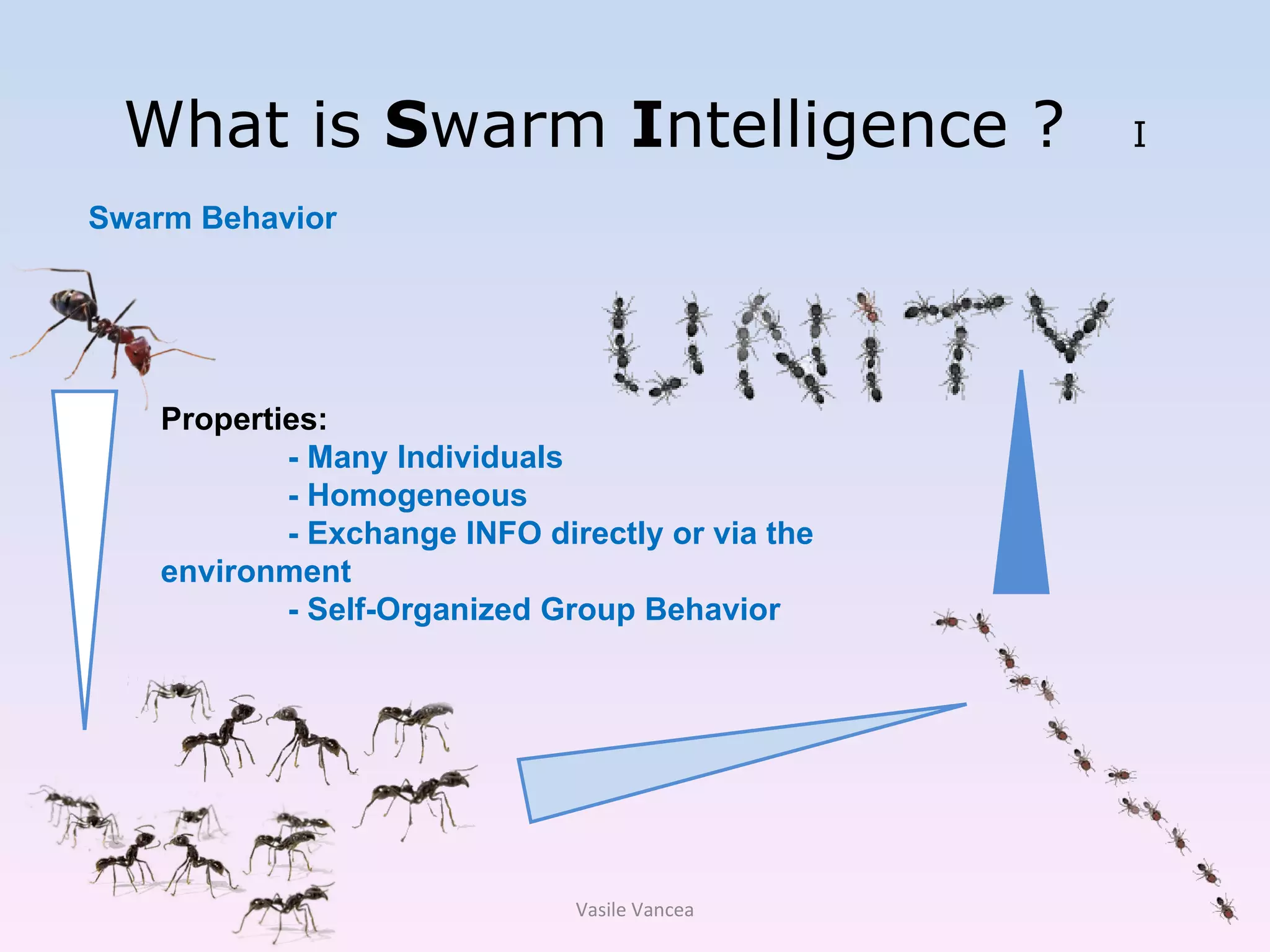
What is  S warm  I ntelligence ?  I Swarm Behavior Properties: - Many Individuals - Homogeneous - Exchange INFO directly or via the environment - Self-Organized Group Behavior Vasile Vancea
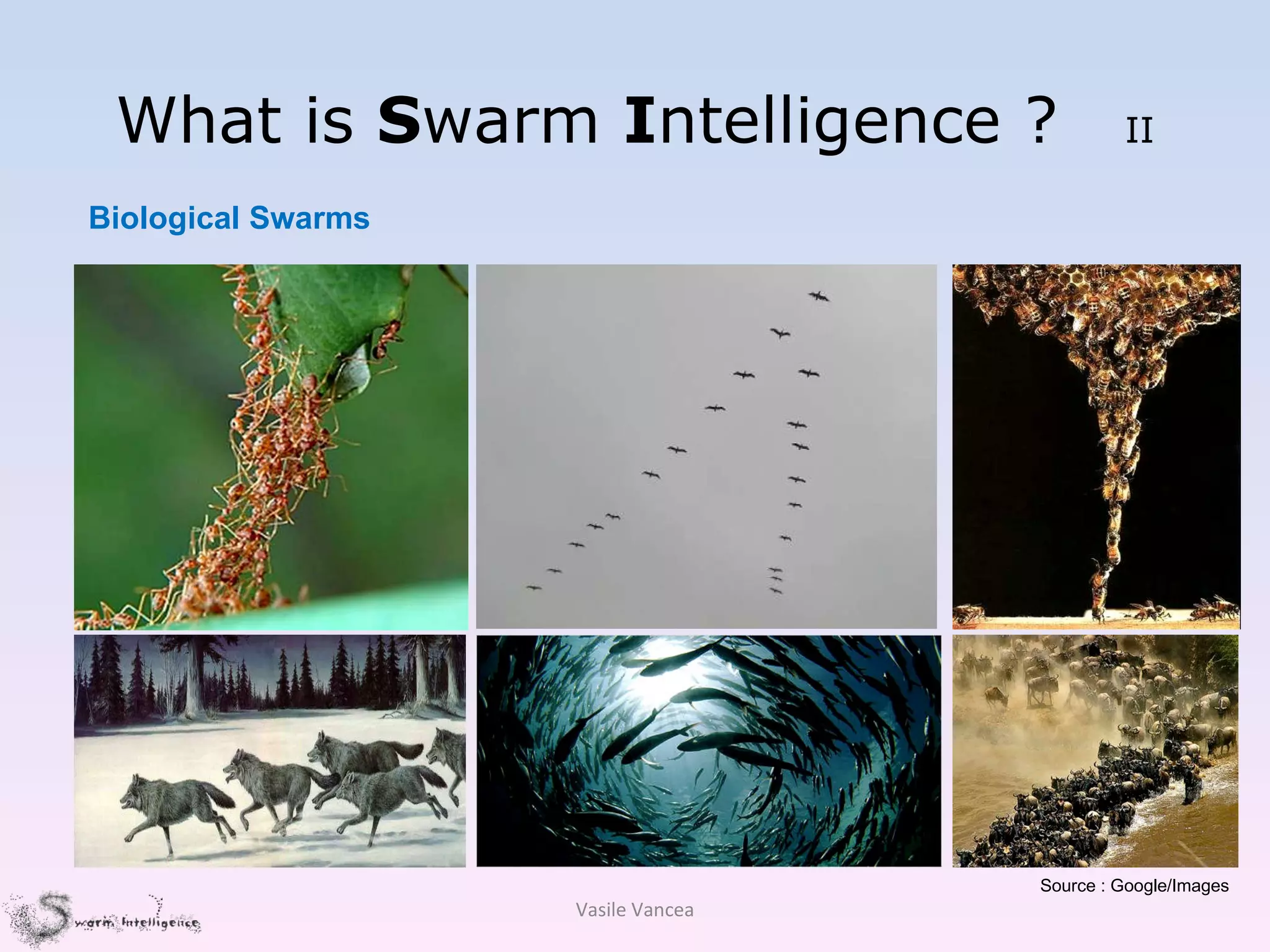
What is  S warm  I ntelligence ?  II Source : Google/Images Biological Swarms Vasile Vancea
What is  S warm  I ntelligence ?  III Collective problem solving by  ants Algorithms Vasile Vancea Travelling Salesman Problem ( TSP ) 1  2  3 Bird flocks  and  Fish schools Cohesion Separation Alignment Auteur :  Johann Dréo http://wapedia.mobi/en Boid’s experiment  [7]
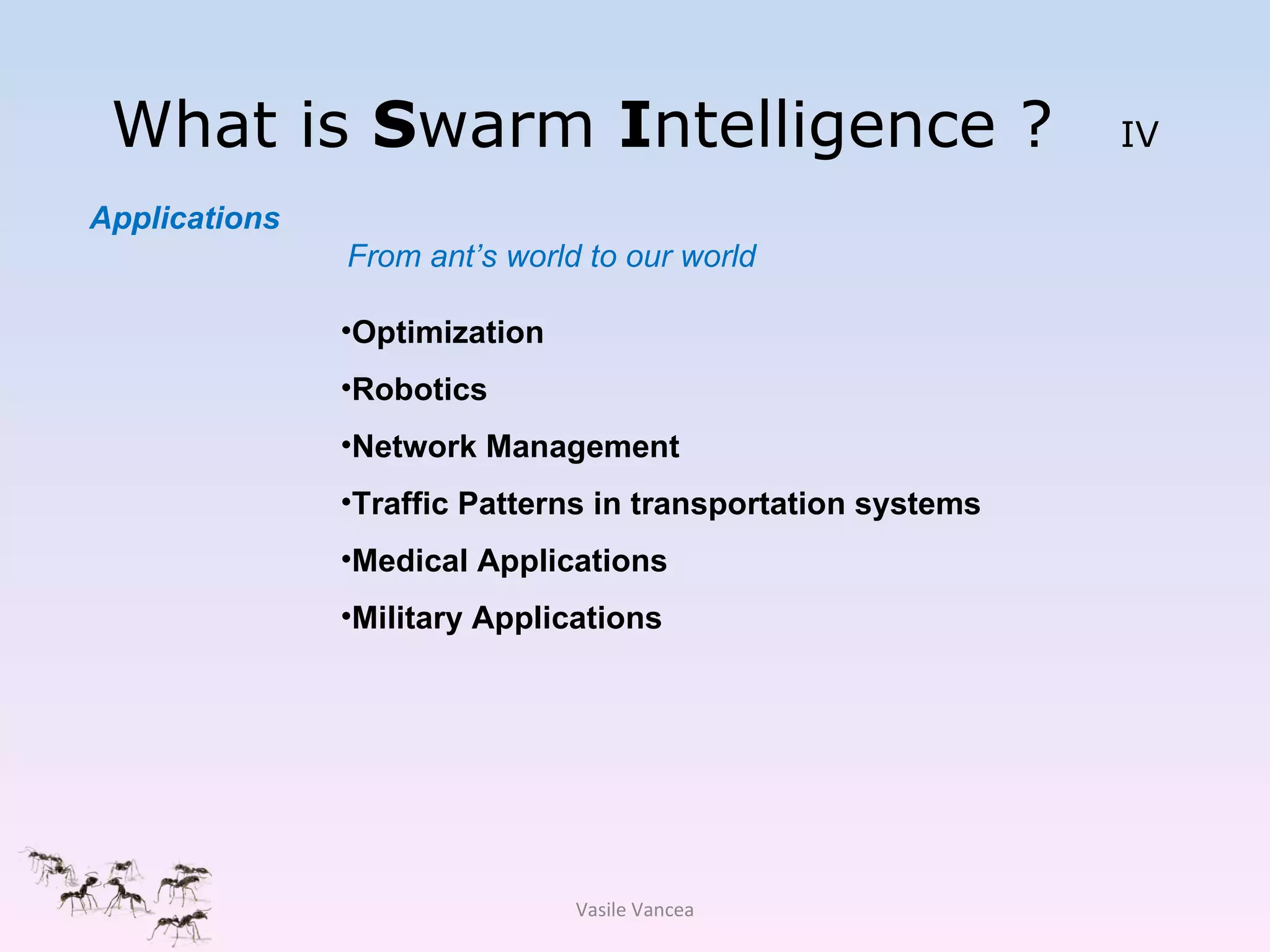
What is  S warm  I ntelligence ?  IV Optimization Robotics Network Management Traffic Patterns in transportation systems Medical Applications Military Applications Applications From ant’s world to our world  Vasile Vancea
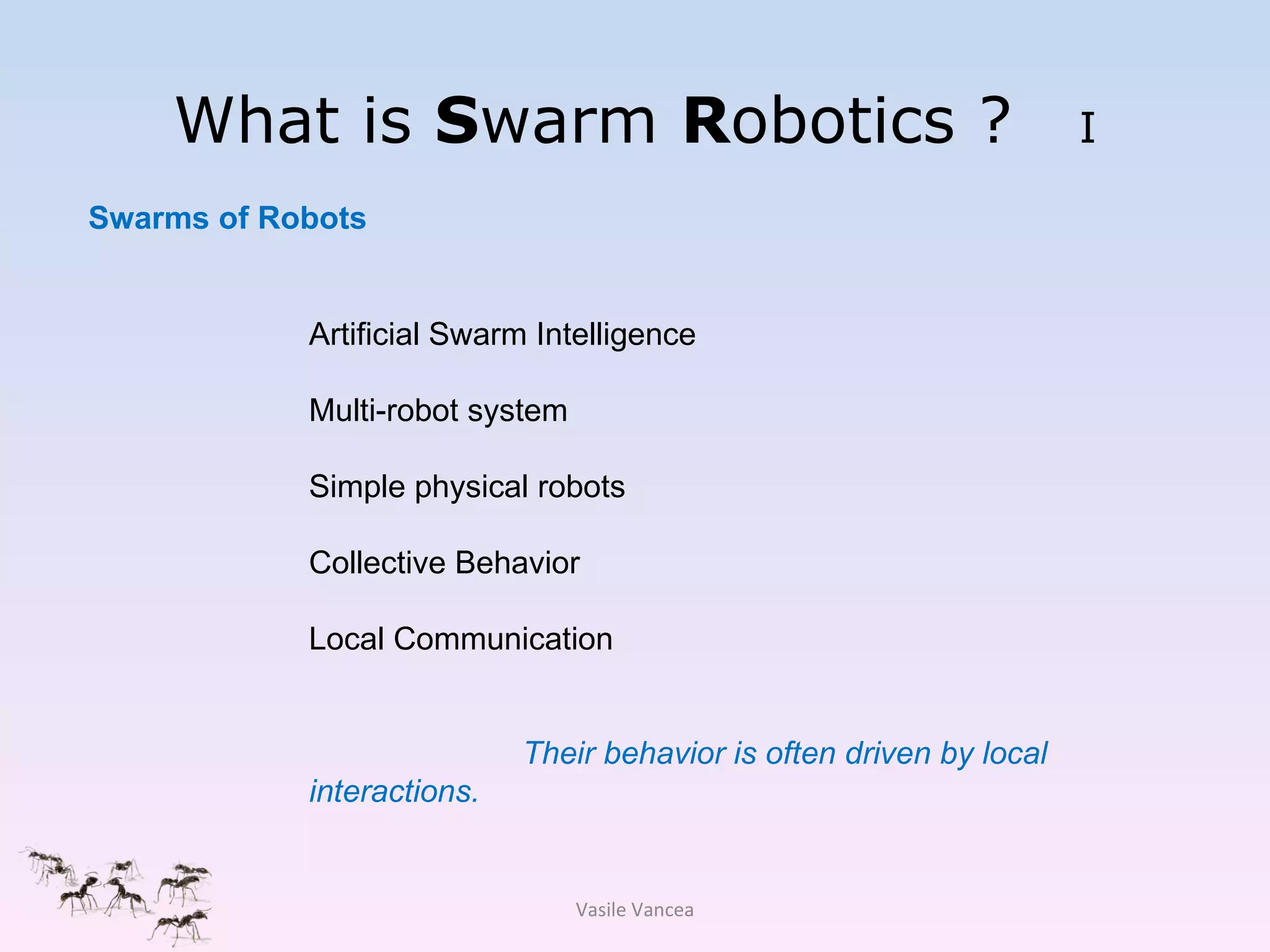
What is  S warm  R obotics ?  I Swarms of Robots Vasile Vancea Artificial Swarm Intelligence Multi-robot system Simple physical robots Collective Behavior Local Communication Their behavior is often driven by local interactions.
What is  S warm  R obotics ?  II Flyfire   swarm from  MIT [1]   Examples  I Fleet of  drones  to explore the ocean  by  AUE  ( The Autonomous Underwater Explorers)  [2] Vasile Vancea ARES Ingestible Surgical Robots  [3] Source : http://singularityhub.com/
What is  S warm  R obotics ?  III E-puck robots Ecole Polytechnique Federale de Lausanne  [4] Symbrion  The University of the West of England  [5]   Examples  I I Examples  I Vasile Vancea I-Swarm   Micro Robots  [6] Source : http://singularityhub.com/
Why   SI  ? Intelligent  = must be able to learn about their world and develop their own ability to interact with it  [8]  . Groups  are powerful  [9]   Less complicated agents. Many individuals - Division of labor. More effective - Safety in numbers. Coordinating movements . Decrease of energy consumption.  Cheaper  (“each  termite  is simple, each  termite  is cheap, each  termite  is expendable”). Vasile Vancea Source : google/images
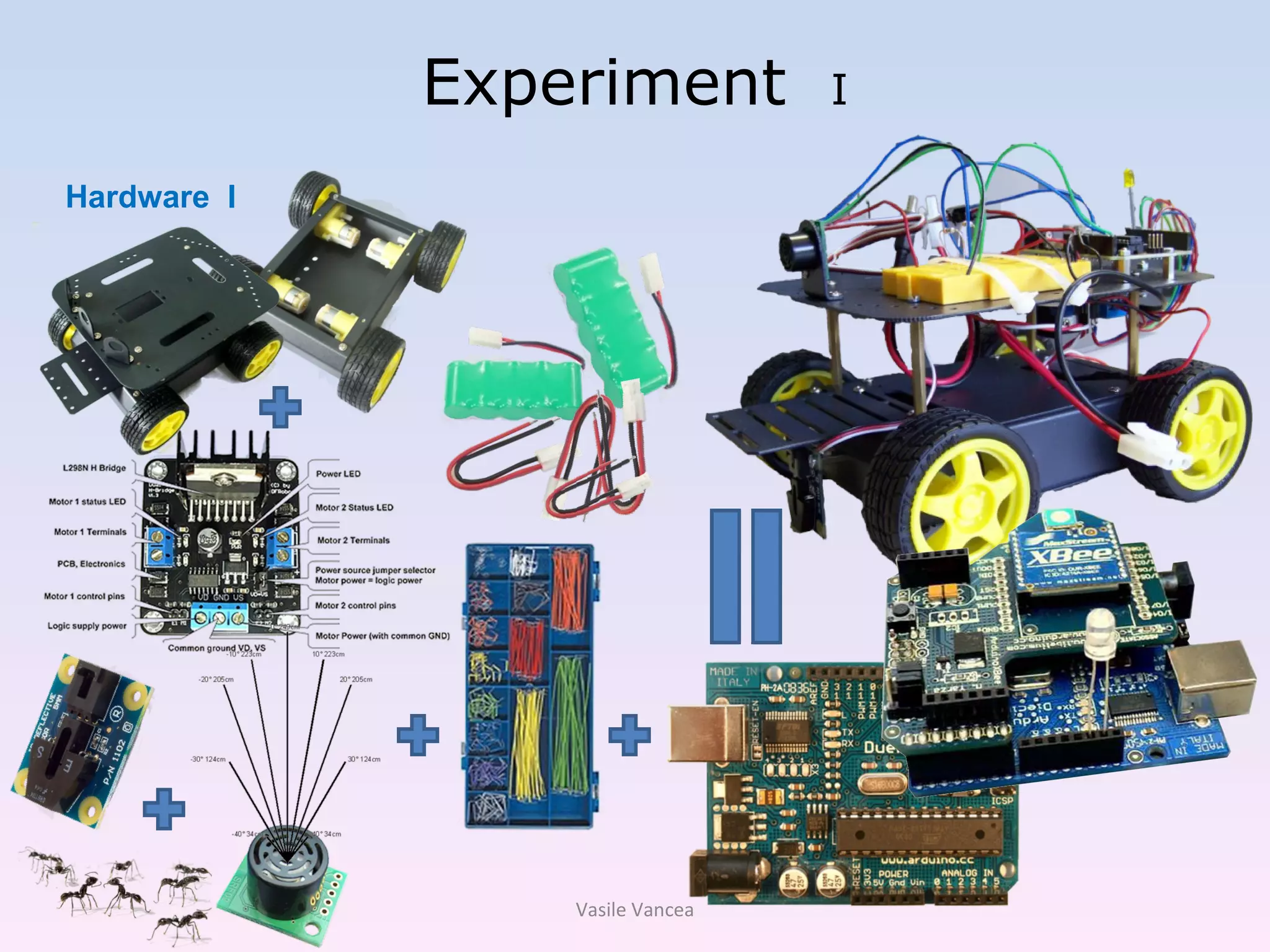
Experiment  I Vasile Vancea Hardware  I
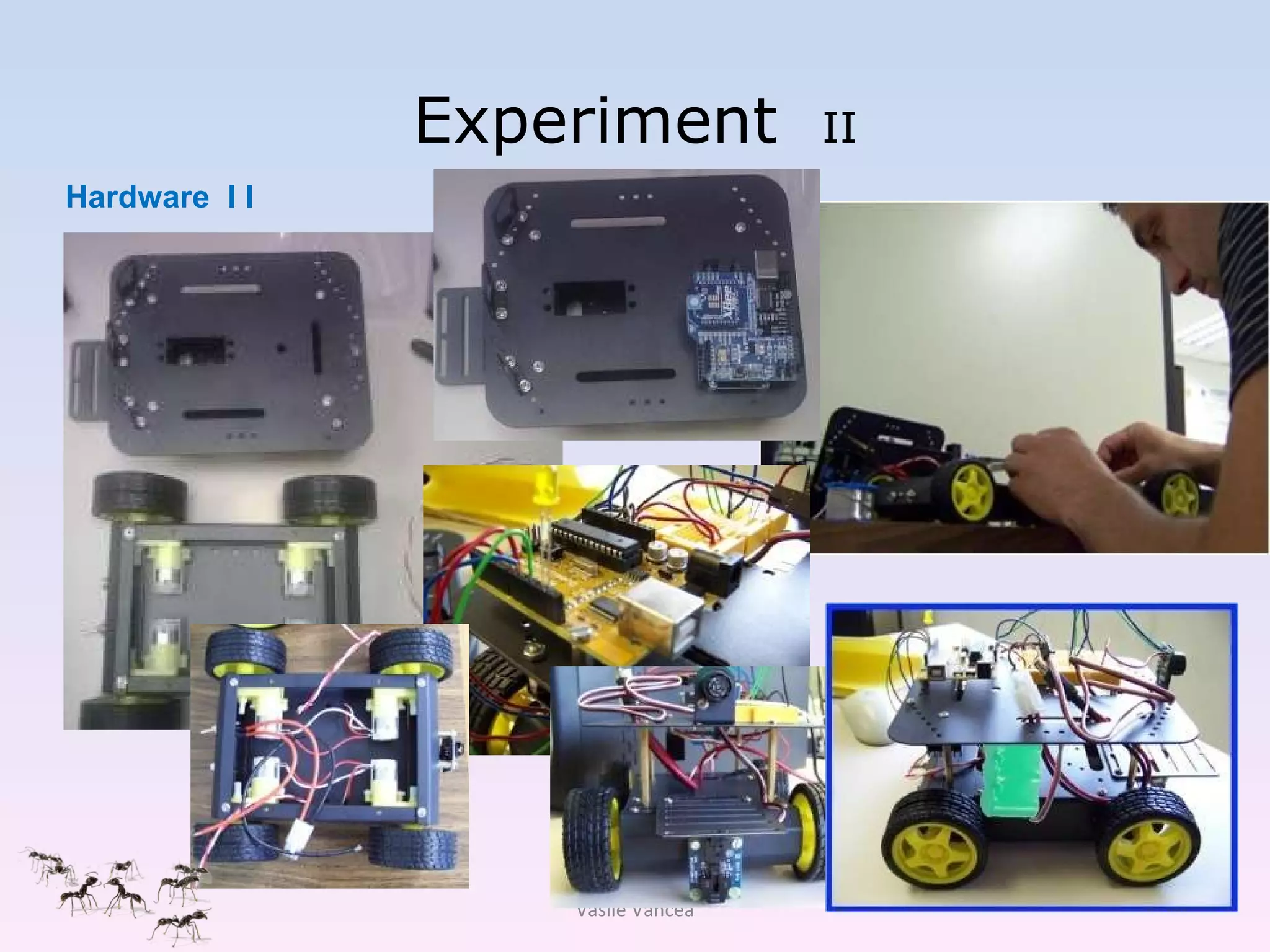
Experiment  II Vasile Vancea Hardware  I I
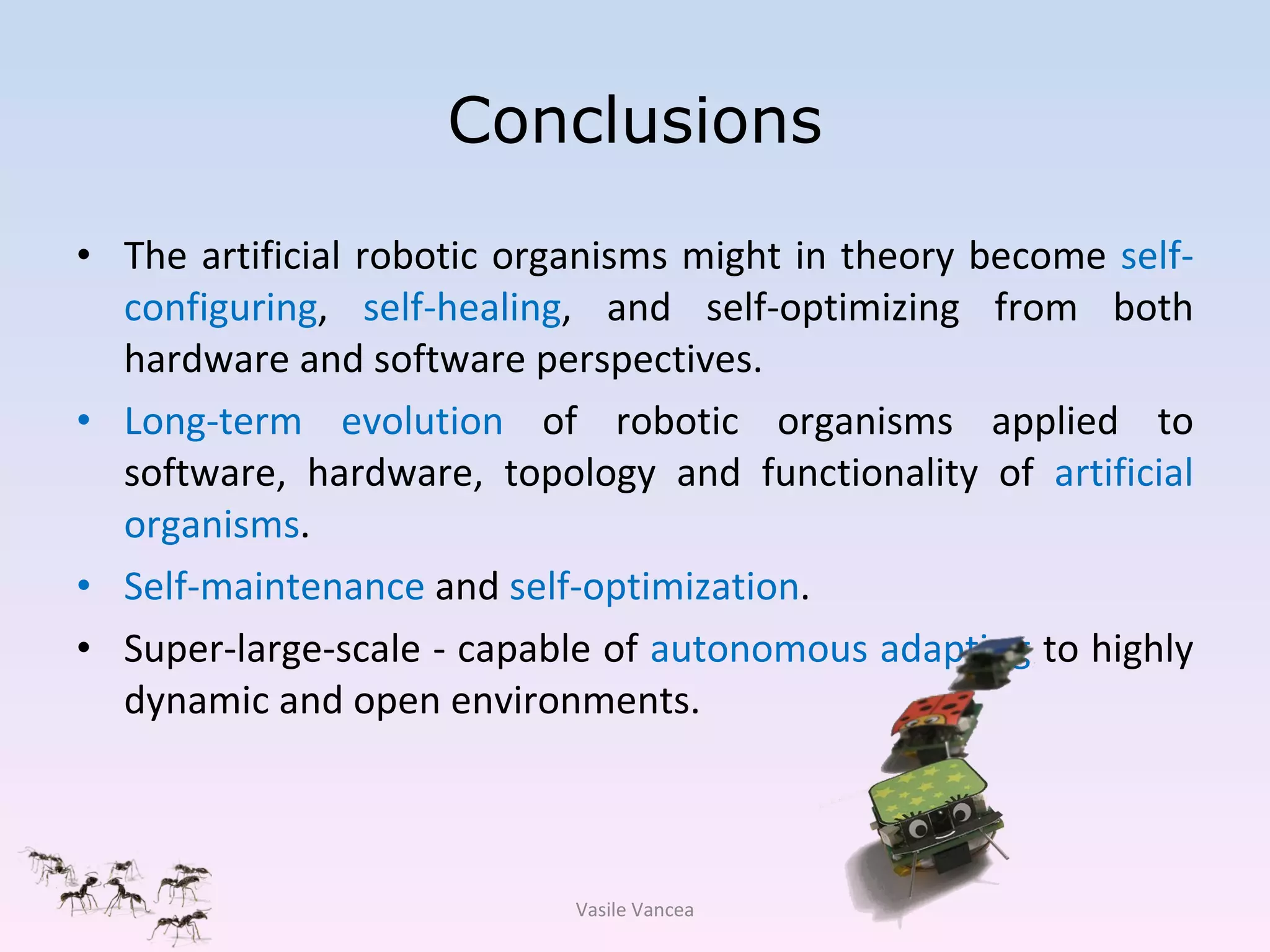
Conclusions The artificial robotic organisms might in theory become  self-configuring ,  self-healing , and self-optimizing from both hardware and software perspectives. Long-term evolution  of robotic organisms applied to software, hardware, topology and functionality of  artificial   organisms . Self-maintenance  and  self-optimization . Super-large-scale - capable of  autonomous   adapting  to highly dynamic and open environments. Vasile Vancea
Bibliography [1] http://senseable.mit.edu/flyfire/ [2] http://jaffeweb.ucsd.edu/node/81 [3] http://www.ares-nest.org/tiki-index.php [4] http://www.e-puck.org/index.php?option=com_frontpage&Itemid=1 [5] http://www.symbrion.eu/tiki-index.php [6] http://www.i-swarm.org/MainPage/Project/P_Overview1.htm [7] http://www.red3d.com/cwr/boids [8]  http://ants.gsfc.nasa.gov/ArchandAI.html [9] http://battlecode.mit.edu/2006/public/lectures/classroom5.pdf [10] Lynne E. Parker, “Distributed Intelligence: Overview of the Field and its Application in Multi-Robot Systems”, Journal of Physical Agents, vol.2, no. 1, March 2008 [11] Aleksandar Jevti ć ,Diego Andina ,  “  Swarm Intelligence and Its Applications in Swarm Robotics  ”,  6th WSEAS Int. Conference on Computational Intelligence, Man-Machine Systems and Cybernetics, Tenerife, Spain, December 14-16, 2007 Vasile Vancea
Thank You Source : Google Images Vasile Vancea

Vancea vasile swarm intelligence

  • 1.
    Swarm Intelligence ~ Swarm Robotics ~ Vasile Vancea Universidad Politécnica de Madrid (UPM) TÉCNICAS DE INTELIGENCIA ARTIFICIAL APLICADAS A PROCESAMIENTO DE SEÑAL
  • 2.
    Intro What is S warm I ntelligence ? What is S warm R obotics ? Why Swarm in AI field? E xperiment ( partial ) C onclusions Vasile Vancea
  • 3.
    What is S warm I ntelligence ? I Swarm Behavior Properties: - Many Individuals - Homogeneous - Exchange INFO directly or via the environment - Self-Organized Group Behavior Vasile Vancea
  • 4.
    What is S warm I ntelligence ? II Source : Google/Images Biological Swarms Vasile Vancea
  • 5.
    What is S warm I ntelligence ? III Collective problem solving by ants Algorithms Vasile Vancea Travelling Salesman Problem ( TSP ) 1 2 3 Bird flocks and Fish schools Cohesion Separation Alignment Auteur :  Johann Dréo http://wapedia.mobi/en Boid’s experiment [7]
  • 6.
    What is S warm I ntelligence ? IV Optimization Robotics Network Management Traffic Patterns in transportation systems Medical Applications Military Applications Applications From ant’s world to our world Vasile Vancea
  • 7.
    What is S warm R obotics ? I Swarms of Robots Vasile Vancea Artificial Swarm Intelligence Multi-robot system Simple physical robots Collective Behavior Local Communication Their behavior is often driven by local interactions.
  • 8.
    What is S warm R obotics ? II Flyfire swarm from MIT [1] Examples I Fleet of drones to explore the ocean by AUE ( The Autonomous Underwater Explorers) [2] Vasile Vancea ARES Ingestible Surgical Robots [3] Source : http://singularityhub.com/
  • 9.
    What is S warm R obotics ? III E-puck robots Ecole Polytechnique Federale de Lausanne [4] Symbrion The University of the West of England [5] Examples I I Examples I Vasile Vancea I-Swarm Micro Robots [6] Source : http://singularityhub.com/
  • 10.
    Why SI ? Intelligent = must be able to learn about their world and develop their own ability to interact with it [8] . Groups are powerful [9] Less complicated agents. Many individuals - Division of labor. More effective - Safety in numbers. Coordinating movements . Decrease of energy consumption. Cheaper (“each termite is simple, each termite is cheap, each termite is expendable”). Vasile Vancea Source : google/images
  • 11.
    Experiment IVasile Vancea Hardware I
  • 12.
    Experiment IIVasile Vancea Hardware I I
  • 13.
    Conclusions The artificialrobotic organisms might in theory become self-configuring , self-healing , and self-optimizing from both hardware and software perspectives. Long-term evolution of robotic organisms applied to software, hardware, topology and functionality of artificial organisms . Self-maintenance and self-optimization . Super-large-scale - capable of autonomous adapting to highly dynamic and open environments. Vasile Vancea
  • 14.
    Bibliography [1] http://senseable.mit.edu/flyfire/[2] http://jaffeweb.ucsd.edu/node/81 [3] http://www.ares-nest.org/tiki-index.php [4] http://www.e-puck.org/index.php?option=com_frontpage&Itemid=1 [5] http://www.symbrion.eu/tiki-index.php [6] http://www.i-swarm.org/MainPage/Project/P_Overview1.htm [7] http://www.red3d.com/cwr/boids [8] http://ants.gsfc.nasa.gov/ArchandAI.html [9] http://battlecode.mit.edu/2006/public/lectures/classroom5.pdf [10] Lynne E. Parker, “Distributed Intelligence: Overview of the Field and its Application in Multi-Robot Systems”, Journal of Physical Agents, vol.2, no. 1, March 2008 [11] Aleksandar Jevti ć ,Diego Andina , “ Swarm Intelligence and Its Applications in Swarm Robotics ”, 6th WSEAS Int. Conference on Computational Intelligence, Man-Machine Systems and Cybernetics, Tenerife, Spain, December 14-16, 2007 Vasile Vancea
  • 15.
    Thank You Source: Google Images Vasile Vancea