Swarm IntelligenceSwarm Intelligence
05005028 (sarat chand)
05005029(naresh Kumar)
05005031(veeranjaneyulu)
05010033(kalyan raghu)
Swarms

Natural phenomena as inspiration

A flock of birds sweeps across the Sky.

How do ants collectively forage for food?

How does a school of fish swims, turns together?

They are so ordered.

What made them to be so ordered?

There is no centralized controller

But they exhibit complex global behavior.

Individuals follow simple rules to interact with
neighbors .

Rules followed by birds
− collision avoidance
− velocity matching
− Flock Centering
Swarm Intelligence-Definition

“Swarm intelligence (SI) is artificial intelligence
based on the collective behavior of decentralized,
self-organized systems”
Characteristics of Swarms

Composed of many individuals

Individuals are homogeneous

Local interaction based on simple rules

Self-organization
Overview

Ant colony optimization

TSP

Bees Algorithms

Comparison between bees and ants

Conclusions
Ant Colony Optimization

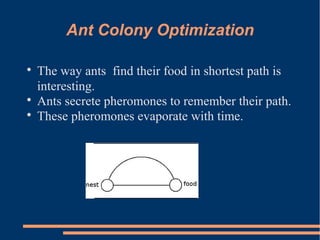
The way ants find their food in shortest path is
interesting.

Ants secrete pheromones to remember their path.

These pheromones evaporate with time.
Ant Colony Optimization..

Whenever an ant finds food , it marks its return
journey with pheromones.

Pheromones evaporate faster on longer paths.

Shorter paths serve as the way to food for most of
the other ants.
Ant Colony Optimization

The shorter path will be reinforced by the
pheromones further.

Finally , the ants arrive at the shortest path.
Optimization using SI

Swarms have the ability to solve problems

Ant Colony Optimization (ACO) , a meta-heuristic

ACO can be used to solve hard problems like TSP,
Quadratic Assignment Problem(QAP)

We discuss ACO meta-heuristic for TSP
ACO-TSP

Given a graph with n nodes, should give the
shortest Hamiltonian cycle

m ants traverse the graph

Each ant starts at a random node
Transitions

Ants leave pheromone trails when they make a
transition

Trails are used in prioritizing transition
Transitions

Suppose ant k is at u.

Nk(u) be the nodes not visited by k

Tuv be the pheromone trail of edge (u,v)

k jumps from u to a node v in Nk(u) with
probability
puv(k) = Tuv ( 1/ d(u,v))
Iteration of AOC-STP

m ants are started at random nodes

They traverse the graph prioritized on trails and
edge-weights

An iteration ends when all the ants visit all nodes

After each iteration, pheromone trails are updated.
Updating Pheromone trails

New trail should have two components
− Old trail left after evaporation and
− Trails added by ants traversing the edge during the
iteration

T'uv = (1-p) Tuv + ChangeIn(Tuv)

Solution gets better and better as the number of
iterations increase
Performance of TSP with ACO heuristic

Performs better than state-of-the-art TSP
algorithms for small (50-100) of nodes

The main point to appreciate is that Swarms give
us new algorithms for optimization
Bee Algorithm
Bees Foraging

Recruitment Behaviour :
− Waggle Dancing
− series of alternating left and right loops
− Direction of dancing
− Duration of dancing

Navigation Behaviour :
− Path vector represents knowledge representation of
path by inspect
− Construction of PI.
Algorithm

It has two steps :
− ManageBeesActivity()
− CalculateVectors()

ManageBeesActivity: It handles agents activities
based on their internal state. That is it decides
action it has to take depending on the knowledge it
has.

CalculateVectors : It is used for administrative
purposes and calculates PI vectors for the agents.
Uses of Bee Algorithm

Training neural networks for pattern recognition

Forming manufacturing cells.

Scheduling jobs for a production machine.

Data clustering
Comparisons

Ants use pheromones for back tracking route to
food source.

Bees instead use Path Integration. Bees are able to
compute their present location from past trajectory
continuously.

So bees can return to home through direct route
instead of back tracking their original route.

Does path emerge faster in this algorithm.
Results

Experiments with different test cases on these
algorithms show that.
− Bees algorithm is more efficient when finding and
collecting food, that is it takes less number of steps.
− Bees algorithm is more scalable it requires less
computation time to complete task.
− Bees algorithm is less adaptive than ACO.
Applications of SI

In Movies : Graphics in movies like Lord of the
Rings trilogy, Troy.

Unmanned underwater vehicles(UUV):
− Groups of UUVs used as security units
− Only local maps at each UUV
− Joint detection of and attack over enemy vessels by co-
ordinating within the group of UUVs
More Applications

Swarmcasting:
− For fast downloads in a peer-to-peer file-sharing
network
− Fragments of a file are downloaded from different
hosts in the network, parallelly.

AntNet : a routing algorithm developed on the
framework of Ant Colony Optimization

BeeHive : another routing algorithm modelled on
the communicative behaviour of honey bees
A Philosophical issue

Individual agents in the group seem to have no
intelligence but the group as a whole displays
some intelligence

In terms of intelligence, whole is not equal to sum
of parts?

Where does the intelligence of the group come
from ?

Answer : Rules followed by individual agents
Conclusion

SI provides heuristics to solve difficult
optimization problems.

Has wide variety of applications.

Basic philosophy of Swarm Intelligence : Observe
the behaviour of social animals and try to mimic
those animals on computer systems.

Basic theme of Natural Computing: Observe
nature, mimic nature.
Bibliography

A Bee Algorithm for Multi-Agents System-
Lemmens ,Steven . Karl Tuyls, Ann Nowe -2007

Swarm Intelligence – Literature Overview, Yang
Liu , Kevin M. Passino. 2000.

www.wikipedia.org

The ACO metaheuristic: Algorithms,
Applications, and Advances. Marco Dorigo and
Thomas Stutzle-Handbook of metaheuristics,
2002.

swarm-intelligence

  • 1.
    Swarm IntelligenceSwarm Intelligence 05005028(sarat chand) 05005029(naresh Kumar) 05005031(veeranjaneyulu) 05010033(kalyan raghu)
  • 2.
    Swarms  Natural phenomena asinspiration  A flock of birds sweeps across the Sky.  How do ants collectively forage for food?  How does a school of fish swims, turns together?  They are so ordered.
  • 3.
     What made themto be so ordered?  There is no centralized controller  But they exhibit complex global behavior.  Individuals follow simple rules to interact with neighbors .  Rules followed by birds − collision avoidance − velocity matching − Flock Centering
  • 4.
    Swarm Intelligence-Definition  “Swarm intelligence(SI) is artificial intelligence based on the collective behavior of decentralized, self-organized systems”
  • 5.
    Characteristics of Swarms  Composedof many individuals  Individuals are homogeneous  Local interaction based on simple rules  Self-organization
  • 6.
    Overview  Ant colony optimization  TSP  BeesAlgorithms  Comparison between bees and ants  Conclusions
  • 7.
    Ant Colony Optimization  Theway ants find their food in shortest path is interesting.  Ants secrete pheromones to remember their path.  These pheromones evaporate with time.
  • 8.
    Ant Colony Optimization..  Wheneveran ant finds food , it marks its return journey with pheromones.  Pheromones evaporate faster on longer paths.  Shorter paths serve as the way to food for most of the other ants.
  • 9.
    Ant Colony Optimization  Theshorter path will be reinforced by the pheromones further.  Finally , the ants arrive at the shortest path.
  • 10.
    Optimization using SI  Swarmshave the ability to solve problems  Ant Colony Optimization (ACO) , a meta-heuristic  ACO can be used to solve hard problems like TSP, Quadratic Assignment Problem(QAP)  We discuss ACO meta-heuristic for TSP
  • 11.
    ACO-TSP  Given a graphwith n nodes, should give the shortest Hamiltonian cycle  m ants traverse the graph  Each ant starts at a random node
  • 12.
    Transitions  Ants leave pheromonetrails when they make a transition  Trails are used in prioritizing transition
  • 13.
    Transitions  Suppose ant kis at u.  Nk(u) be the nodes not visited by k  Tuv be the pheromone trail of edge (u,v)  k jumps from u to a node v in Nk(u) with probability puv(k) = Tuv ( 1/ d(u,v))
  • 14.
    Iteration of AOC-STP  mants are started at random nodes  They traverse the graph prioritized on trails and edge-weights  An iteration ends when all the ants visit all nodes  After each iteration, pheromone trails are updated.
  • 15.
    Updating Pheromone trails  Newtrail should have two components − Old trail left after evaporation and − Trails added by ants traversing the edge during the iteration  T'uv = (1-p) Tuv + ChangeIn(Tuv)  Solution gets better and better as the number of iterations increase
  • 16.
    Performance of TSPwith ACO heuristic  Performs better than state-of-the-art TSP algorithms for small (50-100) of nodes  The main point to appreciate is that Swarms give us new algorithms for optimization
  • 17.
  • 19.
    Bees Foraging  Recruitment Behaviour: − Waggle Dancing − series of alternating left and right loops − Direction of dancing − Duration of dancing  Navigation Behaviour : − Path vector represents knowledge representation of path by inspect − Construction of PI.
  • 20.
    Algorithm  It has twosteps : − ManageBeesActivity() − CalculateVectors()  ManageBeesActivity: It handles agents activities based on their internal state. That is it decides action it has to take depending on the knowledge it has.  CalculateVectors : It is used for administrative purposes and calculates PI vectors for the agents.
  • 21.
    Uses of BeeAlgorithm  Training neural networks for pattern recognition  Forming manufacturing cells.  Scheduling jobs for a production machine.  Data clustering
  • 22.
    Comparisons  Ants use pheromonesfor back tracking route to food source.  Bees instead use Path Integration. Bees are able to compute their present location from past trajectory continuously.  So bees can return to home through direct route instead of back tracking their original route.  Does path emerge faster in this algorithm.
  • 23.
    Results  Experiments with differenttest cases on these algorithms show that. − Bees algorithm is more efficient when finding and collecting food, that is it takes less number of steps. − Bees algorithm is more scalable it requires less computation time to complete task. − Bees algorithm is less adaptive than ACO.
  • 24.
    Applications of SI  InMovies : Graphics in movies like Lord of the Rings trilogy, Troy.  Unmanned underwater vehicles(UUV): − Groups of UUVs used as security units − Only local maps at each UUV − Joint detection of and attack over enemy vessels by co- ordinating within the group of UUVs
  • 25.
    More Applications  Swarmcasting: − Forfast downloads in a peer-to-peer file-sharing network − Fragments of a file are downloaded from different hosts in the network, parallelly.  AntNet : a routing algorithm developed on the framework of Ant Colony Optimization  BeeHive : another routing algorithm modelled on the communicative behaviour of honey bees
  • 26.
    A Philosophical issue  Individualagents in the group seem to have no intelligence but the group as a whole displays some intelligence  In terms of intelligence, whole is not equal to sum of parts?  Where does the intelligence of the group come from ?  Answer : Rules followed by individual agents
  • 27.
    Conclusion  SI provides heuristicsto solve difficult optimization problems.  Has wide variety of applications.  Basic philosophy of Swarm Intelligence : Observe the behaviour of social animals and try to mimic those animals on computer systems.  Basic theme of Natural Computing: Observe nature, mimic nature.
  • 28.
    Bibliography  A Bee Algorithmfor Multi-Agents System- Lemmens ,Steven . Karl Tuyls, Ann Nowe -2007  Swarm Intelligence – Literature Overview, Yang Liu , Kevin M. Passino. 2000.  www.wikipedia.org  The ACO metaheuristic: Algorithms, Applications, and Advances. Marco Dorigo and Thomas Stutzle-Handbook of metaheuristics, 2002.