S W A R M
C O M P U T I N G
BY GROUP 13:
PATEL SMITKUMAR
V.
VAGHELA DHRUV K.
PATEL RIYA H.
Panchal MANAV P,
SHAH SAGAR U.
TA B L E O F C O N T E N T S
What is swarm
intelligence ?
Why Swarm
Intelligence
Matters
Key Principles of
Swarm
Intelligence
Natural
Examples of
Swarm
Intelligence
Algorithms
Inspired by
Swarm
Intelligence
Ant Colony
Optimization
(ACO)
Particle Swarm
Optimization
(PSO)
Swarm Robotics
Applications
Advantages of
Swarm
Intelligence
Challenges of
Swarm
Intelligence
Future of
Swarm
Intelligence
Q&A
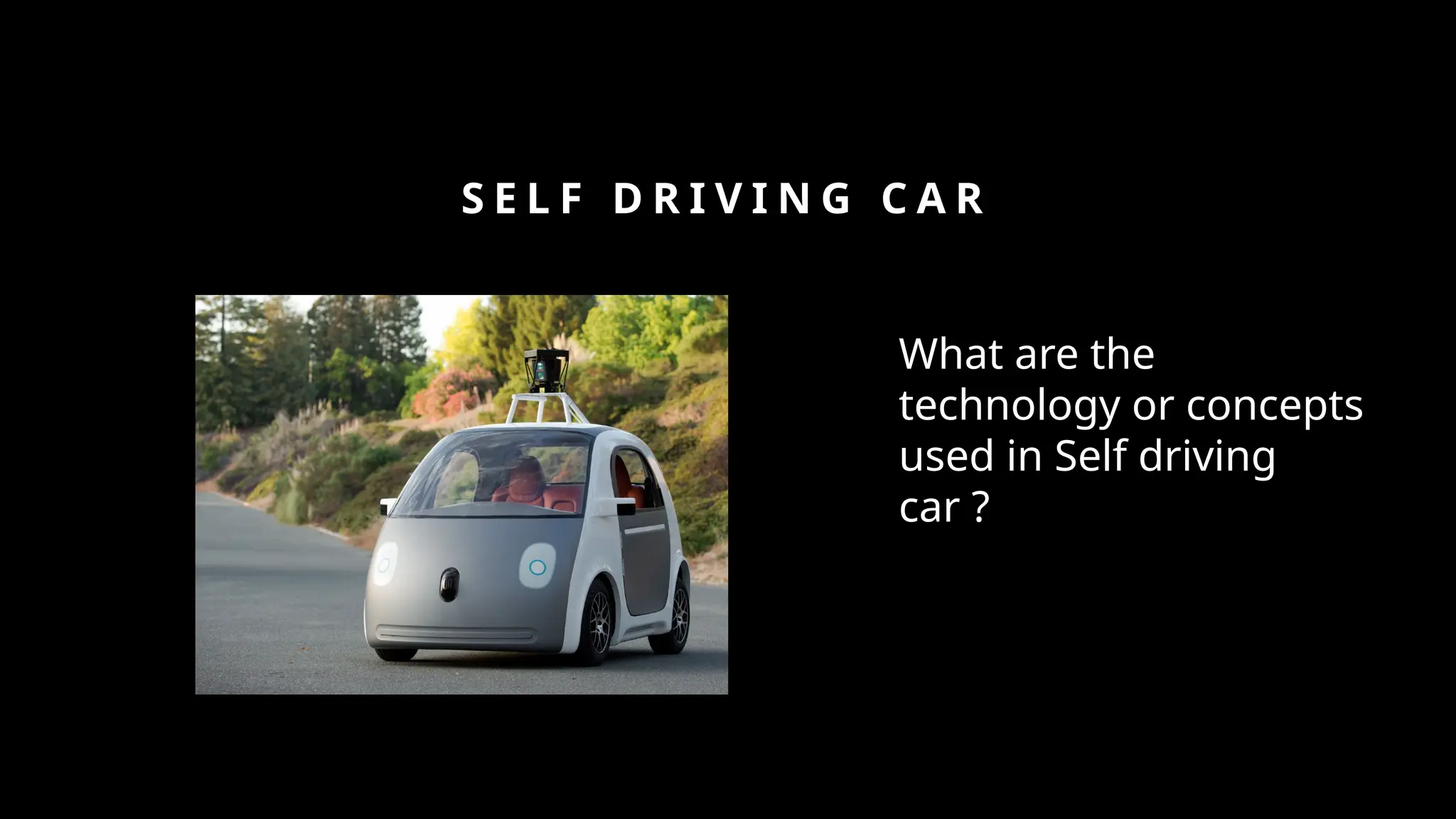
S E L F D R I V I N G C A R
What are the
technology or concepts
used in Self driving
car ?
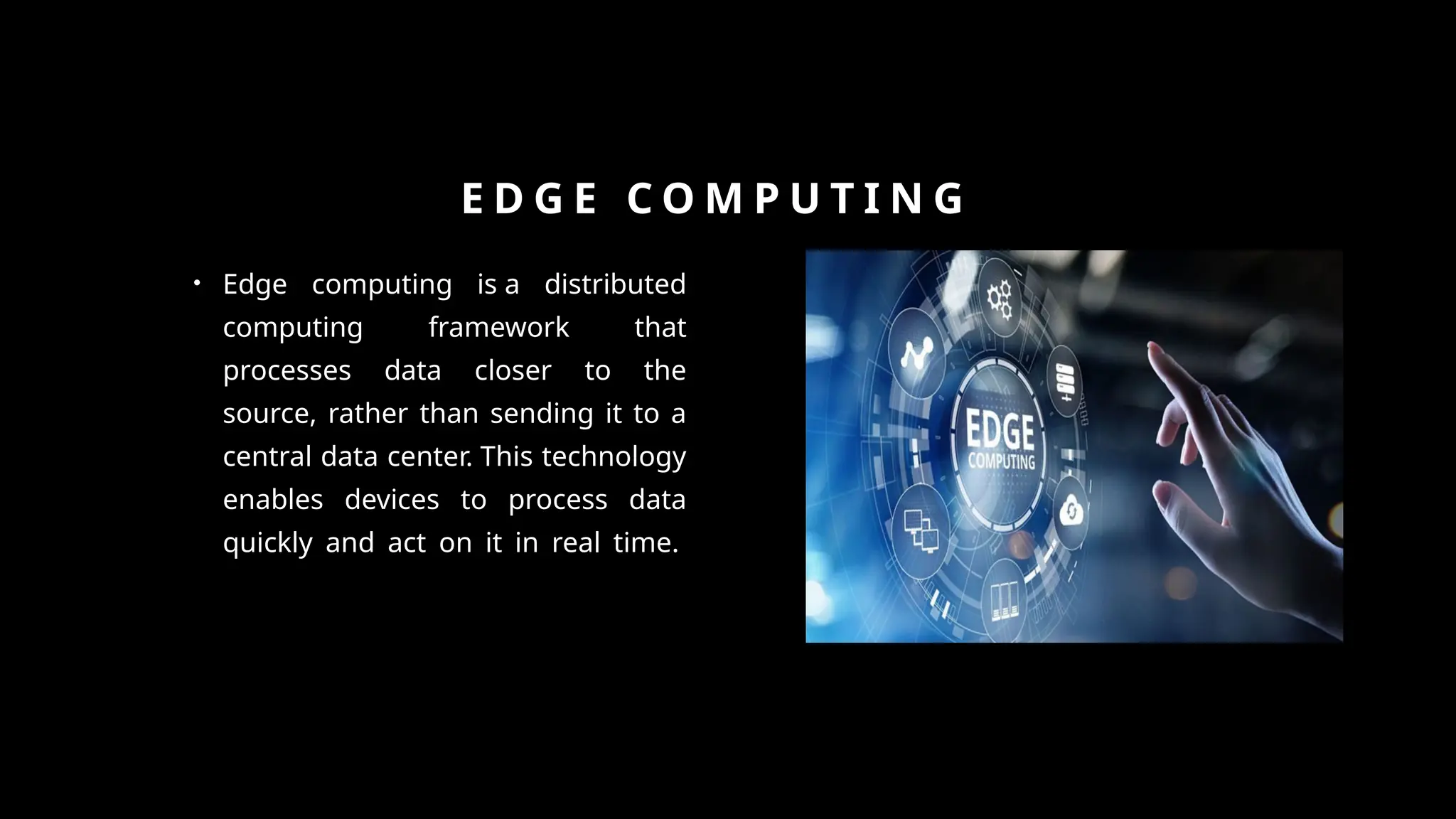
E D G E C O M P U T I N G
• Edge computing is a distributed
computing framework that
processes data closer to the
source, rather than sending it to a
central data center. This technology
enables devices to process data
quickly and act on it in real time.
W H AT I S S W A R M I N T E L L I G E N C E ?
• Swarm intelligence is the study of how decentralized, self-organized systems
behave collectively, and how to simulate that behavior to solve complex
problems. The term was coined in 1989 by Gerardo Beni and Jing Wang in the
context of cellular robotic systems.
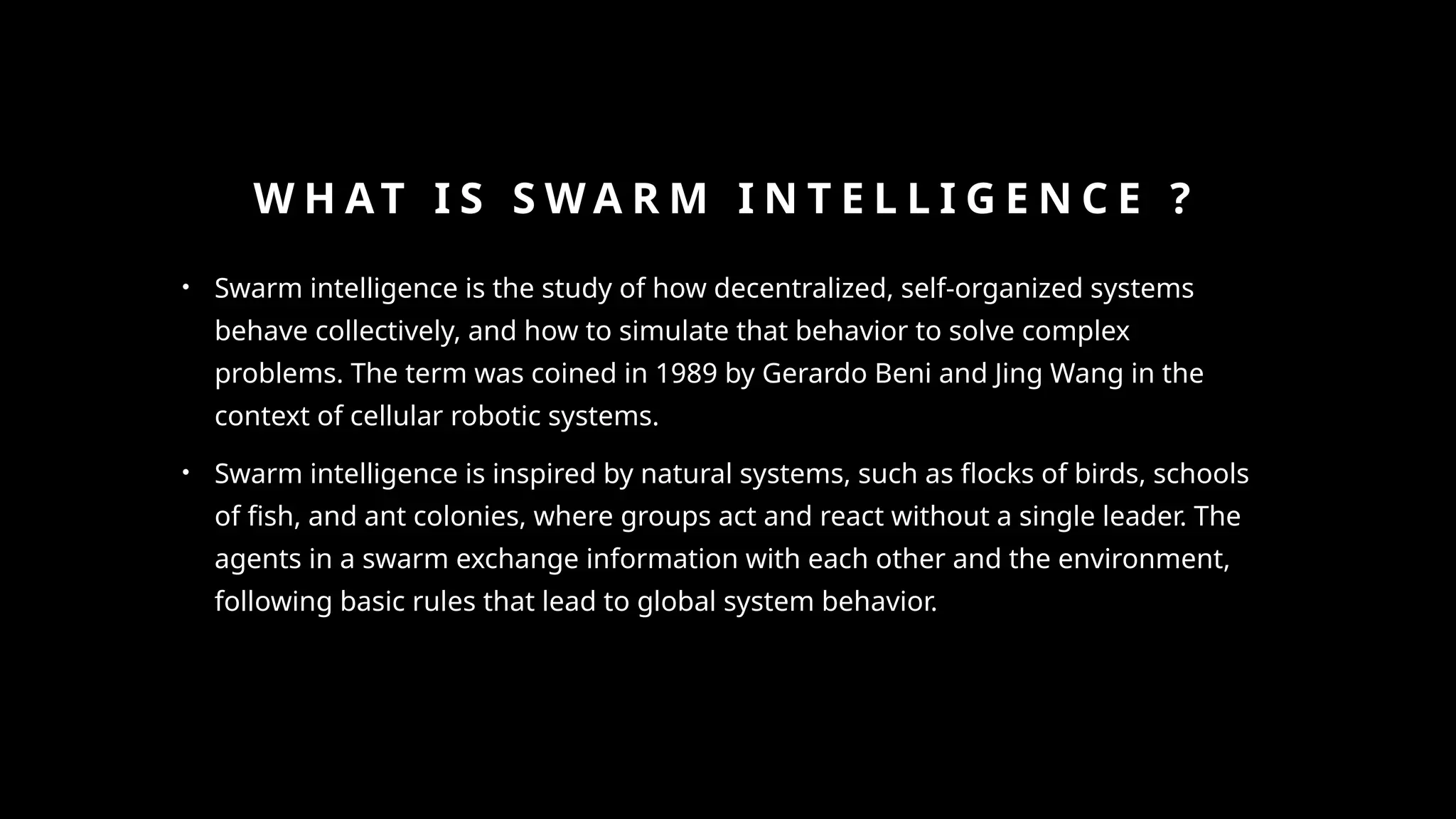
• Swarm intelligence is inspired by natural systems, such as flocks of birds, schools
of fish, and ant colonies, where groups act and react without a single leader. The
agents in a swarm exchange information with each other and the environment,
following basic rules that lead to global system behavior.
W H Y S W A R M I N T E L L I G E N C E M AT T E R S
• Understanding swarm intelligence allows
us to design distributed systems that
mirror nature’s efficiency and adaptability.
• Swarm intelligence follows the concept ,
where a single task is distributed amongst
multiple entities within a group. Since the
task is now performed by multiple group
members, the process is more efficient,
and the results are more accurate
K E Y P R I N C I P L E S O F S W A R M
I N T E L L I G E N C E
• Decentralization
• Self-Organization
• Local Interactions
• Collective Intelligence
• Adaptivity
• Exploration and Exploitation
• Scalability
• Robustness
N AT U R A L E X A M P L E S O F S W A R M
I N T E L L I G E N C E
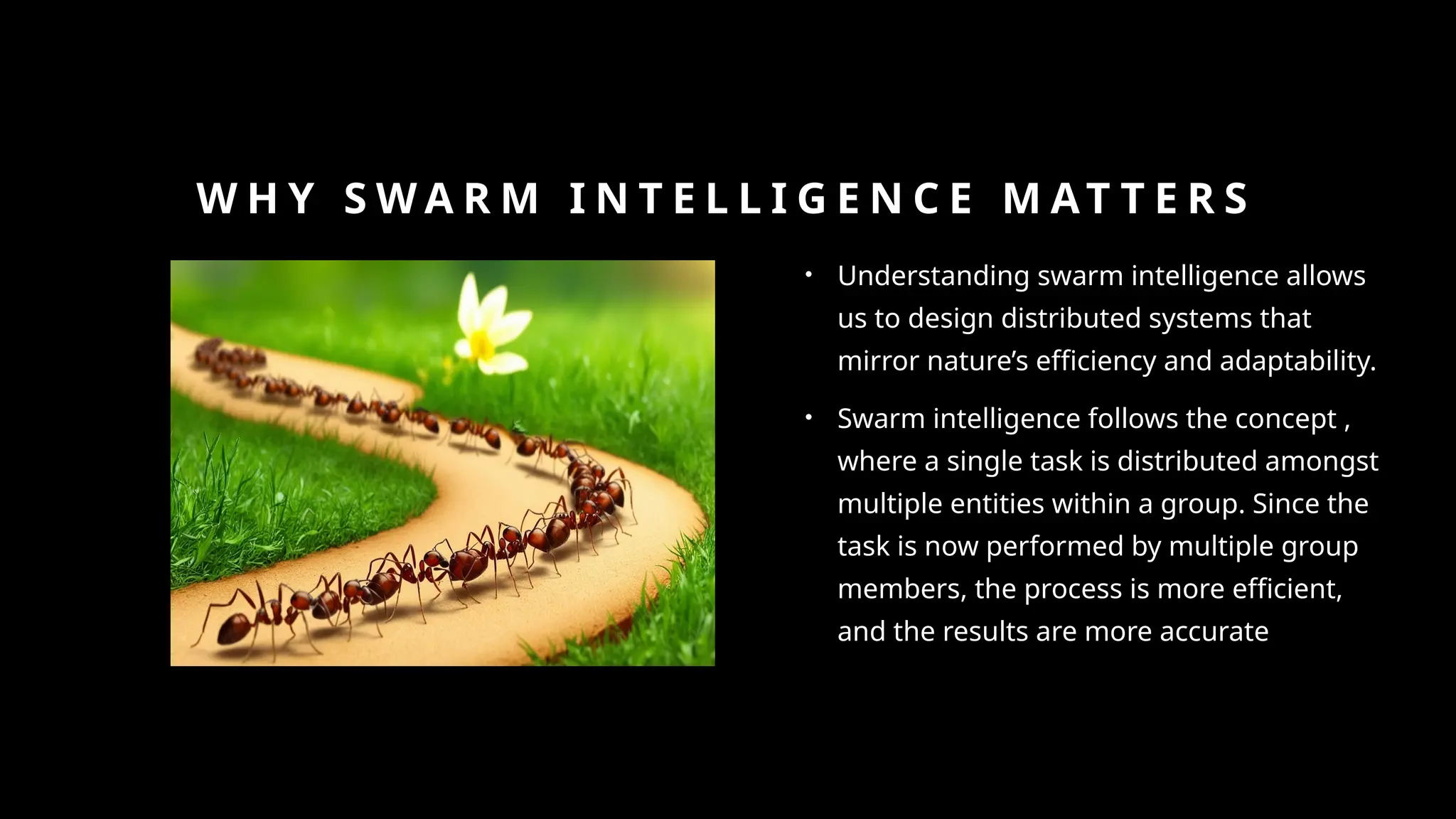
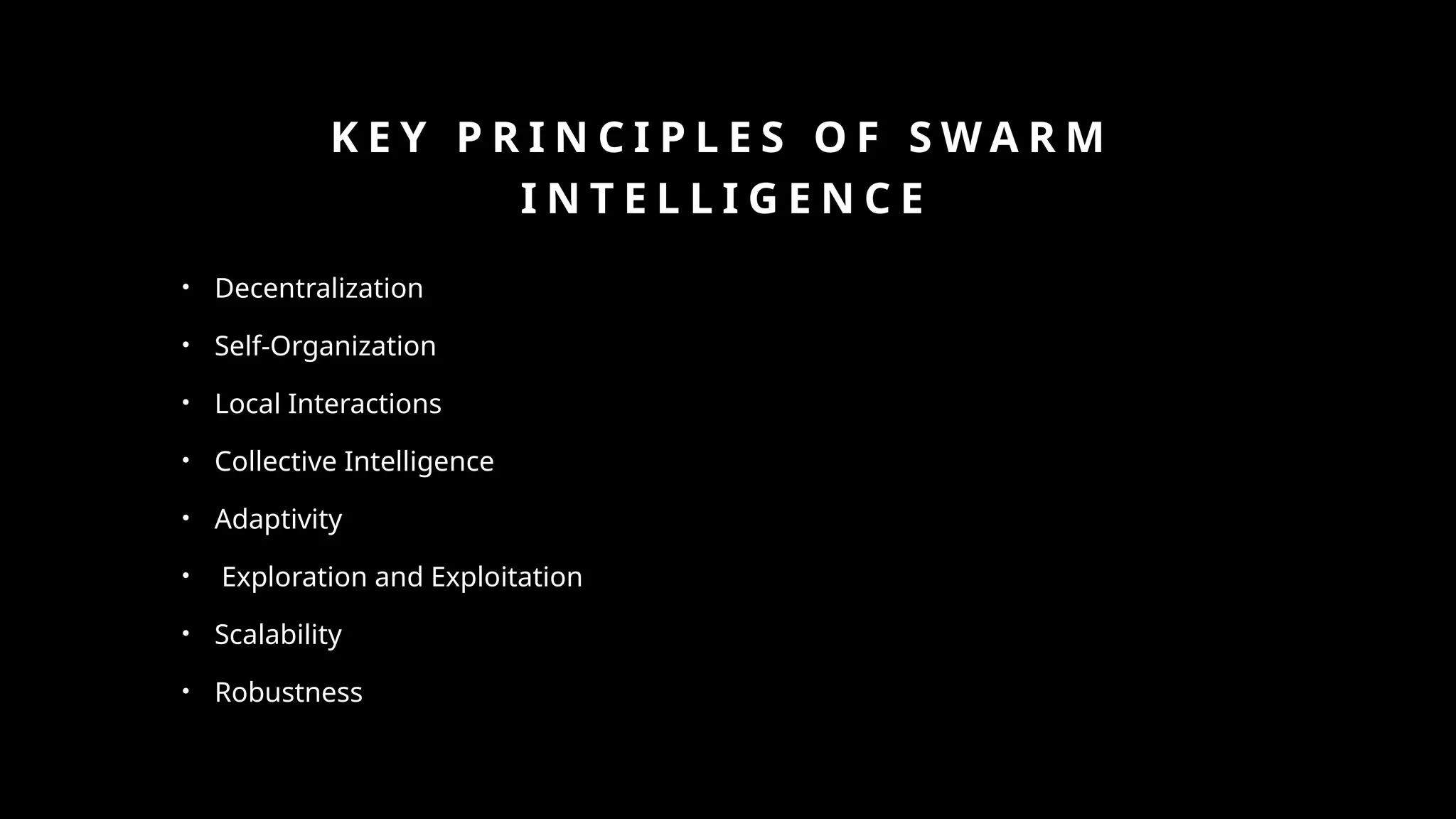
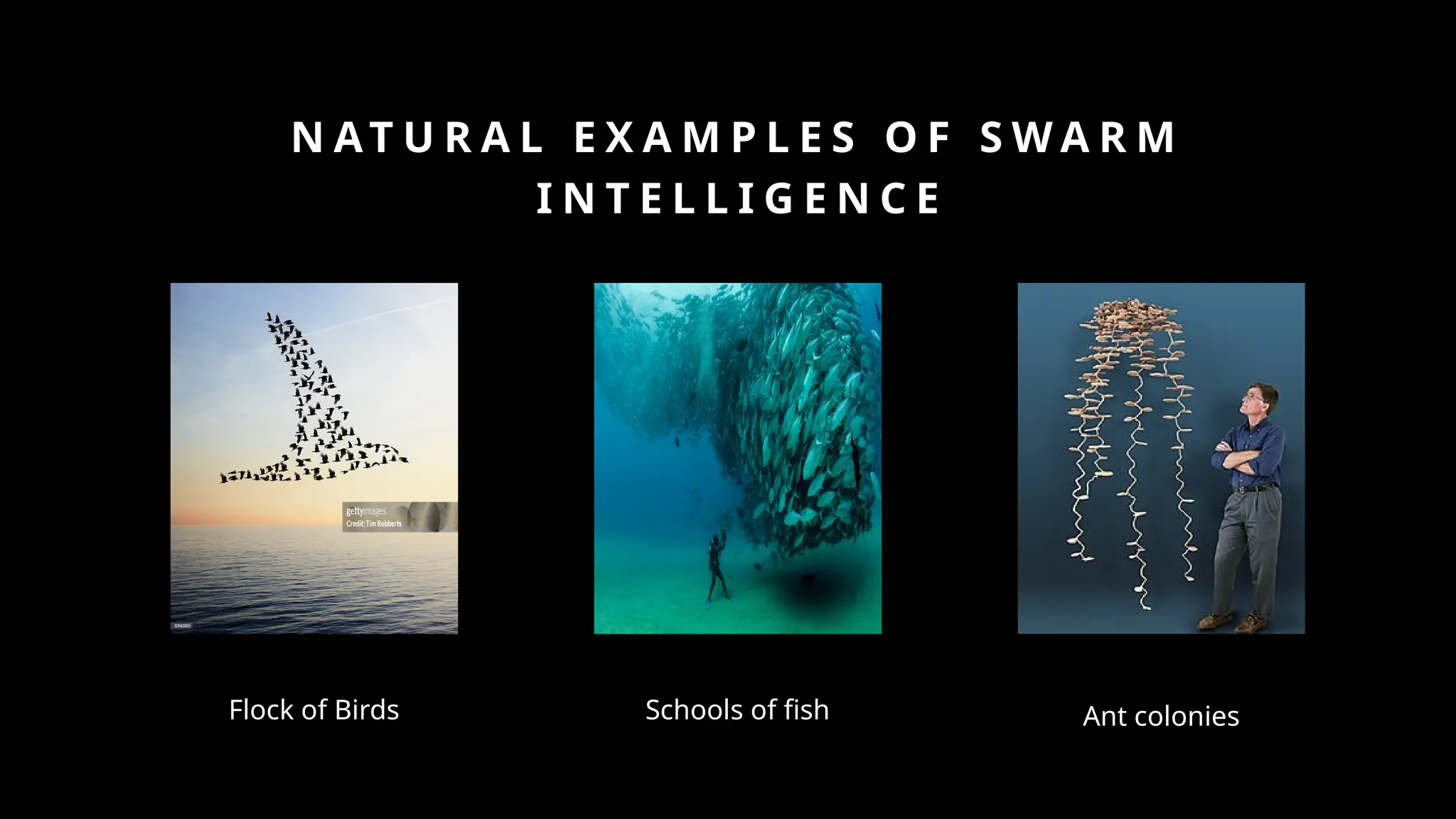
Flock of Birds Schools of fish Ant colonies
A L G O R I T H M S I N S P I R E D B Y S W A R M
I N T E L L I G E N C E
• Ant Colony Optimization (ACO)
• Particle Swarm Optimization (PSO):
• Artificial Bee Colony (ABC) Algorithm
• Glowworm Swarm Optimization (GSO)
• Cuckoo Search Algorithm
• Firefly Algorithm
• Bat Algorithm
• Fish Schooling Optimization (FSO)
• Termite Colony Optimization (TCO)
• Ant Lion Optimizer (ALO)
A N T C O L O N Y O P T I M I Z AT I O N ( A C O )
• Inspiration: This algorithm is inspired by the foraging behavior of ants. Ants
deposit pheromones as they move, which influences other ants to follow the
path. Over time, shorter paths accumulate more pheromones, guiding other ants
to find the most efficient route.
• Application: ACO is primarily used for optimization problems, such as the
traveling salesman problem (TSP), vehicle routing, and network routing.
P A R T I C L E S W A R M
O P T I M I Z AT I O N ( P S O )
• is inspired by the flocking behavior of birds and schooling of fish. Particles
(agents) move through the solution space, adjusting their positions based on
their previous experiences and the experiences of their neighbors
• Application: PSO is widely used in optimization tasks like function optimization,
machine learning model tuning, and control system design.
• Key Idea: Each particle has a velocity and a position. It adjusts its position based
on its own best position and the best position found by its neighbors, iterating
until convergence to an optimal solution.
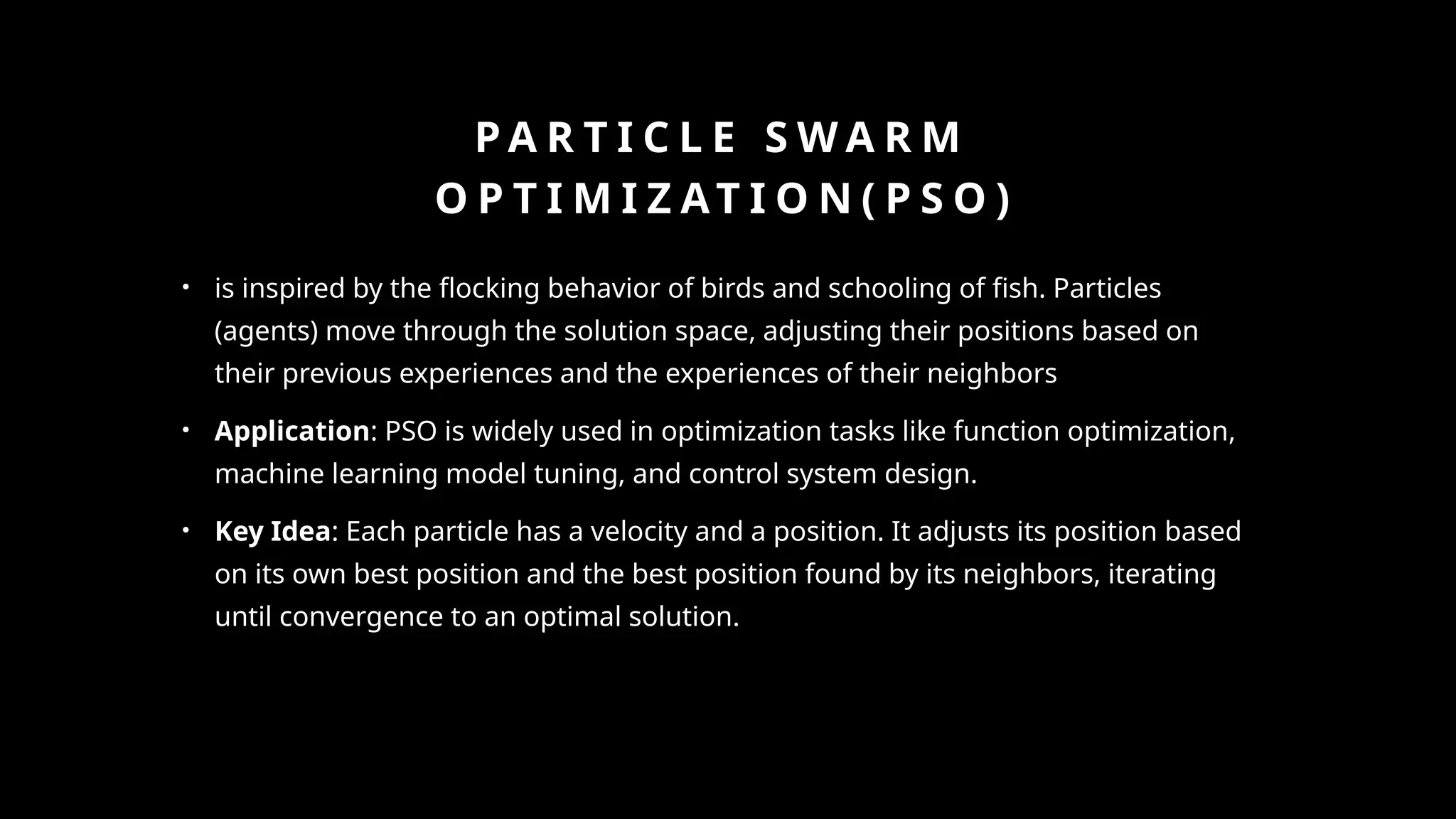
S W A R M R O B O T I C S A P P L I C AT I O N S
https://youtube.com/shorts/usYWrB6w5TM?
si=Hqsu56iyWU88Jaok
https://youtu.be/oD9Psya3uHY?si=3S0jVJNJ6tPhzBk4 08:05 -
S W A R M R O B O T I C S A D V A N TA G E S
• Scalability- Handles Large-Scale Problems, Flexible with Increased Agents
• Adaptability- Responsive to Environmental Changes, No Central Control
• Robustness and Fault Tolerance- Resilient to Agent Failure, Redundancy of Agents
• Efficiency and Optimization- Cost-Effective Solutions, Collective Problem Solving
• Distributed Processing and Parallelism- Parallel Computation, No Bottlenecks
• Simplicity of Individual Agents- Low Computational Cost, Easy to Implement
• Exploration and Exploitation Balance- Effective Search Mechanisms, Avoids Premature
Convergence
• Real-World Applications Across Domains- Versatile Applications, Adaptable to Complex Systems
S W A R M R O B O T I C S C H A L L E N G E S
• Complex Parameter Tuning- Sensitivity to Parameters, Lack of Standardization
• Limited Theoretical Framework- Lack of Formal Guarantees
• Difficulty in Predicting Behavior
• Hardware Constraints
• Sensitivity to Environmental Changes
• Challenges with Unstructured Environments
• Ethical Use of Swarm Technology
F U T U R E O F S W A R M I N T E L L I G E N C E
• IoT and Smart Cities - Decentralized IoT Coordination
• Wildlife Monitoring and Conservation
• Pollution Control and Disaster Management
• Cloud-Based Swarm Simulations
• Ethical Frameworks for Swarm Intelligence
• Regulation and Governance
• Autonomous Surveillance
A N Y Q U E S T I O N S ?
T H A N K Y O U S O M U C H F O R L I S T E N I N G
U S

Swarm Computing Introduction and inspiration Group Project by Smit Patel

  • 1.
    S W AR M C O M P U T I N G BY GROUP 13: PATEL SMITKUMAR V. VAGHELA DHRUV K. PATEL RIYA H. Panchal MANAV P, SHAH SAGAR U.
  • 2.
    TA B LE O F C O N T E N T S What is swarm intelligence ? Why Swarm Intelligence Matters Key Principles of Swarm Intelligence Natural Examples of Swarm Intelligence Algorithms Inspired by Swarm Intelligence Ant Colony Optimization (ACO) Particle Swarm Optimization (PSO) Swarm Robotics Applications Advantages of Swarm Intelligence Challenges of Swarm Intelligence Future of Swarm Intelligence Q&A
  • 3.
    S E LF D R I V I N G C A R What are the technology or concepts used in Self driving car ?
  • 4.
    E D GE C O M P U T I N G • Edge computing is a distributed computing framework that processes data closer to the source, rather than sending it to a central data center. This technology enables devices to process data quickly and act on it in real time.
  • 5.
    W H ATI S S W A R M I N T E L L I G E N C E ? • Swarm intelligence is the study of how decentralized, self-organized systems behave collectively, and how to simulate that behavior to solve complex problems. The term was coined in 1989 by Gerardo Beni and Jing Wang in the context of cellular robotic systems. • Swarm intelligence is inspired by natural systems, such as flocks of birds, schools of fish, and ant colonies, where groups act and react without a single leader. The agents in a swarm exchange information with each other and the environment, following basic rules that lead to global system behavior.
  • 6.
    W H YS W A R M I N T E L L I G E N C E M AT T E R S • Understanding swarm intelligence allows us to design distributed systems that mirror nature’s efficiency and adaptability. • Swarm intelligence follows the concept , where a single task is distributed amongst multiple entities within a group. Since the task is now performed by multiple group members, the process is more efficient, and the results are more accurate
  • 7.
    K E YP R I N C I P L E S O F S W A R M I N T E L L I G E N C E • Decentralization • Self-Organization • Local Interactions • Collective Intelligence • Adaptivity • Exploration and Exploitation • Scalability • Robustness
  • 8.
    N AT UR A L E X A M P L E S O F S W A R M I N T E L L I G E N C E Flock of Birds Schools of fish Ant colonies
  • 9.
    A L GO R I T H M S I N S P I R E D B Y S W A R M I N T E L L I G E N C E • Ant Colony Optimization (ACO) • Particle Swarm Optimization (PSO): • Artificial Bee Colony (ABC) Algorithm • Glowworm Swarm Optimization (GSO) • Cuckoo Search Algorithm • Firefly Algorithm • Bat Algorithm • Fish Schooling Optimization (FSO) • Termite Colony Optimization (TCO) • Ant Lion Optimizer (ALO)
  • 10.
    A N TC O L O N Y O P T I M I Z AT I O N ( A C O ) • Inspiration: This algorithm is inspired by the foraging behavior of ants. Ants deposit pheromones as they move, which influences other ants to follow the path. Over time, shorter paths accumulate more pheromones, guiding other ants to find the most efficient route. • Application: ACO is primarily used for optimization problems, such as the traveling salesman problem (TSP), vehicle routing, and network routing.
  • 11.
    P A RT I C L E S W A R M O P T I M I Z AT I O N ( P S O ) • is inspired by the flocking behavior of birds and schooling of fish. Particles (agents) move through the solution space, adjusting their positions based on their previous experiences and the experiences of their neighbors • Application: PSO is widely used in optimization tasks like function optimization, machine learning model tuning, and control system design. • Key Idea: Each particle has a velocity and a position. It adjusts its position based on its own best position and the best position found by its neighbors, iterating until convergence to an optimal solution.
  • 12.
    S W AR M R O B O T I C S A P P L I C AT I O N S https://youtube.com/shorts/usYWrB6w5TM? si=Hqsu56iyWU88Jaok https://youtu.be/oD9Psya3uHY?si=3S0jVJNJ6tPhzBk4 08:05 -
  • 13.
    S W AR M R O B O T I C S A D V A N TA G E S • Scalability- Handles Large-Scale Problems, Flexible with Increased Agents • Adaptability- Responsive to Environmental Changes, No Central Control • Robustness and Fault Tolerance- Resilient to Agent Failure, Redundancy of Agents • Efficiency and Optimization- Cost-Effective Solutions, Collective Problem Solving • Distributed Processing and Parallelism- Parallel Computation, No Bottlenecks • Simplicity of Individual Agents- Low Computational Cost, Easy to Implement • Exploration and Exploitation Balance- Effective Search Mechanisms, Avoids Premature Convergence • Real-World Applications Across Domains- Versatile Applications, Adaptable to Complex Systems
  • 14.
    S W AR M R O B O T I C S C H A L L E N G E S • Complex Parameter Tuning- Sensitivity to Parameters, Lack of Standardization • Limited Theoretical Framework- Lack of Formal Guarantees • Difficulty in Predicting Behavior • Hardware Constraints • Sensitivity to Environmental Changes • Challenges with Unstructured Environments • Ethical Use of Swarm Technology
  • 15.
    F U TU R E O F S W A R M I N T E L L I G E N C E • IoT and Smart Cities - Decentralized IoT Coordination • Wildlife Monitoring and Conservation • Pollution Control and Disaster Management • Cloud-Based Swarm Simulations • Ethical Frameworks for Swarm Intelligence • Regulation and Governance • Autonomous Surveillance
  • 16.
    A N YQ U E S T I O N S ?
  • 17.
    T H AN K Y O U S O M U C H F O R L I S T E N I N G U S