Choosing the Right Business Intelligence
Tools for Your Data Architecture
Types of Business Intelligence Tools…

     • ETL Tools

     • OLAP Tools

     • Reporting tools

     • Metadata tools

     • Data warehouse tools
  FREE Performance Management Kit at www.performance-success.com
5 Criteria for Identifying Business
   Intelligence Tools…

• Do we intend to buy these products or build them in-
  house?

• What are the requirements for our business
  intelligence tools?

• What technical skills does my staff possess?

• What is our timeline for implementation?

• What is our available budget for the task?
  FREE Performance Management Kit at www.performance-success.com
3 Criteria for Selecting Smaller, Less
   Known Vendors…

       • Vendor Stability


       • Technical Support


       • Professional Services
  FREE Performance Management Kit at www.performance-success.com
Relational Database Tools & Hardware
    Evaluation Criteria

         • Scalability


         •Parallel Processing Support


         •RDBMS/Hardware Combination

   FREE Performance Management Kit at www.performance-success.com
Popular Relational Database Tools and
   Platforms

Popular Relational Databases            Popular OS Platforms

•   Oracle                              • Linux
•   Microsoft SQL Server                • FreeBSD
•   IBM DB2                             • Microsoft
•   Teradata
•   Sybase
•   MySQL


    FREE Performance Management Kit at www.performance-success.com
ETL (Extract, Transform, & Load) Tools

  ETL data can come from many sources:
   
  •mainframe applications
  •ERP applications
  •CRM tools
  •flat files
  •Excel spreadsheets,
  •or even a message queue. 
 FREE Performance Management Kit at www.performance-success.com
ETL Tools apply rules to convert
  content from multiple databases
For Example, a Telephone number can  be 
  recorded several ways

• (123) 456-7890
• 1234567890
• 123-456-7890
• 123 456 7890
 FREE Performance Management Kit at www.performance-success.com
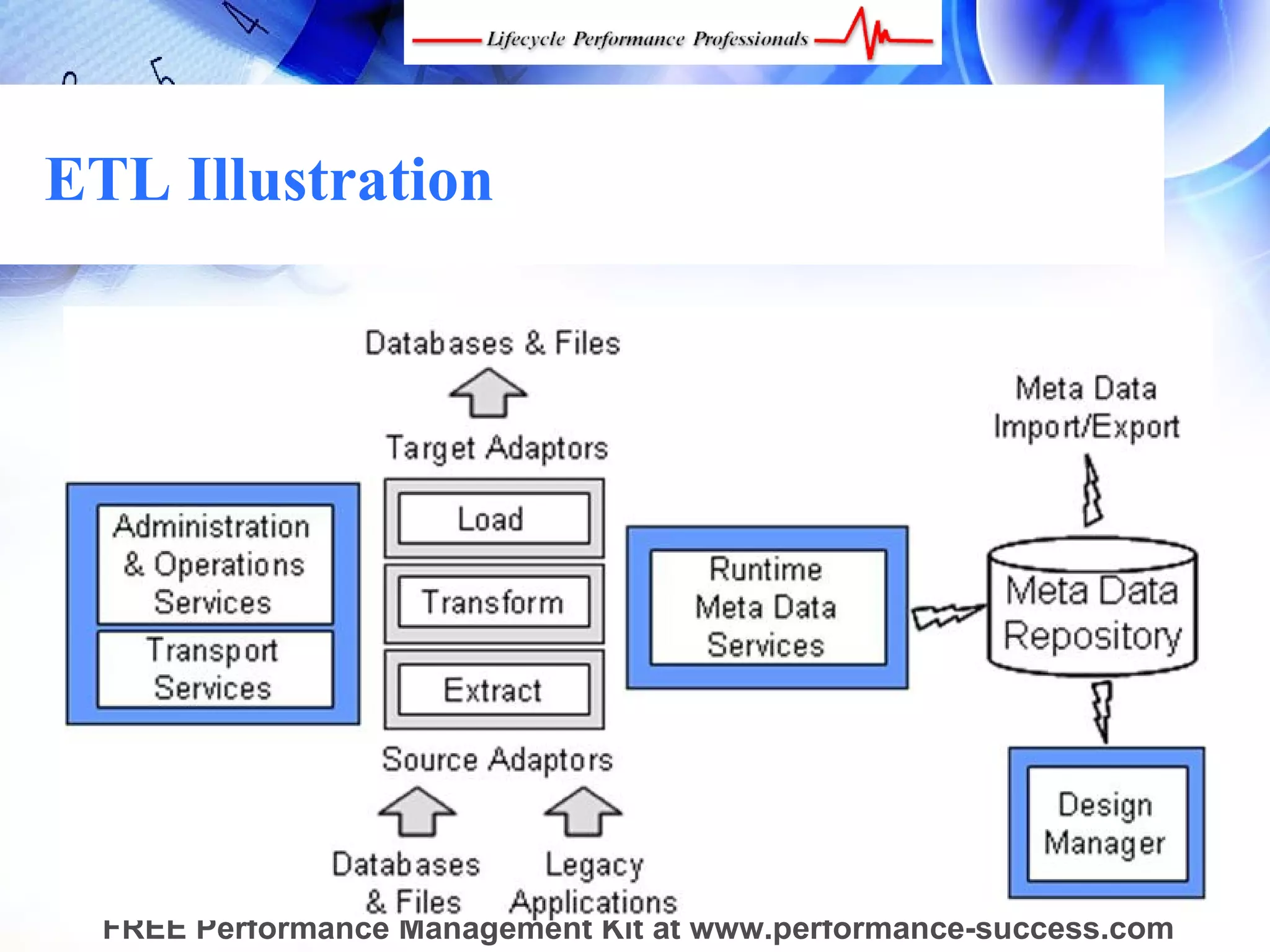
ETL Illustration


  FREE Performance Management Kit at www.performance-success.com
ETL Buy vs Build Factors…


•    Complexity of the data transformation


•    Data cleansing needs


•    Data volume
    FREE Performance Management Kit at www.performance-success.com
ETL Implementation Questions

•    How many sources will users extract the information
     from?
•    What are your types of data sources?
•    What are the expected sizes of these input files?
•    Is there a need to join information from different
     sources?
•    What are the growth expectations
•    What is the current environment
•    What is the budget for purchasing your ETL tool?
    FREE Performance Management Kit at www.performance-success.com
Evaluation Criteria for ETL Tools


         • Functionality capability


       •Compatibility to your data
    source


         •Metadata Support
  FREE Performance Management Kit at www.performance-success.com
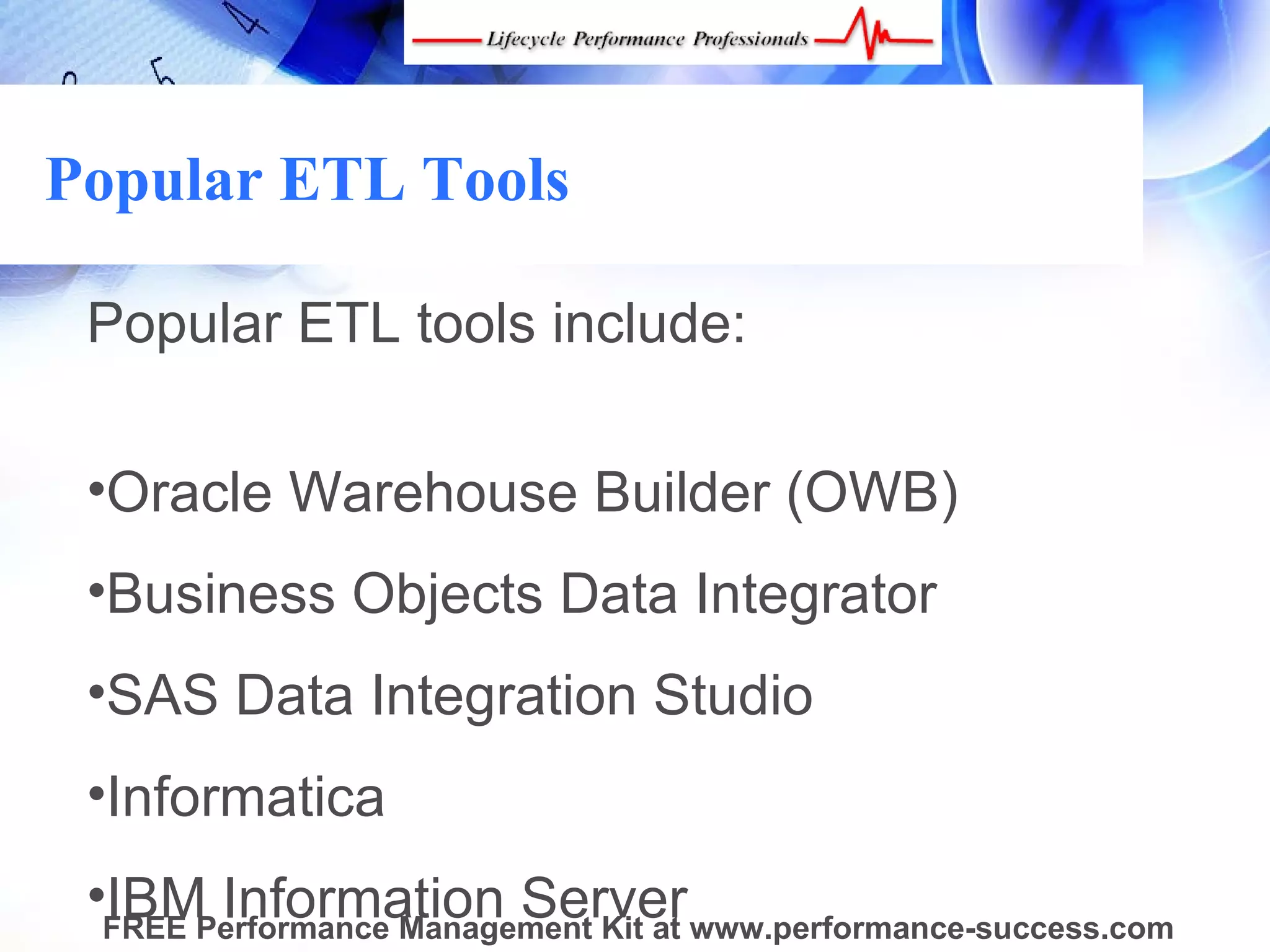
Popular ETL Tools

 Popular ETL tools include:
  
 •Oracle Warehouse Builder (OWB)
 •Business Objects Data Integrator
 •SAS Data Integration Studio
 •Informatica
 •FREE Performance Management Kit at www.performance-success.com
  IBM Information Server
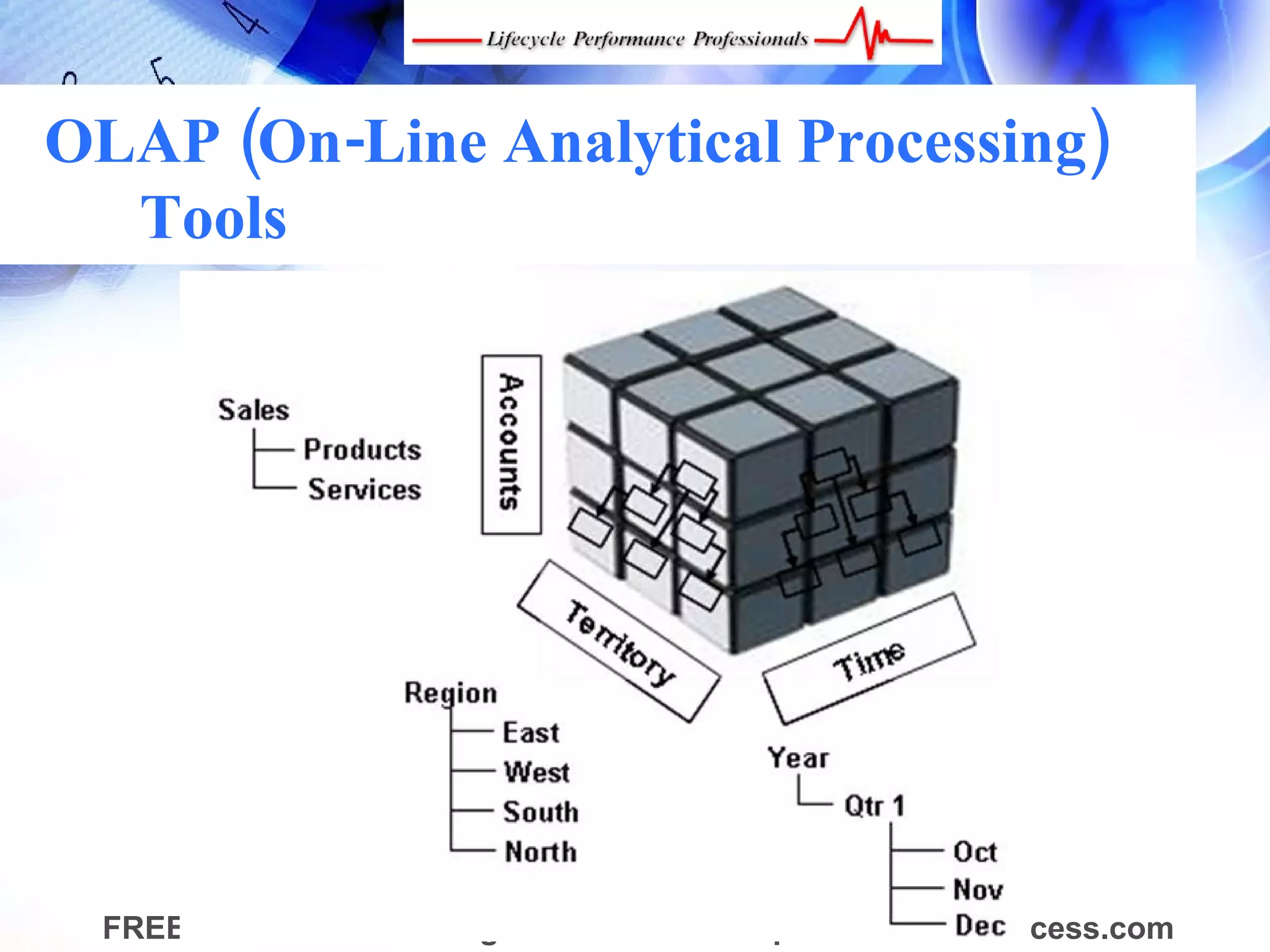
OLAP (On-Line Analytical Processing)
  Tools


 FREE Performance Management Kit at www.performance-success.com
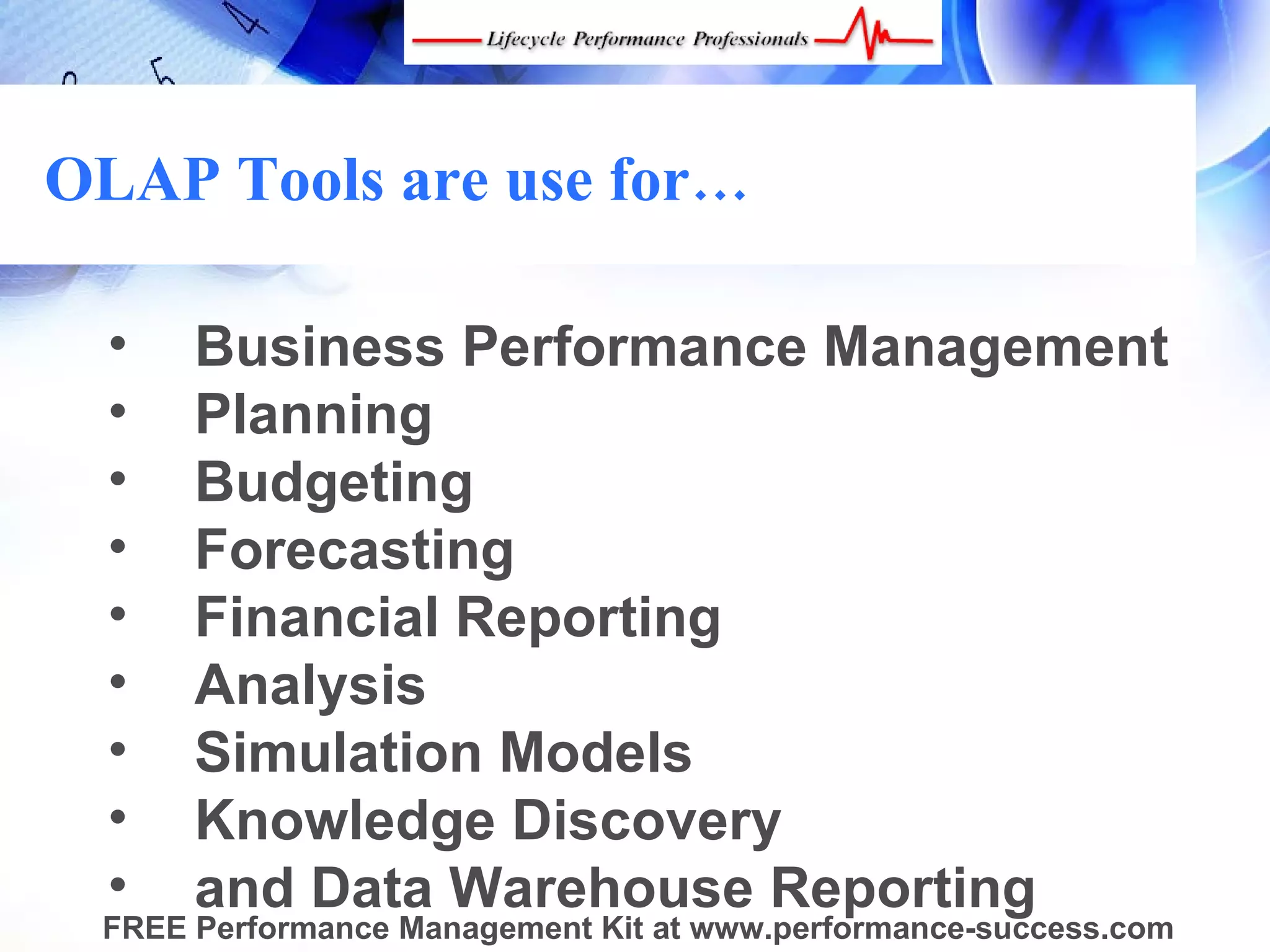
OLAP Tools are use for…

  •   Business Performance Management
  •   Planning
  •   Budgeting
  •   Forecasting
  •   Financial Reporting
  •   Analysis
  •   Simulation Models
  •   Knowledge Discovery
  •   and Data Warehouse Reporting
 FREE Performance Management Kit at www.performance-success.com
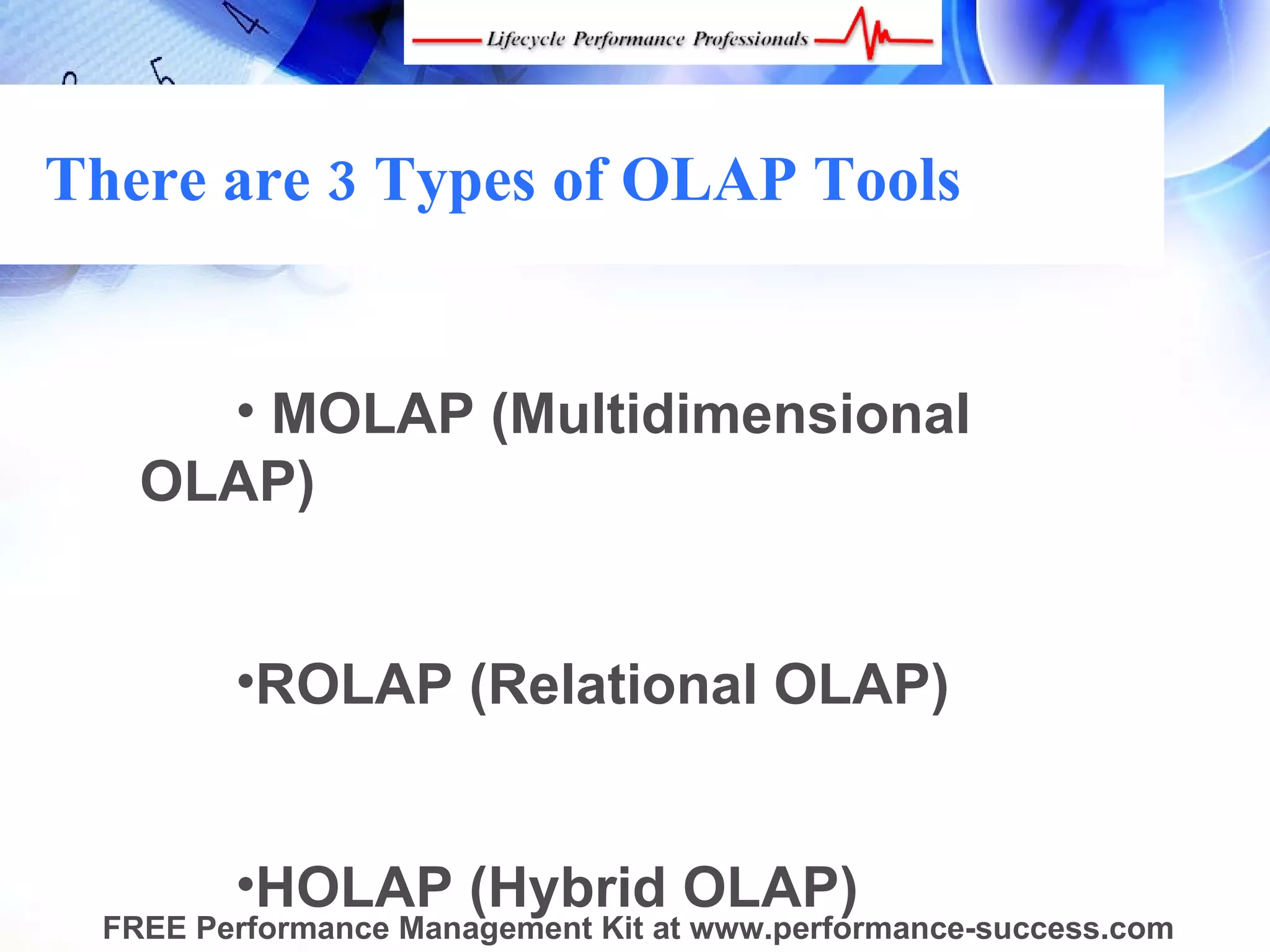
There are 3 Types of OLAP Tools


     • MOLAP (Multidimensional
   OLAP)


        •ROLAP (Relational OLAP)


        •HOLAP (Hybrid OLAP)
 FREE Performance Management Kit at www.performance-success.com
OLAP Evaluation Criteria

  • Ability to leverage parallelism supplied by
    RDBMS and hardware

  • Performance

  • Customization efforts

  • Security features

  • Metadata support
 FREE Performance Management Kit at www.performance-success.com
OLAP Implementation Questions

 • How many developers need to access the
   tool?
 • Is there any security to be implemented for
   access?
 • What is the level of end users knowledge
 • What is the budget
 • What is the report requirement
 • FREE Performance Management Kit at www.performance-success.com
     What is the functional domain for analysis?
FASMI Method for OLAP Selection


    • Fast
    • Analysis
    • Shared
    • Multidimensional
    • Information
 FREE Performance Management Kit at www.performance-success.com
Popular OLAP Tools


     • Business Objects
     • Cognos
     • Hyperion
     • DB2
     • MicroStrategy
 FREE Performance Management Kit at www.performance-success.com
Reporting Tools
   Evaluation Criteria


 • Number of reports


 • Desired Report Distribution Mode


 • Ad hoc Report creation
  FREE Performance Management Kit at www.performance-success.com
Reporting Tools
  Evaluation Criteria

• Data source connection capabilities
• Scheduling and distribution capabilities
• Security features
• Export capabilities
• Integration with the Microsoft Office
  environment


 FREE Performance Management Kit at www.performance-success.com
Popular Reporting Tools


 • Business Objects (Crystal Reports)
 • Cognos
 • Actuate
 • DB2

 FREE Performance Management Kit at www.performance-success.com
Metadata Tools


Metadata refers to the collection of information
about the data stored in an application or database.
Information about data can include:

•Definition of the data
•Type of data
•Size of data
•Systems abbreviation
•Business unit
  FREE Performance Management Kit at www.performance-success.com
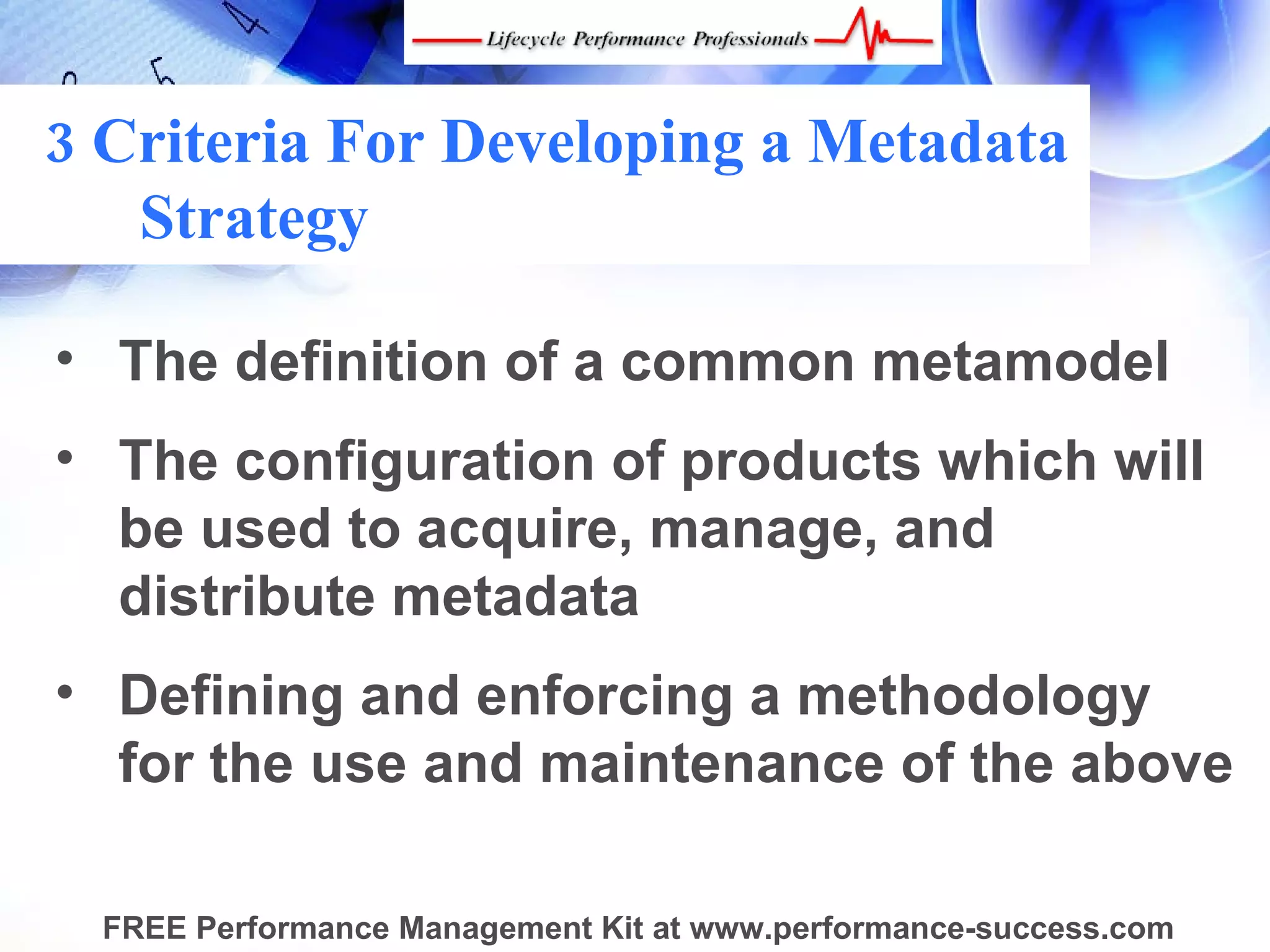
3 Criteria For Developing a Metadata
   Strategy

• The definition of a common metamodel
• The configuration of products which will
  be used to acquire, manage, and
  distribute metadata
• Defining and enforcing a methodology
  for the use and maintenance of the above

  FREE Performance Management Kit at www.performance-success.com
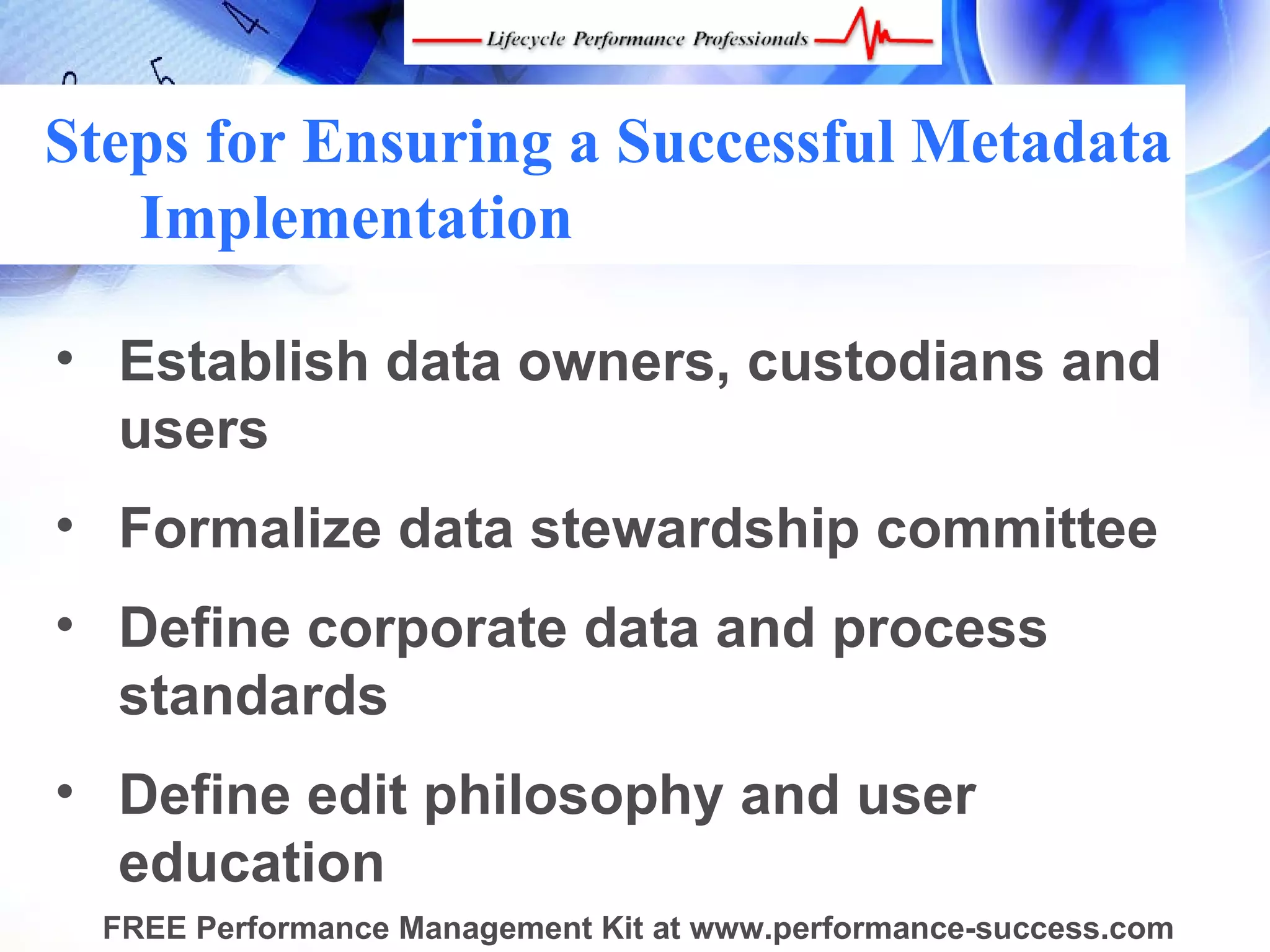
Steps for Ensuring a Successful Metadata
   Implementation

• Establish data owners, custodians and
  users
• Formalize data stewardship committee
• Define corporate data and process
  standards
• Define edit philosophy and user
  education
  FREE Performance Management Kit at www.performance-success.com
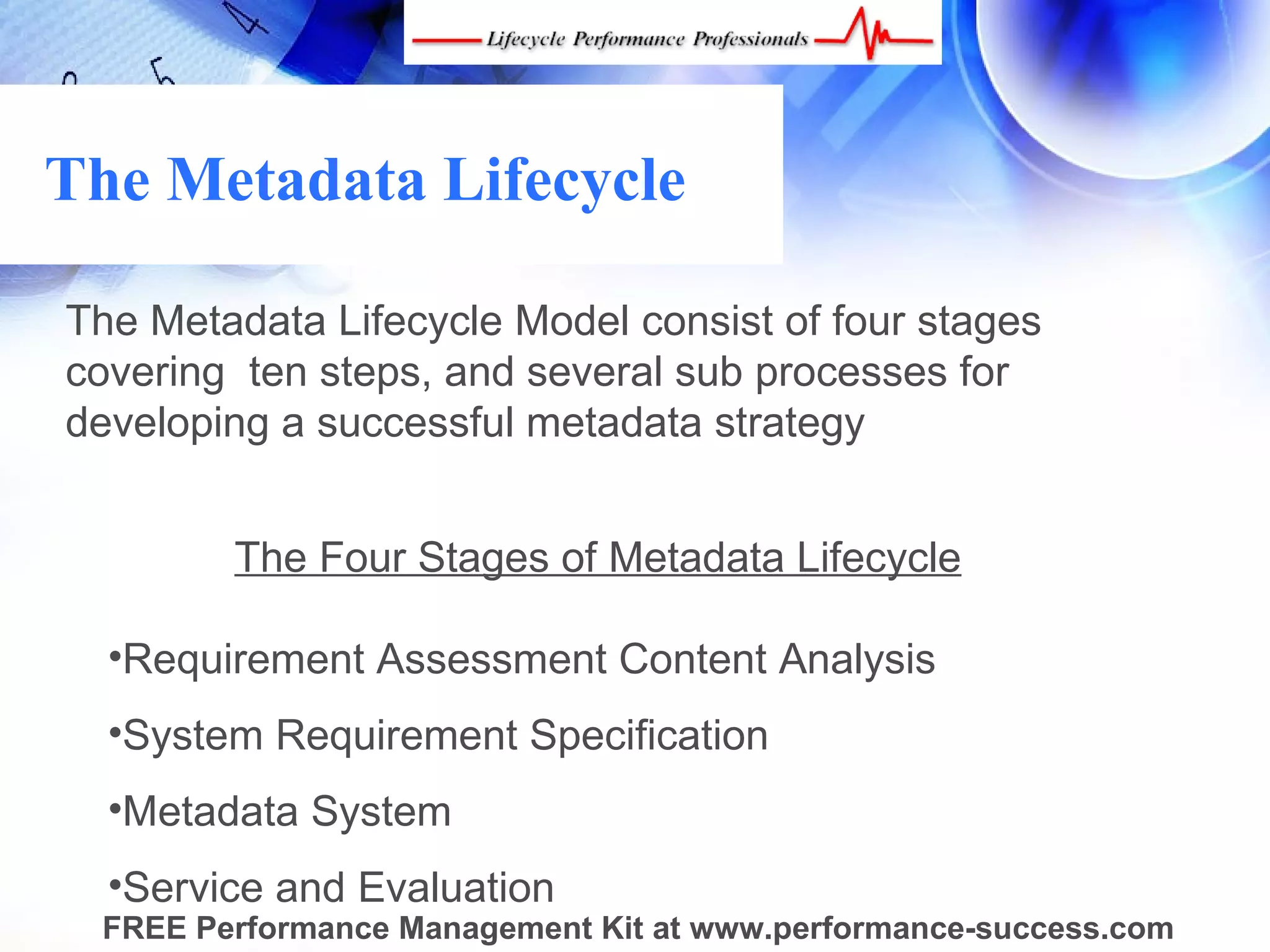
The Metadata Lifecycle

The Metadata Lifecycle Model consist of four stages 
covering  ten steps, and several sub processes for 
developing a successful metadata strategy


        The Four Stages of Metadata Lifecycle

  •Requirement Assessment Content Analysis
  •System Requirement Specification
  •Metadata System
  •Service and Evaluation
 FREE Performance Management Kit at www.performance-success.com
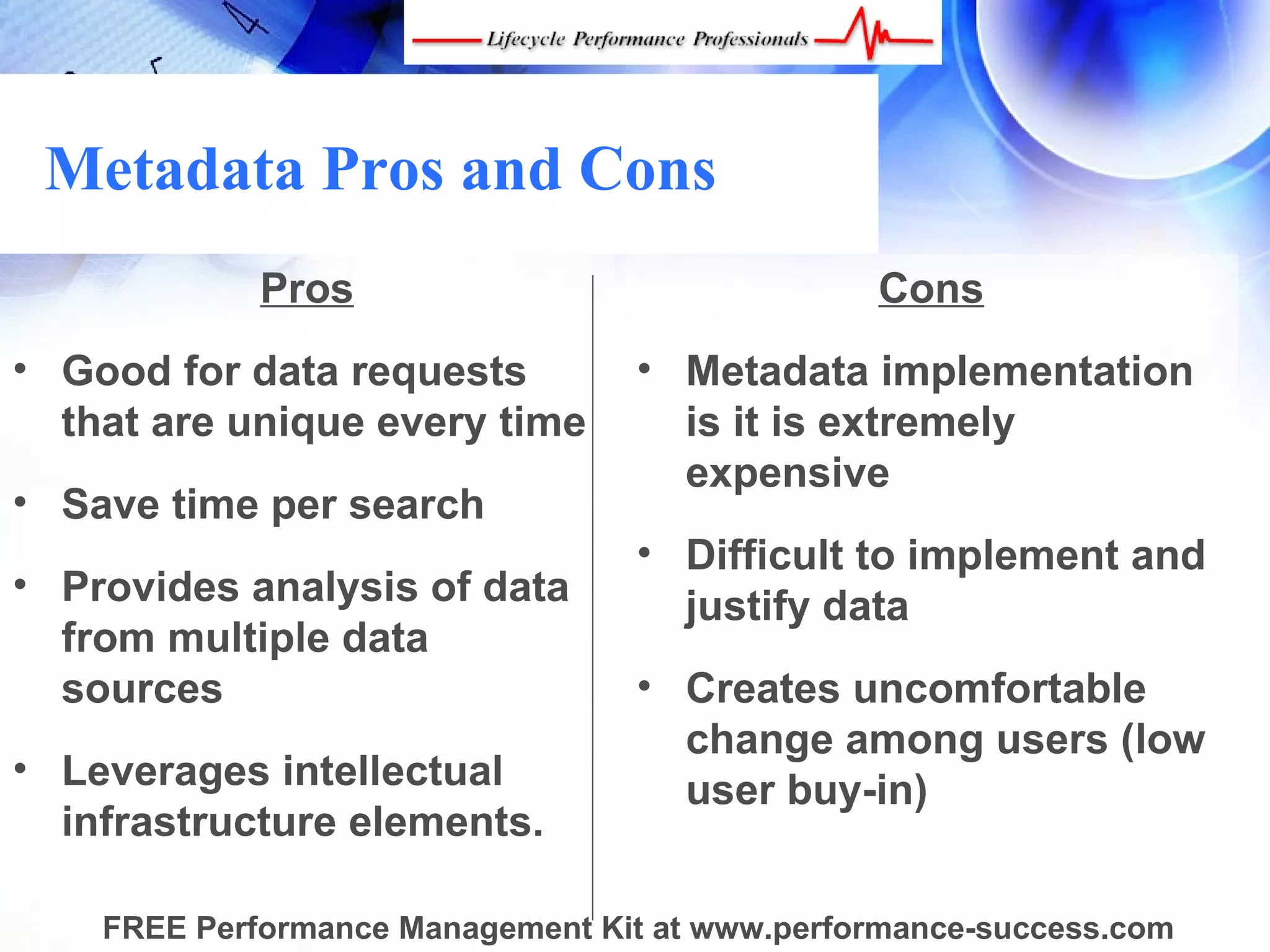
Metadata Pros and Cons
             Pros                               Cons
• Good for data requests          • Metadata implementation
  that are unique every time        is it is extremely
                                    expensive
• Save time per search
                                  • Difficult to implement and
• Provides analysis of data
                                    justify data
  from multiple data
  sources                         • Creates uncomfortable
                                    change among users (low
• Leverages intellectual
                                    user buy-in)
  infrastructure elements.

    FREE Performance Management Kit at www.performance-success.com
Data Warehousing Pros

 • Simplifies the technical aspects of database technology
 • Performs server or disk bound requests that require
   querying and reporting
 • Queries and reports data from multiple transaction
   processing systems
 • Utilizes data models or server technologies that speed
   up querying and reporting
 • Provides query and reporting capabilities while limiting
   access to the transaction processing system
  FREE Performance Management Kit at www.performance-success.com
Data Warehousing Pros


 • Provides customers with access to data from a vast
   amount of transactions each day delivered via
   management reports, scorecards and dashboards
 • Provides a repository of “cleaned up” data without
   having to change the transaction processing systems
 • Provides a repository or “snapshot” of data to archive
   “as was” information


   FREE Performance Management Kit at www.performance-success.com
Data Warehousing Cons


 • Stored, historical data has limited value in many
   organizations
 • Data warehousing systems can complicate business
   processes
 • Not necessary if reporting needs are simple and there
   is not a requirement for end user ad hoc querying and
   reporting
 • There is a learning curve that may not be suitable for
   time constraints or budget
  FREE Performance Management Kit at www.performance-success.com
Data Warehousing Cons


 • Not useful if there is not a clearly determined process
   or guideline for adding data and data sources to a
   warehouse.
 • Data warehousing requires a great deal of
   maintenance
 • The cost to capture, clean and load data in a special
   format may be out of budget


  FREE Performance Management Kit at www.performance-success.com

Choosing the Right Business Intelligence Tools for Your Data and Architectural Needs

  • 1.
    Choosing the RightBusiness Intelligence Tools for Your Data Architecture
  • 2.
    Types of BusinessIntelligence Tools… • ETL Tools • OLAP Tools • Reporting tools • Metadata tools • Data warehouse tools FREE Performance Management Kit at www.performance-success.com
  • 3.
    5 Criteria forIdentifying Business Intelligence Tools… • Do we intend to buy these products or build them in- house? • What are the requirements for our business intelligence tools? • What technical skills does my staff possess? • What is our timeline for implementation? • What is our available budget for the task? FREE Performance Management Kit at www.performance-success.com
  • 4.
    3 Criteria forSelecting Smaller, Less Known Vendors… • Vendor Stability • Technical Support • Professional Services FREE Performance Management Kit at www.performance-success.com
  • 5.
    Relational Database Tools& Hardware Evaluation Criteria • Scalability •Parallel Processing Support •RDBMS/Hardware Combination FREE Performance Management Kit at www.performance-success.com
  • 6.
    Popular Relational DatabaseTools and Platforms Popular Relational Databases Popular OS Platforms • Oracle • Linux • Microsoft SQL Server • FreeBSD • IBM DB2 • Microsoft • Teradata • Sybase • MySQL FREE Performance Management Kit at www.performance-success.com
  • 7.
    ETL (Extract, Transform,& Load) Tools ETL data can come from many sources:   •mainframe applications •ERP applications •CRM tools •flat files •Excel spreadsheets, •or even a message queue.  FREE Performance Management Kit at www.performance-success.com
  • 8.
    ETL Tools applyrules to convert content from multiple databases For Example, a Telephone number can  be  recorded several ways • (123) 456-7890 • 1234567890 • 123-456-7890 • 123 456 7890 FREE Performance Management Kit at www.performance-success.com
  • 9.
    ETL Illustration FREE Performance Management Kit at www.performance-success.com
  • 10.
    ETL Buy vsBuild Factors… • Complexity of the data transformation • Data cleansing needs • Data volume FREE Performance Management Kit at www.performance-success.com
  • 11.
    ETL Implementation Questions • How many sources will users extract the information from? • What are your types of data sources? • What are the expected sizes of these input files? • Is there a need to join information from different sources? • What are the growth expectations • What is the current environment • What is the budget for purchasing your ETL tool? FREE Performance Management Kit at www.performance-success.com
  • 12.
    Evaluation Criteria forETL Tools • Functionality capability •Compatibility to your data source •Metadata Support FREE Performance Management Kit at www.performance-success.com
  • 13.
    Popular ETL Tools Popular ETL tools include:   •Oracle Warehouse Builder (OWB) •Business Objects Data Integrator •SAS Data Integration Studio •Informatica •FREE Performance Management Kit at www.performance-success.com IBM Information Server
  • 14.
    OLAP (On-Line AnalyticalProcessing) Tools FREE Performance Management Kit at www.performance-success.com
  • 15.
    OLAP Tools areuse for… • Business Performance Management • Planning • Budgeting • Forecasting • Financial Reporting • Analysis • Simulation Models • Knowledge Discovery • and Data Warehouse Reporting FREE Performance Management Kit at www.performance-success.com
  • 16.
    There are 3Types of OLAP Tools • MOLAP (Multidimensional OLAP) •ROLAP (Relational OLAP) •HOLAP (Hybrid OLAP) FREE Performance Management Kit at www.performance-success.com
  • 17.
    OLAP Evaluation Criteria • Ability to leverage parallelism supplied by RDBMS and hardware • Performance • Customization efforts • Security features • Metadata support FREE Performance Management Kit at www.performance-success.com
  • 18.
    OLAP Implementation Questions • How many developers need to access the tool? • Is there any security to be implemented for access? • What is the level of end users knowledge • What is the budget • What is the report requirement • FREE Performance Management Kit at www.performance-success.com What is the functional domain for analysis?
  • 19.
    FASMI Method forOLAP Selection • Fast • Analysis • Shared • Multidimensional • Information FREE Performance Management Kit at www.performance-success.com
  • 20.
    Popular OLAP Tools • Business Objects • Cognos • Hyperion • DB2 • MicroStrategy FREE Performance Management Kit at www.performance-success.com
  • 21.
    Reporting Tools Evaluation Criteria • Number of reports • Desired Report Distribution Mode • Ad hoc Report creation FREE Performance Management Kit at www.performance-success.com
  • 22.
    Reporting Tools Evaluation Criteria • Data source connection capabilities • Scheduling and distribution capabilities • Security features • Export capabilities • Integration with the Microsoft Office environment FREE Performance Management Kit at www.performance-success.com
  • 23.
    Popular Reporting Tools • Business Objects (Crystal Reports) • Cognos • Actuate • DB2 FREE Performance Management Kit at www.performance-success.com
  • 24.
    Metadata Tools Metadata refersto the collection of information about the data stored in an application or database. Information about data can include: •Definition of the data •Type of data •Size of data •Systems abbreviation •Business unit FREE Performance Management Kit at www.performance-success.com
  • 25.
    3 Criteria ForDeveloping a Metadata Strategy • The definition of a common metamodel • The configuration of products which will be used to acquire, manage, and distribute metadata • Defining and enforcing a methodology for the use and maintenance of the above FREE Performance Management Kit at www.performance-success.com
  • 26.
    Steps for Ensuringa Successful Metadata Implementation • Establish data owners, custodians and users • Formalize data stewardship committee • Define corporate data and process standards • Define edit philosophy and user education FREE Performance Management Kit at www.performance-success.com
  • 27.
    The Metadata Lifecycle The Metadata Lifecycle Model consist of four stages  covering  ten steps, and several sub processes for  developing a successful metadata strategy The Four Stages of Metadata Lifecycle •Requirement Assessment Content Analysis •System Requirement Specification •Metadata System •Service and Evaluation FREE Performance Management Kit at www.performance-success.com
  • 28.
    Metadata Pros andCons Pros Cons • Good for data requests • Metadata implementation that are unique every time is it is extremely expensive • Save time per search • Difficult to implement and • Provides analysis of data justify data from multiple data sources • Creates uncomfortable change among users (low • Leverages intellectual user buy-in) infrastructure elements. FREE Performance Management Kit at www.performance-success.com
  • 29.
    Data Warehousing Pros • Simplifies the technical aspects of database technology • Performs server or disk bound requests that require querying and reporting • Queries and reports data from multiple transaction processing systems • Utilizes data models or server technologies that speed up querying and reporting • Provides query and reporting capabilities while limiting access to the transaction processing system FREE Performance Management Kit at www.performance-success.com
  • 30.
    Data Warehousing Pros • Provides customers with access to data from a vast amount of transactions each day delivered via management reports, scorecards and dashboards • Provides a repository of “cleaned up” data without having to change the transaction processing systems • Provides a repository or “snapshot” of data to archive “as was” information FREE Performance Management Kit at www.performance-success.com
  • 31.
    Data Warehousing Cons • Stored, historical data has limited value in many organizations • Data warehousing systems can complicate business processes • Not necessary if reporting needs are simple and there is not a requirement for end user ad hoc querying and reporting • There is a learning curve that may not be suitable for time constraints or budget FREE Performance Management Kit at www.performance-success.com
  • 32.
    Data Warehousing Cons • Not useful if there is not a clearly determined process or guideline for adding data and data sources to a warehouse. • Data warehousing requires a great deal of maintenance • The cost to capture, clean and load data in a special format may be out of budget FREE Performance Management Kit at www.performance-success.com