Master Data Management
Zahra Mansoori
1
1. Preference
2
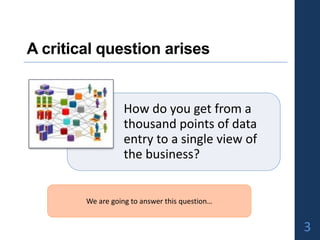
A critical question arises
How do you get from a
thousand points of data
entry to a single view of
the business?
3
We are going to answer this question…
Master Data Management (MDM)
Characteristics
Master data management has two architectural components:
•The technology to profile, consolidate and synchronize the master data across the
enterprise
•The applications to manage, cleanse, and enrich the structured and unstructured master
data
Integrate with modern service oriented architectures (SOA)
•And bring the clean corporate master data to the applications and processes that run the
business
Integrate with data warehouses and the business intelligence (BI) systems
•Bring the right information in the right form to the right person at the right time
Support data governance
•Enables orchestrated data stewardship across the enterprise
4
3. Enterprise Data
5
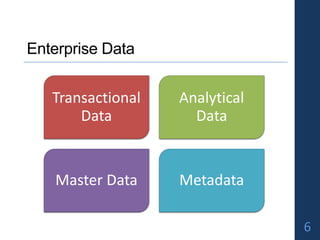
Enterprise Data
Transactional
Data
Analytical
Data
Master Data Metadata
6
Transactional Data : OLTP
• Significant amounts of data caused by a company’s
operations:
 Sales, service, order management, manufacturing, purchasing,
billing, accounts receivable and accounts payable
• The objects of the transaction are the customer and the
product
• Data stores in
tables
• Support high volume low latency access and update
• Master data solution is called:
7
Analytical Data: OLAP
• Support a company’s decision making
• Identify
 Churn, profitability, and marketing segmentation
 Suppliers categorization based on performance, for better supply
chain decisions
 Product behavior over long periods to identify failure patterns
• Data is stored in large data warehouses and possibly
smaller data marts with table structures
• Data stores in tables
• Master data solution is called:
 Lack the ability to influence operational systems
8
Master Data:
A Single Version Of The Truth
• Master Data represents
 Business objects that are shared across more than one
transactional application
 Key dimensions around which analytics are done
• Must support high volume transaction rates
9
Introduction to Data Hub
10
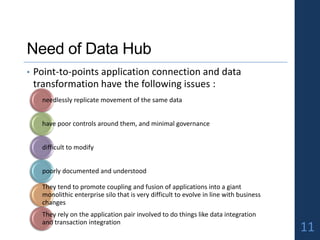
Need of Data Hub
• Point-to-points application connection and data
transformation have the following issues :
11
needlessly replicate movement of the same data
have poor controls around them, and minimal governance
difficult to modify
poorly documented and understood
They tend to promote coupling and fusion of applications into a giant
monolithic enterprise silo that is very difficult to evolve in line with business
changes
They rely on the application pair involved to do things like data integration
and transaction integration
Data Hub vs. Staging Area
• Staging area: A database that is situated between one
source and one destination
• Data hub: Must have more than one source populating it,
or more than one destination to which data is moved, or
both multiple sources and destinations
12
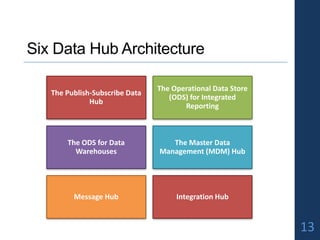
Six Data Hub Architecture
13
The Publish-Subscribe Data
Hub
The Operational Data Store
(ODS) for Integrated
Reporting
The ODS for Data
Warehouses
The Master Data
Management (MDM) Hub
Message Hub Integration Hub
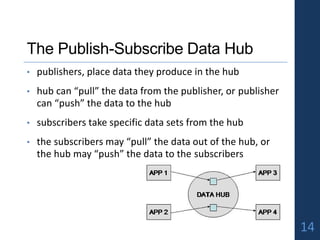
The Publish-Subscribe Data Hub
14
• publishers, place data they produce in the hub
• hub can “pull” the data from the publisher, or publisher
can “push” the data to the hub
• subscribers take specific data sets from the hub
• the subscribers may “pull” the data out of the hub, or
the hub may “push” the data to the subscribers
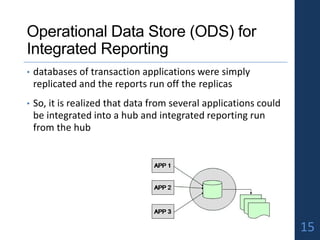
Operational Data Store (ODS) for
Integrated Reporting
15
• databases of transaction applications were simply
replicated and the reports run off the replicas
• So, it is realized that data from several applications could
be integrated into a hub and integrated reporting run
from the hub
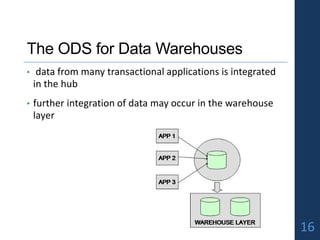
The ODS for Data Warehouses
16
• data from many transactional applications is integrated
in the hub
• further integration of data may occur in the warehouse
layer
The Master Data Management
(MDM) Hub
17
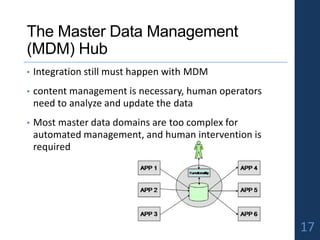
• Integration still must happen with MDM
• content management is necessary, human operators
need to analyze and update the data
• Most master data domains are too complex for
automated management, and human intervention is
required
Message Hub
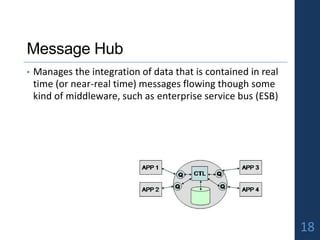
• Manages the integration of data that is contained in real
time (or near-real time) messages flowing though some
kind of middleware, such as enterprise service bus (ESB)
18
Integration Hub
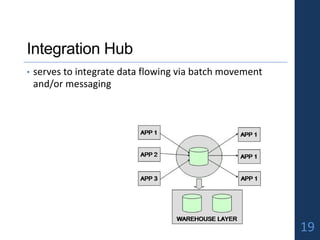
• serves to integrate data flowing via batch movement
and/or messaging
19
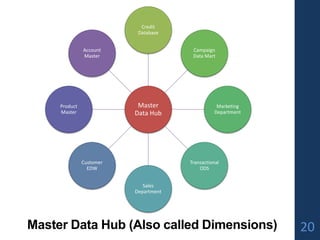
Master Data Hub (Also called Dimensions)
Master
Data Hub
Credit
Database
Campaign
Data Mart
Marketing
Department
Transactional
ODS
Sales
Department
Customer
EDW
Product
Master
Account
Master
20
MDM Program
21
MDM Basics
• MDM fundamentals:
 Processes for consolidating variant version of instances of core
data objects
 Distribute across the organization
 Into a unique representation
22
MDM maturity model
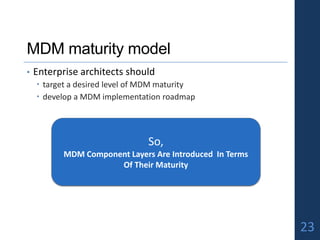
• Enterprise architects should
 target a desired level of MDM maturity
 develop a MDM implementation roadmap
23
So,
MDM Component Layers Are Introduced In Terms
Of Their Maturity
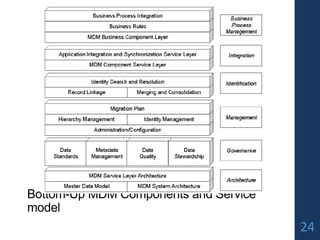
Bottom-Up MDM Components and Service
model
24
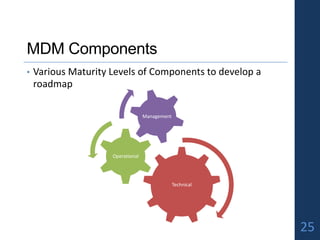
MDM Components
• Various Maturity Levels of Components to develop a
roadmap
25
Technical
Operational
Management
Architecture
• Master Data Model
 There must be a consolidated master representation model to act
as the core repository
 A model to support all of the data in all of the application models
• MDM System Architecture
 A set of low-level component services for Master Data Life Cycle
(Create, Access, Update, Retire) of Master Data types
• MDM Service Layer Architecture
 High-Level component service like: Synchronization, Serialization,
Embedded access control, Integration, Consolidation, Access
26
Governance and Oversight
• MDM Policies to insure the access of stakeholders to
information
• Standardize Definitions:
 Assessing organizational data element information and putting
them into business metadata provide standardization definition
 Drive and control the determination of master data objects
27
Governance and Oversight – cont.
• Consolidated Metadata Management
 Identifying and clarifying data element names, definition and
other relevant attributes
 Enterprises need to determine:
 Business uses of each data element
 Which data element definitions refer to the same concept
 The applications that refer to manifestations of that concept
 How each data element and associated concepts are created, read,
modified, or retired by different applications
 Data quality characteristics, inspection and monitoring locations within
the business process flow
 How all the uses are tied together
28
Governance and Oversight – cont.
• Data Quality
 Impacts data quality in two ways:
1. Unique representation for each real-world object
2. Integration and consolidation processes for data
• Data Governance and stewardship
 There must be some assurance of that end users will follow the
rules that govern data quality
29
Management
• Identity Management:
 To ensure that:
 A record for that individual exists and that no more than one record for
that individual exists, or
 No record exists and one can be created that can be uniquely
distinguishing form all other
• Hierarchy Management:
 Linage and process of resolving multiple records into a single
representation
30
References
I. David Butler, Bob Stackowiak, “Master Data
Management, An Oracle White Paper”, June 2009
II. Ralph Kimball, Margy Ross, “The Kimball Group
Reader: Relentlessly Practical Tools for Data
Warehousing and Business Intelligence”, Wiley
Publications, March 2010
III. Sabir Asadullaev ,Learning course Data warehouse
architectures and development strategy, Open Group
IV. http://www.b-eye-network.com/view/8109
31

Master data management

  • 1.
  • 2.
  • 3.
    A critical questionarises How do you get from a thousand points of data entry to a single view of the business? 3 We are going to answer this question…
  • 4.
    Master Data Management(MDM) Characteristics Master data management has two architectural components: •The technology to profile, consolidate and synchronize the master data across the enterprise •The applications to manage, cleanse, and enrich the structured and unstructured master data Integrate with modern service oriented architectures (SOA) •And bring the clean corporate master data to the applications and processes that run the business Integrate with data warehouses and the business intelligence (BI) systems •Bring the right information in the right form to the right person at the right time Support data governance •Enables orchestrated data stewardship across the enterprise 4
  • 5.
  • 6.
  • 7.
    Transactional Data :OLTP • Significant amounts of data caused by a company’s operations:  Sales, service, order management, manufacturing, purchasing, billing, accounts receivable and accounts payable • The objects of the transaction are the customer and the product • Data stores in tables • Support high volume low latency access and update • Master data solution is called: 7
  • 8.
    Analytical Data: OLAP •Support a company’s decision making • Identify  Churn, profitability, and marketing segmentation  Suppliers categorization based on performance, for better supply chain decisions  Product behavior over long periods to identify failure patterns • Data is stored in large data warehouses and possibly smaller data marts with table structures • Data stores in tables • Master data solution is called:  Lack the ability to influence operational systems 8
  • 9.
    Master Data: A SingleVersion Of The Truth • Master Data represents  Business objects that are shared across more than one transactional application  Key dimensions around which analytics are done • Must support high volume transaction rates 9
  • 10.
  • 11.
    Need of DataHub • Point-to-points application connection and data transformation have the following issues : 11 needlessly replicate movement of the same data have poor controls around them, and minimal governance difficult to modify poorly documented and understood They tend to promote coupling and fusion of applications into a giant monolithic enterprise silo that is very difficult to evolve in line with business changes They rely on the application pair involved to do things like data integration and transaction integration
  • 12.
    Data Hub vs.Staging Area • Staging area: A database that is situated between one source and one destination • Data hub: Must have more than one source populating it, or more than one destination to which data is moved, or both multiple sources and destinations 12
  • 13.
    Six Data HubArchitecture 13 The Publish-Subscribe Data Hub The Operational Data Store (ODS) for Integrated Reporting The ODS for Data Warehouses The Master Data Management (MDM) Hub Message Hub Integration Hub
  • 14.
    The Publish-Subscribe DataHub 14 • publishers, place data they produce in the hub • hub can “pull” the data from the publisher, or publisher can “push” the data to the hub • subscribers take specific data sets from the hub • the subscribers may “pull” the data out of the hub, or the hub may “push” the data to the subscribers
  • 15.
    Operational Data Store(ODS) for Integrated Reporting 15 • databases of transaction applications were simply replicated and the reports run off the replicas • So, it is realized that data from several applications could be integrated into a hub and integrated reporting run from the hub
  • 16.
    The ODS forData Warehouses 16 • data from many transactional applications is integrated in the hub • further integration of data may occur in the warehouse layer
  • 17.
    The Master DataManagement (MDM) Hub 17 • Integration still must happen with MDM • content management is necessary, human operators need to analyze and update the data • Most master data domains are too complex for automated management, and human intervention is required
  • 18.
    Message Hub • Managesthe integration of data that is contained in real time (or near-real time) messages flowing though some kind of middleware, such as enterprise service bus (ESB) 18
  • 19.
    Integration Hub • servesto integrate data flowing via batch movement and/or messaging 19
  • 20.
    Master Data Hub(Also called Dimensions) Master Data Hub Credit Database Campaign Data Mart Marketing Department Transactional ODS Sales Department Customer EDW Product Master Account Master 20
  • 21.
  • 22.
    MDM Basics • MDMfundamentals:  Processes for consolidating variant version of instances of core data objects  Distribute across the organization  Into a unique representation 22
  • 23.
    MDM maturity model •Enterprise architects should  target a desired level of MDM maturity  develop a MDM implementation roadmap 23 So, MDM Component Layers Are Introduced In Terms Of Their Maturity
  • 24.
    Bottom-Up MDM Componentsand Service model 24
  • 25.
    MDM Components • VariousMaturity Levels of Components to develop a roadmap 25 Technical Operational Management
  • 26.
    Architecture • Master DataModel  There must be a consolidated master representation model to act as the core repository  A model to support all of the data in all of the application models • MDM System Architecture  A set of low-level component services for Master Data Life Cycle (Create, Access, Update, Retire) of Master Data types • MDM Service Layer Architecture  High-Level component service like: Synchronization, Serialization, Embedded access control, Integration, Consolidation, Access 26
  • 27.
    Governance and Oversight •MDM Policies to insure the access of stakeholders to information • Standardize Definitions:  Assessing organizational data element information and putting them into business metadata provide standardization definition  Drive and control the determination of master data objects 27
  • 28.
    Governance and Oversight– cont. • Consolidated Metadata Management  Identifying and clarifying data element names, definition and other relevant attributes  Enterprises need to determine:  Business uses of each data element  Which data element definitions refer to the same concept  The applications that refer to manifestations of that concept  How each data element and associated concepts are created, read, modified, or retired by different applications  Data quality characteristics, inspection and monitoring locations within the business process flow  How all the uses are tied together 28
  • 29.
    Governance and Oversight– cont. • Data Quality  Impacts data quality in two ways: 1. Unique representation for each real-world object 2. Integration and consolidation processes for data • Data Governance and stewardship  There must be some assurance of that end users will follow the rules that govern data quality 29
  • 30.
    Management • Identity Management: To ensure that:  A record for that individual exists and that no more than one record for that individual exists, or  No record exists and one can be created that can be uniquely distinguishing form all other • Hierarchy Management:  Linage and process of resolving multiple records into a single representation 30
  • 31.
    References I. David Butler,Bob Stackowiak, “Master Data Management, An Oracle White Paper”, June 2009 II. Ralph Kimball, Margy Ross, “The Kimball Group Reader: Relentlessly Practical Tools for Data Warehousing and Business Intelligence”, Wiley Publications, March 2010 III. Sabir Asadullaev ,Learning course Data warehouse architectures and development strategy, Open Group IV. http://www.b-eye-network.com/view/8109 31