INTRODUCTION TO
MEDIA STUDIES
WHAT IS MEDIA?
What is Media?
 Collective communication outlets or tools that are used to store and deliver information or
data
 Channels of general communication, information, or entertainment in society, as
newspapers, radio or television
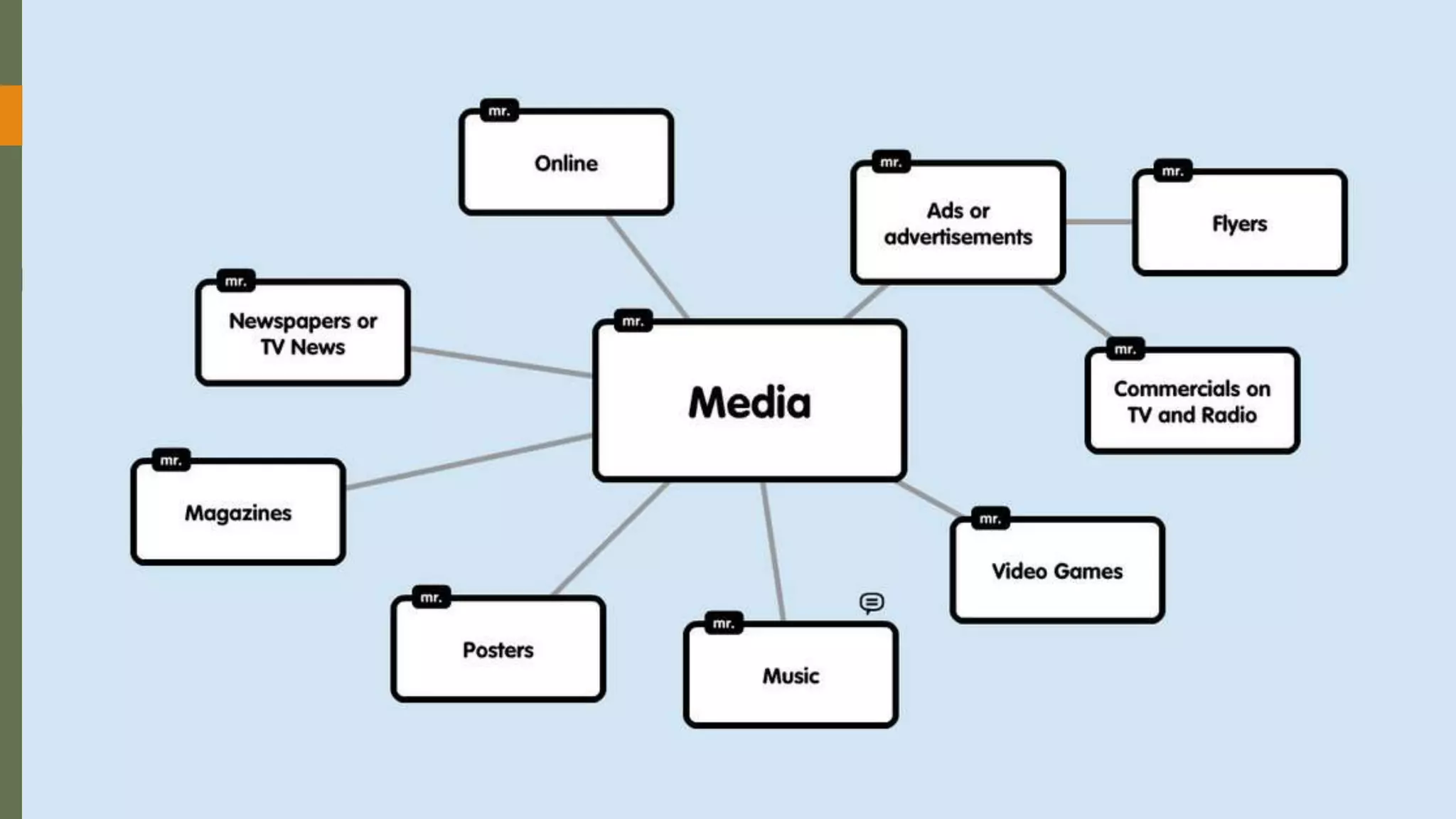
 Media' is the plural of medium (of communication), and the main media are
 Television
 Pop Music
 Newspapers
 Internet
 Advertising
 Film
 Radio
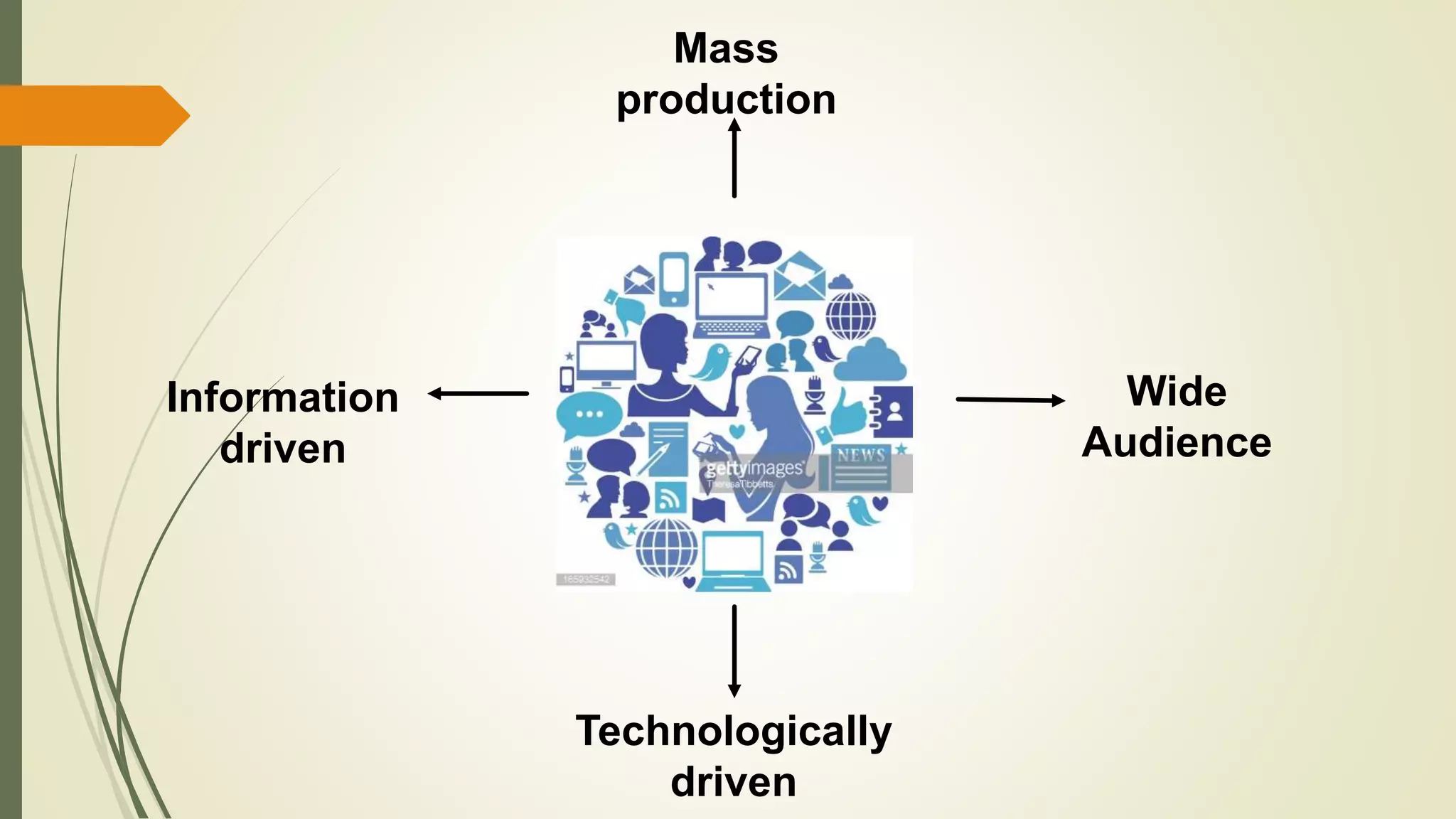
Wide
Audience
Mass
production
Technologically
driven
Information
driven
What is Media Studies?
 Media studies is a discipline and field of study that deals with the
content, history, and effects of various media; in particular, the
mass media
 Media Studies involves the close analysis of the images, sounds and
text that we experience via the media
 It is the study of individual media texts such as films, TV shows,
magazines, websites
 Media Studies also involves practical work, where you learn the
techniques involved for the production of your own media text
Why is it important?
 As we progress into the 21st century, communications are
becoming faster and faster
 Think of the millions of different media images you are
bombarded with every day
 It is as important now to be able to read and make sense of
those images, as it has been to be able to read ordinary text
 You also need to have a good idea of how those messages are
made, and who is making them, so that you may quickly
become aware if someone (or some corporation!) is trying to
manipulate your thoughts and feelings
Media Studies in Contemporary Times
 Technological capabilities and features of the Internet and World Wide
Web have prompted concerns about the variety of online information, the
credibility of new media and the new responsibilities placed on media
consumers
 Filters and control mechanisms which formerly served to validate and
endorse a rather limited number of information outlets, may not be as
effective in this new media environment
 One distinctive feature of the Internet is its relative lack of professional
gatekeepers
 Newspapers, magazine, books, television all undergo certain
levels of factual verification, analysis of content and editorial
review
 But web based information is not always subject to the same
level of scrutiny
 Another distinctive feature of the Web is its convergence of
genres of information, particularly the blending of advertising
and informational content
 Media environment in the contemporary time has helped in
the development of appropriate information literacy or the
ability to analyse and evaluate information from media
sources
HISTORICAL PERSPECTIVES OF
MEDIA STUDIES
HISTORY OF MEDIA
Late 1400’s
 The development of printing in China which spreads to
Europe
 The first newspaper was printed in the 1600’s, an the first
magazine in the 1700’s
Late 1800’s
 Media develops through the rise of technology
 Creation of photography
 Creation of the telephone
 Creation of cinematography
 First advertising agency
Early 1900’s
 The first forms of modern media developed
 The first feature film
 Radio is invented and radio stations emerge
Mid 1900’s
 First television is broadcast and colour TV
goes to the mass market in the US
 Advertising
Late 1900’s
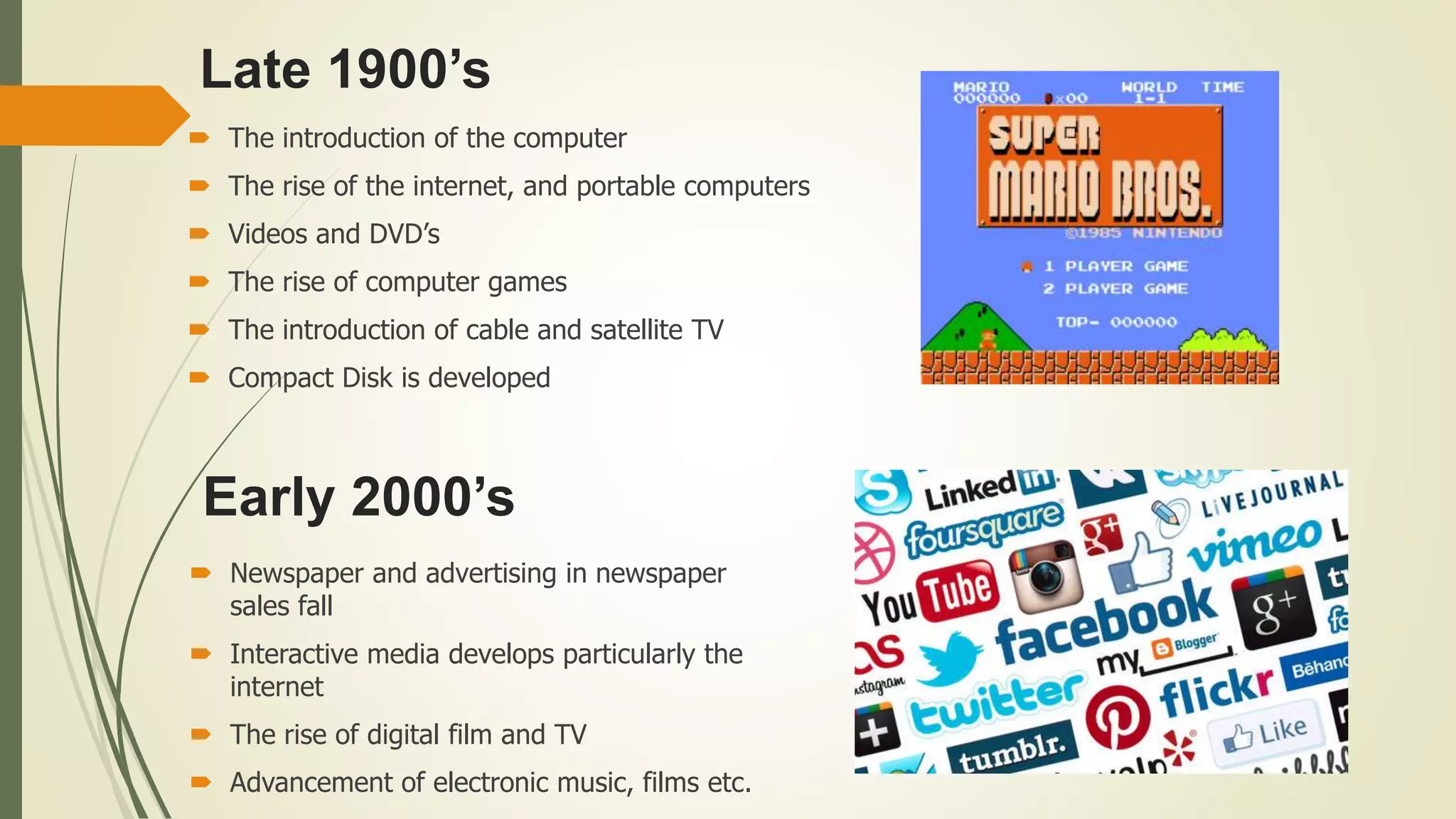
 The introduction of the computer
 The rise of the internet, and portable computers
 Videos and DVD’s
 The rise of computer games
 The introduction of cable and satellite TV
 Compact Disk is developed
Early 2000’s
 Newspaper and advertising in newspaper
sales fall
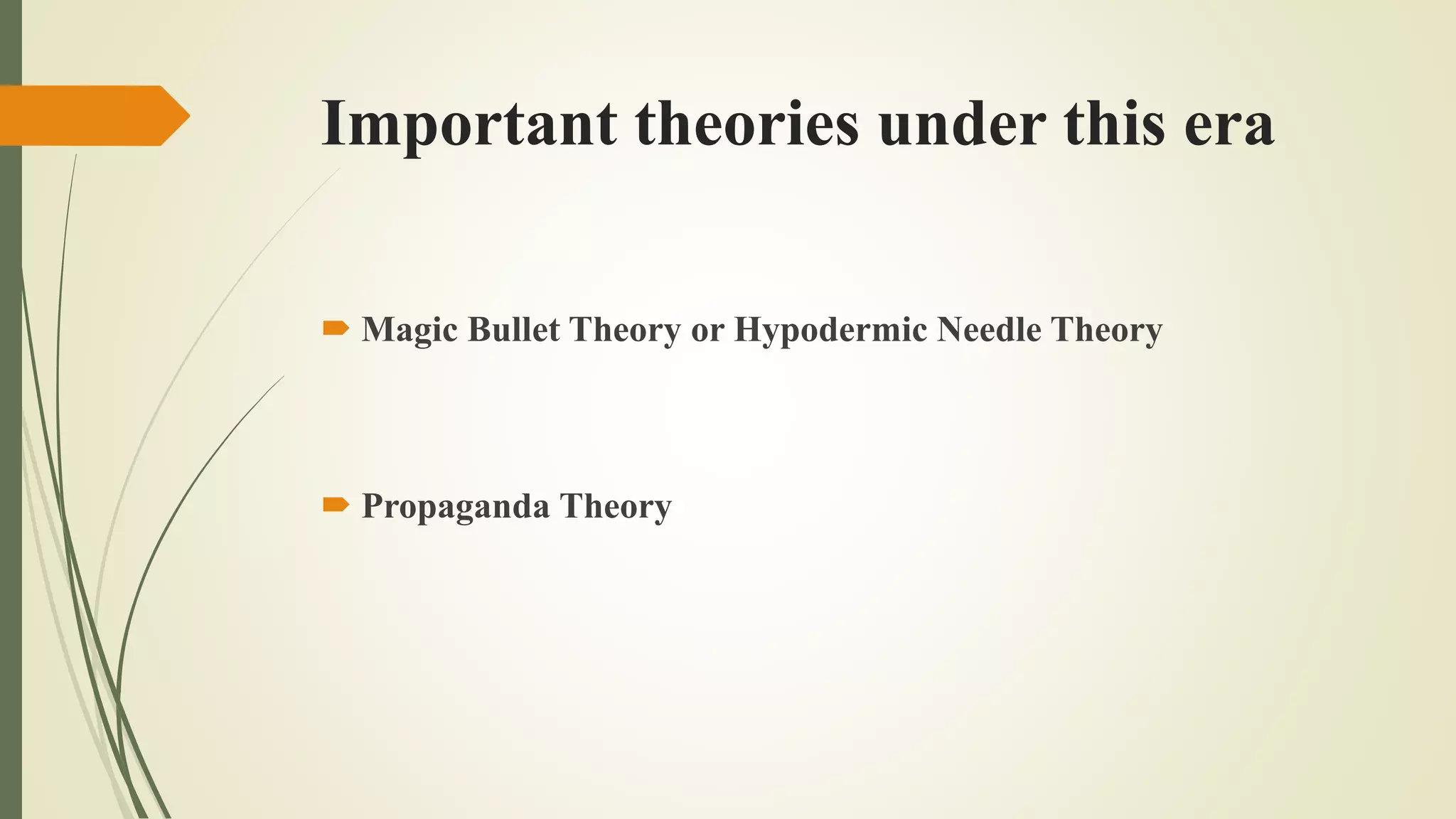
 Interactive media develops particularly the
internet
 The rise of digital film and TV
 Advancement of electronic music, films etc.
FOUR ERAS OF MEDIA THEORY
Era of mass society theory (1850-1940)
Era of scientific perspective on mass media (1940-1950)
Era of limited effects (1950-60s)
Era of cultural criticism (1960s-1980s)
WHAT IS A THEORY?
A set of assumptions, propositions, or accepted facts that attempts
to provide a plausible or rational explanation of cause-and-effect
(causal) relationships among a group of observed phenomenon.
The word's origin (from the Greek thorós, a spectator), stresses
the fact that all theories are mental models of the perceived reality
Era of mass society theory (1850-1940)
 These theories begins with a review of some of the earliest notions about media
 These ideas were initially developed in the later half of the 19th century as new media
technologies were invented and popularized
 Although some theorists were optimistic about new technology, most were extremely
pessimistic
 They blamed new industrial technology for disrupting peaceful, rural communities and
forcing people to live in urban areas merely to serve as a convenient workforce in large
factories, mines or bureaucracies
Important theories under this era
 Magic Bullet Theory or Hypodermic Needle Theory
 Propaganda Theory
Era of scientific perspective on
mass media (1940-1950)
 During the 1930’s, world events seemed to continually confirm the truth of mass
media society ideas
 In Europe, reactionary and revolutionary political movements used media in
their struggles for political power
 German Nazis introduced propaganda techniques that ruthlessly exploited the
power of new media technology like motion pictures and radio
 All across Europe, leaders like Hitler, Stalin and Mussolini rose to political
power and were able to exercise seemingly total control over vast populations
 Private ownership of media, especially broadcast media, was
replaced by direct government control in most European nations
 The purpose was to use media for the service of the society
 But the unintended outcome in most cases was to place enormous
power in the hands of ruthless leaders who were convinced that they
personally embodied what as best for all their citizens
 Paul Lazarsfeld (1941), an Austrian researcher and scientist, argues that it
wasn`t enough to merely speculate about the influence of media on society
 Instead he proposed conducting carefully designed, elaborate field experiments
in which he would be able to observe media influence and measure its
magnitude
 It was not enough to assume that political propaganda is powerful – hard
evidence was needed to prove the existence of such effects (Lazarsfeld,
Berelson, and Gaudet, 1944)
 Lazersfeld’s most famous efforts, the “Voter Studies”, actually began as an
attempt to demonstrate the media’s power, yet they proved, at least to him and
his colleagues, just the opposite
 By the early 1950’s, Lazarfeld work had generated an enormous amount of data
based on which he concluded that media were not nearly as powerful as had been
previously imagined
 Instead, he found that people had numerous ways of resisting media influence and
were influenced by many competing factors
 He found little evidence to support the worst of fears of mass society theorists
 Though Lazarsfeld never labeled his theory, it is now referred as Limited-effects
perspective
 These view media as playing a very limited role in the lives of individuals and
larger society
Important theories under this era
Two Step flow theory
Lasswell’s Model
Persuasion Theory
Limited Effect Theory
Era of limited effects (1950-60s)
 During the 1950’s, limited-effects notions about media continued to gain
acceptance within academia
 Several importance clashes occurred between their adherents and those who
supported mass society ideas (Bauer and Bauer, 1960)
 In 1960, several classic studies of media effects provided apparently definitive
support for the limited-effects notions
 However, by the mid-1960’s the debate between mass society and limited-effects
notions appeared to be over-at least within the mass communication research
community
Important theories under this era
Uses & Gratification Theory
Agenda Setting Theory
Dependency Theory
Dissonance Theory
Era of Cultural Criticism (1960s-1980s)
 Mass society notions continued to flourish in Europe. Both left wing and right wing
concerns about the power of media, learning from the trauma of the WW II
 During the 1960s, neomarxist in Britain developed a school of social theory widely
referred to as British cultural studies
 Neomarxist: Social theorists asserting that media enable dominant social elites to
maintain power
 In North America, there was an attempt to create an “American culture studies”
(Innis and McLuhan, for example).
Important theory under this era
 Cultivation Theory
THANK YOU

Intro to media studies

  • 1.
  • 2.
  • 4.
    What is Media? Collective communication outlets or tools that are used to store and deliver information or data  Channels of general communication, information, or entertainment in society, as newspapers, radio or television  Media' is the plural of medium (of communication), and the main media are  Television  Pop Music  Newspapers  Internet  Advertising  Film  Radio
  • 5.
  • 6.
    What is MediaStudies?  Media studies is a discipline and field of study that deals with the content, history, and effects of various media; in particular, the mass media  Media Studies involves the close analysis of the images, sounds and text that we experience via the media  It is the study of individual media texts such as films, TV shows, magazines, websites  Media Studies also involves practical work, where you learn the techniques involved for the production of your own media text
  • 7.
    Why is itimportant?  As we progress into the 21st century, communications are becoming faster and faster  Think of the millions of different media images you are bombarded with every day  It is as important now to be able to read and make sense of those images, as it has been to be able to read ordinary text  You also need to have a good idea of how those messages are made, and who is making them, so that you may quickly become aware if someone (or some corporation!) is trying to manipulate your thoughts and feelings
  • 8.
    Media Studies inContemporary Times  Technological capabilities and features of the Internet and World Wide Web have prompted concerns about the variety of online information, the credibility of new media and the new responsibilities placed on media consumers  Filters and control mechanisms which formerly served to validate and endorse a rather limited number of information outlets, may not be as effective in this new media environment  One distinctive feature of the Internet is its relative lack of professional gatekeepers
  • 9.
     Newspapers, magazine,books, television all undergo certain levels of factual verification, analysis of content and editorial review  But web based information is not always subject to the same level of scrutiny  Another distinctive feature of the Web is its convergence of genres of information, particularly the blending of advertising and informational content  Media environment in the contemporary time has helped in the development of appropriate information literacy or the ability to analyse and evaluate information from media sources
  • 11.
  • 12.
  • 13.
    Late 1400’s  Thedevelopment of printing in China which spreads to Europe  The first newspaper was printed in the 1600’s, an the first magazine in the 1700’s Late 1800’s  Media develops through the rise of technology  Creation of photography  Creation of the telephone  Creation of cinematography  First advertising agency
  • 14.
    Early 1900’s  Thefirst forms of modern media developed  The first feature film  Radio is invented and radio stations emerge Mid 1900’s  First television is broadcast and colour TV goes to the mass market in the US  Advertising
  • 15.
    Late 1900’s  Theintroduction of the computer  The rise of the internet, and portable computers  Videos and DVD’s  The rise of computer games  The introduction of cable and satellite TV  Compact Disk is developed Early 2000’s  Newspaper and advertising in newspaper sales fall  Interactive media develops particularly the internet  The rise of digital film and TV  Advancement of electronic music, films etc.
  • 16.
    FOUR ERAS OFMEDIA THEORY Era of mass society theory (1850-1940) Era of scientific perspective on mass media (1940-1950) Era of limited effects (1950-60s) Era of cultural criticism (1960s-1980s)
  • 17.
    WHAT IS ATHEORY?
  • 18.
    A set ofassumptions, propositions, or accepted facts that attempts to provide a plausible or rational explanation of cause-and-effect (causal) relationships among a group of observed phenomenon. The word's origin (from the Greek thorós, a spectator), stresses the fact that all theories are mental models of the perceived reality
  • 19.
    Era of masssociety theory (1850-1940)  These theories begins with a review of some of the earliest notions about media  These ideas were initially developed in the later half of the 19th century as new media technologies were invented and popularized  Although some theorists were optimistic about new technology, most were extremely pessimistic  They blamed new industrial technology for disrupting peaceful, rural communities and forcing people to live in urban areas merely to serve as a convenient workforce in large factories, mines or bureaucracies
  • 20.
    Important theories underthis era  Magic Bullet Theory or Hypodermic Needle Theory  Propaganda Theory
  • 21.
    Era of scientificperspective on mass media (1940-1950)  During the 1930’s, world events seemed to continually confirm the truth of mass media society ideas  In Europe, reactionary and revolutionary political movements used media in their struggles for political power  German Nazis introduced propaganda techniques that ruthlessly exploited the power of new media technology like motion pictures and radio  All across Europe, leaders like Hitler, Stalin and Mussolini rose to political power and were able to exercise seemingly total control over vast populations
  • 22.
     Private ownershipof media, especially broadcast media, was replaced by direct government control in most European nations  The purpose was to use media for the service of the society  But the unintended outcome in most cases was to place enormous power in the hands of ruthless leaders who were convinced that they personally embodied what as best for all their citizens
  • 23.
     Paul Lazarsfeld(1941), an Austrian researcher and scientist, argues that it wasn`t enough to merely speculate about the influence of media on society  Instead he proposed conducting carefully designed, elaborate field experiments in which he would be able to observe media influence and measure its magnitude  It was not enough to assume that political propaganda is powerful – hard evidence was needed to prove the existence of such effects (Lazarsfeld, Berelson, and Gaudet, 1944)  Lazersfeld’s most famous efforts, the “Voter Studies”, actually began as an attempt to demonstrate the media’s power, yet they proved, at least to him and his colleagues, just the opposite
  • 24.
     By theearly 1950’s, Lazarfeld work had generated an enormous amount of data based on which he concluded that media were not nearly as powerful as had been previously imagined  Instead, he found that people had numerous ways of resisting media influence and were influenced by many competing factors  He found little evidence to support the worst of fears of mass society theorists  Though Lazarsfeld never labeled his theory, it is now referred as Limited-effects perspective  These view media as playing a very limited role in the lives of individuals and larger society
  • 25.
    Important theories underthis era Two Step flow theory Lasswell’s Model Persuasion Theory Limited Effect Theory
  • 26.
    Era of limitedeffects (1950-60s)  During the 1950’s, limited-effects notions about media continued to gain acceptance within academia  Several importance clashes occurred between their adherents and those who supported mass society ideas (Bauer and Bauer, 1960)  In 1960, several classic studies of media effects provided apparently definitive support for the limited-effects notions  However, by the mid-1960’s the debate between mass society and limited-effects notions appeared to be over-at least within the mass communication research community
  • 27.
    Important theories underthis era Uses & Gratification Theory Agenda Setting Theory Dependency Theory Dissonance Theory
  • 28.
    Era of CulturalCriticism (1960s-1980s)  Mass society notions continued to flourish in Europe. Both left wing and right wing concerns about the power of media, learning from the trauma of the WW II  During the 1960s, neomarxist in Britain developed a school of social theory widely referred to as British cultural studies  Neomarxist: Social theorists asserting that media enable dominant social elites to maintain power  In North America, there was an attempt to create an “American culture studies” (Innis and McLuhan, for example).
  • 29.
    Important theory underthis era  Cultivation Theory
  • 30.