






Week # 2 Social Media: Histories of the Internet

Loading...

Flash Player 9 (or above) is needed to view presentations.
We have detected that you do not have it on your computer. To install it, go here.

0 comments

Post a comment

    Post a comment
    Embed Video
    Edit your comment Cancel

    36 Favorites

    Week # 2 Social Media: Histories of the Internet - Presentation Transcript

    1. Social Media week2 ARPANET, “Alternative” Networks, Counter Culture, the Internet, and “Virtual Community” Trebor Scholz | LCST 2031 A | Spring 2009
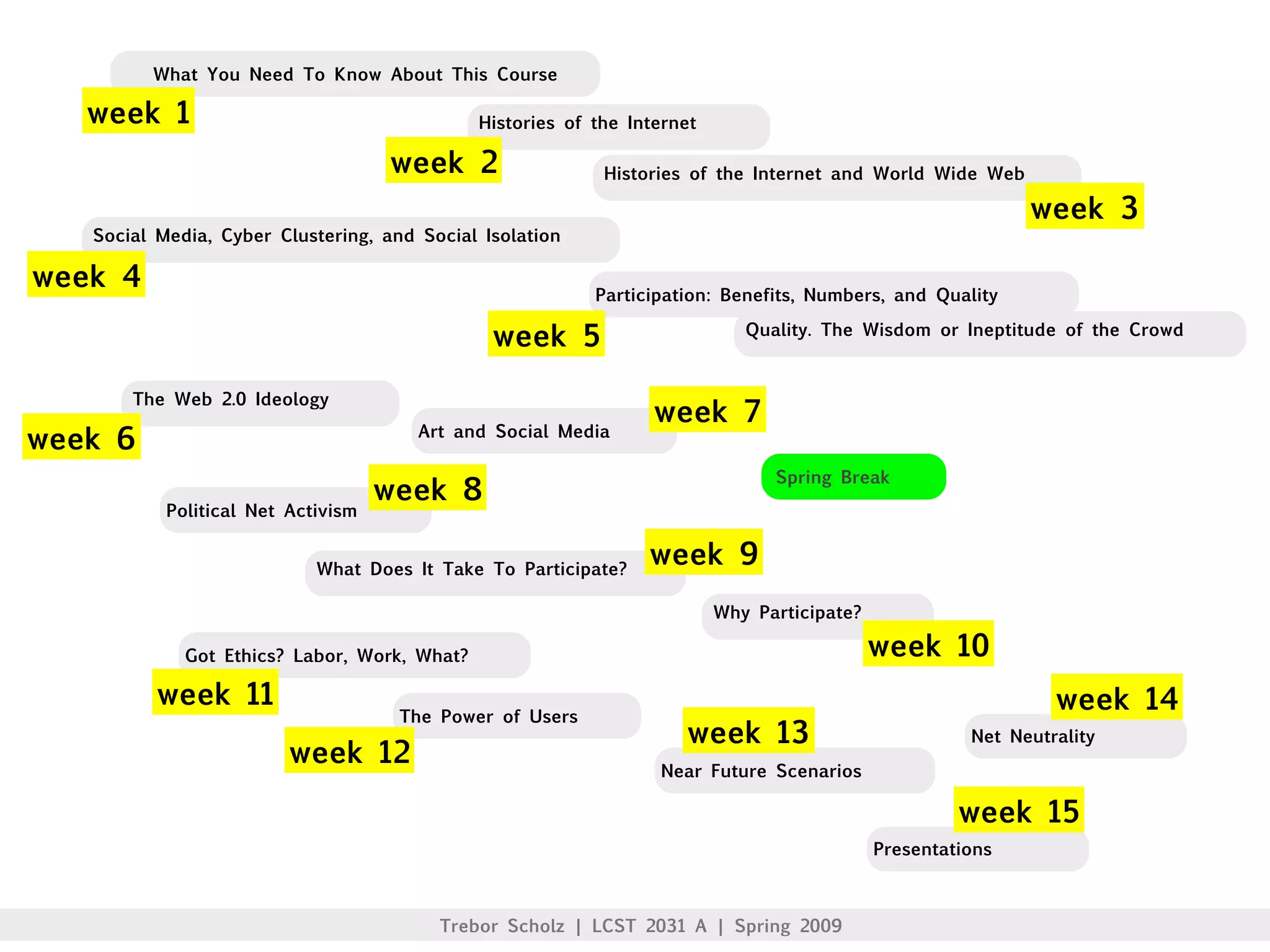
    2. What You Need To Know About This Course week 1 Histories of the Internet week 2 Histories of the Internet and World Wide Web week 3 Social Media, Cyber Clustering, and Social Isolation week 4 Participation: Benefits, Numbers, and Quality week 5 Quality. The Wisdom or Ineptitude of the Crowd The Web 2.0 Ideology week 7 week 6 Art and Social Media Spring Break week 8 Political Net Activism week 9 What Does It Take To Participate? Why Participate? week 10 Got Ethics? Labor, Work, What? week 11 week 14 The Power of Users week 13 Net Neutrality week 12 Near Future Scenarios week 15 Presentations Trebor Scholz | LCST 2031 A | Spring 2009
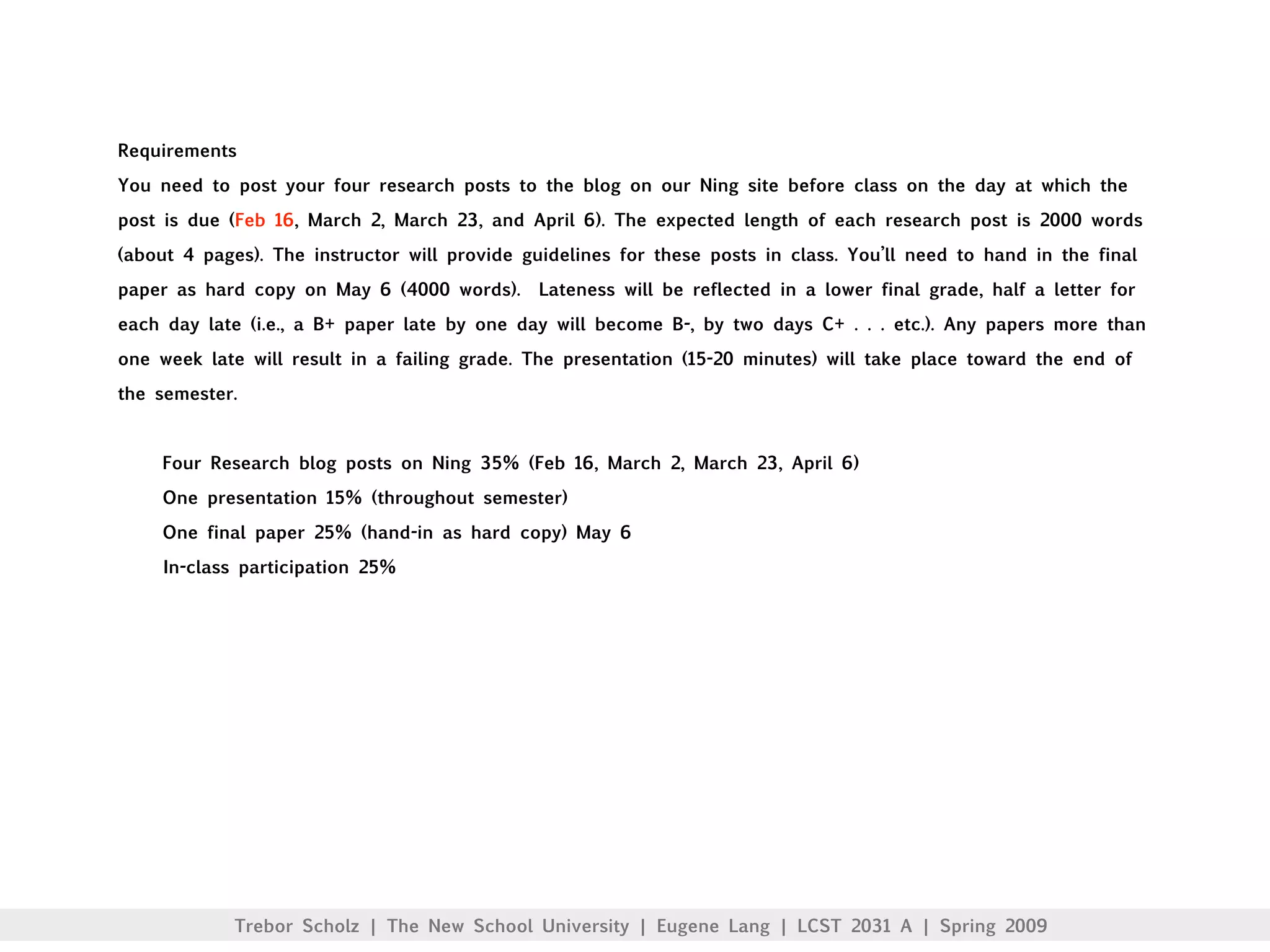
    3. Requirements You need to post your four research posts to the blog on our Ning site before class on the day at which the post is due (Feb 16, March 2, March 23, and April 6). The expected length of each research post is 2000 words (about 4 pages). The instructor will provide guidelines for these posts in class. You’ll need to hand in the final paper as hard copy on May 6 (4000 words). Lateness will be reflected in a lower final grade, half a letter for each day late (i.e., a B+ paper late by one day will become B-, by two days C+ . . . etc.). Any papers more than one week late will result in a failing grade. The presentation (15-20 minutes) will take place toward the end of the semester. Four Research blog posts on Ning 35% (Feb 16, March 2, March 23, April 6) One presentation 15% (throughout semester) One final paper 25% (hand-in as hard copy) May 6 In-class participation 25% Trebor Scholz | The New School University | Eugene Lang | LCST 2031 A | Spring 2009
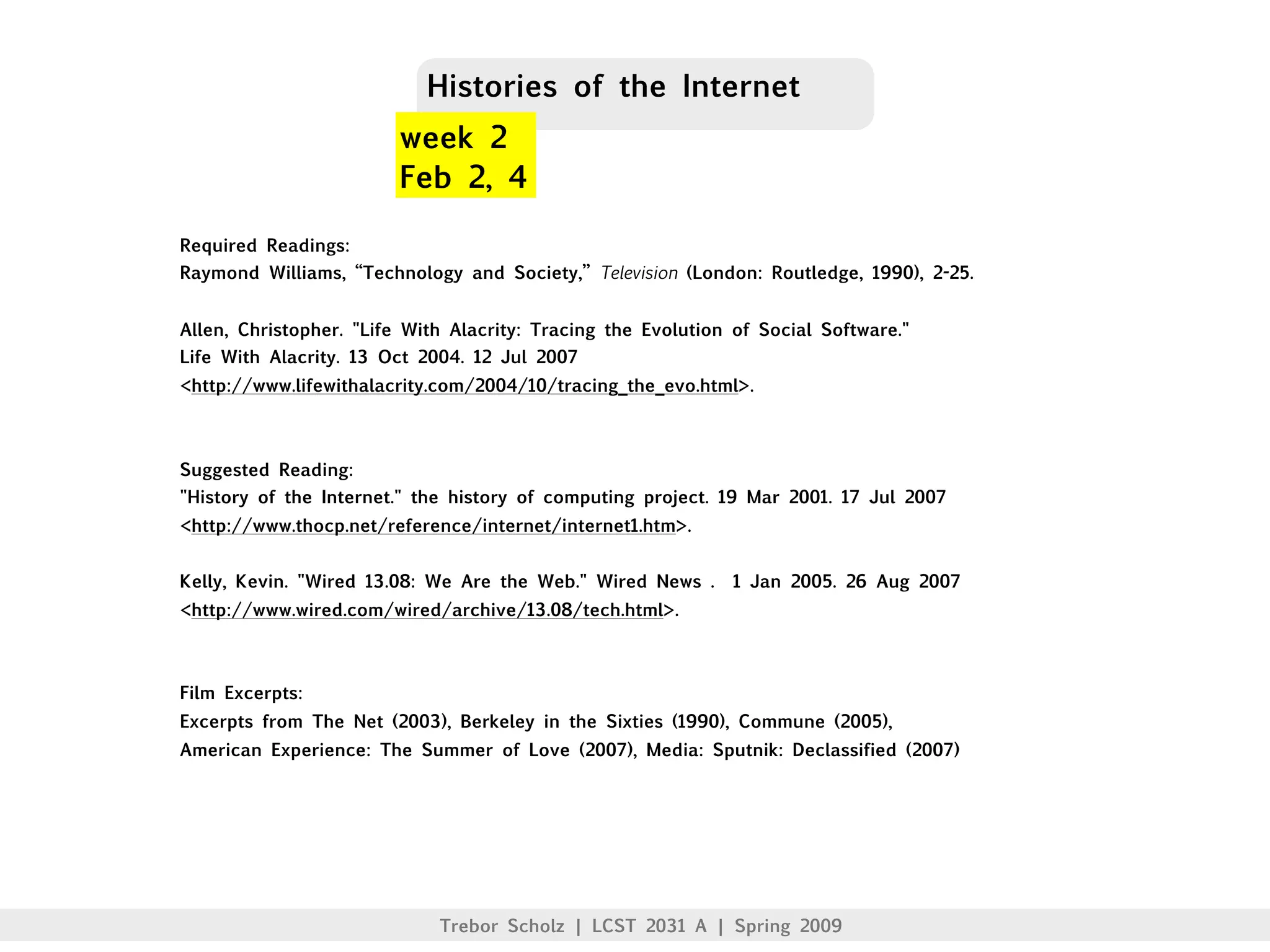
    4. Histories of the Internet week 2 Feb 2, 4 Required Readings: Raymond Williams, “Technology and Society,” Television (London: Routledge, 1990), 2-25. Allen, Christopher. \"Life With Alacrity: Tracing the Evolution of Social Software.\" Life With Alacrity. 13 Oct 2004. 12 Jul 2007 <http://www.lifewithalacrity.com/2004/10/tracing_the_evo.html>. Suggested Reading: \"History of the Internet.\" the history of computing project. 19 Mar 2001. 17 Jul 2007 <http://www.thocp.net/reference/internet/internet1.htm>. Kelly, Kevin. \"Wired 13.08: We Are the Web.\" Wired News . 1 Jan 2005. 26 Aug 2007 <http://www.wired.com/wired/archive/13.08/tech.html>. Film Excerpts: Excerpts from The Net (2003), Berkeley in the Sixties (1990), Commune (2005), American Experience: The Summer of Love (2007), Media: Sputnik: Declassified (2007) Trebor Scholz | LCST 2031 A | Spring 2009
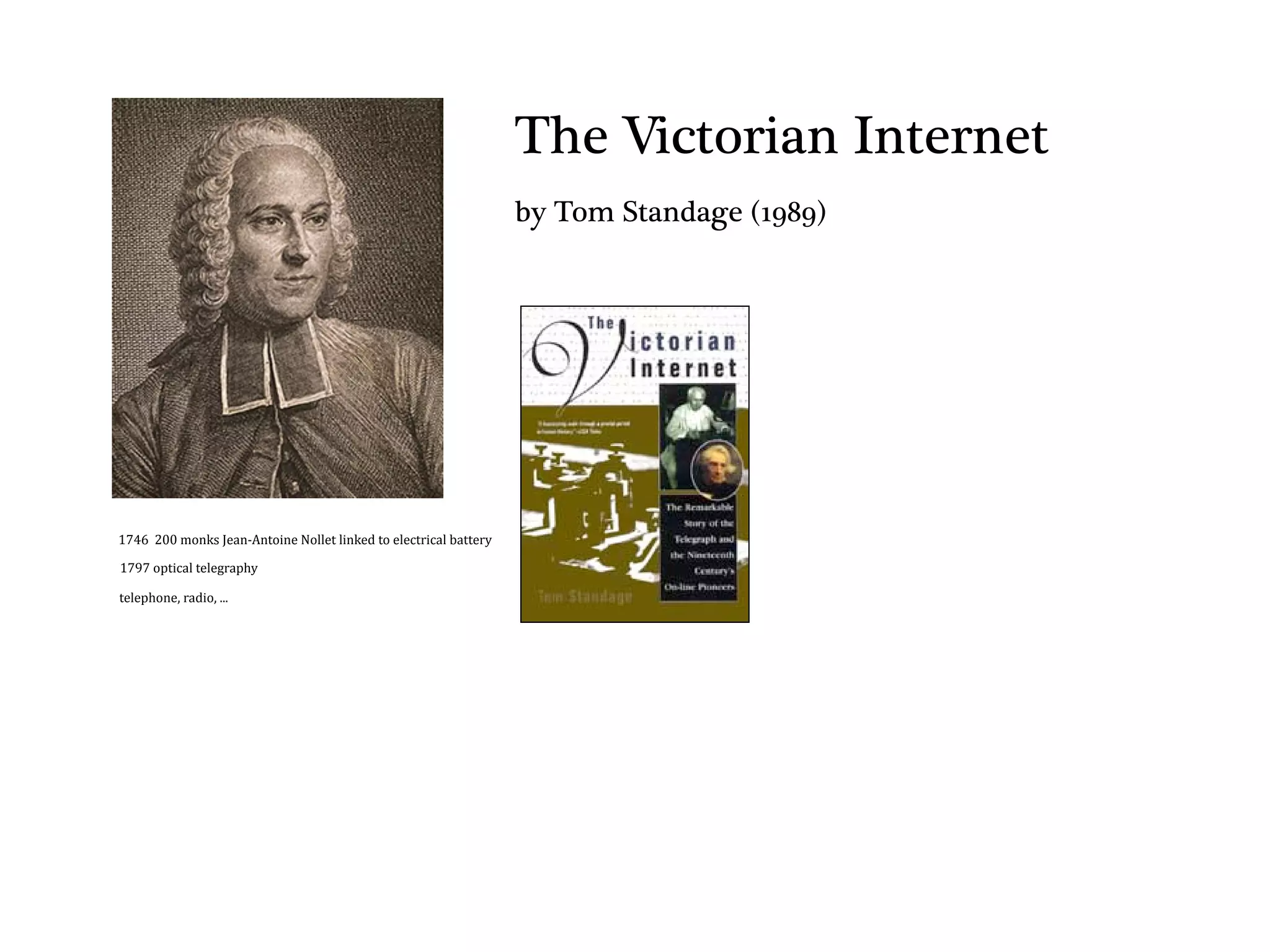
    5. The Victorian Internet by Tom Standage (1989) 1746  200 monks Jean‐Antoine Nollet linked to electrical battery  1797 optical telegraphy telephone, radio, ...
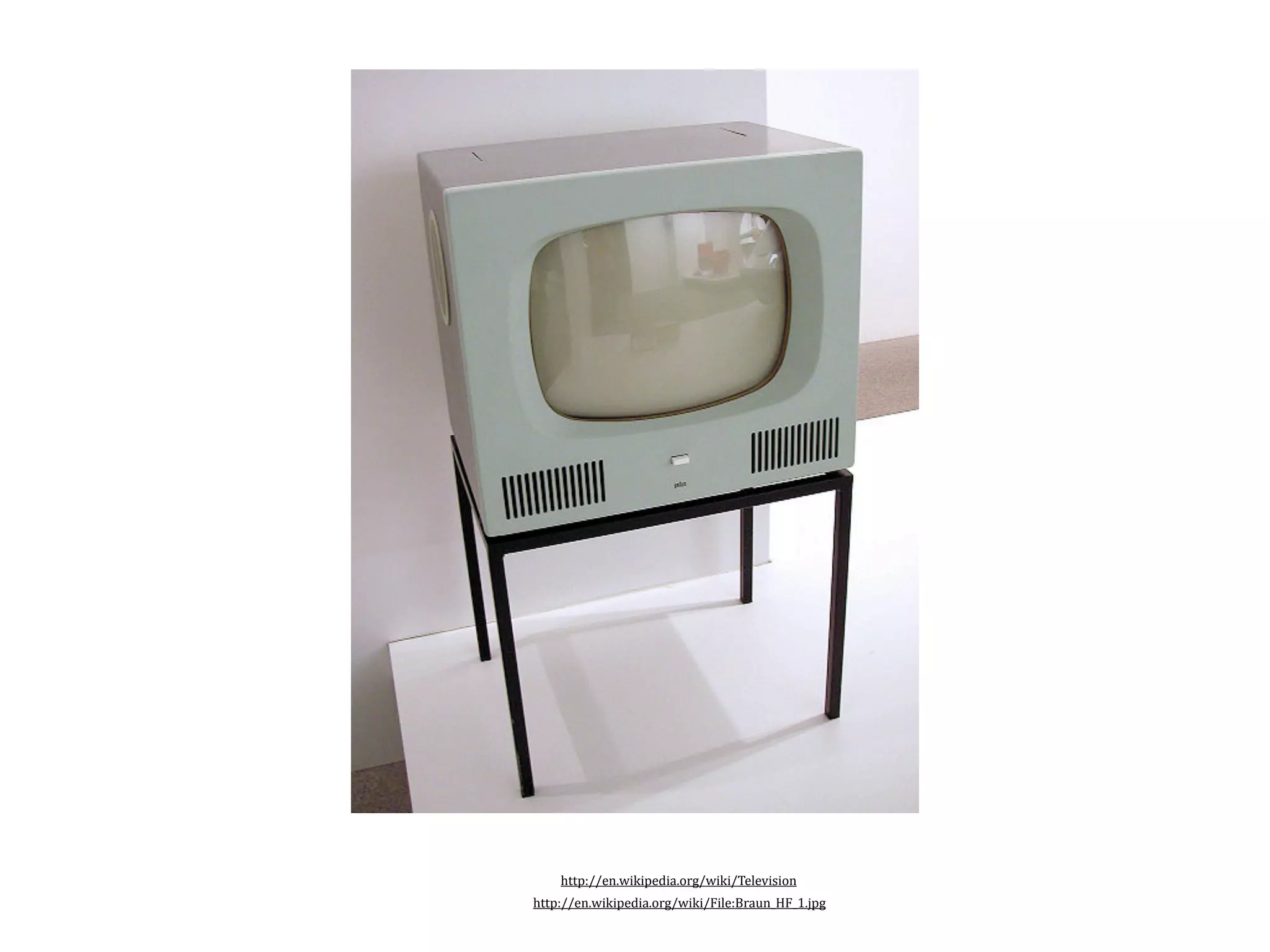
    6. http://en.wikipedia.org/wiki/Television http://en.wikipedia.org/wiki/File:Braun_HF_1.jpg
    7. Discussion: Required Readings: Raymond Williams, “Technology and Society,” Television (London: Routledge, 1990), 2-25. Your questions: Trebor Scholz | LCST 2031 A | Spring 2009
    8. 1945
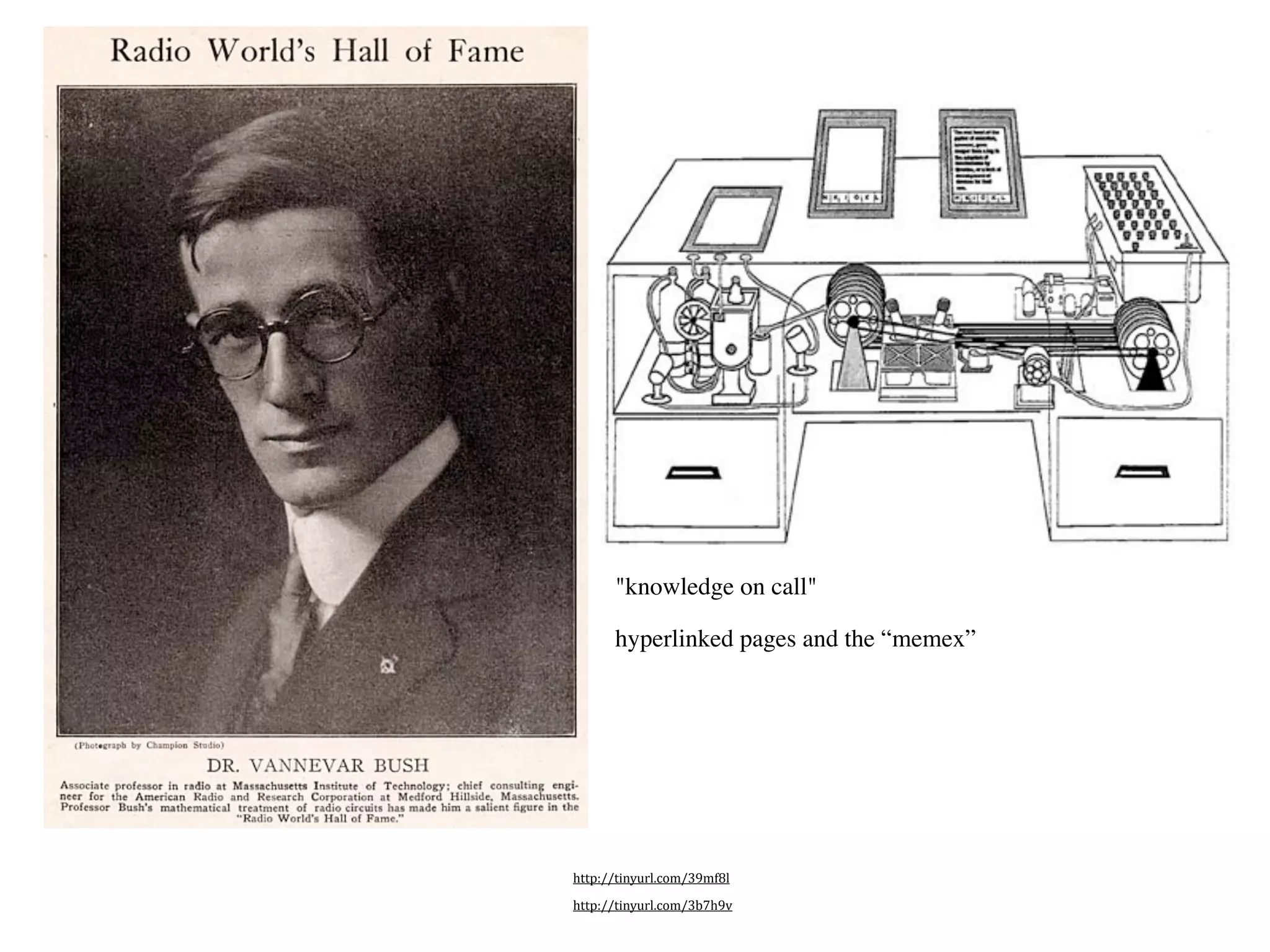
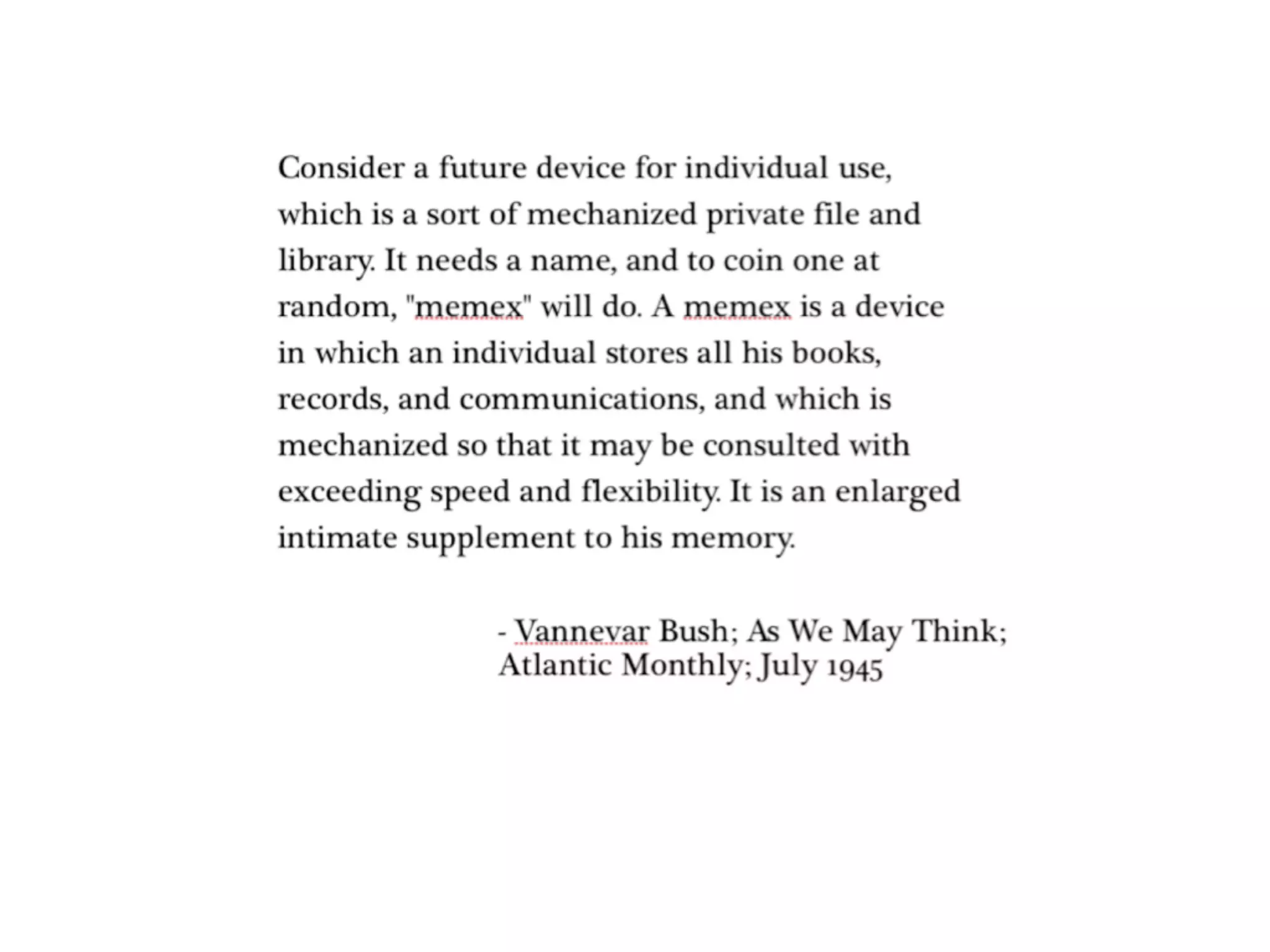
    9. \"knowledge on call\" hyperlinked pages and the “memex” http://tinyurl.com/39mf8l http://tinyurl.com/3b7h9v
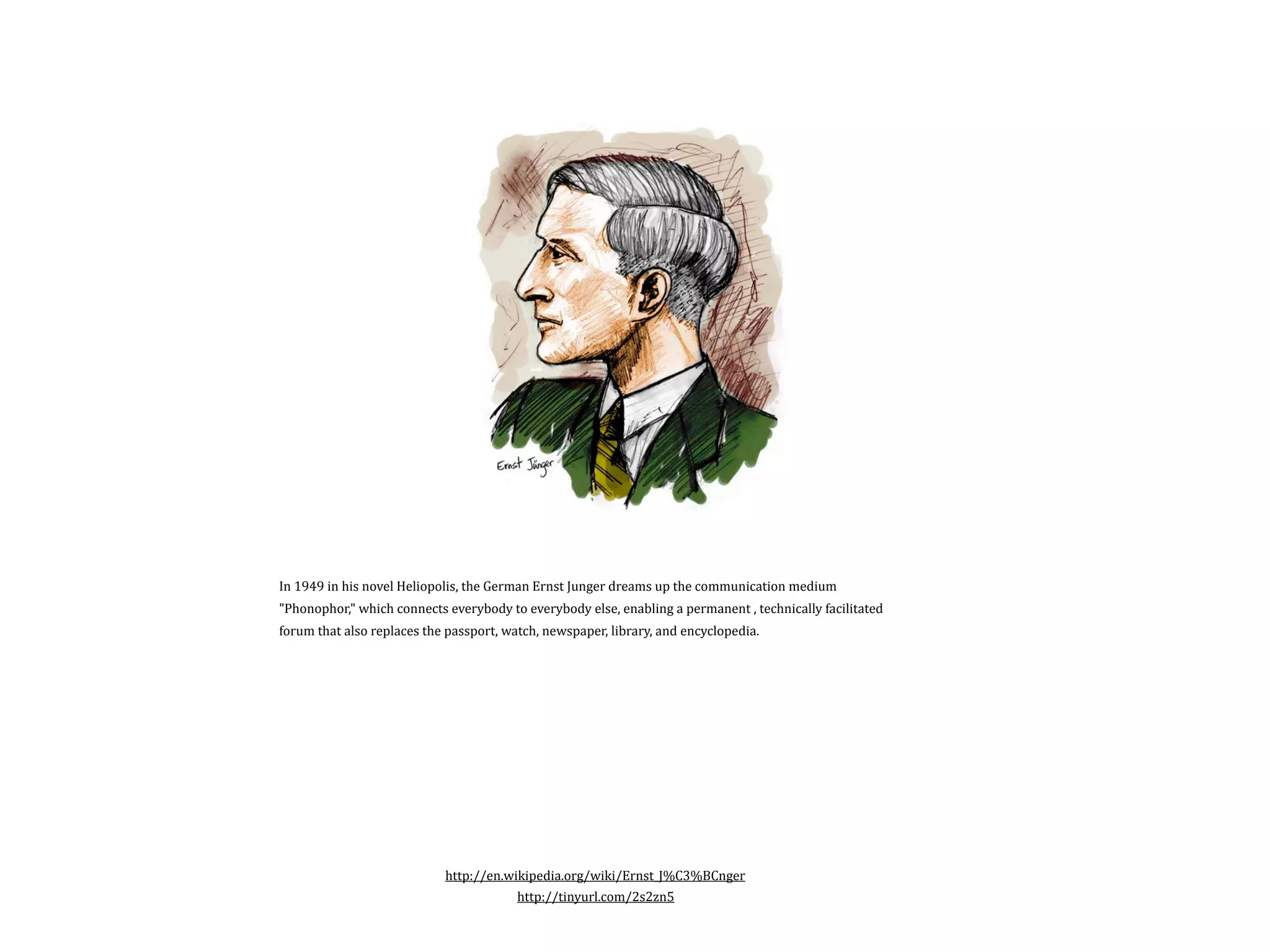
    10. In 1949 in his novel Heliopolis, the German Ernst Junger dreams up the communication medium  \"Phonophor,\" which connects everybody to everybody else, enabling a permanent , technically facilitated  forum that also replaces the passport, watch, newspaper, library, and encyclopedia. http://en.wikipedia.org/wiki/Ernst_J%C3%BCnger http://tinyurl.com/2s2zn5
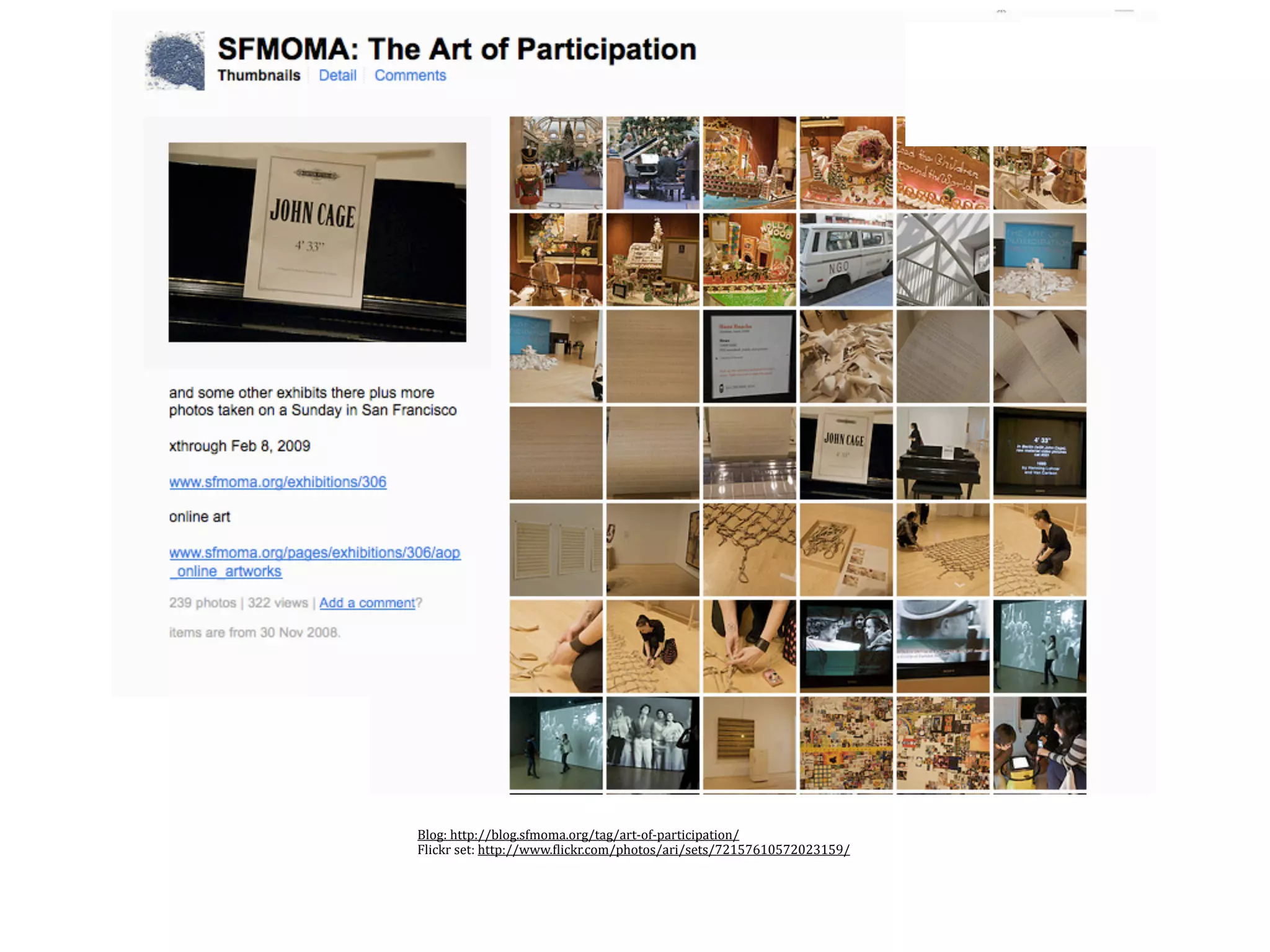
    11. [A]ctivation; authorship; community ‐‐ are the most frequently cited motivations for almost all artistic  attempts to encourage participation in art since the 1960s.\" according to art historian Claire Bishop.
    12. Blog: http://blog.sfmoma.org/tag/art‐of‐participation/ Flickr set: http://www.\\lickr.com/photos/ari/sets/72157610572023159/
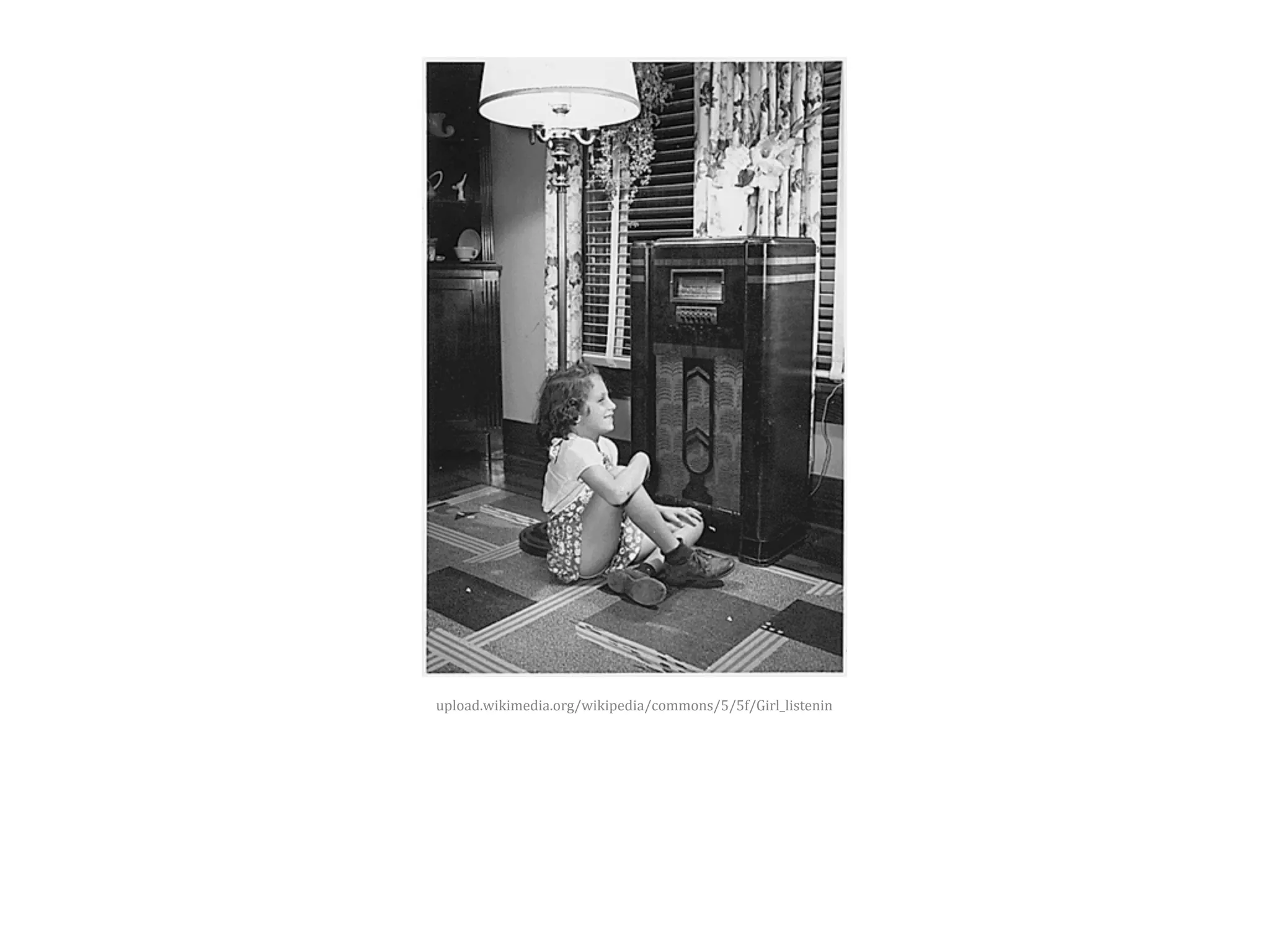
    13. upload.wikimedia.org/wikipedia/commons/5/5f/Girl_listenin
    14. 1957
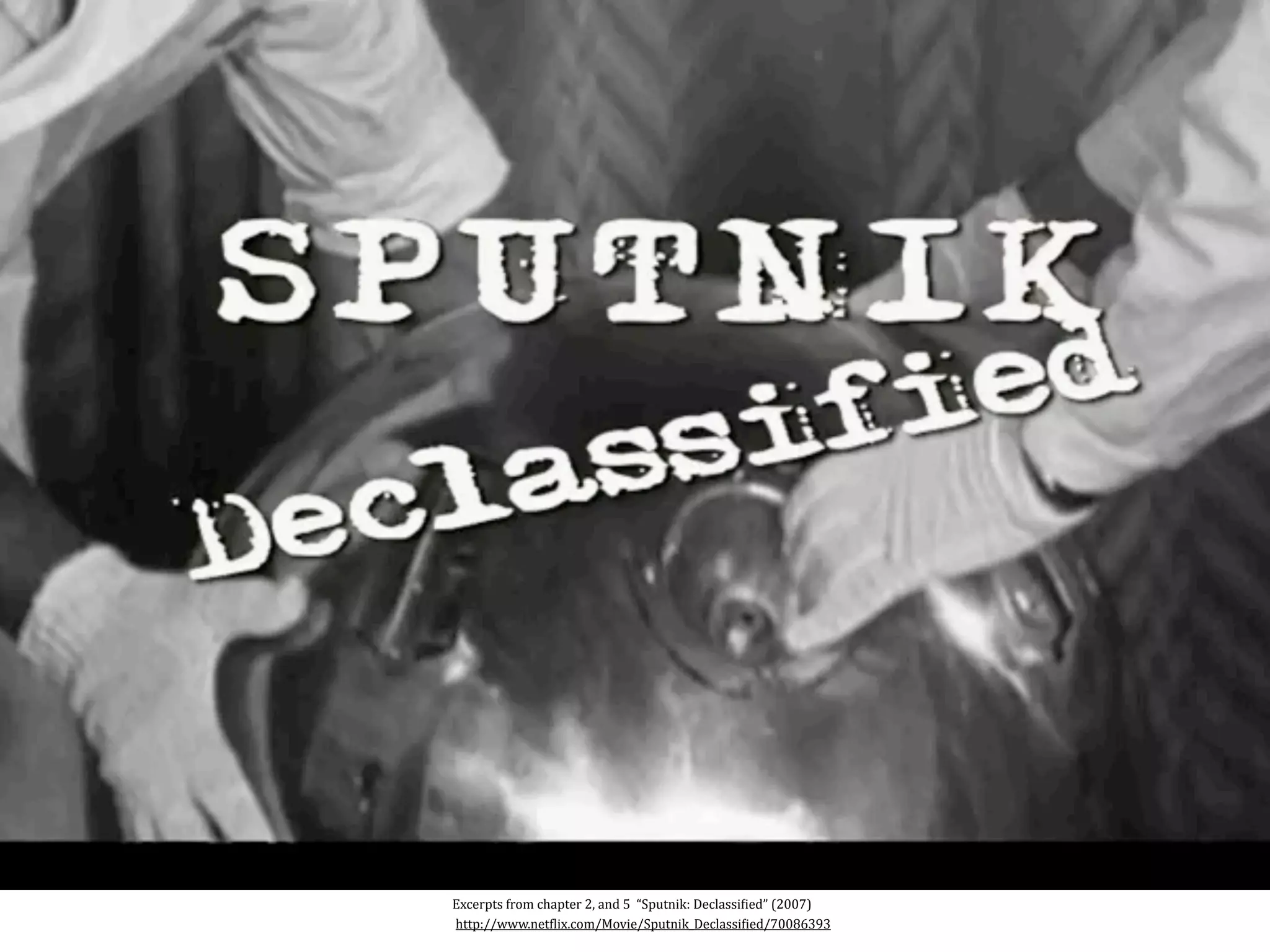
    15. Excerpts from chapter 2, and 5  “Sputnik: Declassi\\ied” (2007)  http://www.net\\lix.com/Movie/Sputnik_Declassi\\ied/70086393
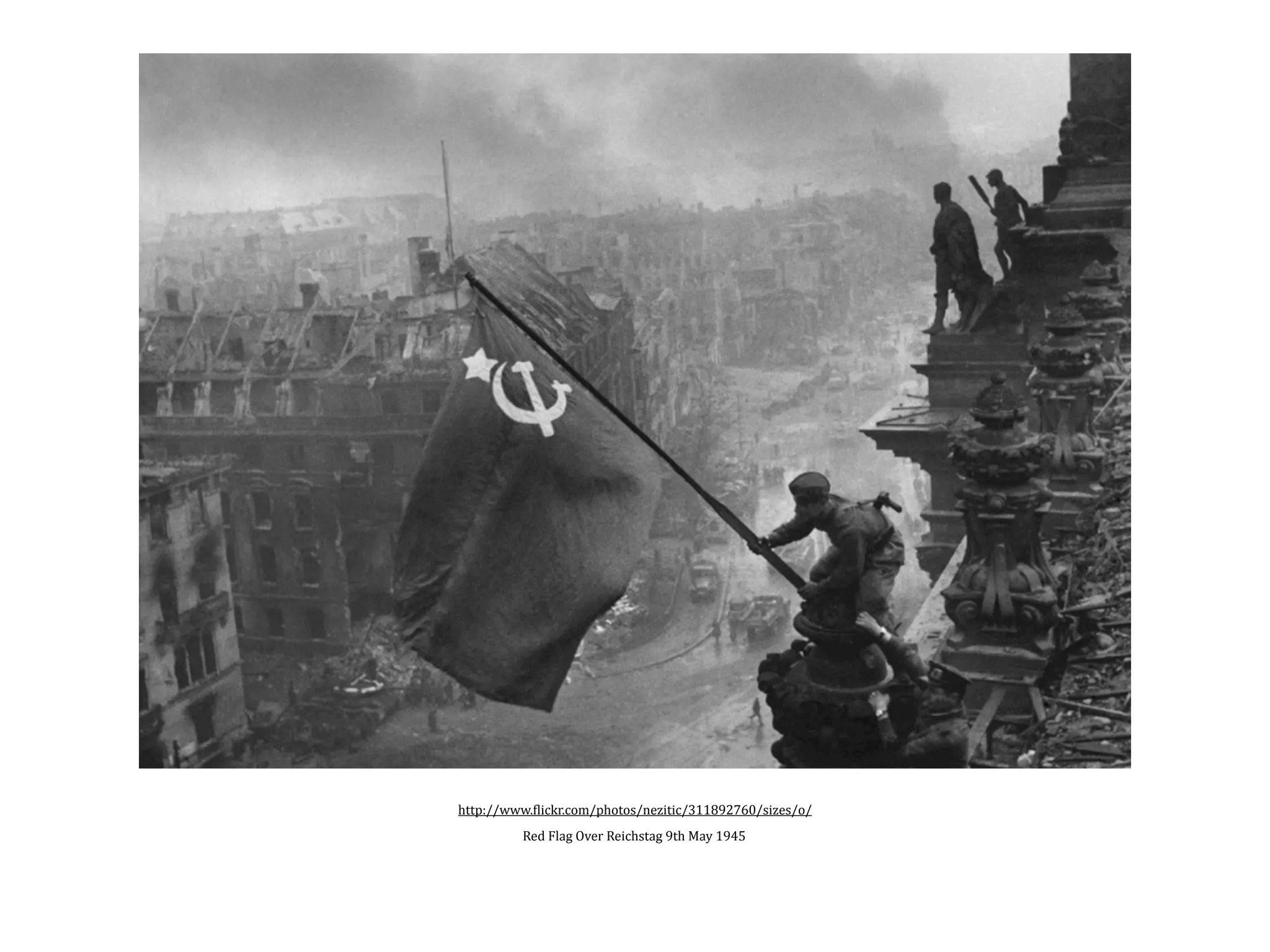
    16. http://www.\\lickr.com/photos/nezitic/311892760/sizes/o/ Red Flag Over Reichstag 9th May 1945
    17. The Advanced Research Projects Agency
    18. http://www.youtube.com/watch?v=V2QdEj8UjBc
    19. 1961
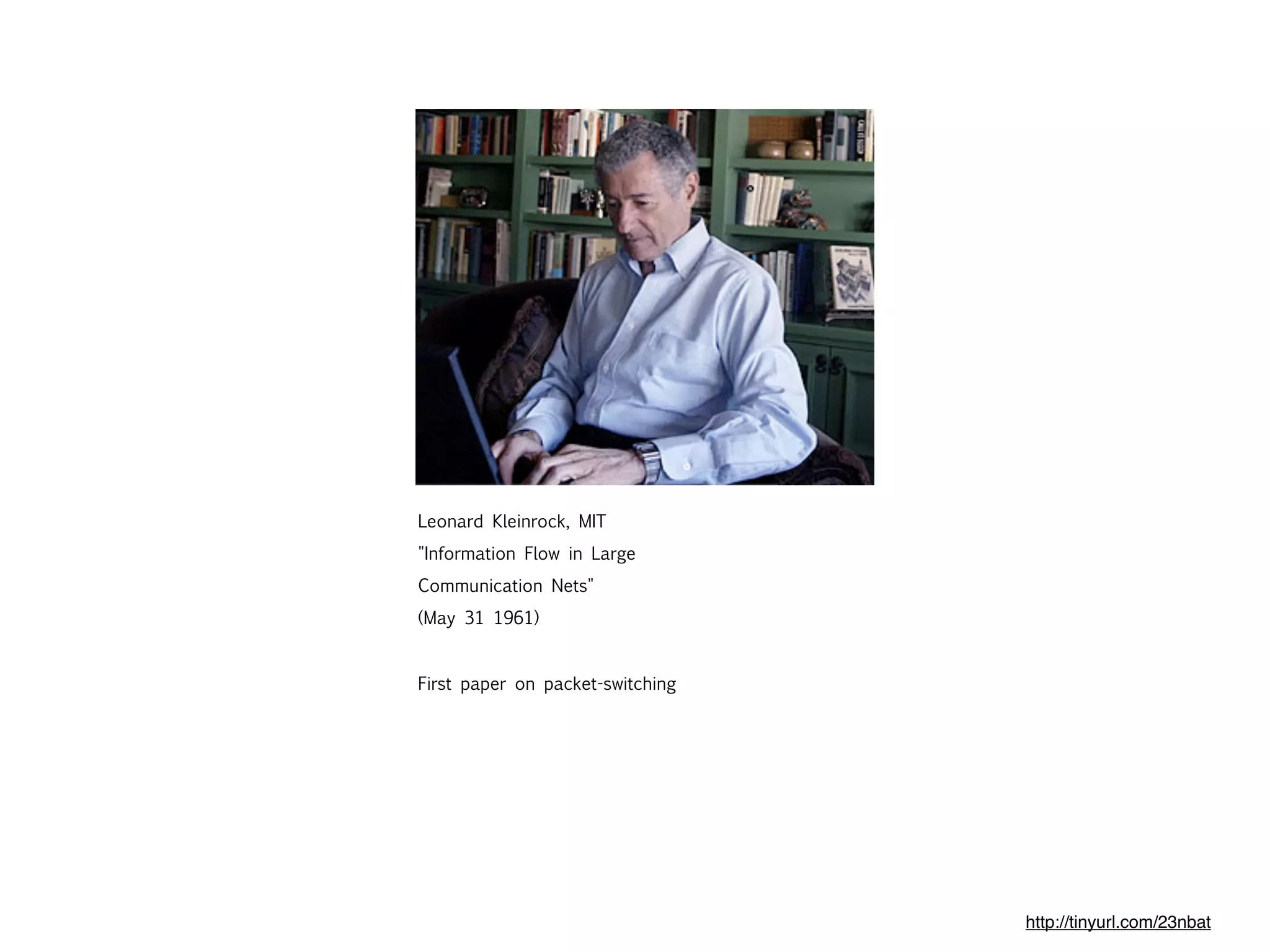
    20. Leonard Kleinrock, MIT \"Information Flow in Large Communication Nets\" (May 31 1961) First paper on packet-switching http://tinyurl.com/23nbat
    21. 1962
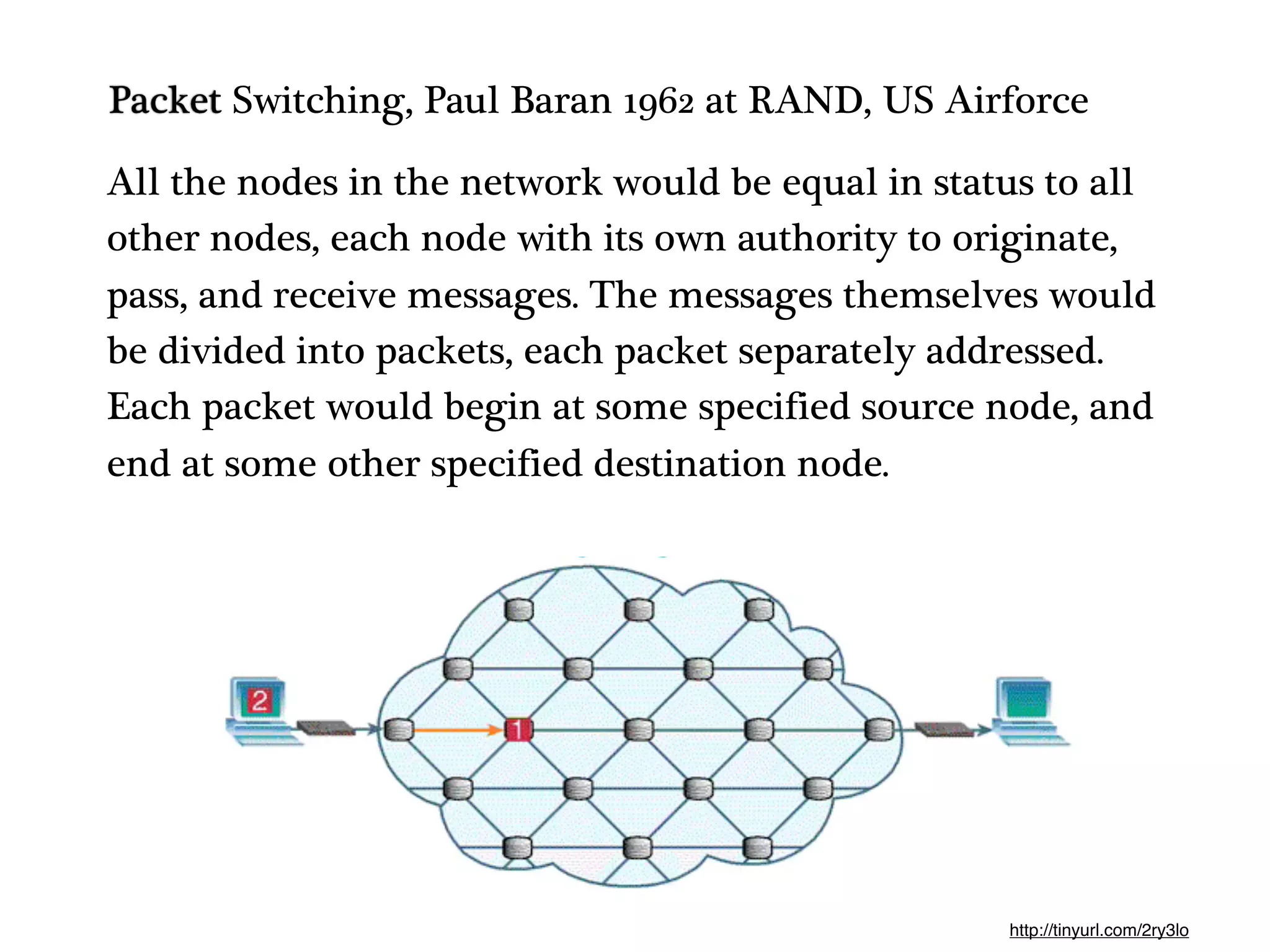
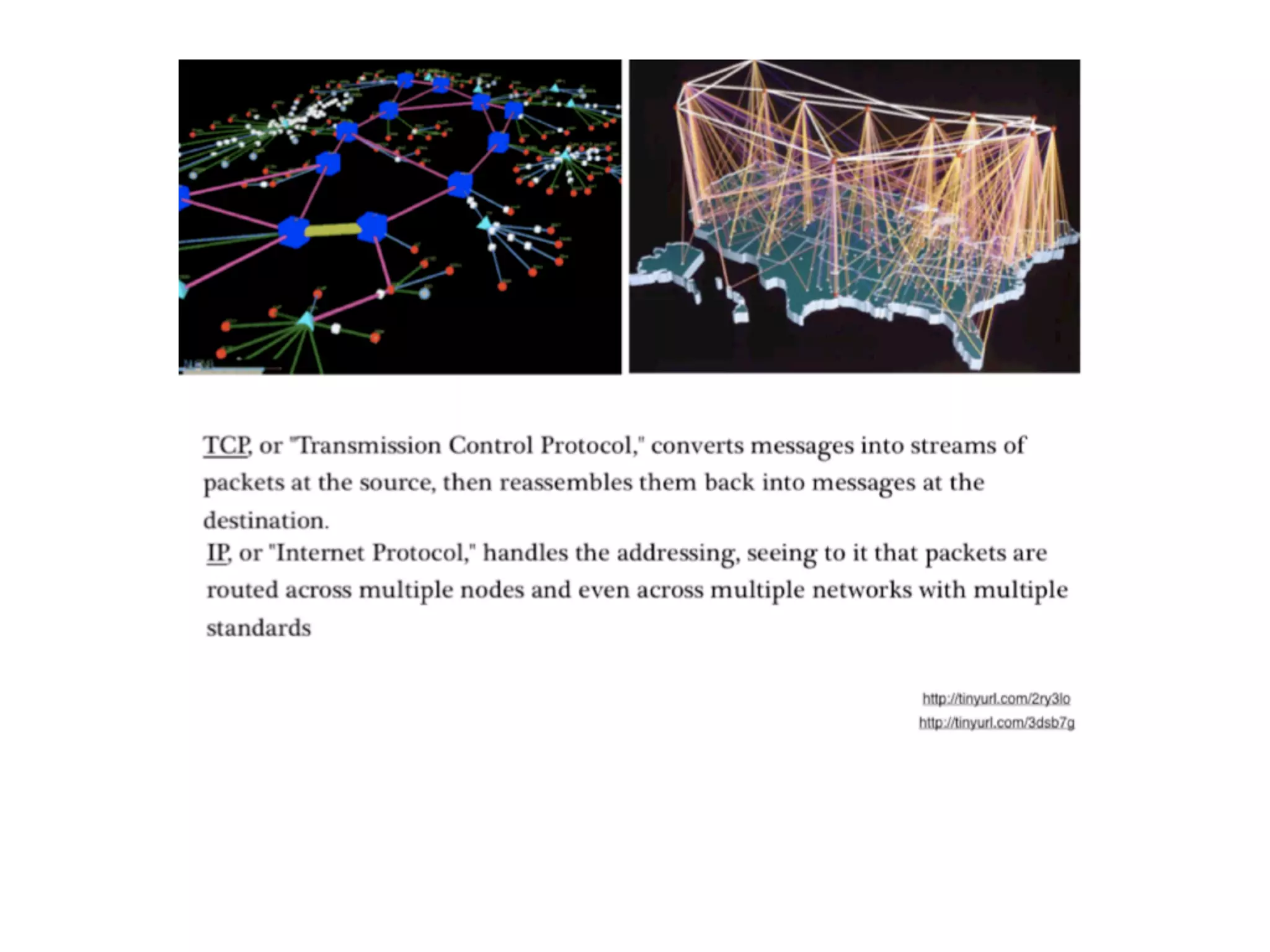
    22. Packet Switching, Paul Baran 1962 at RAND, US Airforce All the nodes in the network would be equal in status to all other nodes, each node with its own authority to originate, pass, and receive messages. The messages themselves would be divided into packets, each packet separately addressed. Each packet would begin at some specified source node, and end at some other specified destination node. http://tinyurl.com/2ry3lo
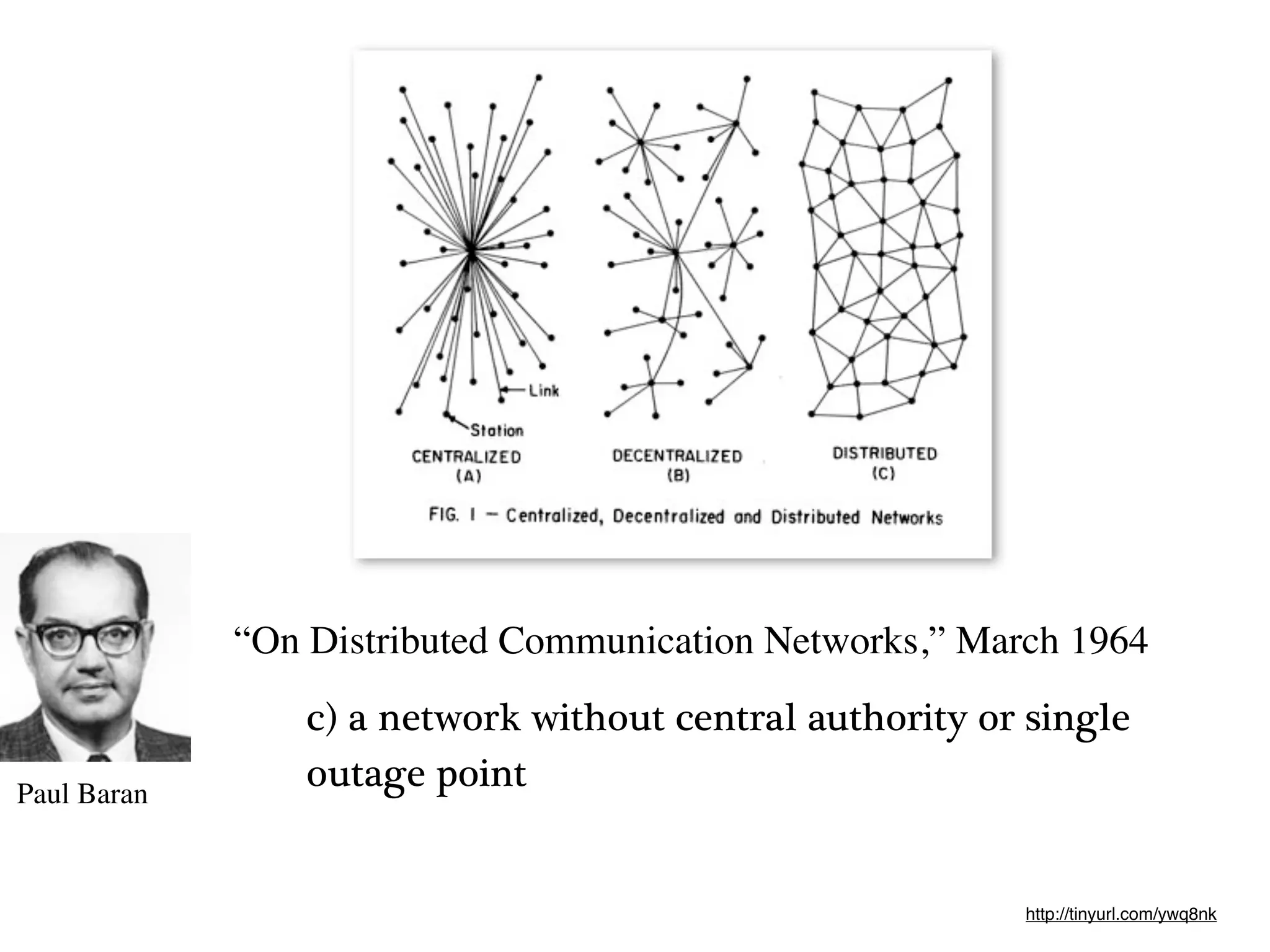
    23. “On Distributed Communication Networks,” March 1964 c) a network without central authority or single outage point Paul Baran http://tinyurl.com/ywq8nk
    24. 1965
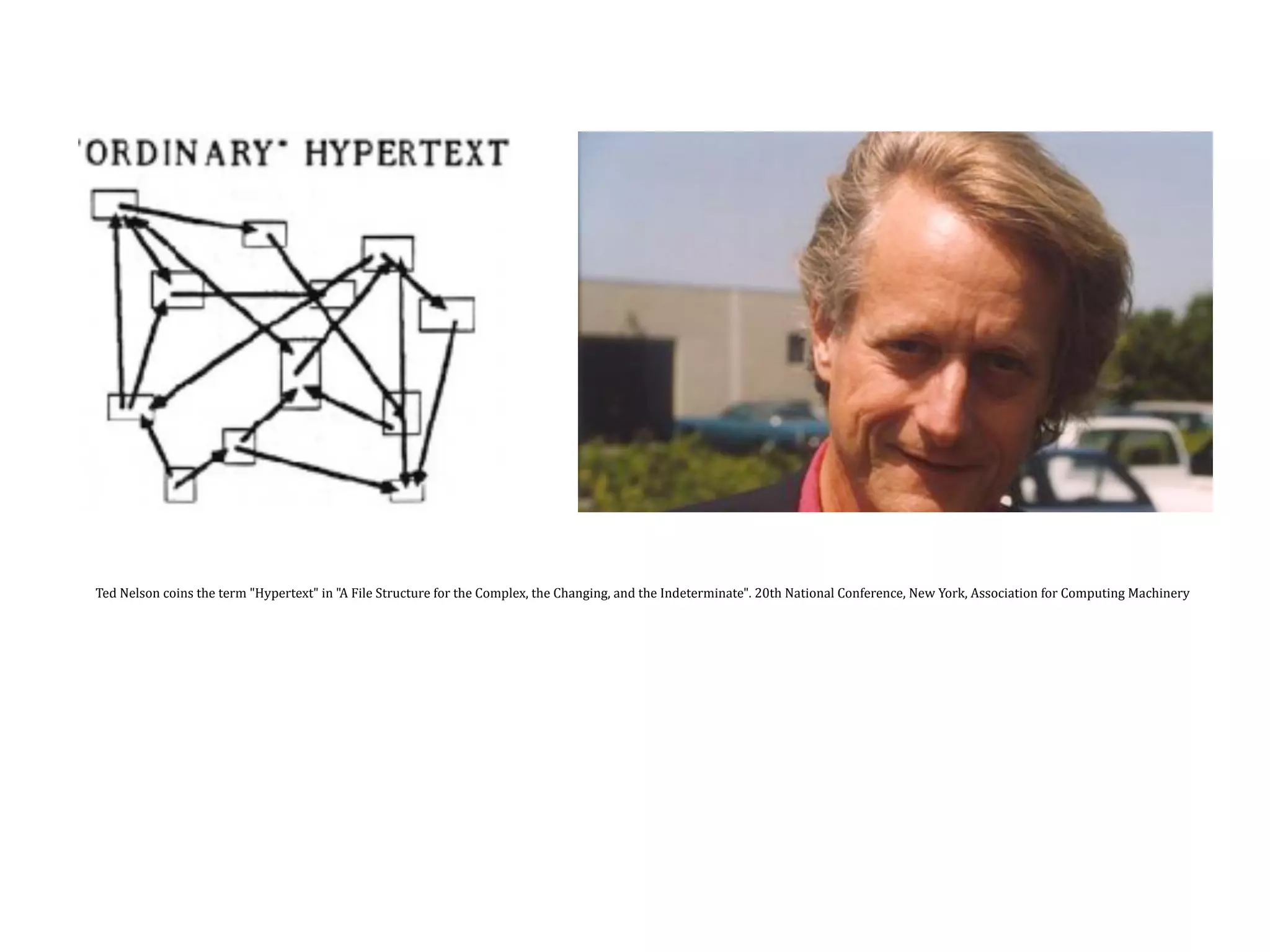
    25. Ted Nelson coins the term \"Hypertext\" in \"A File Structure for the Complex, the Changing, and the Indeterminate\". 20th National Conference, New York, Association for Computing Machinery
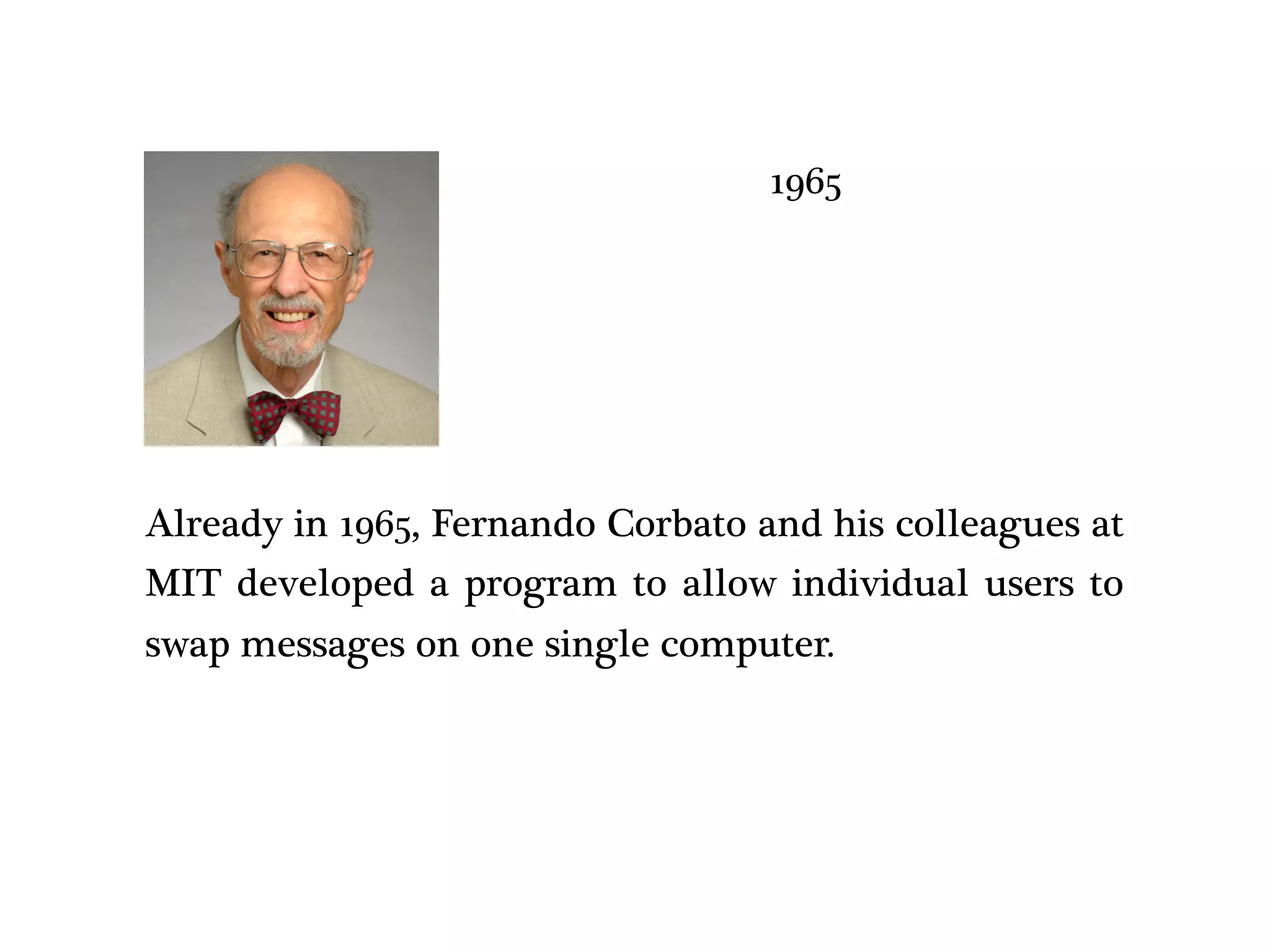
    26. 1965 Already in 1965, Fernando Corbato and his colleagues at MIT developed a program to allow individual users to swap messages on one single computer.
    27. 1967
    28. Excerpts from: American Experience | Summer of Love | PBS www.pbs.org/wgbh/amex/love/
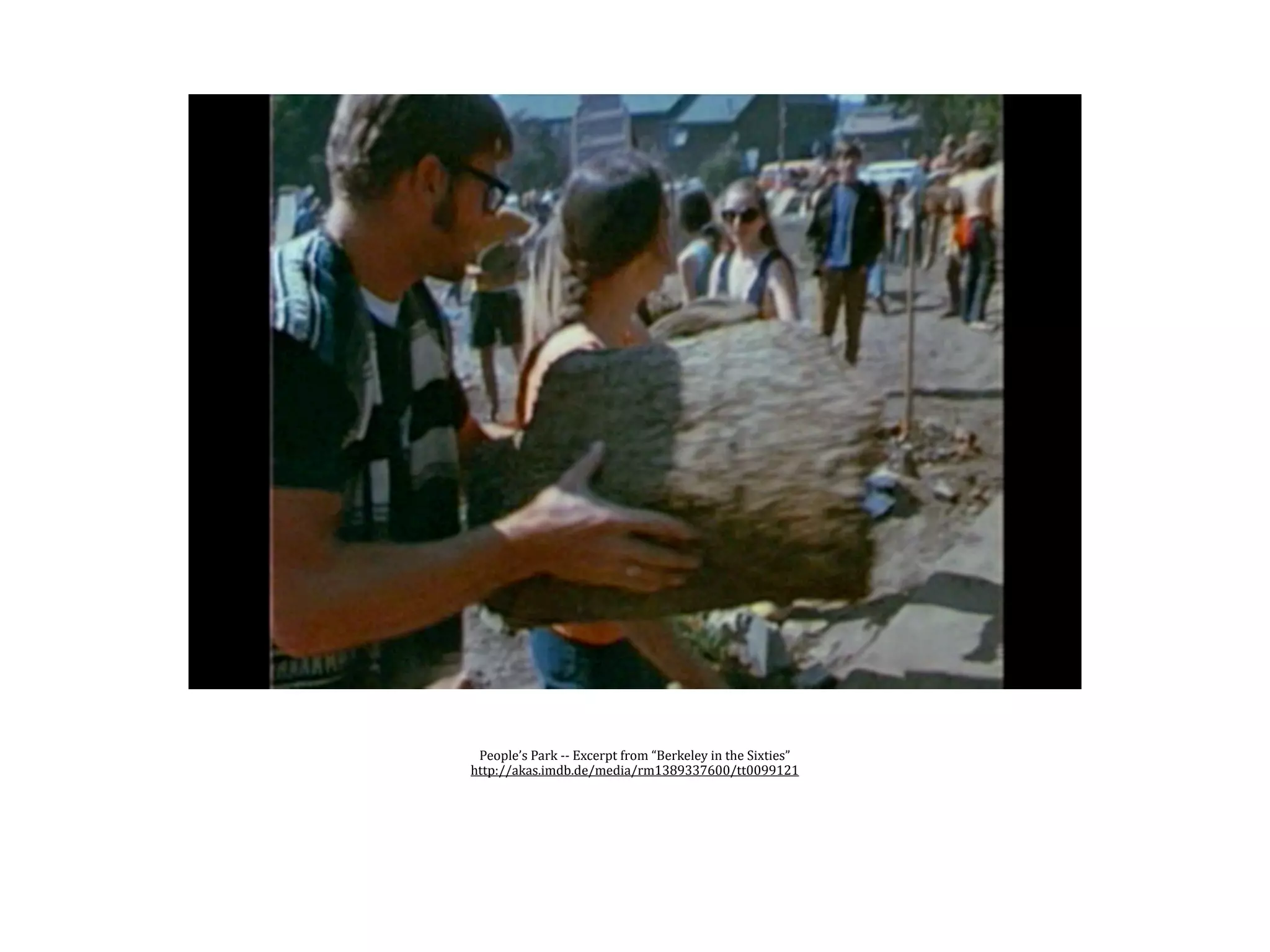
    29. People’s Park ‐‐ Excerpt from “Berkeley in the Sixties” http://akas.imdb.de/media/rm1389337600/tt0099121
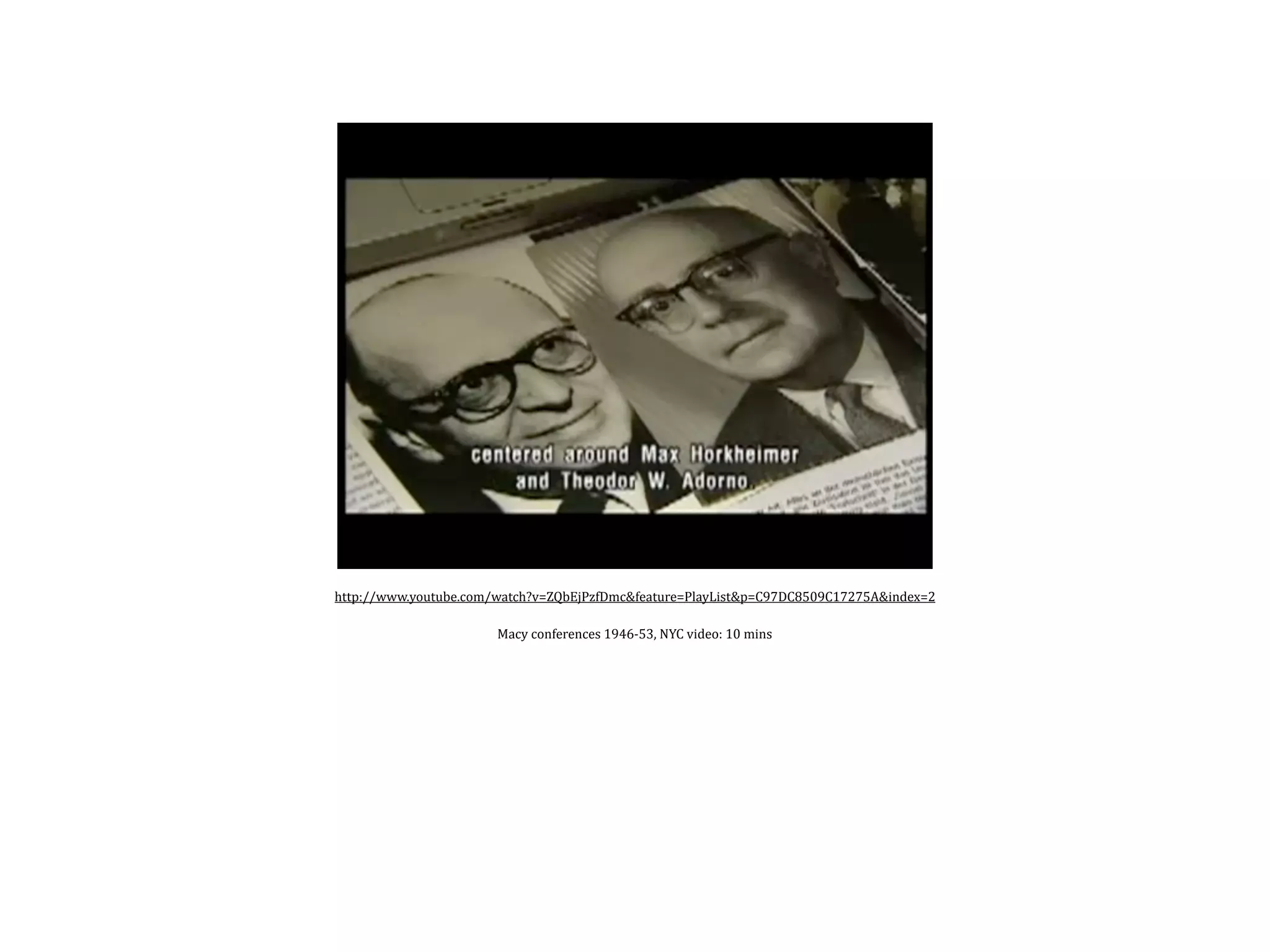
    30. http://www.youtube.com/watch?v=ZQbEjPzfDmc&feature=PlayList&p=C97DC8509C17275A&index=2 Macy conferences 1946‐53, NYC video: 10 mins
    31. Excerpts from: The Commune (2005) http://www.imdb.com/title/tt0439511/
    32. 1968
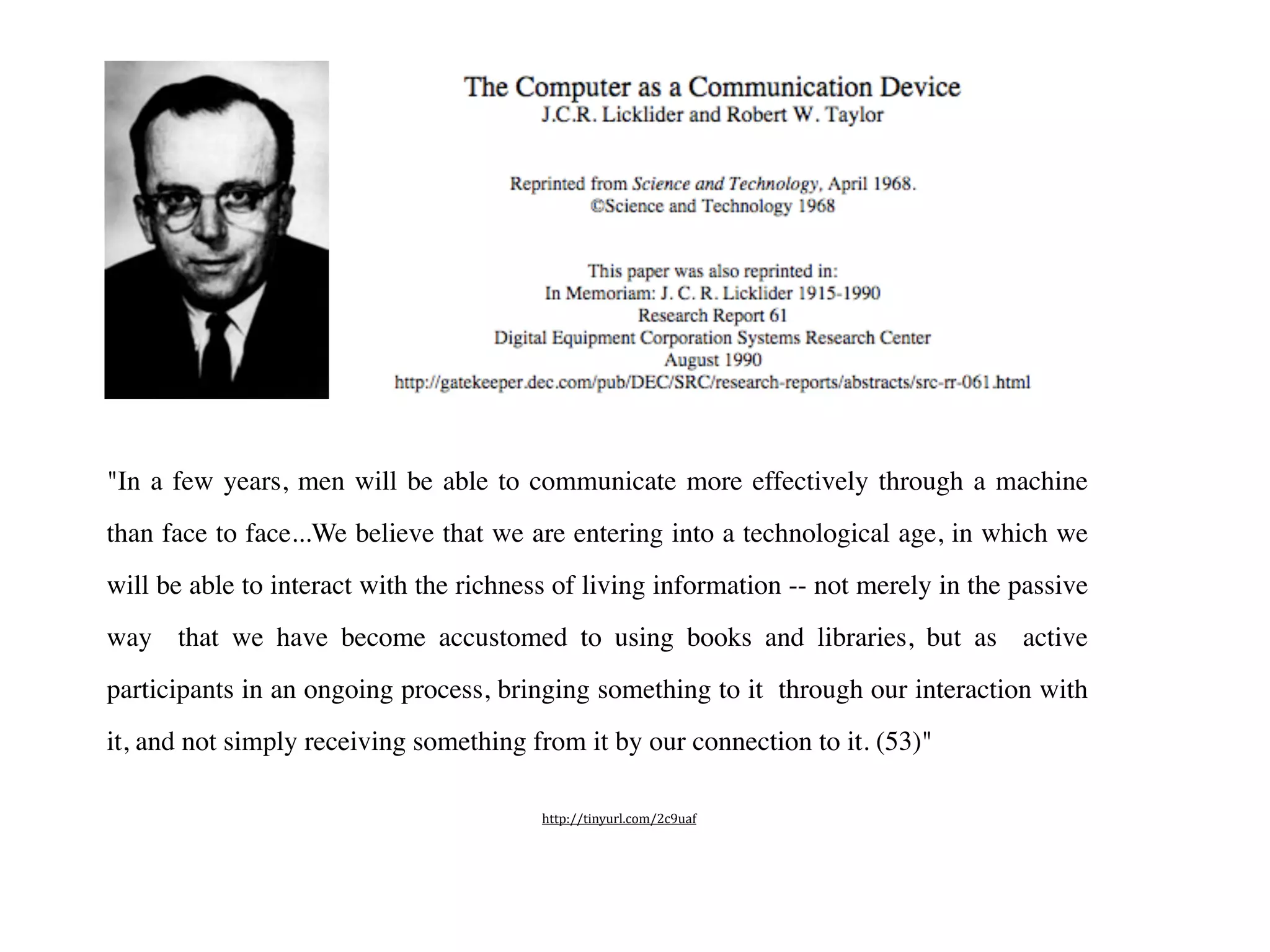
    33. \"In a few years, men will be able to communicate more effectively through a machine than face to face...We believe that we are entering into a technological age, in which we will be able to interact with the richness of living information -- not merely in the passive way that we have become accustomed to using books and libraries, but as active participants in an ongoing process, bringing something to it through our interaction with it, and not simply receiving something from it by our connection to it. (53)\" http://tinyurl.com/2c9uaf
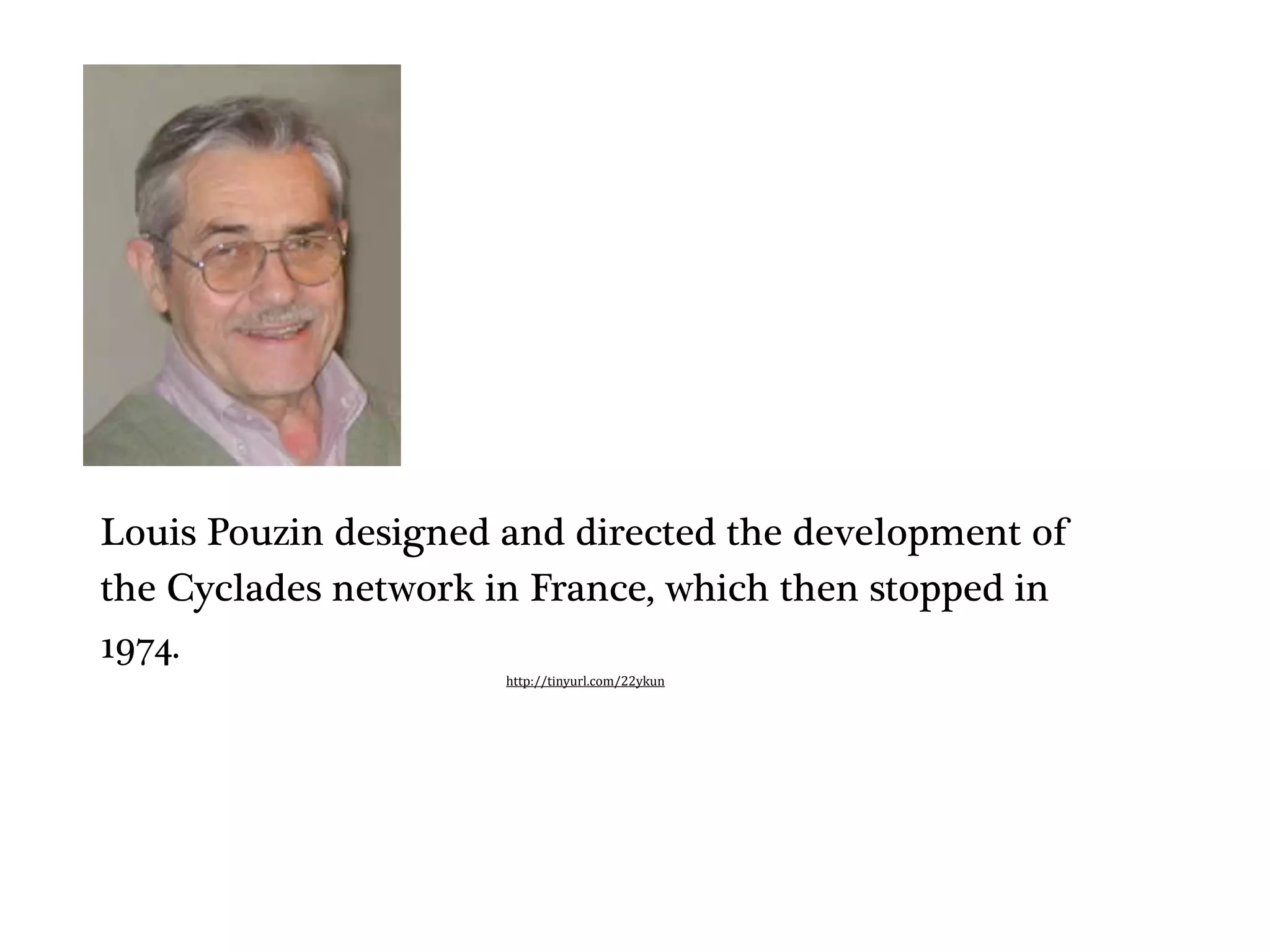
    34. Louis Pouzin designed and directed the development of the Cyclades network in France, which then stopped in 1974. http://tinyurl.com/22ykun
    35. 1969
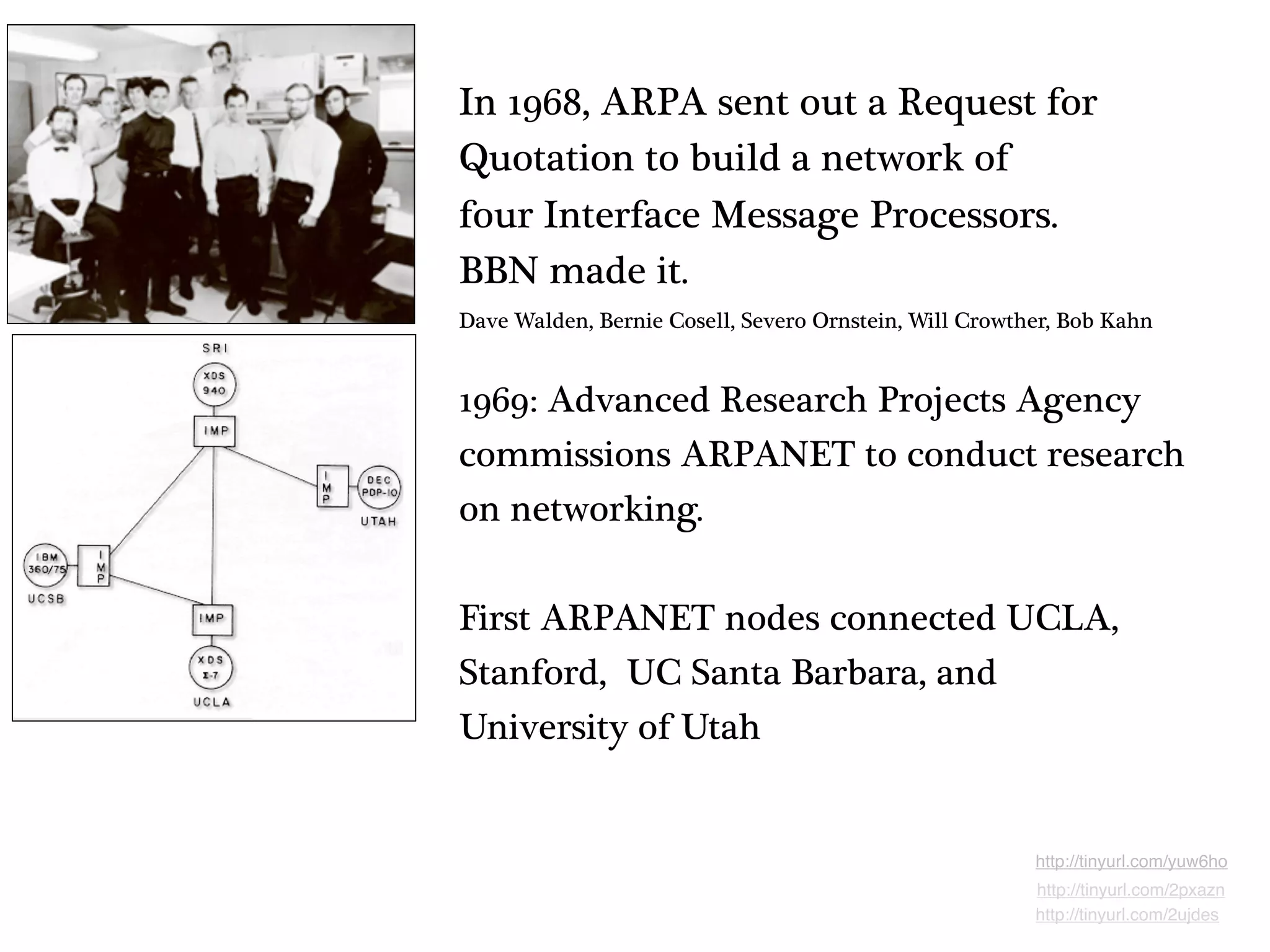
    36. In 1968, ARPA sent out a Request for Quotation to build a network of four Interface Message Processors. BBN made it. Dave Walden, Bernie Cosell, Severo Ornstein, Will Crowther, Bob Kahn 1969: Advanced Research Projects Agency commissions ARPANET to conduct research on networking. First ARPANET nodes connected UCLA, Stanford, UC Santa Barbara, and University of Utah http://tinyurl.com/yuw6ho http://tinyurl.com/2pxazn http://tinyurl.com/2ujdes
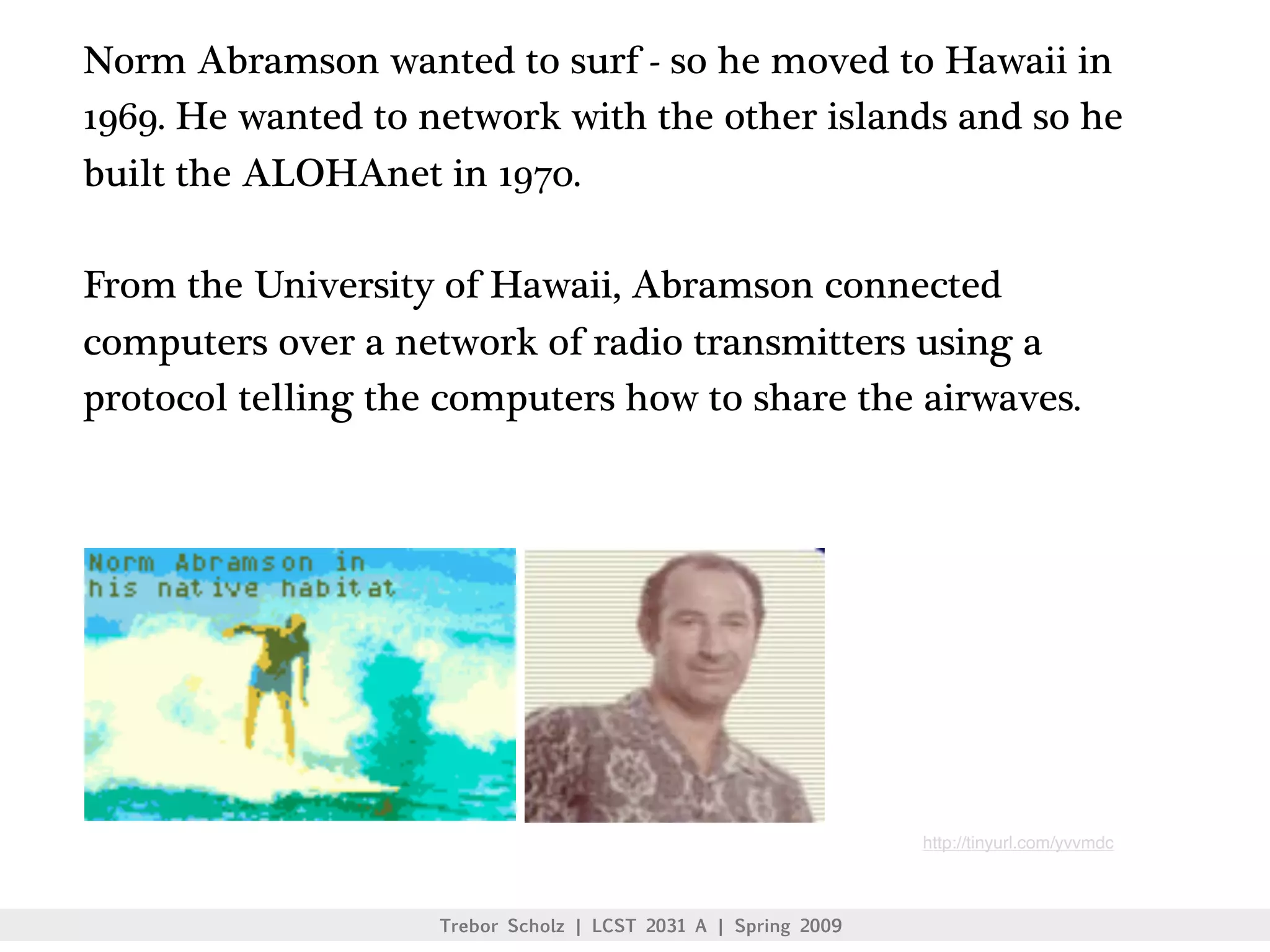
    37. Norm Abramson wanted to surf - so he moved to Hawaii in 1969. He wanted to network with the other islands and so he built the ALOHAnet in 1970. From the University of Hawaii, Abramson connected computers over a network of radio transmitters using a protocol telling the computers how to share the airwaves. http://tinyurl.com/yvvmdc Trebor Scholz | LCST 2031 A | Spring 2009
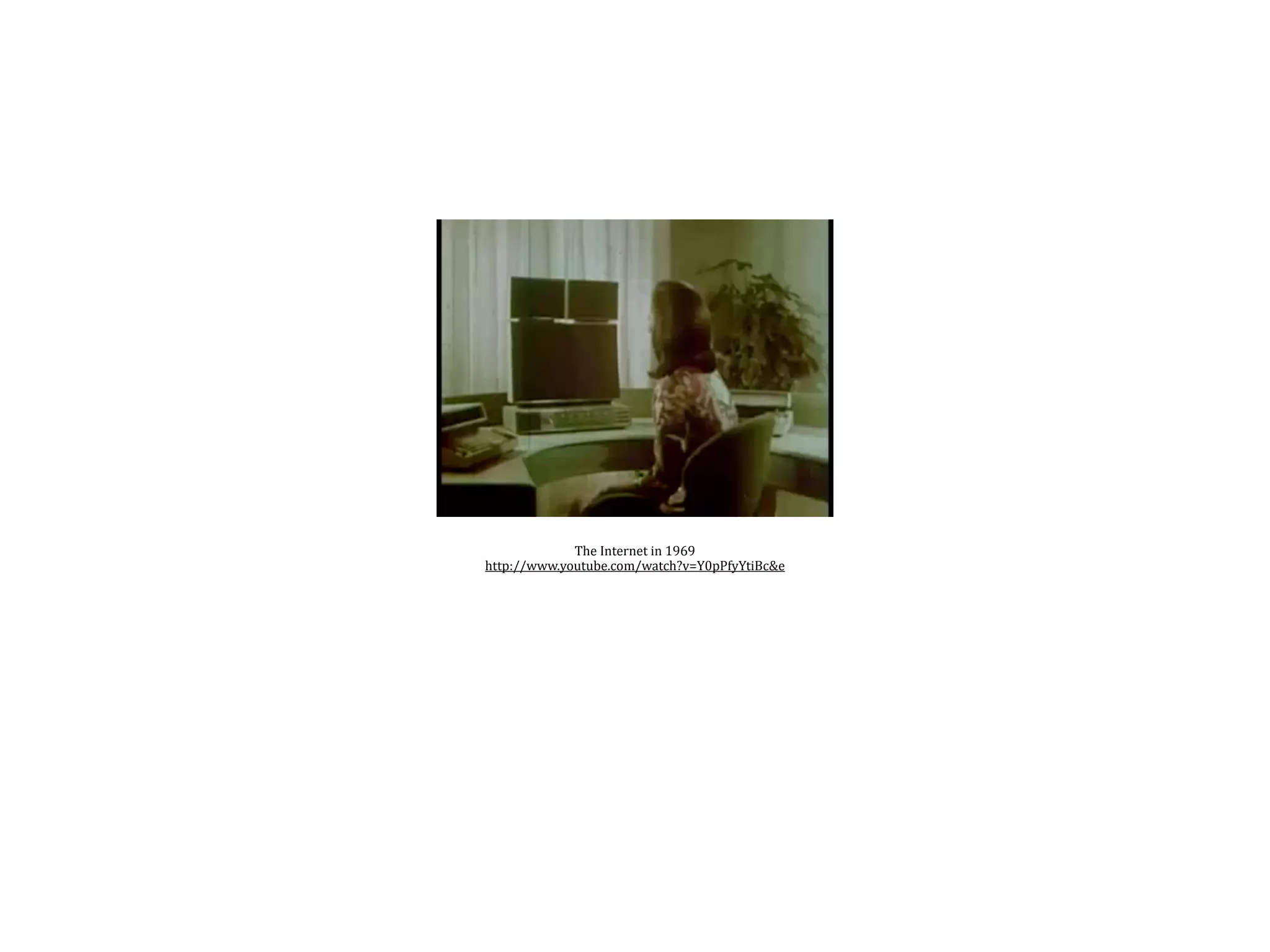
    38. The Internet in 1969 http://www.youtube.com/watch?v=Y0pPfyYtiBc&e
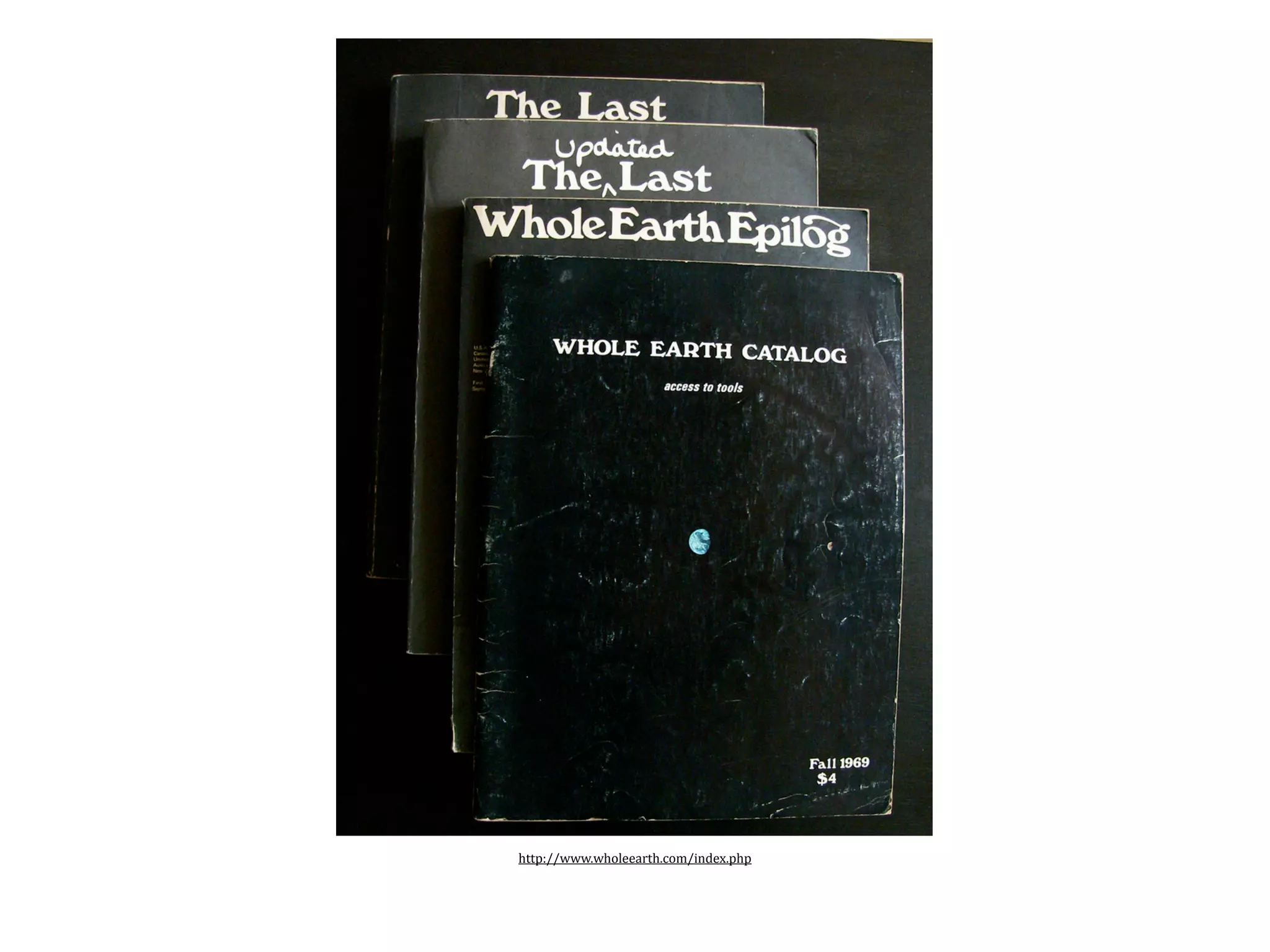
    39. http://www.wholeearth.com/index.php
    40. 1970
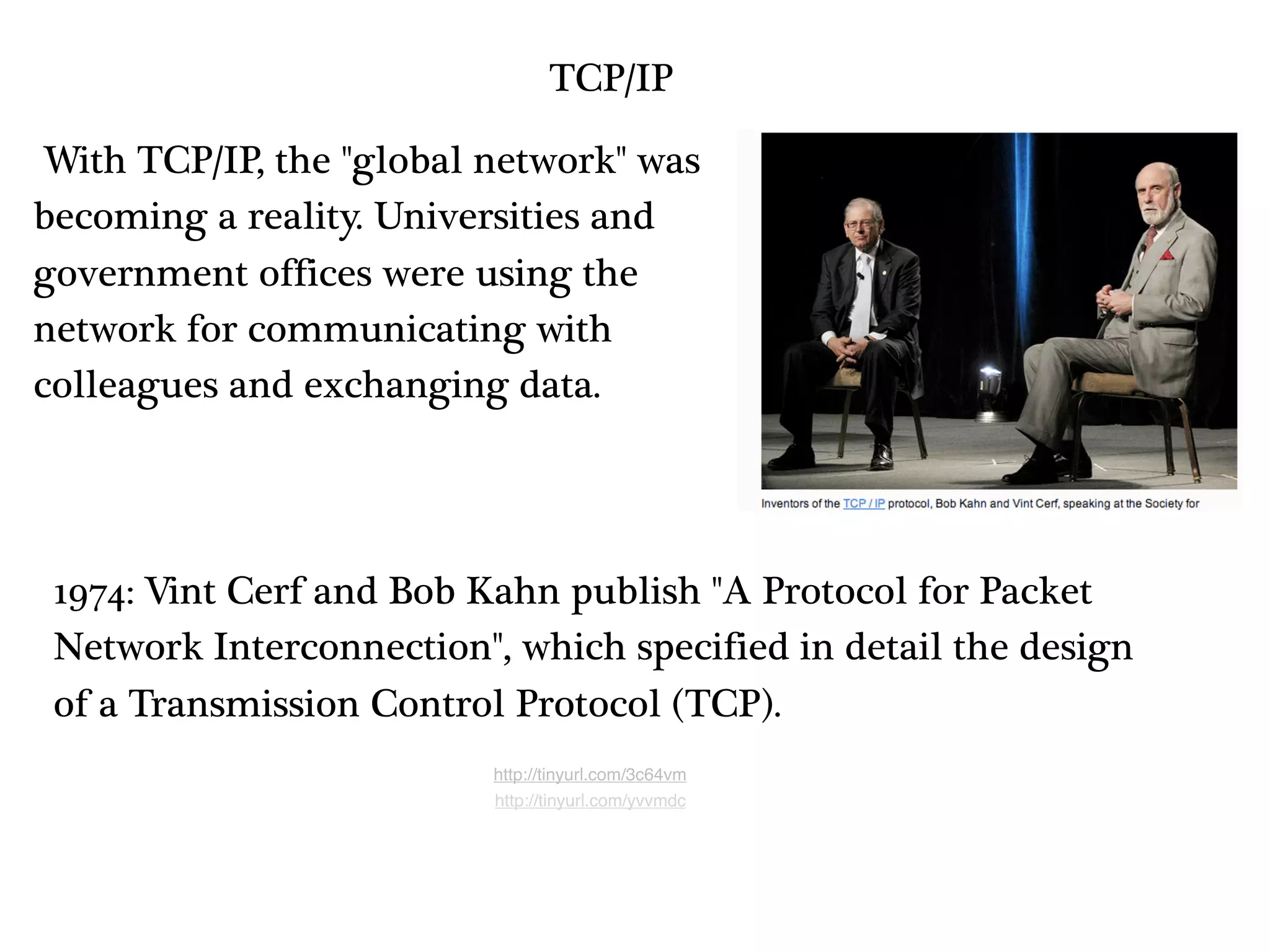
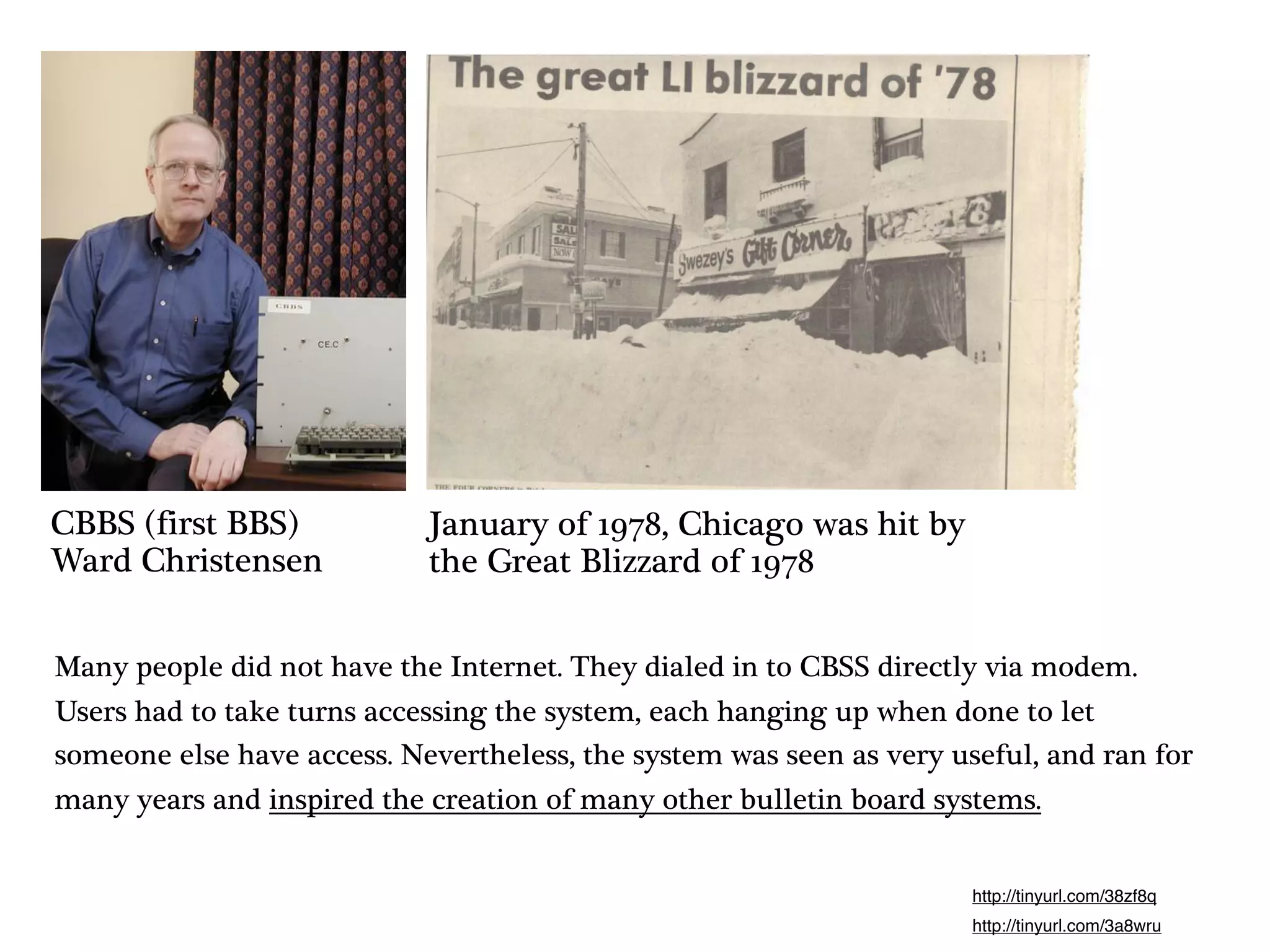
    41. TCP/IP With TCP/IP, the \"global network\" was becoming a reality. Universities and government offices were using the network for communicating with colleagues and exchanging data. 1974: Vint Cerf and Bob Kahn publish \"A Protocol for Packet Network Interconnection\", which specified in detail the design of a Transmission Control Protocol (TCP). http://tinyurl.com/3c64vm http://tinyurl.com/yvvmdc
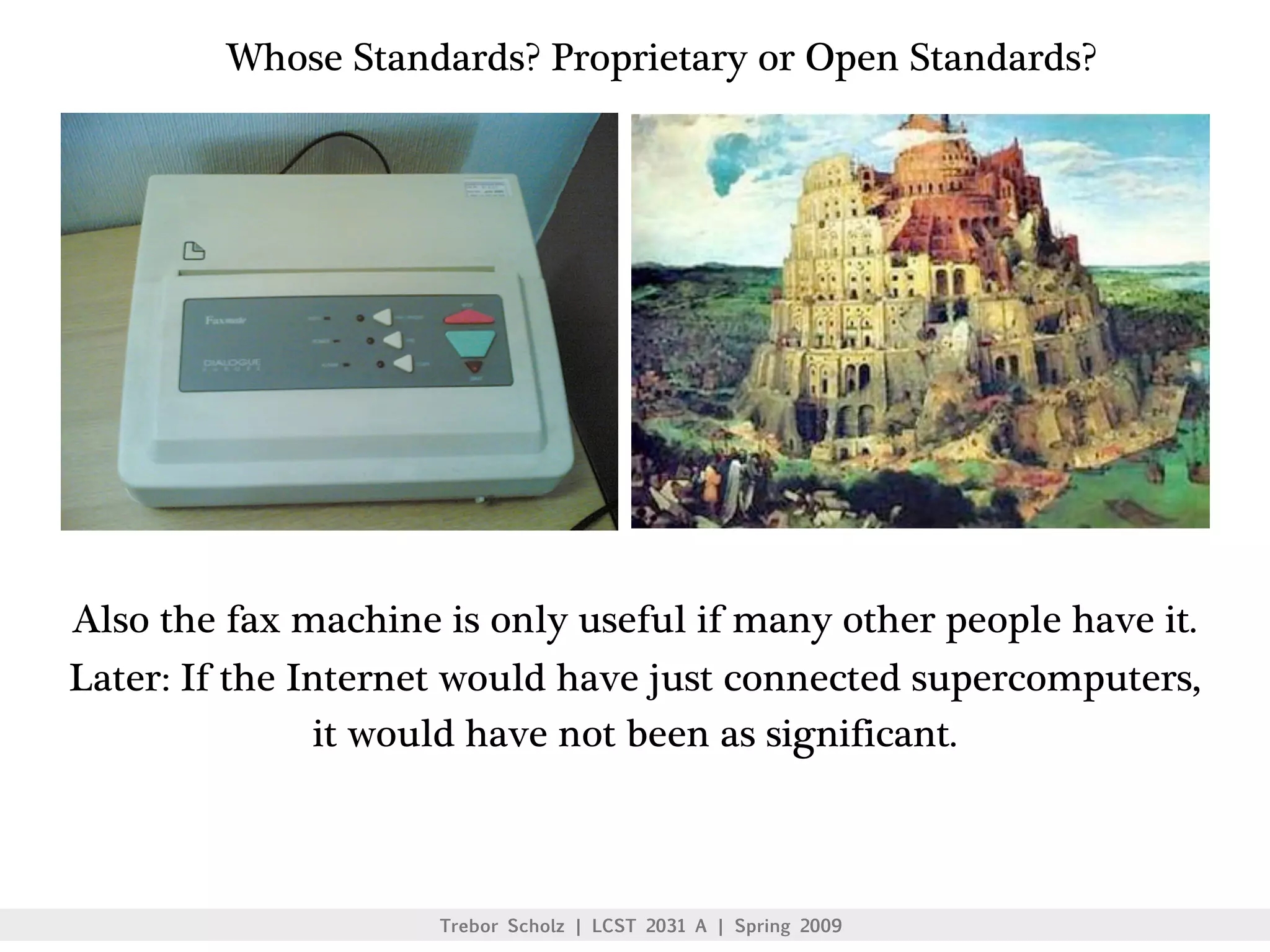
    42. Whose Standards? Proprietary or Open Standards? Also the fax machine is only useful if many other people have it. Later: If the Internet would have just connected supercomputers, it would have not been as significant. Trebor Scholz | LCST 2031 A | Spring 2009 http://tinyurl.com/yu7g2m
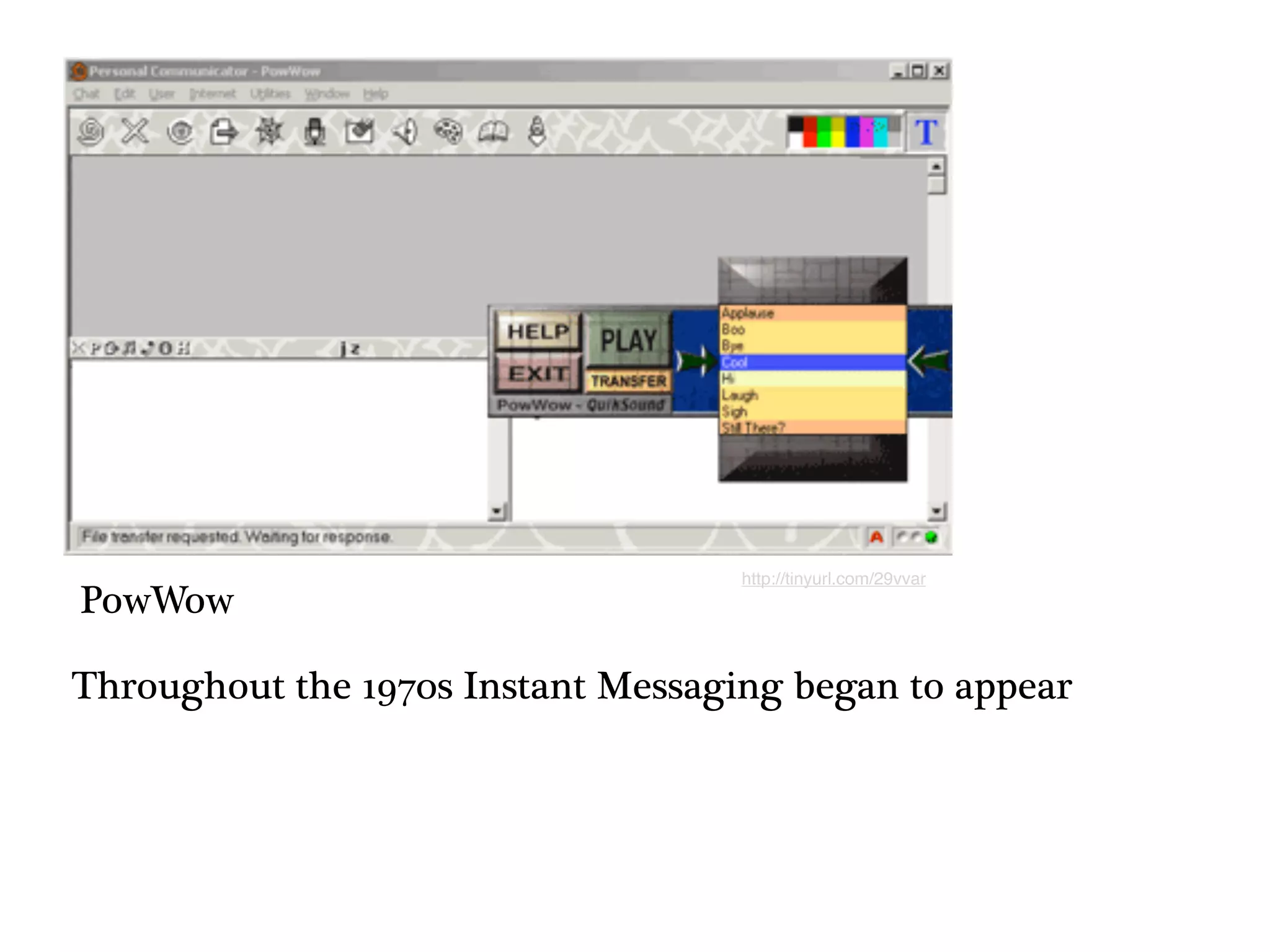
    43. http://tinyurl.com/29vvar PowWow Throughout the 1970s Instant Messaging began to appear
    44. •There was no single inventor of the Internet. •ARPANET, Usenet, BITNET, and BBS •DARPA was not solely a response to the fear of a nuclear armageddon.
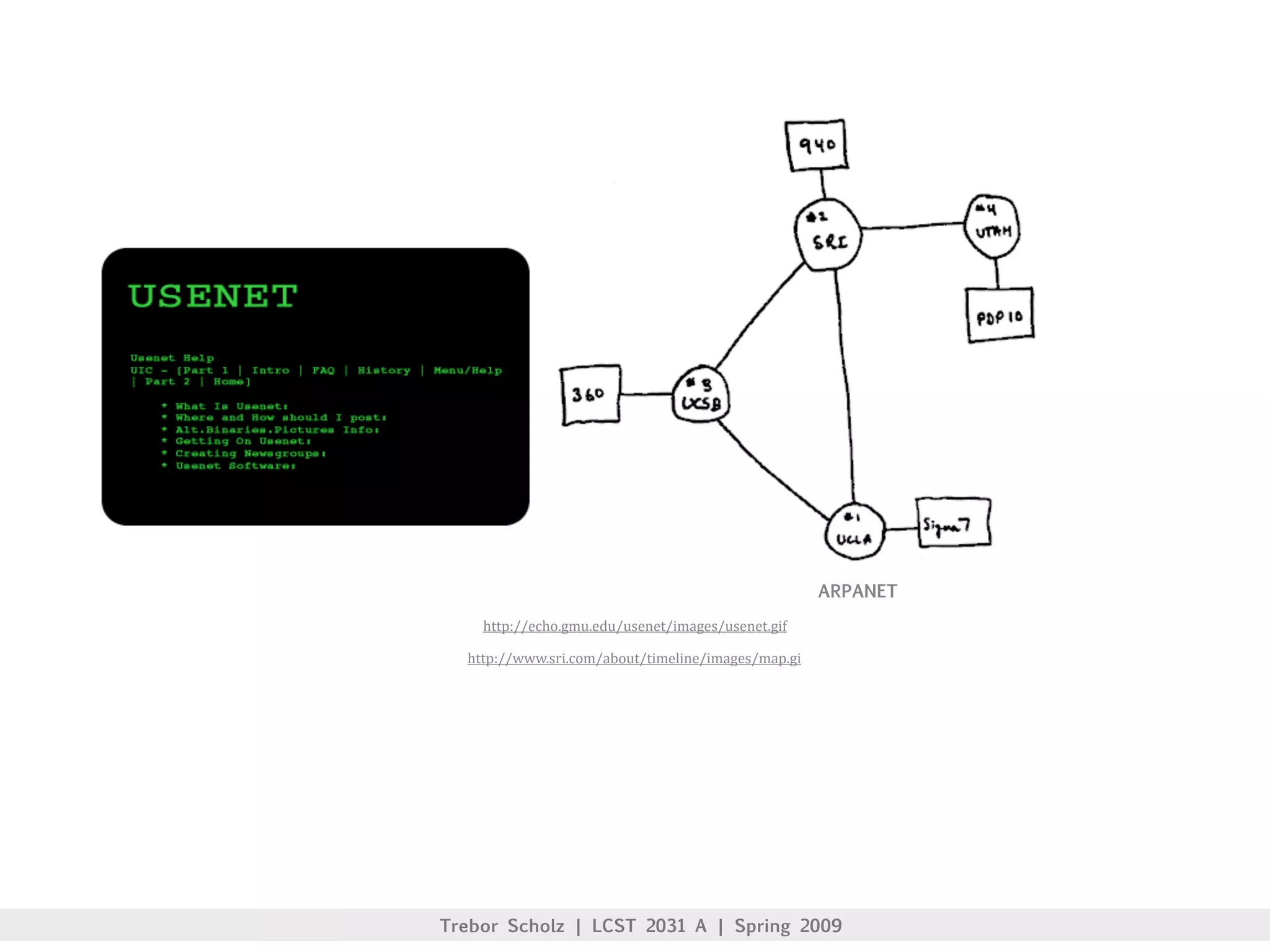
    45. 1971
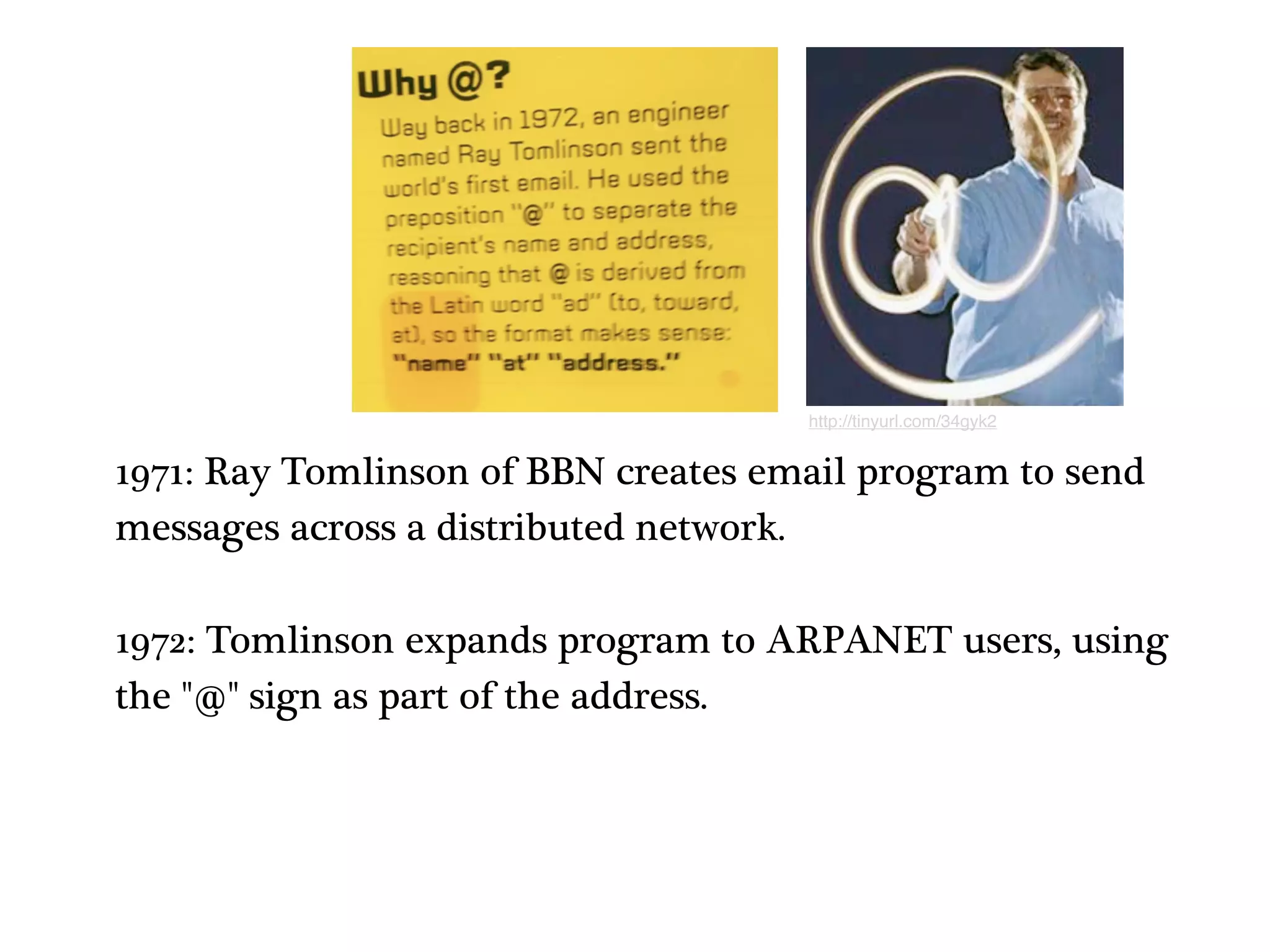
    46. http://tinyurl.com/34gyk2 1971: Ray Tomlinson of BBN creates email program to send messages across a distributed network. 1972: Tomlinson expands program to ARPANET users, using the \"@\" sign as part of the address.
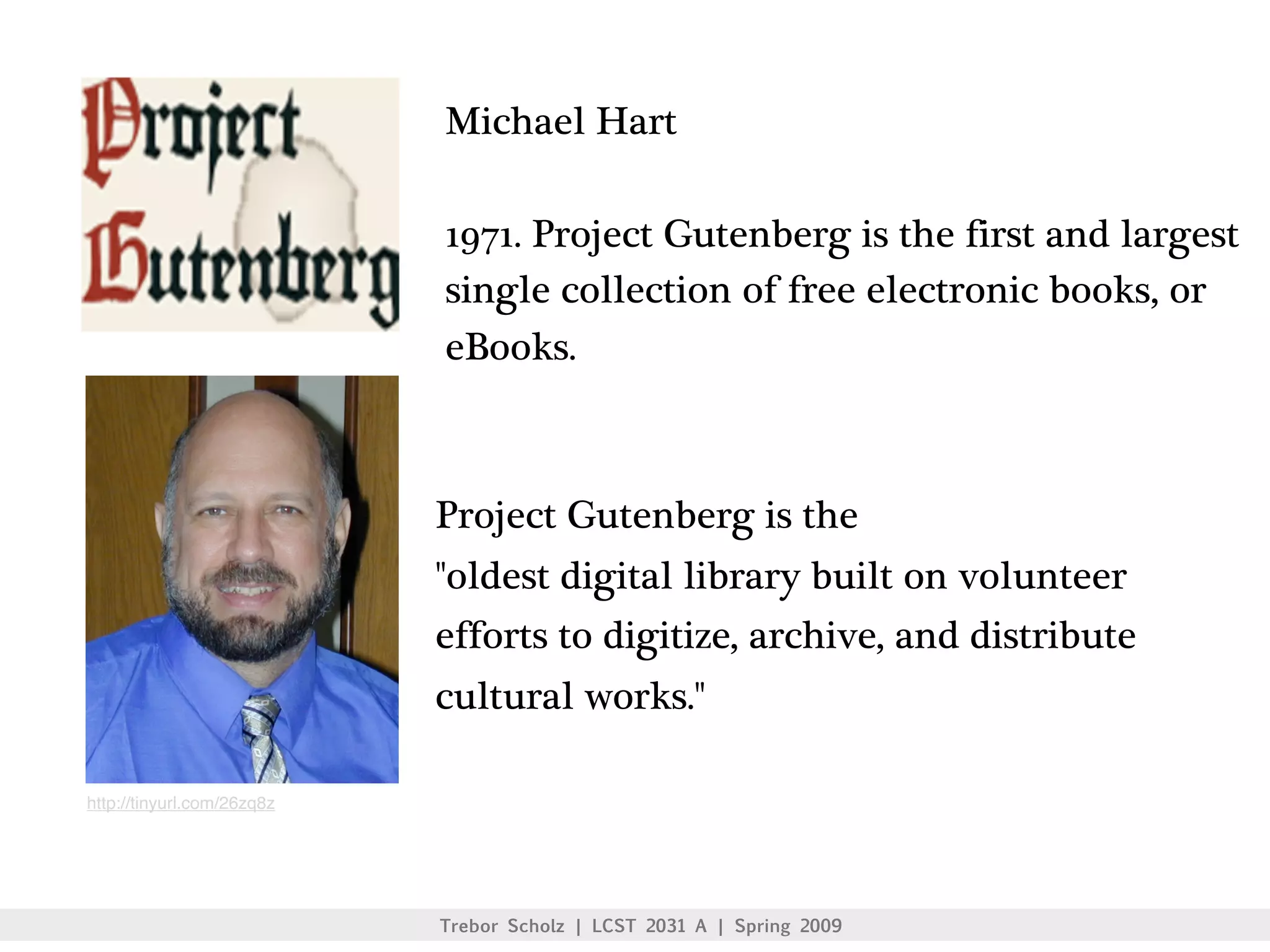
    47. Michael Hart 1971. Project Gutenberg is the first and largest single collection of free electronic books, or eBooks. Project Gutenberg is the \"oldest digital library built on volunteer efforts to digitize, archive, and distribute cultural works.\" http://tinyurl.com/26zq8z Trebor Scholz | LCST 2031 A | Spring 2009
    48. 1977
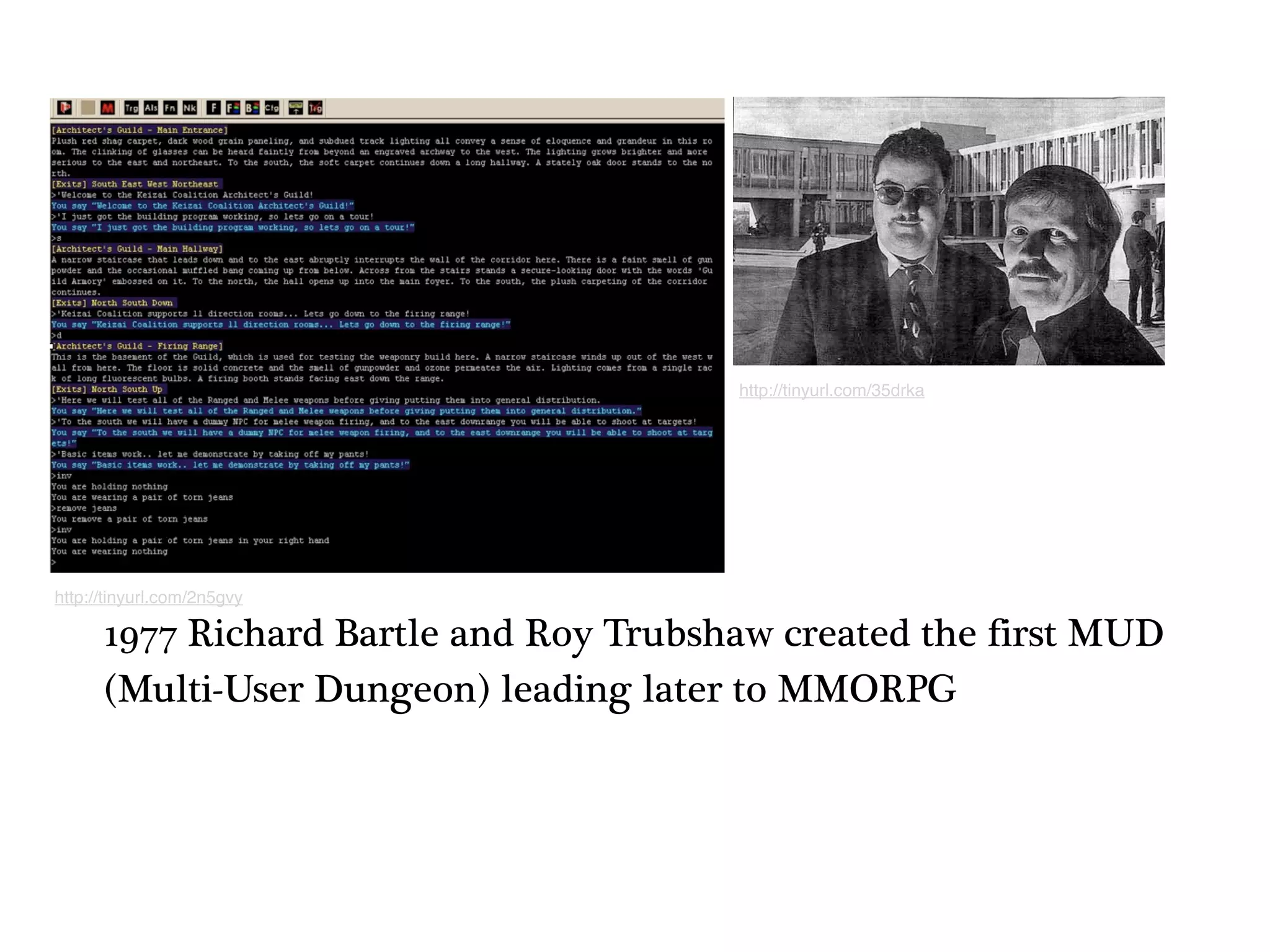
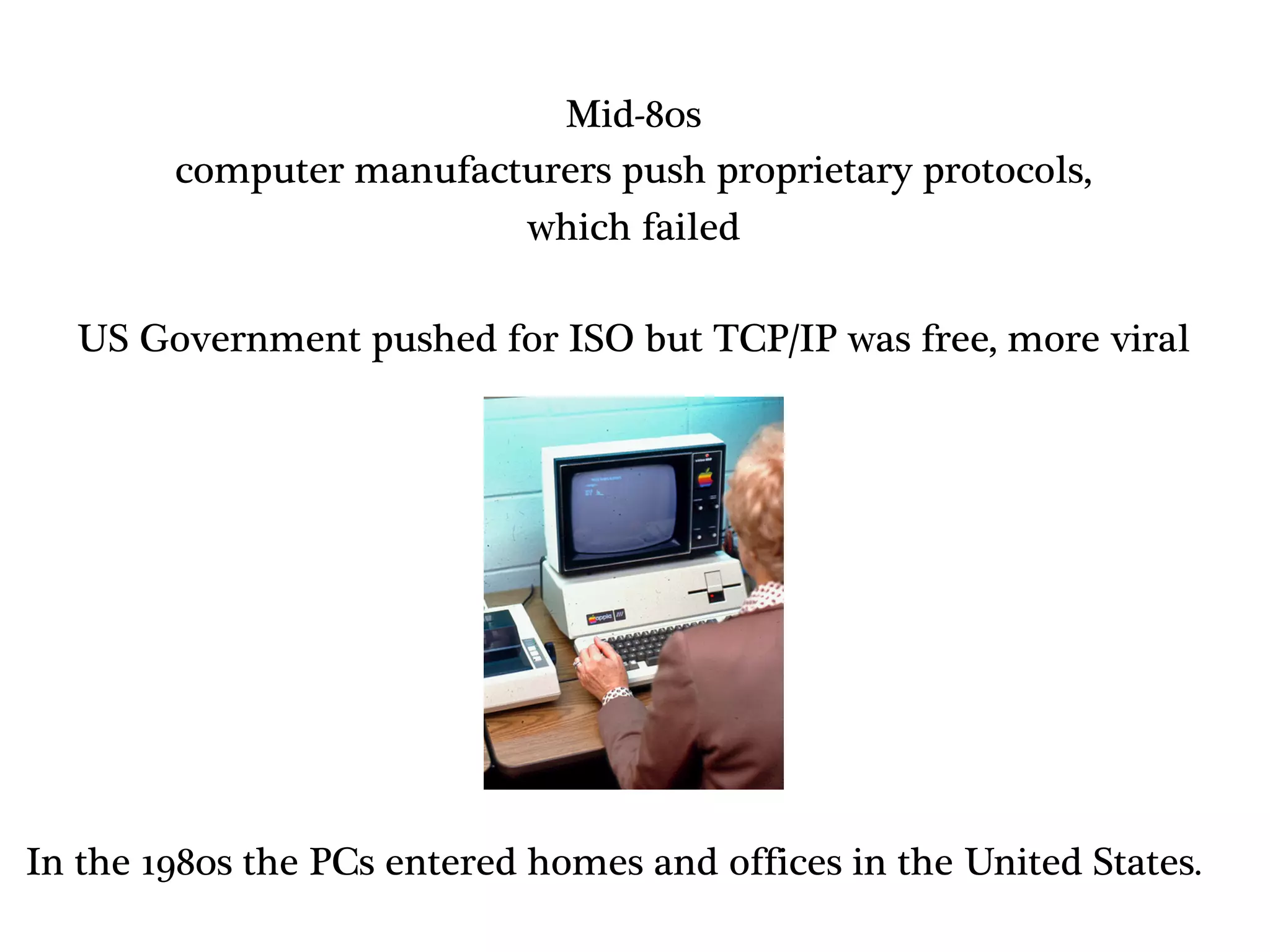
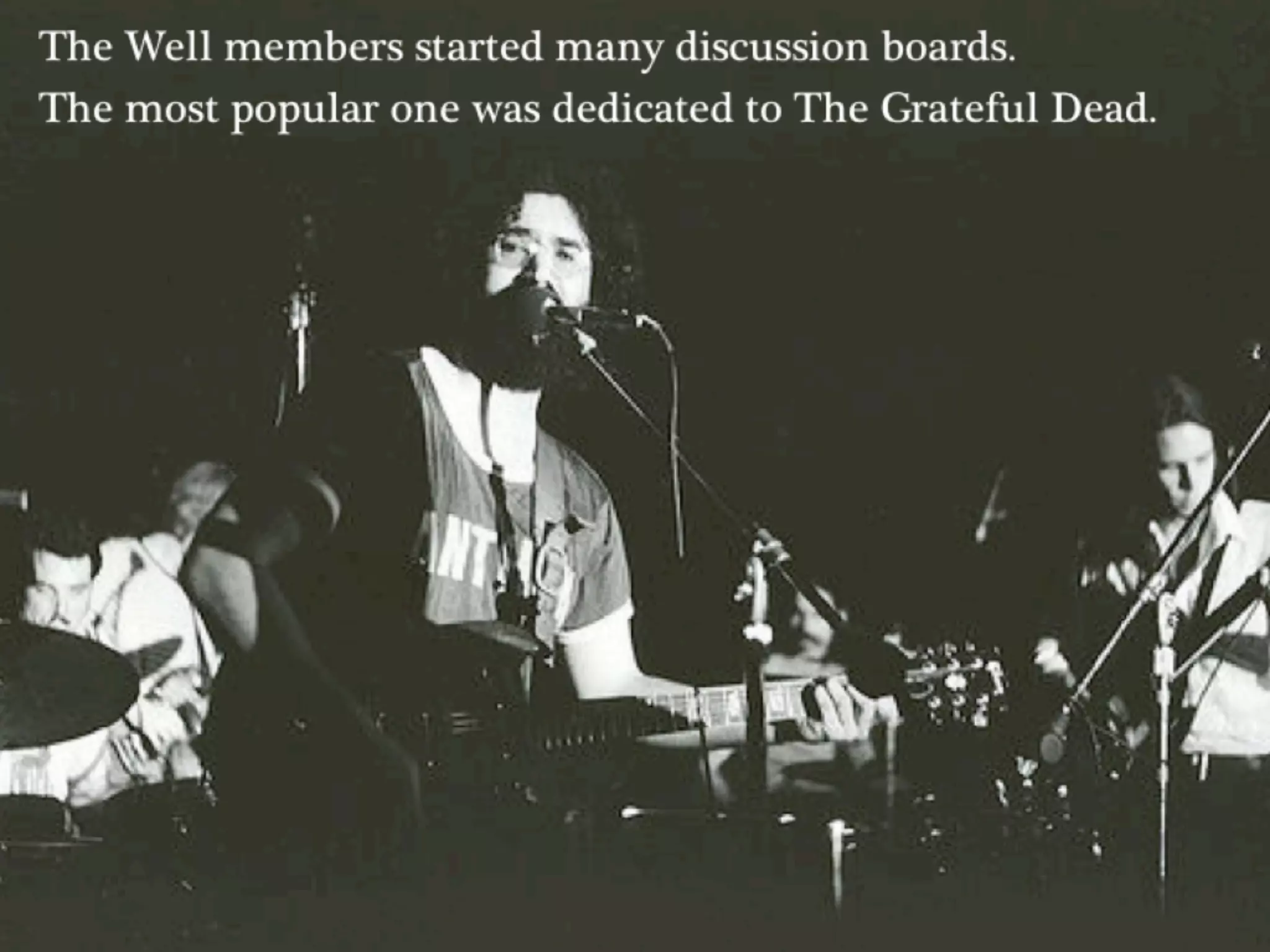
    49. http://tinyurl.com/35drka http://tinyurl.com/2n5gvy 1977 Richard Bartle and Roy Trubshaw created the first MUD (Multi-User Dungeon) leading later to MMORPG
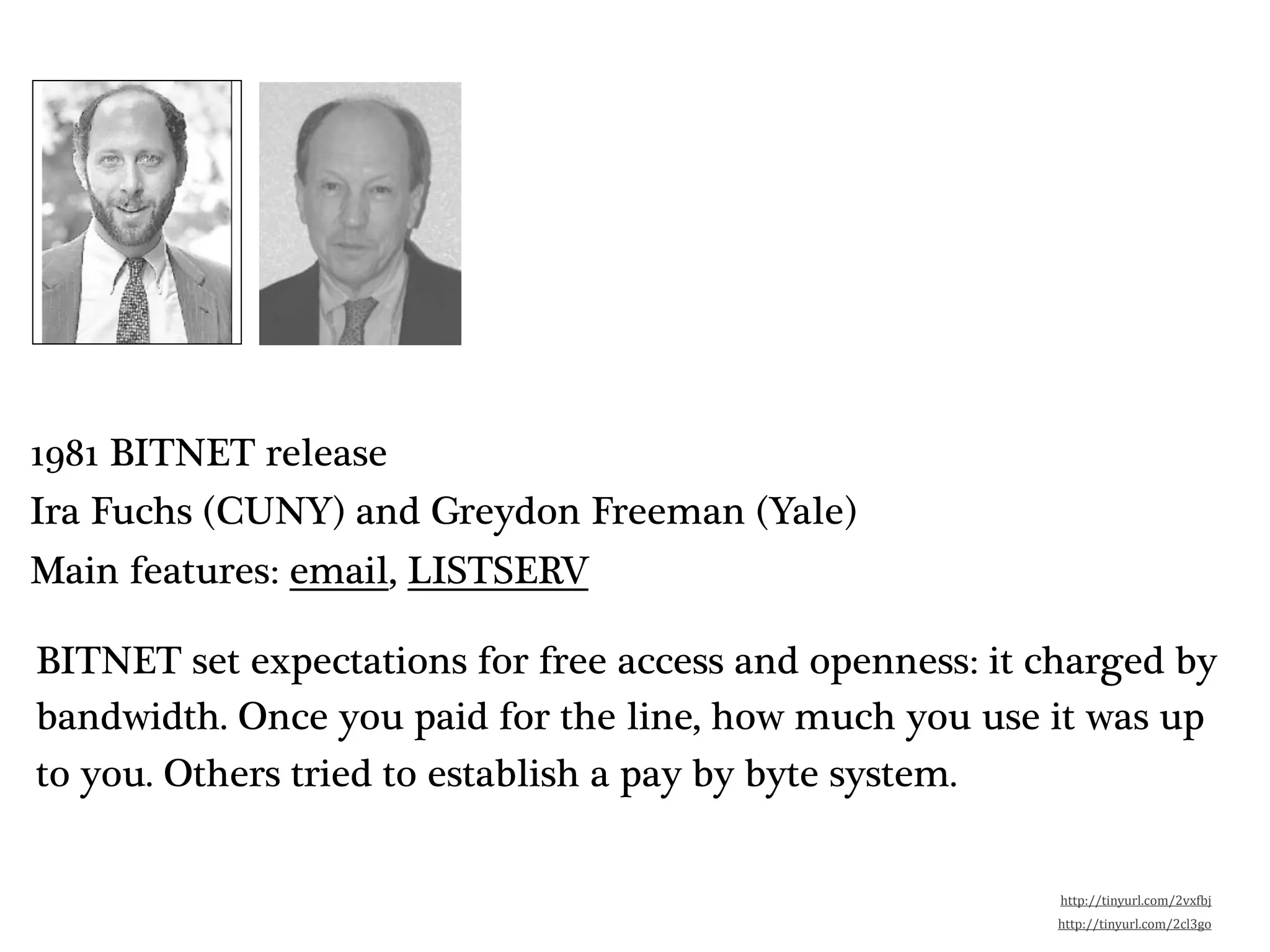
    50. 1978
    51. CBBS (first BBS) January of 1978, Chicago was hit by Ward Christensen the Great Blizzard of 1978 Many people did not have the Internet. They dialed in to CBSS directly via modem. Users had to take turns accessing the system, each hanging up when done to let someone else have access. Nevertheless, the system was seen as very useful, and ran for many years and inspired the creation of many other bulletin board systems. http://tinyurl.com/38zf8q http://tinyurl.com/3a8wru
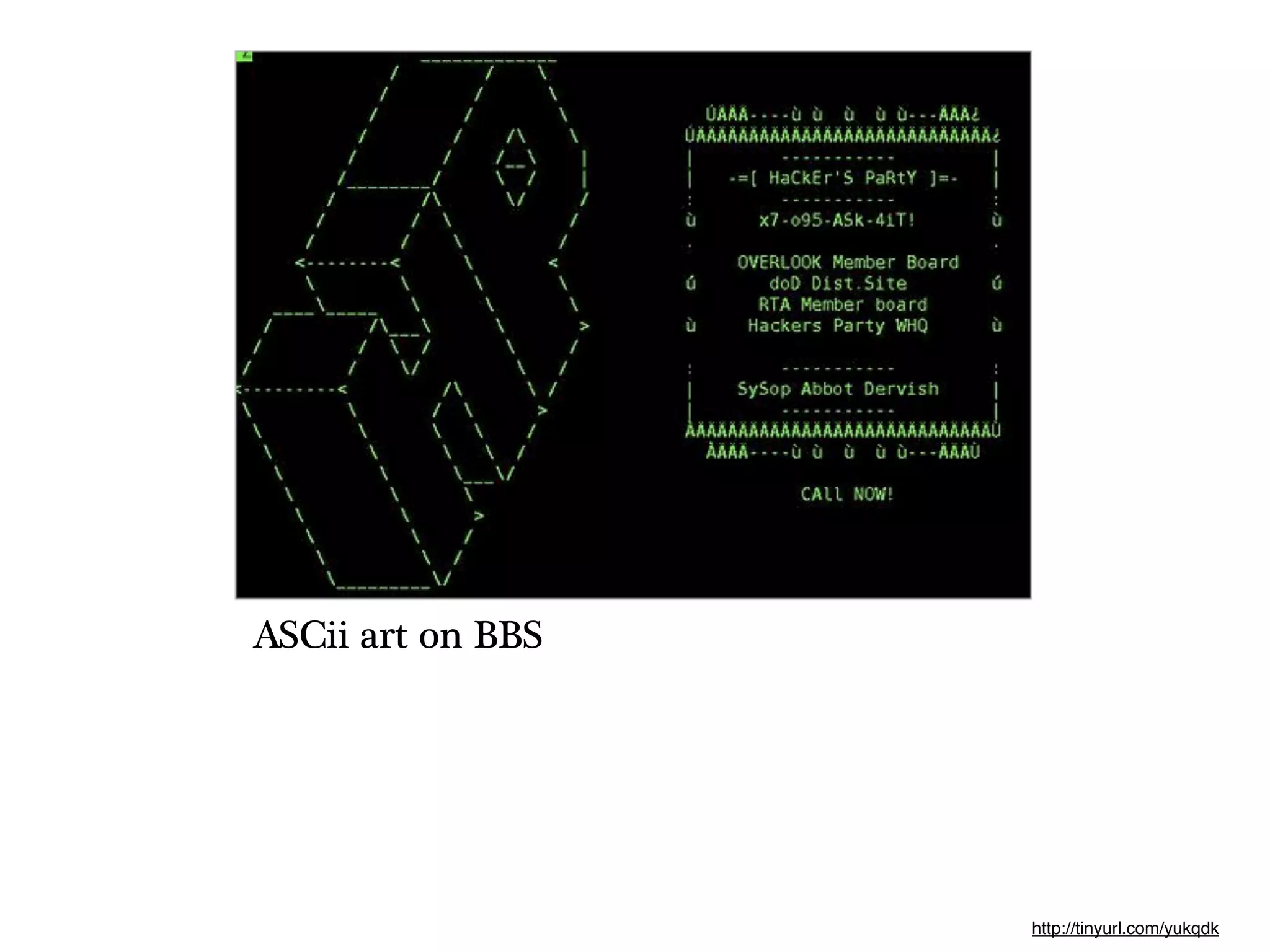
    52. ASCii art on BBS http://tinyurl.com/yukqdk
    53. 1979
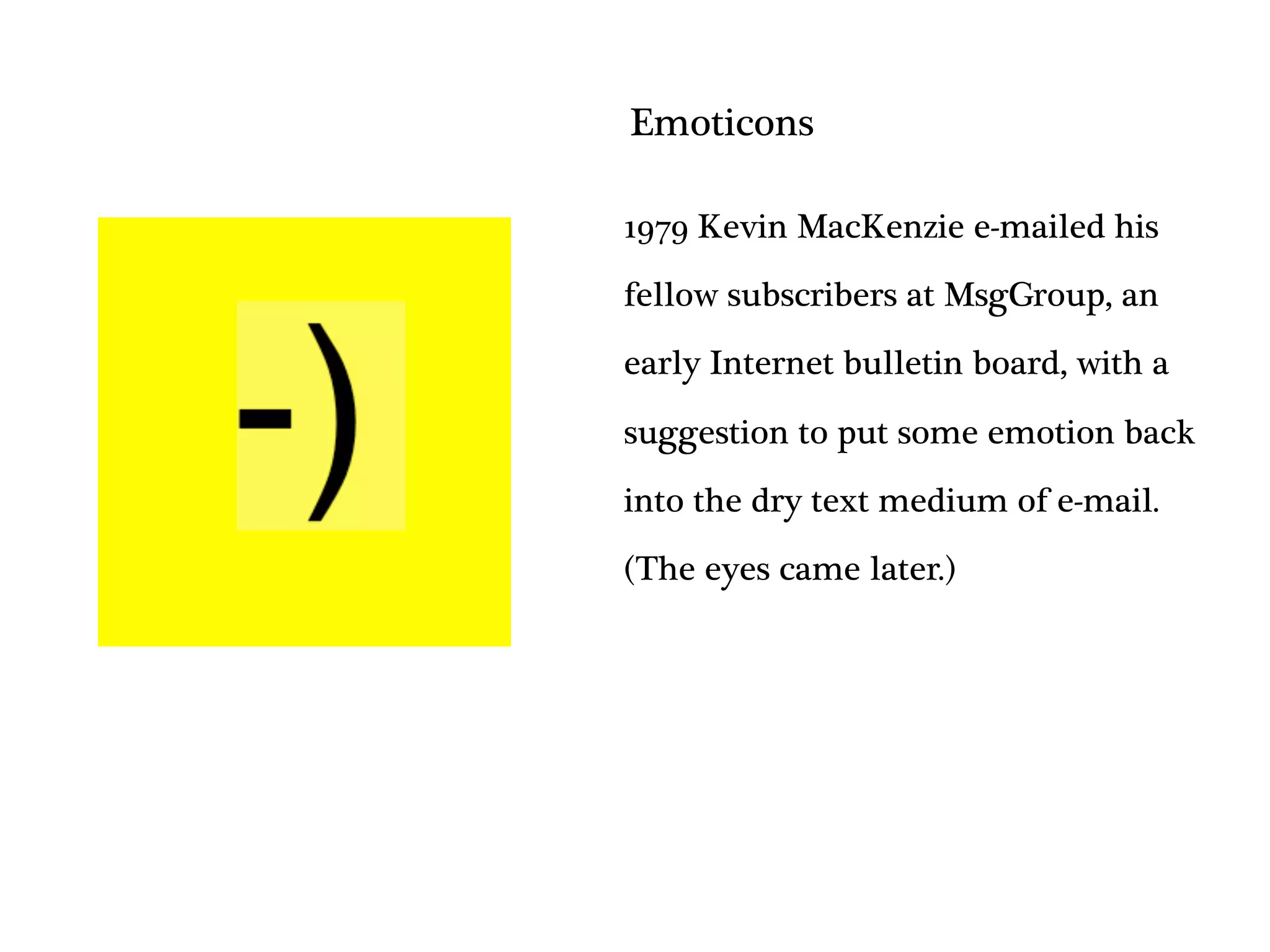
    54. Emoticons 1979 Kevin MacKenzie e-mailed his fellow subscribers at MsgGroup, an early Internet bulletin board, with a suggestion to put some emotion back into the dry text medium of e-mail. (The eyes came later.)
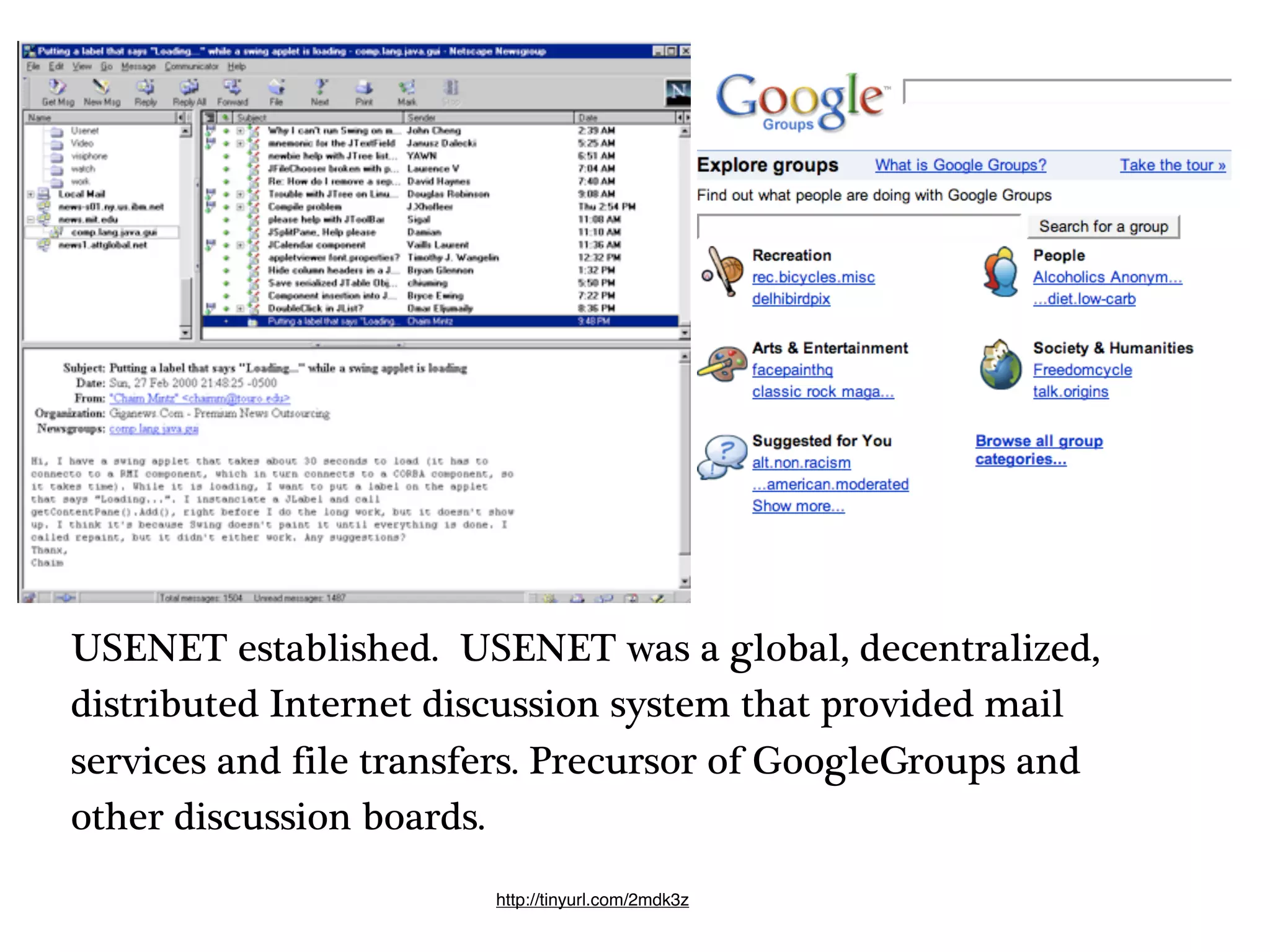
    55. USENET established. USENET was a global, decentralized, distributed Internet discussion system that provided mail services and file transfers. Precursor of GoogleGroups and other discussion boards. http://tinyurl.com/2mdk3z
    56. ARPANET http://echo.gmu.edu/usenet/images/usenet.gif http://www.sri.com/about/timeline/images/map.gi Trebor Scholz | LCST 2031 A | Spring 2009
    57. 1980s
    58. What else did it take to make this WWW work? http://tinyurl.com/2km2n9 This was the first IBM PC introduced on Aug 12, 1981 Douglas Engelbart http://tinyurl.com/3c7suu
    59. The Well members could start discussion boards: Mid-80s the most popular one was dedicated to computer manufacturers push proprietary protocols, The Grateful Dead. which failed US Government pushed for ISO but TCP/IP was free, more viral In the 1980s the PCs entered homes and offices in the United States.
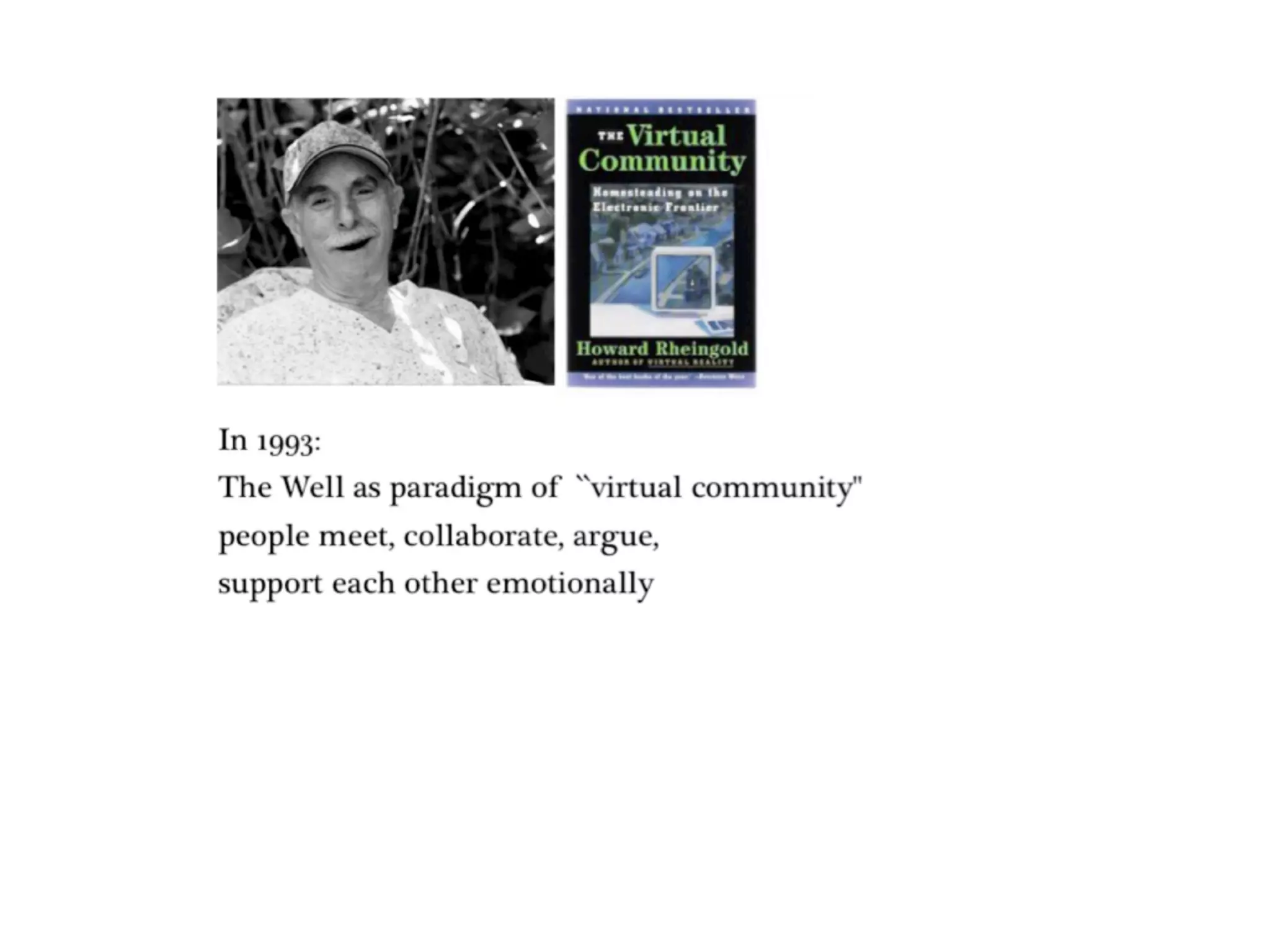
    60. The Well members could start discussion boards: the most popular one was dedicated to The Grateful Dead. 1981 BITNET release Ira Fuchs (CUNY) and Greydon Freeman (Yale) Main features: email, LISTSERV BITNET set expectations for free access and openness: it charged by bandwidth. Once you paid for the line, how much you use it was up to you. Others tried to establish a pay by byte system. http://tinyurl.com/2vx\\bj http://tinyurl.com/2cl3go
    61. 1985 Stewart Brand & Larry Brilliant one of the first community bulletin board systems The Whole Earth 'Lectronic Link (The Well) Brand used a networked PC on his houseboat in Sasalito, CA, claiming that he did so in order to experience commune living without actually moving into one. http://tinyurl.com/374e2g
    62. 1984
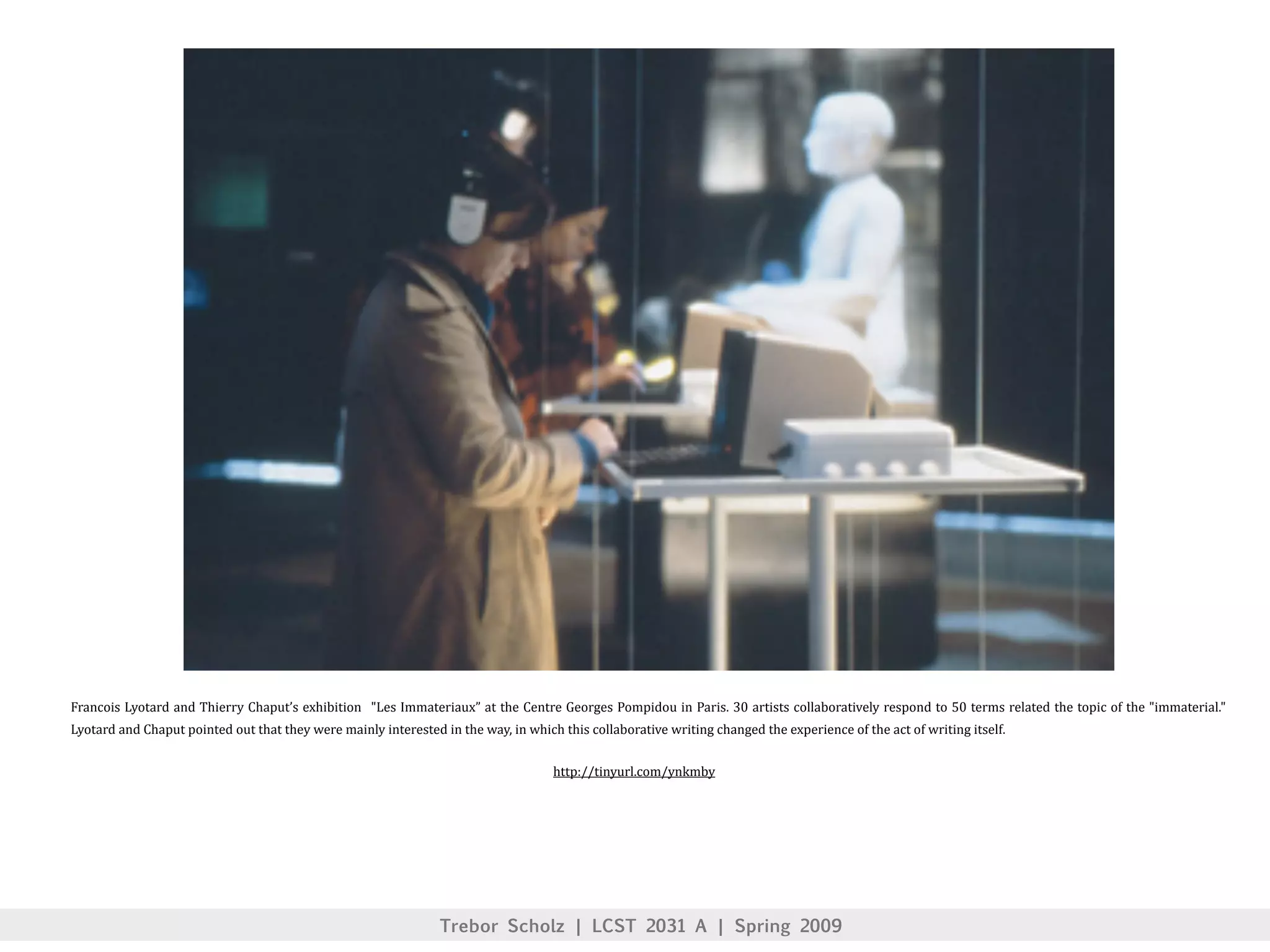
    63. Francois Lyotard  and  Thierry Chaput’s exhibition   \"Les Immateriaux”  at the  Centre Georges Pompidou in  Paris.  30 artists collaboratively respond to 50  terms related  the topic of  the  \"immaterial.\"  Lyotard and Chaput pointed out that they were mainly interested in the way, in which this collaborative writing changed the experience of the act of writing itself.  http://tinyurl.com/ynkmby Trebor Scholz | LCST 2031 A | Spring 2009
    64. Trebor Scholz The New School University scholzt@newschool.edu Twitter: trebors Blog: http://www.collectivate.net/journalisms This presentation is made public using the creative commons attribution, non-commercial, share alike license. This presentation is based on my previous courses on the topic including: http://www.slideshare.net/trebor/how-the-social-web-came-to-be-part1

    + The New School UniversityThe New School University, 9 months ago

    custom

    3154 views, 36 favs, 4 embeds more stats

    ARPANET, 'Alternative' Networks, the Internet, Coun more

    More info about this document

    CC Attribution-NonCommercial-ShareAlike LicenseCC Attribution-NonCommercial-ShareAlike LicenseCC Attribution-NonCommercial-ShareAlike License

    Go to text version

    • Total Views 3154
      • 3139 on SlideShare
      • 15 from embeds
    • Comments 0
    • Favorites 36
    • Downloads 0
    Most viewed embeds
    • 11 views on http://www.slideshare.net
    • 2 views on http://sidewalk.goube.org
    • 1 views on http://www.ppia.nl
    • 1 views on http://www.araaish.com

    more

    All embeds
    • 11 views on http://www.slideshare.net
    • 2 views on http://sidewalk.goube.org
    • 1 views on http://www.ppia.nl
    • 1 views on http://www.araaish.com

    less

    Flagged as inappropriate Flag as inappropriate
    Flag as inappropriate

    Select your reason for flagging this presentation as inappropriate. If needed, use the feedback form to let us know more details.

    Cancel
    File a copyright complaint
    Having problems? Go to our helpdesk?

    Categories