Federal Risk and Authorization
  Management Program
  (FedRAMP)

Developing Your System Security Plan


November 28, 2012
Today’s Webinar

FedRAMP is a government-wide program that provides
a standardized approach to security assessment,
authorization, and continuous monitoring for cloud
services.
 The goal of this webinar is review the System
  Security Plan (SSP) and provide the information
  and guidelines that you need to accurately
  document the FedRAMP controls and assemble
  a strong SSP that will meet FedRAMP review
  requirements.


                                                     2
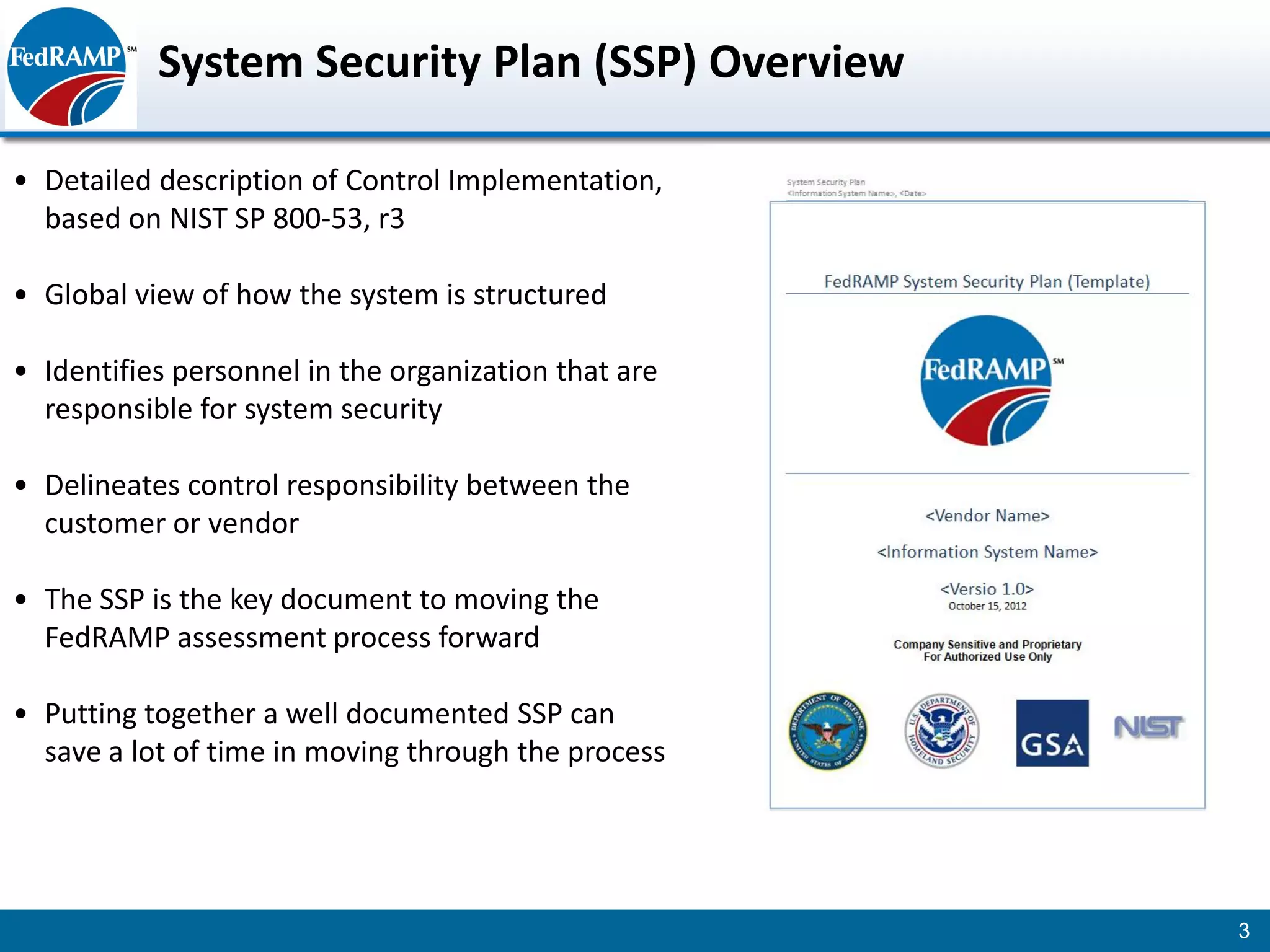
System Security Plan (SSP) Overview

• Detailed description of Control Implementation,
  based on NIST SP 800-53, r3

• Global view of how the system is structured

• Identifies personnel in the organization that are
  responsible for system security

• Delineates control responsibility between the
  customer or vendor

• The SSP is the key document to moving the
  FedRAMP assessment process forward

• Putting together a well documented SSP can
  save a lot of time in moving through the process


                                                      3
Why Such a Long Document?

             • SSP template is 352 pages long

             • Long template required to assure
               the system and implementation of
               controls are properly documented

             • Effort to produce a well
               documented SSP leads to a smooth
               process


                                                  4
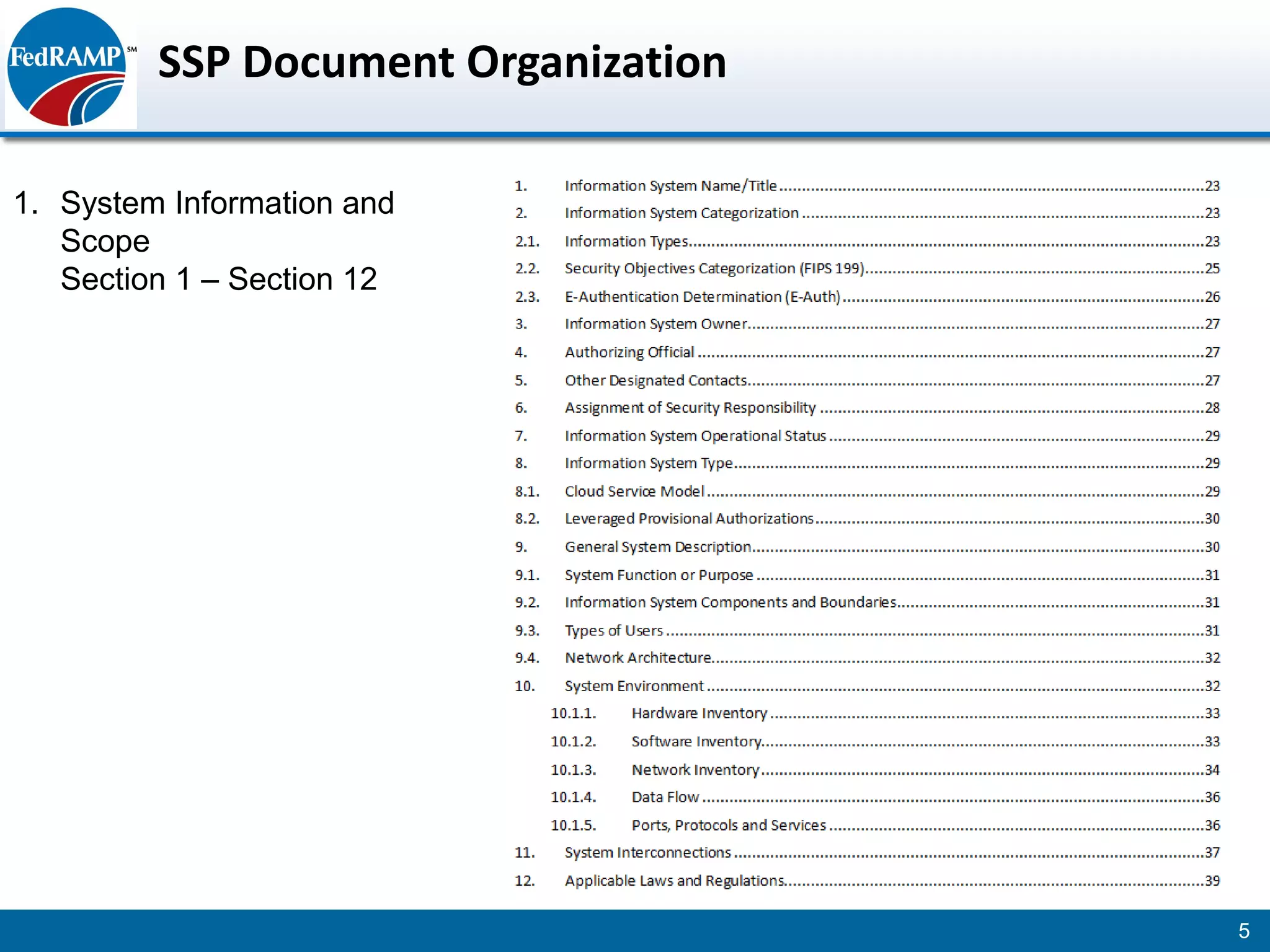
SSP Document Organization

1. System Information and
   Scope
   Section 1 – Section 12


                                     5
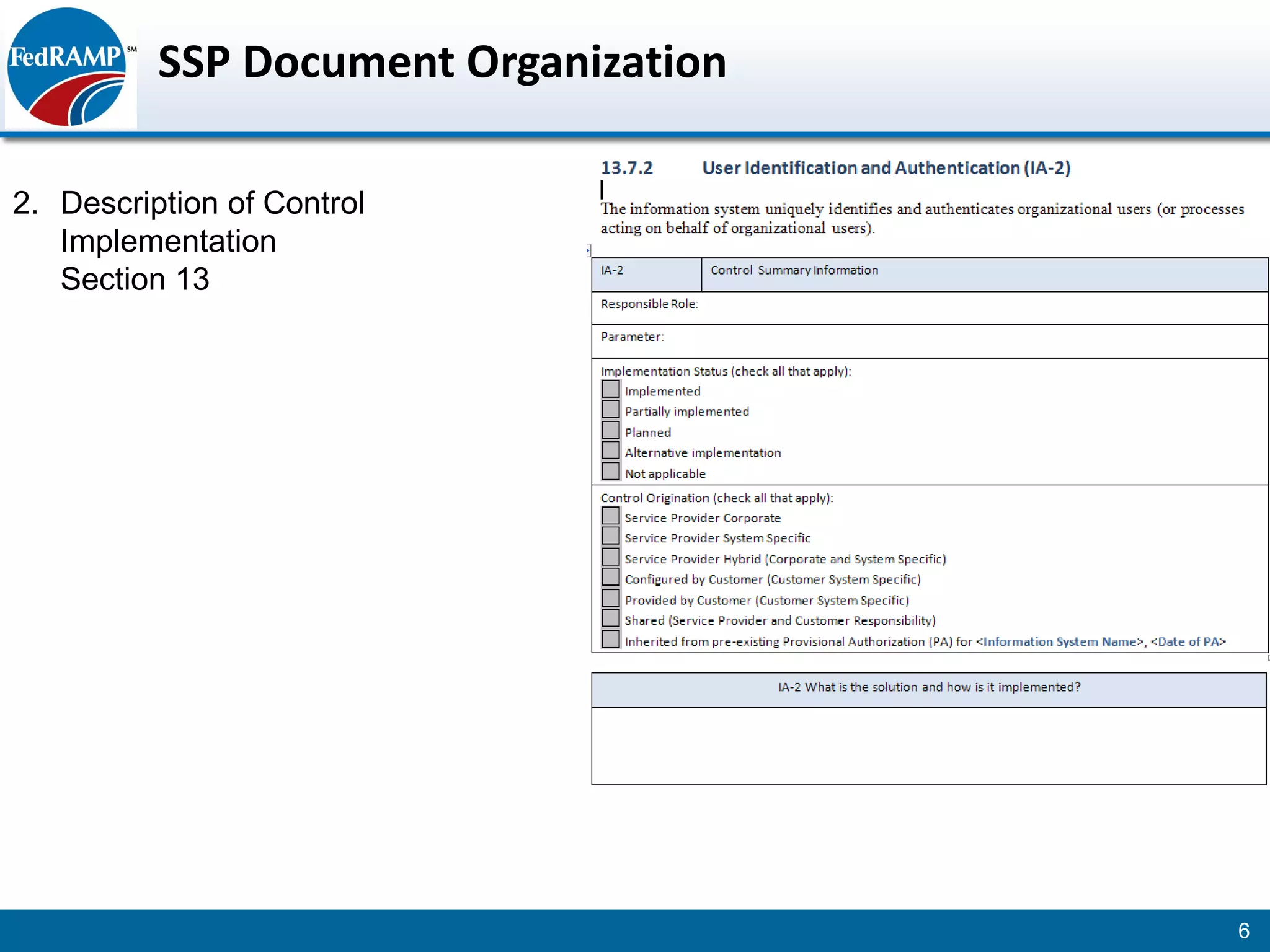
SSP Document Organization

2. Description of Control
   Implementation
   Section 13


                                      6
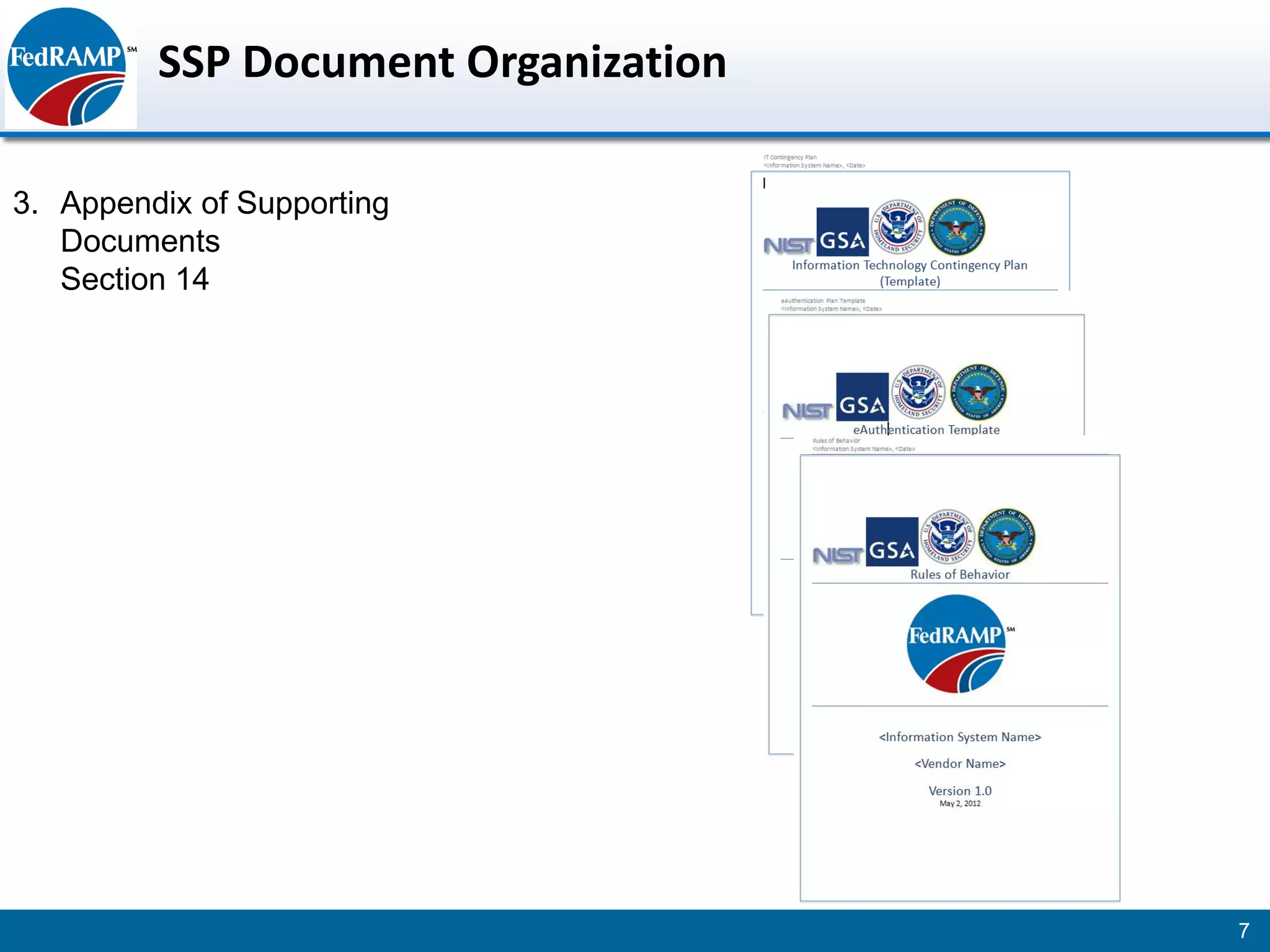
SSP Document Organization

3. Appendix of Supporting
   Documents
   Section 14


                                     7
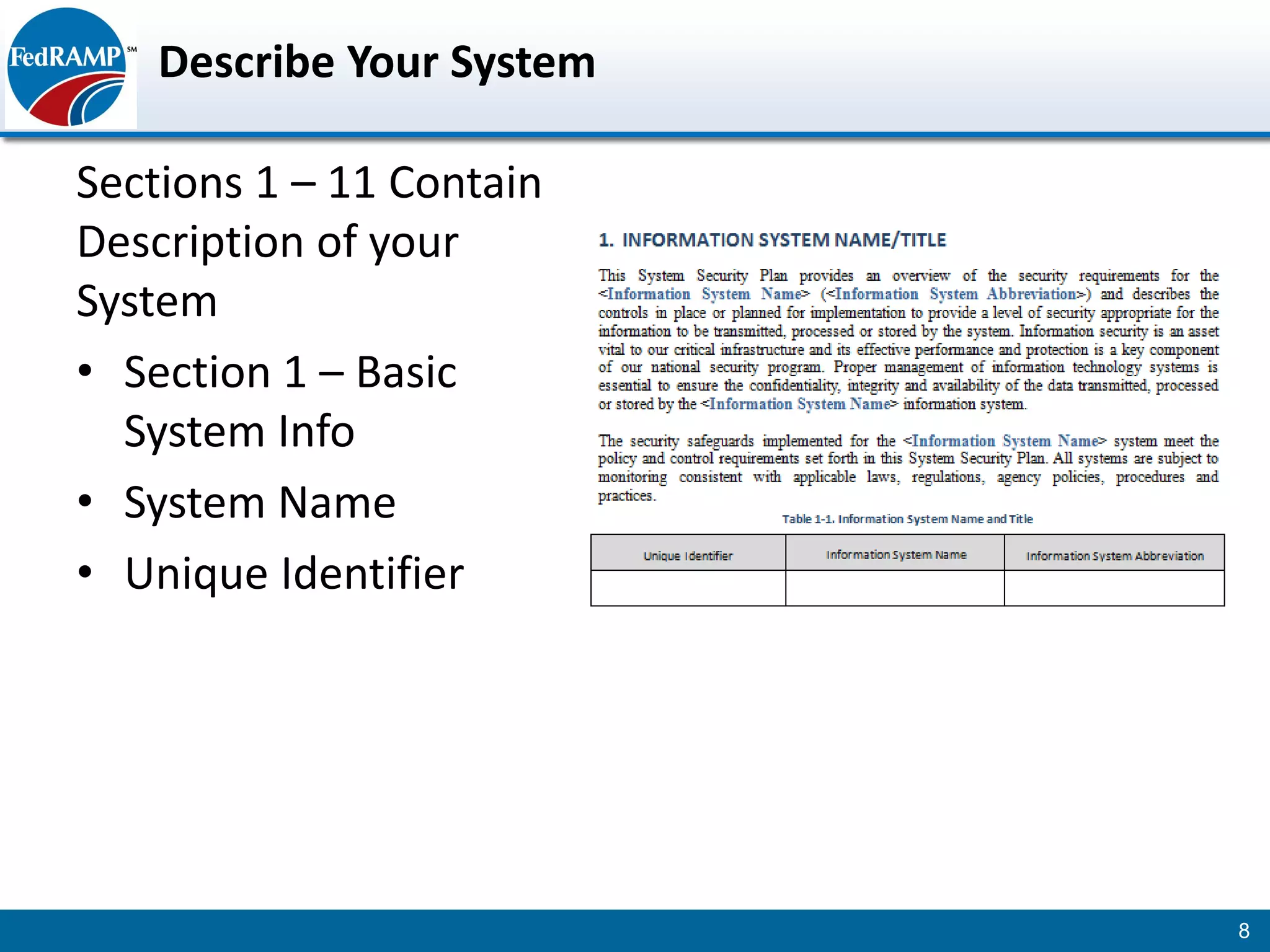
Describe Your System

Sections 1 – 11 Contain
Description of your
System
• Section 1 – Basic
  System Info
• System Name
• Unique Identifier


                           8
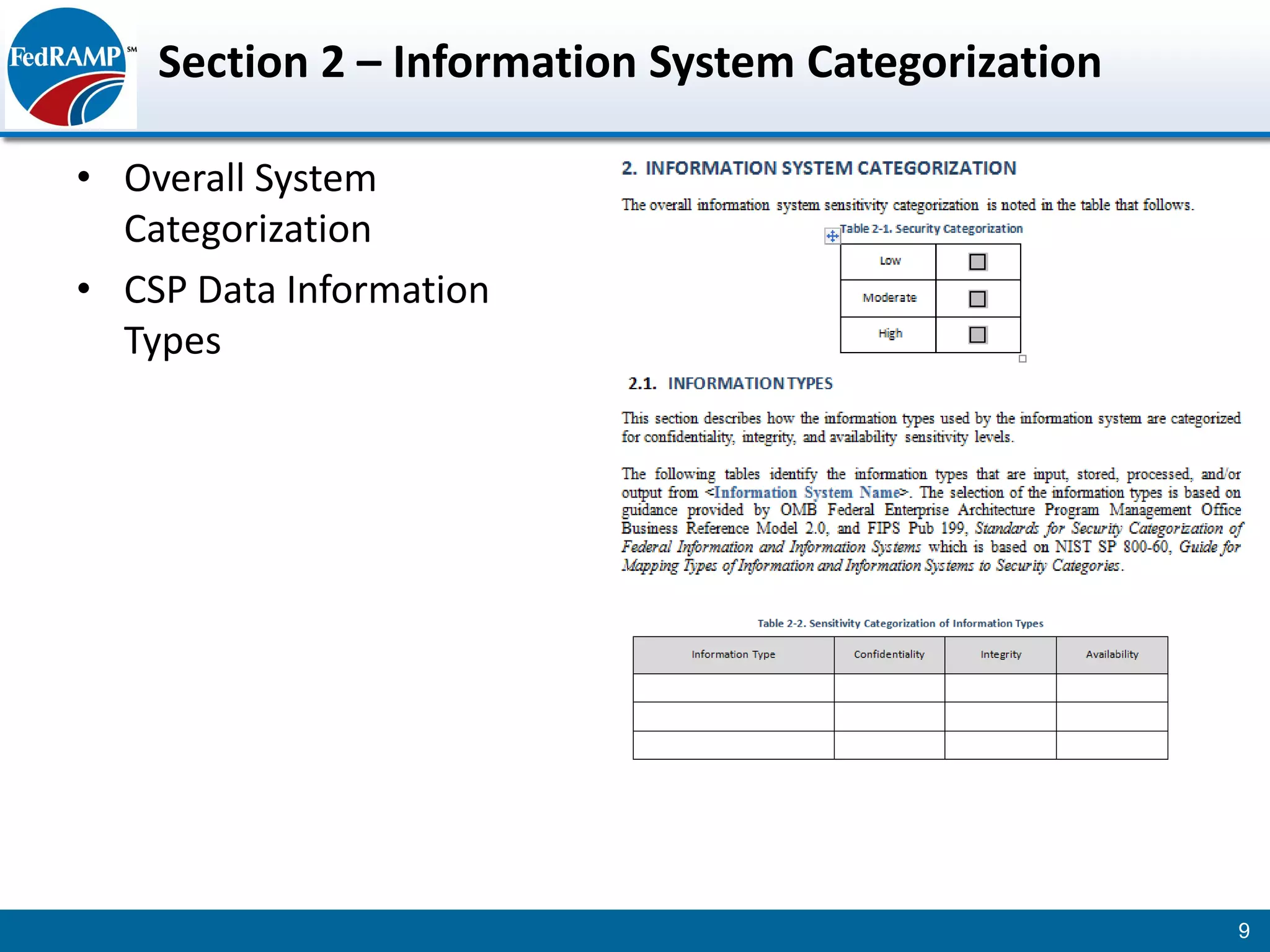
Section 2 – Information System Categorization

• Overall System
  Categorization
• CSP Data Information
  Types


                                                    9
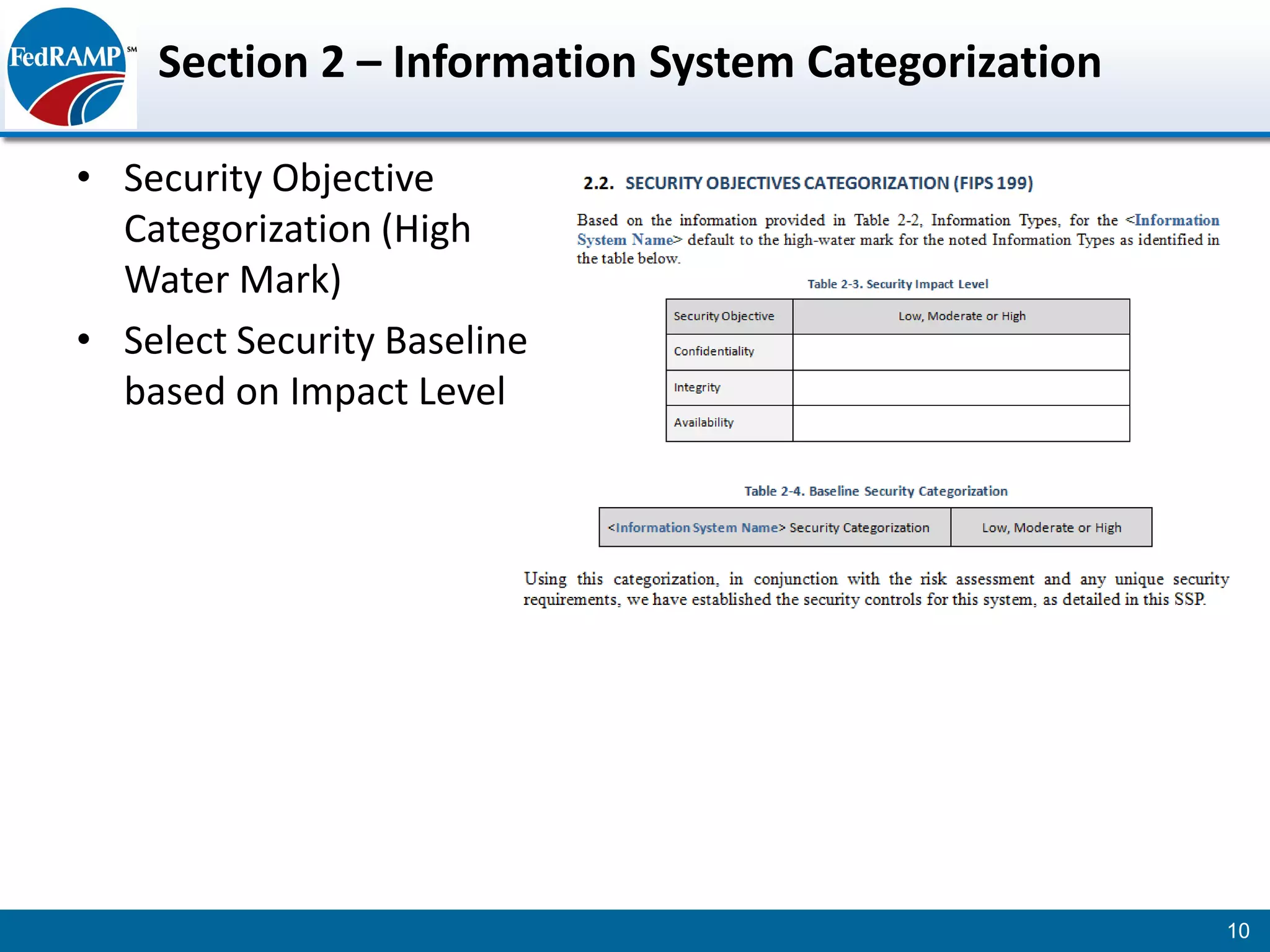
Section 2 – Information System Categorization

• Security Objective
  Categorization (High
  Water Mark)
• Select Security Baseline
  based on Impact Level


                                                    10
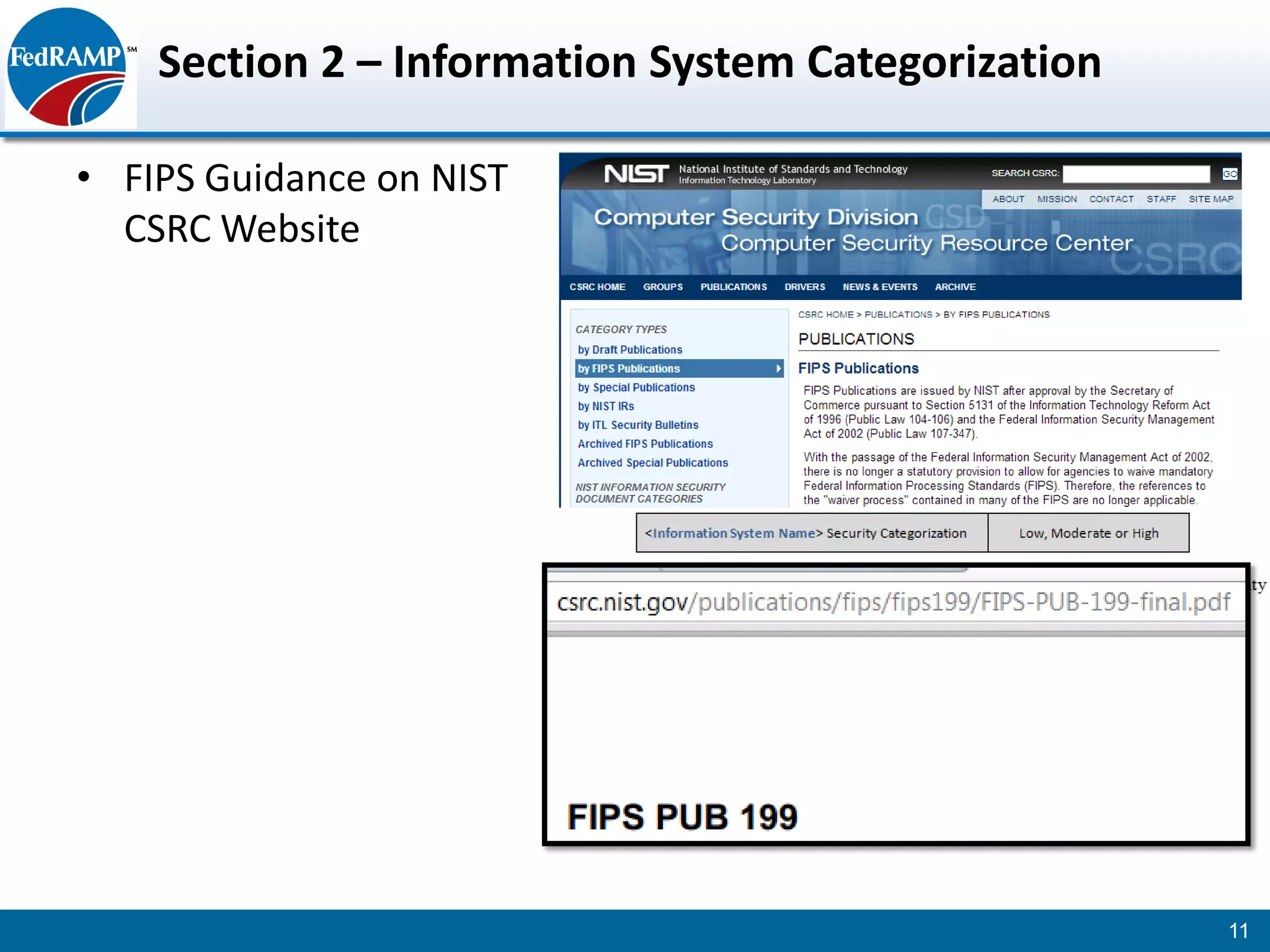
Section 2 – Information System Categorization

• FIPS Guidance on NIST
  CSRC Website


                                                    11
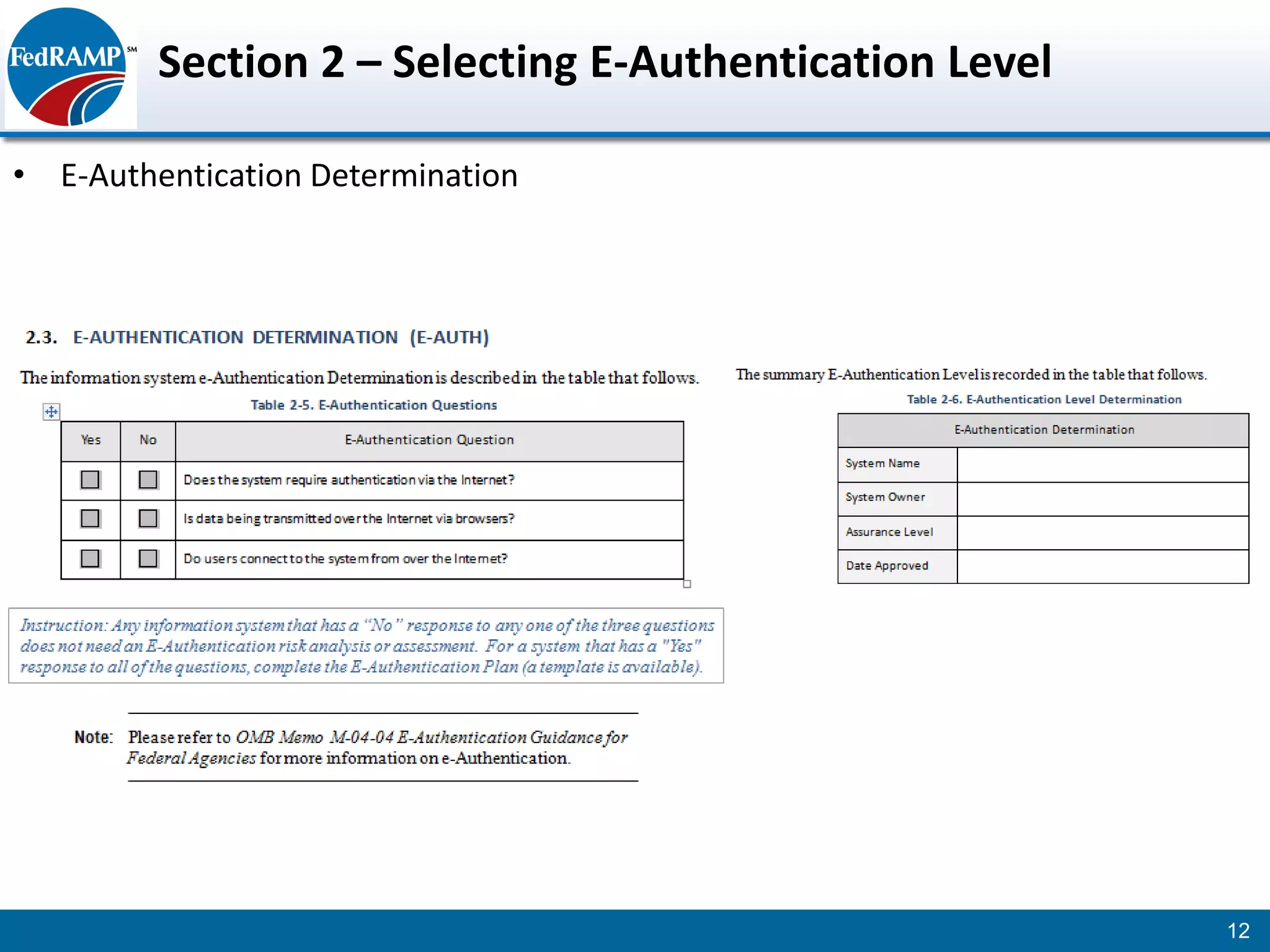
Section 2 – Selecting E-Authentication Level

• E-Authentication Determination


                                                        12
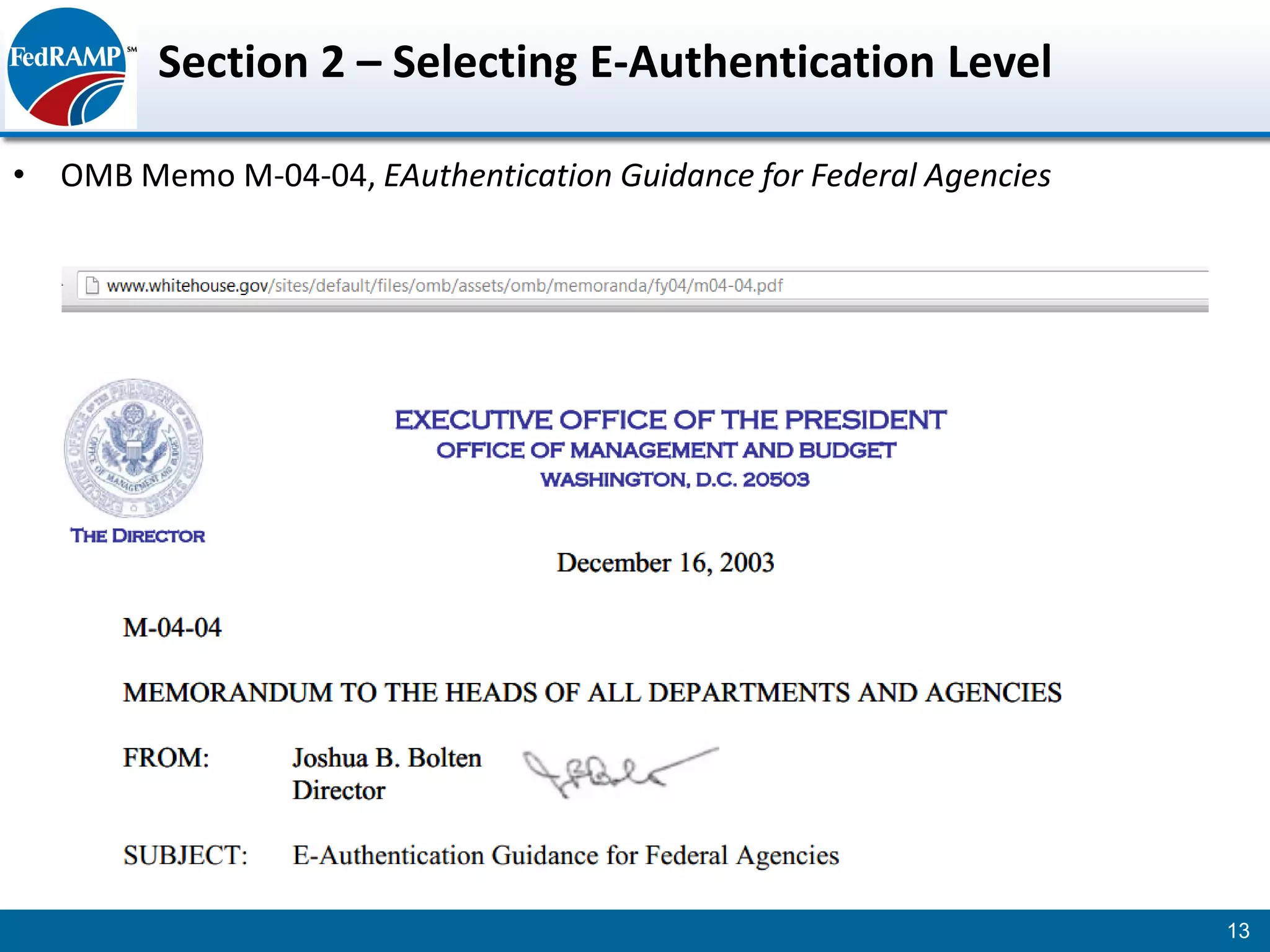
Section 2 – Selecting E-Authentication Level

• OMB Memo M-04-04, EAuthentication Guidance for Federal Agencies


                                                                    13
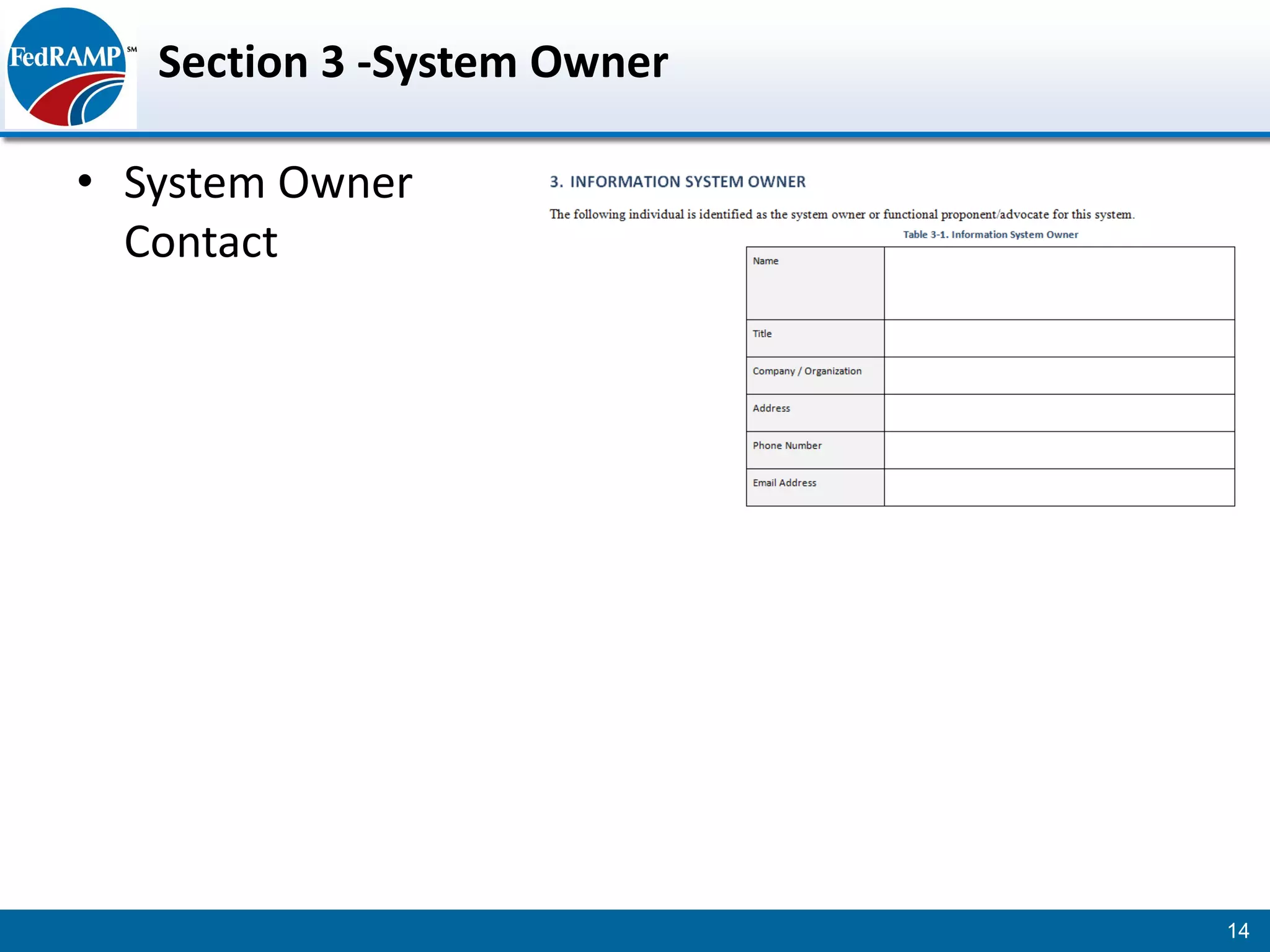
Section 3 -System Owner

• System Owner
  Contact


                             14
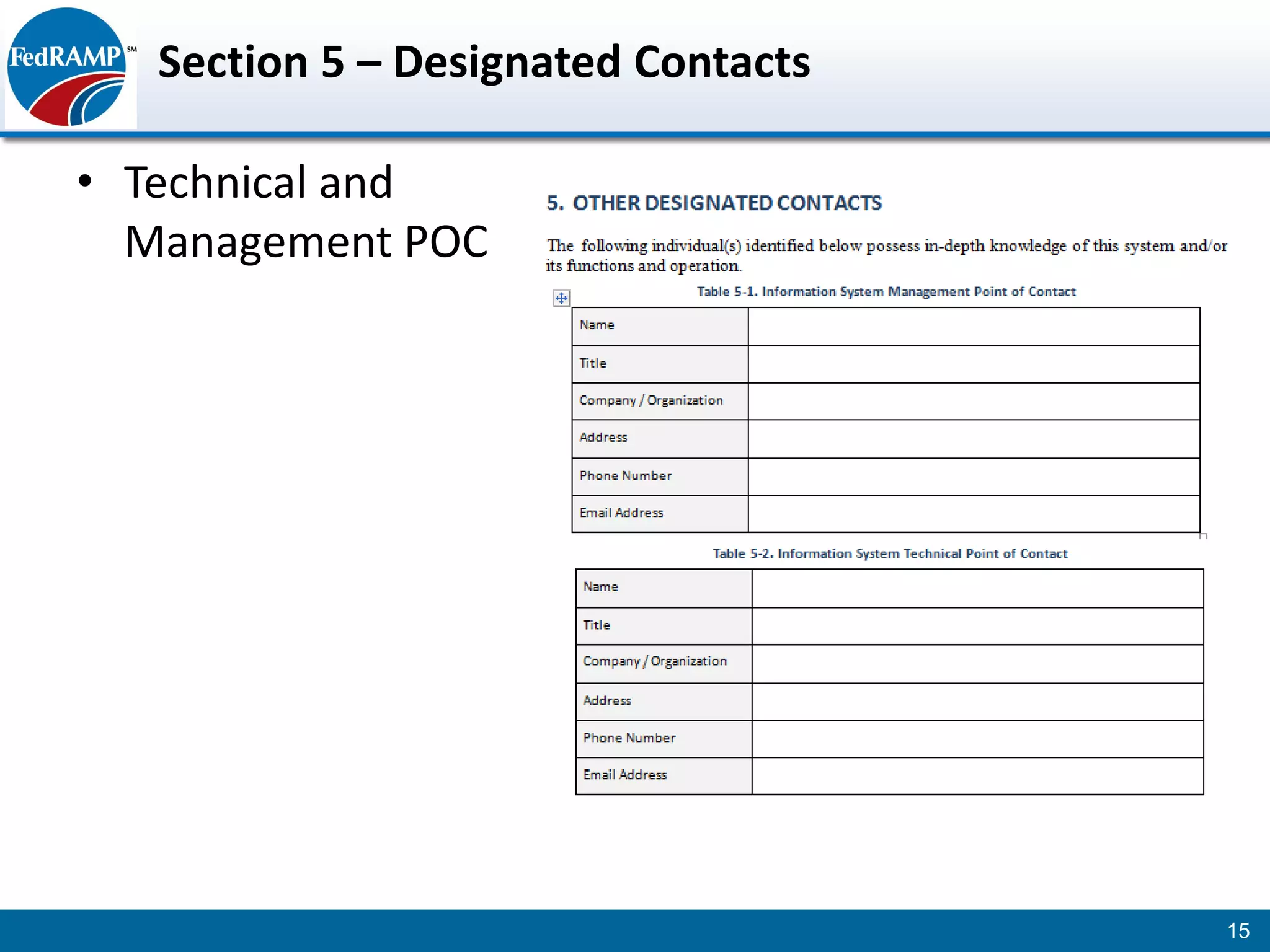
Section 5 – Designated Contacts

• Technical and
  Management POC


                                     15
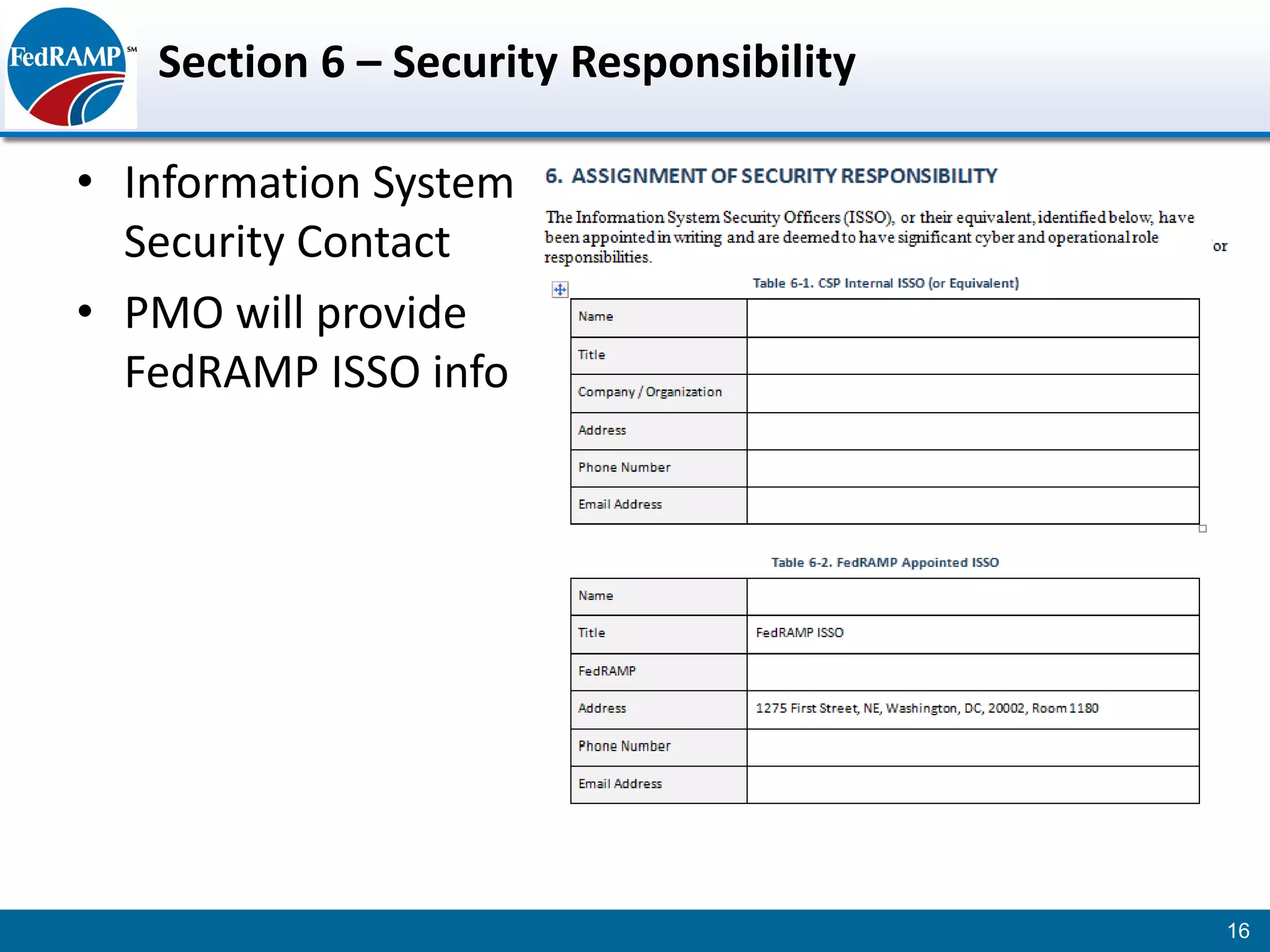
Section 6 – Security Responsibility

• Information System
  Security Contact
• PMO will provide
  FedRAMP ISSO info


                                         16
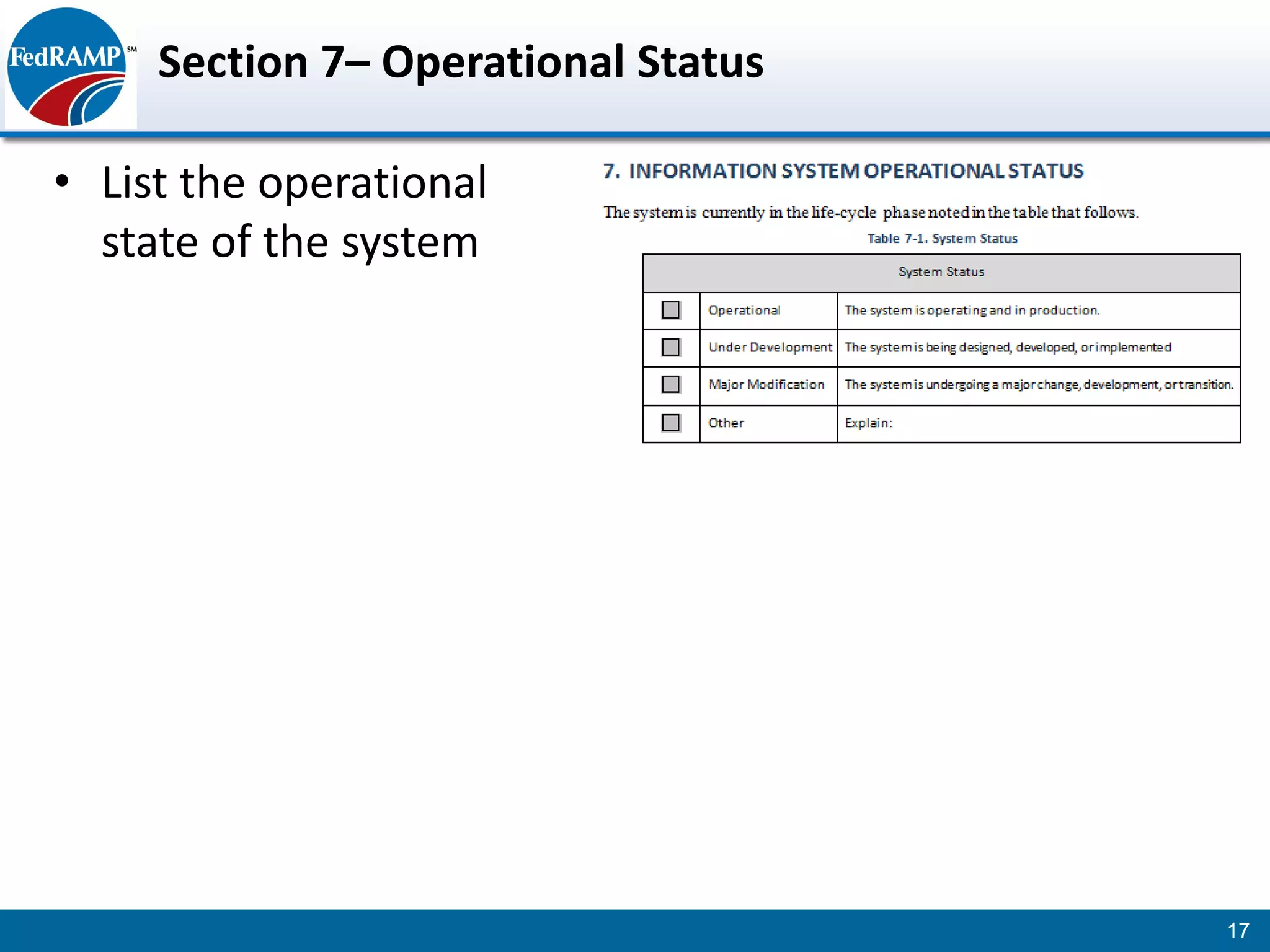
Section 7– Operational Status

• List the operational
  state of the system


                                     17
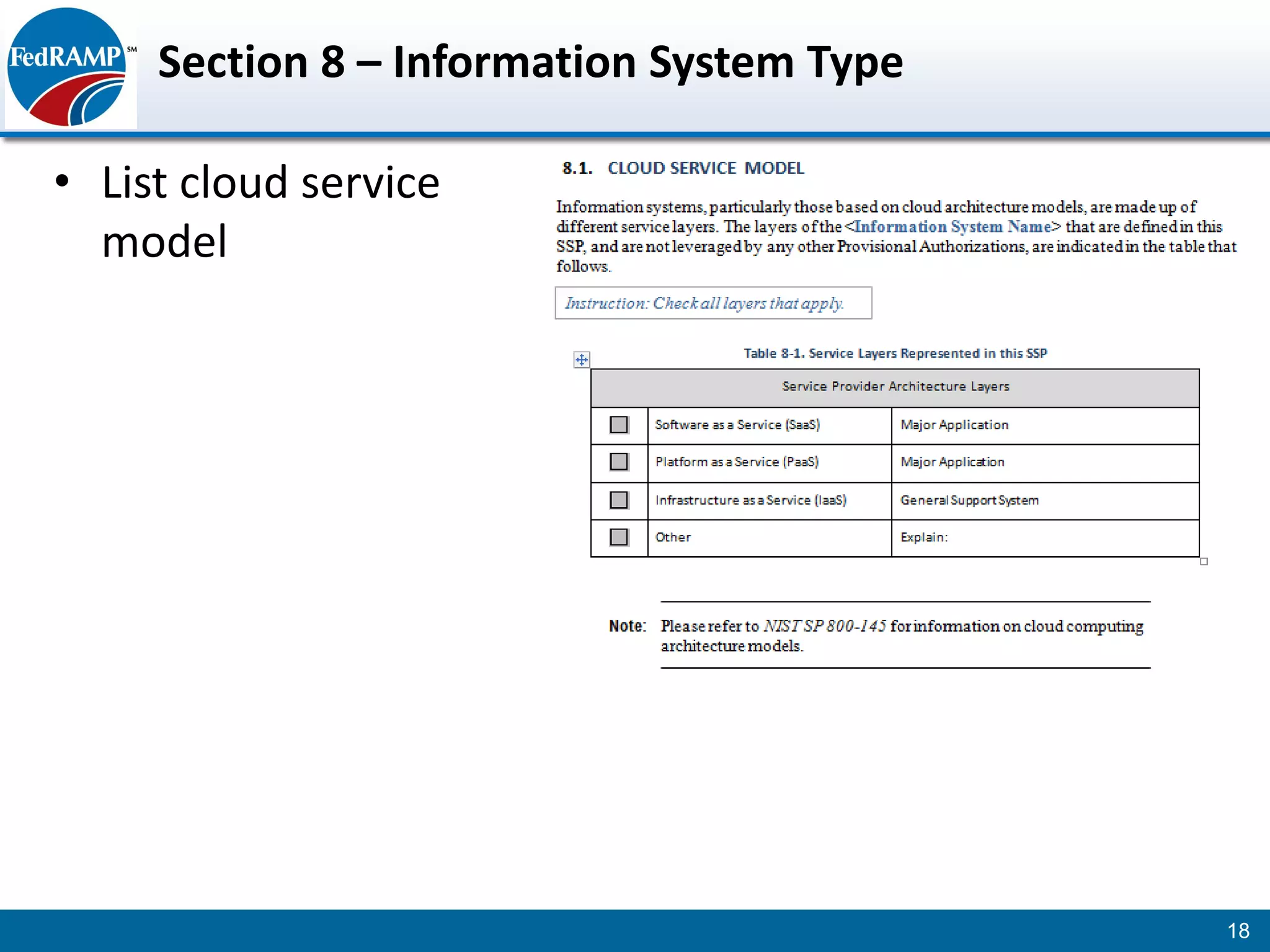
Section 8 – Information System Type

• List cloud service
  model


                                           18
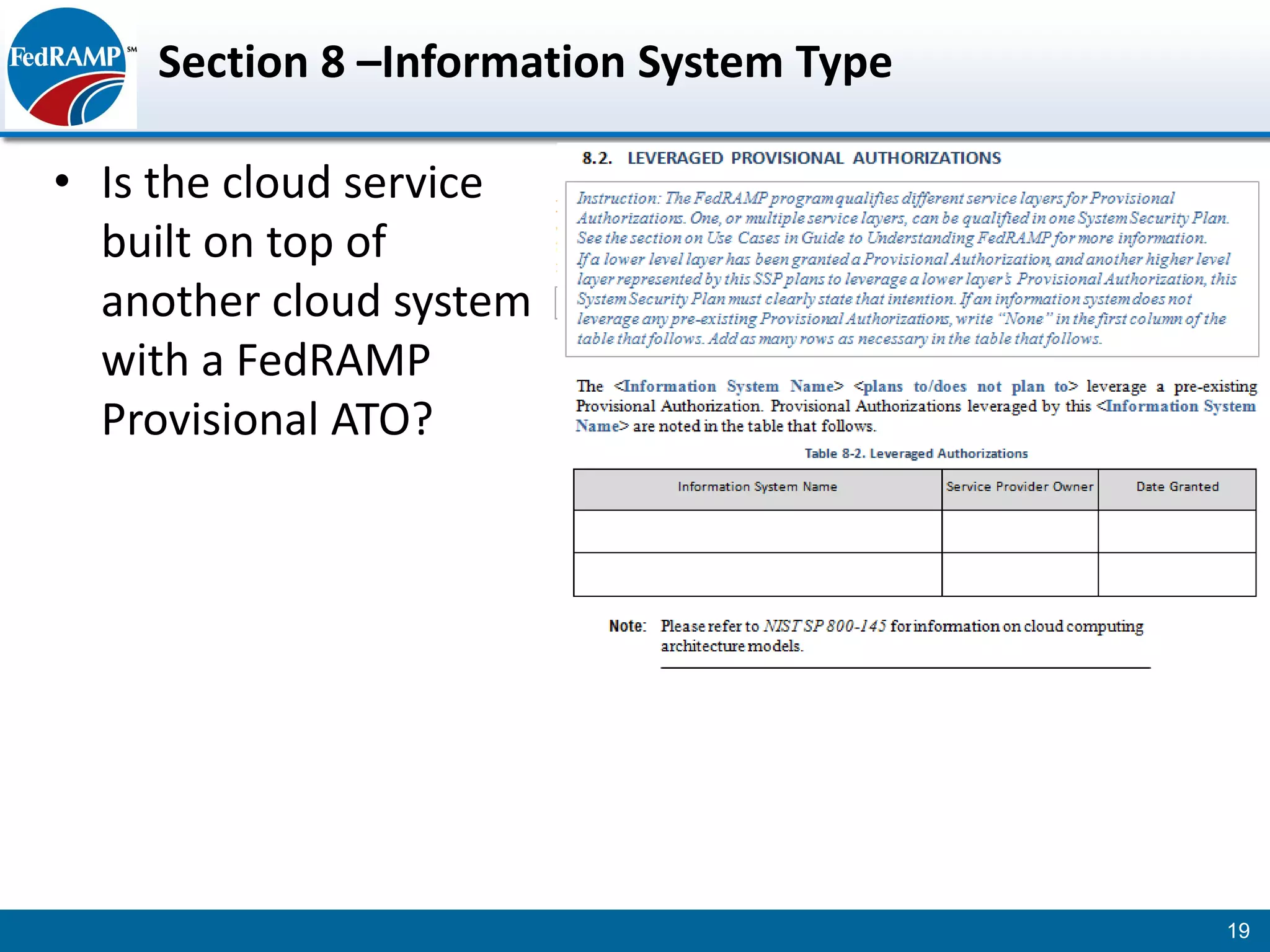
Section 8 –Information System Type

• Is the cloud service
  built on top of
  another cloud system
  with a FedRAMP
  Provisional ATO?


                                         19
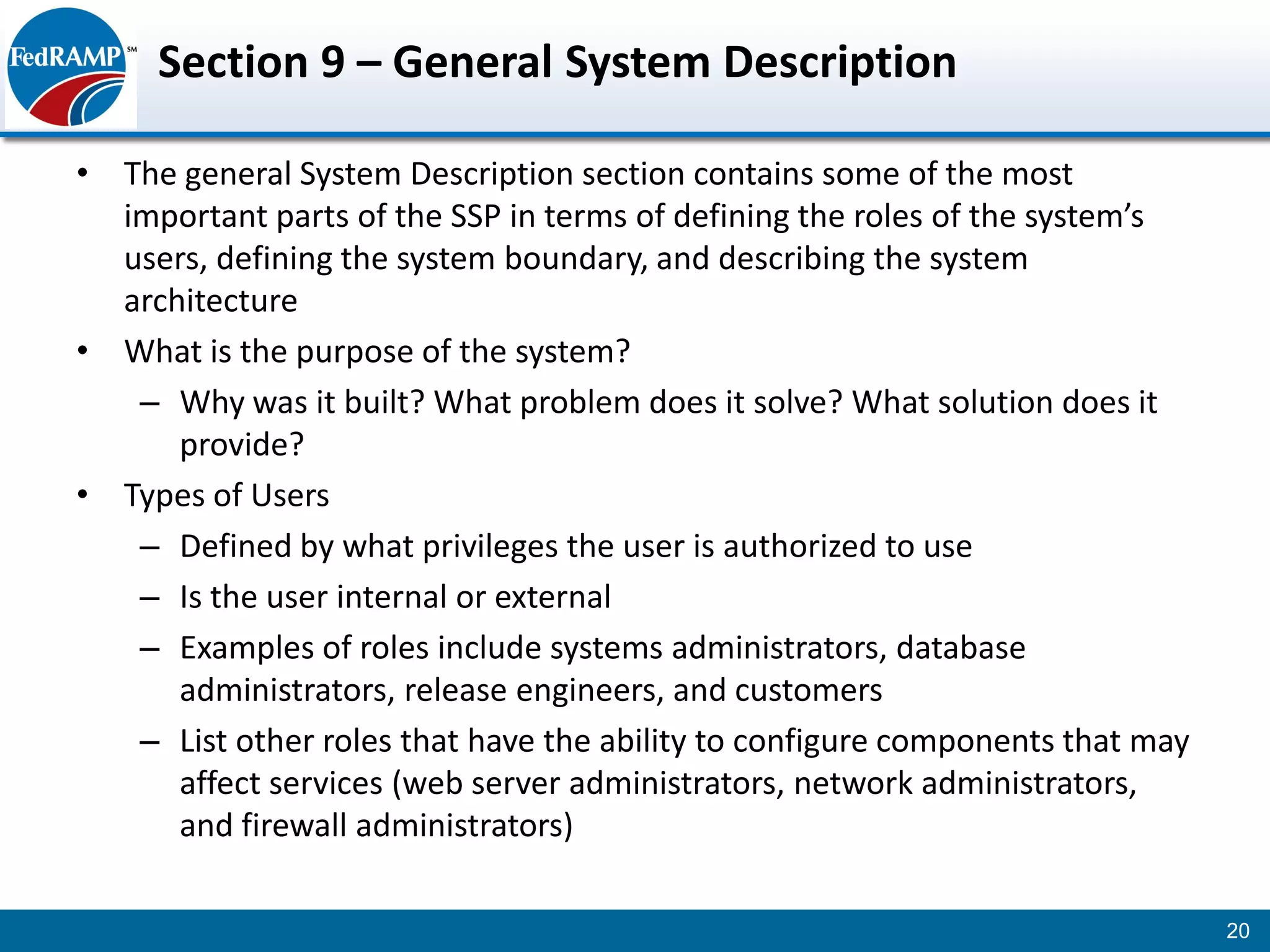
Section 9 – General System Description

• The general System Description section contains some of the most
  important parts of the SSP in terms of defining the roles of the system’s
  users, defining the system boundary, and describing the system
  architecture
• What is the purpose of the system?
   – Why was it built? What problem does it solve? What solution does it
      provide?
• Types of Users
   – Defined by what privileges the user is authorized to use
   – Is the user internal or external
   – Examples of roles include systems administrators, database
      administrators, release engineers, and customers
   – List other roles that have the ability to configure components that may
      affect services (web server administrators, network administrators,
      and firewall administrators)

                                                                               20
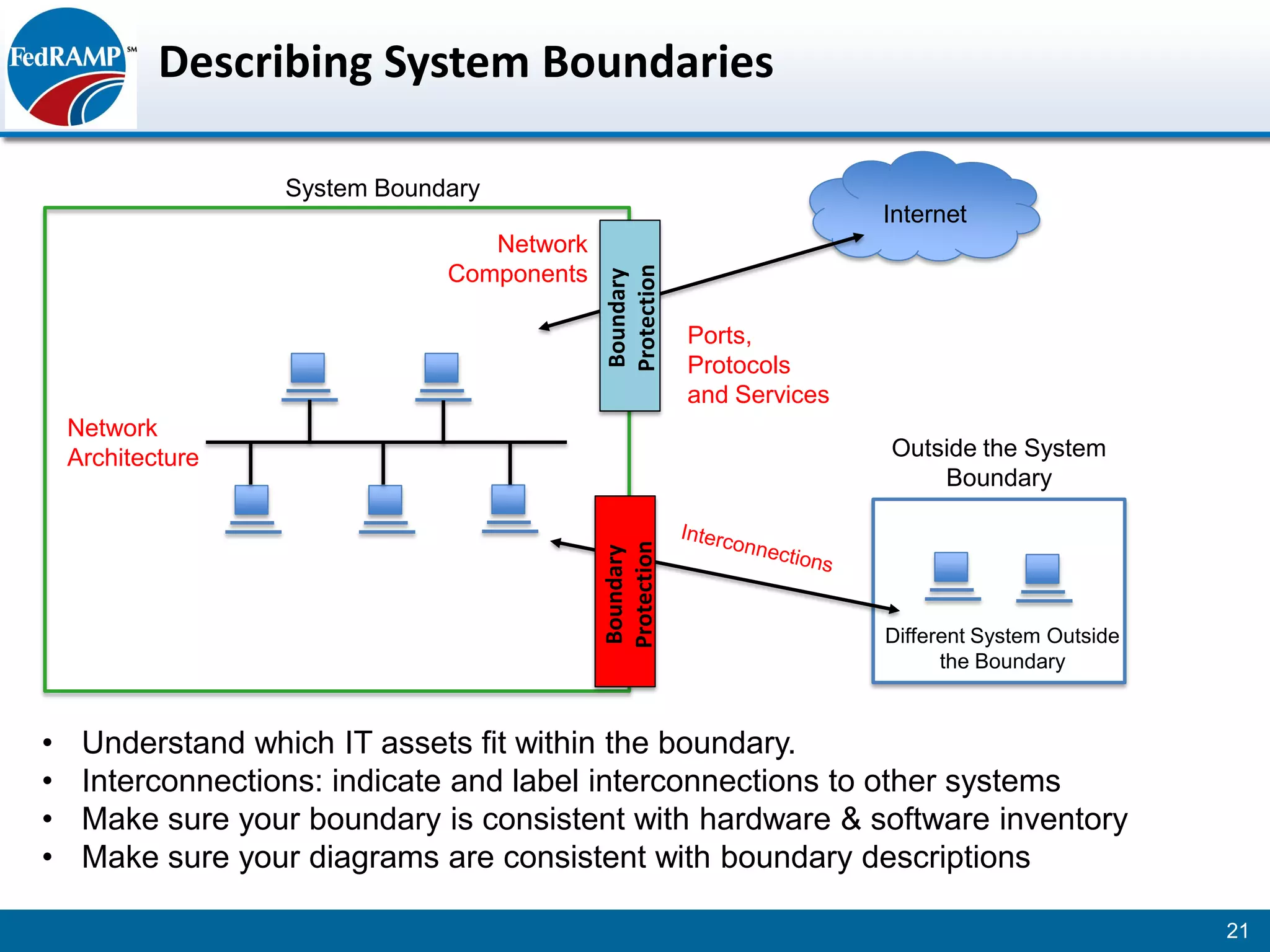
Describing System Boundaries

                   System Boundary
                                                                        Internet
                                  Network
                               Components


                                            Protection
                                            Boundary
                                                         Ports,
                                                         Protocols
                                                         and Services
    Network
    Architecture                                                        Outside the System
                                                                            Boundary


                                            Protection
                                            Boundary
                                                                        Different System Outside
                                                                              the Boundary


•    Understand which IT assets fit within the boundary.
•    Interconnections: indicate and label interconnections to other systems
•    Make sure your boundary is consistent with hardware & software inventory
•    Make sure your diagrams are consistent with boundary descriptions

                                                                                                   21
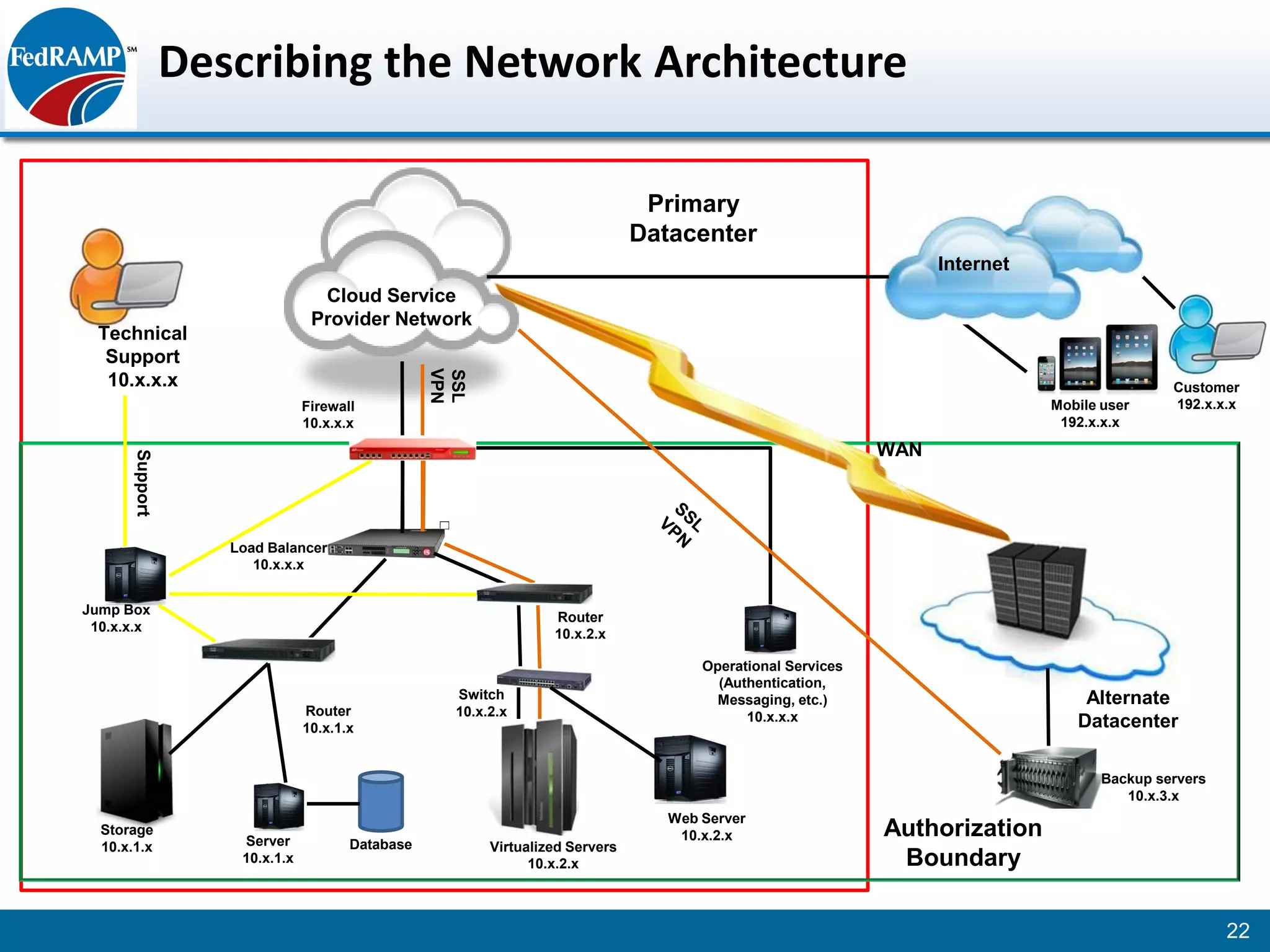
Describing the Network Architecture

                                                                                Primary
                                                                               Datacenter
                                                                                                                   Internet
                                  Cloud Service
                                 Provider Network
  Technical
   Support


                                                  VPN
                                                  SSL
   10.x.x.x                                                                                                                                   Customer
                                Firewall                                                                                      Mobile user     192.x.x.x
                                10.x.x.x                                                                                       192.x.x.x

                                                                                                             WAN
       Support


                    Load Balancer
                       10.x.x.x


Jump Box
                                                                  Router
 10.x.x.x
                                                                  10.x.2.x

                                                                                      Operational Services
                                                                                        (Authentication,
                                                    Switch                              Messaging, etc.)                          Alternate
                                Router              10.x.2.x                                10.x.x.x
                                10.x.1.x                                                                                         Datacenter

                                                                                                                                     Backup servers
                                                                                                                                        10.x.3.x
                                                                                  Web Server
  Storage
                     Server                                                        10.x.2.x                  Authorization
  10.x.1.x                             Database          Virtualized Servers
                     10.x.1.x                                  10.x.2.x                                       Boundary

                                                                                                                                                      22
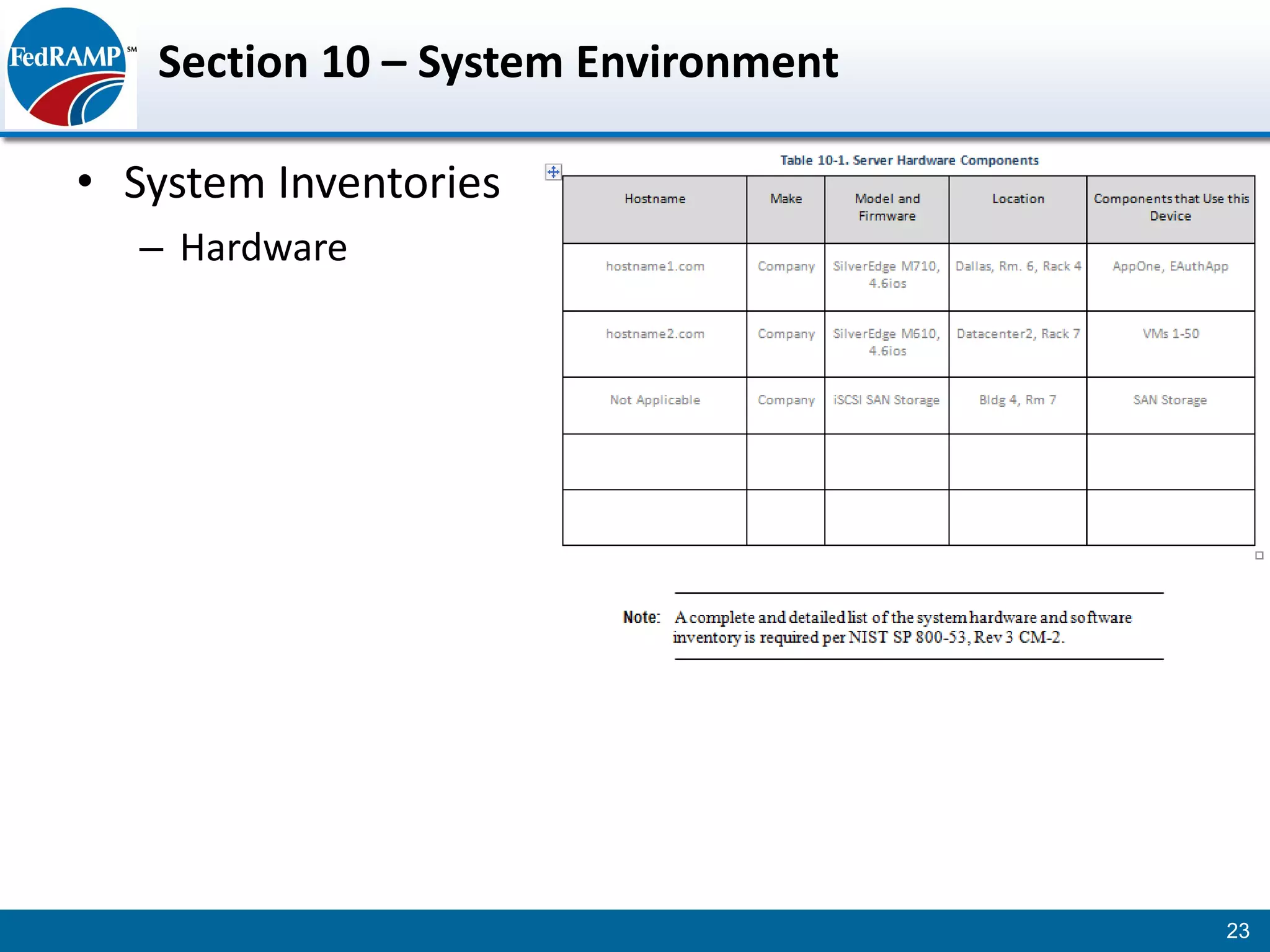
Section 10 – System Environment

• System Inventories
  – Hardware


                                     23
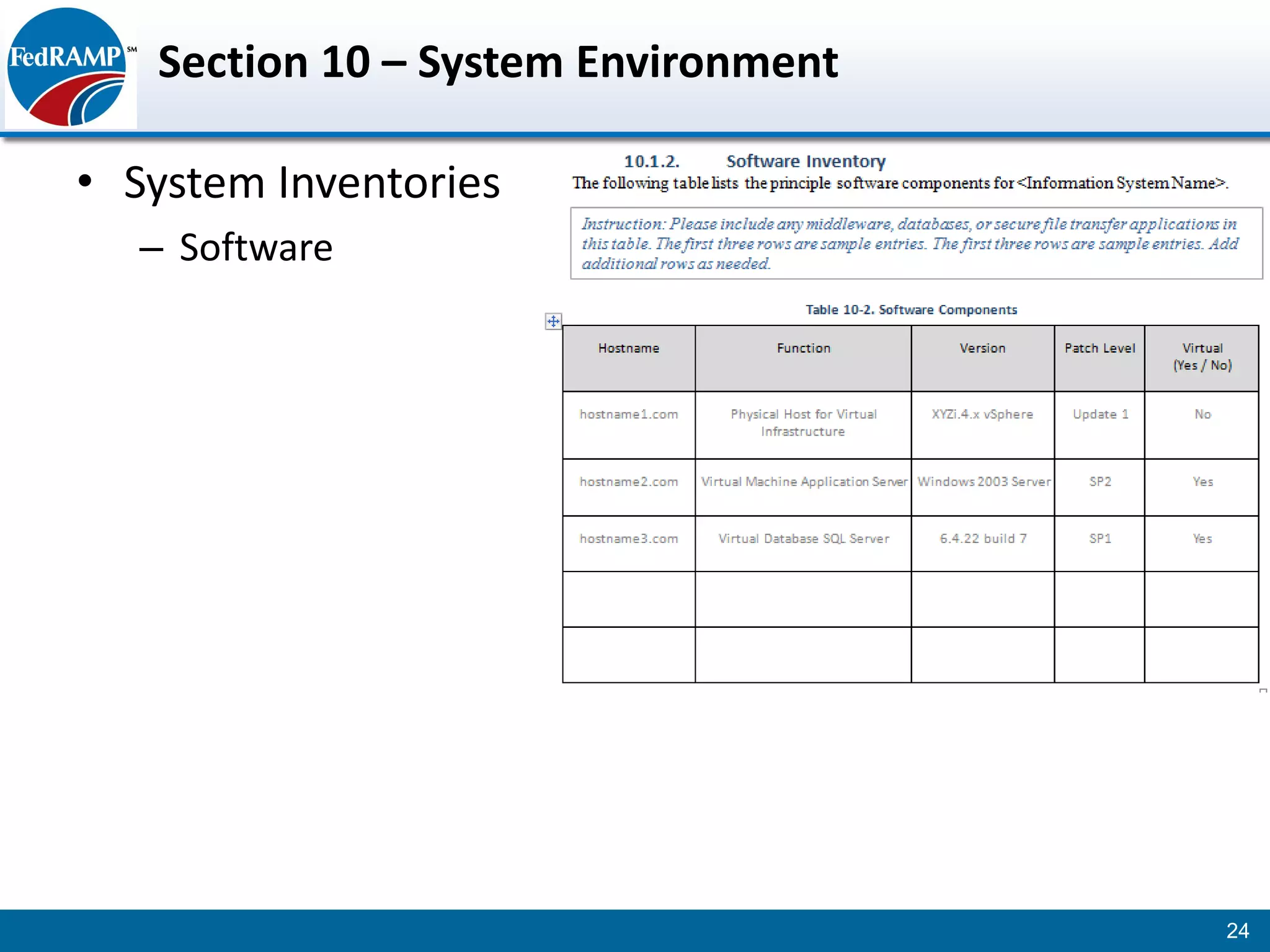
Section 10 – System Environment

• System Inventories
  – Software


                                     24
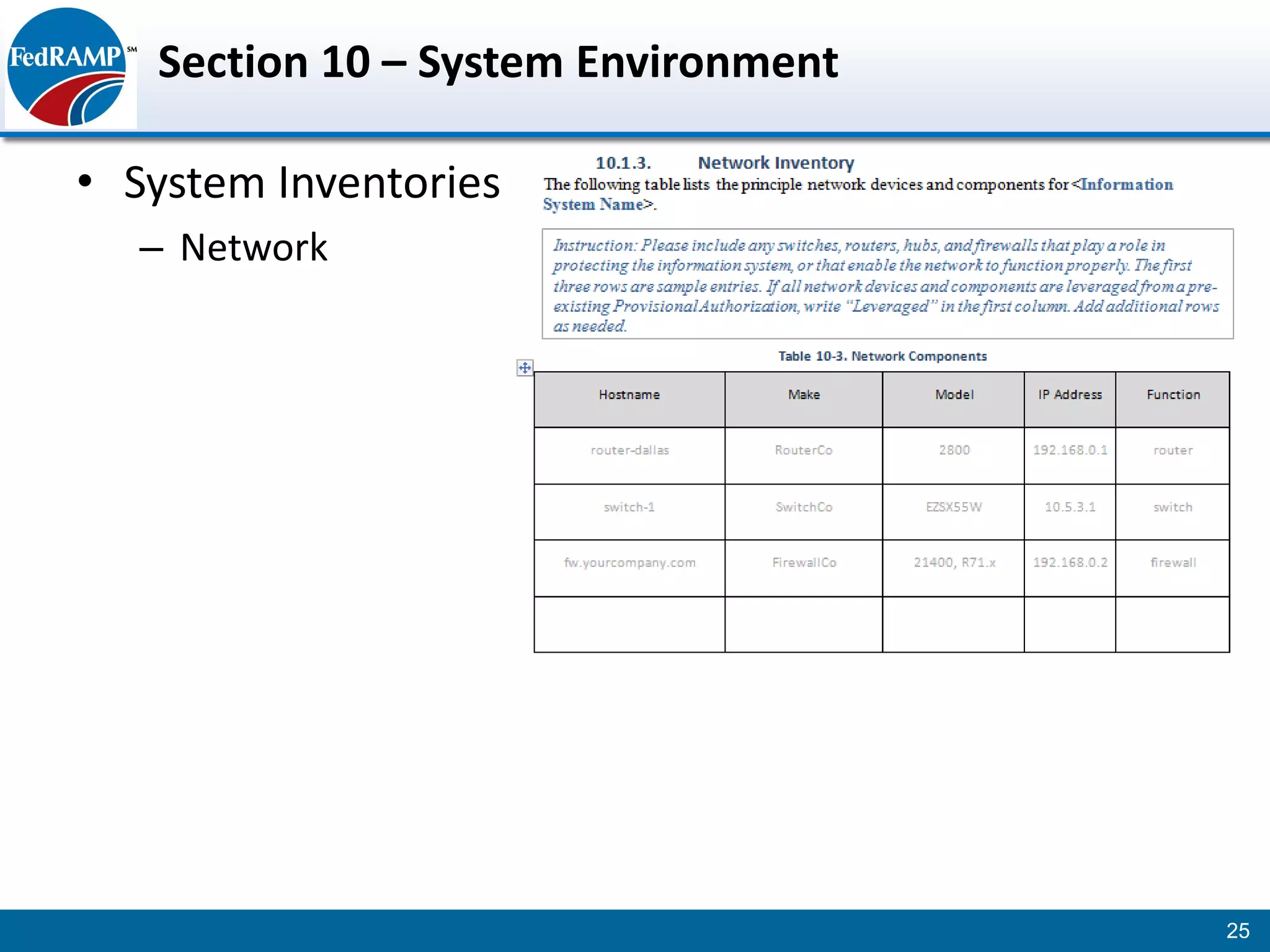
Section 10 – System Environment

• System Inventories
  – Network


                                     25
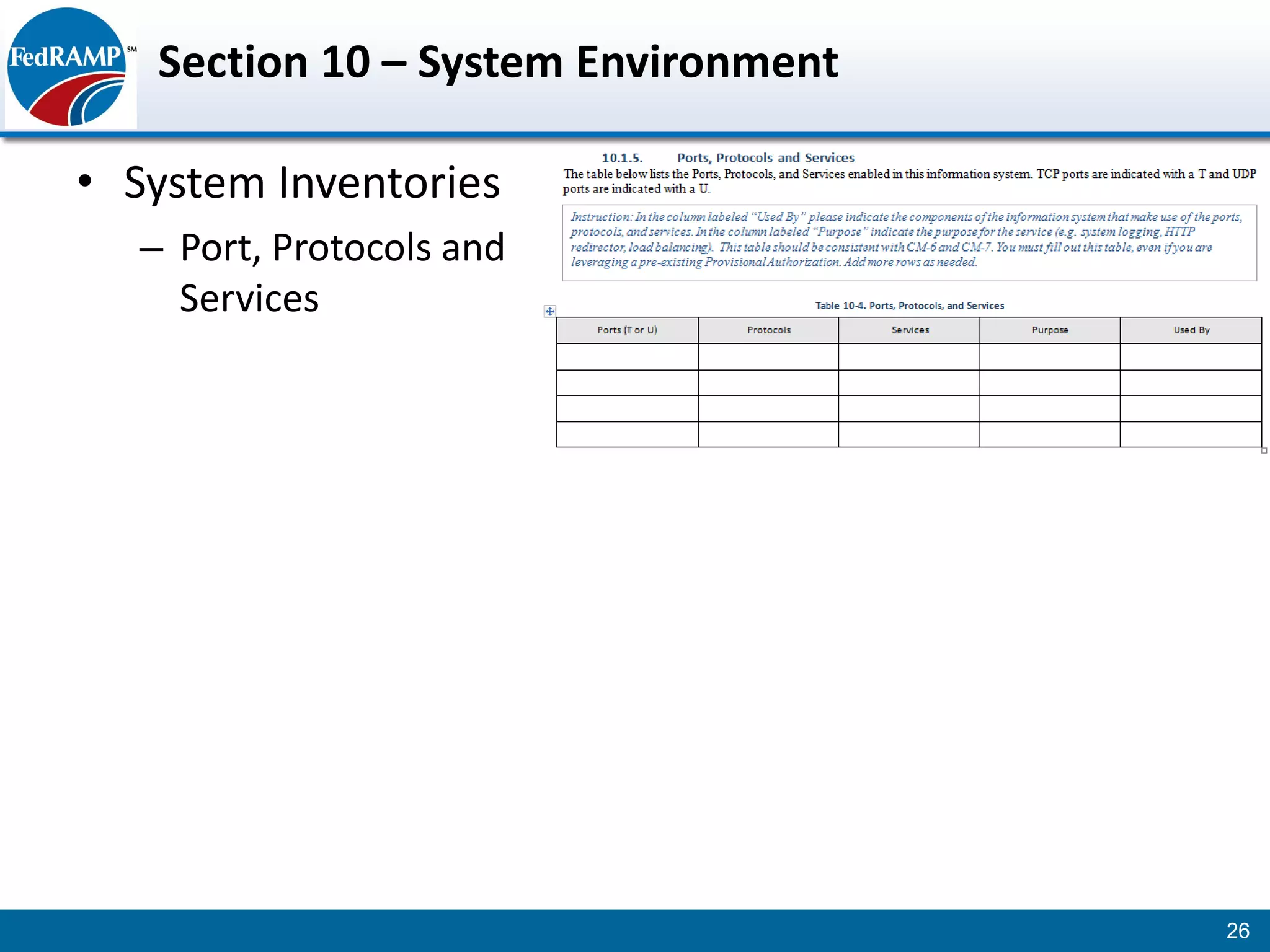
Section 10 – System Environment

• System Inventories
  – Port, Protocols and
    Services


                                     26
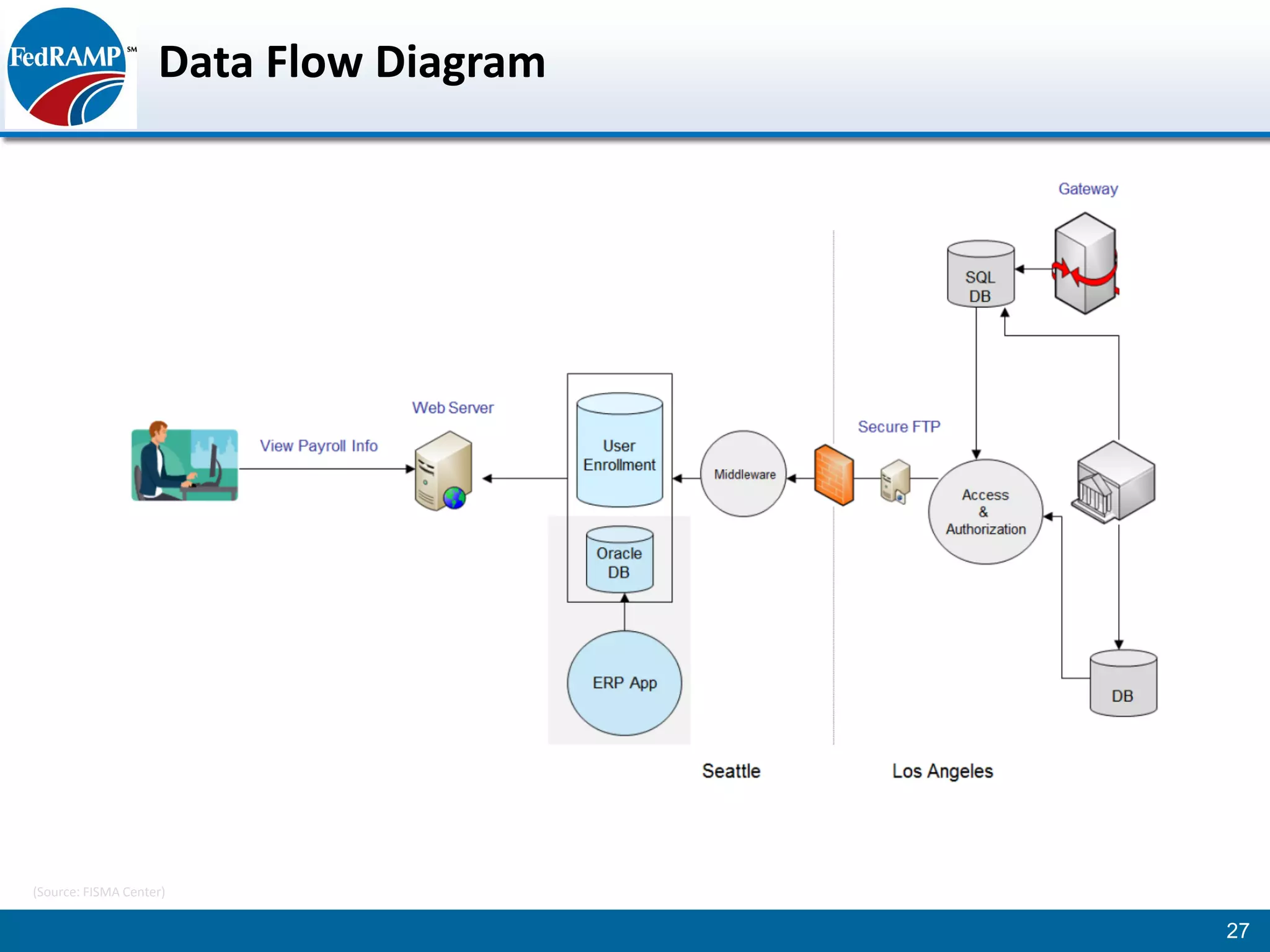
Data Flow Diagram


(Source: FISMA Center)

                                        27
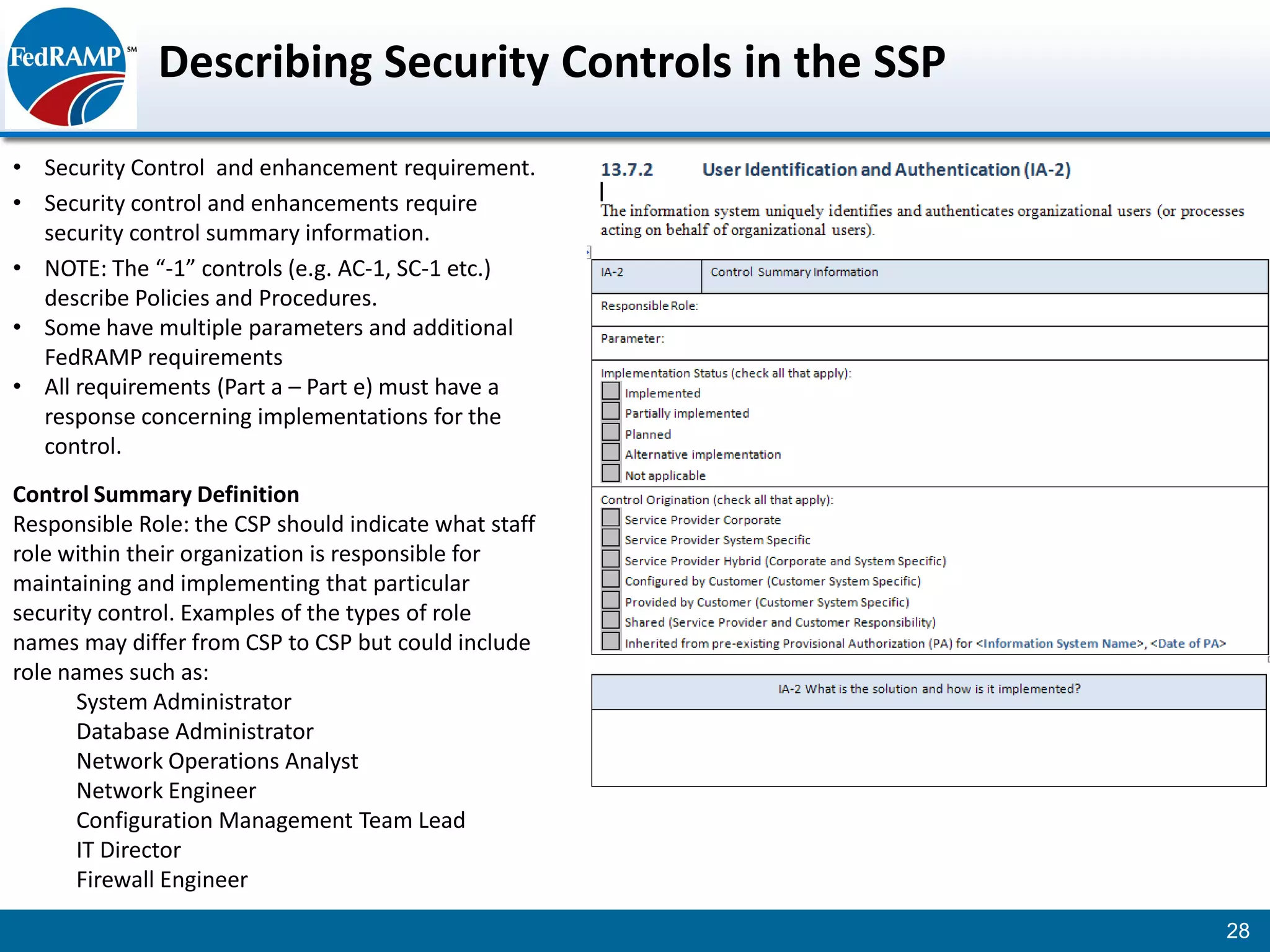
Describing Security Controls in the SSP
• Security Control and enhancement requirement.
• Security control and enhancements require
  security control summary information.
• NOTE: The “-1” controls (e.g. AC-1, SC-1 etc.)
  describe Policies and Procedures.
• Some have multiple parameters and additional
  FedRAMP requirements
• All requirements (Part a – Part e) must have a
  response concerning implementations for the
  control.
Control Summary Definition
Responsible Role: the CSP should indicate what staff
role within their organization is responsible for
maintaining and implementing that particular
security control. Examples of the types of role
names may differ from CSP to CSP but could include
role names such as:
       System Administrator
       Database Administrator
       Network Operations Analyst
       Network Engineer
       Configuration Management Team Lead
       IT Director
       Firewall Engineer

                                                        28
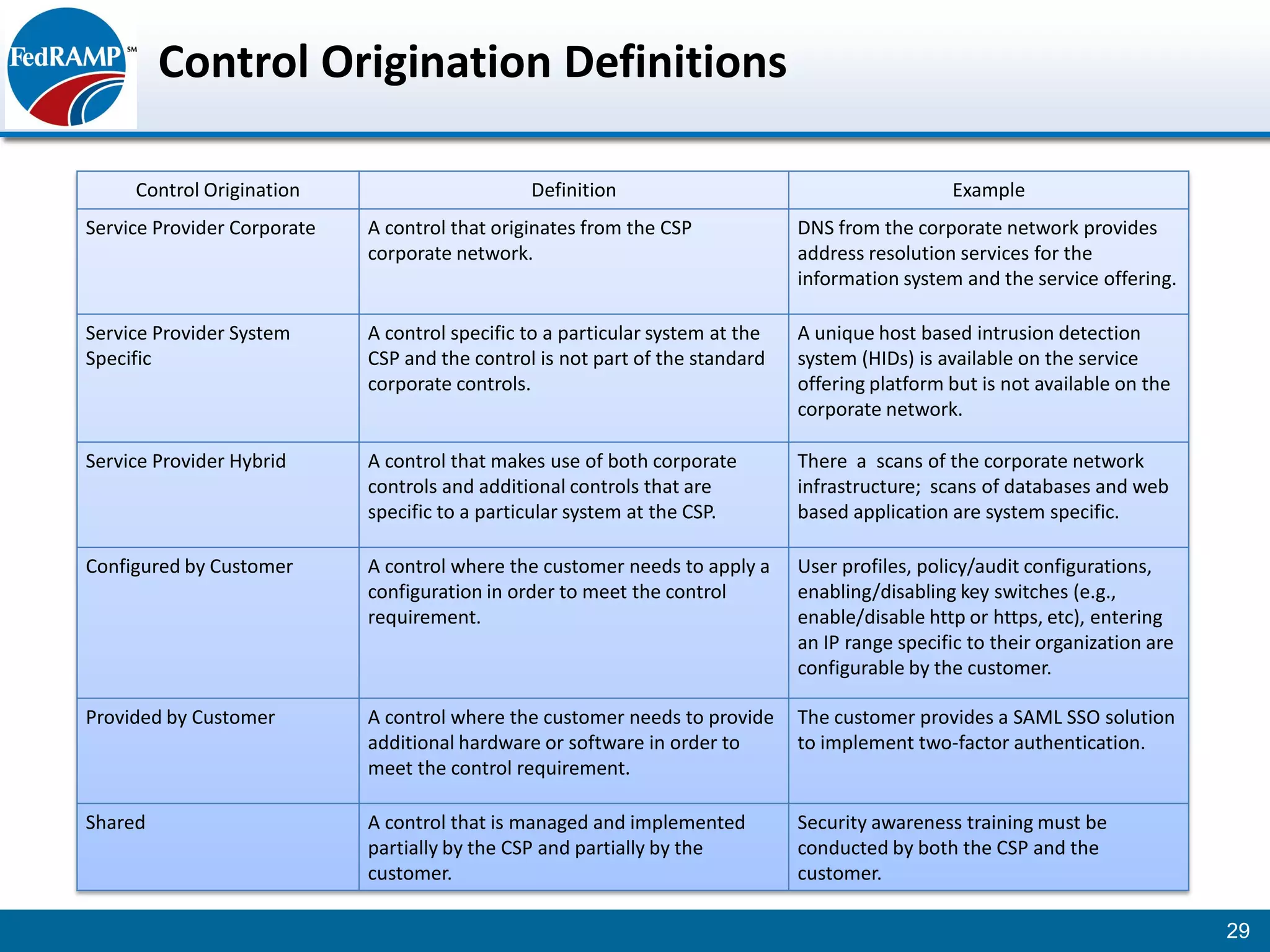
Control Origination Definitions

     Control Origination                        Definition                                        Example
Service Provider Corporate   A control that originates from the CSP             DNS from the corporate network provides
                             corporate network.                                 address resolution services for the
                                                                                information system and the service offering.

Service Provider System      A control specific to a particular system at the   A unique host based intrusion detection
Specific                     CSP and the control is not part of the standard    system (HIDs) is available on the service
                             corporate controls.                                offering platform but is not available on the
                                                                                corporate network.

Service Provider Hybrid      A control that makes use of both corporate         There a scans of the corporate network
                             controls and additional controls that are          infrastructure; scans of databases and web
                             specific to a particular system at the CSP.        based application are system specific.

Configured by Customer       A control where the customer needs to apply a      User profiles, policy/audit configurations,
                             configuration in order to meet the control         enabling/disabling key switches (e.g.,
                             requirement.                                       enable/disable http or https, etc), entering
                                                                                an IP range specific to their organization are
                                                                                configurable by the customer.

Provided by Customer         A control where the customer needs to provide      The customer provides a SAML SSO solution
                             additional hardware or software in order to        to implement two-factor authentication.
                             meet the control requirement.

Shared                       A control that is managed and implemented          Security awareness training must be
                             partially by the CSP and partially by the          conducted by both the CSP and the
                             customer.                                          customer.

                                                                                                                                 29
Quick Tips: Easy Mistakes to Avoid

• Submitting an SSP without a Hardware or Software
  Inventory
• Incorrect references to supporting documents or
  guidelines
• Presenting non-applicable controls as implemented
• Not reviewing information pulled from other
  documents or sources
• Single sentence responses without details


                                                      30
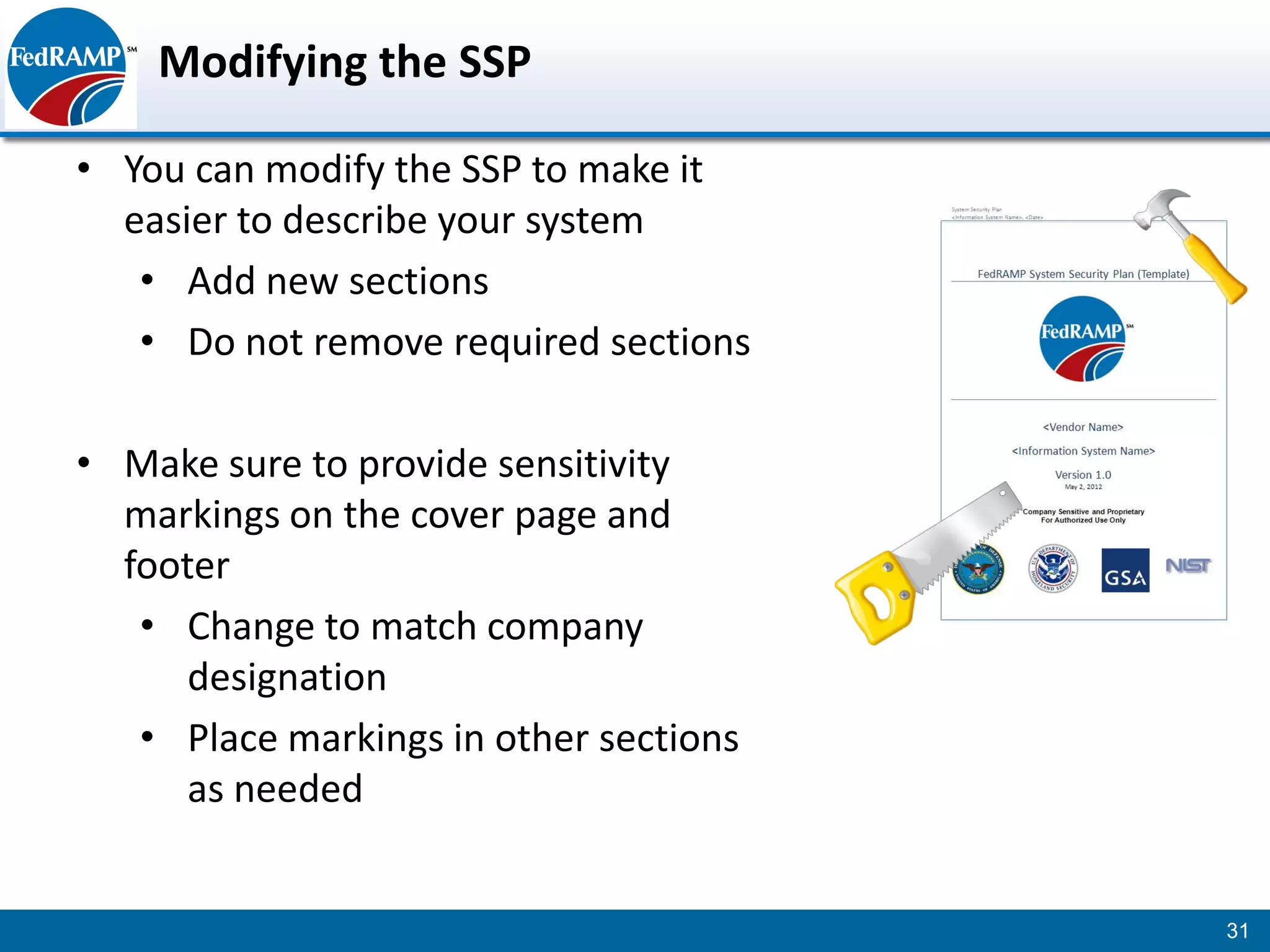
Modifying the SSP

• You can modify the SSP to make it
  easier to describe your system
   • Add new sections
   • Do not remove required sections

• Make sure to provide sensitivity
  markings on the cover page and
  footer
   • Change to match company
      designation
   • Place markings in other sections
      as needed


                                        31
Supporting Documentation

User Guide

Describes how leveraging
agencies use the system


                                 32
Supporting Documentation

User Guide

Describes how leveraging
agencies use the system


                                   33
Supporting Documentation

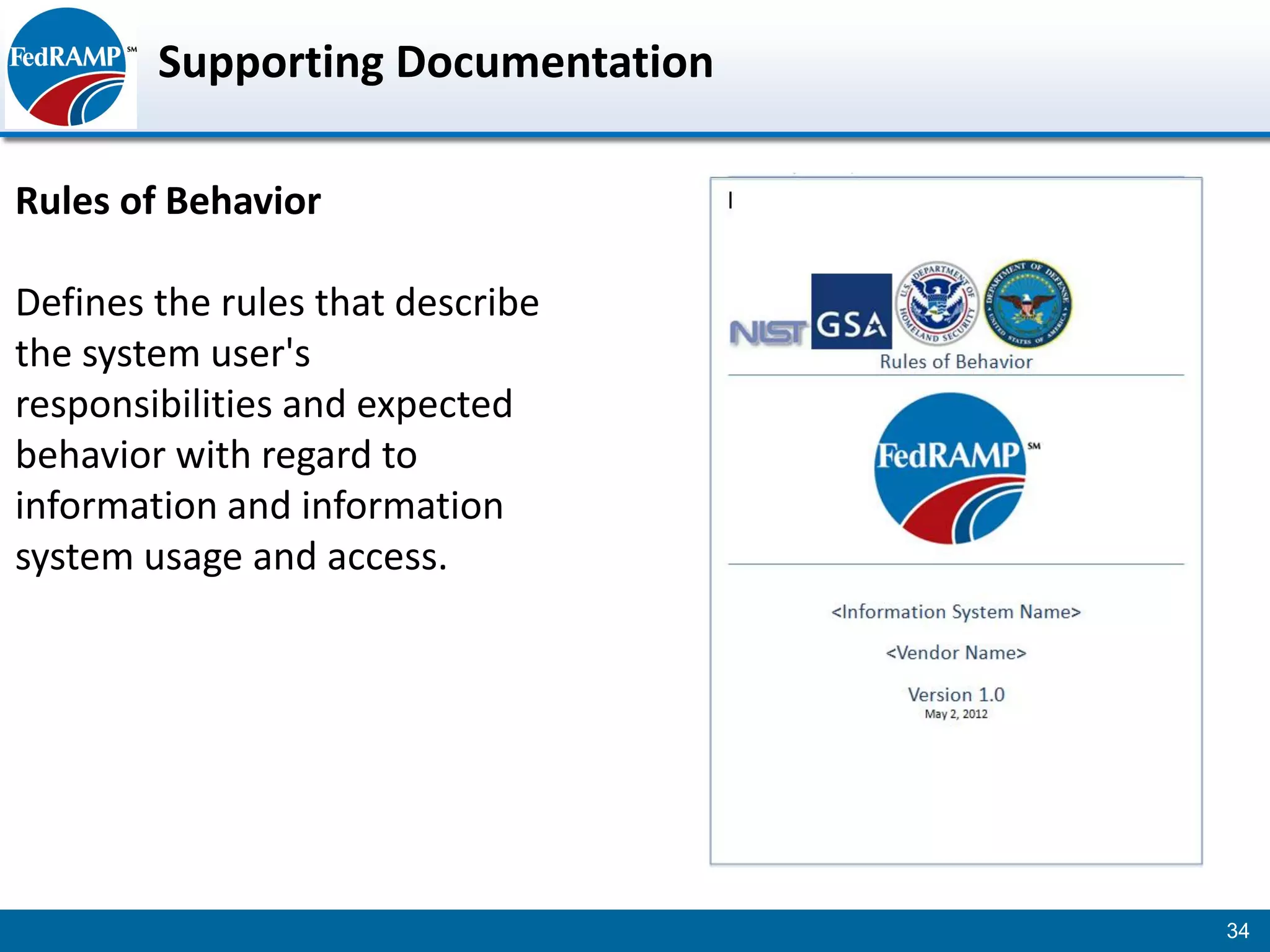
Rules of Behavior

Defines the rules that describe
the system user's
responsibilities and expected
behavior with regard to
information and information
system usage and access.


                                   34
Supporting Documentation

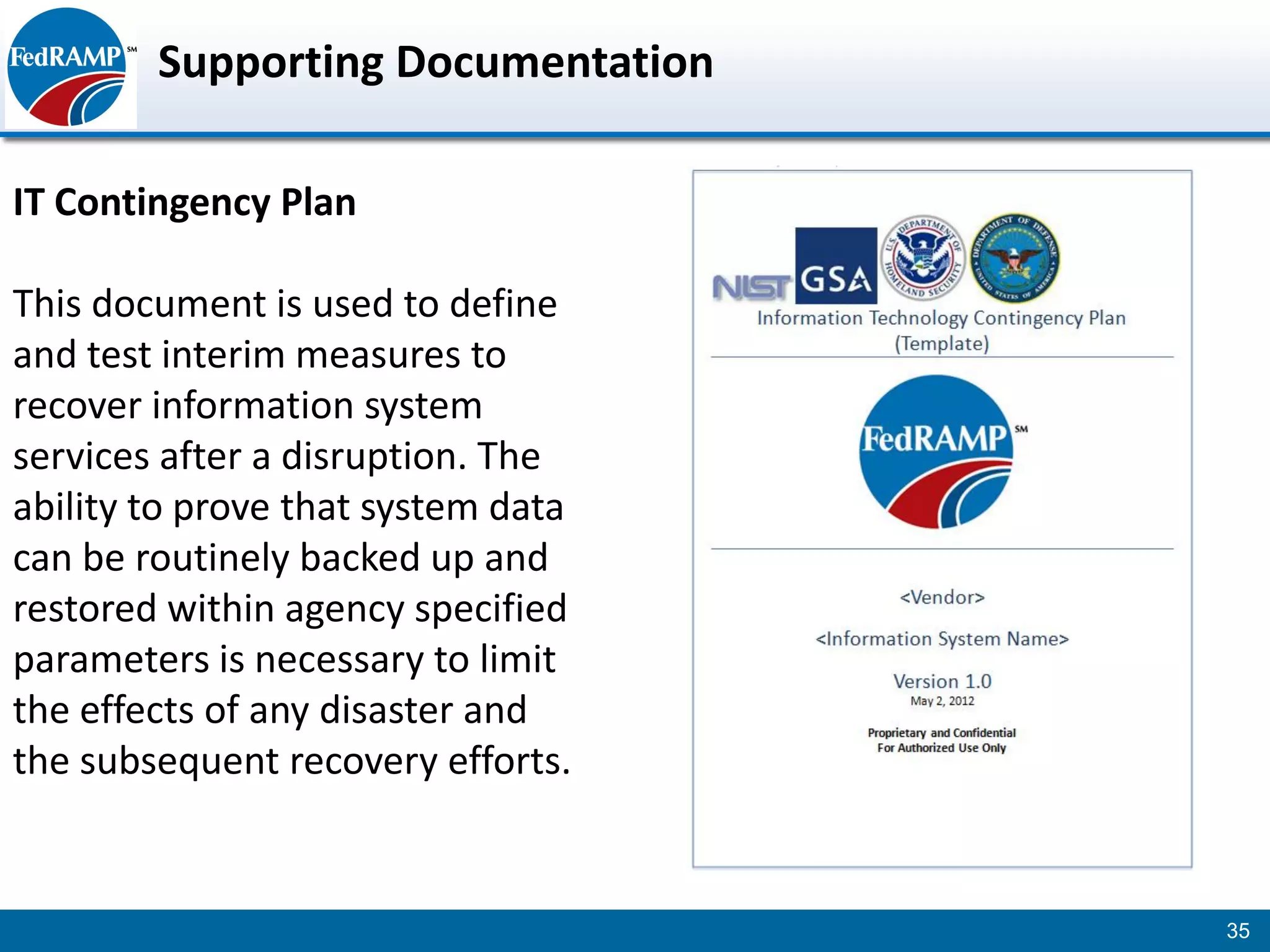
IT Contingency Plan

This document is used to define
and test interim measures to
recover information system
services after a disruption. The
ability to prove that system data
can be routinely backed up and
restored within agency specified
parameters is necessary to limit
the effects of any disaster and
the subsequent recovery efforts.


                                    35
Supporting Documentation

Configuration Management
Plan

This plan describes how
changes to the system are
managed and tracked. The
Configuration Management
Plan should be consistent with
NIST SP 800-128


                                 36
Supporting Documentation


Incident Response Plan

This plan documents how
incidents are detected, reported,
and escalated and should include
timeframes, points of contact,
and how incidents are handled
and remediated. The Incident
Response Plan should be
consistent with NIST Special
Publication 800-61.


                                    37
Supporting Documentation

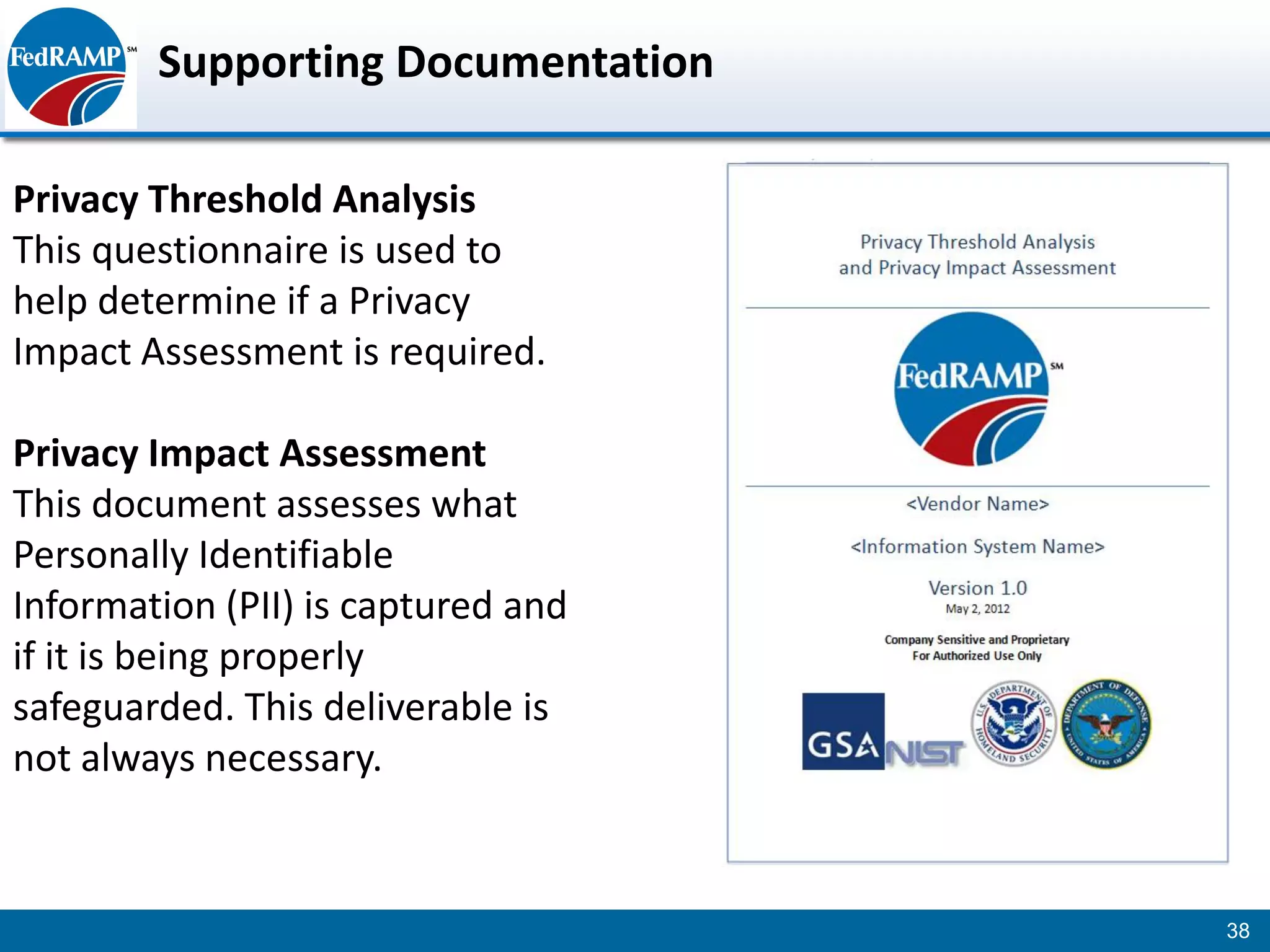
Privacy Threshold Analysis
This questionnaire is used to
help determine if a Privacy
Impact Assessment is required.

Privacy Impact Assessment
This document assesses what
Personally Identifiable
Information (PII) is captured and
if it is being properly
safeguarded. This deliverable is
not always necessary.


                                    38
What Makes a Good SSP

Key Areas of Focus for Documentation
     • Completeness
     • Compliant with FedRAMP policy and consistency with other package documents
     • Delivery of supporting documentation
     • Documentation is adequately referenced – e.g. : Policy, SOPs, Rules of Behavior,
       common control catalogs, waivers, exceptions, etc.

Content should address four (4) criteria :
    1. What
    2. Who
    3. When
    4. How

Proper level of detail for responses should be:
    • Unambiguous
    • Specific
    • Complete
    • Comprehensive
    • Make sure the response is sufficient in length to properly answer the question
                                                                                          39
How to Document References


References To Other Documents Must:
• Be relevant to the control requirement
• Be up to date…not from 4 years ago
• Refer to a real document, not something that
  doesn’t exist

• References Must Include:
   • Full document title
   • Publication date
   • Version number

                                                 40
CM-6: Poor Response


Security settings of information technology products
used with the XX system are set to the most restrictive
mode consistent with information system operational
requirements. From NIST Special Publication 800-70,
guidance was received on necessary configuration
settings for information technology products.


                                                          41
CM-6: Good Response

A. All servers, databases, and workstations are configured according to the Center for
   Internet Security (Level 1) guidelines.
B. Configuration settings are implemented and updated weekly by the System
   Administrator.
C. No system component is exempt from compliance with CIS Level 1 settings
D. Team X monitors and controls changes to configuration settings by using ZZZ
   monitoring system. Any and all changes must go through the official change request
   process.

More information may be found in the Configuration Management Plan.

(1) CSP XYZ uses COTS Product AutoBlitz, Version 1.3 to manage, apply, and verify
configuration settings. The nightly AutoBlitz report identifies and detects configuration
changes made in the last 24 hours, including authorized and unauthorized changes
(3) Upon detection of an unauthorized change or setting, a notice is automatically sent
to the CSP XYZ SOC to report and track the incident.


                                                                                            42
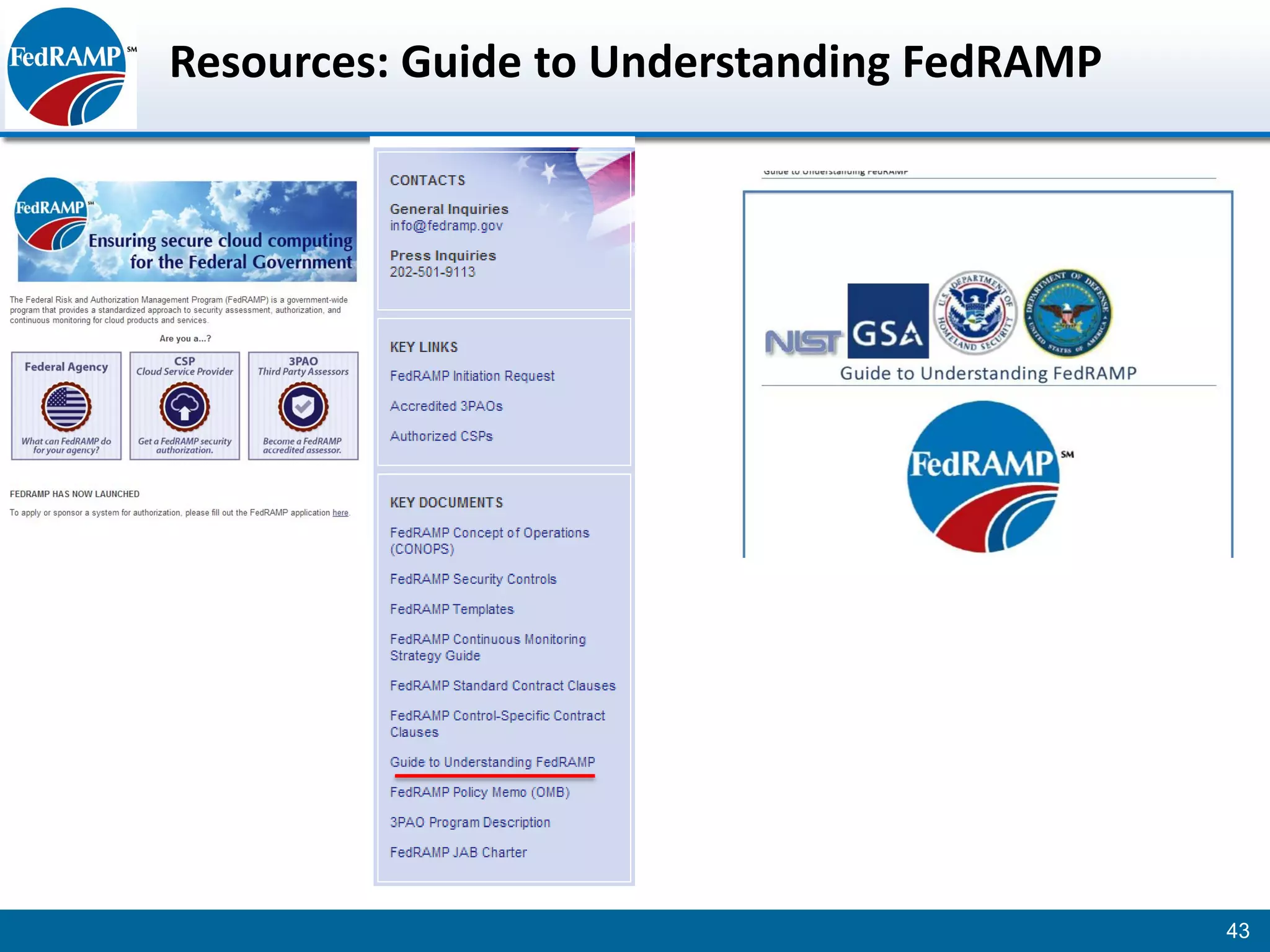
Resources: Guide to Understanding FedRAMP


                                            43
In Summary…

• Three main parts of the SSP
• Avoid easy mistakes by paying attention to details

• Structure your response
    • Who, What, When, How
    • Be consistent throughout the document
    • Provide the right details in your answer

• Read the Guide to Understanding FedRAMP
   • Review the Prep Checklist


                                                       44
Question and Answer Session

For more information, please contact us or
visit us at any of the following websites:
http://FedRAMP.gov
http://gsa.gov/FedRAMP
Email: info@fedramp.gov
               @ FederalCloud
For more information, please contact us or
visit us at any of the following websites:
http://FedRAMP.gov
http://gsa.gov/FedRAMP
Email: info@fedramp.gov
               @ FederalCloud

Fedramp developing-system-security-plan-slides

  • 1.
    Federal Risk andAuthorization Management Program (FedRAMP) Developing Your System Security Plan November 28, 2012
  • 2.
    Today’s Webinar FedRAMP isa government-wide program that provides a standardized approach to security assessment, authorization, and continuous monitoring for cloud services.  The goal of this webinar is review the System Security Plan (SSP) and provide the information and guidelines that you need to accurately document the FedRAMP controls and assemble a strong SSP that will meet FedRAMP review requirements. 2
  • 3.
    System Security Plan(SSP) Overview • Detailed description of Control Implementation, based on NIST SP 800-53, r3 • Global view of how the system is structured • Identifies personnel in the organization that are responsible for system security • Delineates control responsibility between the customer or vendor • The SSP is the key document to moving the FedRAMP assessment process forward • Putting together a well documented SSP can save a lot of time in moving through the process 3
  • 4.
    Why Such aLong Document? • SSP template is 352 pages long • Long template required to assure the system and implementation of controls are properly documented • Effort to produce a well documented SSP leads to a smooth process 4
  • 5.
    SSP Document Organization 1.System Information and Scope Section 1 – Section 12 5
  • 6.
    SSP Document Organization 2.Description of Control Implementation Section 13 6
  • 7.
    SSP Document Organization 3.Appendix of Supporting Documents Section 14 7
  • 8.
    Describe Your System Sections1 – 11 Contain Description of your System • Section 1 – Basic System Info • System Name • Unique Identifier 8
  • 9.
    Section 2 –Information System Categorization • Overall System Categorization • CSP Data Information Types 9
  • 10.
    Section 2 –Information System Categorization • Security Objective Categorization (High Water Mark) • Select Security Baseline based on Impact Level 10
  • 11.
    Section 2 –Information System Categorization • FIPS Guidance on NIST CSRC Website 11
  • 12.
    Section 2 –Selecting E-Authentication Level • E-Authentication Determination 12
  • 13.
    Section 2 –Selecting E-Authentication Level • OMB Memo M-04-04, EAuthentication Guidance for Federal Agencies 13
  • 14.
    Section 3 -SystemOwner • System Owner Contact 14
  • 15.
    Section 5 –Designated Contacts • Technical and Management POC 15
  • 16.
    Section 6 –Security Responsibility • Information System Security Contact • PMO will provide FedRAMP ISSO info 16
  • 17.
    Section 7– OperationalStatus • List the operational state of the system 17
  • 18.
    Section 8 –Information System Type • List cloud service model 18
  • 19.
    Section 8 –InformationSystem Type • Is the cloud service built on top of another cloud system with a FedRAMP Provisional ATO? 19
  • 20.
    Section 9 –General System Description • The general System Description section contains some of the most important parts of the SSP in terms of defining the roles of the system’s users, defining the system boundary, and describing the system architecture • What is the purpose of the system? – Why was it built? What problem does it solve? What solution does it provide? • Types of Users – Defined by what privileges the user is authorized to use – Is the user internal or external – Examples of roles include systems administrators, database administrators, release engineers, and customers – List other roles that have the ability to configure components that may affect services (web server administrators, network administrators, and firewall administrators) 20
  • 21.
    Describing System Boundaries System Boundary Internet Network Components Protection Boundary Ports, Protocols and Services Network Architecture Outside the System Boundary Protection Boundary Different System Outside the Boundary • Understand which IT assets fit within the boundary. • Interconnections: indicate and label interconnections to other systems • Make sure your boundary is consistent with hardware & software inventory • Make sure your diagrams are consistent with boundary descriptions 21
  • 22.
    Describing the NetworkArchitecture Primary Datacenter Internet Cloud Service Provider Network Technical Support VPN SSL 10.x.x.x Customer Firewall Mobile user 192.x.x.x 10.x.x.x 192.x.x.x WAN Support Load Balancer 10.x.x.x Jump Box Router 10.x.x.x 10.x.2.x Operational Services (Authentication, Switch Messaging, etc.) Alternate Router 10.x.2.x 10.x.x.x 10.x.1.x Datacenter Backup servers 10.x.3.x Web Server Storage Server 10.x.2.x Authorization 10.x.1.x Database Virtualized Servers 10.x.1.x 10.x.2.x Boundary 22
  • 23.
    Section 10 –System Environment • System Inventories – Hardware 23
  • 24.
    Section 10 –System Environment • System Inventories – Software 24
  • 25.
    Section 10 –System Environment • System Inventories – Network 25
  • 26.
    Section 10 –System Environment • System Inventories – Port, Protocols and Services 26
  • 27.
  • 28.
    Describing Security Controlsin the SSP • Security Control and enhancement requirement. • Security control and enhancements require security control summary information. • NOTE: The “-1” controls (e.g. AC-1, SC-1 etc.) describe Policies and Procedures. • Some have multiple parameters and additional FedRAMP requirements • All requirements (Part a – Part e) must have a response concerning implementations for the control. Control Summary Definition Responsible Role: the CSP should indicate what staff role within their organization is responsible for maintaining and implementing that particular security control. Examples of the types of role names may differ from CSP to CSP but could include role names such as: System Administrator Database Administrator Network Operations Analyst Network Engineer Configuration Management Team Lead IT Director Firewall Engineer 28
  • 29.
    Control Origination Definitions Control Origination Definition Example Service Provider Corporate A control that originates from the CSP DNS from the corporate network provides corporate network. address resolution services for the information system and the service offering. Service Provider System A control specific to a particular system at the A unique host based intrusion detection Specific CSP and the control is not part of the standard system (HIDs) is available on the service corporate controls. offering platform but is not available on the corporate network. Service Provider Hybrid A control that makes use of both corporate There a scans of the corporate network controls and additional controls that are infrastructure; scans of databases and web specific to a particular system at the CSP. based application are system specific. Configured by Customer A control where the customer needs to apply a User profiles, policy/audit configurations, configuration in order to meet the control enabling/disabling key switches (e.g., requirement. enable/disable http or https, etc), entering an IP range specific to their organization are configurable by the customer. Provided by Customer A control where the customer needs to provide The customer provides a SAML SSO solution additional hardware or software in order to to implement two-factor authentication. meet the control requirement. Shared A control that is managed and implemented Security awareness training must be partially by the CSP and partially by the conducted by both the CSP and the customer. customer. 29
  • 30.
    Quick Tips: EasyMistakes to Avoid • Submitting an SSP without a Hardware or Software Inventory • Incorrect references to supporting documents or guidelines • Presenting non-applicable controls as implemented • Not reviewing information pulled from other documents or sources • Single sentence responses without details 30
  • 31.
    Modifying the SSP •You can modify the SSP to make it easier to describe your system • Add new sections • Do not remove required sections • Make sure to provide sensitivity markings on the cover page and footer • Change to match company designation • Place markings in other sections as needed 31
  • 32.
    Supporting Documentation User Guide Describeshow leveraging agencies use the system 32
  • 33.
    Supporting Documentation User Guide Describeshow leveraging agencies use the system 33
  • 34.
    Supporting Documentation Rules ofBehavior Defines the rules that describe the system user's responsibilities and expected behavior with regard to information and information system usage and access. 34
  • 35.
    Supporting Documentation IT ContingencyPlan This document is used to define and test interim measures to recover information system services after a disruption. The ability to prove that system data can be routinely backed up and restored within agency specified parameters is necessary to limit the effects of any disaster and the subsequent recovery efforts. 35
  • 36.
    Supporting Documentation Configuration Management Plan Thisplan describes how changes to the system are managed and tracked. The Configuration Management Plan should be consistent with NIST SP 800-128 36
  • 37.
    Supporting Documentation Incident ResponsePlan This plan documents how incidents are detected, reported, and escalated and should include timeframes, points of contact, and how incidents are handled and remediated. The Incident Response Plan should be consistent with NIST Special Publication 800-61. 37
  • 38.
    Supporting Documentation Privacy ThresholdAnalysis This questionnaire is used to help determine if a Privacy Impact Assessment is required. Privacy Impact Assessment This document assesses what Personally Identifiable Information (PII) is captured and if it is being properly safeguarded. This deliverable is not always necessary. 38
  • 39.
    What Makes aGood SSP Key Areas of Focus for Documentation • Completeness • Compliant with FedRAMP policy and consistency with other package documents • Delivery of supporting documentation • Documentation is adequately referenced – e.g. : Policy, SOPs, Rules of Behavior, common control catalogs, waivers, exceptions, etc. Content should address four (4) criteria : 1. What 2. Who 3. When 4. How Proper level of detail for responses should be: • Unambiguous • Specific • Complete • Comprehensive • Make sure the response is sufficient in length to properly answer the question 39
  • 40.
    How to DocumentReferences References To Other Documents Must: • Be relevant to the control requirement • Be up to date…not from 4 years ago • Refer to a real document, not something that doesn’t exist • References Must Include: • Full document title • Publication date • Version number 40
  • 41.
    CM-6: Poor Response Securitysettings of information technology products used with the XX system are set to the most restrictive mode consistent with information system operational requirements. From NIST Special Publication 800-70, guidance was received on necessary configuration settings for information technology products. 41
  • 42.
    CM-6: Good Response A.All servers, databases, and workstations are configured according to the Center for Internet Security (Level 1) guidelines. B. Configuration settings are implemented and updated weekly by the System Administrator. C. No system component is exempt from compliance with CIS Level 1 settings D. Team X monitors and controls changes to configuration settings by using ZZZ monitoring system. Any and all changes must go through the official change request process. More information may be found in the Configuration Management Plan. (1) CSP XYZ uses COTS Product AutoBlitz, Version 1.3 to manage, apply, and verify configuration settings. The nightly AutoBlitz report identifies and detects configuration changes made in the last 24 hours, including authorized and unauthorized changes (3) Upon detection of an unauthorized change or setting, a notice is automatically sent to the CSP XYZ SOC to report and track the incident. 42
  • 43.
    Resources: Guide toUnderstanding FedRAMP 43
  • 44.
    In Summary… • Threemain parts of the SSP • Avoid easy mistakes by paying attention to details • Structure your response • Who, What, When, How • Be consistent throughout the document • Provide the right details in your answer • Read the Guide to Understanding FedRAMP • Review the Prep Checklist 44
  • 45.
    Question and AnswerSession For more information, please contact us or visit us at any of the following websites: http://FedRAMP.gov http://gsa.gov/FedRAMP Email: info@fedramp.gov @ FederalCloud
  • 46.
    For more information,please contact us or visit us at any of the following websites: http://FedRAMP.gov http://gsa.gov/FedRAMP Email: info@fedramp.gov @ FederalCloud