Start Quiz
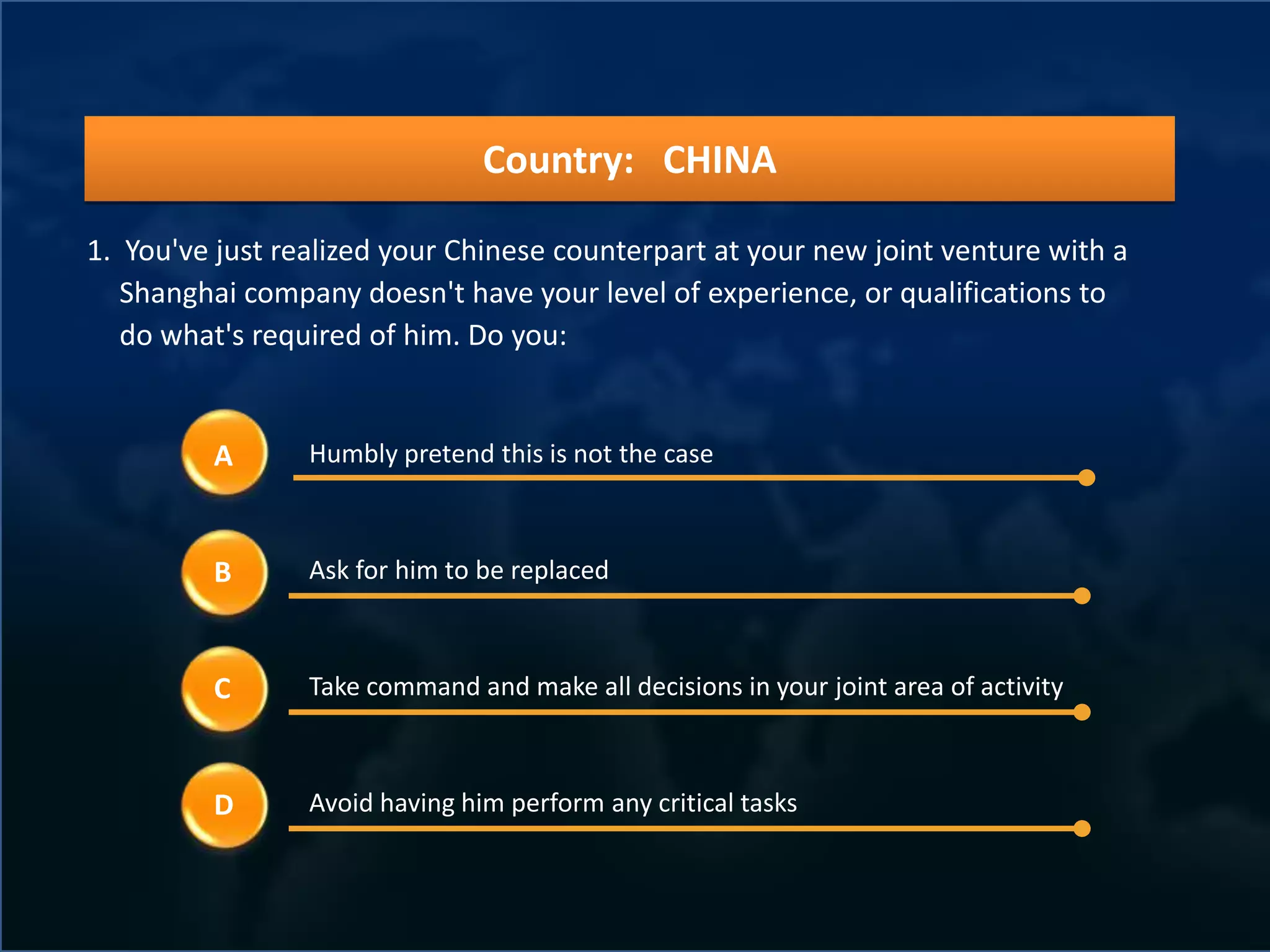
Country: CHINA

1. You've just realized your Chinese counterpart at your new joint venture with a
   Shanghai company doesn't have your level of experience, or qualifications to
   do what's required of him. Do you:


         A       Humbly pretend this is not the case


         B       Ask for him to be replaced


         C       Take command and make all decisions in your joint area of activity


         D       Avoid having him perform any critical tasks
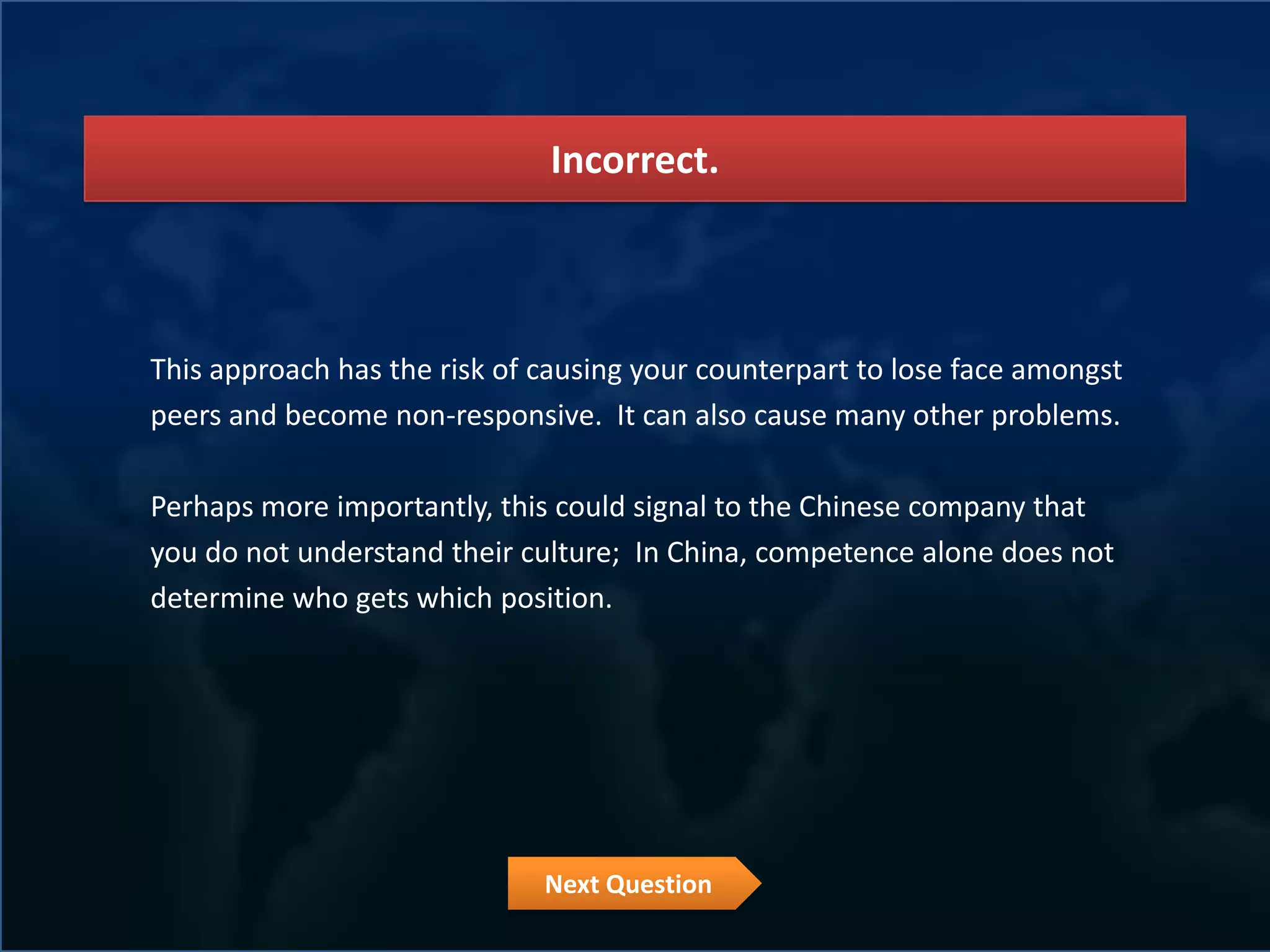
Incorrect.


This approach has the risk of causing your counterpart to lose face amongst
peers and become non-responsive. It can also cause many other problems.

Perhaps more importantly, this could signal to the Chinese company that
you do not understand their culture; In China, competence alone does not
determine who gets which position.


                              Next Question
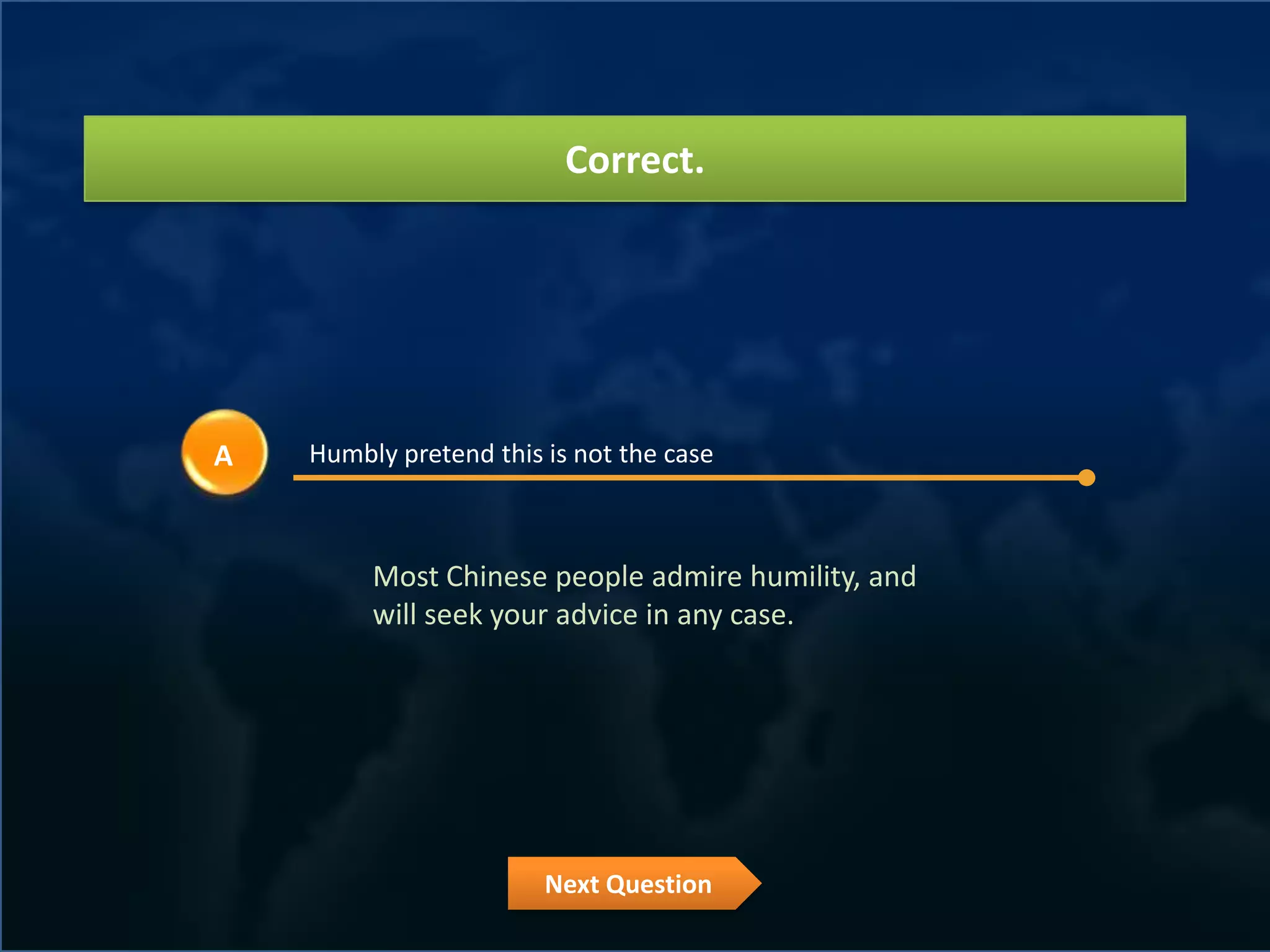
Correct.


A   Humbly pretend this is not the case


         Most Chinese people admire humility, and
         will seek your advice in any case.


                        Next Question
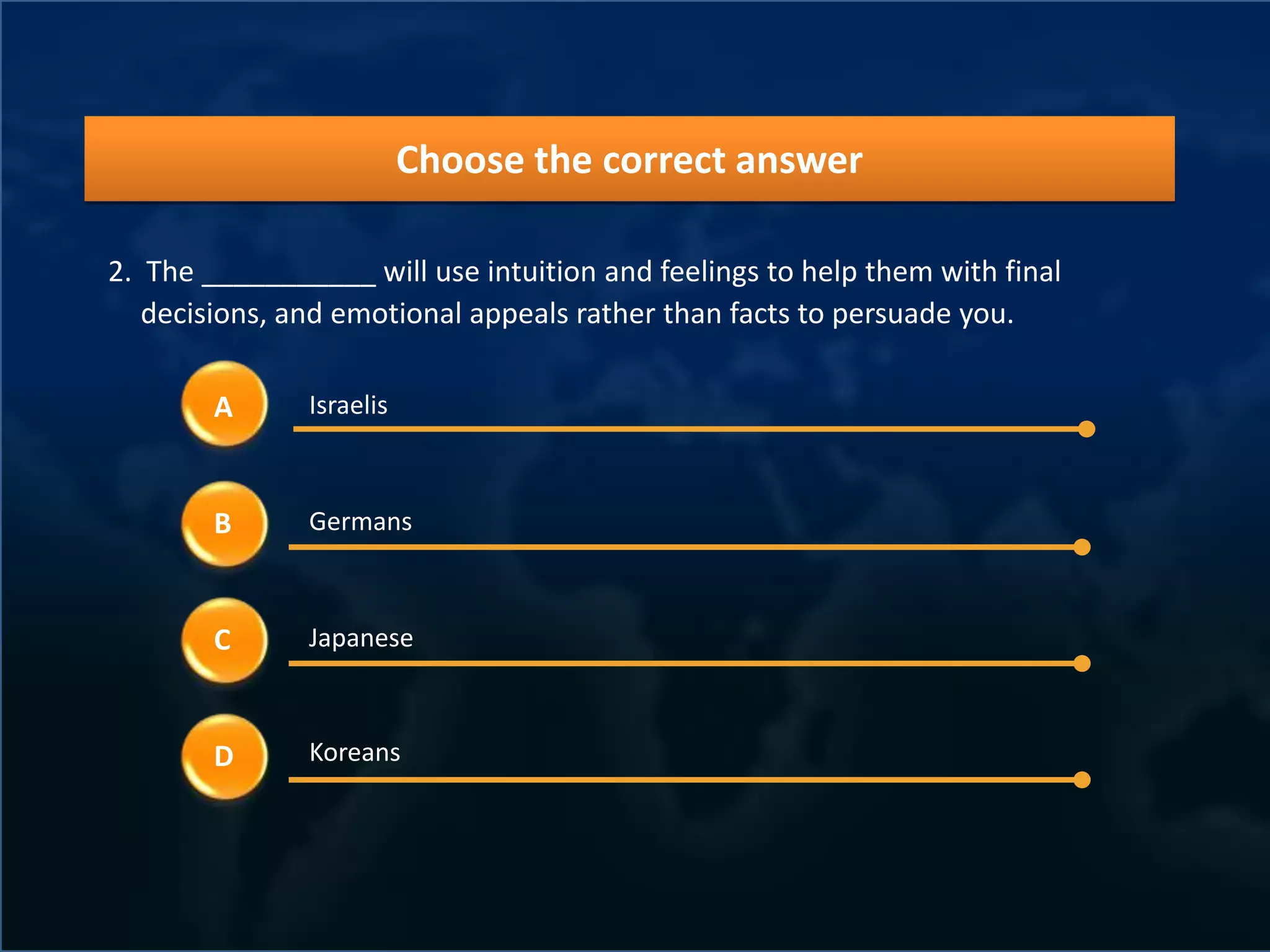
Choose the correct answer

2. The ___________ will use intuition and feelings to help them with final
   decisions, and emotional appeals rather than facts to persuade you.

        A      Israelis


        B      Germans


        C      Japanese


        D      Koreans
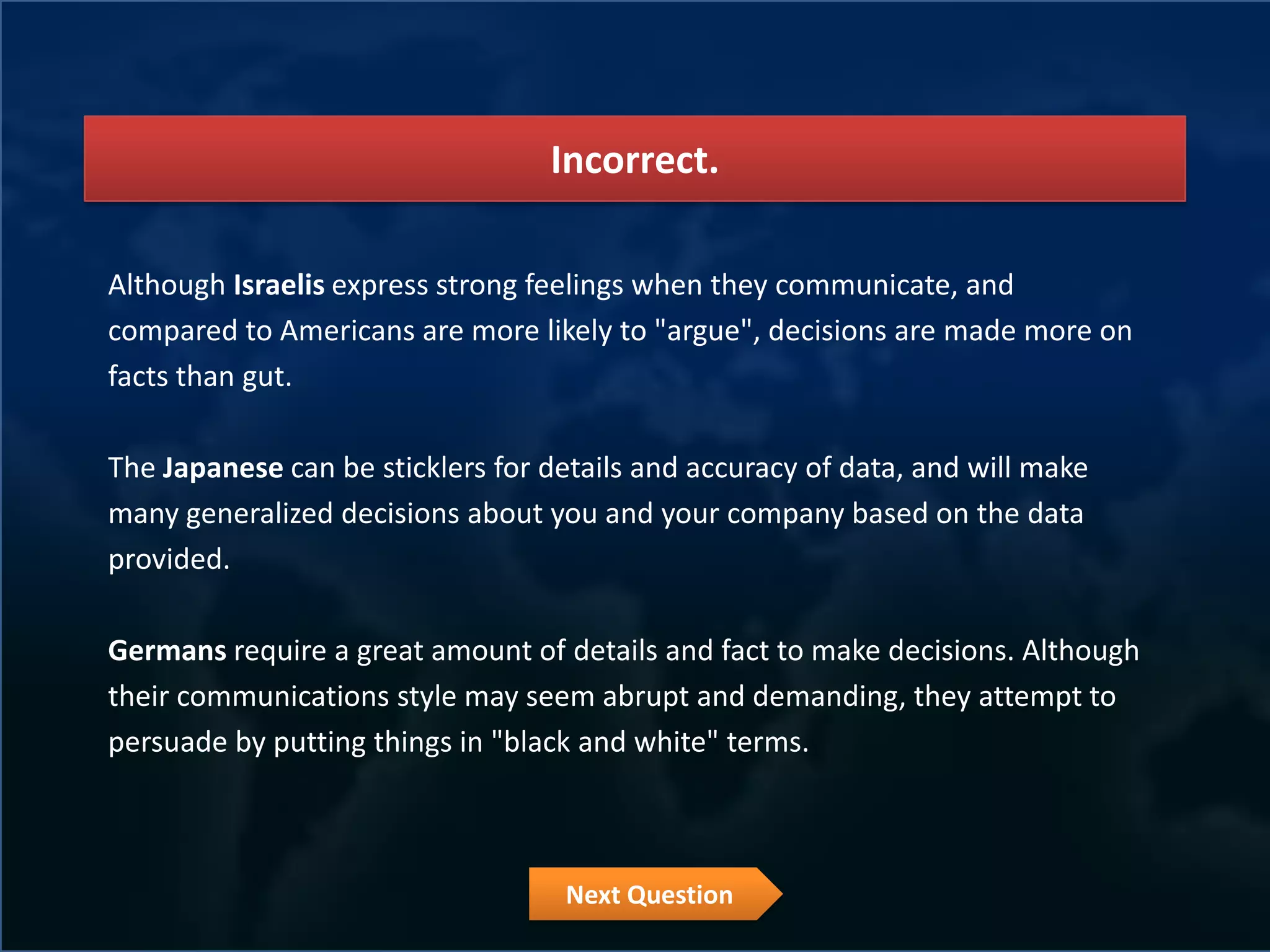
Incorrect.

Although Israelis express strong feelings when they communicate, and
compared to Americans are more likely to "argue", decisions are made more on
facts than gut.

The Japanese can be sticklers for details and accuracy of data, and will make
many generalized decisions about you and your company based on the data
provided.

Germans require a great amount of details and fact to make decisions. Although
their communications style may seem abrupt and demanding, they attempt to
persuade by putting things in "black and white" terms.


                                   Next Question
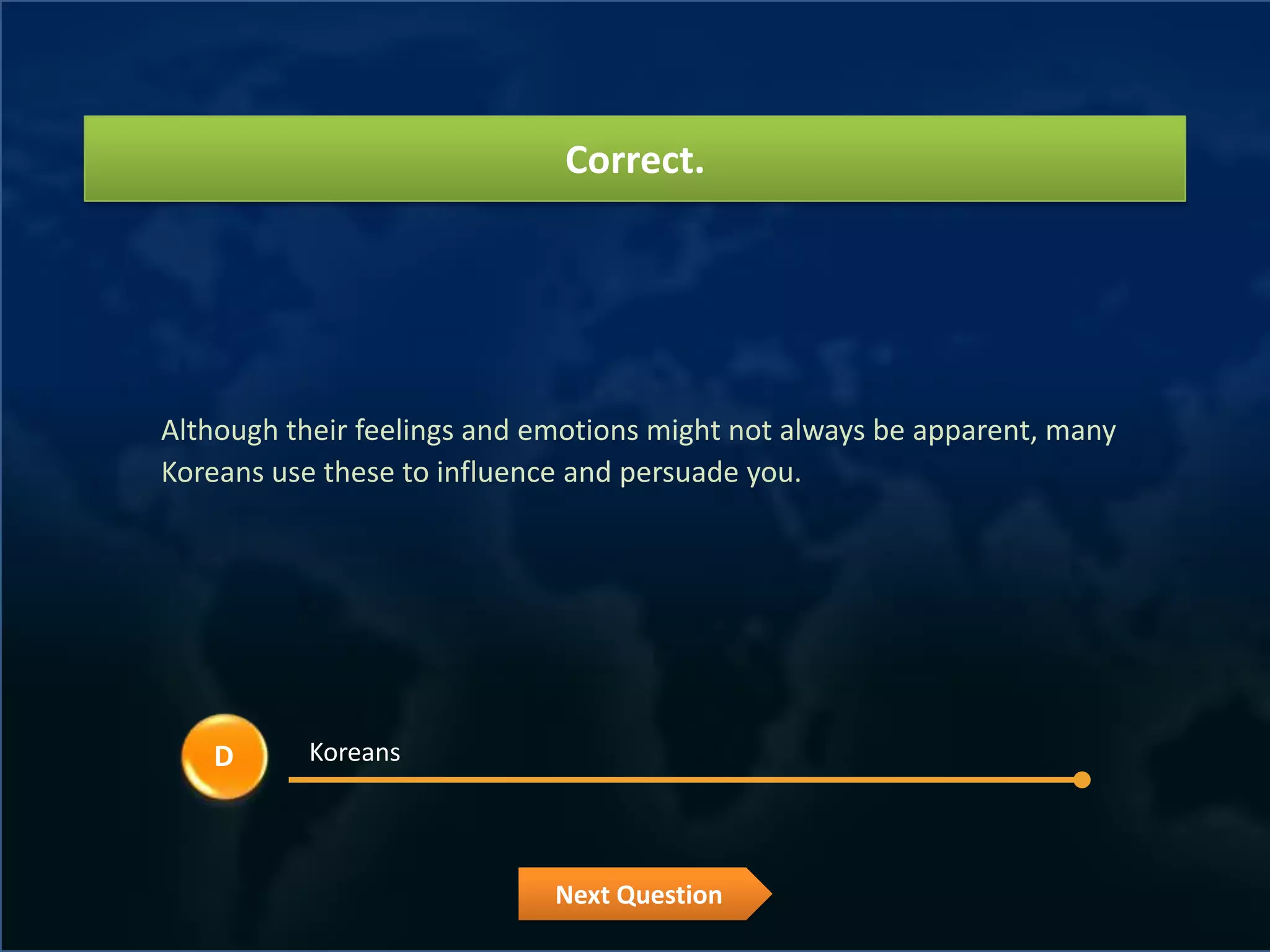
Correct.


Although their feelings and emotions might not always be apparent, many
Koreans use these to influence and persuade you.


   D       Koreans


                             Next Question
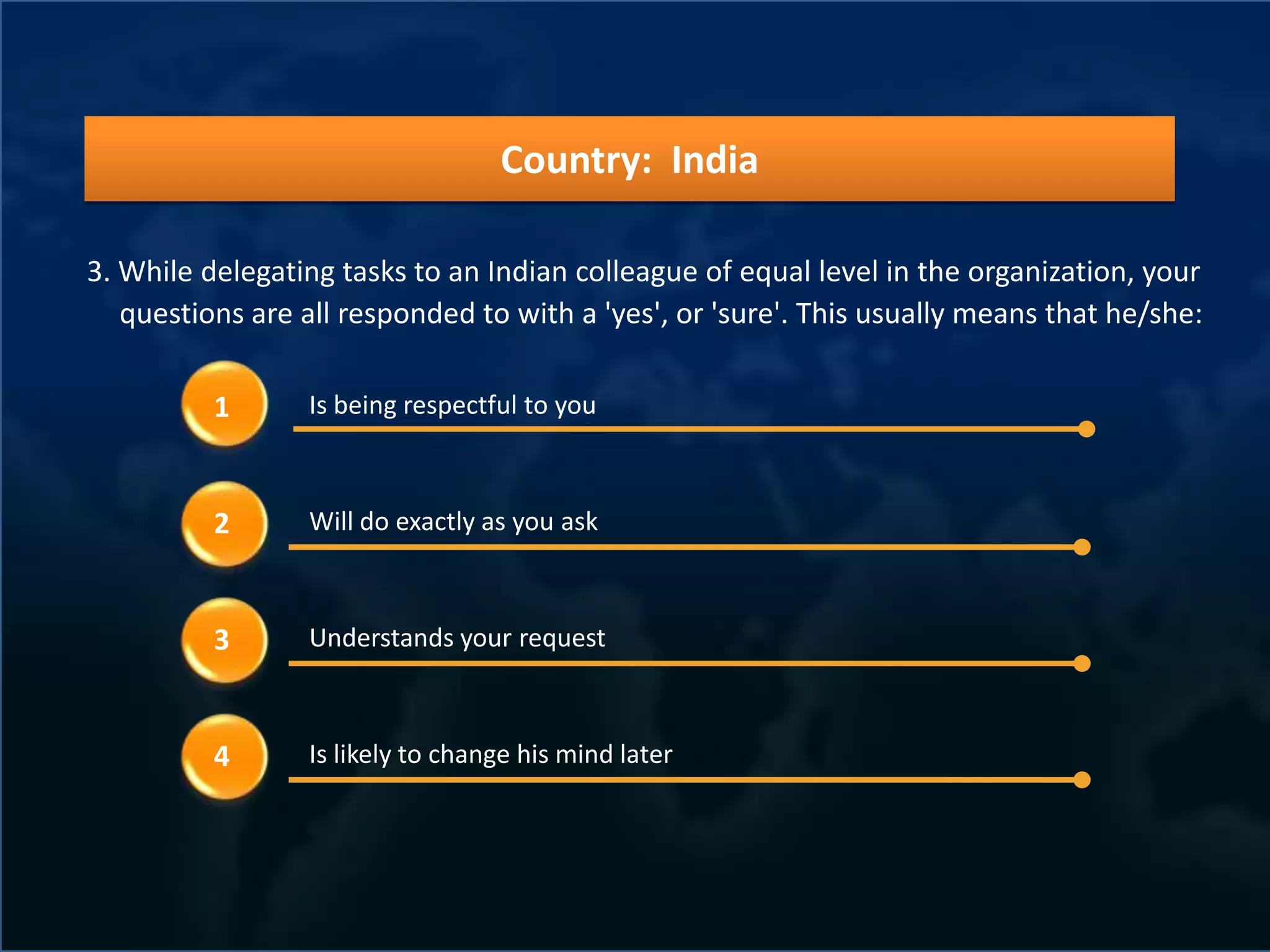
Country: India

3. While delegating tasks to an Indian colleague of equal level in the organization, your
   questions are all responded to with a 'yes', or 'sure'. This usually means that he/she:

          1      Is being respectful to you


          2      Will do exactly as you ask


          3      Understands your request


          4      Is likely to change his mind later
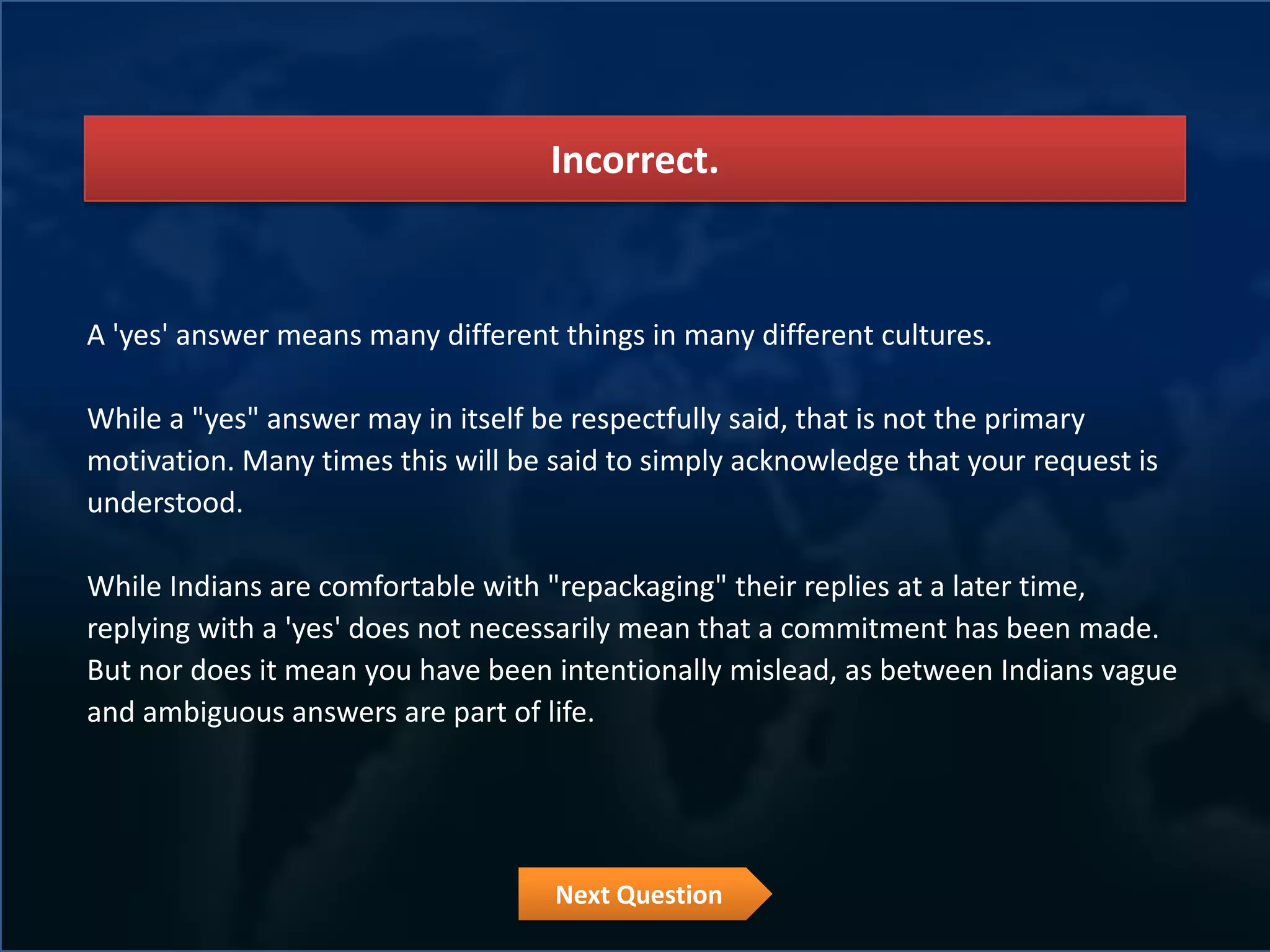
Incorrect.


A 'yes' answer means many different things in many different cultures.

While a "yes" answer may in itself be respectfully said, that is not the primary
motivation. Many times this will be said to simply acknowledge that your request is
understood.

While Indians are comfortable with "repackaging" their replies at a later time,
replying with a 'yes' does not necessarily mean that a commitment has been made.
But nor does it mean you have been intentionally mislead, as between Indians vague
and ambiguous answers are part of life.


                                    Next Question
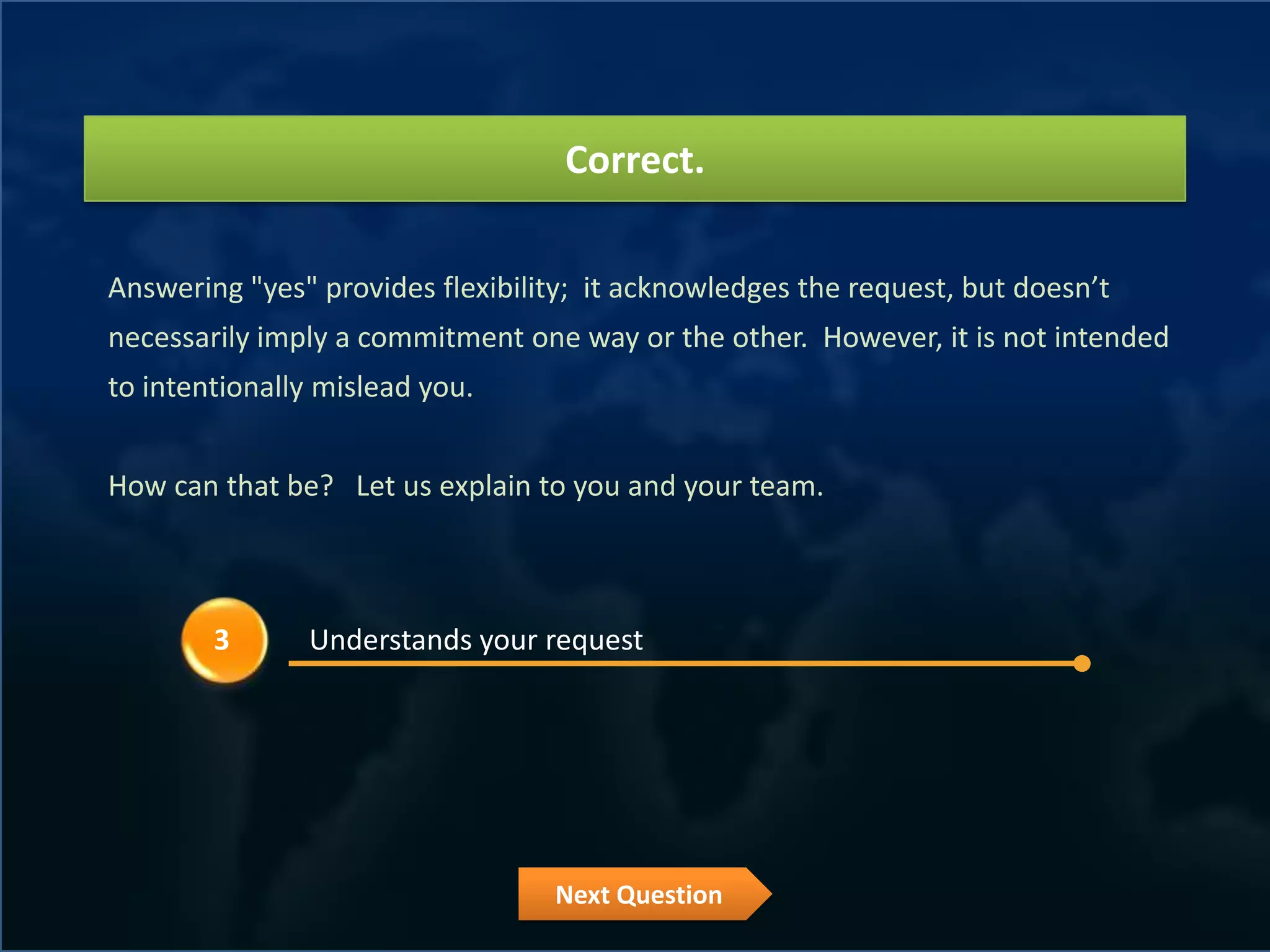
Correct.

Answering "yes" provides flexibility; it acknowledges the request, but doesn’t
necessarily imply a commitment one way or the other. However, it is not intended
to intentionally mislead you.


How can that be? Let us explain to you and your team.


        3      Understands your request


                                  Next Question
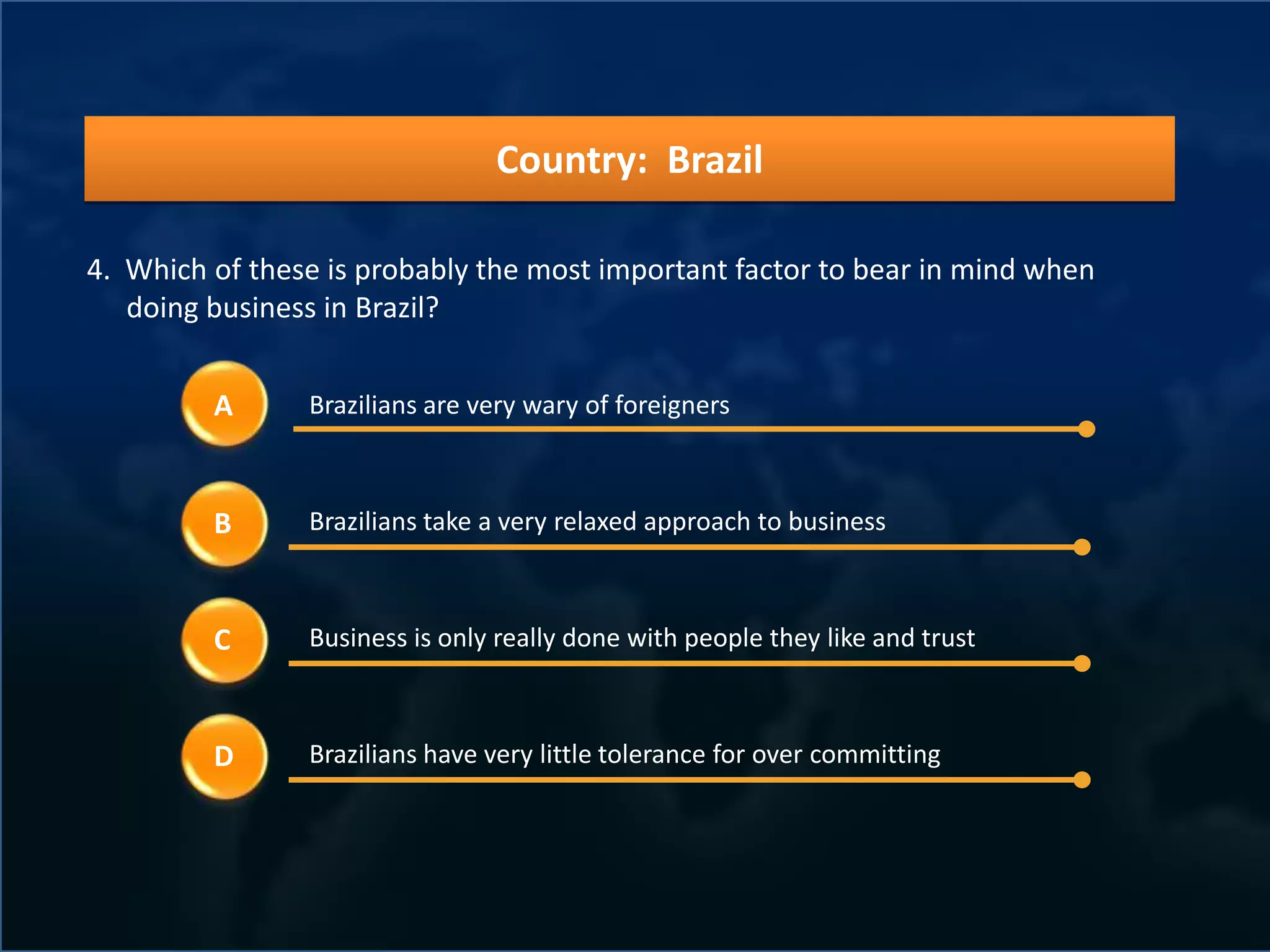
Country: Brazil

4. Which of these is probably the most important factor to bear in mind when
   doing business in Brazil?


         A      Brazilians are very wary of foreigners


         B      Brazilians take a very relaxed approach to business


         C      Business is only really done with people they like and trust


         D      Brazilians have very little tolerance for over committing
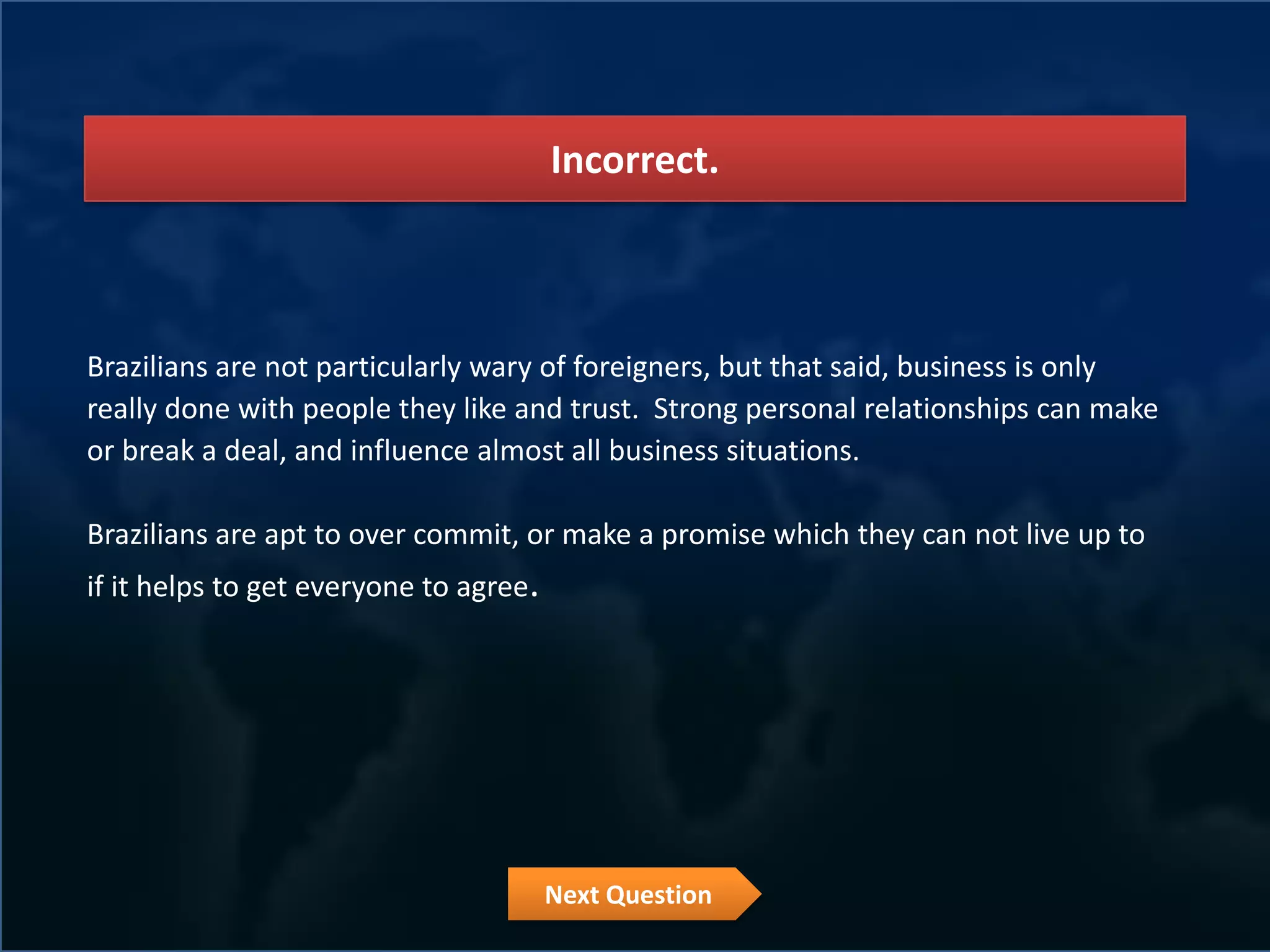
Incorrect.


Brazilians are not particularly wary of foreigners, but that said, business is only
really done with people they like and trust. Strong personal relationships can make
or break a deal, and influence almost all business situations.

Brazilians are apt to over commit, or make a promise which they can not live up to
if it helps to get everyone to agree.


                                        Next Question
Correct.


Strong personal relationships can make or break a deal,
and influence almost all business situations.


  C     Business is only really done with people they like and trust


                              Next Question
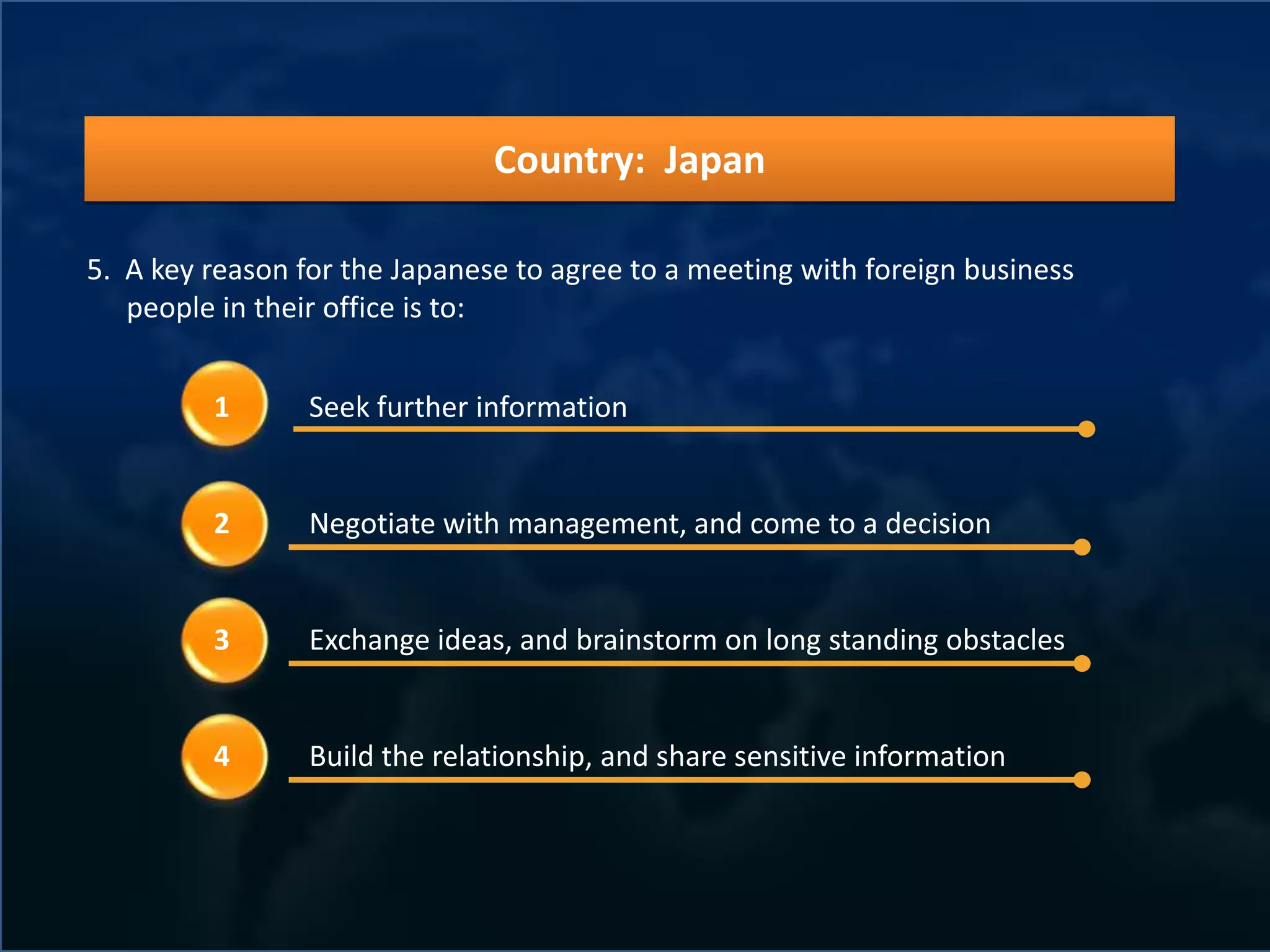
Country: Japan

5. A key reason for the Japanese to agree to a meeting with foreign business
   people in their office is to:


         1       Seek further information


         2       Negotiate with management, and come to a decision


         3       Exchange ideas, and brainstorm on long standing obstacles


         4       Build the relationship, and share sensitive information
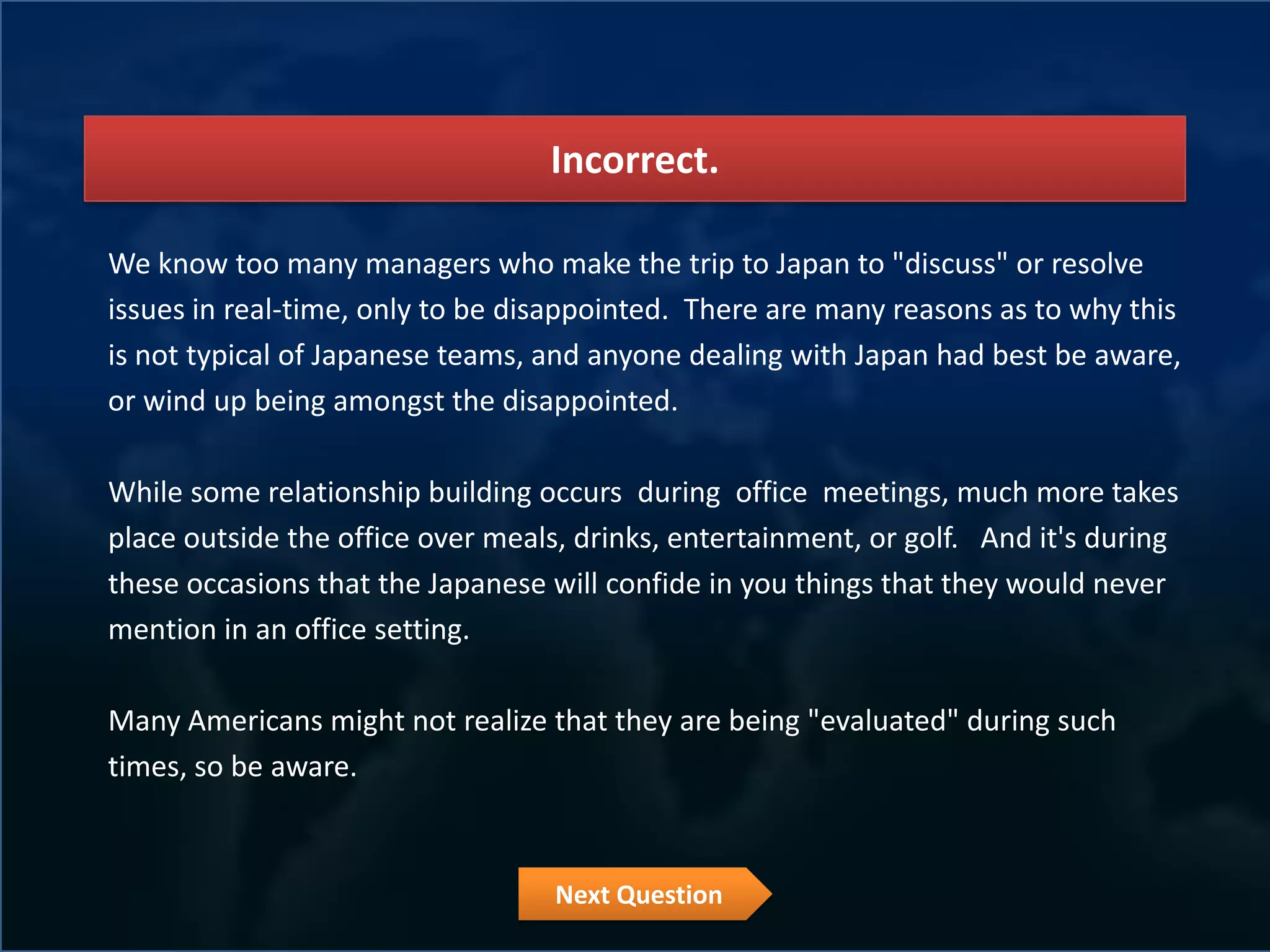
Incorrect.

We know too many managers who make the trip to Japan to "discuss" or resolve
issues in real-time, only to be disappointed. There are many reasons as to why this
is not typical of Japanese teams, and anyone dealing with Japan had best be aware,
or wind up being amongst the disappointed.

While some relationship building occurs during office meetings, much more takes
place outside the office over meals, drinks, entertainment, or golf. And it's during
these occasions that the Japanese will confide in you things that they would never
mention in an office setting.

Many Americans might not realize that they are being "evaluated" during such
times, so be aware.


                                   Next Question
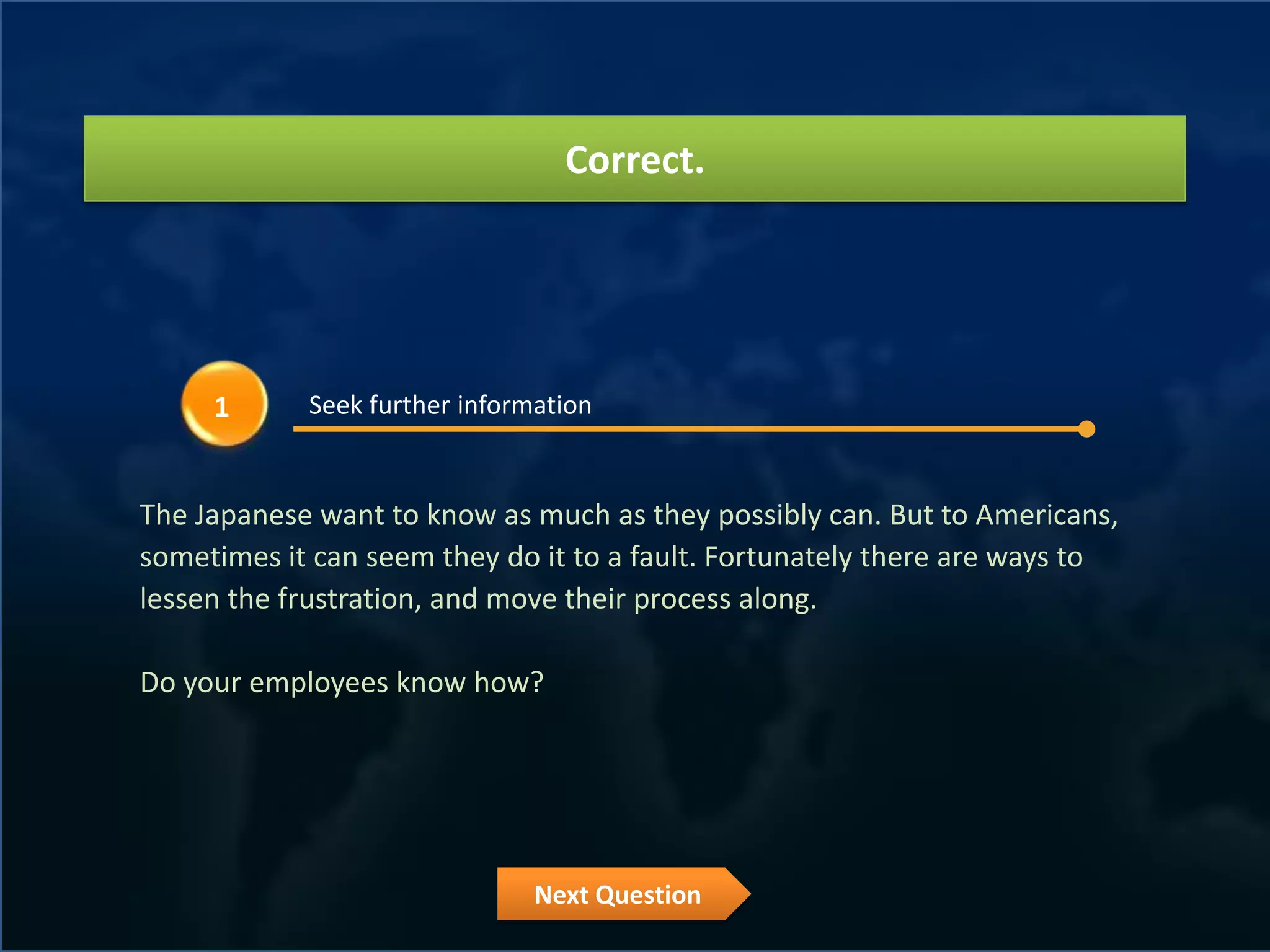
Correct.


     1      Seek further information


The Japanese want to know as much as they possibly can. But to Americans,
sometimes it can seem they do it to a fault. Fortunately there are ways to
lessen the frustration, and move their process along.

Do your employees know how?


                               Next Question
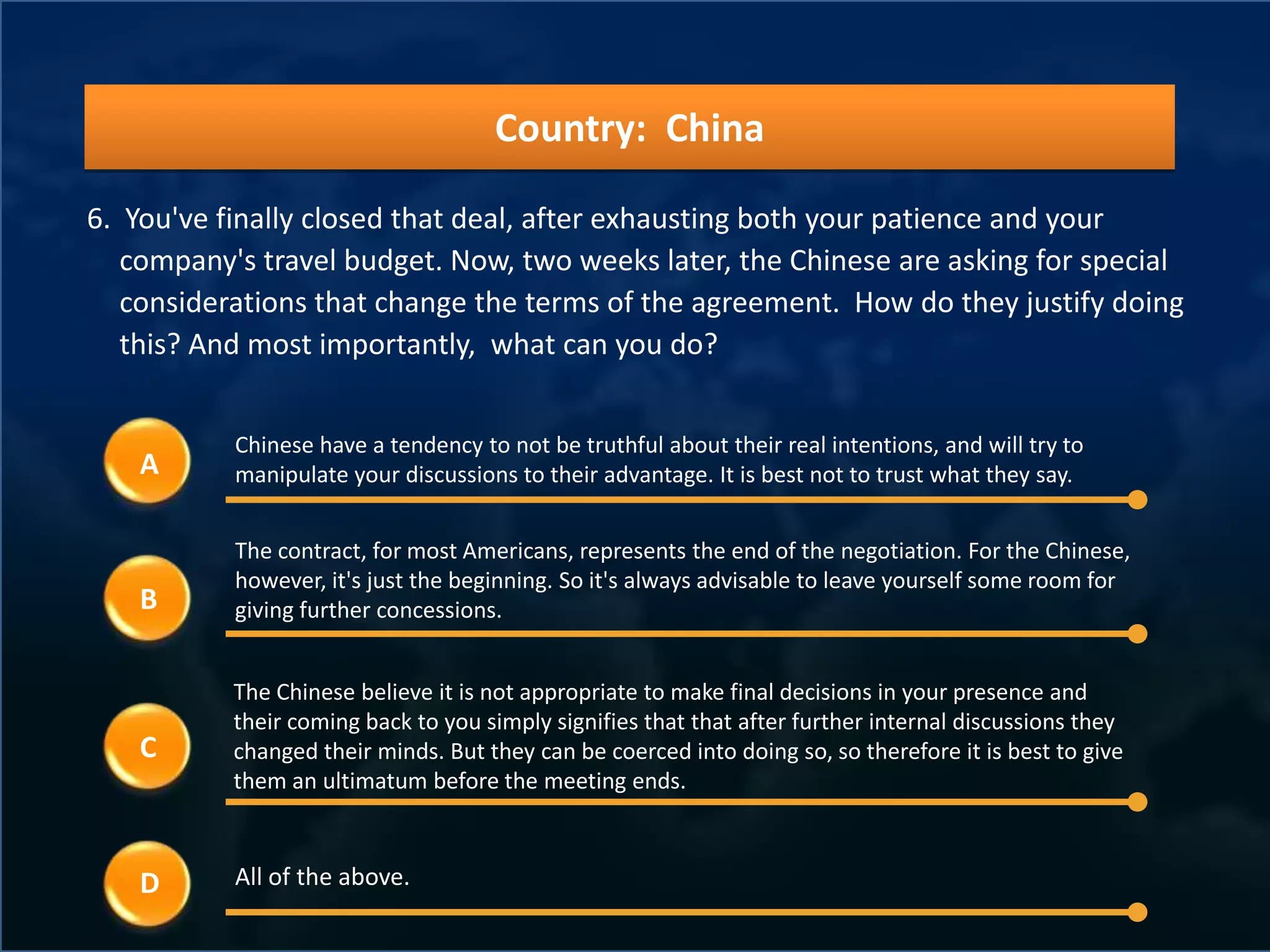
Country: China

6. You've finally closed that deal, after exhausting both your patience and your
   company's travel budget. Now, two weeks later, the Chinese are asking for special
   considerations that change the terms of the agreement. How do they justify doing
   this? And most importantly, what can you do?


           Chinese have a tendency to not be truthful about their real intentions, and will try to
    A      manipulate your discussions to their advantage. It is best not to trust what they say.


           The contract, for most Americans, represents the end of the negotiation. For the Chinese,
           however, it's just the beginning. So it's always advisable to leave yourself some room for
    B      giving further concessions.


           The Chinese believe it is not appropriate to make final decisions in your presence and
           their coming back to you simply signifies that that after further internal discussions they
    C      changed their minds. But they can be coerced into doing so, so therefore it is best to give
           them an ultimatum before the meeting ends.


    D      All of the above.
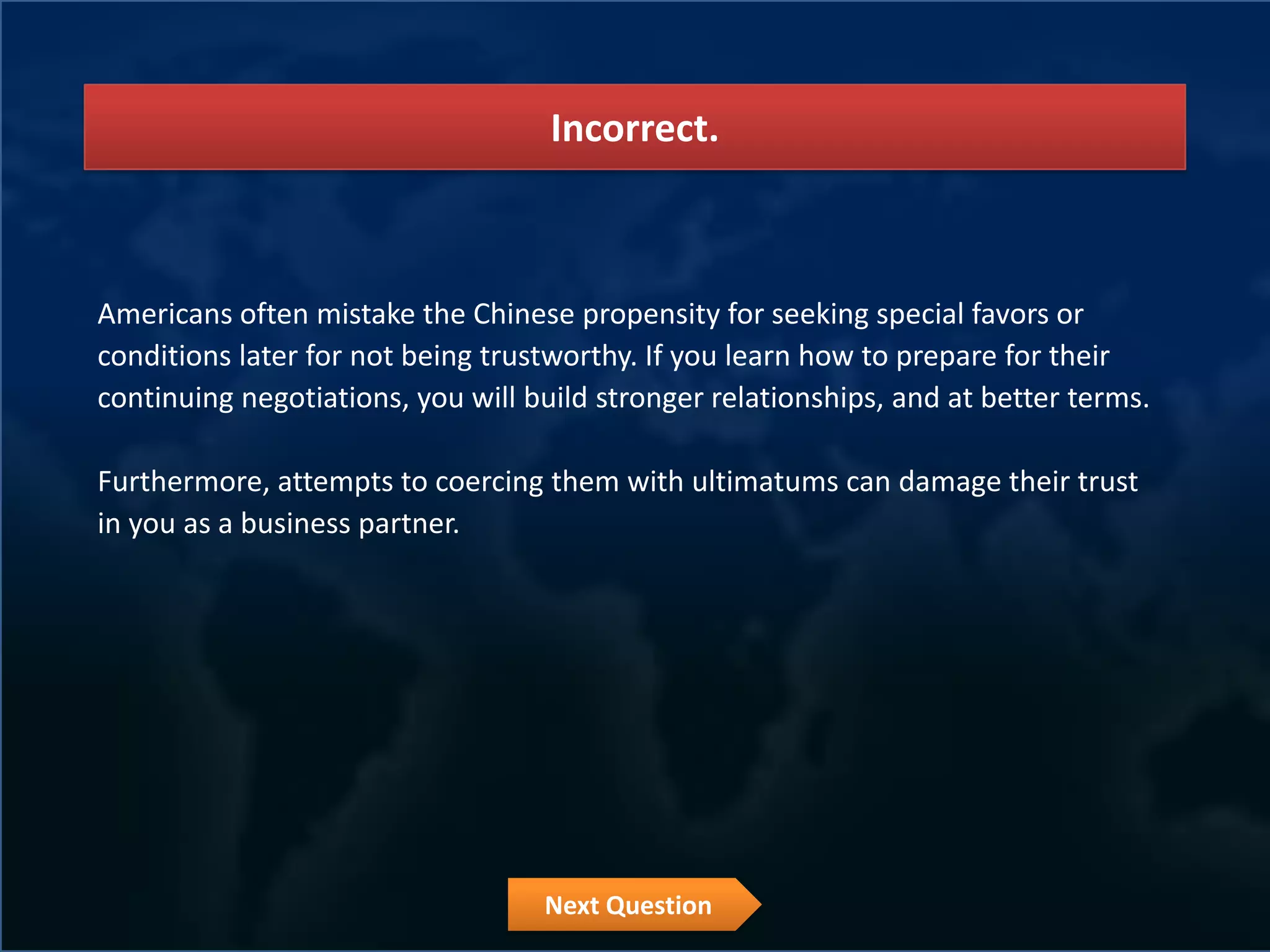
Incorrect.


Americans often mistake the Chinese propensity for seeking special favors or
conditions later for not being trustworthy. If you learn how to prepare for their
continuing negotiations, you will build stronger relationships, and at better terms.

Furthermore, attempts to coercing them with ultimatums can damage their trust
in you as a business partner.


                                   Next Question
Correct.


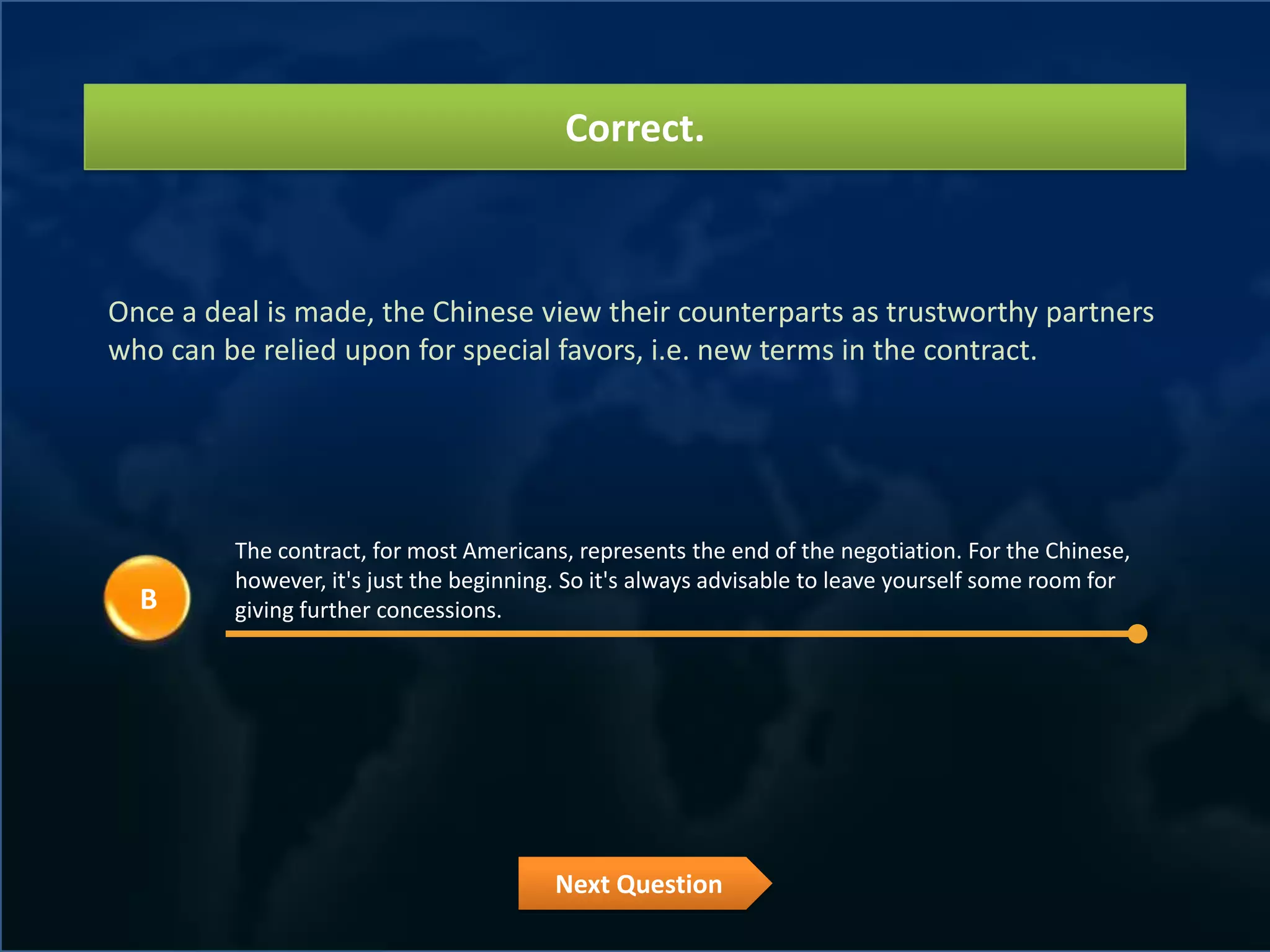
Once a deal is made, the Chinese view their counterparts as trustworthy partners
who can be relied upon for special favors, i.e. new terms in the contract.


         The contract, for most Americans, represents the end of the negotiation. For the Chinese,
         however, it's just the beginning. So it's always advisable to leave yourself some room for
  B      giving further concessions.


                                         Next Question
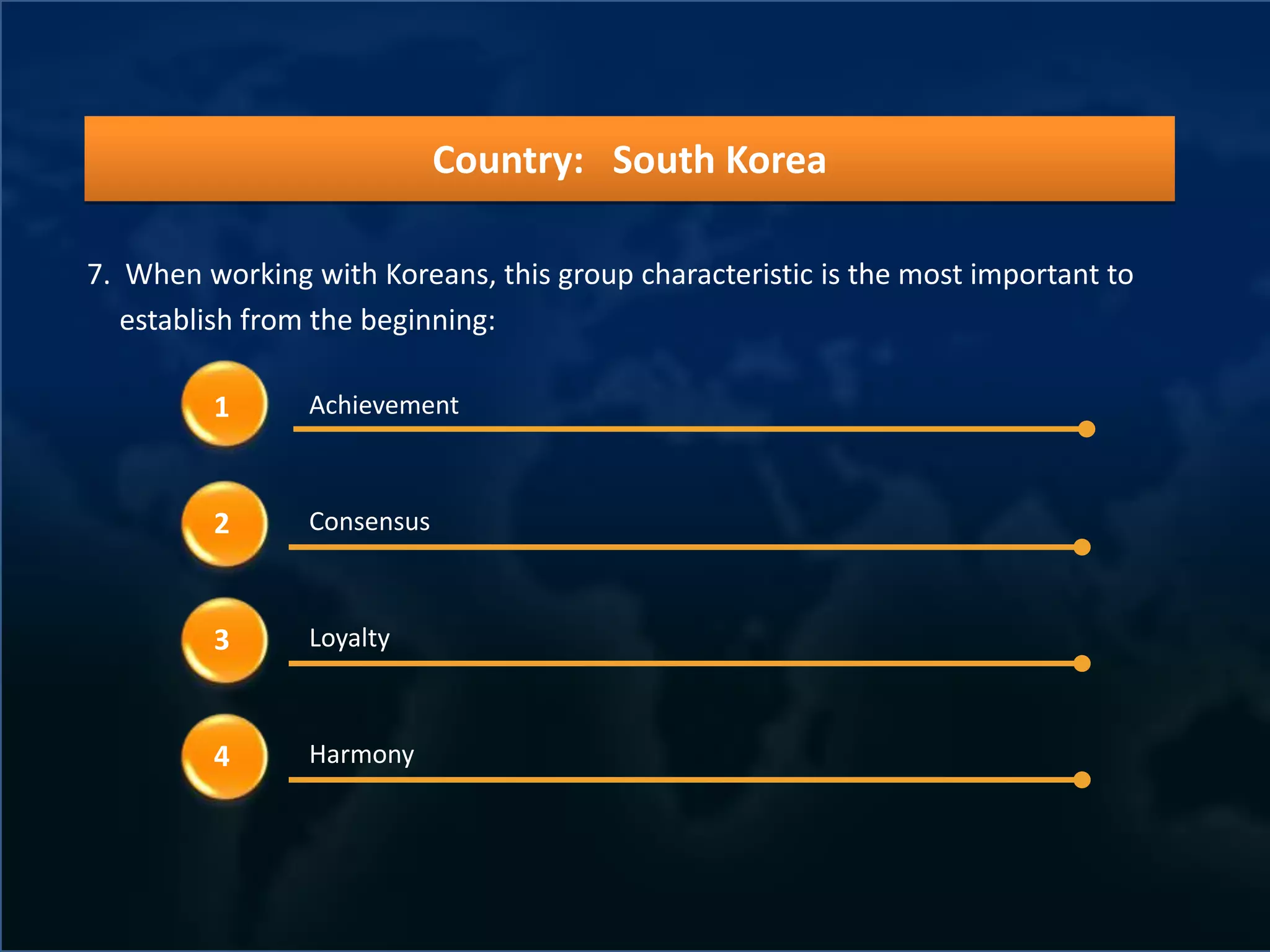
Country: South Korea

7. When working with Koreans, this group characteristic is the most important to
   establish from the beginning:

         1      Achievement


         2      Consensus


         3      Loyalty


         4      Harmony
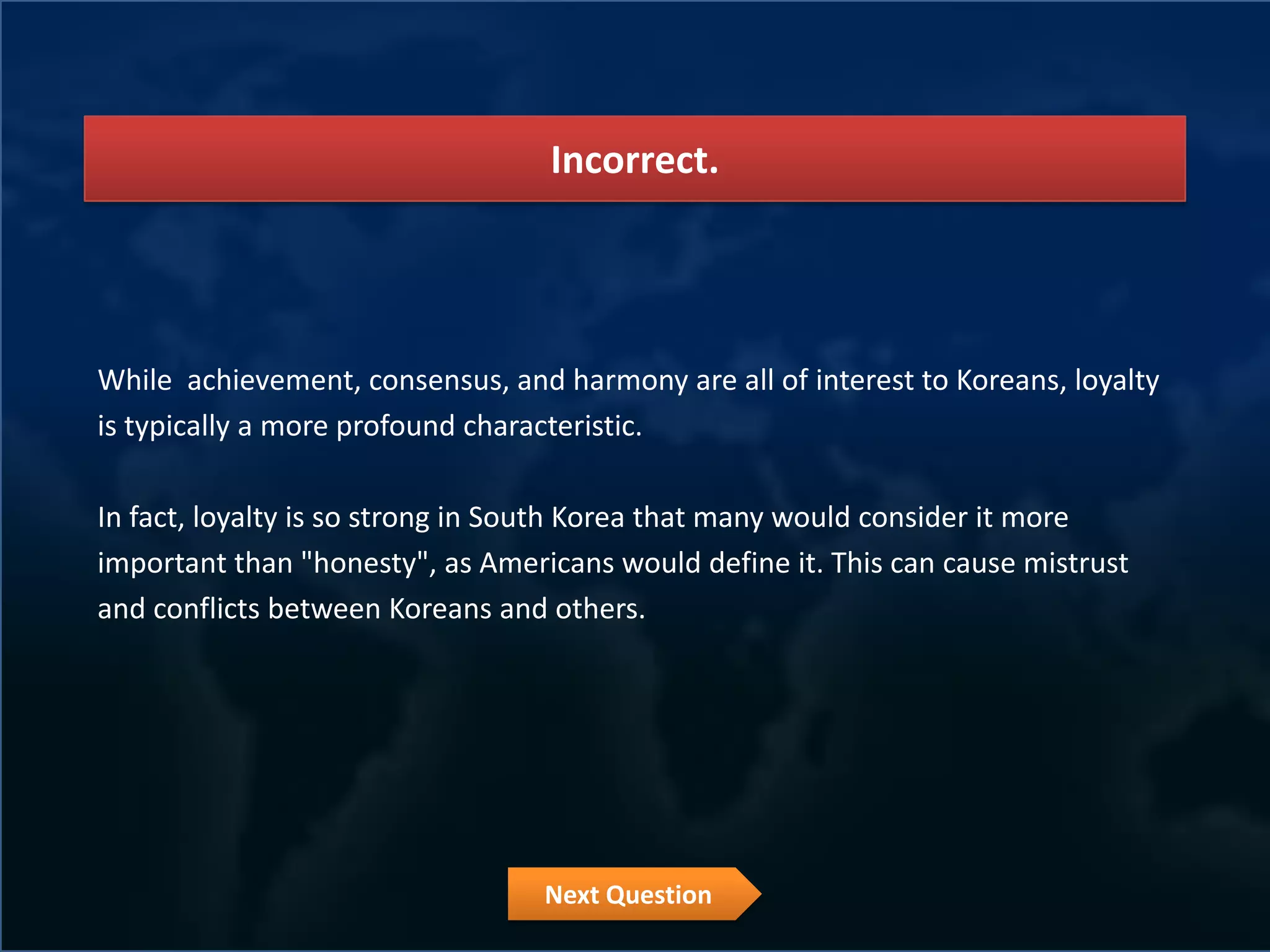
Incorrect.


While achievement, consensus, and harmony are all of interest to Koreans, loyalty
is typically a more profound characteristic.

In fact, loyalty is so strong in South Korea that many would consider it more
important than "honesty", as Americans would define it. This can cause mistrust
and conflicts between Koreans and others.


                                  Next Question
Correct.


In fact, loyalty is so strong in South Korea that many would consider it more
important than "honesty", as Americans would define it. This can cause mistrust
and conflicts between Koreans and others.


     3      Loyalty


                                Next Question
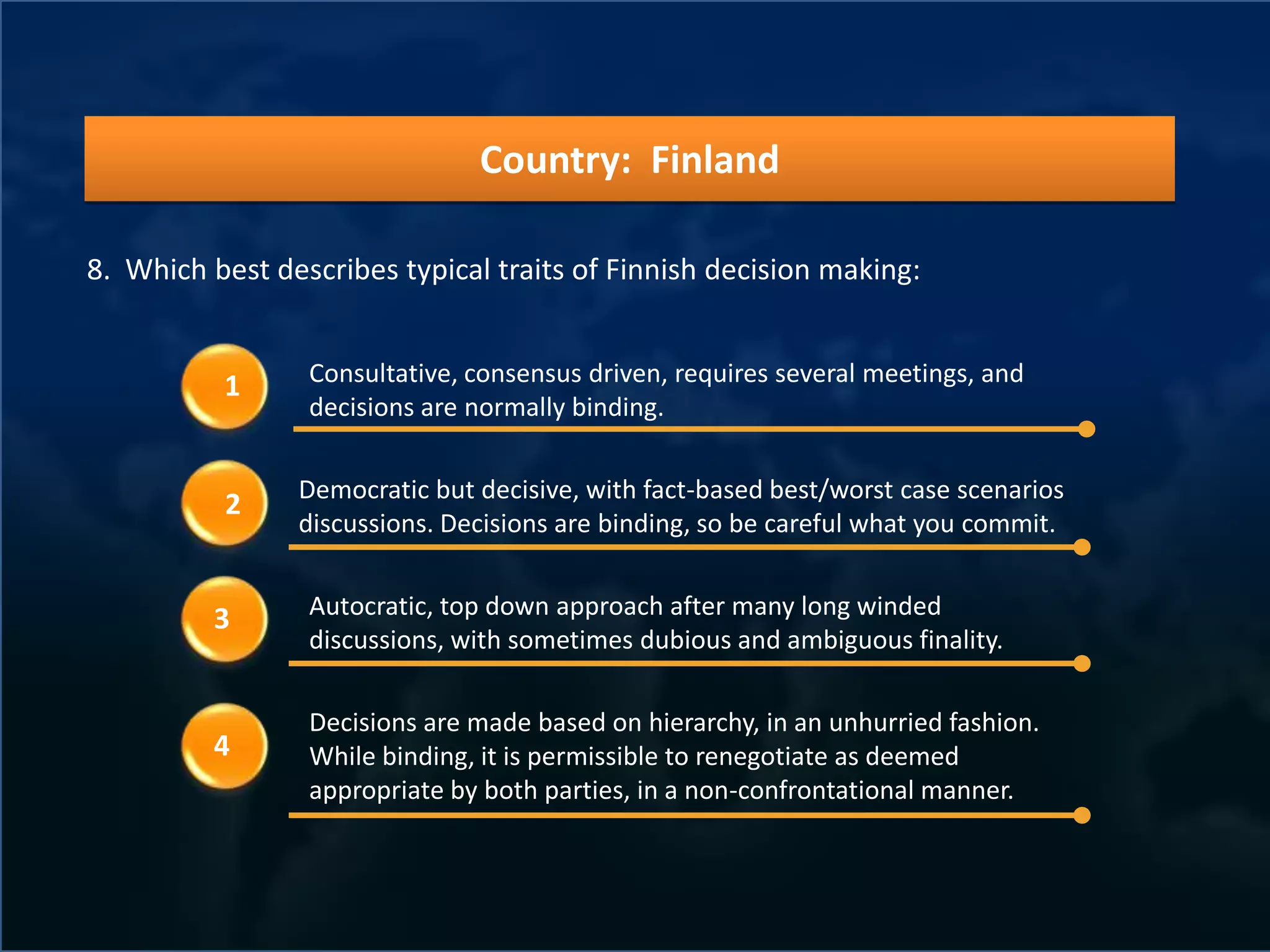
Country: Finland

8. Which best describes typical traits of Finnish decision making:


          1      Consultative, consensus driven, requires several meetings, and
                 decisions are normally binding.

                Democratic but decisive, with fact-based best/worst case scenarios
          2
                discussions. Decisions are binding, so be careful what you commit.


          3      Autocratic, top down approach after many long winded
                 discussions, with sometimes dubious and ambiguous finality.

                 Decisions are made based on hierarchy, in an unhurried fashion.
          4      While binding, it is permissible to renegotiate as deemed
                 appropriate by both parties, in a non-confrontational manner.
Incorrect.


These characteristics are much more typical of another European country.

If you’re not sure where to elevate an issue, or what motivates people to make a
decision, then how can you truly be effective? Not knowing who decides collectively
or individually, or whose organization is hierarchical or flat, may cause you to
alienate the people in either country.

Learn more about the culture you’re working with and you’ll get better results.


                                   Next Question
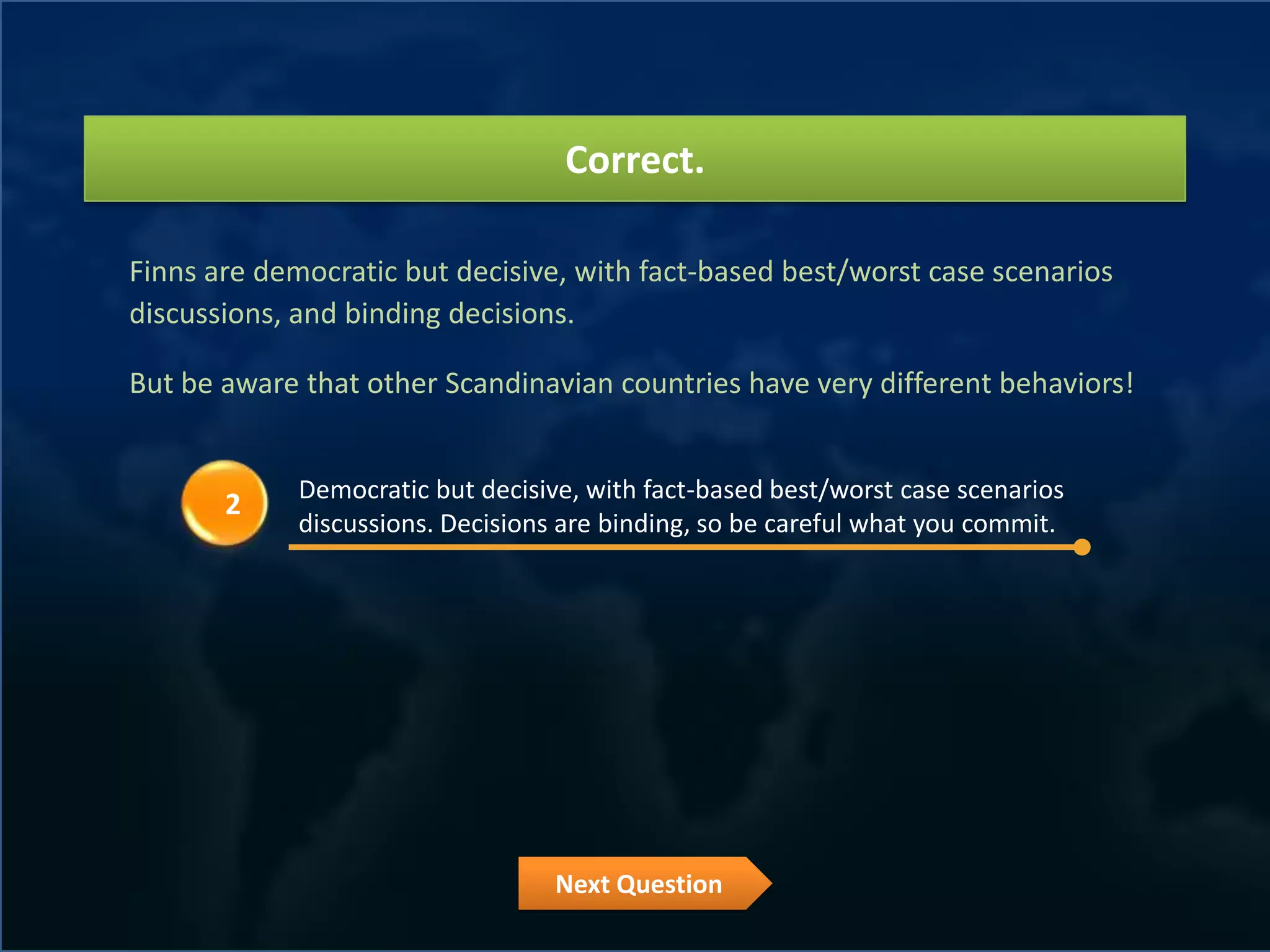
Correct.

Finns are democratic but decisive, with fact-based best/worst case scenarios
discussions, and binding decisions.

But be aware that other Scandinavian countries have very different behaviors!


             Democratic but decisive, with fact-based best/worst case scenarios
       2
             discussions. Decisions are binding, so be careful what you commit.


                                   Next Question
Total Questions

Score per Question

Correct Answers

Wrong Answers


Total Score


              Restart

Cultural Quiz - Across Borders

  • 1.
  • 2.
    Country: CHINA 1. You'vejust realized your Chinese counterpart at your new joint venture with a Shanghai company doesn't have your level of experience, or qualifications to do what's required of him. Do you: A Humbly pretend this is not the case B Ask for him to be replaced C Take command and make all decisions in your joint area of activity D Avoid having him perform any critical tasks
  • 3.
    Incorrect. This approach hasthe risk of causing your counterpart to lose face amongst peers and become non-responsive. It can also cause many other problems. Perhaps more importantly, this could signal to the Chinese company that you do not understand their culture; In China, competence alone does not determine who gets which position. Next Question
  • 4.
    Correct. A Humbly pretend this is not the case Most Chinese people admire humility, and will seek your advice in any case. Next Question
  • 5.
    Choose the correctanswer 2. The ___________ will use intuition and feelings to help them with final decisions, and emotional appeals rather than facts to persuade you. A Israelis B Germans C Japanese D Koreans
  • 6.
    Incorrect. Although Israelis expressstrong feelings when they communicate, and compared to Americans are more likely to "argue", decisions are made more on facts than gut. The Japanese can be sticklers for details and accuracy of data, and will make many generalized decisions about you and your company based on the data provided. Germans require a great amount of details and fact to make decisions. Although their communications style may seem abrupt and demanding, they attempt to persuade by putting things in "black and white" terms. Next Question
  • 7.
    Correct. Although their feelingsand emotions might not always be apparent, many Koreans use these to influence and persuade you. D Koreans Next Question
  • 8.
    Country: India 3. Whiledelegating tasks to an Indian colleague of equal level in the organization, your questions are all responded to with a 'yes', or 'sure'. This usually means that he/she: 1 Is being respectful to you 2 Will do exactly as you ask 3 Understands your request 4 Is likely to change his mind later
  • 9.
    Incorrect. A 'yes' answermeans many different things in many different cultures. While a "yes" answer may in itself be respectfully said, that is not the primary motivation. Many times this will be said to simply acknowledge that your request is understood. While Indians are comfortable with "repackaging" their replies at a later time, replying with a 'yes' does not necessarily mean that a commitment has been made. But nor does it mean you have been intentionally mislead, as between Indians vague and ambiguous answers are part of life. Next Question
  • 10.
    Correct. Answering "yes" providesflexibility; it acknowledges the request, but doesn’t necessarily imply a commitment one way or the other. However, it is not intended to intentionally mislead you. How can that be? Let us explain to you and your team. 3 Understands your request Next Question
  • 11.
    Country: Brazil 4. Whichof these is probably the most important factor to bear in mind when doing business in Brazil? A Brazilians are very wary of foreigners B Brazilians take a very relaxed approach to business C Business is only really done with people they like and trust D Brazilians have very little tolerance for over committing
  • 12.
    Incorrect. Brazilians are notparticularly wary of foreigners, but that said, business is only really done with people they like and trust. Strong personal relationships can make or break a deal, and influence almost all business situations. Brazilians are apt to over commit, or make a promise which they can not live up to if it helps to get everyone to agree. Next Question
  • 13.
    Correct. Strong personal relationshipscan make or break a deal, and influence almost all business situations. C Business is only really done with people they like and trust Next Question
  • 14.
    Country: Japan 5. Akey reason for the Japanese to agree to a meeting with foreign business people in their office is to: 1 Seek further information 2 Negotiate with management, and come to a decision 3 Exchange ideas, and brainstorm on long standing obstacles 4 Build the relationship, and share sensitive information
  • 15.
    Incorrect. We know toomany managers who make the trip to Japan to "discuss" or resolve issues in real-time, only to be disappointed. There are many reasons as to why this is not typical of Japanese teams, and anyone dealing with Japan had best be aware, or wind up being amongst the disappointed. While some relationship building occurs during office meetings, much more takes place outside the office over meals, drinks, entertainment, or golf. And it's during these occasions that the Japanese will confide in you things that they would never mention in an office setting. Many Americans might not realize that they are being "evaluated" during such times, so be aware. Next Question
  • 16.
    Correct. 1 Seek further information The Japanese want to know as much as they possibly can. But to Americans, sometimes it can seem they do it to a fault. Fortunately there are ways to lessen the frustration, and move their process along. Do your employees know how? Next Question
  • 17.
    Country: China 6. You'vefinally closed that deal, after exhausting both your patience and your company's travel budget. Now, two weeks later, the Chinese are asking for special considerations that change the terms of the agreement. How do they justify doing this? And most importantly, what can you do? Chinese have a tendency to not be truthful about their real intentions, and will try to A manipulate your discussions to their advantage. It is best not to trust what they say. The contract, for most Americans, represents the end of the negotiation. For the Chinese, however, it's just the beginning. So it's always advisable to leave yourself some room for B giving further concessions. The Chinese believe it is not appropriate to make final decisions in your presence and their coming back to you simply signifies that that after further internal discussions they C changed their minds. But they can be coerced into doing so, so therefore it is best to give them an ultimatum before the meeting ends. D All of the above.
  • 18.
    Incorrect. Americans often mistakethe Chinese propensity for seeking special favors or conditions later for not being trustworthy. If you learn how to prepare for their continuing negotiations, you will build stronger relationships, and at better terms. Furthermore, attempts to coercing them with ultimatums can damage their trust in you as a business partner. Next Question
  • 19.
    Correct. Once a dealis made, the Chinese view their counterparts as trustworthy partners who can be relied upon for special favors, i.e. new terms in the contract. The contract, for most Americans, represents the end of the negotiation. For the Chinese, however, it's just the beginning. So it's always advisable to leave yourself some room for B giving further concessions. Next Question
  • 20.
    Country: South Korea 7.When working with Koreans, this group characteristic is the most important to establish from the beginning: 1 Achievement 2 Consensus 3 Loyalty 4 Harmony
  • 21.
    Incorrect. While achievement, consensus,and harmony are all of interest to Koreans, loyalty is typically a more profound characteristic. In fact, loyalty is so strong in South Korea that many would consider it more important than "honesty", as Americans would define it. This can cause mistrust and conflicts between Koreans and others. Next Question
  • 22.
    Correct. In fact, loyaltyis so strong in South Korea that many would consider it more important than "honesty", as Americans would define it. This can cause mistrust and conflicts between Koreans and others. 3 Loyalty Next Question
  • 23.
    Country: Finland 8. Whichbest describes typical traits of Finnish decision making: 1 Consultative, consensus driven, requires several meetings, and decisions are normally binding. Democratic but decisive, with fact-based best/worst case scenarios 2 discussions. Decisions are binding, so be careful what you commit. 3 Autocratic, top down approach after many long winded discussions, with sometimes dubious and ambiguous finality. Decisions are made based on hierarchy, in an unhurried fashion. 4 While binding, it is permissible to renegotiate as deemed appropriate by both parties, in a non-confrontational manner.
  • 24.
    Incorrect. These characteristics aremuch more typical of another European country. If you’re not sure where to elevate an issue, or what motivates people to make a decision, then how can you truly be effective? Not knowing who decides collectively or individually, or whose organization is hierarchical or flat, may cause you to alienate the people in either country. Learn more about the culture you’re working with and you’ll get better results. Next Question
  • 25.
    Correct. Finns are democraticbut decisive, with fact-based best/worst case scenarios discussions, and binding decisions. But be aware that other Scandinavian countries have very different behaviors! Democratic but decisive, with fact-based best/worst case scenarios 2 discussions. Decisions are binding, so be careful what you commit. Next Question
  • 26.
    Total Questions Score perQuestion Correct Answers Wrong Answers Total Score Restart