Cultural Competency 101 Werner Bahr [email_address]
Aim of this presentation to understand people of a different culture  to look at their major differences and what are the drivers in their lives to crack our personal cocoon
Essential Keys to Understanding  paci ê ncia  focus  acceptance
foreigners evaluate you on non-verbal characteristics - what you are doing - how you are dressed, cleanliness - the tone of your voice and how you treat those around    you don’t take things personally – some cultures may be more abrupt than what you are used to (Chinese, Mid East), people may be non-conciliatory (Germans)  people need to trust you and have confidence in you  learn to listen – spend the time to know about them Have you ever thought about what it means to be American?
Latins warm, friendly, like to be close – offensive to them for you to move backwards driven by external values, love music, dancing and dress  not punctual! May not be as thorough as you want them to be – personal obligations can take precedence over business sometimes appear to us to be not flexible like low cost  business solutions use eye contact extensively
Latins may not be as courteous as what we are used to, don’t respect  queues may hug and kiss close friends, males too. They are very friendly and caring about relationships business people like working breakfasts and lunches to build the relationship  They use two surnames, and like to use titles
Asians take time to open up, you need to build trust diligent, love repetition, very punctual will do as is requested without argument don’t get angry with them, they won’t admit mistakes, don’t blame them  they respect age and knowledge don’t often use first name culture is hierarchical in structure – different roles at different levels
Asians may not look you in the eye, are not touchy people will more easily trust well groomed and well dressed people – as this shows competence are visual people their cultural behaviour is inbuilt, we can’t profess to remember each aspect, don’t mimic their behaviour candor is not appreciated body language may say ‘no’, as they don’t like using this word
Asians prefer face to face meetings elders are often consulted in business and relationships prefer subtlety and to talk in low tones, without emotion Japan – bowing is an art form, slower and deeper more deference  shown to the guest silence is a form of respect and contemplation  show an interest in their country and culture they have no respect for egotism and brashness Thai people demand perceptiveness from foreigners, just as they do amongst themselves. If someone disagrees with an opinion or idea, it will not be spelled out, but will merely be implied so gently that there is no "loss of face."
Japanese are conservative in their approach -  "The nail that sticks up gets hit with the hammer" when considering your choices for attire in Japan don’t point don’t blow your nose in public a smile can have double meaning. It can express either joy or displeasure. Use caution with your facial expressions. They can be easily misunderstood personal space is valued. Because the Japanese live in such a densely populated area, they value their personal space.  the Japanese are comfortable with silence. They use it to their advantage in many situations
India can be forthright – remember they come from a country with a population of over 1.1B – fight for survival well educated will try to do things their way – stand firm  may analyse costs of equipment and will always negotiate never touch top of head, even with kids, it is seat of the soul the word ‘no’ is very harsh in this culture, it may be simpler to say ‘I will try’ always use titles – very important  don’t point your feet at anyone, if your shoes touch another person apologise  Hindu’s don’t eat beef, many are vegetarian
Chinese priorities are money, food and family Horoscope - superstitious – numerology – numbers can be good or evil hardworking and diligent punctual hence don’t like to waste time, will arrive early don’t use finger to point, use open palm, don’t point when speaking are not used to people putting hands in their mouth
Chinese avoid personal contact don’t eat before your host begins, don’t eat everything, don’t drop your chopsticks Feng Shui – wind and water gift giving - to give a clock to Chinese colleagues for their birthday. The direct translation of "clock" to Chinese means paying last respects - person's funeral may be immanent Chinese - negotiating technique has been likened to both guerrilla warfare and psychological warfare - strike, retreat; strike, retreat; confuse the enemy, get them off guard, weaken their will, make them feel guilty for opposing you, make a "final offer" that is considerably below what they know is acceptable.
Chinese New Year Traditions Entire house cleaned before New Year, no dusting or sweeping on new year or good fortune may be swept out Sweep inwards, or one of family may be swept away Rubbish taken out the back door only Firecrackers on New Years Eve frighten away any bad spirits from the old year At midnight all doors and windows are opened to allow the old year out No money lent at new year or you will be lending for the rest of the year too No bad language or unlucky words, never use the word “4” (Ssu) as it sounds like death, no reference to past year as everything is geared to looking forward to new year
Chinese New Year Traditions Children are not spanked as to cry on this day you will cry for the whole year Don’t wash your hair on this day as you will wash away good fortune Wear red clothing as it is sure to bring a sunny and bright future Do not use knives or scissors as this will cut off good luck While many people may not believe in these traditions, customs are kept as a way to provide continuity with the past and the family with an identity
Middle East  male dominated society  male may speak for female even when she is the patient as a race very hospitable can be highly reticent in dealing with females you need to address the head of the household they respect the one who is strongest  alcohol and pork are illegal, Friday is day of rest communications occur at a slow pace. Do not feel obligated to speak during periods of silence. "Yes" usually means "possibly". at a meeting, the person who asks the most questions is likely to be the least important. The decision maker is likely a silent observer.
give people more than they expect and do it cheerfully  there are no secrets to success, it is the result of preparation, hard work and learning from failure.  C Powell   pay attention to the simple little things that most men neglect  H Ford
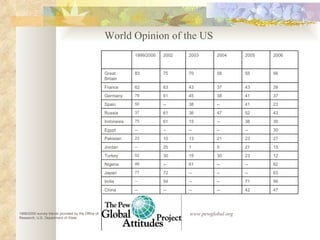
1999/2000 survey trends provided by the Office of Research, U.S. Department of State www.pewglobal.org World Opinion of the US 1999/2000 2002 2003 2004 2005 2006 Great Britain 83 75  70 58 55 56 France 62 63 43 37 43 39 Germany 78 61 45 38 41 37 Spain 50 -- 38 -- 41 23 Russia 37 61 36 47 52 43 Indonesia 75 61 15 -- 38 30 Egypt -- -- -- -- -- 30 Pakistan 23 10 13 21 23 27 Jordan  --  25 1 5 21 15 Turkey 52 30 15 30 23 12 Nigeria 46  -- 61 -- -- 62 Japan 77 72 -- -- -- 63 India --  54 -- -- 71 56 China -- -- -- -- 42 47

Cultural Competency 101 Aug 2010

  • 1.
    Cultural Competency 101Werner Bahr [email_address]
  • 2.
    Aim of thispresentation to understand people of a different culture to look at their major differences and what are the drivers in their lives to crack our personal cocoon
  • 3.
    Essential Keys toUnderstanding paci ê ncia focus acceptance
  • 4.
    foreigners evaluate youon non-verbal characteristics - what you are doing - how you are dressed, cleanliness - the tone of your voice and how you treat those around you don’t take things personally – some cultures may be more abrupt than what you are used to (Chinese, Mid East), people may be non-conciliatory (Germans) people need to trust you and have confidence in you learn to listen – spend the time to know about them Have you ever thought about what it means to be American?
  • 5.
    Latins warm, friendly,like to be close – offensive to them for you to move backwards driven by external values, love music, dancing and dress not punctual! May not be as thorough as you want them to be – personal obligations can take precedence over business sometimes appear to us to be not flexible like low cost business solutions use eye contact extensively
  • 6.
    Latins may notbe as courteous as what we are used to, don’t respect queues may hug and kiss close friends, males too. They are very friendly and caring about relationships business people like working breakfasts and lunches to build the relationship They use two surnames, and like to use titles
  • 7.
    Asians take timeto open up, you need to build trust diligent, love repetition, very punctual will do as is requested without argument don’t get angry with them, they won’t admit mistakes, don’t blame them they respect age and knowledge don’t often use first name culture is hierarchical in structure – different roles at different levels
  • 8.
    Asians may notlook you in the eye, are not touchy people will more easily trust well groomed and well dressed people – as this shows competence are visual people their cultural behaviour is inbuilt, we can’t profess to remember each aspect, don’t mimic their behaviour candor is not appreciated body language may say ‘no’, as they don’t like using this word
  • 9.
    Asians prefer faceto face meetings elders are often consulted in business and relationships prefer subtlety and to talk in low tones, without emotion Japan – bowing is an art form, slower and deeper more deference shown to the guest silence is a form of respect and contemplation show an interest in their country and culture they have no respect for egotism and brashness Thai people demand perceptiveness from foreigners, just as they do amongst themselves. If someone disagrees with an opinion or idea, it will not be spelled out, but will merely be implied so gently that there is no "loss of face."
  • 10.
    Japanese are conservativein their approach - "The nail that sticks up gets hit with the hammer" when considering your choices for attire in Japan don’t point don’t blow your nose in public a smile can have double meaning. It can express either joy or displeasure. Use caution with your facial expressions. They can be easily misunderstood personal space is valued. Because the Japanese live in such a densely populated area, they value their personal space. the Japanese are comfortable with silence. They use it to their advantage in many situations
  • 11.
    India can beforthright – remember they come from a country with a population of over 1.1B – fight for survival well educated will try to do things their way – stand firm may analyse costs of equipment and will always negotiate never touch top of head, even with kids, it is seat of the soul the word ‘no’ is very harsh in this culture, it may be simpler to say ‘I will try’ always use titles – very important don’t point your feet at anyone, if your shoes touch another person apologise Hindu’s don’t eat beef, many are vegetarian
  • 12.
    Chinese priorities aremoney, food and family Horoscope - superstitious – numerology – numbers can be good or evil hardworking and diligent punctual hence don’t like to waste time, will arrive early don’t use finger to point, use open palm, don’t point when speaking are not used to people putting hands in their mouth
  • 13.
    Chinese avoid personalcontact don’t eat before your host begins, don’t eat everything, don’t drop your chopsticks Feng Shui – wind and water gift giving - to give a clock to Chinese colleagues for their birthday. The direct translation of "clock" to Chinese means paying last respects - person's funeral may be immanent Chinese - negotiating technique has been likened to both guerrilla warfare and psychological warfare - strike, retreat; strike, retreat; confuse the enemy, get them off guard, weaken their will, make them feel guilty for opposing you, make a "final offer" that is considerably below what they know is acceptable.
  • 14.
    Chinese New YearTraditions Entire house cleaned before New Year, no dusting or sweeping on new year or good fortune may be swept out Sweep inwards, or one of family may be swept away Rubbish taken out the back door only Firecrackers on New Years Eve frighten away any bad spirits from the old year At midnight all doors and windows are opened to allow the old year out No money lent at new year or you will be lending for the rest of the year too No bad language or unlucky words, never use the word “4” (Ssu) as it sounds like death, no reference to past year as everything is geared to looking forward to new year
  • 15.
    Chinese New YearTraditions Children are not spanked as to cry on this day you will cry for the whole year Don’t wash your hair on this day as you will wash away good fortune Wear red clothing as it is sure to bring a sunny and bright future Do not use knives or scissors as this will cut off good luck While many people may not believe in these traditions, customs are kept as a way to provide continuity with the past and the family with an identity
  • 16.
    Middle East male dominated society male may speak for female even when she is the patient as a race very hospitable can be highly reticent in dealing with females you need to address the head of the household they respect the one who is strongest alcohol and pork are illegal, Friday is day of rest communications occur at a slow pace. Do not feel obligated to speak during periods of silence. "Yes" usually means "possibly". at a meeting, the person who asks the most questions is likely to be the least important. The decision maker is likely a silent observer.
  • 17.
    give people morethan they expect and do it cheerfully there are no secrets to success, it is the result of preparation, hard work and learning from failure. C Powell pay attention to the simple little things that most men neglect H Ford
  • 18.
    1999/2000 survey trendsprovided by the Office of Research, U.S. Department of State www.pewglobal.org World Opinion of the US 1999/2000 2002 2003 2004 2005 2006 Great Britain 83 75 70 58 55 56 France 62 63 43 37 43 39 Germany 78 61 45 38 41 37 Spain 50 -- 38 -- 41 23 Russia 37 61 36 47 52 43 Indonesia 75 61 15 -- 38 30 Egypt -- -- -- -- -- 30 Pakistan 23 10 13 21 23 27 Jordan -- 25 1 5 21 15 Turkey 52 30 15 30 23 12 Nigeria 46 -- 61 -- -- 62 Japan 77 72 -- -- -- 63 India -- 54 -- -- 71 56 China -- -- -- -- 42 47