The Art of•
rawln eo e
© 2008, 201 1 Walter Foster Publishing, Inc. Photos on pages 8-9
© 2001 , 2003 WFP. Artwork on page 10 © 2004 WFP, value
scales © 2006 Diane Cardaci. Photos on page 1 1 © 2006 Diane
Cardaci, artwork © 2004 WFP. Artwork on pages 1 2-13 © 2006
Diane Cardaci. Artwork on pages 6, 14-15, 88-91 © 200 1 , 2003
WFP. Artwork on pages 16-17 © 1999, 2003 WFP. Artwork on
pages 1 8-23, 64, 66-88, 92-93 © 1997, 2003 WFP. Artwork on
pages 24, 26-41 © 2004, 2005 Ken Goldman. Artwork on pages
42, 44-63 © 1989, 1997, 2003 WFP. Artwork on pages 1 , 4,
6, 96-123 © 2006 Debra Kauffman Yaun. Artwork on pages 3,
94, 1 24-139 © 2007 Debra Kauffman Yaun. All rights reserved.
Walter Foster is a registered trademark.
Digital edition: 978-1-61059-81 7-0
Softcover edition: 978-1-60058-069-7
This book has been produced to aid the aspiring artist. Repro­
duction of the work for study or finished art is permissible.
Any art produced or photomechanically reproduced from this
publication for commercial purposes is forbidden without written
consent from the publisher, Walter Foster Publishing, Inc.
10 9 8 7 6 5
The Art of•
rawln eo e
WALTER FOSTER PUBLISHING, INC.
/
CONTENTS
INTRODUCTION TO DRAWING PEOPLE • • • • • • • • • • • 7
Tools &: Materials 8
The Elements of Drawing 10
Basic Pencil Techniques 1 1
Other Ways to Shade 12
Learning to See 14
People in Perspective 16
PlaCing People in a Composition 18
Adding Complete Figures 20
Beginning Portraiture 22
ANATOMY WITH KEN GOLDMAN • • • • • • • • • • • • • • • 25
Exploring the Torso: Front View 26
Exploring the Torso: Back View 27
Exploring the Torso: Side View 28
Exploring the Torso: Tips 29
Depicting the Arm: Front View 30
Depicting the Arm: Back View 3 1
Depicting the Arm: Side View 32
Portraying the Hand 33
Sketching the Leg: Front View 34
Sketching the Leg: Back View 35
Sketching the Leg: Side View 36
Drawing the Foot
Studying the Head &: Skull
Capturing Facial Features
37
38
41
FACES WITH WALTER T. FOSTER • • • • • • • • • • • • • • • 43
Peopk 44
Women: Profile 46
Women: Three-Quarter View 48
Women: Frontal View 50
Men: Three-Quarter View 52
Elderly Women 54
Elderly Men 56
People of the World 58
Developing Your Own Style 60
Male Faces 62
PEOPLE WITH WILLIAM F. POWELL• • • • • • • • • • • • • 65
Adult Head Proportions 66
Head Positions &: Angles 67
Facial Features: Eyes 68
Facial Features: Noses &: Ears 69
Facial Features: Lips
Facial Features: The Smile
The Profile
The Three-Quarter View
Child Head Proportions
70
71
72
73
74
Mature Faces 76
Adult Body Proportions 78
Child Body Proportions 79
The Body 80
Hands &: Feet 8 1
Clothing Folds 82
Foreshortening 83
Movement &: Balance 84
Bending &: Twisting Figures 85
Sports Figures in Action 86
Children in Action 87
Developing a Portrait 88
Focusing on Foreshortening 90
Applying Your Skills 92
PEOPLE WITH DEBRA KAUFFMAN YAUN • • • • • • • • • 95
Understanding Facial Anatomy 96
Learning the Planes of the Face 97
Adult Facial Proportions 98
Exploring Other Views 99
Depicting Adult Features 100
Capturing a Likeness
Life Drawing (Portrait)
Approaching a Profile View
Working with Lighting
Including a Background
Developing Hair
Depicting Age
Creating Facial Hair
Children's Facial Proportions
Portraying Children's Features
Drawing a Baby
ChOOSing a Photo Reference
Indicating Fair Features
Replicating Dark Skin Tones
Understanding Body Anatomy
Adult Body Proportions
Hands
Feet
Showing Movement
Foreshortening
Understanding Lighting
Life Drawing (Full Body)
Bridal Portrait
Children's Body Proportions
Children in Action
ChOOSing a Pose
102
103
104
106
107
108
1 10
1 1 1
1 12
1 14
1 16
1 18
120
122
124
125
126
127
128
129
130
132
134
136
137
138
INDEX • • • • • • • • • • • • • • • • • • • • • • • • • • • • • • • • • • • 140
!
CHAPTER 1
INTRODUCTIO N TO
People are such interesting and varied subjects to draw. With this
compilation of projects from some of the most popular titles in our
How to Draw and Paint series, you'll find in-depth information on
every aspect of drawing people. Featuring instruction from four
accomplished artists, this book is filled with step-by-step demon­
strations that show you how to re-create a range of people of
differing ages and ethnicities. You'll find plenty of helpful tips on
tools and materials, shading, and other fundamental drawing tech­
niques, as well as important information about the influences of
bone structure and musculature. And detailed examples of facial
features, hands, and feet will help guide you through the most chal­
lenging aspects of drawing people. With practice, you'll soon be
able to capture amazing likenesses of family and friends in your
pencil drawings!
7
8
TOOLS & MATERIALS
D
rawing is not only fun, it also is an important art form in
itself. Even when you write or print your name, you are
actually drawing! If you organize the lines, you can make shapes;
and when you carry that a bit further and add dark and light
shading, your drawings begin to take on a three-dimensional
form and look more realistic. One of the great things about
drawing is that you can do it anywhere, and the materials are
very inexpensive. You do get what you pay for, though, so pur­
chase the best you can afford at the time, and upgrade your
supplies whenever possible. Although anything that will make a
mark can be used for some type of drawing, you'll want to make
certain your magnificent efforts will last and not fade over time.
Here are some materials that will get you off to a good start.
Sketch Pads Conveniently bound
drawing pads come in a wide
variety of sizes, textures,
weights, and bindings.
They are particularly
handy for making quick
sketches and when drawing out­
doors. You can use a large sketch­
book in the studio for laying out a
painting, or take a small one with
you for recording quick impressions
when you travel. Smooth- to medium­
grain paper texture (which is called the
"tooth") often is an ideal choice.
Drawing Papers
For finished works of art,
using single sheets of
drawing paper is best.
They are available in a
range of surface textures:
smooth grain (plate and
hot pressed), medium grain
(cold pressed), and rough
to very rough. The cold­
pressed surface is the most
versatile. It is of medium
texture but it's not totally
smooth, so it makes a good
surface for a variety of dif­
ferent drawing techniques.
Charcoal Papers Char­
coal paper and tablets also
are available in a variety
oftextures. Some of the
surface finishes are quite
pronounced, and you can
use them to enhance the
texture in your drawings.
These papers also come in
a variety of colors, which
can add depth and visual
interest to your drawings.
•
•
•
•
•
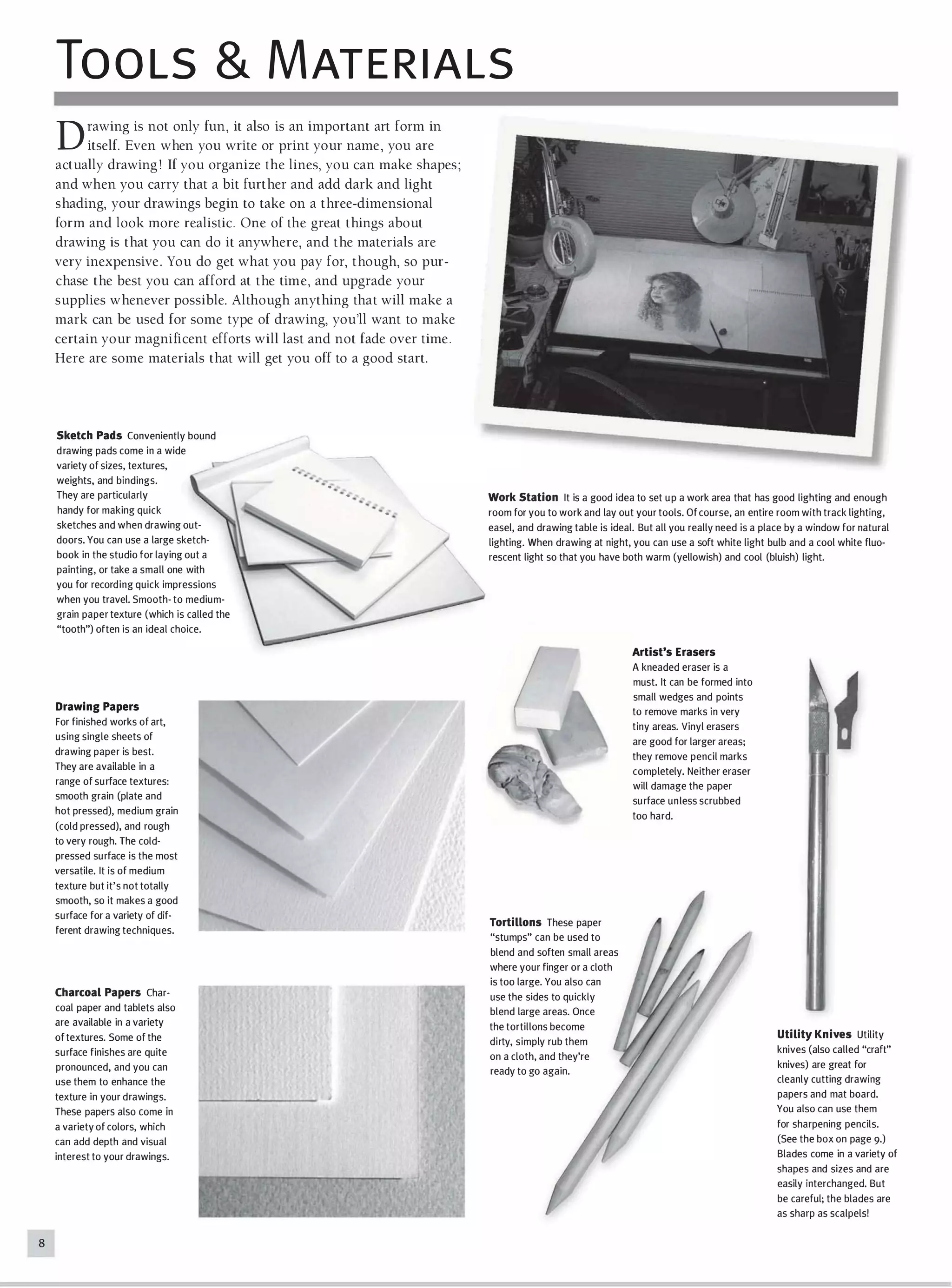
Work Station It is a good idea to set up a work area that has good lighting and enough
room for you to work and lay out your tools. Ofcourse, an entire room with track lighting,
easel, and drawing table is ideal. But all you really need is a place by a window for natural
lighting. When drawing at night, you can use a soft white light bulb and a cool white fluo­
rescent light so that you have both warm (yellowish) and cool (bluish) light.
Tortillons These paper
"stumps" can be used to
blend and soften small areas
where your finger or a cloth
is too large. You also can
use the sides to quickly
blend large areas. Once
the tortilions become
dirty, simply rub them
on a cloth, and they're
ready to go again.
Artist's Erasers
A kneaded eraser is a
must. It can be formed into
small wedges and points
to remove marks in very
tiny areas. Vinyl erasers
are good for larger areas;
they remove pencil marks
completely. Neither eraser
will damage the paper
surface unless scrubbed
too hard.
Utility Knives Utility
knives (also called "craft"
knives) are great for
cleanly cutting drawing
papers and mat board.
You also can use them
for sharpening pencils.
(See the box on page 9.)
Blades come in a variety of
shapes and sizes and are
easily interchanged. But
be careful; the blades are
as sharp as scalpels!
GATHERING THE BASICS
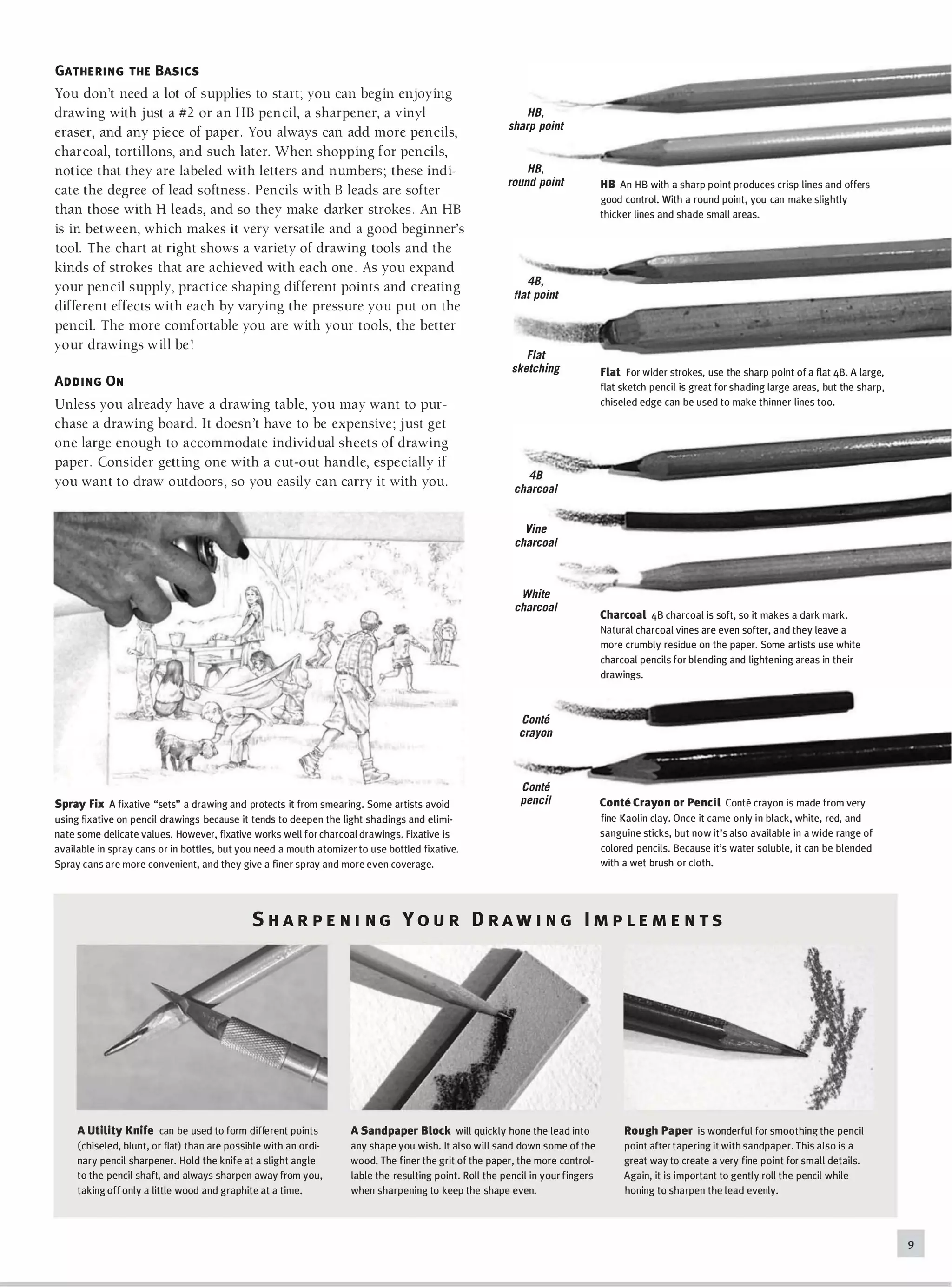
HB,
sharp point
HB,
round point HB An HB with a sharp point produces crisp lines and offers
good control. With a round point, you can make slightly
thicker lines and shade small areas.
You don't need a lot of supplies to start; you can begin enjoying
drawing with just a #2 or an HB pencil, a sharpener, a vinyl
eraser, and any piece of paper. You always can add more pencils,
charcoal, tortillons, and such later. When shopping for pencils,
notice that they are labeled with letters and numbers; these indi­
cate the degree of lead softness. Pencils with B leads are softer
than those with H leads, and so they make darker strokes. An HB
is in between, which makes it very versatile and a good beginner's
tool. The chart at right shows a variety of drawing tools and the
kinds of strokes that are achieved with each one. As you expand
your pencil supply, practice shaping different points and creating
different effects with each by varying the pressure you put on the
pencil. The more comfortable you are with your tools, the better
your drawings will be!
4B,---�!!!
ADDING ON
Unless you already have a drawing table, you may want to pur­
chase a drawing board. It doesn't have to be expensive; just get
one large enough to accommodate individual sheets of drawing
paper. Consider getting one with a cut-out handle, especially if
you want to draw outdoors, so you easily can carry it with you.
Spray Fix A fixative "sets" a drawing and protects it from smearing. Some artists avoid
using fixative on pencil drawings because it tends to deepen the light shadings and elimi·
flat point
Flat
sketching
charcoal
Vine
charcoal
White
charcoal
Conte
crayon
Conte
pencil
Flat For wider strokes, use the sharp point of a flat 4B. A large,
flat sketch pencil is great for shading large areas, but the sharp,
chiseled edge can be used to make thinner lines too.
Charcoal 4B charcoal is soft, so it makes a dark mark.
Natural charcoal vines are even softer, and they leave a
more crumbly residue on the paper. Some artists use white
charcoal pencils for blending and lightening areas in their
drawings.
Conte Crayon or Pencil Conte crayon is made from very
fine Kaolin clay. Once it came only in black, white, red, and
nate some delicate values. However, fixative works well forcharcoal drawings. Fixative is sanguine sticks, but now it's also available in a wide range of
available in spray cans or in bottles, but you need a mouth atomizer to use bottled fixative. colored pencils. Because it's water soluble, it can be blended
Spray cans are more convenient, and they give a finer spray and more even coverage. with a wet brush or cloth.
S H ARP E N I N G YO U R D RAW I N G IMPL E M E N TS
A Utility Knife can be used to form different points
(chiseled, blunt, or flat) than are possible with an ordi·
nary pencil sharpener. Hold the knife at a slight angle
to the pencil shaft, and always sharpen away from you,
taking offonly a little wood and graphite at a time.
A Sandpaper Block will quickly hone the lead into
any shape you wish. It also will sand down some ofthe
wood. The finer the grit of the paper, the more control·
lable the resulting point. Roll the pencil in your fingers
when sharpening to keep the shape even.
Rough Paper is wonderful for smoothing the pencil
point after tapering it with sandpaper. This also is a
great way to create a very fine point for small details.
Again, it is important to gently roll the pencil while
honing to sharpen the lead evenly.
9
10
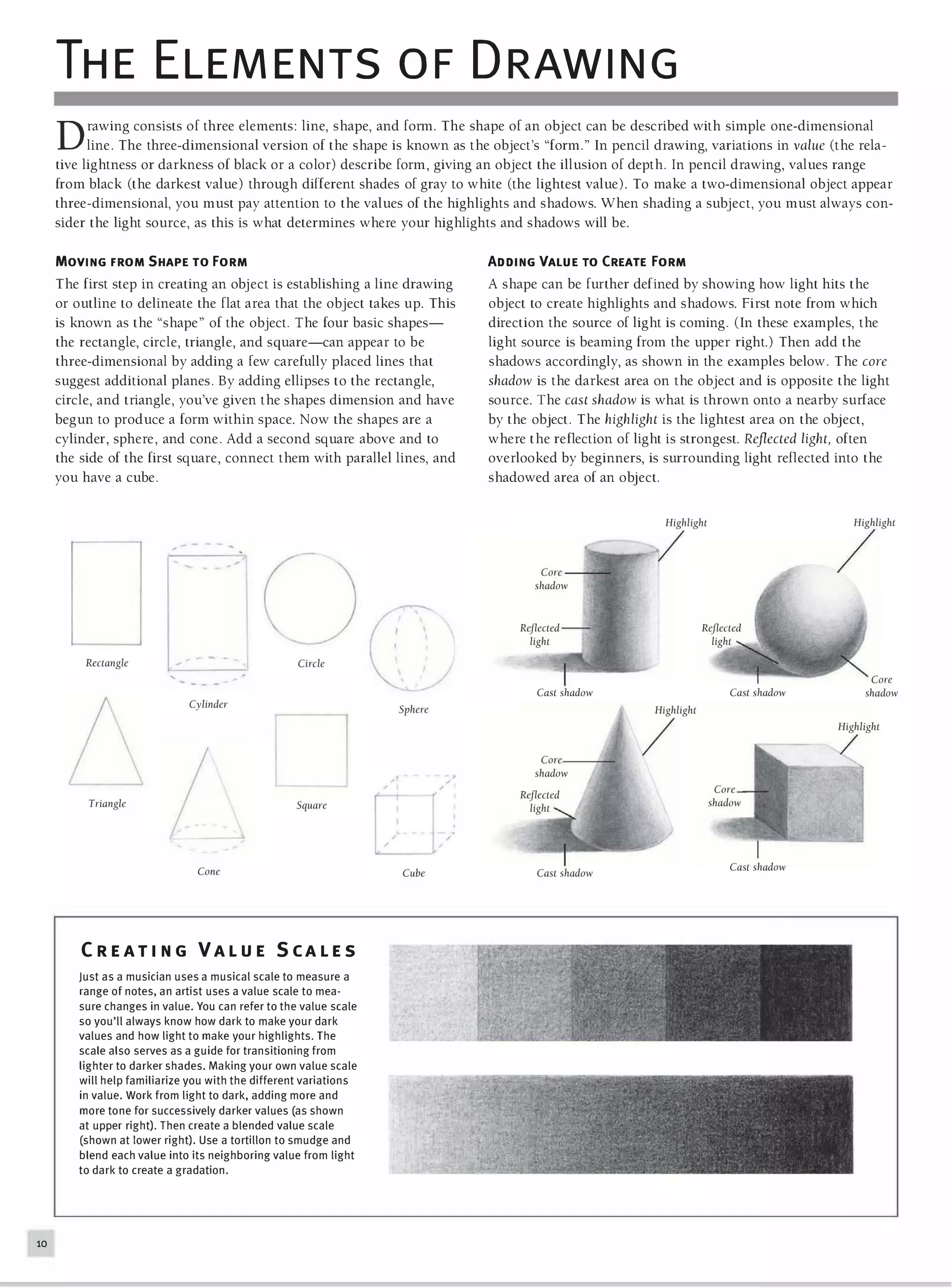
TH E ELEM ENTS OF DRAWI NG
D
rawing consists of three elements: line, shape, and form. The shape of an object can be described with simple one-dimensional
line. The three-dimensional version of the shape is known as the object's "form." In pencil drawing, variations in value (the rela­
tive lightness or darkness of black or a color) describe form, giving an object the illusion of depth. In pencil drawing, values range
from black (the darkest value) through different shades of gray to white (the lightest value). To make a two-dimensional object appear
three-dimensional, you must pay attention to the values of the highlights and shadows. When shading a subject, you must always con­
sider the light source, as this is what determines where your highlights and shadows will be.
MOVING FROM SHAPE TO FORM
The first step in creating an object is establishing a line drawing
or outline to delineate the flat area that the object takes up. This
is known as the "shape" of the object. The four basic shapes­
the rectangle, circle, triangle, and square-can appear to be
three-dimensional by adding a few carefully placed lines that
suggest additional planes. By adding ellipses to the rectangle,
circle, and triangle, you've given the shapes dimension and have
begun to produce a form within space. Now the shapes are a
cylinder, sphere, and cone. Add a second square above and to
the side of the first square, connect them with parallel lines, and
you have a cube.
CR E AT I N G VAL U E S CAL E S
Just as a musician uses a musical scale to measure a
range of notes, an artist uses a value scale to mea­
sure changes in value. You can refer to the value scale
so you'll always know how dark to make your dark
values and how light to make your highlights. The
scale also serves as a guide for transitioning from
lighter to darker shades. Making your own value scale
will help familiarize you with the different variations
in value. Work from light to dark, adding more and
more tone for successively darker values (as shown
at upper right). Then create a blended value scale
(shown at lower right). Use a tortillon to smudge and
blend each value into its neighboring value from light
to dark to create a gradation.
ADDING VALUE TO CREATE FORM
A shape can be further defined by showing how light hits the
object to create highlights and shadows. First note from which
direction the source of light is coming. (In these examples, the
light source is beaming from the upper right.) Then add the
shadows accordingly, as shown in the examples below. The core
shadow is the darkest area on the object and is opposite the light
source. The cast shadow is what is thrown onto a nearby surface
by the object. The highlight is the lightest area on the object,
where the reflection of light is strongest. Reflected light, often
overlooked by beginners, is surrounding light reflected into the
shadowed area of an object.
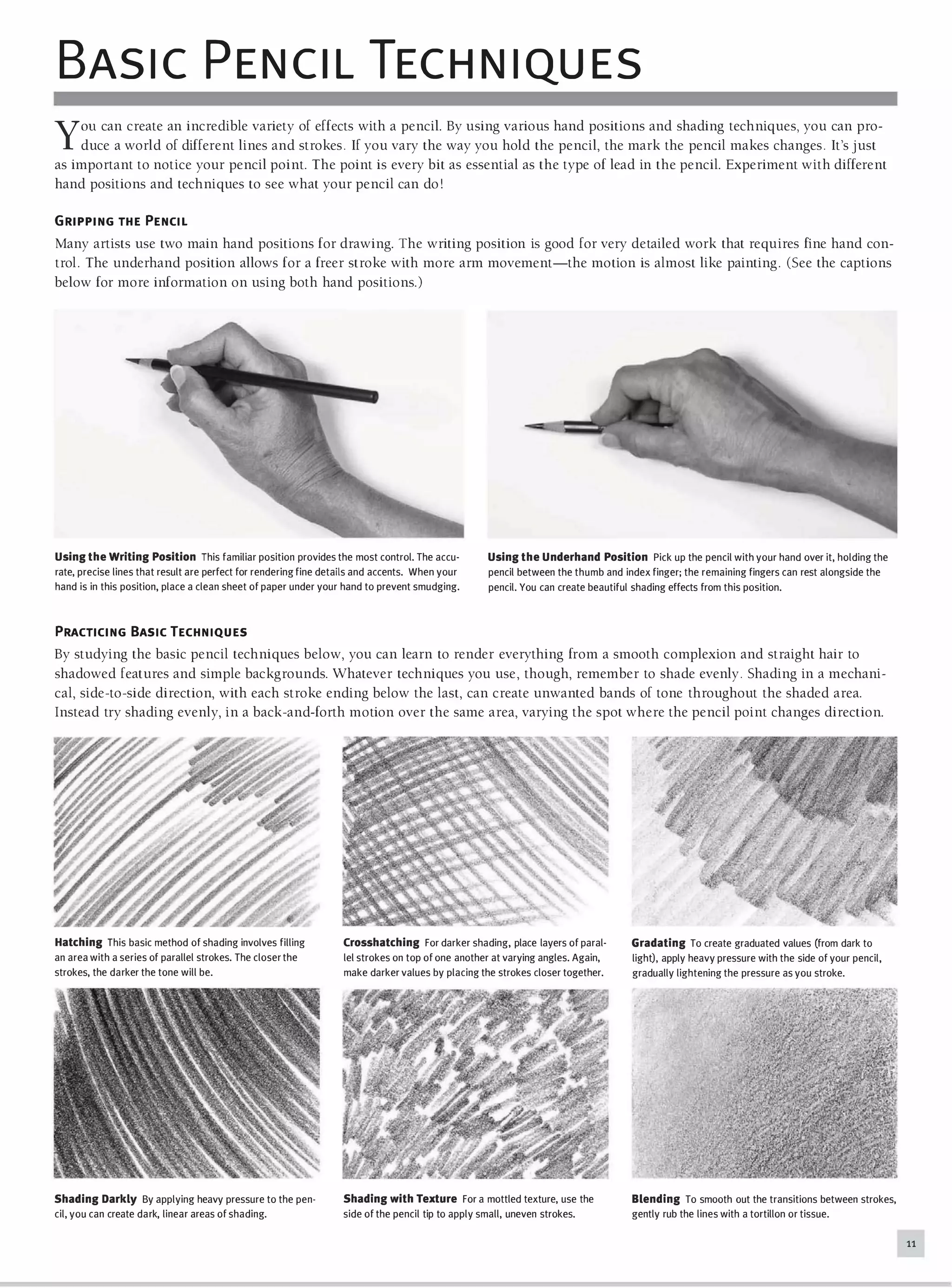
BASIC PENCI L TECH N IQU ES
Y
OU can create an incredible variety of effects with a pencil. By using various hand positions and shading techniques, you can pro­
duce a world of different lines and strokes. If you vary the way you hold the pencil, the mark the pencil makes changes. It's just
as important to notice your pencil point. The point is every bit as essential as the type of lead in the pencil. Experiment with different
hand positions and techniques to see what your pencil can do!
GRIPPING THE PENCIL
Many artists use two main hand positions for drawing. The writing position is good for very detailed work that requires fine hand con­
trol. The underhand position allows for a freer stroke with more arm movement-the motion is almost like painting. (See the captions
below for more information on using both hand positions.)
Using the Writing Position This familiar position provides the most control. The accu­
rate, precise lines that result are perfect for rendering fine details and accents. When your
hand is in this position, place a clean sheet of paper under your hand to prevent smudging.
Using theUnderhand Position Pick up the pencil with your hand over it, holding the
pencil between the thumb and index finger; the remaining fingers can rest alongside the
pencil. You can create beautiful shading effects from this position.
PRACTICING BASIC TECHNIQUES
By studying the basic pencil techniques below, you can learn to render everything from a smooth complexion and straight hair to
shadowed features and simple backgrounds. Whatever techniques you use, though, remember to shade evenly. Shading in a mechani­
cal, side-to-side direction, with each stroke ending below the last, can create unwanted bands of tone throughout the shaded area.
Instead try shading evenly, in a back-and-forth motion over the same area, varying the spot where the pencil point changes direction.
Hatching This basic method of shading involves filling
an area with a series of parallel strokes. The closer the
strokes, the darker the tone will be_
Shading Darkly By applying heavy pressure to the pen­
cil, you can create dark, linear areas of shading.
Crosshatching For darker shading, place layers of paral­
lel strokes on top of one another at varying angles. Again,
make darker values by placing the strokes closer together.
Shading with Texture For a mottled texture, use the
side of the pencil tip to apply small, uneven strokes.
Gradating To create graduated values (from dark to
light), apply heavy pressure with the side of your pencil,
gradually lightening the pressure as you stroke_
Blending To smooth out the transitions between strokes,
gently rub the lines with a tortillon or tissue_
11
12
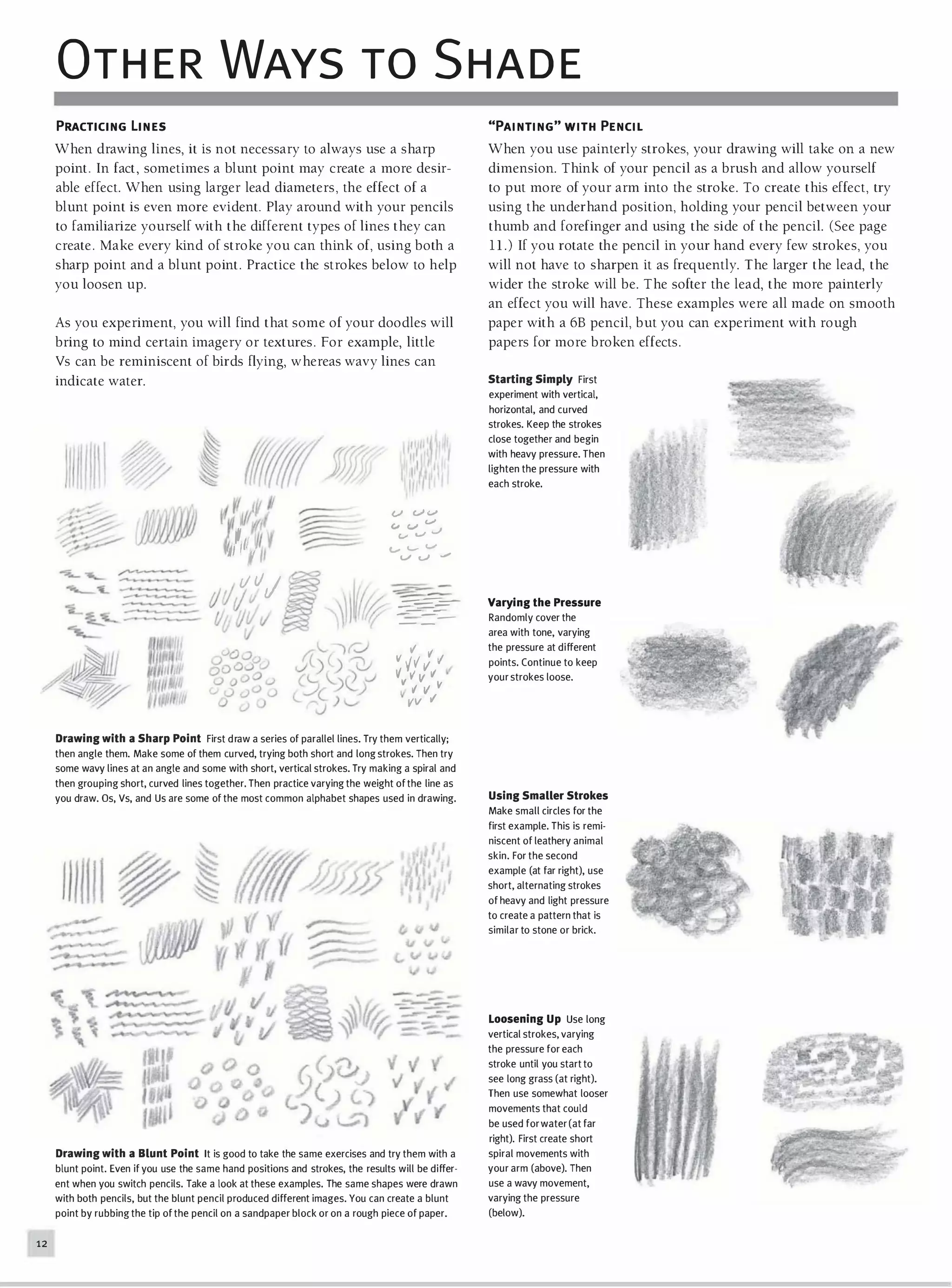
OTH ER WAYS TO SHADE
PRACTICING LINES
When drawing lines, it is not necessary to always use a sharp
point. In fact, sometimes a blunt point may create a more desir­
able effect. When using larger lead diameters, the effect of a
blunt point is even more evident. Play around with your pencils
to familiarize yourself with the different types of lines they can
create. Make every kind of stroke you can think of, using both a
sharp point and a blunt point. Practice the strokes below to help
you loosen up.
As you experiment, you will find that some of your doodles will
bring to mind certain imagery or textures. For example, little
Vs can be reminiscent of birds flying, whereas wavy lines can
indicate water.
I,
,......,--�-�­
�---
--
_............ ...
-
-- .
1 if /I
l /ltf' �
�I"I �I �
-
till; �
)I��(/1/- �
Ii Jt!
v �v
<..-uV
vvv
("'<-'"-'
v <.J ....,
� -- -
---
-�=-- -- -
--
'I
v VV; :/
I/vv"
v -I
V
v
VV v
Drawing with a Sharp Point First draw a series of parallel lines. Try them vertically;
then angle them. Make some of them curved, trying both short and long strokes. Then try
some wavy lines at an angle and some with short, vertical strokes. Try making a spiral and
then grouping short, curved lines together. Then practice varying the weight ofthe line as
you draw. Os, Vs, and Us are some of the most common alphabet shapes used in drawing.
�,---.....
-
Drawing with a Blunt Point It is good to take the same exercises and try them with a
blunt point. Even if you use the same hand positions and strokes, the results will be differ·
ent when you switch pencils. Take a look at these examples. The same shapes were drawn
with both pencils, but the blunt pencil produced different images. You can create a blunt
point by rubbing the tip ofthe pencil on a sandpaper block or on a rough piece of paper.
"PAINTING" WITH PENCIL
When you use painterly strokes, your drawing will take on a new
dimension. Think of your pencil as a brush and allow yourself
to put more of your arm into the stroke. To create this effect, try
using the underhand position, holding your pencil between your
thumb and forefinger and using the side of the pencil. (See page
1 1 .) If you rotate the pencil in your hand every few strokes, you
will not have to sharpen it as frequently. The larger the lead, the
wider the stroke will be. The softer the lead, the more painterly
an effect you will have. These examples were all made on smooth
paper with a 6B pencil, but you can experiment with rough
papers for more broken effects.
Starting Simply First
experiment with vertical,
horizontal, and curved
strokes. Keep the strokes
close together and begin
with heavy pressure. Then
lighten the pressure with
each stroke.
Varying the Pressure
Randomly cover the
area with tone, varying
the pressure at different
points. Continue to keep
your strokes loose.
Using Smaller Strokes
Make small circles for the
first example. This is remi­
niscent of leathery animal
skin. For the second
example (at far right), use
short, alternating strokes
of heavy and light pressure
to create a pattern that is
similar to stone or brick.
Loosening Up Use long
vertical strokes, varying
the pressure for each
stroke until you start to
see long grass (at right).
Then use somewhat looser
movements that could
be used forwater (at far
right). First create short
spiral movements with
your arm (above). Then
use a wavy movement,
varying the pressure
(below).
FINDING YOUR STYLE WORKING WITH DIFFERENT TECHNIQUES
Many great artists of the past can now be identified by their
unique experiments with line. Van Gogh's drawings were a feast
of calligraphic lines; Seurat became synonymous with pointillism;
and Giacometti was famous for his scribble. Can you find your
identity in a pencil stroke?
Below are several examples of techniques that can be done with
pencil. These techniques are important for creating more paint­
erly effects in your drawing. Remember that B pencils have soft
lead and H pencils have hard lead-you will need to use both for
these exercises.
Using Criss-Crossed
Strokes If you like a
good deal of fine detail in
your work, you'll find that
crosshatching allows you a
lot of control (see page 11).
You can adjust the depth
ofyour shading by
changing the distance
between your strokes.
Sketching Circular
Scribbles If you work
with round, loose strokes
like these, you are prob·
ably very experimental
with your art. These
looping lines suggest a
free-form style that is more
concerned with evoking a
mood than with capturing
precise details.
Drawing SmallDots
This technique is called
"stippling"-many small
dots are used to create a
larger picture. Make the
points different sizes to
create various depths and
shading effects. Stippling
takes a great deal of preci­
sion and practice.
Simulating Brush­
strokes You can create
the illusion of brush­
strokes by using short,
sweeping lines. This
captures the feeling of
painting but allows you
the same control you
would get from cross­
hatching. These strokes
are ideal for a more
stylistic approach.
Smudging is an important
technique for creating shading
and gradients. Use a tortillon
or chamois cloth to blend your
strokes. It is important to not use
your finger, because your hand,
even if clean, has natural oils
that can damage your art.
S M U D G I N G
Smudging on Rough
Surfaces Use a 6B pencil
on vellum-finish Bristol board.
Make your strokes with the
side ofthe pencil and blend. In
this example, the effect is very
granular.
Creating Washes First
shade an area with a water­
soluble pencil (a pencil that
produces washes similar
to watercolor paint when
manipulated with water).
Then blend the shading with
a wet brush. Make sure your
brush isn't too wet, and use
thicker paper, such as vel­
lum board.
Rubbing Place paper over
an object and rub the side
ofyour pencil lead over
the paper. The strokes of
your pencil will pick up the
pattern and replicate it on
the paper. Try using a soft
pencil on smooth paper,
and choose an object with a
strong textural pattern. This
example uses a wire grid.
Lifting Out Blend a soft
pencil on smooth paper, and
then lift out the desired area
of graphite with an eraser.
You can create highlights
and other interesting effects
with this technique.
Producing Indented
Lines Draw a pattern or
design on the paper with a
sharp, non-marking object,
like a knitting needle or
skewer, before drawing with
a pencil. When you shade
over the area with the side
ofyour pencil, the graphite
will not reach the indented
areas, leaving white lines.
Smudging on Smooth
Surfaces Use a 4B pencil on
plate-finish Bristol board. Stroke
with the side ofthe pencil, and
then blend your strokes with a
blending stump.
13
14
LEARNI NG TO SEE
M
any beginners draw without really looking carefully at their
subject; instead of drawing what they actually see, they
draw what they think they see. Try drawing something you know
well, such as your hand, without looking at it. Chances are your
finished drawing won't look as realistic as you expected. That's
because you drew what you think your hand looks like. Instead,
you need to forget about all your preconceptions and learn to
draw only what you really see in front of you (or in a photo).
Two great exercises for training your eye to see are contour
drawing and gesture drawing.
PENCILING THE CONTOURS
In contour drawing, you pick a starting point on your subject
and then draw only the contours-or outlines-of the shapes
you see. Because you're not looking at your paper, you're training
your hand to draw the lines exactly as your eye sees them. Try
doing some contour drawings of your own; you'll be surprised at
how well you're able to capture the subjects.
To test your observation
skills, stLldy an object very
closelyJar aJew minLltes,
and then close your eyes and
try drawing itJrom memory,
letUng your handJollow
• Drawing "Blind" For the contour drawing on the
left, the artist occasionally looked down at the paper.
The drawing on the right is an example of a blind contour
drawing, where the artist drew without looking at his paper
even once. It's a little distorted, but it's clearly a hand.
Blind contour drawing is one ofthe best ways of making
sure you're truly drawing only what you see.
the mental image.
... Drawing with a
Continuous Line When
drawing this man pushing a
wheelbarrow, try glancing only
occasionally at your paper to
check that you are on track, but
concentrate on really looking
at the subject and tracing the
outlines you see. Instead of
lifting your pencil between
shapes, keep the line unbroken
by freely looping back and
crossing overyour lines. Notice
how this simple technique
effectively captures the subject.
Drawing Children Once you have trained your eye to observe carefully and can draw quickly, you'll be able to capture actions such as this child looking and then reaching into the bag.
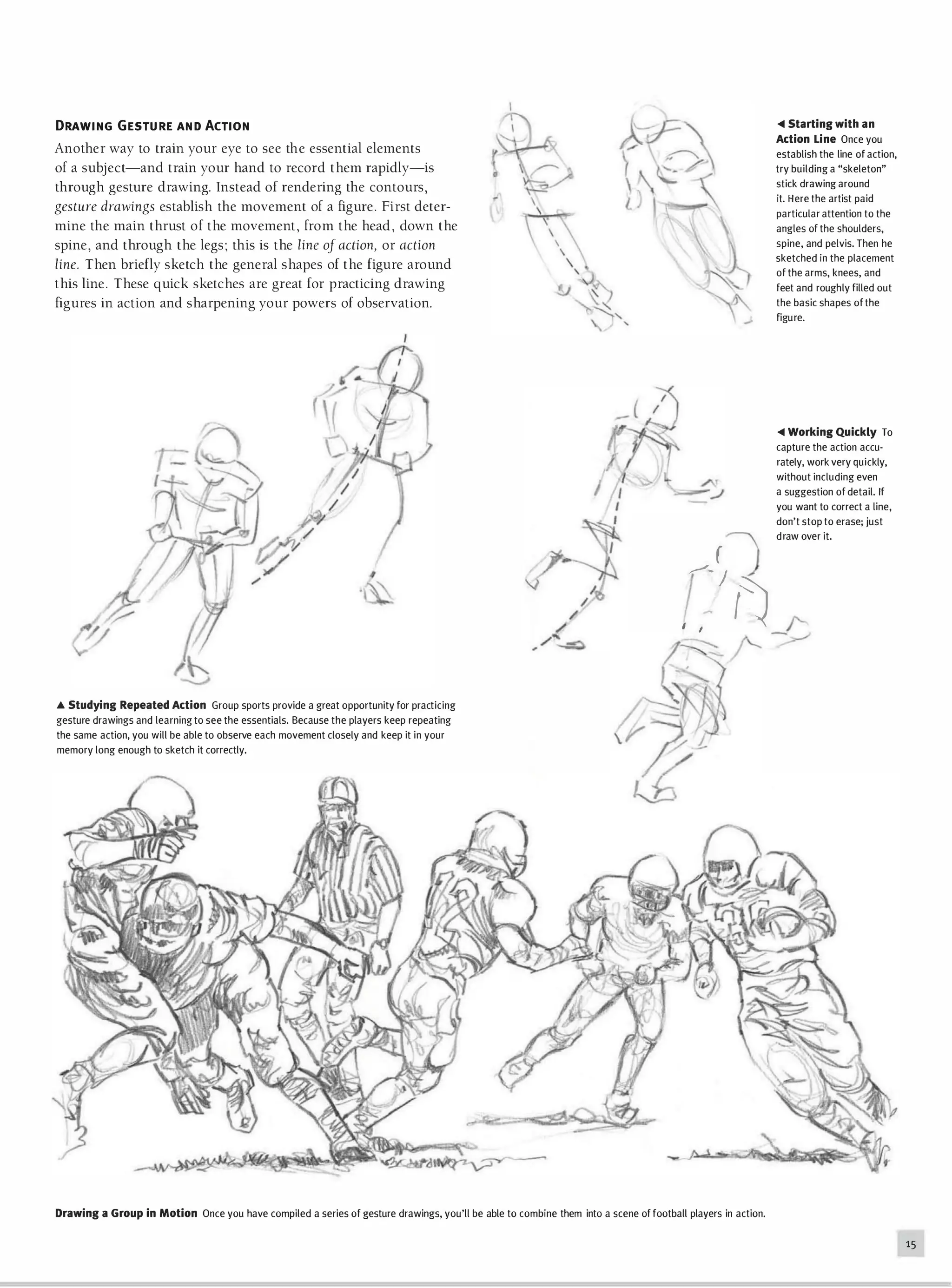
DRAWING GESTURE AND ACTION
Another way to train your eye to see the essential elements
of a subject-and train your hand to record them rapidly-is
through gesture drawing. Instead of rendering the contours,
gesture drawings establish the movement of a figure. First deter­
mine the main thrust of the movement, from the head, down the
spine, and through the legs; this is the line oj action, or action
line. Then briefly sketch the general shapes of the figure around
this line. These quick sketches are great for practicing drawing
figures in action and sharpening your powers of observation.
I
I
j--.;
... Studying Repeated Action Group sports provide a great opportunity for practicing
gesture drawings and learning to see the essentials. Because the players keep repeating
the same action, you will be able to observe each movement closely and keep it in your
memory long enough to sketch it correctly.
...
(
--
- J
I (�I I
Drawing a Group in Motion Once you have compiled a series of gesture drawings, you'll be able to combine them into a scene of football players in action.
... Starting with an
Action Line Once you
establish the line of action,
try building a "skeleton"
stick drawing around
it. Here the artist paid
particular attention to the
angles of the shoulders,
spine, and pelvis. Then he
sketched in the placement
of the arms, knees, and
feet and roughly filled out
the basic shapes ofthe
figure.
... Working Quickly To
capture the action accu­
rately, work very quickly,
without including even
a suggestion of detail. If
you want to correct a line,
don't stop to erase; just
draw over it.
15
16
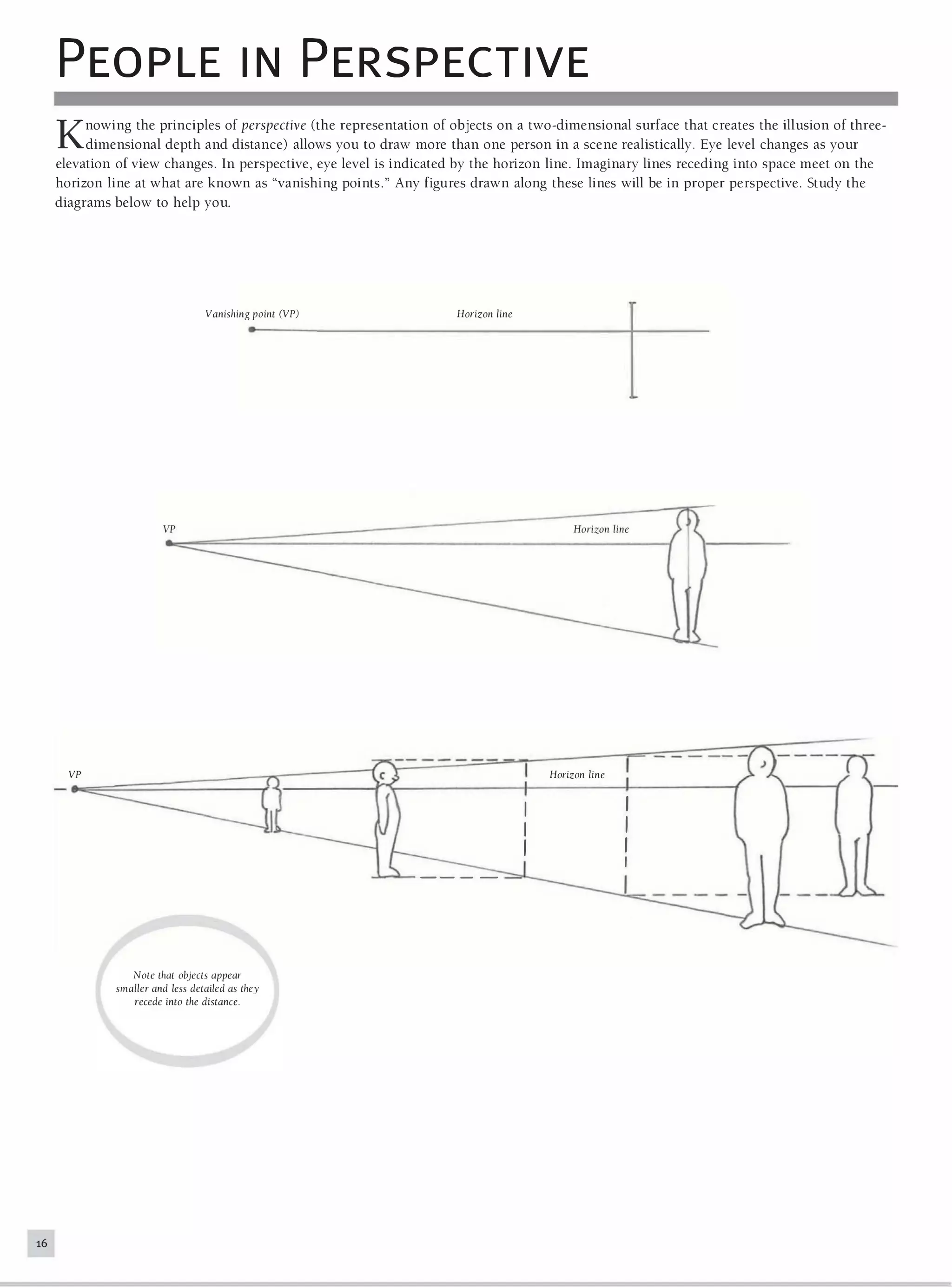
PEOPLE I N PERSPECTIVE
K
nowing the principles of perspective (the representation of objects on a two-dimensional surface that creates the illusion of three­
dimensional depth and distance) allows you to draw more than one person in a scene realistically. Eye level changes as your
elevation of view changes. In perspective, eye level is indicated by the horizon line. Imaginary lines receding into space meet on the
horizon line at what are known as "vanishing points." Any figures drawn along these lines will be in proper perspective. Study the
diagrams below to help you.
VP
Vanishing pOint (VP) Horizon line
V�P �==�=====H�orizon�line �f��__
-
Note that objects appear
smaller and less detailed as they
recede into the distance.
->--"-- -- - - -
-
I
I
I
Horizon line
I
I
I
I
I
-
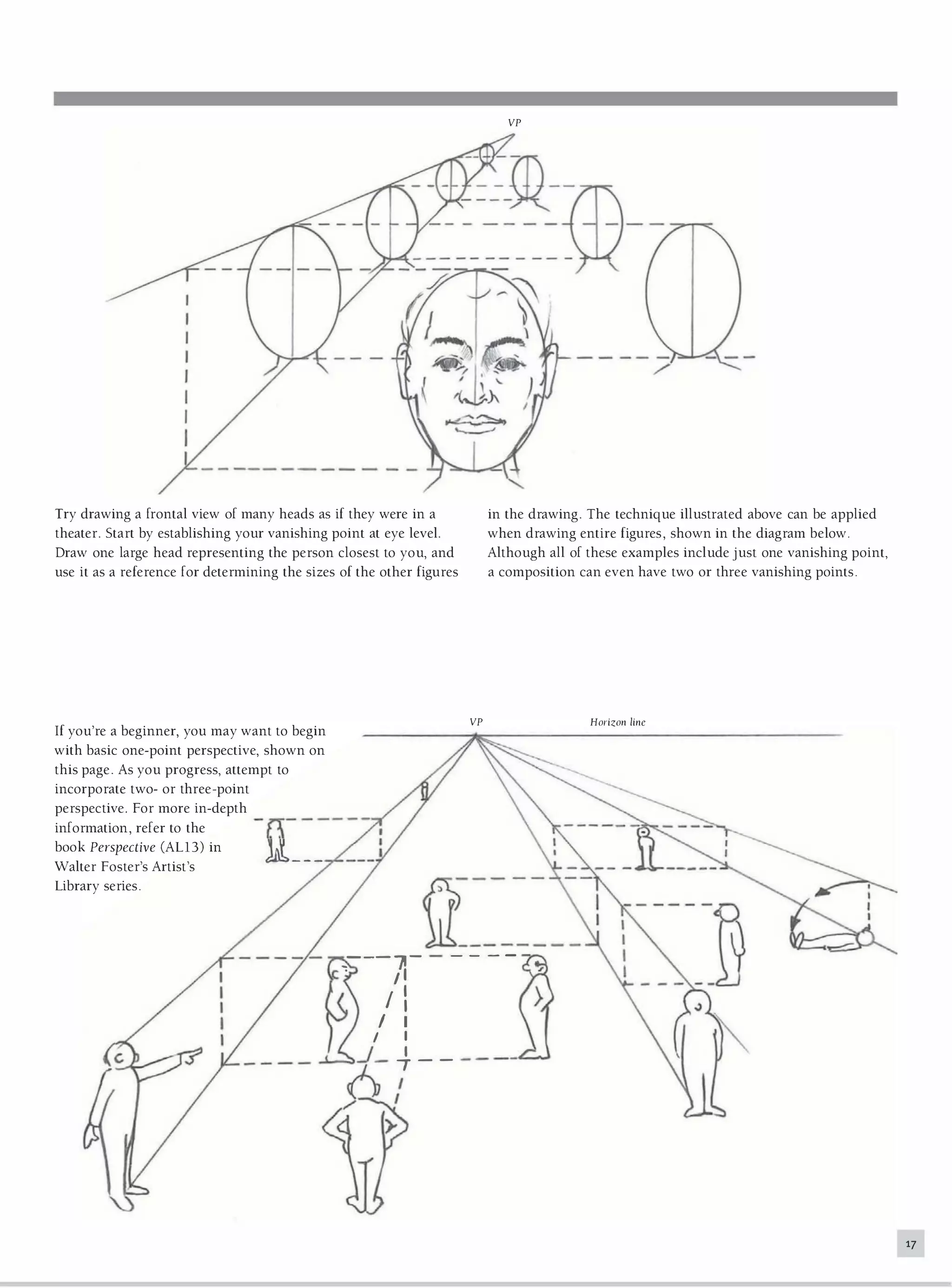
Try drawing a frontal view of many heads as if they were in a
theater. Start by establishing your vanishing point at eye level.
Draw one large head representing the person closest to you, and
use it as a reference for determining the sizes of the other figures
If you're a beginner, you may want to begin
with basic one-point perspective, shown on
this page. As you progress, attempt to
incorporate two- or three-point
perspective. For more in-depth
information, refer to the
book Perspective (ALl3) in
Walter Foster's Artist's
Library series.
-[1------
1i---
VP
VP
in the drawing. The technique illustrated above can be applied
when drawing entire figures, shown in the diagram below.
Although all of these examples include just one vanishing point,
a composition can even have two or three vanishing points.
Horizon line
---7!-
----
.
/1
/ :
I I
/ I
��-'- -} --
PI,
----�....,
17
18
PLACI NG PEOPLE I N A COMPOSITION
T
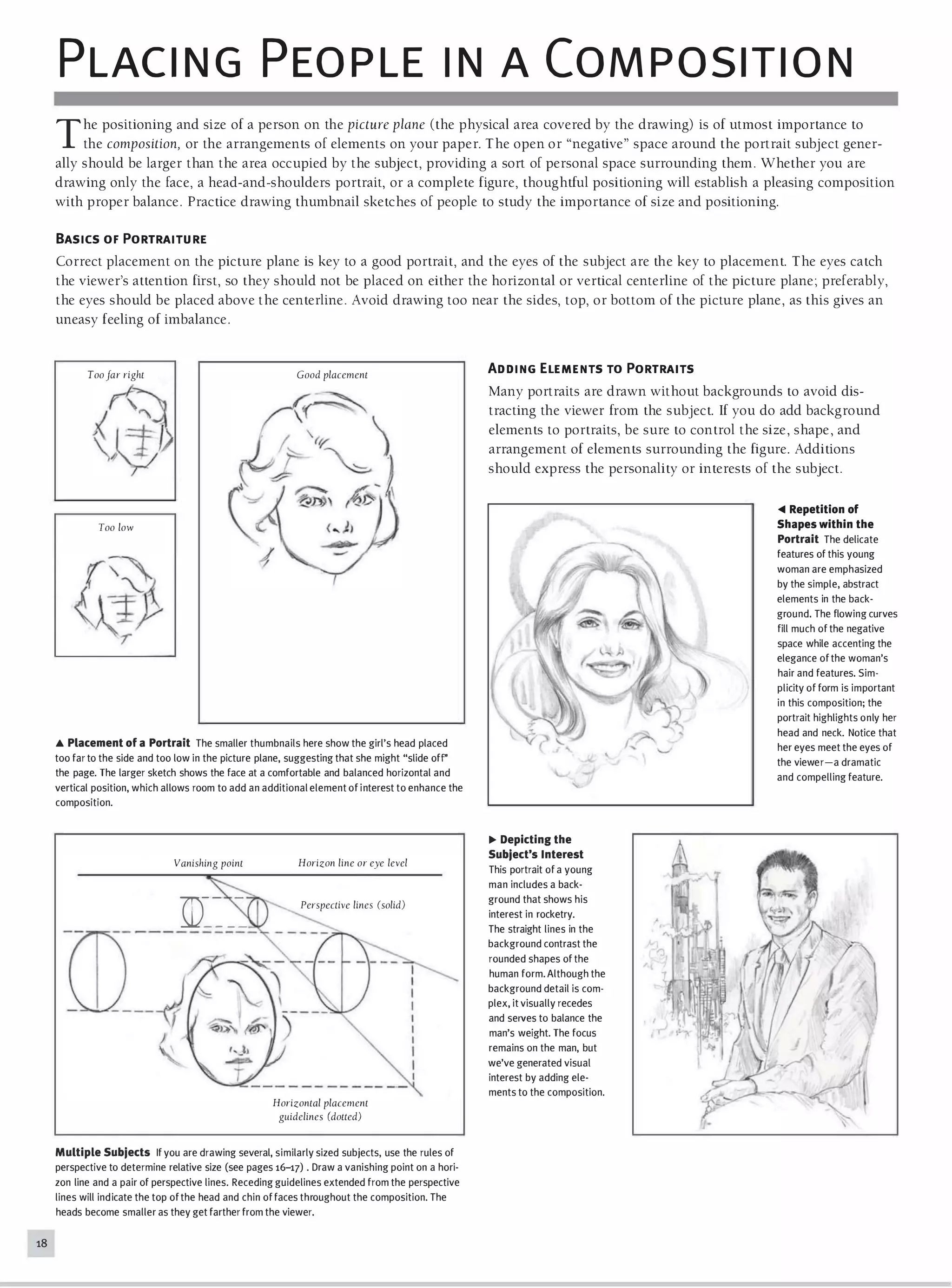
he positioning and size of a person on the picture plane (the physical area covered by the drawing) is of utmost importance to
the composition, or the arrangements of elements on your paper. The open or "negative" space around the portrait subject gener­
ally should be larger than the area occupied by the subject, providing a sort of personal space surrounding them. Whether you are
drawing only the face, a head-and-shoulders portrait, or a complete figure, thoughtful positioning will establish a pleasing composition
with proper balance. Practice drawing thumbnail sketches of people to study the importance of size and positioning.
BASICS OF PORTRAITURE
Correct placement on the picture plane is key to a good portrait, and the eyes of the subject are the key to placement. The eyes catch
the viewer's attention first, so they should not be placed on either the horizontal or vertical centerline of the picture plane; preferably,
the eyes should be placed above the centerline. Avoid drawing too near the sides, top, or bottom of the picture plane, as this gives an
uneasy feeling of imbalance.
Toofar right
r�
�,t�
Too low
Good placement
... Placement of a Portrait The smaller thumbnails here show the girl's head placed
too far to the side and too low in the picture plane, suggesting that she might "slide off'
the page. The larger sketch shows the face at a comfortable and balanced horizontal and
vertical position, which allows room to add an additional element of interest to enhance the
composition.
)
Vanishing pOint Horizon line or eye level
ID-- -
-- --
Perspective lines (solid)
�-c;________ _ _ _ _._
Horizontal placement
guidelines (dotted)
Multiple Subjects If you are drawing several, similarly sized subjects, use the rules of
perspective to determine relative size (see pages 16-17) . Draw a vanishing point on a hori­
zon line and a pair of perspective lines. Receding guidelines extended from the perspective
lines will indicate the top ofthe head and chin offaces throughout the composition. The
heads become smaller as they get farther from the viewer.
ADDING ELEMENTS TO PORTRAITS
Many portraits are drawn without backgrounds to avoid dis­
tracting the viewer from the subject. If you do add background
elements to portraits, be sure to control the size, shape, and
arrangement of elements surrounding the figure. Additions
should express the personality or interests of the subject.
� Depicting the
Subject's Interest
This portrait of a young
man includes a back­
ground that shows his
interest in rocketry.
The straight lines in the
background contrast the
rounded shapes of the
human form. Although the
background detail is com­
plex, it visually recedes
and serves to balance the
man's weight. The focus
remains on the man, but
we've generated visual
interest by adding ele­
ments to the composition.
<III Repetition of
Shapes within the
Portrait The delicate
features of this young
woman are emphasized
by the simple, abstract
elements in the back­
ground. The flowing curves
fill much of the negative
space while accenting the
elegance ofthe woman's
hair and features. Sim­
plicity of form is important
in this composition; the
portrait highlights only her
head and neck. Notice that
her eyes meet the eyes of
the viewer-a dramatic
and compelling feature.
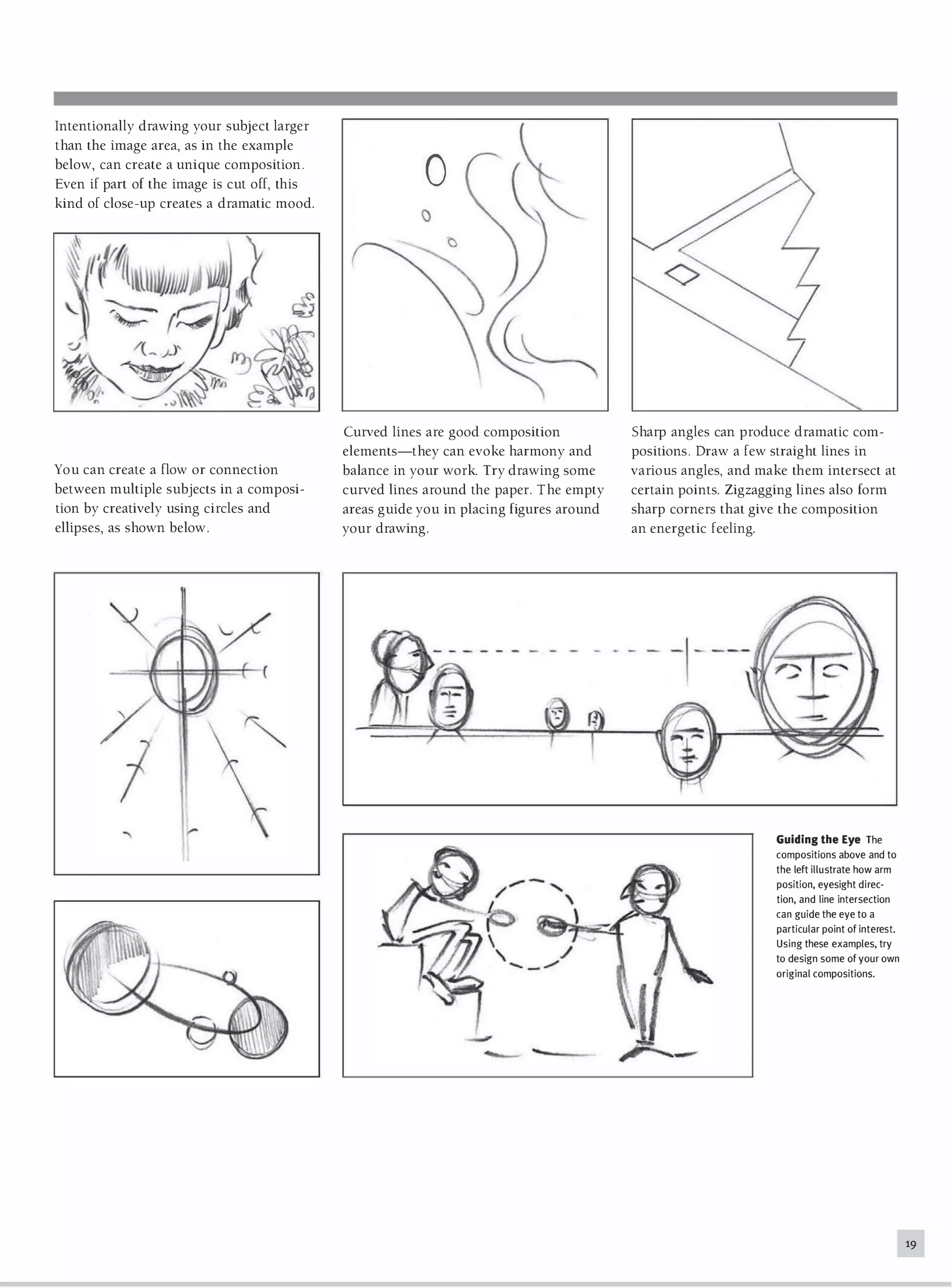
Intentionally drawing your subject larger
than the image area, as in the example
below, can create a unique composition.
Even if part of the image is cut off, this
kind of close-up creates a dramatic mood.
You can create a flow or connection
between multiple subjects in a composi­
tion by creatively using circles and
ellipses, as shown below.
o
Curved lines are good composition
elements-they can evoke harmony and
balance in your work. Try drawing some
curved lines around the paper. The empty
areas guide you in placing figures around
your drawing.
Sharp angles can produce dramatic com­
positions. Draw a few straight lines in
various angles, and make them intersect at
certain points. Zigzagging lines also form
sharp corners that give the composition
an energetic feeling.
Guiding the Eye The
compositions above and to
the left illustrate how arm
position, eyesight direc­
tion, and line intersection
can guide the eye to a
particular point of interest
Using these examples, try
to design some of your own
original compositions.
19
20
ADDING COMPLETE FIGU RES
C
reating a composition that shows a complete person can be challenging. A standing figure is much taller than it is wide, so the fig­
ure should be positioned so that its action relates naturally to the eye level of the viewer and the horizon line. To place more than
one figure on the picture plane, use perspective as we did with the portrait heads. Remember that people appear smaller and less distinct
when they are more distant. For comfortable placement of people in a composition, they should be on the same eye level as the viewer
with the horizon line about waist high.
B
. I
Horizon line Perspective lines
Vanishing point
Horizontal placement guidelines
---
-
�
r�r'
'-:
-
�
, r
Full Figure Placement In thumbnail A,
the subject is too perfectly centered in the
picture plane. In thumbnail B, the figure is
placed too far to the left. Thumbnail C is an
example of effective placement of a human
figure in a composition.
Sizing Multiple Figures For realistic
compositions, we need to keep figures in
proportion. All the figures here are in pro·
portion; we use perspective to determine
the height of each figure. Start by drawing
a horizon line and placing a vanishing
point on it. Then draw your main character
(on the right here) to which all others will
be proportional. Add light perspective
lines from the top and bottom of the figure
to the vanishing point to determine the
height of other figures. If we want figures
on the other side of the vanishing point,
we draw horizontal placement guidelines
from the perspective lines to determine his
height, and then add perspective lines on
that side.
Line of Sight Figures in a composition
like this one can relate to one another or
to objects within the scene through line of
sight (shown here as dotted lines). You
can show line of sight with the eyes, but
also by using head position and even a
pointing hand. These indications can guide
the viewer to a particular point of interest
in the composition. Though the man on the
left is facing forward, his eyes are looking
to our right. The viewer's eye follows the
line of sight ofthose within the drawing
and is guided around the picture plane as
the people interact. The man at the top is
looking straight up.
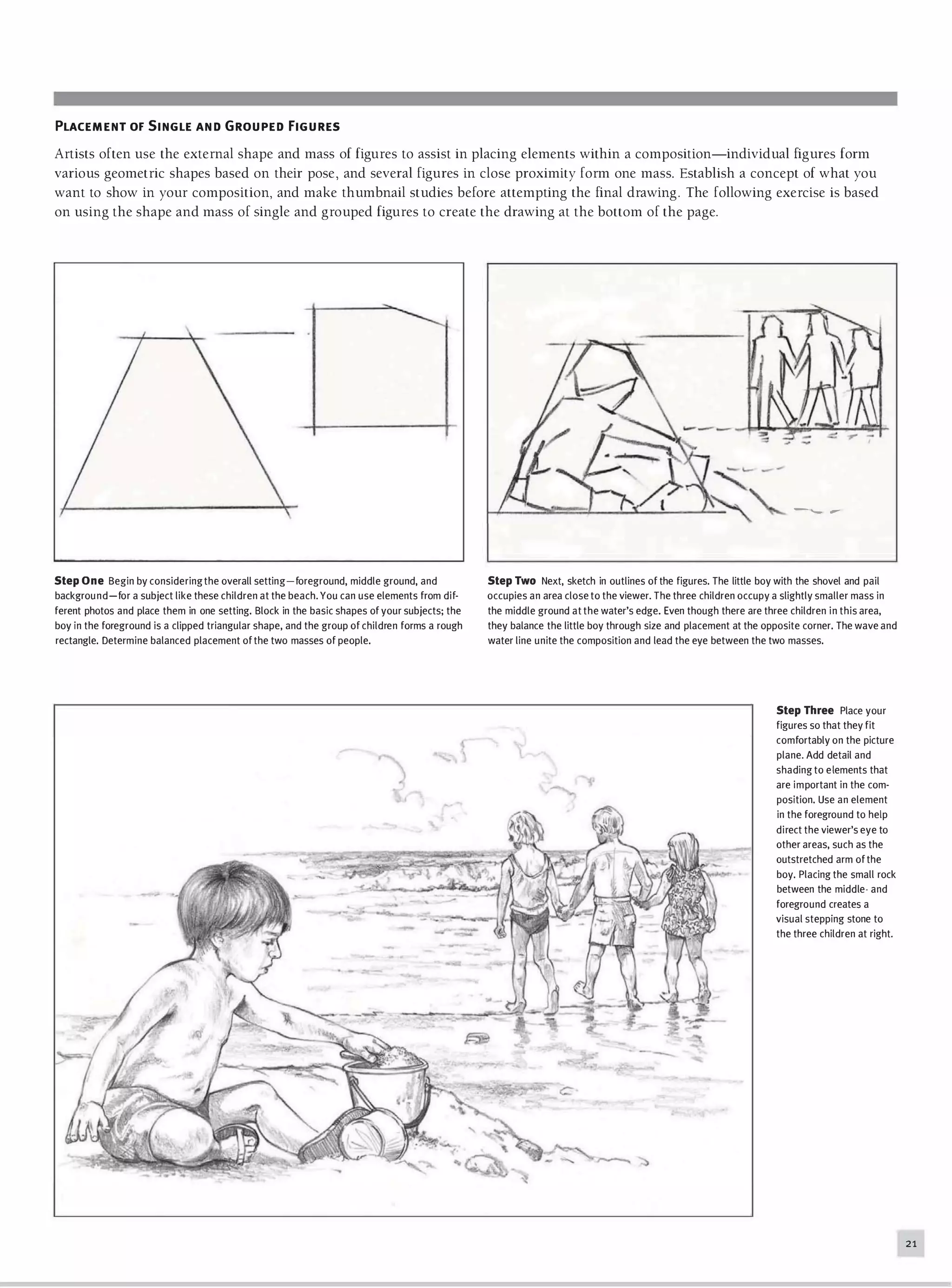
PLACEMENT OF SINGLE AND GROUPED FIGURES
Artists often use the external shape and mass of figures to assist in placing elements within a composition-individual figures form
various geometric shapes based on their pose, and several figures in close proximity form one mass. Establish a concept of what you
want to show in your composition, and make thumbnail studies before attempting the final drawing. The following exercise is based
on using the shape and mass of Single and grouped figures to create the drawing at the bottom of the page.
Step One Begin by consideringthe overall setting-foreground, middle ground, and
background-for a subject like these children at the beach. You can use elements from dif­
ferent photos and place them in one setting. Block in the basic shapes of your subjects; the
boy in the foreground is a clipped triangular shape, and the group of children forms a rough
rectangle. Determine balanced placement ofthe two masses of people.
- ..... --
Step Two Next, sketch in outlines of the figures. The little boy with the shovel and pail
occupies an area close to the viewer. The three children occupy a slightly smaller mass in
the middle ground at the water's edge. Even though there are three children in this area,
they balance the little boy through size and placement at the opposite corner. The wave and
water line unite the composition and lead the eye between the two masses.
...--..... .
Step Three Place your
figures so that they fit
comfortably on the picture
plane. Add detail and
shading to elements that
are important in the com­
position. Use an element
in the foreground to help
direct the viewer's eye to
other areas, such as the
outstretched arm ofthe
boy. Placing the small rock
between the middle- and
foreground creates a
visual stepping stone to
the three children at right.
21
22
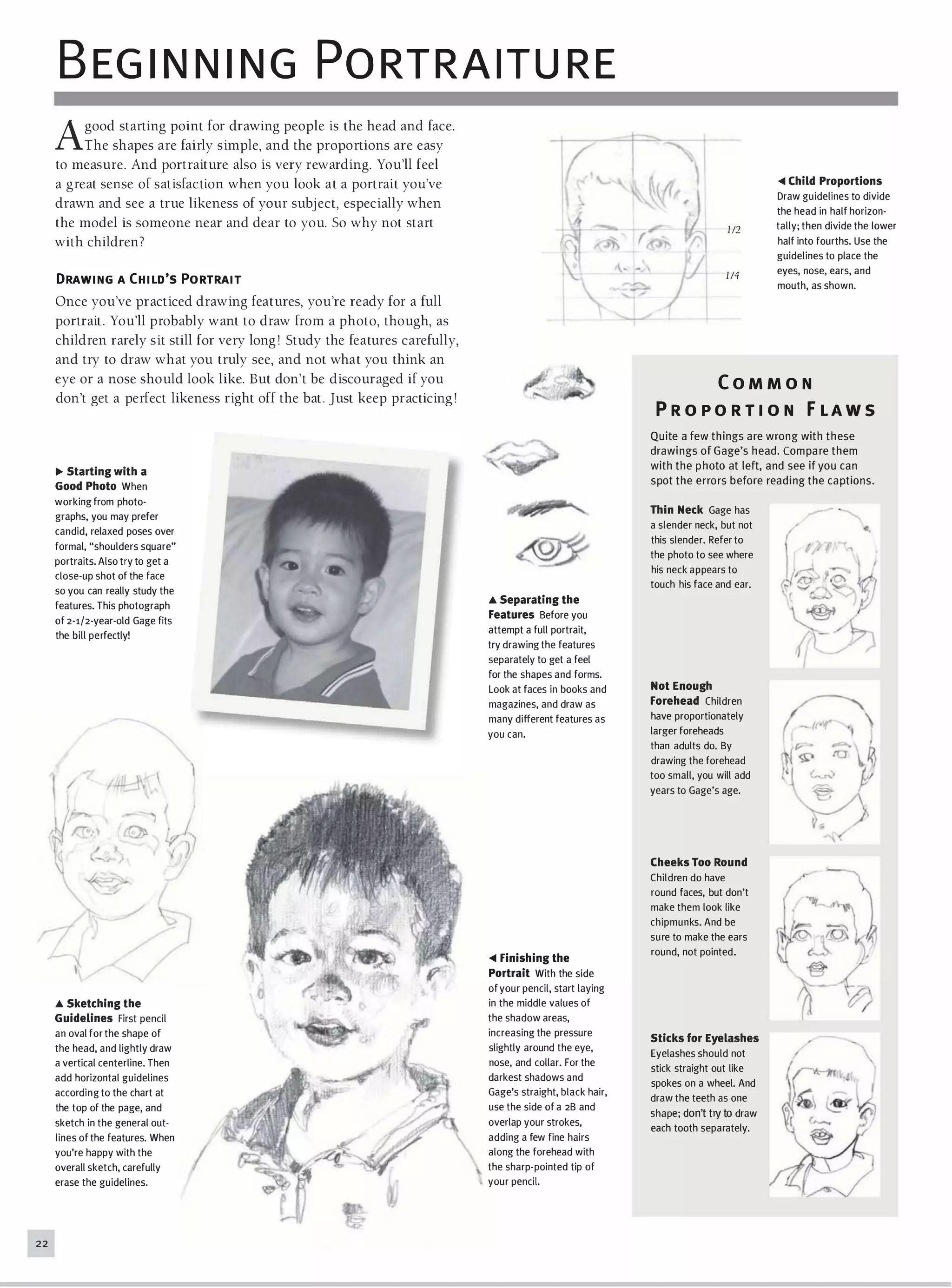
BEG I N N I NG PORTRAITU RE
Agood starting point for drawing people is the head and face.
The shapes are fairly simple, and the proportions are easy
to measure. And portraiture also is very rewarding. You'll feel
a great sense of satisfaction when you look at a portrait you've
drawn and see a true likeness of your subject, especially when
the model is someone near and dear to you. So why not start
with children?
DRAWING A CHILD'S PORTRAIT
Once you've practiced drawing features, you're ready for a full
portrait. You'll probably want to draw from a photo, though, as
children rarely sit still for very long! Study the features carefully,
and try to draw what you truly see, and not what you think an
eye or a nose should look like. But don't be discouraged if you
don't get a perfect likeness right off the bat. Just keep practicing!
� Starting with a
Good Photo When
working from photo·
graphs, you may prefer
candid, relaxed poses over
formal, "shoulders square"
portraits. Also try to get a
close·up shot of the face
so you can really study the
features. This photograph
of 2·1/2·year·old Gage fits
the bill perfectly!
 /
I
J(I
... Sketching the
Guidelines First pencil
an oval for the shape of
the head, and lightly draw
a vertical centerline. Then
add horizontal guidelines
according to the chart at
the top of the page, and
sketch in the general out·
lines of the features. When
you're happy with the
overall sketch, carefully
erase the guidelines.
... Separating the
Features Before you
attempt a full portrait,
try drawing the features
separately to get a feel
for the shapes and forms.
Look at faces in books and
magazines, and draw as
many different features as
you can.
... Finishing the
Portrait With the side
ofyour pencil, start laying
in the middle values of
the shadow areas,
increasing the pressure
slightly around the eye,
nose, and collar. For the
darkest shadows and
Gage's straight, black hair,
use the side of a 2B and
overlap your strokes,
adding a few fine hairs
along the forehead with
the sharp·pointed tip of
your pencil.
112
114
... Child Proportions
Draw guidelines to divide
the head in half horizon·
tally; then divide the lower
half into fourths. Use the
guidelines to place the
eyes, nose, ears, and
mouth, as shown.
COMMON
PROPORT I ON FLAWS
Quite a few things are wrong with these
drawings of Gage's head. Compare them
with the photo at left, and see if you can
spot the errors before reading the captions.
Thin Neck Gage has
a slender neck, but not
this slender. Refer to
the photo to see where
his neck appears to
touch his face and ear.
Not Enough
Forehead Children
have proportionately
larger foreheads
than adults do. By
drawing the forehead
too small, you will add
years to Gage's age.
Cheeks Too Round
Children do have
round faces, but don't
make them look like
chipmunks. And be
sure to make the ears
round, not pointed.
Sticks for Eyelashes
Eyelashes should not
stick straight out like
spokes on a wheel. And
draw the teeth as one
shape; don't try to draw
each tooth separately.
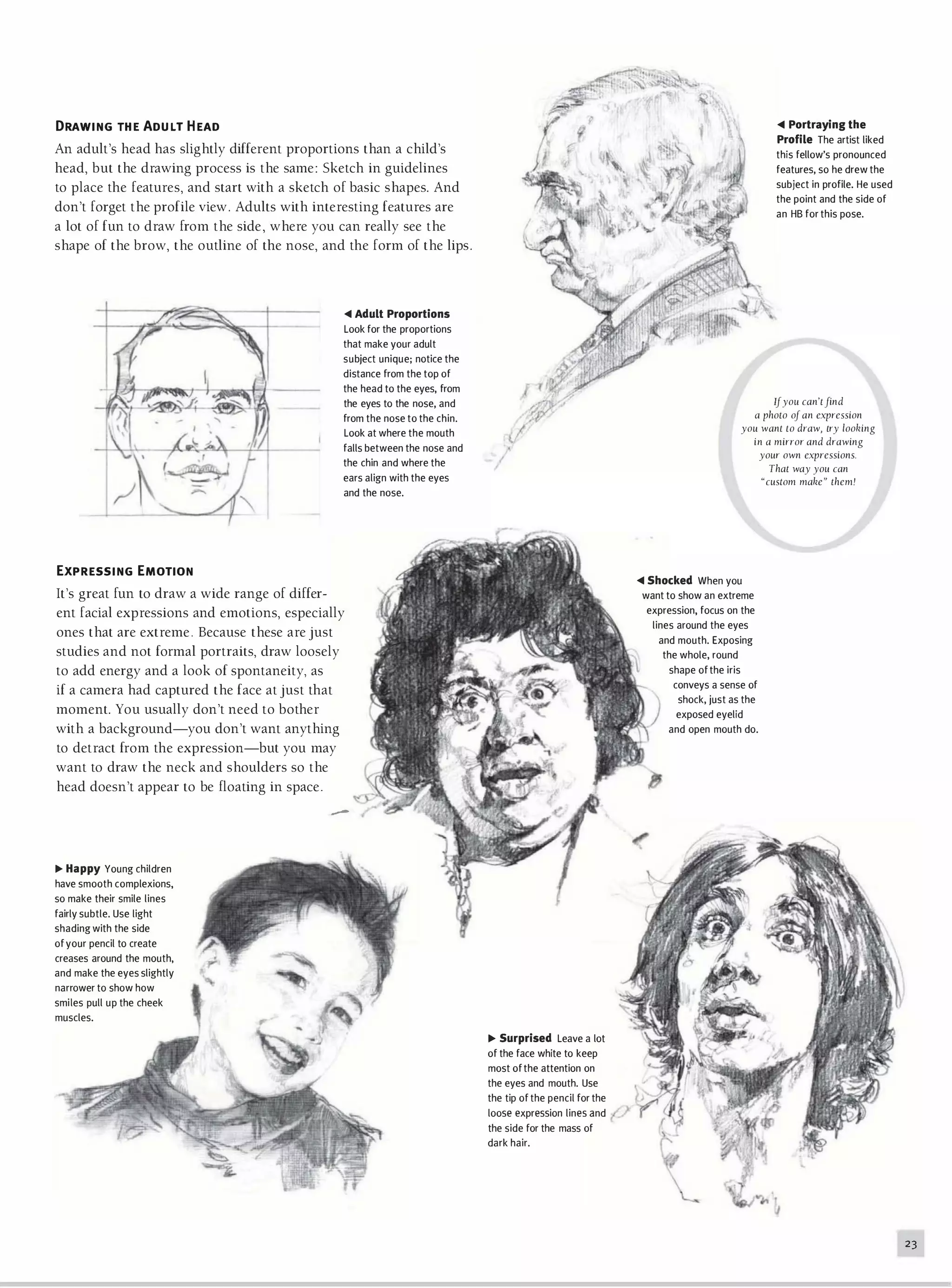
DRAWING THE ADULT HEAD
An adult's head has slightly different proportions than a child's
head, but the drawing process is the same: Sketch in guidelines
to place the features, and start with a sketch of basic shapes. And
don't forget the profile view. Adults with interesting features are
a lot of fun to draw from the side, where you can really see the
shape of the brow, the outline of the nose, and the form of the lips.
EXPRESSING EMOTION
<III Adult Proportions
Look for the proportions
that make your adult
subject unique; notice the
distance from the top of
the head to the eyes, from
the eyes to the nose, and
from the nose to the chin.
Look at where the mouth
falls between the nose and
the chin and where the
ears align with the eyes
and the nose.
It's great fun to draw a wide range of differ­
ent facial expressions and emotions, especially
ones that are extreme. Because these are just
studies and not formal portraits, draw loosely
to add energy and a look of spontaneity, as
if a camera had captured the face at just that
moment. You usually don't need to bother
with a background-you don't want anything
to detract from the expression-but you may
want to draw the neck and shoulders so the
head doesn't appear to be floating in space.
� Happy Young children
have smooth complexions,
so make their smile lines
fairly subtle. Use light
shading with the side
ofyour pencil to create
creases around the mouth,
and make the eyes slightly
narrower to show how
smiles pull up the cheek
muscles.
-
I
� Surprised Leave a lot
of the face white to keep
most ofthe attention on
the eyes and mouth. Use
the tip of the pencil for the
loose expression lines and ,
the side for the mass of
dark hair.
<III Portraying the
Profile The artist liked
this fellow's pronounced
features, so he drew the
subject in profile. He used
the point and the side of
an HB for this pose.
Ifyou can'tfind
a photo ofan expression
you want to draw, try looking
in a mirror and drawing
your own expressions.
<III Shocked When you
want to show an extreme
expression, focus on the
lines around the eyes
and mouth. Exposing
the whole, round
shape ofthe iris
conveys a sense of
) shock, just as the
exposed eyelid
and open mouth do.
That way you can
"custom make" them!
23
CHAPTER 2
WITH KEN GO LDMAN
Ken Goldman is a popular instructor at the Athenaeum School
of the Arts in La Jolla, California, where he teaches portraiture,
artistic anatomy, and landscape painting classes. Ken also is the
author of six Walter Foster books, including Pastel 1; Pastel:
Landscapes; Acrylic 1; and Basic Anatomy and Figure Drawing in
the How to Draw and Paint series; as well as Charcoal Drawing in
the Artist's Library series and Understanding Values in the Drawing
Made Easy series. Ken received his training in New York at the Art
Students League of New York, National Academy, and New York
Studio School. A recipient of numerous awards, Ken has exhibited
widely in group shows and in more than 30 one-man shows in the
United States, Mexico, and Europe. His artwork is featured in the
permanent collections of several major museums. Ken lives in San
Diego, California, with his artist-wife Stephanie Goldman.
25
26
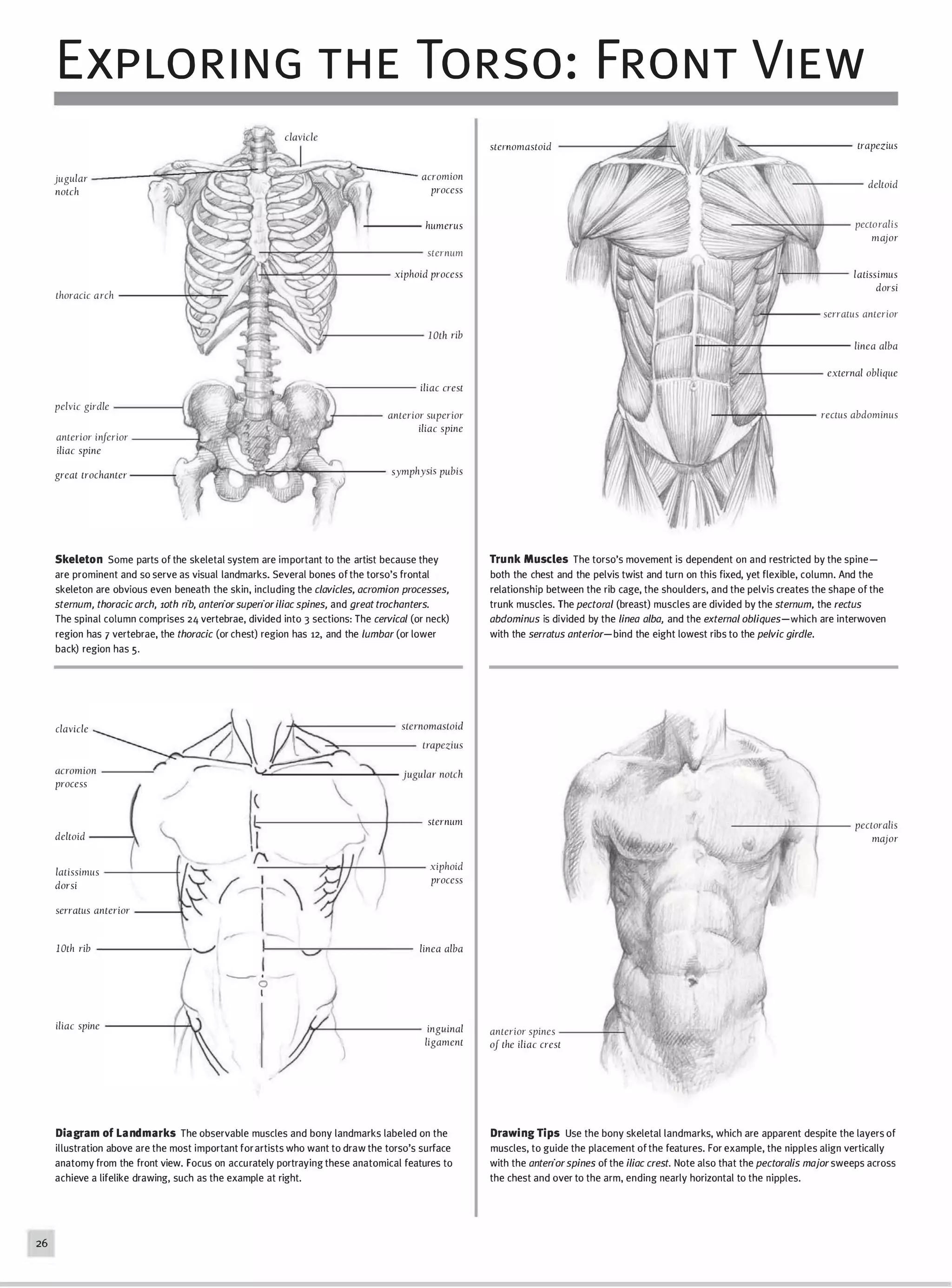
EXPLORI NG TH E TORSO: FRONT VI EW
jugular ----
-
1����tc���J�������.:y----- acromion
notch process
-;.----- humerus
��-=7"";...",:c.rr-------- sternum
::--'-4'1'"6'j-P..,ll.:::.......o;;,..40�---- xiphoid process
thoracic arch ------';r,.�'T""
�,�t_------ lOth rib
..,;::0-:--------- iliac crest
pelvic girdle ------1
+---- anterior superior
anterior inJerior -------L�
iliac spine
iliac spine
great trochanter ----" �t'ir--��!6�rao:!�.:--=----- symphysis pubis
I
Skeleton Some parts of the skeletal system are important to the artist because they
are prominent and so serve as visual landmarks. Several bones ofthe torso's frontal
skeleton are obvious even beneath the skin, including the clavicles, acromion processes,
sternum, thoracic arch, 10th rib, anteriorsuperioriliac spines, and great trochanters.
The spinal column comprises 24 vertebrae, divided into 3 sections: The cervical (or neck)
region has 7 vertebrae, the thoracic (or chest) region has 12, and the lumbar (or lower
back) region has 5.
clavicle
acromion ___-.!r
process
(
/---------'.--f--- sternum
deltoid ---"A
latissimus --'----+
-----..,..-++---i--- xiphoid
dorsi
process
serratus anterior -----
"
10th rib 'C7 linea alba
- , -
0
)
I
/ )
iliac spine -----+--A. {¥'--'-------- ingUinal
ligament
Diagram of Landmarks The observable muscles and bony landmarks labeled on the
illustration above are the most important forartists who want to draw the torso's surface
anatomy from the front view. focus on accurately portraying these anatomical features to
achieve a lifelike drawing, such as the example at right.
stemomastoid .::..,--------- trapezius
--:----- deltoid
-,...:.:::...,e�'-<-':"--:i--- pectoralis
major
1.-11:--'-;-';:--;--- latissimus
dorsi
�'fI----- serratus anterior
if.--�"'--:l-i------- linea alba
�;;:�iil�-lr----- external oblique
-,"1"":-&1+---- rectus abdominus
Trunk Muscles The torso's movement is dependent on and restricted by the spine­
both the chest and the pelvis twist and turn on this fixed, yet flexible, column. And the
relationship between the rib cage, the shoulders, and the pelvis creates the shape of the
trunk muscles. The pectoral (breast) muscles are divided by the sternum, the rectus
abdominus is divided by the linea alba, and the external obliques-which are interwoven
with the serratus anterior-bind the eight lowest ribs to the pelvic girdle.
-----==c;--:--- pectoralis
major
anterior spines ----t-:-:-:'--:.
oj the iliac crest
Drawing Tips Use the bony skeletal landmarks, which are apparent despite the layers of
muscles, to guide the placement ofthe features. for example, the nipples align vertically
with the anteriorspines of the iliac crest. Note also that the pectoralis majorsweeps across
the chest and over to the arm, ending nearly horizontal to the nipples.
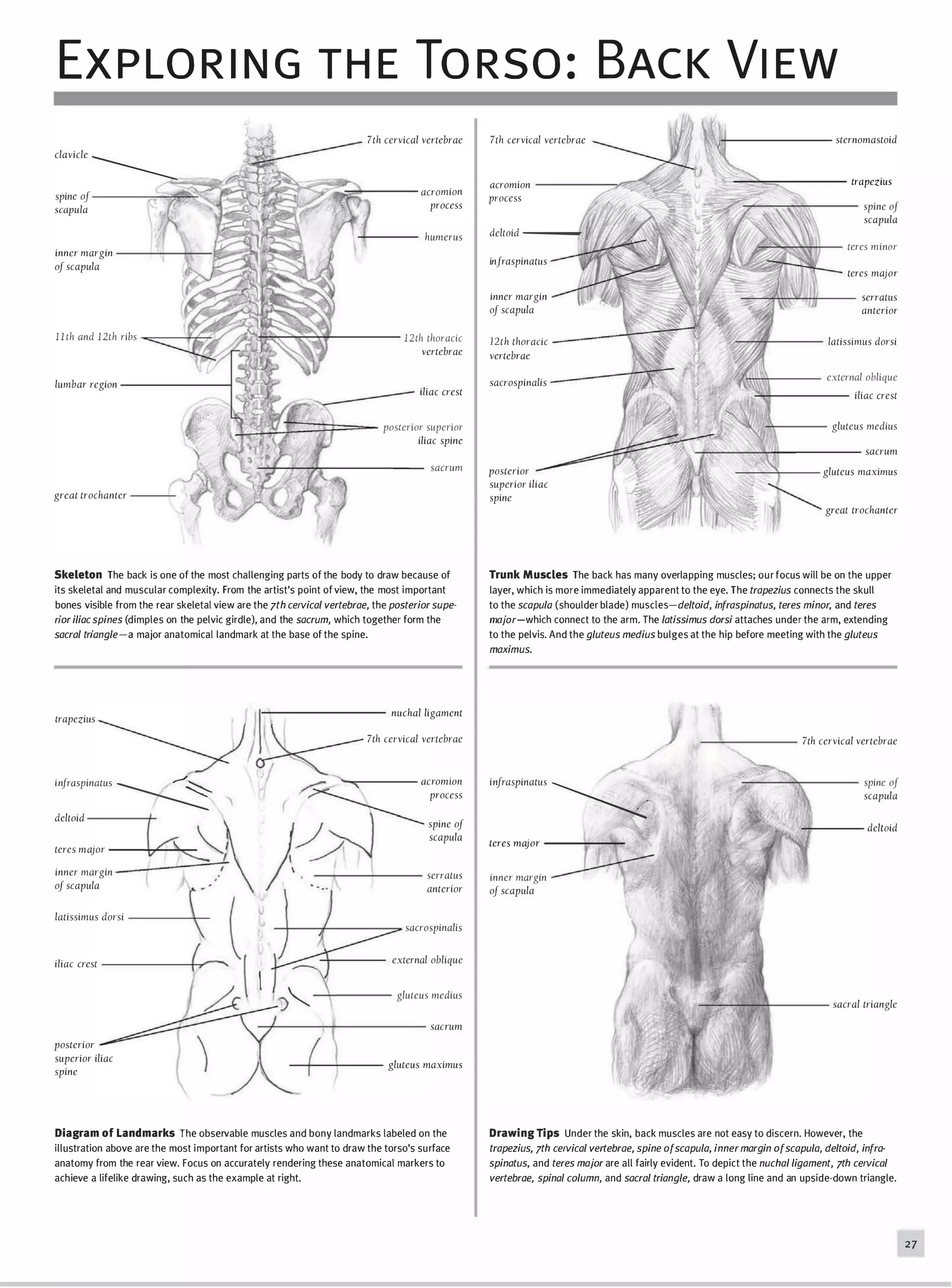
EXPLORI NG TH E TORSO: BACK VI EW
7th cervical vertebrae
clavicle _____________
spine oj ------.,,�--7=:;.��,��E������;�;�;---- acromion
scapula
;:
process
-:!:----- humerus
inner margin ---��-i�-tt���'���;,
oj scapula
1 1 th and 12th ribs ---==---�-r--_'/ �I"d..,:;;,",,�,r-�T------ 12th thoracic
vertebrae
lumbar region ----------i
iliac crest
l�i:1�t==�F==-- posterior superior
iliac spine
-'-j----;T.--------- sacrum
great trochanter ---'-
Skeleton The back is one of the most challenging parts of the body to draw because of
its skeletal and muscular complexity. From the artist's point ofview, the most important
bones visible from the rear skeletal view are the 7th celVical vertebrae, the posteriorsupe·
riariliacspines (dimples on the pelvic girdle), and the sacrum, which together form the
sacral triangle-a major anatomical landmark at the base of the spine.
trapezius
inJraspinatus �
deltoid
teres major 16 �I� <::::..... I
inner margin __-----=-7,
oj scapula
latissimus dorsi -----+-
iliac crest --------+."
posterior
superior iliac
spine
---------- nuchal ligament
7th cervical vertebrae
'...
..,._---- acromion
process
spine oj
scapula
--------- serratus
- -- anterior
-t-----,f-------::,.- sacrospinalis
,--,_�_ 4----- external oblique
 ')....._..l....____ gluteus medius
---,f-----+-------- sacrum
--+(-�)�---gluteus maximus
Diagram of Landmarks The observable muscles and bony landmarks labeled on the
illustration above are the most important for artists who want to draw the torso's surface
anatomy from the rear view. Focus on accurately rendering these anatomical markers to
achieve a lifelike drawing, such as the example at right.
7th cervical vertebrae
acromion ------"7��'�p."""�
process
deltoid ----...;;
inJraspinatus
inner margin
oj scapula
"'�r,l--------- sternomastoid
-..,...:"'==------ trapezius
"'7"---:-.....-:-:-',.,---- spine oj
scapula
(;:o.'-:':=�=+-- teres minor
teres major
serratus
anterior
12th thoracic _-----�-::��r-1t!:·t.,�=.....,q..---- latissimus dorsi
vertebrae
sacrospinalis
posterior
superior iliac
spine
:"'Il;l�I----- external oblique
.I":�l------- iliac crest
,.---- gluteus medius
----:-.,---:-i,...------- sacrum
� gluteus maximus
�great trochanter
Trunk Muscles The back has many overlapping muscles; our focus will be on the upper
layer, which is more immediately apparent to the eye. The trapezius connects the skull
to the scapula (shoulder blade) muscles-deltoid, infraspinatus, teres minar, and teres
major-which connect to the arm. The latissimus dorsi attaches under the arm, extending
to the pelvis. And the gluteus medius bulges at the hip before meeting with the gluteus
maximus.
�--..:....,------ 7th cervical vertebrae
inJraspinatus � =-:;;----"'r---- spine oj
scapula
�<!.d'::::'----- delLoid
teres major ---..:.:.---
inner margin �oj scapula
�_"-:-'�'::":'-:-:-�T----- sacral triangle
Drawing Tips Under the skin, back muscles are not easy to discern. However, the
trapezius, 7th celVical vertebrae, spine ofscapula, innermargin ofscapula, deltoid, infra­
spinatus, and teres major are all fairly evident. To depict the nuchal ligament, 7th celVical
vertebrae, spinal column, and sacral triangle, draw a long line and an upside-down triangle.
27
28
EXPLORI NG TH E TORSO: SI DE VI EW
cervical curve
acromion process clavicle
inner margin humerus
ofscapula
sternal angle
thoracic curve
10th rib
lumbar curve
iliac crest
sacrum
sacral curve
coccyx
great trochanter pubic bone
Skeleton The visual landmarks ofthe skeleton in profile are the 7th cervical vertebrae,
acromion process, innermargin afscapula, and backbone. The backbone's four curves­
cervical (forward), thoracic (backward), lumbar (forward), and sacral (backward)-arrange
the head, chest, and pelvic girdle over the legs for balance.
deltoid --------t-L-�
angle ofscapula ----.,
latissimus dorsi -------'t----"�
---,,.------- deltoidfurrow
---.::0..:------ pectoralis major
--:--�---j'----- mammaryfat

---------- serratus anterior
�)-------10th rib"
iliac crest ----------+---'--, ---+---- external oblique
'-,..<...--/'------ iliacfurrow
gluteus medius -------:-(-------l
gluteus maximus----,
great trochanter--------r---f+- abdominalfat
Diagram of Landmarks It is lack offat in addition to degree of muscularity that deter­
mines surface definition. To render the female form, it's important to become familiar with
fat deposit areas, including the flank (iliac crest); buttocks (gluteus); and stomach (abdo­
min), especially below the navel. Mammary fat accounts for the smoothness of the breast.
trapeziu.
7::---------- sternomastoid
acromion process clavicle
infraspinatus
deltoid
teres major
pectoralis major
serratus anterior
latissimus dorsi
rectus abdominus
sacrospinalis
external oblique
iliac crest
gluteus medius
anterior superior
iliac spine
gluteus maximus
tensorfasciae latae
great trochanter
Trunk Muscles The upper torso muscles-as well as the scapula, which is anchored by
muscle to the spine, ribs, and arms-follow and influence all arm movement. Mid·torso
muscles, such as external oblique, rectus abdominus, and latissimus dorsi, bend, twist, and
stabilize the rib cage and pelvis. Muscles below the pelvicgirdle activate the legs.
Drawing Tips Female figures display a more fluid contour than do male figures, largely
because ofthe female's extra fatty layer, which serves a reproductive purpose but also
obscures muscular form. Muscular structure is basically the same for both sexes, but the
width and angle of the pelvis makes the skeleton more recognizably male or female.
EXPLORI NG TH E TORSO:
FRONT VIEW
Head

Proportion The pelvic girdle
is about 1 head high, and the
torso-from trochanters to 7th
cervical vertebroe-is about 3
heads high.
BACK VIEW
3
2
1
3
2
1
Trapezoids represent the overall
bone structure of the torso from
both front and rear views. Here
you can see the same three·part
division.
SIDE VIEW

,

I
')/oj;
3
2
1
The simplified torso from the side
view has a bean-shaped appear­
ance, but the same proportional
divisions of the torso apply.
Simplified Figurette
Sketching with simple lines and
basic shapes is a good way to
establish the base ofa figure
drawing.
This simplified sketch from the
back view includes an important
feature: a line from the 7th
cervical vertebrae to the sacral
triangle.
I
The simplified figurette in profile
makes use ofthe bean and oval
shapes that appear in the pro­
portional drawing at left.
Tips The nipples, 1 head-width
apart, are vertically aligned with
pelvic landmarks and diagonally
aligned with the acromian pro­
cesses.
On an erect figure, the bones
of both the lower ribs and the
upper spine are apparent, where­
as the lumbar region looks like
a furrow.
cervical
curve
thoracic
curve
lumbar �)curve �
sacral
curve
__�s.1.-=-_
Each spinal segment curves
more as the column descends
toward the sacrum. The thoracic
region has the longest curve.
TI PS
B
Detail Note the relationship between the skeletal and muscular struc­
tures (A). The linea alba (interrupting tendons) ofthe rectus abdominis
create a "six pack" appearance as they arch progressively higher
toward the sternum (B). Two ofthe interrupting tendons line up with
the 10th rib and the navel (e).
B
D
The shape of the trapezius is similar to that of a kite (A) or a four­
pointed star (e). The simplified shape of the latissimus dorsi suggests
the appearance of an upside-down triangle (B), with a diamond-shaped
sheath removed from its upside-down apex (D).
c
The serratus anterior muscle starts alongside the first eight ribs, then
ends at the inner margin of the scapula (A). Its main mass appears as
a bulge underneath the latissimus dorsi (B). At the muscle's origin (on
the ribs), it looks a little like the fingers of a hand (e).
29
30
DEPICTI NG TH E ARM: FRONT VI EW
--
-:;:;-��i::.::::::;',L A. clavicle
C;::;;�'1--:'-----:---- B. acromion process
JP''----------- L. phalanges
Figure 1 Figure 2
Bones The underlying skeletal structure determines much of the overall shape ofthe
arm (figure 1). Several elements of this substructure, such as the innerepicandyle (E), act
as visual landmarks that are identifiable even under layers of muscle (figure 2) and skin
(figure 3).
Muscles The upper and lowerportions of the arm each consist ofthree major muscle
masses. The bicep and brachialis of the upper arm bend the lower arm, the tricep (see page
31) straightens it, and the deltaid raises the entire arm. In the lower arm, the flexars (flexor
carpi radiales, palmerus longus, and flexorcarpi ulnaris) bend the palm and clench the fin·
deltoid
Figure 3
deltoid _____---1'-
gers; the extensors on the back of the arm (see page 31) straighten the palm and open the bicep -----1=--"'-"--
fingers; and the supinators (brachioradialis, see page 31), attached to the outer epicandyle
(0, figure 1) on the outside arm, rotate the hand outward. A fourth, smaller muscle, the pra·
nator teres, rotates the palm inward.
brachialis
Drawing Tips The bicep does not extend across the full width of the upper arm. The del­
toid inserts in between the brachialis and the bicep.
DEPICTI NG TH E ARM: BACK VI EW
A. clavicle
�::�����:r"--B. acromion process
C. humerus
D. inner epicondyle
E. outer epicondyle
F. olecranon
G. radius
H. ulna
I. head oj radius
Figure 1 Figure 2
Bones Much of the overall shape of the arm in the back view is determined by the under­
lying skeletal structure, just as with the front view. The inner and outerepicondyle (0 and
(E), are again identifiable, even under layers of muscle. And from this view, the olecranon,
or elbow (F), also is evident.
Muscles Muscles work in opposing pairs: Flexors (see page 30, figures 2 and 3) pull
and extensors extend, moving in the opposite direction. When a flexor or extensor muscle
becomes active, its opposite becomes passive. From the back view, when the hand is
pronate (illustrated in figures 2 and 3 above), extensor groups are the most prominent
muscles. On the upper arm, the tricep is the most visible extensor. On the lower arm,
extensor carpi radialis langus, extensorcarpi ulnaris, and extensor digitorum, which all
originate on the outerepicondyle, are evident.
deltoid
triceps (long head)
triceps (outer head)
brachialis
brachiaradialis
D
extensor carpi radialis longus
anconeus
extensor carpi ulnaris
extensor digitorum
abductor pollids longus
extensor pollids brevis
I
Figure 3
long head
outer head
triceps tendon
Drawing Tips The tricep has three heads (the long and outer heads are shown here; the
medial head lies beneath). All share a common tendon: a flattened form on the back ofthe
upper arm.
31
32
DEPICTI NG TH E ARM: SI DE VI EW
CLENCHED FIST
A. acromion process
B. coracoid process
-:------t-- c. humerus
,,-_+-___ D. olecranon
.�r---i--- E. outer epicondyle
+--+--- F. radius
....,.---'t-'t--:!--- G. ulna
H. head oj ulna
LT-"""" -+-r-- l. head oj radius
Bones Here the arm is not viewed in full profile; rather it is seen from an angle that is
a combination of a side view and a back view. Because of the angle, the bony landmarks
most apparent under the muscle are the olecranon, outerepicondyle, and headofulna.
Muscles The side view provides a good angle for observing the extensors and flexors
of the upper and lower arm. The brachioradialis, located where the upper and lower
arms meet, is particularly important. It originates on the lateral side of the humerus (C),
above the outerepicondyle (E), and then attaches to the lateral side of the wrist above
the head ofradius (I).
tf
I
) deltoid
triceps (long head)
triceps (outer head)
biceps
brachialis
brachioradialis
extensor carpi radialis longus
anconeus
extensor digitorum
extensor carpi ulnaris
flexor digitorum
DRAWING Tips
Rotated arm
The brachiaradialis is responsible forturning
the palm up (supinate), and the pronator
teres (see page 30) for turning the palm
down (pronate). The radius (shaded) rotates
around the fixed ulna, permitting pronation
and supination ofthe palm.
Bent arm
The span between the inside bend of the
elbow and the wrist is usually about one
hand length. The arrows show the inward
and outward curvature ofthe muscles, and
the dashed line shows the line of the ulna,
called the "ulnar furrow."
PORTRAYI NG TH E HAN D
OPEN PALM
5
6
7
8
9
Bones The hand contains 8 wrist (carpal) bones: minor
multangular (1), major multangular (2), navicular (3),
lunate (4), triquetrum (5), pisiform (6), hamate (7), and
capitate (8). The hand also features 5 metacarpals (9) and
14 phalanges (10).
BACK
4
Bones From this view of the hand, all the same bones
are visible, but the carpal bones appear convex ratherthan
concave. From this angle, the bones have more influence
on the shape ofthe fleshed·out hand.
'h'-f-- C
D
�4-- E
Muscles The flexor tendons (A, B, C) from the forearm muscles (see page 30) extend into the hand. The teardrop-shaped
muscle masses, the thenareminence abductors ofthe thumb (I, J) and the hypothenareminence abductor (D) and flexor (E)
of the little finger, are known as the "palmer hand muscles." The adductorof the thumb (G) lies under the flexortendons
(F). The visible creases of the palm result from the way the skin folds over the fat and muscles of the hand.
C
Muscles Whereas the palm side of the hand is muscular and fatty, the back of the hand is bony and full of tendons. The
extensortendons ofthe thumb (A) are visible when contracted, as are the other four extensor tendons (C). The first dorsal
interosseous (B) is the largest of the four dorsal interosseous muscles, and it is the only one that shows its form through
the skin's surface; when the thumb is flexed, this muscle appears as a bulging teardrop shape.
33
34
SKETCH ING TH E LEG: FRONT VI EW
A
-+---''r'-='/--r-- A. great trochanter
I
B. femur
C. outer epicondyle
D. inner epicondyle
E. patella
F. tibial tuberosity
G. head of thefibula
H. fibula
1. tibia
]. inner malleolus
K. outer malleolus
Bones The femur (B), with its great trochanter at the top (A) and outerepicandyles (e)
and innerepicandyles (D) at the base, is the heaviest and longest bone of the skeletal sys­
tern. The knee cap (patella) sits in between the outer epicandyles and innerepicandyles on
the patellar surface. The lower leg consists ofthe thick tibia (I) and the slender fibula (H).
The tibial tuberosity (F) and head ofthe fibula (G) are important landmarks at the top, as
are the ankle bones (the innermalleolus and outer malleolus).
Muscles The upper leg has four major muscle masses: vastus externus, which attaches
to the knee cap (E); rectus femoris, which engulfs the patella (E) and continues toward the
tibial tuberosity (F); vastus internus, a medial bulge; and the adductorgroup on the inside
ofthe leg. There also are two other masses: the tensorfascia lata and the sartorius. The
sartorius is the longest muscle in the body. The lower leg has six long muscles visible:
gastrocnemius, protruding on both sides; tibialis anterior, running along the shin toward
the big toe; soleus; flexordigitorum longus; extensor digitorum longus; and peroneus
longus.
tensorfascia lata
adductor group
vasius exlernus
reclusfemoris
vastus internus
sartorius
D
gastrocnemius
tibialis anterior
soleLlS
flexor digitorum longus
extensor digitorum longus
peroneus longus
Drawing Tips The legs angle in toward the middle, positioning the body's weight over
the gravitational center. (See figures 1 and 2.) The muscle masses on the outside ofthe leg
are higher than those on the inside. (See figure 3.) The ankles are just the reverse-high
inside, low outside.
)
Figure 1 Figure 2 Figure 3
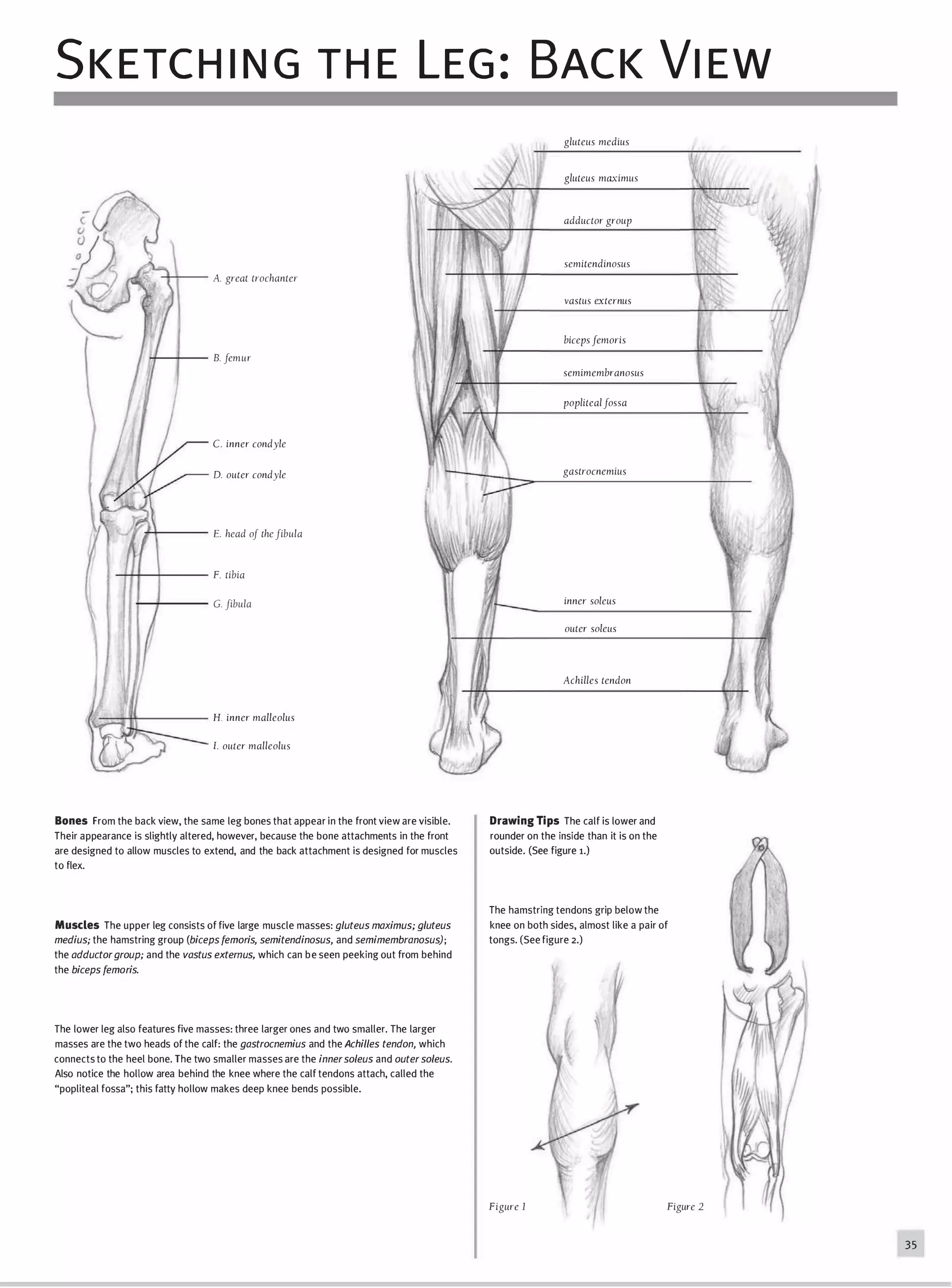
SKETCH ING TH E LEG: BACK VI EW
-+-.-- A. great trochanter
.+-+--- B. femur
C. inner condyle
..,,-- D. outer condyle
:H---- E. head of thefibula
-i+-i'--+---- F. tibia
4--1---- G. fibula
(�:;:::=tiMl----- H. inner malleolus
1. outer malleolus
Bones From the back view, the same leg bones that appear in the front view are visible.
Their appearance is slightly altered, however, because the bone attachments in the front
are designed to allow muscles to extend, and the back attachment is designed for muscles
to flex.
Muscles The upper leg consists of five large muscle masses: gluteus maximus; gluteus
medius; the hamstring group (biceps femoris, semitendinosus, and semimembranosus);
the adductorgroup; and the vastus externus, which can be seen peeking out from behind
the biceps femoris.
The lower leg also features five masses: three larger ones and two smaller. The larger
masses are the two heads of the calf: the gastrocnemius and the Achilles tendon, which
connects to the heel bone. The two smaller masses are the innersoleus and outersoleus.
Also notice the hollow area behind the knee where the calf tendons attach, called the
"popliteal fossa"; this fatty hollow makes deep knee bends possible.
gluteus medius
gluteus maximus
adductor group
semitendinosus
vastus externus
bicepsfemoris
semimembranosus
poplitealfossa
gastrocnemius
inner soleus
outer soleus
Achilles tendon
Drawing Tips The calf is lower and
rounder on the inside than it is on the
outside. (See figure 1.)
The hamstring tendons grip below the
knee on both sides, almost like a pair of
tongs. (See figure 2.)
Figure 1 Figure 2
35
SKETCH ING TH E LEG:
�-...,....- A. great trochanter
-i------ B. femur
C. patella
........-- D. outer condyle
E. tibial tuberosity
F head offibula
-';--f-fjl----- G. fibula
H+------ H. tibia
I. outer malleolus
Bones and Muscles Because the long femur (B), and large tibia (H) carry the weight of
the body, they sit directly on top of each other. But in a side-view drawing, the upper and
lower leg appear staggered; the front of the shin lines up directly below the iIlio-tibial band
muscles and behind the upper-leg masses of the rectus femoris and vastus externus.
In the lower leg, the forms to look for are the gastrocnemius; the long, straight form of the
Achilles tendon; the peroneus longus tendon, which passes behind the outermalleolus (I)
and the bulk of the extensordigitarum longus; and the tibialis anterior, toward the front of
the leg.
SI DE VI EW
tensorfasciae lata
reclusfemoris
vastus externus
illio-tibial band
bicepsfemoris
popliteal fossa
patellar ligament
gastrocnemius
tibialis anterior
soleus
extensor digitorum longus
peroneus longus
Achilles tendon
Figure 1 Figure 2 Drawing Tips The six arrows in figure
1 show the overall gesture of the leg. The
upper thigh and lower calf create the
gesture. (See figure 2.) Figure 3 shows
the pattern oftendons in the foot. (See
page 19.)
t Figure 3
r
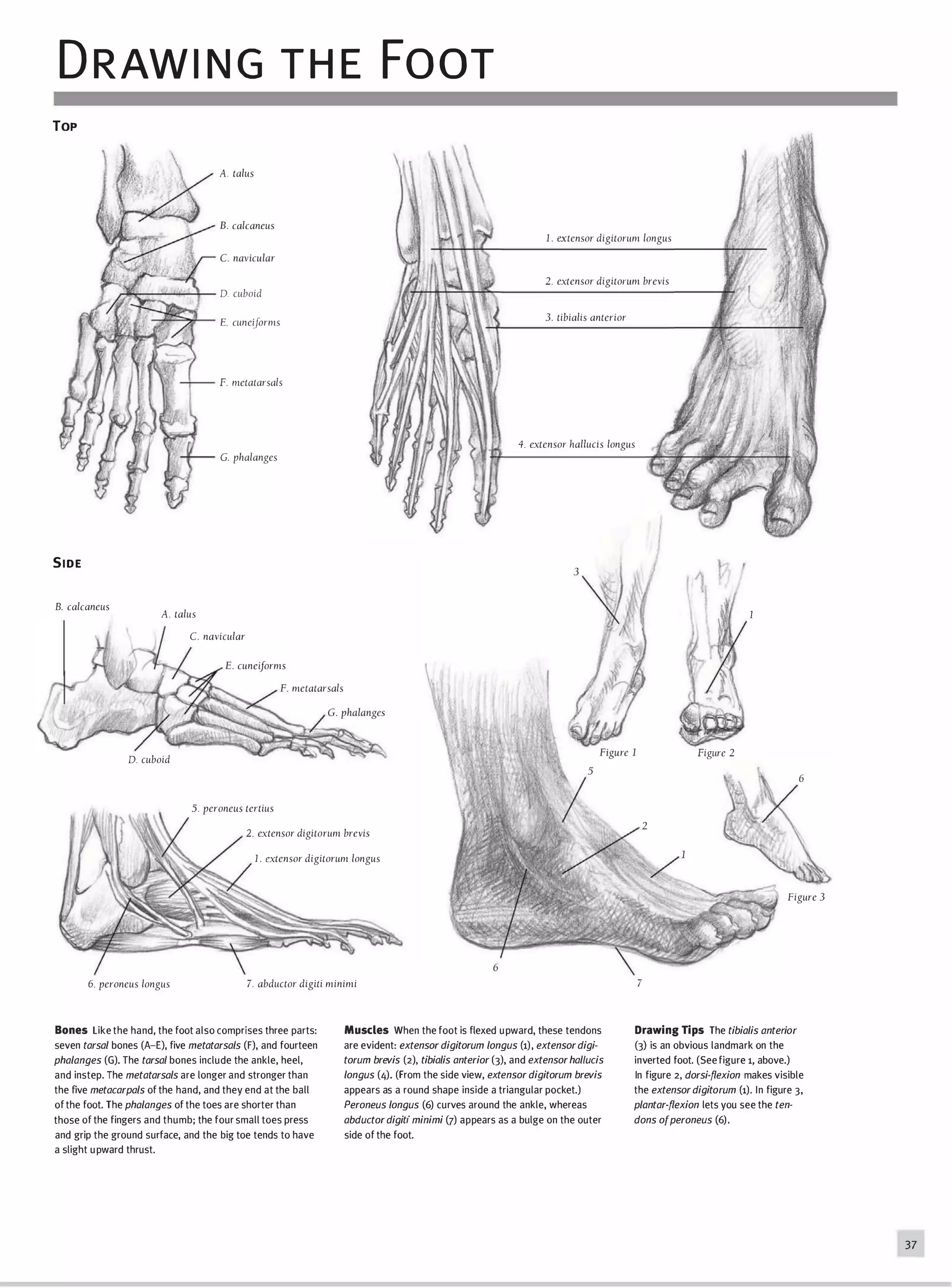
DRAWI NG TH E FOOT
Top
A. talus
calcaneus
1 . extensor digitorum longus
2. extensor digitorum brevis
d!�;::::-"'---t- D. cuboid
-:-:I�::::':�- E. cuneif0rms 3. tibialis anterior
..,-- F. metatarsals
4. extensor hal/uds longus
SIDE
B. calcaneus
�-- G. phalanges
A. talus
C. navicular
cuneiforms
D. cuboid
5. peroneus tertius
metatarsals
2. extensor digitorum brevis
1 . extensor digitorum longus
6. peroneus longus 7. abductor digiti minimi
Bones like the hand, the foot also comprises three parts:
seven tarsal bones (A-E), five metatarsals (F), and fourteen
phalanges (G). The tarsal bones include the ankle, heel,
and instep. The metatarsals are longer and stronger than
the five metacarpals of the hand, and they end at the ball
ofthe foot. The phalanges of the toes are shorter than
those of the fingers and thumb; the four small toes press
and grip the ground surface, and the big toe tends to have
a slight upward thrust.
Muscles When the foot is flexed upward, these tendons
are evident: extensor digitorum longus (1), extensordigi­
torum brevis (2), tibialis anterior (3), and extensorhal/ucis
longus (4). (From the side view, extensor digitorum brevis
appears as a round shape inside a triangular pocket.)
Peroneus longus (6) curves around the ankle, whereas
abductordigiti minimi (7) appears as a bulge on the outer
side of the foot.
1
Figure 2
Figure 3
7
Drawing Tips The tibialis anterior
(3) is an obvious landmark on the
inverted foot. (See figure 1, above.)
In figure 2, dorsi·flexion makes visible
the extensordigitorum (1). In figure 3,
plantar·flexion lets you see the ten·
dons ofperoneus (6).
37
STU DYI NG TH E H EAD & SKU LL
-
Becoming familiar with the head and skull is an excellent way to improve your portraiture skills. If you purchase a plastic skull, you can practice drawing the skull from all angles, as shown
in the charcoal pencil studies above. Start with an outline of the basic shape of the skull; then block in the shapes ofthe main features and refine the lines (shown in the upper·right corner).
The important skull bones for an artist to know are the parietal eminence (A), frontal bone (B), frontal eminence (e), glabella (D), superciliary crest or "brow ridge" (E), temporal line (F),
zygomaticprocess (G), orbit (H), zygomatic bone (I), maxilla 0), ramus ofmandible (K), mandible (l), and mental protuberance (M).
FRONT VIEW
A
A. frontalis
B. temporalis
C. obicularis oculi
D. nasalis
E. levator labii superioris
F. zygomaticus minor
G. zygomaticus major
H. masseter
l. risorius
]. depressor anguli oris
K. depressor labii inferioris
L. mentalis
M. obicularis oris
N. procerus
O. occipitalis
P. trapezius
Q. sternocleidomastoid
N
M
Most of the facial muscles originate from bone and insert into muscle fibers
of other facial muscles. They do not create surface form directly, as the skel­
etal muscles do, because they are much more delicate and usually concealed
by facial fat. The visible forms on the face are created by several factors­
skin, fatty tissue, underlying skull, cartilage, eyeballs, and some muscles.
SIDE VIEW
39
40
STU DYI NG TH E H EAD & SKU LL (CONT.)
FRONT VIEW
Visualizing Light and Shadow In this final stage, light and
shadow are translated from simple planes onto a more subtle, realistic
portrait. Self-portraiture is a great way to practice identifying the planes
ofthe head from many different angles. Using a mirror as reference,
focus on the placement of the light and dark values that create the form
of your face. Just remember to draw what you really see in the mirror,
not what you expect to see.
Simplifying the Features When facial muscles contract, they affect
the shape of the fatty forms, skin, and other facial muscles, causing
the wrinkles, furrows, ridges, and bulges that convey various facial
expressions. Simplifying these complex shapes into easily recognizable
geometric planes (the "planes of the head") can help guide an artist in
the proper placement of light and shadow. As an artist, there's no need
to actually sketch the planes, but it helps to understand the planes and
visualize them when approaching complex features and shading.
-
CAPTU RI NG FACIAL FEATU RES
A D E
B c
The Eye The eyeball is a moist sphere. Because its surface is glossy, the carnea (E) often features a highlight.
c
The Lips Because the lips curve around the cylinder of the teeth, it's helpful to draw and shade the mouth as if it were a sphere.
4--- A --*--'"r
bone
�t------ B
c ---
cartilageJ
"rI---- E
The Nose The nose is made up of bone, cartilage, and fatty tissue. Halfway down from the eyebrows, cartilage replaces the bone.
--- D
The Ear Think of the ear as an oval disc divided into three sections and placed on a diagonal angle.
Drawing Tips The sclera (A) is the white
of the eye. The iris (B) is a colored disc
that controls the amount of light entering
the round opening ofthe pupil (e). The
domelike, transparent cornea (E) sits over
the iris. The innercanthus (D) at the cor­
ner of the eye is an important feature of
the shape of the eye.
Drawing Tips The vertical furrow
between the nose and upper lip is the
philtrum (A). The tubercle (B) ofthe upper
lip is a small rounded form surrounded by
two elongated forms; it fits into the middle
ofthe two elongated forms ofthe lower
lip. The node (e) is an oval muscular form
on the outer edge of the mouth.
Drawing Tips The bridge ofthe nose is
formed by two nasal bones (A). The mid­
dle section ofthe nose is made of a rigid
septal cartilage (B), surrounded by two
lateral cartilages (e). The bulb of the nose
is formed by two greateralar cartilages
(D). Two wings (E) create the nostrils.
Drawing Tips The cartilaginous helix
(A) forms the outer rim of the ear. The
antihelix (e) lies just inside the helix,
running roughly parallel to it; the two are
divided by the scapha (B). The tragus (D)
is a cartilaginous projection, located over
the bowl (the cancha, G). The antitragus
(E) is located opposite the tragus and just
above the fatty lobe (Fl.
41
.' ,
•
"
•
"
I'
I
, ,
•
•
,
,
I
I
•
",
• • Of ·
� ' I
,.�(� �
I '.
� "
"
,
, ,
•
Po
.
'
,
•
t
"
,
•
," ""
"
I ,
..
. .
"
•
.'
I
,
w
,
:
'" - ..,
,� ,.
.
f'
.".. "' �T
;,,�,
.,:t�"
�. . . ..� .# • • �.' ,
I � y.
• . .... , 1' . " ' .
t I ' �..
, I
,� ';' . ( ,. '
':";r-
't· ,
� �.
, .
/' ,A" -'.:.v. '
..� ... . """,
, " • I •
, ..
�
J'"
•
".
,
,
� ..
. .
· 
. ,
�r·� ", .. �
•
•
i..
r
I

,�
,- ...
-:r,'-'I •
..
•
//
1
�IOr
oJ
j'
/•
--
'f:G
I
t

./
.� c-.
���. .. �..,
f ,
'
1,•
i
I
I
�
I
A�''''''
I
CHAPTER 3
WITH WALTE R T. FOSTE R
Walter T. Foster was born in Woodland Park, Colorado, in 189 l . In
his younger years, he worked as a sign painter and a hog medicine
salesman. He also performed in a singing and drawing vaudeville
act. Mr. Foster invented the first postage-stamp vending machine
and drew political caricatures for several large newspapers. In the
1920s, while running his own advertising agency and instructing
young artists, Mr. Foster began writing self-help art instruction
books. The books were first produced in his home in Laguna Beach,
California, where he wrote, illustrated, and printed them himself.
In the 1960s, as the product line grew, he moved the operation to
a commercial facility, which allowed him to expand the company
and achieve worldwide distribution. Mr. Foster passed away in
198 1 , but he is fondly remembered for his warmth, dedication, and
unique instruction books.
43
44
PEOPLE
M
any people believe that drawing
the human face is difficult, but it's
really only a matter of proportion and
properly placing the features. The lines
and forms involved are just simple curves
and basic shapes. The easiest way to learn
to draw people is to start with individual
features such as the eyes and mouth. It's
best to draw from a photo or a live model.
A reference makes rendering the head
much easier!
EVE
A
�-�
.....'"
----�.......--.
In this view, the iris
is set somewhat oJJ
center, so place your
guidelinesjust to the
right oj center.
Highlight
Whether from a frontal view or in profile,
eyes and lips are drawn around horizontal
and vertical gUidelines. Both gUidelines
are perpendicular in the frontal view, and
the vertical line is slanted slightly in the
profile view. Then you can build on these
guidelines with circles and simple curved
lines. Study the outlines on this page, and
practice drawing them several times.
The dotted line indicates
the shape oj the eyeball
beneath the eyelid. The
curve oj the eyelidJollows
the curve oj the eyeball.
A
B
c
D
EVE I N PROFI LE
Notice that a good portion
oj the eyeball is covered by
the eyelid, no matter what
the viewpoint.

MOUTH IN PROFILE
A
Most oj the upper lip Jails to
the leJt oj the vertical gUide­
line, whereas most oj the
lower lip Jails to the right. D
MOUTH
A
B
c
These human profiles are built on two
slanted gUidelines: one for the line of the
plane of the face, and one for the line of
the nose. There is a variety of sizes and
shapes of noses, eyes, and mouths; study
your subject closely and make several
practice sketches of his or her features.
Then combine the features into a simple
profile.
A
, I
. .
B


,

I 
I
,

,
I
I
I
I
I (
I(
c I
vD
To draw the nose, block in a triangle, and
draw the basic outline of the nose within
the triangle, as in steps A and B. Refine
the outline, and add a small curve to
suggest the nostril in step C.
For the full profile, start with a slanted
guideline from the eyebrow to the chin.
Then add horizontal gUidelines to place
the features. In adults, the bottom of the
nose is approximately halfway between
the eyebrow and the bottom of the chin.
The bottom lip is about halfway between
the nose and the chin. Note that these are
just general rules of human proportion.
The precise placement of features will
vary slightly from individual to individual
and between men and women.
�--��--��----- --
Then add the centerline for the eye at the
top of the bridge of the nose. Next place
the eye, eyebrow, and upper lip. Once
you are satisfied with your sketches, try
a complete profile.
45
WOM EN : PROFI LE
T
hese heads were drawn from photos
(photos serve as good models because
they hold still). Try profile views like the
ones you see here, keeping them fairly
Simple. Don't worry about rendering the
hair for now; spend time learning how to
draw the face, and work on the hair later.
Step A illustrates the proportions of the
face. In this close-up profile, the bottom
of the nose is about halfway between the
eyebrows and chin. The mouth is about
halfway between the bottom of the nose
and the chin. Once the proportions are
established, sketch the actual features.
Study each one closely to achieve an
accurate resemblance. This drawing was
done on plate-finish Bristol board, which
usually is used for pen and ink drawings.
Tortilion
A tortilion is helpful for blending
the contours of theface.
112
112
Eyebrow
/
-------r- Nose
114
___-,=--_1Mouth
I114
�Chin
I
When drawing portraits,
make sure you're comfortably seated
and that the drawing board is at
a good angle. Rotate the drawing
often to prevent your hands
from smudging areas you've
already drawn.
D
--
B
-
 c
----
.1
Allfigure and portrait renderings have been drawn directly
from the artist's imagination orfrom paid professional
models. Any likeness to persons other than those hiredfor
this purpose is purely coincidental.
Draw the guidelines in step A to lay out the correct
proportions. Lay down each line in the numbered
order shown. In step B, sketch the nose, eyebrow,
chin, and eyes on the guidelines; then refine them
into more recognizable parts of the face. All of
these elements must be resolved before shading.
Draw this �
linefirst.
/'•
./ -<
/K
l
/
/
3
5 , :
(
I:
Focus on the dark and light values of the lips in
step C, as well as the direction of the strokes.
The value contrasts make the lips appear soft and
round, especially because the shading is lighter
toward the middle of the lip. Note in the final
rendering that the hair is merely implied as a
surrounding element.
.I
,I
t
..
.I '
.
Keep the shading lighter
toward the middle of the
lips to create highlights
and make them appearfull.
B
,
,
.
/ /
"',....' I
/  .''-- ."
..
..
""
( ,
,
,
t
..
" ..,.-
'..
. 
••"
,
•
I
, .,, 
j'
,;


'.
.
.
'.
'.
"
.
.r
,
.
�


�
,
,
•
>
. �.��: /
.. ...·..:.:"'.. . 1 1 � •
."'..... .......... . ..�..., . �
.,
......,-...-....
•...h
.... ....-...... -. -
" , ..
...
.
. �'.
-..
('"
( .... .
I
"
,
I
1./
,
•
,. �f"¥
)I
•
,
t.
�
,
•
t.
,
,
,
I
The type of paper you use will affect your drawings.
This portrait was done on vellum-finish paper, which
has a slight tooth that works well with pencil or crayon.
•
47
WOM EN : TH REE-QUARTER VI EW
D
rawing a three-quarter view is slightly more difficult than the
frontal view-but you can do it! Study your subject carefully,
and follow the steps. Block in the basic shapes, and use guidelines
to place the features. Note that because the face is angled, the
features are all set off center, with the nose at the three-quarter
point. Curve the line for the bridge of the nose all the way out to
the edge of the face, so it partially blocks her left eye.
A
B
�
•
"
1
�.
,.
•
r•
,
r
I
l
:
-.
,.
�r
."
/
- ." -
-..---- ------:;::::::�
./'�
-
'
..'
...... /
{ �
-"' I
 t
. ,
J
�
,.'-
.......-- -... --- .... � -,. .. .!..
/
,
'.
..
.1
......
.-
.'
.. - - .---"
"' _.
I
- " ... - ......
- -
i
(
I
When you block in the hair, think
ojit as one mass that has a curved
outline. You can suggest some oj
the individual hairs later.
•
•
•
I
...-
..
.-
f
I
(.-
• •
e
('
•
•
I•
•
"
,
�
•
•
,
�
/"
/
,
,.
,
II
;
,
;
J
II
(
)
"
-.r" .".
-
•
. .
,,>
- . ,
. . ,
. ... - .
.. '
"
....
..--- ". - - .
'. ' . or
..,
.. ...
... .
.'
'.
J
. .,.,
"J .l , �
. "
j , • •J .... . ,.
•
1
I
&1
f
,I. "
,
./ /
��.:---...r;: /..
- ... --,. ) I. ,
" . .0
�
/
��,
I
Check the proportions and the placement of the features. When
you're happy with your sketch, refine the features, and add some
light shading to finish off your drawing. Shade as much or as
little as you like; sometimes simpler is better.
. .
.-...�
....·'-�r'
L-.r-...�ri'
.
../# .,
-
....... .. ,t
",:",...
.'
�
/
/
Browse through books and magazines for subjects to draw, or
even look in the mirror and draw yourself. The more you practice
and the more diverse your subjects, the better your drawings will
become. Young or old, male or female, all portraits start with the
same basic steps.
A
./
.I
[
�
..
(
�
1
f•
f•
- -
--'
---.....-- �
---
---
�-!
7
;
I
•
. -
,
,J
---
B
,
•
,
•
",
.,
•
J
•
,
1
-
•
!
•
J
I
Use the ClIrved, vertical
guidelines to help maintain
the roundness oj the lips
and chin.
,
r
I/
I
/,
,.
I
"
�
I
.'
--
{•
I
H

•
�
-
/
�
,
.J
I
49
50
WOM EN : FRONTAL VI EW
F
or these frontal-view drawings, you
will need to pay special attention to
the position of the features. In a profile,
for example, you don't have to worry
about aligning the eyes with each other.
Study your subject closely, because a
small detail such as the distance between
the eyes may determine whether or not
your drawing achieves a strong likeness
to your model.
• •
,' /
:; �
I � (,. ."
J . , ..
. . .
I' 't .
r. .� , .. .!. � : .. ."
..
�
"
Afew loose, curving strokes
with a chisel-tipped pencil can
create the appearance ofafull
head of hair.
.."
, .
•
r -.��-
.
,,
l"
.' ... -.�..�
.; .,.�J.�" - /,......-..---
f, •. ,... ......
� �"J ., .. ... , _ I
. ,.....-"
• .."t• ......- • • ..-;
( I •.r '-" _
, • I --"
, .. ,
• "t ' .,.'
� J. f · .:J ,,�
v. " . � • ,.• " ...�.
.., . ," .� I �: .,..".,4; rI"
. -r� " . , ( . .
...., �., '" t�1/: .. .."" 't
! � . I
I � . �
" ': 'I."" '"
"
"" 
."
"
A
I
,
.
•
::>
� � . "-
. " 'i
I
l
-
�•
�
•
•
�
/1
)
,
-"
�..,.. "'"
I
/
/
-
-
I
/
---
..
....,.
,�,
. �
I
J
,
Notice that the nose is barely
suggested; the viewer's eyefills
in theform.
Step A shows minimal proportion guide­
lines. You will be able to start with fewer
lines as you become more comfortable
with your drawing and observation skills.
Even the two lines shown are helpful for
determining placement of the features.
B
)
......--
� .
�
i
-<C"-:---- �1-
•
..
In step B, make the facial features more
recognizable, and begin to suggest the
hair. Notice that features rarely are sym­
metrical; for instance, one eye usually is
slightly larger than the other. To finish
the drawing, create depth by shading the
eyes, nose, and lips. If you wish, practice
developing form by shading along the
planes of the face and around the eyes.
The features of this subject's face differ
from those in the previous drawing. Here
the nose is much thinner, and the eyes
are closer together. You will need to make
these adjustments during the block-in
stage.
In step A, use an HB pencil to block in the
proportions. Use the gUidelines to place
and develop the features in step B. Notice
the types of strokes used for the hair; they
are loose and free. Quick renderings like
this one are good for practice; do many
of them!
A
Remember that your prelimi­
nary drawing must be corree[
before continuing. No amount
of shading will repair the
drawing if the proportions
are not accurate.
I
/
B
This rendering shows thefinest details in the eyes.
Therefore, the eyes appear to be thefocus of the
drawing, with the hair acting as aframing element.
� (;,
-
1
J
r::-...-//
,Y....-
� --
51
52
MEN: TH REE-QUARTER VI EW
T
he three-quarter view is more chal­
lenging than the profile and frontal
views, but if you begin with the usual
proportion guidelines, you shouldn't have
any trouble. Simply take your time, and
observe closely.
Clothing can be used to
identify a character; here
the headdress emphasizes
the model's Middle-eastern
heritage.
A
-.
-
•
,
• I
1
I
, i
I
'  I
" !•
•
I
,
I
• •
, • I
t I l
,
� I
I I
.fi Ii{
Ittt"•
B
"
Follow the steps as shown, using charcoal
for the block-in stage. When you begin
shading, use dark, bold strokes for the
eyebrows, mustache, and beard. Notice
this subject's facial expression; his dark
eyes are intense. Fill in the irises with the
darkest values, but be sure to leave tiny
white highlights.
(
"
•
, .
" .
. ,
,
-
,
,

,
i
./
The dark vertical strokes
of the background are used
to define the outline of the
subject's face
Use photos from
books or magazines
to draw people ofall types
and ethnicities in
various styles of dress.
This drawing was done after an old mas­
ter's painting. Copying a master's work is
excellent practice; it helps to improve
your artistic skills and understanding.
When copying a great work, think .,
•
about the reasons the original
artist may have done certain
things, and then use your
insights to better your
own works.
A
----------------
1-------------
Use overlapping
brush strokes to
create the beard.
Follow the steps as illustrated, blocking in /
each of the features with quick, confident
strokes. Look for the basic shapes in your
subject; then refine them as necessary to
achieve a likeness.
B
�...,
"�..'. '-"
' -.
. ,: ....
..' ,
• • •
.,.:-.
-.. " - � ...
Notice this character's
piercing expression, which
is enhanced by the thick,
dark eyebrows.
. - ,
...
.
�
r.. °0 ' . f .l1o
. . .... ,. ... . . ...
Most of the shading and details for this
drawing were done with a brush and India
ink, although charcoal was used for the
guidelines and initial sketching. Brush and
ink is a good choice for creating the thick,
dark facial hair.
•
. . .
•
...
•
' .
..•
......
...
The tip of the bmsh is
used to createfine lines.
�: .f" •
- '.•
Keep practicing
ifyou want to become a
modern-day master!
53
54
ELDERLY WOMEN
T
hese more advanced renderings bring
out the character of the subjects. The
elderly woman on this page, for example,
appears stern and serious, whereas the
woman on the opposite page evokes a
certain kindness and gentle spirit.
Using the usual proportion guidelines,
block in the face. Remember to include
the hat as part of the initial sketch, as
shown in step A. Add shapes to indicate
the wrinkles and loose skin in step B.
As people age, certain features will begin
to sag and perhaps become less symmetri­
cal. Notice that the shading strokes are
rather harsh and bold. This technique
creates the appearance of rough, weath­
ered skin.
Be sure to include the pronounced creases
around the mouth and under the eyes; these
details give your SLlbject character
_
. -:��:.:.�����::='�:
A
/ ..
/
. -
,
.....
..
/
The shapes of the woman·s
eyes differ slightly
•.
-.
. .,.
•
The small, sparkling eyes and fragile hand
of this woman create an entirely different
mood from the previous subject. Here the
facial expression is more delicate, giving a
feeling of compassion and sympathy.
A
In step A, lay down the guidelines for the
features, and lightly block in the ears,
nose, and mouth. In steps B, C, and D ,
continue to develop the features, adding
craggy lines for the wrinkles. In the final
drawing, shade the face to create the aged
appearance.
c
Hands can be difficult to draw. Study your
own hands, and practice drawing them
on scrap paper. Check the proportions
to make sure your drawings are accurate.
For example, the length of the hand is
approximately equal to the length of the
face. What other hand-proportion rules do
you see?
Occasionally step back
from your drawing
to get a new perspective.
Ask yourselfifyou've created
the right mood and personality.
If not, make adjustments!
Keep the head wrap
simple; it provides a
contrastingframefor
theface.
Dark hatching strohes
enhance thefragile, bony
appearance of the hand.
o
55
ELDERLY MEN
E
lderly men are good subjects for practicing a variety of
techniques, such as drawing wrinkles, thinning white hair,
and aging features. Pay close attention to the details to create
an accurate rendering.
-
-
Minimal shading on the head
suggests thinning white hair.
.� /
;/.:'"
Notice the loose skin on
the neck; the neck blends
into the chin.
Indicate the shirt and tie tofinish the
drawing; the head shouldn't appear as
though it's }loating on the paper.
A
B
Coarse shading over
the entireface creates
the rough skin texture.
---
I
This model exhibits a somewhat wor­
ried expression; notice how the eyebrow
angles down slightly in step A. Use bold
lines to develop the features and hairline
in step B. Begin shading with diagonal
strokes, changing direction slightly to
accommodate the uneven surface.
-
_ ......-._...
cOl
,
I
,
Two media were used for this drawing.
A chisel-tipped 6B pencil was used for
the shading on the face, and a brush and
black India ink were used for the darkest
details. Experiment with different drawing
media to create new effects.
- '- '--
..•--.---
� --4'- -
��

A
,

--
 I
. ..I
When observing your
subject, look for unique
characteristics such as
the pronounced brow and
the bump on the nose.
.' ..
�J B
;
{
I 
/, :
(I
.I(
,: / 
I I 
.'f
I

,
r
/".
�.
I , I
' '( 1  _ .
( ' - "",,: ) )� '_ .A- �
1/
c
... .
,
/
o
�,
/
As always, begin with quick
proportion guidelines. Then sketch
the basic shapes of the features,
including the bushy mustache. Keep
referring to your subject, checking
the proportions and shapes. When the
sketch is to your liking, create form
through shading.
'11-
r_
F.
Use a brush and ink to bring outfine
strands in the hair, eyebrow, and
mustache. Keep the shading to a
minimum to indicate the white hair.
Practice will allow
you to develop your
own artistic style.
Keep at it!
Shade the darkest areas
first. Be sure to leave light
areas for highlights.
<J
-:.
v 57
58
PEOPLE OF TH E WORLD
W
hen drawing subjects of ethnic background, it is important to study
their features and proportions closely. Although you may find some
characteristics typical of a certain ethnicity, there still are many variances
between individuals. Your observation skills will be tested with these drawings!
For this young boy, begin as usual with gUidelines and a block-in sketch. Look
for the features that make the subject unique-for example, large, round eyes,
a wide nose, and full lips. Notice that the eyes are especially dark in value,
providing a striking contrast to the white highlights.
A
B
--, ......


----------------���
II
-' '-'"
�----
/!
I
/I
- . ... ._ -
..,�.
.. c
The diverse population
provides endless opportuniLies
Jor drawing subjects;
continue to observe people
around you to challenge and
improve your skills.
The slightly darker
area here illustrates
the cast shadow created
by the bill oj the cap.
.J..-" .
('. 1
J !! .10' •
...
t•
To render the dark skin, use charcoal or
a soft-lead pencil to shade over the face
with even, parallel strokes. Leave areas of
white for highlights, especially on the tip
of the nose and the center of the lower lip.
. .
This Asian girl has her head tilted for­
ward, which requires you to adjust the
proportions. In this position, where the
chin is close to the chest, the length of
the face should be shortened, leaving
a larger area for the top of the head.
This adjustment is an example of fore­
shortening. For further information on
foreshortening, see Perspective (ALl3)
in Walter Foster's Artist's Library series.
A 0"
n
�. /
B
/
,
/
The length of theface must
_ . -:..;::.-�
, ---..,----...--- !--/
be shortened because her head
is tiltedforward. The best way
to masterforeshortening is
through plenty ofpractice!
Notice how the guidelines are altered in step A. Observe
your subject closely to determine the differences. In steps
B and C, develop the features, and suggest the hair and
costume. Try using a brush and India ink, as shown in
step D, to achieve the shiny black hair. Leave small white
areas for highlights, enhancing the sheen of the hair.
Draw curved lines
for the closed eyes,
adding short, thick
strokesfor the lashes.
/

I
Don't try to draw
from your imagination;
always use a live model
or photographfor
reference.
-
59
60
DEVELOPI N G YOUR OWN STYLE
T
hese two subjects have distinctive characteris­
tics that will lead to interesting artistic works.
As you follow the steps, notice the manner in which
the facial features are developed and how shading is
used to add depth and create interest.
.
•
,
•
I
"
•
1
.
•
•
. .
•

To develop your own artistic style, experiment with different
techniques, and use all kinds of media. Try minimal shading or
heavy shading; keep your lines loose or make them deliberate.
It's all up to you!
, _ .. _...
•
.!...
·
•
!
·
•
I
I
A
�
I
;-.
I
I
!
I
I
"
I -.
,
;

,
-........
/
-'"- .
. . .
�
A dark background can be
used to create the shape of
the profile
• •
�'f
,
c

I
,
I.
I
I
•
I
I
-1
•
•
·
I
II
--'
.:..�

......,- -. ..-- .... ...-"'t--....
,
, - ­
... -� - . --
- ... �-
•
,
B
/
",
I ,
i
I
I I� -
c /
•
"
j
I
t
..
f
·
•
•
i
A
· ".
..'
i•
r
' -
/
The unJinished areas oj this drawin d
. .
Jocusing the viewer on th (. d
g a d an arLlsl!c element,
e J me etads oj theJace.
'
.'
j
..
,
..
,
. '
,
-'� •
"/"", '
.,
:
/
,
i/-

•
,
,
• -
,
61
62
MALE FACES
Aphoto of a well-known artist served as the model for this
sketch. In steps A and B, place the facial features according
to the proportions. Develop some of the details in step C; then
add some outlines for the hair.
A
..... ..,. . - ..
- -.. - ;� .
..-
...
'.. "
" .
#3 round
watercolor brush
... .!
.... ..
-.;�
. ....
i) ._
.... ' .
; ..
WI
T.
r.
., ,
./
B
I
I
i
. .. ,� #
, . . • .
� 3.• ./
-........,r-
As you can see, the final drawing is fairly simple, yet it preserves
the likeness of the person. More detail easily could be added, but
you might lose the pleasing artistic quality the drawing has at
this stage.
c
/
"-
"
Use a dry brush and
a liule ink to create
"shading" lines Jor
theJinal.
. � . .
G_
- . .
�,
k� .
,
,
i
)!
Although this face appears to be a difficult drawing subject, if
you follow the step-by-step illustrations, you may be surprised
at how well you do. When you reach step B, lightly sketch the
wrinkles. Step C demonstrates how to use the paper stump to
blend and shade the crevices. This combination of both lines and
shading creates a terrific aged effect.
HB pencil
A
�o::::::-----..::-...�"
" .
�...J-=---�'--."""-'-'"'''' "'_. ..
.
.. ..._--
 -----------
......
...�
'"
#3 round watercolor brush
B
'-
You can emphasize the
wrinkles by drawing
heavy lines over the
blended shading.
c
Remember, one of the most common faults of
beginners is lack of patience. Don't expect your
works to be as good as those of an experienced artist
Charcoal
Paper
stump
who has spent years learning the craft. Take your time,
practice, and you'll improve. Good luck, and enjoy yourself!
.
" .. ..
."
/ . ,
"
CHAPTER 4
WITH WILLIAM F. POWE LL
William F. Powell is an internationally recognized artist and one of
America's foremost colorists. A native of Huntington, West Virginia,
Bill studied at the Art Student's Career School in New York; Harrow
Technical College in Harrow, England; and the Louvre Free School
of Art in Paris, France. He has been professionally involved in fine
art, commercial art, and technical illustrations for more than 45
years. His experience as an art instructor includes oil, watercolor,
acrylic, colored pencil, and pastel-with subjects ranging from
landscapes to portraits and wildlife. He also has authored a number
of art instruction books including several popular Walter Foster
titles. His work has included the creation of background sets for
films, model making, animated cartoons, and animated films for
computer mockup programs. He also produces instructional
painting, color mixing, and drawing videos.
65
66
ADU LT H EAD PROPORTIONS
L
earning proper head proportions will enable you to accu­
rately draw the head of a person. Study the measurements
on the illustration below left. Draw a basic oval head shape, and
divide it in half with a light, horizontal line. On an adult, the
eyes fall on this line, usually about one "eye-width" apart. Draw
another line dividing the head in half vertically to locate the
position of the nose.
I
I
I
I
I
I
I
I
I
-+----- -6- -E/.:--::-""""'--+­I
I
I
I
I
I
I
I
I
Facial mass
The diagram below illustrates how to determine correct place­
ment for the rest of the facial features. Study it closely before
beginning to draw, and make some practice sketches. The bottom
of the nose lies halfway between the brow line and the bottom of
the chin. The bottom lip rests halfway between the nose and the
chin. The length of the ears extends from brow line to the bottom
of the nose.
Cranial hair line
Brow
lines
Nose lines
Frontal view
-
--
J
- - t�- -
I I
I I
 I I
I I
I I , I
�-�: 1/2
__" -------,'-----1--
1/2
Head length
Profile view
The horizontal length of the head, including the nose, is uSLtally equal to the
vertical length. Divide the cranial mass into thirds to help place the ear.
Shlill inside
human head
This drawing above illustrates how the skull "fills up" the head.
Familiarizing yourself with bone structure is especially helpful at
the shading stage. You'll know why the face bulges and curves in
certain areas because you'll be aware of the bones that lie under­
neath the skin. For more information, see page 38.
The bottom Iip rests
halfway between the
nose and the chin.
Three-qLtarter view of shull
H EAD POSITIONS & ANGLES
T
he boxes shown here correlate with
the head positions directly below
them. Drawing boxes like these first will
help you correctly position the head. The
boxes also allow the major frontal and
profile planes, or level surfaces, of the
face to be discernible. Once you become
comfortable with this process, practice
drawing the heads shown on this page.
A
��
)
0 �
P
/
I/I'-�I
- -
, -
-
/,
B
/ A

lfJ�I
'-::-j)-
- -
-
, "­
,
"
,. ,'/:;- 1
r; _ . ' .I�.J
� /-
B
¢9 ¢9
 I
"In,--. /
:&-'
f({}0J
D�
Your shading strokes shouldfollow
the arrow directions to bring out the
contours of theface.
Keep all guidelines very light so they
won't show in your actual drawing.
< 8
.....
' j
•
/
68
FACIAL FEATU RES: EVES
T
he eyes are the most important fea­
ture for achieving a true likeness.
They also reveal the mood or emotion of
the person you are drawing. Study and
practice the diagrams showing how to
block in frontal and profile views of eyes.
Notice that with the profile, you don't
begin with the same shape as with the
frontal view.
Outside eye contours
(front)
Outside eye contours
(profile)
- --
---- /
B
A
---
B
,
B
c
B
--
�-�-
I
A
B
c
Pay particular attention to
the highlights in the eye.
They bring life and realism
to the drawing.
A three-quarter angle view can generate
a totally different mood, especially if the
eyes aren't completely open.
Even if the rest of the
features are correct, ifthe
eyes aren't drawn correctly
your drawing won't look
like your subject.
IiII
A
A person's eyes are rarely
symmetrical. Lookfor
the subtle differences in
each eye to achieve a real
likeness.
Shade delicately around the eyes, but
make your strokes dark enough to show
the eyes' depth and indentation into the
face. Very sharp pencils are best for filling
in the creases and corners around the eye.
These tiny areas (which don't get much
light) should be very dark, gradually get­
ting lighter as you shade away from the
eye to bring out the contours of the face.
Eyebrows also play an important part offacial expression.
They can be bushy or thin, arched or straight. Study your
subject's eyebrows carefully.
FACIAL FEATURES: NOSES & EARS
N
oses easily can be developed from simple straight lines. The first step is to sketch
the overall shape as illustrated by the sketches below. Then smooth out the cor­
ners into subtle curves in accordance with the shape of the nose. A three-quarter view
also can be drawn with this method. Once you have a good preliminary drawing, begin
shading to create form. The nostrils enhance the personality of the nose as well as the
person. Make sure the shading inside the nostrils isn't too dark or they might draw too
much attention. Men's nostrils generally are angular, whereas women's nostrils are more
gently curved. Observe your subject closely to ensure that each feature of your drawing
is accurate.
ProJile view
The tip oj the nose
usually slants
upward.
Bone
Frontal view
- - - - - - - - - -
Cartilage
The diagram to the right illustrates how
the nose changes as a person ages. In
many cases, the tip begins to sag and turn
downward. All of these details are impor­
tant for producing a realistic work.
Upward view Upraised three-quarter view
The lower portion oj the nose is
made oj cartilage, whereas the
upper portion is supported by
bone. Also, the tip ojthe nose
usually has a slight ball shape.
Process oj an aging nose
-
I
/
- -
/
I
I
/
/
/
I
-
Ears usually connect to the head at a slight
angle. To draw an ear, first sketch the
general shape, and divide it into thirds,
as shown above. Sketch the "ridges" of
the ear with light lines, studying where
they fall in relation to the division lines.
These ridges indicate where to bring out
the grooves in the ear; you should shade
heavier inside them.
J
70
FACIAL FEATU RES: LI PS
L
ips can be very easy to draw if you
study their forms closely. For exam­
ple, notice that the top lip often protrudes
slightly over the bottom one. You should
also familiarize yourself with the various
planes of the lips to shade them well.


,,.-.
Top lip slightly protrudes.
Shade in the
direction of the
planes of the lips.
-...
-...
A
-
To draw the lips, block in the overall
mouth shape with preliminary guidelines.
Once you have a satisfactory line drawing,
you can begin shading, paying particu-
lar attention to where the highlights are.
Highlights enhance the lips' fullness.
Divide the upper lip into three parts and
the lower lip into two parts, as shown
above. These light division lines will help
you draw the top and bottom lips in pro­
portion with each other.
Facial planes around the mouth
When drawing men's lips, keep the
shading light or they may appear as
though they're covered with lipstick.
Also, note that men's lips generally
do not appear as full as women's.
Determine how much detail
you'd like to add. For instance,
these examples don't show any
clearly defined teeth, but how
you handle this depends on per­
sonal preference.
FACIAL FEATURES: TH E SMI LE
F
acial expressions will add life to your
artistic work because your drawings
will seem more realistic. One of the most
basic ways to create expression is with a
smile. The illustrations on this page dem­
onstrate steps for drawing smiles.
When a person smiles, the rest of the
facial features are affected. For example,
the bottom eyelids move slightly upward,
making the eyes appear smaller.
1 """ -....
B / � ./ J/o
,-' r '-
1/
I
} I
0"-
j (1 'I'!
1 ' --;
-
I
B
�
1 ./
fI'
f
�-�I(r <J::-.
Smiling also causes creases around the
mouth and produces more highlights on
the cheek area because the cheeks are
fuller and rounder. The lips, on the other
hand, require fewer highlights because the
smile causes them to slightly flatten out.
./ -........
t ,
.J,.
--
/�J
/' --
"
�
B
� y
(/
Once you've mastered drawing separatefaCialfeatures,
combine them to build the entireface. Use the head propor­
tions you've already learned to correctly place thefeatures.
71
72
TH E PROFI LE
Aprofile drawing can be very dramatic.
This drawing was done on plate-finish
Bristol board. With an HB pencil, first sketch
the lines to establish the head angle. You
might want to use the technique of drawing
a box first to position the head, as demon­
strated earlier on page 67.
I
,.
I
/ / B
) /
A
When shading the profile or any view of the face,
it's important to recognize the different planes of
the face. These are illustrated in the drawing to
the right. When you reach the shading stage, use
a sharp 2B pencil to fill in darker areas such as
wrinkles or creases. Use a paper stump to soften
smoother features, such as cheeks.
You can produce a very
eJJective drawing with
simple, delicate shading.
c
I�
Planes oj theJace
Although the nose is a prominent part of
the profile, make certain it doesn't domi­
nate the entire drawing. Take as much
time drawing the other features as you
would the nose.
TH E TH REE-QUARTER VI EW
Although the three-quarter view may
seem difficult, it can be drawn by
following all of the techniques you've
already learned. With an HB pencil, use
the proper head proportions to lightly
sketch the guidelines indicating where
the main features will be located.
0
I
E
�
�

I
Begin blocking in the shape of the head;
then add the hairline, and sketch the ear.
Bring out the planes of the face (imagine
a box), and position the nose correctly.
Sketch the eyes and mouth on the guide­
lines you've drawn.
F
)/

/
__ d�
- �
-r
G
(
'I{
- �k
/I ......
/
Begin to smooth out your block-in lines,
shading lightly with an HB pencil to bring
out the face's three-dimensional form. Fill
in the creases and details with a sharp­
pointed pencil; then use a kneaded eraser
molded into an edge or point to pull out
the highlights in the hair.
Ask yourfriends to pose
for your drawings.
They might get a nice
portrait out ofit!
73
74
CH I LD H EAD PROPORTIONS
T
he proportions of a child's head differ from those of an adult.
Children generally have bigger foreheads; therefore the eye­
brows-not the eyes-fall on the center horizontal division line.
Also, the eyes of youngsters usually are larger and rounder than
the eyes of adults.
Brow line
Eye line
I f
'.
J
-
B
112
- -------...,,-.
--- --
-��--�- / 112
�
J
-<=- >-
The younger the child, the
smoother the skin andfacial
features. Keep your shading
even and relatively light.
1 2
I
�
I
I 5
-
- , -"'-
1")) I (l)'
(�)
-<Z"l
"--'-
I
The forehead can be divided into five equal sections with verti­
cal lines. You can position the other facial features in relation to
these lines as well.
Children arefascinating
drawing subjects;
they bring vitality and
life to your work.
To correctly place the features, use the horizontal lines shown
to the left to divide the region between the child's brow line
and the chin into four equal sections. Study where each fea­
ture falls in relation to these division lines.
Practice drawing boys and girls of vari­
ous ages in different head positions. Keep
the shading simple and smooth in these
drawings to capture each child's youthful
qualities.
A
/
)
A
('
<
" -
A
c
B
' /

/
A
Notice how minimal
shading in thefinal sketches
creates a pleasing,
artistic quality.
75
MATU RE FACES
P
ortraits of older individuals require
more detail because fine lines and
wrinkles must be included. Attempt this
drawing on vellum-finish Bristol board,
using an HB pencil to block in your
guidelines and facial features. Then
find your own drawing model.
A
Shade delicately
with a sharpened
2B pencil. A sharp,
dark lead is best
for drawing tiny
details, such as
creases in the lips,
fine hair strands,
and the corners
of the eyes. Your
shading should
help the features
"emerge" from
the face. Again,
notice the areas
where there is no
shading and how
these areas seem
to come toward
you. Practice this
drawing; then find
your own model or
a photograph.
D
p.
(
"-
J
I I
r
. )
c
Once you've drawn the basic head shape,
lightly indicate where the wrinkles will
be. Some of the minor lines can be "sug­
gested" through shading rather than
drawing each one. This process can be
used for drawing all older individuals.
Older people generally
reveal a lot oj character in theirJaces.
Be true to your subjects and try to
bring out their essence and personality
in your drawing.

f.':
(
I
-�
/
)
B
When drawing the face of an older man, you can be more
aggressive with the lines and shading, because men usually have
more rugged features and pronounced creases than women.
Develop the curves and planes of an older man's face with darker
shading than for the woman on the previous page. This enhances
the rough quality of his skin.
This man's face looks
even more rugged and
aged than the previous
drawing. His cheek
bones also are more
defined, and he has a
wider chin. It's helpful
to envision the skull
inside this fellow's
head to accurately
shade the outer
features.
Drawnfrom a photograph of Big Star.
© Americall Museum oJNatural History, New YOrll.
A paper stump is helpful for the smoother areas of this subject's
face, whereas a sharp 2B will aid in rendering the craggy texture
of his chin and the distinct wrinkles around his eyes.
77
ADU LT BODY PROPORTIONS
J
ust as there are proportion rules for
drawing the head, gUidelines exist for
drawing the human body. You can use
average or artistic measurements. The dia­
grams on this page effectively illustrate the
differences between these types of propor­
tions. Study them, and make many prac­
tice sketches. As you probably know, an
unrealistic figure drawing is easy to spot.
I
Head length as a
unit of measurement
Jor rest ojbody.
1
2
3
7-112 heads
4
5
6
7
1/2
/
I ,.
. .
1
2
3
4
I
5
6
7
1/2
, ,
./
. I
I

7-112 heads
Average proportions
Generally the male Jigure is widest at the shoulders,
whereas theJemale is widest at the hips.
r',
P1
�
2
-
� '----
3
� r
(4
S heads
)  /
5
6
 I
r
I7
J� � '
, r;::/ 
( " I
r;-
- -
..
'-
)
1
2
3
4
5
6
7
8 8
.I 
Artistic proportions
Realistically, most bodies are about 7-1/2
heads tall (average), but we usually draw
them 8 heads tall (artistic) because a fig-
ure drawn only 7-1/2 heads tall appears
short and squatty.
Try drawing some of your own figures.
The first renderings may not look quite
right, but keep practicing until you get the
hang of it. Remember that figure drawing
is much easier when you use a reference,
such as a live subject or good photograph.
Artistic proportions
have been used by artists
since the ancient
Greeh times.
CH I LD BODY PROPORTIONS
T
he illustrations at the bottom of the page explain how to use the size of the head as a measuring unit for drawing children of vari­
ous ages. If you're observing your own model, measure exactly how many heads make up the height of the subject's actual body.
Begin the drawing below by lightly sketching a stick figure in the general pose. Use simple shapes such as circles, ovals, and rectangles
to block in the body. Smooth out the shapes into the actual body parts, and add the outline of the clothing.
A
I
YourJigure should be balanced
on an imaginary ground plane
and a vertical centerline.
15 years
7-3/4 heads
---1
1 0 years
7 heads
-
B
I
I
I
I
-V-6I---
/
I
c
I
I
I ,
7 I 
J ./( : --- ,_ _ _ .- , : f- fL - ­
:::::: ----+-c.�_ /Ground plane contact line
3 years
5 heads
I
I
D I
I
Children are greatJun to draw, but because they generally don't remain stillJor long periods, start out using photographs as models.
1 year
4 heads
79
80
TH E BODY
T
he human body is challenging to render;
therefore, it's important to start with a
quick drawing of the basic skeletal structure.
The human skeleton can be compared to
the wood frame of a house; it supports and
affects the figure's entire form.
Frontal view
� l
(t- ">
 1 ./ I
', - -l-J';.

. J I ,, / I I
 � I
 /
 I I
 I I
�Torsoforms into triangle shape.
The frontal view illustrates the planes of
the body which are created from the skel­
eton's form. In men's bodies especially,
the torso forms a triangle shape between
the shoulder blades and the waist. In
women's torsos, the triangle shape gener­
ally is less pronounced, and their bodies
can even resemble an inverted triangle.
A
-
-
-
_._--.......
Basic skeletal structure
B
/
I
/
/ "
-, 
 
, 
I �
... -

)1 
 � , , I
 / J ' '/
. / / I 1',_ }, .... �
<I J,
': ,
- ..., ( ' - ..- - - ....
.,..
I
' 1 - ,
- ,
I I
,
"'
,
. I
/ ..... /
I


,
Skeletal structure inside body
Michelangelo dissected
human cadavers to
learn about sheletal and
muscle structure!
The muscles also affect the body's form.
To gain further insight into shading the
contours of the body, study the human
muscular structure in chapter 2.
HAN DS & FEET
H
ands and feet are very expressive parts of the body and also
are an artistic challenge. To familiarize yourself with hand
proportions, begin by drawing three curved lines equidistant
from each other. The tips of the fingers fall at the first line, the
second knuckle at the middle line, and the first knuckle at the
last one. The third knuckle falls halfway between the finger tips
and the second knuckle. The palm, coincidentally, is approxi­
mately the same length as the middle finger.
/ -1- -
Third knuckle
/
I
1'-
r
-
�Q. / -
,
,
5
d
First
eeon
Finger
h hi
knuchle
nue etips
Your own hands and
Jeet can make great
drawing models.

/
"

"" .,, "-
.,-
 .,­
 .,-
/
X

Follow the steps shown to draw the feet. Block in the shape in
two parts: the main part of the foot and the toes. Once you've
drawn a good outline, add minimal shading so you don't call
too much attention to the feet.
I
I

- - -
A
I
/
A
,/
B
Every time aJinger bends at the
knuckle, a new plane is created.
Picture the three-dimensional
shape oj the hand in various
positions This will help you
correctly draw the hand.
--
I
B
c
(
D
81
82
CLOTH I N G FOLDS
N
OW that you've mastered drawing
the body, you need to know certain
techniques that will improve the quality
of your work. Drawing realistic clothing
folds is one of those techniques.
/
Shirtfolds close-up
Begin by drawing a stick figure, indicating
the location of each joint with some light
circles. Then sketch the outline of the
clothing, along with preliminary guide­
lines for the folds; the gUidelines will later
provide a map for your shading. Indicate
only the major folds at this point, while
continuing to add light gUidelines.
To shade, darken the areas inside the folds
with short, diagonal strokes using the
point of a 2B pencil. Overlap your strokes
at different angles, making them darker
toward the center of the folds. Use a paper
stump for the finishing touches, blending
the edges of the folded areas. You might
also want to leave some shading lines to
give the drawing an artistic feel.
Pantfolds close-up
FORESHORTEN I NG
F
oreshortening allows you to create the
illusion of an object coming toward
you in space. While the principles of per­
spective still exist, body parts are more
difficult to draw in this manner because
they don't have straight edges. In addi­
tion, the body proportions are somewhat
skewed, or shortened, in a drawing that
includes foreshortened subjects. (See
pages 90-91 for more information.)
Foreshortening means
you are shortening what is
comingforward. Notice at the
dinner table, when someone passes
you something, how his or her
arm isforeshortened.
--
A
The arm resting on the keyboard
appears to be receding back into space.
The parts of the body closest to you
should be shaded the least because they
have the most light on them. Also keep
in mind that as objects move farther
away, they become less detailed and
more blurred.
B
With crossed legs, most of the shading
falls on the part of the leg farthest away,
enhancing the perception of depth in the
drawing. Be certain to rough in both legs
and the major folds correctly before you
begin shading.
MOVEMENT & BALANCE
Another way to make drawings more
realistic is to draw the figures in
action. Because people hardly ever sit or
stand still, your figure drawings of them
shouldn't either. You can begin by using
simple sketch lines to lay out the domi­
nant action of the figure.
A
____ Line ofaction
I
)Center line
ofbalance
- - ;...... - -
No matter what position afigure
takes, you always canfind a center
ofbalance, illustrated by the dotted
lines on these examples.
B
l
I
(
A
B
-
�
----��. -�----�-
----
(
(
- - -- - - ::.--
Try employing an imaginary centerline
of balance that seems to hold or balance
the figure in its position. Otherwise, the
figure may look as though it's going to
fall over. The best way to achieve bal­
ance is to place approximately the same
amount of weight on either side of this
center line.
�)
,
J
v
�I
A
,,-
7
I
Line ofAction
I
I
Another tip is to draw a line that repre­
sents the spine of the figure in its action
pose; you can develop the pose from this
line of action. Using both the center line
of balance and the line of action help
establish effective action figure drawings.
BEN DING & TWISTI NG FIGU RES
W
hen people are involved in something active, they bend and twist their bodies.
You should be able to render these movements in your drawings. Clothing helps
convey the appearance of a twisting body because the folds form into a twisting design.
When drawing figures in a twisting motion, use what you've already learned about
shading folds, but keep in mind that folds on a twisting body will be tighter than folds
on a person in a still pose.
- --.
)
/.
/
-.
-.
Folds form a
twisting pauem.
Don'tforget that
you can make
terrific drawingsfrom
photographs too.
A (
A
--
--
�J-}//
.,
/
.,
--
- t
(� -
B
/
/
.,
--
/
I
!
)
J
B
To accurately position the active body,
sketch some gUidelines to indicate the
angles of the shoulders, hips, and knees,
as shown in the examples.
85
86
SPORTS FIGU RES I N ACTION
D
rawing figures playing sports is a great way to practice all the techniques you've learned. It's
especially important to sketch the line of action in such dramatic poses because the body
often stretches, bends, and twists in all sorts of contortions during these kinds of activities.
,
I
...--
/', /
IVI
/' J.--,-
, ...J
'- /
(.-'
B
Angles will play a fundamental role in
effectively rendering these figures. Use
your knowledge of proportions extensively
to capture the body movements.
c
-
-----_/
People playing sports often
display expressions that contort
theirfacial features, such as
looks ofgrimace, shock, joy,
or pain.
CH I LDREN I N ACTION
T
he same principles of drawing adults
in action can be applied to drawing
children. But remember, children's arms
and legs usually are pudgier than those of
an adult, and the proportions of children's
bodies are different.
A
-
Before using children in public
places as drawing models, it's a
good idea to get their parents'
permission to do so.
c
Recognize how the line of action
differs from the boy jumping for the
ball and the girl gathering flowers.
Also, adding a ground, field, or river
also enhances your work by providing
a nice background for your subject.
There is nothing beller
than the simple innocence
ofa child at play. Try to
bring out this quality
in your drawings.
- "
A
� 'f
' - --
- -
-- )
c
88
DEVELOPI N G A PORTRAIT
D
rawing a person really is no different than drawing anything
else. A human face has contours just like a landscape, an
apple, or any other subject-and these contours catch the light and
create shadow patterns just as they do on any other object. The
difference is that the contours of the face change slightly from indi­
vidual to individual. The "trick" to portraiture is observing these
differences and duplicating them in your drawings.
CAPTURING A LIKENESS
You don't need to memorize all the bones, muscles, and tendons in
the human head to draw a portrait; just follow the general rules of
proportions, as shown in the chart at right. Simply divide the face
into thirds, and note where the features fall in relation to the face
and to one another. Then study your model to determine how his
or her face differs from the chart (that is, how it is unique). Look
for subtle changes, such as a wider nose or thinner lips, wide- or
close-set eyes, or a higher or lower forehead. It also is important to
practice drawing faces from different viewpoints-front, side, and
three-quarter views-keeping the proportions the same but noting
how the features change as the head turns. Remember: Draw what
you really see, and your portrait will look like your model!
A Lips In a frontal view, -
-
the upper lip has two
�J{
"peaks" and a slight pro·
trusion in the center. The
lower lip is fleshier and
has no sharp peaks. When
shading, I defined the
bottom edge of the lower
lip by shading the area
directly below it.
A Eyes In a side view,
the eye has a triangular
shape. The iris has an
oval shape, and the eye·
lids slightly cover it at the
top and bottom. When
shading, I concentrated on
developing the iris, lashes,
and lids, leaving most of
the brow white.
FrontView In a frontal view, we can see that the face
is not perfectly symmetrical. One eye is generally smaller
than the other, or one might sit at a slightly different angle.
The same is true of the ears, cheeks, and the sides ofthe
nose and the mouth.
Profile The head shape changes in a side view, but the
features remain in the same relative positions. Although
the nose is a prominent feature in profile, take care not to
let it dominate the face. Also pay attention to where the
eye sits and how the lower lip curves into the chin.
.... Facial Proportions
This chart shows some
general guidelines for
facial proportions. The
eyes sit in the middle of
the head. The distance
from the hair line to the
brow line is usually the
same distance as from the
brow line to the bottom
of the nose and from the
bottom ofthe nose to the
chin. The lower lip rests
halfway between the bot·
tom of the nose and the
chin. The eyes are one
eye·width apart, and each
eye is the same width as
the nose. The width of the
mouth is the distance from
the center of one eye to
the center of the other eye.
The top of the ear aligns
with the brow line; the
bottom ofthe ear aligns
with the nose.
A Nose In a three·
quarter view, the far
nostril is partially hid·
den from sight. The light
strikes most strongly on
the center ridge, so I ere·
ated the form by shading
the side of the nose, under
the tip, and outside the
nostril.
Three-Quarter View This view can be challenging
because you have to distort the features to make them
look realistic. Here I changed the eye and lip shapes to
curve with the face. You might want to start with a contour
drawing to work out how the features really look.
,
--
( / -
,..
Step One I started with a sharp HB charcoal pencil and
very lightly sketched the general shapes ofjenna's head,
hair, and collar. (I chose charcoal for this drawing because
it allows me to achieve very subtle value changes.) Then I
lightly placed her features.
!
/
Step Two Next I began refining her features, adding the
pupil and iris in each eye, plus dimples and smile lines. At
this stage, I studied the photo carefully so I could duplicate
the angles and lines that make these features uniquely
jenna's. Then I began adding a few shadows.
... Drawing from aSnapshot Although I prefer to
draw portraits from a live model, sometimes a black-and­
white photo works just as well-and it doesn't get tired of
posing! In this photo of jenna, I see her delicate features,
smooth skin, and sparkling eyes. But I'm also going to try
to capture the features that are unique to her: the slightly
crooked mouth, smile lines, and wide-set eyes. Note also
that you can barely see her nostrils. It's details like these
that will make the drawing look like jenna and no one else.
Step Four I continued building up the shading with the
charcoal pencil and willow stick. For gradual blends and
soft gradations ofvalue, I rubbed the area gently with my
finger. (Don't use a brush or cloth to remove the excess
charcoal dust; it will smear the drawing.) When I was fin­
ished, I took the drawing outside, turned it over, and gently
tapped the back side to release any loose charcoal dust.
Finally, I sprayed it lightly with fixative to protect it from
further smudging.
/
Step Three As I developed the forms with shading, I
used the side of an HB charcoal pencil and followed the
direction of the facial planes. I shaped a kneaded eraser
to a point to lift out the eye highlights, and I used a soft
willow charcoal stick for the dark masses of hair.
90
FOCUSI NG ON FORESHORTEN I NG
D
rawing is all about illusion, but not the sleight-of-hand
variety magicians perform. In my drawings, I create the illu­
sion of three dimensions in a variety of ways, but in every case
I'm just drawing what I see in front of me. Foreshortening is an
important method of creating the illusion of depth, and it works
hand in hand with perspective; that is, the part of the subject that
is closest to us appears to be larger than the parts that are farther
away.
TAKING A DIFFERENT VIEW
So what exactly is foreshortening in terms of drawing? It's a
technique for rendering objects that aren't parallel to the picture
plane in which you shorten the lines on the sides of the object
that is closest to you. (It may sound confusing, but it's really not
once you get the hang of it.) For example, if you look at someone
holding his arm straight down against the side of his body, the
arm is perfectly vertical and so looks in proportion to the rest of
the figure. But if he raises his arm and points directly at you, the
arm is now angled (and not parallel to the picture plane), so it
appears distorted. In other words, the hand looks bigger and the
arm looks shorter. So, in turn, you would draw a big hand and
an arm with shortened sides. That's foreshortening!
� Recognizing
Foreshortening
This photo of Justin is an
excellent example of fore­
shortening_ Notice the differ­
ence in the size of his tiny
head compared to his huge
feet. This is because his feet
are closer to us, so they
appear much larger_
Additionally, I know his
legs must be longer than
they appear from this view­
point, and I know that his
foot can't be the same
length as his shin. But
these are the size rela­
tionships I see, so these
are the size relationships
I will draw.
Be selective
--- --....,
,;
when you draw. Analyze
the scene or subject matter,
and change it around
,
/)
-M
A --;� 7
ifYOLl think it will rnahe
a stronger visual statement.
- .-------
Step Two Next I lightly added secondary curves to
represent the roundness ofthe figure and the folds in
the clothes_ I am still blocking in basic information at this
point, so I kept these lines light so they wouldn't interfere
when I refined the outlines.
, .-'
t
(;-/
Step One I began, as always, by lightly blocking in the
outlines of only the major shapes-no details yet. The
most important thing was to study the photo carefully and
make sure I had all the size relationships correct. However,
although I followed the photo faithfully, I noticed that the
book appeared to be unnaturally supported, so I added the
right arm and hand. Even though I keep repeating "draw
what you see," sometimes you need to take what is called
artistic license and make a few changes, or no one will
believe that's really what you saw!
/
,
t -1' )- ,
/(hlj:- r-.."r----._
/�
:--� �
- -
"
---
-
....... ..--- ~-
-- - �--
7
/
. ­
-
-
Step Four In the final stage, I added some light shading
and all the details offabric folds and facial features. Within
the overall foreshortened pose, there are secondary areas
of foreshortening. For instance, notice how Justin's left
foot is foreshortened (because it points toward us) and his
right one is not (because it points straight up). The backs
of his hands, wrists, and forearms also are foreshortened
(because they point toward us), whereas his fingers
are not.
 )
j J
./
-
Step Three As I began
refining the shapes, I
needed to check my refer­
ence frequently. I added
a dark shadow for an eye
anchor to help me keep
my place as I glanced back
and forth from photo to
drawing. Notice how the
darker, thicker lines on
the feet already make
them appear to come for·
ward, whereas the thinner,
fainter lines of the upper
body recede. This tech·
nique enhances the sense
of depth.
FOR E S H ORT E N I N G
S I MPL I F I E D
Fingers Straight Up Hold your hand in front
of a mirror, palm forward. Notice that your fin·
gers are the right length in relation to your palm.
Nothing is foreshortened here.
Fingers Angled Toward You Now tip your
hand a little, and see how the length of the
fingers and the palm appears shortened. This
is subtle foreshortening. Of course, your fingers
didn't really get shorter; it just looks that way!
Fingers Pointing Front Now point them
straight at you. This is the most extreme fore·
shortened view; the fingers appear to be mere
stubs. Notice the shape ofthe fingernails as they
curve over the cylindrical fingers.
I
I
bit
Fingers Angled Down The fingers appear
longer now but still not full length, yet the fin·
gertips are still visible. This pose shows some
foreshortening; the fingers seem too long and
thick in relation to the back of the hand.
Fingers Pointing Straight Down No fore·
shortening is at work in this position-another
frontal view. The tips ofthe fingers cannot be
seen, and the length of the fingers and hand are
not distorted at all.
91
..
•
ApPLYI NG YOU R SKILLS
N
OW that you've mastered all the techniques in this chapter, you can incorporate
them into one finished work. As you can see, this drawing demonstrates principles
of perspective, line of action, and center of balance. It also illustrates successful
renderings of figures bending and twisting, sitting, and moving in a variety of action
poses. It's important that you attempt to draw a challenging work like this to improve
your artistic skills. On location, record your subjects with quick simple lines, creating a
reference for a tighter, more polished work back at home. Remember, success requires
patience and a lot of practice.
,
-
•
•
I
,
I
-{
•
•
r
I •
•
,
J
, ..
"
"
(
-
, I
I
'

J
/I
,.
. .
,
( ,
-1 q
,
•
CHAPTER 5
WITH
D E B RA KAU F FMAN YAU N
Debra Kauffman Yaun discovered that she had a knack for drawing
people when she was a young girl growing up in Tampa, Florida.
After graduating from the Ringling School of Art and Design in
Sarasota, Florida, Debra worked as a fashion illustrator. Debra's art­
work has been published in several art magazines and books, and
she has won numerous awards, including an international award.
She is a signature member of the Colored Pencil Society of America,
having served as president of the Atlanta chapter, and she is a
juried member of the Portrait Society of Atlanta. Debra's work is
featured in four Walter Foster titles: Drawing: Faces & Features
and Drawing: People with Debra Kauffman Yaun in the How to Draw
and Paint series; and Colored Pencil Step by Step and Watercolor
Pencil Step by Step in the Artist's Library series. Debra and her
artist-husband have two grown sons and reside in Georgia.
95
U N DERSTAN DI NG FACIAL ANATOMY
W
hen drawing faces, it is important to be aware of the underlying structures of the head. Although the bones and muscles aren't
visible in a final portrait, they provide the framework for the drawing, establishing the shape of the head and gUiding the place­
ment of the features. Having an understanding of the basic anatomy of the head will lend realism and credibility to your drawings.
Frontalis -1"*.:-+__
Temporal fascia --=-��
(
OrbiCLllaris OCLlli -,-;::-:-44.
OrbiCLllaris oris ---=+t--l'ti?�
Masseter
Mentalis --t--����{:::��
Sternocleidomastoideus
Trapezius _____
I
I
Understanding Bone Structure Becoming familiar with the bones of the skull and
the way they affect the surface ofthe skin is essential for correctly placing the curvatures,
ridges, and other prominent features of the head.
Understanding Muscle Structure When facial muscles contract, they affect the shape
ofthe skin, cartilage, and underlying fatty tissues that cause the bulges, furrows, and other
forms that create various facial expressions.
Head width
Seeing theSkull in Profile In a profile view, it is easy
to see how much area the back ofthe skull takes up. Notice
that the length ofthe skull is just shy of its width.
j
/
Visualizing the Underlying
Muscles The large muscles of the
neck and the clavicle bone twist when
the head is turned. The muscles and
clavicle are visible, even underneath
the skin; they can create a bulge or
tension that is evident on the surface.
_r'
-
LEARN I N G TH E PLAN ES OF TH E FACE
O
nce you understand the basic structure of the head, you can simplify the complex shapes of the skull into geometric planes.
These planes are the foundation for shading, as they act as a guide to help you properly place highlights and shadows.
T H E E F F E CTS
O F L I G H T
... Lighting the Planes from Above When light
comes from above, the more prominent planes of
the face-such as the bridge of the nose and the
cheekbones-are highlighted. The eyes, which recede
slightly, are shadowed by the brow; the sides of the
nose, bottom ofthe chin, and underside of the neck
also are in shadow.
Light ""'-
source �
shadow
... Lighting the Planes from the Side Features
are shaded differently when light hits the side ofthe
face: The eyes are still in shadow, but the side of the
face and neck are now highlighted. The shading on
the head becomes darker as it recedes toward the
neck; the sides ofthe cheeks appear "sunken"; and
the ear casts a shadow on the back ofthe head.
Highlight
Highlight
RejJected light
Shading the Planes of the Face Many types and values of shadows contribute to the piecing together of all the planes
ofthe face. Core shadows-or the main value ofthe shadows-are a result of both the underlying structure and the light
source. Protruding objects, such as the nose, produce cast shadows, like the dark area on the left of this subject's nose.
Highlights are most visible when directly in the light's path; here the light source is coming from above left, so the lightest
planes ofthe face are the top ofthe head and the forehead. The darkest areas are directly opposite the light source, here
the left side ofthe subject's face and neck. Even in shadow, however, there are areas ofthe planes that receive spots of
reflected light, such as those shown here on the chin and under the eye.
97
ADU LT FACIAL PROPORTIONS
U
nderstanding the basic rules of human proportions (meaning the comparative sizes and placement of parts to one another) is
imperative for accurately drawing the human face. Understanding proper proportions will help you determine the correct size
and placement of each facial feature, as well as how to modify them to fit the unique, individual characteristics of your subject.
Vertical
centerline
t ��<----- Hairline
-
-- Horizontal
f centerline
(2j.;,:------ Nose
....._-..;1.
Establishing Guidelines Visualize the head as a ball that has been flattened on the
sides. The ball is divided in half horizontally and vertically, and the face is divided horizon·
tally into three equal parts: the hairline, the brow line, and the line forthe nose. Use these
guidelines to determine the correct placement and spacing of adult facial features.
Looking Up When the head is tilted back, the horizontal guidelines curve with the shape
ofthe face. Note the way the features change when the head tilts back: The ears appear a
little lower on the head, and more of the whites of the eyes are visible.
I�
Placing the Features The eyes lie between the horizontal centerline and the brow line.
The bottom ofthe nose is halfway between the brow line and the bottom of the chin. The
bottom lip is halfway between the bottom of the nose and the chin, and the ears extend
from the brow line to the bottom of the nose.
Looking Down When the head is tilted forward, the eyes appear closed, and much more
ofthe top of the head is visible. The ears appear higher, almost lining up with the hairline
and following the curve ofthe horizontal guideline.
EXPLORI NG OTH ER VI EWS
B
eginning artists often study profile views first, as this angle tends to simplify the drawing process. For example, in a profile view,
you don't have to worry about aligning symmetrical features. But the rules of proportion still apply when drawing profile views, as
well as the more complex three-quarter views.
Vertical -
centerline
-------_-;-:�'F:::�:--"'""
-
Hairline ----i::r--------i-
Bmw line -���---------+--��-----
Eyes ---;--�---------+--_t--------''''-- Horizontal
centerline
Mouth ------i:-------------
Chin-----.:�-�
Simplifying the Profile To draw an adult head in profile, start by blocking in the
cranial mass with a large circle. Add two curved lines that meet at a point to establish
the face and chin. Place the ear just behind the vertical centerline.
Vertical
centerline
Hairline ---,=---.�:",_
Placing the Features Use the large cranial circle as a guideline for placing the features.
The nose, lips, and chin fall outside the circle, whereas the eyes and ear remain inside. The
slanted, broken lines indicate the parallel slant of the nose and ear.
Brow line 1
Eyes -------=.;. centerline
Nose --------.::�
Mouth -----"I
��::::=-
Chin ------------��.::.--�
Drawing a Three-Quarter View In a three·quarter view, the vertical centerline shifts
into view. More ofthe left side of the subject's head is visible, but you still see only the left
ear. As the head turns, the guidelines also curve, following the shape of the head.
Distorting the Features When the head turns, the eye closest to the viewer (in this case
the left eye) appears larger than the other eye. This is a technique called "foreshortening,"
in which elements of a drawing are distorted to create the illusion of three·dimensional
space; objects closer to the viewer appear largerthan objects that are farther away.
99
100
DEPICTI NG ADU LT FEATU RES
I
f you're a beginner, it's a good idea to practice drawing all the facial features separately, working out any problems before attempting
a complete portrait. Facial features work together to convey everything from mood and emotion to age. Pay attention to the areas
around the features, as well; wrinkles, moles, and other similar characteristics help make your subject distinct.
EVES
Step One Make a circle for the iris first; then draw the
eyelid over it. (Drawing an entire object before adding any
overlapping elements is called "drawing through.") Note
that part of the iris is always covered by the eyelid.
Step Two Start shading the iris, drawing lines that radi­
ate out from the pupil. Then add the eyelashes and the
shadow being cast on the eyeball from the upper lid and
eyelashes, working around the highlight on the iris.
Step Three Continue shading the iris, stroking outward
from the pupil. Then shade the eyelid and the white of the
eye to add three-dimensional form.
Step 1
Step 3
I
I


/
I
"
, -
- -
Step One Draw through a circle for the eye first; then
draw the eyelid around it, as shown. In a profile view, the
iris and pupil are ellipses; the top and bottom of the iris are
covered by the upper and lower eyelids.
Step Two To draw eyelashes in profile, start at the out­
side corner ofthe eye and make quick, curved lines, always
stroking in the direction of growth. The longest lashes are
at the center of the eye.
Step Three When shading the eyelid, make light lines
that follow the curve ofthe eyelid. As with the frontal view,
the shading in the iris radiates out from the pupil.
Step 2
Step 4
Rendering a Pair of Eyes After becoming comfortable with drawing the eye itself, start developing the features around
the eye, including the eyebrows and the nose. Be sure to space adult eyes about one eye-width apart from each other_ And
keep in mind that eyes are always glossy-the highlights help indicate this. It's best to shade around the highlights, but if
you accidentally shade over the area, you can pull out the highlight with a kneaded eraser_
VARY I N G Q U AL I T I E S
There are several characteristics that influ­
ence the final impression that a pair of eyes
give: The shape of the eye, position of the
eyebrows, length and thickness of the eye­
lashes, and number of creases and wrinkles
can denote everything from age and gender
to mood and ethnicity_ Study the examples
below to see how these different elements
work together.
J
NOSES
Rendering Noses To draw a nose, I first block
in the four planes-two for the bridge and two
for the sides (see "Combining Features" below).
Then I study the way each plane is lit before
adding the dark and light values. The nostrils
should be shaded lightly; ifthey're too dark,
they'll draw attention away from the rest of the
face. Generally men's nostrils are more angular,
whereas women's are more gently curved. Round nose Flat nose Bulbous nose Ridged nose Hooked nose
EARS
Rim
Bowl
Dividing theEar The ear is shaped like a
disk that is divided into three parts: the rim,
the bowl, and the lobe.
LIPS
Step One First I simplify
the nose by dividing it into
four planes- plus a circle
on the tip to indicate its
roundness. Then I draw
the outline of the lips. I
add a small circle to con-
nect the base ofthe nose
with the top of the lip. The
arrows on the lips indicate
the direction in which I will
shade them.
1
I
Sizing the Ear The ear usually connects
to the head at a slight angle; the width
is generally about one·half ofthe length.
Step One When drawing lips, I first
sketch the basic outline. The top lip
slightly protrudes over the bottom lip;
the bottom lip is also usually fuller than
the top lip.
Step Two Next I begin shading in the
direction of the planes ofthe lips. The
shading on the top lip curves upward,
and the shading on the bottom lip curves
downward.
Step Three I continue shading, making
the darkest value at the line where the lips
meet. Then I pull out some highlights to
give the lips shine and form. Highlights also
enhance the lips' fullness, so it's often best
to include larger highlights on the fuller
bottom lip.
COM B I N I N G
Step Two Now I lightly
,
shade the sides of the
•
nose, as well as theI I
, I
nostrils and the area,
I
between the nose and lips.
I ) I begin shading the lips
in the direction indicated
� by the arrows in step 1.
Then I shade the dark
• area between the top and,
I bottom lips. This helps
separate the lips and gives
them form.
Step 1 Step 2 Step 3
Developing the Ear in Profile I first block in the general shape, visually dividing it into
its three parts. Next I start shading the darkest areas, defining the ridges and folds. Then I
shade the entire ear, leaving highlights in key areas to create the illusion of form.
A B
(
C 0
E F
Detailing the Lips Determine how much detail you'd like to add to your renderings of
lips. You can add smile lines and dimples (A, B, and D), you can draw clearly defined teeth
(A) or parts ofthe teeth (E and F), or you can draw closed lips (B, C, and D).
F E AT U R E S
Step Three I con·
tinue shading to create
the forms of the nose
and mouth. Where appro·
priate, I retain lighter
areas for highlights and to
/)
show reflected light. For
example, I use a kneaded
eraser to pull out high·
lights on the top lip, on the
�
tip of the nose, and on the
bridge of the nose.
101
102
CAPTU RI NG A LI KEN ESS
O
nce you've practiced drawing the individual features, you're ready to combine them in a full portrait. Use your understanding of
the basics of proportion to block in the head and place the features. Study your subject carefully to see how his or her facial pro­
portions differ from the "average"; capturing these subtle differences will help you achieve a better likeness to your subject.
Drawing What You See Working from a photo helps
you draw what you really see-as opposed to what you
expect to see-because you can change your viewpoint.
Try turning both the photo and your drawing upside down
as you work; you'll find that you can represent many
shapes more accurately.
Step Three I erase my guidelines and then begin
shading, following the form of the face with the 2B pencil
and softly blending to create the smoothness ofthe skin.
Next I create the teeth, lightly indicating the separations
with incomplete lines. Then I switch to a 3B pencil to
lay in more dark streaks of hair.
-
-/-
Step One Using an HB pencil, I sketch the general out­
line of the subject's face. Then I place the facial guidelines
before blocking in the eyes, nose, and mouth. (Notice that
the mouth takes up about one-fourth ofthe face.) I also
block in the shape of her hair, including the bangs.
Step Two Switching to a 2B pencil, I indicate the round­
ness ofthe facial features. I compare my sketch to the pho­
tograph often, making sure that I've captured the things
that make this individual unique, like the turned-up nose,
slightly asymmetrical eyes, and wide smile.
FOC U S I N G ON
F E AT U R E S
This drawing shows the same
young lady with a different hair
style, expression, and pose.
Although she's in costume,
she is still recognizable as the
same subject because I was
faithful to the facial character­
istics that are specific to this
individual.
Step Four To render the smooth, shiny hair, I use a 4B to lay in darker
values. I vary the length ofthe strokes, pulling some strokes into the areas
at the top of her head that have been left white for highlights to produce a
gradual transition from light to dark. Then I refine the eyes and mouth by
adding darker layers of shading.
LIFE DRAWI NG (PORTRAIT)
H
aving models pose for you as you draw-or life drawing-is an excellent way to practice rendering faces. When drawing from life,
you usually have control over the way your models are lit. If you're indoors, you can position the light source to your liking; if
you're outdoors, you can reposition your model until you're satisfied.
Creating a Comfortable Setup When using live mod­
els, make sure they are comfortable and in a pose they can
hold for a while. Schedule short breaks every 30 minutes
so that both you and your models can take a "breather."
I
Step Four I start
shading the face in the
darkest areas, frequently
looking up at my model to
see where the shadows lie.
I use a 2B pencil to devel­
op the hair, varying the
length of my strokes and
leaving some areas mostly
white for highlights. Then I
shade the neck using light,
horizontal strokes.
Step One First I place the basic shape of the head with
an HB pencil. My subject's head is tilted at a three-quarter
angle, so I shift the vertical centerline to the right a bit.
(See page 99 for specific information on placing features
in a three-quarter view_) I use my guidelines to block in the
eyes, nose, and mouth_ Then I indicate the neck_
Step Three I let my model
take a short break so she
can relax and stretch while I
check the proportions of my
drawing. When I'm satisfied
with the placement of the
features, I begin to develop
the eyes, nose, mouth, and
eyebrows_ I take note of
what my model is wearing
(her necklace and the ruffled
shirt), and begin to render
the details accurately_
Step Two I use the same HB pencil to foreshorten the
subject's left eye, making it a little smaller than the right
eye. (See "Distorting the Features" on page 99 for more
on foreshortening.) I draw only one nostril, and I make the
mouth smaller on the left side. Making closer elements
largershows that the face is angled toward the viewer_
Step Five After another short break, I use a 3B pencil to add even darker values to the
hair, leaving the lightest areas at the top of her head to show that the light is coming
directly from above_ Then, looking up at my model to locate the lightest values in her face,
I use a kneaded eraser to lift out some highlights and to soften any strokes that are too
dark, smoothing out the skin_
103
104
ApPROACH I NG A PROFI LE VI EW
Aprofile view can be very dramatic. Seeing only one side of the face can bring out a subject's distinctive features, such as a pro­
truding brow, an upturned nose, or a strong chin. Because parts of the face appear more prominent in profile, be careful not
to allow any one feature to dominate the entire drawing. Take your time working out the proportions before drawing the complete
portrait.
Drawing in Profile When drawing a subject in profile,
be careful with proportions, as your facial guidelines will
differ slightly. In a profile view, you see more ofthe back
ofthe head than you do of the face, so be sure to draw the
shape of the skull accordingly.
Step One After lightly drawing a circle for the cranial
mass, I use an HB pencil to block in the general shapes of
the face, chin, and jaw line. Then I add guidelines for the
eyes, nose, mouth, and ear. (See page 99 for general rules
regarding the placement of features in a profile view.)
I closely observe my subject to see how the positions
and angles of his features differ from the "average."
I)
)
I
Step Two Following the guidelines, I rough in the shapes
of the features, including my subject's slightly protruding
upper lip. I sketch a small part of the eye, indicating how
little ofthe iris you actually see in a profile view. (See page
100 for more information on drawing eyes in profile.)
Step Three When I sketch the eyebrow, I pay particular
attention to the space between the eye and the eyebrow;
in this case, the subject's eyebrow is fairly close to his eye.
It also grows past the inside corner of his eye, very close
to his nose, and tapers toward the outside corner of the
eye. Next I continue refining the profile, carefully defining
the shapes ofthe chin and the neck (including the Adam's
apple).
Step Four In a profile view, the hairline is important to
achieving a likeness, as it affects the size and shape of the
forehead. This subject has a very high forehead, so the
hairline starts near the vertical centerline of the cranial
mass. Once I'm happy with the shapes ofthe face and
hairline, I start refining the features, giving them form.
- ---...
!
I
! �
Step Five Here you can see that the drawing is really
starting to resemble the subject. Next I switch to a 2B pen·
cil and continue building up the forms: I round out the nose
and chin; add light, soft strokes to the area above the lip
for the mustache; and suggest the hair using short, quick
strokes. Then I add more detail to the eye and develop the
ear and the eyebrow.
Step Six Still using the 2B, I continue to develop the hair,
eyebrows, and mustache, always stroking in the direction
that the hair grows. I leave plenty ofwhite areas in the hair
to create the illusion of individual strands. Next I begin to
suggest the curves and shadows ofthe face by shading the
eye, ear, and nose. (See "The Effects of Light" on page 97
for tips on shading a profile.)
Step Seven I continue shading the lips, pulling out a
white highlight on the bottom lip with a kneaded eraser.
Then I shade more ofthe ear and add even darker values
to the hair, leaving highlights on the crown of the head, as
it is in the direct path ofthe light source. I also shade the
forehead, the nose, and the chin. I leave the majority of
the cheek and the middle part of the forehead white. This
helps indicate that the light source is coming from above,
angled toward the visible side of the face.
105
106
WORKING WITH LIGHTI NG
W
hether you're drawing from a photo or from life, lighting is extremely important to the overall feeling of your portrait. Lighting
can influence the mood or atmosphere of your drawing-intense lighting creates drama, whereas soft lighting produces a more
tranquil feeling. Lighting also can affect shadows, creating stronger contrasts between light and dark values. Remember that the
lightest highlights will be in the direct path of your light source, and the darkest shadows will be opposite the light source.
Using Backlighting Here the light source is coming
from behind the subject-the face is in shadow, but the
hair is highlighted. When drawing a backlit subject, try
leaving some areas of paper white around the edges ofthe
head. This keeps the hair from looking stiff and unrealistic,
and it also separates the hair from the background.
Step Three Using a 2B and frequently referring to my
photograph, [ shade the right side of the face: First [ apply
a layer of light, short strokes; then [ go back and apply a
layer of longer strokes, still maintaining a light touch.
To shade the hair, [ leave several white areas to indicate
that the light is shining through it. [ apply long strokes,
staggering them at the top of the head to produce an
uneven, more realistic shape.
Step One I sketch the basic shape of the head, neck,
and hair with an HB pencil. My subject's head is turned in
a three-quarter view, so I curve the guidelines around the
face accordingly. (See page 99.) Then I lightly sketch the
facial features, indicating the roundness of the nose and
the chin.
/
/
Step Two Switching to a 2B pencil, I define the features
and fill in the eyebrows. I also sketch a few creases near
the mouth and around the eyes. Then [ add the collar, but­
ton, and neckband to his shirt.
Step Four Still using a 2B pencil, [ continue shading the face, keeping the left side a bit lighter in value to show that
the light source is coming from the subject's left. [ also refine the left eye, leaving the right eye more in shadow. [ shade the
neck, again making his right side a bit darker. Then [ add more definition to the hair, leaving some white space around the
edges to suggest the light shining through the hair.
I NCLU DING A BACKG ROU N D
An effective background will draw the viewer's eye to your subject and play a role in setting a mood. A background always should
complement a drawing; it should never overwhelm the subject. Generally a light, neutral setting will enhance a subject with dark
hair or skin, and a dark background will set off a subject with light hair or skin.
Simplifying a Background When
working from a photo reference that fea­
tures an unflattering background, you
easily can change it. Simplify a back­
ground by removing any extraneous
elements or altering the overall values.
Step One With an HB pencil, I sketch in
the basic head shape and the guidelines.
Then I block in the position ofthe eyes,
brows, nose, and mouth. (Notice that the
center guideline is to the far left ofthe face
because of the way the head is turned.)
Next I indicate the neck and the hair.
Step Four I finish shading the face, neck, and shirt with a 2B; then I switch to a 3B to
add more dark streaks to the hair. I apply another layer of strokes to the background, care­
fully working around the hair and leaving a few gaps between the strokes to create texture
and interest. Next I use a kneaded eraser to smooth out the transitions.
Step Two Switching to a 2B pencil,
I begin refining the shape ofthe eyes,
brows, nose, and mouth. I block in the
hair with long, sweeping strokes, curving
around the face and drawing in the direc­
tion the hair grows. Then I add a neckline
to her shirt.
Step Three First I shade the irises with a
2B pencil. Then I begin shading the back­
ground using diagonal hatching strokes.
Once the background is laid in, I use a 3B
to build up the dark values ofthe hair. (I
create the background before developing
the hair so my hand doesn't smearthe
delicate strands of hair.)
CR E AT I N G DRAMA
A darker background can add intensity or drama to your portrait. Here
the subject is in profile, so the lightest values of her face stand out
against the dark values of the background. To ensure that her dark hair
does not become "lost," I create a gradation from dark to light, leaving
the lightest areas of the background at the top and along the edge of the
hair for separation.
107
108
DEVELOPI N G HAI R
T
here are many different types and styles of hair-thick and thin; long and short; curly, straight, and wavy; and even braided! And
because hair is often one of an individual's most distinguishing features, knowing how to render different types and textures is
essential. When drawing hair, don't try to draw every strand; just create the overall impression and allow the viewer's eye and imagina­
tion to fill in the rest.
)
Step One I use an HB pencil to sketch the shape of the head and place the features. Then
I use loose strokes to block in the general outline ofthe hair. Starting at the part on the
left side of the head, I lightly draw the hair in the direction of growth on either side of the
part. At this stage, I merely indicate the shape ofthe hair; I don't worry about the individual
ringlets yet.
CR E A T I N G R I N G L E TS
Step One First I sketch the shapes ofthe ringlets
using curved, S·shaped lines. I make sure that the
ringlets are not too similar in shape; some are thick
and some are thin.
Step Two To give the ringlets form, I squint my
eyes to find the dark and light values. I leave the
top ofthe ringlets (the hair closest to the head)
lighter and add a bit more shading as I move down
the strands, indicating that the light is coming from
above.
StepThree To create the darkest values under­
neath the hair, I place the strokes closer together.
Step Four I add even darker values, making sure
that my transitions in value are smooth and that
there are no abrupt changes in direction.
Step 1
-
{
(
Step Two Switching to a 2B pencil, I start refining the eyes, eyebrows, nose, and mouth.
Then I define the neckline of her shirt with curved lines that follow the shape of her body.
Returning to the hair, I lightlysketch in sections ofringlets, working from top to bottom. I
start adding dark values underneath and behind certain sections of hair, creating contrast
and depth. (See "Creating Ringlets" below.)
Step 2 Step 3 Step 4
Step Three I shade the face,
neck, and chest using linear
strokes that reach across the
width of the body. Then I define
the eyes, lips, and teeth, and I add
her shoulder and the sleeve of her
shirt. Next I continue working in
darker values within the ringlets,
leaving some areas of hair white
to suggest blond highlights.
Although the hair is much more
detailed at this final stage, I am
still simply indicating the general
mass, allowing the viewer's eye
to complete the scene. Finally I
draw some loose strands along
the edges of the hair, leaving the
lightest values at the top of the
subject's head.
R E N D E R I N G BRA I D S
Step One First I sketch the outline of each braid. I
taper the ends a bit, adding a line across the bottom of
each to indicate the ties that hold the braids together.
Step Two Now I start shading each section, indicating
the overlapping hair in each braid. I add some wispy
hair "escaping" from the braids to add realism.
Step Three I continue shading the braids using
heavier strokes. I add even more "escaped" strands of
hair. Then I use a kneaded eraser to pull out highlights
at the bottom of each braid, emphasizing the ties. I also
pull out some highlights in the braids themselves.
Step 1 Step 2 Step 3
109
110
DEPICTI NG AGE
As people age, their skin loses elasticity, causing loose, wrinkled skin; drooping noses; and sagging ears. In addition, lips often
become thinner, hair turns gray, and eyesight becomes poor (which is why many elderly subjects wear glasses). Accurately
rendering these characteristics is essential to creating successful portraits of mature subjects.
I•
Step One I block in the face with an HB pencil. Then I add
guidelines, which I use to place the eyes, nose, ears, eye­
brows, and mouth. The lips thin out and move inward as a
person ages, so I draw them accordingly. I also sketch the
wavy outline of the hair.
Step Two I draw the basic shape of the eyeglasses, then
begin to suggest my subject's age by adding delicate lines
around her eyes and across her forehead. I also round out
the jaw and chin to show where the skin has begun to sag.
I draw loose skin on the neck and deep lines on either side
ofthe nose.
Step Four Still using a 2B, I shade the face and neck,
adding strokes to the side ofthe neck for wrinkles. I
finish shading the irises and the eyelids. I shade the area
between the right side of the cheek and the jawbone
to show the prominent cheekbone, and I add shading
around the nose and mouth to make the skin appear
puffy. Then I add darkervalues to the hair and earrings.
Step Five As I continue shading the face, I add more
definition to the wrinkles around the eyes so they don't
disappear into the shaded areas. I am careful to keep them
subtle, smoothing out the transitions with a tortillon. (See
"Rendering Wrinkles" at right for more on blending.) Finally
I add a button to her collar and create the plaid pattern of
her shirt. I stand back from the drawing, making sure that
I'm pleased with the effect the angular bones, loose skin,
and wrinkles have on the subject's face and that they sug­
gest her age.
Step Three Switching to a 2B pencil, I begin shading the
hair and developing the eyes, adding light, curved lines
around and under the eyes to create "bags." I magnify
the wrinkles slightly where they can be seen through the
glasses. (See "Rendering Wrinkles" below.)
R E N D ER I N G WRI N KLE S
The key to drawing realistic-looking wrinkles
is to keep them subtle. Indicate wrinkles with
soft shading, not with hard or angular lines.
You can best achieve this effect by using a
dull pencil point. You also can use a cloth
or a tortillon to softly blend the transitions
between the light and dark values in the
wrinkles. Or use a kneaded eraser to soften
wrinkles that appear too deep.
When drawing a subject with glasses, as in
the example below, try to magnify the wrinkle
lines that are seen through the lenses. You
can do this by drawing the lines of shading
a little larger and spacing them farther from
one another.
CREATING FACIAL HAI R
F
acial hair is another characteristic that distinguishes one individual from the next. Short, dark strokes are perfect for rendering a
thick, coarse beard; whereas light, sweeping strokes are ideal for depicting a wispy mustache. Experiment with variations of light
and dark lines when drawing a "salt-and-pepper" beard, and use a series of quick, short lines when indicating stubble.
j
)

rDrawing Through When drawing a face that is partly
hidden by facial hair, it is important to draw the entire
head first (i.e., "draw through") and then add the hair,
beard, and accessories (such as the hat). Although the
entire head isn't visible, it still needs to be drawn accu­
rately so the hat sits properly.
-
Step One First I sketch the shape of the face with an HB
pencil. Then I place the guidelines and the features. Next I
draw the hat, including the band. I block in the masses of
the hair, mustache, and beard with loose, curved lines. Just
as when drawing any othertype of hair, I simply indicate
the general shapes at this stage.
Step Two Switching to a 2B pencil, I refine the eyes,
eyebrows, and teeth. I add wrinkles around the eyes and
on the forehead; then I build up the hat, sketch the shirt
collar, and drawthe suspenders. Now I return to the hair,
indicating the curls with circular strokes. Working from top
to bottom, I fill out the top of the hair, and then I develop
the mustache, which partially covers the mouth.
StepThree After erasing my guidelines, adding the
glasses, and defining the eyes, I shade the hat, crosshatching
to create a pattern on the band. I begin rendering the short,
tight curls ofthe beard and the mustache. Then I add darker
values to the curls on the left side ofthe face to separate
them and to show the cast shadow of the hat.
FOC U S I N G ON
B E AR D S
When drawing a white beard, such as
this one, group several lines together to
create form, but leave some areas white.
Also try drawing the strokes in varying
directions-this adds interest and move­
ment. It's also a good idea to overlap
your shading a bit where the skin meets
the hair, indicating that the skin is
showing through the beard.
Step Four I add a layer of shading to the irises, leaving white highlights in each eye.
Using the edge of a kneaded eraser, I pull out a highlight on each lens of the glasses
to show the reflected light. I apply more shading to the hat to give it more of a three­
dimensional look; then I shade the suspenders and the shirt. Finally I finish the curls
in the hair and beard, varying my strokes between tight, curved lines and quick, straight
lines. I create the shortest, most defined lines in the mustache and around the mouth,
leaving most of the beard to the viewer's imagination.
111
112
CH I LDREN'S FACIAL PROPORTIONS
C
hildren's proportions are different than those of adults: Young children have rounder faces with larger eyes that are spaced farther
apart. Their features also are positioned a little lower on the face; for example, the eyebrows begin on the centerline, where the
eyes would be on a teenager or an adult. As a child ages, the shape of the face elongates, altering the proportions.
Vertical -__��-=::==_
centerline /
Hairline
Horizontal
centerline ---:::=-:.
Eyes----:---'-:
Nose ------.:,,---7.
--�7 - Corner ofeye and
Mouth ----....:..
I
,
l /I)
nose line up with
side of mouth
Placing the Features Based on the placement of this subject's features, you can esti­
mate that he is around five or six years old. The face has elongated enough to shift the
brow line so that it lines up with the tops of the ears, showing that the child is no longer a
baby. But the eyes are spaced farther apart, indicating youth. The mouth is still relatively
close to the chin, which also emphasizes his young age. (See the diagrams at right for more
on the shifting of the features with age.)
C H AN G I N G O V ER T I M E
The placement of the features changes as the face becomes longer and
thinner with age. Use horizontal guidelines to divide the area from the
horizontal centerline to the chin into equal sections; these lines can then
be used to determine where to the place the facial features.
Centerline
Centerline
1/*.- ."
I
{ Centerline
I
�
1!--:,.o-;'--w�:---l-rlOr.;ih-+''''';'+- Centerline
-...I
Drawing an Infant
A baby's head fits into a
square shape, as shown
here. Babies have larger
foreheads than adults
do, so their eyebrows
(not their eyes) fall on
the horizontal centerline.
Their eyes are large in
relation to the rest
oftheir features because
the eyes are already fully
developed at birth.
Drawing a Toddler
As a child grows, the
forehead shortens a bit
and the chin elongates,
so the bottoms of the
eyebrows now meet the
horizontal centerline. The
eyes are still more than
one eye-width apart,
but they are bit closer
together than an infant's
eyes are.
Drawing a Child
As a child nears seven
or eight years of age,
the face has lengthened
and fits into more of a
rectangular shape. The
eyebrows are now well
above the horizontal
centerline and the eyes
are a little closer to the
centerline. The ears line
up with the bottom of
the nose.
Drawing a Teenager
By age 13, the face is
even longer and has lost
most of its round shape;
now it's more oval. The
eyes are nearly at the
centerline, as on an
adult's face, but a teen's
face and eyes are still
slightly more rounded
and full. The tops of the
ears are about even with
the eyebrows.
112
114
Vertical centerline
/
1-----------_____
+_Horizontal
-t-+-:--'--- centerline
'.J.
(
/
Drawing a Baby in Profile The profile of a child usually is very rounded. Youngsters generally have bigger, more protruding foreheads than adults do. And children's noses tend to be
smaller and more rounded, as well. The shape of a baby's head in profile also fits into a square. Block in the large cranial mass with a circle; then sketch the features. The brow line is at the
horizontal centerline, whereas the nose is about one·fourth of the way up the face. Study where each feature falls in relation to the dividing lines. In addition, light eyebrows and wispy hair
help indicate a baby's age; as children get older, their hair grows in thicker.
-----.::..,r---Top ojhead
----'-;--- Hairline
c--- Brow line
n---- Eyes
----1+--- Nose
�-=- ---:'----Mouth
!/
Adding Children's Details The features shift slightly in a three·quarter view, as shown
here. Although a baby's features are placed differently on the head than an older child's
are, their facial guidelines shift similarly, following the direction in which the head turns.
Place the features according to the guidelines. Hair style and clothing-including accesso·
ries-also can influence the perceived age of your subject!
M O D I F Y I N G T H E
PRO F I L E
As children age, their profiles change quite a bit.
The head elongates at each stage: The top of the
baby's eyebrow lines up with the bottom of the
toddler's eyebrow, the midway·point between the
young boy's eyebrow and eyelid, and the top of
the teenage girl's eyelid.
-
./ :;f
/
113
114
PORTRAYI NG CH I LDREN'S FEATU RES
C
hildren are fascinating drawing subjects, but they can be a challenge to draw accurately. It's important to get the right proportions
for the particular age (see pages 1 1 2-1 13 for more on children's proportions) and to correctly render their features: Their eyes
tend to be bigger and more rounded than those of adults, their nostrils are barely visible, and their hair is usually fine and wispy.
0
J
/
/
Step One With a sharpened 2B pencil, , sketch the basic shape of the face. Using my
knowledge of children's proportions as a guide, ' lightly draw the guidelines, which curve
slightly because of the viewpoint. , place the features below the horizontal centerline,
where the eyebrows begin. , block in the round eyes, placing them a little more than one
eye-width apart. Then ' sketch the round nose and small mouth and add some wispy hair
to frame the face.
Step Three With a 3B pencil, , fill in the area between the lips, then shade the pupil and
outline the iris. , add a few thin lines for hair between the scalp and the ear, darkening the
hair where it is in shadow behind the ear. , keep the hair soft by sketching with light, short
lines-this keeps my subject looking youthful. Switching back to the 2B pencil, , shade the
inside ofthe ear and the underside of the shirt collar, helping to show the direction of the
light source. Then ' define the lines around the eyes and the mouth.
(
�
J
C--�
/
JI
Step Two ' add details to the eyes and indicate highlights. (Prominent highlights give
children's eyes that curious, youthful spark.) Then ' develop the ear and fill out the lips.
, draw a curved line from the tip ofthe girl's left nostril up to her left eye to build up the
nose and draw another line connecting the nose to the mouth, giving her right cheek form. ,
sketch a few quick lines to indicate the slightly chubby area underneath her eyes, extending
the cheek a bit to round it out. , add the bangs with light, soft strokes.
--
�/
Step Four ' shade the lips with a 2B pencil, leaving a light area on the bottom lip to give
it shine. Then ' shade the neck using light strokes that follow the shape of the neck. With a
few short lines, , draw the eyebrows; , also add light shading to the lower half of the face,
filling out the cheeks and making them look rosy.
Step Five Over each eyelid, I sketch a series of small lines curving up to the eyebrows to
show the youthful chubbiness. Then I add eyelashes using curved pencil strokes. To keep
the subject looking young, I drawvery light, almost nonexistent eyebrows. I shade the fore·
head in an up·and·down motion, and then I give her right cheek more form by darkening
the areas around it. I use sweeping strokes to build up the bangs, leaving the paper white
in areas for a shiny look.
Step Six Still using the 2B pencil, I further build up the ear. I shade a small area between
the bottom of the nose and the top of the lips to suggest the indentation, and I add shading
to the creases around the mouth. I create more dark strokes in the back ofthe hair to show
where the hair is layered. Then I draw a flower pattern on the shirt collar. Adding youthful
patterns to your subject's clothing helps define their age; overalls, jumpers, ribbons, base­
ball caps, and bows also can imply youth.
•
DRAW I N G FROM A
D I F F E R E N T AN G L E
Because of the way this young girl's head is
tilted back, you see more of her chin and neck
than you do the top of her head. The ears
appear a bit lower on the head, and you see
more of the bottom parts of her eyes. You can
even see the underside of the upper eyelid
beneath the eyelashes. Even when drawing
children from a different angle, the features
remain rounded and childlike; for example,
you can still get a sense of this girl's wide­
eyed, curious expression, although you see
less of the eyes than you would in a forward­
facingview. And although the nostrils are a
little more prominent in this view, they still
retain their soft, smooth shape.
Step Seven Putting my pencil aside for a moment, I carefully drag the edge of a kneaded eraser across the top ofthe
bangs to create the appearance of blond hair. Using the 3B pencil, I create texture on the jumper and shirt by spacing the
lines of the corduroy slightly apart from one another. Then I develop the floral pattern on the sleeves of her shirt. Finally I
draw a small button, then stand back from my portrait and make sure the transitions from light to dark values are smooth
and that there are no harsh or angular lines that might make the subject appear older than she is.
/
115
116
DRAWI NG A BABY
D
rawing babies can be tricky because it's easy to unintentionally make them look older than they are. The face gets longer in pro­
portion to the cranium with age, so the younger the child, the lower the eyes are on the face (and thus, the larger the forehead).
In addition, babies' eyes are disproportionately large in comparison to the rest of their bodies-so draw them this way!
--
Step One Using an HB pencil, I block in the cranial mass and the facial guidelines. (See
page 112 for more information on placing a baby's features.) The head is tilted downward
and turned slightly to its left, so I adjust the guidelines accordingly. I place the eyebrows at
the horizontal centerline and the eyes in the lower half of the face.
-
Step Three Erasing guidelines as I draw, I add pupils and highlights to the eyes with a B
pencil. I lightly sketch more of the hair and eyebrows, then shade under the chin to give it
form. I also shade inside the ears. Then I connect and refine the lips, shading the upturned
corners to suggest the pudgy mouth. I shade the inside of the mouth, showing that there
aren't any teeth; then I further define the neckline of the shirt.
fJ
-.
Step Two Now I create the fine hair using soft, short strokes and a B pencil. I draw the
open mouth with the bottom lip resting against the chin. Then I add large irises that take up
most ofthe eyes and suggest the small nose. I draw a curved line under the chin to suggest
chubbiness; then I indicate the shoulders, omitting the neck.
Step Four With a 2B pencil, I shade the irises, and then go back in and lighten the high·
lights with a kneaded eraser. I draw more soft strokes in the hair and eyebrows and shade
the lips and face. I emphasize the pudgy mouth by softly shading the smile lines, then
finally add curving lines to the neckline of the shirt.
Step Five I continue shading
the face, then add another light
layer of shading to the lips. I
use the end of a kneaded eraser
to pull out a highlight on the
bottom lip. Then I draw some
very light eyelashes. I create
darker values in the hair and
eyebrows and round out the
outline of the face. I also lightly
shade the shirt. Then I take a
step back from the portrait to
assess whether I've properly
built up the roundness in the
cheeks, chin, eyes, nose, and
mouth. I use a tortillon to softly
blend transitions in my shading
to make the complexion baby
smooth.
DRAW I N G A
BA B Y ' S F E AT U R E S
Babies often have wide·eyed, curious expres­
sions. Try curving the eyebrows upward to
create the appearance of childlike curiosity;
pull out highlights in each eye to add life and
interest to your drawing. A baby's lips have a
soft, pudgy appearance, and the mouth usually
is not as wide as an adult's is. Adding highlights
is important to convey a smooth texture, and
creating creases at the corners of the mouth
will help indicate youthful chubbiness.
-J
)
117
118
CHOOSI NG A PHOTO REFERENCE
I
f you're using a photograph as a reference while you draw, it's usually best to have several different photographs from varying angles
and with different light sources to choose from. Not only does this give you a wider selection of poses and lighting options, it also
allows you to combine different elements from each photograph. For example, if you are satisfied with the lighting in one photograph
but you're drawn to the facial expression in another, you can combine the best parts from each for your portrait.
A
B
c
Finding the Best Pose In photo A, the subject's eyes
are squinting just a tad too much. In photo B, the subject's
pose seems stiff and stilted. But in photo C, his pose and
expression are just right!
I
Step One After studying
my selection of photo­
graphs, I choose the best
one and use it as a refer­
ence to block in the outline
of the face, the guidelines,
and the features_
Step Two I compare my
initial sketch with the
photograph and make
necessary adjustments,
indicating the roundness
of the bottoms of the
earlobes with light circles.
Next I draw the slightly
protruding teeth.
Step Three After erasing
my guidelines, I use a 2B
pencil to add details to the
eyes and eyebrows, and
I also shade the lips and
cheeks. My photograph
shows that the light source
is coming from above, so
I leave the lightest areas
at the top of the head and
create the darkest values
on the bottom half of the
face and neck.
-�
Step Four I darken the
hair by firmly shading with
a 2B. I continue evenly
shading the face and the
neck, then add a few light
freckles with the tip of my
pencil. I darken the inside
ofthe mouth to give the
teeth form and add detail
to the shirt by stroking
on horizontal stripes and
shading the neckband.
Finally I compare my pho­
tograph with my drawing,
making sure I've captured
the likeness.
119
120
I N DICATING FAI R FEATURES
W
hen drawing a subject with fair skin and hair, keep your shading to a minimum; apply just enough medium and dark values
to create the illusion of form without creating the appearance of color. Draw blond hair by outlining the general shape, then
adding a few carefully placed strokes to suggest the hair style and create some dimension. Keep in mind that light, wispy eyebrows
and freckles often accompany fair skin and hair.
Shading Fair Skin and Hair In this photo, the over­
head light makes the bangs, nose, and cheeks look
nearly pure white, so I avoid these areas when shading
my drawing, leaving much ofthe paper white.
Step Three Now I refine the features, erasing my guide­
lines as I draw. I continue building up the hair, leaving the
top and sides mostlywhite, adding only a few dark strands
here and there. The darkest values are around the ears
where the hair is in shadow. Next I add small circles for the
earrings and shade the insides of the ears. I develop the
lips, then use horizontal strokes to shade the neck.
-
Step One First I lay out the face with an HB pencil. The
face is slightly tilted to the subject's left, so I shift the
vertical centerline to the left a bit as well. I lightly place
the eyes, nose, mouth, and ears, then block in her long,
slender neck.
/
Step Four I shade the face with light, soft strokes to
depict the subject's fair skin. Then I make short, quick
strokes for the eyebrows, keeping them light and soft to
indicate blond hair. Next I shade the irises using strokes
that radiate out from the pupil. I also add some hatching
strokes to the neckband of the shirt.
--
Step Two Switching to a 2B pencil, I develop the fea­
tures. Although I use the photo for a reference, I use
artistic license to adjust my rendering as I see fit. For
example, I sketch the bangs so they fall straight onto her
forehead, ratherthan being swept to the side as they are
in the photo. I also omit the strand of hair that is blowing
in the wind.
D E P I C T I N G F I N E H A I R
Blond hair is often finer than darker hair,
especially in children. Draw fine hair in nar­
row sections, leaving plenty of white areas
showing through the dark values. Add some
short, wispy strands of hair at the forehead
to frame the face.
Step Five Using a kneaded eraser, I pull out a highlight on the bottom lip. Then I create
more dark strands of hair and further develop the eyes and eyebrows. I begin adding freck­
les, making sure that they vary in size and shape. (See "Creating Realistic Freckles" below.)
CR EAT I N G R E AL I S T I C
FR E C KL E S
To draw freckles, space them sporadically, in varying sizes
and distances from one other. You don't have to replicate
every freckle on your subject's face-just draw the general
shapes and let the viewer's eye fill in the rest.
� What to Do Make sure some of the freckles overlap, and
make some light and some dark by varying the pressure you place
on the pencil.
Finally I shade the shirt, using relatively dark strokes. It's easy for a blond subject to look
washed out on white paper, so the dark values in the shirt help frame the subject and make
her face stand out.
• • • • • •
� What Not to Do • • • •
When drawing freckles, .. •
•
do not space them too
•
•
•
• •
evenly or make them • •
�
equal in size, as shown • •
• •
•
• •
here. These freckles look
•
• • •
•
more like polka dots! ••
•
121
122
REPLICATI NG DARK SKI N TON ES
W
hen depicting dark skin tones, pay attention to the value of the skin tone and how it compares with the values of the features;
for example, when the skin is dark, the lips need to be shaded even more heavily. In addition, look for differences in features
that indicate ethnicity or race, such as the nose, lips, or eye shapes and the hair color or texture.
_...----
Step One With a 2B pencil, I block in the basic head shape
and place the features, following the guidelines. I draw the
almond-shaped eyes, wide nose, and full lips, accurately
depicting the features as I see them. Then I block in the teeth
and indicate the hairline, eyebrows, and ears.
Step Four Using strokes that follow the shape of the
mouth, I continue shading the lips; then I shade the gums,
carefully working around the teeth. I make sure the lips
and gums won't contrast too sharply with the skin, because
ifthey're too dark they'll look unnatural. Next I build up the
coarse hair with more circular strokes. Then I move to the
neck, using horizontal lines that curve with the shape of
the neck. Notice how these lines overlap and blend into the
shading that was applied in step 3-
Step Two Still using the 28 pencil, I sketch in the curved
neck and define the chin. Then I develop the eyes and
use short, quick lines to draw the eyebrows. Next I start
defining the ears and teeth_ Then I block in the hairline
and the neckline ofthe shirt.
Step Three Next I shade the nose, neck, and top lip,
trying to make the lip appear full. I shade the nostrils rela­
tively darkly so they will stand out against the dark skin_
Using quick, circular strokes, I start to render the short,
curly hair. Then I detail the eyebrows and eyes and define
the neckband of the shirt.
Step Five Now I apply a light layer of shading over the
entire face, always varying the direction of my strokes as
necessary to follow the shapes ofthe different planes. The
shading is starting to round out the face, which has looked
a bit flat up to this point. I'll add more shading later to
make it appear even rounder and fuller.
E S TA BL I S H I N G
VAL U E S
Every skin tone is made up of a variety of
values-when drawing in graphite pencil,
you can accurately capture these differing
tones using varying degrees of light and
shadow. Before you start drawing, be sure
to study your subject to establish the richest
darks and brightest lights of their skin tone,
whether they are fair-, medium-, or dark­
skinned. In the examples at right, hair color
and contrasting values work together to
suggest the medium skin tone of the boy to
the far left and the fair skin tone of the boy
at center. The darkly shaded, fully formed
cheeks of the boy to the far right give his
skin a ruddy, tanned appearance.
Step Six I continue shading the face, making the sides
ofthe forehead a bit darker and leaving the middle area
lighter to show where the light hits. Then I darken the
nose, leaving a white highlight on the tip. I also refine
the shirt, curving the strokes as they go around the back
ofthe collar. Next I further shade the lips to accentuate
their fullness, then pull out a highlight on the top lip with
a kneaded eraser. Finally I go back and soften the transi·
tions between values byvery lightly blending them with a
kneaded eraser.
123
124
U N DERSTAN DI NG BODY ANATOMY
F
igure drawing is easier when you have an understanding of the basic structure of the body. The muscles and bones give the body
three-dimensional form, with the muscles filling out the skeletal foundation. Together they give the figure correct proportion-the
relationship of the individual body parts to one another and to the body as a whole. Knowing what is beneath the skin of the figure
will make your drawings more realistic and true to the form of your subject.
Muscles Affect Form The musculature of different
individuals can vary depending on their level of physical
fitness, but we all have the same muscles underneath.
Therefore the general pattern of bumps and curves that
make up the shape and form of a figure are very similar
from person to person. It's a good idea to become familiar
with the placement ofthe structures shown in the front
view (above) and back view (below) so you can better
envision the way the skin lays over the muscles to create
the human form.
Torso Musculature (Front) The torso muscles-from
the neck to the shoulders, across the chest, down and
around the rib cage, and then from the hips to the legs­
control the movement of the body and give form to the
skeleton. Compare this with the drawing at top left.
Torso Musculature (Back) The muscles in the back
of the torso generallyextend across the body, rather than
up and down as in the front. They hold the body erect,
stretching tightly across the back when the limbs move
forward. Compare this with the drawing at far left.
ADU LT BODY PROPORTIONS
T
he proportional measurements of the parts of the human body vary slightly for every person, making them unique; paying atten­
tion to these variations will help you render accurate likenesses. But first it's important to understand how we're all the same by
studying the average proportions of the human body, which are more apparent when we look at the skeletal and muscular views of the
body. When drawing a figure, we measure in "heads," the vertical distance from the top of the head to the chin. Use rough measure­
ments to help place the parts of your figure. If a head or other body part appears too large or too small, you can check the body's pro­
portions to correct the problem.
Skeletal Structure By studying
bone structure, we can clearly see the
relationship of the length of each part of
the body to the whole.
7-1/2 heads
7
6
5
4
3
2
1
Body Musculature Proportion doesn't
apply to length alone-the thickness of
the body also must be proportionate. This
aspect of proportion varies depending
on the fitness ofthe individual, but the
drawing above will help you assess these
proportions based on an ideal human
musculature.
Top oj head to bot­
tom oj chin = 1 head
Chin to shoulder
= 112 head
Top ojshoulder
to elbow = about
1-1/2 heads
Top oj head to navel
= 3 heads
Elbow toJingertips
= almost 2 heads
Pe/vic area (hips)
= 1 head
Waist to knee
= 2 heads
Waist to ankle
= 4 heads
Knee to ankle
= almost 2 heads
Ankle to sole ojJoot
= about 112 head
Male Proportions The average male is
approximately 7-1/2 heads high; of course,
these proportions vary with different body
types. Often artists use an 8-head-high
figure for the male as an ideal proportion.
Female Proportions The average
female is about half a head shorter than
the male, or 7 heads high. Artists often
elongate the female figure, especially in
fashion drawings. Generally the female has
narrower shoulders and a smaller waist
than a male, but proportionally wider hips.
125
126
HAN DS
H
ands are very complex and involve many
moveable elements, which can be a challenge
to draw. Some positions of the hand are more
difficult to draw than others. You may want to try
posing a hand-yours or a model's-in many dif­
ferent positions and drawing them for practice. In
general, draw men's hands more angularly, with a
heavier line quality; draw women's hands lightly
with smooth, graceful lines. When sizing a hand to
a figure, remember that a hand is about the same
length as the face, from chin to hairline. If a hand
is posed in a way that does not allow you to see
H AN D AN ATOMY
��������
-.�
all the fingers, don't be tempted to draw what you
can't see or it will look unnatural. Try not to be
discouraged if your first few drawings aren't life­
like; hands definitely take a lot of practice!
Bones and Muscles Studying the bones and muscles of the hand can help you understand the form
and movement of the hand. That, in turn, can help you render more successful drawings. Notice the joints
of the fingers, their relationship to the other fingers, and how the bones and muscles extend from the
base ofthe hand.
Differences in Male and Female Hands Here the
hands of a young married couple clearly show how male
and female hands are drawn differently. The strong lighting
is from above, creating bright highlights on the back ofthe
woman's hand.
Holding a Pen or Brush This adult male hand holds a
paintbrush, but the same pose could hold a pen or pencil.
The strong light source from the right highlights the fingers
and leaves the back of the hand and wrist shadowed.
ExtendedVersus Folded Fingers The skin at the base
of the thumb shows more modeling or folds than the other
fingers. This view is lit from above, so the highlights are on
the tops of the fingers, and the shadows are beneath.
Making a Fist The middle-aged male fist here could
be holding something tightly or using a tool. The lighting
is soft and evenly distributed from a source that is to the
viewer's left.
Showing an Open Palm An open'palm rendering of
an adult female's hand could be at rest, showing us some­
thing in her hand, or reaching for something. With lighting
from above, the highlights are on the tops of the fingers
and palm, with the back of the hand in shadow.
Playing an Instrument In this view of a young male's
hands on a keyboard, several of the fingers are not visible.
These hands also could depict reaching for something.
The light here is from above, highlighting the backs of the
hands.
FEET
T
oes are less flexible than fingers, so feet are not as complicated to draw as hands. Because feet have a unique structure, however, it
is still helpful to study the bones, muscles, and tendons to assist you in rendering accurate drawings. Practice drawing feet in vari­
ous views, as shown here, to build your skills.
Skeletal Structure In this frontal view, we see
that the main bones ofthe feet are heavier than those
ofthe hands. The toe joints are close together, as
compared with the widely separated finger joints.
<OIl Back View of Feet
When viewed from behind,
the heel and leg bone
catch the light and become
one large area. Very little
ofthe front of the feet are
visible from this angle.
<OIl Adult Male Feet This
man is lifting his right foot
at an angle to take a step;
it looks smaller than the
other foot because it is far­
ther away from the viewer.
Notice how the raised foot
catches the light, but the
foot on the floor shows
more intricate shading of
light and dark areas.
FOOT AN ATOMY
Heel and Arch Formation Both the attachment
ofthe leg bones at the ankle and the heavy bone that
forms the heel and arch are visible in this side view of
the skeletal structure of the foot.
<OIl Crossed Feet From
our viewpoint in front of
this man's crossed feet,
we see the entire bottom
of his right foot. The left
leg is crossed over the
right and the foot is
pointed at us, so there is
severe foreshortening (see
page 129); the toes are
just ovals when they are
seen straight on like this.
<OIl Young Female Feet
The feet of this young
girl are smooth on top
because she is sitting
with her feet extended in
front of her. The strong
lighting from above gives
the tops of the feet bright
highlights and casts dark
shadows.
<OIl Feet in Profile In this
view of a woman walking,
her right foot is a complete
side view with only the big
toe showing. Her left foot
is bending at the toes and
pointed slightly toward
us, so we can see all the
toes on that foot. Notice
the difference between the
shape ofthe foot when
flat as opposed to when it
is bent.
---
Muscles The relationship between the foot and leg are
easy to see in this side view of the musculature ofthe
foot. You can follow most ofthe foot muscles up the leg,
from which most foot movement comes.
127
128
SHOWI NG MOVEMENT
All the parts of the body combine to show movement of the
figure. Our jointed skeleton and muscles allow us to bend
and stretch into many different positions. To create drawings
with realistic poses, it helps to study how a body looks and
changes when stretched or flexed, as well as when sitting or
standing. Begin by drawing the line of action (a line to indicate
the curve and movement of the body) or "gesture" first; then
build the forms of the figure around it.
Extending and Contracting The spine is flexible and allows us to bend many ways
while stretching and contracting our Iimbs_ These three poses show how the shape of the
body can change drastically while the proportions stay the same.
Stretching and
Bending You almost
can feel the muscles
stretching on this cheer­
leader's body as she pulls
up her right leg behind
her head. Notice how
the bending figure cre­
ates wrinkles and tightly
stretched areas in the
clothing. Be sure to
draw these creases and
smooth areas to make
your drawing believable_

I
L
,
----
Everyday Action This woman kneeling in her garden is bending into an 5 shape. All
wrinkles or folds in the fabric are on the inward side of the body's bend; the back side is
fairly smooth. The curve of her turned head has only a slight influence on the line of action.
FORESHORTEN I NG
T
o achieve realistic depth in your drawings, it's important to
understand foreshortening. Foreshortening refers to the visual
effect (or optical illusion) that an object is shorter than it actually
is because it is angled toward the viewer-and that objects closer
to the viewer appear proportionately larger than objects farther
away. For example, an arm held out toward the viewer will look
shorter (and the hand will look larger) than an arm held straight
down by the subject's side. When foreshortening something in
a drawing, be sure to draw the object the way you really see it­
not the way you think it should look. Foreshortening helps create
a three-dimensional effect and often provides dramatic emphasis.
Study the examples here to see how foreshortening influences
their sense of depth.
Angled View In this
view, the head is closer to
the viewer than the feet.
The thighs seem to disap­
pear behind the hips. Only
part of one foot is visible,
and it is relatively small
due to foreshortening.
The right arm supporting
the head is not distorted
by perspective because
the full length is parallel
with the side ofthe picture
plane (i.e., not angled
toward or away from the
viewer). The torso is
slightly distorted by
foreshortening; the shoul­
ders are closer to us and
appear a little larger in
comparison with the hips.
Side View In this view, the young woman's limbs are not
distorted because the view is directly from the side, not
at an angle. Her torso, head, and legs are all at roughly
the same distance from the viewer. The fingers of her left
hand are somewhat foreshortened because they are turned
toward the viewer.
Back View with Angled Head and Arm In this view,
most of the body is on the same plane (and parallel to the
picture plane), but the head and arms are angled slightly
away from the viewer, so they appear relatively small when
compared with the rest ofthe body.
Fo c u s ON F I N G E RS
When foreshortening occurs, you must forget
everything you know about proportion and draw
what you see instead of what you expect to see.
Even something as simple as a fingertip can take
on a drastically different appearance.
Straight-On View Now the legs are
extended directly toward the viewer­
so the legs are foreshortened, making
them appear much shorter than they
really are. This distortion creates the
illusion that the feet are much closer
to the viewer than the rest ofthe body.
The torso, head, and arms are all on
the same plane, so they are in proper
proportion to one another_ Notice here
that the stretched-out legs appear to
be only about 2 heads long.
Foot to HeadView Here the feet are closest
to the viewer, and the head is farthest away,
so the feet appear relatively larger than
Lthey would normally. The lower legs are
foreshortened because they are angled
directly toward the viewer. Most of
the torso and the arms are hidden
behind the legs-remember
that you shouldn't draw
what you can't see!
c
Fingers When viewing a finger from the side (A), the
tip of the finger is much smaller than the knuckle. When
viewed straight on (8), the tip and the knuckle appear
equal in size. When the lines ofthe rounded fingertip
and nail are shortened, both appear quite square (e).
Foreshortening from this angle causes the length ofthe
fingernail to appear quite short as well.
129
130
U N DERSTAN DI NG LIGHTI NG
An important aspect of drawing-especially when drawing
people-is lighting the subject. Lighting can have a dramatic
effect on the figure's appearance, eliciting an emotional response
from the viewer and setting the mood of the drawing. Subtle
lighting often is associated with tranquility and can make a sub­
ject appear soft and smooth. This type of lighting tends to lighten
the mood, generally lending a more cheerful feel to the composi­
tion. On the other hand, strong lighting makes it easier to see
the contrasts between light and dark, which can add drama and
make the subject appear more precisely formed. Longer shadows
can mute the mood of a portrait, producing an air of pensiveness.
Here strong shadows on the subject's face make her subtle smile
seem reflective rather than content.
Step Two Switching to a B pencil, begin
refining the head by adding the features and
the hair, erasing unneeded lines as the drawing
progresses. Refine the shirt and jeans, adding
details like the seam along the leg. Add the back
of the chair, and refine the shape ofthe rest of
the chair. Draw the lowerwindow frame, and
refine her fingers and the shapes ofthe shoes.
The main concern at this stage is establishing
the overall shape of the figure-shading to indio
cate lighting and mood will come next.
-
-
Step One First sketch the outlines of the
figure on white drawing paper, using an HB
pencil. Start with the torso, and then add the
shape of the head. This is a three·quarter view
ofthe body, but the face is in complete profile
as the subject looks out the window. Block in
the lines ofthe shoulders and chest; then add
the window frame and sketch both arms. Draw
the seat of the chair, and indicate the chair
legs. Then add the subject's legs, with the sub-
ject's right leg stretched out in front of
her and the left leg pulled back
toward the chair. Lightly
sketch the entire back leg,
"drawing through" the front
leg to help position the leg
correctly, and then erase any
unnecessary lines.
StepThree Using a very light touch, draw
the edges of the shadows along the face, neck,
arms, hands, and ankles. These lines will serve
as a guide for adding the shading later. Also
add this shading line to the shirt and pants,
following your reference photo to outline areas
where the lightest highlights will be, as this part
ofthe paper will remain white. Begin to shade
the hair, curving the strokes to follow its shape.
Then shade the front of the chair.
Using Strong Natural Light The model for this
drawing is sitting beside a f1oor-to-ceiling window.
The sun is streaming through the glass from above and
in front of her. The strong light creates visual interest by
casting deep shadows and creating bright highlights.
-
Step Four Shade the skin using light, diagonal strokes, except where the highlight is
strongest. Erase any remaining shading guidelines. Then draw the stripes of the subject's
shirt, following the folds and curves of the fabric over her form and leaving the lightest
areas white. After adding details to the shoes, use a 2B pencil to create dramatic contrasts
in value-shading the inside of the left leg, adding a few more dark values to the hair, and
drawing the outlines of the shadows on the floor. look at your reference photo frequently
to check the placement and strength of your highlights and dark values. Then apply addi­
tional shading to the back and legs ofthe chair, and shade the window frame.
Step Five Switch back to a very sharp B pencil to add some details to the face. Using a 2B
pencil, create more dark values in the hair and shade the stripes on the shirt. Darken the
rest of the jeans using strokes that follow the form of her legs. With a sharp pencil point,
carefully add a layer of shading to the darker areas of the skin. Reflected light from the shirt
lightens her jaw line. Reflected light also appears on her arms and fingers; stroke across the
arms to give them form. Shade the rest of the chair, leavingwhite on the chair legs where
the light hits them. Because this portrait utilizes strong contrasts in light, larger portions of
the drawing will remain nearly white-including the highlights on her legs, her throat, and
her chest. A portrait that comprises varying degrees of shadows without these large areas
of highlight would lose drama and intensity. Next shade the shoes, making them darker
where the woven pattern is more detailed. On the floor, use diagonal hatching strokes,
angling away from the light to create the shadows cast by the legs of both the subject and
the chair.
131
132
LI FE DRAWI NG (FU LL BODY)
D
rawing from a live model (also called "drawing from life"
or "life drawing") is a wonderful exercise in drawing the
human body in its various shapes and positions. Drawing from
life helps you avoid overworking your drawing because you're
instead focused on qUickly recording the gesture and specific
details of your model before he or she moves, resulting in a
spontaneous, uncomplicated finished drawing. Take advantage
of available models-your children, other family members, or
friends-whenever possible. When drawing from life, be sure
the pose is comfortable for the model. Allow short breaks for
your models (also providing you time to rest), and don't require
them to smile, as this can tire out their facial muscles. Because
you're working at a faster pace, drawing from life will help you
learn freedom and flexibility-both of which will benefit your
drawings regardless of the type of reference. It also will help you
appreciate the subtleties the eye perceives that the camera can't­
such as the twinkle in this man's eye!
Step Two Begin to refine the shapes, indicating the
clothing and shoes. Then block in the mustache and beard,
and place guidelines forthe facial features. Study the
model's face to see how the proportions and placement
of the features differ from the "average" proportions.
/
/
I
Step One Using an HB pencil, lightly block in the basic
shapes of the figure and the rocking chair, paying par­
ticular attention to the vertical lines and balance to make
sure the figure doesn't look as if he's going to tip over
in the chair. Notice that the model's back curves forward
while the back of the chair angles backward, and his head
aligns vertically with the back of the chair leg. Foreshorten
the right leg and make the right foot larger than the left
because the right leg is angled toward the viewer_
Step Three With a B pencil, draw in the facial features
and refine the shapes of the head, including the ear, hair,
and hat. Then hone the rest of the body, drawing the folds
and details ofthe fabric and adding the fingers on the left
hand. Next further develop the chair, using a ruler to create
straight lines. Continue by shading the hat, the sock, the
far rocker, and the model's back.
)
Step Four Using a 2B pencil, begin shading the hat,
leaving the top edge and a line on the brim white. Add
some detailing to the hair and beard with short strokes,
following the direction of growth. Shade the clothing,
leaving the areas white along the side where the light hits.
Watch the shapes of the wrinkles and how they affect the
lights and shadows. Also shade some of the rocker, and
lightly sketch in the shapes of the cast shadows.
Step Five Lightly shade the face, varying your strokes to
follow the different planes. Add further details and shading
to the eyes, nose, mouth, ear, hair, and facial hair. Study
your model to see what details will help create a likeness.
Then shade the clothing and chair, always keeping in mind
where the light is coming from and adjusting the lights
and shadows as needed to enhance the illusion of depth.
Use a 4B pencil forthe darkest areas and leave the lightest
areas pure white. Soften any hard edges with an eraser, a
tortillon, or a tissue. finally, step back from your drawing,
squint your eyes, and see if there are any areas that need
to be corrected. If any areas are too light or too
dark, adjust them as necessary.
FAC E D E TA IL
To create the beard, apply very
dark tone to areas ofthe beard,
showing the gaps between
groups of hair. Also leave some
areas of the paper completely
white to reflect the areas of the
beard that are in the direct path
of sunlight. When detailing the
face, shade very lightly to indi­
cate wrinkles and creases. The
wrinkles should appear soft, so
avoid using hard lines. To create
the twinkle in the eyes, pull out
a highlight in each pupil with a
kneaded eraser.
133
134
BRI DAL PORTRAIT
S
pecial occasion photos, such as a bridal portrait, provide great references for drawing people. When drawing a bride, focus on
capturing the key elements that symbolize the event, such as the veil, bouquet, and gown. The details of these objects are always
unique to the particular subject, making it easy to achieve a likeness. Pay special attention to the way the gown and veil drape, the
small details on the gown, the way the veil fits on the bride's head, and how her hair is styled. Finally, be sure to capture the glowing
expression on her face!
Step One With an HB pencil, sketch in the shape of the
figure. (Notice that this particular subject is only 6-1/2
heads tall.) Start with an oval for the head, and then block
in the basic shapes ofthe veil, dress, and bouquet. Check
the proportions before continuing. Make sure that the skirt
ofthe gown is long enough in relation to the bodice and
that you haven't made the head too small or too big in
relation to the body. (You may find it easier to get the pro­
portions right if you block in the subject's entire body first,
then draw the clothing over it.) Once you're happy with the
basic outlines, add guidelines for the facial features,
curving them as necessary for the three-quarter view.
Step Two Using the facial guidelines, place the eyes, eye­
brows, nose, mouth, and ear. The ear sits high on the head
because the face is tilted down. Begin finding the location
of the folds in the dress and veil, and sketch in placement
lines. Remember that the way a fabric drapes depends on
the thickness of the fabric as well as the form underneath
it. Then block in the flower shapes inside the oval bouquet
shape, and indicate the necklace with one line where it lays
on her neck.
Step Three Switch to a B pencil. Then shade the pulled­
back hair, working from the hairline toward the crown
and curving the strokes around the head. Be sure to leave
the white highlight near the front of the head, as shown.
Next lightly shade the dress and the veil to indicate the
folds, always thinking about where the light is coming
from. Be sure to leave strong highlights alongthe ridges
of the veil to suggest the translucency ofthe filmy, white
fabric. Shade the flowers in the bouquet, suggesting the
shapes of the different types offlowers. Now refine the
facial features, darkening the eyes and lips and creating
the shape of the nose. Then begin to lightly shade the
skin ofthe face, chest, and arm. It's important not to
make the skin too dark; use a kneaded eraser to
pull out some of the tone or create highlights
as needed.
Step Four Finally, refine the shading by adding more lay·
ers of strokes where darker values are needed. Keep the
shading smooth, applying the strokes very lightly and close
together. Use a kneaded eraser to create some white edges
on the veiL To soften the shading and give the material a
more realistic appearance, lightly use a tortillon on a few
areas of the veil and dress. Add more shading to the flow·
ers, using a 2B pencil in the darkest areas. Use the same
pencil to further shade the hair, still leaving some white
along the front for shine. Finish by using diagonal strokes
with a 3B pencil to shade the background, which helps the
white veil and dress stand out from the white paper.
135
CH I LDREN'S BODY PROPORTIONS
D
rawing children can be challenging because you have to get their proportions just right or your drawings will look odd.
Children's proportions are much different than adults', and children's proportions change as they age. For example, a baby's
head is extremely large in proportion to its body-but as the child grows up, the head becomes smaller in proportion to the body.
Additionally, a child's head is wider than it is long, so it's rounder than that of an adult. If your drawings of children look too old,
make sure you're not using adult proportions!
Proportion Scale forGrowth Years Infants' bodies are short, making their
torsos and limbs appear proportionately thicker. As infants grow into toddlers,
their faces and bodies begin to elongate. By age five, children are about half as
tall as they will be as adults; and by age eight, growth spurts will add another
1 to 2 heads in height, further elongating the body. By the early teens, the face
has elongated to such a degree that the eyes are almost at the centerline ofthe
face (where they are located on adults' faces); the change in proportion
results in a less chubby look, thus we say bodies lose their "baby fat."
People reach their full adult height between the ages of 18 and
20; musculature is still developing, but adult proportions have
been achieved. Note: These proportions and observations
are based on averages; carefully study your subjects to
determine their individual proportions.
•
f
•
J
'"
•
•
, .
Toddler
(3-3/4 heads tal/)
Age five
(4- 112 heads tal/)
Age eight
(6 heads tal/)
Young teen
(6- 112 heads tal/)
Older teen
(7 heads tal/)
TO D D L E RS ' L I M B S
Arm and Hand The arm of a two-year-old usually is a bit pudgy and
has wrinkles at the joints. Deep folds of skin at the inner elbow and wrist
are fairly common, as are dimples on the elbow and knuckles.
Hand and Fingers The back of a
toddler's hand is chubby and rounded.
The fingers are plump and fleshy. even
at the tips.
(
-
Legs and Feet The legs are short. which makes
them look fairly thick. Plump. two-year-old toes are
short. round, and nearly shapeless_ The foot is just
starting to form an arch at this stage.
I
CH I LDREN I N ACTION
T
o capture children's actions, train your eye to assess the essential elements of the movement, and then quickly draw what you see.
One way to rapidly record details is through a gesture drawing, a quick sketch establishing a figure's pose. First determine the
main thrust of the movement-or the line of action-from the head, down the spine, and through the legs. Then sketch general shapes
around this line. As you can see here, a quick sketch is all you need to capture the main gesture-and you always can add details later.
Step One A pose of this nature can be
challenging because skateboarders often
appear to defy gravity! But just record this
action the same as you would any other:
Draw the line of action down the spine,
sharply curving through the left thigh.
Then add the arms and the right leg for
balance. Keep the head in line with the
spine.
Step Two Here again, minimal shading
and detail are the best ways to keep the
movement from looking stiff. Loose speed
lines around the boy's helmet, hand, and
skateboard also indicate motion.
-
)
Step One To capture the gesture of these boys, first establish the lines of action; then
block in the general shapes surrounding them. For the boy on the left, the line of action
moves down his spine and through his left leg, where his weight is balanced. The boy on
the right is kicking with his right leg-note the way the kick causes his body to bend for­
ward in order to balance, curving the line of action at the base of his spine.
Step One This ballet
pose has two lines of
action: The main line
curves with the torso and
runs down the left leg; the
secondary line starts at the
left hand and flows across
the chest, down the right
arm, and through the right
hand. Most ofthe weight
is on the left leg; the right
leg is extended for bal­
ance. If the basic gesture
isn't correct, the figure will
look like she's falling over.
Step Two When blocking
in and refining the shapes
of a complicated pose such
as this one, it's important
to keep in mind many of the
concepts you've learned
in this book, including the
head and body proportions
and how foreshortening
affects them.
Step Two After placing the lines of action correctly and blocking in the basic shapes,
add a few details on their heads, hands, feet, and clothing, keeping the lines loose. Karate
uniforms are loose fitting, but you can see how the boys' movements have pulled the fabric
taut in some places.
137
CHOOSI NG A POSE
N
ot every photo you take is going to be good, and not every pose your
model strikes is going to be perfect. Look for poses that are natural and
balanced, not stiff or boring. Some movement or tension can make the pose
more interesting, but your subject should look stable and comfortable in the
position. Unless in motion, the model should not have his or her arms and
legs stretched out in all directions; instead, he or she should be more compact
and relaxed. The pose should reflect the personality or interests of the subject.
Take many photos to use as references, and evaluate them for suitability.
A
c
E VAL U AT I N G P H OTOS
B
Selecting a Photo Reference In photo A,
the subject has a stable, compact pose, but
he looks a bit stiffand bored; his personal­
ity doesn't show through. The pose in photo
B is more relaxed, but the boy looks a little
out of balance, and his arms and legs are
in awkward positions; in addition, the light
behind him is a bit harsh. Photo C is a great
pose to represent this young man. He looks
quite comfortable, and his hands and feet are
in good, natural positions; his head is turned
at a 90° angle to his body, which helps give
some movement and interest to the pose.
The lighting is more even as well. This is the
best pose to use for a drawing_
Step One Using an HB pencil, block in the figure. Place
the head above the center of the main body mass, as indi­
cated bythe vertical line. Sketch the shapes ofthe arms
and legs, drawing through the overlapping body parts
for correct placement. The vertical centerline on the head
shows the three-quarter view. Add the horizontal guide­
lines for the facial features. Sketch the general shapes of
the shoes and the lines for the ends of the shorts and the
shirt sleeve_ Be sure the pose and proportions are accurate
before adding any details_
1
Step Two Now it's time for some definition_ Place the
facial features on the guidelines. Remember: The guides
you learned about earlier are based on averages; to
achieve a good likeness, be sure to follow your photo
reference and adjust accordingly-for example, accounting
forthis boy's high forehead and wide-set eyes. Indicate the
hair, and sketch in the clothing, showing some ofthe folds
and wrinkles. Sketch in the shapes of the fingers of his left
hand and the elbow of his right arm. Refine the shapes of
the shoes, and indicate laces.
Step Three Erase the guidelines. Then use a B pencil
to refine the facial features and the hair. Give the fingers
a more precise shape, and add the fingernails. Refine the
shapes of the arms, legs, and clothing, removing unneeded
lines with a kneaded eraser. Using "artistic license" (the
artist's prerogative to ignore what actually exists, and to
make changes, deletions, or additions), the author decides
to change the shoelace so it is not awkwardly sticking up at
an odd angle.
Step Four Using a 2B pencil, begin shading the hair with
strokes that follow the direction of growth. Leave areas
of white paper where the light hits the hair. Shade some
darker areas around the eyes, cheekbones, and under the
lips, as well as on the neck. Use a very sharp pencil and
small strokes for the eyebrows and lashes. Darken the
legs where they are in shadow; these strokes follow the
curve of the leg and help show its form. (See "Shading the
Forms" at right.) Begin to shade the arms and other areas
in shadow, such as the ends ofthe fingers. Add more
shading to the clothing and shoes, rendering additional
details as you go.
Step Five Using a very sharp 2B pencil with light pressure, shade the face, leaving a white highlight on the nose and chin
and on the side ofthe right cheek that is in more direct sunlight. To show the delicate form ofthe face, place your shading
strokes very close together and follow the contours ofthe face, often changing direction. Shade the arms and legs using a
little pressure for the lighter areas; press harder for darker areas. Leave a white highlight on the top of the right arm to show
where the sunlight is reflected. Along the back, leave a vertical area of white paper to represent the bright sunlight on the
shirt; otherfolds ofthe shirt and pants also have highlights. Use a 3B pencil to add some dark areas in the hair and in the
darkest areas of the clothing before switching back to the 2B pencil. The shoes receive a little more refining and shading;
don't draw all the details, as they are not needed. Add some grass, leaves, and a little shading to showthat the boy is sitting
outside. Leave a lot of white paper around him, providing very little detail to the grassy area to keep the focus on the boy.
S H A D I N G T H E FORMS
Shading with varying values-from black through
all shades of gray to white-enhances the illusion
of depth in a drawing. Effective shading also adds
life and realism to a drawing. When shading cylin­
drical elements, such as the arms and legs, make
sure your pencil strokes follow the curved forms,
as shown in the diagram at right. This illustration
has been exaggerated to demonstrate the different
directions the shading lines should follow; your
strokes, of course, will be smoother with subtle
gradations and highlighting.
139
140
I N DEX
A
Action. See Lines (of action); Movement
and action
Age, depicting, 54-57, 76-77, 1 10
Anatomy, 25-41, 124
arms, 30-32, 83, 90
facial, 96
feet, 37, 81, 90, 127
hands, 33, 55, 81, 9 1 , 1 26
head and skull, 38-40, 96
legs, 34-36, 83, 90
torso, 26-29, 80, 124. See also Faces;
Heads; Muscles; Skeleton and bones
Angles, 19
and active body, 85, 86
and faces and heads, 48, 67, 72, 1 15
and noses, 69
Artistic license, 90, 120, 139
B
Babies. See Children (babies)
Background
and children in action, 87
importance of, 107
and placement of figures, 21
and portraits and faces, 18, 23, 52, 60,
107, 135
Blending
and clothing, 82
and skin, 102
and smudging, 13
and tortillons, 8, 1 1 , 1 1 7
and values, 123
and white charcoal, 9
and wrinkles, 63, 110
Blocking in, 21 , 38, 45, 48, 51, 52, 53, 54,
55, 58, 68, 70, 73, 76, 79, 8 1 , 90, 99,
101, 102, 103, 104, 107, 108, 1 10, I l l ,
1 13, 1 14, 1 16, 1 18, 1 20, 1 22, 130, 132,
134, 137, 138
Body proportions, 78-79, 125, 136
Bones. See Skeleton and bones
Breasts, 28
Bristol board, 13, 46, 72, 76
c
Charcoal, 8, 9, 52, 53, 58, 63, 89
Children, 14
in action, 87, 137
babies, 1 12, 1 13, 1 16-1 1 7
at beach, 21
body proportions of, 79, 136
faces and heads of, 22, 23,
58, 74-75, 1 1 2-1 13, 1 14-115,
116-117, 1 18-1 19
limbs of toddlers, 136
and portraiture, 22, 23, 1 1 8
portraying features of, 1 14-1 15
Chins, 59
and children, 1 12, 1 15, 1 16, 1 1 7
and elderly people, 56, 77, 1 1 0
and ethnicity, 122
and head and facial proportions, 66, 98
and planes of face, 97
and portraits, 88, 106
in profile, 45, 46-47, 99, 104, 105
in three-quarter view, 49, 99
Clothing, 82, 85, 90, 9 1 , 1 1 1 , 115, 1 22,
123, 128, 13 1 , 132, 133, 134, 135,
138, 139
Composition, 18-19, 20, 21
Conte crayon, 9
Contour drawing, 14, 88
Crosshatching, 1 1, 13, 1 1 1
D
Depth
and color of paper, 8
and eyes, 68
and foreshortening, 83, 90, 91, 129
and hair, 108
and light and shadows, 133
and perspective, 1 6
and shading, 50, 60, 139
and values, 10
Dimension, 10. See also Three dimensions
Distance, 16, 20
Drama, creating, 1 06, 107, 130
Drawing board, 9, 46
Drawing elements, 10
Drawing table, 8, 9
Drawing through, 100, 130
E
Ears, 41, 55, 66, 73, 88, 98, 99, 104, 105,
1 10, 1 12, 1 14, 1 15, 1 16, 122, 134
steps in drawing, 69, 101
Easels, 8
Erasers, 8, 9, 73, 89, 100, 101, 103, 105,
109, 1 10, 1 15, 1 1 7, 121, 123, 133,
134, 135
Ethnic people, 58-59, 122-123
Eyes
balls of, 41, 44, 68, 100
brows of, 46, 47, 52, 53, 56, 57, 68,
100, 104, 105, 106, 1 10, 1 12, 1 13, 1 14,
1 1 5, 116, 1 1 7, 120, 121, 122
and children, 74, 1 1 2, 1 13, 1 14, 1 15,
1 1 6, 1 1 7, 1 18, 1 1 9
and elderly people, 54, 55, 76, 77, 1 1 0
and ethnicity, 58, 59, 122
frontal view of, 50, 5 1 , 68, 100
glasses for, 1 10, 1 1 1
and guidelines, 44, 73, 98
and head and facial proportions, 66,
88, 98, 99, 136
intense, 52, 53
and line of sight, 20
as most important facial feature, 68
and portraits, 18, 88, 89, 102, 103 ,
106, 107
in profile, 44, 45, 46, 47, 68, 88, 100,
104, 105
and shadows, 97, 100, 106
and smiles, 71
steps in drawing, 68, 100
in three-quarter view, 99
twinkle in, 133
varying qualities of, 100
F
Faces, 43-63
adult, 23, 45-57, 88-89, 98
anatomy of, 96
children, 22, 23, 58, 1 12-1 13, 1 14-1 15,
1 1 6-117, 1 18-119
and emotions and expressions, 23, 40,
52, 53, 54, 55, 56, 68, 7 1 , 86, 96, 100,
1 1 7, 134
and features, 22, 23, 41, 44, 48, 50-51 ,
54, 55, 60, 62, 66, 68-71 , 88, 89, 98,
99, 100-101, 102, 1 12
male, 62-63
mature, 76-77
and muscles, 39, 40
planes of, 45, 50, 67, 70, 72, 73, 77, 89,
97, 122, 133
in profile, 23, 44, 45, 46-47, 56-57,
60-61 , 67, 72, 88, 99, 104-105,
107, 1 13
three-quarter view of, 48-49, 52-53,
73, 88, 99, 1 13 , 134, 135. See also
Chins; Ears; Eyes; Heads; Lips; Mouths;
Noses; Portraiture; Proportion (and
faces); Smiles
Fair features, 1 20-1ll
Figures, placing in a composition, 20-ll
Fingers. See Anatomy (hands)
Fixative, 9, 89
Foreground, 21
Foreshortening, 59, 83, 90-91 , 99, 103,
127, 129, 132, 137
Forms, 10
Foster, Walter T., 43
Freckles, 1 21
G
Gesture drawing, 14, 15, 137
Giacometti, 13
Goldman, Ken, 25
Goldman, Stephanie, 25
Gradating, 1 1
Guidelines. See Lines (guide)
H
Hair, 46, 47, 76
blocking in, 48
braids, 109
and children, 1 1 2, 1 13, 1 14, 1 15, 1 16,
1 1 7, 1 1 9
developing, 108-109
and elderly people, 56, 57, 1 1 0
and ethnicity, 122, 123
facial, 52, 53, 105, 1 1 1 , 132, 133
fair, 120, 121
fine, 120
and highlights, 59, 73, 102, 103, 105,
106, 109
line, 73, 98, 99, 104, 1 1 2,
1 13, 122
outlines for, 62, 108
and portraits, 88, 89, 102, 103, 106,
107, 134, 135
ringlets, 108, 109
shiny black, 59
and strokes, 50, 5 1 , 52, 53, 102, 103,
105, 106, 107, 108 , 109, 1 1 1 , 1 14,
1 1 5, 122, 133, 134, 139
Hands. See Anatomy (hands)
Hatching, 1 1 , 55, 107, 120, 131
Hats, 1 1 1 , 132, 133
Heads
adult, 23, 46-57, 66
and body proportions, 78, 79, 125, 136
children, 22, 23, 58, 74-75, 1 12-113,
1 14-1 15, 1 1 6-1 17, 1 18-1 19, 136
and composition, 18
and perspective, 1 7
planes of, 40, 97
positions and angles of, 67, 72, 75, 98
in profile, 23, 45-47, 56-57, 60-6 1 , 67,
72, 88, 96, 99, 1 04-105, 1 13
and skull, 38-40
three-quarter view of, 48-49, 52-53, 73,
88, 99, 106, 1 13 , 138. See also Faces;
Portraiture; Proportion (and heads)
Highlights
I
and clothing, 134, 139
and ears, 101
and eyes, 44, 52, 68, 89, 97,
100, 114, 1 16, 1 17, 133
and fuces, 57, 58, 7 1 , 97, 103, 139
and feet, 127
and forms, 139
and hair, 59, 73, 102, 103, 105,
106, 109
and hands, 126
and light, 10, 13 1
and lighting, 106, 130
and lips, 47, 70, 7 1, 101, 105, 1 1 7,
lll, l23
and mouths, 1 1 7
and noses, 97, 101, 123
and skin, 131
and three dimensions, 10
and value scale, 10
India ink, 53, 57, 59
K
Knives, 8, 9
L
Life drawing, 103, 132-133
Lifting out, 13
Light
back, 106
and highlights, shading, and shadows,
10, 40, 88, 97, 105, 1 06, 1 23, 126,
127, 133
and life drawing, 103
and planes of face, 97
and portraiture, 88, 103, 106, 1 18
strong natural, 131
Lighting, 8, 106, 1 18, 130-131
Lines
of action, 15, 84, 86, 87, 92, 128, 137
center, 18, 22, 45, 79, 84, 98, 99, 1 12,
1 13, 1 14, 138
and contour drawing, 14
division, 69, 70, 74
experiments with, by great artists, 13
gUide, 18, 20, 22, 23, 44, 45, 47, 48,
49, 50, 5 1 , 52, 53, 54, 55, 57, 58, 59,
67, 70, 73, 76, 82, 85, 98, 99, 102,
104, 107, Ill, 1 1 2, 1 13, 1 14, 1 16,
132, 134, 138
hor�on, 16, 1 7, 18, 20
indented, 13
looping, 13
and pencil point, 12
perspective, 18, 20
practicing different types of, 12
and shapes and forms, 8, 10
short and sweeping, 13
of Sight, 20
and writing hand position, 1 1
zigzagging, 19
Lips
and children, 1 14, 1 15, 1 16, 1 1 7, 1 1 9
and dark skin, 122
drawing, 41, 70, 101
and elderly people, 76, 1 10
and ethnicity, 58, 122, 123
and fair features, I I I
frontal view, 44, 50
and head and facial proportions, 66, 98
and portraits, 88
in profile, 44, 45, 47, 99, 104, 105
and smiles, 71
three-quarter view, 49
M
Men
body proportions of, 125
elderly, 56-57
faces of, 62-63
three-quarter view of, 52-53
Middle ground, II
Models, 103, 132-133, 138
Mood
and background, 107
and composition, 19
and elderly woman, 55
and eyes, 68
and facial features, 100
141
142
and lighting, 106, 130
and strokes, 13
Mouths, 73, 101
and children, 1 12, 1 13, 1 14, 1 1 5, 1 16,
1 1 7, 1 1 9
and elderly people, 54, 55, 1 10
and ethnicity, 122
and portraiture, 88, 89, 102, 103,
106, 107
in profile, 44, 45, 46-47, 99, 1 04. See
also Lips; Smiles
Movement and action, 86, 92-93, 128
and balance, 84
and bending, twisting, and stretching,
85, 1 28
and children, 87, 137
and gesture drawing, 15, 137
sports figures, 86, 137
Muscles, 26-37, 39, 40, 80, 96, 1 24, 1 25,
126, 127
N
Noses
and children, 1 12, 1 13, 1 14, 1 1 5,
1 16, 1 1 7
and elderly people, 55, 57, 1 10
and ethnicity, 58, 122, 123
and eyes, 100
and facial proportions, 98
frontal view, 50, 5 1
and head proportions, 66
make-up of, 41
and planes of face, 97
and portraits, 88, 102, 103, 106, 107
in profile, 45, 46-47, 72, 99, 104, 105
steps in drawing, 69, 101
in three-quarter view, 48, 73, 99
types of, 101
o
Outdoor drawing, 8, 9
p
Paper, 8, 9, 1 2, 47
Paper stump, 63, 72, 77, 82
Pencils
sharpening, 9
techniques with, 1 1-13
types, 9
Perspective, 16-17, 1 8, 20, 83, 90, 92
Photos
choosing, 1 18-1 19, 138
and poses, 138
use of, 14, 21, 22, 44, 46, 52, 59, 78, 79,
89, 90, 102, 1 06, 107, 1 20, 131 , 134
Picture plane, 18, 20, 21
Point of interest, 19, 20
Portraiture
and background, 107
beginning, 22-23
bridal, 134-135
and capturing likeness to subject, 102
and choosing photos, 1 18
and composition, 18
developing, 88-89
and life drawing, 103
and lighting, 106
and planes of head, 40. See also Faces;
Heads
Poses, choosing, 138-139
Powell, William F., 65
Profile. See Faces (in profile);
Heads (in profile)
Proportion
and adult body, 78, 124, 125
and child's body, 79, 87, 136
and fuces, 44, 45, 46, 47, 48, 50, 51,
52, 54, 57, 58, 59, 62, 88, 98, 99, 102,
104, 1 1 2-1 13, 1 14
and foreshortening, 83, 90
and hands, 55, 81
and heads, 66, 73, 74-75, 98, 99
and life drawing, 132
and lips, 70
and movement, 86
and multiple figures, 20
and portraits, 22, 23, 102, 103, 134
and profiles, 104
and torso, 29
R
Realism, 8, 68, 7 1, 82, 84, 96, 109, 139
Rubbing, 13
5
Sandpaper block, 9, 12
Seeing, 14-15
Seurat, 13
Shading
and background, 107
and body contours, 80
and bones, 66
and children, 74, 75, 1 14, 1 15, 1 16 , 1 17
and chins, 1 16
and clothing, 82, 85, 132, 133, 134
and ears, 69, 101, 105, 1 14, 1 16
and eyes, 68, 88, 1 00, 102, 105, 107,
110, 1 14, 1 16
and faces, 47, 48, 50, 5 1 , 52, 53, 54,
55, 56, 57, 58, 60, 62, 63, 67, 72, 73,
76, 88, 89, 97, 106, 1 10, 1 14, 1 15, 1 16,
1 1 7, 1 19, 1 20, 1 22, 123, 133, 139
and feet, 81, 127
and fixative, 9
and foreshortening, 83, 91
forms, 139
and hair, 1 06, 108, 109, 1 10, I l l , 1 19,
134, 135, 139
and heads, 40, 56, 66, 97
and life drawing, 132, 133
and light, 1 0, 131
and lighting, 130
and lips, 70, 88, 101, 105, 1 14, 1 16,
1 1 7, 1 19, 122
and mouths, 101, 102, 1 1 0, 1 1 6
and movement, 137
and noses, 69, 88, 101, 105, 1 10, 122
and older people, 76, 77
and pencil types, 9, 12
and planes, 97
and portraits, 23, 88, 89, 102, 103,
134, 135
and skin and wrinkles, 56, 63, 131 , 134
and smudging, 13
techniques, 1 1-13
and thinning hair, 56
and three dimensions, 8
and underhand position, 1 1, 12
and wrinkles, 76, 1 10
Shadows
cast, 10, 58, 97, 1 1 1 , 131 , 133
core, 10, 97
and feet, 127
and foreshortening, 91
and hands, 1 26
and heads, faces, and portraits, 22, 40,
88, 89, 97, 100, 103, 106, 114
and light, 10, 97, 123, 131
and lighting, 106, 130
and three dimensions, 10
Shapes, 8
basic, 10
and child's body proportions, 79
and faces, 44, 48
and figures, 21, 29
Skeletal structure, basic, 80, 124, 1 25
Skeleton and bones, 26-38, 41, 66, 77, 80,
96, 1 24, 1 25, 1 26, 127
Sketching
and base of figure drawing, 29
and pads, 8
Skin, 54, 56, 58, 74, 77, 89, 96, 102, 1 03,
1 l0, 1 1 1 , 1 3 1 , 134, 136
dark, 122-1 23
fair, 1 20, 1 2 1
and values, 123. See also Wrinkles
Skulls. See Anatomy (head and skull);
Skeleton and bones
Smiles, 7 1 , 89, 1 0 1 , 102
Smudging, 13
Stippling, 13
Strokes
and background, 52
and clothing, 82, 123
diagonal, 56, 82, 107, 1 3 1 , 1 35
and eyes, 1 00
and hair, 50, 5 1 , 52, 53, 102, 103,
105, 1 06, 107, 108, 109, 1 1 1 , 1 14,
1 1 5, 122, 133, 134, 139
and hand position, 1 1
hatching, l l , 55, 1 07, 1 20, 131
and lines, 12
and lips, 47
and mood, 13
and shading, l l , 12, 13, 54, 58, 106,
134, 1 35
and smudging, 13
and tools, 9
T
Teeth, 70, 7 1 , 1 0 1 , 1 02, 1 18, 1 19, 1 22
Texture
and clothing, 1 15
and paper, 8
and shading, 1 1
and types of lines, 1 2
Three dimensions, 8, 10, 16, 73, 8 1 , 90,
99, 100, I l l , 1 24, 1 29
Tone, 12
Tools and materials, 8-9. See also specific
tools and materials
Tortillons, 8, 9, 10, 1 1 , 13, 46, 1 l0, 1 1 7,
133, 135
v
Values
and background, 107
dramatic contrasts in, 1 3 1
and fair features, 120
and form, 1 0
and hair, 1 02, 103, 105, 107, 108, 109,
1 l0, 1 1 1 , 1 20
and lighting, 1 06
and lips, 47
and noses, 101
scale of, 10
and skin, 1 23
variations and gradations in, 10, 89, 139
and wrinkles, 1 10
Van Gogh, 13
Vanishing points, 16, 1 7, 18, 20
w
Washes, 13
Women
body proportions of, 125
elderly, 54-55
facial profiles of, 46-47
frontal view of, 50-5 1
three-quarter view of, 48-49
Work station, 8
Wrinkles, 54, 55, 56, 63, 72, 76, 77, 1 00,
133, 136
keys to drawing, 1 10
y
Yaun, Debra Kauffman, 95
143

The art of drawing people

  • 3.
  • 4.
    © 2008, 2011 Walter Foster Publishing, Inc. Photos on pages 8-9 © 2001 , 2003 WFP. Artwork on page 10 © 2004 WFP, value scales © 2006 Diane Cardaci. Photos on page 1 1 © 2006 Diane Cardaci, artwork © 2004 WFP. Artwork on pages 1 2-13 © 2006 Diane Cardaci. Artwork on pages 6, 14-15, 88-91 © 200 1 , 2003 WFP. Artwork on pages 16-17 © 1999, 2003 WFP. Artwork on pages 1 8-23, 64, 66-88, 92-93 © 1997, 2003 WFP. Artwork on pages 24, 26-41 © 2004, 2005 Ken Goldman. Artwork on pages 42, 44-63 © 1989, 1997, 2003 WFP. Artwork on pages 1 , 4, 6, 96-123 © 2006 Debra Kauffman Yaun. Artwork on pages 3, 94, 1 24-139 © 2007 Debra Kauffman Yaun. All rights reserved. Walter Foster is a registered trademark. Digital edition: 978-1-61059-81 7-0 Softcover edition: 978-1-60058-069-7 This book has been produced to aid the aspiring artist. Repro­ duction of the work for study or finished art is permissible. Any art produced or photomechanically reproduced from this publication for commercial purposes is forbidden without written consent from the publisher, Walter Foster Publishing, Inc. 10 9 8 7 6 5
  • 5.
    The Art of• rawlneo e WALTER FOSTER PUBLISHING, INC.
  • 6.
  • 7.
    CONTENTS INTRODUCTION TO DRAWINGPEOPLE • • • • • • • • • • • 7 Tools &: Materials 8 The Elements of Drawing 10 Basic Pencil Techniques 1 1 Other Ways to Shade 12 Learning to See 14 People in Perspective 16 PlaCing People in a Composition 18 Adding Complete Figures 20 Beginning Portraiture 22 ANATOMY WITH KEN GOLDMAN • • • • • • • • • • • • • • • 25 Exploring the Torso: Front View 26 Exploring the Torso: Back View 27 Exploring the Torso: Side View 28 Exploring the Torso: Tips 29 Depicting the Arm: Front View 30 Depicting the Arm: Back View 3 1 Depicting the Arm: Side View 32 Portraying the Hand 33 Sketching the Leg: Front View 34 Sketching the Leg: Back View 35 Sketching the Leg: Side View 36 Drawing the Foot Studying the Head &: Skull Capturing Facial Features 37 38 41 FACES WITH WALTER T. FOSTER • • • • • • • • • • • • • • • 43 Peopk 44 Women: Profile 46 Women: Three-Quarter View 48 Women: Frontal View 50 Men: Three-Quarter View 52 Elderly Women 54 Elderly Men 56 People of the World 58 Developing Your Own Style 60 Male Faces 62 PEOPLE WITH WILLIAM F. POWELL• • • • • • • • • • • • • 65 Adult Head Proportions 66 Head Positions &: Angles 67 Facial Features: Eyes 68 Facial Features: Noses &: Ears 69 Facial Features: Lips Facial Features: The Smile The Profile The Three-Quarter View Child Head Proportions 70 71 72 73 74 Mature Faces 76 Adult Body Proportions 78 Child Body Proportions 79 The Body 80 Hands &: Feet 8 1 Clothing Folds 82 Foreshortening 83 Movement &: Balance 84 Bending &: Twisting Figures 85 Sports Figures in Action 86 Children in Action 87 Developing a Portrait 88 Focusing on Foreshortening 90 Applying Your Skills 92 PEOPLE WITH DEBRA KAUFFMAN YAUN • • • • • • • • • 95 Understanding Facial Anatomy 96 Learning the Planes of the Face 97 Adult Facial Proportions 98 Exploring Other Views 99 Depicting Adult Features 100 Capturing a Likeness Life Drawing (Portrait) Approaching a Profile View Working with Lighting Including a Background Developing Hair Depicting Age Creating Facial Hair Children's Facial Proportions Portraying Children's Features Drawing a Baby ChOOSing a Photo Reference Indicating Fair Features Replicating Dark Skin Tones Understanding Body Anatomy Adult Body Proportions Hands Feet Showing Movement Foreshortening Understanding Lighting Life Drawing (Full Body) Bridal Portrait Children's Body Proportions Children in Action ChOOSing a Pose 102 103 104 106 107 108 1 10 1 1 1 1 12 1 14 1 16 1 18 120 122 124 125 126 127 128 129 130 132 134 136 137 138 INDEX • • • • • • • • • • • • • • • • • • • • • • • • • • • • • • • • • • • 140
  • 8.
  • 9.
    CHAPTER 1 INTRODUCTIO NTO People are such interesting and varied subjects to draw. With this compilation of projects from some of the most popular titles in our How to Draw and Paint series, you'll find in-depth information on every aspect of drawing people. Featuring instruction from four accomplished artists, this book is filled with step-by-step demon­ strations that show you how to re-create a range of people of differing ages and ethnicities. You'll find plenty of helpful tips on tools and materials, shading, and other fundamental drawing tech­ niques, as well as important information about the influences of bone structure and musculature. And detailed examples of facial features, hands, and feet will help guide you through the most chal­ lenging aspects of drawing people. With practice, you'll soon be able to capture amazing likenesses of family and friends in your pencil drawings! 7
  • 10.
    8 TOOLS & MATERIALS D rawingis not only fun, it also is an important art form in itself. Even when you write or print your name, you are actually drawing! If you organize the lines, you can make shapes; and when you carry that a bit further and add dark and light shading, your drawings begin to take on a three-dimensional form and look more realistic. One of the great things about drawing is that you can do it anywhere, and the materials are very inexpensive. You do get what you pay for, though, so pur­ chase the best you can afford at the time, and upgrade your supplies whenever possible. Although anything that will make a mark can be used for some type of drawing, you'll want to make certain your magnificent efforts will last and not fade over time. Here are some materials that will get you off to a good start. Sketch Pads Conveniently bound drawing pads come in a wide variety of sizes, textures, weights, and bindings. They are particularly handy for making quick sketches and when drawing out­ doors. You can use a large sketch­ book in the studio for laying out a painting, or take a small one with you for recording quick impressions when you travel. Smooth- to medium­ grain paper texture (which is called the "tooth") often is an ideal choice. Drawing Papers For finished works of art, using single sheets of drawing paper is best. They are available in a range of surface textures: smooth grain (plate and hot pressed), medium grain (cold pressed), and rough to very rough. The cold­ pressed surface is the most versatile. It is of medium texture but it's not totally smooth, so it makes a good surface for a variety of dif­ ferent drawing techniques. Charcoal Papers Char­ coal paper and tablets also are available in a variety oftextures. Some of the surface finishes are quite pronounced, and you can use them to enhance the texture in your drawings. These papers also come in a variety of colors, which can add depth and visual interest to your drawings. • • • • • Work Station It is a good idea to set up a work area that has good lighting and enough room for you to work and lay out your tools. Ofcourse, an entire room with track lighting, easel, and drawing table is ideal. But all you really need is a place by a window for natural lighting. When drawing at night, you can use a soft white light bulb and a cool white fluo­ rescent light so that you have both warm (yellowish) and cool (bluish) light. Tortillons These paper "stumps" can be used to blend and soften small areas where your finger or a cloth is too large. You also can use the sides to quickly blend large areas. Once the tortilions become dirty, simply rub them on a cloth, and they're ready to go again. Artist's Erasers A kneaded eraser is a must. It can be formed into small wedges and points to remove marks in very tiny areas. Vinyl erasers are good for larger areas; they remove pencil marks completely. Neither eraser will damage the paper surface unless scrubbed too hard. Utility Knives Utility knives (also called "craft" knives) are great for cleanly cutting drawing papers and mat board. You also can use them for sharpening pencils. (See the box on page 9.) Blades come in a variety of shapes and sizes and are easily interchanged. But be careful; the blades are as sharp as scalpels!
  • 11.
    GATHERING THE BASICS HB, sharppoint HB, round point HB An HB with a sharp point produces crisp lines and offers good control. With a round point, you can make slightly thicker lines and shade small areas. You don't need a lot of supplies to start; you can begin enjoying drawing with just a #2 or an HB pencil, a sharpener, a vinyl eraser, and any piece of paper. You always can add more pencils, charcoal, tortillons, and such later. When shopping for pencils, notice that they are labeled with letters and numbers; these indi­ cate the degree of lead softness. Pencils with B leads are softer than those with H leads, and so they make darker strokes. An HB is in between, which makes it very versatile and a good beginner's tool. The chart at right shows a variety of drawing tools and the kinds of strokes that are achieved with each one. As you expand your pencil supply, practice shaping different points and creating different effects with each by varying the pressure you put on the pencil. The more comfortable you are with your tools, the better your drawings will be! 4B,---�!!! ADDING ON Unless you already have a drawing table, you may want to pur­ chase a drawing board. It doesn't have to be expensive; just get one large enough to accommodate individual sheets of drawing paper. Consider getting one with a cut-out handle, especially if you want to draw outdoors, so you easily can carry it with you. Spray Fix A fixative "sets" a drawing and protects it from smearing. Some artists avoid using fixative on pencil drawings because it tends to deepen the light shadings and elimi· flat point Flat sketching charcoal Vine charcoal White charcoal Conte crayon Conte pencil Flat For wider strokes, use the sharp point of a flat 4B. A large, flat sketch pencil is great for shading large areas, but the sharp, chiseled edge can be used to make thinner lines too. Charcoal 4B charcoal is soft, so it makes a dark mark. Natural charcoal vines are even softer, and they leave a more crumbly residue on the paper. Some artists use white charcoal pencils for blending and lightening areas in their drawings. Conte Crayon or Pencil Conte crayon is made from very fine Kaolin clay. Once it came only in black, white, red, and nate some delicate values. However, fixative works well forcharcoal drawings. Fixative is sanguine sticks, but now it's also available in a wide range of available in spray cans or in bottles, but you need a mouth atomizer to use bottled fixative. colored pencils. Because it's water soluble, it can be blended Spray cans are more convenient, and they give a finer spray and more even coverage. with a wet brush or cloth. S H ARP E N I N G YO U R D RAW I N G IMPL E M E N TS A Utility Knife can be used to form different points (chiseled, blunt, or flat) than are possible with an ordi· nary pencil sharpener. Hold the knife at a slight angle to the pencil shaft, and always sharpen away from you, taking offonly a little wood and graphite at a time. A Sandpaper Block will quickly hone the lead into any shape you wish. It also will sand down some ofthe wood. The finer the grit of the paper, the more control· lable the resulting point. Roll the pencil in your fingers when sharpening to keep the shape even. Rough Paper is wonderful for smoothing the pencil point after tapering it with sandpaper. This also is a great way to create a very fine point for small details. Again, it is important to gently roll the pencil while honing to sharpen the lead evenly. 9
  • 12.
    10 TH E ELEMENTS OF DRAWI NG D rawing consists of three elements: line, shape, and form. The shape of an object can be described with simple one-dimensional line. The three-dimensional version of the shape is known as the object's "form." In pencil drawing, variations in value (the rela­ tive lightness or darkness of black or a color) describe form, giving an object the illusion of depth. In pencil drawing, values range from black (the darkest value) through different shades of gray to white (the lightest value). To make a two-dimensional object appear three-dimensional, you must pay attention to the values of the highlights and shadows. When shading a subject, you must always con­ sider the light source, as this is what determines where your highlights and shadows will be. MOVING FROM SHAPE TO FORM The first step in creating an object is establishing a line drawing or outline to delineate the flat area that the object takes up. This is known as the "shape" of the object. The four basic shapes­ the rectangle, circle, triangle, and square-can appear to be three-dimensional by adding a few carefully placed lines that suggest additional planes. By adding ellipses to the rectangle, circle, and triangle, you've given the shapes dimension and have begun to produce a form within space. Now the shapes are a cylinder, sphere, and cone. Add a second square above and to the side of the first square, connect them with parallel lines, and you have a cube. CR E AT I N G VAL U E S CAL E S Just as a musician uses a musical scale to measure a range of notes, an artist uses a value scale to mea­ sure changes in value. You can refer to the value scale so you'll always know how dark to make your dark values and how light to make your highlights. The scale also serves as a guide for transitioning from lighter to darker shades. Making your own value scale will help familiarize you with the different variations in value. Work from light to dark, adding more and more tone for successively darker values (as shown at upper right). Then create a blended value scale (shown at lower right). Use a tortillon to smudge and blend each value into its neighboring value from light to dark to create a gradation. ADDING VALUE TO CREATE FORM A shape can be further defined by showing how light hits the object to create highlights and shadows. First note from which direction the source of light is coming. (In these examples, the light source is beaming from the upper right.) Then add the shadows accordingly, as shown in the examples below. The core shadow is the darkest area on the object and is opposite the light source. The cast shadow is what is thrown onto a nearby surface by the object. The highlight is the lightest area on the object, where the reflection of light is strongest. Reflected light, often overlooked by beginners, is surrounding light reflected into the shadowed area of an object.
  • 13.
    BASIC PENCI LTECH N IQU ES Y OU can create an incredible variety of effects with a pencil. By using various hand positions and shading techniques, you can pro­ duce a world of different lines and strokes. If you vary the way you hold the pencil, the mark the pencil makes changes. It's just as important to notice your pencil point. The point is every bit as essential as the type of lead in the pencil. Experiment with different hand positions and techniques to see what your pencil can do! GRIPPING THE PENCIL Many artists use two main hand positions for drawing. The writing position is good for very detailed work that requires fine hand con­ trol. The underhand position allows for a freer stroke with more arm movement-the motion is almost like painting. (See the captions below for more information on using both hand positions.) Using the Writing Position This familiar position provides the most control. The accu­ rate, precise lines that result are perfect for rendering fine details and accents. When your hand is in this position, place a clean sheet of paper under your hand to prevent smudging. Using theUnderhand Position Pick up the pencil with your hand over it, holding the pencil between the thumb and index finger; the remaining fingers can rest alongside the pencil. You can create beautiful shading effects from this position. PRACTICING BASIC TECHNIQUES By studying the basic pencil techniques below, you can learn to render everything from a smooth complexion and straight hair to shadowed features and simple backgrounds. Whatever techniques you use, though, remember to shade evenly. Shading in a mechani­ cal, side-to-side direction, with each stroke ending below the last, can create unwanted bands of tone throughout the shaded area. Instead try shading evenly, in a back-and-forth motion over the same area, varying the spot where the pencil point changes direction. Hatching This basic method of shading involves filling an area with a series of parallel strokes. The closer the strokes, the darker the tone will be_ Shading Darkly By applying heavy pressure to the pen­ cil, you can create dark, linear areas of shading. Crosshatching For darker shading, place layers of paral­ lel strokes on top of one another at varying angles. Again, make darker values by placing the strokes closer together. Shading with Texture For a mottled texture, use the side of the pencil tip to apply small, uneven strokes. Gradating To create graduated values (from dark to light), apply heavy pressure with the side of your pencil, gradually lightening the pressure as you stroke_ Blending To smooth out the transitions between strokes, gently rub the lines with a tortillon or tissue_ 11
  • 14.
    12 OTH ER WAYSTO SHADE PRACTICING LINES When drawing lines, it is not necessary to always use a sharp point. In fact, sometimes a blunt point may create a more desir­ able effect. When using larger lead diameters, the effect of a blunt point is even more evident. Play around with your pencils to familiarize yourself with the different types of lines they can create. Make every kind of stroke you can think of, using both a sharp point and a blunt point. Practice the strokes below to help you loosen up. As you experiment, you will find that some of your doodles will bring to mind certain imagery or textures. For example, little Vs can be reminiscent of birds flying, whereas wavy lines can indicate water. I, ,......,--�-�­ �--- -- _............ ... - -- . 1 if /I l /ltf' � �I"I �I � - till; � )I��(/1/- � Ii Jt! v �v <..-uV vvv ("'<-'"-' v <.J ...., � -- - --- -�=-- -- - -- 'I v VV; :/ I/vv" v -I V v VV v Drawing with a Sharp Point First draw a series of parallel lines. Try them vertically; then angle them. Make some of them curved, trying both short and long strokes. Then try some wavy lines at an angle and some with short, vertical strokes. Try making a spiral and then grouping short, curved lines together. Then practice varying the weight ofthe line as you draw. Os, Vs, and Us are some of the most common alphabet shapes used in drawing. �,---..... - Drawing with a Blunt Point It is good to take the same exercises and try them with a blunt point. Even if you use the same hand positions and strokes, the results will be differ· ent when you switch pencils. Take a look at these examples. The same shapes were drawn with both pencils, but the blunt pencil produced different images. You can create a blunt point by rubbing the tip ofthe pencil on a sandpaper block or on a rough piece of paper. "PAINTING" WITH PENCIL When you use painterly strokes, your drawing will take on a new dimension. Think of your pencil as a brush and allow yourself to put more of your arm into the stroke. To create this effect, try using the underhand position, holding your pencil between your thumb and forefinger and using the side of the pencil. (See page 1 1 .) If you rotate the pencil in your hand every few strokes, you will not have to sharpen it as frequently. The larger the lead, the wider the stroke will be. The softer the lead, the more painterly an effect you will have. These examples were all made on smooth paper with a 6B pencil, but you can experiment with rough papers for more broken effects. Starting Simply First experiment with vertical, horizontal, and curved strokes. Keep the strokes close together and begin with heavy pressure. Then lighten the pressure with each stroke. Varying the Pressure Randomly cover the area with tone, varying the pressure at different points. Continue to keep your strokes loose. Using Smaller Strokes Make small circles for the first example. This is remi­ niscent of leathery animal skin. For the second example (at far right), use short, alternating strokes of heavy and light pressure to create a pattern that is similar to stone or brick. Loosening Up Use long vertical strokes, varying the pressure for each stroke until you start to see long grass (at right). Then use somewhat looser movements that could be used forwater (at far right). First create short spiral movements with your arm (above). Then use a wavy movement, varying the pressure (below).
  • 15.
    FINDING YOUR STYLEWORKING WITH DIFFERENT TECHNIQUES Many great artists of the past can now be identified by their unique experiments with line. Van Gogh's drawings were a feast of calligraphic lines; Seurat became synonymous with pointillism; and Giacometti was famous for his scribble. Can you find your identity in a pencil stroke? Below are several examples of techniques that can be done with pencil. These techniques are important for creating more paint­ erly effects in your drawing. Remember that B pencils have soft lead and H pencils have hard lead-you will need to use both for these exercises. Using Criss-Crossed Strokes If you like a good deal of fine detail in your work, you'll find that crosshatching allows you a lot of control (see page 11). You can adjust the depth ofyour shading by changing the distance between your strokes. Sketching Circular Scribbles If you work with round, loose strokes like these, you are prob· ably very experimental with your art. These looping lines suggest a free-form style that is more concerned with evoking a mood than with capturing precise details. Drawing SmallDots This technique is called "stippling"-many small dots are used to create a larger picture. Make the points different sizes to create various depths and shading effects. Stippling takes a great deal of preci­ sion and practice. Simulating Brush­ strokes You can create the illusion of brush­ strokes by using short, sweeping lines. This captures the feeling of painting but allows you the same control you would get from cross­ hatching. These strokes are ideal for a more stylistic approach. Smudging is an important technique for creating shading and gradients. Use a tortillon or chamois cloth to blend your strokes. It is important to not use your finger, because your hand, even if clean, has natural oils that can damage your art. S M U D G I N G Smudging on Rough Surfaces Use a 6B pencil on vellum-finish Bristol board. Make your strokes with the side ofthe pencil and blend. In this example, the effect is very granular. Creating Washes First shade an area with a water­ soluble pencil (a pencil that produces washes similar to watercolor paint when manipulated with water). Then blend the shading with a wet brush. Make sure your brush isn't too wet, and use thicker paper, such as vel­ lum board. Rubbing Place paper over an object and rub the side ofyour pencil lead over the paper. The strokes of your pencil will pick up the pattern and replicate it on the paper. Try using a soft pencil on smooth paper, and choose an object with a strong textural pattern. This example uses a wire grid. Lifting Out Blend a soft pencil on smooth paper, and then lift out the desired area of graphite with an eraser. You can create highlights and other interesting effects with this technique. Producing Indented Lines Draw a pattern or design on the paper with a sharp, non-marking object, like a knitting needle or skewer, before drawing with a pencil. When you shade over the area with the side ofyour pencil, the graphite will not reach the indented areas, leaving white lines. Smudging on Smooth Surfaces Use a 4B pencil on plate-finish Bristol board. Stroke with the side ofthe pencil, and then blend your strokes with a blending stump. 13
  • 16.
    14 LEARNI NG TOSEE M any beginners draw without really looking carefully at their subject; instead of drawing what they actually see, they draw what they think they see. Try drawing something you know well, such as your hand, without looking at it. Chances are your finished drawing won't look as realistic as you expected. That's because you drew what you think your hand looks like. Instead, you need to forget about all your preconceptions and learn to draw only what you really see in front of you (or in a photo). Two great exercises for training your eye to see are contour drawing and gesture drawing. PENCILING THE CONTOURS In contour drawing, you pick a starting point on your subject and then draw only the contours-or outlines-of the shapes you see. Because you're not looking at your paper, you're training your hand to draw the lines exactly as your eye sees them. Try doing some contour drawings of your own; you'll be surprised at how well you're able to capture the subjects. To test your observation skills, stLldy an object very closelyJar aJew minLltes, and then close your eyes and try drawing itJrom memory, letUng your handJollow • Drawing "Blind" For the contour drawing on the left, the artist occasionally looked down at the paper. The drawing on the right is an example of a blind contour drawing, where the artist drew without looking at his paper even once. It's a little distorted, but it's clearly a hand. Blind contour drawing is one ofthe best ways of making sure you're truly drawing only what you see. the mental image. ... Drawing with a Continuous Line When drawing this man pushing a wheelbarrow, try glancing only occasionally at your paper to check that you are on track, but concentrate on really looking at the subject and tracing the outlines you see. Instead of lifting your pencil between shapes, keep the line unbroken by freely looping back and crossing overyour lines. Notice how this simple technique effectively captures the subject. Drawing Children Once you have trained your eye to observe carefully and can draw quickly, you'll be able to capture actions such as this child looking and then reaching into the bag.
  • 17.
    DRAWING GESTURE ANDACTION Another way to train your eye to see the essential elements of a subject-and train your hand to record them rapidly-is through gesture drawing. Instead of rendering the contours, gesture drawings establish the movement of a figure. First deter­ mine the main thrust of the movement, from the head, down the spine, and through the legs; this is the line oj action, or action line. Then briefly sketch the general shapes of the figure around this line. These quick sketches are great for practicing drawing figures in action and sharpening your powers of observation. I I j--.; ... Studying Repeated Action Group sports provide a great opportunity for practicing gesture drawings and learning to see the essentials. Because the players keep repeating the same action, you will be able to observe each movement closely and keep it in your memory long enough to sketch it correctly. ... ( -- - J I (�I I Drawing a Group in Motion Once you have compiled a series of gesture drawings, you'll be able to combine them into a scene of football players in action. ... Starting with an Action Line Once you establish the line of action, try building a "skeleton" stick drawing around it. Here the artist paid particular attention to the angles of the shoulders, spine, and pelvis. Then he sketched in the placement of the arms, knees, and feet and roughly filled out the basic shapes ofthe figure. ... Working Quickly To capture the action accu­ rately, work very quickly, without including even a suggestion of detail. If you want to correct a line, don't stop to erase; just draw over it. 15
  • 18.
    16 PEOPLE I NPERSPECTIVE K nowing the principles of perspective (the representation of objects on a two-dimensional surface that creates the illusion of three­ dimensional depth and distance) allows you to draw more than one person in a scene realistically. Eye level changes as your elevation of view changes. In perspective, eye level is indicated by the horizon line. Imaginary lines receding into space meet on the horizon line at what are known as "vanishing points." Any figures drawn along these lines will be in proper perspective. Study the diagrams below to help you. VP Vanishing pOint (VP) Horizon line V�P �==�=====H�orizon�line �f��__ - Note that objects appear smaller and less detailed as they recede into the distance. ->--"-- -- - - - - I I I Horizon line I I I I I -
  • 19.
    Try drawing afrontal view of many heads as if they were in a theater. Start by establishing your vanishing point at eye level. Draw one large head representing the person closest to you, and use it as a reference for determining the sizes of the other figures If you're a beginner, you may want to begin with basic one-point perspective, shown on this page. As you progress, attempt to incorporate two- or three-point perspective. For more in-depth information, refer to the book Perspective (ALl3) in Walter Foster's Artist's Library series. -[1------ 1i--- VP VP in the drawing. The technique illustrated above can be applied when drawing entire figures, shown in the diagram below. Although all of these examples include just one vanishing point, a composition can even have two or three vanishing points. Horizon line ---7!- ---- . /1 / : I I / I ��-'- -} -- PI, ----�...., 17
  • 20.
    18 PLACI NG PEOPLEI N A COMPOSITION T he positioning and size of a person on the picture plane (the physical area covered by the drawing) is of utmost importance to the composition, or the arrangements of elements on your paper. The open or "negative" space around the portrait subject gener­ ally should be larger than the area occupied by the subject, providing a sort of personal space surrounding them. Whether you are drawing only the face, a head-and-shoulders portrait, or a complete figure, thoughtful positioning will establish a pleasing composition with proper balance. Practice drawing thumbnail sketches of people to study the importance of size and positioning. BASICS OF PORTRAITURE Correct placement on the picture plane is key to a good portrait, and the eyes of the subject are the key to placement. The eyes catch the viewer's attention first, so they should not be placed on either the horizontal or vertical centerline of the picture plane; preferably, the eyes should be placed above the centerline. Avoid drawing too near the sides, top, or bottom of the picture plane, as this gives an uneasy feeling of imbalance. Toofar right r� �,t� Too low Good placement ... Placement of a Portrait The smaller thumbnails here show the girl's head placed too far to the side and too low in the picture plane, suggesting that she might "slide off' the page. The larger sketch shows the face at a comfortable and balanced horizontal and vertical position, which allows room to add an additional element of interest to enhance the composition. ) Vanishing pOint Horizon line or eye level ID-- - -- -- Perspective lines (solid) �-c;________ _ _ _ _._ Horizontal placement guidelines (dotted) Multiple Subjects If you are drawing several, similarly sized subjects, use the rules of perspective to determine relative size (see pages 16-17) . Draw a vanishing point on a hori­ zon line and a pair of perspective lines. Receding guidelines extended from the perspective lines will indicate the top ofthe head and chin offaces throughout the composition. The heads become smaller as they get farther from the viewer. ADDING ELEMENTS TO PORTRAITS Many portraits are drawn without backgrounds to avoid dis­ tracting the viewer from the subject. If you do add background elements to portraits, be sure to control the size, shape, and arrangement of elements surrounding the figure. Additions should express the personality or interests of the subject. � Depicting the Subject's Interest This portrait of a young man includes a back­ ground that shows his interest in rocketry. The straight lines in the background contrast the rounded shapes of the human form. Although the background detail is com­ plex, it visually recedes and serves to balance the man's weight. The focus remains on the man, but we've generated visual interest by adding ele­ ments to the composition. <III Repetition of Shapes within the Portrait The delicate features of this young woman are emphasized by the simple, abstract elements in the back­ ground. The flowing curves fill much of the negative space while accenting the elegance ofthe woman's hair and features. Sim­ plicity of form is important in this composition; the portrait highlights only her head and neck. Notice that her eyes meet the eyes of the viewer-a dramatic and compelling feature.
  • 21.
    Intentionally drawing yoursubject larger than the image area, as in the example below, can create a unique composition. Even if part of the image is cut off, this kind of close-up creates a dramatic mood. You can create a flow or connection between multiple subjects in a composi­ tion by creatively using circles and ellipses, as shown below. o Curved lines are good composition elements-they can evoke harmony and balance in your work. Try drawing some curved lines around the paper. The empty areas guide you in placing figures around your drawing. Sharp angles can produce dramatic com­ positions. Draw a few straight lines in various angles, and make them intersect at certain points. Zigzagging lines also form sharp corners that give the composition an energetic feeling. Guiding the Eye The compositions above and to the left illustrate how arm position, eyesight direc­ tion, and line intersection can guide the eye to a particular point of interest Using these examples, try to design some of your own original compositions. 19
  • 22.
    20 ADDING COMPLETE FIGURES C reating a composition that shows a complete person can be challenging. A standing figure is much taller than it is wide, so the fig­ ure should be positioned so that its action relates naturally to the eye level of the viewer and the horizon line. To place more than one figure on the picture plane, use perspective as we did with the portrait heads. Remember that people appear smaller and less distinct when they are more distant. For comfortable placement of people in a composition, they should be on the same eye level as the viewer with the horizon line about waist high. B . I Horizon line Perspective lines Vanishing point Horizontal placement guidelines --- - � r�r' '-: - � , r Full Figure Placement In thumbnail A, the subject is too perfectly centered in the picture plane. In thumbnail B, the figure is placed too far to the left. Thumbnail C is an example of effective placement of a human figure in a composition. Sizing Multiple Figures For realistic compositions, we need to keep figures in proportion. All the figures here are in pro· portion; we use perspective to determine the height of each figure. Start by drawing a horizon line and placing a vanishing point on it. Then draw your main character (on the right here) to which all others will be proportional. Add light perspective lines from the top and bottom of the figure to the vanishing point to determine the height of other figures. If we want figures on the other side of the vanishing point, we draw horizontal placement guidelines from the perspective lines to determine his height, and then add perspective lines on that side. Line of Sight Figures in a composition like this one can relate to one another or to objects within the scene through line of sight (shown here as dotted lines). You can show line of sight with the eyes, but also by using head position and even a pointing hand. These indications can guide the viewer to a particular point of interest in the composition. Though the man on the left is facing forward, his eyes are looking to our right. The viewer's eye follows the line of sight ofthose within the drawing and is guided around the picture plane as the people interact. The man at the top is looking straight up.
  • 23.
    PLACEMENT OF SINGLEAND GROUPED FIGURES Artists often use the external shape and mass of figures to assist in placing elements within a composition-individual figures form various geometric shapes based on their pose, and several figures in close proximity form one mass. Establish a concept of what you want to show in your composition, and make thumbnail studies before attempting the final drawing. The following exercise is based on using the shape and mass of Single and grouped figures to create the drawing at the bottom of the page. Step One Begin by consideringthe overall setting-foreground, middle ground, and background-for a subject like these children at the beach. You can use elements from dif­ ferent photos and place them in one setting. Block in the basic shapes of your subjects; the boy in the foreground is a clipped triangular shape, and the group of children forms a rough rectangle. Determine balanced placement ofthe two masses of people. - ..... -- Step Two Next, sketch in outlines of the figures. The little boy with the shovel and pail occupies an area close to the viewer. The three children occupy a slightly smaller mass in the middle ground at the water's edge. Even though there are three children in this area, they balance the little boy through size and placement at the opposite corner. The wave and water line unite the composition and lead the eye between the two masses. ...--..... . Step Three Place your figures so that they fit comfortably on the picture plane. Add detail and shading to elements that are important in the com­ position. Use an element in the foreground to help direct the viewer's eye to other areas, such as the outstretched arm ofthe boy. Placing the small rock between the middle- and foreground creates a visual stepping stone to the three children at right. 21
  • 24.
    22 BEG I NN I NG PORTRAITU RE Agood starting point for drawing people is the head and face. The shapes are fairly simple, and the proportions are easy to measure. And portraiture also is very rewarding. You'll feel a great sense of satisfaction when you look at a portrait you've drawn and see a true likeness of your subject, especially when the model is someone near and dear to you. So why not start with children? DRAWING A CHILD'S PORTRAIT Once you've practiced drawing features, you're ready for a full portrait. You'll probably want to draw from a photo, though, as children rarely sit still for very long! Study the features carefully, and try to draw what you truly see, and not what you think an eye or a nose should look like. But don't be discouraged if you don't get a perfect likeness right off the bat. Just keep practicing! � Starting with a Good Photo When working from photo· graphs, you may prefer candid, relaxed poses over formal, "shoulders square" portraits. Also try to get a close·up shot of the face so you can really study the features. This photograph of 2·1/2·year·old Gage fits the bill perfectly! / I J(I ... Sketching the Guidelines First pencil an oval for the shape of the head, and lightly draw a vertical centerline. Then add horizontal guidelines according to the chart at the top of the page, and sketch in the general out· lines of the features. When you're happy with the overall sketch, carefully erase the guidelines. ... Separating the Features Before you attempt a full portrait, try drawing the features separately to get a feel for the shapes and forms. Look at faces in books and magazines, and draw as many different features as you can. ... Finishing the Portrait With the side ofyour pencil, start laying in the middle values of the shadow areas, increasing the pressure slightly around the eye, nose, and collar. For the darkest shadows and Gage's straight, black hair, use the side of a 2B and overlap your strokes, adding a few fine hairs along the forehead with the sharp·pointed tip of your pencil. 112 114 ... Child Proportions Draw guidelines to divide the head in half horizon· tally; then divide the lower half into fourths. Use the guidelines to place the eyes, nose, ears, and mouth, as shown. COMMON PROPORT I ON FLAWS Quite a few things are wrong with these drawings of Gage's head. Compare them with the photo at left, and see if you can spot the errors before reading the captions. Thin Neck Gage has a slender neck, but not this slender. Refer to the photo to see where his neck appears to touch his face and ear. Not Enough Forehead Children have proportionately larger foreheads than adults do. By drawing the forehead too small, you will add years to Gage's age. Cheeks Too Round Children do have round faces, but don't make them look like chipmunks. And be sure to make the ears round, not pointed. Sticks for Eyelashes Eyelashes should not stick straight out like spokes on a wheel. And draw the teeth as one shape; don't try to draw each tooth separately.
  • 25.
    DRAWING THE ADULTHEAD An adult's head has slightly different proportions than a child's head, but the drawing process is the same: Sketch in guidelines to place the features, and start with a sketch of basic shapes. And don't forget the profile view. Adults with interesting features are a lot of fun to draw from the side, where you can really see the shape of the brow, the outline of the nose, and the form of the lips. EXPRESSING EMOTION <III Adult Proportions Look for the proportions that make your adult subject unique; notice the distance from the top of the head to the eyes, from the eyes to the nose, and from the nose to the chin. Look at where the mouth falls between the nose and the chin and where the ears align with the eyes and the nose. It's great fun to draw a wide range of differ­ ent facial expressions and emotions, especially ones that are extreme. Because these are just studies and not formal portraits, draw loosely to add energy and a look of spontaneity, as if a camera had captured the face at just that moment. You usually don't need to bother with a background-you don't want anything to detract from the expression-but you may want to draw the neck and shoulders so the head doesn't appear to be floating in space. � Happy Young children have smooth complexions, so make their smile lines fairly subtle. Use light shading with the side ofyour pencil to create creases around the mouth, and make the eyes slightly narrower to show how smiles pull up the cheek muscles. - I � Surprised Leave a lot of the face white to keep most ofthe attention on the eyes and mouth. Use the tip of the pencil for the loose expression lines and , the side for the mass of dark hair. <III Portraying the Profile The artist liked this fellow's pronounced features, so he drew the subject in profile. He used the point and the side of an HB for this pose. Ifyou can'tfind a photo ofan expression you want to draw, try looking in a mirror and drawing your own expressions. <III Shocked When you want to show an extreme expression, focus on the lines around the eyes and mouth. Exposing the whole, round shape ofthe iris conveys a sense of ) shock, just as the exposed eyelid and open mouth do. That way you can "custom make" them! 23
  • 27.
    CHAPTER 2 WITH KENGO LDMAN Ken Goldman is a popular instructor at the Athenaeum School of the Arts in La Jolla, California, where he teaches portraiture, artistic anatomy, and landscape painting classes. Ken also is the author of six Walter Foster books, including Pastel 1; Pastel: Landscapes; Acrylic 1; and Basic Anatomy and Figure Drawing in the How to Draw and Paint series; as well as Charcoal Drawing in the Artist's Library series and Understanding Values in the Drawing Made Easy series. Ken received his training in New York at the Art Students League of New York, National Academy, and New York Studio School. A recipient of numerous awards, Ken has exhibited widely in group shows and in more than 30 one-man shows in the United States, Mexico, and Europe. His artwork is featured in the permanent collections of several major museums. Ken lives in San Diego, California, with his artist-wife Stephanie Goldman. 25
  • 28.
    26 EXPLORI NG THE TORSO: FRONT VI EW jugular ---- - 1����tc���J�������.:y----- acromion notch process -;.----- humerus ��-=7"";...",:c.rr-------- sternum ::--'-4'1'"6'j-P..,ll.:::.......o;;,..40�---- xiphoid process thoracic arch ------';r,.�'T"" �,�t_------ lOth rib ..,;::0-:--------- iliac crest pelvic girdle ------1 +---- anterior superior anterior inJerior -------L� iliac spine iliac spine great trochanter ----" �t'ir--��!6�rao:!�.:--=----- symphysis pubis I Skeleton Some parts of the skeletal system are important to the artist because they are prominent and so serve as visual landmarks. Several bones ofthe torso's frontal skeleton are obvious even beneath the skin, including the clavicles, acromion processes, sternum, thoracic arch, 10th rib, anteriorsuperioriliac spines, and great trochanters. The spinal column comprises 24 vertebrae, divided into 3 sections: The cervical (or neck) region has 7 vertebrae, the thoracic (or chest) region has 12, and the lumbar (or lower back) region has 5. clavicle acromion ___-.!r process ( /---------'.--f--- sternum deltoid ---"A latissimus --'----+ -----..,..-++---i--- xiphoid dorsi process serratus anterior ----- " 10th rib 'C7 linea alba - , - 0 ) I / ) iliac spine -----+--A. {¥'--'-------- ingUinal ligament Diagram of Landmarks The observable muscles and bony landmarks labeled on the illustration above are the most important forartists who want to draw the torso's surface anatomy from the front view. focus on accurately portraying these anatomical features to achieve a lifelike drawing, such as the example at right. stemomastoid .::..,--------- trapezius --:----- deltoid -,...:.:::...,e�'-<-':"--:i--- pectoralis major 1.-11:--'-;-';:--;--- latissimus dorsi �'fI----- serratus anterior if.--�"'--:l-i------- linea alba �;;:�iil�-lr----- external oblique -,"1"":-&1+---- rectus abdominus Trunk Muscles The torso's movement is dependent on and restricted by the spine­ both the chest and the pelvis twist and turn on this fixed, yet flexible, column. And the relationship between the rib cage, the shoulders, and the pelvis creates the shape of the trunk muscles. The pectoral (breast) muscles are divided by the sternum, the rectus abdominus is divided by the linea alba, and the external obliques-which are interwoven with the serratus anterior-bind the eight lowest ribs to the pelvic girdle. -----==c;--:--- pectoralis major anterior spines ----t-:-:-:'--:. oj the iliac crest Drawing Tips Use the bony skeletal landmarks, which are apparent despite the layers of muscles, to guide the placement ofthe features. for example, the nipples align vertically with the anteriorspines of the iliac crest. Note also that the pectoralis majorsweeps across the chest and over to the arm, ending nearly horizontal to the nipples.
  • 29.
    EXPLORI NG THE TORSO: BACK VI EW 7th cervical vertebrae clavicle _____________ spine oj ------.,,�--7=:;.��,��E������;�;�;---- acromion scapula ;: process -:!:----- humerus inner margin ---��-i�-tt���'���;, oj scapula 1 1 th and 12th ribs ---==---�-r--_'/ �I"d..,:;;,",,�,r-�T------ 12th thoracic vertebrae lumbar region ----------i iliac crest l�i:1�t==�F==-- posterior superior iliac spine -'-j----;T.--------- sacrum great trochanter ---'- Skeleton The back is one of the most challenging parts of the body to draw because of its skeletal and muscular complexity. From the artist's point ofview, the most important bones visible from the rear skeletal view are the 7th celVical vertebrae, the posteriorsupe· riariliacspines (dimples on the pelvic girdle), and the sacrum, which together form the sacral triangle-a major anatomical landmark at the base of the spine. trapezius inJraspinatus � deltoid teres major 16 �I� <::::..... I inner margin __-----=-7, oj scapula latissimus dorsi -----+- iliac crest --------+." posterior superior iliac spine ---------- nuchal ligament 7th cervical vertebrae '... ..,._---- acromion process spine oj scapula --------- serratus - -- anterior -t-----,f-------::,.- sacrospinalis ,--,_�_ 4----- external oblique ')....._..l....____ gluteus medius ---,f-----+-------- sacrum --+(-�)�---gluteus maximus Diagram of Landmarks The observable muscles and bony landmarks labeled on the illustration above are the most important for artists who want to draw the torso's surface anatomy from the rear view. Focus on accurately rendering these anatomical markers to achieve a lifelike drawing, such as the example at right. 7th cervical vertebrae acromion ------"7��'�p."""� process deltoid ----...;; inJraspinatus inner margin oj scapula "'�r,l--------- sternomastoid -..,...:"'==------ trapezius "'7"---:-.....-:-:-',.,---- spine oj scapula (;:o.'-:':=�=+-- teres minor teres major serratus anterior 12th thoracic _-----�-::��r-1t!:·t.,�=.....,q..---- latissimus dorsi vertebrae sacrospinalis posterior superior iliac spine :"'Il;l�I----- external oblique .I":�l------- iliac crest ,.---- gluteus medius ----:-.,---:-i,...------- sacrum � gluteus maximus �great trochanter Trunk Muscles The back has many overlapping muscles; our focus will be on the upper layer, which is more immediately apparent to the eye. The trapezius connects the skull to the scapula (shoulder blade) muscles-deltoid, infraspinatus, teres minar, and teres major-which connect to the arm. The latissimus dorsi attaches under the arm, extending to the pelvis. And the gluteus medius bulges at the hip before meeting with the gluteus maximus. �--..:....,------ 7th cervical vertebrae inJraspinatus � =-:;;----"'r---- spine oj scapula �<!.d'::::'----- delLoid teres major ---..:.:.--- inner margin �oj scapula �_"-:-'�'::":'-:-:-�T----- sacral triangle Drawing Tips Under the skin, back muscles are not easy to discern. However, the trapezius, 7th celVical vertebrae, spine ofscapula, innermargin ofscapula, deltoid, infra­ spinatus, and teres major are all fairly evident. To depict the nuchal ligament, 7th celVical vertebrae, spinal column, and sacral triangle, draw a long line and an upside-down triangle. 27
  • 30.
    28 EXPLORI NG THE TORSO: SI DE VI EW cervical curve acromion process clavicle inner margin humerus ofscapula sternal angle thoracic curve 10th rib lumbar curve iliac crest sacrum sacral curve coccyx great trochanter pubic bone Skeleton The visual landmarks ofthe skeleton in profile are the 7th cervical vertebrae, acromion process, innermargin afscapula, and backbone. The backbone's four curves­ cervical (forward), thoracic (backward), lumbar (forward), and sacral (backward)-arrange the head, chest, and pelvic girdle over the legs for balance. deltoid --------t-L-� angle ofscapula ----., latissimus dorsi -------'t----"� ---,,.------- deltoidfurrow ---.::0..:------ pectoralis major --:--�---j'----- mammaryfat ---------- serratus anterior �)-------10th rib" iliac crest ----------+---'--, ---+---- external oblique '-,..<...--/'------ iliacfurrow gluteus medius -------:-(-------l gluteus maximus----, great trochanter--------r---f+- abdominalfat Diagram of Landmarks It is lack offat in addition to degree of muscularity that deter­ mines surface definition. To render the female form, it's important to become familiar with fat deposit areas, including the flank (iliac crest); buttocks (gluteus); and stomach (abdo­ min), especially below the navel. Mammary fat accounts for the smoothness of the breast. trapeziu. 7::---------- sternomastoid acromion process clavicle infraspinatus deltoid teres major pectoralis major serratus anterior latissimus dorsi rectus abdominus sacrospinalis external oblique iliac crest gluteus medius anterior superior iliac spine gluteus maximus tensorfasciae latae great trochanter Trunk Muscles The upper torso muscles-as well as the scapula, which is anchored by muscle to the spine, ribs, and arms-follow and influence all arm movement. Mid·torso muscles, such as external oblique, rectus abdominus, and latissimus dorsi, bend, twist, and stabilize the rib cage and pelvis. Muscles below the pelvicgirdle activate the legs. Drawing Tips Female figures display a more fluid contour than do male figures, largely because ofthe female's extra fatty layer, which serves a reproductive purpose but also obscures muscular form. Muscular structure is basically the same for both sexes, but the width and angle of the pelvis makes the skeleton more recognizably male or female.
  • 31.
    EXPLORI NG THE TORSO: FRONT VIEW Head Proportion The pelvic girdle is about 1 head high, and the torso-from trochanters to 7th cervical vertebroe-is about 3 heads high. BACK VIEW 3 2 1 3 2 1 Trapezoids represent the overall bone structure of the torso from both front and rear views. Here you can see the same three·part division. SIDE VIEW , I ')/oj; 3 2 1 The simplified torso from the side view has a bean-shaped appear­ ance, but the same proportional divisions of the torso apply. Simplified Figurette Sketching with simple lines and basic shapes is a good way to establish the base ofa figure drawing. This simplified sketch from the back view includes an important feature: a line from the 7th cervical vertebrae to the sacral triangle. I The simplified figurette in profile makes use ofthe bean and oval shapes that appear in the pro­ portional drawing at left. Tips The nipples, 1 head-width apart, are vertically aligned with pelvic landmarks and diagonally aligned with the acromian pro­ cesses. On an erect figure, the bones of both the lower ribs and the upper spine are apparent, where­ as the lumbar region looks like a furrow. cervical curve thoracic curve lumbar �)curve � sacral curve __�s.1.-=-_ Each spinal segment curves more as the column descends toward the sacrum. The thoracic region has the longest curve. TI PS B Detail Note the relationship between the skeletal and muscular struc­ tures (A). The linea alba (interrupting tendons) ofthe rectus abdominis create a "six pack" appearance as they arch progressively higher toward the sternum (B). Two ofthe interrupting tendons line up with the 10th rib and the navel (e). B D The shape of the trapezius is similar to that of a kite (A) or a four­ pointed star (e). The simplified shape of the latissimus dorsi suggests the appearance of an upside-down triangle (B), with a diamond-shaped sheath removed from its upside-down apex (D). c The serratus anterior muscle starts alongside the first eight ribs, then ends at the inner margin of the scapula (A). Its main mass appears as a bulge underneath the latissimus dorsi (B). At the muscle's origin (on the ribs), it looks a little like the fingers of a hand (e). 29
  • 32.
    30 DEPICTI NG THE ARM: FRONT VI EW -- -:;:;-��i::.::::::;',L A. clavicle C;::;;�'1--:'-----:---- B. acromion process JP''----------- L. phalanges Figure 1 Figure 2 Bones The underlying skeletal structure determines much of the overall shape ofthe arm (figure 1). Several elements of this substructure, such as the innerepicandyle (E), act as visual landmarks that are identifiable even under layers of muscle (figure 2) and skin (figure 3). Muscles The upper and lowerportions of the arm each consist ofthree major muscle masses. The bicep and brachialis of the upper arm bend the lower arm, the tricep (see page 31) straightens it, and the deltaid raises the entire arm. In the lower arm, the flexars (flexor carpi radiales, palmerus longus, and flexorcarpi ulnaris) bend the palm and clench the fin· deltoid Figure 3 deltoid _____---1'- gers; the extensors on the back of the arm (see page 31) straighten the palm and open the bicep -----1=--"'-"-- fingers; and the supinators (brachioradialis, see page 31), attached to the outer epicandyle (0, figure 1) on the outside arm, rotate the hand outward. A fourth, smaller muscle, the pra· nator teres, rotates the palm inward. brachialis Drawing Tips The bicep does not extend across the full width of the upper arm. The del­ toid inserts in between the brachialis and the bicep.
  • 33.
    DEPICTI NG THE ARM: BACK VI EW A. clavicle �::�����:r"--B. acromion process C. humerus D. inner epicondyle E. outer epicondyle F. olecranon G. radius H. ulna I. head oj radius Figure 1 Figure 2 Bones Much of the overall shape of the arm in the back view is determined by the under­ lying skeletal structure, just as with the front view. The inner and outerepicondyle (0 and (E), are again identifiable, even under layers of muscle. And from this view, the olecranon, or elbow (F), also is evident. Muscles Muscles work in opposing pairs: Flexors (see page 30, figures 2 and 3) pull and extensors extend, moving in the opposite direction. When a flexor or extensor muscle becomes active, its opposite becomes passive. From the back view, when the hand is pronate (illustrated in figures 2 and 3 above), extensor groups are the most prominent muscles. On the upper arm, the tricep is the most visible extensor. On the lower arm, extensor carpi radialis langus, extensorcarpi ulnaris, and extensor digitorum, which all originate on the outerepicondyle, are evident. deltoid triceps (long head) triceps (outer head) brachialis brachiaradialis D extensor carpi radialis longus anconeus extensor carpi ulnaris extensor digitorum abductor pollids longus extensor pollids brevis I Figure 3 long head outer head triceps tendon Drawing Tips The tricep has three heads (the long and outer heads are shown here; the medial head lies beneath). All share a common tendon: a flattened form on the back ofthe upper arm. 31
  • 34.
    32 DEPICTI NG THE ARM: SI DE VI EW CLENCHED FIST A. acromion process B. coracoid process -:------t-- c. humerus ,,-_+-___ D. olecranon .�r---i--- E. outer epicondyle +--+--- F. radius ....,.---'t-'t--:!--- G. ulna H. head oj ulna LT-"""" -+-r-- l. head oj radius Bones Here the arm is not viewed in full profile; rather it is seen from an angle that is a combination of a side view and a back view. Because of the angle, the bony landmarks most apparent under the muscle are the olecranon, outerepicondyle, and headofulna. Muscles The side view provides a good angle for observing the extensors and flexors of the upper and lower arm. The brachioradialis, located where the upper and lower arms meet, is particularly important. It originates on the lateral side of the humerus (C), above the outerepicondyle (E), and then attaches to the lateral side of the wrist above the head ofradius (I). tf I ) deltoid triceps (long head) triceps (outer head) biceps brachialis brachioradialis extensor carpi radialis longus anconeus extensor digitorum extensor carpi ulnaris flexor digitorum DRAWING Tips Rotated arm The brachiaradialis is responsible forturning the palm up (supinate), and the pronator teres (see page 30) for turning the palm down (pronate). The radius (shaded) rotates around the fixed ulna, permitting pronation and supination ofthe palm. Bent arm The span between the inside bend of the elbow and the wrist is usually about one hand length. The arrows show the inward and outward curvature ofthe muscles, and the dashed line shows the line of the ulna, called the "ulnar furrow."
  • 35.
    PORTRAYI NG THE HAN D OPEN PALM 5 6 7 8 9 Bones The hand contains 8 wrist (carpal) bones: minor multangular (1), major multangular (2), navicular (3), lunate (4), triquetrum (5), pisiform (6), hamate (7), and capitate (8). The hand also features 5 metacarpals (9) and 14 phalanges (10). BACK 4 Bones From this view of the hand, all the same bones are visible, but the carpal bones appear convex ratherthan concave. From this angle, the bones have more influence on the shape ofthe fleshed·out hand. 'h'-f-- C D �4-- E Muscles The flexor tendons (A, B, C) from the forearm muscles (see page 30) extend into the hand. The teardrop-shaped muscle masses, the thenareminence abductors ofthe thumb (I, J) and the hypothenareminence abductor (D) and flexor (E) of the little finger, are known as the "palmer hand muscles." The adductorof the thumb (G) lies under the flexortendons (F). The visible creases of the palm result from the way the skin folds over the fat and muscles of the hand. C Muscles Whereas the palm side of the hand is muscular and fatty, the back of the hand is bony and full of tendons. The extensortendons ofthe thumb (A) are visible when contracted, as are the other four extensor tendons (C). The first dorsal interosseous (B) is the largest of the four dorsal interosseous muscles, and it is the only one that shows its form through the skin's surface; when the thumb is flexed, this muscle appears as a bulging teardrop shape. 33
  • 36.
    34 SKETCH ING THE LEG: FRONT VI EW A -+---''r'-='/--r-- A. great trochanter I B. femur C. outer epicondyle D. inner epicondyle E. patella F. tibial tuberosity G. head of thefibula H. fibula 1. tibia ]. inner malleolus K. outer malleolus Bones The femur (B), with its great trochanter at the top (A) and outerepicandyles (e) and innerepicandyles (D) at the base, is the heaviest and longest bone of the skeletal sys­ tern. The knee cap (patella) sits in between the outer epicandyles and innerepicandyles on the patellar surface. The lower leg consists ofthe thick tibia (I) and the slender fibula (H). The tibial tuberosity (F) and head ofthe fibula (G) are important landmarks at the top, as are the ankle bones (the innermalleolus and outer malleolus). Muscles The upper leg has four major muscle masses: vastus externus, which attaches to the knee cap (E); rectus femoris, which engulfs the patella (E) and continues toward the tibial tuberosity (F); vastus internus, a medial bulge; and the adductorgroup on the inside ofthe leg. There also are two other masses: the tensorfascia lata and the sartorius. The sartorius is the longest muscle in the body. The lower leg has six long muscles visible: gastrocnemius, protruding on both sides; tibialis anterior, running along the shin toward the big toe; soleus; flexordigitorum longus; extensor digitorum longus; and peroneus longus. tensorfascia lata adductor group vasius exlernus reclusfemoris vastus internus sartorius D gastrocnemius tibialis anterior soleLlS flexor digitorum longus extensor digitorum longus peroneus longus Drawing Tips The legs angle in toward the middle, positioning the body's weight over the gravitational center. (See figures 1 and 2.) The muscle masses on the outside ofthe leg are higher than those on the inside. (See figure 3.) The ankles are just the reverse-high inside, low outside. ) Figure 1 Figure 2 Figure 3
  • 37.
    SKETCH ING THE LEG: BACK VI EW -+-.-- A. great trochanter .+-+--- B. femur C. inner condyle ..,,-- D. outer condyle :H---- E. head of thefibula -i+-i'--+---- F. tibia 4--1---- G. fibula (�:;:::=tiMl----- H. inner malleolus 1. outer malleolus Bones From the back view, the same leg bones that appear in the front view are visible. Their appearance is slightly altered, however, because the bone attachments in the front are designed to allow muscles to extend, and the back attachment is designed for muscles to flex. Muscles The upper leg consists of five large muscle masses: gluteus maximus; gluteus medius; the hamstring group (biceps femoris, semitendinosus, and semimembranosus); the adductorgroup; and the vastus externus, which can be seen peeking out from behind the biceps femoris. The lower leg also features five masses: three larger ones and two smaller. The larger masses are the two heads of the calf: the gastrocnemius and the Achilles tendon, which connects to the heel bone. The two smaller masses are the innersoleus and outersoleus. Also notice the hollow area behind the knee where the calf tendons attach, called the "popliteal fossa"; this fatty hollow makes deep knee bends possible. gluteus medius gluteus maximus adductor group semitendinosus vastus externus bicepsfemoris semimembranosus poplitealfossa gastrocnemius inner soleus outer soleus Achilles tendon Drawing Tips The calf is lower and rounder on the inside than it is on the outside. (See figure 1.) The hamstring tendons grip below the knee on both sides, almost like a pair of tongs. (See figure 2.) Figure 1 Figure 2 35
  • 38.
    SKETCH ING THE LEG: �-...,....- A. great trochanter -i------ B. femur C. patella ........-- D. outer condyle E. tibial tuberosity F head offibula -';--f-fjl----- G. fibula H+------ H. tibia I. outer malleolus Bones and Muscles Because the long femur (B), and large tibia (H) carry the weight of the body, they sit directly on top of each other. But in a side-view drawing, the upper and lower leg appear staggered; the front of the shin lines up directly below the iIlio-tibial band muscles and behind the upper-leg masses of the rectus femoris and vastus externus. In the lower leg, the forms to look for are the gastrocnemius; the long, straight form of the Achilles tendon; the peroneus longus tendon, which passes behind the outermalleolus (I) and the bulk of the extensordigitarum longus; and the tibialis anterior, toward the front of the leg. SI DE VI EW tensorfasciae lata reclusfemoris vastus externus illio-tibial band bicepsfemoris popliteal fossa patellar ligament gastrocnemius tibialis anterior soleus extensor digitorum longus peroneus longus Achilles tendon Figure 1 Figure 2 Drawing Tips The six arrows in figure 1 show the overall gesture of the leg. The upper thigh and lower calf create the gesture. (See figure 2.) Figure 3 shows the pattern oftendons in the foot. (See page 19.) t Figure 3 r
  • 39.
    DRAWI NG THE FOOT Top A. talus calcaneus 1 . extensor digitorum longus 2. extensor digitorum brevis d!�;::::-"'---t- D. cuboid -:-:I�::::':�- E. cuneif0rms 3. tibialis anterior ..,-- F. metatarsals 4. extensor hal/uds longus SIDE B. calcaneus �-- G. phalanges A. talus C. navicular cuneiforms D. cuboid 5. peroneus tertius metatarsals 2. extensor digitorum brevis 1 . extensor digitorum longus 6. peroneus longus 7. abductor digiti minimi Bones like the hand, the foot also comprises three parts: seven tarsal bones (A-E), five metatarsals (F), and fourteen phalanges (G). The tarsal bones include the ankle, heel, and instep. The metatarsals are longer and stronger than the five metacarpals of the hand, and they end at the ball ofthe foot. The phalanges of the toes are shorter than those of the fingers and thumb; the four small toes press and grip the ground surface, and the big toe tends to have a slight upward thrust. Muscles When the foot is flexed upward, these tendons are evident: extensor digitorum longus (1), extensordigi­ torum brevis (2), tibialis anterior (3), and extensorhal/ucis longus (4). (From the side view, extensor digitorum brevis appears as a round shape inside a triangular pocket.) Peroneus longus (6) curves around the ankle, whereas abductordigiti minimi (7) appears as a bulge on the outer side of the foot. 1 Figure 2 Figure 3 7 Drawing Tips The tibialis anterior (3) is an obvious landmark on the inverted foot. (See figure 1, above.) In figure 2, dorsi·flexion makes visible the extensordigitorum (1). In figure 3, plantar·flexion lets you see the ten· dons ofperoneus (6). 37
  • 40.
    STU DYI NGTH E H EAD & SKU LL - Becoming familiar with the head and skull is an excellent way to improve your portraiture skills. If you purchase a plastic skull, you can practice drawing the skull from all angles, as shown in the charcoal pencil studies above. Start with an outline of the basic shape of the skull; then block in the shapes ofthe main features and refine the lines (shown in the upper·right corner). The important skull bones for an artist to know are the parietal eminence (A), frontal bone (B), frontal eminence (e), glabella (D), superciliary crest or "brow ridge" (E), temporal line (F), zygomaticprocess (G), orbit (H), zygomatic bone (I), maxilla 0), ramus ofmandible (K), mandible (l), and mental protuberance (M).
  • 41.
    FRONT VIEW A A. frontalis B.temporalis C. obicularis oculi D. nasalis E. levator labii superioris F. zygomaticus minor G. zygomaticus major H. masseter l. risorius ]. depressor anguli oris K. depressor labii inferioris L. mentalis M. obicularis oris N. procerus O. occipitalis P. trapezius Q. sternocleidomastoid N M Most of the facial muscles originate from bone and insert into muscle fibers of other facial muscles. They do not create surface form directly, as the skel­ etal muscles do, because they are much more delicate and usually concealed by facial fat. The visible forms on the face are created by several factors­ skin, fatty tissue, underlying skull, cartilage, eyeballs, and some muscles. SIDE VIEW 39
  • 42.
    40 STU DYI NGTH E H EAD & SKU LL (CONT.) FRONT VIEW Visualizing Light and Shadow In this final stage, light and shadow are translated from simple planes onto a more subtle, realistic portrait. Self-portraiture is a great way to practice identifying the planes ofthe head from many different angles. Using a mirror as reference, focus on the placement of the light and dark values that create the form of your face. Just remember to draw what you really see in the mirror, not what you expect to see. Simplifying the Features When facial muscles contract, they affect the shape of the fatty forms, skin, and other facial muscles, causing the wrinkles, furrows, ridges, and bulges that convey various facial expressions. Simplifying these complex shapes into easily recognizable geometric planes (the "planes of the head") can help guide an artist in the proper placement of light and shadow. As an artist, there's no need to actually sketch the planes, but it helps to understand the planes and visualize them when approaching complex features and shading. -
  • 43.
    CAPTU RI NGFACIAL FEATU RES A D E B c The Eye The eyeball is a moist sphere. Because its surface is glossy, the carnea (E) often features a highlight. c The Lips Because the lips curve around the cylinder of the teeth, it's helpful to draw and shade the mouth as if it were a sphere. 4--- A --*--'"r bone �t------ B c --- cartilageJ "rI---- E The Nose The nose is made up of bone, cartilage, and fatty tissue. Halfway down from the eyebrows, cartilage replaces the bone. --- D The Ear Think of the ear as an oval disc divided into three sections and placed on a diagonal angle. Drawing Tips The sclera (A) is the white of the eye. The iris (B) is a colored disc that controls the amount of light entering the round opening ofthe pupil (e). The domelike, transparent cornea (E) sits over the iris. The innercanthus (D) at the cor­ ner of the eye is an important feature of the shape of the eye. Drawing Tips The vertical furrow between the nose and upper lip is the philtrum (A). The tubercle (B) ofthe upper lip is a small rounded form surrounded by two elongated forms; it fits into the middle ofthe two elongated forms ofthe lower lip. The node (e) is an oval muscular form on the outer edge of the mouth. Drawing Tips The bridge ofthe nose is formed by two nasal bones (A). The mid­ dle section ofthe nose is made of a rigid septal cartilage (B), surrounded by two lateral cartilages (e). The bulb of the nose is formed by two greateralar cartilages (D). Two wings (E) create the nostrils. Drawing Tips The cartilaginous helix (A) forms the outer rim of the ear. The antihelix (e) lies just inside the helix, running roughly parallel to it; the two are divided by the scapha (B). The tragus (D) is a cartilaginous projection, located over the bowl (the cancha, G). The antitragus (E) is located opposite the tragus and just above the fatty lobe (Fl. 41
  • 44.
    .' , • " • " I' I , , • • , , I I • ", •• Of · � ' I ,.�(� � I '. � " " , , , • Po . ' , • t " , • ," "" " I , .. . . " • .' I , w , : '" - .., ,� ,. . f' .".. "' �T ;,,�, .,:t�" �. . . ..� .# • • �.' , I � y. • . .... , 1' . " ' . t I ' �.. , I ,� ';' . ( ,. ' ':";r- 't· , � �. , . /' ,A" -'.:.v. ' ..� ... . """, , " • I • , .. � J'" • ". , , � .. . . · . , �r·� ", .. � • • i.. r I ,� ,- ... -:r,'-'I • .. • // 1 �IOr oJ j' /• -- 'f:G I t ./ .� c-. ���. .. �.., f , ' 1,• i I I � I A�'''''' I
  • 45.
    CHAPTER 3 WITH WALTER T. FOSTE R Walter T. Foster was born in Woodland Park, Colorado, in 189 l . In his younger years, he worked as a sign painter and a hog medicine salesman. He also performed in a singing and drawing vaudeville act. Mr. Foster invented the first postage-stamp vending machine and drew political caricatures for several large newspapers. In the 1920s, while running his own advertising agency and instructing young artists, Mr. Foster began writing self-help art instruction books. The books were first produced in his home in Laguna Beach, California, where he wrote, illustrated, and printed them himself. In the 1960s, as the product line grew, he moved the operation to a commercial facility, which allowed him to expand the company and achieve worldwide distribution. Mr. Foster passed away in 198 1 , but he is fondly remembered for his warmth, dedication, and unique instruction books. 43
  • 46.
    44 PEOPLE M any people believethat drawing the human face is difficult, but it's really only a matter of proportion and properly placing the features. The lines and forms involved are just simple curves and basic shapes. The easiest way to learn to draw people is to start with individual features such as the eyes and mouth. It's best to draw from a photo or a live model. A reference makes rendering the head much easier! EVE A �-� .....'" ----�.......--. In this view, the iris is set somewhat oJJ center, so place your guidelinesjust to the right oj center. Highlight Whether from a frontal view or in profile, eyes and lips are drawn around horizontal and vertical gUidelines. Both gUidelines are perpendicular in the frontal view, and the vertical line is slanted slightly in the profile view. Then you can build on these guidelines with circles and simple curved lines. Study the outlines on this page, and practice drawing them several times. The dotted line indicates the shape oj the eyeball beneath the eyelid. The curve oj the eyelidJollows the curve oj the eyeball. A B c D EVE I N PROFI LE Notice that a good portion oj the eyeball is covered by the eyelid, no matter what the viewpoint. MOUTH IN PROFILE A Most oj the upper lip Jails to the leJt oj the vertical gUide­ line, whereas most oj the lower lip Jails to the right. D MOUTH A B c
  • 47.
    These human profilesare built on two slanted gUidelines: one for the line of the plane of the face, and one for the line of the nose. There is a variety of sizes and shapes of noses, eyes, and mouths; study your subject closely and make several practice sketches of his or her features. Then combine the features into a simple profile. A , I . . B , I I , , I I I I I ( I( c I vD To draw the nose, block in a triangle, and draw the basic outline of the nose within the triangle, as in steps A and B. Refine the outline, and add a small curve to suggest the nostril in step C. For the full profile, start with a slanted guideline from the eyebrow to the chin. Then add horizontal gUidelines to place the features. In adults, the bottom of the nose is approximately halfway between the eyebrow and the bottom of the chin. The bottom lip is about halfway between the nose and the chin. Note that these are just general rules of human proportion. The precise placement of features will vary slightly from individual to individual and between men and women. �--��--��----- -- Then add the centerline for the eye at the top of the bridge of the nose. Next place the eye, eyebrow, and upper lip. Once you are satisfied with your sketches, try a complete profile. 45
  • 48.
    WOM EN :PROFI LE T hese heads were drawn from photos (photos serve as good models because they hold still). Try profile views like the ones you see here, keeping them fairly Simple. Don't worry about rendering the hair for now; spend time learning how to draw the face, and work on the hair later. Step A illustrates the proportions of the face. In this close-up profile, the bottom of the nose is about halfway between the eyebrows and chin. The mouth is about halfway between the bottom of the nose and the chin. Once the proportions are established, sketch the actual features. Study each one closely to achieve an accurate resemblance. This drawing was done on plate-finish Bristol board, which usually is used for pen and ink drawings. Tortilion A tortilion is helpful for blending the contours of theface. 112 112 Eyebrow / -------r- Nose 114 ___-,=--_1Mouth I114 �Chin I When drawing portraits, make sure you're comfortably seated and that the drawing board is at a good angle. Rotate the drawing often to prevent your hands from smudging areas you've already drawn. D -- B - c ---- .1 Allfigure and portrait renderings have been drawn directly from the artist's imagination orfrom paid professional models. Any likeness to persons other than those hiredfor this purpose is purely coincidental.
  • 49.
    Draw the guidelinesin step A to lay out the correct proportions. Lay down each line in the numbered order shown. In step B, sketch the nose, eyebrow, chin, and eyes on the guidelines; then refine them into more recognizable parts of the face. All of these elements must be resolved before shading. Draw this � linefirst. /'• ./ -< /K l / / 3 5 , : ( I: Focus on the dark and light values of the lips in step C, as well as the direction of the strokes. The value contrasts make the lips appear soft and round, especially because the shading is lighter toward the middle of the lip. Note in the final rendering that the hair is merely implied as a surrounding element. .I ,I t .. .I ' . Keep the shading lighter toward the middle of the lips to create highlights and make them appearfull. B , , . / / "',....' I / .''-- ." .. .. "" ( , , , t .. " ..,.- '.. . ••" , • I , .,, j' ,; '. . . '. '. " . .r , . � � , , • > . �.��: / .. ...·..:.:"'.. . 1 1 � • ."'..... .......... . ..�..., . � ., ......,-...-.... •...h .... ....-...... -. - " , .. ... . . �'. -.. ('" ( .... . I " , I 1./ , • ,. �f"¥ )I • , t. � , • t. , , , I The type of paper you use will affect your drawings. This portrait was done on vellum-finish paper, which has a slight tooth that works well with pencil or crayon. • 47
  • 50.
    WOM EN :TH REE-QUARTER VI EW D rawing a three-quarter view is slightly more difficult than the frontal view-but you can do it! Study your subject carefully, and follow the steps. Block in the basic shapes, and use guidelines to place the features. Note that because the face is angled, the features are all set off center, with the nose at the three-quarter point. Curve the line for the bridge of the nose all the way out to the edge of the face, so it partially blocks her left eye. A B � • " 1 �. ,. • r• , r I l : -. ,. �r ." / - ." - -..---- ------:;::::::� ./'� - ' ..' ...... / { � -"' I t . , J � ,.'- .......-- -... --- .... � -,. .. .!.. / , '. .. .1 ...... .- .' .. - - .---" "' _. I - " ... - ...... - - i ( I When you block in the hair, think ojit as one mass that has a curved outline. You can suggest some oj the individual hairs later. • • • I ...- .. .- f I (.- • • e (' • • I• • " , � • • , � /" / , ,. , II ; , ; J II ( ) " -.r" .". - • . . ,,> - . , . . , . ... - . .. ' " .... ..--- ". - - . '. ' . or .., .. ... ... . .' '. J . .,., "J .l , � . " j , • •J .... . ,. • 1 I &1 f ,I. " , ./ / ��.:---...r;: /.. - ... --,. ) I. , " . .0 � / ��, I Check the proportions and the placement of the features. When you're happy with your sketch, refine the features, and add some light shading to finish off your drawing. Shade as much or as little as you like; sometimes simpler is better. . . .-...� ....·'-�r' L-.r-...�ri' . ../# ., - ....... .. ,t ",:",... .' � / /
  • 51.
    Browse through booksand magazines for subjects to draw, or even look in the mirror and draw yourself. The more you practice and the more diverse your subjects, the better your drawings will become. Young or old, male or female, all portraits start with the same basic steps. A ./ .I [ � .. ( � 1 f• f• - - --' ---.....-- � --- --- �-! 7 ; I • . - , ,J --- B , • , • ", ., • J • , 1 - • ! • J I Use the ClIrved, vertical guidelines to help maintain the roundness oj the lips and chin. , r I/ I /, ,. I " � I .' -- {• I H • � - / � , .J I 49
  • 52.
    50 WOM EN :FRONTAL VI EW F or these frontal-view drawings, you will need to pay special attention to the position of the features. In a profile, for example, you don't have to worry about aligning the eyes with each other. Study your subject closely, because a small detail such as the distance between the eyes may determine whether or not your drawing achieves a strong likeness to your model. • • ,' / :; � I � (,. ." J . , .. . . . I' 't . r. .� , .. .!. � : .. ." .. � " Afew loose, curving strokes with a chisel-tipped pencil can create the appearance ofafull head of hair. .." , . • r -.��- . ,, l" .' ... -.�..� .; .,.�J.�" - /,......-..--- f, •. ,... ...... � �"J ., .. ... , _ I . ,.....-" • .."t• ......- • • ..-; ( I •.r '-" _ , • I --" , .. , • "t ' .,.' � J. f · .:J ,,� v. " . � • ,.• " ...�. .., . ," .� I �: .,..".,4; rI" . -r� " . , ( . . ...., �., '" t�1/: .. .."" 't ! � . I I � . � " ': 'I."" '" " "" ." " A I , . • ::> � � . "- . " 'i I l - �• � • • � /1 ) , -" �..,.. "'" I / / - - I / --- .. ....,. ,�, . � I J , Notice that the nose is barely suggested; the viewer's eyefills in theform. Step A shows minimal proportion guide­ lines. You will be able to start with fewer lines as you become more comfortable with your drawing and observation skills. Even the two lines shown are helpful for determining placement of the features. B ) ......-- � . � i -<C"-:---- �1- • .. In step B, make the facial features more recognizable, and begin to suggest the hair. Notice that features rarely are sym­ metrical; for instance, one eye usually is slightly larger than the other. To finish the drawing, create depth by shading the eyes, nose, and lips. If you wish, practice developing form by shading along the planes of the face and around the eyes.
  • 53.
    The features ofthis subject's face differ from those in the previous drawing. Here the nose is much thinner, and the eyes are closer together. You will need to make these adjustments during the block-in stage. In step A, use an HB pencil to block in the proportions. Use the gUidelines to place and develop the features in step B. Notice the types of strokes used for the hair; they are loose and free. Quick renderings like this one are good for practice; do many of them! A Remember that your prelimi­ nary drawing must be corree[ before continuing. No amount of shading will repair the drawing if the proportions are not accurate. I / B This rendering shows thefinest details in the eyes. Therefore, the eyes appear to be thefocus of the drawing, with the hair acting as aframing element. � (;, - 1 J r::-...-// ,Y....- � -- 51
  • 54.
    52 MEN: TH REE-QUARTERVI EW T he three-quarter view is more chal­ lenging than the profile and frontal views, but if you begin with the usual proportion guidelines, you shouldn't have any trouble. Simply take your time, and observe closely. Clothing can be used to identify a character; here the headdress emphasizes the model's Middle-eastern heritage. A -. - • , • I 1 I , i I ' I " !• • I , I • • , • I t I l , � I I I .fi Ii{ Ittt"• B " Follow the steps as shown, using charcoal for the block-in stage. When you begin shading, use dark, bold strokes for the eyebrows, mustache, and beard. Notice this subject's facial expression; his dark eyes are intense. Fill in the irises with the darkest values, but be sure to leave tiny white highlights. ( " • , . " . . , , - , , , i ./ The dark vertical strokes of the background are used to define the outline of the subject's face Use photos from books or magazines to draw people ofall types and ethnicities in various styles of dress.
  • 55.
    This drawing wasdone after an old mas­ ter's painting. Copying a master's work is excellent practice; it helps to improve your artistic skills and understanding. When copying a great work, think ., • about the reasons the original artist may have done certain things, and then use your insights to better your own works. A ---------------- 1------------- Use overlapping brush strokes to create the beard. Follow the steps as illustrated, blocking in / each of the features with quick, confident strokes. Look for the basic shapes in your subject; then refine them as necessary to achieve a likeness. B �..., "�..'. '-" ' -. . ,: .... ..' , • • • .,.:-. -.. " - � ... Notice this character's piercing expression, which is enhanced by the thick, dark eyebrows. . - , ... . � r.. °0 ' . f .l1o . . .... ,. ... . . ... Most of the shading and details for this drawing were done with a brush and India ink, although charcoal was used for the guidelines and initial sketching. Brush and ink is a good choice for creating the thick, dark facial hair. • . . . • ... • ' . ..• ...... ... The tip of the bmsh is used to createfine lines. �: .f" • - '.• Keep practicing ifyou want to become a modern-day master! 53
  • 56.
    54 ELDERLY WOMEN T hese moreadvanced renderings bring out the character of the subjects. The elderly woman on this page, for example, appears stern and serious, whereas the woman on the opposite page evokes a certain kindness and gentle spirit. Using the usual proportion guidelines, block in the face. Remember to include the hat as part of the initial sketch, as shown in step A. Add shapes to indicate the wrinkles and loose skin in step B. As people age, certain features will begin to sag and perhaps become less symmetri­ cal. Notice that the shading strokes are rather harsh and bold. This technique creates the appearance of rough, weath­ ered skin. Be sure to include the pronounced creases around the mouth and under the eyes; these details give your SLlbject character _ . -:��:.:.�����::='�: A / .. / . - , ..... .. / The shapes of the woman·s eyes differ slightly •. -. . .,. •
  • 57.
    The small, sparklingeyes and fragile hand of this woman create an entirely different mood from the previous subject. Here the facial expression is more delicate, giving a feeling of compassion and sympathy. A In step A, lay down the guidelines for the features, and lightly block in the ears, nose, and mouth. In steps B, C, and D , continue to develop the features, adding craggy lines for the wrinkles. In the final drawing, shade the face to create the aged appearance. c Hands can be difficult to draw. Study your own hands, and practice drawing them on scrap paper. Check the proportions to make sure your drawings are accurate. For example, the length of the hand is approximately equal to the length of the face. What other hand-proportion rules do you see? Occasionally step back from your drawing to get a new perspective. Ask yourselfifyou've created the right mood and personality. If not, make adjustments! Keep the head wrap simple; it provides a contrastingframefor theface. Dark hatching strohes enhance thefragile, bony appearance of the hand. o 55
  • 58.
    ELDERLY MEN E lderly menare good subjects for practicing a variety of techniques, such as drawing wrinkles, thinning white hair, and aging features. Pay close attention to the details to create an accurate rendering. - - Minimal shading on the head suggests thinning white hair. .� / ;/.:'" Notice the loose skin on the neck; the neck blends into the chin. Indicate the shirt and tie tofinish the drawing; the head shouldn't appear as though it's }loating on the paper. A B Coarse shading over the entireface creates the rough skin texture. --- I This model exhibits a somewhat wor­ ried expression; notice how the eyebrow angles down slightly in step A. Use bold lines to develop the features and hairline in step B. Begin shading with diagonal strokes, changing direction slightly to accommodate the uneven surface. - _ ......-._... cOl
  • 59.
    , I , Two media wereused for this drawing. A chisel-tipped 6B pencil was used for the shading on the face, and a brush and black India ink were used for the darkest details. Experiment with different drawing media to create new effects. - '- '-- ..•--.--- � --4'- - �� A , -- I . ..I When observing your subject, look for unique characteristics such as the pronounced brow and the bump on the nose. .' .. �J B ; { I /, : (I .I( ,: / I I .'f I , r /". �. I , I ' '( 1 _ . ( ' - "",,: ) )� '_ .A- � 1/ c ... . , / o �, / As always, begin with quick proportion guidelines. Then sketch the basic shapes of the features, including the bushy mustache. Keep referring to your subject, checking the proportions and shapes. When the sketch is to your liking, create form through shading. '11- r_ F. Use a brush and ink to bring outfine strands in the hair, eyebrow, and mustache. Keep the shading to a minimum to indicate the white hair. Practice will allow you to develop your own artistic style. Keep at it! Shade the darkest areas first. Be sure to leave light areas for highlights. <J -:. v 57
  • 60.
    58 PEOPLE OF THE WORLD W hen drawing subjects of ethnic background, it is important to study their features and proportions closely. Although you may find some characteristics typical of a certain ethnicity, there still are many variances between individuals. Your observation skills will be tested with these drawings! For this young boy, begin as usual with gUidelines and a block-in sketch. Look for the features that make the subject unique-for example, large, round eyes, a wide nose, and full lips. Notice that the eyes are especially dark in value, providing a striking contrast to the white highlights. A B --, ...... ----------------��� II -' '-'" �---- /! I /I - . ... ._ - ..,�. .. c The diverse population provides endless opportuniLies Jor drawing subjects; continue to observe people around you to challenge and improve your skills. The slightly darker area here illustrates the cast shadow created by the bill oj the cap. .J..-" . ('. 1 J !! .10' • ... t• To render the dark skin, use charcoal or a soft-lead pencil to shade over the face with even, parallel strokes. Leave areas of white for highlights, especially on the tip of the nose and the center of the lower lip. . .
  • 61.
    This Asian girlhas her head tilted for­ ward, which requires you to adjust the proportions. In this position, where the chin is close to the chest, the length of the face should be shortened, leaving a larger area for the top of the head. This adjustment is an example of fore­ shortening. For further information on foreshortening, see Perspective (ALl3) in Walter Foster's Artist's Library series. A 0" n �. / B / , / The length of theface must _ . -:..;::.-� , ---..,----...--- !--/ be shortened because her head is tiltedforward. The best way to masterforeshortening is through plenty ofpractice! Notice how the guidelines are altered in step A. Observe your subject closely to determine the differences. In steps B and C, develop the features, and suggest the hair and costume. Try using a brush and India ink, as shown in step D, to achieve the shiny black hair. Leave small white areas for highlights, enhancing the sheen of the hair. Draw curved lines for the closed eyes, adding short, thick strokesfor the lashes. / I Don't try to draw from your imagination; always use a live model or photographfor reference. - 59
  • 62.
    60 DEVELOPI N GYOUR OWN STYLE T hese two subjects have distinctive characteris­ tics that will lead to interesting artistic works. As you follow the steps, notice the manner in which the facial features are developed and how shading is used to add depth and create interest. . • , • I " • 1 . • • . . • To develop your own artistic style, experiment with different techniques, and use all kinds of media. Try minimal shading or heavy shading; keep your lines loose or make them deliberate. It's all up to you! , _ .. _... • .!... · • ! · • I I A � I ;-. I I ! I I " I -. , ; , -........ / -'"- . . . . � A dark background can be used to create the shape of the profile • • �'f , c I , I. I I • I I -1 • • · I II --' .:..� ......,- -. ..-- .... ...-"'t--.... , , - ­ ... -� - . -- - ... �- • ,
  • 63.
    B / ", I , i I I I�- c / • " j I t .. f · • • i A · ". ..' i• r ' - / The unJinished areas oj this drawin d . . Jocusing the viewer on th (. d g a d an arLlsl!c element, e J me etads oj theJace. ' .' j .. , .. , . ' , -'� • "/"", ' ., : / , i/- • , , • - , 61
  • 64.
    62 MALE FACES Aphoto ofa well-known artist served as the model for this sketch. In steps A and B, place the facial features according to the proportions. Develop some of the details in step C; then add some outlines for the hair. A ..... ..,. . - .. - -.. - ;� . ..- ... '.. " " . #3 round watercolor brush ... .! .... .. -.;� . .... i) ._ .... ' . ; .. WI T. r. ., , ./ B I I i . .. ,� # , . . • . � 3.• ./ -........,r- As you can see, the final drawing is fairly simple, yet it preserves the likeness of the person. More detail easily could be added, but you might lose the pleasing artistic quality the drawing has at this stage. c / "- " Use a dry brush and a liule ink to create "shading" lines Jor theJinal. . � . . G_ - . . �, k� . , , i )!
  • 65.
    Although this faceappears to be a difficult drawing subject, if you follow the step-by-step illustrations, you may be surprised at how well you do. When you reach step B, lightly sketch the wrinkles. Step C demonstrates how to use the paper stump to blend and shade the crevices. This combination of both lines and shading creates a terrific aged effect. HB pencil A �o::::::-----..::-...�" " . �...J-=---�'--."""-'-'"'''' "'_. .. . .. ..._-- ----------- ...... ...� '" #3 round watercolor brush B '- You can emphasize the wrinkles by drawing heavy lines over the blended shading. c Remember, one of the most common faults of beginners is lack of patience. Don't expect your works to be as good as those of an experienced artist Charcoal Paper stump who has spent years learning the craft. Take your time, practice, and you'll improve. Good luck, and enjoy yourself! . " .. .. ." / . , "
  • 67.
    CHAPTER 4 WITH WILLIAMF. POWE LL William F. Powell is an internationally recognized artist and one of America's foremost colorists. A native of Huntington, West Virginia, Bill studied at the Art Student's Career School in New York; Harrow Technical College in Harrow, England; and the Louvre Free School of Art in Paris, France. He has been professionally involved in fine art, commercial art, and technical illustrations for more than 45 years. His experience as an art instructor includes oil, watercolor, acrylic, colored pencil, and pastel-with subjects ranging from landscapes to portraits and wildlife. He also has authored a number of art instruction books including several popular Walter Foster titles. His work has included the creation of background sets for films, model making, animated cartoons, and animated films for computer mockup programs. He also produces instructional painting, color mixing, and drawing videos. 65
  • 68.
    66 ADU LT HEAD PROPORTIONS L earning proper head proportions will enable you to accu­ rately draw the head of a person. Study the measurements on the illustration below left. Draw a basic oval head shape, and divide it in half with a light, horizontal line. On an adult, the eyes fall on this line, usually about one "eye-width" apart. Draw another line dividing the head in half vertically to locate the position of the nose. I I I I I I I I I -+----- -6- -E/.:--::-""""'--+­I I I I I I I I I Facial mass The diagram below illustrates how to determine correct place­ ment for the rest of the facial features. Study it closely before beginning to draw, and make some practice sketches. The bottom of the nose lies halfway between the brow line and the bottom of the chin. The bottom lip rests halfway between the nose and the chin. The length of the ears extends from brow line to the bottom of the nose. Cranial hair line Brow lines Nose lines Frontal view - -- J - - t�- - I I I I I I I I I I , I �-�: 1/2 __" -------,'-----1-- 1/2 Head length Profile view The horizontal length of the head, including the nose, is uSLtally equal to the vertical length. Divide the cranial mass into thirds to help place the ear. Shlill inside human head This drawing above illustrates how the skull "fills up" the head. Familiarizing yourself with bone structure is especially helpful at the shading stage. You'll know why the face bulges and curves in certain areas because you'll be aware of the bones that lie under­ neath the skin. For more information, see page 38. The bottom Iip rests halfway between the nose and the chin. Three-qLtarter view of shull
  • 69.
    H EAD POSITIONS& ANGLES T he boxes shown here correlate with the head positions directly below them. Drawing boxes like these first will help you correctly position the head. The boxes also allow the major frontal and profile planes, or level surfaces, of the face to be discernible. Once you become comfortable with this process, practice drawing the heads shown on this page. A �� ) 0 � P / I/I'-�I - - , - - /, B / A lfJ�I '-::-j)- - - - , "­ , " ,. ,'/:;- 1 r; _ . ' .I�.J � /- B ¢9 ¢9 I "In,--. / :&-' f({}0J D� Your shading strokes shouldfollow the arrow directions to bring out the contours of theface. Keep all guidelines very light so they won't show in your actual drawing. < 8 ..... ' j • /
  • 70.
    68 FACIAL FEATU RES:EVES T he eyes are the most important fea­ ture for achieving a true likeness. They also reveal the mood or emotion of the person you are drawing. Study and practice the diagrams showing how to block in frontal and profile views of eyes. Notice that with the profile, you don't begin with the same shape as with the frontal view. Outside eye contours (front) Outside eye contours (profile) - -- ---- / B A --- B , B c B -- �-�- I A B c Pay particular attention to the highlights in the eye. They bring life and realism to the drawing. A three-quarter angle view can generate a totally different mood, especially if the eyes aren't completely open. Even if the rest of the features are correct, ifthe eyes aren't drawn correctly your drawing won't look like your subject. IiII A A person's eyes are rarely symmetrical. Lookfor the subtle differences in each eye to achieve a real likeness. Shade delicately around the eyes, but make your strokes dark enough to show the eyes' depth and indentation into the face. Very sharp pencils are best for filling in the creases and corners around the eye. These tiny areas (which don't get much light) should be very dark, gradually get­ ting lighter as you shade away from the eye to bring out the contours of the face. Eyebrows also play an important part offacial expression. They can be bushy or thin, arched or straight. Study your subject's eyebrows carefully.
  • 71.
    FACIAL FEATURES: NOSES& EARS N oses easily can be developed from simple straight lines. The first step is to sketch the overall shape as illustrated by the sketches below. Then smooth out the cor­ ners into subtle curves in accordance with the shape of the nose. A three-quarter view also can be drawn with this method. Once you have a good preliminary drawing, begin shading to create form. The nostrils enhance the personality of the nose as well as the person. Make sure the shading inside the nostrils isn't too dark or they might draw too much attention. Men's nostrils generally are angular, whereas women's nostrils are more gently curved. Observe your subject closely to ensure that each feature of your drawing is accurate. ProJile view The tip oj the nose usually slants upward. Bone Frontal view - - - - - - - - - - Cartilage The diagram to the right illustrates how the nose changes as a person ages. In many cases, the tip begins to sag and turn downward. All of these details are impor­ tant for producing a realistic work. Upward view Upraised three-quarter view The lower portion oj the nose is made oj cartilage, whereas the upper portion is supported by bone. Also, the tip ojthe nose usually has a slight ball shape. Process oj an aging nose - I / - - / I I / / / I - Ears usually connect to the head at a slight angle. To draw an ear, first sketch the general shape, and divide it into thirds, as shown above. Sketch the "ridges" of the ear with light lines, studying where they fall in relation to the division lines. These ridges indicate where to bring out the grooves in the ear; you should shade heavier inside them. J
  • 72.
    70 FACIAL FEATU RES:LI PS L ips can be very easy to draw if you study their forms closely. For exam­ ple, notice that the top lip often protrudes slightly over the bottom one. You should also familiarize yourself with the various planes of the lips to shade them well. ,,.-. Top lip slightly protrudes. Shade in the direction of the planes of the lips. -... -... A - To draw the lips, block in the overall mouth shape with preliminary guidelines. Once you have a satisfactory line drawing, you can begin shading, paying particu- lar attention to where the highlights are. Highlights enhance the lips' fullness. Divide the upper lip into three parts and the lower lip into two parts, as shown above. These light division lines will help you draw the top and bottom lips in pro­ portion with each other. Facial planes around the mouth When drawing men's lips, keep the shading light or they may appear as though they're covered with lipstick. Also, note that men's lips generally do not appear as full as women's. Determine how much detail you'd like to add. For instance, these examples don't show any clearly defined teeth, but how you handle this depends on per­ sonal preference.
  • 73.
    FACIAL FEATURES: THE SMI LE F acial expressions will add life to your artistic work because your drawings will seem more realistic. One of the most basic ways to create expression is with a smile. The illustrations on this page dem­ onstrate steps for drawing smiles. When a person smiles, the rest of the facial features are affected. For example, the bottom eyelids move slightly upward, making the eyes appear smaller. 1 """ -.... B / � ./ J/o ,-' r '- 1/ I } I 0"- j (1 'I'! 1 ' --; - I B � 1 ./ fI' f �-�I(r <J::-. Smiling also causes creases around the mouth and produces more highlights on the cheek area because the cheeks are fuller and rounder. The lips, on the other hand, require fewer highlights because the smile causes them to slightly flatten out. ./ -........ t , .J,. -- /�J /' -- " � B � y (/ Once you've mastered drawing separatefaCialfeatures, combine them to build the entireface. Use the head propor­ tions you've already learned to correctly place thefeatures. 71
  • 74.
    72 TH E PROFILE Aprofile drawing can be very dramatic. This drawing was done on plate-finish Bristol board. With an HB pencil, first sketch the lines to establish the head angle. You might want to use the technique of drawing a box first to position the head, as demon­ strated earlier on page 67. I ,. I / / B ) / A When shading the profile or any view of the face, it's important to recognize the different planes of the face. These are illustrated in the drawing to the right. When you reach the shading stage, use a sharp 2B pencil to fill in darker areas such as wrinkles or creases. Use a paper stump to soften smoother features, such as cheeks. You can produce a very eJJective drawing with simple, delicate shading. c I� Planes oj theJace Although the nose is a prominent part of the profile, make certain it doesn't domi­ nate the entire drawing. Take as much time drawing the other features as you would the nose.
  • 75.
    TH E THREE-QUARTER VI EW Although the three-quarter view may seem difficult, it can be drawn by following all of the techniques you've already learned. With an HB pencil, use the proper head proportions to lightly sketch the guidelines indicating where the main features will be located. 0 I E � � I Begin blocking in the shape of the head; then add the hairline, and sketch the ear. Bring out the planes of the face (imagine a box), and position the nose correctly. Sketch the eyes and mouth on the guide­ lines you've drawn. F )/ / __ d� - � -r G ( 'I{ - �k /I ...... / Begin to smooth out your block-in lines, shading lightly with an HB pencil to bring out the face's three-dimensional form. Fill in the creases and details with a sharp­ pointed pencil; then use a kneaded eraser molded into an edge or point to pull out the highlights in the hair. Ask yourfriends to pose for your drawings. They might get a nice portrait out ofit! 73
  • 76.
    74 CH I LDH EAD PROPORTIONS T he proportions of a child's head differ from those of an adult. Children generally have bigger foreheads; therefore the eye­ brows-not the eyes-fall on the center horizontal division line. Also, the eyes of youngsters usually are larger and rounder than the eyes of adults. Brow line Eye line I f '. J - B 112 - -------...,,-. --- -- -��--�- / 112 � J -<=- >- The younger the child, the smoother the skin andfacial features. Keep your shading even and relatively light. 1 2 I � I I 5 - - , -"'- 1")) I (l)' (�) -<Z"l "--'- I The forehead can be divided into five equal sections with verti­ cal lines. You can position the other facial features in relation to these lines as well. Children arefascinating drawing subjects; they bring vitality and life to your work. To correctly place the features, use the horizontal lines shown to the left to divide the region between the child's brow line and the chin into four equal sections. Study where each fea­ ture falls in relation to these division lines.
  • 77.
    Practice drawing boysand girls of vari­ ous ages in different head positions. Keep the shading simple and smooth in these drawings to capture each child's youthful qualities. A / ) A (' < " - A c B ' / / A Notice how minimal shading in thefinal sketches creates a pleasing, artistic quality. 75
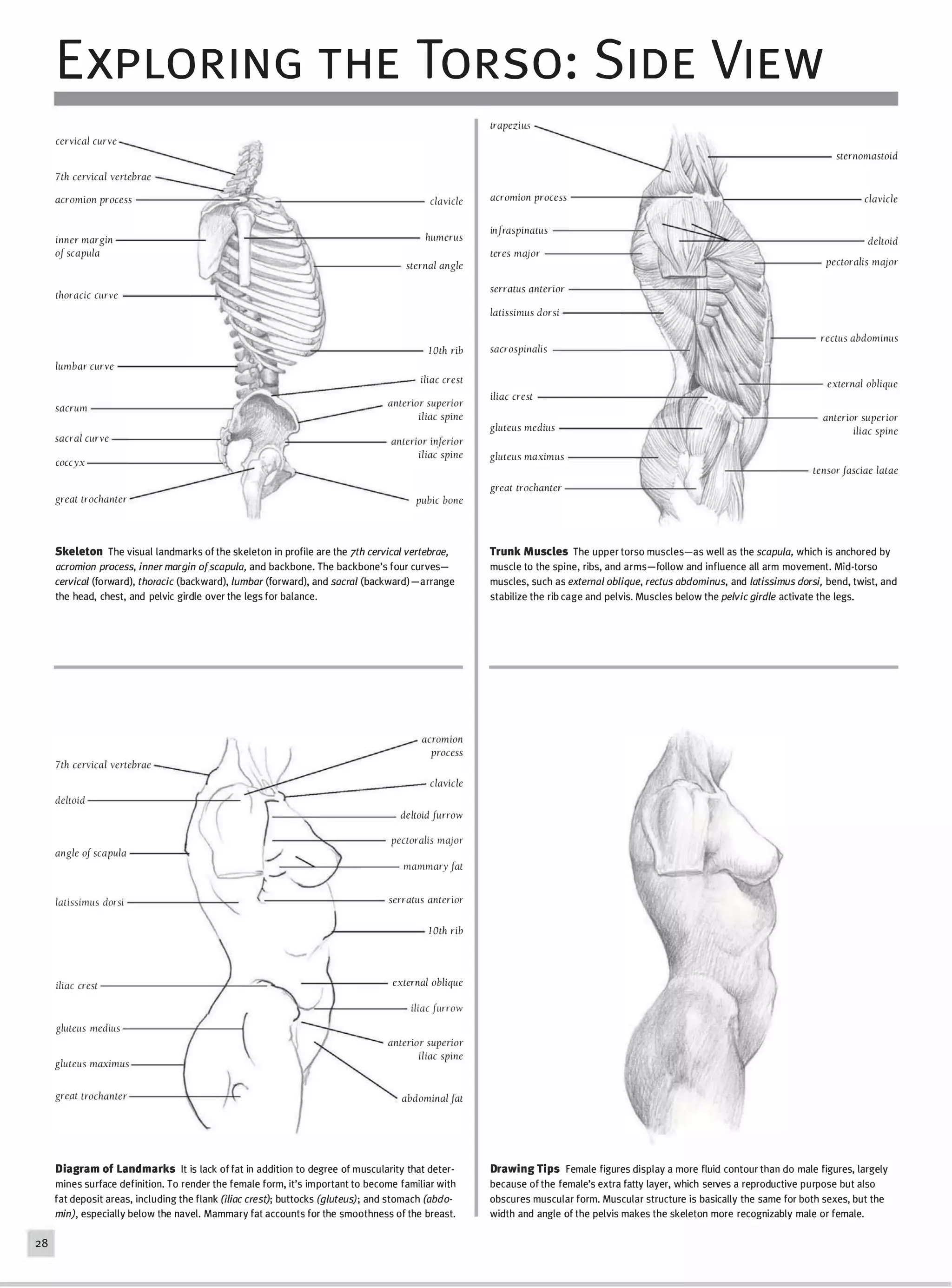
  • 78.
    MATU RE FACES P ortraitsof older individuals require more detail because fine lines and wrinkles must be included. Attempt this drawing on vellum-finish Bristol board, using an HB pencil to block in your guidelines and facial features. Then find your own drawing model. A Shade delicately with a sharpened 2B pencil. A sharp, dark lead is best for drawing tiny details, such as creases in the lips, fine hair strands, and the corners of the eyes. Your shading should help the features "emerge" from the face. Again, notice the areas where there is no shading and how these areas seem to come toward you. Practice this drawing; then find your own model or a photograph. D p. ( "- J I I r . ) c Once you've drawn the basic head shape, lightly indicate where the wrinkles will be. Some of the minor lines can be "sug­ gested" through shading rather than drawing each one. This process can be used for drawing all older individuals. Older people generally reveal a lot oj character in theirJaces. Be true to your subjects and try to bring out their essence and personality in your drawing. f.': ( I -� / )
  • 79.
    B When drawing theface of an older man, you can be more aggressive with the lines and shading, because men usually have more rugged features and pronounced creases than women. Develop the curves and planes of an older man's face with darker shading than for the woman on the previous page. This enhances the rough quality of his skin. This man's face looks even more rugged and aged than the previous drawing. His cheek bones also are more defined, and he has a wider chin. It's helpful to envision the skull inside this fellow's head to accurately shade the outer features. Drawnfrom a photograph of Big Star. © Americall Museum oJNatural History, New YOrll. A paper stump is helpful for the smoother areas of this subject's face, whereas a sharp 2B will aid in rendering the craggy texture of his chin and the distinct wrinkles around his eyes. 77
  • 80.
    ADU LT BODYPROPORTIONS J ust as there are proportion rules for drawing the head, gUidelines exist for drawing the human body. You can use average or artistic measurements. The dia­ grams on this page effectively illustrate the differences between these types of propor­ tions. Study them, and make many prac­ tice sketches. As you probably know, an unrealistic figure drawing is easy to spot. I Head length as a unit of measurement Jor rest ojbody. 1 2 3 7-112 heads 4 5 6 7 1/2 / I ,. . . 1 2 3 4 I 5 6 7 1/2 , , ./ . I I 7-112 heads Average proportions Generally the male Jigure is widest at the shoulders, whereas theJemale is widest at the hips. r', P1 � 2 - � '---- 3 � r (4 S heads ) / 5 6 I r I7 J� � ' , r;::/ ( " I r;- - - .. '- ) 1 2 3 4 5 6 7 8 8 .I Artistic proportions Realistically, most bodies are about 7-1/2 heads tall (average), but we usually draw them 8 heads tall (artistic) because a fig- ure drawn only 7-1/2 heads tall appears short and squatty. Try drawing some of your own figures. The first renderings may not look quite right, but keep practicing until you get the hang of it. Remember that figure drawing is much easier when you use a reference, such as a live subject or good photograph. Artistic proportions have been used by artists since the ancient Greeh times.
  • 81.
    CH I LDBODY PROPORTIONS T he illustrations at the bottom of the page explain how to use the size of the head as a measuring unit for drawing children of vari­ ous ages. If you're observing your own model, measure exactly how many heads make up the height of the subject's actual body. Begin the drawing below by lightly sketching a stick figure in the general pose. Use simple shapes such as circles, ovals, and rectangles to block in the body. Smooth out the shapes into the actual body parts, and add the outline of the clothing. A I YourJigure should be balanced on an imaginary ground plane and a vertical centerline. 15 years 7-3/4 heads ---1 1 0 years 7 heads - B I I I I -V-6I--- / I c I I I , 7 I J ./( : --- ,_ _ _ .- , : f- fL - ­ :::::: ----+-c.�_ /Ground plane contact line 3 years 5 heads I I D I I Children are greatJun to draw, but because they generally don't remain stillJor long periods, start out using photographs as models. 1 year 4 heads 79
  • 82.
    80 TH E BODY T hehuman body is challenging to render; therefore, it's important to start with a quick drawing of the basic skeletal structure. The human skeleton can be compared to the wood frame of a house; it supports and affects the figure's entire form. Frontal view � l (t- "> 1 ./ I ', - -l-J';. . J I ,, / I I � I / I I I I �Torsoforms into triangle shape. The frontal view illustrates the planes of the body which are created from the skel­ eton's form. In men's bodies especially, the torso forms a triangle shape between the shoulder blades and the waist. In women's torsos, the triangle shape gener­ ally is less pronounced, and their bodies can even resemble an inverted triangle. A - - - _._--....... Basic skeletal structure B / I / / " -, , I � ... - )1 � , , I / J ' '/ . / / I 1',_ }, .... � <I J, ': , - ..., ( ' - ..- - - .... .,.. I ' 1 - , - , I I , "' , . I / ..... / I , Skeletal structure inside body Michelangelo dissected human cadavers to learn about sheletal and muscle structure! The muscles also affect the body's form. To gain further insight into shading the contours of the body, study the human muscular structure in chapter 2.
  • 83.
    HAN DS &FEET H ands and feet are very expressive parts of the body and also are an artistic challenge. To familiarize yourself with hand proportions, begin by drawing three curved lines equidistant from each other. The tips of the fingers fall at the first line, the second knuckle at the middle line, and the first knuckle at the last one. The third knuckle falls halfway between the finger tips and the second knuckle. The palm, coincidentally, is approxi­ mately the same length as the middle finger. / -1- - Third knuckle / I 1'- r - �Q. / - , , 5 d First eeon Finger h hi knuchle nue etips Your own hands and Jeet can make great drawing models. / " "" .,, "- .,- .,­ .,- / X Follow the steps shown to draw the feet. Block in the shape in two parts: the main part of the foot and the toes. Once you've drawn a good outline, add minimal shading so you don't call too much attention to the feet. I I - - - A I / A ,/ B Every time aJinger bends at the knuckle, a new plane is created. Picture the three-dimensional shape oj the hand in various positions This will help you correctly draw the hand. -- I B c ( D 81
  • 84.
    82 CLOTH I NG FOLDS N OW that you've mastered drawing the body, you need to know certain techniques that will improve the quality of your work. Drawing realistic clothing folds is one of those techniques. / Shirtfolds close-up Begin by drawing a stick figure, indicating the location of each joint with some light circles. Then sketch the outline of the clothing, along with preliminary guide­ lines for the folds; the gUidelines will later provide a map for your shading. Indicate only the major folds at this point, while continuing to add light gUidelines. To shade, darken the areas inside the folds with short, diagonal strokes using the point of a 2B pencil. Overlap your strokes at different angles, making them darker toward the center of the folds. Use a paper stump for the finishing touches, blending the edges of the folded areas. You might also want to leave some shading lines to give the drawing an artistic feel. Pantfolds close-up
  • 85.
    FORESHORTEN I NG F oreshorteningallows you to create the illusion of an object coming toward you in space. While the principles of per­ spective still exist, body parts are more difficult to draw in this manner because they don't have straight edges. In addi­ tion, the body proportions are somewhat skewed, or shortened, in a drawing that includes foreshortened subjects. (See pages 90-91 for more information.) Foreshortening means you are shortening what is comingforward. Notice at the dinner table, when someone passes you something, how his or her arm isforeshortened. -- A The arm resting on the keyboard appears to be receding back into space. The parts of the body closest to you should be shaded the least because they have the most light on them. Also keep in mind that as objects move farther away, they become less detailed and more blurred. B With crossed legs, most of the shading falls on the part of the leg farthest away, enhancing the perception of depth in the drawing. Be certain to rough in both legs and the major folds correctly before you begin shading.
  • 86.
    MOVEMENT & BALANCE Anotherway to make drawings more realistic is to draw the figures in action. Because people hardly ever sit or stand still, your figure drawings of them shouldn't either. You can begin by using simple sketch lines to lay out the domi­ nant action of the figure. A ____ Line ofaction I )Center line ofbalance - - ;...... - - No matter what position afigure takes, you always canfind a center ofbalance, illustrated by the dotted lines on these examples. B l I ( A B - � ----��. -�----�- ---- ( ( - - -- - - ::.-- Try employing an imaginary centerline of balance that seems to hold or balance the figure in its position. Otherwise, the figure may look as though it's going to fall over. The best way to achieve bal­ ance is to place approximately the same amount of weight on either side of this center line. �) , J v �I A ,,- 7 I Line ofAction I I Another tip is to draw a line that repre­ sents the spine of the figure in its action pose; you can develop the pose from this line of action. Using both the center line of balance and the line of action help establish effective action figure drawings.
  • 87.
    BEN DING &TWISTI NG FIGU RES W hen people are involved in something active, they bend and twist their bodies. You should be able to render these movements in your drawings. Clothing helps convey the appearance of a twisting body because the folds form into a twisting design. When drawing figures in a twisting motion, use what you've already learned about shading folds, but keep in mind that folds on a twisting body will be tighter than folds on a person in a still pose. - --. ) /. / -. -. Folds form a twisting pauem. Don'tforget that you can make terrific drawingsfrom photographs too. A ( A -- -- �J-}// ., / ., -- - t (� - B / / ., -- / I ! ) J B To accurately position the active body, sketch some gUidelines to indicate the angles of the shoulders, hips, and knees, as shown in the examples. 85
  • 88.
    86 SPORTS FIGU RESI N ACTION D rawing figures playing sports is a great way to practice all the techniques you've learned. It's especially important to sketch the line of action in such dramatic poses because the body often stretches, bends, and twists in all sorts of contortions during these kinds of activities. , I ...-- /', / IVI /' J.--,- , ...J '- / (.-' B Angles will play a fundamental role in effectively rendering these figures. Use your knowledge of proportions extensively to capture the body movements. c - -----_/ People playing sports often display expressions that contort theirfacial features, such as looks ofgrimace, shock, joy, or pain.
  • 89.
    CH I LDRENI N ACTION T he same principles of drawing adults in action can be applied to drawing children. But remember, children's arms and legs usually are pudgier than those of an adult, and the proportions of children's bodies are different. A - Before using children in public places as drawing models, it's a good idea to get their parents' permission to do so. c Recognize how the line of action differs from the boy jumping for the ball and the girl gathering flowers. Also, adding a ground, field, or river also enhances your work by providing a nice background for your subject. There is nothing beller than the simple innocence ofa child at play. Try to bring out this quality in your drawings. - " A � 'f ' - -- - - -- ) c
  • 90.
    88 DEVELOPI N GA PORTRAIT D rawing a person really is no different than drawing anything else. A human face has contours just like a landscape, an apple, or any other subject-and these contours catch the light and create shadow patterns just as they do on any other object. The difference is that the contours of the face change slightly from indi­ vidual to individual. The "trick" to portraiture is observing these differences and duplicating them in your drawings. CAPTURING A LIKENESS You don't need to memorize all the bones, muscles, and tendons in the human head to draw a portrait; just follow the general rules of proportions, as shown in the chart at right. Simply divide the face into thirds, and note where the features fall in relation to the face and to one another. Then study your model to determine how his or her face differs from the chart (that is, how it is unique). Look for subtle changes, such as a wider nose or thinner lips, wide- or close-set eyes, or a higher or lower forehead. It also is important to practice drawing faces from different viewpoints-front, side, and three-quarter views-keeping the proportions the same but noting how the features change as the head turns. Remember: Draw what you really see, and your portrait will look like your model! A Lips In a frontal view, - - the upper lip has two �J{ "peaks" and a slight pro· trusion in the center. The lower lip is fleshier and has no sharp peaks. When shading, I defined the bottom edge of the lower lip by shading the area directly below it. A Eyes In a side view, the eye has a triangular shape. The iris has an oval shape, and the eye· lids slightly cover it at the top and bottom. When shading, I concentrated on developing the iris, lashes, and lids, leaving most of the brow white. FrontView In a frontal view, we can see that the face is not perfectly symmetrical. One eye is generally smaller than the other, or one might sit at a slightly different angle. The same is true of the ears, cheeks, and the sides ofthe nose and the mouth. Profile The head shape changes in a side view, but the features remain in the same relative positions. Although the nose is a prominent feature in profile, take care not to let it dominate the face. Also pay attention to where the eye sits and how the lower lip curves into the chin. .... Facial Proportions This chart shows some general guidelines for facial proportions. The eyes sit in the middle of the head. The distance from the hair line to the brow line is usually the same distance as from the brow line to the bottom of the nose and from the bottom ofthe nose to the chin. The lower lip rests halfway between the bot· tom of the nose and the chin. The eyes are one eye·width apart, and each eye is the same width as the nose. The width of the mouth is the distance from the center of one eye to the center of the other eye. The top of the ear aligns with the brow line; the bottom ofthe ear aligns with the nose. A Nose In a three· quarter view, the far nostril is partially hid· den from sight. The light strikes most strongly on the center ridge, so I ere· ated the form by shading the side of the nose, under the tip, and outside the nostril. Three-Quarter View This view can be challenging because you have to distort the features to make them look realistic. Here I changed the eye and lip shapes to curve with the face. You might want to start with a contour drawing to work out how the features really look.
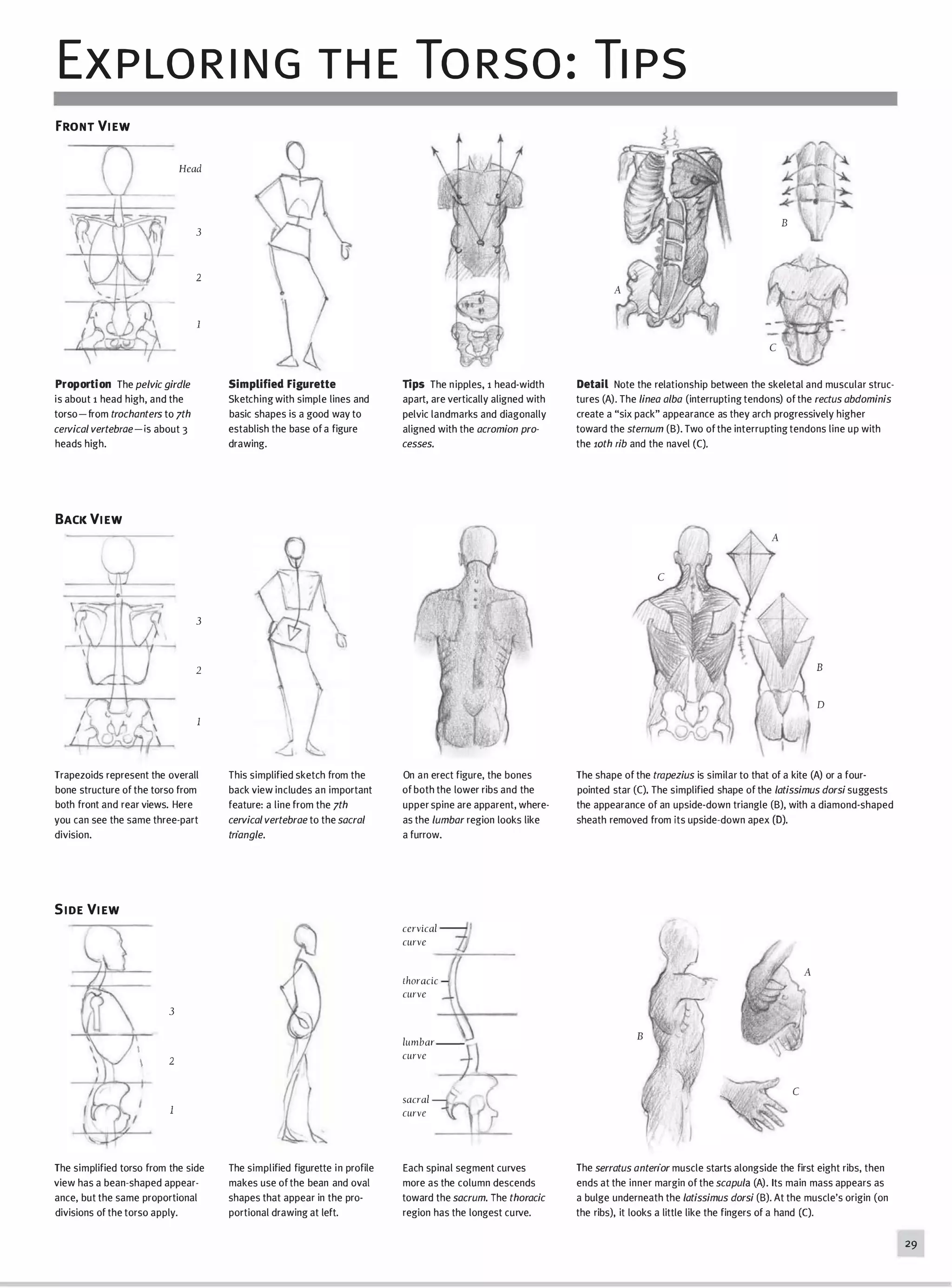
  • 91.
    , -- ( / - ,.. StepOne I started with a sharp HB charcoal pencil and very lightly sketched the general shapes ofjenna's head, hair, and collar. (I chose charcoal for this drawing because it allows me to achieve very subtle value changes.) Then I lightly placed her features. ! / Step Two Next I began refining her features, adding the pupil and iris in each eye, plus dimples and smile lines. At this stage, I studied the photo carefully so I could duplicate the angles and lines that make these features uniquely jenna's. Then I began adding a few shadows. ... Drawing from aSnapshot Although I prefer to draw portraits from a live model, sometimes a black-and­ white photo works just as well-and it doesn't get tired of posing! In this photo of jenna, I see her delicate features, smooth skin, and sparkling eyes. But I'm also going to try to capture the features that are unique to her: the slightly crooked mouth, smile lines, and wide-set eyes. Note also that you can barely see her nostrils. It's details like these that will make the drawing look like jenna and no one else. Step Four I continued building up the shading with the charcoal pencil and willow stick. For gradual blends and soft gradations ofvalue, I rubbed the area gently with my finger. (Don't use a brush or cloth to remove the excess charcoal dust; it will smear the drawing.) When I was fin­ ished, I took the drawing outside, turned it over, and gently tapped the back side to release any loose charcoal dust. Finally, I sprayed it lightly with fixative to protect it from further smudging. / Step Three As I developed the forms with shading, I used the side of an HB charcoal pencil and followed the direction of the facial planes. I shaped a kneaded eraser to a point to lift out the eye highlights, and I used a soft willow charcoal stick for the dark masses of hair.
  • 92.
    90 FOCUSI NG ONFORESHORTEN I NG D rawing is all about illusion, but not the sleight-of-hand variety magicians perform. In my drawings, I create the illu­ sion of three dimensions in a variety of ways, but in every case I'm just drawing what I see in front of me. Foreshortening is an important method of creating the illusion of depth, and it works hand in hand with perspective; that is, the part of the subject that is closest to us appears to be larger than the parts that are farther away. TAKING A DIFFERENT VIEW So what exactly is foreshortening in terms of drawing? It's a technique for rendering objects that aren't parallel to the picture plane in which you shorten the lines on the sides of the object that is closest to you. (It may sound confusing, but it's really not once you get the hang of it.) For example, if you look at someone holding his arm straight down against the side of his body, the arm is perfectly vertical and so looks in proportion to the rest of the figure. But if he raises his arm and points directly at you, the arm is now angled (and not parallel to the picture plane), so it appears distorted. In other words, the hand looks bigger and the arm looks shorter. So, in turn, you would draw a big hand and an arm with shortened sides. That's foreshortening! � Recognizing Foreshortening This photo of Justin is an excellent example of fore­ shortening_ Notice the differ­ ence in the size of his tiny head compared to his huge feet. This is because his feet are closer to us, so they appear much larger_ Additionally, I know his legs must be longer than they appear from this view­ point, and I know that his foot can't be the same length as his shin. But these are the size rela­ tionships I see, so these are the size relationships I will draw. Be selective --- --...., ,; when you draw. Analyze the scene or subject matter, and change it around , /) -M A --;� 7 ifYOLl think it will rnahe a stronger visual statement. - .------- Step Two Next I lightly added secondary curves to represent the roundness ofthe figure and the folds in the clothes_ I am still blocking in basic information at this point, so I kept these lines light so they wouldn't interfere when I refined the outlines. , .-' t (;-/ Step One I began, as always, by lightly blocking in the outlines of only the major shapes-no details yet. The most important thing was to study the photo carefully and make sure I had all the size relationships correct. However, although I followed the photo faithfully, I noticed that the book appeared to be unnaturally supported, so I added the right arm and hand. Even though I keep repeating "draw what you see," sometimes you need to take what is called artistic license and make a few changes, or no one will believe that's really what you saw! / , t -1' )- , /(hlj:- r-.."r----._ /� :--� � - - " --- - ....... ..--- ~-
  • 93.
    -- - �-- 7 / .­ - - Step Four In the final stage, I added some light shading and all the details offabric folds and facial features. Within the overall foreshortened pose, there are secondary areas of foreshortening. For instance, notice how Justin's left foot is foreshortened (because it points toward us) and his right one is not (because it points straight up). The backs of his hands, wrists, and forearms also are foreshortened (because they point toward us), whereas his fingers are not. ) j J ./ - Step Three As I began refining the shapes, I needed to check my refer­ ence frequently. I added a dark shadow for an eye anchor to help me keep my place as I glanced back and forth from photo to drawing. Notice how the darker, thicker lines on the feet already make them appear to come for· ward, whereas the thinner, fainter lines of the upper body recede. This tech· nique enhances the sense of depth. FOR E S H ORT E N I N G S I MPL I F I E D Fingers Straight Up Hold your hand in front of a mirror, palm forward. Notice that your fin· gers are the right length in relation to your palm. Nothing is foreshortened here. Fingers Angled Toward You Now tip your hand a little, and see how the length of the fingers and the palm appears shortened. This is subtle foreshortening. Of course, your fingers didn't really get shorter; it just looks that way! Fingers Pointing Front Now point them straight at you. This is the most extreme fore· shortened view; the fingers appear to be mere stubs. Notice the shape ofthe fingernails as they curve over the cylindrical fingers. I I bit Fingers Angled Down The fingers appear longer now but still not full length, yet the fin· gertips are still visible. This pose shows some foreshortening; the fingers seem too long and thick in relation to the back of the hand. Fingers Pointing Straight Down No fore· shortening is at work in this position-another frontal view. The tips ofthe fingers cannot be seen, and the length of the fingers and hand are not distorted at all. 91
  • 94.
    .. • ApPLYI NG YOUR SKILLS N OW that you've mastered all the techniques in this chapter, you can incorporate them into one finished work. As you can see, this drawing demonstrates principles of perspective, line of action, and center of balance. It also illustrates successful renderings of figures bending and twisting, sitting, and moving in a variety of action poses. It's important that you attempt to draw a challenging work like this to improve your artistic skills. On location, record your subjects with quick simple lines, creating a reference for a tighter, more polished work back at home. Remember, success requires patience and a lot of practice. , - • • I
  • 95.
    , I -{ • • r I • • , J , .. " " ( - ,I I ' J /I ,. . . , ( , -1 q , •
  • 97.
    CHAPTER 5 WITH D EB RA KAU F FMAN YAU N Debra Kauffman Yaun discovered that she had a knack for drawing people when she was a young girl growing up in Tampa, Florida. After graduating from the Ringling School of Art and Design in Sarasota, Florida, Debra worked as a fashion illustrator. Debra's art­ work has been published in several art magazines and books, and she has won numerous awards, including an international award. She is a signature member of the Colored Pencil Society of America, having served as president of the Atlanta chapter, and she is a juried member of the Portrait Society of Atlanta. Debra's work is featured in four Walter Foster titles: Drawing: Faces & Features and Drawing: People with Debra Kauffman Yaun in the How to Draw and Paint series; and Colored Pencil Step by Step and Watercolor Pencil Step by Step in the Artist's Library series. Debra and her artist-husband have two grown sons and reside in Georgia. 95
  • 98.
    U N DERSTANDI NG FACIAL ANATOMY W hen drawing faces, it is important to be aware of the underlying structures of the head. Although the bones and muscles aren't visible in a final portrait, they provide the framework for the drawing, establishing the shape of the head and gUiding the place­ ment of the features. Having an understanding of the basic anatomy of the head will lend realism and credibility to your drawings. Frontalis -1"*.:-+__ Temporal fascia --=-�� ( OrbiCLllaris OCLlli -,-;::-:-44. OrbiCLllaris oris ---=+t--l'ti?� Masseter Mentalis --t--����{:::�� Sternocleidomastoideus Trapezius _____ I I Understanding Bone Structure Becoming familiar with the bones of the skull and the way they affect the surface ofthe skin is essential for correctly placing the curvatures, ridges, and other prominent features of the head. Understanding Muscle Structure When facial muscles contract, they affect the shape ofthe skin, cartilage, and underlying fatty tissues that cause the bulges, furrows, and other forms that create various facial expressions. Head width Seeing theSkull in Profile In a profile view, it is easy to see how much area the back ofthe skull takes up. Notice that the length ofthe skull is just shy of its width. j / Visualizing the Underlying Muscles The large muscles of the neck and the clavicle bone twist when the head is turned. The muscles and clavicle are visible, even underneath the skin; they can create a bulge or tension that is evident on the surface. _r' -
  • 99.
    LEARN I NG TH E PLAN ES OF TH E FACE O nce you understand the basic structure of the head, you can simplify the complex shapes of the skull into geometric planes. These planes are the foundation for shading, as they act as a guide to help you properly place highlights and shadows. T H E E F F E CTS O F L I G H T ... Lighting the Planes from Above When light comes from above, the more prominent planes of the face-such as the bridge of the nose and the cheekbones-are highlighted. The eyes, which recede slightly, are shadowed by the brow; the sides of the nose, bottom ofthe chin, and underside of the neck also are in shadow. Light ""'- source � shadow ... Lighting the Planes from the Side Features are shaded differently when light hits the side ofthe face: The eyes are still in shadow, but the side of the face and neck are now highlighted. The shading on the head becomes darker as it recedes toward the neck; the sides ofthe cheeks appear "sunken"; and the ear casts a shadow on the back ofthe head. Highlight Highlight RejJected light Shading the Planes of the Face Many types and values of shadows contribute to the piecing together of all the planes ofthe face. Core shadows-or the main value ofthe shadows-are a result of both the underlying structure and the light source. Protruding objects, such as the nose, produce cast shadows, like the dark area on the left of this subject's nose. Highlights are most visible when directly in the light's path; here the light source is coming from above left, so the lightest planes ofthe face are the top ofthe head and the forehead. The darkest areas are directly opposite the light source, here the left side ofthe subject's face and neck. Even in shadow, however, there are areas ofthe planes that receive spots of reflected light, such as those shown here on the chin and under the eye. 97
  • 100.
    ADU LT FACIALPROPORTIONS U nderstanding the basic rules of human proportions (meaning the comparative sizes and placement of parts to one another) is imperative for accurately drawing the human face. Understanding proper proportions will help you determine the correct size and placement of each facial feature, as well as how to modify them to fit the unique, individual characteristics of your subject. Vertical centerline t ��<----- Hairline - -- Horizontal f centerline (2j.;,:------ Nose ....._-..;1. Establishing Guidelines Visualize the head as a ball that has been flattened on the sides. The ball is divided in half horizontally and vertically, and the face is divided horizon· tally into three equal parts: the hairline, the brow line, and the line forthe nose. Use these guidelines to determine the correct placement and spacing of adult facial features. Looking Up When the head is tilted back, the horizontal guidelines curve with the shape ofthe face. Note the way the features change when the head tilts back: The ears appear a little lower on the head, and more of the whites of the eyes are visible. I� Placing the Features The eyes lie between the horizontal centerline and the brow line. The bottom ofthe nose is halfway between the brow line and the bottom of the chin. The bottom lip is halfway between the bottom of the nose and the chin, and the ears extend from the brow line to the bottom of the nose. Looking Down When the head is tilted forward, the eyes appear closed, and much more ofthe top of the head is visible. The ears appear higher, almost lining up with the hairline and following the curve ofthe horizontal guideline.
  • 101.
    EXPLORI NG OTHER VI EWS B eginning artists often study profile views first, as this angle tends to simplify the drawing process. For example, in a profile view, you don't have to worry about aligning symmetrical features. But the rules of proportion still apply when drawing profile views, as well as the more complex three-quarter views. Vertical - centerline -------_-;-:�'F:::�:--"'"" - Hairline ----i::r--------i- Bmw line -���---------+--��----- Eyes ---;--�---------+--_t--------''''-- Horizontal centerline Mouth ------i:------------- Chin-----.:�-� Simplifying the Profile To draw an adult head in profile, start by blocking in the cranial mass with a large circle. Add two curved lines that meet at a point to establish the face and chin. Place the ear just behind the vertical centerline. Vertical centerline Hairline ---,=---.�:",_ Placing the Features Use the large cranial circle as a guideline for placing the features. The nose, lips, and chin fall outside the circle, whereas the eyes and ear remain inside. The slanted, broken lines indicate the parallel slant of the nose and ear. Brow line 1 Eyes -------=.;. centerline Nose --------.::� Mouth -----"I ��::::=- Chin ------------��.::.--� Drawing a Three-Quarter View In a three·quarter view, the vertical centerline shifts into view. More ofthe left side of the subject's head is visible, but you still see only the left ear. As the head turns, the guidelines also curve, following the shape of the head. Distorting the Features When the head turns, the eye closest to the viewer (in this case the left eye) appears larger than the other eye. This is a technique called "foreshortening," in which elements of a drawing are distorted to create the illusion of three·dimensional space; objects closer to the viewer appear largerthan objects that are farther away. 99
  • 102.
    100 DEPICTI NG ADULT FEATU RES I f you're a beginner, it's a good idea to practice drawing all the facial features separately, working out any problems before attempting a complete portrait. Facial features work together to convey everything from mood and emotion to age. Pay attention to the areas around the features, as well; wrinkles, moles, and other similar characteristics help make your subject distinct. EVES Step One Make a circle for the iris first; then draw the eyelid over it. (Drawing an entire object before adding any overlapping elements is called "drawing through.") Note that part of the iris is always covered by the eyelid. Step Two Start shading the iris, drawing lines that radi­ ate out from the pupil. Then add the eyelashes and the shadow being cast on the eyeball from the upper lid and eyelashes, working around the highlight on the iris. Step Three Continue shading the iris, stroking outward from the pupil. Then shade the eyelid and the white of the eye to add three-dimensional form. Step 1 Step 3 I I / I " , - - - Step One Draw through a circle for the eye first; then draw the eyelid around it, as shown. In a profile view, the iris and pupil are ellipses; the top and bottom of the iris are covered by the upper and lower eyelids. Step Two To draw eyelashes in profile, start at the out­ side corner ofthe eye and make quick, curved lines, always stroking in the direction of growth. The longest lashes are at the center of the eye. Step Three When shading the eyelid, make light lines that follow the curve ofthe eyelid. As with the frontal view, the shading in the iris radiates out from the pupil. Step 2 Step 4 Rendering a Pair of Eyes After becoming comfortable with drawing the eye itself, start developing the features around the eye, including the eyebrows and the nose. Be sure to space adult eyes about one eye-width apart from each other_ And keep in mind that eyes are always glossy-the highlights help indicate this. It's best to shade around the highlights, but if you accidentally shade over the area, you can pull out the highlight with a kneaded eraser_ VARY I N G Q U AL I T I E S There are several characteristics that influ­ ence the final impression that a pair of eyes give: The shape of the eye, position of the eyebrows, length and thickness of the eye­ lashes, and number of creases and wrinkles can denote everything from age and gender to mood and ethnicity_ Study the examples below to see how these different elements work together. J
  • 103.
    NOSES Rendering Noses Todraw a nose, I first block in the four planes-two for the bridge and two for the sides (see "Combining Features" below). Then I study the way each plane is lit before adding the dark and light values. The nostrils should be shaded lightly; ifthey're too dark, they'll draw attention away from the rest of the face. Generally men's nostrils are more angular, whereas women's are more gently curved. Round nose Flat nose Bulbous nose Ridged nose Hooked nose EARS Rim Bowl Dividing theEar The ear is shaped like a disk that is divided into three parts: the rim, the bowl, and the lobe. LIPS Step One First I simplify the nose by dividing it into four planes- plus a circle on the tip to indicate its roundness. Then I draw the outline of the lips. I add a small circle to con- nect the base ofthe nose with the top of the lip. The arrows on the lips indicate the direction in which I will shade them. 1 I Sizing the Ear The ear usually connects to the head at a slight angle; the width is generally about one·half ofthe length. Step One When drawing lips, I first sketch the basic outline. The top lip slightly protrudes over the bottom lip; the bottom lip is also usually fuller than the top lip. Step Two Next I begin shading in the direction of the planes ofthe lips. The shading on the top lip curves upward, and the shading on the bottom lip curves downward. Step Three I continue shading, making the darkest value at the line where the lips meet. Then I pull out some highlights to give the lips shine and form. Highlights also enhance the lips' fullness, so it's often best to include larger highlights on the fuller bottom lip. COM B I N I N G Step Two Now I lightly , shade the sides of the • nose, as well as theI I , I nostrils and the area, I between the nose and lips. I ) I begin shading the lips in the direction indicated � by the arrows in step 1. Then I shade the dark • area between the top and, I bottom lips. This helps separate the lips and gives them form. Step 1 Step 2 Step 3 Developing the Ear in Profile I first block in the general shape, visually dividing it into its three parts. Next I start shading the darkest areas, defining the ridges and folds. Then I shade the entire ear, leaving highlights in key areas to create the illusion of form. A B ( C 0 E F Detailing the Lips Determine how much detail you'd like to add to your renderings of lips. You can add smile lines and dimples (A, B, and D), you can draw clearly defined teeth (A) or parts ofthe teeth (E and F), or you can draw closed lips (B, C, and D). F E AT U R E S Step Three I con· tinue shading to create the forms of the nose and mouth. Where appro· priate, I retain lighter areas for highlights and to /) show reflected light. For example, I use a kneaded eraser to pull out high· lights on the top lip, on the � tip of the nose, and on the bridge of the nose. 101
  • 104.
    102 CAPTU RI NGA LI KEN ESS O nce you've practiced drawing the individual features, you're ready to combine them in a full portrait. Use your understanding of the basics of proportion to block in the head and place the features. Study your subject carefully to see how his or her facial pro­ portions differ from the "average"; capturing these subtle differences will help you achieve a better likeness to your subject. Drawing What You See Working from a photo helps you draw what you really see-as opposed to what you expect to see-because you can change your viewpoint. Try turning both the photo and your drawing upside down as you work; you'll find that you can represent many shapes more accurately. Step Three I erase my guidelines and then begin shading, following the form of the face with the 2B pencil and softly blending to create the smoothness ofthe skin. Next I create the teeth, lightly indicating the separations with incomplete lines. Then I switch to a 3B pencil to lay in more dark streaks of hair. - -/- Step One Using an HB pencil, I sketch the general out­ line of the subject's face. Then I place the facial guidelines before blocking in the eyes, nose, and mouth. (Notice that the mouth takes up about one-fourth ofthe face.) I also block in the shape of her hair, including the bangs. Step Two Switching to a 2B pencil, I indicate the round­ ness ofthe facial features. I compare my sketch to the pho­ tograph often, making sure that I've captured the things that make this individual unique, like the turned-up nose, slightly asymmetrical eyes, and wide smile. FOC U S I N G ON F E AT U R E S This drawing shows the same young lady with a different hair style, expression, and pose. Although she's in costume, she is still recognizable as the same subject because I was faithful to the facial character­ istics that are specific to this individual. Step Four To render the smooth, shiny hair, I use a 4B to lay in darker values. I vary the length ofthe strokes, pulling some strokes into the areas at the top of her head that have been left white for highlights to produce a gradual transition from light to dark. Then I refine the eyes and mouth by adding darker layers of shading.
  • 105.
    LIFE DRAWI NG(PORTRAIT) H aving models pose for you as you draw-or life drawing-is an excellent way to practice rendering faces. When drawing from life, you usually have control over the way your models are lit. If you're indoors, you can position the light source to your liking; if you're outdoors, you can reposition your model until you're satisfied. Creating a Comfortable Setup When using live mod­ els, make sure they are comfortable and in a pose they can hold for a while. Schedule short breaks every 30 minutes so that both you and your models can take a "breather." I Step Four I start shading the face in the darkest areas, frequently looking up at my model to see where the shadows lie. I use a 2B pencil to devel­ op the hair, varying the length of my strokes and leaving some areas mostly white for highlights. Then I shade the neck using light, horizontal strokes. Step One First I place the basic shape of the head with an HB pencil. My subject's head is tilted at a three-quarter angle, so I shift the vertical centerline to the right a bit. (See page 99 for specific information on placing features in a three-quarter view_) I use my guidelines to block in the eyes, nose, and mouth_ Then I indicate the neck_ Step Three I let my model take a short break so she can relax and stretch while I check the proportions of my drawing. When I'm satisfied with the placement of the features, I begin to develop the eyes, nose, mouth, and eyebrows_ I take note of what my model is wearing (her necklace and the ruffled shirt), and begin to render the details accurately_ Step Two I use the same HB pencil to foreshorten the subject's left eye, making it a little smaller than the right eye. (See "Distorting the Features" on page 99 for more on foreshortening.) I draw only one nostril, and I make the mouth smaller on the left side. Making closer elements largershows that the face is angled toward the viewer_ Step Five After another short break, I use a 3B pencil to add even darker values to the hair, leaving the lightest areas at the top of her head to show that the light is coming directly from above_ Then, looking up at my model to locate the lightest values in her face, I use a kneaded eraser to lift out some highlights and to soften any strokes that are too dark, smoothing out the skin_ 103
  • 106.
    104 ApPROACH I NGA PROFI LE VI EW Aprofile view can be very dramatic. Seeing only one side of the face can bring out a subject's distinctive features, such as a pro­ truding brow, an upturned nose, or a strong chin. Because parts of the face appear more prominent in profile, be careful not to allow any one feature to dominate the entire drawing. Take your time working out the proportions before drawing the complete portrait. Drawing in Profile When drawing a subject in profile, be careful with proportions, as your facial guidelines will differ slightly. In a profile view, you see more ofthe back ofthe head than you do of the face, so be sure to draw the shape of the skull accordingly. Step One After lightly drawing a circle for the cranial mass, I use an HB pencil to block in the general shapes of the face, chin, and jaw line. Then I add guidelines for the eyes, nose, mouth, and ear. (See page 99 for general rules regarding the placement of features in a profile view.) I closely observe my subject to see how the positions and angles of his features differ from the "average." I) ) I Step Two Following the guidelines, I rough in the shapes of the features, including my subject's slightly protruding upper lip. I sketch a small part of the eye, indicating how little ofthe iris you actually see in a profile view. (See page 100 for more information on drawing eyes in profile.) Step Three When I sketch the eyebrow, I pay particular attention to the space between the eye and the eyebrow; in this case, the subject's eyebrow is fairly close to his eye. It also grows past the inside corner of his eye, very close to his nose, and tapers toward the outside corner of the eye. Next I continue refining the profile, carefully defining the shapes ofthe chin and the neck (including the Adam's apple). Step Four In a profile view, the hairline is important to achieving a likeness, as it affects the size and shape of the forehead. This subject has a very high forehead, so the hairline starts near the vertical centerline of the cranial mass. Once I'm happy with the shapes ofthe face and hairline, I start refining the features, giving them form.
  • 107.
    - ---... ! I ! � StepFive Here you can see that the drawing is really starting to resemble the subject. Next I switch to a 2B pen· cil and continue building up the forms: I round out the nose and chin; add light, soft strokes to the area above the lip for the mustache; and suggest the hair using short, quick strokes. Then I add more detail to the eye and develop the ear and the eyebrow. Step Six Still using the 2B, I continue to develop the hair, eyebrows, and mustache, always stroking in the direction that the hair grows. I leave plenty ofwhite areas in the hair to create the illusion of individual strands. Next I begin to suggest the curves and shadows ofthe face by shading the eye, ear, and nose. (See "The Effects of Light" on page 97 for tips on shading a profile.) Step Seven I continue shading the lips, pulling out a white highlight on the bottom lip with a kneaded eraser. Then I shade more ofthe ear and add even darker values to the hair, leaving highlights on the crown of the head, as it is in the direct path ofthe light source. I also shade the forehead, the nose, and the chin. I leave the majority of the cheek and the middle part of the forehead white. This helps indicate that the light source is coming from above, angled toward the visible side of the face. 105
  • 108.
    106 WORKING WITH LIGHTING W hether you're drawing from a photo or from life, lighting is extremely important to the overall feeling of your portrait. Lighting can influence the mood or atmosphere of your drawing-intense lighting creates drama, whereas soft lighting produces a more tranquil feeling. Lighting also can affect shadows, creating stronger contrasts between light and dark values. Remember that the lightest highlights will be in the direct path of your light source, and the darkest shadows will be opposite the light source. Using Backlighting Here the light source is coming from behind the subject-the face is in shadow, but the hair is highlighted. When drawing a backlit subject, try leaving some areas of paper white around the edges ofthe head. This keeps the hair from looking stiff and unrealistic, and it also separates the hair from the background. Step Three Using a 2B and frequently referring to my photograph, [ shade the right side of the face: First [ apply a layer of light, short strokes; then [ go back and apply a layer of longer strokes, still maintaining a light touch. To shade the hair, [ leave several white areas to indicate that the light is shining through it. [ apply long strokes, staggering them at the top of the head to produce an uneven, more realistic shape. Step One I sketch the basic shape of the head, neck, and hair with an HB pencil. My subject's head is turned in a three-quarter view, so I curve the guidelines around the face accordingly. (See page 99.) Then I lightly sketch the facial features, indicating the roundness of the nose and the chin. / / Step Two Switching to a 2B pencil, I define the features and fill in the eyebrows. I also sketch a few creases near the mouth and around the eyes. Then [ add the collar, but­ ton, and neckband to his shirt. Step Four Still using a 2B pencil, [ continue shading the face, keeping the left side a bit lighter in value to show that the light source is coming from the subject's left. [ also refine the left eye, leaving the right eye more in shadow. [ shade the neck, again making his right side a bit darker. Then [ add more definition to the hair, leaving some white space around the edges to suggest the light shining through the hair.
  • 109.
    I NCLU DINGA BACKG ROU N D An effective background will draw the viewer's eye to your subject and play a role in setting a mood. A background always should complement a drawing; it should never overwhelm the subject. Generally a light, neutral setting will enhance a subject with dark hair or skin, and a dark background will set off a subject with light hair or skin. Simplifying a Background When working from a photo reference that fea­ tures an unflattering background, you easily can change it. Simplify a back­ ground by removing any extraneous elements or altering the overall values. Step One With an HB pencil, I sketch in the basic head shape and the guidelines. Then I block in the position ofthe eyes, brows, nose, and mouth. (Notice that the center guideline is to the far left ofthe face because of the way the head is turned.) Next I indicate the neck and the hair. Step Four I finish shading the face, neck, and shirt with a 2B; then I switch to a 3B to add more dark streaks to the hair. I apply another layer of strokes to the background, care­ fully working around the hair and leaving a few gaps between the strokes to create texture and interest. Next I use a kneaded eraser to smooth out the transitions. Step Two Switching to a 2B pencil, I begin refining the shape ofthe eyes, brows, nose, and mouth. I block in the hair with long, sweeping strokes, curving around the face and drawing in the direc­ tion the hair grows. Then I add a neckline to her shirt. Step Three First I shade the irises with a 2B pencil. Then I begin shading the back­ ground using diagonal hatching strokes. Once the background is laid in, I use a 3B to build up the dark values ofthe hair. (I create the background before developing the hair so my hand doesn't smearthe delicate strands of hair.) CR E AT I N G DRAMA A darker background can add intensity or drama to your portrait. Here the subject is in profile, so the lightest values of her face stand out against the dark values of the background. To ensure that her dark hair does not become "lost," I create a gradation from dark to light, leaving the lightest areas of the background at the top and along the edge of the hair for separation. 107
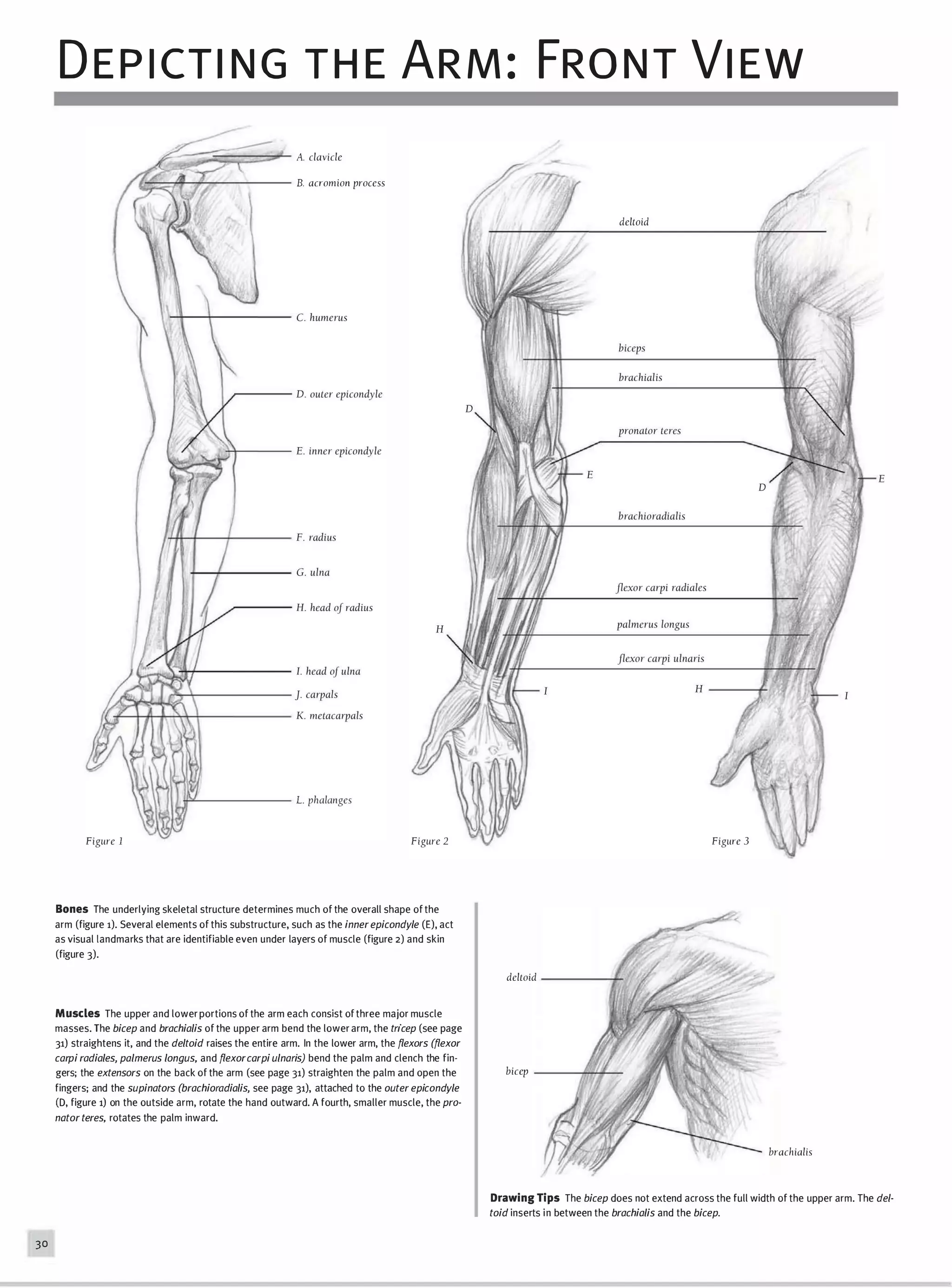
  • 110.
    108 DEVELOPI N GHAI R T here are many different types and styles of hair-thick and thin; long and short; curly, straight, and wavy; and even braided! And because hair is often one of an individual's most distinguishing features, knowing how to render different types and textures is essential. When drawing hair, don't try to draw every strand; just create the overall impression and allow the viewer's eye and imagina­ tion to fill in the rest. ) Step One I use an HB pencil to sketch the shape of the head and place the features. Then I use loose strokes to block in the general outline ofthe hair. Starting at the part on the left side of the head, I lightly draw the hair in the direction of growth on either side of the part. At this stage, I merely indicate the shape ofthe hair; I don't worry about the individual ringlets yet. CR E A T I N G R I N G L E TS Step One First I sketch the shapes ofthe ringlets using curved, S·shaped lines. I make sure that the ringlets are not too similar in shape; some are thick and some are thin. Step Two To give the ringlets form, I squint my eyes to find the dark and light values. I leave the top ofthe ringlets (the hair closest to the head) lighter and add a bit more shading as I move down the strands, indicating that the light is coming from above. StepThree To create the darkest values under­ neath the hair, I place the strokes closer together. Step Four I add even darker values, making sure that my transitions in value are smooth and that there are no abrupt changes in direction. Step 1 - { ( Step Two Switching to a 2B pencil, I start refining the eyes, eyebrows, nose, and mouth. Then I define the neckline of her shirt with curved lines that follow the shape of her body. Returning to the hair, I lightlysketch in sections ofringlets, working from top to bottom. I start adding dark values underneath and behind certain sections of hair, creating contrast and depth. (See "Creating Ringlets" below.) Step 2 Step 3 Step 4
  • 111.
    Step Three Ishade the face, neck, and chest using linear strokes that reach across the width of the body. Then I define the eyes, lips, and teeth, and I add her shoulder and the sleeve of her shirt. Next I continue working in darker values within the ringlets, leaving some areas of hair white to suggest blond highlights. Although the hair is much more detailed at this final stage, I am still simply indicating the general mass, allowing the viewer's eye to complete the scene. Finally I draw some loose strands along the edges of the hair, leaving the lightest values at the top of the subject's head. R E N D E R I N G BRA I D S Step One First I sketch the outline of each braid. I taper the ends a bit, adding a line across the bottom of each to indicate the ties that hold the braids together. Step Two Now I start shading each section, indicating the overlapping hair in each braid. I add some wispy hair "escaping" from the braids to add realism. Step Three I continue shading the braids using heavier strokes. I add even more "escaped" strands of hair. Then I use a kneaded eraser to pull out highlights at the bottom of each braid, emphasizing the ties. I also pull out some highlights in the braids themselves. Step 1 Step 2 Step 3 109
  • 112.
    110 DEPICTI NG AGE Aspeople age, their skin loses elasticity, causing loose, wrinkled skin; drooping noses; and sagging ears. In addition, lips often become thinner, hair turns gray, and eyesight becomes poor (which is why many elderly subjects wear glasses). Accurately rendering these characteristics is essential to creating successful portraits of mature subjects. I• Step One I block in the face with an HB pencil. Then I add guidelines, which I use to place the eyes, nose, ears, eye­ brows, and mouth. The lips thin out and move inward as a person ages, so I draw them accordingly. I also sketch the wavy outline of the hair. Step Two I draw the basic shape of the eyeglasses, then begin to suggest my subject's age by adding delicate lines around her eyes and across her forehead. I also round out the jaw and chin to show where the skin has begun to sag. I draw loose skin on the neck and deep lines on either side ofthe nose. Step Four Still using a 2B, I shade the face and neck, adding strokes to the side ofthe neck for wrinkles. I finish shading the irises and the eyelids. I shade the area between the right side of the cheek and the jawbone to show the prominent cheekbone, and I add shading around the nose and mouth to make the skin appear puffy. Then I add darkervalues to the hair and earrings. Step Five As I continue shading the face, I add more definition to the wrinkles around the eyes so they don't disappear into the shaded areas. I am careful to keep them subtle, smoothing out the transitions with a tortillon. (See "Rendering Wrinkles" at right for more on blending.) Finally I add a button to her collar and create the plaid pattern of her shirt. I stand back from the drawing, making sure that I'm pleased with the effect the angular bones, loose skin, and wrinkles have on the subject's face and that they sug­ gest her age. Step Three Switching to a 2B pencil, I begin shading the hair and developing the eyes, adding light, curved lines around and under the eyes to create "bags." I magnify the wrinkles slightly where they can be seen through the glasses. (See "Rendering Wrinkles" below.) R E N D ER I N G WRI N KLE S The key to drawing realistic-looking wrinkles is to keep them subtle. Indicate wrinkles with soft shading, not with hard or angular lines. You can best achieve this effect by using a dull pencil point. You also can use a cloth or a tortillon to softly blend the transitions between the light and dark values in the wrinkles. Or use a kneaded eraser to soften wrinkles that appear too deep. When drawing a subject with glasses, as in the example below, try to magnify the wrinkle lines that are seen through the lenses. You can do this by drawing the lines of shading a little larger and spacing them farther from one another.
  • 113.
    CREATING FACIAL HAIR F acial hair is another characteristic that distinguishes one individual from the next. Short, dark strokes are perfect for rendering a thick, coarse beard; whereas light, sweeping strokes are ideal for depicting a wispy mustache. Experiment with variations of light and dark lines when drawing a "salt-and-pepper" beard, and use a series of quick, short lines when indicating stubble. j ) rDrawing Through When drawing a face that is partly hidden by facial hair, it is important to draw the entire head first (i.e., "draw through") and then add the hair, beard, and accessories (such as the hat). Although the entire head isn't visible, it still needs to be drawn accu­ rately so the hat sits properly. - Step One First I sketch the shape of the face with an HB pencil. Then I place the guidelines and the features. Next I draw the hat, including the band. I block in the masses of the hair, mustache, and beard with loose, curved lines. Just as when drawing any othertype of hair, I simply indicate the general shapes at this stage. Step Two Switching to a 2B pencil, I refine the eyes, eyebrows, and teeth. I add wrinkles around the eyes and on the forehead; then I build up the hat, sketch the shirt collar, and drawthe suspenders. Now I return to the hair, indicating the curls with circular strokes. Working from top to bottom, I fill out the top of the hair, and then I develop the mustache, which partially covers the mouth. StepThree After erasing my guidelines, adding the glasses, and defining the eyes, I shade the hat, crosshatching to create a pattern on the band. I begin rendering the short, tight curls ofthe beard and the mustache. Then I add darker values to the curls on the left side ofthe face to separate them and to show the cast shadow of the hat. FOC U S I N G ON B E AR D S When drawing a white beard, such as this one, group several lines together to create form, but leave some areas white. Also try drawing the strokes in varying directions-this adds interest and move­ ment. It's also a good idea to overlap your shading a bit where the skin meets the hair, indicating that the skin is showing through the beard. Step Four I add a layer of shading to the irises, leaving white highlights in each eye. Using the edge of a kneaded eraser, I pull out a highlight on each lens of the glasses to show the reflected light. I apply more shading to the hat to give it more of a three­ dimensional look; then I shade the suspenders and the shirt. Finally I finish the curls in the hair and beard, varying my strokes between tight, curved lines and quick, straight lines. I create the shortest, most defined lines in the mustache and around the mouth, leaving most of the beard to the viewer's imagination. 111
  • 114.
    112 CH I LDREN'SFACIAL PROPORTIONS C hildren's proportions are different than those of adults: Young children have rounder faces with larger eyes that are spaced farther apart. Their features also are positioned a little lower on the face; for example, the eyebrows begin on the centerline, where the eyes would be on a teenager or an adult. As a child ages, the shape of the face elongates, altering the proportions. Vertical -__��-=::==_ centerline / Hairline Horizontal centerline ---:::=-:. Eyes----:---'-: Nose ------.:,,---7. --�7 - Corner ofeye and Mouth ----....:.. I , l /I) nose line up with side of mouth Placing the Features Based on the placement of this subject's features, you can esti­ mate that he is around five or six years old. The face has elongated enough to shift the brow line so that it lines up with the tops of the ears, showing that the child is no longer a baby. But the eyes are spaced farther apart, indicating youth. The mouth is still relatively close to the chin, which also emphasizes his young age. (See the diagrams at right for more on the shifting of the features with age.) C H AN G I N G O V ER T I M E The placement of the features changes as the face becomes longer and thinner with age. Use horizontal guidelines to divide the area from the horizontal centerline to the chin into equal sections; these lines can then be used to determine where to the place the facial features. Centerline Centerline 1/*.- ." I { Centerline I � 1!--:,.o-;'--w�:---l-rlOr.;ih-+''''';'+- Centerline -...I Drawing an Infant A baby's head fits into a square shape, as shown here. Babies have larger foreheads than adults do, so their eyebrows (not their eyes) fall on the horizontal centerline. Their eyes are large in relation to the rest oftheir features because the eyes are already fully developed at birth. Drawing a Toddler As a child grows, the forehead shortens a bit and the chin elongates, so the bottoms of the eyebrows now meet the horizontal centerline. The eyes are still more than one eye-width apart, but they are bit closer together than an infant's eyes are. Drawing a Child As a child nears seven or eight years of age, the face has lengthened and fits into more of a rectangular shape. The eyebrows are now well above the horizontal centerline and the eyes are a little closer to the centerline. The ears line up with the bottom of the nose. Drawing a Teenager By age 13, the face is even longer and has lost most of its round shape; now it's more oval. The eyes are nearly at the centerline, as on an adult's face, but a teen's face and eyes are still slightly more rounded and full. The tops of the ears are about even with the eyebrows.
  • 115.
    112 114 Vertical centerline / 1-----------_____ +_Horizontal -t-+-:--'--- centerline '.J. ( / Drawinga Baby in Profile The profile of a child usually is very rounded. Youngsters generally have bigger, more protruding foreheads than adults do. And children's noses tend to be smaller and more rounded, as well. The shape of a baby's head in profile also fits into a square. Block in the large cranial mass with a circle; then sketch the features. The brow line is at the horizontal centerline, whereas the nose is about one·fourth of the way up the face. Study where each feature falls in relation to the dividing lines. In addition, light eyebrows and wispy hair help indicate a baby's age; as children get older, their hair grows in thicker. -----.::..,r---Top ojhead ----'-;--- Hairline c--- Brow line n---- Eyes ----1+--- Nose �-=- ---:'----Mouth !/ Adding Children's Details The features shift slightly in a three·quarter view, as shown here. Although a baby's features are placed differently on the head than an older child's are, their facial guidelines shift similarly, following the direction in which the head turns. Place the features according to the guidelines. Hair style and clothing-including accesso· ries-also can influence the perceived age of your subject! M O D I F Y I N G T H E PRO F I L E As children age, their profiles change quite a bit. The head elongates at each stage: The top of the baby's eyebrow lines up with the bottom of the toddler's eyebrow, the midway·point between the young boy's eyebrow and eyelid, and the top of the teenage girl's eyelid. - ./ :;f / 113
  • 116.
    114 PORTRAYI NG CHI LDREN'S FEATU RES C hildren are fascinating drawing subjects, but they can be a challenge to draw accurately. It's important to get the right proportions for the particular age (see pages 1 1 2-1 13 for more on children's proportions) and to correctly render their features: Their eyes tend to be bigger and more rounded than those of adults, their nostrils are barely visible, and their hair is usually fine and wispy. 0 J / / Step One With a sharpened 2B pencil, , sketch the basic shape of the face. Using my knowledge of children's proportions as a guide, ' lightly draw the guidelines, which curve slightly because of the viewpoint. , place the features below the horizontal centerline, where the eyebrows begin. , block in the round eyes, placing them a little more than one eye-width apart. Then ' sketch the round nose and small mouth and add some wispy hair to frame the face. Step Three With a 3B pencil, , fill in the area between the lips, then shade the pupil and outline the iris. , add a few thin lines for hair between the scalp and the ear, darkening the hair where it is in shadow behind the ear. , keep the hair soft by sketching with light, short lines-this keeps my subject looking youthful. Switching back to the 2B pencil, , shade the inside ofthe ear and the underside of the shirt collar, helping to show the direction of the light source. Then ' define the lines around the eyes and the mouth. ( � J C--� / JI Step Two ' add details to the eyes and indicate highlights. (Prominent highlights give children's eyes that curious, youthful spark.) Then ' develop the ear and fill out the lips. , draw a curved line from the tip ofthe girl's left nostril up to her left eye to build up the nose and draw another line connecting the nose to the mouth, giving her right cheek form. , sketch a few quick lines to indicate the slightly chubby area underneath her eyes, extending the cheek a bit to round it out. , add the bangs with light, soft strokes. -- �/ Step Four ' shade the lips with a 2B pencil, leaving a light area on the bottom lip to give it shine. Then ' shade the neck using light strokes that follow the shape of the neck. With a few short lines, , draw the eyebrows; , also add light shading to the lower half of the face, filling out the cheeks and making them look rosy.
  • 117.
    Step Five Overeach eyelid, I sketch a series of small lines curving up to the eyebrows to show the youthful chubbiness. Then I add eyelashes using curved pencil strokes. To keep the subject looking young, I drawvery light, almost nonexistent eyebrows. I shade the fore· head in an up·and·down motion, and then I give her right cheek more form by darkening the areas around it. I use sweeping strokes to build up the bangs, leaving the paper white in areas for a shiny look. Step Six Still using the 2B pencil, I further build up the ear. I shade a small area between the bottom of the nose and the top of the lips to suggest the indentation, and I add shading to the creases around the mouth. I create more dark strokes in the back ofthe hair to show where the hair is layered. Then I draw a flower pattern on the shirt collar. Adding youthful patterns to your subject's clothing helps define their age; overalls, jumpers, ribbons, base­ ball caps, and bows also can imply youth. • DRAW I N G FROM A D I F F E R E N T AN G L E Because of the way this young girl's head is tilted back, you see more of her chin and neck than you do the top of her head. The ears appear a bit lower on the head, and you see more of the bottom parts of her eyes. You can even see the underside of the upper eyelid beneath the eyelashes. Even when drawing children from a different angle, the features remain rounded and childlike; for example, you can still get a sense of this girl's wide­ eyed, curious expression, although you see less of the eyes than you would in a forward­ facingview. And although the nostrils are a little more prominent in this view, they still retain their soft, smooth shape. Step Seven Putting my pencil aside for a moment, I carefully drag the edge of a kneaded eraser across the top ofthe bangs to create the appearance of blond hair. Using the 3B pencil, I create texture on the jumper and shirt by spacing the lines of the corduroy slightly apart from one another. Then I develop the floral pattern on the sleeves of her shirt. Finally I draw a small button, then stand back from my portrait and make sure the transitions from light to dark values are smooth and that there are no harsh or angular lines that might make the subject appear older than she is. / 115
  • 118.
    116 DRAWI NG ABABY D rawing babies can be tricky because it's easy to unintentionally make them look older than they are. The face gets longer in pro­ portion to the cranium with age, so the younger the child, the lower the eyes are on the face (and thus, the larger the forehead). In addition, babies' eyes are disproportionately large in comparison to the rest of their bodies-so draw them this way! -- Step One Using an HB pencil, I block in the cranial mass and the facial guidelines. (See page 112 for more information on placing a baby's features.) The head is tilted downward and turned slightly to its left, so I adjust the guidelines accordingly. I place the eyebrows at the horizontal centerline and the eyes in the lower half of the face. - Step Three Erasing guidelines as I draw, I add pupils and highlights to the eyes with a B pencil. I lightly sketch more of the hair and eyebrows, then shade under the chin to give it form. I also shade inside the ears. Then I connect and refine the lips, shading the upturned corners to suggest the pudgy mouth. I shade the inside of the mouth, showing that there aren't any teeth; then I further define the neckline of the shirt. fJ -. Step Two Now I create the fine hair using soft, short strokes and a B pencil. I draw the open mouth with the bottom lip resting against the chin. Then I add large irises that take up most ofthe eyes and suggest the small nose. I draw a curved line under the chin to suggest chubbiness; then I indicate the shoulders, omitting the neck. Step Four With a 2B pencil, I shade the irises, and then go back in and lighten the high· lights with a kneaded eraser. I draw more soft strokes in the hair and eyebrows and shade the lips and face. I emphasize the pudgy mouth by softly shading the smile lines, then finally add curving lines to the neckline of the shirt.
  • 119.
    Step Five Icontinue shading the face, then add another light layer of shading to the lips. I use the end of a kneaded eraser to pull out a highlight on the bottom lip. Then I draw some very light eyelashes. I create darker values in the hair and eyebrows and round out the outline of the face. I also lightly shade the shirt. Then I take a step back from the portrait to assess whether I've properly built up the roundness in the cheeks, chin, eyes, nose, and mouth. I use a tortillon to softly blend transitions in my shading to make the complexion baby smooth. DRAW I N G A BA B Y ' S F E AT U R E S Babies often have wide·eyed, curious expres­ sions. Try curving the eyebrows upward to create the appearance of childlike curiosity; pull out highlights in each eye to add life and interest to your drawing. A baby's lips have a soft, pudgy appearance, and the mouth usually is not as wide as an adult's is. Adding highlights is important to convey a smooth texture, and creating creases at the corners of the mouth will help indicate youthful chubbiness. -J ) 117
  • 120.
    118 CHOOSI NG APHOTO REFERENCE I f you're using a photograph as a reference while you draw, it's usually best to have several different photographs from varying angles and with different light sources to choose from. Not only does this give you a wider selection of poses and lighting options, it also allows you to combine different elements from each photograph. For example, if you are satisfied with the lighting in one photograph but you're drawn to the facial expression in another, you can combine the best parts from each for your portrait. A B c Finding the Best Pose In photo A, the subject's eyes are squinting just a tad too much. In photo B, the subject's pose seems stiff and stilted. But in photo C, his pose and expression are just right! I Step One After studying my selection of photo­ graphs, I choose the best one and use it as a refer­ ence to block in the outline of the face, the guidelines, and the features_ Step Two I compare my initial sketch with the photograph and make necessary adjustments, indicating the roundness of the bottoms of the earlobes with light circles. Next I draw the slightly protruding teeth.
  • 121.
    Step Three Aftererasing my guidelines, I use a 2B pencil to add details to the eyes and eyebrows, and I also shade the lips and cheeks. My photograph shows that the light source is coming from above, so I leave the lightest areas at the top of the head and create the darkest values on the bottom half of the face and neck. -� Step Four I darken the hair by firmly shading with a 2B. I continue evenly shading the face and the neck, then add a few light freckles with the tip of my pencil. I darken the inside ofthe mouth to give the teeth form and add detail to the shirt by stroking on horizontal stripes and shading the neckband. Finally I compare my pho­ tograph with my drawing, making sure I've captured the likeness. 119
  • 122.
    120 I N DICATINGFAI R FEATURES W hen drawing a subject with fair skin and hair, keep your shading to a minimum; apply just enough medium and dark values to create the illusion of form without creating the appearance of color. Draw blond hair by outlining the general shape, then adding a few carefully placed strokes to suggest the hair style and create some dimension. Keep in mind that light, wispy eyebrows and freckles often accompany fair skin and hair. Shading Fair Skin and Hair In this photo, the over­ head light makes the bangs, nose, and cheeks look nearly pure white, so I avoid these areas when shading my drawing, leaving much ofthe paper white. Step Three Now I refine the features, erasing my guide­ lines as I draw. I continue building up the hair, leaving the top and sides mostlywhite, adding only a few dark strands here and there. The darkest values are around the ears where the hair is in shadow. Next I add small circles for the earrings and shade the insides of the ears. I develop the lips, then use horizontal strokes to shade the neck. - Step One First I lay out the face with an HB pencil. The face is slightly tilted to the subject's left, so I shift the vertical centerline to the left a bit as well. I lightly place the eyes, nose, mouth, and ears, then block in her long, slender neck. / Step Four I shade the face with light, soft strokes to depict the subject's fair skin. Then I make short, quick strokes for the eyebrows, keeping them light and soft to indicate blond hair. Next I shade the irises using strokes that radiate out from the pupil. I also add some hatching strokes to the neckband of the shirt. -- Step Two Switching to a 2B pencil, I develop the fea­ tures. Although I use the photo for a reference, I use artistic license to adjust my rendering as I see fit. For example, I sketch the bangs so they fall straight onto her forehead, ratherthan being swept to the side as they are in the photo. I also omit the strand of hair that is blowing in the wind. D E P I C T I N G F I N E H A I R Blond hair is often finer than darker hair, especially in children. Draw fine hair in nar­ row sections, leaving plenty of white areas showing through the dark values. Add some short, wispy strands of hair at the forehead to frame the face.
  • 123.
    Step Five Usinga kneaded eraser, I pull out a highlight on the bottom lip. Then I create more dark strands of hair and further develop the eyes and eyebrows. I begin adding freck­ les, making sure that they vary in size and shape. (See "Creating Realistic Freckles" below.) CR EAT I N G R E AL I S T I C FR E C KL E S To draw freckles, space them sporadically, in varying sizes and distances from one other. You don't have to replicate every freckle on your subject's face-just draw the general shapes and let the viewer's eye fill in the rest. � What to Do Make sure some of the freckles overlap, and make some light and some dark by varying the pressure you place on the pencil. Finally I shade the shirt, using relatively dark strokes. It's easy for a blond subject to look washed out on white paper, so the dark values in the shirt help frame the subject and make her face stand out. • • • • • • � What Not to Do • • • • When drawing freckles, .. • • do not space them too • • • • • evenly or make them • • � equal in size, as shown • • • • • • • here. These freckles look • • • • • more like polka dots! •• • 121
  • 124.
    122 REPLICATI NG DARKSKI N TON ES W hen depicting dark skin tones, pay attention to the value of the skin tone and how it compares with the values of the features; for example, when the skin is dark, the lips need to be shaded even more heavily. In addition, look for differences in features that indicate ethnicity or race, such as the nose, lips, or eye shapes and the hair color or texture. _...---- Step One With a 2B pencil, I block in the basic head shape and place the features, following the guidelines. I draw the almond-shaped eyes, wide nose, and full lips, accurately depicting the features as I see them. Then I block in the teeth and indicate the hairline, eyebrows, and ears. Step Four Using strokes that follow the shape of the mouth, I continue shading the lips; then I shade the gums, carefully working around the teeth. I make sure the lips and gums won't contrast too sharply with the skin, because ifthey're too dark they'll look unnatural. Next I build up the coarse hair with more circular strokes. Then I move to the neck, using horizontal lines that curve with the shape of the neck. Notice how these lines overlap and blend into the shading that was applied in step 3- Step Two Still using the 28 pencil, I sketch in the curved neck and define the chin. Then I develop the eyes and use short, quick lines to draw the eyebrows. Next I start defining the ears and teeth_ Then I block in the hairline and the neckline ofthe shirt. Step Three Next I shade the nose, neck, and top lip, trying to make the lip appear full. I shade the nostrils rela­ tively darkly so they will stand out against the dark skin_ Using quick, circular strokes, I start to render the short, curly hair. Then I detail the eyebrows and eyes and define the neckband of the shirt. Step Five Now I apply a light layer of shading over the entire face, always varying the direction of my strokes as necessary to follow the shapes ofthe different planes. The shading is starting to round out the face, which has looked a bit flat up to this point. I'll add more shading later to make it appear even rounder and fuller.
  • 125.
    E S TABL I S H I N G VAL U E S Every skin tone is made up of a variety of values-when drawing in graphite pencil, you can accurately capture these differing tones using varying degrees of light and shadow. Before you start drawing, be sure to study your subject to establish the richest darks and brightest lights of their skin tone, whether they are fair-, medium-, or dark­ skinned. In the examples at right, hair color and contrasting values work together to suggest the medium skin tone of the boy to the far left and the fair skin tone of the boy at center. The darkly shaded, fully formed cheeks of the boy to the far right give his skin a ruddy, tanned appearance. Step Six I continue shading the face, making the sides ofthe forehead a bit darker and leaving the middle area lighter to show where the light hits. Then I darken the nose, leaving a white highlight on the tip. I also refine the shirt, curving the strokes as they go around the back ofthe collar. Next I further shade the lips to accentuate their fullness, then pull out a highlight on the top lip with a kneaded eraser. Finally I go back and soften the transi· tions between values byvery lightly blending them with a kneaded eraser. 123
  • 126.
    124 U N DERSTANDI NG BODY ANATOMY F igure drawing is easier when you have an understanding of the basic structure of the body. The muscles and bones give the body three-dimensional form, with the muscles filling out the skeletal foundation. Together they give the figure correct proportion-the relationship of the individual body parts to one another and to the body as a whole. Knowing what is beneath the skin of the figure will make your drawings more realistic and true to the form of your subject. Muscles Affect Form The musculature of different individuals can vary depending on their level of physical fitness, but we all have the same muscles underneath. Therefore the general pattern of bumps and curves that make up the shape and form of a figure are very similar from person to person. It's a good idea to become familiar with the placement ofthe structures shown in the front view (above) and back view (below) so you can better envision the way the skin lays over the muscles to create the human form. Torso Musculature (Front) The torso muscles-from the neck to the shoulders, across the chest, down and around the rib cage, and then from the hips to the legs­ control the movement of the body and give form to the skeleton. Compare this with the drawing at top left. Torso Musculature (Back) The muscles in the back of the torso generallyextend across the body, rather than up and down as in the front. They hold the body erect, stretching tightly across the back when the limbs move forward. Compare this with the drawing at far left.
  • 127.
    ADU LT BODYPROPORTIONS T he proportional measurements of the parts of the human body vary slightly for every person, making them unique; paying atten­ tion to these variations will help you render accurate likenesses. But first it's important to understand how we're all the same by studying the average proportions of the human body, which are more apparent when we look at the skeletal and muscular views of the body. When drawing a figure, we measure in "heads," the vertical distance from the top of the head to the chin. Use rough measure­ ments to help place the parts of your figure. If a head or other body part appears too large or too small, you can check the body's pro­ portions to correct the problem. Skeletal Structure By studying bone structure, we can clearly see the relationship of the length of each part of the body to the whole. 7-1/2 heads 7 6 5 4 3 2 1 Body Musculature Proportion doesn't apply to length alone-the thickness of the body also must be proportionate. This aspect of proportion varies depending on the fitness ofthe individual, but the drawing above will help you assess these proportions based on an ideal human musculature. Top oj head to bot­ tom oj chin = 1 head Chin to shoulder = 112 head Top ojshoulder to elbow = about 1-1/2 heads Top oj head to navel = 3 heads Elbow toJingertips = almost 2 heads Pe/vic area (hips) = 1 head Waist to knee = 2 heads Waist to ankle = 4 heads Knee to ankle = almost 2 heads Ankle to sole ojJoot = about 112 head Male Proportions The average male is approximately 7-1/2 heads high; of course, these proportions vary with different body types. Often artists use an 8-head-high figure for the male as an ideal proportion. Female Proportions The average female is about half a head shorter than the male, or 7 heads high. Artists often elongate the female figure, especially in fashion drawings. Generally the female has narrower shoulders and a smaller waist than a male, but proportionally wider hips. 125
  • 128.
    126 HAN DS H ands arevery complex and involve many moveable elements, which can be a challenge to draw. Some positions of the hand are more difficult to draw than others. You may want to try posing a hand-yours or a model's-in many dif­ ferent positions and drawing them for practice. In general, draw men's hands more angularly, with a heavier line quality; draw women's hands lightly with smooth, graceful lines. When sizing a hand to a figure, remember that a hand is about the same length as the face, from chin to hairline. If a hand is posed in a way that does not allow you to see H AN D AN ATOMY �������� -.� all the fingers, don't be tempted to draw what you can't see or it will look unnatural. Try not to be discouraged if your first few drawings aren't life­ like; hands definitely take a lot of practice! Bones and Muscles Studying the bones and muscles of the hand can help you understand the form and movement of the hand. That, in turn, can help you render more successful drawings. Notice the joints of the fingers, their relationship to the other fingers, and how the bones and muscles extend from the base ofthe hand. Differences in Male and Female Hands Here the hands of a young married couple clearly show how male and female hands are drawn differently. The strong lighting is from above, creating bright highlights on the back ofthe woman's hand. Holding a Pen or Brush This adult male hand holds a paintbrush, but the same pose could hold a pen or pencil. The strong light source from the right highlights the fingers and leaves the back of the hand and wrist shadowed. ExtendedVersus Folded Fingers The skin at the base of the thumb shows more modeling or folds than the other fingers. This view is lit from above, so the highlights are on the tops of the fingers, and the shadows are beneath. Making a Fist The middle-aged male fist here could be holding something tightly or using a tool. The lighting is soft and evenly distributed from a source that is to the viewer's left. Showing an Open Palm An open'palm rendering of an adult female's hand could be at rest, showing us some­ thing in her hand, or reaching for something. With lighting from above, the highlights are on the tops of the fingers and palm, with the back of the hand in shadow. Playing an Instrument In this view of a young male's hands on a keyboard, several of the fingers are not visible. These hands also could depict reaching for something. The light here is from above, highlighting the backs of the hands.
  • 129.
    FEET T oes are lessflexible than fingers, so feet are not as complicated to draw as hands. Because feet have a unique structure, however, it is still helpful to study the bones, muscles, and tendons to assist you in rendering accurate drawings. Practice drawing feet in vari­ ous views, as shown here, to build your skills. Skeletal Structure In this frontal view, we see that the main bones ofthe feet are heavier than those ofthe hands. The toe joints are close together, as compared with the widely separated finger joints. <OIl Back View of Feet When viewed from behind, the heel and leg bone catch the light and become one large area. Very little ofthe front of the feet are visible from this angle. <OIl Adult Male Feet This man is lifting his right foot at an angle to take a step; it looks smaller than the other foot because it is far­ ther away from the viewer. Notice how the raised foot catches the light, but the foot on the floor shows more intricate shading of light and dark areas. FOOT AN ATOMY Heel and Arch Formation Both the attachment ofthe leg bones at the ankle and the heavy bone that forms the heel and arch are visible in this side view of the skeletal structure of the foot. <OIl Crossed Feet From our viewpoint in front of this man's crossed feet, we see the entire bottom of his right foot. The left leg is crossed over the right and the foot is pointed at us, so there is severe foreshortening (see page 129); the toes are just ovals when they are seen straight on like this. <OIl Young Female Feet The feet of this young girl are smooth on top because she is sitting with her feet extended in front of her. The strong lighting from above gives the tops of the feet bright highlights and casts dark shadows. <OIl Feet in Profile In this view of a woman walking, her right foot is a complete side view with only the big toe showing. Her left foot is bending at the toes and pointed slightly toward us, so we can see all the toes on that foot. Notice the difference between the shape ofthe foot when flat as opposed to when it is bent. --- Muscles The relationship between the foot and leg are easy to see in this side view of the musculature ofthe foot. You can follow most ofthe foot muscles up the leg, from which most foot movement comes. 127
  • 130.
    128 SHOWI NG MOVEMENT Allthe parts of the body combine to show movement of the figure. Our jointed skeleton and muscles allow us to bend and stretch into many different positions. To create drawings with realistic poses, it helps to study how a body looks and changes when stretched or flexed, as well as when sitting or standing. Begin by drawing the line of action (a line to indicate the curve and movement of the body) or "gesture" first; then build the forms of the figure around it. Extending and Contracting The spine is flexible and allows us to bend many ways while stretching and contracting our Iimbs_ These three poses show how the shape of the body can change drastically while the proportions stay the same. Stretching and Bending You almost can feel the muscles stretching on this cheer­ leader's body as she pulls up her right leg behind her head. Notice how the bending figure cre­ ates wrinkles and tightly stretched areas in the clothing. Be sure to draw these creases and smooth areas to make your drawing believable_ I L , ---- Everyday Action This woman kneeling in her garden is bending into an 5 shape. All wrinkles or folds in the fabric are on the inward side of the body's bend; the back side is fairly smooth. The curve of her turned head has only a slight influence on the line of action.
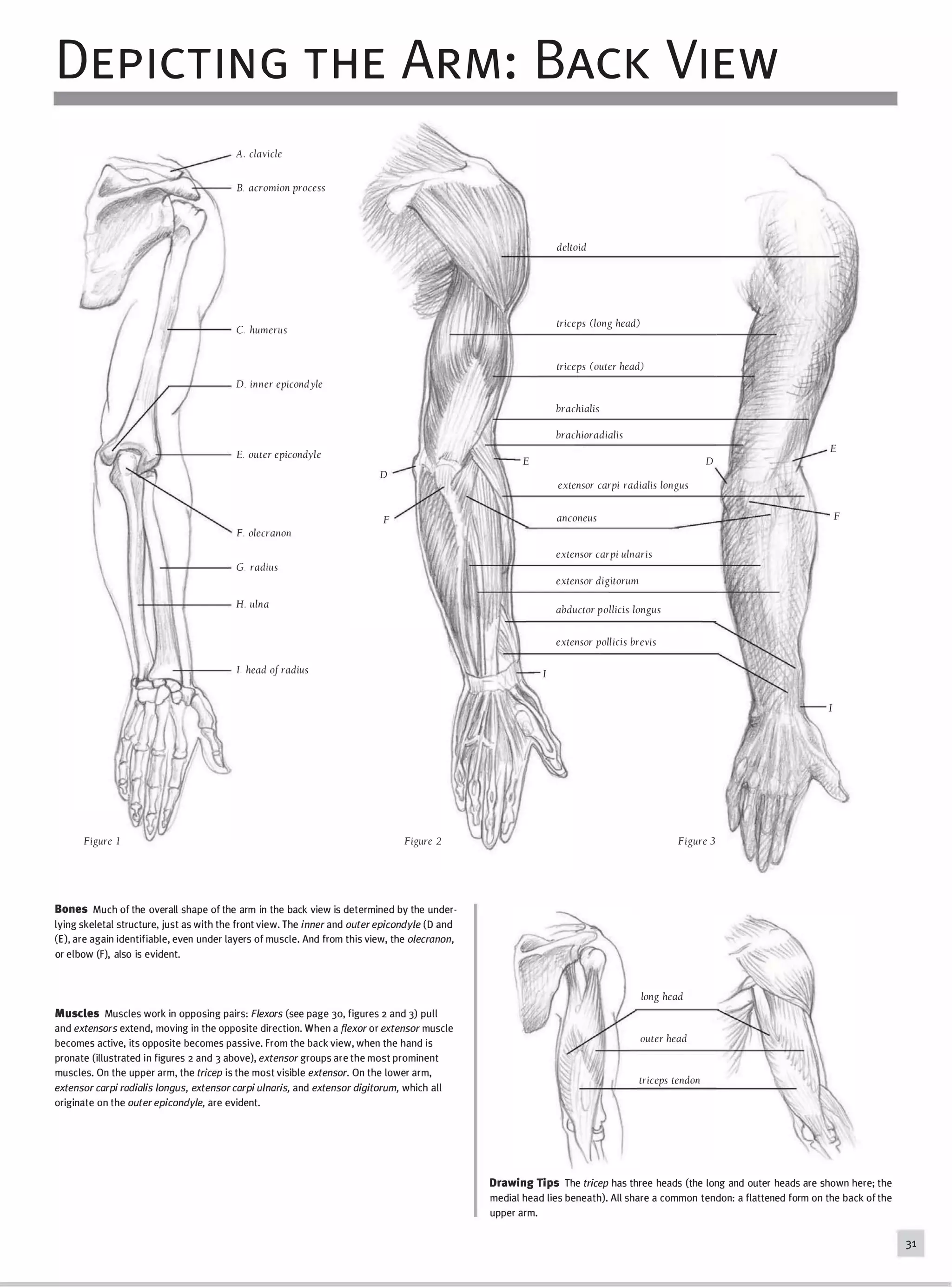
  • 131.
    FORESHORTEN I NG T oachieve realistic depth in your drawings, it's important to understand foreshortening. Foreshortening refers to the visual effect (or optical illusion) that an object is shorter than it actually is because it is angled toward the viewer-and that objects closer to the viewer appear proportionately larger than objects farther away. For example, an arm held out toward the viewer will look shorter (and the hand will look larger) than an arm held straight down by the subject's side. When foreshortening something in a drawing, be sure to draw the object the way you really see it­ not the way you think it should look. Foreshortening helps create a three-dimensional effect and often provides dramatic emphasis. Study the examples here to see how foreshortening influences their sense of depth. Angled View In this view, the head is closer to the viewer than the feet. The thighs seem to disap­ pear behind the hips. Only part of one foot is visible, and it is relatively small due to foreshortening. The right arm supporting the head is not distorted by perspective because the full length is parallel with the side ofthe picture plane (i.e., not angled toward or away from the viewer). The torso is slightly distorted by foreshortening; the shoul­ ders are closer to us and appear a little larger in comparison with the hips. Side View In this view, the young woman's limbs are not distorted because the view is directly from the side, not at an angle. Her torso, head, and legs are all at roughly the same distance from the viewer. The fingers of her left hand are somewhat foreshortened because they are turned toward the viewer. Back View with Angled Head and Arm In this view, most of the body is on the same plane (and parallel to the picture plane), but the head and arms are angled slightly away from the viewer, so they appear relatively small when compared with the rest ofthe body. Fo c u s ON F I N G E RS When foreshortening occurs, you must forget everything you know about proportion and draw what you see instead of what you expect to see. Even something as simple as a fingertip can take on a drastically different appearance. Straight-On View Now the legs are extended directly toward the viewer­ so the legs are foreshortened, making them appear much shorter than they really are. This distortion creates the illusion that the feet are much closer to the viewer than the rest ofthe body. The torso, head, and arms are all on the same plane, so they are in proper proportion to one another_ Notice here that the stretched-out legs appear to be only about 2 heads long. Foot to HeadView Here the feet are closest to the viewer, and the head is farthest away, so the feet appear relatively larger than Lthey would normally. The lower legs are foreshortened because they are angled directly toward the viewer. Most of the torso and the arms are hidden behind the legs-remember that you shouldn't draw what you can't see! c Fingers When viewing a finger from the side (A), the tip of the finger is much smaller than the knuckle. When viewed straight on (8), the tip and the knuckle appear equal in size. When the lines ofthe rounded fingertip and nail are shortened, both appear quite square (e). Foreshortening from this angle causes the length ofthe fingernail to appear quite short as well. 129
  • 132.
    130 U N DERSTANDI NG LIGHTI NG An important aspect of drawing-especially when drawing people-is lighting the subject. Lighting can have a dramatic effect on the figure's appearance, eliciting an emotional response from the viewer and setting the mood of the drawing. Subtle lighting often is associated with tranquility and can make a sub­ ject appear soft and smooth. This type of lighting tends to lighten the mood, generally lending a more cheerful feel to the composi­ tion. On the other hand, strong lighting makes it easier to see the contrasts between light and dark, which can add drama and make the subject appear more precisely formed. Longer shadows can mute the mood of a portrait, producing an air of pensiveness. Here strong shadows on the subject's face make her subtle smile seem reflective rather than content. Step Two Switching to a B pencil, begin refining the head by adding the features and the hair, erasing unneeded lines as the drawing progresses. Refine the shirt and jeans, adding details like the seam along the leg. Add the back of the chair, and refine the shape ofthe rest of the chair. Draw the lowerwindow frame, and refine her fingers and the shapes ofthe shoes. The main concern at this stage is establishing the overall shape of the figure-shading to indio cate lighting and mood will come next. - - Step One First sketch the outlines of the figure on white drawing paper, using an HB pencil. Start with the torso, and then add the shape of the head. This is a three·quarter view ofthe body, but the face is in complete profile as the subject looks out the window. Block in the lines ofthe shoulders and chest; then add the window frame and sketch both arms. Draw the seat of the chair, and indicate the chair legs. Then add the subject's legs, with the sub- ject's right leg stretched out in front of her and the left leg pulled back toward the chair. Lightly sketch the entire back leg, "drawing through" the front leg to help position the leg correctly, and then erase any unnecessary lines. StepThree Using a very light touch, draw the edges of the shadows along the face, neck, arms, hands, and ankles. These lines will serve as a guide for adding the shading later. Also add this shading line to the shirt and pants, following your reference photo to outline areas where the lightest highlights will be, as this part ofthe paper will remain white. Begin to shade the hair, curving the strokes to follow its shape. Then shade the front of the chair.
  • 133.
    Using Strong NaturalLight The model for this drawing is sitting beside a f1oor-to-ceiling window. The sun is streaming through the glass from above and in front of her. The strong light creates visual interest by casting deep shadows and creating bright highlights. - Step Four Shade the skin using light, diagonal strokes, except where the highlight is strongest. Erase any remaining shading guidelines. Then draw the stripes of the subject's shirt, following the folds and curves of the fabric over her form and leaving the lightest areas white. After adding details to the shoes, use a 2B pencil to create dramatic contrasts in value-shading the inside of the left leg, adding a few more dark values to the hair, and drawing the outlines of the shadows on the floor. look at your reference photo frequently to check the placement and strength of your highlights and dark values. Then apply addi­ tional shading to the back and legs ofthe chair, and shade the window frame. Step Five Switch back to a very sharp B pencil to add some details to the face. Using a 2B pencil, create more dark values in the hair and shade the stripes on the shirt. Darken the rest of the jeans using strokes that follow the form of her legs. With a sharp pencil point, carefully add a layer of shading to the darker areas of the skin. Reflected light from the shirt lightens her jaw line. Reflected light also appears on her arms and fingers; stroke across the arms to give them form. Shade the rest of the chair, leavingwhite on the chair legs where the light hits them. Because this portrait utilizes strong contrasts in light, larger portions of the drawing will remain nearly white-including the highlights on her legs, her throat, and her chest. A portrait that comprises varying degrees of shadows without these large areas of highlight would lose drama and intensity. Next shade the shoes, making them darker where the woven pattern is more detailed. On the floor, use diagonal hatching strokes, angling away from the light to create the shadows cast by the legs of both the subject and the chair. 131
  • 134.
    132 LI FE DRAWING (FU LL BODY) D rawing from a live model (also called "drawing from life" or "life drawing") is a wonderful exercise in drawing the human body in its various shapes and positions. Drawing from life helps you avoid overworking your drawing because you're instead focused on qUickly recording the gesture and specific details of your model before he or she moves, resulting in a spontaneous, uncomplicated finished drawing. Take advantage of available models-your children, other family members, or friends-whenever possible. When drawing from life, be sure the pose is comfortable for the model. Allow short breaks for your models (also providing you time to rest), and don't require them to smile, as this can tire out their facial muscles. Because you're working at a faster pace, drawing from life will help you learn freedom and flexibility-both of which will benefit your drawings regardless of the type of reference. It also will help you appreciate the subtleties the eye perceives that the camera can't­ such as the twinkle in this man's eye! Step Two Begin to refine the shapes, indicating the clothing and shoes. Then block in the mustache and beard, and place guidelines forthe facial features. Study the model's face to see how the proportions and placement of the features differ from the "average" proportions. / / I Step One Using an HB pencil, lightly block in the basic shapes of the figure and the rocking chair, paying par­ ticular attention to the vertical lines and balance to make sure the figure doesn't look as if he's going to tip over in the chair. Notice that the model's back curves forward while the back of the chair angles backward, and his head aligns vertically with the back of the chair leg. Foreshorten the right leg and make the right foot larger than the left because the right leg is angled toward the viewer_ Step Three With a B pencil, draw in the facial features and refine the shapes of the head, including the ear, hair, and hat. Then hone the rest of the body, drawing the folds and details ofthe fabric and adding the fingers on the left hand. Next further develop the chair, using a ruler to create straight lines. Continue by shading the hat, the sock, the far rocker, and the model's back. )
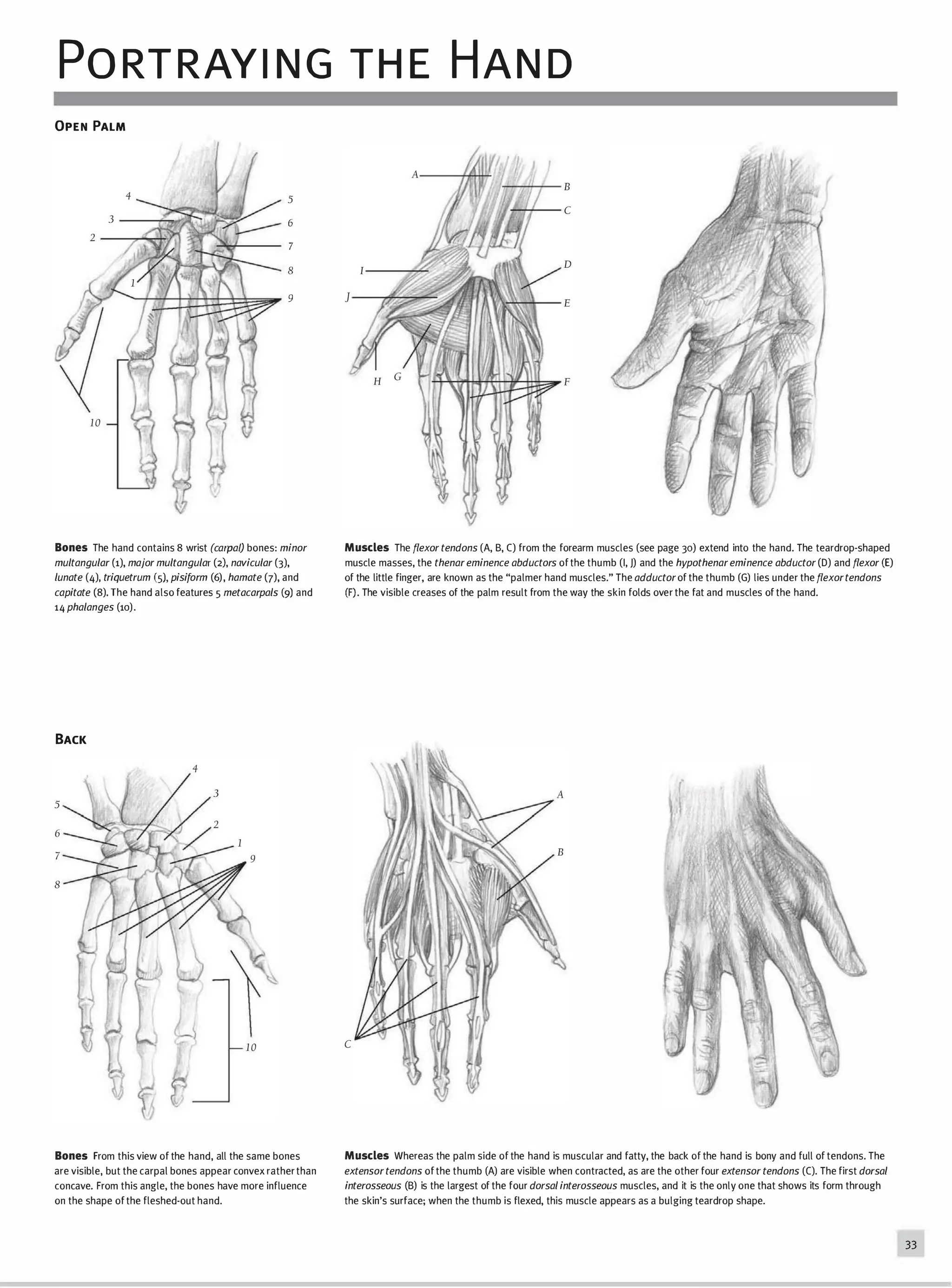
  • 135.
    Step Four Usinga 2B pencil, begin shading the hat, leaving the top edge and a line on the brim white. Add some detailing to the hair and beard with short strokes, following the direction of growth. Shade the clothing, leaving the areas white along the side where the light hits. Watch the shapes of the wrinkles and how they affect the lights and shadows. Also shade some of the rocker, and lightly sketch in the shapes of the cast shadows. Step Five Lightly shade the face, varying your strokes to follow the different planes. Add further details and shading to the eyes, nose, mouth, ear, hair, and facial hair. Study your model to see what details will help create a likeness. Then shade the clothing and chair, always keeping in mind where the light is coming from and adjusting the lights and shadows as needed to enhance the illusion of depth. Use a 4B pencil forthe darkest areas and leave the lightest areas pure white. Soften any hard edges with an eraser, a tortillon, or a tissue. finally, step back from your drawing, squint your eyes, and see if there are any areas that need to be corrected. If any areas are too light or too dark, adjust them as necessary. FAC E D E TA IL To create the beard, apply very dark tone to areas ofthe beard, showing the gaps between groups of hair. Also leave some areas of the paper completely white to reflect the areas of the beard that are in the direct path of sunlight. When detailing the face, shade very lightly to indi­ cate wrinkles and creases. The wrinkles should appear soft, so avoid using hard lines. To create the twinkle in the eyes, pull out a highlight in each pupil with a kneaded eraser. 133
  • 136.
    134 BRI DAL PORTRAIT S pecialoccasion photos, such as a bridal portrait, provide great references for drawing people. When drawing a bride, focus on capturing the key elements that symbolize the event, such as the veil, bouquet, and gown. The details of these objects are always unique to the particular subject, making it easy to achieve a likeness. Pay special attention to the way the gown and veil drape, the small details on the gown, the way the veil fits on the bride's head, and how her hair is styled. Finally, be sure to capture the glowing expression on her face! Step One With an HB pencil, sketch in the shape of the figure. (Notice that this particular subject is only 6-1/2 heads tall.) Start with an oval for the head, and then block in the basic shapes ofthe veil, dress, and bouquet. Check the proportions before continuing. Make sure that the skirt ofthe gown is long enough in relation to the bodice and that you haven't made the head too small or too big in relation to the body. (You may find it easier to get the pro­ portions right if you block in the subject's entire body first, then draw the clothing over it.) Once you're happy with the basic outlines, add guidelines for the facial features, curving them as necessary for the three-quarter view. Step Two Using the facial guidelines, place the eyes, eye­ brows, nose, mouth, and ear. The ear sits high on the head because the face is tilted down. Begin finding the location of the folds in the dress and veil, and sketch in placement lines. Remember that the way a fabric drapes depends on the thickness of the fabric as well as the form underneath it. Then block in the flower shapes inside the oval bouquet shape, and indicate the necklace with one line where it lays on her neck. Step Three Switch to a B pencil. Then shade the pulled­ back hair, working from the hairline toward the crown and curving the strokes around the head. Be sure to leave the white highlight near the front of the head, as shown. Next lightly shade the dress and the veil to indicate the folds, always thinking about where the light is coming from. Be sure to leave strong highlights alongthe ridges of the veil to suggest the translucency ofthe filmy, white fabric. Shade the flowers in the bouquet, suggesting the shapes of the different types offlowers. Now refine the facial features, darkening the eyes and lips and creating the shape of the nose. Then begin to lightly shade the skin ofthe face, chest, and arm. It's important not to make the skin too dark; use a kneaded eraser to pull out some of the tone or create highlights as needed.
  • 137.
    Step Four Finally,refine the shading by adding more lay· ers of strokes where darker values are needed. Keep the shading smooth, applying the strokes very lightly and close together. Use a kneaded eraser to create some white edges on the veiL To soften the shading and give the material a more realistic appearance, lightly use a tortillon on a few areas of the veil and dress. Add more shading to the flow· ers, using a 2B pencil in the darkest areas. Use the same pencil to further shade the hair, still leaving some white along the front for shine. Finish by using diagonal strokes with a 3B pencil to shade the background, which helps the white veil and dress stand out from the white paper. 135
  • 138.
    CH I LDREN'SBODY PROPORTIONS D rawing children can be challenging because you have to get their proportions just right or your drawings will look odd. Children's proportions are much different than adults', and children's proportions change as they age. For example, a baby's head is extremely large in proportion to its body-but as the child grows up, the head becomes smaller in proportion to the body. Additionally, a child's head is wider than it is long, so it's rounder than that of an adult. If your drawings of children look too old, make sure you're not using adult proportions! Proportion Scale forGrowth Years Infants' bodies are short, making their torsos and limbs appear proportionately thicker. As infants grow into toddlers, their faces and bodies begin to elongate. By age five, children are about half as tall as they will be as adults; and by age eight, growth spurts will add another 1 to 2 heads in height, further elongating the body. By the early teens, the face has elongated to such a degree that the eyes are almost at the centerline ofthe face (where they are located on adults' faces); the change in proportion results in a less chubby look, thus we say bodies lose their "baby fat." People reach their full adult height between the ages of 18 and 20; musculature is still developing, but adult proportions have been achieved. Note: These proportions and observations are based on averages; carefully study your subjects to determine their individual proportions. • f • J '" • • , . Toddler (3-3/4 heads tal/) Age five (4- 112 heads tal/) Age eight (6 heads tal/) Young teen (6- 112 heads tal/) Older teen (7 heads tal/) TO D D L E RS ' L I M B S Arm and Hand The arm of a two-year-old usually is a bit pudgy and has wrinkles at the joints. Deep folds of skin at the inner elbow and wrist are fairly common, as are dimples on the elbow and knuckles. Hand and Fingers The back of a toddler's hand is chubby and rounded. The fingers are plump and fleshy. even at the tips. ( - Legs and Feet The legs are short. which makes them look fairly thick. Plump. two-year-old toes are short. round, and nearly shapeless_ The foot is just starting to form an arch at this stage. I
  • 139.
    CH I LDRENI N ACTION T o capture children's actions, train your eye to assess the essential elements of the movement, and then quickly draw what you see. One way to rapidly record details is through a gesture drawing, a quick sketch establishing a figure's pose. First determine the main thrust of the movement-or the line of action-from the head, down the spine, and through the legs. Then sketch general shapes around this line. As you can see here, a quick sketch is all you need to capture the main gesture-and you always can add details later. Step One A pose of this nature can be challenging because skateboarders often appear to defy gravity! But just record this action the same as you would any other: Draw the line of action down the spine, sharply curving through the left thigh. Then add the arms and the right leg for balance. Keep the head in line with the spine. Step Two Here again, minimal shading and detail are the best ways to keep the movement from looking stiff. Loose speed lines around the boy's helmet, hand, and skateboard also indicate motion. - ) Step One To capture the gesture of these boys, first establish the lines of action; then block in the general shapes surrounding them. For the boy on the left, the line of action moves down his spine and through his left leg, where his weight is balanced. The boy on the right is kicking with his right leg-note the way the kick causes his body to bend for­ ward in order to balance, curving the line of action at the base of his spine. Step One This ballet pose has two lines of action: The main line curves with the torso and runs down the left leg; the secondary line starts at the left hand and flows across the chest, down the right arm, and through the right hand. Most ofthe weight is on the left leg; the right leg is extended for bal­ ance. If the basic gesture isn't correct, the figure will look like she's falling over. Step Two When blocking in and refining the shapes of a complicated pose such as this one, it's important to keep in mind many of the concepts you've learned in this book, including the head and body proportions and how foreshortening affects them. Step Two After placing the lines of action correctly and blocking in the basic shapes, add a few details on their heads, hands, feet, and clothing, keeping the lines loose. Karate uniforms are loose fitting, but you can see how the boys' movements have pulled the fabric taut in some places. 137
  • 140.
    CHOOSI NG APOSE N ot every photo you take is going to be good, and not every pose your model strikes is going to be perfect. Look for poses that are natural and balanced, not stiff or boring. Some movement or tension can make the pose more interesting, but your subject should look stable and comfortable in the position. Unless in motion, the model should not have his or her arms and legs stretched out in all directions; instead, he or she should be more compact and relaxed. The pose should reflect the personality or interests of the subject. Take many photos to use as references, and evaluate them for suitability. A c E VAL U AT I N G P H OTOS B Selecting a Photo Reference In photo A, the subject has a stable, compact pose, but he looks a bit stiffand bored; his personal­ ity doesn't show through. The pose in photo B is more relaxed, but the boy looks a little out of balance, and his arms and legs are in awkward positions; in addition, the light behind him is a bit harsh. Photo C is a great pose to represent this young man. He looks quite comfortable, and his hands and feet are in good, natural positions; his head is turned at a 90° angle to his body, which helps give some movement and interest to the pose. The lighting is more even as well. This is the best pose to use for a drawing_ Step One Using an HB pencil, block in the figure. Place the head above the center of the main body mass, as indi­ cated bythe vertical line. Sketch the shapes ofthe arms and legs, drawing through the overlapping body parts for correct placement. The vertical centerline on the head shows the three-quarter view. Add the horizontal guide­ lines for the facial features. Sketch the general shapes of the shoes and the lines for the ends of the shorts and the shirt sleeve_ Be sure the pose and proportions are accurate before adding any details_ 1 Step Two Now it's time for some definition_ Place the facial features on the guidelines. Remember: The guides you learned about earlier are based on averages; to achieve a good likeness, be sure to follow your photo reference and adjust accordingly-for example, accounting forthis boy's high forehead and wide-set eyes. Indicate the hair, and sketch in the clothing, showing some ofthe folds and wrinkles. Sketch in the shapes of the fingers of his left hand and the elbow of his right arm. Refine the shapes of the shoes, and indicate laces.
  • 141.
    Step Three Erasethe guidelines. Then use a B pencil to refine the facial features and the hair. Give the fingers a more precise shape, and add the fingernails. Refine the shapes of the arms, legs, and clothing, removing unneeded lines with a kneaded eraser. Using "artistic license" (the artist's prerogative to ignore what actually exists, and to make changes, deletions, or additions), the author decides to change the shoelace so it is not awkwardly sticking up at an odd angle. Step Four Using a 2B pencil, begin shading the hair with strokes that follow the direction of growth. Leave areas of white paper where the light hits the hair. Shade some darker areas around the eyes, cheekbones, and under the lips, as well as on the neck. Use a very sharp pencil and small strokes for the eyebrows and lashes. Darken the legs where they are in shadow; these strokes follow the curve of the leg and help show its form. (See "Shading the Forms" at right.) Begin to shade the arms and other areas in shadow, such as the ends ofthe fingers. Add more shading to the clothing and shoes, rendering additional details as you go. Step Five Using a very sharp 2B pencil with light pressure, shade the face, leaving a white highlight on the nose and chin and on the side ofthe right cheek that is in more direct sunlight. To show the delicate form ofthe face, place your shading strokes very close together and follow the contours ofthe face, often changing direction. Shade the arms and legs using a little pressure for the lighter areas; press harder for darker areas. Leave a white highlight on the top of the right arm to show where the sunlight is reflected. Along the back, leave a vertical area of white paper to represent the bright sunlight on the shirt; otherfolds ofthe shirt and pants also have highlights. Use a 3B pencil to add some dark areas in the hair and in the darkest areas of the clothing before switching back to the 2B pencil. The shoes receive a little more refining and shading; don't draw all the details, as they are not needed. Add some grass, leaves, and a little shading to showthat the boy is sitting outside. Leave a lot of white paper around him, providing very little detail to the grassy area to keep the focus on the boy. S H A D I N G T H E FORMS Shading with varying values-from black through all shades of gray to white-enhances the illusion of depth in a drawing. Effective shading also adds life and realism to a drawing. When shading cylin­ drical elements, such as the arms and legs, make sure your pencil strokes follow the curved forms, as shown in the diagram at right. This illustration has been exaggerated to demonstrate the different directions the shading lines should follow; your strokes, of course, will be smoother with subtle gradations and highlighting. 139
  • 142.
    140 I N DEX A Action.See Lines (of action); Movement and action Age, depicting, 54-57, 76-77, 1 10 Anatomy, 25-41, 124 arms, 30-32, 83, 90 facial, 96 feet, 37, 81, 90, 127 hands, 33, 55, 81, 9 1 , 1 26 head and skull, 38-40, 96 legs, 34-36, 83, 90 torso, 26-29, 80, 124. See also Faces; Heads; Muscles; Skeleton and bones Angles, 19 and active body, 85, 86 and faces and heads, 48, 67, 72, 1 15 and noses, 69 Artistic license, 90, 120, 139 B Babies. See Children (babies) Background and children in action, 87 importance of, 107 and placement of figures, 21 and portraits and faces, 18, 23, 52, 60, 107, 135 Blending and clothing, 82 and skin, 102 and smudging, 13 and tortillons, 8, 1 1 , 1 1 7 and values, 123 and white charcoal, 9 and wrinkles, 63, 110 Blocking in, 21 , 38, 45, 48, 51, 52, 53, 54, 55, 58, 68, 70, 73, 76, 79, 8 1 , 90, 99, 101, 102, 103, 104, 107, 108, 1 10, I l l , 1 13, 1 14, 1 16, 1 18, 1 20, 1 22, 130, 132, 134, 137, 138 Body proportions, 78-79, 125, 136 Bones. See Skeleton and bones Breasts, 28 Bristol board, 13, 46, 72, 76 c Charcoal, 8, 9, 52, 53, 58, 63, 89 Children, 14 in action, 87, 137 babies, 1 12, 1 13, 1 16-1 1 7 at beach, 21 body proportions of, 79, 136 faces and heads of, 22, 23, 58, 74-75, 1 1 2-1 13, 1 14-115, 116-117, 1 18-1 19 limbs of toddlers, 136 and portraiture, 22, 23, 1 1 8 portraying features of, 1 14-1 15 Chins, 59 and children, 1 12, 1 15, 1 16, 1 1 7 and elderly people, 56, 77, 1 1 0 and ethnicity, 122 and head and facial proportions, 66, 98 and planes of face, 97 and portraits, 88, 106 in profile, 45, 46-47, 99, 104, 105 in three-quarter view, 49, 99 Clothing, 82, 85, 90, 9 1 , 1 1 1 , 115, 1 22, 123, 128, 13 1 , 132, 133, 134, 135, 138, 139 Composition, 18-19, 20, 21 Conte crayon, 9 Contour drawing, 14, 88 Crosshatching, 1 1, 13, 1 1 1 D Depth and color of paper, 8 and eyes, 68 and foreshortening, 83, 90, 91, 129 and hair, 108 and light and shadows, 133 and perspective, 1 6 and shading, 50, 60, 139 and values, 10 Dimension, 10. See also Three dimensions Distance, 16, 20 Drama, creating, 1 06, 107, 130 Drawing board, 9, 46 Drawing elements, 10 Drawing table, 8, 9 Drawing through, 100, 130 E Ears, 41, 55, 66, 73, 88, 98, 99, 104, 105, 1 10, 1 12, 1 14, 1 15, 1 16, 122, 134 steps in drawing, 69, 101 Easels, 8 Erasers, 8, 9, 73, 89, 100, 101, 103, 105, 109, 1 10, 1 15, 1 1 7, 121, 123, 133, 134, 135 Ethnic people, 58-59, 122-123 Eyes balls of, 41, 44, 68, 100 brows of, 46, 47, 52, 53, 56, 57, 68, 100, 104, 105, 106, 1 10, 1 12, 1 13, 1 14, 1 1 5, 116, 1 1 7, 120, 121, 122 and children, 74, 1 1 2, 1 13, 1 14, 1 15, 1 1 6, 1 1 7, 1 18, 1 1 9 and elderly people, 54, 55, 76, 77, 1 1 0 and ethnicity, 58, 59, 122 frontal view of, 50, 5 1 , 68, 100 glasses for, 1 10, 1 1 1 and guidelines, 44, 73, 98 and head and facial proportions, 66, 88, 98, 99, 136 intense, 52, 53 and line of sight, 20 as most important facial feature, 68 and portraits, 18, 88, 89, 102, 103 , 106, 107 in profile, 44, 45, 46, 47, 68, 88, 100, 104, 105 and shadows, 97, 100, 106 and smiles, 71 steps in drawing, 68, 100 in three-quarter view, 99 twinkle in, 133 varying qualities of, 100 F Faces, 43-63 adult, 23, 45-57, 88-89, 98 anatomy of, 96 children, 22, 23, 58, 1 12-1 13, 1 14-1 15, 1 1 6-117, 1 18-119 and emotions and expressions, 23, 40, 52, 53, 54, 55, 56, 68, 7 1 , 86, 96, 100, 1 1 7, 134 and features, 22, 23, 41, 44, 48, 50-51 , 54, 55, 60, 62, 66, 68-71 , 88, 89, 98, 99, 100-101, 102, 1 12 male, 62-63 mature, 76-77 and muscles, 39, 40 planes of, 45, 50, 67, 70, 72, 73, 77, 89, 97, 122, 133 in profile, 23, 44, 45, 46-47, 56-57, 60-61 , 67, 72, 88, 99, 104-105, 107, 1 13 three-quarter view of, 48-49, 52-53, 73, 88, 99, 1 13 , 134, 135. See also Chins; Ears; Eyes; Heads; Lips; Mouths;
  • 143.
    Noses; Portraiture; Proportion(and faces); Smiles Fair features, 1 20-1ll Figures, placing in a composition, 20-ll Fingers. See Anatomy (hands) Fixative, 9, 89 Foreground, 21 Foreshortening, 59, 83, 90-91 , 99, 103, 127, 129, 132, 137 Forms, 10 Foster, Walter T., 43 Freckles, 1 21 G Gesture drawing, 14, 15, 137 Giacometti, 13 Goldman, Ken, 25 Goldman, Stephanie, 25 Gradating, 1 1 Guidelines. See Lines (guide) H Hair, 46, 47, 76 blocking in, 48 braids, 109 and children, 1 1 2, 1 13, 1 14, 1 15, 1 16, 1 1 7, 1 1 9 developing, 108-109 and elderly people, 56, 57, 1 1 0 and ethnicity, 122, 123 facial, 52, 53, 105, 1 1 1 , 132, 133 fair, 120, 121 fine, 120 and highlights, 59, 73, 102, 103, 105, 106, 109 line, 73, 98, 99, 104, 1 1 2, 1 13, 122 outlines for, 62, 108 and portraits, 88, 89, 102, 103, 106, 107, 134, 135 ringlets, 108, 109 shiny black, 59 and strokes, 50, 5 1 , 52, 53, 102, 103, 105, 106, 107, 108 , 109, 1 1 1 , 1 14, 1 1 5, 122, 133, 134, 139 Hands. See Anatomy (hands) Hatching, 1 1 , 55, 107, 120, 131 Hats, 1 1 1 , 132, 133 Heads adult, 23, 46-57, 66 and body proportions, 78, 79, 125, 136 children, 22, 23, 58, 74-75, 1 12-113, 1 14-1 15, 1 1 6-1 17, 1 18-1 19, 136 and composition, 18 and perspective, 1 7 planes of, 40, 97 positions and angles of, 67, 72, 75, 98 in profile, 23, 45-47, 56-57, 60-6 1 , 67, 72, 88, 96, 99, 1 04-105, 1 13 and skull, 38-40 three-quarter view of, 48-49, 52-53, 73, 88, 99, 106, 1 13 , 138. See also Faces; Portraiture; Proportion (and heads) Highlights I and clothing, 134, 139 and ears, 101 and eyes, 44, 52, 68, 89, 97, 100, 114, 1 16, 1 17, 133 and fuces, 57, 58, 7 1 , 97, 103, 139 and feet, 127 and forms, 139 and hair, 59, 73, 102, 103, 105, 106, 109 and hands, 126 and light, 10, 13 1 and lighting, 106, 130 and lips, 47, 70, 7 1, 101, 105, 1 1 7, lll, l23 and mouths, 1 1 7 and noses, 97, 101, 123 and skin, 131 and three dimensions, 10 and value scale, 10 India ink, 53, 57, 59 K Knives, 8, 9 L Life drawing, 103, 132-133 Lifting out, 13 Light back, 106 and highlights, shading, and shadows, 10, 40, 88, 97, 105, 1 06, 1 23, 126, 127, 133 and life drawing, 103 and planes of face, 97 and portraiture, 88, 103, 106, 1 18 strong natural, 131 Lighting, 8, 106, 1 18, 130-131 Lines of action, 15, 84, 86, 87, 92, 128, 137 center, 18, 22, 45, 79, 84, 98, 99, 1 12, 1 13, 1 14, 138 and contour drawing, 14 division, 69, 70, 74 experiments with, by great artists, 13 gUide, 18, 20, 22, 23, 44, 45, 47, 48, 49, 50, 5 1 , 52, 53, 54, 55, 57, 58, 59, 67, 70, 73, 76, 82, 85, 98, 99, 102, 104, 107, Ill, 1 1 2, 1 13, 1 14, 1 16, 132, 134, 138 hor�on, 16, 1 7, 18, 20 indented, 13 looping, 13 and pencil point, 12 perspective, 18, 20 practicing different types of, 12 and shapes and forms, 8, 10 short and sweeping, 13 of Sight, 20 and writing hand position, 1 1 zigzagging, 19 Lips and children, 1 14, 1 15, 1 16, 1 1 7, 1 1 9 and dark skin, 122 drawing, 41, 70, 101 and elderly people, 76, 1 10 and ethnicity, 58, 122, 123 and fair features, I I I frontal view, 44, 50 and head and facial proportions, 66, 98 and portraits, 88 in profile, 44, 45, 47, 99, 104, 105 and smiles, 71 three-quarter view, 49 M Men body proportions of, 125 elderly, 56-57 faces of, 62-63 three-quarter view of, 52-53 Middle ground, II Models, 103, 132-133, 138 Mood and background, 107 and composition, 19 and elderly woman, 55 and eyes, 68 and facial features, 100 141
  • 144.
    142 and lighting, 106,130 and strokes, 13 Mouths, 73, 101 and children, 1 12, 1 13, 1 14, 1 1 5, 1 16, 1 1 7, 1 1 9 and elderly people, 54, 55, 1 10 and ethnicity, 122 and portraiture, 88, 89, 102, 103, 106, 107 in profile, 44, 45, 46-47, 99, 1 04. See also Lips; Smiles Movement and action, 86, 92-93, 128 and balance, 84 and bending, twisting, and stretching, 85, 1 28 and children, 87, 137 and gesture drawing, 15, 137 sports figures, 86, 137 Muscles, 26-37, 39, 40, 80, 96, 1 24, 1 25, 126, 127 N Noses and children, 1 12, 1 13, 1 14, 1 1 5, 1 16, 1 1 7 and elderly people, 55, 57, 1 10 and ethnicity, 58, 122, 123 and eyes, 100 and facial proportions, 98 frontal view, 50, 5 1 and head proportions, 66 make-up of, 41 and planes of face, 97 and portraits, 88, 102, 103, 106, 107 in profile, 45, 46-47, 72, 99, 104, 105 steps in drawing, 69, 101 in three-quarter view, 48, 73, 99 types of, 101 o Outdoor drawing, 8, 9 p Paper, 8, 9, 1 2, 47 Paper stump, 63, 72, 77, 82 Pencils sharpening, 9 techniques with, 1 1-13 types, 9 Perspective, 16-17, 1 8, 20, 83, 90, 92 Photos choosing, 1 18-1 19, 138 and poses, 138 use of, 14, 21, 22, 44, 46, 52, 59, 78, 79, 89, 90, 102, 1 06, 107, 1 20, 131 , 134 Picture plane, 18, 20, 21 Point of interest, 19, 20 Portraiture and background, 107 beginning, 22-23 bridal, 134-135 and capturing likeness to subject, 102 and choosing photos, 1 18 and composition, 18 developing, 88-89 and life drawing, 103 and lighting, 106 and planes of head, 40. See also Faces; Heads Poses, choosing, 138-139 Powell, William F., 65 Profile. See Faces (in profile); Heads (in profile) Proportion and adult body, 78, 124, 125 and child's body, 79, 87, 136 and fuces, 44, 45, 46, 47, 48, 50, 51, 52, 54, 57, 58, 59, 62, 88, 98, 99, 102, 104, 1 1 2-1 13, 1 14 and foreshortening, 83, 90 and hands, 55, 81 and heads, 66, 73, 74-75, 98, 99 and life drawing, 132 and lips, 70 and movement, 86 and multiple figures, 20 and portraits, 22, 23, 102, 103, 134 and profiles, 104 and torso, 29 R Realism, 8, 68, 7 1, 82, 84, 96, 109, 139 Rubbing, 13 5 Sandpaper block, 9, 12 Seeing, 14-15 Seurat, 13 Shading and background, 107 and body contours, 80 and bones, 66 and children, 74, 75, 1 14, 1 15, 1 16 , 1 17 and chins, 1 16 and clothing, 82, 85, 132, 133, 134 and ears, 69, 101, 105, 1 14, 1 16 and eyes, 68, 88, 1 00, 102, 105, 107, 110, 1 14, 1 16 and faces, 47, 48, 50, 5 1 , 52, 53, 54, 55, 56, 57, 58, 60, 62, 63, 67, 72, 73, 76, 88, 89, 97, 106, 1 10, 1 14, 1 15, 1 16, 1 1 7, 1 19, 1 20, 1 22, 123, 133, 139 and feet, 81, 127 and fixative, 9 and foreshortening, 83, 91 forms, 139 and hair, 1 06, 108, 109, 1 10, I l l , 1 19, 134, 135, 139 and heads, 40, 56, 66, 97 and life drawing, 132, 133 and light, 1 0, 131 and lighting, 130 and lips, 70, 88, 101, 105, 1 14, 1 16, 1 1 7, 1 19, 122 and mouths, 101, 102, 1 1 0, 1 1 6 and movement, 137 and noses, 69, 88, 101, 105, 1 10, 122 and older people, 76, 77 and pencil types, 9, 12 and planes, 97 and portraits, 23, 88, 89, 102, 103, 134, 135 and skin and wrinkles, 56, 63, 131 , 134 and smudging, 13 techniques, 1 1-13 and thinning hair, 56 and three dimensions, 8 and underhand position, 1 1, 12 and wrinkles, 76, 1 10 Shadows cast, 10, 58, 97, 1 1 1 , 131 , 133 core, 10, 97 and feet, 127 and foreshortening, 91 and hands, 1 26 and heads, faces, and portraits, 22, 40, 88, 89, 97, 100, 103, 106, 114 and light, 10, 97, 123, 131 and lighting, 106, 130 and three dimensions, 10 Shapes, 8 basic, 10 and child's body proportions, 79 and faces, 44, 48 and figures, 21, 29
  • 145.
    Skeletal structure, basic,80, 124, 1 25 Skeleton and bones, 26-38, 41, 66, 77, 80, 96, 1 24, 1 25, 1 26, 127 Sketching and base of figure drawing, 29 and pads, 8 Skin, 54, 56, 58, 74, 77, 89, 96, 102, 1 03, 1 l0, 1 1 1 , 1 3 1 , 134, 136 dark, 122-1 23 fair, 1 20, 1 2 1 and values, 123. See also Wrinkles Skulls. See Anatomy (head and skull); Skeleton and bones Smiles, 7 1 , 89, 1 0 1 , 102 Smudging, 13 Stippling, 13 Strokes and background, 52 and clothing, 82, 123 diagonal, 56, 82, 107, 1 3 1 , 1 35 and eyes, 1 00 and hair, 50, 5 1 , 52, 53, 102, 103, 105, 1 06, 107, 108, 109, 1 1 1 , 1 14, 1 1 5, 122, 133, 134, 139 and hand position, 1 1 hatching, l l , 55, 1 07, 1 20, 131 and lines, 12 and lips, 47 and mood, 13 and shading, l l , 12, 13, 54, 58, 106, 134, 1 35 and smudging, 13 and tools, 9 T Teeth, 70, 7 1 , 1 0 1 , 1 02, 1 18, 1 19, 1 22 Texture and clothing, 1 15 and paper, 8 and shading, 1 1 and types of lines, 1 2 Three dimensions, 8, 10, 16, 73, 8 1 , 90, 99, 100, I l l , 1 24, 1 29 Tone, 12 Tools and materials, 8-9. See also specific tools and materials Tortillons, 8, 9, 10, 1 1 , 13, 46, 1 l0, 1 1 7, 133, 135 v Values and background, 107 dramatic contrasts in, 1 3 1 and fair features, 120 and form, 1 0 and hair, 1 02, 103, 105, 107, 108, 109, 1 l0, 1 1 1 , 1 20 and lighting, 1 06 and lips, 47 and noses, 101 scale of, 10 and skin, 1 23 variations and gradations in, 10, 89, 139 and wrinkles, 1 10 Van Gogh, 13 Vanishing points, 16, 1 7, 18, 20 w Washes, 13 Women body proportions of, 125 elderly, 54-55 facial profiles of, 46-47 frontal view of, 50-5 1 three-quarter view of, 48-49 Work station, 8 Wrinkles, 54, 55, 56, 63, 72, 76, 77, 1 00, 133, 136 keys to drawing, 1 10 y Yaun, Debra Kauffman, 95 143