Harmony in the Family   By: Priya Jaidka
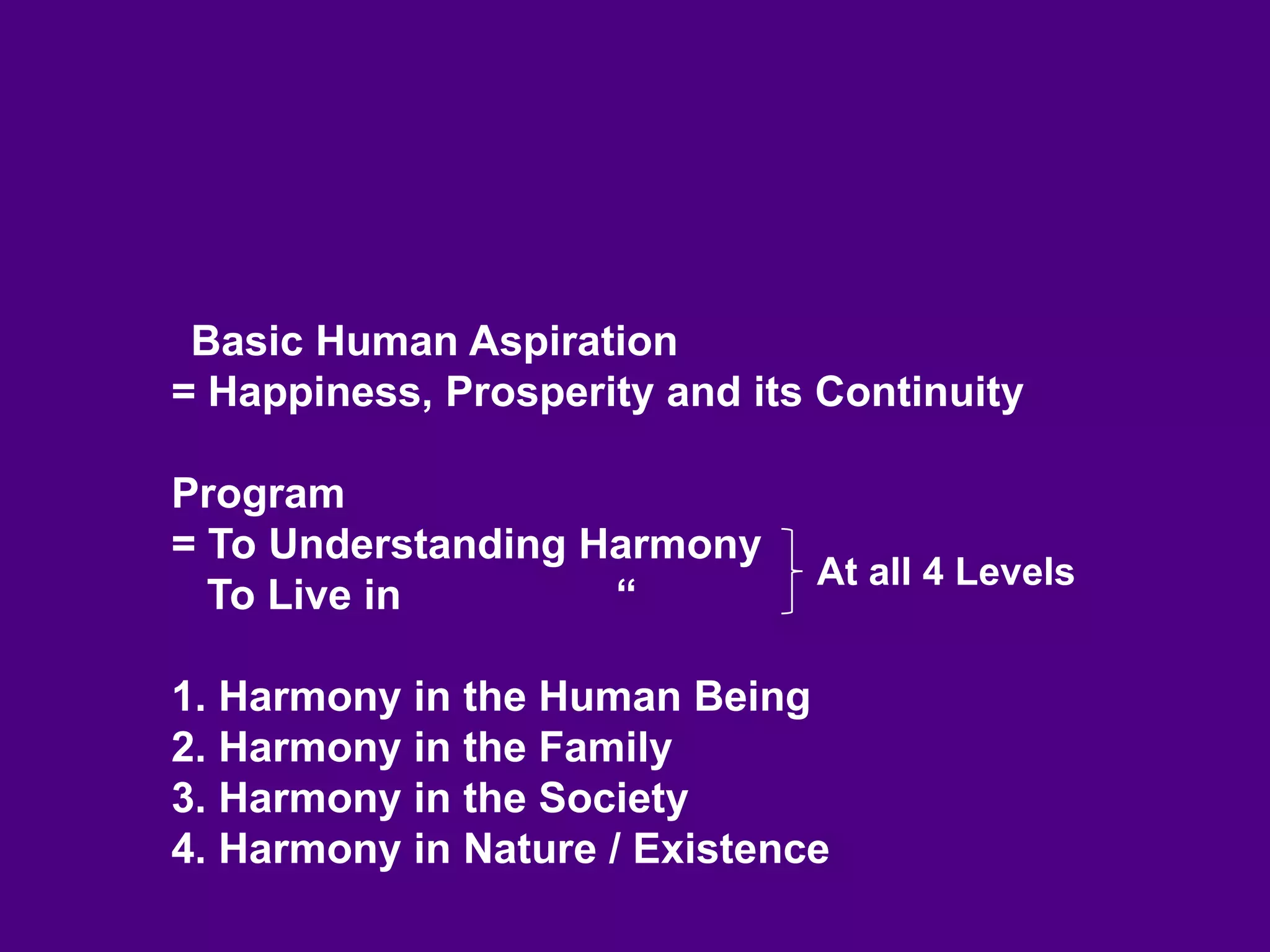
Basic Human Aspiration = Happiness, Prosperity and its Continuity Program = To Understanding Harmony    To Live in  “ 1. Harmony in the Human Being 2. Harmony in the Family 3. Harmony in the Society 4. Harmony in Nature / Existence At all 4 Levels
Program RELATIONSHIPS  (with human beings) PHYSICAL FACILITIES (with rest of nature) RIGHT UNDERSTANDING (in the self) MUTUAL HAPPINESS MUTUAL PROSPERITY 3 2 Human Conciousness Animal Conciousness 1
Harmony in the Family Relationship is – between the self (I) and the other self (I) There are feelings, or expectation of feelings, in relationship – of one self (I) for the other self (I) These feelings can be recognized – they are definite Their fulfilment and evaluation leads to mutual happiness Feelings in relationship: 1-  Trust  2-   Respect  3-  Affection 4-  Care  5-   Guidance   6-   Reverence   7-   Glory   8-   Gratitude  9-   Love
When these feelings are in me, I am in a state of harmony, happiness When I express them to the other, the other also feels happy Vs I only expect the other to express these feelings to me I feel happy only when the other expresses these feelings to me In which case do I have control on my state?
Trust  Trust = to be assured  = to be assured that each human being inherently wants oneself  and the other to be happy and prosperous, to have this clarity Absence of Trust = lack of assurance that the other intends my happiness = Doubt, Fear, Opposition…
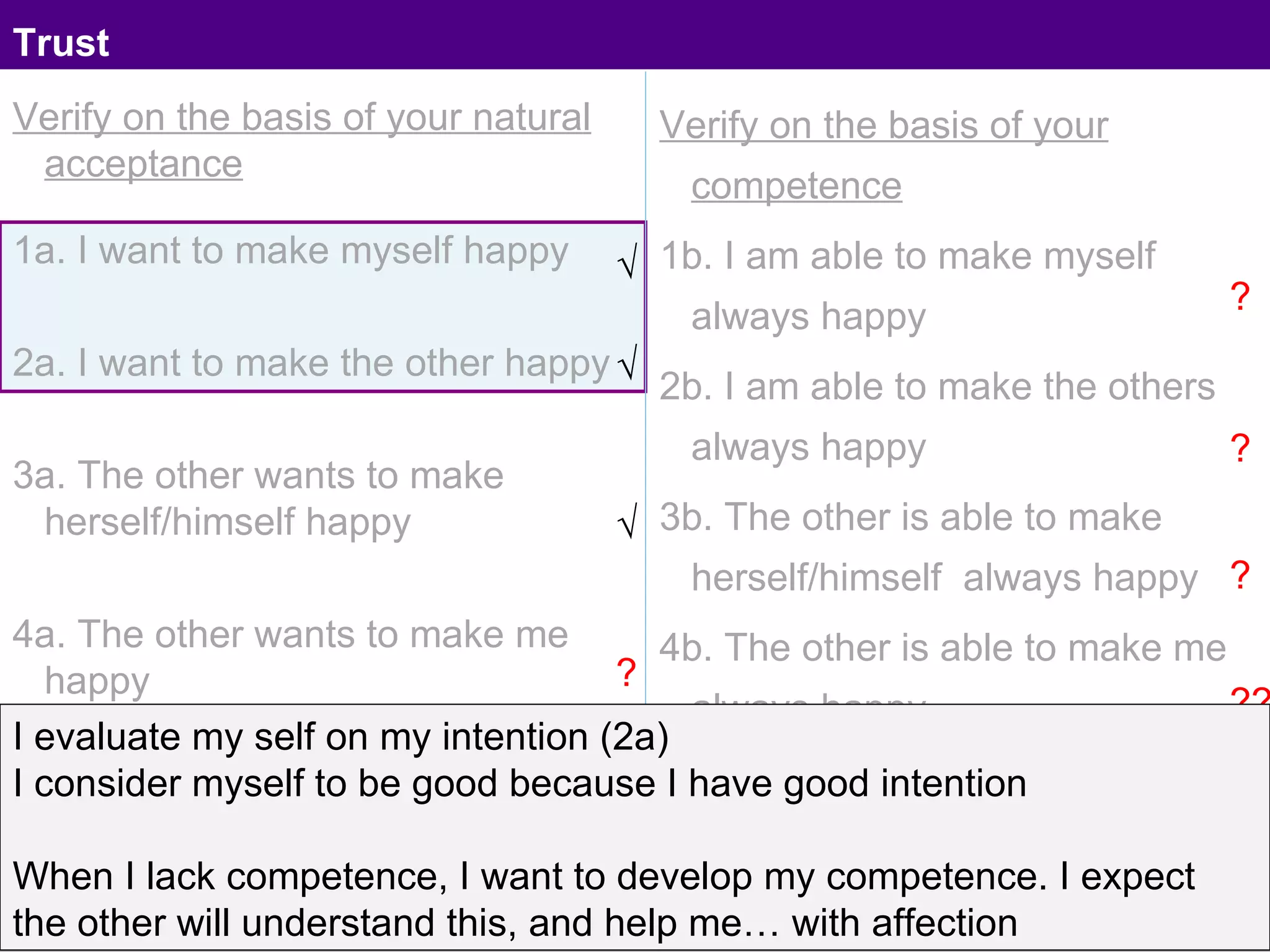
Verify on the basis of your natural acceptance 1a. I  want to  make myself happy 2a. I  want to  make the other happy 3a. The other  wants to  make herself/himself happy 4a. The other  wants to  make me happy Verify on the basis of your competence 1b. I  am able to  make myself  always happy  2b. I  am able to  make the others always happy 3b. The other  is able to  make herself/himself  always happy 4b. The other  is able to  make me  always happy Trust Intention – Natural Acceptance What I really want to be Competence What I am √ ? ? ? ?? ? √ √
Verify on the basis of your competence 1b. I am able to make myself  always happy  2b. I am able to make the others always happy 3b. The other is able to make herself/himself  always happy 4b. The other is able to make me  always happy Trust Verify on the basis of your natural acceptance 1a. I want to make myself happy 2a. I want to make the other happy 3a. The other wants to make herself/himself happy 4a. The other wants to make me happy Natural Acceptance, ie Intention  What we really want to be Competence What we are √ ? ? ? ?? ? √ √ Why this much difference? Is the other not like me? Observe that 3a & 4a are but a reflection of 1a & 2a. The other is a reflection of me
Verify on the basis of your natural acceptance 1a. I want to make myself happy 2a. I want to make the other happy 3a. The other wants to make herself/himself happy 4a. The other wants to make me happy Verify on the basis of your competence 1b. I am able to make myself  always happy  2b. I am able to make the others always happy 3b. The other is able to make herself/himself  always happy 4b. The other is able to make me  always happy Trust Natural Acceptance, ie Intention  What we really want to be Competence What we are √ ? ? ? ?? ? √ √ I evaluate my self on my intention  (2a) I consider myself to be good because I have good intention When I lack competence, I want to develop my competence. I expect the other will understand this, and help me… with affection
Verify on the basis of your competence 1b. I am able to make myself  always happy  2b. I am able to make the others always happy 3b. The other is able to make herself/himself  always happy 4b. The other is able to make me  always happy Verify on the basis of your natural acceptance 1a. I want to make myself happy 2a. I want to make the other happy 3a. The other wants to make herself/himself happy 4a. The other wants to make me happy Trust Natural Acceptance, ie Intention  What we really want to be Competence What we are √ ? ? ? ?? ? √ √ I evaluate the other on his competence (4b) Since the other does lack competence, I assume the other does not have the intention –  I doubt his intention  (4a) I conclude the other is bad Irritation, anger, condemning the other are indications of doubt on intention Doubt on intention is a major reason for problems in relationships
The other broke a glass The other did not come on time The other makes mistakes intentionally The other is bad The glass broke by accident I tried really hard to reach on time I make mistakes by accident I am good About the Other About Myself
Verify on the basis of your natural acceptance 1a. I want to make myself happy 2a. I want to make the other happy 3a. The other wants to make herself/himself happy 4a.  The other wants to make me happy Verify on the basis of your competence 1b. I am able to make myself  always happy  2b. I am able to make the others always happy 3b. The other is able to make herself/himself  always happy 4b. The other is able to make me  always happy Trust Natural Acceptance, ie Intention  What we really want to be Competence What we are √ ? ? ? ?? √ √ Trust on intention = Having no doubt on intention Trust is to be able to see that:  Everyone wants to understand (Sabhi sahi samajhna chahte hain) Everyone wants to live in harmony (Sabhi sahi jeena chahte hain) Everyone can understand (Sabhi sahi samajh sakte hain) Ie. to have no doubt on intention, to have the clarity that the other wants to be happy, and to make me happy √
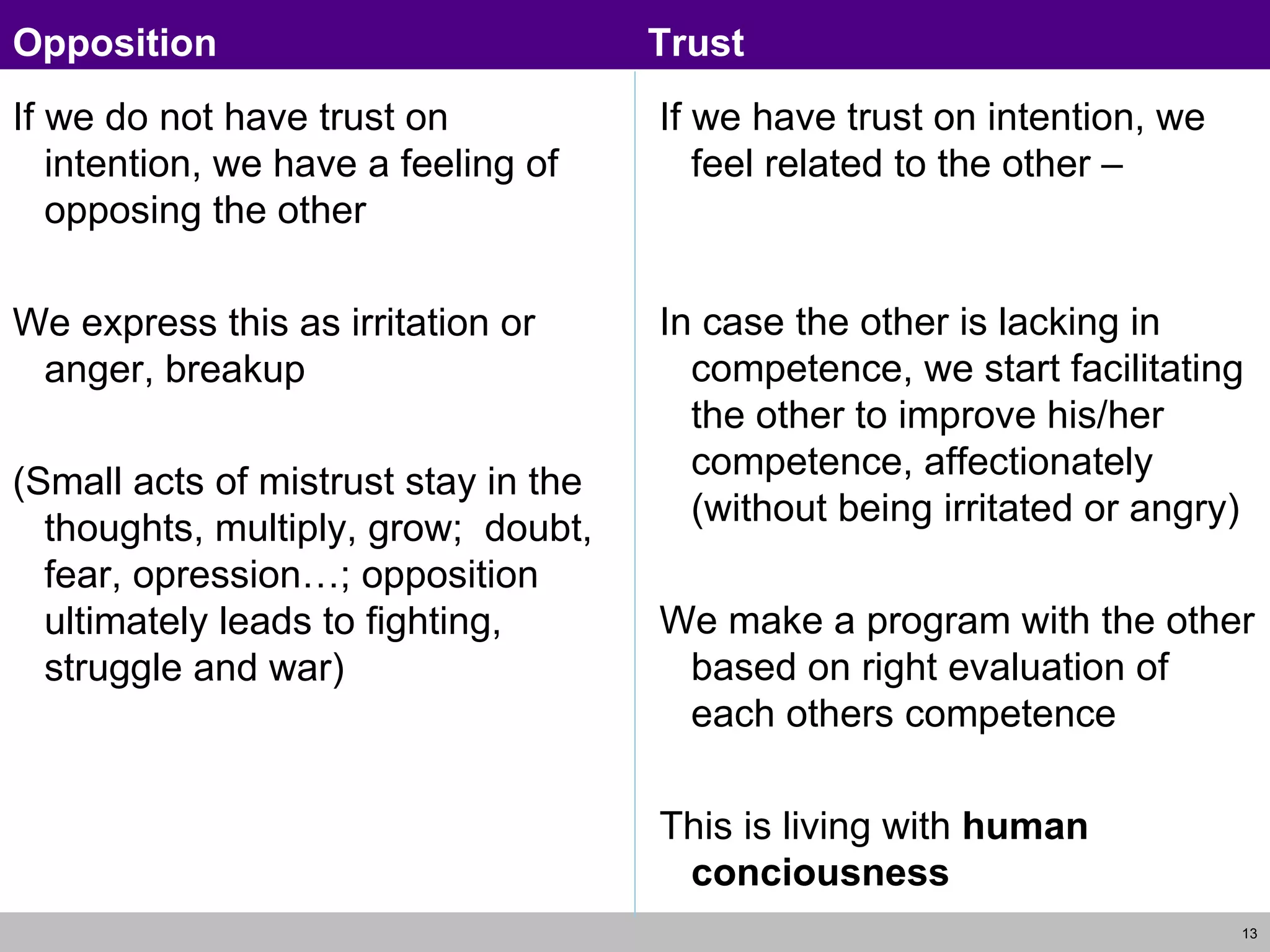
If we do not have trust on intention, we have a feeling of opposing the other We express this as irritation or anger, breakup (Small acts of mistrust stay in the thoughts, multiply, grow;  doubt, fear, opression…; o pposition ultimately leads to fighting, struggle and war) If we have trust on intention, we feel related to the other – In case the other is lacking in competence, we start facilitating the other to improve his/her competence, affectionately (without being irritated or angry) We make a program with the other based on right evaluation of each others competence This is living with  human conciousness Opposition Trust
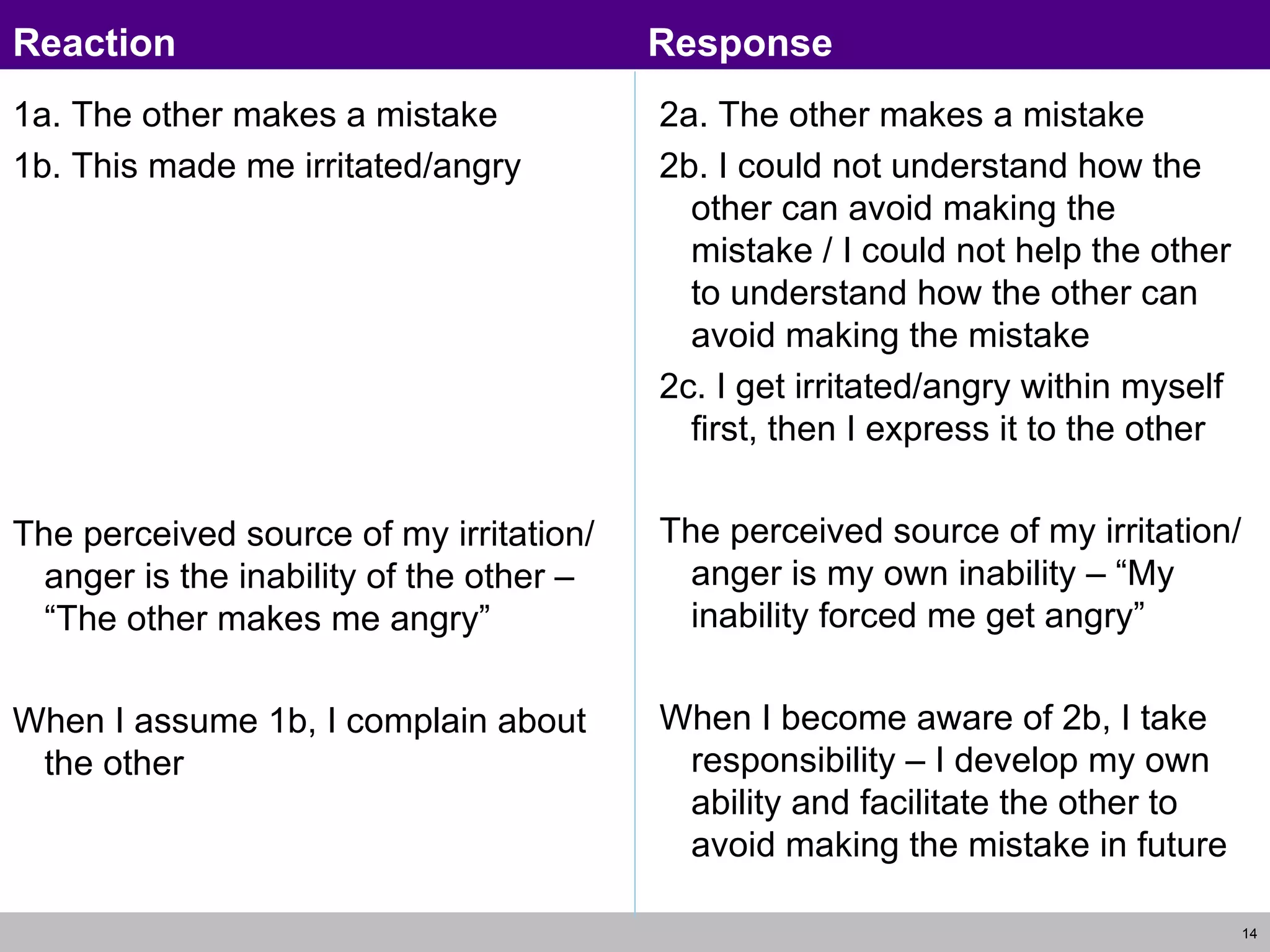
1a. The other makes a mistake 1b. This made me irritated/angry The perceived source of my irritation/anger is the inability of the other – “The other makes me angry” When I assume 1b, I complain about the other 2a. The other makes a mistake 2b. I could not understand how the other can avoid making the mistake / I could not help the other to understand how the other can avoid making the mistake 2c. I get irritated/angry within myself first, then I express it to the other The perceived source of my irritation/anger is my own inability – “My inability forced me get angry” When I become aware of 2b, I take responsibility – I develop my own ability and facilitate the other to avoid making the mistake in future Reaction Response
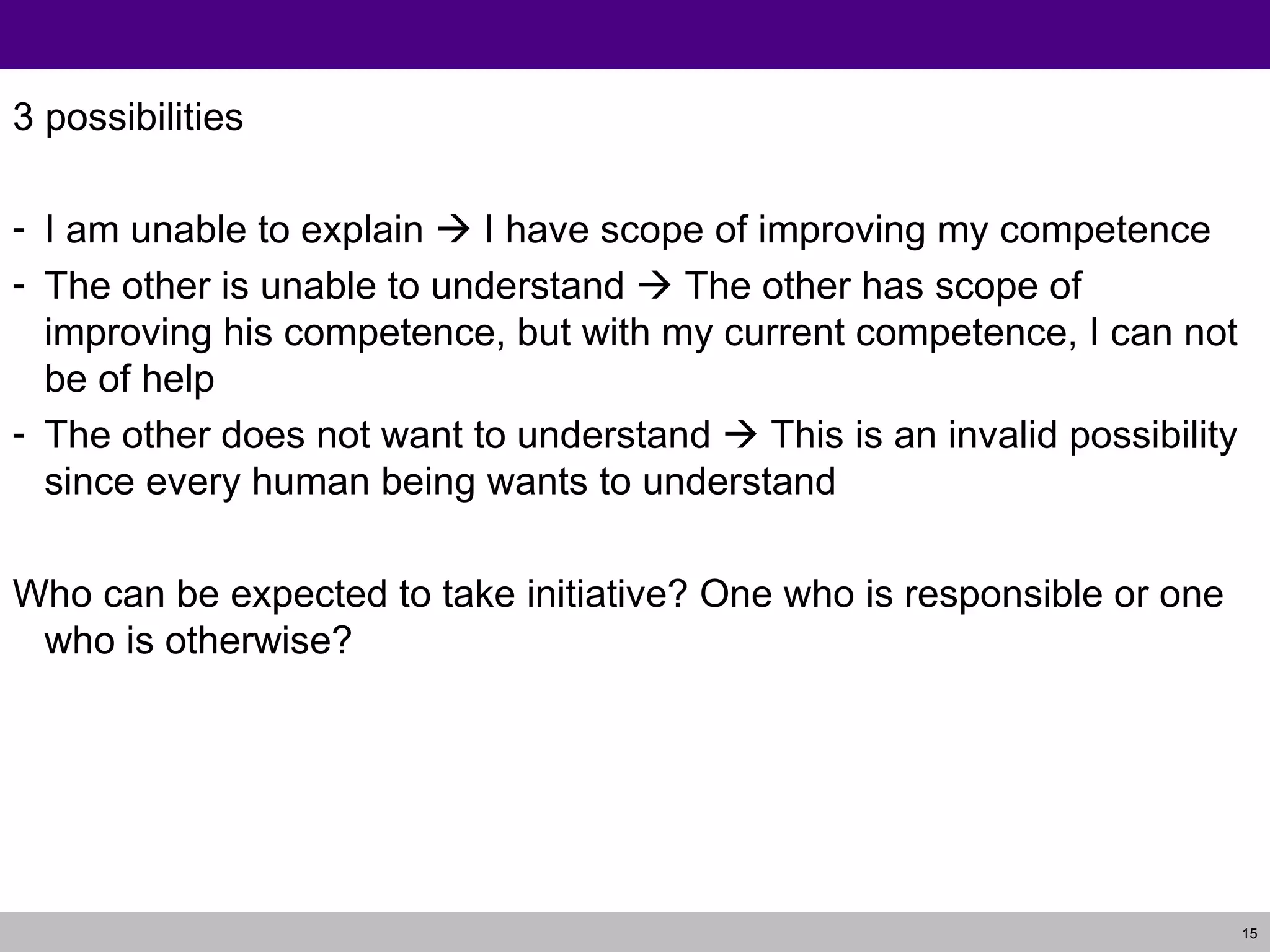
3 possibilities I am unable to explain    I have scope of improving my competence The other is unable to understand    The other has scope of improving his competence, but with my current competence, I can not be of help The other does not want to understand    This is an invalid possibility since every human being wants to understand Who can be expected to take initiative? One who is responsible or one who is otherwise?
Ex: Trust How many persons do you have trust on intention – unconditional (never having a feeling of opposition, getting irritated or angry)? Is increase in this number an indication of your progress or decrease in this number an indication of your progress?
How many persons do you have trust on intention – unconditional (never having a feeling of opposition, getting irritated or angry)? Is increase in this number progress or decrease in this number progress? (Answer yourself…try to find it inside your SELF)
Feelings (or Expectation of Feelings) in Relationships Natural acceptance for all of this is already within you Right understanding makes you aware Once you are aware of it, there is continuity of these feelings and you are able to  fulfill  them Having right feelings in oneself leads to one’s happiness Expressing these feelings to the other leads to happiness in the other Justice is ensuring right understanding in the self leading to right feelings and it's expression in relationship resulting in mutual hapiness. We have Natural Acceptance for Justice for All  –  from Family to World Family Trust  (Vishwas)  FOUNDATION   VALUE Respect  (sammaan) Affection  (Sneha) Care  (Mamta) Guidance  (Vatsalya) Reverence  (Shraddha) Glory  (Gaurav) Gratitude  (Kratagyata) Love  (Prem)  COMPLETE VALUE
Respect Respect = Right Evaluation Over evaluation– to evaluate for more than what it is Under evaluation– to evaluate for less than what it is Otherwise evaluation– to evaluate for other than what it is Whenever the evaluation is not right, it is disrespect If we observe, we will find in our day to day relationship, we tend to do one of the above three, leading to disrespect Check for yourself in every interaction with others whether it is respect or disrespect Disrespect
Differentiation (Disrespect) Evaluation  on the basis of Body, Physical Facilities or Beliefs (preconditioning) turns out to be differentiation and therefore disrespect Differentiation like this has led to resentments and protests.  Example:  Generation Gap, Black vs White, Powerful vs Opressed, Rich-Poor, Communism-Capatilism, Hindu-Muslim and so on Body Physical Facilities Beliefs Gender Age Post Wealth Isms Physical Strength Race Sects Differentiation  = Disrespect
Respect :  Right Evaluation – on the basis of the Self (I) Our purpose is the same, our natural acceptance  is the same  –  Just as I want to be continuously happy, so does the other Our program  is the same  –  Just as I can live happily by understanding and living in harmony at all levels, so it is for the other Our potential  is the same  –   Desire, Thought & Selection is continuous in me and also in the other .  Just as I can understand, so can the other The minimum content of respect is – to be able to  see and accept that  The Other is Similar to Me The difference could only be at the level of  4.  Understanding ;not information If the other has better understanding than me, I want to understand from other If the other has lesser understanding than me, I accept the responsibility to improve the understanding of the other
I evaluate on the basis of body, physical facilities or belief (pre conditioning) The other is different from me We are competitors. I make effort to accentuate the difference, to manipulate, exploit the other I evaluate on the basis of I (Self) We have the same purpose We have the same program We have the same potential (difference only in competence) The other is like me We are complementary to each other.  I live with responsibility if I have more understanding than the other, I help the other If the other has more understanding than me, I become ready to understand from the other This is living with  human conciousness Differentiation Respect
The feeling of being related Verify on the basis of your natural acceptance if you  want to be related to: None One Many Everyone None    The feeling of being related to none – in opposition to all One    The feeling of being related to one Many    The feeling of being related to many Everyone    The feeling of being related to all Affection Love
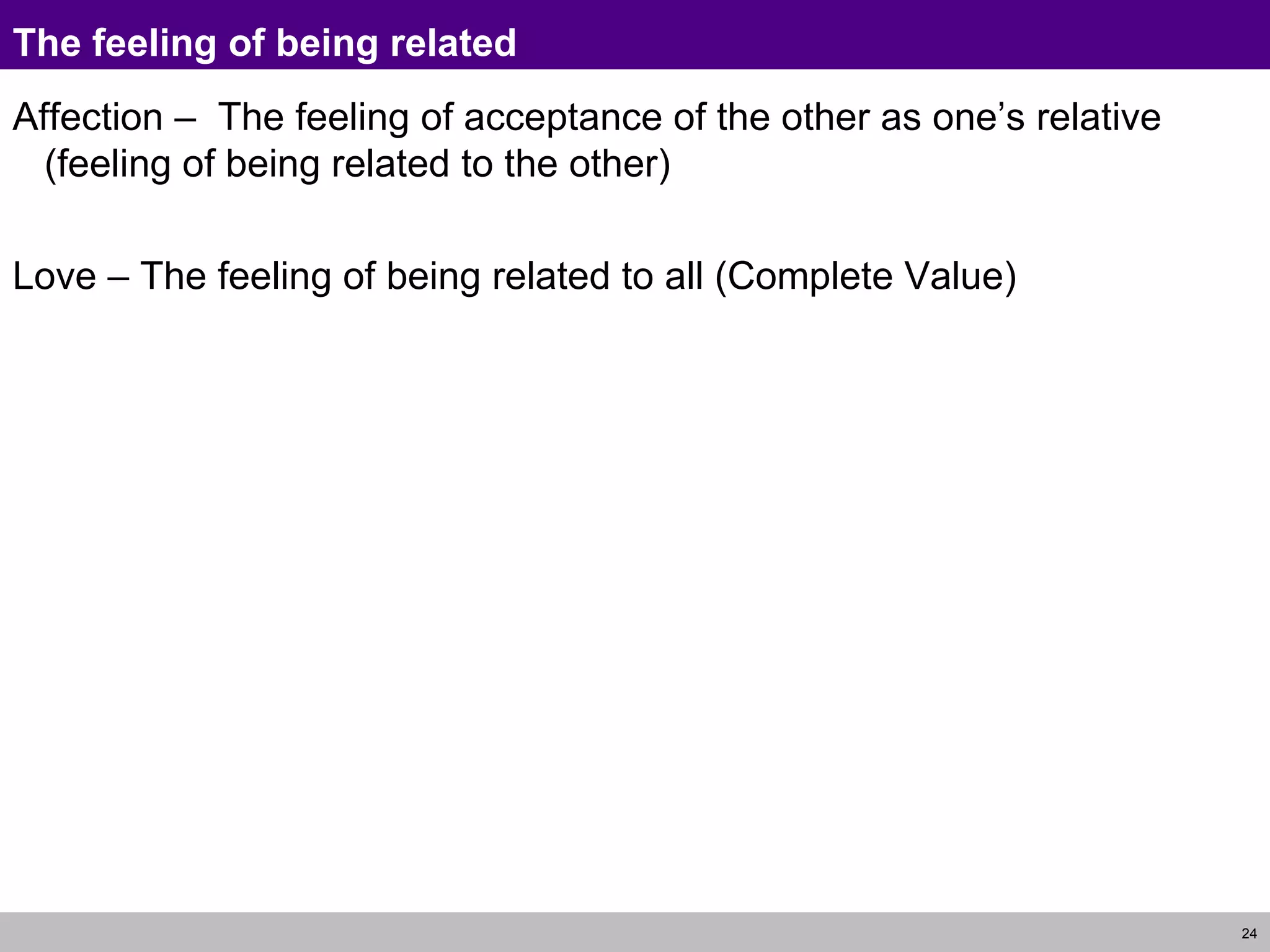
The feeling of being related Affection –  The feeling of acceptance of the other as one’s relative (feeling of being related to the other) Love – The feeling of being related to all (Complete Value)
The feeling of being related It all starts with identifying that one is related to other human being (Affection ) and it slowly expands to the feeling of being related to all human beings (Love ) and then to all, each & every unit in nature (human being as well as other units).  This leads to Undivided Society .It starts from family and slowly expands to world family; without being obstructed at any intermediate level. Evaluate for yourself if you have natural acceptance for this or to make a boundary at some level. Every human being has natural acceptance for expanding up to world family through this feeling of love, but due to lack of understanding of relationship, he is not able to ensure a relationship of mutual happiness even with his family members.
Understanding of the Harmony & Living in that Harmony Excellence and competition are not similar. In excellence, one helps to bring the other to his level In competition, he hinders the other from reaching to his level Excellence is Absolute & Definite Competition is always relative, with no definite state, no point of completion Reverence – The feeling of acceptance for Excellence Excellence at all 4 levels
Understanding of the Harmony & Living in that Harmony Excellence and competition are not similar. In excellence, one helps to bring the other to his level In competition, he hinders the other from reaching to his level Excellence is Absolute & Definite Competition is always relative, with no definite state, no point of completion Worship Effort made to achieve the excellence Reverence – The feeling of acceptance for the Excellence Excellence at all 4 levels
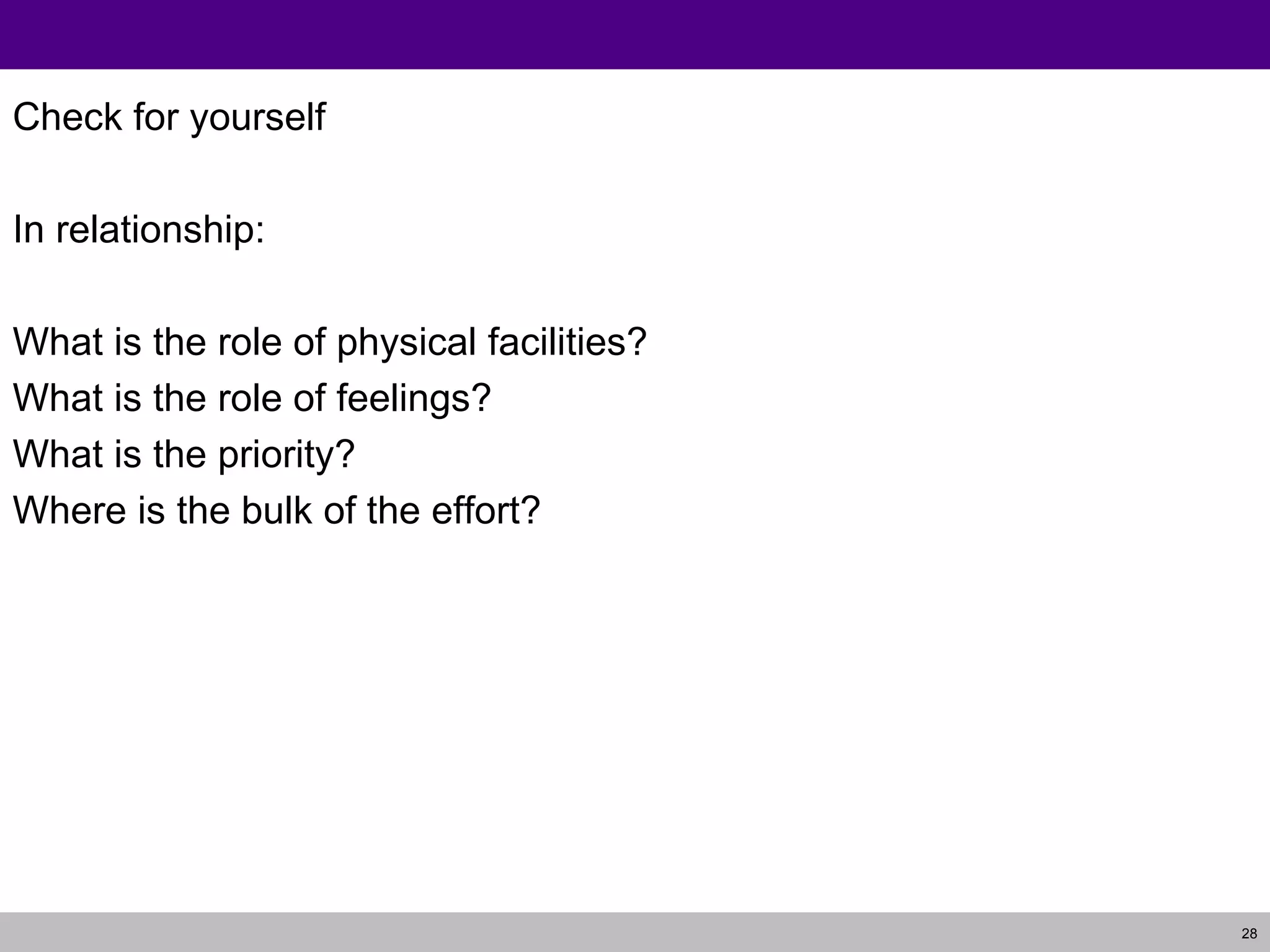
Check for yourself In relationship: What is the role of physical facilities? What is the role of feelings? What is the priority? Where is the bulk of the effort?
Joint family = happy family? Small family = happy family? Samajhdaar  family = happy family Love marriage = happy marriage? Arranged marriage = happy marriage? Marriage with right understanding & right feeling = happy marriage
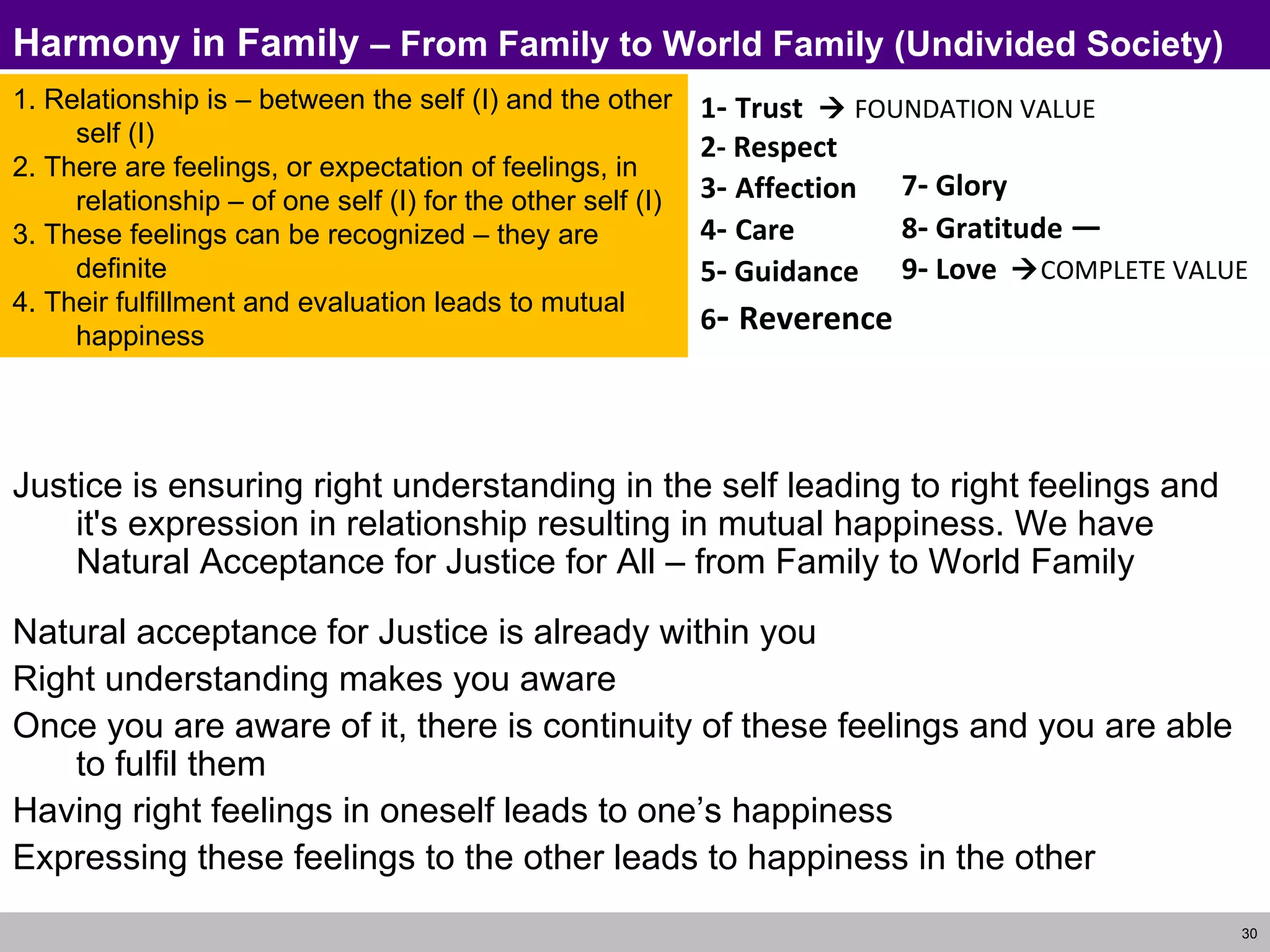
Justice is ensuring right understanding in the self leading to right feelings and it's expression in relationship resulting in mutual happiness. We have Natural Acceptance for Justice for All – from Family to World Family Natural acceptance for Justice   is already within you Right understanding makes you aware Once you are aware of it, there is continuity of these feelings and you are able to  fulfil  them Having right feelings in oneself leads to one’s happiness Expressing these feelings to the other leads to happiness in the other Harmony in Family  – From Family to World Family (Undivided Society) 1. Relationship is – between the self (I) and the other self (I) 2. There are feelings, or expectation of feelings, in relationship – of one self (I) for the other self (I) 3. These feelings can be recognized – they are definite 4. Their fulfillment and evaluation leads to mutual happiness 1 -  Trust     FOUNDATION  VALUE  2-  Respect  3 -  Affection  4 -  Care 5 -   Guidance   6 -  Reverence   7 -   Glory   8 -   Gratitude  — 9 -   Love   COMPLETE VALUE

Harmony in family

  • 1.
    Harmony in theFamily By: Priya Jaidka
  • 2.
    Basic Human Aspiration= Happiness, Prosperity and its Continuity Program = To Understanding Harmony To Live in “ 1. Harmony in the Human Being 2. Harmony in the Family 3. Harmony in the Society 4. Harmony in Nature / Existence At all 4 Levels
  • 3.
    Program RELATIONSHIPS (with human beings) PHYSICAL FACILITIES (with rest of nature) RIGHT UNDERSTANDING (in the self) MUTUAL HAPPINESS MUTUAL PROSPERITY 3 2 Human Conciousness Animal Conciousness 1
  • 4.
    Harmony in theFamily Relationship is – between the self (I) and the other self (I) There are feelings, or expectation of feelings, in relationship – of one self (I) for the other self (I) These feelings can be recognized – they are definite Their fulfilment and evaluation leads to mutual happiness Feelings in relationship: 1- Trust 2- Respect 3- Affection 4- Care 5- Guidance 6- Reverence 7- Glory 8- Gratitude 9- Love
  • 5.
    When these feelingsare in me, I am in a state of harmony, happiness When I express them to the other, the other also feels happy Vs I only expect the other to express these feelings to me I feel happy only when the other expresses these feelings to me In which case do I have control on my state?
  • 6.
    Trust Trust= to be assured = to be assured that each human being inherently wants oneself and the other to be happy and prosperous, to have this clarity Absence of Trust = lack of assurance that the other intends my happiness = Doubt, Fear, Opposition…
  • 7.
    Verify on thebasis of your natural acceptance 1a. I want to make myself happy 2a. I want to make the other happy 3a. The other wants to make herself/himself happy 4a. The other wants to make me happy Verify on the basis of your competence 1b. I am able to make myself always happy 2b. I am able to make the others always happy 3b. The other is able to make herself/himself always happy 4b. The other is able to make me always happy Trust Intention – Natural Acceptance What I really want to be Competence What I am √ ? ? ? ?? ? √ √
  • 8.
    Verify on thebasis of your competence 1b. I am able to make myself always happy 2b. I am able to make the others always happy 3b. The other is able to make herself/himself always happy 4b. The other is able to make me always happy Trust Verify on the basis of your natural acceptance 1a. I want to make myself happy 2a. I want to make the other happy 3a. The other wants to make herself/himself happy 4a. The other wants to make me happy Natural Acceptance, ie Intention What we really want to be Competence What we are √ ? ? ? ?? ? √ √ Why this much difference? Is the other not like me? Observe that 3a & 4a are but a reflection of 1a & 2a. The other is a reflection of me
  • 9.
    Verify on thebasis of your natural acceptance 1a. I want to make myself happy 2a. I want to make the other happy 3a. The other wants to make herself/himself happy 4a. The other wants to make me happy Verify on the basis of your competence 1b. I am able to make myself always happy 2b. I am able to make the others always happy 3b. The other is able to make herself/himself always happy 4b. The other is able to make me always happy Trust Natural Acceptance, ie Intention What we really want to be Competence What we are √ ? ? ? ?? ? √ √ I evaluate my self on my intention (2a) I consider myself to be good because I have good intention When I lack competence, I want to develop my competence. I expect the other will understand this, and help me… with affection
  • 10.
    Verify on thebasis of your competence 1b. I am able to make myself always happy 2b. I am able to make the others always happy 3b. The other is able to make herself/himself always happy 4b. The other is able to make me always happy Verify on the basis of your natural acceptance 1a. I want to make myself happy 2a. I want to make the other happy 3a. The other wants to make herself/himself happy 4a. The other wants to make me happy Trust Natural Acceptance, ie Intention What we really want to be Competence What we are √ ? ? ? ?? ? √ √ I evaluate the other on his competence (4b) Since the other does lack competence, I assume the other does not have the intention – I doubt his intention (4a) I conclude the other is bad Irritation, anger, condemning the other are indications of doubt on intention Doubt on intention is a major reason for problems in relationships
  • 11.
    The other brokea glass The other did not come on time The other makes mistakes intentionally The other is bad The glass broke by accident I tried really hard to reach on time I make mistakes by accident I am good About the Other About Myself
  • 12.
    Verify on thebasis of your natural acceptance 1a. I want to make myself happy 2a. I want to make the other happy 3a. The other wants to make herself/himself happy 4a. The other wants to make me happy Verify on the basis of your competence 1b. I am able to make myself always happy 2b. I am able to make the others always happy 3b. The other is able to make herself/himself always happy 4b. The other is able to make me always happy Trust Natural Acceptance, ie Intention What we really want to be Competence What we are √ ? ? ? ?? √ √ Trust on intention = Having no doubt on intention Trust is to be able to see that: Everyone wants to understand (Sabhi sahi samajhna chahte hain) Everyone wants to live in harmony (Sabhi sahi jeena chahte hain) Everyone can understand (Sabhi sahi samajh sakte hain) Ie. to have no doubt on intention, to have the clarity that the other wants to be happy, and to make me happy √
  • 13.
    If we donot have trust on intention, we have a feeling of opposing the other We express this as irritation or anger, breakup (Small acts of mistrust stay in the thoughts, multiply, grow; doubt, fear, opression…; o pposition ultimately leads to fighting, struggle and war) If we have trust on intention, we feel related to the other – In case the other is lacking in competence, we start facilitating the other to improve his/her competence, affectionately (without being irritated or angry) We make a program with the other based on right evaluation of each others competence This is living with human conciousness Opposition Trust
  • 14.
    1a. The othermakes a mistake 1b. This made me irritated/angry The perceived source of my irritation/anger is the inability of the other – “The other makes me angry” When I assume 1b, I complain about the other 2a. The other makes a mistake 2b. I could not understand how the other can avoid making the mistake / I could not help the other to understand how the other can avoid making the mistake 2c. I get irritated/angry within myself first, then I express it to the other The perceived source of my irritation/anger is my own inability – “My inability forced me get angry” When I become aware of 2b, I take responsibility – I develop my own ability and facilitate the other to avoid making the mistake in future Reaction Response
  • 15.
    3 possibilities Iam unable to explain  I have scope of improving my competence The other is unable to understand  The other has scope of improving his competence, but with my current competence, I can not be of help The other does not want to understand  This is an invalid possibility since every human being wants to understand Who can be expected to take initiative? One who is responsible or one who is otherwise?
  • 16.
    Ex: Trust Howmany persons do you have trust on intention – unconditional (never having a feeling of opposition, getting irritated or angry)? Is increase in this number an indication of your progress or decrease in this number an indication of your progress?
  • 17.
    How many personsdo you have trust on intention – unconditional (never having a feeling of opposition, getting irritated or angry)? Is increase in this number progress or decrease in this number progress? (Answer yourself…try to find it inside your SELF)
  • 18.
    Feelings (or Expectationof Feelings) in Relationships Natural acceptance for all of this is already within you Right understanding makes you aware Once you are aware of it, there is continuity of these feelings and you are able to fulfill them Having right feelings in oneself leads to one’s happiness Expressing these feelings to the other leads to happiness in the other Justice is ensuring right understanding in the self leading to right feelings and it's expression in relationship resulting in mutual hapiness. We have Natural Acceptance for Justice for All – from Family to World Family Trust (Vishwas) FOUNDATION VALUE Respect (sammaan) Affection (Sneha) Care (Mamta) Guidance (Vatsalya) Reverence (Shraddha) Glory (Gaurav) Gratitude (Kratagyata) Love (Prem) COMPLETE VALUE
  • 19.
    Respect Respect =Right Evaluation Over evaluation– to evaluate for more than what it is Under evaluation– to evaluate for less than what it is Otherwise evaluation– to evaluate for other than what it is Whenever the evaluation is not right, it is disrespect If we observe, we will find in our day to day relationship, we tend to do one of the above three, leading to disrespect Check for yourself in every interaction with others whether it is respect or disrespect Disrespect
  • 20.
    Differentiation (Disrespect) Evaluation on the basis of Body, Physical Facilities or Beliefs (preconditioning) turns out to be differentiation and therefore disrespect Differentiation like this has led to resentments and protests. Example: Generation Gap, Black vs White, Powerful vs Opressed, Rich-Poor, Communism-Capatilism, Hindu-Muslim and so on Body Physical Facilities Beliefs Gender Age Post Wealth Isms Physical Strength Race Sects Differentiation = Disrespect
  • 21.
    Respect : Right Evaluation – on the basis of the Self (I) Our purpose is the same, our natural acceptance is the same – Just as I want to be continuously happy, so does the other Our program is the same – Just as I can live happily by understanding and living in harmony at all levels, so it is for the other Our potential is the same – Desire, Thought & Selection is continuous in me and also in the other . Just as I can understand, so can the other The minimum content of respect is – to be able to see and accept that The Other is Similar to Me The difference could only be at the level of 4. Understanding ;not information If the other has better understanding than me, I want to understand from other If the other has lesser understanding than me, I accept the responsibility to improve the understanding of the other
  • 22.
    I evaluate onthe basis of body, physical facilities or belief (pre conditioning) The other is different from me We are competitors. I make effort to accentuate the difference, to manipulate, exploit the other I evaluate on the basis of I (Self) We have the same purpose We have the same program We have the same potential (difference only in competence) The other is like me We are complementary to each other. I live with responsibility if I have more understanding than the other, I help the other If the other has more understanding than me, I become ready to understand from the other This is living with human conciousness Differentiation Respect
  • 23.
    The feeling ofbeing related Verify on the basis of your natural acceptance if you want to be related to: None One Many Everyone None  The feeling of being related to none – in opposition to all One  The feeling of being related to one Many  The feeling of being related to many Everyone  The feeling of being related to all Affection Love
  • 24.
    The feeling ofbeing related Affection – The feeling of acceptance of the other as one’s relative (feeling of being related to the other) Love – The feeling of being related to all (Complete Value)
  • 25.
    The feeling ofbeing related It all starts with identifying that one is related to other human being (Affection ) and it slowly expands to the feeling of being related to all human beings (Love ) and then to all, each & every unit in nature (human being as well as other units). This leads to Undivided Society .It starts from family and slowly expands to world family; without being obstructed at any intermediate level. Evaluate for yourself if you have natural acceptance for this or to make a boundary at some level. Every human being has natural acceptance for expanding up to world family through this feeling of love, but due to lack of understanding of relationship, he is not able to ensure a relationship of mutual happiness even with his family members.
  • 26.
    Understanding of theHarmony & Living in that Harmony Excellence and competition are not similar. In excellence, one helps to bring the other to his level In competition, he hinders the other from reaching to his level Excellence is Absolute & Definite Competition is always relative, with no definite state, no point of completion Reverence – The feeling of acceptance for Excellence Excellence at all 4 levels
  • 27.
    Understanding of theHarmony & Living in that Harmony Excellence and competition are not similar. In excellence, one helps to bring the other to his level In competition, he hinders the other from reaching to his level Excellence is Absolute & Definite Competition is always relative, with no definite state, no point of completion Worship Effort made to achieve the excellence Reverence – The feeling of acceptance for the Excellence Excellence at all 4 levels
  • 28.
    Check for yourselfIn relationship: What is the role of physical facilities? What is the role of feelings? What is the priority? Where is the bulk of the effort?
  • 29.
    Joint family =happy family? Small family = happy family? Samajhdaar family = happy family Love marriage = happy marriage? Arranged marriage = happy marriage? Marriage with right understanding & right feeling = happy marriage
  • 30.
    Justice is ensuringright understanding in the self leading to right feelings and it's expression in relationship resulting in mutual happiness. We have Natural Acceptance for Justice for All – from Family to World Family Natural acceptance for Justice is already within you Right understanding makes you aware Once you are aware of it, there is continuity of these feelings and you are able to fulfil them Having right feelings in oneself leads to one’s happiness Expressing these feelings to the other leads to happiness in the other Harmony in Family – From Family to World Family (Undivided Society) 1. Relationship is – between the self (I) and the other self (I) 2. There are feelings, or expectation of feelings, in relationship – of one self (I) for the other self (I) 3. These feelings can be recognized – they are definite 4. Their fulfillment and evaluation leads to mutual happiness 1 - Trust  FOUNDATION VALUE 2- Respect 3 - Affection 4 - Care 5 - Guidance 6 - Reverence 7 - Glory 8 - Gratitude — 9 - Love  COMPLETE VALUE

Editor's Notes

  • #26 Eg samman purvak saada bhojan Samay anusaar expand vishwaas (intention – competence)
  • #29 Eg samman purvak saada bhojan Samay anusaar expand vishwaas (intention – competence)