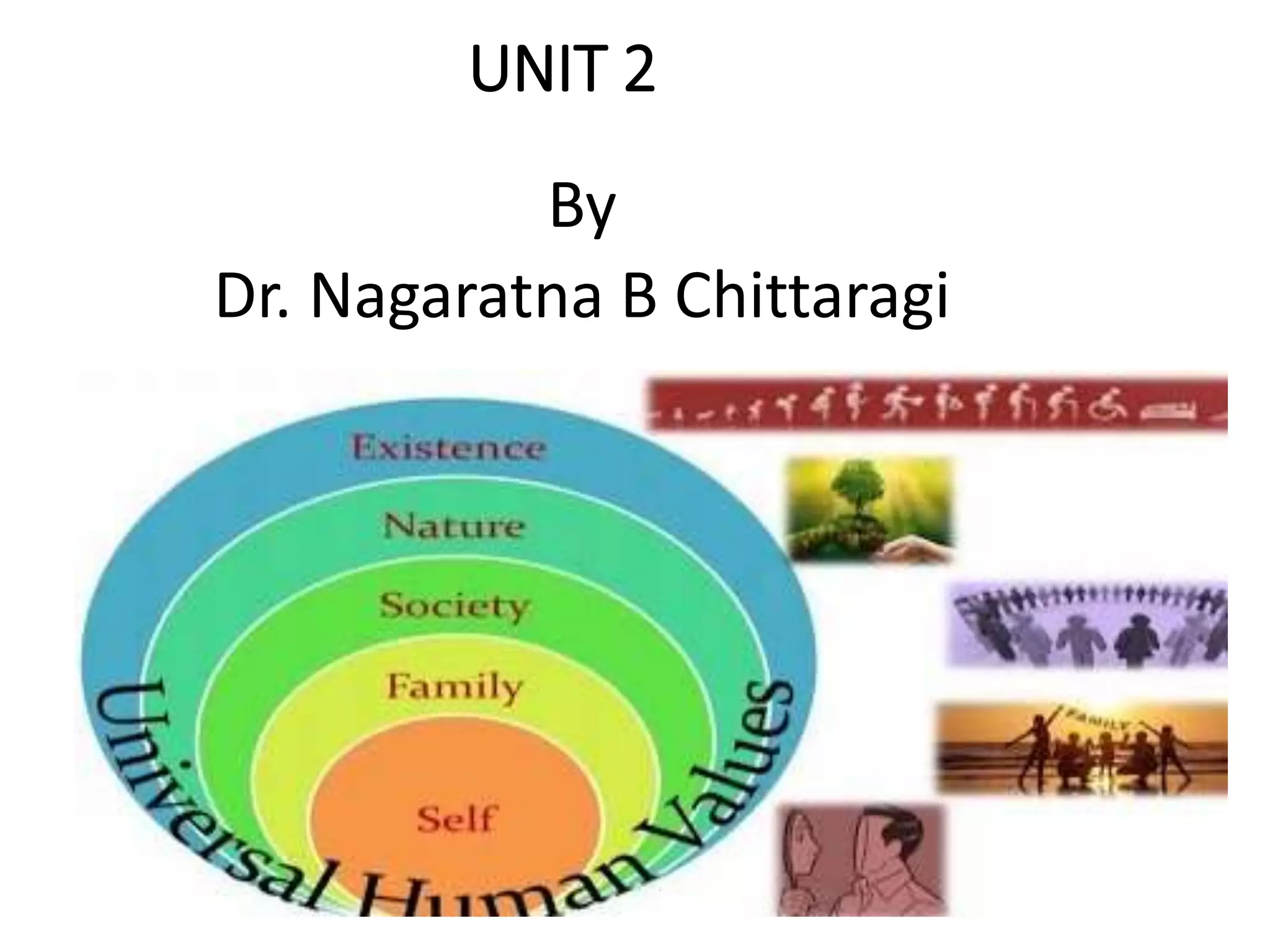
UNIT 2
By
Dr. Nagaratna B Chittaragi
Unit 2: Understanding Harmony in the Family and
Society - Harmony in Human-Human Relationship
• Family is the Basic Unit of all Interaction: Each of us is born into a
family which includes a number of relationships.
• These relationships are the reality of our life. We recognize and
identify these individuals.
• We share our feelings, tastes, interests and understanding with these
people and have an affinity for them.
• Beginning with our family as the basic unit of interaction, we extend
our interactions to the immediate neighbor-hood such as the
shopkeepers, servants, classmates, teachers, colleagues etc.
• Thus we extend our interactions from beginning from our family to a
bigger social order and then move further to a still bigger web of
interdependency.
Set of proposals to verify Harmony in the Family:
1. Relationship IS and it exists between the Self (‘I’) and the other Self
(‘I’): In a family, we do not create relationships. Instead we are
embedded into relationships that are already there and all that we need
to do is to recognize them and understand them.
2. The Self (‘I’) has feelings in a relationship. These feelings are between
(‘I’) and (‘I’): In any relationship, it is the person’s Self (I) that is related
to the other person’s Self (I).
The body is only a means to express our relationship.
For example, in a mother and a child, it is the Self of the mother and the Self
of the child who feel connected. Their bodies are incapable of understanding
or having feelings.
3. These feelings in the (‘I’) are definite. i.e. they can be identified
with definiteness:
The feelings in a relationship between “I” and “I” such as Trust, Respect,
Affection etc., can be identified with clarity. These feelings are the values
which characterize any relationship.
4. Recognizing and Fulfilling these feelings lead to Mutual
Happiness in a relationship: Once we recognize the values
essential for any relationship, we start working and behaving
according to these feelings.
We begin evaluating ours’ and others’ feelings in the relationship.
Thus living with these values leads to mutual fulfillment and happiness
in all our relationships.
Foundation Value and Complete Value in
Human Relationship:
• There are certain basic and important values in maintaining relationship.
• These values, we all know, are the backbone of health and happy family
relations.
• The feelings, emotions, sentiments and respect all are of real
importance.
• These values lead to elimination of friction and establishment of total
harmony in relationship on long term basis.
• Values that are important in any relationship are:
Feelings / Values in Relationships
Sl.No. Feeling
1 Trust / Visvasa
2 Respect / Sammana
3 Affection / Sneha
4 Care / Mamata
5 Guidance / Vatsalya
6 Reverence / Shraddha
7 Glory / Gaurava
8 Gratitude / Kritagyata
9 Love / Prema
What is naturally acceptable to you?
 Feeling of trust or mistrust?
 Feeling of respect or disrespect?
 Feeling of affection or jealousy?
 Feeling of care or exploitation?
 Feeling of guidance or misguidance, confusion?
 Feeling of reverence or irreverence?
 Feeling of glory or inglorious feelings?
 Feeling of gratitude or ingratitude?
 Feeling of love or hatred?
1. Trust:
• Trust or vishwas is the foundational value in relationship.
“To be assured that each human being inherently wants oneself and
the other to be happy and prosperous.” If we have trust in the other,
we are able to see the other as a relative and not as an adversary.
 Having faith in others and believing them. Trust is the expectation of
people that they can rely on our word. It is built through integrity and
consistency in relationships.
 To keep the trust on ourself and others, we have to pay attention on
the intensions and to understand if we or the other person is not able
to do benefit, it is because we are lacking competence.
 Trust is the result of right understanding of the intention of all the
human beings around us.
 This trust helps to improve our competence in others and in ourselves.
There are two aspects in trust:
• i. Intention (wanting to – our natural acceptance)
• ii. Competence (being able to do)
• Both intention and competence are the aspects of trust. Intention
is what one aspires for (our natural acceptance) and competence is
the ability to fulfil the aspiration.
• In intention every human being wants to do what is right, only
the competence may be lacking which needs to be developed
through proper understanding and practice.
2. Respect:
Respect Differentiation
1. Respect is right evaluation. 1. Differentiation is lack of understanding of respect.
2. Respect for others is generated by the
right evaluation and understanding which
leads to fulfilment in relationships.
This further creates a sense of respect
among people
2. This differentiation can take the form of:
o Gender bias
o Generation gap
o Caste struggle
o Power play and domination
o Communal violence
o Clash of race, religion, etc.
o class struggle,
3. This leads to the escalation in the problems of
society which further lowers the respect shown to
others in society.
Respect means individuality. The sense of individuality is prime object.
This is the first basic step towards respect (sammana).
Once we realized that we are individual then only we can see our self
different from others.
In other words, respect means right evaluation, to be evaluated as I am.
Difference between Respect and Differentiation / Disrespect:
• Affection is the feeling of being related to the other.
Affection comes when I recognize that we both want to make each
other happy and both of us are similar.
• Then for the first time, I feel that I am related to the other that the
other is a relative of mine. This feeling is called affection.
• The feeling of affection comes only if trust and respect are
already ensured.
• Without trust and respect, we feel the other is trying to make us
unhappy, does not wish well for us and hence we can never feel
affection for him/her. We always see the other as being in
opposition.
4. Care:
• The feeling of care is the feeling to nurture and protect the
body of our relative. Or in other words a state of mind in which
one is troubled; worry, anxiety, or concern is called care.
5. Guidance:
The feeling of ensuring right understanding and feelings in
the other (my relative) is called guidance. We understand the
need of self (‘I’) for right understanding and feelings.
We also understand that the other is similar to me in his/her
faculty of natural acceptance, desire of wanting continuous
happiness and the program of living in harmony at all the four
levels.
6. Reverence:
• The feeling of acceptance of excellence in the other is called
reverence. When we see that the other has achieved this excellence-
which means to understand and to live in harmony at all the levels of
living ensuring continuity of happiness, we have a feeling of
reverence for him/her.
7. Glory: Each one of us wants to live with continuous happiness and
prosperity. Each one of us has the similar faculty of natural acceptance,
has the same goal and program and we have the same potential to
realize this. Glory is the feeling for someone who has made efforts for
excellence.
8. Gratitude:
Gratitude is the feeling of acceptance for those who have
made efforts for my excellence. Gratitude is an emotion that
occurs after people receive help, depending on how they
interpret the situation.
• 9. Love:
• Love is the emotion of strong affection and personal
attachment. In other words, love is a feeling of warm
personal attachment or deep affection, as for a parent, child,
or friend.
• This feeling or value is also called the complete value since this
is the feeling of relatedness to all human beings. It starts with
identifying that one is related to the other human being (the
feeling of affection) and it slowly expands to the feeling of being
related to all human beings.
Differentiate between intention and competence:
• Mutual trust is a shared belief that we can depend on each other
to achieve a common purpose. Trust is the expectation of people
that they can rely on our word. It is built through integrity and
consistency in relationships. There are two aspects in trust:
• 1. Intention (wanting to – our natural acceptance)
• 2. Competence (being able to do)
• In intention every human being wants to do what is right, only the
competence may be lacking which needs to be developed through
proper understanding and practice.
• But what we are doing today is that when we are judging ourself
we are judging on the basis of our intention, whereas, when we are
judging the other we are judging him on the basis of his
competence.
• We trust our own intention while we are not ready to trust the
others intention. It is the same for other as well. We find that
while we look at our intention, we are sure of it, we are not sure
of the other’s intention. We are actually seeing their
competence, and making a conclusion on their intention. Hence,
mistrust is born and we deny the relationship. We seldom look at
our competence and other’s intention.
• It is very important to differentiate between intention and
competence. If we have trust on intention, we have a feeling of
being related to the other and we start helping the other to
improve his competence, if he does not have enough. Fig 10.
depicts the mistrust on others’ competence while we don’t
doubt our intention.
19
About your Natural Acceptance
1a. I want to make myself happy
always
2a. I want to make the other happy
always
3a. The other wants to make
herself/himself happy always
4a. The other wants to make me
happy always
About your Ability
1b. I am able to make myself
always happy
2b. I am able to make the other
always happy
3b. The other is able to make
herself/himself always happy
4b. The other is able to make me
always happy
Doubt on Intention: Mistrust
Intention – Natural Acceptance
What is Naturally Acceptable to You
Competence
What You Are (∑ D, T, E)
√
?
?
?
??
?
√
√
• We trust our own intention while we are not ready to trust the other’s intention. It is
the same for the others as well.
• They would also have the same answers as we, to the table above. While the other
trusts his/her own intentions, he/she does not trust mine.
• Hence, mistrust is born and we deny the relationship. When we are judging ourself
we are judging on the basis of our intention, whereas, when we are judging the
other we are judging him on the basis of his competence.
• We are sure in point 2 a) that we want to make the other happy, but in point 4 a) we
are not sure that the other wants to make us happy.
• We can see that as we are not able to fulfil our intentions in terms of our competence
at all times. It is the same for the other as well.
• We want to be related to the other, and we want the other to be related to us,
irrespective of who this other is. If we have trust in the other, we are able to see the
other as a relative and not as an adversary.
• We then become ready to become a help to the other. Intentions are always correct; it
is only the competence that is lacking, which can be improved by right understanding.
Difference between reaction and response is represented in table 2.
Table 2: Difference between reaction and response
Reaction Response
1.Doubt on intention. 1. We are able to see that relationship IS at the level of ‘I’.
2. Irritation 2. We feel the relatedness with the other – at the level of ‘I’
3. Getting angry 3. We don’t doubt the intention of the other ‘I’.
4. Fights. 4. We feel a sense of responsibility to improve our own
competence and the other’s competence
5. We work for mutual fulfilment.
2. Respect:
Respect Differentiation
1. Respect is right evaluation. 1. Differentiation is lack of understanding of respect.
2. Respect for others is generated by the
right evaluation and understanding which
leads to fulfilment in relationships.
This further creates a sense of respect
among people
2. This differentiation can take the form of:
o Gender bias
o Generation gap
o Caste struggle
o Power play and domination
o Communal violence
o Clash of race, religion, etc.
o class struggle,
3. This leads to the escalation in the problems of
society which further lowers the respect shown to
others in society.
Respect means individuality. The sense of individuality is prime object.
This is the first basic step towards respect (sammana).
Once we realized that we are individual then only we can see our self
different from others.
In other words, respect means right evaluation, to be evaluated as I am.
Difference between Respect and Differentiation / Disrespect:
Present Scenario:
Differentiation (Disrespect) in relationships on the basis of body, physical
facilities, or beliefs –
• Respect means accepting individuality and doing right evaluation (to be
evaluated as I am). Our basis for respect today is largely quite contrary to
our discussion above.
• Instead of respect being a basis of similarity or one of right evaluation, we
have made it into something on the basis of which we differentiate i.e. by
respecting you mean you are doing something special, because you are
special or have something special or are in some special position.
• There is no notion of respect in terms of right evaluation. Thus, there is no
real feeling of relationship, only one of differentiation.
On the basis of body
• Sex/gender: We ignore the fact that being male or female is an attribute of
the body, and not an attribute at the level of ‘I’. And differentiate in giving
respect on the basis of gender called male and females.
• Race: If the person is of the same race as oneself, then we treat them
differently. For example, we differentiate on the basis of skin colour –
white, brown, black etc. or on the basis of whether the person is of Aryan
race, Mongolian race etc. or on the basis of caste.
• Age: We have notions such as ‘one must respect elders’. There is no such
notion as respect youngsters. Here, we see that we are again evaluating at
the level of the body – age is related to the body, and not to ‘I’.
• Physical strength: If someone is stronger, we again treat him/her
differently.
• This is again at the level of the body. In fact, we think that we are
respecting the other while it is fear; the fear that if we do not treat them like
this, we will be harmed.
On the basis of physical facilities
• Wealth: We differentiate people because some have wealth than others.
What we term as a “rich person” gets idolized.
• We don’t even bother to find out whether such people are feeling
prosperous, or if they just have wealth.
• This way, we are over-evaluating physical facilities first, which are just
meant to fulfil the needs of the body, and then on this basis, we are wrongly
identifying our relationship.
• Post: We try to respect on the basis of a person’s position.
• The post is wrongly evaluated as the mark of a person’s
excellence and differentiation sets in.
• The post is considered important either on the basis that it
gives more physical facilities or on the basis that certain
positions are assumed to be important.
• In our education, we are trained directly or indirectly to earn
posts for us to fetch respect.
On the basis of beliefs
• ‘Isms’: ‘Ism’ means any belief in terms of a ‘thought-system’ that we have,
or that we have adopted.
• There are also many modern ‘isms’ such as capitalism, socialism,
communism, etc.
• The people following these sets of beliefs are called capitalists, socialists,
communists, and so on. The people that have adopted them or are
following them have been exposed to them since childhood. Believing
theirs to be the right belief.
• Sects: People of one sect only consider those with a similar belief system to
be their ‘own’ and worthy of respect.
• Following a particular tradition, or what we call as religion, becomes the
basis of respect and disrespect in relationship.
The Problems Faced Due To Differentiation In
Relationships:
• Differentiation based on sex/gender: Issue of women’s rights, and women
protesting and demanding for equality in education, in jobs, and in peoples’
representation. People are insecure and afraid of one another based on their
gender.
• Differentiation based on race: there are many movements and protect against
racial discrimination and demands for equality, racial attacks, movements
against cast discrimination has people living in fear of such racism, racist
attacks, casticism and discrimination.
• Differentiation based on age: Protests and movements demanding for equal
rights for children on the one hand and for rights for elderly people on the
other, generation gap
• Differentiation based on wealth: Class struggle and movements to do away
with class-differentiation. Many people suffering from a lack of self-esteem and
some even committing suicide,
• Differentiation based on post: Protests against high handed government
officials. At the level of the individual, leads to depression, etc.
• Differentiation based on ’isms: Fights, turmoil, terrorism and war, people
converting from one Ism to another in order to be able to get more respect.
• Differentiation based on sects: Countless religions and sects and each sect has
its own movement to ensure that there is no discrimination against people of
their belief and demands for special provisions in jobs and in education.
Basis of ‘respect’ for a human being:
• Respect means individuality. The sense of individuality is
prime object. This is the first basic step towards respect
(sammana).
• Once we realized that we are individual then only we can
see ourself different from others. In other words, respect
means right evaluation, to be evaluated as I am.
• If we respect a human being on the basis of ‘I’, following
things are true for every human being:
1. I want happiness and prosperity.
¬ The other too wants to be continuously happy and prosperous!
2. To be happy, I need to understand and live in harmony at all
four levels of my living.
¬ The other also needs to understand and live in harmony at all
four levels of his/ her living!
3. The activities in me (‘I’) are continuous, we can check this for
our desires, thoughts and expectations.
¬ It is the same for the other ‘I’ as well. The activities are
continuous there as well, and the other too has continuous desires,
thoughts and expectations!
1. We both want to have continuous happiness and prosperity.
Our basic aspiration is the same.
2. We both need to have the right understanding, which is to understand and
live in harmony at all four levels of our living.
Our program of action is the same.
3. The activities and powers of the self are continuous and the same in both
of us – at the level of ‘I’.
Our potential is the same.
Based on these three evaluations we can conclude that
The other is similar to me
When we are able to see that the other is similar to me, we are able to
recognize the feeling of respect in the relationship. If not, we either hold
ourselves, more or less than the other and this only leads to differentiation.
When we see the above, what can we conclude? The other person also feels quite
like me! There are so many similarities! Let us put down these similarities, in
order:
Justice (Nyaya):
• Justice is the recognition of values (the definite feelings) in relationship,
their fulfilment, the right evaluation of the fulfilment resulting in mutual
happiness.
• Justice concerns itself with the proper ordering of things and people within a
society.
There are four elements:
1. Recognition of values,
2. fulfilment,
3. evaluation and
4. mutual happiness ensured.
When all the four are ensured, justice is ensured.
• Mutual fulfilment is the hallmark of justice. And justice is essential in all
relationships. Justice starts from family and slowly expands to the world family.
• The child gets the understanding of justice in the family. With this understanding, he
goes out in the society and interacts with people.
Justice in human relationships leads to mutual
happiness:
• If the understanding of justice is ensured in the family, there will be justice in
all the interactions we have in the world at large.
• If we do not understand the values in relationships, we are governed by our
petty prejudices and conditionings.
• We may treat people as high or low based on their body (particular caste, or
sex or race or tribe), on the basis of wealth one possesses or the belief systems
that one follows.
• All this is source of injustice and leads to fragmented society while our natural
acceptance is for an undivided society and universal human order.
• We slowly get the competence to live in harmony with all human beings.
Maintaining harmony in relationship:
• The family is the basic unit of human interaction…
• It is the anchor that roots us… it gives us both roots to hold and wings to fly. It is not
surprising that children who grow up in happy families are more successful and well-
adjusted in life.
• There is a set of proposals about the families for us to verify:
1. Relationship IS and it exists between the self (‘I’) and the other self (‘I’)
2. The self (‘I’) has FEELINGS in a relationship. These feelings are between ‘I’ and ‘I’.
3. These feelings in the self (‘I’) are DEFINITE. i.e. they can be identified with
definiteness.
4. RECOGNIZING and FULFILLING these feelings leads to MUTUAL HAPPINESS in
relationship.
1. Relationship IS and it exists between the self (‘I’) and the other self (‘I’):
• Once we have recognized the existence of human relationships, we are
subsequently able to identify the feelings (values). When we work and behave
according to these feelings, it leads to fulfilment of both sides in the relationship,
i.e. it leads to mutual fulfilment.
• Evaluation is a natural process when we live in relationships and we constantly
evaluating ours’ and the other’s feelings in the relationship.
• For example, trust is wanted in a relationship and if there is a mutual feeling of
trust, then it leads to mutual fulfilment and there are no complaints.
• But if there is doubt on the other, the happiness in relationship is missing.
• It is not possible to create the relationships that are existent in a family. We are
naturally born into this. In a similar way, the family has not invented the social
dependencies in which it exists. The family exists naturally as a part of this social
web of interdependency.
• So, we are embedded in relationships, they are there and all that we need to do
is to recognize them and understand.
2. The self (‘I’) has feelings in a relationship. These feelings are between ‘I’ and ‘I’: There are
feelings in relations naturally. They do not have to be created, nor can we remove them. We may try
to suppress them, or argue against them, or undermine them, but they are very much there. These
feelings are fundamental to the relationship and can be recognized. Let’s ask some questions:
Question : Who has these feelings? ‘I’ or body?
Answer : ‘I’
Question : With whom does ‘I’ have these feelings? With the order ‘I’ or the other body?
Answer : With the other ‘I’.
Here’s another question:
Question : Who want trust in relationship? Our Self or body?
Answer : Self want trust.
Question : From whom we want this trust? The other ‘I’ or Body?
Answer : From the other ‘I’.
• This is something we can easily verify ourself, that it is ‘I’ that wants trust. There is no part of
the body that wants trust, no part of the body that wants respect. When we respect someone, we
respect the person’s ‘I’, and not their body organs.
• When we ‘trust’ someone, it is the person, and not the body. Trust is something to do with the
person, the self (‘I’). That is to say, the feelings in relationship are between ‘I’ and ‘I’.
3. These feelings in the self (‘I’) are definite. i.e. they can be identified with
definiteness.:
With little exploration, we can see that feelings in relationships are actually definite, and
not vague.
These are the values characterizing relationships – e.g. Trust, Respect, Affection, etc.
Living with these values, we are able to participate in the right way with other human
beings.
4. Recognizing and fulfilling these feelings leads to mutual happiness in
relationship: Once we have recognized the existence of human relationships, we are
subsequently able to identify the feelings (values).
• When we work and behave according to these feelings, it leads to fulfilment of
both sides in the relationship, i.e. it leads to mutual fulfilment.
• Evaluation is a natural process when we live in relationships and we are constantly
evaluating ours’ and the other’s feelings in the relationship.
• For example, trust is wanted in a relationship and if there is a mutual feeling of trust,
then it leads to mutual fulfilment and there are no complaints. But if there is doubt
on the other, the happiness in relationship is missing.
Comprehensive human goal:
Comprehensive human goals are right understanding, prosperity,
fearlessness and co-existence.
Programs needed to achieve the comprehensive human goals are:
1. Education – Right Living (Siksha – Sanskar)
2. Health – Self Regulation (Svasthya – Sanyam)
3. Justice – Preservation (Nyaya – Suraksha)
4. Production – Work (Utpadan – Kriya)
5. Exchange – Storage (Vinimaya – Kosh)
• Education – Right Living: Education refers to understanding
hormony at all four levels of living.
• While right living refers to commitment and preparedness to live in
harmony at all four levels of living.
• Health – Self Regulation: Sanyama refers to a feeling of
responsibility for nurturing, protecting and rightly utilizing the
body. When the body is fit to act according to the needs of the
self (‘I’), and, there is harmony among the parts of the body, it is
referred to as health or svasthya.
• Justice – Preservation: Justice (nyaya) refers to harmony in
the relationship between human beings, while preservation
(suraksha) refers to harmony in the relationship between human
being and the rest of nature.
• Exchange – Storage: Exchange (vinimaya) refers to the
exchange of physical facilities between the members of the
society, while storage (kosa) refers to the storage of physical
facilities that is left after fulfilling the needs of the family.
• We can now see how these five dimensions of humanistic society are able to
ensure the human goal:
• Education – Right living leads to Right understanding: Having the process of
education and right living leads to right understanding in the individual.
• Health – Self-regulation leads to Prosperity: Having the program for health and
sanyam leads to well being of the body, and identification of need for physical
facilities which along with production ensures feeling of prosperity in the family.
• Justice – Preservation leads to Fearlessness and Co-
existence (respectively): Ensuring justice in relationship, or mutual fulfilment in
relationship on the basis of values like Trust, Respect, etc leads to fearlessness in
society, while Suraksha of nature – via enrichment, protection and right utilization
leads to co-existence in nature.
• Production – Work leads to Prosperity and Co-existence: Production and work
are for physical facilities, and this leads to a feeling of prosperity in the family.
Production is done in harmony with nature, and hence, this also leads to co-
existence with nature.
• Exchange – Storage leads to Prosperity and Fearless-ness: When we store and
exchange for mutual fulfilment and not for exploitation, then it leads to
fearlessness (trust) in society.
Human goal to fulfil the basic aspirations of all human beings
Fearlessness follows from right understanding and prosperity:
In order to facilitate the fulfilment of the basic aspirations of all human beings in the
society, the human goal needs to be understood in a comprehensive manner as shown in
Fig
1. When one does not have the right understanding, one remains disturbed
and also acts in a manner so as to create disharmony with other human being
as well as with rest of nature.
2. Prosperity in the family means that the family is able to identify its needs
and is able to produce/ achieve more than its requirements.
3. Trust in society means every member of society feels related to everyone
else and therefore there is trust and fearlessness.
4. Co-existence in nature means there is a relationship and complementarity
among all the entities in nature including human beings.
• Abhaya means fearlessness; it is a permanent state where there is no question of
ever experiencing any fear. A person with abhaya is continuously aware if his own
reality; for him to become subject to fear would be impossible. We should not consider
this quality of abhaya as just the absence of fear. The fearlessness in the society begins
from the individual. We need to ensure right understanding in the individual as the
foundation of harmony in the society. With right understanding, the need for physical
facilities in the family can be ascertained. By assessing our needs correctly and by
producing more than required the family can be prosperous. Assurance of right
understanding in the individuals and prosperity in the families, understanding of human
relationships leads to harmony and trust (fearlessness) in the society. When every
individual is able to live harmoniously in relationship, and the needs of all the families
are ensured, fearlessness (mutual trust) in society will naturally follow. Thus the state of
absence of fear at society level will only be achieved when we have right understanding
at individual level and prosperity at the level of family.
Unit2Understanding_Harmony_human_Being_Harmony_Family.pptx

Unit2Understanding_Harmony_human_Being_Harmony_Family.pptx

  • 1.
  • 2.
    Unit 2: UnderstandingHarmony in the Family and Society - Harmony in Human-Human Relationship • Family is the Basic Unit of all Interaction: Each of us is born into a family which includes a number of relationships. • These relationships are the reality of our life. We recognize and identify these individuals. • We share our feelings, tastes, interests and understanding with these people and have an affinity for them. • Beginning with our family as the basic unit of interaction, we extend our interactions to the immediate neighbor-hood such as the shopkeepers, servants, classmates, teachers, colleagues etc. • Thus we extend our interactions from beginning from our family to a bigger social order and then move further to a still bigger web of interdependency.
  • 3.
    Set of proposalsto verify Harmony in the Family: 1. Relationship IS and it exists between the Self (‘I’) and the other Self (‘I’): In a family, we do not create relationships. Instead we are embedded into relationships that are already there and all that we need to do is to recognize them and understand them. 2. The Self (‘I’) has feelings in a relationship. These feelings are between (‘I’) and (‘I’): In any relationship, it is the person’s Self (I) that is related to the other person’s Self (I). The body is only a means to express our relationship. For example, in a mother and a child, it is the Self of the mother and the Self of the child who feel connected. Their bodies are incapable of understanding or having feelings.
  • 4.
    3. These feelingsin the (‘I’) are definite. i.e. they can be identified with definiteness: The feelings in a relationship between “I” and “I” such as Trust, Respect, Affection etc., can be identified with clarity. These feelings are the values which characterize any relationship. 4. Recognizing and Fulfilling these feelings lead to Mutual Happiness in a relationship: Once we recognize the values essential for any relationship, we start working and behaving according to these feelings. We begin evaluating ours’ and others’ feelings in the relationship. Thus living with these values leads to mutual fulfillment and happiness in all our relationships.
  • 6.
    Foundation Value andComplete Value in Human Relationship: • There are certain basic and important values in maintaining relationship. • These values, we all know, are the backbone of health and happy family relations. • The feelings, emotions, sentiments and respect all are of real importance. • These values lead to elimination of friction and establishment of total harmony in relationship on long term basis. • Values that are important in any relationship are:
  • 7.
    Feelings / Valuesin Relationships Sl.No. Feeling 1 Trust / Visvasa 2 Respect / Sammana 3 Affection / Sneha 4 Care / Mamata 5 Guidance / Vatsalya 6 Reverence / Shraddha 7 Glory / Gaurava 8 Gratitude / Kritagyata 9 Love / Prema
  • 8.
    What is naturallyacceptable to you?  Feeling of trust or mistrust?  Feeling of respect or disrespect?  Feeling of affection or jealousy?  Feeling of care or exploitation?  Feeling of guidance or misguidance, confusion?  Feeling of reverence or irreverence?  Feeling of glory or inglorious feelings?  Feeling of gratitude or ingratitude?  Feeling of love or hatred?
  • 9.
    1. Trust: • Trustor vishwas is the foundational value in relationship. “To be assured that each human being inherently wants oneself and the other to be happy and prosperous.” If we have trust in the other, we are able to see the other as a relative and not as an adversary.  Having faith in others and believing them. Trust is the expectation of people that they can rely on our word. It is built through integrity and consistency in relationships.  To keep the trust on ourself and others, we have to pay attention on the intensions and to understand if we or the other person is not able to do benefit, it is because we are lacking competence.  Trust is the result of right understanding of the intention of all the human beings around us.  This trust helps to improve our competence in others and in ourselves.
  • 10.
    There are twoaspects in trust: • i. Intention (wanting to – our natural acceptance) • ii. Competence (being able to do) • Both intention and competence are the aspects of trust. Intention is what one aspires for (our natural acceptance) and competence is the ability to fulfil the aspiration. • In intention every human being wants to do what is right, only the competence may be lacking which needs to be developed through proper understanding and practice.
  • 11.
    2. Respect: Respect Differentiation 1.Respect is right evaluation. 1. Differentiation is lack of understanding of respect. 2. Respect for others is generated by the right evaluation and understanding which leads to fulfilment in relationships. This further creates a sense of respect among people 2. This differentiation can take the form of: o Gender bias o Generation gap o Caste struggle o Power play and domination o Communal violence o Clash of race, religion, etc. o class struggle, 3. This leads to the escalation in the problems of society which further lowers the respect shown to others in society. Respect means individuality. The sense of individuality is prime object. This is the first basic step towards respect (sammana). Once we realized that we are individual then only we can see our self different from others. In other words, respect means right evaluation, to be evaluated as I am. Difference between Respect and Differentiation / Disrespect:
  • 12.
    • Affection isthe feeling of being related to the other. Affection comes when I recognize that we both want to make each other happy and both of us are similar. • Then for the first time, I feel that I am related to the other that the other is a relative of mine. This feeling is called affection. • The feeling of affection comes only if trust and respect are already ensured. • Without trust and respect, we feel the other is trying to make us unhappy, does not wish well for us and hence we can never feel affection for him/her. We always see the other as being in opposition.
  • 13.
    4. Care: • Thefeeling of care is the feeling to nurture and protect the body of our relative. Or in other words a state of mind in which one is troubled; worry, anxiety, or concern is called care. 5. Guidance: The feeling of ensuring right understanding and feelings in the other (my relative) is called guidance. We understand the need of self (‘I’) for right understanding and feelings. We also understand that the other is similar to me in his/her faculty of natural acceptance, desire of wanting continuous happiness and the program of living in harmony at all the four levels.
  • 14.
    6. Reverence: • Thefeeling of acceptance of excellence in the other is called reverence. When we see that the other has achieved this excellence- which means to understand and to live in harmony at all the levels of living ensuring continuity of happiness, we have a feeling of reverence for him/her. 7. Glory: Each one of us wants to live with continuous happiness and prosperity. Each one of us has the similar faculty of natural acceptance, has the same goal and program and we have the same potential to realize this. Glory is the feeling for someone who has made efforts for excellence. 8. Gratitude: Gratitude is the feeling of acceptance for those who have made efforts for my excellence. Gratitude is an emotion that occurs after people receive help, depending on how they interpret the situation.
  • 15.
    • 9. Love: •Love is the emotion of strong affection and personal attachment. In other words, love is a feeling of warm personal attachment or deep affection, as for a parent, child, or friend. • This feeling or value is also called the complete value since this is the feeling of relatedness to all human beings. It starts with identifying that one is related to the other human being (the feeling of affection) and it slowly expands to the feeling of being related to all human beings.
  • 16.
    Differentiate between intentionand competence: • Mutual trust is a shared belief that we can depend on each other to achieve a common purpose. Trust is the expectation of people that they can rely on our word. It is built through integrity and consistency in relationships. There are two aspects in trust: • 1. Intention (wanting to – our natural acceptance) • 2. Competence (being able to do) • In intention every human being wants to do what is right, only the competence may be lacking which needs to be developed through proper understanding and practice. • But what we are doing today is that when we are judging ourself we are judging on the basis of our intention, whereas, when we are judging the other we are judging him on the basis of his competence.
  • 17.
    • We trustour own intention while we are not ready to trust the others intention. It is the same for other as well. We find that while we look at our intention, we are sure of it, we are not sure of the other’s intention. We are actually seeing their competence, and making a conclusion on their intention. Hence, mistrust is born and we deny the relationship. We seldom look at our competence and other’s intention. • It is very important to differentiate between intention and competence. If we have trust on intention, we have a feeling of being related to the other and we start helping the other to improve his competence, if he does not have enough. Fig 10. depicts the mistrust on others’ competence while we don’t doubt our intention.
  • 18.
    19 About your NaturalAcceptance 1a. I want to make myself happy always 2a. I want to make the other happy always 3a. The other wants to make herself/himself happy always 4a. The other wants to make me happy always About your Ability 1b. I am able to make myself always happy 2b. I am able to make the other always happy 3b. The other is able to make herself/himself always happy 4b. The other is able to make me always happy Doubt on Intention: Mistrust Intention – Natural Acceptance What is Naturally Acceptable to You Competence What You Are (∑ D, T, E) √ ? ? ? ?? ? √ √
  • 19.
    • We trustour own intention while we are not ready to trust the other’s intention. It is the same for the others as well. • They would also have the same answers as we, to the table above. While the other trusts his/her own intentions, he/she does not trust mine. • Hence, mistrust is born and we deny the relationship. When we are judging ourself we are judging on the basis of our intention, whereas, when we are judging the other we are judging him on the basis of his competence. • We are sure in point 2 a) that we want to make the other happy, but in point 4 a) we are not sure that the other wants to make us happy. • We can see that as we are not able to fulfil our intentions in terms of our competence at all times. It is the same for the other as well. • We want to be related to the other, and we want the other to be related to us, irrespective of who this other is. If we have trust in the other, we are able to see the other as a relative and not as an adversary. • We then become ready to become a help to the other. Intentions are always correct; it is only the competence that is lacking, which can be improved by right understanding.
  • 20.
    Difference between reactionand response is represented in table 2. Table 2: Difference between reaction and response Reaction Response 1.Doubt on intention. 1. We are able to see that relationship IS at the level of ‘I’. 2. Irritation 2. We feel the relatedness with the other – at the level of ‘I’ 3. Getting angry 3. We don’t doubt the intention of the other ‘I’. 4. Fights. 4. We feel a sense of responsibility to improve our own competence and the other’s competence 5. We work for mutual fulfilment.
  • 22.
    2. Respect: Respect Differentiation 1.Respect is right evaluation. 1. Differentiation is lack of understanding of respect. 2. Respect for others is generated by the right evaluation and understanding which leads to fulfilment in relationships. This further creates a sense of respect among people 2. This differentiation can take the form of: o Gender bias o Generation gap o Caste struggle o Power play and domination o Communal violence o Clash of race, religion, etc. o class struggle, 3. This leads to the escalation in the problems of society which further lowers the respect shown to others in society. Respect means individuality. The sense of individuality is prime object. This is the first basic step towards respect (sammana). Once we realized that we are individual then only we can see our self different from others. In other words, respect means right evaluation, to be evaluated as I am. Difference between Respect and Differentiation / Disrespect:
  • 23.
    Present Scenario: Differentiation (Disrespect)in relationships on the basis of body, physical facilities, or beliefs – • Respect means accepting individuality and doing right evaluation (to be evaluated as I am). Our basis for respect today is largely quite contrary to our discussion above. • Instead of respect being a basis of similarity or one of right evaluation, we have made it into something on the basis of which we differentiate i.e. by respecting you mean you are doing something special, because you are special or have something special or are in some special position. • There is no notion of respect in terms of right evaluation. Thus, there is no real feeling of relationship, only one of differentiation.
  • 24.
    On the basisof body • Sex/gender: We ignore the fact that being male or female is an attribute of the body, and not an attribute at the level of ‘I’. And differentiate in giving respect on the basis of gender called male and females. • Race: If the person is of the same race as oneself, then we treat them differently. For example, we differentiate on the basis of skin colour – white, brown, black etc. or on the basis of whether the person is of Aryan race, Mongolian race etc. or on the basis of caste. • Age: We have notions such as ‘one must respect elders’. There is no such notion as respect youngsters. Here, we see that we are again evaluating at the level of the body – age is related to the body, and not to ‘I’. • Physical strength: If someone is stronger, we again treat him/her differently. • This is again at the level of the body. In fact, we think that we are respecting the other while it is fear; the fear that if we do not treat them like this, we will be harmed.
  • 25.
    On the basisof physical facilities • Wealth: We differentiate people because some have wealth than others. What we term as a “rich person” gets idolized. • We don’t even bother to find out whether such people are feeling prosperous, or if they just have wealth. • This way, we are over-evaluating physical facilities first, which are just meant to fulfil the needs of the body, and then on this basis, we are wrongly identifying our relationship. • Post: We try to respect on the basis of a person’s position. • The post is wrongly evaluated as the mark of a person’s excellence and differentiation sets in. • The post is considered important either on the basis that it gives more physical facilities or on the basis that certain positions are assumed to be important. • In our education, we are trained directly or indirectly to earn posts for us to fetch respect.
  • 26.
    On the basisof beliefs • ‘Isms’: ‘Ism’ means any belief in terms of a ‘thought-system’ that we have, or that we have adopted. • There are also many modern ‘isms’ such as capitalism, socialism, communism, etc. • The people following these sets of beliefs are called capitalists, socialists, communists, and so on. The people that have adopted them or are following them have been exposed to them since childhood. Believing theirs to be the right belief. • Sects: People of one sect only consider those with a similar belief system to be their ‘own’ and worthy of respect. • Following a particular tradition, or what we call as religion, becomes the basis of respect and disrespect in relationship.
  • 27.
    The Problems FacedDue To Differentiation In Relationships: • Differentiation based on sex/gender: Issue of women’s rights, and women protesting and demanding for equality in education, in jobs, and in peoples’ representation. People are insecure and afraid of one another based on their gender. • Differentiation based on race: there are many movements and protect against racial discrimination and demands for equality, racial attacks, movements against cast discrimination has people living in fear of such racism, racist attacks, casticism and discrimination. • Differentiation based on age: Protests and movements demanding for equal rights for children on the one hand and for rights for elderly people on the other, generation gap
  • 28.
    • Differentiation basedon wealth: Class struggle and movements to do away with class-differentiation. Many people suffering from a lack of self-esteem and some even committing suicide, • Differentiation based on post: Protests against high handed government officials. At the level of the individual, leads to depression, etc. • Differentiation based on ’isms: Fights, turmoil, terrorism and war, people converting from one Ism to another in order to be able to get more respect. • Differentiation based on sects: Countless religions and sects and each sect has its own movement to ensure that there is no discrimination against people of their belief and demands for special provisions in jobs and in education.
  • 29.
    Basis of ‘respect’for a human being: • Respect means individuality. The sense of individuality is prime object. This is the first basic step towards respect (sammana). • Once we realized that we are individual then only we can see ourself different from others. In other words, respect means right evaluation, to be evaluated as I am. • If we respect a human being on the basis of ‘I’, following things are true for every human being:
  • 30.
    1. I wanthappiness and prosperity. ¬ The other too wants to be continuously happy and prosperous! 2. To be happy, I need to understand and live in harmony at all four levels of my living. ¬ The other also needs to understand and live in harmony at all four levels of his/ her living! 3. The activities in me (‘I’) are continuous, we can check this for our desires, thoughts and expectations. ¬ It is the same for the other ‘I’ as well. The activities are continuous there as well, and the other too has continuous desires, thoughts and expectations!
  • 31.
    1. We bothwant to have continuous happiness and prosperity. Our basic aspiration is the same. 2. We both need to have the right understanding, which is to understand and live in harmony at all four levels of our living. Our program of action is the same. 3. The activities and powers of the self are continuous and the same in both of us – at the level of ‘I’. Our potential is the same. Based on these three evaluations we can conclude that The other is similar to me When we are able to see that the other is similar to me, we are able to recognize the feeling of respect in the relationship. If not, we either hold ourselves, more or less than the other and this only leads to differentiation. When we see the above, what can we conclude? The other person also feels quite like me! There are so many similarities! Let us put down these similarities, in order:
  • 32.
    Justice (Nyaya): • Justiceis the recognition of values (the definite feelings) in relationship, their fulfilment, the right evaluation of the fulfilment resulting in mutual happiness. • Justice concerns itself with the proper ordering of things and people within a society. There are four elements: 1. Recognition of values, 2. fulfilment, 3. evaluation and 4. mutual happiness ensured. When all the four are ensured, justice is ensured. • Mutual fulfilment is the hallmark of justice. And justice is essential in all relationships. Justice starts from family and slowly expands to the world family. • The child gets the understanding of justice in the family. With this understanding, he goes out in the society and interacts with people.
  • 37.
    Justice in humanrelationships leads to mutual happiness: • If the understanding of justice is ensured in the family, there will be justice in all the interactions we have in the world at large. • If we do not understand the values in relationships, we are governed by our petty prejudices and conditionings. • We may treat people as high or low based on their body (particular caste, or sex or race or tribe), on the basis of wealth one possesses or the belief systems that one follows. • All this is source of injustice and leads to fragmented society while our natural acceptance is for an undivided society and universal human order. • We slowly get the competence to live in harmony with all human beings.
  • 39.
    Maintaining harmony inrelationship: • The family is the basic unit of human interaction… • It is the anchor that roots us… it gives us both roots to hold and wings to fly. It is not surprising that children who grow up in happy families are more successful and well- adjusted in life. • There is a set of proposals about the families for us to verify: 1. Relationship IS and it exists between the self (‘I’) and the other self (‘I’) 2. The self (‘I’) has FEELINGS in a relationship. These feelings are between ‘I’ and ‘I’. 3. These feelings in the self (‘I’) are DEFINITE. i.e. they can be identified with definiteness. 4. RECOGNIZING and FULFILLING these feelings leads to MUTUAL HAPPINESS in relationship.
  • 40.
    1. Relationship ISand it exists between the self (‘I’) and the other self (‘I’): • Once we have recognized the existence of human relationships, we are subsequently able to identify the feelings (values). When we work and behave according to these feelings, it leads to fulfilment of both sides in the relationship, i.e. it leads to mutual fulfilment. • Evaluation is a natural process when we live in relationships and we constantly evaluating ours’ and the other’s feelings in the relationship. • For example, trust is wanted in a relationship and if there is a mutual feeling of trust, then it leads to mutual fulfilment and there are no complaints. • But if there is doubt on the other, the happiness in relationship is missing. • It is not possible to create the relationships that are existent in a family. We are naturally born into this. In a similar way, the family has not invented the social dependencies in which it exists. The family exists naturally as a part of this social web of interdependency. • So, we are embedded in relationships, they are there and all that we need to do is to recognize them and understand.
  • 41.
    2. The self(‘I’) has feelings in a relationship. These feelings are between ‘I’ and ‘I’: There are feelings in relations naturally. They do not have to be created, nor can we remove them. We may try to suppress them, or argue against them, or undermine them, but they are very much there. These feelings are fundamental to the relationship and can be recognized. Let’s ask some questions: Question : Who has these feelings? ‘I’ or body? Answer : ‘I’ Question : With whom does ‘I’ have these feelings? With the order ‘I’ or the other body? Answer : With the other ‘I’. Here’s another question: Question : Who want trust in relationship? Our Self or body? Answer : Self want trust. Question : From whom we want this trust? The other ‘I’ or Body? Answer : From the other ‘I’. • This is something we can easily verify ourself, that it is ‘I’ that wants trust. There is no part of the body that wants trust, no part of the body that wants respect. When we respect someone, we respect the person’s ‘I’, and not their body organs. • When we ‘trust’ someone, it is the person, and not the body. Trust is something to do with the person, the self (‘I’). That is to say, the feelings in relationship are between ‘I’ and ‘I’.
  • 42.
    3. These feelingsin the self (‘I’) are definite. i.e. they can be identified with definiteness.: With little exploration, we can see that feelings in relationships are actually definite, and not vague. These are the values characterizing relationships – e.g. Trust, Respect, Affection, etc. Living with these values, we are able to participate in the right way with other human beings. 4. Recognizing and fulfilling these feelings leads to mutual happiness in relationship: Once we have recognized the existence of human relationships, we are subsequently able to identify the feelings (values). • When we work and behave according to these feelings, it leads to fulfilment of both sides in the relationship, i.e. it leads to mutual fulfilment. • Evaluation is a natural process when we live in relationships and we are constantly evaluating ours’ and the other’s feelings in the relationship. • For example, trust is wanted in a relationship and if there is a mutual feeling of trust, then it leads to mutual fulfilment and there are no complaints. But if there is doubt on the other, the happiness in relationship is missing.
  • 43.
    Comprehensive human goal: Comprehensivehuman goals are right understanding, prosperity, fearlessness and co-existence. Programs needed to achieve the comprehensive human goals are: 1. Education – Right Living (Siksha – Sanskar) 2. Health – Self Regulation (Svasthya – Sanyam) 3. Justice – Preservation (Nyaya – Suraksha) 4. Production – Work (Utpadan – Kriya) 5. Exchange – Storage (Vinimaya – Kosh)
  • 44.
    • Education –Right Living: Education refers to understanding hormony at all four levels of living. • While right living refers to commitment and preparedness to live in harmony at all four levels of living. • Health – Self Regulation: Sanyama refers to a feeling of responsibility for nurturing, protecting and rightly utilizing the body. When the body is fit to act according to the needs of the self (‘I’), and, there is harmony among the parts of the body, it is referred to as health or svasthya. • Justice – Preservation: Justice (nyaya) refers to harmony in the relationship between human beings, while preservation (suraksha) refers to harmony in the relationship between human being and the rest of nature. • Exchange – Storage: Exchange (vinimaya) refers to the exchange of physical facilities between the members of the society, while storage (kosa) refers to the storage of physical facilities that is left after fulfilling the needs of the family.
  • 45.
    • We cannow see how these five dimensions of humanistic society are able to ensure the human goal: • Education – Right living leads to Right understanding: Having the process of education and right living leads to right understanding in the individual. • Health – Self-regulation leads to Prosperity: Having the program for health and sanyam leads to well being of the body, and identification of need for physical facilities which along with production ensures feeling of prosperity in the family. • Justice – Preservation leads to Fearlessness and Co- existence (respectively): Ensuring justice in relationship, or mutual fulfilment in relationship on the basis of values like Trust, Respect, etc leads to fearlessness in society, while Suraksha of nature – via enrichment, protection and right utilization leads to co-existence in nature. • Production – Work leads to Prosperity and Co-existence: Production and work are for physical facilities, and this leads to a feeling of prosperity in the family. Production is done in harmony with nature, and hence, this also leads to co- existence with nature. • Exchange – Storage leads to Prosperity and Fearless-ness: When we store and exchange for mutual fulfilment and not for exploitation, then it leads to fearlessness (trust) in society.
  • 48.
    Human goal tofulfil the basic aspirations of all human beings Fearlessness follows from right understanding and prosperity: In order to facilitate the fulfilment of the basic aspirations of all human beings in the society, the human goal needs to be understood in a comprehensive manner as shown in Fig
  • 49.
    1. When onedoes not have the right understanding, one remains disturbed and also acts in a manner so as to create disharmony with other human being as well as with rest of nature. 2. Prosperity in the family means that the family is able to identify its needs and is able to produce/ achieve more than its requirements. 3. Trust in society means every member of society feels related to everyone else and therefore there is trust and fearlessness. 4. Co-existence in nature means there is a relationship and complementarity among all the entities in nature including human beings.
  • 50.
    • Abhaya meansfearlessness; it is a permanent state where there is no question of ever experiencing any fear. A person with abhaya is continuously aware if his own reality; for him to become subject to fear would be impossible. We should not consider this quality of abhaya as just the absence of fear. The fearlessness in the society begins from the individual. We need to ensure right understanding in the individual as the foundation of harmony in the society. With right understanding, the need for physical facilities in the family can be ascertained. By assessing our needs correctly and by producing more than required the family can be prosperous. Assurance of right understanding in the individuals and prosperity in the families, understanding of human relationships leads to harmony and trust (fearlessness) in the society. When every individual is able to live harmoniously in relationship, and the needs of all the families are ensured, fearlessness (mutual trust) in society will naturally follow. Thus the state of absence of fear at society level will only be achieved when we have right understanding at individual level and prosperity at the level of family.