VALUES IN HUMAN
RELATIONSHIPS
• We seen that relationship is between the Self (I)
and the other Self (I)
• It is a need of the Self (‘I’) to be in relationship
with the other
• Being in relationship, we have feelings for the
other.
• These feelings cannot be replaced by any material
or physical things.
• These feelings are definite and these feelings are
the ‘values’ in a relationship
Feelings (Values) in Relationships
• Trust (Visvãsa ) (can be spelt as ‘Vishvas’ too)
• Respect (Sammãna) (can be spelt as ‘Samman’ too)
• Affection (Sneha)
• Care (Mamatã) (can be spelt as ‘Mamata’ too)
• Guidance (Vãtsalya) (can be spelt as ‘Vatsalya’ too)
• Reverence (Shraddhã) (can be spelt as ‘Shraddha’ too)
• Glory (Guarava)
• Gratitude ( Kritagyatã ) (can be spelt as ‘Kritagyata’ too)
• Love (Prema) (can be spelt as ‘Prem’ too)
Trust (Visvãsa)
Trust or vishwãs is the foundational value in
relationship.
The feeling of Trust (Visvãsa ) in relationship is
defined as: “To be assured that each human
being inherently wants oneself and the other
to be happy and
prosperous.
To understand this, let us examine the following
proposals:
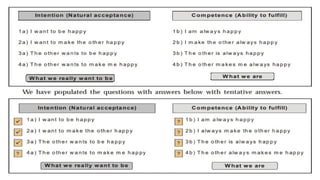
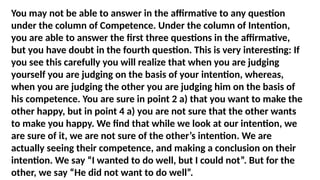
1. I want to make myself happy
2. I want to make the other happy
3. The other wants to be happy
4. The other wants to make me happy
Is this true for you? Ask yourself this question:
“When do you feel afraid of somebody, and when
do you feel assured?
The Answer is:
• We feel assured of the other person when we are
sure that the other wants to work for my happiness
and prosperity.
• Whenever I feel the other will deny my happiness
and/or prosperity, I am afraid of the person.
• When we are assured that the other is for my
happiness and prosperity, I have trust in the other.
When this is doubted, I lack the trust and it becomes
the source of fear.
Let us explore further the following:
1. Do I want to make myself happy?
2. Do I want to make the other happy?
3. Does the other want to make himself happy?
4. Does the other want to make me happy?
You may give an easy ‘Yes’ to the first question.
In the third question, you give a small thought and say ‘Yes’ again.
In the second question, you hesitate to answer first, then you become
choosy and tend to say that there are a few whom I want to make happy,
and I am not concerned about the rest. Or, you may also say that I want
to make some people unhappy, or, you may say that I want to make only
those happy from whom I derive happiness and other such things. But
you are not able to give an easy ‘Yes’ in the beginning
Now re-explore question 2. You will feel like saying ‘Yes’ for all. This
may take some time for you to explore, but certainly since you do
not want to make anybody unhappy, you are able to answer this
question in the affirmative.
What about question 4? A big problem posed to you all of a
sudden! For some people in your relations, you feel like saying ‘no’,
for some you have a doubt, and for a selected few, you tend to say
‘Yes’. But explore into it further. Is it that the other wants to make
you unhappy? Or it is only that he/she is not able to make you
happy every time (as you also do) though he/she intends to make
you happy
Answering question 4 with deep exploration is the basis of gaining
trust in the other. When you are able to answer this question in the
affirmative, you have trust in the other, otherwise doubt continues
When you examine, you find that there are two parts in this
exploration:
1. Intention (wanting to-our natural acceptance) &
2. Competence (being able to do) Intention is what one aspires for
(our natural acceptance), competence is the ability to fulfil the
aspiration.
You may not be able to answer in the affirmative to any question
under the column of Competence. Under the column of Intention,
you are able to answer the first three questions in the affirmative,
but you have doubt in the fourth question. This is very interesting: If
you see this carefully you will realize that when you are judging
yourself you are judging on the basis of your intention, whereas,
when you are judging the other you are judging him on the basis of
his competence. You are sure in point 2 a) that you want to make the
other happy, but in point 4 a) you are not sure that the other wants
to make you happy. We find that while we look at our intention, we
are sure of it, we are not sure of the other’s intention. We are
actually seeing their competence, and making a conclusion on their
intention. We say “I wanted to do well, but I could not”. But for the
other, we say “He did not want to do well”.
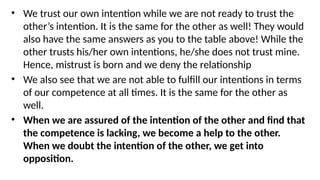
• We trust our own intention while we are not ready to trust the
other’s intention. It is the same for the other as well! They would
also have the same answers as you to the table above! While the
other trusts his/her own intentions, he/she does not trust mine.
Hence, mistrust is born and we deny the relationship
• We also see that we are not able to fulfill our intentions in terms
of our competence at all times. It is the same for the other as
well.
• When we are assured of the intention of the other and find that
the competence is lacking, we become a help to the other.
When we doubt the intention of the other, we get into
opposition.
• You may ask, “how do we know what the other person’s
intentions are?” Ans: I can judge myself properly, and find out
about myself. If I am sure of the answers to 1 and 2 above, then 3
& 4 are just a reflection of 1 & 2. (Other person is a reflection of
me
• The mistake takes place because when I am looking at myself, I
see my intention but, when I am looking at the other, I see his
competence. As a result I conclude about the intention of the
other person based on his competence.
• Intention wise, all of us want to make ourselves happy and the
other person happy. Whereas competence-wise, we all are
unable to do this.
• Thus, we can see that our competence and the other’s
competence is usually lacking and it is because of this
that sometimes we fail to make the other happy, and
sometimes the other fails to make us happy.
• We can be aware of our intention, at the level of our
natural acceptance. We find that our intention, our
natural acceptance, is always to make the other happy.
However, because we are unable to be aware of the
other’s intention, because we don’t understand it, we
begin to doubt the other’s intention and fail to see that
it is actually their competence that is lacking
• If we start making assumptions and doubting the
other’s intentions, the relationship crumbles at that
point. We end up assuming that the other wishes ill of
me.
• This feeling that the other is not for my happiness and
prosperity is a blow to the feeling of relationship.
• As a result, it is very important that we understand the
point about intention and competence and be aware of
it all the time, which is possible by self-exploration only
• You can verify this yourself: you cannot have a problem
in relationship, unless you have ended up doubting the
intention of the other person, no matter how close you
are to them. For example, assume you are walking in
your college campus and your close friend walks by
from the other direction. You look at him and smile, but
he barely notices you, and keeps walking, with his head
down. You feel angry and disappointed that he did not
acknowledge your presence. You tend to assume that
he wants to ignore you. Later on, you find out that he
was disturbed since he had lost his wallet.
In this example, we can clearly see a problem arising in
you due to doubt on intention, and disappearing when the
doubt on intention is gone. This problem in you creates a
conflict with your own natural acceptance, and at that
very instant, you are unhappy. If only you had known from
before that at the level of intention, your friends, and all
others wish only well for you, whereas, their competence
to fulfil the intention was lacking, you could have been
saved from this unhappiness and conflict in yourself! You
can verify this for yourself in numerous examples at home,
outside the home, and in society
Respect (Sammãna)
• Respect means Right Evaluation
• Respect means “Right Evaluation”, to be
evaluated as I am. Usually however, we make
mistakes in our evaluation in the following
three ways
• Over Evaluation (adhi-mülyana) – To evaluate more
than what it is. e.g if you are wrongly flattered you feel
uncomfortable.
• Under Evaluation (ava-mülyana) – To evaluate less than
what it is. e.g if you are condemned, you feel
uncomfortable.
• Otherwise Evaluation (a-mülyana) – To evaluate
otherwise than what it is. e.g if you are evaluated as
something else , you feel uncomfortable
• Example of over evaluation: You are sitting at home and there
are guests around. Your father says ‘my son is the greatest scholar
in India!’ Check for yourself: do you feel comfortable, or do you
feel uncomfortable?
• Example of under evaluation: You are still at home, but this time
your father says ‘My son is a good for nothing. He must be the
laziest person in all of India!’ You obviously feel uncomfortable,
you don’t find this acceptable.
• Example of ‘otherwise’ evaluation: You are at home, and there
are guests around, and your father says, ‘You donkey! Can’t you
even understand this much?’ You feel offended by this This is
evaluating you otherwise, as you are a human being and not
something else.
• What is happening in the above examples? We can see that any
kind of over, under or other-wise evaluation makes us
uncomfortable, we find it unacceptable. We feel ‘disrespected’.
We say we have been disrespected, when we are wrongly
evaluated.
• Thus, Respect means to rightly evaluate. Can you think of the
number of instances when you feel you have been wrongly
evaluated, and the number of times you may have done the same to
others? You would be surprised to find, this happens very often, and
we are insensitive about this aspect in relationship. Even though it is
the cause of many problems for us in relationship, we ignore the
point about respect. We also have many different notions about
respect that we currently hold as individuals and as a society.
• For example, saluting someone is called respecting
someone today, we even fire guns in the air after people
are dead, as a mark of ‘respect’, we put red bulbs on our
cars for respect, we build big houses in the thirst for
respect, we take care of our clothing, we dress up, we
have different hair cuts, we buy fancy cell phones, we
boast about the bike we have, a whole lot of things are
going on in the world or in search for respect. Let us
understand what respect is all about, and whether all
the things we do in the hope of getting some respect
can ensure respect or not:
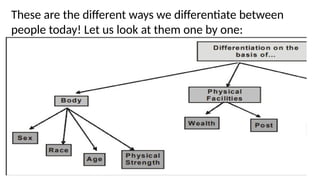
These are the different ways we differentiate between
people today! Let us look at them one by one:
ON THE BASIS OF BODY
Sex/Gender:
We have such notions as, respect males more than females, or even the other
way round in some societies! We ignore the fact that being male or female is an
attribute of the body, and not an attribute at the level of ‘I’. In many countries,
people even prefer a male child to a female child, and in some other societies,
the other way round!
Race:
If the person is of the same race as oneself, then we treat them differently. For
example, we differentiate on the basis of skin colour – white, brown, black, etc.
or on the basis of whether the person is of Mongolian race, Aryan race,
Dravidian race, etc., or on the basis of caste, taking some caste to be high, the
other to be low. Again here, we don’t do the evaluation on the basis of ‘I’, but on
the basis of Body-the colour of the skin or the race or caste of the body
Age:
We have notions such as ‘one must respect elders’. What about
youngsters? Should we insult them? Should we not respect them as
well? Here, we see that we are again evaluating at the level of the
body – age is related to the body, and not to ‘I’.
Physical strength: If someone is stronger, we again treat him/her
differently! This is again at the level of the body. In fact, we think that
we are respecting the other while it is fear; the fear that if we do not
treat them like this, we will be harmed. But this is quite prevalent:
there are so many programmes, awards and titles in the world based
on physical strength! This has nothing to do with how the person is at
the level of ‘I’.
ON THE BASIS OF PHYSICAL FACILITIES/ WEALTH:
We differentiate people because some have more wealth
than others. What we term as a “rich person” gets idolized.
We don’t even bother to find out whether such people are
feeling prosperous, or if they just have wealth? Are they
happy, or just have wealth? – this is evaluation on the basis
of physical facilities. This way, we are over-evaluating
physical facilities first, which are just meant to fulfil the
needs of the Body, and then on this basis, we are wrongly
identifying our relationship.
Post:
This is a very common phenomenon. We try to respect on the basis of
a person’s position. Is this post directly related to the right
understanding and feelings in the Self?-we seldom verify. The post is
wrongly evaluated as the mark of a person’s excellence and
differentiation sets in. The post is considered important either on the
basis that it gives more physical facilities or on the basis that certain
positions are assumed to be important! In our education, we are
trained directly or indirectly to earn posts for us to fetch respect. In
due course of time, we tend to believe that respect can be availed
only if we reach a certain post. Thus, the respect that could be
naturally available to us becomes a rare commodity
The Problems due to Differentiation
• Differentiation based on Sex/Gender: There are many
movements in the world around this. For example, we have
the issue of women’s rights, and women protesting and
demanding for equality in education, in jobs, and in peoples’
representation. Growing feminine movement is an example of
this. As discussed earlier, this problem is acute in some areas,
with people not wanting a girl child and preferring male
children instead, while in some other societies, it could be the
other way round! At the level of the individual, people are
insecure and afraid of one another based on their gender.
Differentiation based on Age:
We hear of protests and movements demanding for
equal rights for children on the one hand and for
rights for elderly people on the other. The problem
of generation gap is talked about quite often. One
generation talks about being ignored by the other
generation, and this has become the source of
tension in many families.
Differentiation based on Wealth:
This is an area that is increasingly becoming a very big area of
differentiation and is leading to all kinds of large scale problems. We
are all aware of the whole debate around rich countries and poor
countries. Not understanding the need for physical facilities, and
working for wealth to fetch respect has led to class struggle and
movements to do away with class-differentiation. If the need for
physical facilities is understood properly, we do not identify it with
happiness. Otherwise we find a large problem at the level of
individuals, with many people suffering from a lack of self-esteem and
some even committing suicide, when they feel they cannot
accumulate enough wealth so as to get the respect that is due to
them!
Differentiation based on Post:
We see protests against high handed government officials,
because people feel they are being taken advantage of. This
is due to the tremendous differentiation we make on the
basis of position. At the level of the individual, it also leads
to depression, etc. since if someone does not get or qualify
for a post, they end up feeling that they will not get the
respect in the society!
Difference between Attention
‘ ’ and ‘Respect’
• Attention: Attention refers to the act of focusing one's mind, senses, or
thoughts on a particular object, person, task, or idea. It involves giving
consideration, concentration, or awareness to something. In modern
times, with the prevalence of technology and distractions, giving
someone your full attention is seen as a sign of respect and
engagement in a conversation or interaction.
• Respect: Respect, on the other hand, is a deeper and broader concept.
It involves recognizing the intrinsic worth, value, and rights of a person,
idea, or thing. It includes showing consideration, honor, and
appreciation for someone's thoughts, feelings, opinions, or boundaries.
Respect encompasses treating others the way you would like to be
treated, regardless of differences in opinions, beliefs, or backgrounds.
Key Differences:
• Depth of Involvement:
– Attention is about being present in the moment, focusing on
something or someone.
– Respect goes beyond the immediate moment and implies a
deeper understanding and appreciation for a person or their
worth.
• Time Frame:
– Attention is often momentary or short-term.
– Respect is a long-term or enduring characteristic of how one
treats others.
Key Differences:
• Intent:
– Attention can be a neutral act, without implying positive or
negative regard.
– Respect implies a positive regard and consideration for the well-
being and dignity of the person or thing being respected.
• Expression:
– Attention can be conveyed through various forms, including eye
contact, active listening, and verbal acknowledgment.
– Respect is demonstrated through actions, words, and behaviors
that honor and uphold the value of another person.
Difference between Attention
‘ ’ and ‘Respect’
There is a whole lot of surplus activity that people are engaged in today, for
the sake of respect. It can be actually funny if you start observing: people
are climbing up mountains for the sake of fame, eating hot chillies and
worms to be on TV, putting on all kinds of clothes, shaving their heads,
letting their hair grow long, letting their finger nails grow long, earning a lot
of money (even trying to become the richest person on the earth), working
very hard to be on the magazine cover, this list is simply endless! If one
understood the simple fact that what you can get from all this is only
‘attention’ and that you cannot ensure the feeling of being in relationship,
the feeling of right evaluation and respect in the other (ask yourself-when
you wear an exclusive dress, does it create a feeling of respect in the other
or a feeling of jealousy?), then all these people will feel very much at ease!
Just think about it
Difference between Attention
‘ ’ and ‘Respect’
All the while, people are uncomfortable inside,
since they are struggling for the sake of respect.
If I see my relationship with you, I shall anyway
respect you. I accept you for what you are, a
human being like me. You don’t have to do
something special to earn this respect from me.
The fact that you are human is enough for me
to respect you.

Universal Human Values In Human relationship

  • 1.
  • 2.
    • We seenthat relationship is between the Self (I) and the other Self (I) • It is a need of the Self (‘I’) to be in relationship with the other • Being in relationship, we have feelings for the other. • These feelings cannot be replaced by any material or physical things. • These feelings are definite and these feelings are the ‘values’ in a relationship
  • 3.
    Feelings (Values) inRelationships • Trust (Visvãsa ) (can be spelt as ‘Vishvas’ too) • Respect (Sammãna) (can be spelt as ‘Samman’ too) • Affection (Sneha) • Care (Mamatã) (can be spelt as ‘Mamata’ too) • Guidance (Vãtsalya) (can be spelt as ‘Vatsalya’ too) • Reverence (Shraddhã) (can be spelt as ‘Shraddha’ too) • Glory (Guarava) • Gratitude ( Kritagyatã ) (can be spelt as ‘Kritagyata’ too) • Love (Prema) (can be spelt as ‘Prem’ too)
  • 4.
    Trust (Visvãsa) Trust orvishwãs is the foundational value in relationship. The feeling of Trust (Visvãsa ) in relationship is defined as: “To be assured that each human being inherently wants oneself and the other to be happy and prosperous.
  • 5.
    To understand this,let us examine the following proposals: 1. I want to make myself happy 2. I want to make the other happy 3. The other wants to be happy 4. The other wants to make me happy Is this true for you? Ask yourself this question: “When do you feel afraid of somebody, and when do you feel assured?
  • 6.
    The Answer is: •We feel assured of the other person when we are sure that the other wants to work for my happiness and prosperity. • Whenever I feel the other will deny my happiness and/or prosperity, I am afraid of the person. • When we are assured that the other is for my happiness and prosperity, I have trust in the other. When this is doubted, I lack the trust and it becomes the source of fear.
  • 7.
    Let us explorefurther the following: 1. Do I want to make myself happy? 2. Do I want to make the other happy? 3. Does the other want to make himself happy? 4. Does the other want to make me happy? You may give an easy ‘Yes’ to the first question. In the third question, you give a small thought and say ‘Yes’ again. In the second question, you hesitate to answer first, then you become choosy and tend to say that there are a few whom I want to make happy, and I am not concerned about the rest. Or, you may also say that I want to make some people unhappy, or, you may say that I want to make only those happy from whom I derive happiness and other such things. But you are not able to give an easy ‘Yes’ in the beginning
  • 8.
    Now re-explore question2. You will feel like saying ‘Yes’ for all. This may take some time for you to explore, but certainly since you do not want to make anybody unhappy, you are able to answer this question in the affirmative. What about question 4? A big problem posed to you all of a sudden! For some people in your relations, you feel like saying ‘no’, for some you have a doubt, and for a selected few, you tend to say ‘Yes’. But explore into it further. Is it that the other wants to make you unhappy? Or it is only that he/she is not able to make you happy every time (as you also do) though he/she intends to make you happy
  • 9.
    Answering question 4with deep exploration is the basis of gaining trust in the other. When you are able to answer this question in the affirmative, you have trust in the other, otherwise doubt continues When you examine, you find that there are two parts in this exploration: 1. Intention (wanting to-our natural acceptance) & 2. Competence (being able to do) Intention is what one aspires for (our natural acceptance), competence is the ability to fulfil the aspiration.
  • 11.
    You may notbe able to answer in the affirmative to any question under the column of Competence. Under the column of Intention, you are able to answer the first three questions in the affirmative, but you have doubt in the fourth question. This is very interesting: If you see this carefully you will realize that when you are judging yourself you are judging on the basis of your intention, whereas, when you are judging the other you are judging him on the basis of his competence. You are sure in point 2 a) that you want to make the other happy, but in point 4 a) you are not sure that the other wants to make you happy. We find that while we look at our intention, we are sure of it, we are not sure of the other’s intention. We are actually seeing their competence, and making a conclusion on their intention. We say “I wanted to do well, but I could not”. But for the other, we say “He did not want to do well”.
  • 12.
    • We trustour own intention while we are not ready to trust the other’s intention. It is the same for the other as well! They would also have the same answers as you to the table above! While the other trusts his/her own intentions, he/she does not trust mine. Hence, mistrust is born and we deny the relationship • We also see that we are not able to fulfill our intentions in terms of our competence at all times. It is the same for the other as well. • When we are assured of the intention of the other and find that the competence is lacking, we become a help to the other. When we doubt the intention of the other, we get into opposition.
  • 13.
    • You mayask, “how do we know what the other person’s intentions are?” Ans: I can judge myself properly, and find out about myself. If I am sure of the answers to 1 and 2 above, then 3 & 4 are just a reflection of 1 & 2. (Other person is a reflection of me • The mistake takes place because when I am looking at myself, I see my intention but, when I am looking at the other, I see his competence. As a result I conclude about the intention of the other person based on his competence. • Intention wise, all of us want to make ourselves happy and the other person happy. Whereas competence-wise, we all are unable to do this.
  • 14.
    • Thus, wecan see that our competence and the other’s competence is usually lacking and it is because of this that sometimes we fail to make the other happy, and sometimes the other fails to make us happy. • We can be aware of our intention, at the level of our natural acceptance. We find that our intention, our natural acceptance, is always to make the other happy. However, because we are unable to be aware of the other’s intention, because we don’t understand it, we begin to doubt the other’s intention and fail to see that it is actually their competence that is lacking
  • 15.
    • If westart making assumptions and doubting the other’s intentions, the relationship crumbles at that point. We end up assuming that the other wishes ill of me. • This feeling that the other is not for my happiness and prosperity is a blow to the feeling of relationship. • As a result, it is very important that we understand the point about intention and competence and be aware of it all the time, which is possible by self-exploration only
  • 16.
    • You canverify this yourself: you cannot have a problem in relationship, unless you have ended up doubting the intention of the other person, no matter how close you are to them. For example, assume you are walking in your college campus and your close friend walks by from the other direction. You look at him and smile, but he barely notices you, and keeps walking, with his head down. You feel angry and disappointed that he did not acknowledge your presence. You tend to assume that he wants to ignore you. Later on, you find out that he was disturbed since he had lost his wallet.
  • 17.
    In this example,we can clearly see a problem arising in you due to doubt on intention, and disappearing when the doubt on intention is gone. This problem in you creates a conflict with your own natural acceptance, and at that very instant, you are unhappy. If only you had known from before that at the level of intention, your friends, and all others wish only well for you, whereas, their competence to fulfil the intention was lacking, you could have been saved from this unhappiness and conflict in yourself! You can verify this for yourself in numerous examples at home, outside the home, and in society
  • 18.
    Respect (Sammãna) • Respectmeans Right Evaluation • Respect means “Right Evaluation”, to be evaluated as I am. Usually however, we make mistakes in our evaluation in the following three ways
  • 19.
    • Over Evaluation(adhi-mülyana) – To evaluate more than what it is. e.g if you are wrongly flattered you feel uncomfortable. • Under Evaluation (ava-mülyana) – To evaluate less than what it is. e.g if you are condemned, you feel uncomfortable. • Otherwise Evaluation (a-mülyana) – To evaluate otherwise than what it is. e.g if you are evaluated as something else , you feel uncomfortable
  • 20.
    • Example ofover evaluation: You are sitting at home and there are guests around. Your father says ‘my son is the greatest scholar in India!’ Check for yourself: do you feel comfortable, or do you feel uncomfortable? • Example of under evaluation: You are still at home, but this time your father says ‘My son is a good for nothing. He must be the laziest person in all of India!’ You obviously feel uncomfortable, you don’t find this acceptable. • Example of ‘otherwise’ evaluation: You are at home, and there are guests around, and your father says, ‘You donkey! Can’t you even understand this much?’ You feel offended by this This is evaluating you otherwise, as you are a human being and not something else.
  • 21.
    • What ishappening in the above examples? We can see that any kind of over, under or other-wise evaluation makes us uncomfortable, we find it unacceptable. We feel ‘disrespected’. We say we have been disrespected, when we are wrongly evaluated. • Thus, Respect means to rightly evaluate. Can you think of the number of instances when you feel you have been wrongly evaluated, and the number of times you may have done the same to others? You would be surprised to find, this happens very often, and we are insensitive about this aspect in relationship. Even though it is the cause of many problems for us in relationship, we ignore the point about respect. We also have many different notions about respect that we currently hold as individuals and as a society.
  • 22.
    • For example,saluting someone is called respecting someone today, we even fire guns in the air after people are dead, as a mark of ‘respect’, we put red bulbs on our cars for respect, we build big houses in the thirst for respect, we take care of our clothing, we dress up, we have different hair cuts, we buy fancy cell phones, we boast about the bike we have, a whole lot of things are going on in the world or in search for respect. Let us understand what respect is all about, and whether all the things we do in the hope of getting some respect can ensure respect or not:
  • 23.
    These are thedifferent ways we differentiate between people today! Let us look at them one by one:
  • 24.
    ON THE BASISOF BODY Sex/Gender: We have such notions as, respect males more than females, or even the other way round in some societies! We ignore the fact that being male or female is an attribute of the body, and not an attribute at the level of ‘I’. In many countries, people even prefer a male child to a female child, and in some other societies, the other way round! Race: If the person is of the same race as oneself, then we treat them differently. For example, we differentiate on the basis of skin colour – white, brown, black, etc. or on the basis of whether the person is of Mongolian race, Aryan race, Dravidian race, etc., or on the basis of caste, taking some caste to be high, the other to be low. Again here, we don’t do the evaluation on the basis of ‘I’, but on the basis of Body-the colour of the skin or the race or caste of the body
  • 25.
    Age: We have notionssuch as ‘one must respect elders’. What about youngsters? Should we insult them? Should we not respect them as well? Here, we see that we are again evaluating at the level of the body – age is related to the body, and not to ‘I’. Physical strength: If someone is stronger, we again treat him/her differently! This is again at the level of the body. In fact, we think that we are respecting the other while it is fear; the fear that if we do not treat them like this, we will be harmed. But this is quite prevalent: there are so many programmes, awards and titles in the world based on physical strength! This has nothing to do with how the person is at the level of ‘I’.
  • 26.
    ON THE BASISOF PHYSICAL FACILITIES/ WEALTH: We differentiate people because some have more wealth than others. What we term as a “rich person” gets idolized. We don’t even bother to find out whether such people are feeling prosperous, or if they just have wealth? Are they happy, or just have wealth? – this is evaluation on the basis of physical facilities. This way, we are over-evaluating physical facilities first, which are just meant to fulfil the needs of the Body, and then on this basis, we are wrongly identifying our relationship.
  • 27.
    Post: This is avery common phenomenon. We try to respect on the basis of a person’s position. Is this post directly related to the right understanding and feelings in the Self?-we seldom verify. The post is wrongly evaluated as the mark of a person’s excellence and differentiation sets in. The post is considered important either on the basis that it gives more physical facilities or on the basis that certain positions are assumed to be important! In our education, we are trained directly or indirectly to earn posts for us to fetch respect. In due course of time, we tend to believe that respect can be availed only if we reach a certain post. Thus, the respect that could be naturally available to us becomes a rare commodity
  • 28.
    The Problems dueto Differentiation • Differentiation based on Sex/Gender: There are many movements in the world around this. For example, we have the issue of women’s rights, and women protesting and demanding for equality in education, in jobs, and in peoples’ representation. Growing feminine movement is an example of this. As discussed earlier, this problem is acute in some areas, with people not wanting a girl child and preferring male children instead, while in some other societies, it could be the other way round! At the level of the individual, people are insecure and afraid of one another based on their gender.
  • 29.
    Differentiation based onAge: We hear of protests and movements demanding for equal rights for children on the one hand and for rights for elderly people on the other. The problem of generation gap is talked about quite often. One generation talks about being ignored by the other generation, and this has become the source of tension in many families.
  • 30.
    Differentiation based onWealth: This is an area that is increasingly becoming a very big area of differentiation and is leading to all kinds of large scale problems. We are all aware of the whole debate around rich countries and poor countries. Not understanding the need for physical facilities, and working for wealth to fetch respect has led to class struggle and movements to do away with class-differentiation. If the need for physical facilities is understood properly, we do not identify it with happiness. Otherwise we find a large problem at the level of individuals, with many people suffering from a lack of self-esteem and some even committing suicide, when they feel they cannot accumulate enough wealth so as to get the respect that is due to them!
  • 31.
    Differentiation based onPost: We see protests against high handed government officials, because people feel they are being taken advantage of. This is due to the tremendous differentiation we make on the basis of position. At the level of the individual, it also leads to depression, etc. since if someone does not get or qualify for a post, they end up feeling that they will not get the respect in the society!
  • 32.
    Difference between Attention ‘’ and ‘Respect’ • Attention: Attention refers to the act of focusing one's mind, senses, or thoughts on a particular object, person, task, or idea. It involves giving consideration, concentration, or awareness to something. In modern times, with the prevalence of technology and distractions, giving someone your full attention is seen as a sign of respect and engagement in a conversation or interaction. • Respect: Respect, on the other hand, is a deeper and broader concept. It involves recognizing the intrinsic worth, value, and rights of a person, idea, or thing. It includes showing consideration, honor, and appreciation for someone's thoughts, feelings, opinions, or boundaries. Respect encompasses treating others the way you would like to be treated, regardless of differences in opinions, beliefs, or backgrounds.
  • 33.
    Key Differences: • Depthof Involvement: – Attention is about being present in the moment, focusing on something or someone. – Respect goes beyond the immediate moment and implies a deeper understanding and appreciation for a person or their worth. • Time Frame: – Attention is often momentary or short-term. – Respect is a long-term or enduring characteristic of how one treats others.
  • 34.
    Key Differences: • Intent: –Attention can be a neutral act, without implying positive or negative regard. – Respect implies a positive regard and consideration for the well- being and dignity of the person or thing being respected. • Expression: – Attention can be conveyed through various forms, including eye contact, active listening, and verbal acknowledgment. – Respect is demonstrated through actions, words, and behaviors that honor and uphold the value of another person.
  • 35.
    Difference between Attention ‘’ and ‘Respect’ There is a whole lot of surplus activity that people are engaged in today, for the sake of respect. It can be actually funny if you start observing: people are climbing up mountains for the sake of fame, eating hot chillies and worms to be on TV, putting on all kinds of clothes, shaving their heads, letting their hair grow long, letting their finger nails grow long, earning a lot of money (even trying to become the richest person on the earth), working very hard to be on the magazine cover, this list is simply endless! If one understood the simple fact that what you can get from all this is only ‘attention’ and that you cannot ensure the feeling of being in relationship, the feeling of right evaluation and respect in the other (ask yourself-when you wear an exclusive dress, does it create a feeling of respect in the other or a feeling of jealousy?), then all these people will feel very much at ease! Just think about it
  • 36.
    Difference between Attention ‘’ and ‘Respect’ All the while, people are uncomfortable inside, since they are struggling for the sake of respect. If I see my relationship with you, I shall anyway respect you. I accept you for what you are, a human being like me. You don’t have to do something special to earn this respect from me. The fact that you are human is enough for me to respect you.