Janus
Provenance


         Workflows for Information Integration
                         in the Life Sciences

        Part 2: Workflows in context

                     Paolo Missier
            Information Management Group
School of Computer Science, University of Manchester, UK


                Search Computing workshop
                 Como, Italy, May 28th, 2010
Purpose and outline
• In the first part we have seen a case study in system biology
  – showcasing scientific workflows at work


• Two key questions:
  1.Workflows live within an eco-system of models, tools and technologies.
    Can any of these benefit / complement the SeCo paradigm?
  2.What is the relationship between a dataflow model (Taverna) and a SeCo
    query plan?


• To inform the discussion, we focus of some elements of a
  workflow’s lifecycle
  – importing services
  – benefits of domain-specific service collections
  – collecting and querying provenance traces


                                                                             2
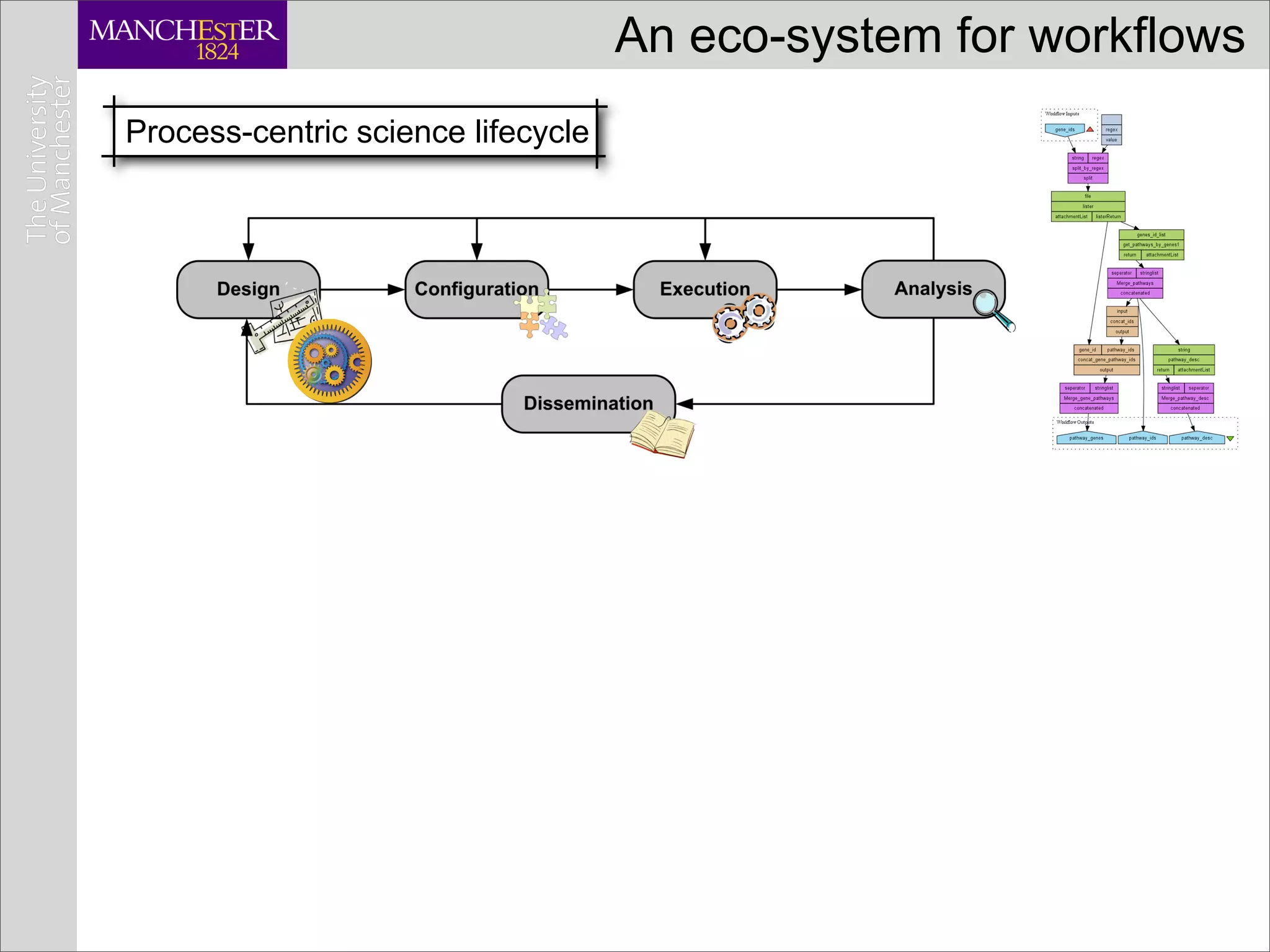
An eco-system for workflows
Process-centric science lifecycle
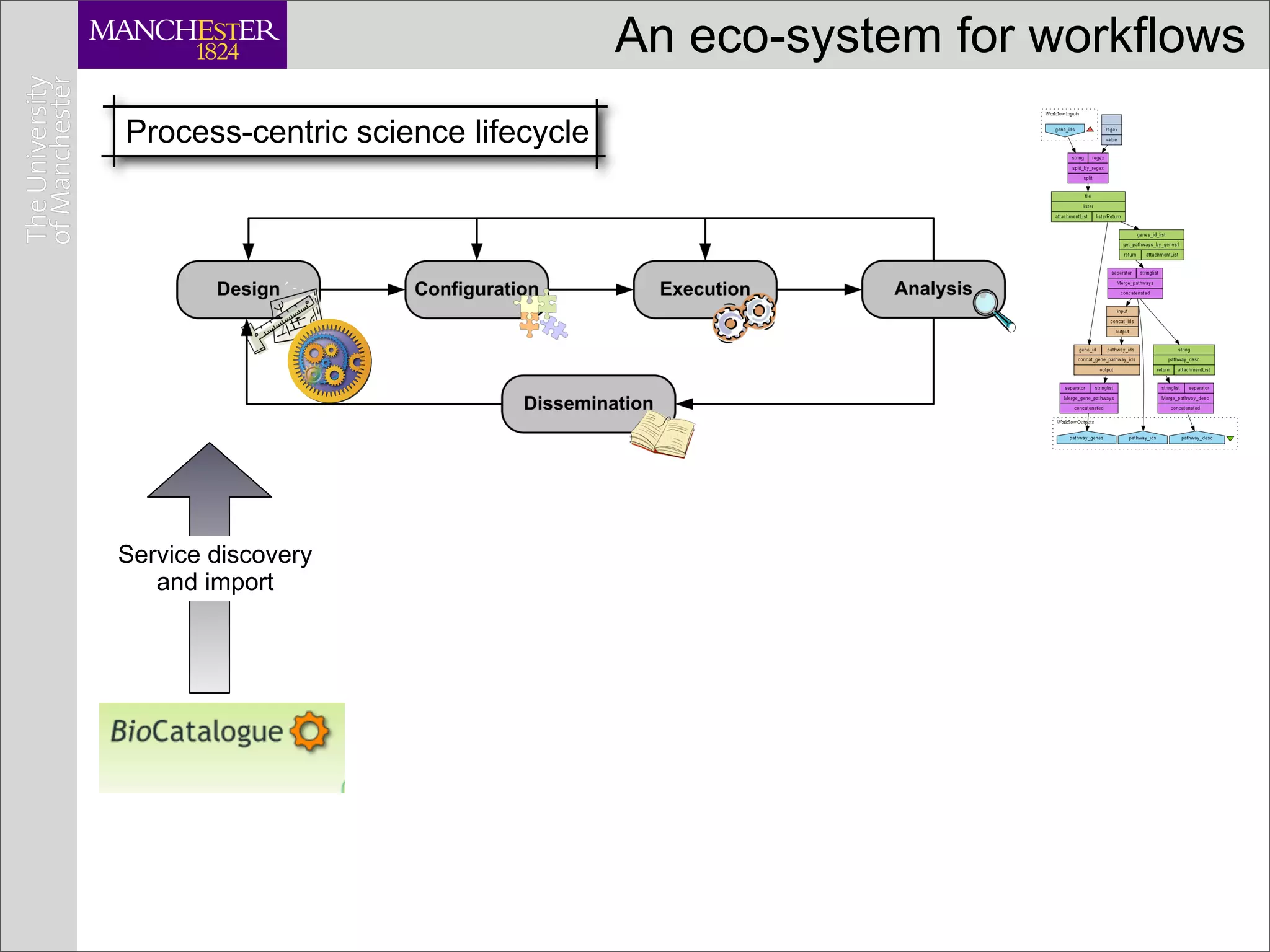
An eco-system for workflows
Process-centric science lifecycle


Service discovery
   and import
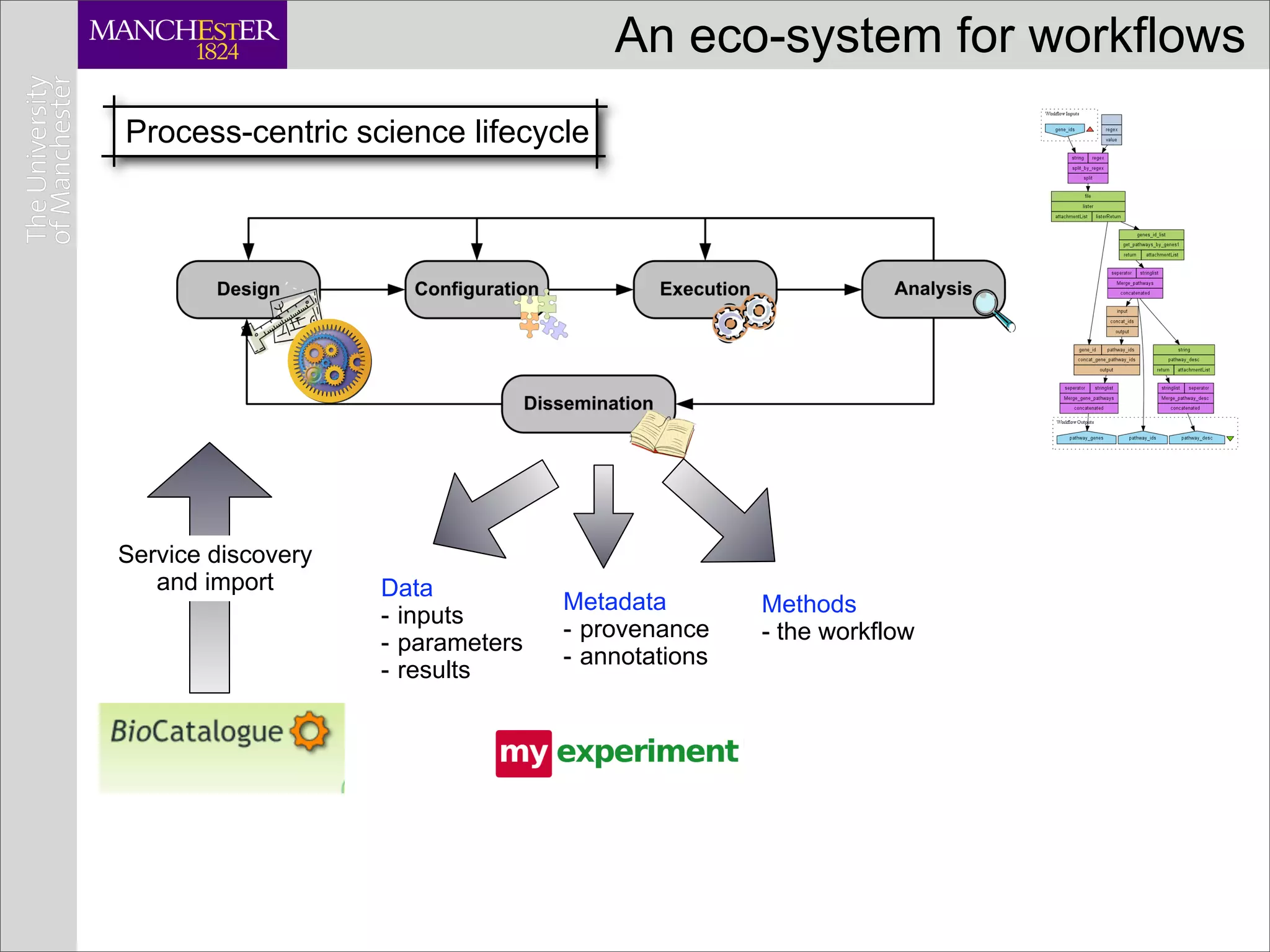
An eco-system for workflows
Process-centric science lifecycle


Service discovery
   and import       Data
                                   Metadata        Methods
                    - inputs
                                   - provenance    - the workflow
                    - parameters
                                   - annotations
                    - results
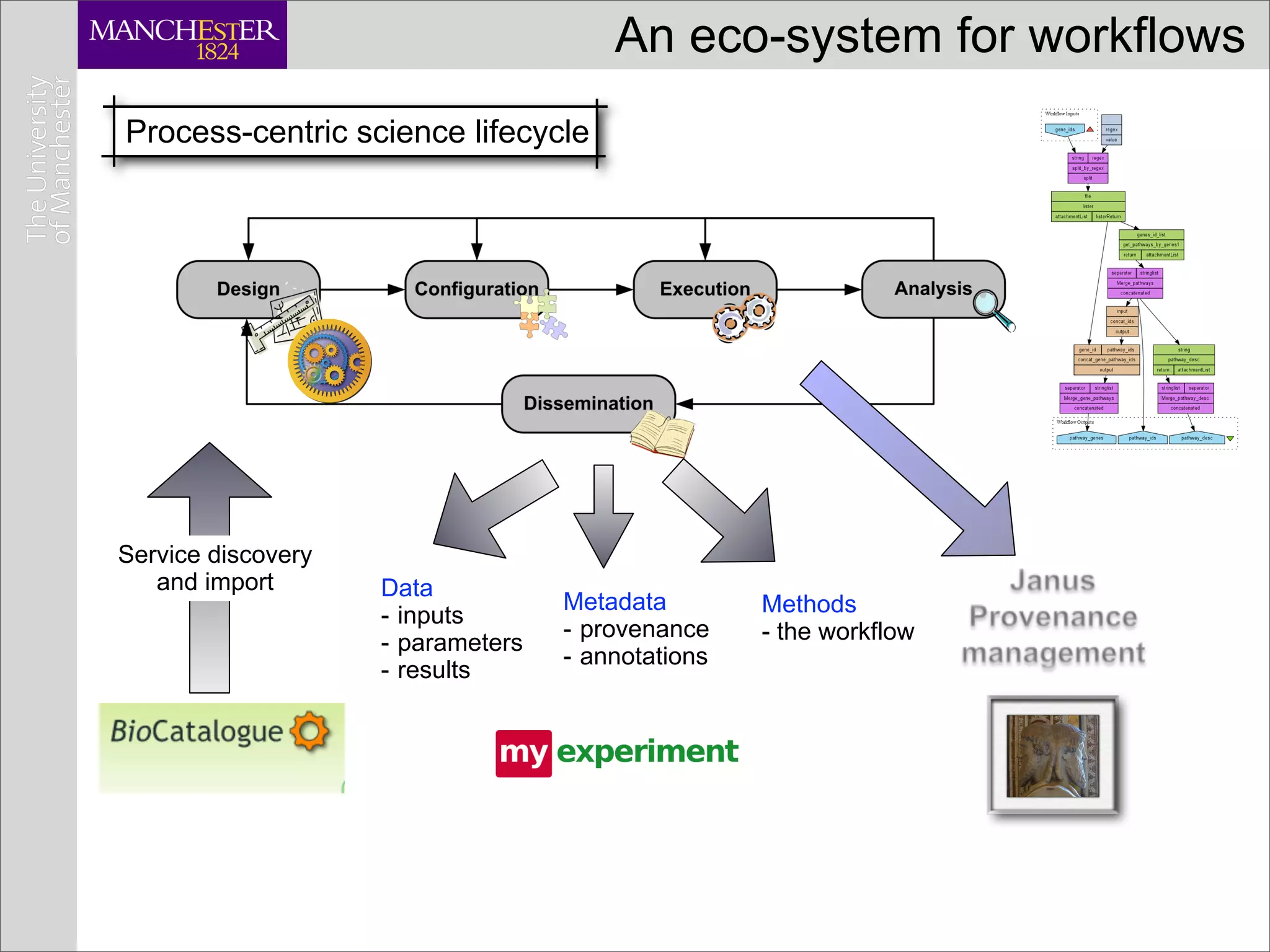
An eco-system for workflows
Process-centric science lifecycle


Service discovery
   and import       Data
                                   Metadata        Methods
                    - inputs
                                   - provenance    - the workflow
                    - parameters
                                   - annotations
                    - results
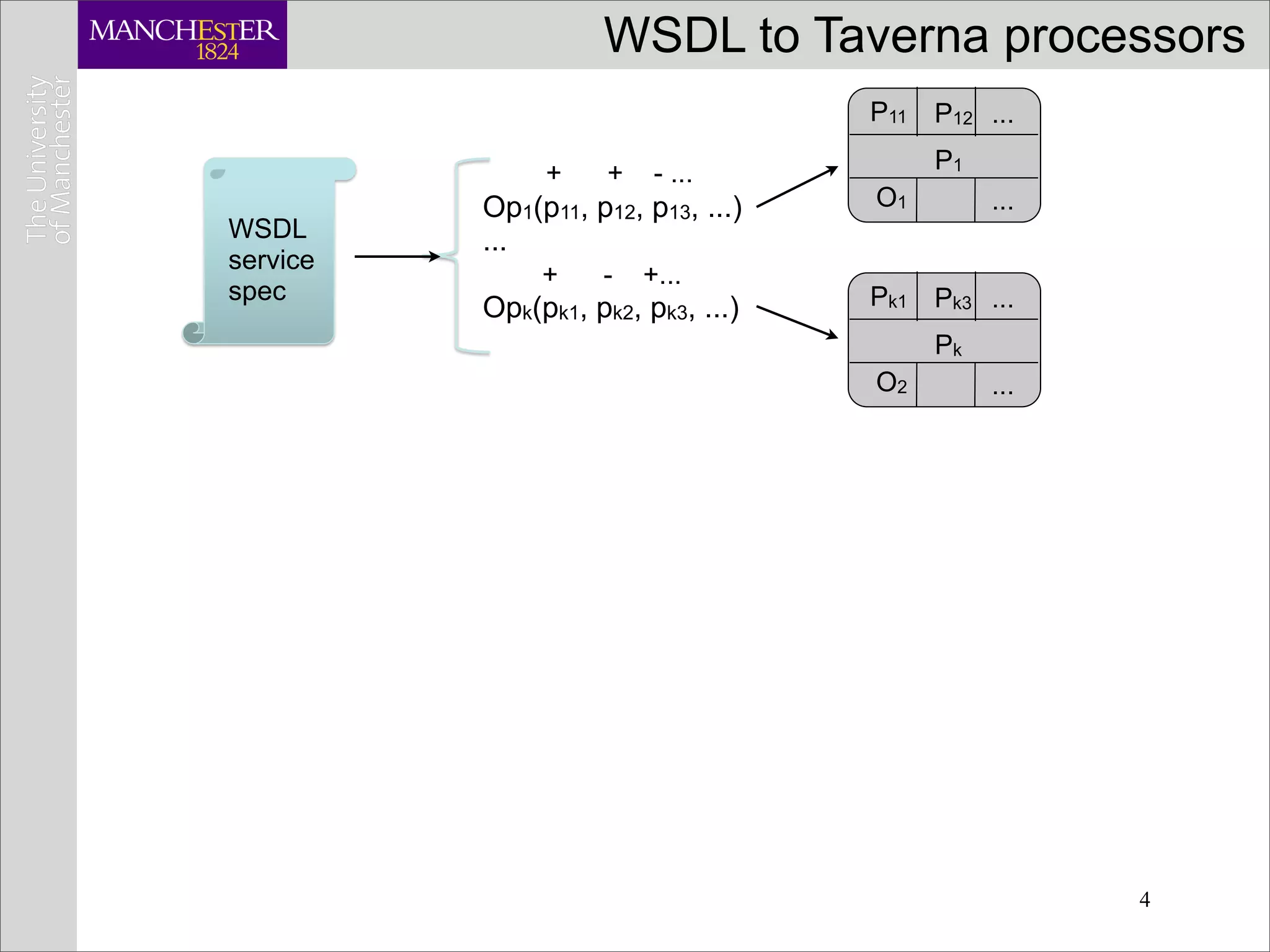
WSDL to Taverna processors
                                    P11   P12 ...

               +     +    - ...           P1
          Op1(p11, p12, p13, ...)   O1         ...
WSDL      ...
service
               +    -    +...
spec                                Pk1 Pk3 ...
          Opk(pk1, pk2, pk3, ...)
                                          Pk
                                    O2         ...


                                                     4
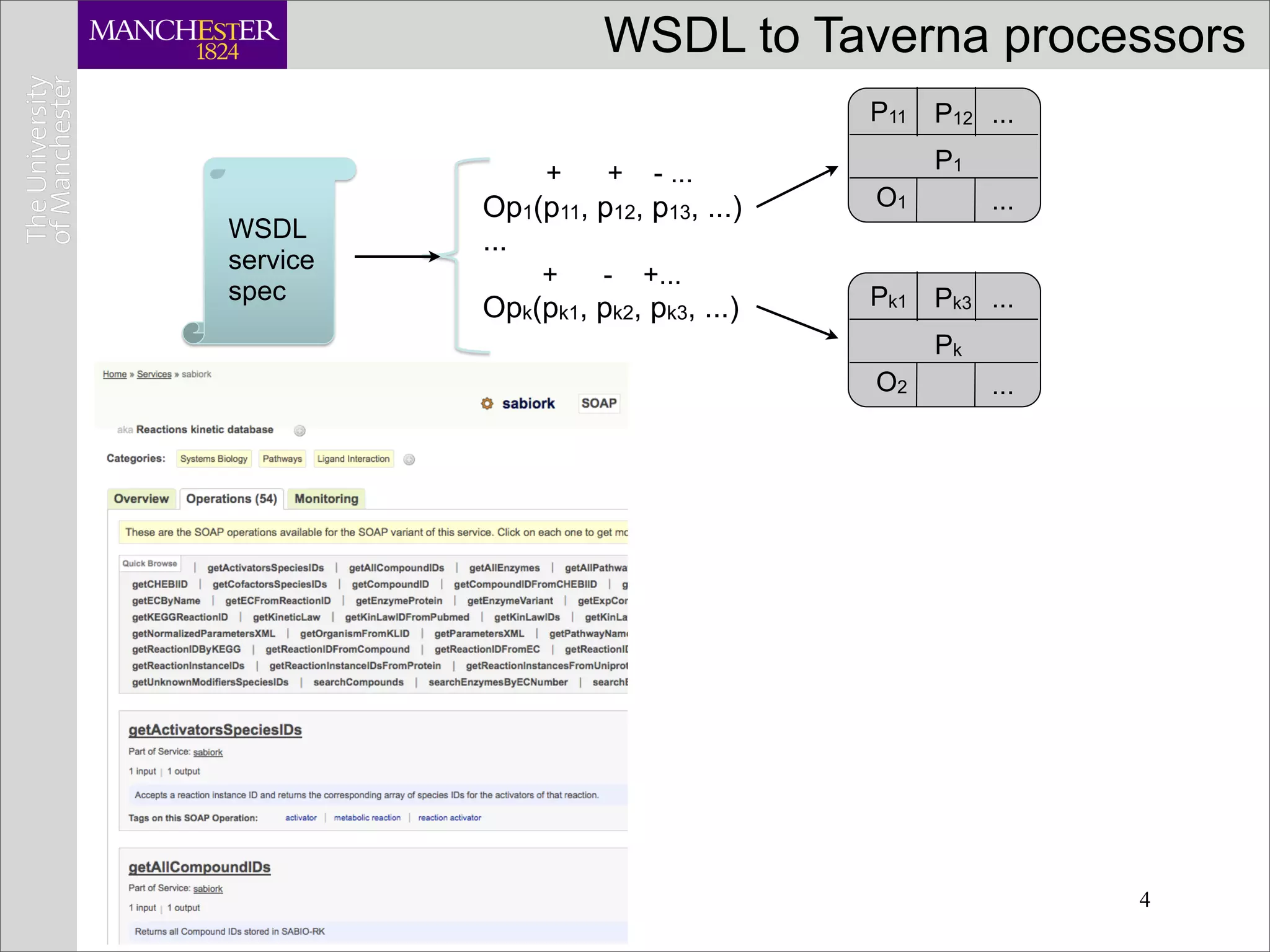
WSDL to Taverna processors
                                    P11   P12 ...

               +     +    - ...           P1
          Op1(p11, p12, p13, ...)   O1         ...
WSDL      ...
service
               +    -    +...
spec                                Pk1 Pk3 ...
          Opk(pk1, pk2, pk3, ...)
                                          Pk
                                    O2         ...


                                                     4
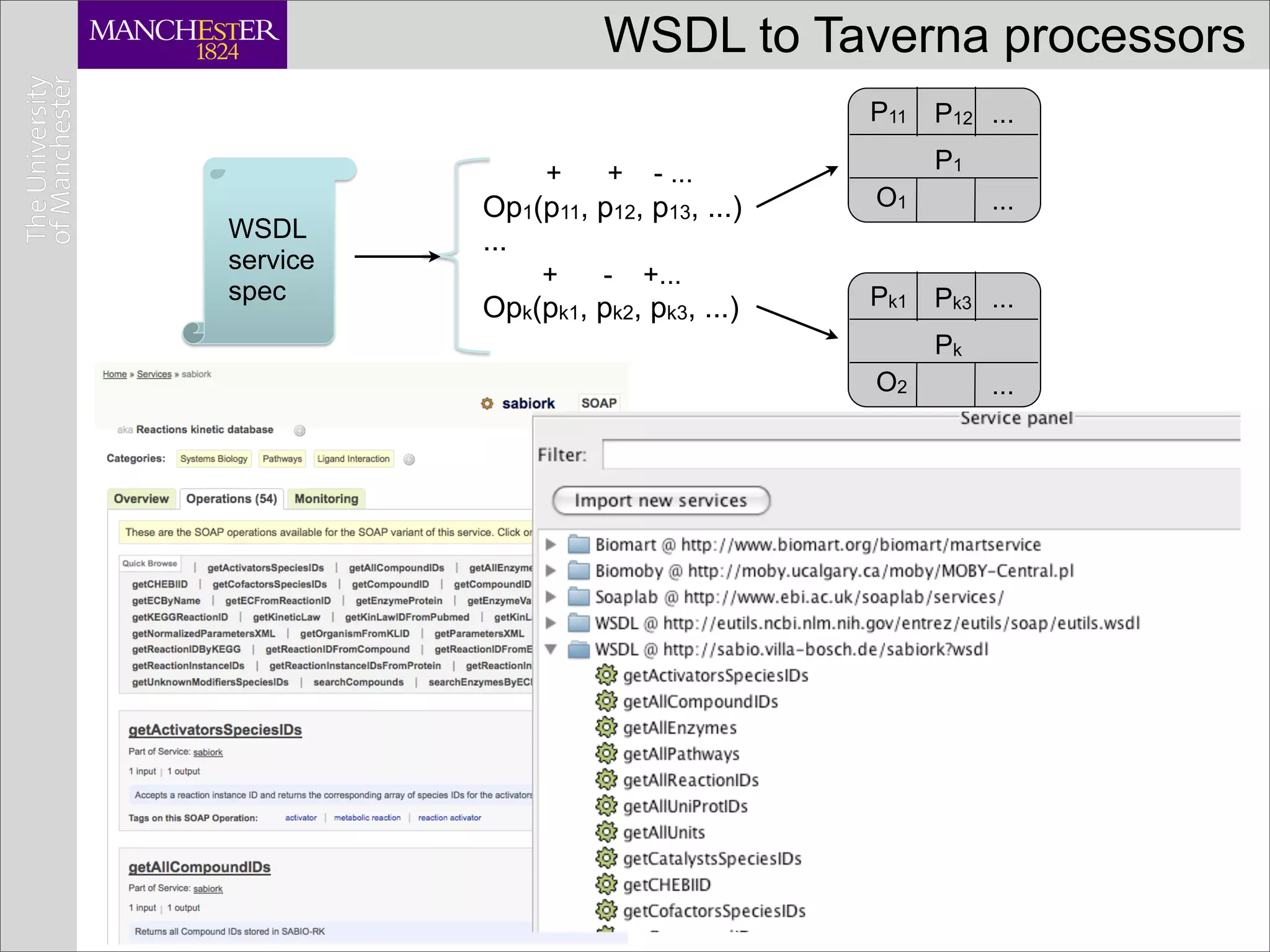
WSDL to Taverna processors
                                    P11   P12 ...

               +     +    - ...           P1
          Op1(p11, p12, p13, ...)   O1         ...
WSDL      ...
service
               +    -    +...
spec                                Pk1 Pk3 ...
          Opk(pk1, pk2, pk3, ...)
                                          Pk
                                    O2         ...


                                                     4
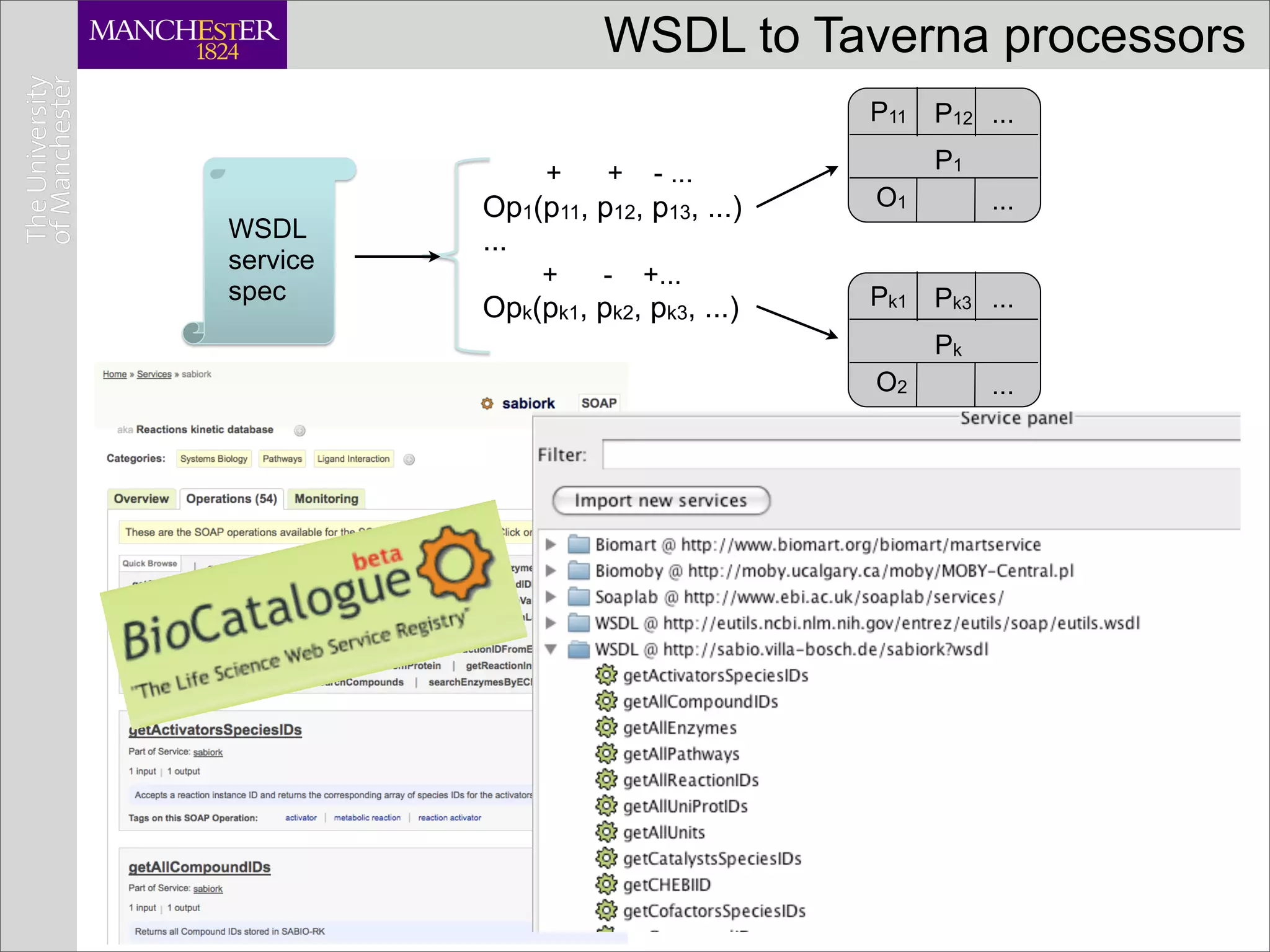
WSDL to Taverna processors
                                    P11   P12 ...

               +     +    - ...           P1
          Op1(p11, p12, p13, ...)   O1         ...
WSDL      ...
service
               +    -    +...
spec                                Pk1 Pk3 ...
          Opk(pk1, pk2, pk3, ...)
                                          Pk
                                    O2         ...


                                                     4
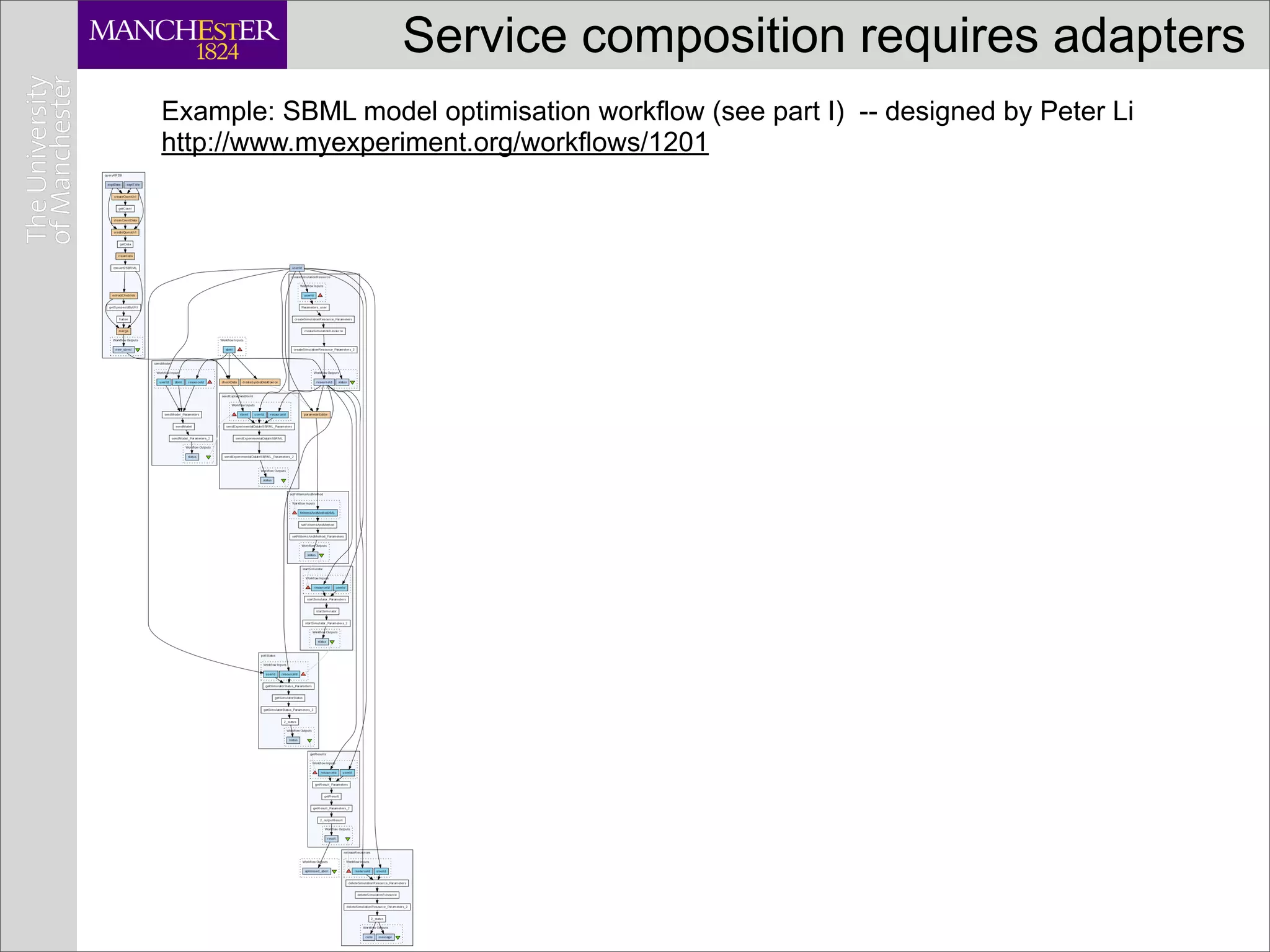
Service composition requires adapters
Example: SBML model optimisation workflow (see part I) -- designed by Peter Li
http://www.myexperiment.org/workflows/1201
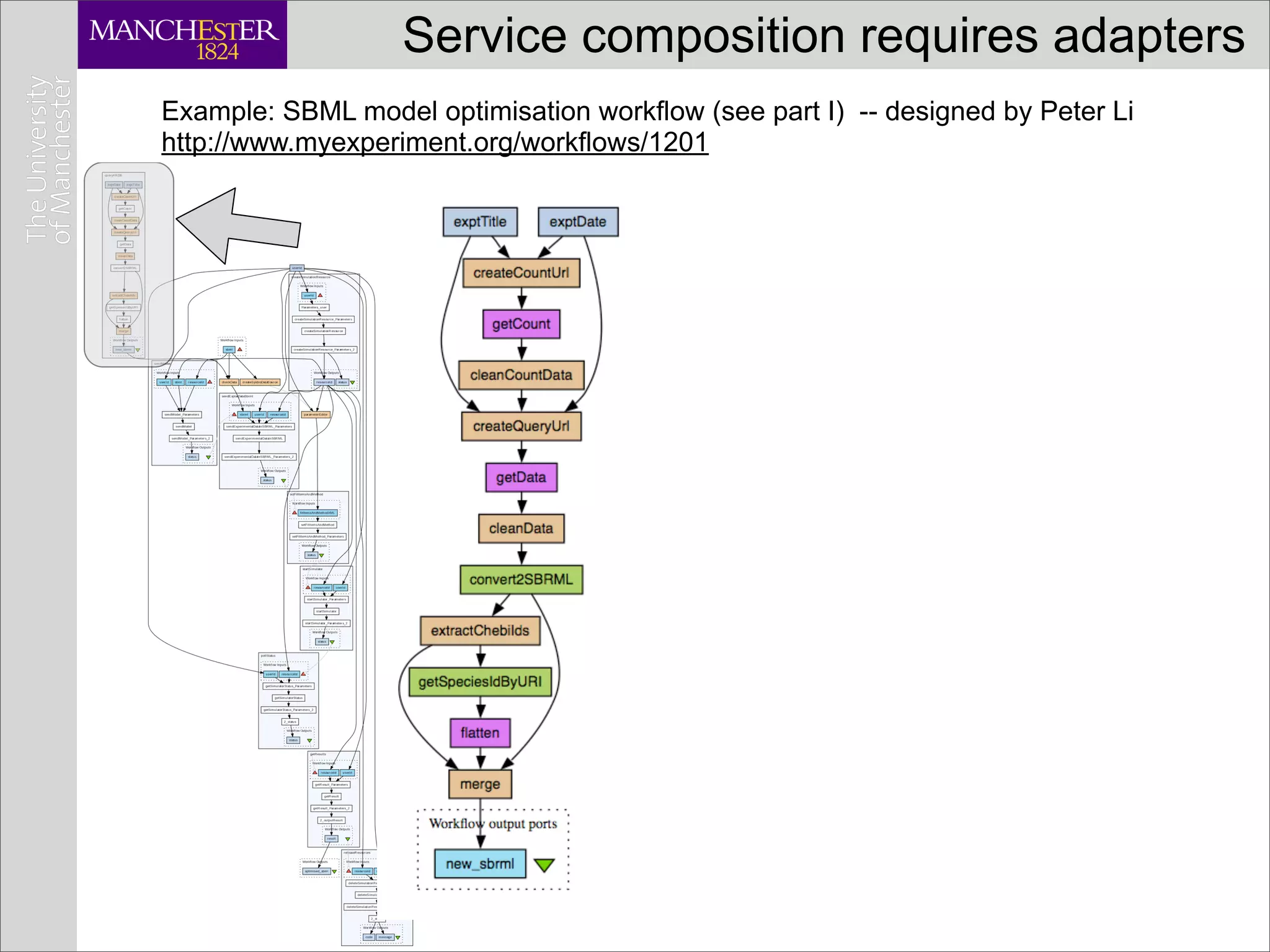
Service composition requires adapters
Example: SBML model optimisation workflow (see part I) -- designed by Peter Li
http://www.myexperiment.org/workflows/1201
Service composition requires adapters
Example: SBML model optimisation workflow (see part I) -- designed by Peter Li
http://www.myexperiment.org/workflows/1201

                                                                    String[] lines = inStr.split("n");
                                                                    StringBuffer sb = new StringBuffer();
                                                                    for(i = 1; i < lines.length -1; i++)
                                                                    {
                                                                      String str = lines[i];
                                                                      str = str.replaceAll("<result>", "");
                                                                      str = str.replaceAll("</result>", "");
                                                                      sb.append(str.trim() + "n");
                                                                    }

                                                                    String outStr = sb.toString();


                                       Url -> content (built-in shell script)


                                            import java.util.regex.Pattern;
                                            import java.util.regex.Matcher;

                                            sb = new StringBuffer();
                                            p = "CHEBI:[0-9]+";

                                            Pattern pattern = Pattern.compile(p);
                                            Matcher matcher = pattern.matcher(sbrml);
                                            while (matcher.find())
                                            {
                                              sb.append("urn:miriam:obo.chebi:" + matcher.group() + ",");
                                            }
                                            String out = sb.toString();
                                            //Clean up
                                            if(out.endsWith(","))
                                              out = out.substring(0, out.length()-1);

                                            chebiIds = out.split(",");
Services in the wild and “in the pen”
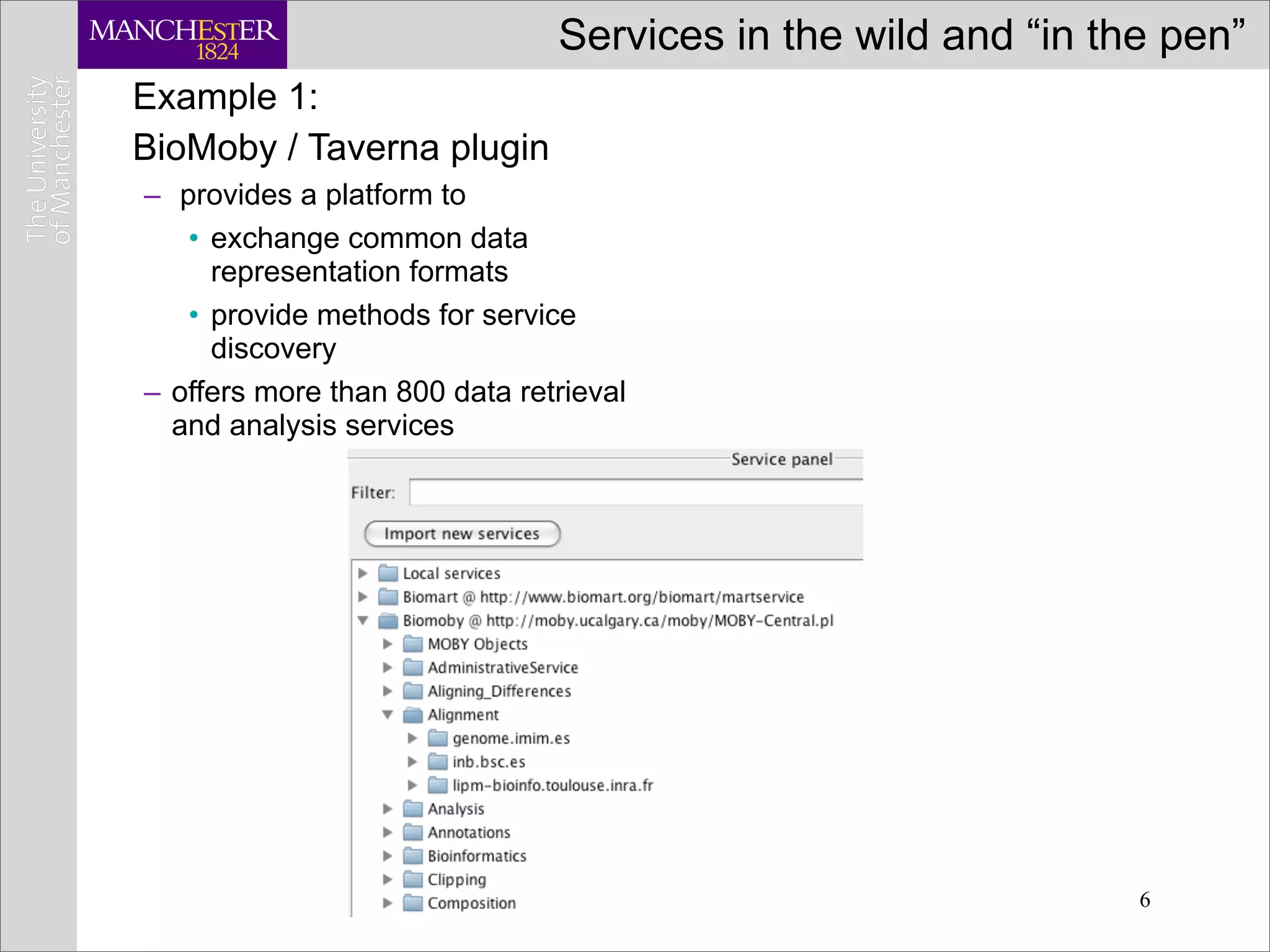
Example 1:
BioMoby / Taverna plugin
– provides a platform to
   • exchange common data
     representation formats
   • provide methods for service
     discovery
– offers more than 800 data retrieval
  and analysis services


                                                              6
Services in the wild and “in the pen”
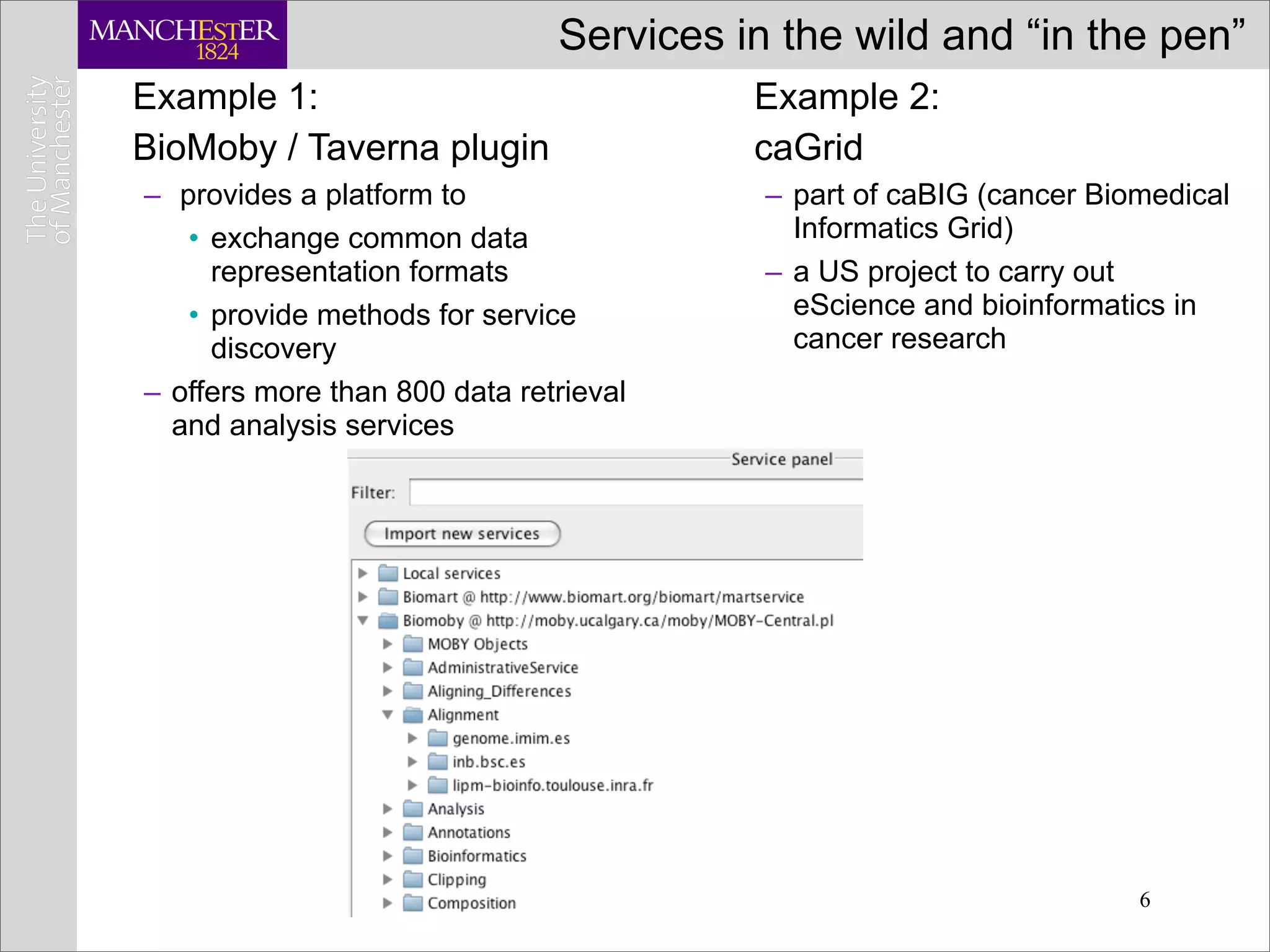
Example 1:                               Example 2:
BioMoby / Taverna plugin                 caGrid
– provides a platform to                  – part of caBIG (cancer Biomedical
   • exchange common data                   Informatics Grid)
     representation formats               – a US project to carry out
   • provide methods for service            eScience and bioinformatics in
     discovery                              cancer research
– offers more than 800 data retrieval
  and analysis services


                                                                     6
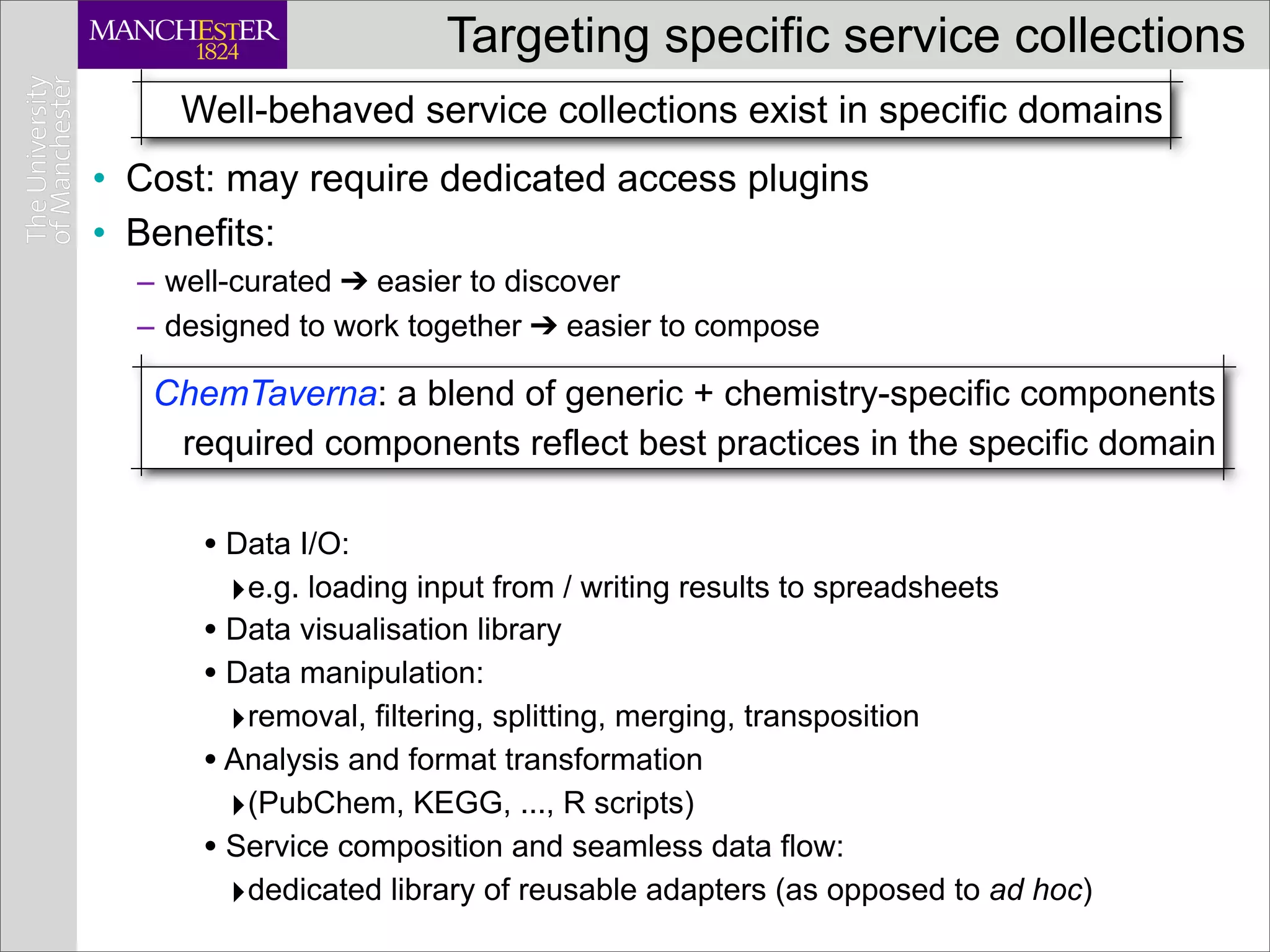
Targeting specific service collections
     Well-behaved service collections exist in specific domains
• Cost: may require dedicated access plugins
• Benefits:
  – well-curated ➔ easier to discover
  – designed to work together ➔ easier to compose
Targeting specific service collections
     Well-behaved service collections exist in specific domains
• Cost: may require dedicated access plugins
• Benefits:
  – well-curated ➔ easier to discover
  – designed to work together ➔ easier to compose

   ChemTaverna: a blend of generic + chemistry-specific components
    required components reflect best practices in the specific domain
Targeting specific service collections
     Well-behaved service collections exist in specific domains
• Cost: may require dedicated access plugins
• Benefits:
  – well-curated ➔ easier to discover
  – designed to work together ➔ easier to compose

   ChemTaverna: a blend of generic + chemistry-specific components
    required components reflect best practices in the specific domain

      • Data I/O:
        ‣e.g. loading input from / writing results to spreadsheets
      • Data visualisation library
      • Data manipulation:
        ‣removal, filtering, splitting, merging, transposition
      • Analysis and format transformation
        ‣(PubChem, KEGG, ..., R scripts)
      • Service composition and seamless data flow:
        ‣dedicated library of reusable adapters (as opposed to ad hoc)
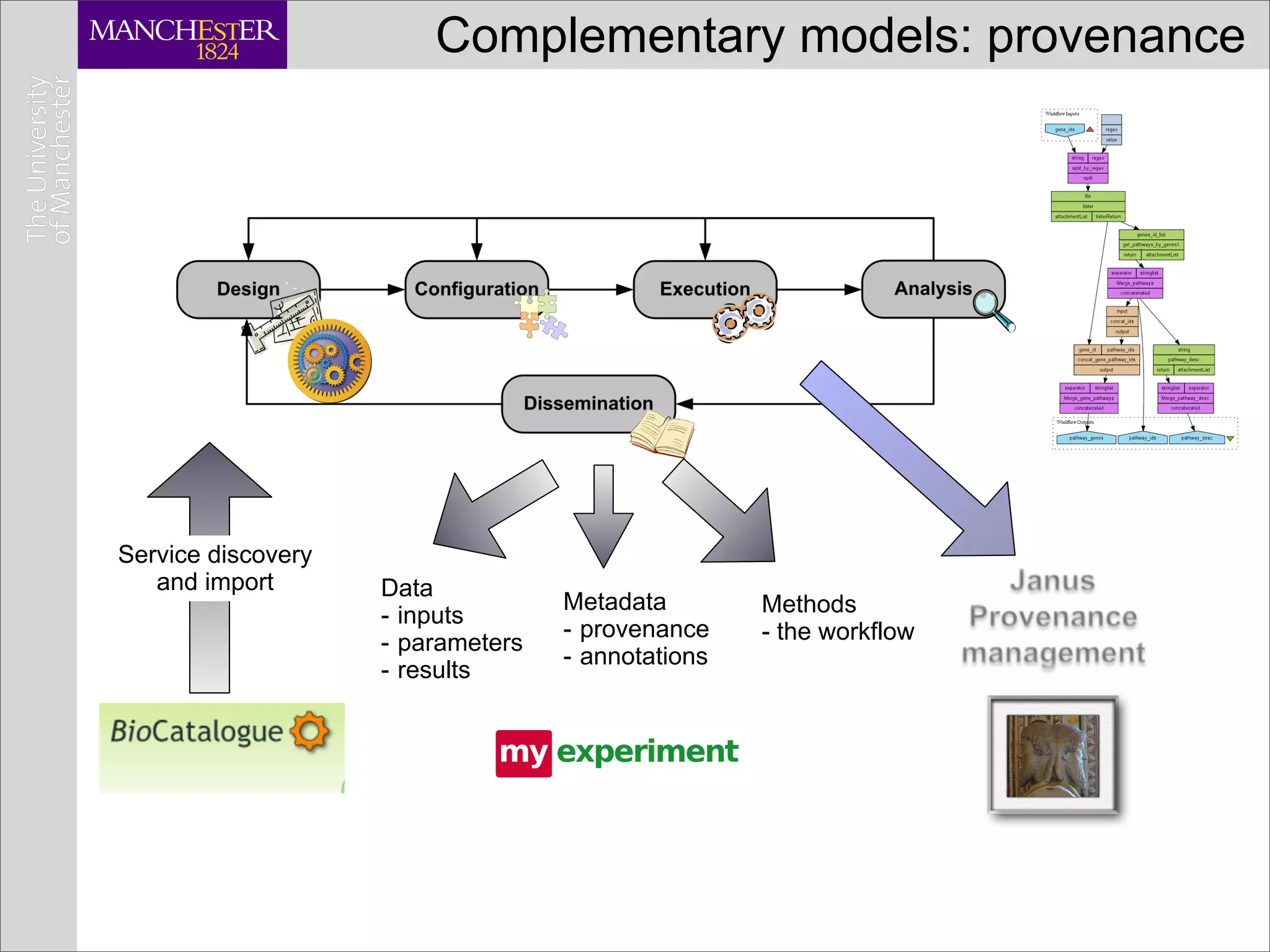
Complementary models: provenance


Service discovery
   and import       Data
                                   Metadata        Methods
                    - inputs
                                   - provenance    - the workflow
                    - parameters
                                   - annotations
                    - results
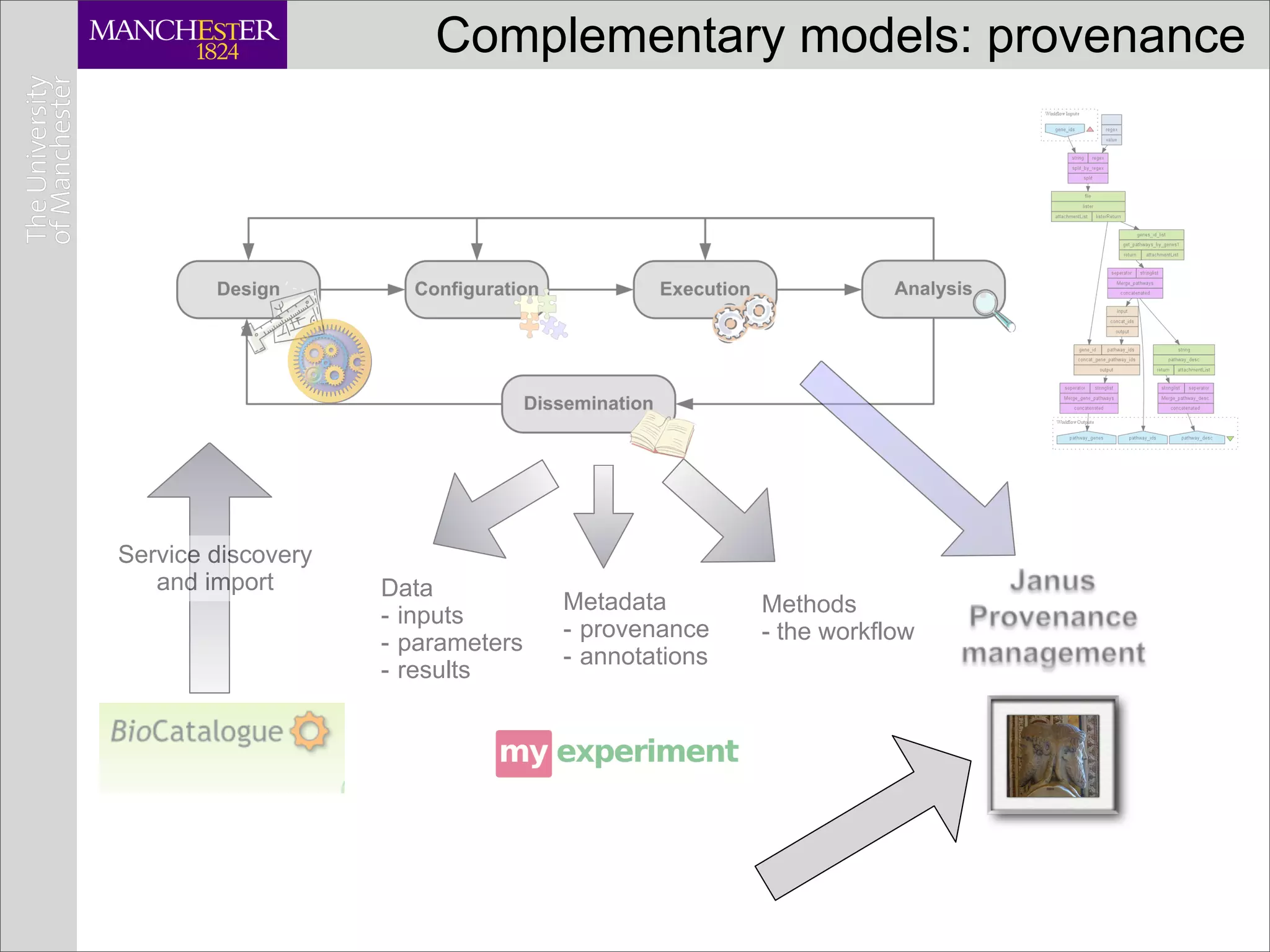
Complementary models: provenance


Service discovery
   and import       Data
                                   Metadata        Methods
                    - inputs
                                   - provenance    - the workflow
                    - parameters
                                   - annotations
                    - results
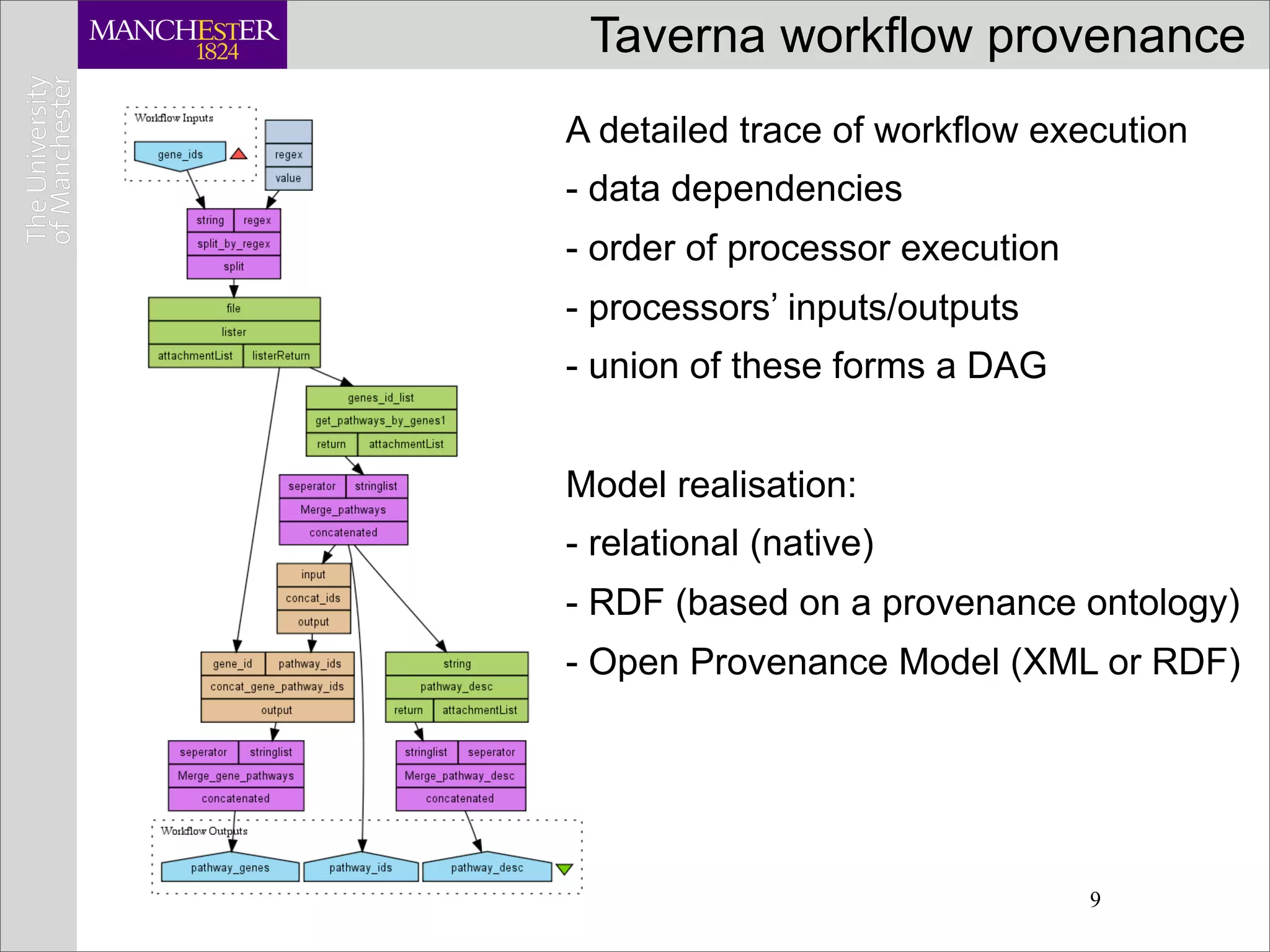
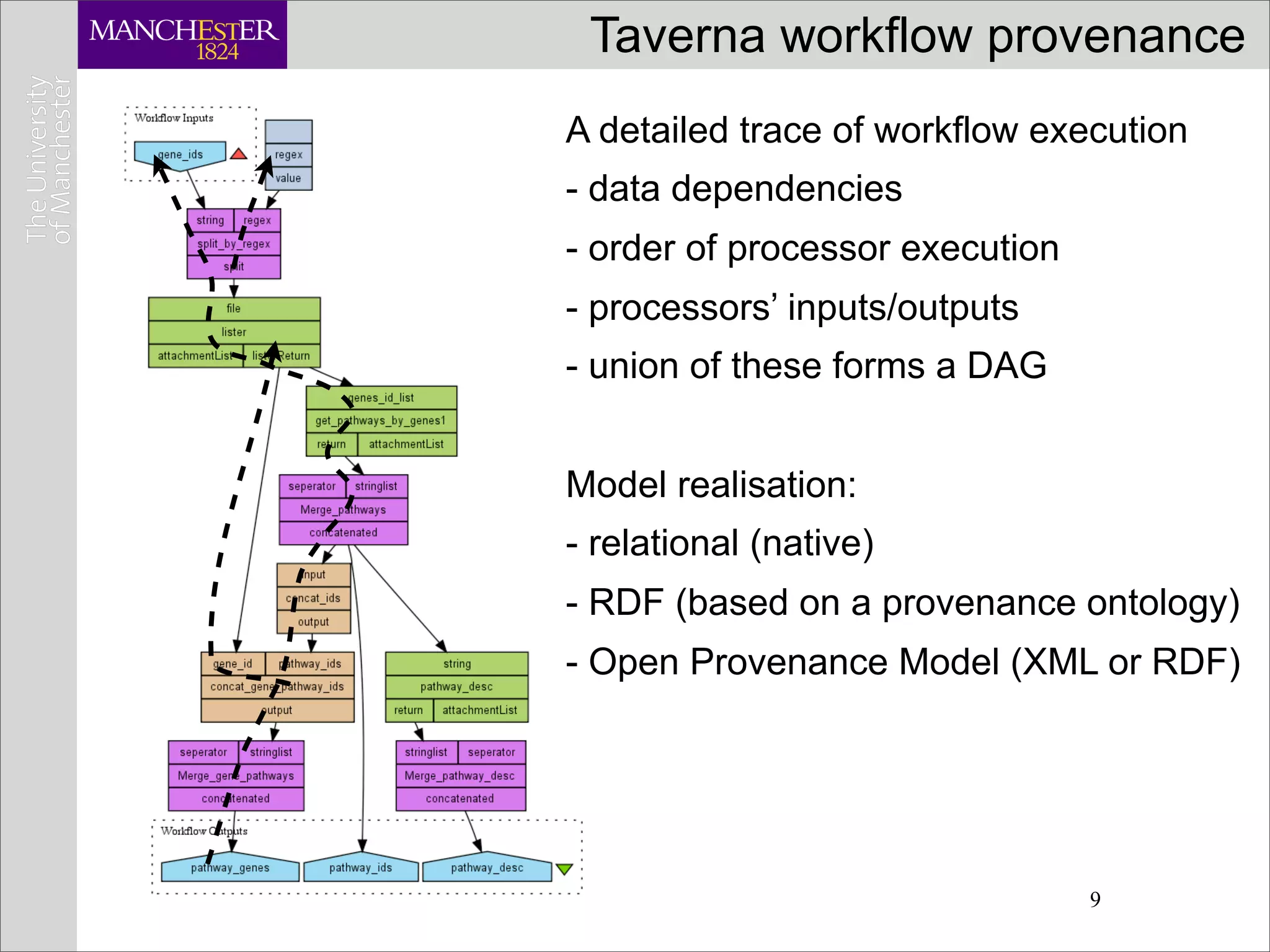
Taverna workflow provenance
A detailed trace of workflow execution
- data dependencies
- order of processor execution
- processors’ inputs/outputs
- union of these forms a DAG


Model realisation:
- relational (native)
- RDF (based on a provenance ontology)
- Open Provenance Model (XML or RDF)


                                 9
Taverna workflow provenance
A detailed trace of workflow execution
- data dependencies
- order of processor execution
- processors’ inputs/outputs
- union of these forms a DAG


Model realisation:
- relational (native)
- RDF (based on a provenance ontology)
- Open Provenance Model (XML or RDF)


                                 9
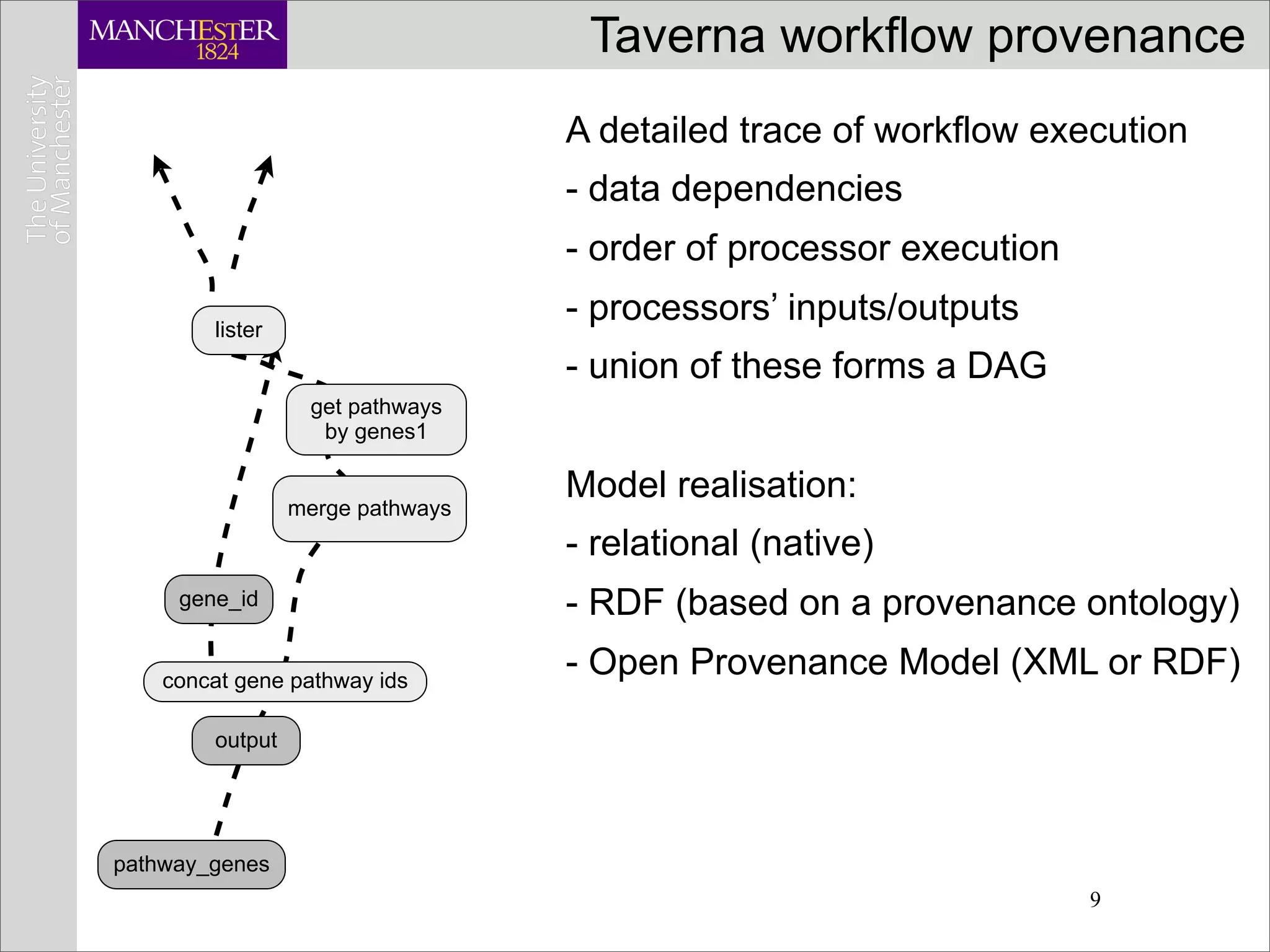
Taverna workflow provenance
                                  A detailed trace of workflow execution
                                  - data dependencies
                                  - order of processor execution

        lister
                                  - processors’ inputs/outputs
                                  - union of these forms a DAG
                  get pathways
                   by genes1

                                  Model realisation:
                 merge pathways
                                  - relational (native)
     gene_id                      - RDF (based on a provenance ontology)
    concat gene pathway ids
                                  - Open Provenance Model (XML or RDF)
        output


pathway_genes
                                                                   9
Potential benefits of provenance metadata
• To establish quality, relevance, trust
• To track information attribution through complex transformations
• To describe one’s experiment to others, for understanding / reuse
• To provide evidence in support of scientific claims
• To enable post hoc process analysis for improvement, re-design

  More specifically:
• Causal relations:
   - which input values contributed to computing an output value?
   - which process(es) caused data to be incorrect?
   - which data caused a process to fail?
• Process and data analytics:
   – analyze variations in output vs an input parameter sweep
   – how often has my favourite service been executed? on what inputs?
   – who produced this data?

 See use cases and requirements from the W3C Incubator on Provenance
 http://www.w3.org/2005/Incubator/prov/wiki                            10
Querying Taverna provenance
                      provenance access                  Provenance
                          API (Java)                       capture
<select>
 <workflow name="lymphoma"> Query
   <processor name="fetch">
    <outputPort name="value"
                index="[1,2]" />
   </processor>
   ...
</select>
<focus>                                                 Provenance
  <workflow name="exprAnalysis">           lineage          DB
    <processor name="p1" />
  </workflow>                                query
   ...
</focus>
                                          processor
           Native query answer               [1]
              (Java objects)

            RDF query answer
     [2]     (Janus ontology)

                                                         Tupelo
                      OPM graph
                      (RDF/XML)                         OPM RDF
                                          OPM graph      graph
     [3]
                                           manager      manager
                                                             11
Taverna workflows and SeCo queries
   Is there a possible relationship between a dataflow model
   (Taverna) and a SeCo query plan?


• Could any of the bioinformaitcs / sysmo workflows
  presented earlier have been expressed as SeCo
  queries?
• More generally:
  – under what assumptions can a hand-coded workflow be
    replaced by a query plan?

• In other words:
  – is the SeCo query model interesting from the point of view
    of system biology(or other bioinf domain) research?
  – would it let scientists express their service compositions at
    a higher level?
                                                                    12
Taverna computational model (very briefly)
                                 [ [ mmu:26416, ... ],
                                   [ mmu:328788, ... ] ]


                                             • Collection processing
                                             • Simple type system
                                               • no record / tuple structure
                                             • data driven computation
                                               • with optional processor synchronisation
                                             • parallel processor activation
                                               • greedy (no scheduler)


                                            [ path:mmu04010 MAPK signaling,
                                              path:mmu04370 VEGF signaling ]

[ [ path:mmu04210 Apoptosis, path:mmu04010 MAPK signaling, ...],
  [ path:mmu04010 MAPK signaling , path:mmu04620 Toll-like receptor, ...] ]

                                                               EDBT, Lausanne, March 2010
Parallelism in Taverna

                 • intra-processor: implicit iteration over collections
                 • inter-processor: pipelining

[ a, b, c,...]

[ (echo_1 a),       (echo_1 b),     (echo_1 c)]


(echo_2 (echo_1 a))
                  (echo_2 (echo_1 b))
                           (echo_2 (echo_1 c))


                 But:
                 no “chunking”
                 no repeated stateful calls to processors
                 no ranking
                                                               14
Summary, challenges, and opportunities
• Service composition requires adapters
• Target well-behaved collections of services
   – potentially low-hanging fruits
• The Taverna workflow enactor comes with a provenance capture
  and query component

    • Two key questions:
       1.Workflows live within eco-system of models, tools and technologies.
         Can any of these benefit / complement the SeCo paradigm?
       2.what is the relationship between a dataflow model (Taverna) and a
         SeCo query plan?


• how does the SeCo query model deal with data integration?
  • i.e., the adapters that account for the reality of data heterogeneity (in
     format and content)
• Is there a benefit in enhancing Taverna to support SeCo query plans?
• can the SeCo model take advantage of existing provenance models?

                                                                               15
(Shameless self) references
(1) P. Missier, N. Paton, and K. Belhajjame, "Fine-grained and efficient lineage
   querying of collection-based workflow provenance," Procs. EDBT, Lausanne,
   Switzerland: 2010.
(2) P. Missier, S.S. Sahoo, J. Zhao, A. Sheth, and C. Goble, "Janus: from Workflows
   to Semantic Provenance and Linked Open Data," Procs. IPAW 2010, Troy, NY:
   2010.
(3) P. Missier and C. Goble, “Workflows to Open Provenance Graphs, round-trip”,
   Future Generation Computing Systems Journal, Special issue on the Open
   Provenance Model, submitted.
(4) P. Missier, S. Soiland-Reyes, S. Owen, W. Tan, A. Nenadic, I. Dunlop, A. Williams,
   T. Oinn, and C. Goble, "Taverna, reloaded," Procs. SSDBM 2010, M. Gertz, T. Hey,
   and B. Ludaescher, Heidelberg, Germany: 2010.


                                                                                         16

Invited talk: Second Search Computing workshop

  • 1.
    Janus Provenance Workflows for Information Integration in the Life Sciences Part 2: Workflows in context Paolo Missier Information Management Group School of Computer Science, University of Manchester, UK Search Computing workshop Como, Italy, May 28th, 2010
  • 2.
    Purpose and outline •In the first part we have seen a case study in system biology – showcasing scientific workflows at work • Two key questions: 1.Workflows live within an eco-system of models, tools and technologies. Can any of these benefit / complement the SeCo paradigm? 2.What is the relationship between a dataflow model (Taverna) and a SeCo query plan? • To inform the discussion, we focus of some elements of a workflow’s lifecycle – importing services – benefits of domain-specific service collections – collecting and querying provenance traces 2
  • 3.
    An eco-system forworkflows Process-centric science lifecycle
  • 4.
    An eco-system forworkflows Process-centric science lifecycle Service discovery and import
  • 5.
    An eco-system forworkflows Process-centric science lifecycle Service discovery and import Data Metadata Methods - inputs - provenance - the workflow - parameters - annotations - results
  • 6.
    An eco-system forworkflows Process-centric science lifecycle Service discovery and import Data Metadata Methods - inputs - provenance - the workflow - parameters - annotations - results
  • 7.
    WSDL to Tavernaprocessors P11 P12 ... + + - ... P1 Op1(p11, p12, p13, ...) O1 ... WSDL ... service + - +... spec Pk1 Pk3 ... Opk(pk1, pk2, pk3, ...) Pk O2 ... 4
  • 8.
    WSDL to Tavernaprocessors P11 P12 ... + + - ... P1 Op1(p11, p12, p13, ...) O1 ... WSDL ... service + - +... spec Pk1 Pk3 ... Opk(pk1, pk2, pk3, ...) Pk O2 ... 4
  • 9.
    WSDL to Tavernaprocessors P11 P12 ... + + - ... P1 Op1(p11, p12, p13, ...) O1 ... WSDL ... service + - +... spec Pk1 Pk3 ... Opk(pk1, pk2, pk3, ...) Pk O2 ... 4
  • 10.
    WSDL to Tavernaprocessors P11 P12 ... + + - ... P1 Op1(p11, p12, p13, ...) O1 ... WSDL ... service + - +... spec Pk1 Pk3 ... Opk(pk1, pk2, pk3, ...) Pk O2 ... 4
  • 11.
    Service composition requiresadapters Example: SBML model optimisation workflow (see part I) -- designed by Peter Li http://www.myexperiment.org/workflows/1201
  • 12.
    Service composition requiresadapters Example: SBML model optimisation workflow (see part I) -- designed by Peter Li http://www.myexperiment.org/workflows/1201
  • 13.
    Service composition requiresadapters Example: SBML model optimisation workflow (see part I) -- designed by Peter Li http://www.myexperiment.org/workflows/1201 String[] lines = inStr.split("n"); StringBuffer sb = new StringBuffer(); for(i = 1; i < lines.length -1; i++) { String str = lines[i]; str = str.replaceAll("<result>", ""); str = str.replaceAll("</result>", ""); sb.append(str.trim() + "n"); } String outStr = sb.toString(); Url -> content (built-in shell script) import java.util.regex.Pattern; import java.util.regex.Matcher; sb = new StringBuffer(); p = "CHEBI:[0-9]+"; Pattern pattern = Pattern.compile(p); Matcher matcher = pattern.matcher(sbrml); while (matcher.find()) { sb.append("urn:miriam:obo.chebi:" + matcher.group() + ","); } String out = sb.toString(); //Clean up if(out.endsWith(",")) out = out.substring(0, out.length()-1); chebiIds = out.split(",");
  • 14.
    Services in thewild and “in the pen” Example 1: BioMoby / Taverna plugin – provides a platform to • exchange common data representation formats • provide methods for service discovery – offers more than 800 data retrieval and analysis services 6
  • 15.
    Services in thewild and “in the pen” Example 1: Example 2: BioMoby / Taverna plugin caGrid – provides a platform to – part of caBIG (cancer Biomedical • exchange common data Informatics Grid) representation formats – a US project to carry out • provide methods for service eScience and bioinformatics in discovery cancer research – offers more than 800 data retrieval and analysis services 6
  • 16.
    Targeting specific servicecollections Well-behaved service collections exist in specific domains • Cost: may require dedicated access plugins • Benefits: – well-curated ➔ easier to discover – designed to work together ➔ easier to compose
  • 17.
    Targeting specific servicecollections Well-behaved service collections exist in specific domains • Cost: may require dedicated access plugins • Benefits: – well-curated ➔ easier to discover – designed to work together ➔ easier to compose ChemTaverna: a blend of generic + chemistry-specific components required components reflect best practices in the specific domain
  • 18.
    Targeting specific servicecollections Well-behaved service collections exist in specific domains • Cost: may require dedicated access plugins • Benefits: – well-curated ➔ easier to discover – designed to work together ➔ easier to compose ChemTaverna: a blend of generic + chemistry-specific components required components reflect best practices in the specific domain • Data I/O: ‣e.g. loading input from / writing results to spreadsheets • Data visualisation library • Data manipulation: ‣removal, filtering, splitting, merging, transposition • Analysis and format transformation ‣(PubChem, KEGG, ..., R scripts) • Service composition and seamless data flow: ‣dedicated library of reusable adapters (as opposed to ad hoc)
  • 19.
    Complementary models: provenance Servicediscovery and import Data Metadata Methods - inputs - provenance - the workflow - parameters - annotations - results
  • 20.
    Complementary models: provenance Servicediscovery and import Data Metadata Methods - inputs - provenance - the workflow - parameters - annotations - results
  • 21.
    Taverna workflow provenance Adetailed trace of workflow execution - data dependencies - order of processor execution - processors’ inputs/outputs - union of these forms a DAG Model realisation: - relational (native) - RDF (based on a provenance ontology) - Open Provenance Model (XML or RDF) 9
  • 22.
    Taverna workflow provenance Adetailed trace of workflow execution - data dependencies - order of processor execution - processors’ inputs/outputs - union of these forms a DAG Model realisation: - relational (native) - RDF (based on a provenance ontology) - Open Provenance Model (XML or RDF) 9
  • 23.
    Taverna workflow provenance A detailed trace of workflow execution - data dependencies - order of processor execution lister - processors’ inputs/outputs - union of these forms a DAG get pathways by genes1 Model realisation: merge pathways - relational (native) gene_id - RDF (based on a provenance ontology) concat gene pathway ids - Open Provenance Model (XML or RDF) output pathway_genes 9
  • 24.
    Potential benefits ofprovenance metadata • To establish quality, relevance, trust • To track information attribution through complex transformations • To describe one’s experiment to others, for understanding / reuse • To provide evidence in support of scientific claims • To enable post hoc process analysis for improvement, re-design More specifically: • Causal relations: - which input values contributed to computing an output value? - which process(es) caused data to be incorrect? - which data caused a process to fail? • Process and data analytics: – analyze variations in output vs an input parameter sweep – how often has my favourite service been executed? on what inputs? – who produced this data? See use cases and requirements from the W3C Incubator on Provenance http://www.w3.org/2005/Incubator/prov/wiki 10
  • 25.
    Querying Taverna provenance provenance access Provenance API (Java) capture <select> <workflow name="lymphoma"> Query <processor name="fetch"> <outputPort name="value" index="[1,2]" /> </processor> ... </select> <focus> Provenance <workflow name="exprAnalysis"> lineage DB <processor name="p1" /> </workflow> query ... </focus> processor Native query answer [1] (Java objects) RDF query answer [2] (Janus ontology) Tupelo OPM graph (RDF/XML) OPM RDF OPM graph graph [3] manager manager 11
  • 26.
    Taverna workflows andSeCo queries Is there a possible relationship between a dataflow model (Taverna) and a SeCo query plan? • Could any of the bioinformaitcs / sysmo workflows presented earlier have been expressed as SeCo queries? • More generally: – under what assumptions can a hand-coded workflow be replaced by a query plan? • In other words: – is the SeCo query model interesting from the point of view of system biology(or other bioinf domain) research? – would it let scientists express their service compositions at a higher level? 12
  • 27.
    Taverna computational model(very briefly) [ [ mmu:26416, ... ], [ mmu:328788, ... ] ] • Collection processing • Simple type system • no record / tuple structure • data driven computation • with optional processor synchronisation • parallel processor activation • greedy (no scheduler) [ path:mmu04010 MAPK signaling, path:mmu04370 VEGF signaling ] [ [ path:mmu04210 Apoptosis, path:mmu04010 MAPK signaling, ...], [ path:mmu04010 MAPK signaling , path:mmu04620 Toll-like receptor, ...] ] EDBT, Lausanne, March 2010
  • 28.
    Parallelism in Taverna • intra-processor: implicit iteration over collections • inter-processor: pipelining [ a, b, c,...] [ (echo_1 a), (echo_1 b), (echo_1 c)] (echo_2 (echo_1 a)) (echo_2 (echo_1 b)) (echo_2 (echo_1 c)) But: no “chunking” no repeated stateful calls to processors no ranking 14
  • 29.
    Summary, challenges, andopportunities • Service composition requires adapters • Target well-behaved collections of services – potentially low-hanging fruits • The Taverna workflow enactor comes with a provenance capture and query component • Two key questions: 1.Workflows live within eco-system of models, tools and technologies. Can any of these benefit / complement the SeCo paradigm? 2.what is the relationship between a dataflow model (Taverna) and a SeCo query plan? • how does the SeCo query model deal with data integration? • i.e., the adapters that account for the reality of data heterogeneity (in format and content) • Is there a benefit in enhancing Taverna to support SeCo query plans? • can the SeCo model take advantage of existing provenance models? 15
  • 30.
    (Shameless self) references (1)P. Missier, N. Paton, and K. Belhajjame, "Fine-grained and efficient lineage querying of collection-based workflow provenance," Procs. EDBT, Lausanne, Switzerland: 2010. (2) P. Missier, S.S. Sahoo, J. Zhao, A. Sheth, and C. Goble, "Janus: from Workflows to Semantic Provenance and Linked Open Data," Procs. IPAW 2010, Troy, NY: 2010. (3) P. Missier and C. Goble, “Workflows to Open Provenance Graphs, round-trip”, Future Generation Computing Systems Journal, Special issue on the Open Provenance Model, submitted. (4) P. Missier, S. Soiland-Reyes, S. Owen, W. Tan, A. Nenadic, I. Dunlop, A. Williams, T. Oinn, and C. Goble, "Taverna, reloaded," Procs. SSDBM 2010, M. Gertz, T. Hey, and B. Ludaescher, Heidelberg, Germany: 2010. 16