© 2009 CloudMade. Map data © 2009 OpenStreetMap.org


Geodata creation: past, present and future
              Peter Batty
              Amsterdam, June 2009
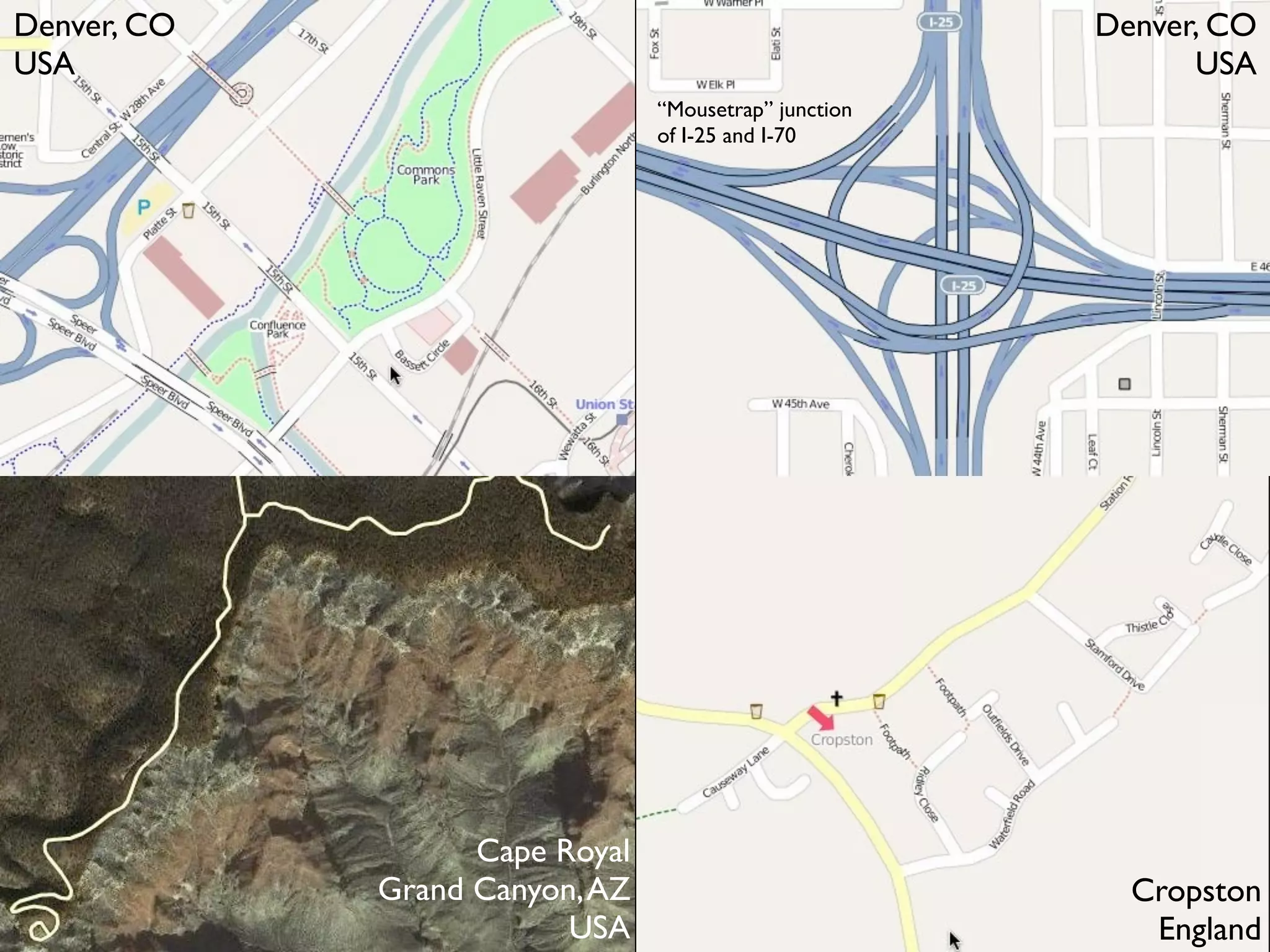
Denver, CO                                             Denver, CO
USA                                                          USA
                                “Mousetrap” junction
                                of I-25 and I-70


                   Cape Royal
             Grand Canyon, AZ                            Cropston
                         USA                              England
Overview

• A little geohistory
• 4 business models for geodata
• Crowdsourcing
• Future geodata directions
a little
geohistory
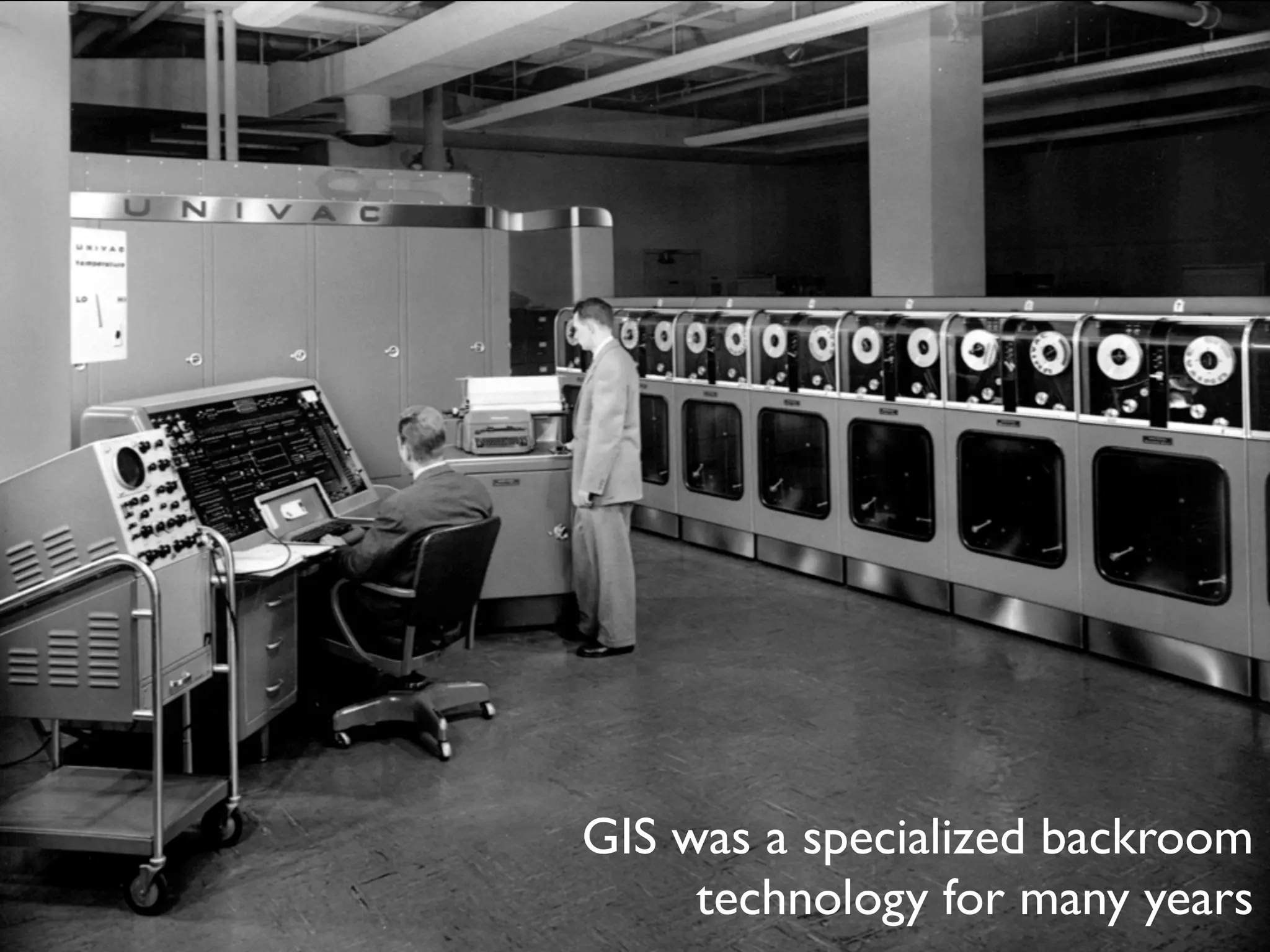
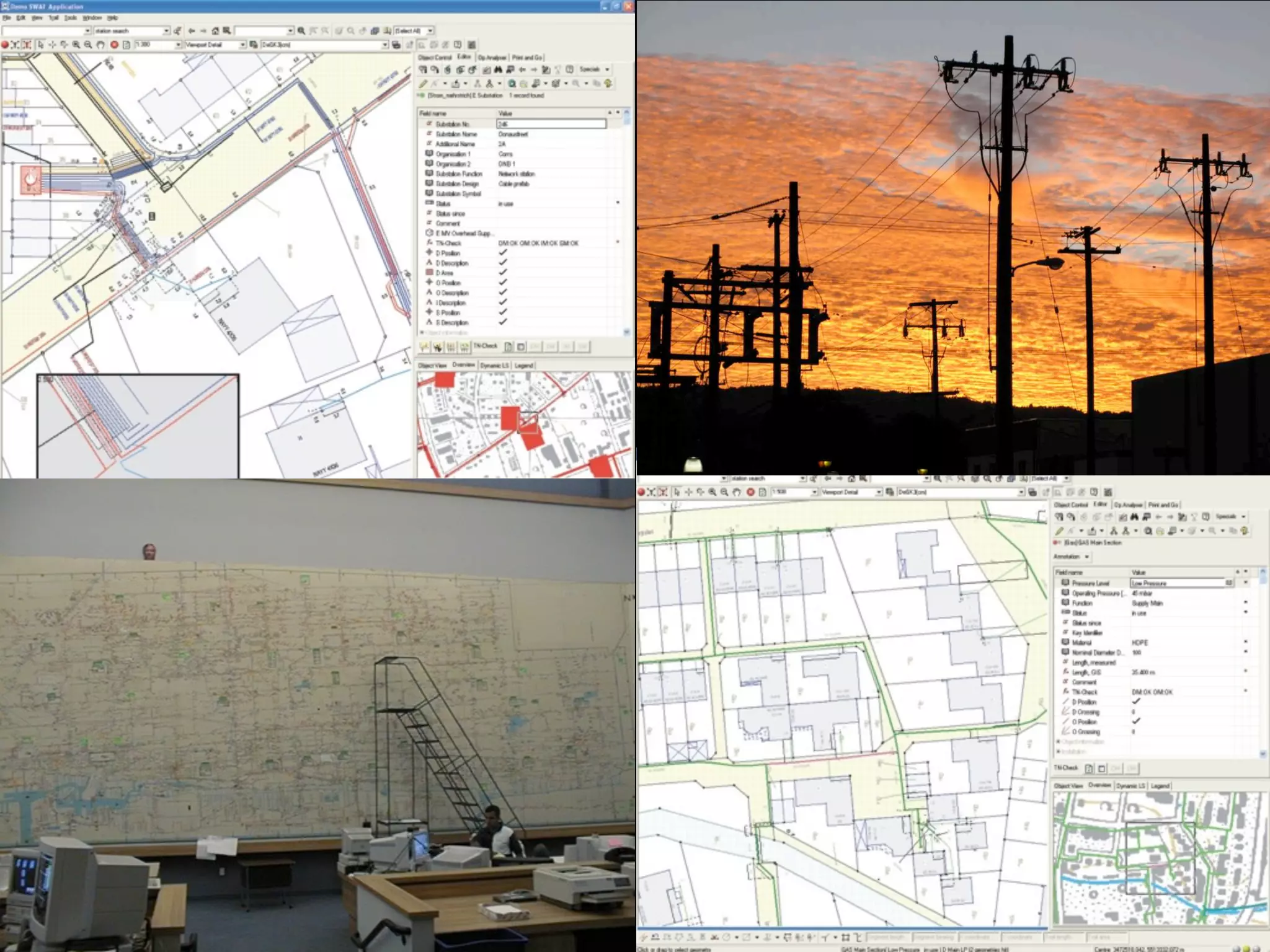
GIS was a specialized backroom
     technology for many years
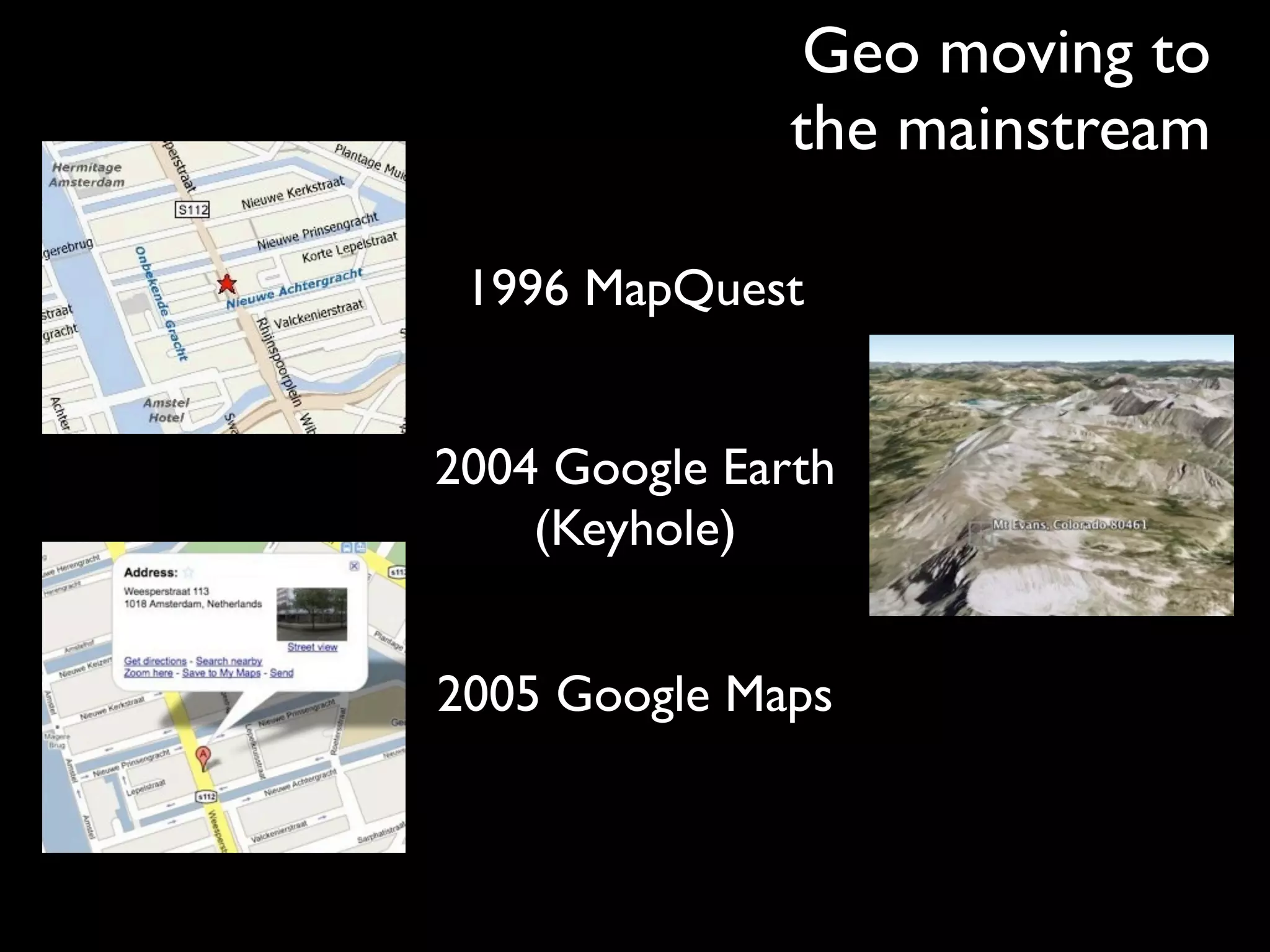
Geo moving to
               the mainstream

 1996 MapQuest


2004 Google Earth
    (Keyhole)


2005 Google Maps
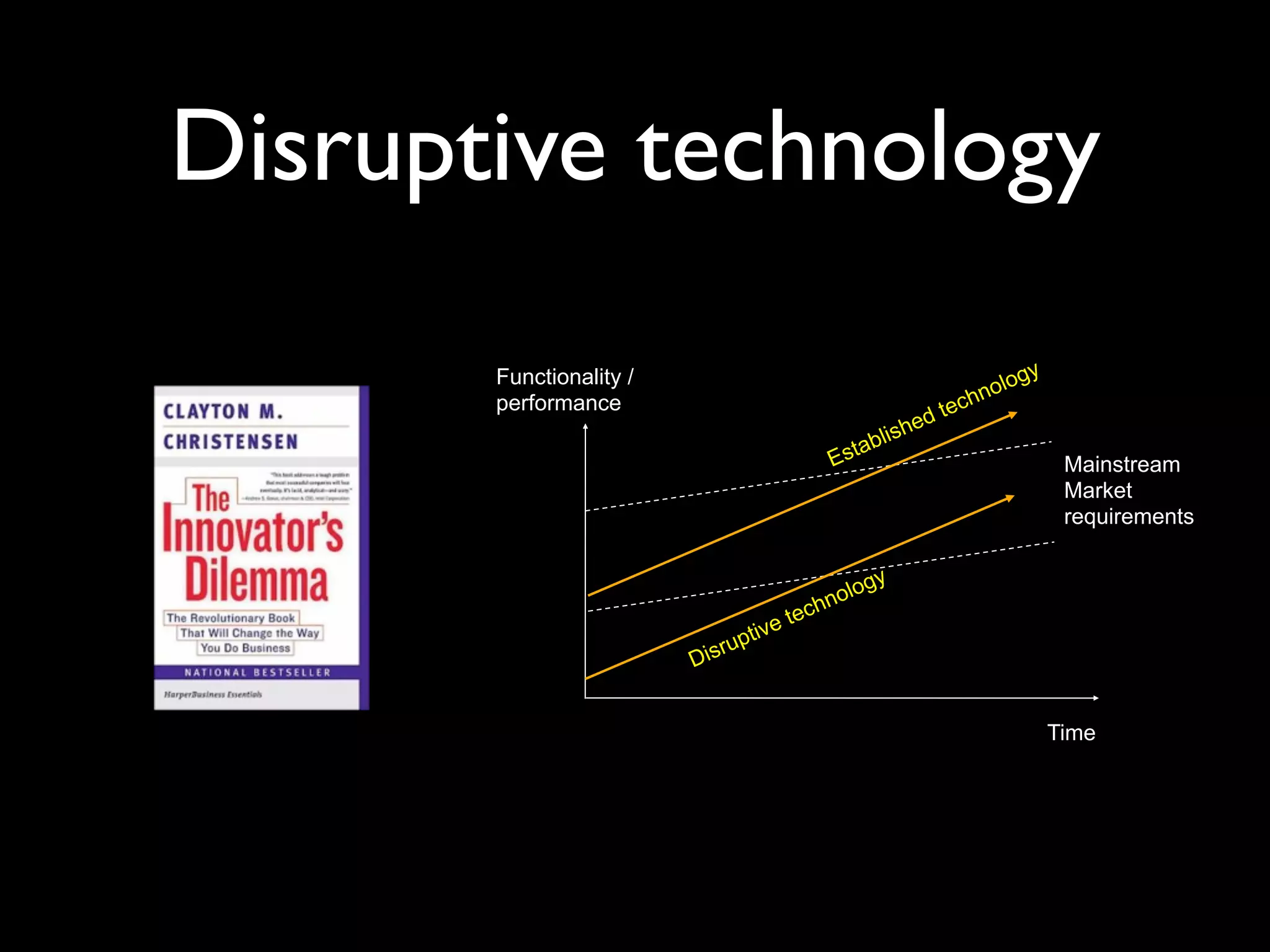
Disruptive technology
       Functionality /                                               logy
       performance                                              chno
                                                        he d te
                                                 bl   is
                                           E sta                             Mainstream
                                                                             Market
                                                                             requirements


                                              logy
                                       c  hno
                                     te
                               ptive
                            ru
                         Dis


                                                                            Time
4 business models
     for geodata
1: Build your own
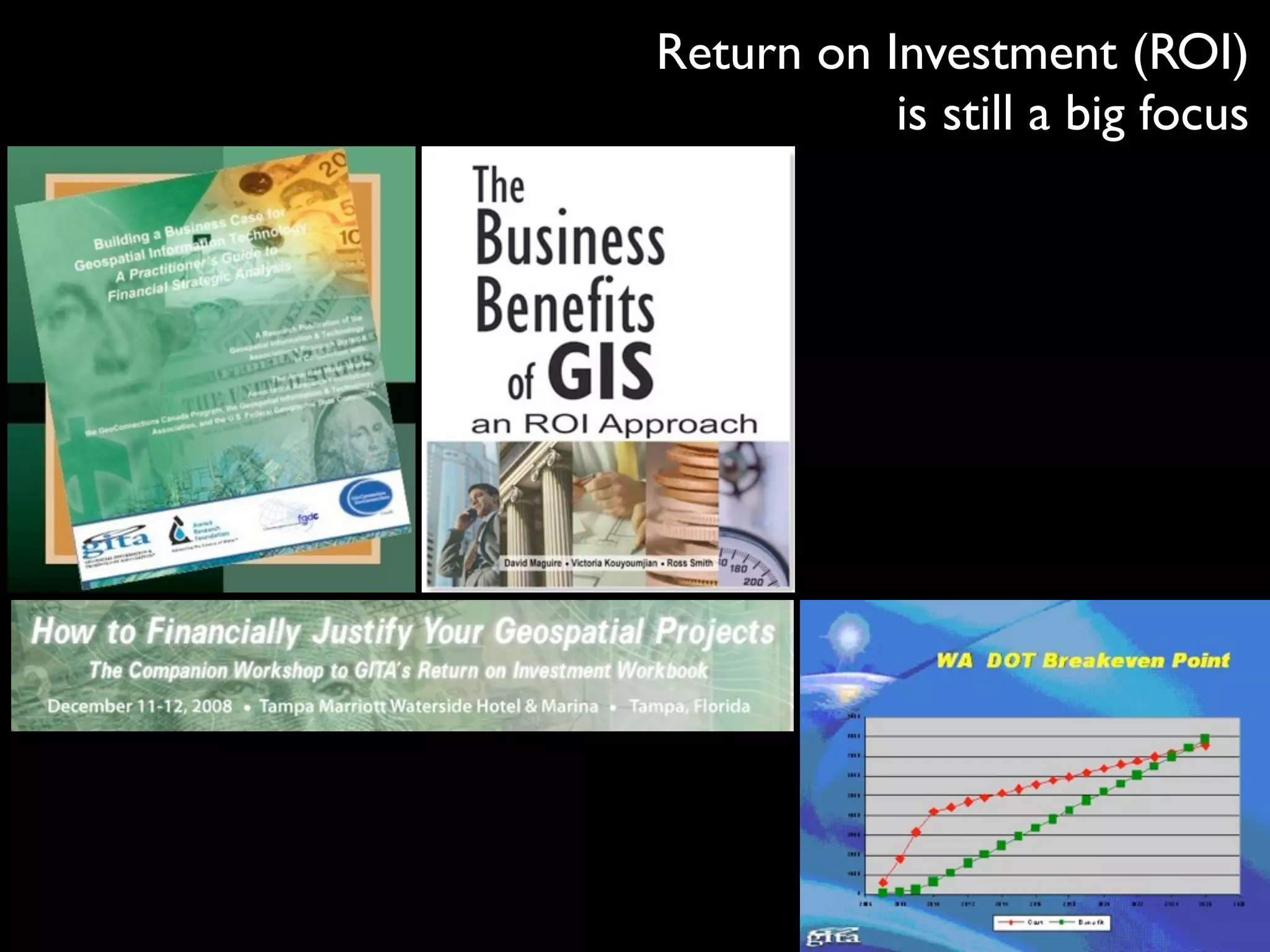
Return on Investment (ROI)
           is still a big focus
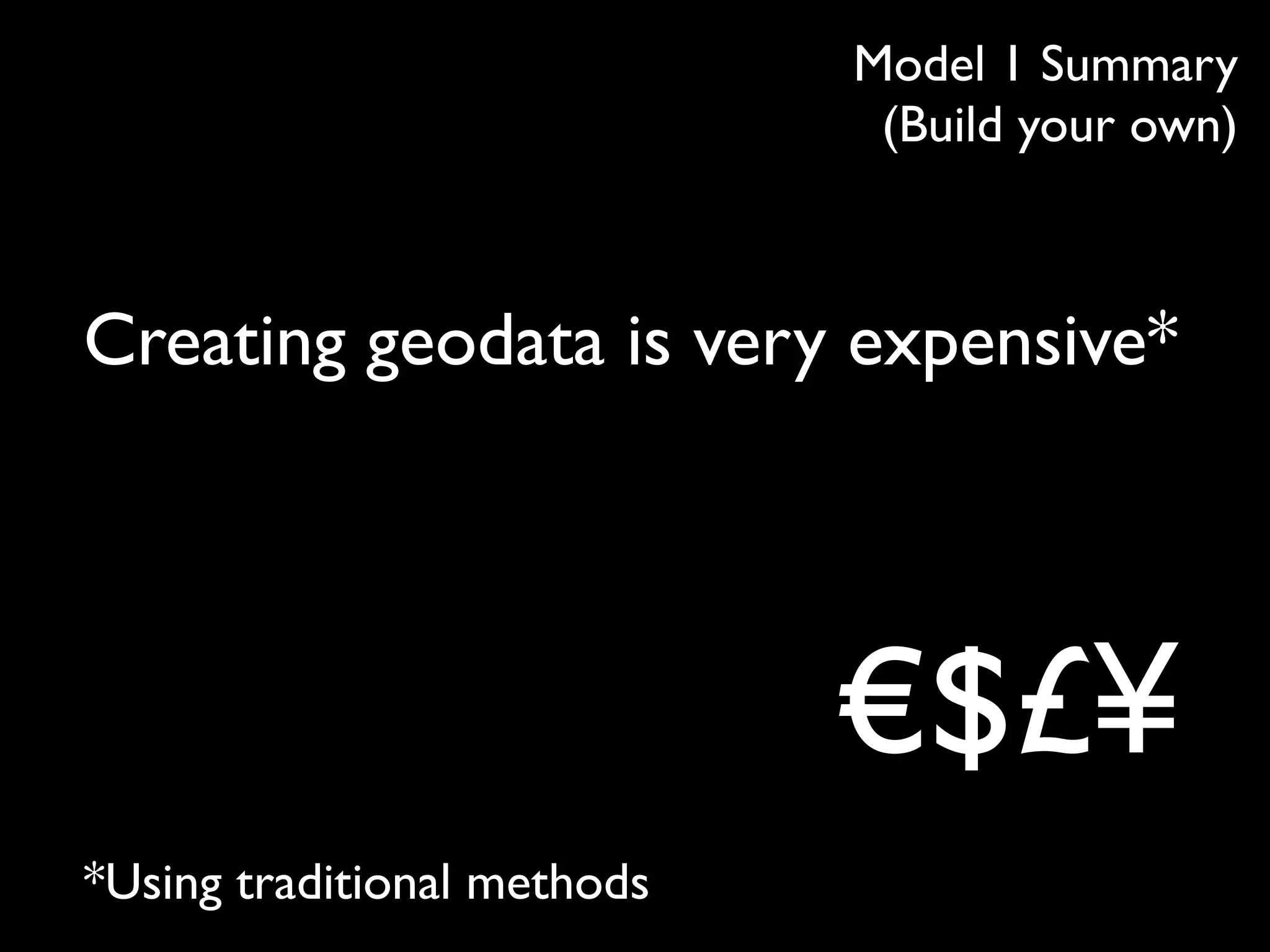
Model 1 Summary
                              (Build your own)


Creating geodata is very expensive*


                             €$£¥
*Using traditional methods
2: Let the Government
          do it
Everyone’s favorite
        punchbag
“Our taxes fund the collection of public data -
yet we have to pay again to access it. [Make] it
    freely available to stimulate innovation”

             The Guardian “Free Our Data” web site
sadly it’s   not that simple ...
   Taxes only pay some of the costs
    Costs are ongoing, not one off
Many competing priorities for tax money
       All geodata is not equal
   Commercial companies can profit
Land of the

Free
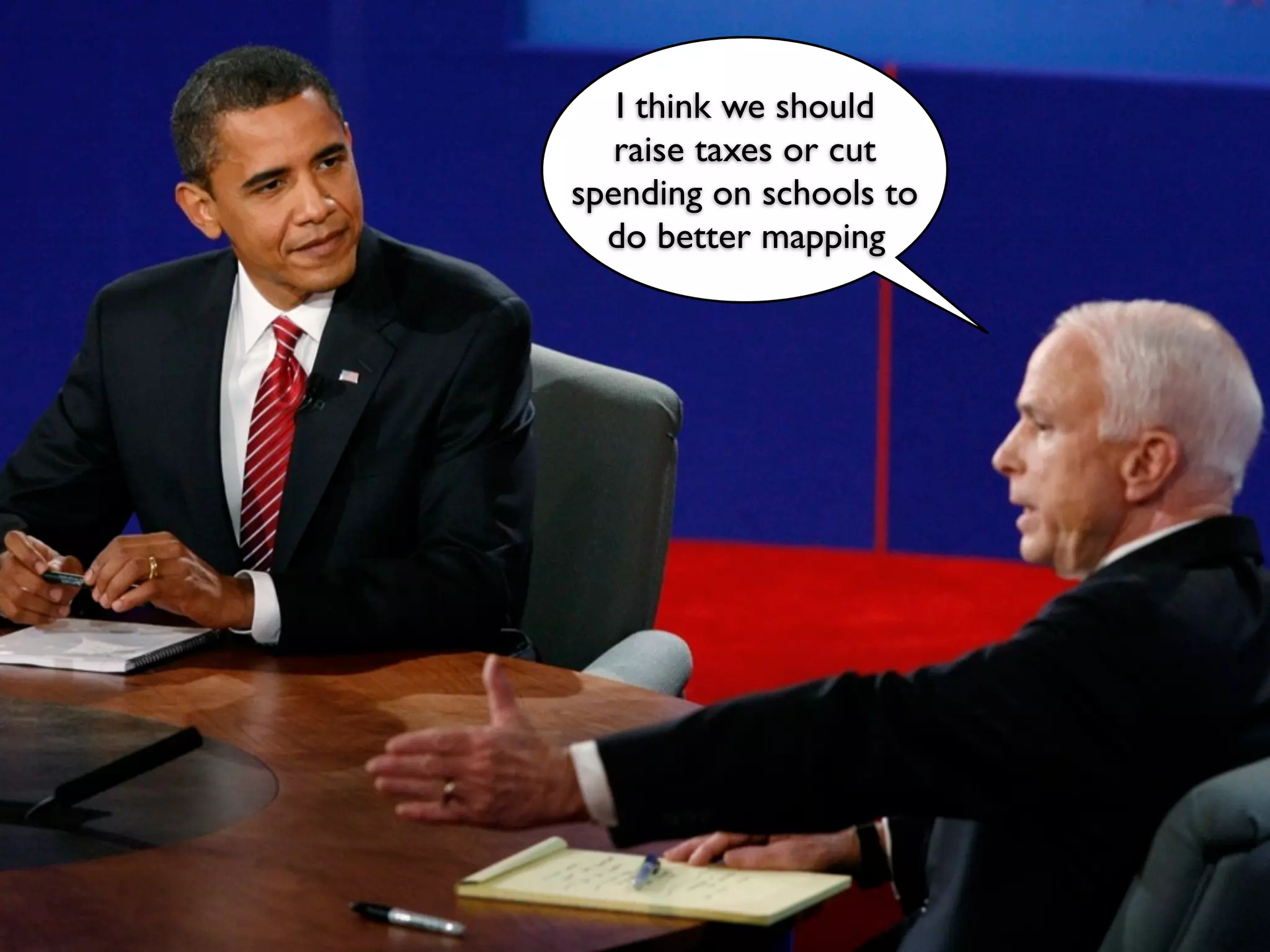
I think we should
   raise taxes or cut
spending on schools to
  do better mapping
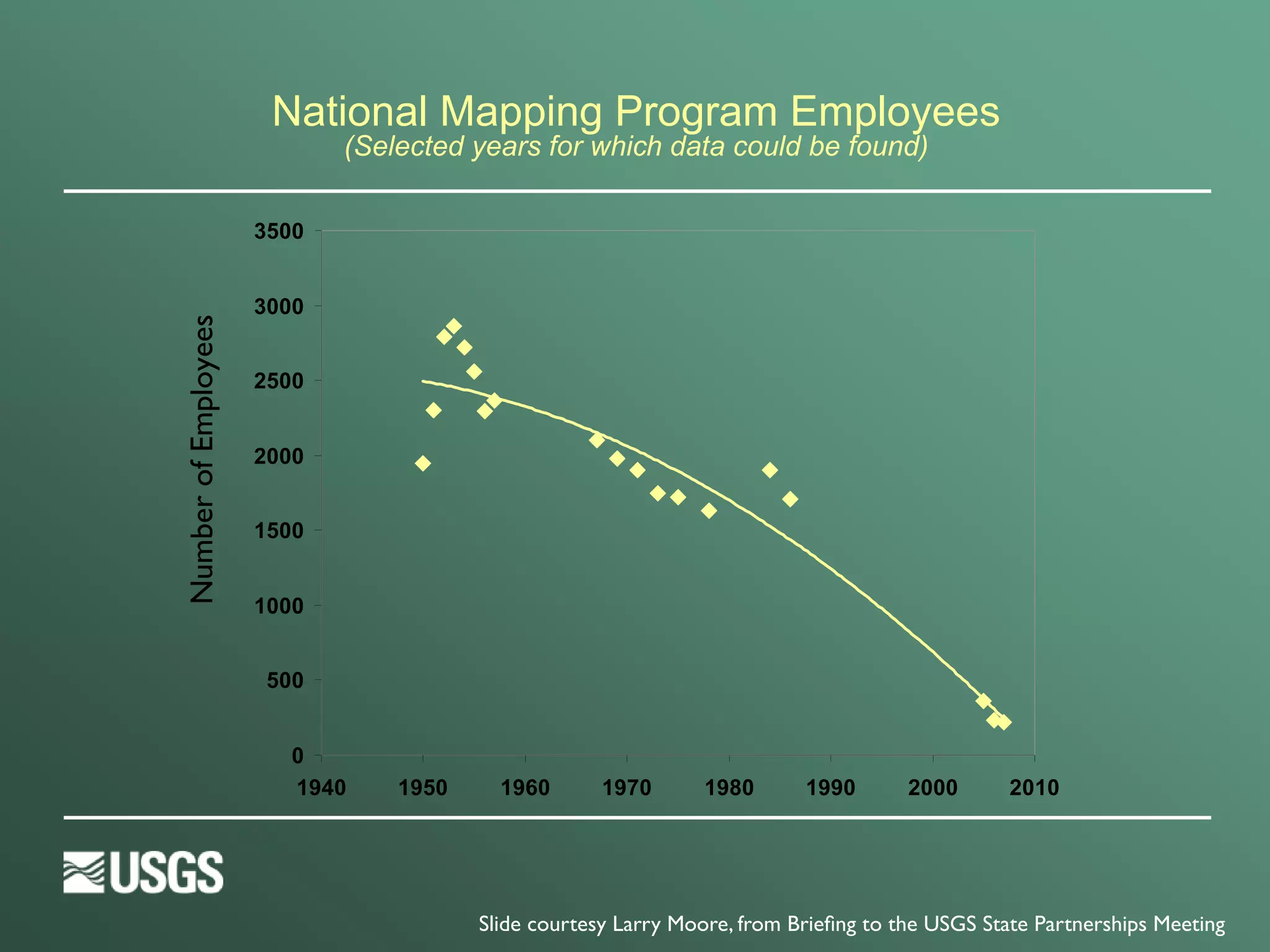
National Mapping Program Employees
                             (Selected years for which data could be found)

                      3500


                      3000
!"#$%&'()'*#+,(-%%.


                      2500


                      2000


                      1500


                      1000


                       500


                         0
                         1940    1950     1960       1970      1980       1990       2000       2010


                                        Slide courtesy Larry Moore, from Briefing to the USGS State Partnerships Meeting
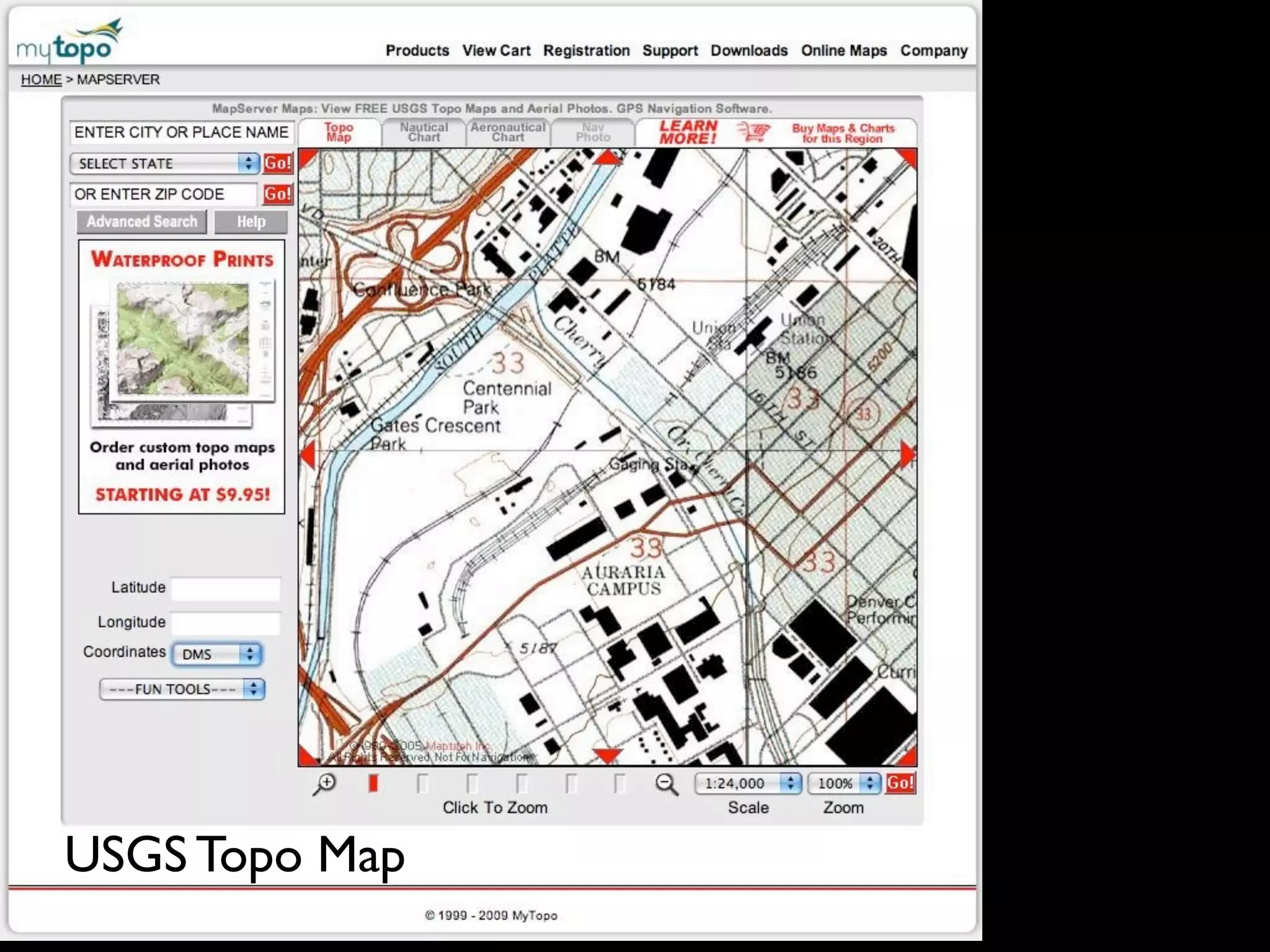
USGS Topo Map
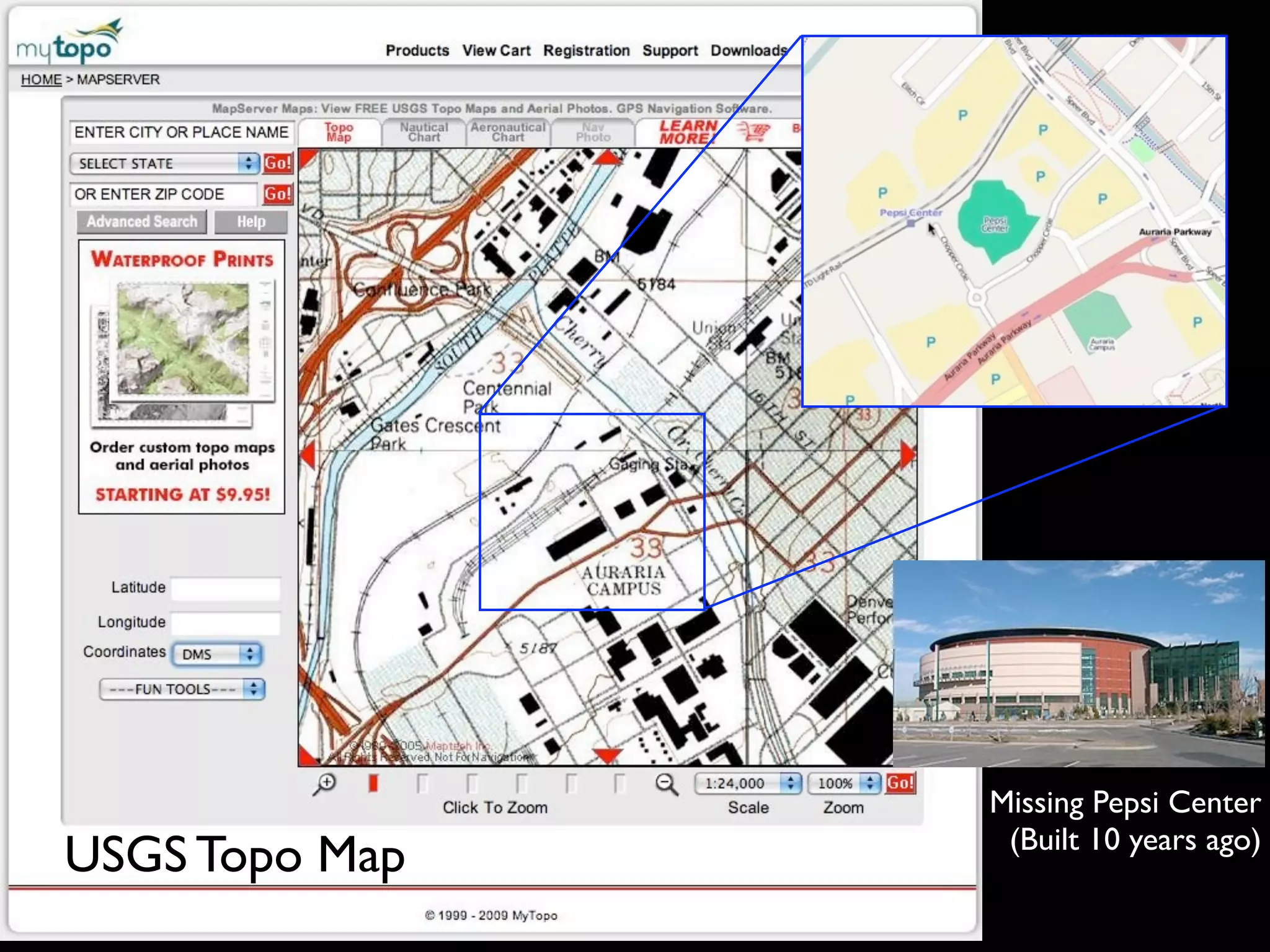
Missing Pepsi Center
                 (Built 10 years ago)
USGS Topo Map
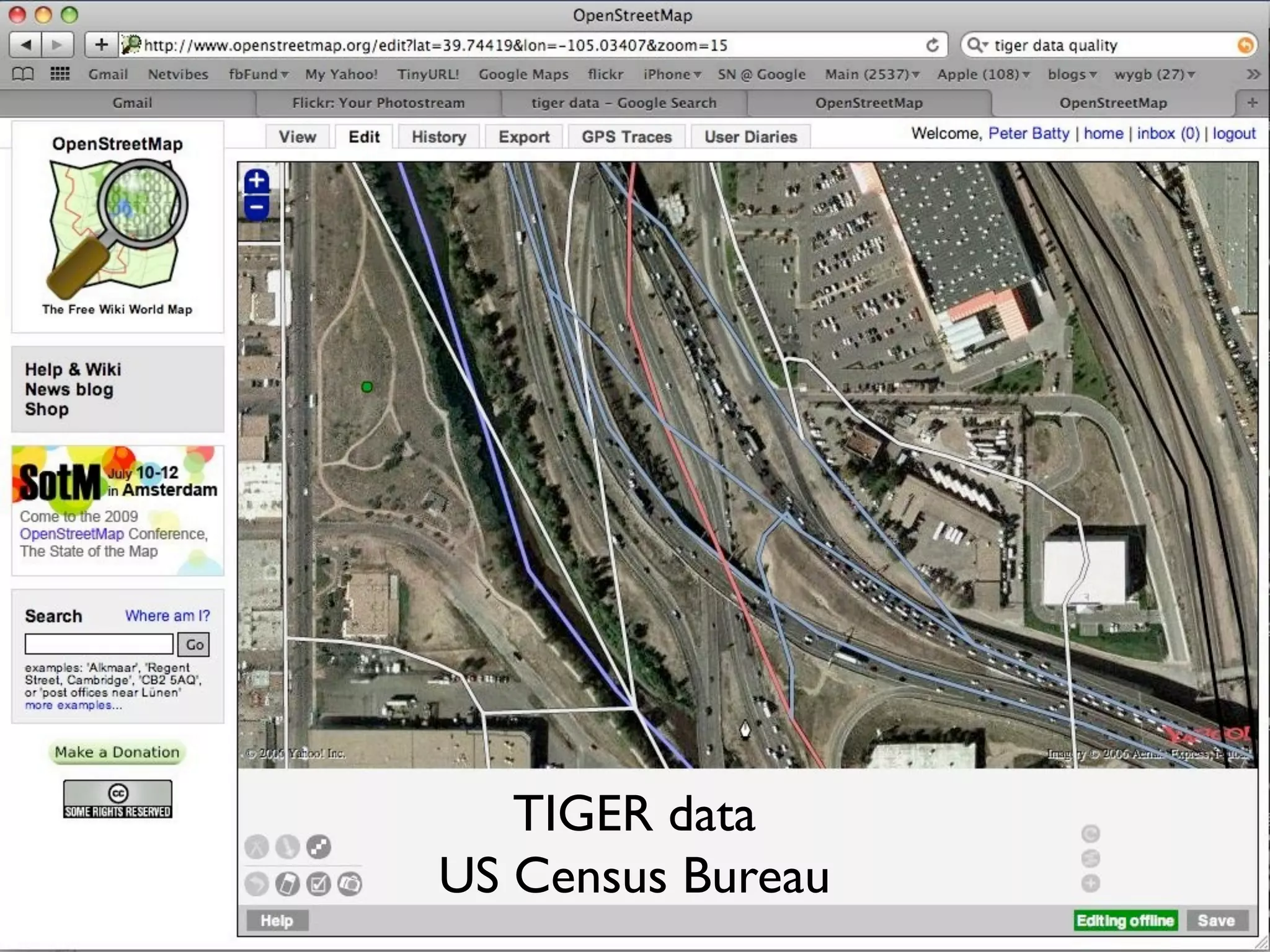
TIGER data
US Census Bureau
The US situation

There is no large scale “national map”

Almost all utilities and local governments do
their own base mapping

Therefore most cities are mapped many times -
huge duplication of effort

Typically there are significant inconsistencies
between basemaps (tens or hundreds of meters
not uncommon)
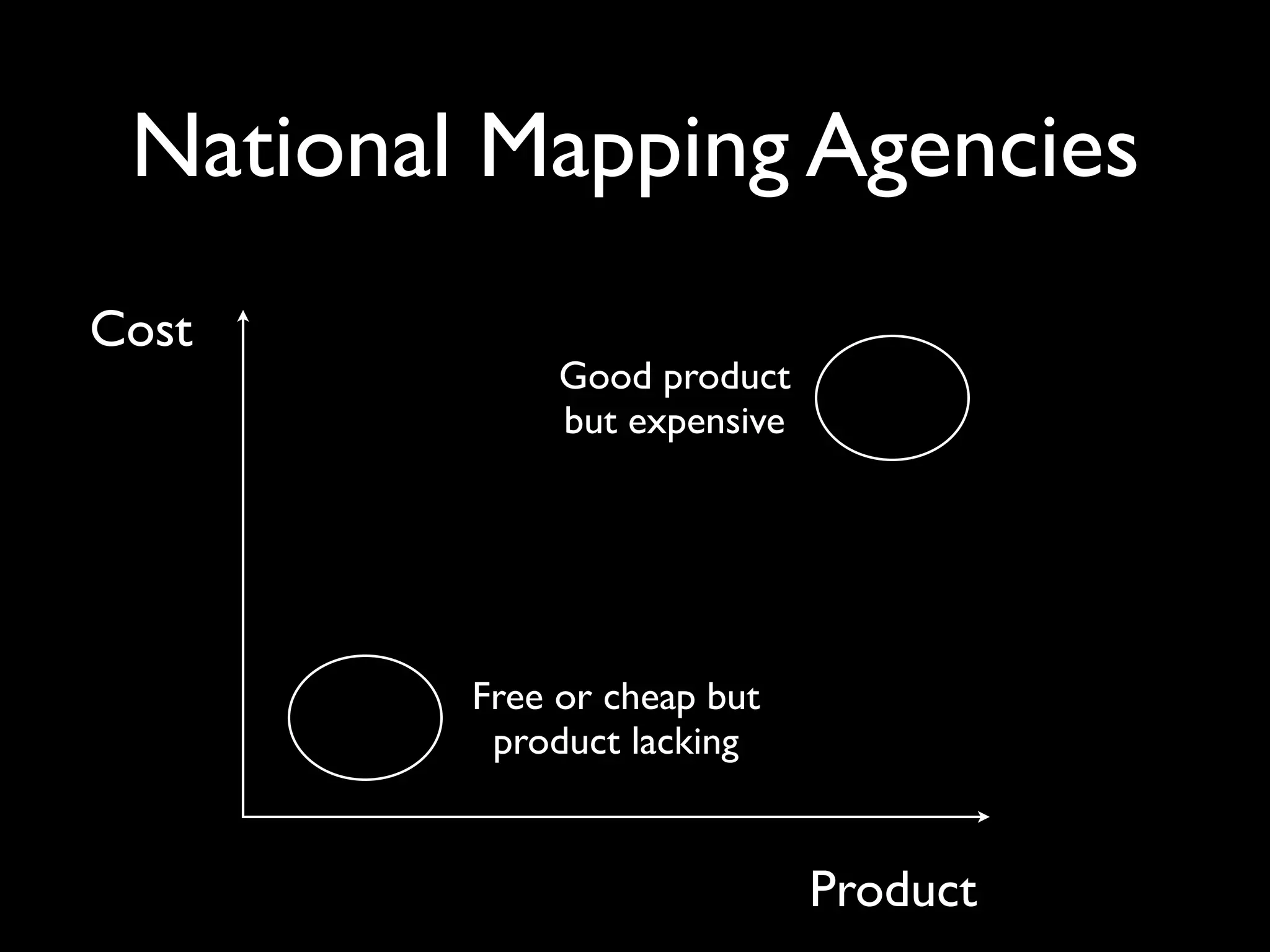
National Mapping Agencies
Cost
              Good product
              but expensive


         Free or cheap but
          product lacking


                              Product
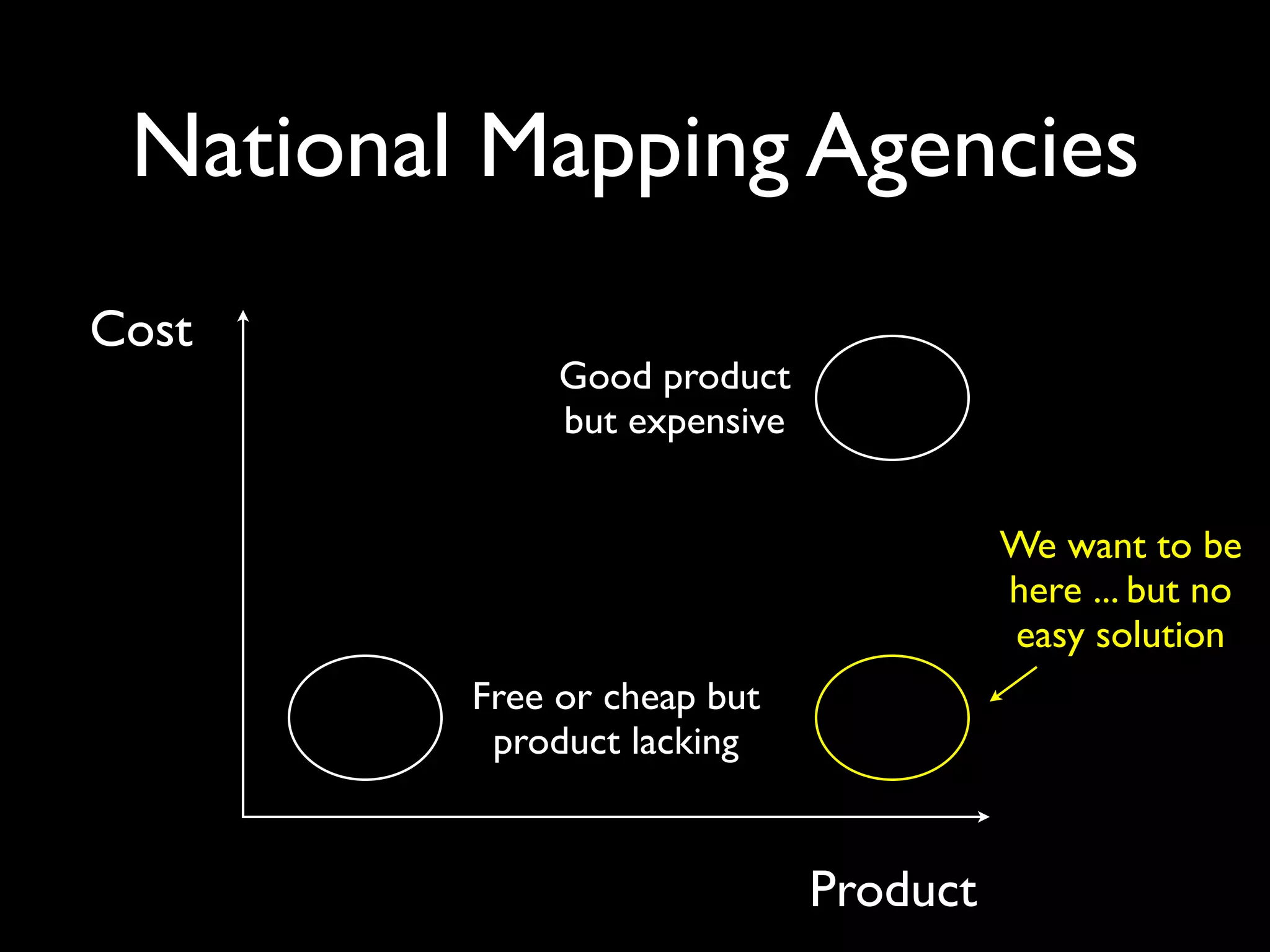
National Mapping Agencies
Cost
              Good product
              but expensive


                                        We want to be
                                        here ... but no
                                        easy solution
         Free or cheap but
          product lacking


                              Product
The grass is always greener on the other side of the fence
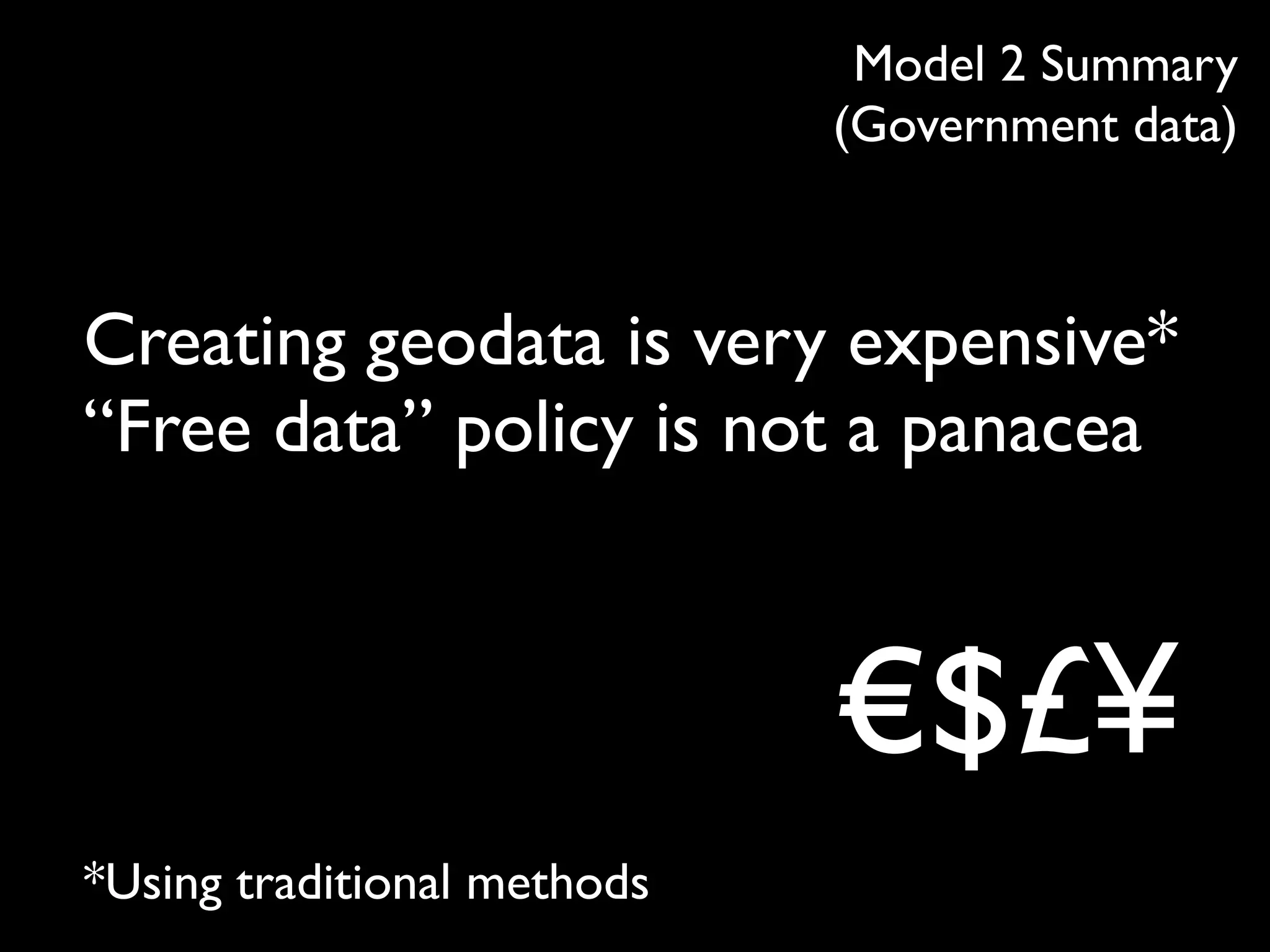
Model 2 Summary
                             (Government data)


Creating geodata is very expensive*
“Free data” policy is not a panacea


                             €$£¥
*Using traditional methods
3: Buy commercially
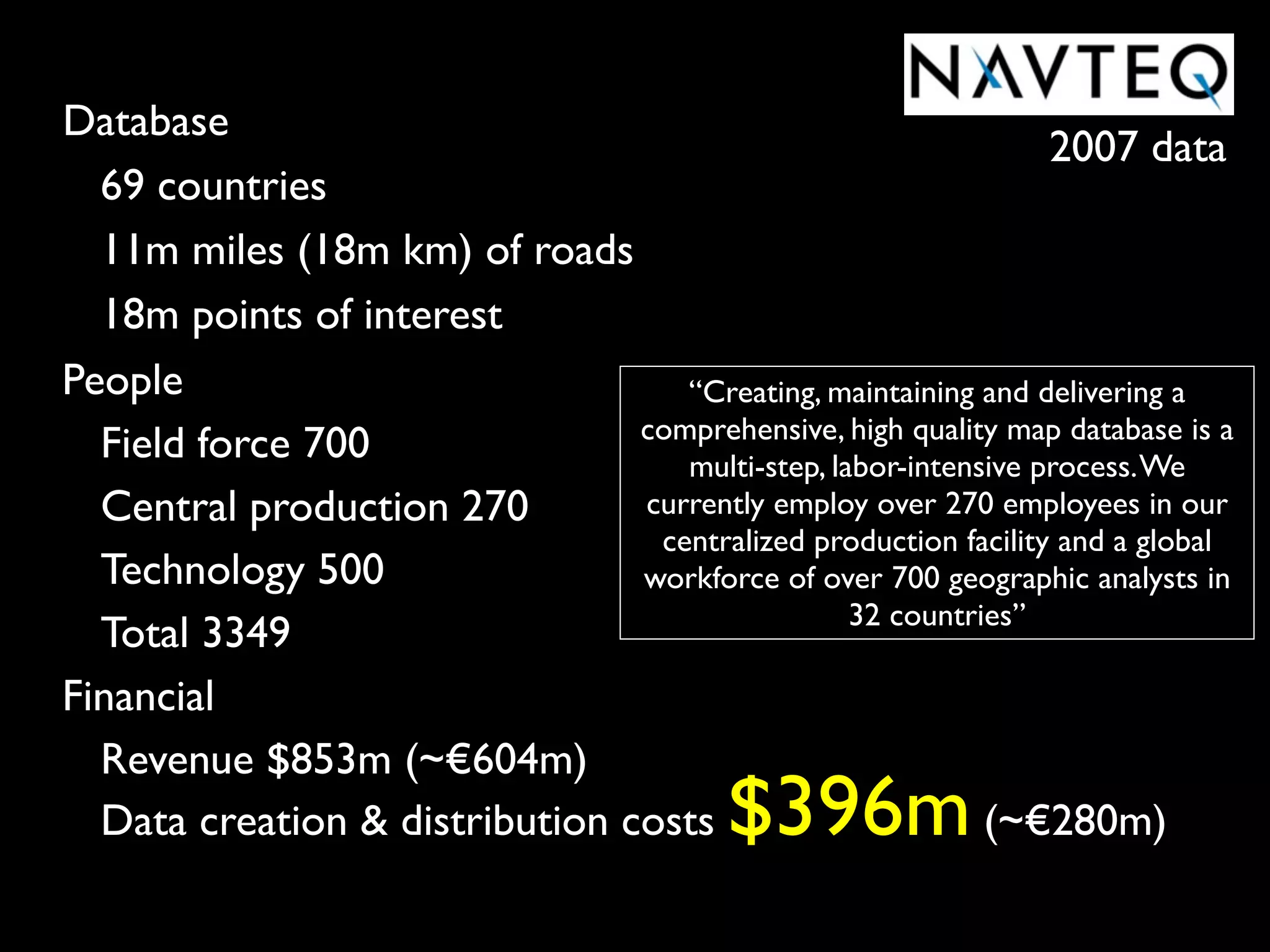
“Creating, maintaining and delivering a
comprehensive, high quality map database is a
   multi-step, labor-intensive process. We
currently employ over 270 employees in our
 centralized production facility and a global
workforce of over 700 geographic analysts in
                 32 countries”
Database
                                                                2007 data
  69 countries
  11m miles (18m km) of roads
  18m points of interest
People                             “Creating, maintaining and delivering a
                                comprehensive, high quality map database is a
  Field force 700                  multi-step, labor-intensive process. We
  Central production 270        currently employ over 270 employees in our
                                 centralized production facility and a global
  Technology 500                workforce of over 700 geographic analysts in
                                                 32 countries”
  Total 3349
Financial
  Revenue $853m (~€604m)
  Data creation & distribution costs       $396m           (~€280m)
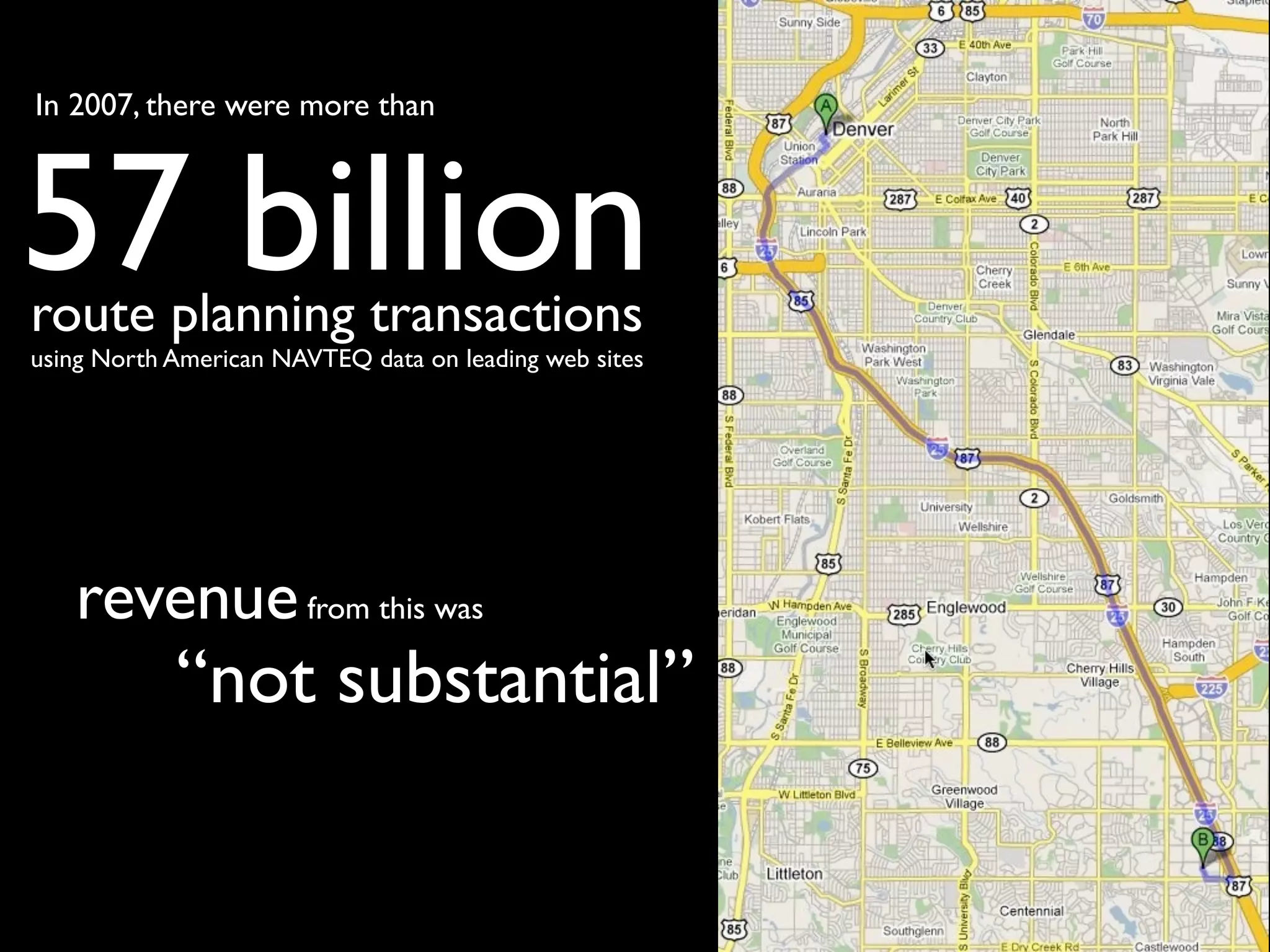
In 2007, there were more than


57 billion
route planning transactions
using North American NAVTEQ data on leading web sites


   revenue from this was
            “not substantial”
€$£¥


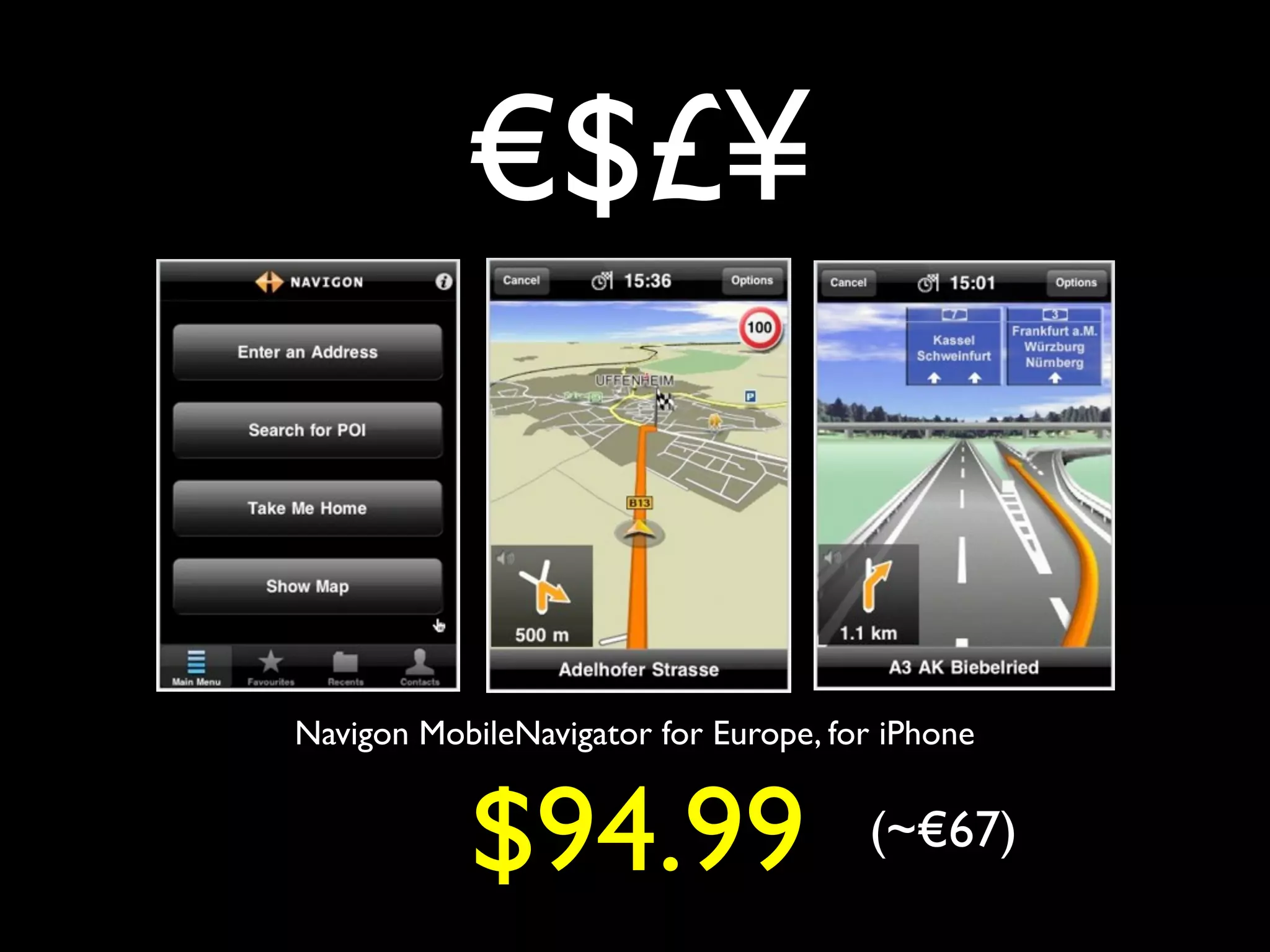
Navigon MobileNavigator for Europe, for iPhone


           $94.99                     (~€67)
Model 3 Summary
                             (Buy commercial data)


Creating geodata is very expensive*
Some improvement through sharing
of costs between more companies

                                €$£¥
*Using traditional methods
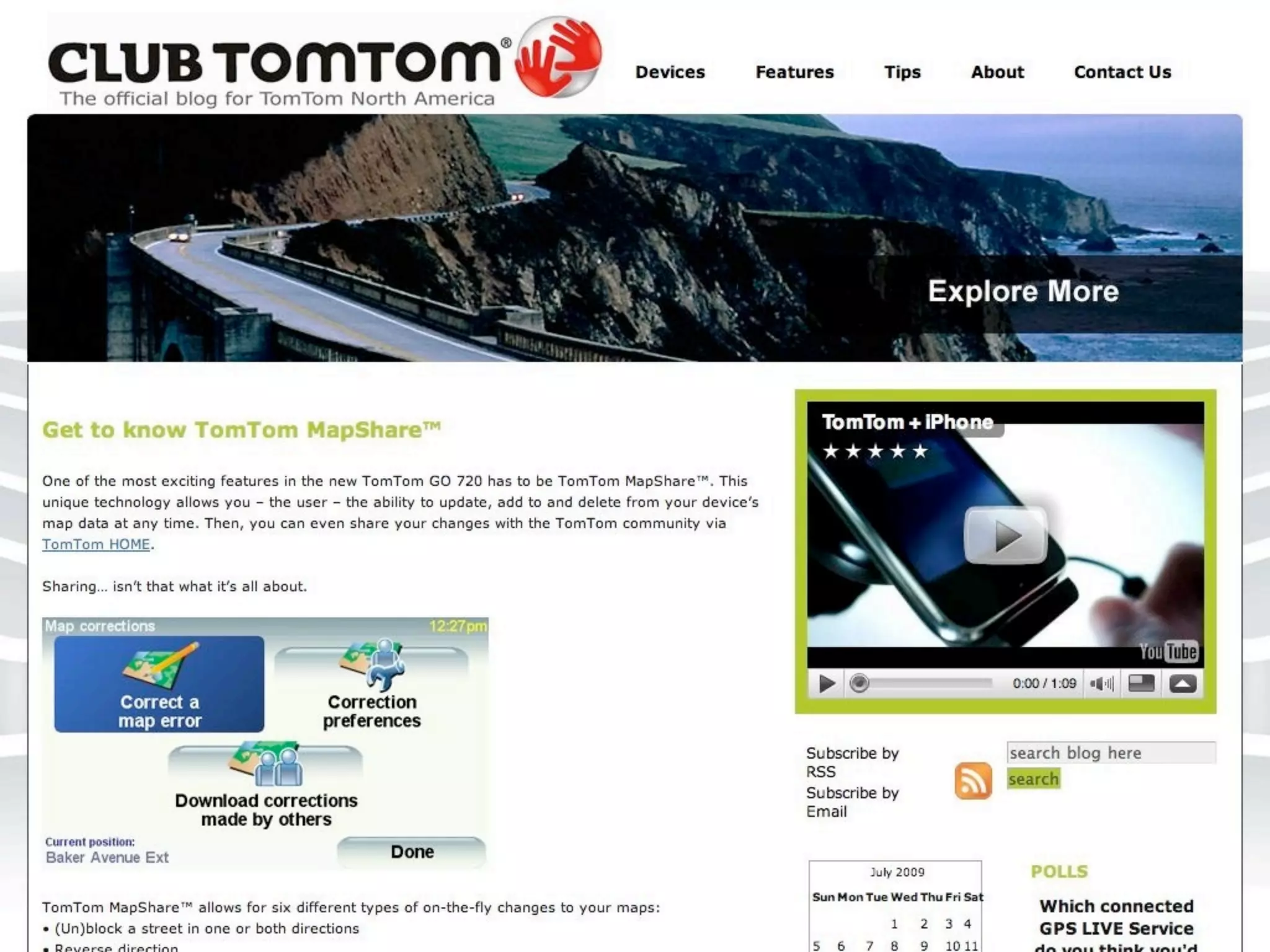
4: Free* commercial
      services
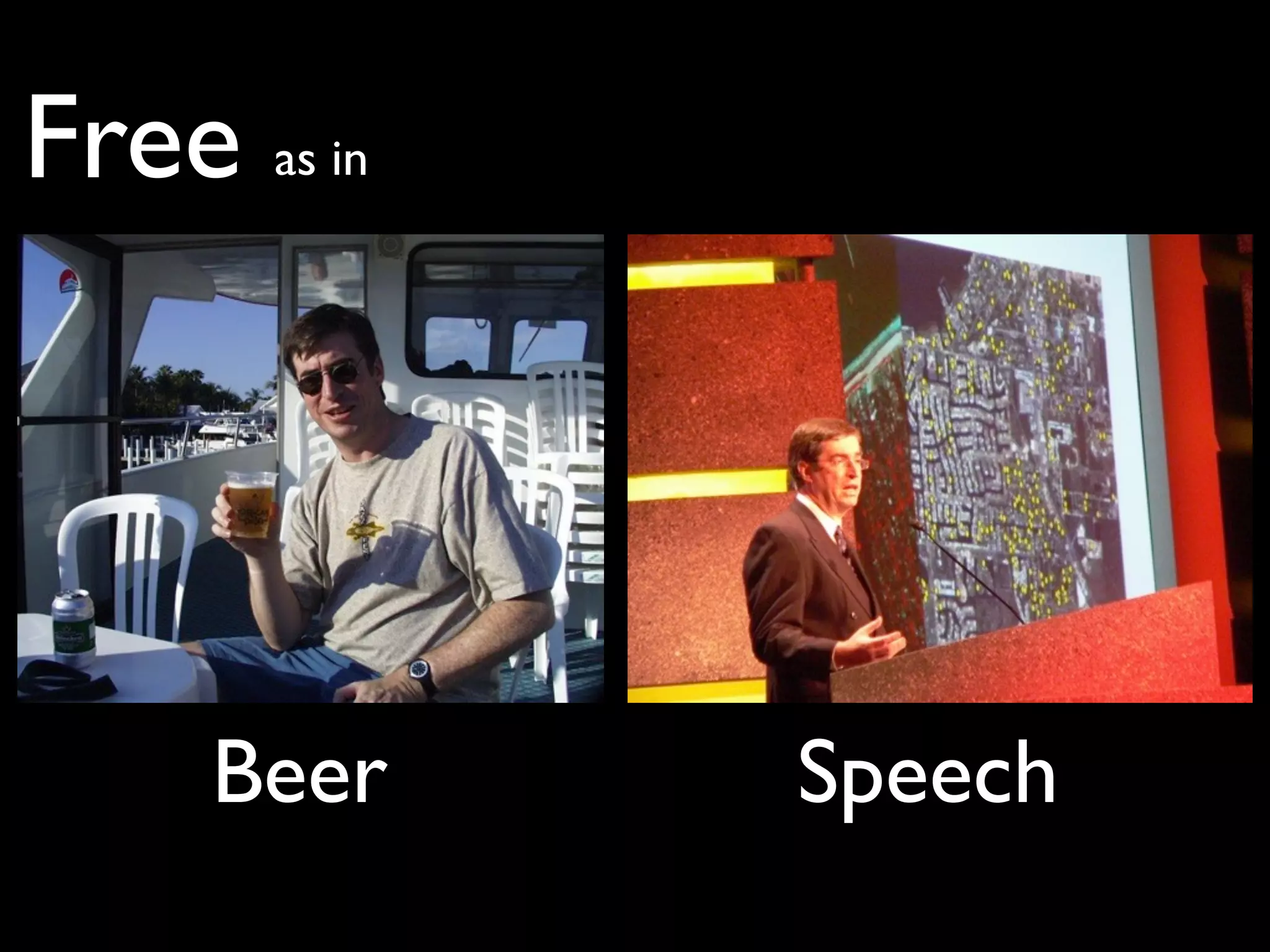
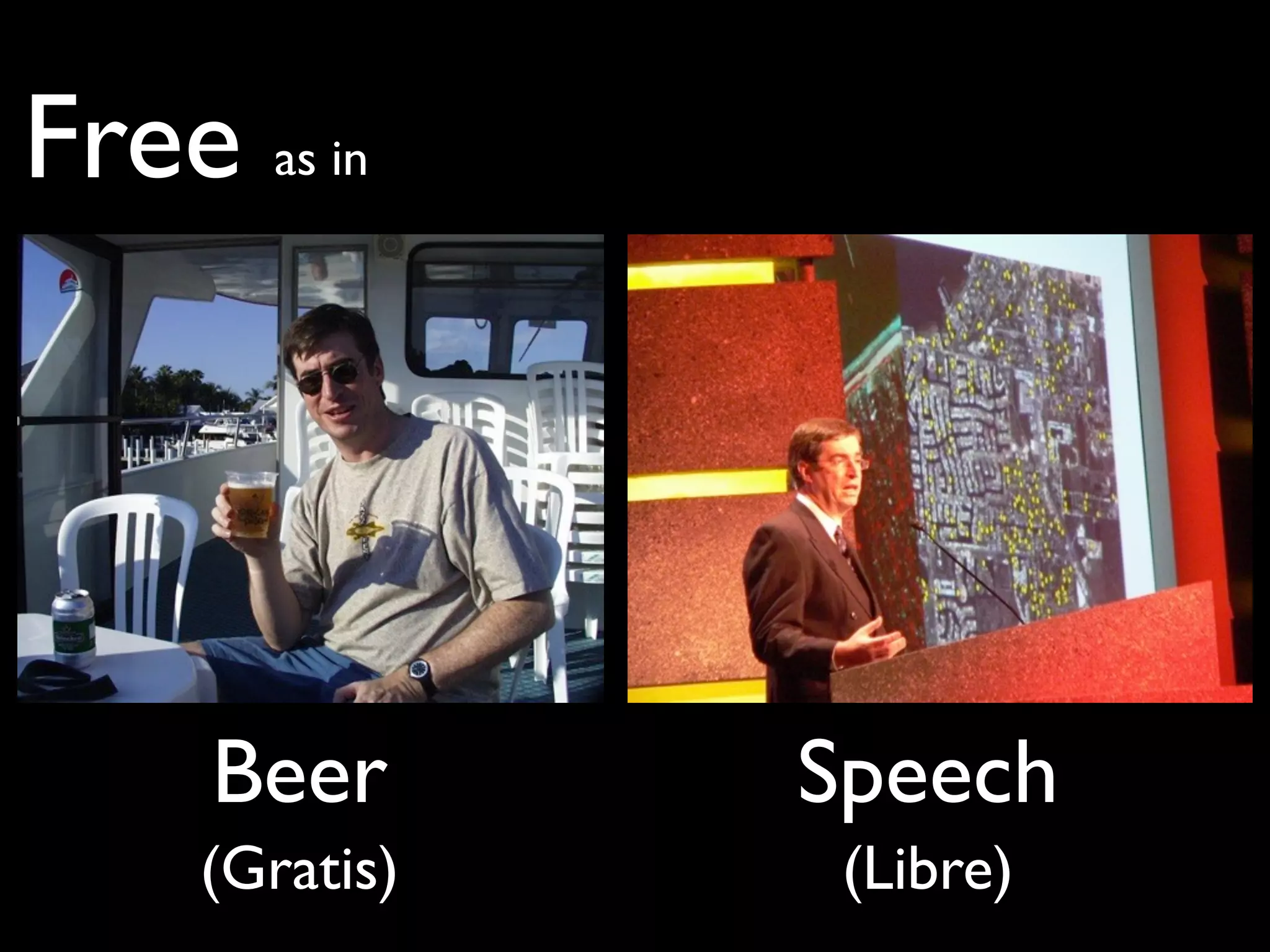
Free as in


     Beer    Speech
Free as in


     Beer       Speech
     (Gratis)    (Libre)
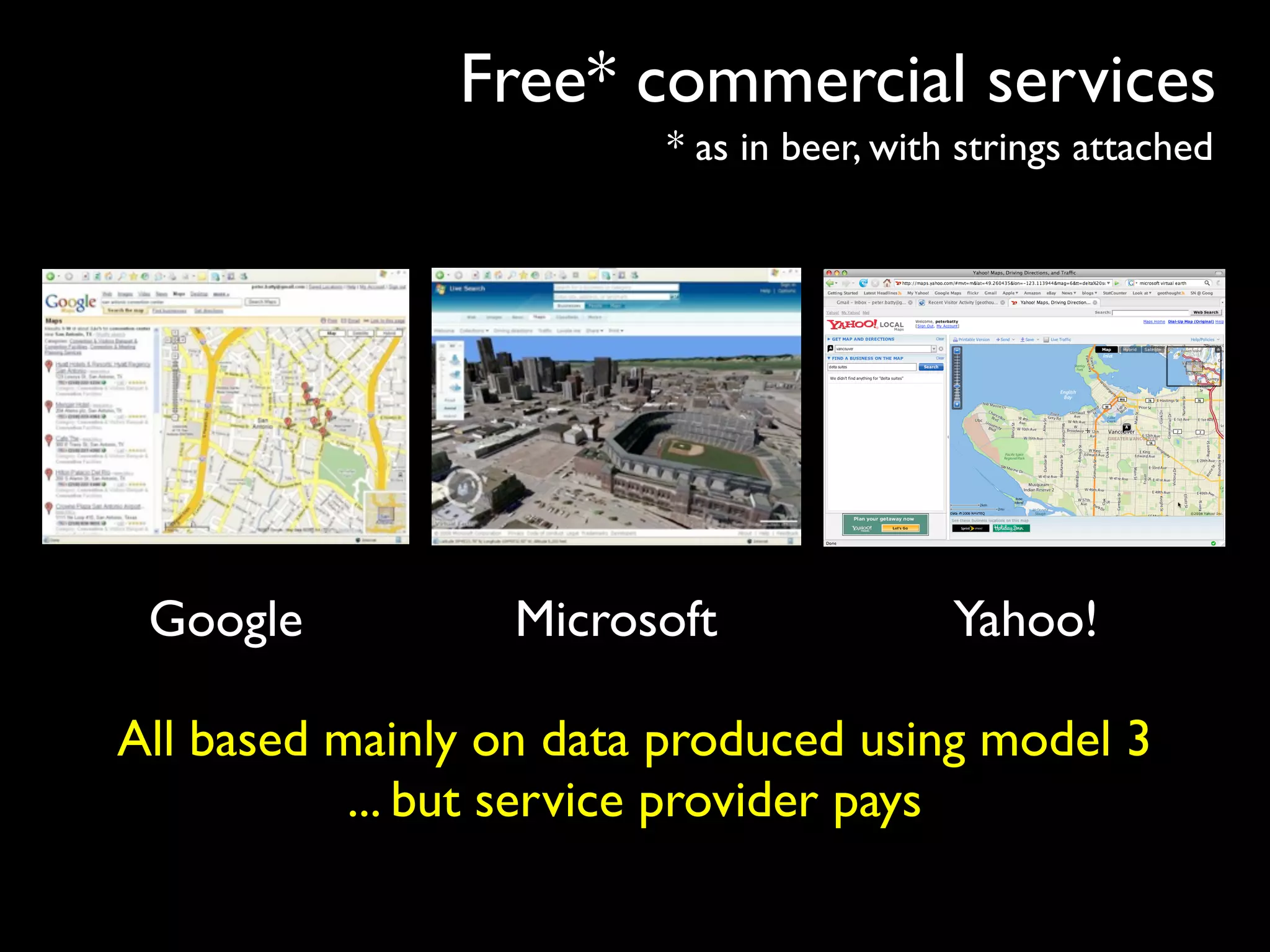
Free* commercial services
                        * as in beer, with strings attached


 Google           Microsoft               Yahoo!

All based mainly on data produced using model 3
           ... but service provider pays
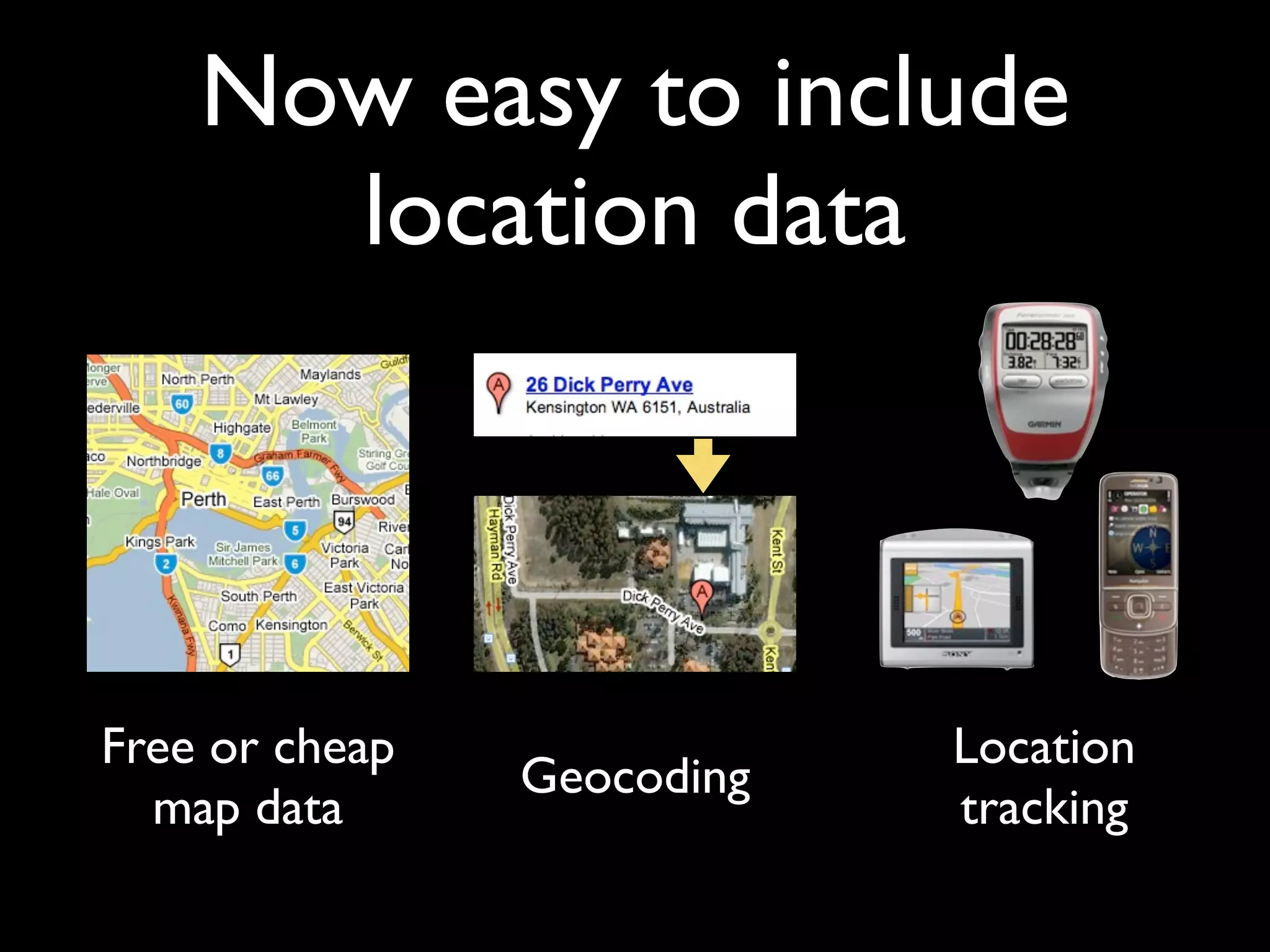
Now easy to include
      location data


Free or cheap               Location
                Geocoding
  map data                  tracking
Google Maps API
                                     Terms of Service
Application must be free to the public             (paraphrased)
No access to underlying (vector) data
No use for real time navigation, dispatch,
fleet management or business asset tracking
No use of geocodes except with a Google map
No creation of a derivative work of any content


                                          In future, Google may ...
                                ... limit number of transactions
                                   ... include ads on map images
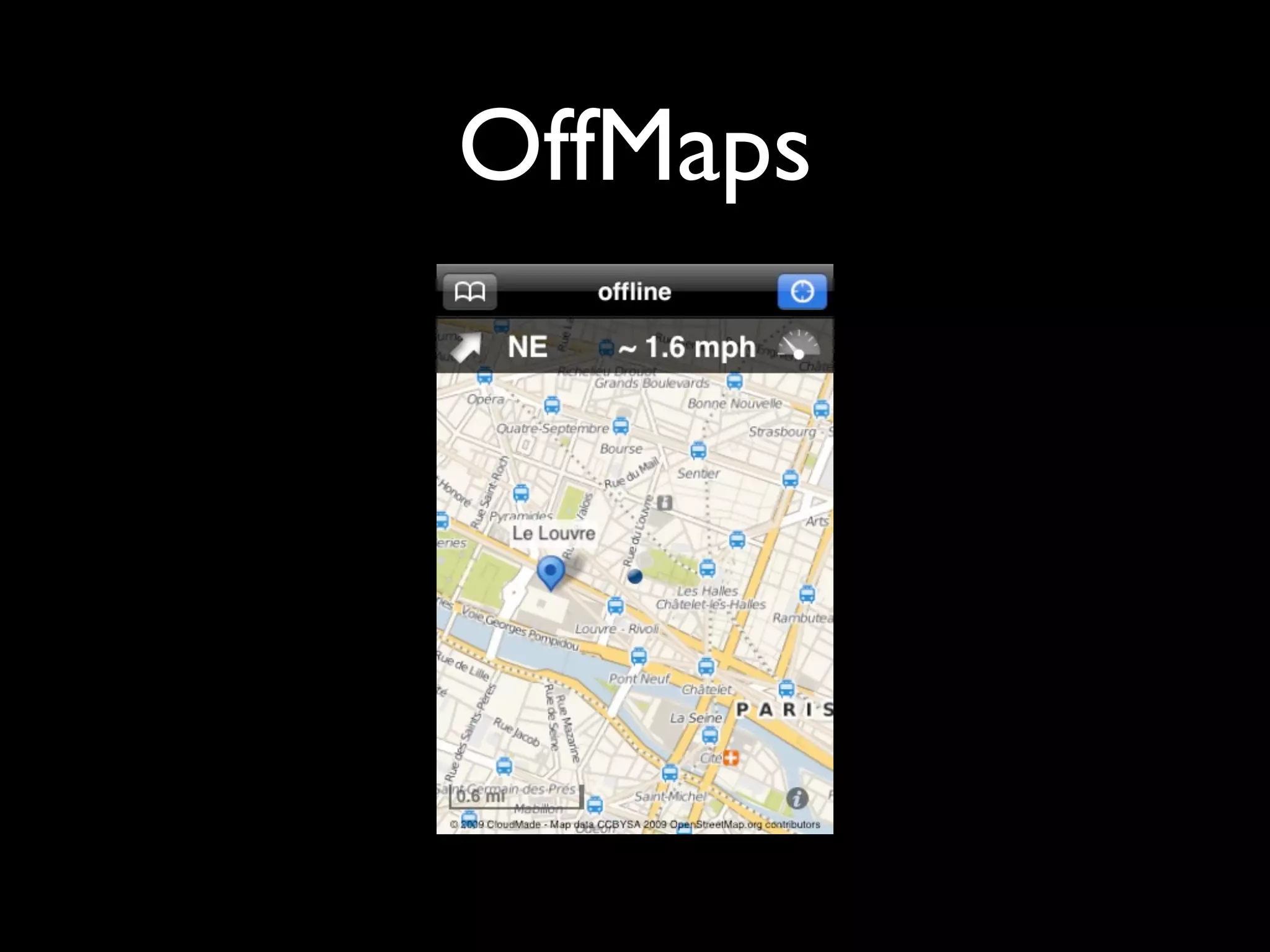
OffMaps
Model 4 Summary
                             (Free commercial data)


Has enabled huge growth in geo
... but terms limiting for many apps
Creating geodata is still expensive*
Is this model sustainable?

                                €$£¥
*Using traditional methods
The continuing issue is that
     geodata creation is
fundamentally labor-intensive
  and therefore expensive
Crowdsourcing
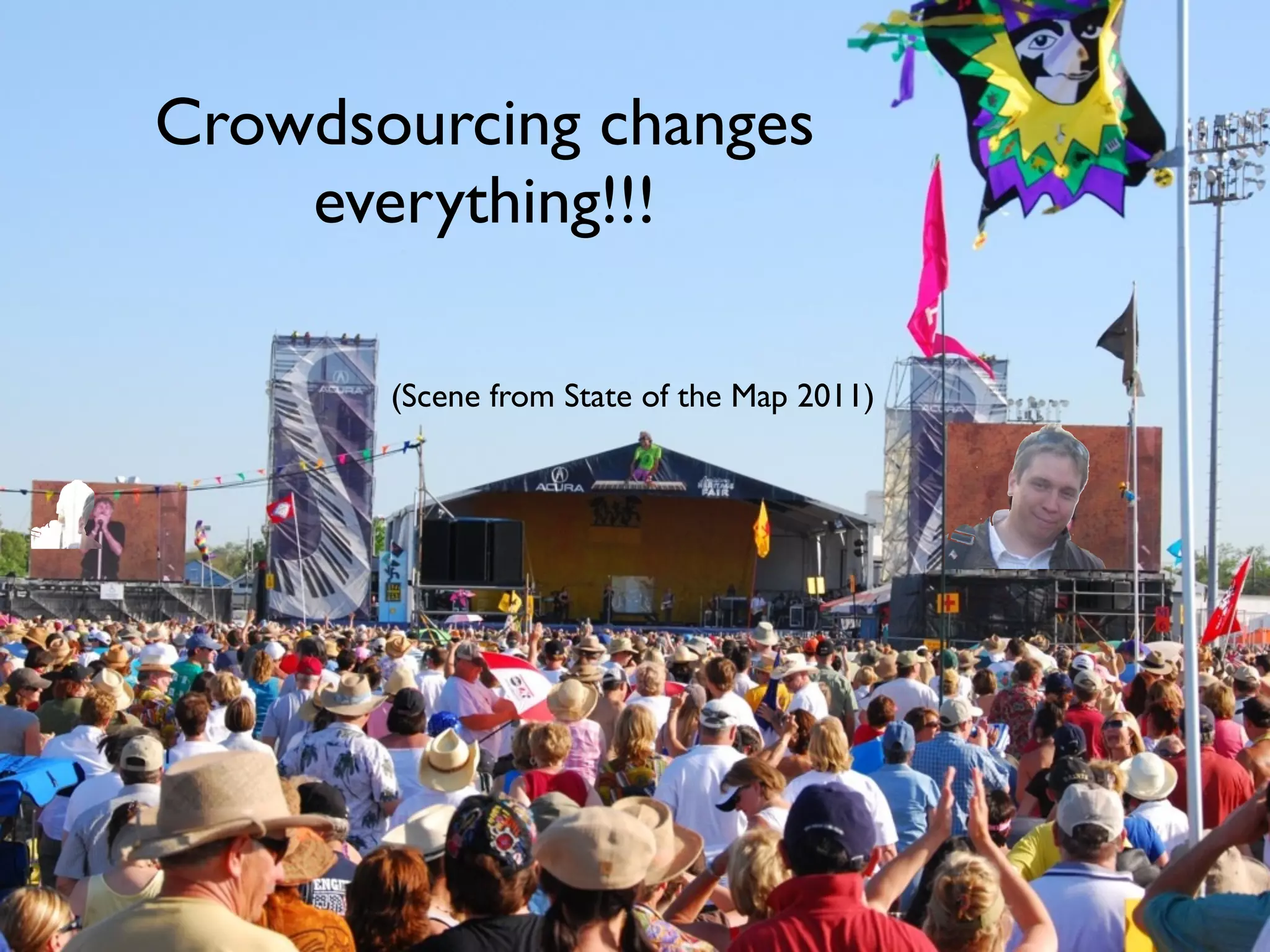
Crowdsourcing changes
    everything!!!

       (Scene from State of the Map 2011)
can crowdsourcing deliver good enough

           quality?
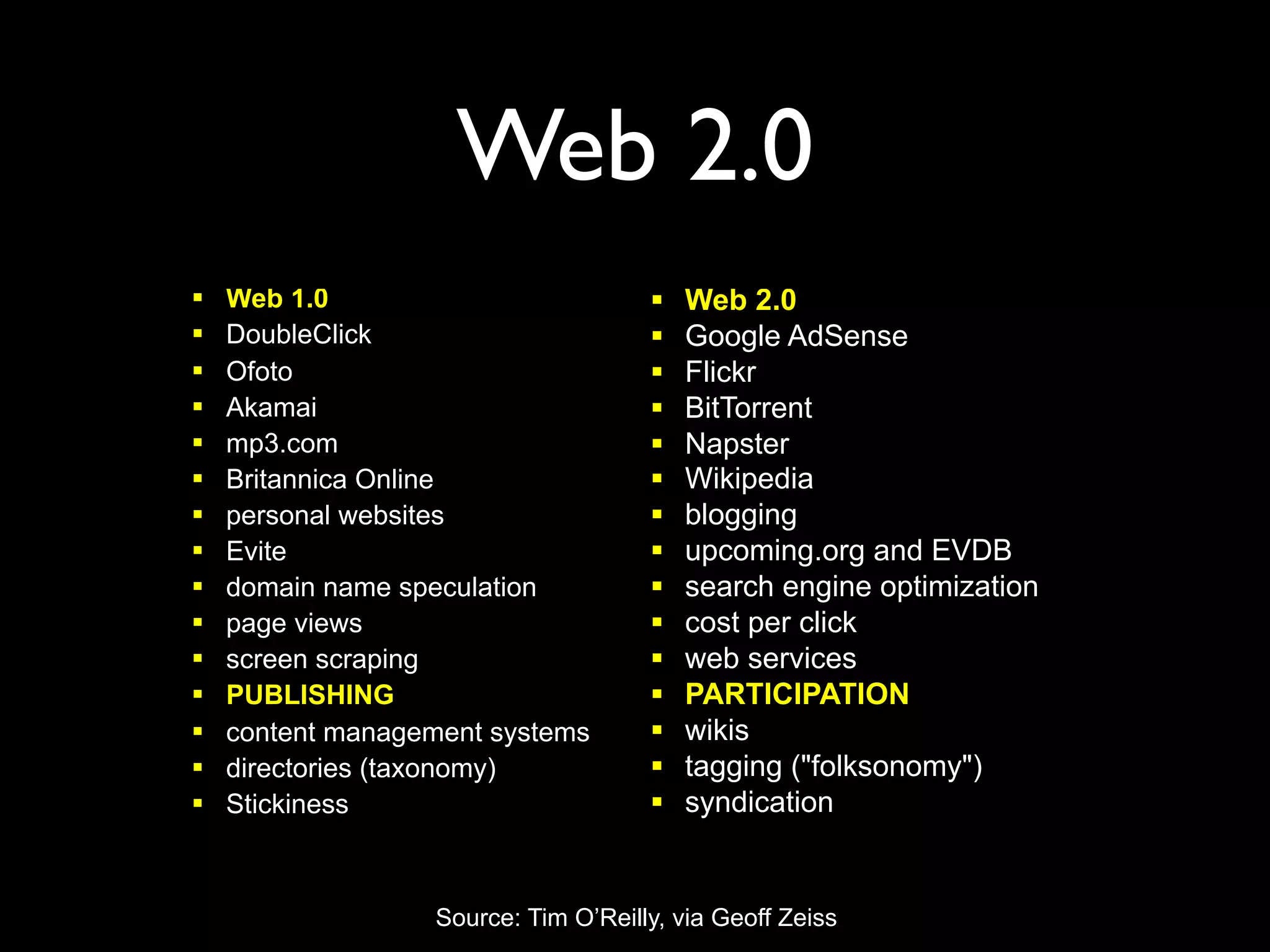
Web 2.0
   Web 1.0                             Web 2.0
   DoubleClick                         Google AdSense
   Ofoto                               Flickr
   Akamai                              BitTorrent
   mp3.com                             Napster
   Britannica Online                   Wikipedia
   personal websites                   blogging
   Evite                               upcoming.org and EVDB
   domain name speculation             search engine optimization
   page views                          cost per click
   screen scraping                     web services
   PUBLISHING                          PARTICIPATION
   content management systems          wikis
   directories (taxonomy)              tagging ("folksonomy")
   Stickiness                          syndication


                  Source: Tim O’Reilly, via Geoff Zeiss
Jan 2007
Wikipedia
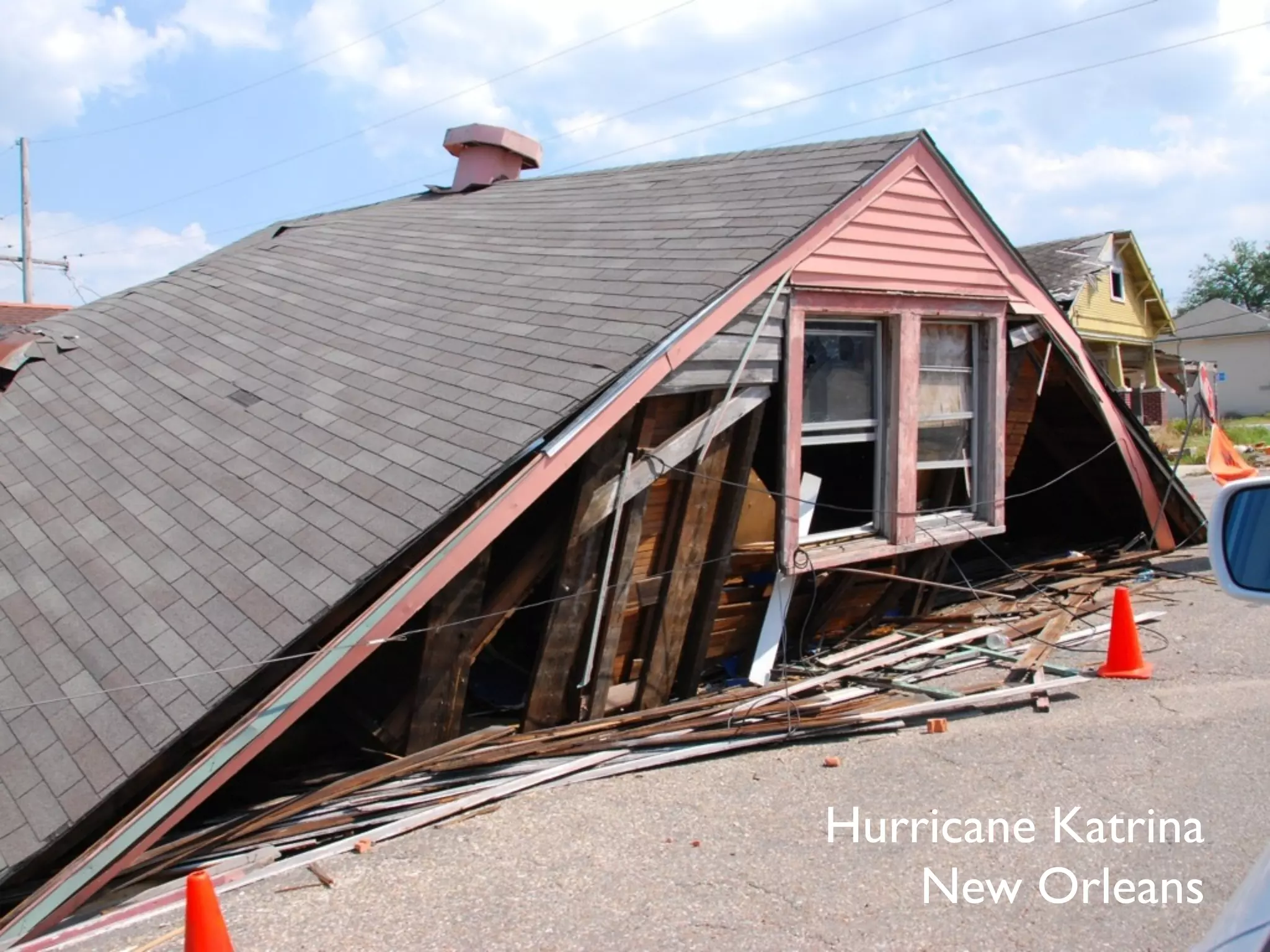
Hurricane Katrina
    New Orleans
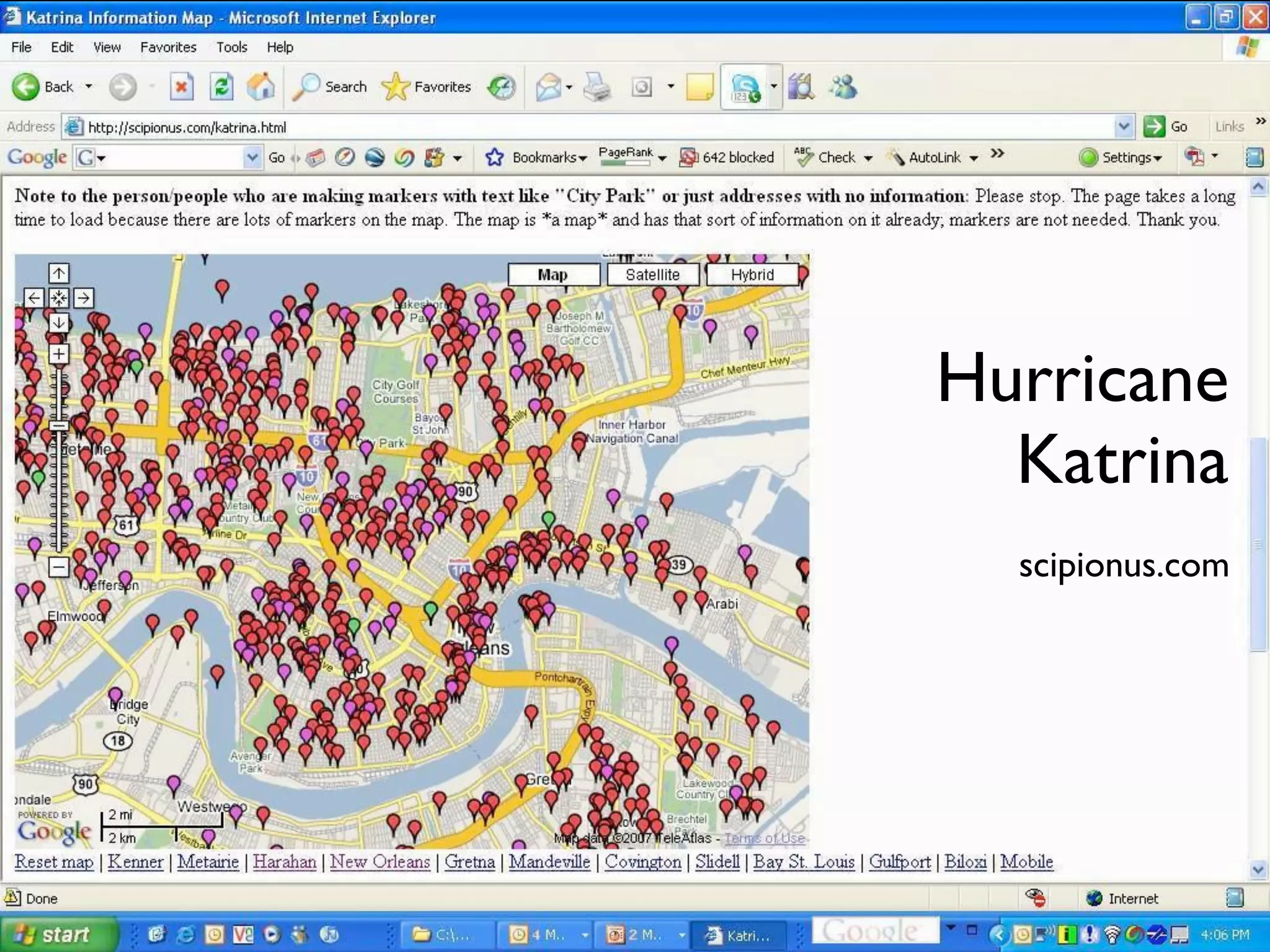
Hurric

         Hurricane
           Katrina
           scipionus.com
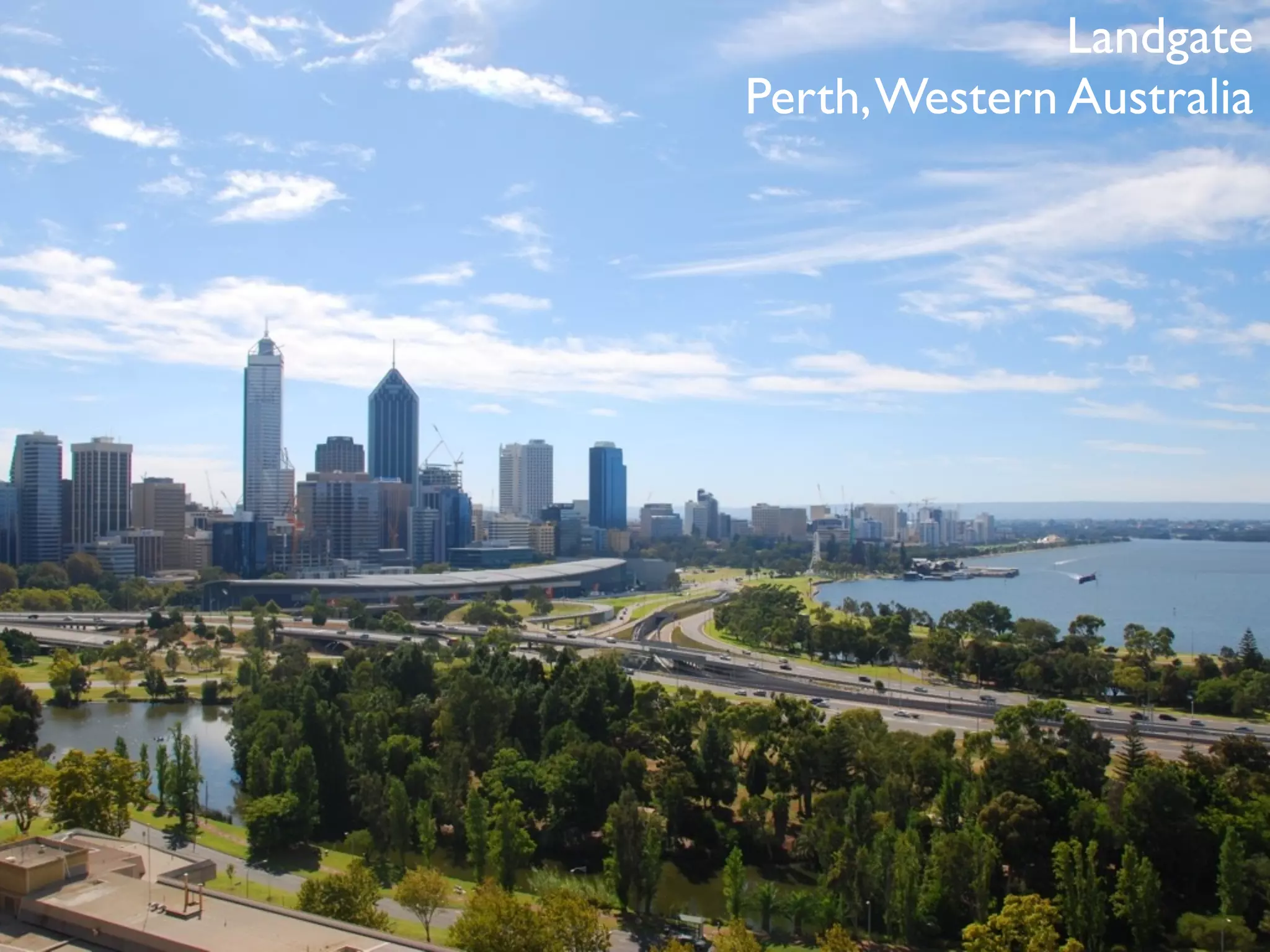
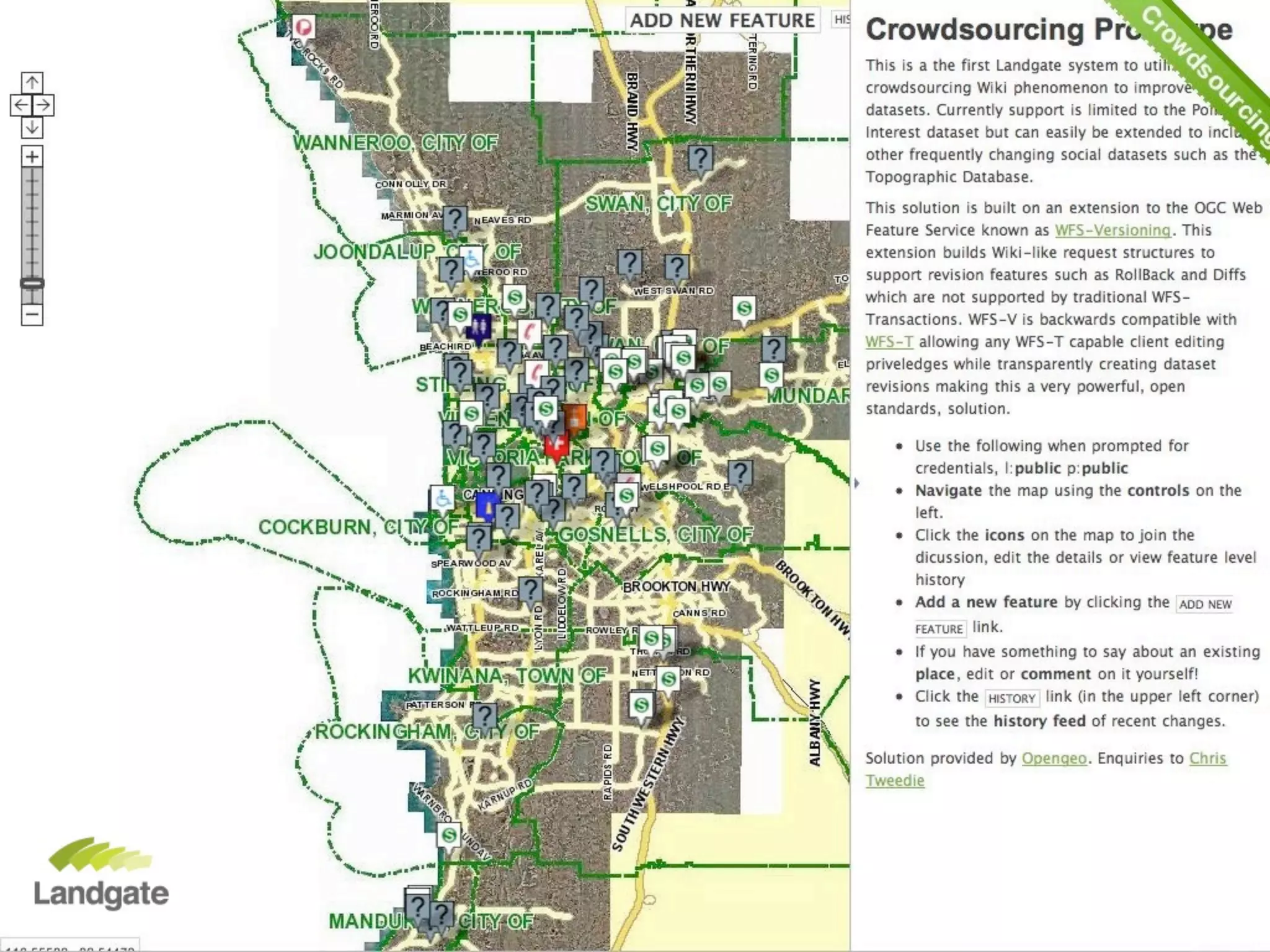
Landgate
Perth, Western Australia
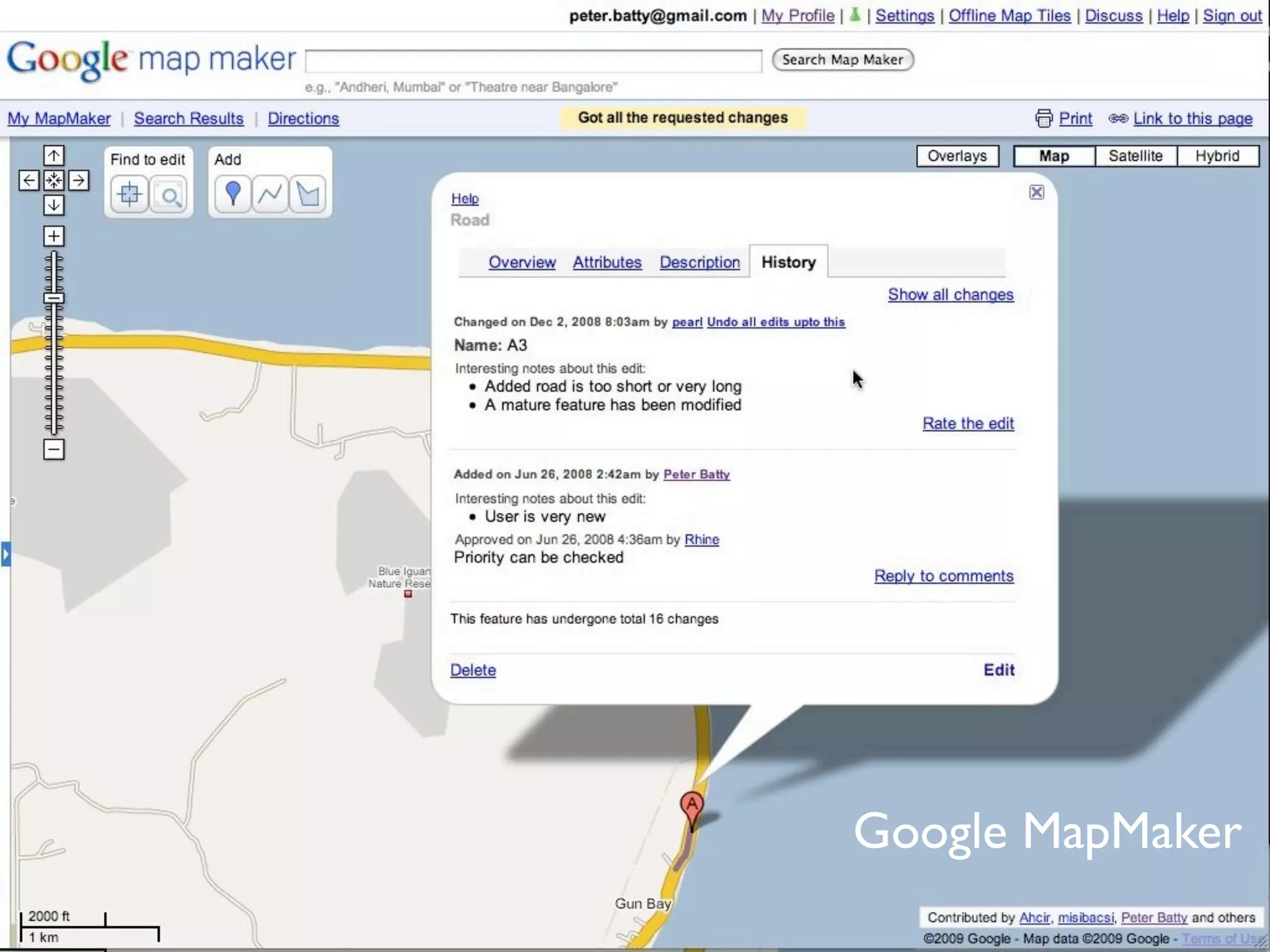
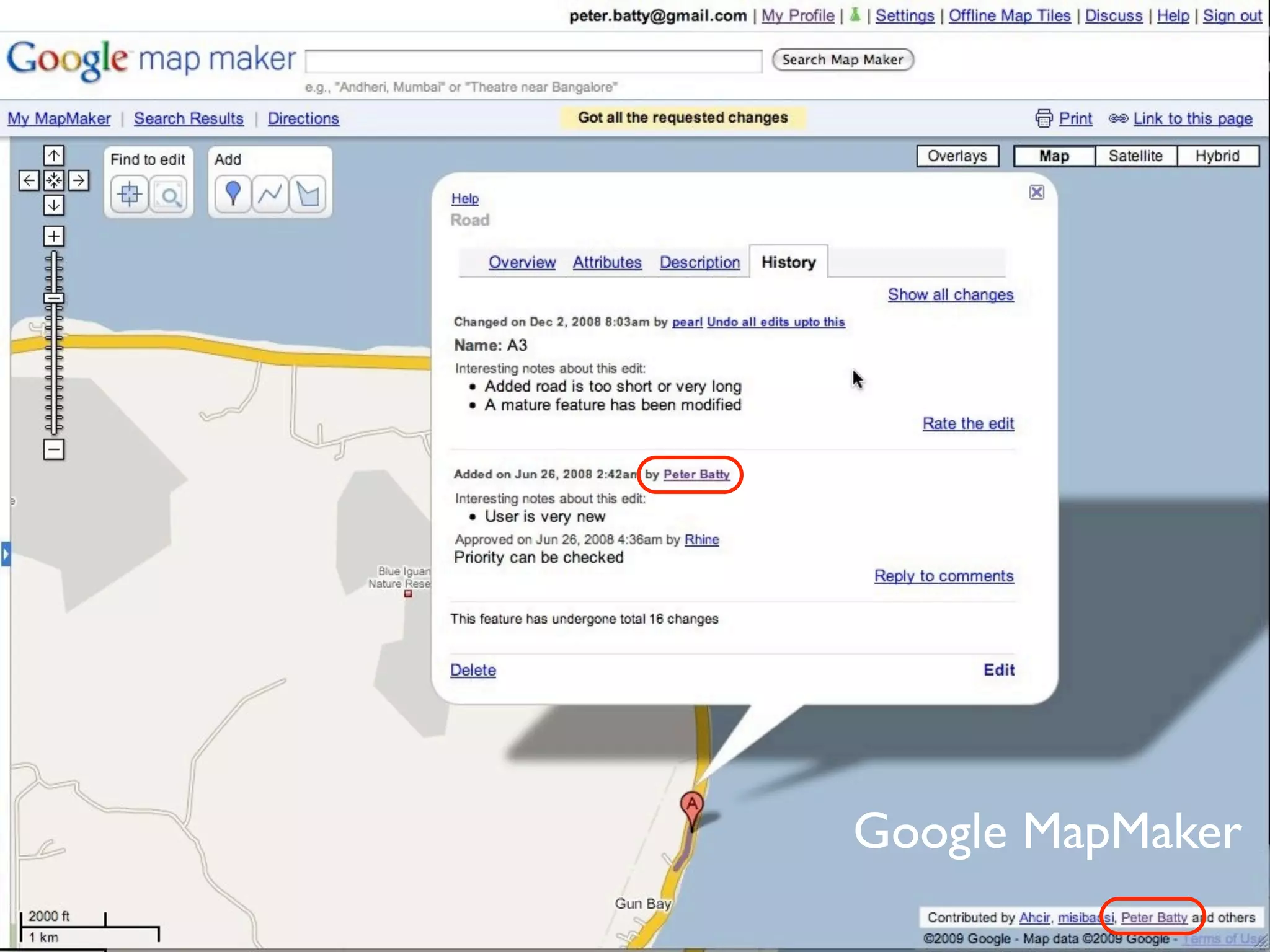
Google MapMaker
Google MapMaker
OpenStreetMap!!
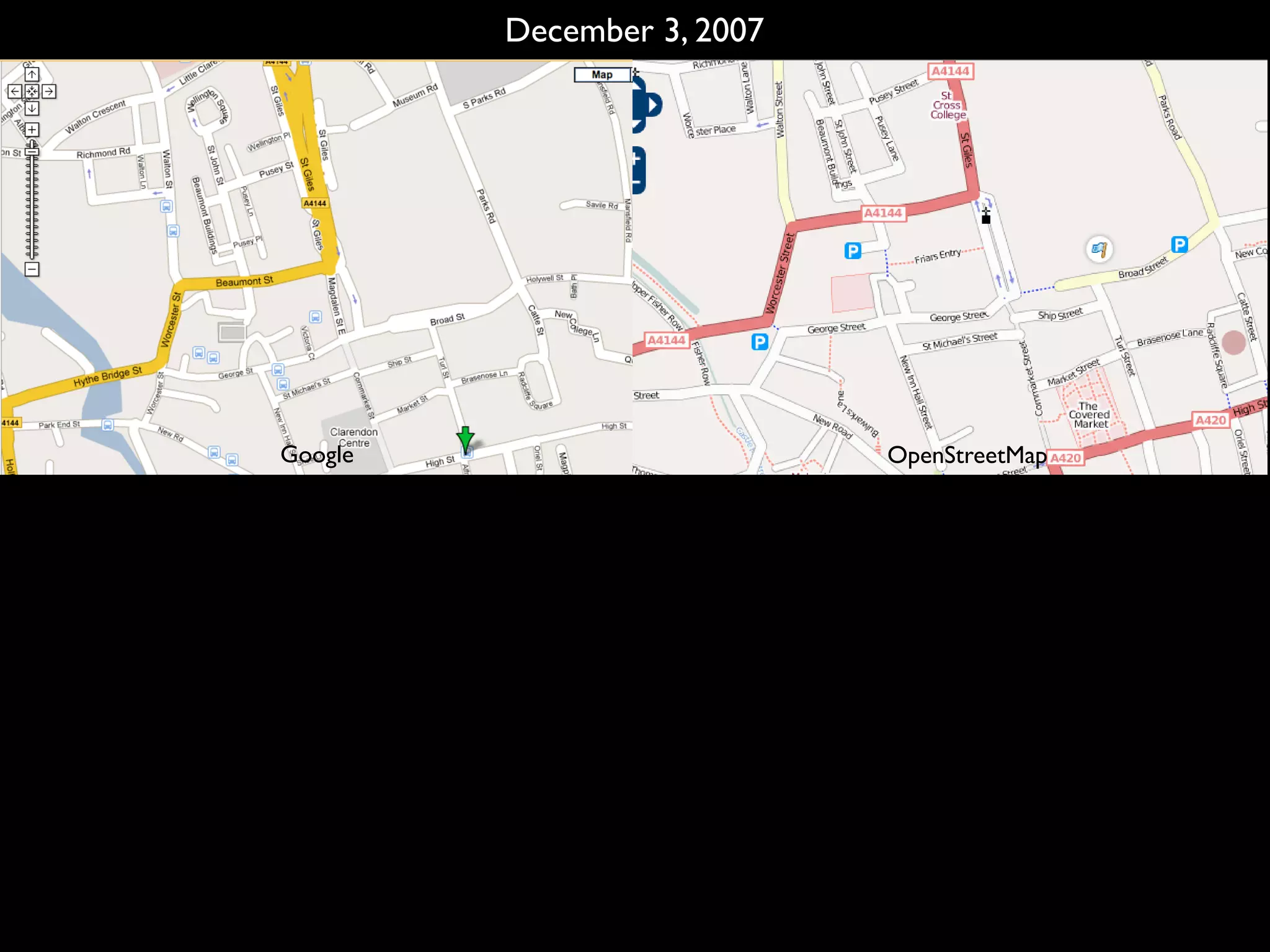
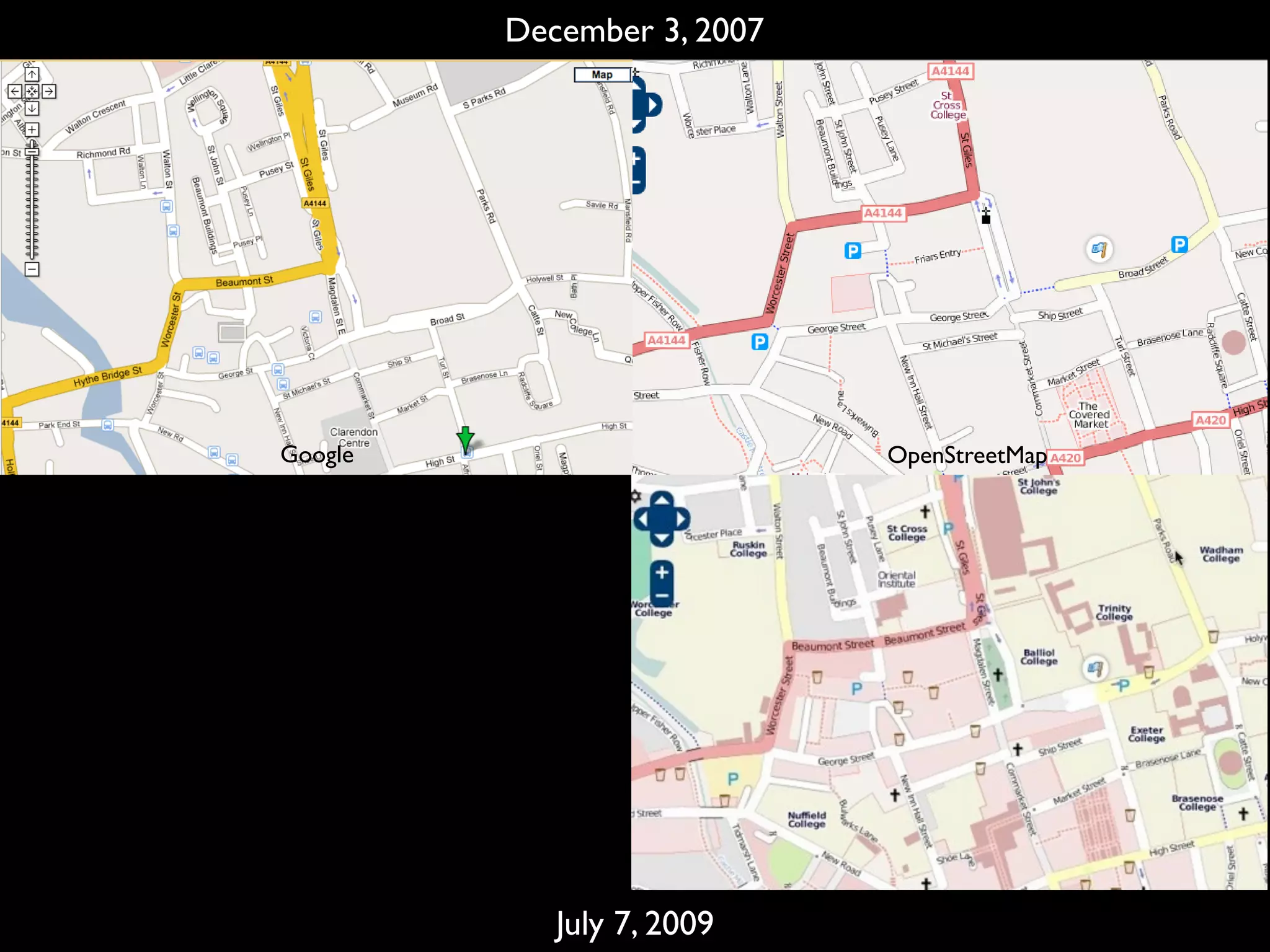
December 3, 2007
December 3, 2007


Google                      OpenStreetMap
December 3, 2007


Google                      OpenStreetMap


            July 7, 2009
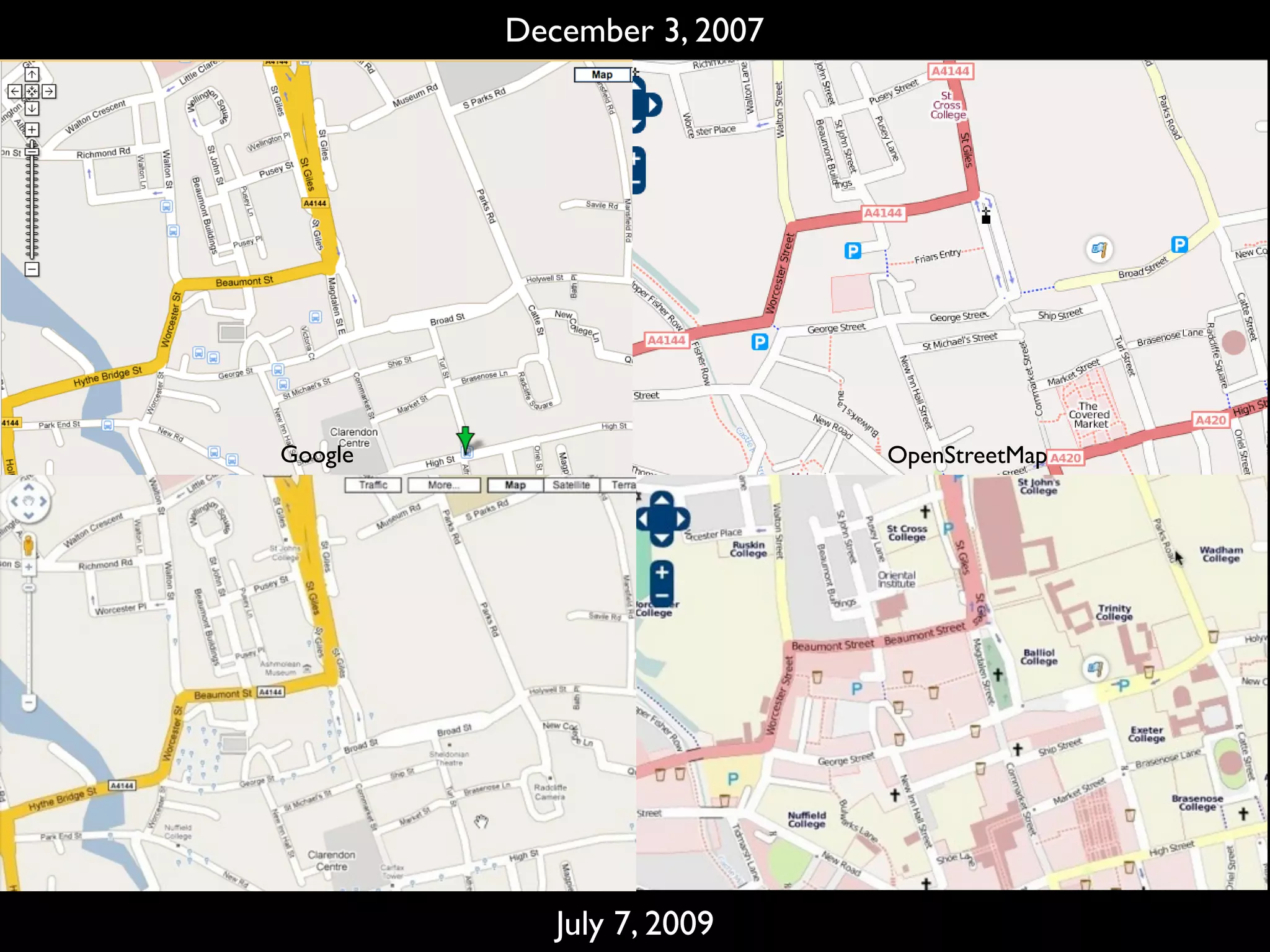
December 3, 2007


Google                      OpenStreetMap


            July 7, 2009
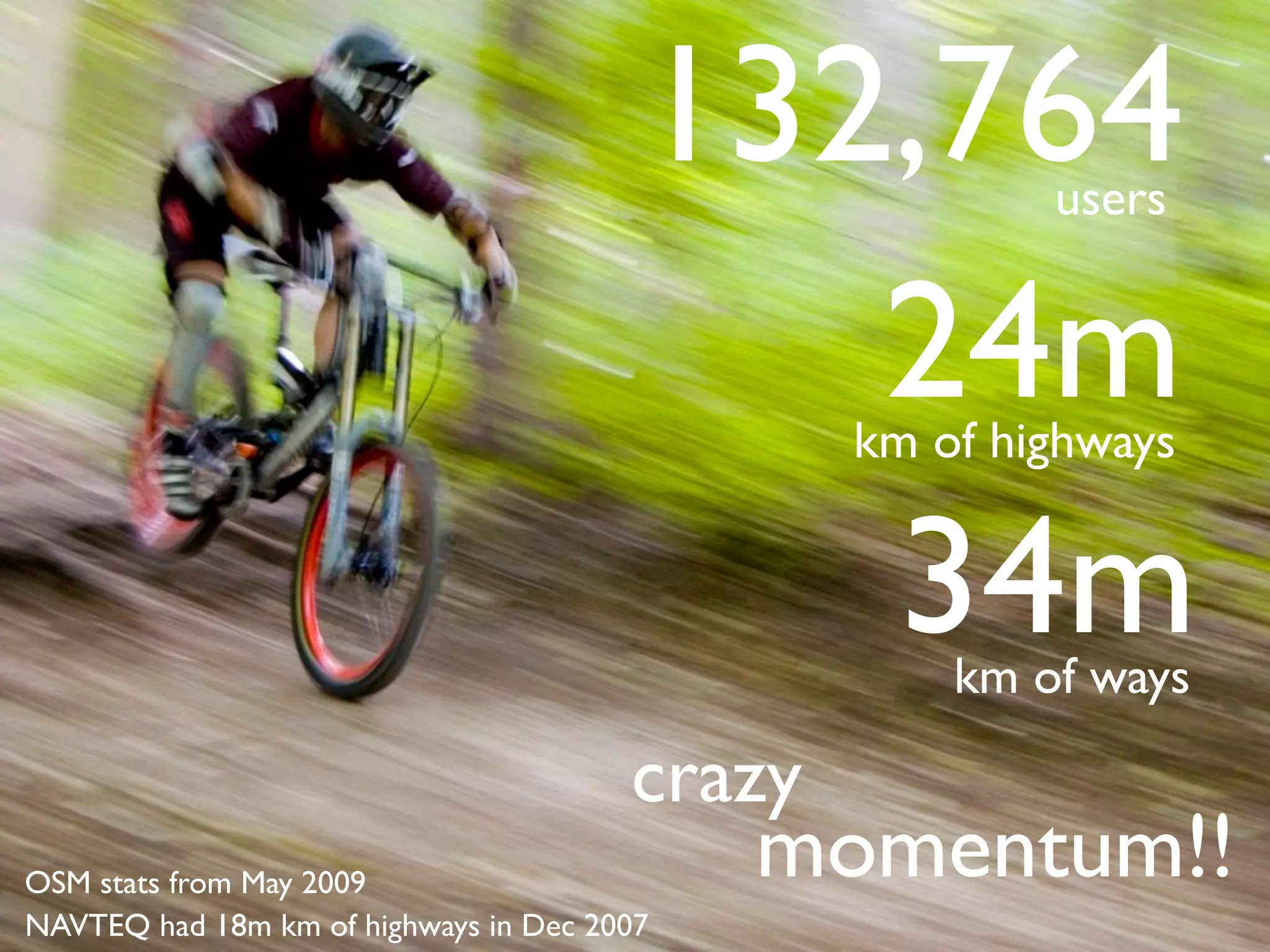
132,764        users


                                           24m km of highways


                                           34m     km of ways

                                       crazy
OSM stats from May 2009
                                            momentum!!
NAVTEQ had 18m km of highways in Dec 2007
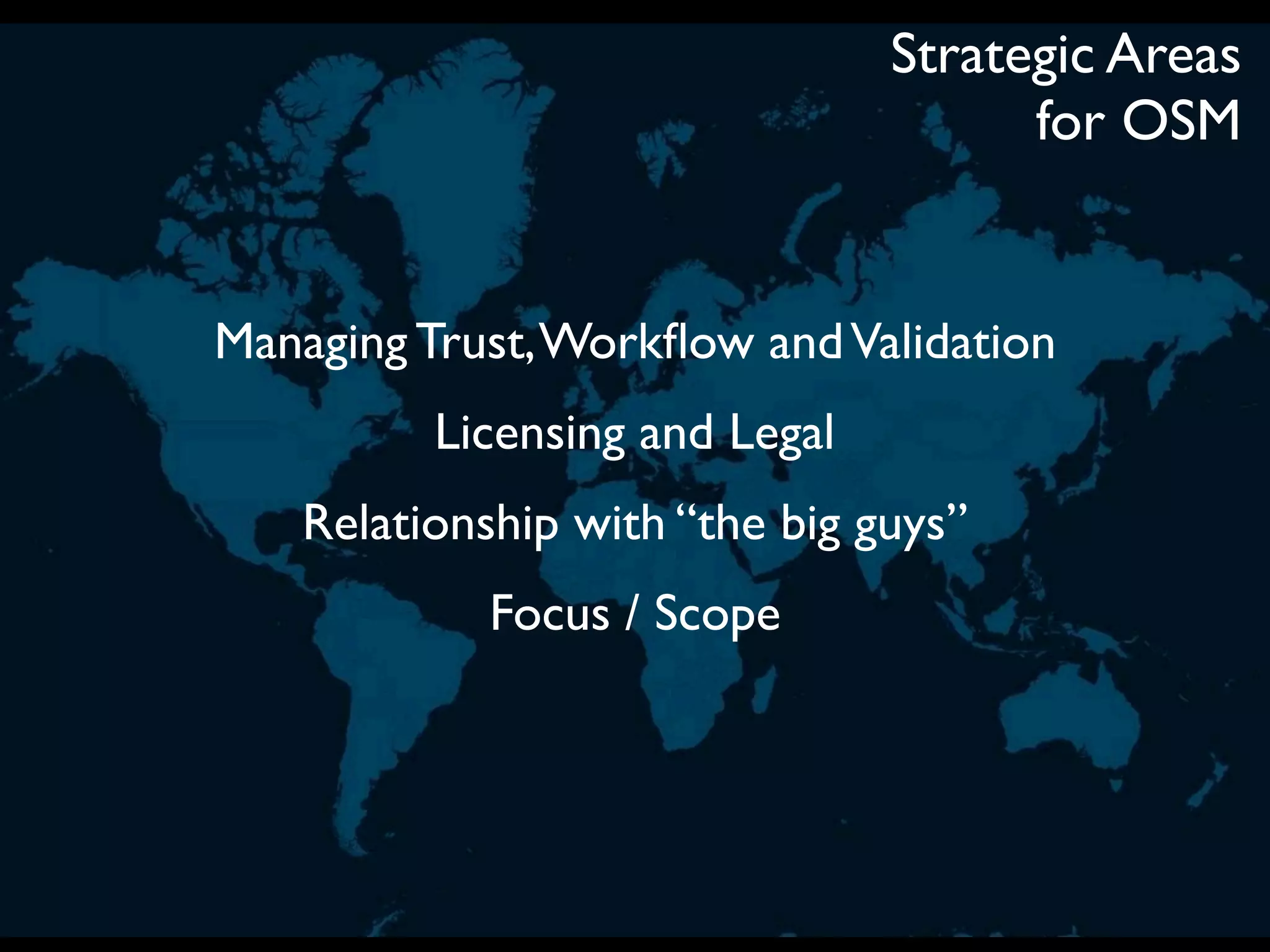
Strategic Areas
                                     for OSM


Managing Trust, Workflow and Validation
         Licensing and Legal
   Relationship with “the big guys”
            Focus / Scope
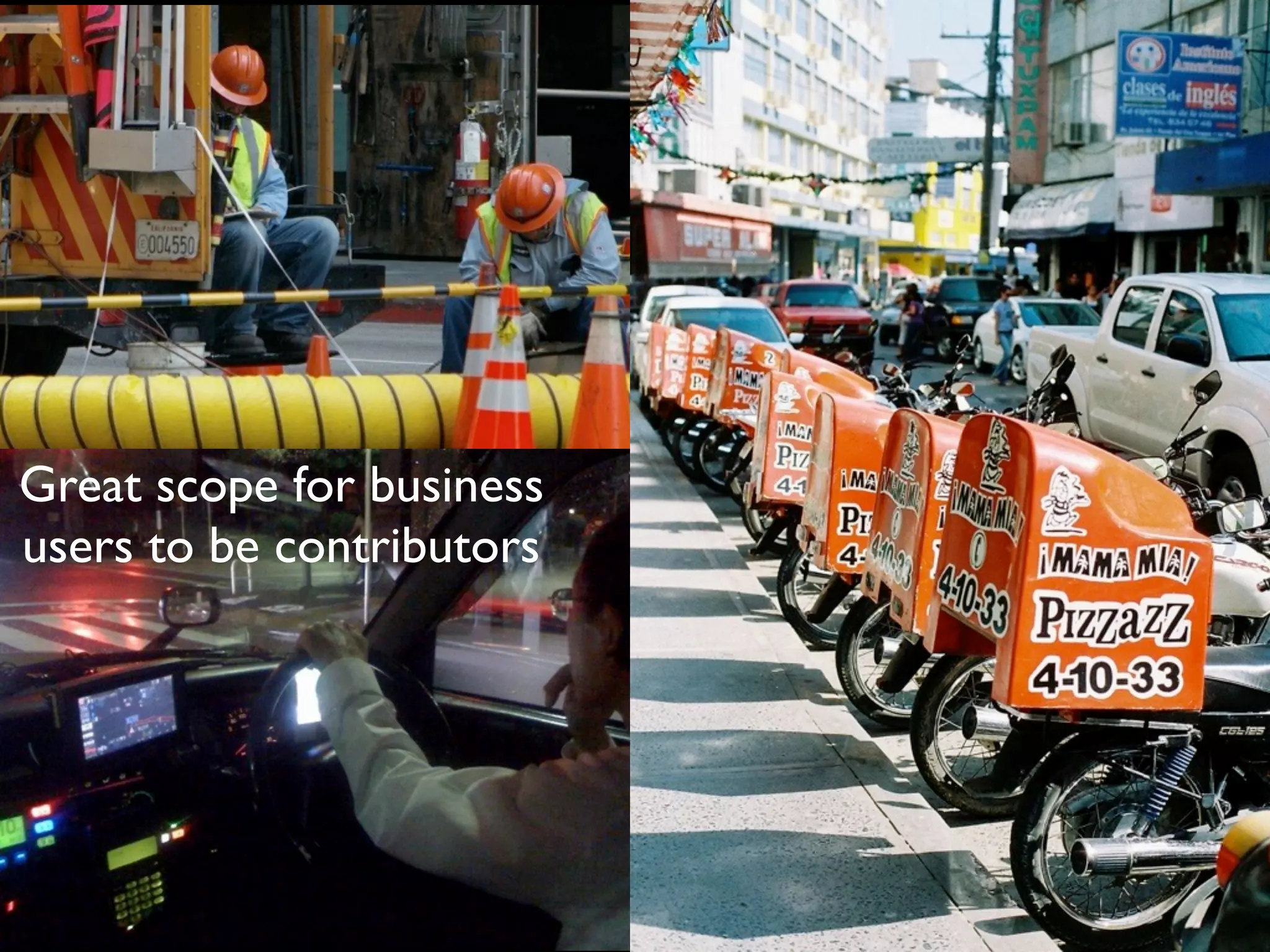
Great scope for business
users to be contributors
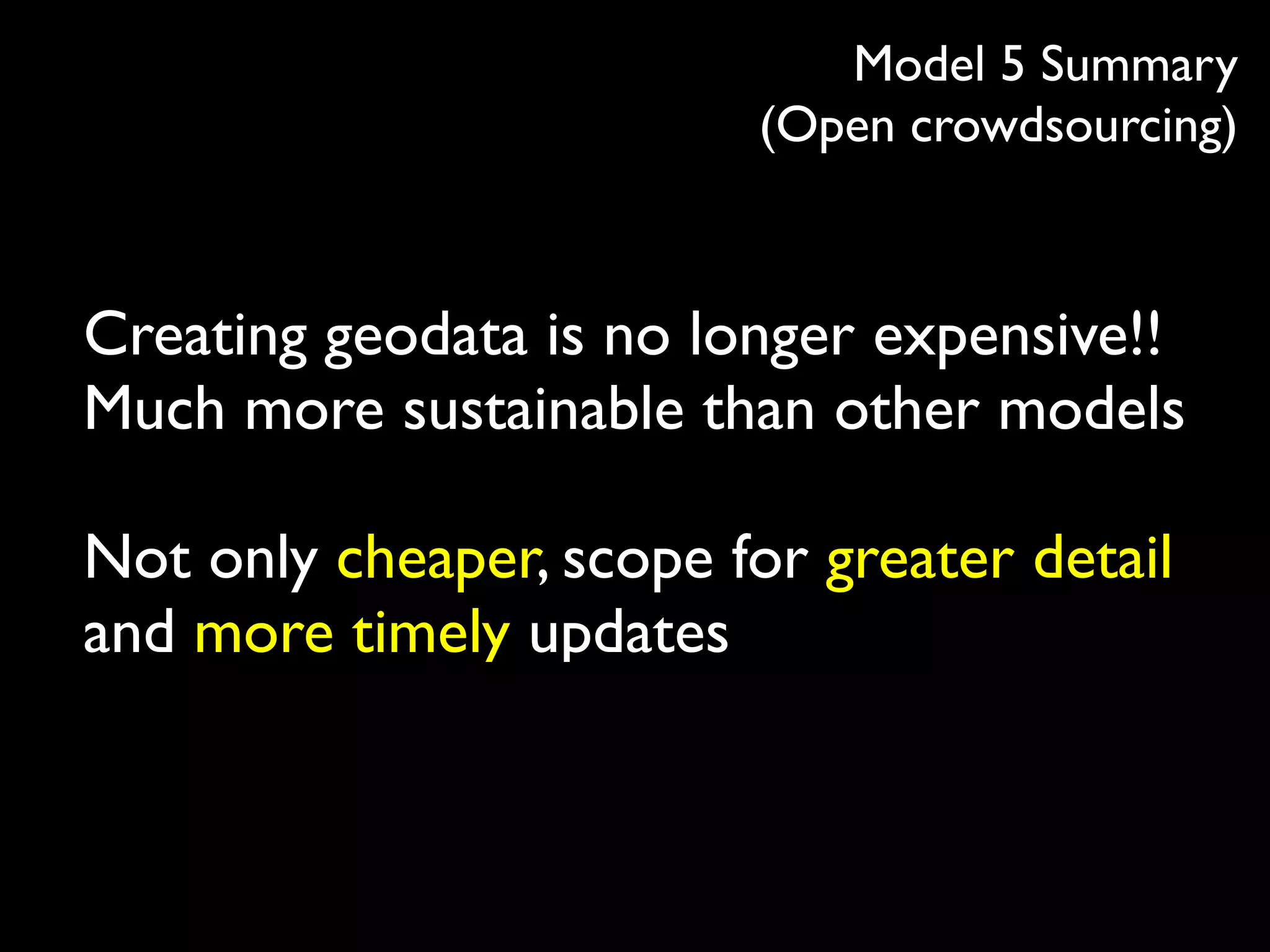
Model 5 Summary
                          (Open crowdsourcing)


Creating geodata is no longer expensive!!
Much more sustainable than other models

Not only cheaper, scope for greater detail
and more timely updates
The Future
 Geodata Trends
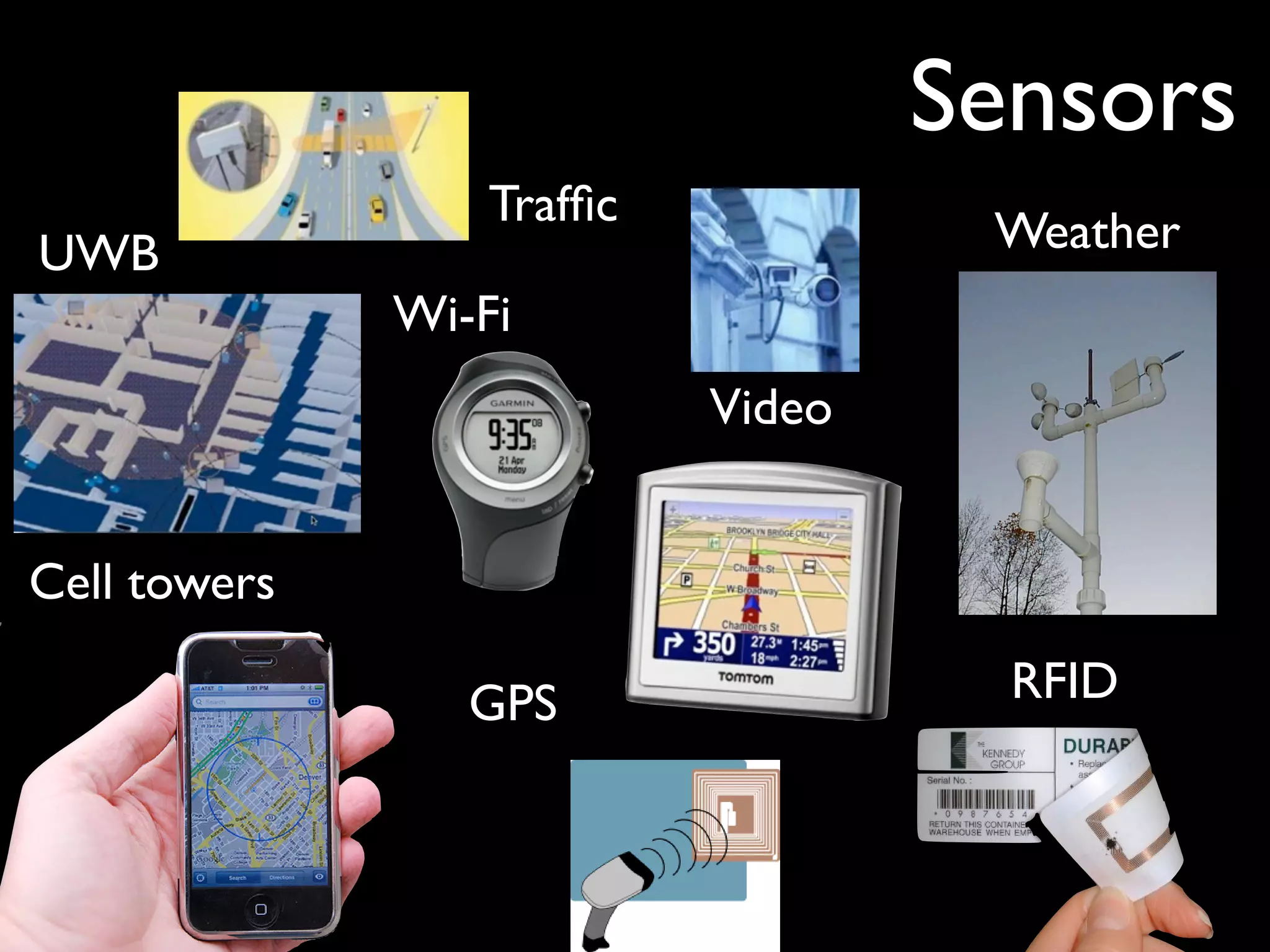
Sensors
                  Traffic
UWB                                 Weather
              Wi-Fi
                           Video


Cell towers

                 GPS                 RFID
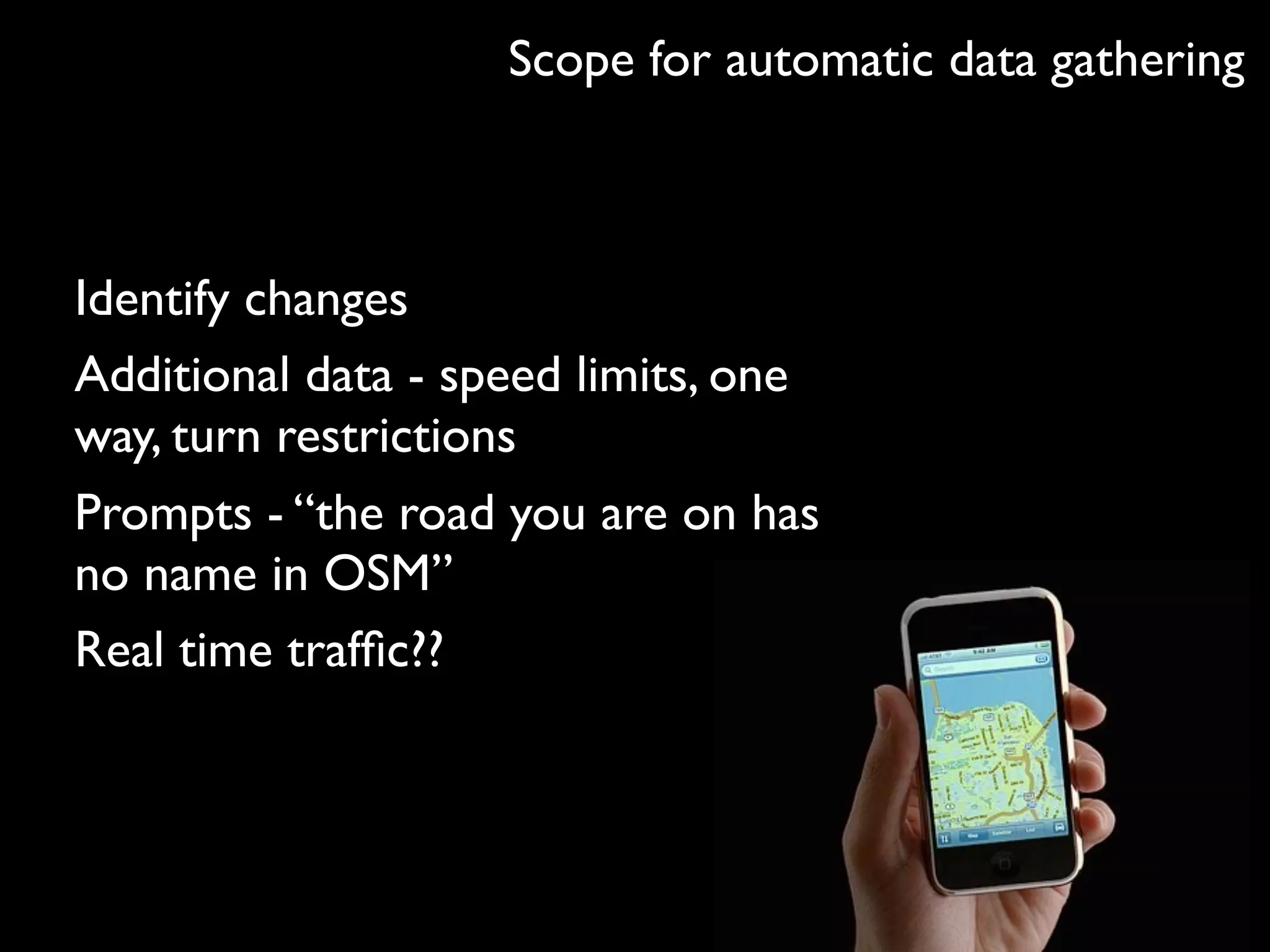
Scope for automatic data gathering


Identify changes
Additional data - speed limits, one
way, turn restrictions
Prompts - “the road you are on has
no name in OSM”
Real time traffic??
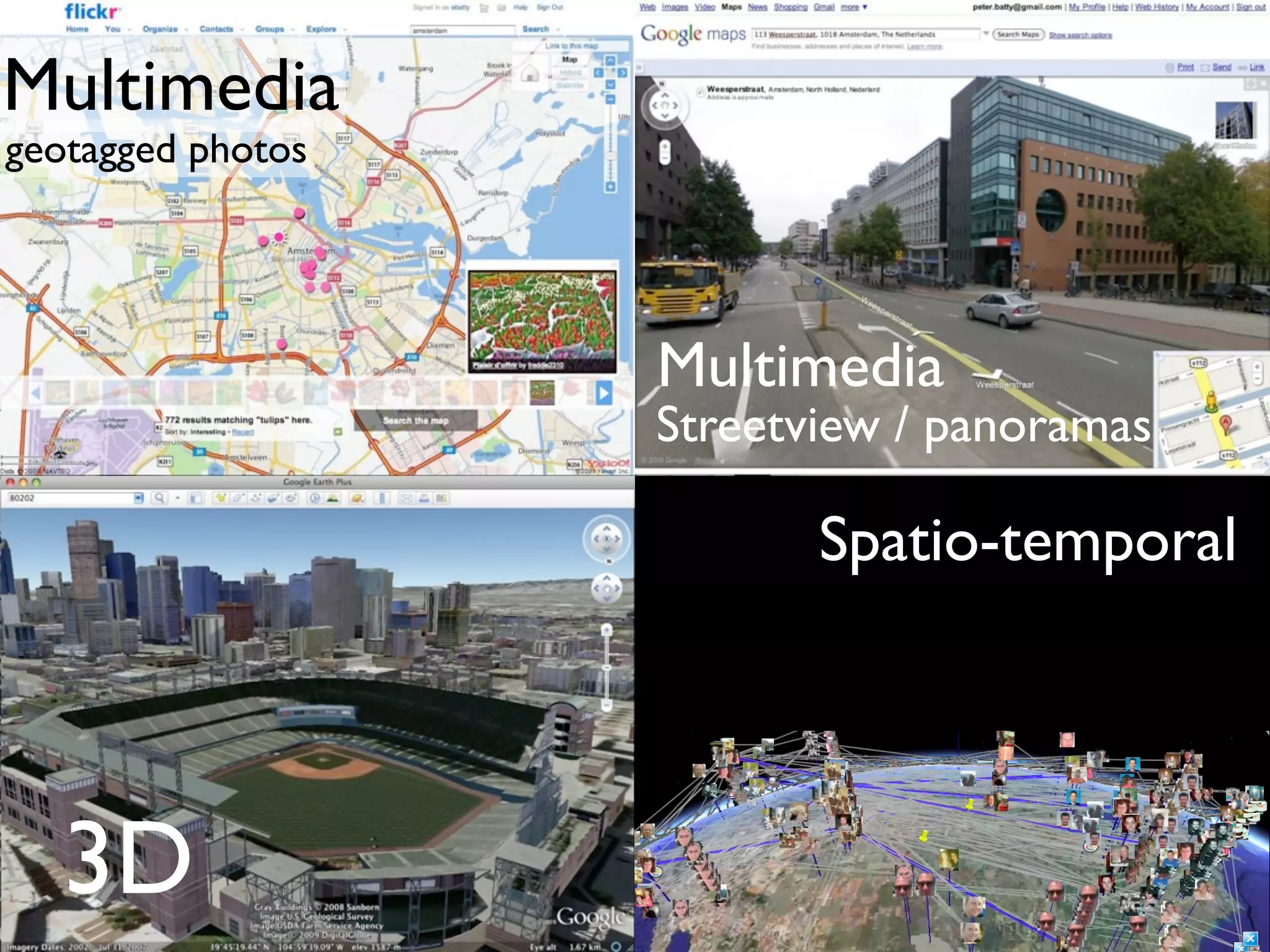
Multimedia
geotagged photos


                   Multimedia
                   Streetview / panoramas

                          Spatio-temporal


 Multimedia
   3D
 Photosynth
Summary
Summary

OpenStreetMap
   Rocks!!
Credits
Ludovic Bertron   Bryan Brennemann      Neil Cain
   laverrue             kainr        Pimpmaster Jazz


                    Photos from flickr used under Creative Commmons Attribution license

Geodata creation:past, present and future

  • 1.
    © 2009 CloudMade.Map data © 2009 OpenStreetMap.org Geodata creation: past, present and future Peter Batty Amsterdam, June 2009
  • 2.
    Denver, CO Denver, CO USA USA “Mousetrap” junction of I-25 and I-70 Cape Royal Grand Canyon, AZ Cropston USA England
  • 3.
    Overview • A littlegeohistory • 4 business models for geodata • Crowdsourcing • Future geodata directions
  • 4.
  • 5.
    GIS was aspecialized backroom technology for many years
  • 6.
    Geo moving to the mainstream 1996 MapQuest 2004 Google Earth (Keyhole) 2005 Google Maps
  • 7.
    Disruptive technology Functionality / logy performance chno he d te bl is E sta Mainstream Market requirements logy c hno te ptive ru Dis Time
  • 8.
    4 business models for geodata
  • 9.
  • 11.
    Return on Investment(ROI) is still a big focus
  • 12.
    Model 1 Summary (Build your own) Creating geodata is very expensive* €$£¥ *Using traditional methods
  • 13.
    2: Let theGovernment do it
  • 14.
  • 15.
    “Our taxes fundthe collection of public data - yet we have to pay again to access it. [Make] it freely available to stimulate innovation” The Guardian “Free Our Data” web site
  • 16.
    sadly it’s not that simple ... Taxes only pay some of the costs Costs are ongoing, not one off Many competing priorities for tax money All geodata is not equal Commercial companies can profit
  • 17.
  • 18.
    I think weshould raise taxes or cut spending on schools to do better mapping
  • 19.
    National Mapping ProgramEmployees (Selected years for which data could be found) 3500 3000 !"#$%&'()'*#+,(-%%. 2500 2000 1500 1000 500 0 1940 1950 1960 1970 1980 1990 2000 2010 Slide courtesy Larry Moore, from Briefing to the USGS State Partnerships Meeting
  • 20.
  • 21.
    Missing Pepsi Center (Built 10 years ago) USGS Topo Map
  • 22.
  • 23.
    The US situation Thereis no large scale “national map” Almost all utilities and local governments do their own base mapping Therefore most cities are mapped many times - huge duplication of effort Typically there are significant inconsistencies between basemaps (tens or hundreds of meters not uncommon)
  • 24.
    National Mapping Agencies Cost Good product but expensive Free or cheap but product lacking Product
  • 25.
    National Mapping Agencies Cost Good product but expensive We want to be here ... but no easy solution Free or cheap but product lacking Product
  • 26.
    The grass isalways greener on the other side of the fence
  • 27.
    Model 2 Summary (Government data) Creating geodata is very expensive* “Free data” policy is not a panacea €$£¥ *Using traditional methods
  • 28.
  • 30.
    “Creating, maintaining anddelivering a comprehensive, high quality map database is a multi-step, labor-intensive process. We currently employ over 270 employees in our centralized production facility and a global workforce of over 700 geographic analysts in 32 countries”
  • 31.
    Database 2007 data 69 countries 11m miles (18m km) of roads 18m points of interest People “Creating, maintaining and delivering a comprehensive, high quality map database is a Field force 700 multi-step, labor-intensive process. We Central production 270 currently employ over 270 employees in our centralized production facility and a global Technology 500 workforce of over 700 geographic analysts in 32 countries” Total 3349 Financial Revenue $853m (~€604m) Data creation & distribution costs $396m (~€280m)
  • 32.
    In 2007, therewere more than 57 billion route planning transactions using North American NAVTEQ data on leading web sites revenue from this was “not substantial”
  • 35.
    €$£¥ Navigon MobileNavigator forEurope, for iPhone $94.99 (~€67)
  • 36.
    Model 3 Summary (Buy commercial data) Creating geodata is very expensive* Some improvement through sharing of costs between more companies €$£¥ *Using traditional methods
  • 37.
  • 38.
    Free as in Beer Speech
  • 39.
    Free as in Beer Speech (Gratis) (Libre)
  • 40.
    Free* commercial services * as in beer, with strings attached Google Microsoft Yahoo! All based mainly on data produced using model 3 ... but service provider pays
  • 41.
    Now easy toinclude location data Free or cheap Location Geocoding map data tracking
  • 42.
    Google Maps API Terms of Service Application must be free to the public (paraphrased) No access to underlying (vector) data No use for real time navigation, dispatch, fleet management or business asset tracking No use of geocodes except with a Google map No creation of a derivative work of any content In future, Google may ... ... limit number of transactions ... include ads on map images
  • 43.
  • 44.
    Model 4 Summary (Free commercial data) Has enabled huge growth in geo ... but terms limiting for many apps Creating geodata is still expensive* Is this model sustainable? €$£¥ *Using traditional methods
  • 45.
    The continuing issueis that geodata creation is fundamentally labor-intensive and therefore expensive
  • 46.
  • 48.
    Crowdsourcing changes everything!!! (Scene from State of the Map 2011)
  • 49.
    can crowdsourcing delivergood enough quality?
  • 50.
    Web 2.0  Web 1.0  Web 2.0  DoubleClick  Google AdSense  Ofoto  Flickr  Akamai  BitTorrent  mp3.com  Napster  Britannica Online  Wikipedia  personal websites  blogging  Evite  upcoming.org and EVDB  domain name speculation  search engine optimization  page views  cost per click  screen scraping  web services  PUBLISHING  PARTICIPATION  content management systems  wikis  directories (taxonomy)  tagging ("folksonomy")  Stickiness  syndication Source: Tim O’Reilly, via Geoff Zeiss
  • 51.
  • 52.
  • 53.
    Hurricane Katrina New Orleans
  • 54.
    Hurric Hurricane Katrina scipionus.com
  • 55.
  • 57.
  • 58.
  • 60.
  • 61.
  • 62.
  • 63.
    December 3, 2007 Google OpenStreetMap July 7, 2009
  • 64.
    December 3, 2007 Google OpenStreetMap July 7, 2009
  • 65.
    132,764 users 24m km of highways 34m km of ways crazy OSM stats from May 2009 momentum!! NAVTEQ had 18m km of highways in Dec 2007
  • 66.
    Strategic Areas for OSM Managing Trust, Workflow and Validation Licensing and Legal Relationship with “the big guys” Focus / Scope
  • 67.
    Great scope forbusiness users to be contributors
  • 68.
    Model 5 Summary (Open crowdsourcing) Creating geodata is no longer expensive!! Much more sustainable than other models Not only cheaper, scope for greater detail and more timely updates
  • 69.
  • 70.
    Sensors Traffic UWB Weather Wi-Fi Video Cell towers GPS RFID
  • 71.
    Scope for automaticdata gathering Identify changes Additional data - speed limits, one way, turn restrictions Prompts - “the road you are on has no name in OSM” Real time traffic??
  • 72.
    Multimedia geotagged photos Multimedia Streetview / panoramas Spatio-temporal Multimedia 3D Photosynth
  • 73.
  • 74.
  • 75.
    Credits Ludovic Bertron Bryan Brennemann Neil Cain laverrue kainr Pimpmaster Jazz Photos from flickr used under Creative Commmons Attribution license

Editor's Notes

  • #6 When I started in GIS, it looked a bit like this (I exaggerate slightly, but only just) For a long time geospatial technology was a backroom thing, and still is in many places - a lot of FUD about needing special training etc
  • #7 Only companies that could justify “GIS” were those like utilities, telecom companies, government agencies, etc - largely because of the cost of data (which we’ll talk about more)
  • #9 Google Earth was cool and fun - everyone liked to fly to their house etc Big step in making people more aware of online maps / geospatial data
  • #10 Why was Google Maps so successful? Great performance and usability - slippy maps and AJAX Biggest single factor was the API, spawned the real growth in “neogeography”
  • #11 Google Earth was cool and fun - everyone liked to fly to their house etc Big step in making people more aware of online maps / geospatial data Why was Google Maps so successful? Great performance and usability - slippy maps and AJAX Biggest single factor was the API, spawned the real growth in “neogeography”
  • #15 In the early days of GIS, 20-25 years ago, only companies that could really justify the cost and effort were those with lots of geospatial data of their own - utilities, local and central government agencies, etc Really major effort to create and maintain their own data (pre-GPS) In some cases may have been able to use government map data, in others not (typically not in the US)
  • #20 Nobody would argue with that, surely? Especially here? Well, it’s not as simple as it might seem ...
  • #22 Free speech and free data, but not free beer sadly :(
  • #23 I don’t know how closely you all follow the US election, but this was widely considered a turning point in the campaign ... I’m joking of course, but the point is that we can’t imagine a politician advocating raising taxes or cutting funding on schools to do better mapping
  • #24 USGS doesn’t have the resources to create large scale maps, small scale maps are generally 10+ years out of date Utilities, telcos, local governments all do their own base mapping - huge duplication of effort. Made worse because of major inconsistencies in data between agencies
  • #25 This is an example of a USGS topo map
  • #26 This is an example of a USGS topo map
  • #29 Bottom line is that geodata creation is expensive using traditional methods, no easy way around that
  • #30 Bottom line is that geodata creation is expensive using traditional methods, no easy way around that
  • #31 Bottom line is that geodata creation is expensive using traditional methods, no easy way around that
  • #36 The two main companies focused on commercial street data Navteq now owned by Nokia, and Tele Atlas owned by TomTom Does this risk more restriction on availability of data? Potential conflict Mainly focused on automative navigation, street maps as a byproduct NAVTEQ spent $330m maintaining their database in 2007 (Autocarto presentation)
  • #37 The two main companies focused on commercial street data Navteq now owned by Nokia, and Tele Atlas owned by TomTom Does this risk more restriction on availability of data? Potential conflict Mainly focused on automative navigation, street maps as a byproduct NAVTEQ spent $330m maintaining their database in 2007 (Autocarto presentation)
  • #38 The two main companies focused on commercial street data Navteq now owned by Nokia, and Tele Atlas owned by TomTom Does this risk more restriction on availability of data? Potential conflict Mainly focused on automative navigation, street maps as a byproduct NAVTEQ spent $330m maintaining their database in 2007 (Autocarto presentation)
  • #39 The two main companies focused on commercial street data Navteq now owned by Nokia, and Tele Atlas owned by TomTom Does this risk more restriction on availability of data? Potential conflict Mainly focused on automative navigation, street maps as a byproduct NAVTEQ spent $330m maintaining their database in 2007 (Autocarto presentation)
  • #40 The two main companies focused on commercial street data Navteq now owned by Nokia, and Tele Atlas owned by TomTom Does this risk more restriction on availability of data? Potential conflict Mainly focused on automative navigation, street maps as a byproduct NAVTEQ spent $330m maintaining their database in 2007 (Autocarto presentation)
  • #41 The two main companies focused on commercial street data Navteq now owned by Nokia, and Tele Atlas owned by TomTom Does this risk more restriction on availability of data? Potential conflict Mainly focused on automative navigation, street maps as a byproduct NAVTEQ spent $330m maintaining their database in 2007 (Autocarto presentation)
  • #42 The two main companies focused on commercial street data Navteq now owned by Nokia, and Tele Atlas owned by TomTom Does this risk more restriction on availability of data? Potential conflict Mainly focused on automative navigation, street maps as a byproduct NAVTEQ spent $330m maintaining their database in 2007 (Autocarto presentation)
  • #43 The two main companies focused on commercial street data Navteq now owned by Nokia, and Tele Atlas owned by TomTom Does this risk more restriction on availability of data? Potential conflict Mainly focused on automative navigation, street maps as a byproduct NAVTEQ spent $330m maintaining their database in 2007 (Autocarto presentation)
  • #44 The two main companies focused on commercial street data Navteq now owned by Nokia, and Tele Atlas owned by TomTom Does this risk more restriction on availability of data? Potential conflict Mainly focused on automative navigation, street maps as a byproduct NAVTEQ spent $330m maintaining their database in 2007 (Autocarto presentation)
  • #45 The two main companies focused on commercial street data Navteq now owned by Nokia, and Tele Atlas owned by TomTom Does this risk more restriction on availability of data? Potential conflict Mainly focused on automative navigation, street maps as a byproduct NAVTEQ spent $330m maintaining their database in 2007 (Autocarto presentation)
  • #46 The two main companies focused on commercial street data Navteq now owned by Nokia, and Tele Atlas owned by TomTom Does this risk more restriction on availability of data? Potential conflict Mainly focused on automative navigation, street maps as a byproduct NAVTEQ spent $330m maintaining their database in 2007 (Autocarto presentation)
  • #47 The two main companies focused on commercial street data Navteq now owned by Nokia, and Tele Atlas owned by TomTom Does this risk more restriction on availability of data? Potential conflict Mainly focused on automative navigation, street maps as a byproduct NAVTEQ spent $330m maintaining their database in 2007 (Autocarto presentation)
  • #48 The two main companies focused on commercial street data Navteq now owned by Nokia, and Tele Atlas owned by TomTom Does this risk more restriction on availability of data? Potential conflict Mainly focused on automative navigation, street maps as a byproduct NAVTEQ spent $330m maintaining their database in 2007 (Autocarto presentation)
  • #49 The two main companies focused on commercial street data Navteq now owned by Nokia, and Tele Atlas owned by TomTom Does this risk more restriction on availability of data? Potential conflict Mainly focused on automative navigation, street maps as a byproduct NAVTEQ spent $330m maintaining their database in 2007 (Autocarto presentation)
  • #53 In general, licensing costs are relatively expensive - reflecting the cost of data capture Expensive iPhone app is normally $9.95
  • #60 $10,000 per million sessions for GM enterprise Microsoft tile based - $8000 per x tiles
  • #62 Big question is whether this model is sustainable ... not clear whether GYM are making any money from maps Has been an aggressive battle to try to gain market share. Interesting parallel with early days of GIS - business model was not clear, required an act of faith to make big investment in data Microsoft had said they were investing hundreds of millions - but recently made significant layoffs in Virtual Earth team, several senior people moved on Yahoo recently released their GeoPlant data as a free download - widely welcomed, but also makes you wonder if they have give up on trying to make money (and lots of upheaval at Yahoo in general) So has Google almost “won the war” ... and if so will they be more aggressive about trying to make some money?