OpenERP            6.1
 Technical Changes at
 API/Framework level


                  @odony – 6.1 Framework Changes – 05.2012
OpenERP 6.1

  ●   Released February 2011
  ●   Normal release – non LTS = limited support
  ●   Release Notes
      ●   http://bit.ly/openerp61RN
  ●   Focus
      ●   Usability
      ●   Social features
      ●   New web client
      ●   Cleanup


                                      @odony – 6.1 Framework Changes – 05.2012
Agenda                                                                
  ●
      Framework & API
      ●
          Architecture changes
      ●
          API evolution
      ●
          New views and UI features
      ●
          Other important bits
      ●
          Exercises, Q&A


                                      @odony – 6.1 Framework Changes – 05.2012
Evolution: Architecture changes

  ●   Unified server-side deployment
  ●   Scalability through multi-processing
      ●   Use all those cores on modern hardware
      ●   Bypass Python GIL issues
      ●   Reliability (cpu/memory/crashes)
  ●   WSGI
      ●   Standard Python solution – OpenERP 6.1 is compliant
      ●   Gunicorn - a WSGI compliant HTTP server
  ●   Statelessness
  ●   Distributed scheduled tasks (cron)


                                                   @odony – 6.1 Framework Changes – 05.2012
Unified server-side deployment

   ●
       No more need to deploy web client
   ●
       Web client is now an OpenERP module
   ●
       Only one package to install
   ●
       Pre-loaded server-wide via –-load=web
   ●
       All modules in same place (addons_path)
   ●
       openerp-web still available stand-alone
       ●
           For testing/debugging purposes
       ●
           Needs to have copy of normal modules too!


                                            @odony – 6.1 Framework Changes – 05.2012
Scalability through multi-processing

   ●
       Use all those cores on modern hardware
   ●
       Bypass Python GIL limitations
   ●
       Improve reliability (cpu/memory/crashes)


       → What does this all mean??


                                 @odony – 6.1 Framework Changes – 05.2012
Multi-processing and GIL (1)

   ●
       CPython has a Global Interpreter Lock/GIL
   ●
       Simplifies low-level memory management,
       C calls, etc.
   ●
       1 Python thread = 1 OS thread
   ●
       Parallel execution of threads forbidden
   ●
       Cooperative multi-tasking on 1 CPU
   ●
       Worse performance on multi-CPU/core!
       ●
           Battle for GIL on the different virtual CPUs!


                                                @odony – 6.1 Framework Changes – 05.2012
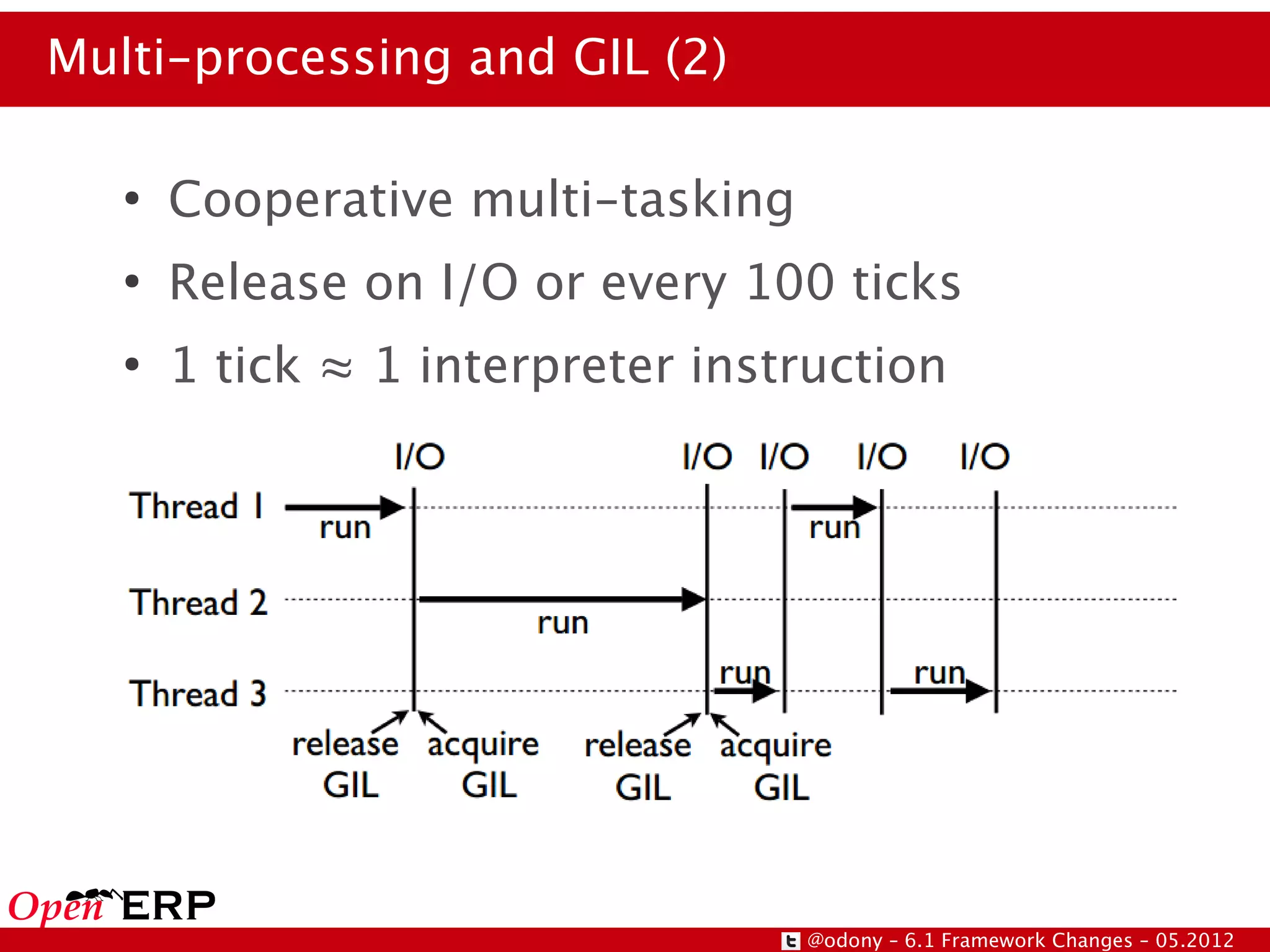
Multi-processing and GIL (2)

   ●
       Cooperative multi-tasking
   ●
       Release on I/O or every 100 ticks
   ●
       1 tick ≈ 1 interpreter instruction


                                   @odony – 6.1 Framework Changes – 05.2012
Scalability through multi-processing

  ●
      multiprocessing module was an option
  ●
      Using Unix tools and real processes was
      more flexible and easier to scale up
  ●
      Managing the processes was not
      necessary, many tools exist to do that
      (e.g. Gunicorn)
  ●
      Just had to make OpenERP WSGI-compliant


                                @odony – 6.1 Framework Changes – 05.2012
WSGI (1)

   ●
       Web Server Gateway Interface for Python
   ●
       WSGI applications can be embedded in
       WSGI-compliant web servers
   ●
       Many web frameworks support WSGI
       ●
           Django, CherryPy, …
   ●
       Many HTTP servers support WSGI
       ●
           Apache(+mod), nginx(+mod), tornado, gunicorn, …


                                          @odony – 6.1 Framework Changes – 05.2012
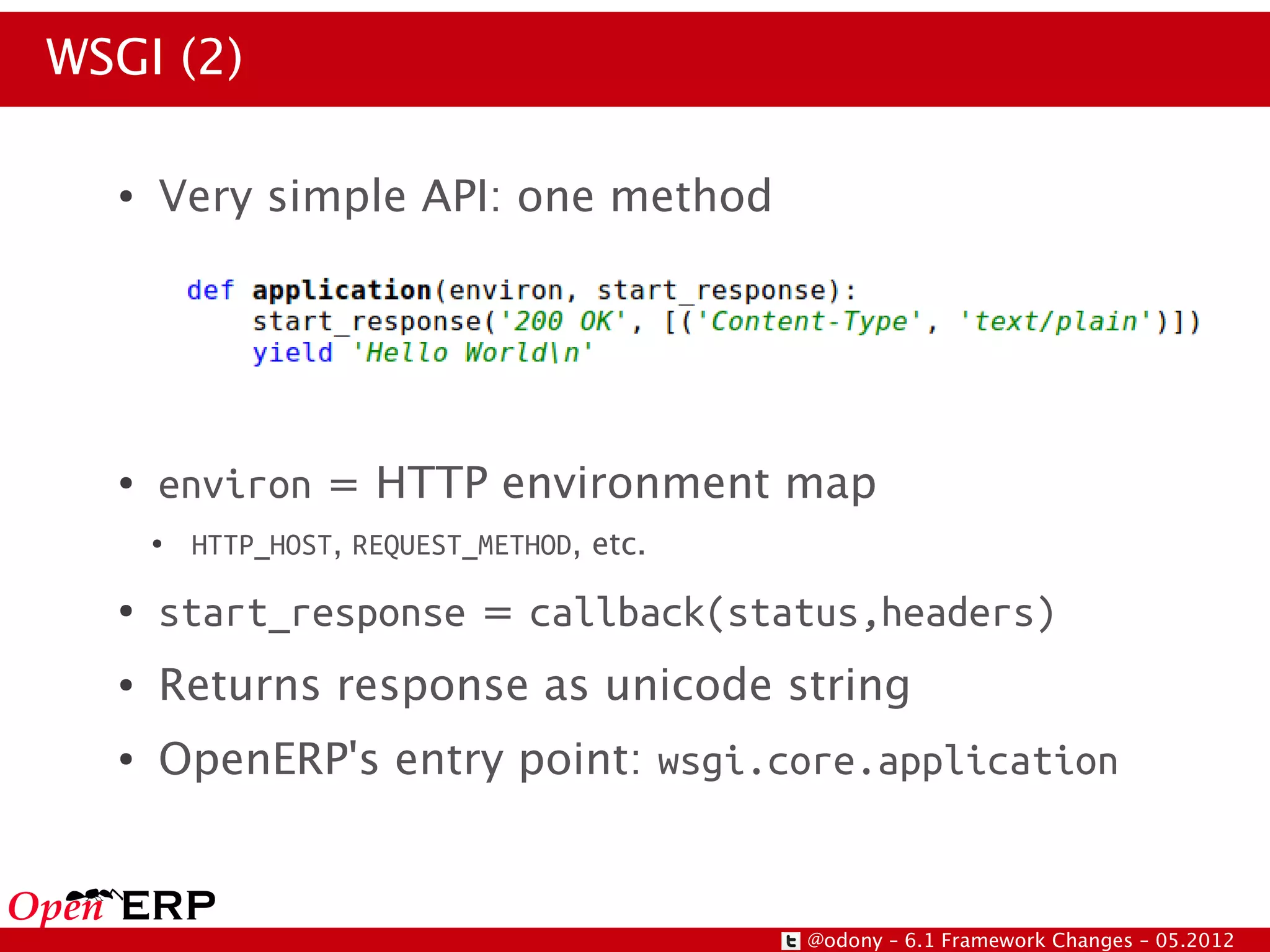
WSGI (2)

  ●   Very simple API: one method


  ●   environ = HTTP environment map
      ●   HTTP_HOST, REQUEST_METHOD, etc.
  ●   start_response = callback(status,headers)
  ●   Returns response as unicode string
  ●   OpenERP's entry point: wsgi.core.application


                                            @odony – 6.1 Framework Changes – 05.2012
Gunicorn (1)

   ●
       WGSI compliant HTTP Server
   ●
       Python port of Ruby Unicorn
   ●
       Pre-fork multi-process model
   ●
       Flexible and easily configurable
   ●
       UNIX only (fork support needed)
   ●
       See also gunicorn.org


                                  @odony – 6.1 Framework Changes – 05.2012
Gunicorn (2)

   ●
       Master “Arbiter” process
       ●
           Starts and monitors workers (crash/timeout/...)
       ●
           Restarts killed workers → fork
       ●
           Increment/Decrement worker count (TTIN/TTOU signals)
       ●
           Doesn't speak HTTP → naive dispatch
   ●
       Forked worker processes
       ●
           Speak HTTP → Perform WSGI translation
       ●
           Dispatch to application entry point
       ●
           Can restart after given number of requests


                                                 @odony – 6.1 Framework Changes – 05.2012
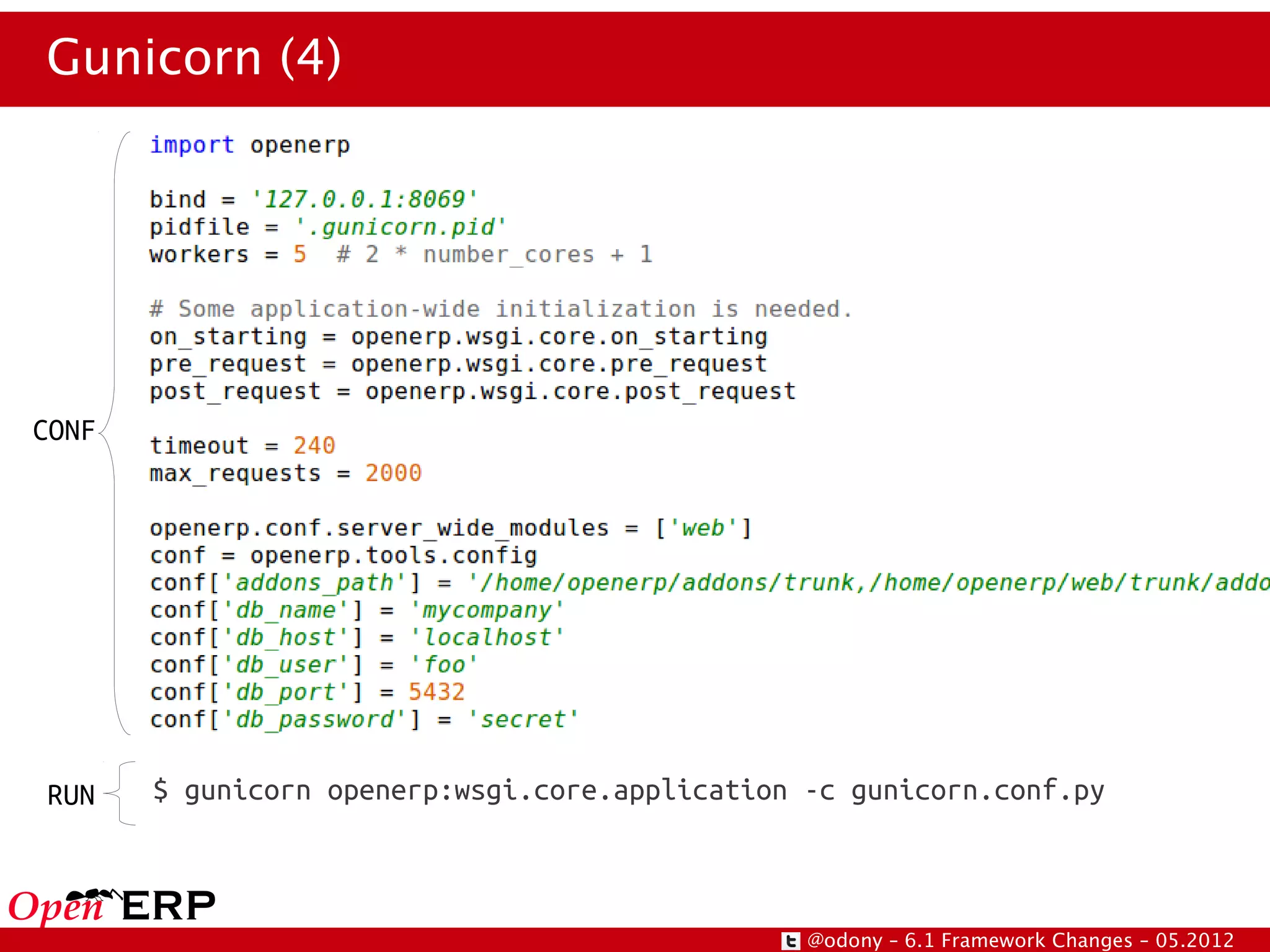
Gunicorn (3)

   ●
       OpenERP can't use normal config file or
       command-line options
   ●
       Config has to be provided via Gunicorn
   ●
       gunicorn.conf, written in Python!
       ●
           Contains Gunicorn configuration (workers, limits, etc.)
       ●
           Contains OpenERP configuration
       ●
           Sets up requests/application hooks (pre/post request...)
   ●
       Arbiter controls max-requests limit
   ●
       Workers control memory/cpu limits


                                                @odony – 6.1 Framework Changes – 05.2012
Gunicorn (4)


CONF


RUN    $ gunicorn openerp:wsgi.core.application -c gunicorn.conf.py


                                                @odony – 6.1 Framework Changes – 05.2012
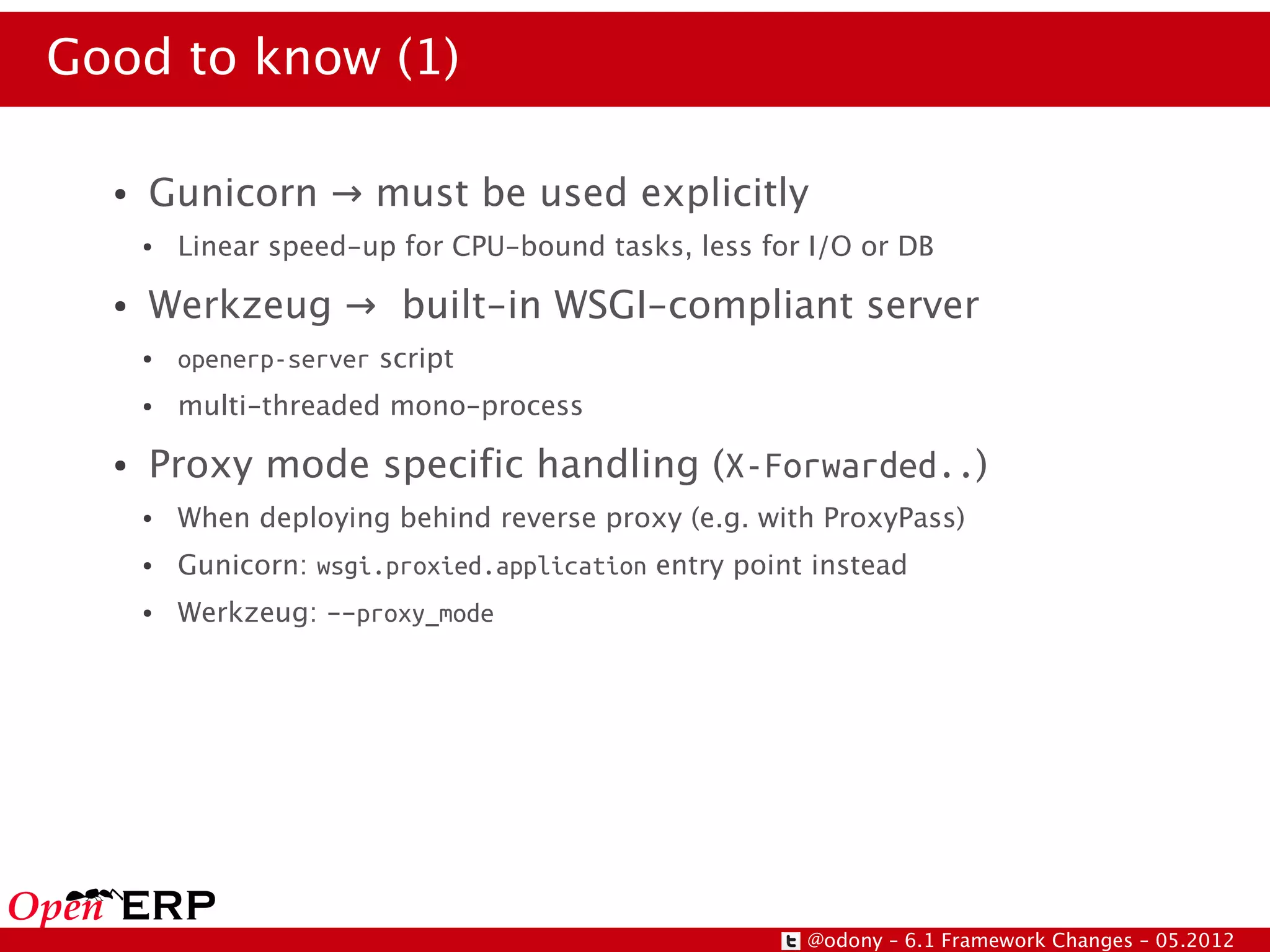
Good to know (1)

  ●   Gunicorn → must be used explicitly
      ●   Linear speed-up for CPU-bound tasks, less for I/O or DB

  ●   Werkzeug → built-in WSGI-compliant server
      ●   openerp-server script
      ●   multi-threaded mono-process

  ●   Proxy mode specific handling (X-Forwarded..)
      ●   When deploying behind reverse proxy (e.g. with ProxyPass)
      ●   Gunicorn: wsgi.proxied.application entry point instead
      ●   Werkzeug: --proxy_mode


                                                        @odony – 6.1 Framework Changes – 05.2012
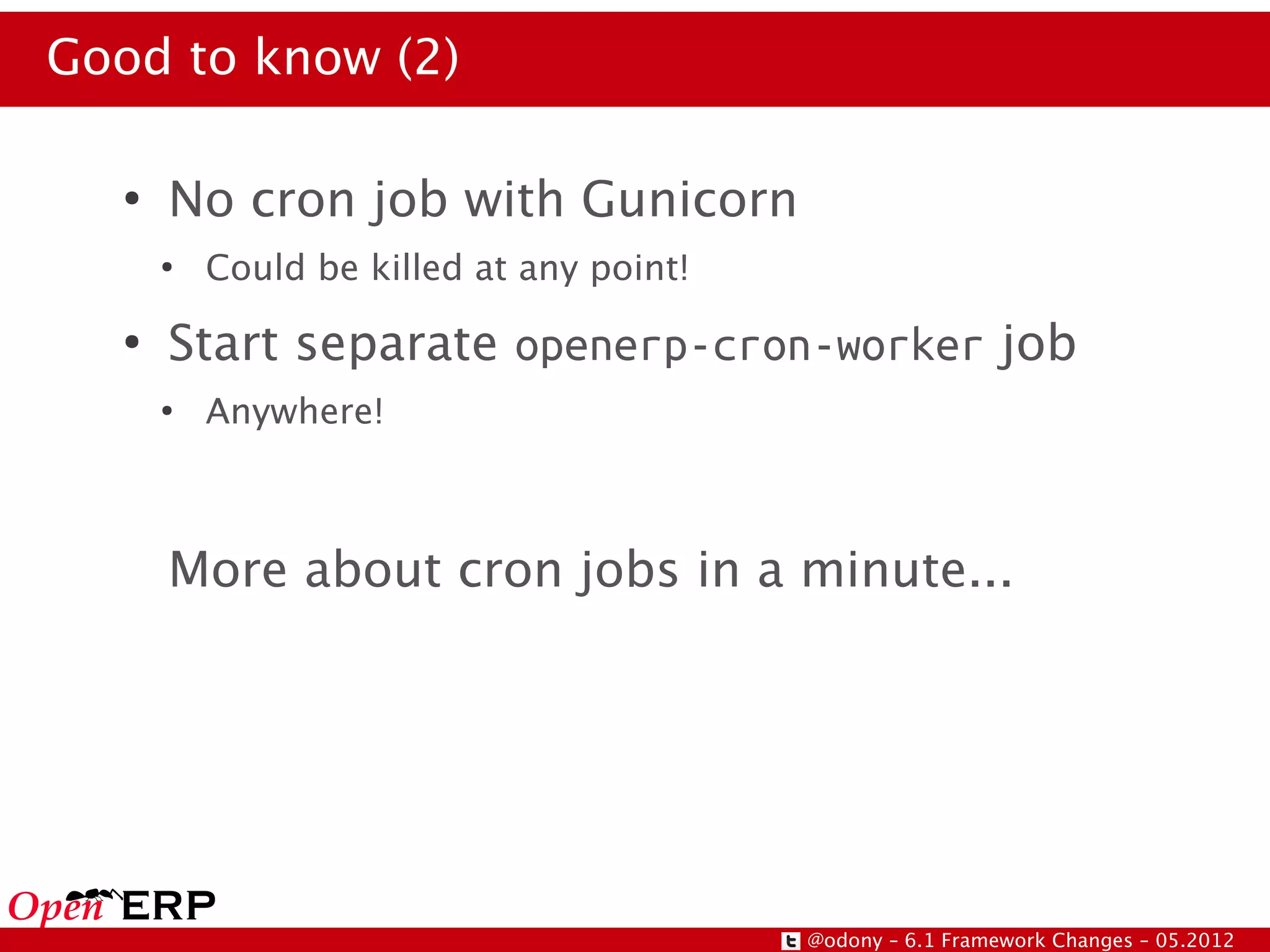
Good to know (2)

  ●
      No cron job with Gunicorn
      ●
          Could be killed at any point!
  ●
      Start separate openerp-cron-worker job
      ●
          Anywhere!


      More about cron jobs in a minute...


                                          @odony – 6.1 Framework Changes – 05.2012
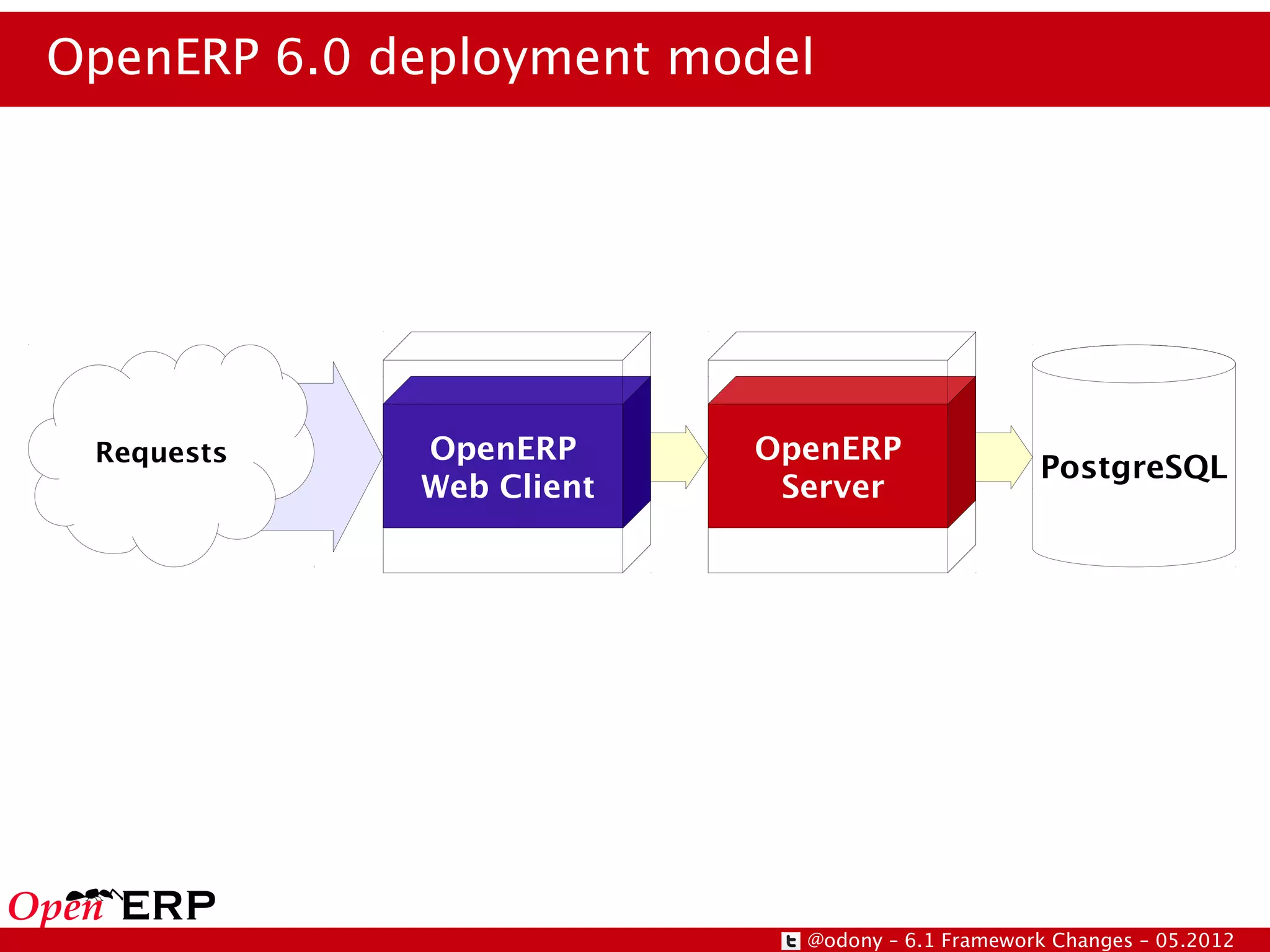
OpenERP 6.0 deployment model


 Requests    OpenERP      OpenERP
                                                 PostgreSQL
             Web Client    Server


                            @odony – 6.1 Framework Changes – 05.2012
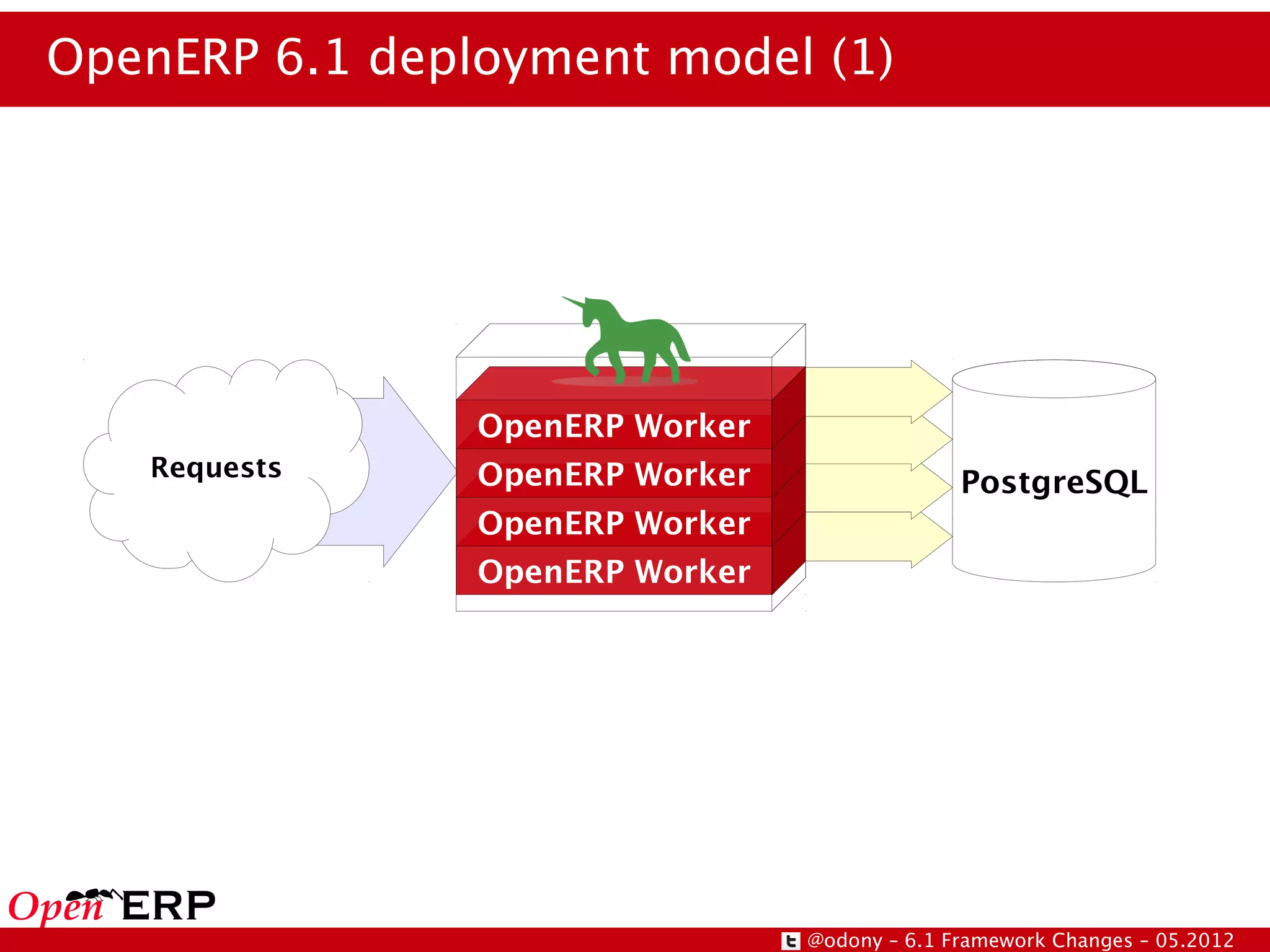
OpenERP 6.1 deployment model (1)


                OpenERP Worker
   Requests     OpenERP Worker                 PostgreSQL
                OpenERP Worker
                OpenERP Worker


                                 @odony – 6.1 Framework Changes – 05.2012
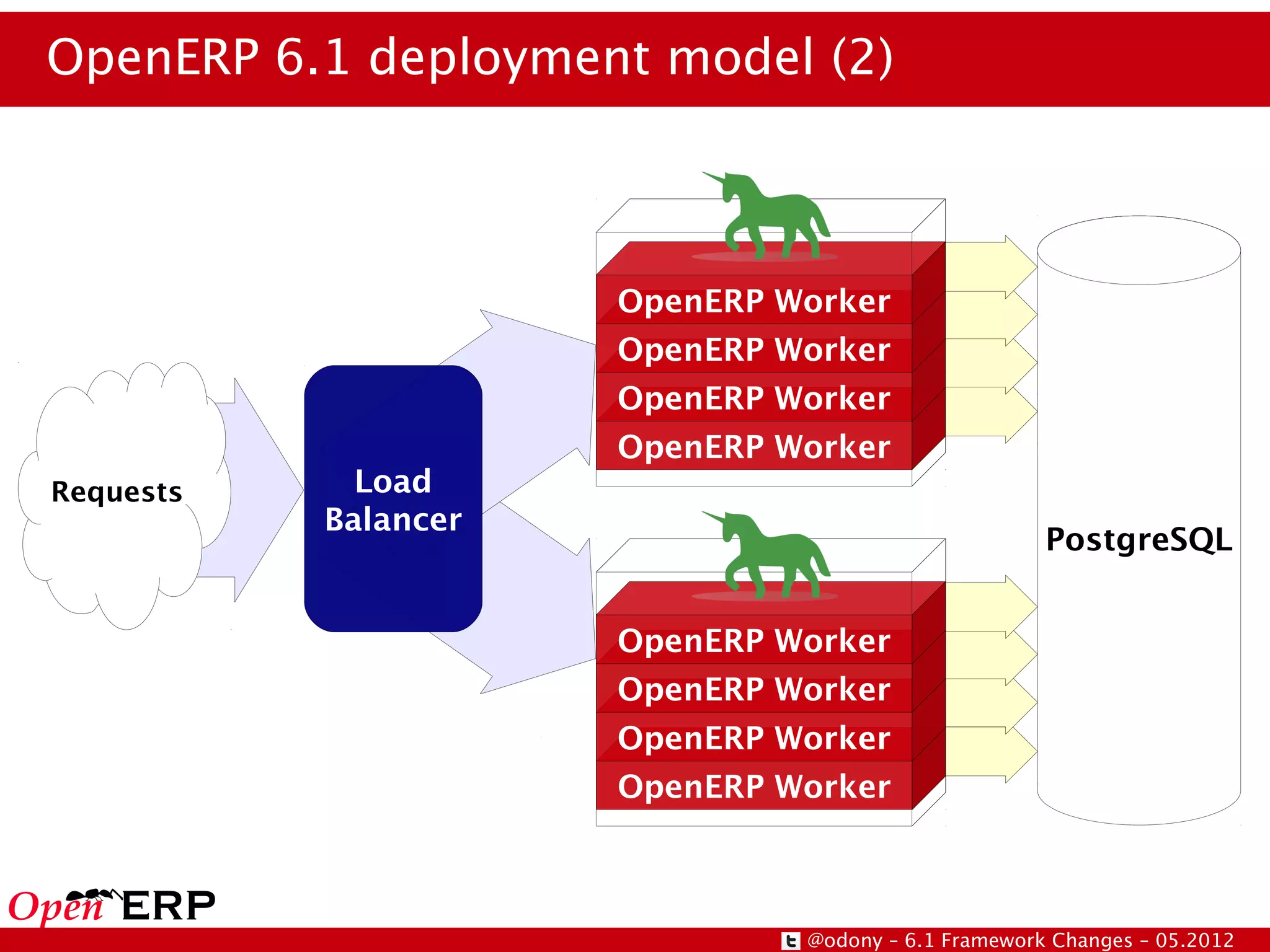
OpenERP 6.1 deployment model (2)


                      OpenERP Worker
                      OpenERP Worker
                      OpenERP Worker
                      OpenERP Worker
Requests     Load
           Balancer
                                                     PostgreSQL


                      OpenERP Worker
                      OpenERP Worker
                      OpenERP Worker
                      OpenERP Worker


                               @odony – 6.1 Framework Changes – 05.2012
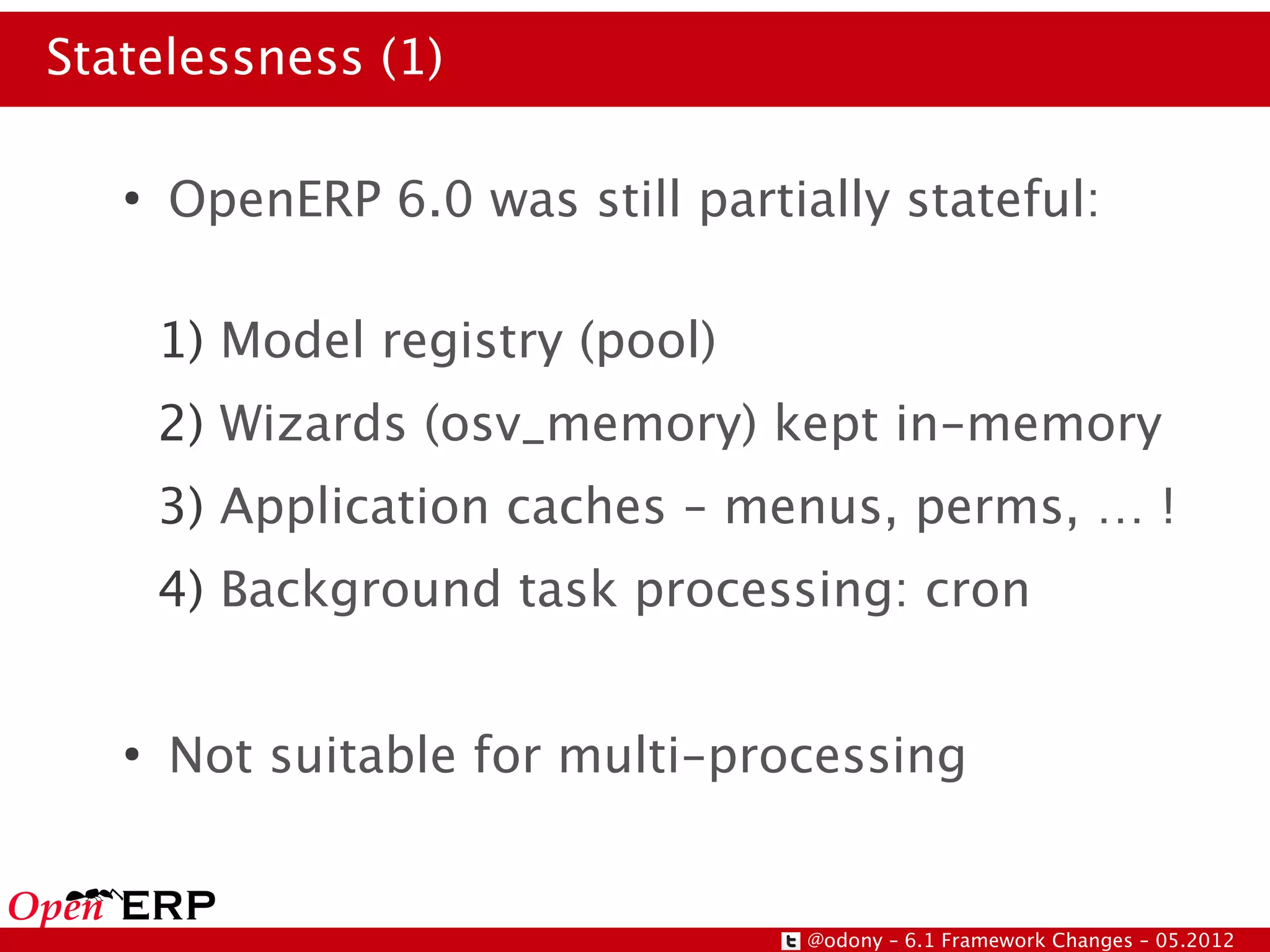
Statelessness (1)

   ●
       OpenERP 6.0 was still partially stateful:

       1) Model registry (pool)
       2) Wizards (osv_memory) kept in-memory
       3) Application caches – menus, perms, … !
       4) Background task processing: cron


   ●
       Not suitable for multi-processing


                                   @odony – 6.1 Framework Changes – 05.2012
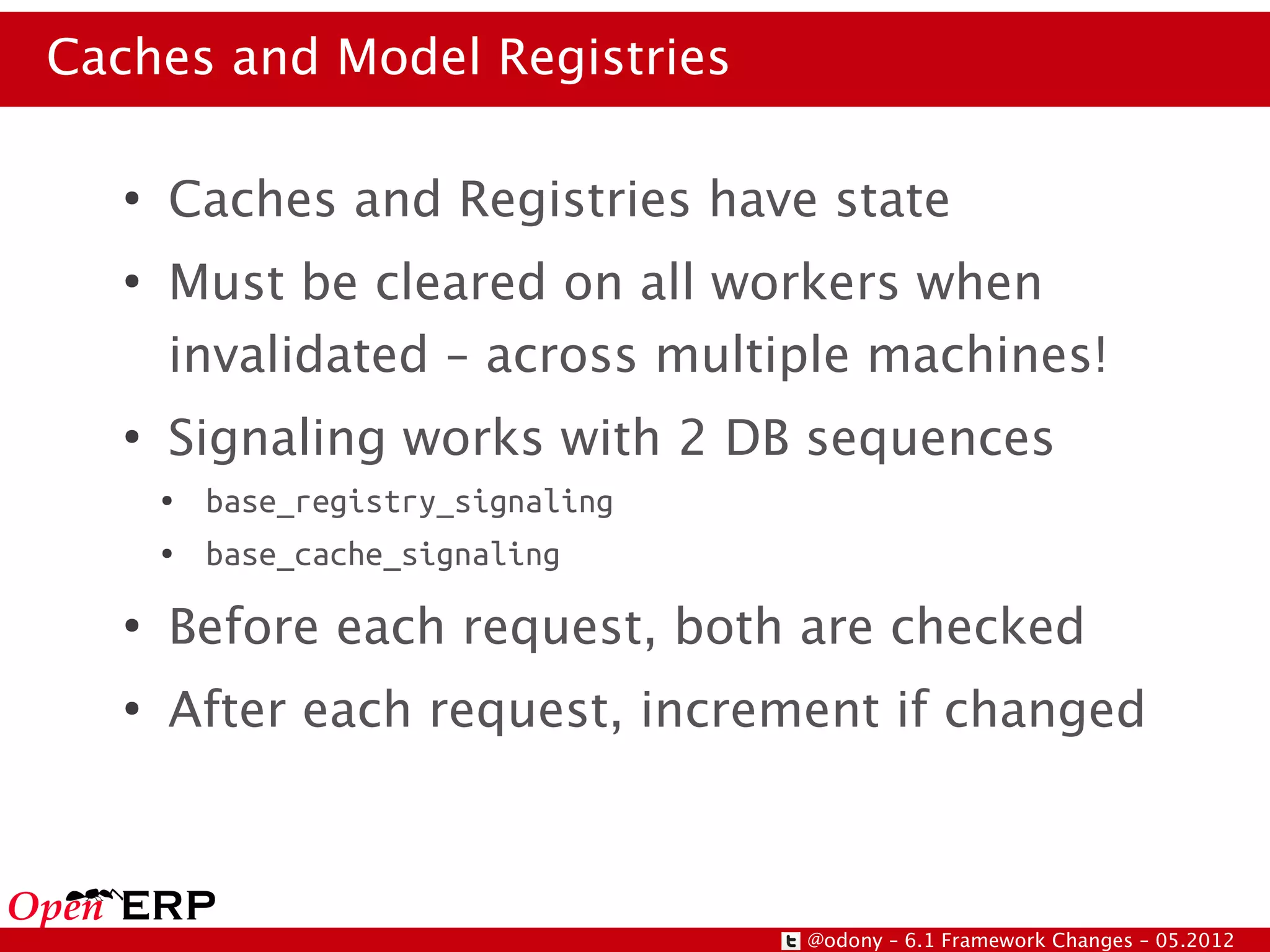
Caches and Model Registries

   ●
       Caches and Registries have state
   ●
       Must be cleared on all workers when
       invalidated – across multiple machines!
   ●
       Signaling works with 2 DB sequences
       ●   base_registry_signaling
       ●   base_cache_signaling
   ●
       Before each request, both are checked
   ●
       After each request, increment if changed


                                     @odony – 6.1 Framework Changes – 05.2012
TransientModel

  ●
      osv_memory → TransientModel
      ●
          Real database-backed model
      ●
          Automatically vacuum-cleaned
      ●
          Based on size limit or time limit
      ●
          Default: 2 hours
  ●
      Has special and implicit access rights
      ●
          Everyone can perform CRUD
      ●
          But only access on your own records
  ●
      Can be used indifferently by multiple workers


                                                @odony – 6.1 Framework Changes – 05.2012
Background Tasks (cron) (1)

  ●   Problem:
      ●   Each worker possibly runs a cron processor
      ●   Must prevent duplicate run of same task
      ●   Must benefit from multi-processing when multiple cron processors
          are running (each runs different tasks)
  ●   Solution:
      ●   Database row-level mutex using LOCK
      ●   Cron processor can be run on any number of servers
      ●   Disabled on Gunicorn workers by default
      ●   Can be run separately with openerp-cron-worker script added in 6.1
      ●   Cron tasks can't be changed while running (locked)


                                                    @odony – 6.1 Framework Changes – 05.2012
Background Tasks (cron) (2)

   ●
       And by the way, cron tasks are executed
       in parallel in OpenERP 6.1
   ●
       Also if running mono-process, up to
       number or thread specified with
         –-max-cron-threads   (default: 4)
   ●
       Allows multiple tasks to be executed at
       the same time


                                       @odony – 6.1 Framework Changes – 05.2012
Agenda                                                                
  ●
      Framework & API
      ●
          Architecture changes
      ●
          API evolution
      ●
          New views and UI features
      ●
          Other important bits
      ●
          Exercises, Q&A


                                      @odony – 6.1 Framework Changes – 05.2012
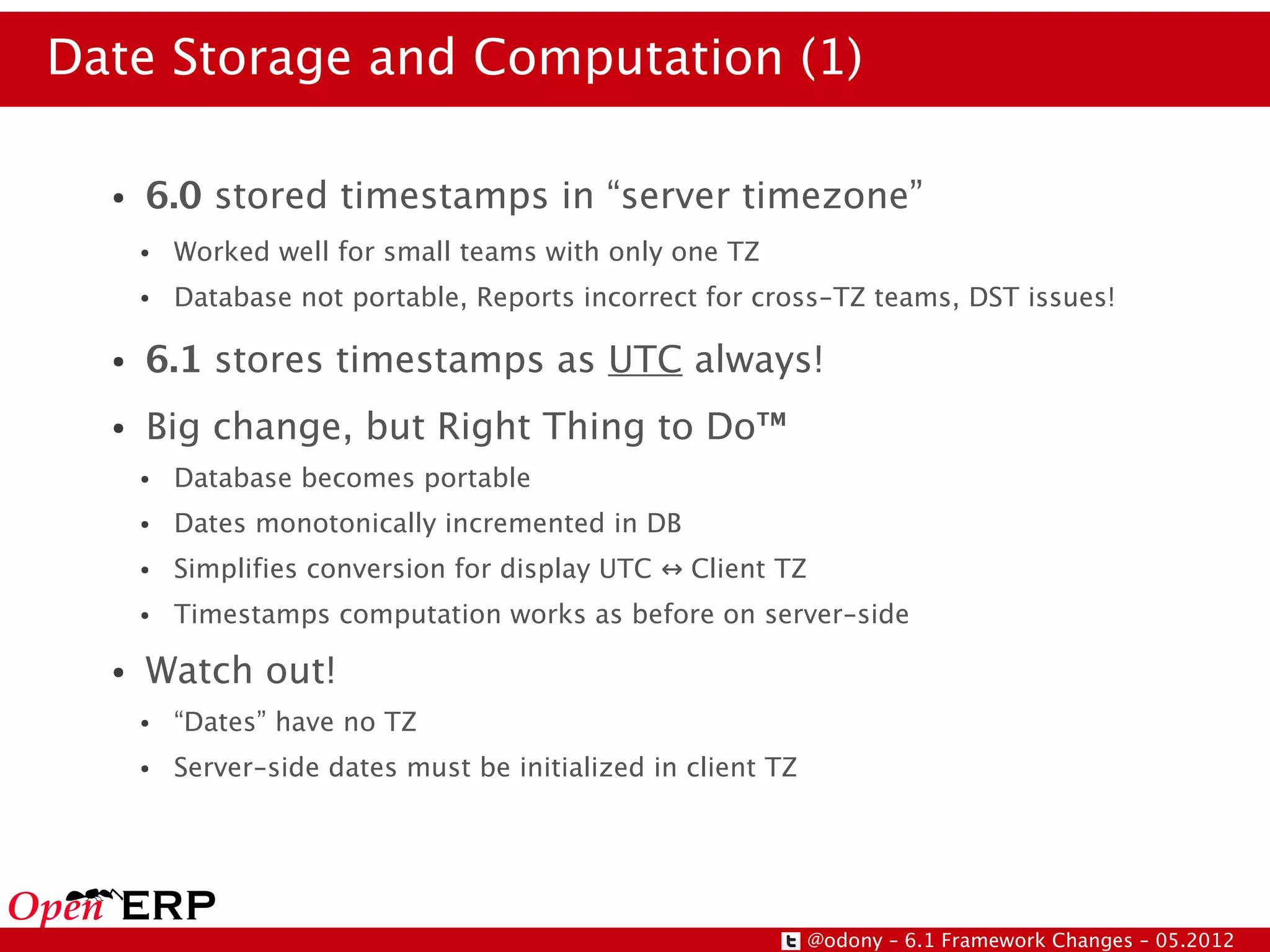
Date Storage and Computation (1)

  ●   6.0 stored timestamps in “server timezone”
      ●   Worked well for small teams with only one TZ
      ●   Database not portable, Reports incorrect for cross-TZ teams, DST issues!

  ●   6.1 stores timestamps as UTC always!
  ●   Big change, but Right Thing to Do™
      ●   Database becomes portable
      ●   Dates monotonically incremented in DB
      ●   Simplifies conversion for display UTC ↔ Client TZ
      ●   Timestamps computation works as before on server-side

  ●   Watch out!
      ●   “Dates” have no TZ
      ●   Server-side dates must be initialized in client TZ


                                                               @odony – 6.1 Framework Changes – 05.2012
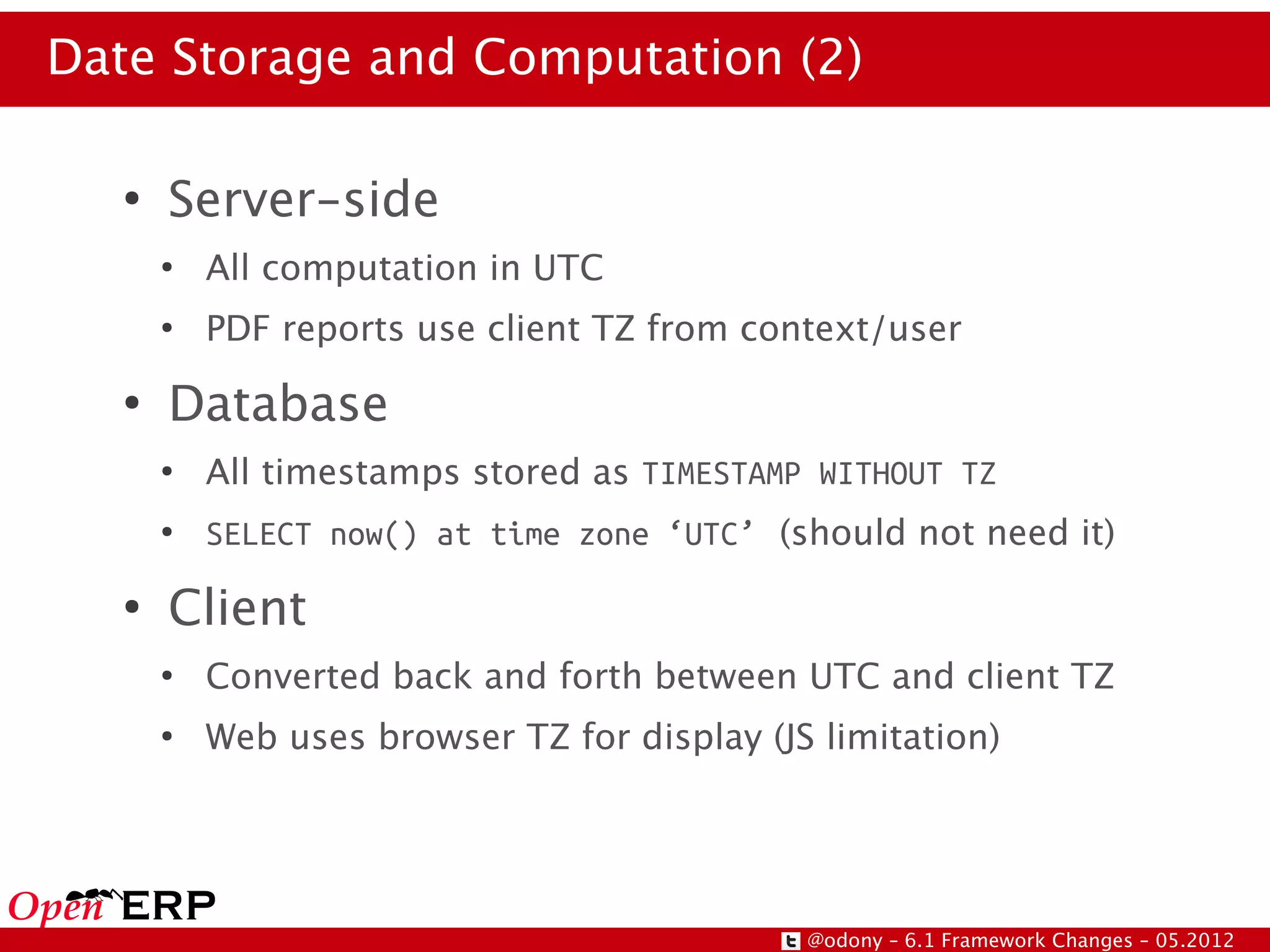
Date Storage and Computation (2)

   ●
       Server-side
       ●
           All computation in UTC
       ●
           PDF reports use client TZ from context/user
   ●
       Database
       ●
           All timestamps stored as TIMESTAMP WITHOUT TZ
       ●
           SELECT now() at time zone ‘UTC’ (should not need it)
   ●
       Client
       ●
           Converted back and forth between UTC and client TZ
       ●
           Web uses browser TZ for display (JS limitation)


                                              @odony – 6.1 Framework Changes – 05.2012
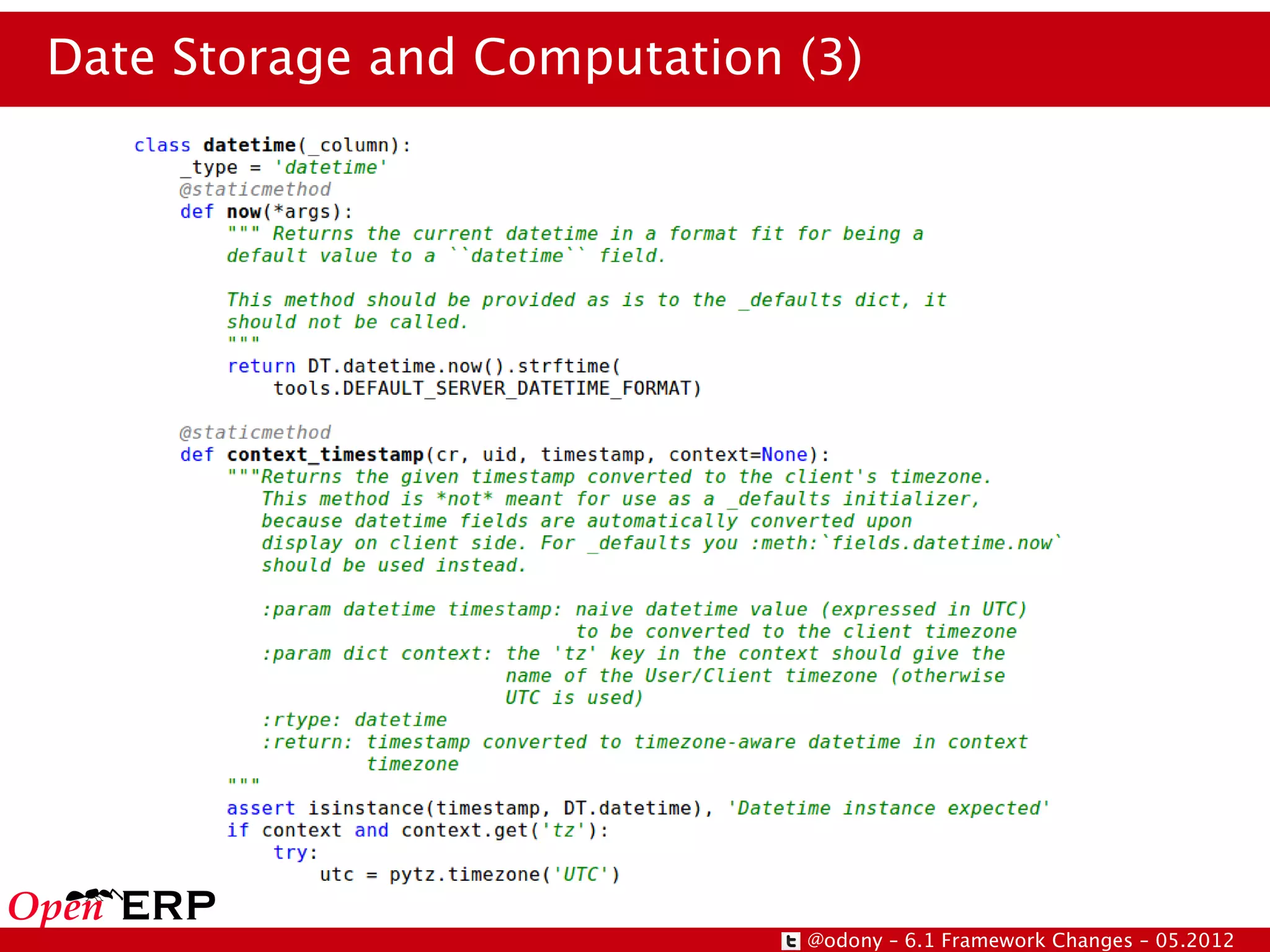
Date Storage and Computation (3)


                             @odony – 6.1 Framework Changes – 05.2012
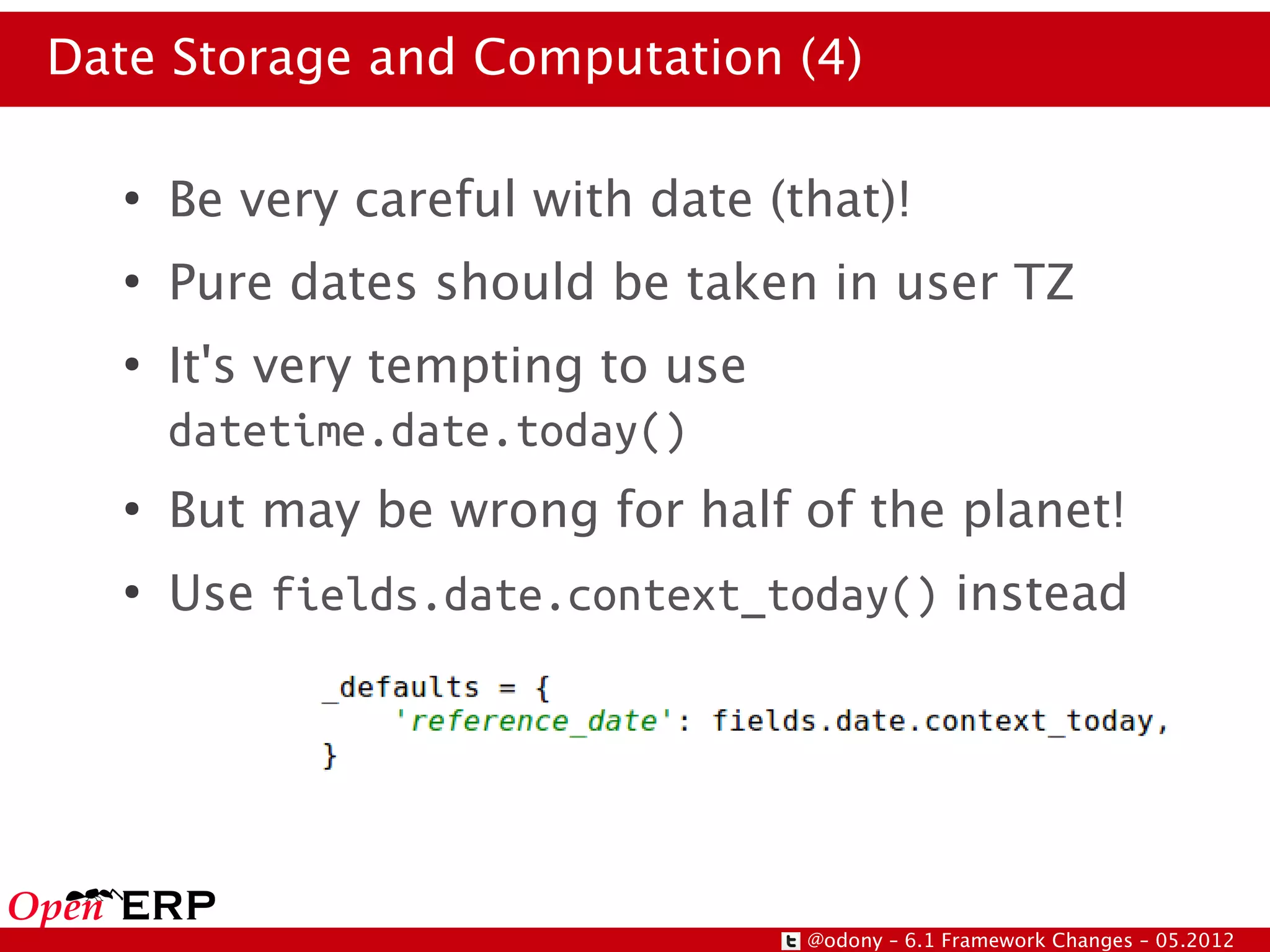
Date Storage and Computation (4)

   ●
       Be very careful with date (that)!
   ●
       Pure dates should be taken in user TZ
   ●
       It's very tempting to use
       datetime.date.today()
   ●
       But may be wrong for half of the planet!
   ●
       Use fields.date.context_today() instead


                                   @odony – 6.1 Framework Changes – 05.2012
Unified Mail Subsystem

   ●
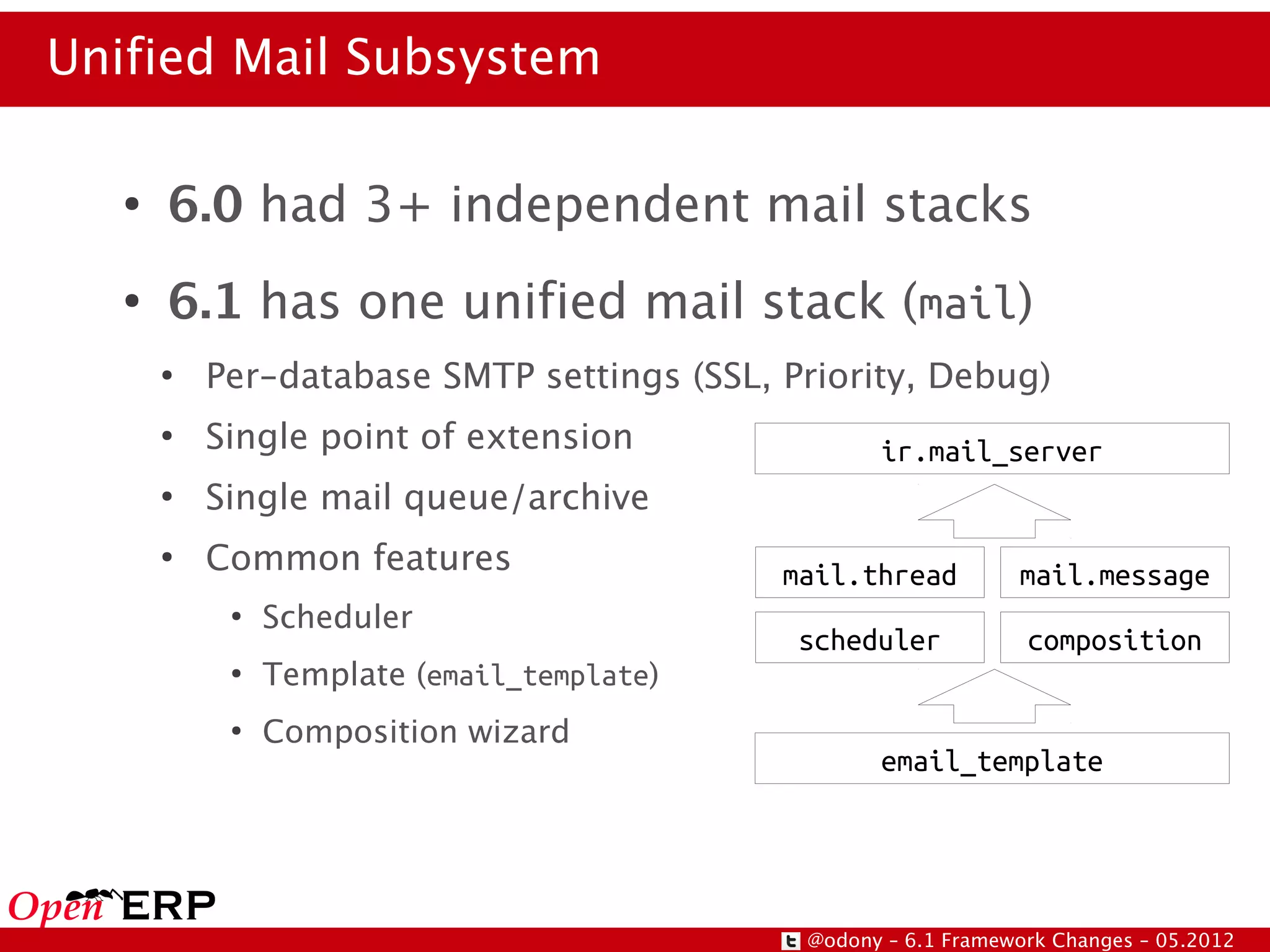
       6.0 had 3+ independent mail stacks
   ●
       6.1 has one unified mail stack (mail)
       ●
           Per-database SMTP settings (SSL, Priority, Debug)
       ●
           Single point of extension               ir.mail_server
       ●
           Single mail queue/archive
       ●
           Common features                  mail.thread         mail.message
            ●
                Scheduler
                                             scheduler           composition
            ●
                Template (email_template)
            ●
                Composition wizard
                                                   email_template


                                             @odony – 6.1 Framework Changes – 05.2012
Many2Many auto-naming and inheritance

  ●
      What happens when you _inherit a model
      containing m2m field, w/ different _name?
  ●
      Problem more apparent with abstract
      osv_memory models
  ●
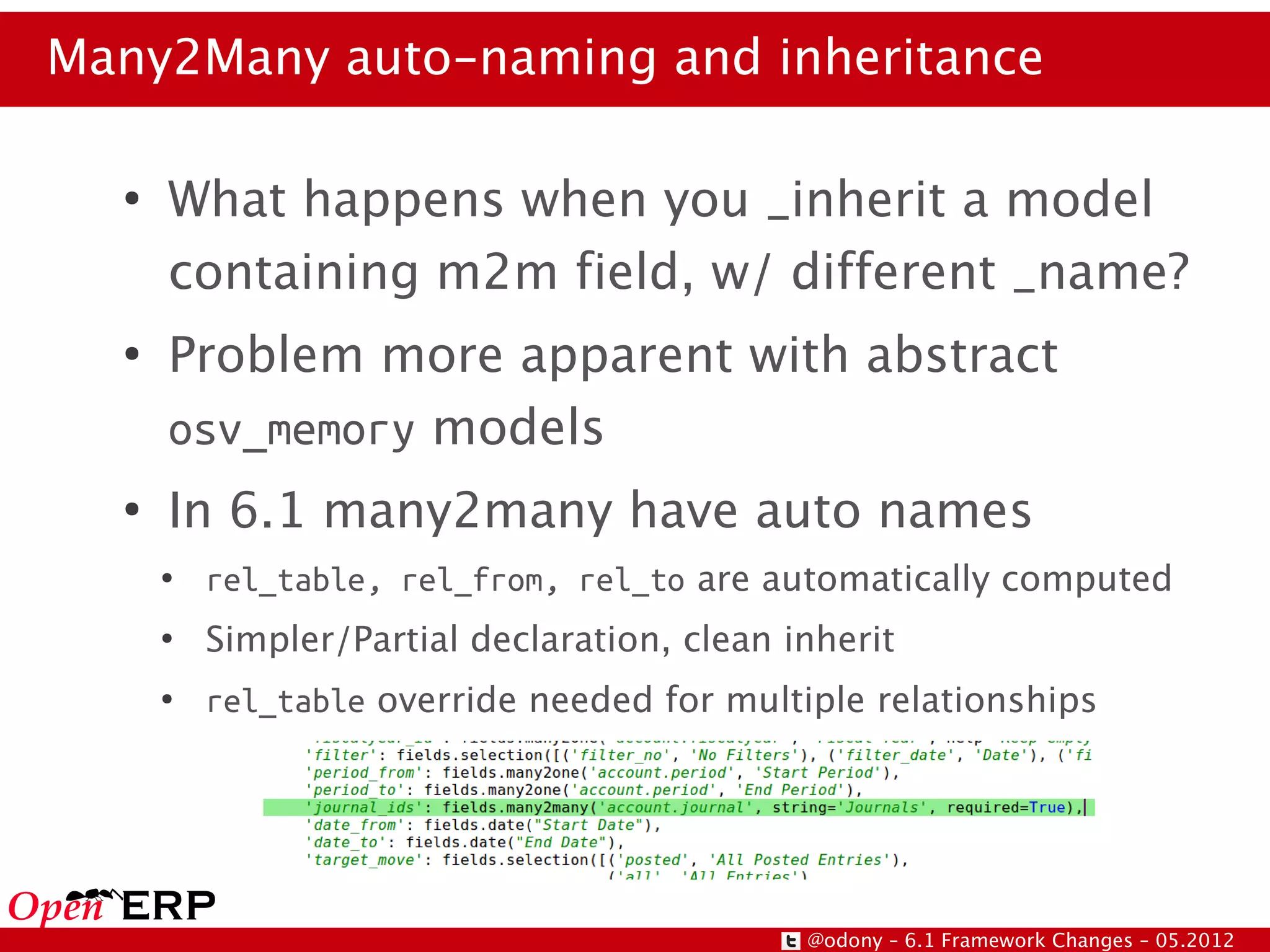
      In 6.1 many2many have auto names
      ●
          rel_table, rel_from, rel_to are automatically computed
      ●
          Simpler/Partial declaration, clean inherit
      ●
          rel_table override needed for multiple relationships


                                              @odony – 6.1 Framework Changes – 05.2012
YAML improvements (1)

  ●   6.1 YAML tests:
      ●   65% coverage, 150 scenarios, 1800 test steps
  ●   Simulating workflows works well
  ●   But what about UI: views, on_change, … ?


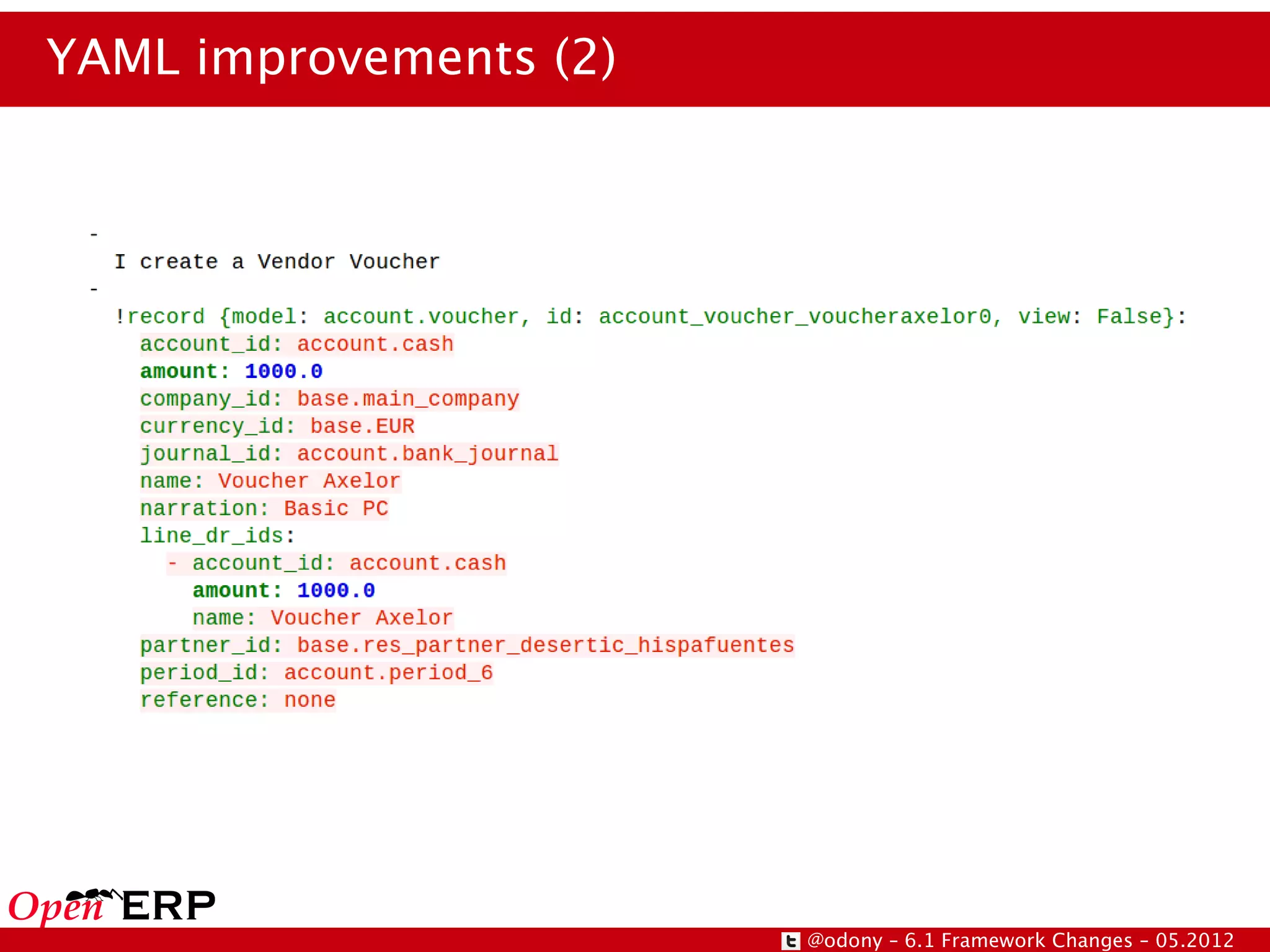
  ●   Done! YAML will now automatically use form
      views and on_change methods
      ●   Better coverage
      ●   Less code: on_change can fill in implicit values
      ●   Can be overridden with view attribute


                                                      @odony – 6.1 Framework Changes – 05.2012
YAML improvements (2)


                        @odony – 6.1 Framework Changes – 05.2012
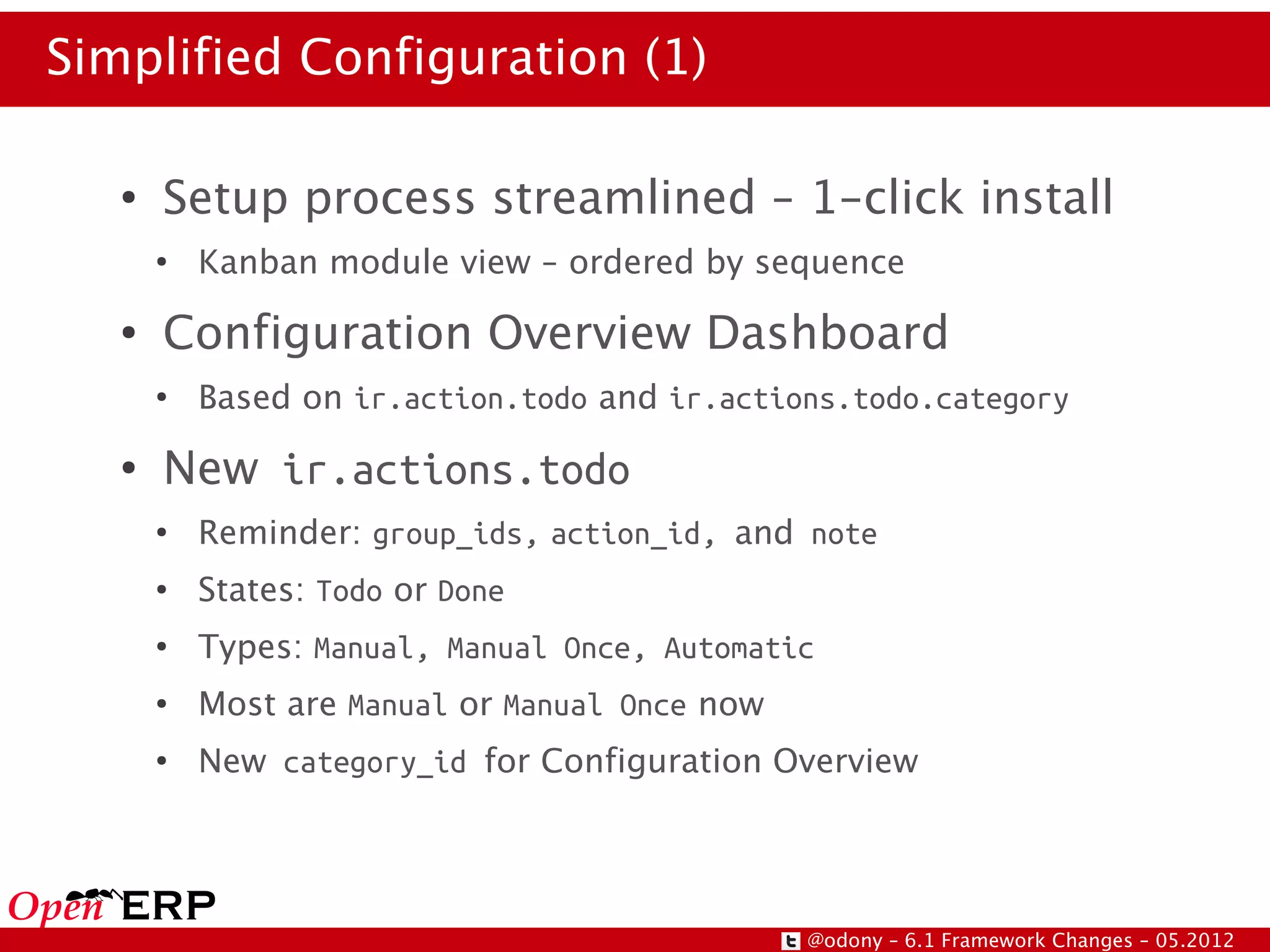
Simplified Configuration (1)

   ●
       Setup process streamlined – 1-click install
       ●
           Kanban module view – ordered by sequence
   ●
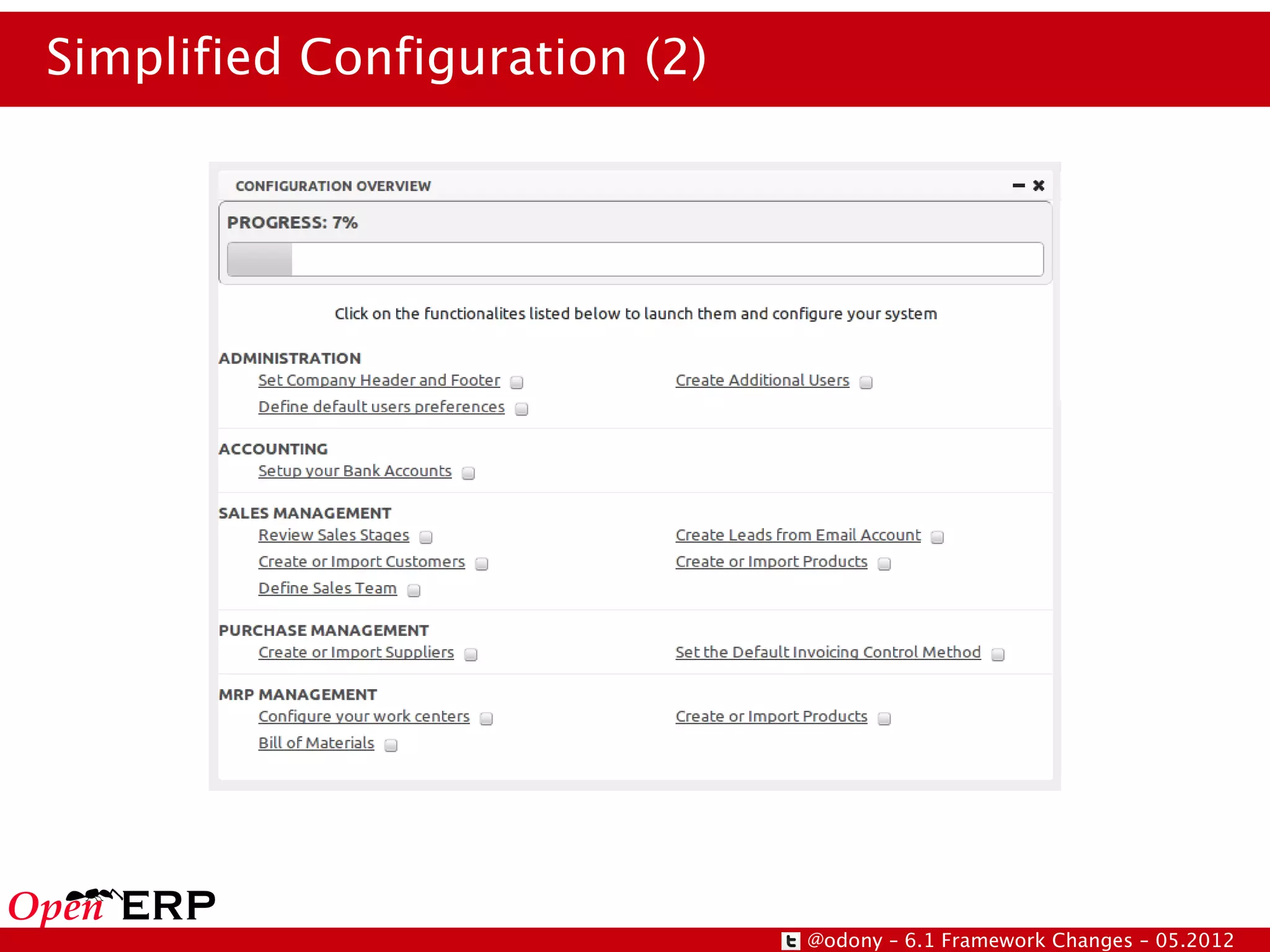
       Configuration Overview Dashboard
       ●
           Based on ir.action.todo and ir.actions.todo.category
   ●
       New ir.actions.todo
       ●
           Reminder: group_ids, action_id, and note
       ●
           States: Todo or Done
       ●
           Types: Manual, Manual Once, Automatic
       ●
           Most are Manual or Manual Once now
       ●
           New category_id for Configuration Overview


                                                @odony – 6.1 Framework Changes – 05.2012
Simplified Configuration (2)


                               @odony – 6.1 Framework Changes – 05.2012
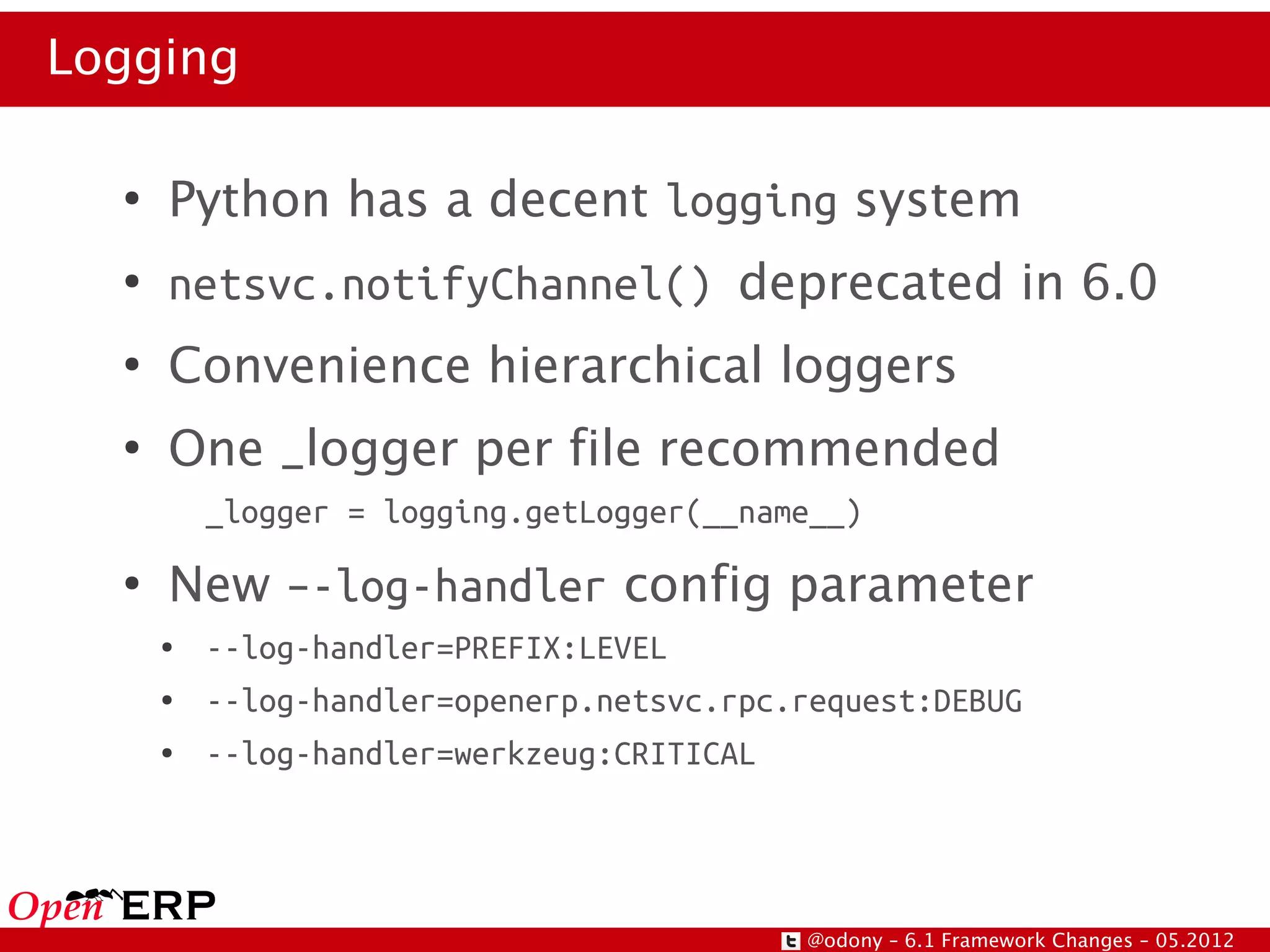
Logging

  ●
      Python has a decent logging system
  ●
      netsvc.notifyChannel() deprecated in 6.0
  ●
      Convenience hierarchical loggers
  ●
      One _logger per file recommended
          _logger = logging.getLogger(__name__)
  ●
      New –-log-handler config parameter
      ●   --log-handler=PREFIX:LEVEL
      ●   --log-handler=openerp.netsvc.rpc.request:DEBUG
      ●   --log-handler=werkzeug:CRITICAL


                                           @odony – 6.1 Framework Changes – 05.2012
Agenda                                                                
  ●
      Framework & API
      ●
          Architecture changes
      ●
          API evolution
      ●
          New views and UI features
      ●
          Other important bits
      ●
          Exercises, Q&A


                                      @odony – 6.1 Framework Changes – 05.2012
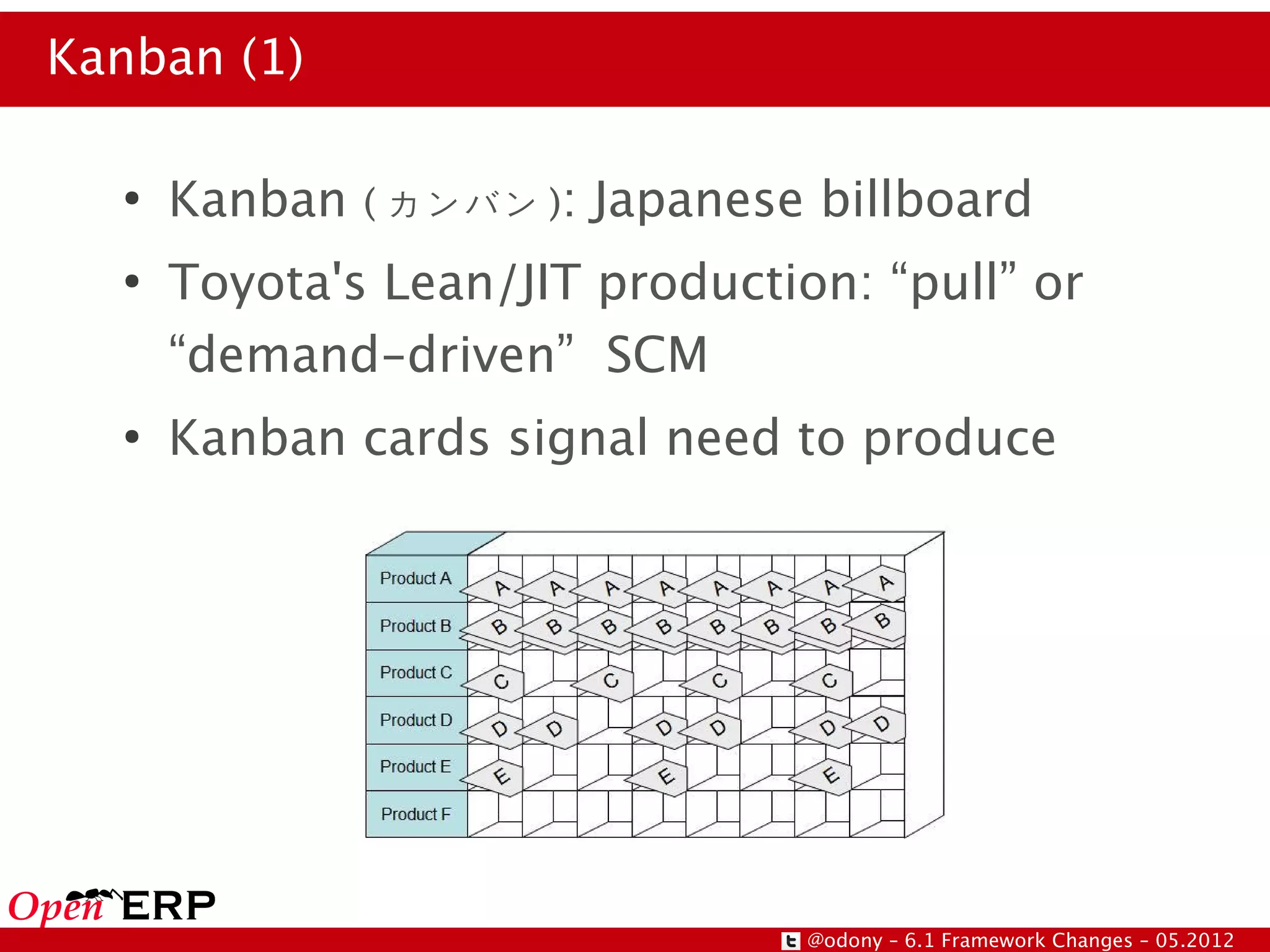
Kanban (1)

  ●
      Kanban   ( カンバン ):   Japanese billboard
  ●
      Toyota's Lean/JIT production: “pull” or
      “demand-driven” SCM
  ●
      Kanban cards signal need to produce


                                   @odony – 6.1 Framework Changes – 05.2012
Kanban (2)

  ●
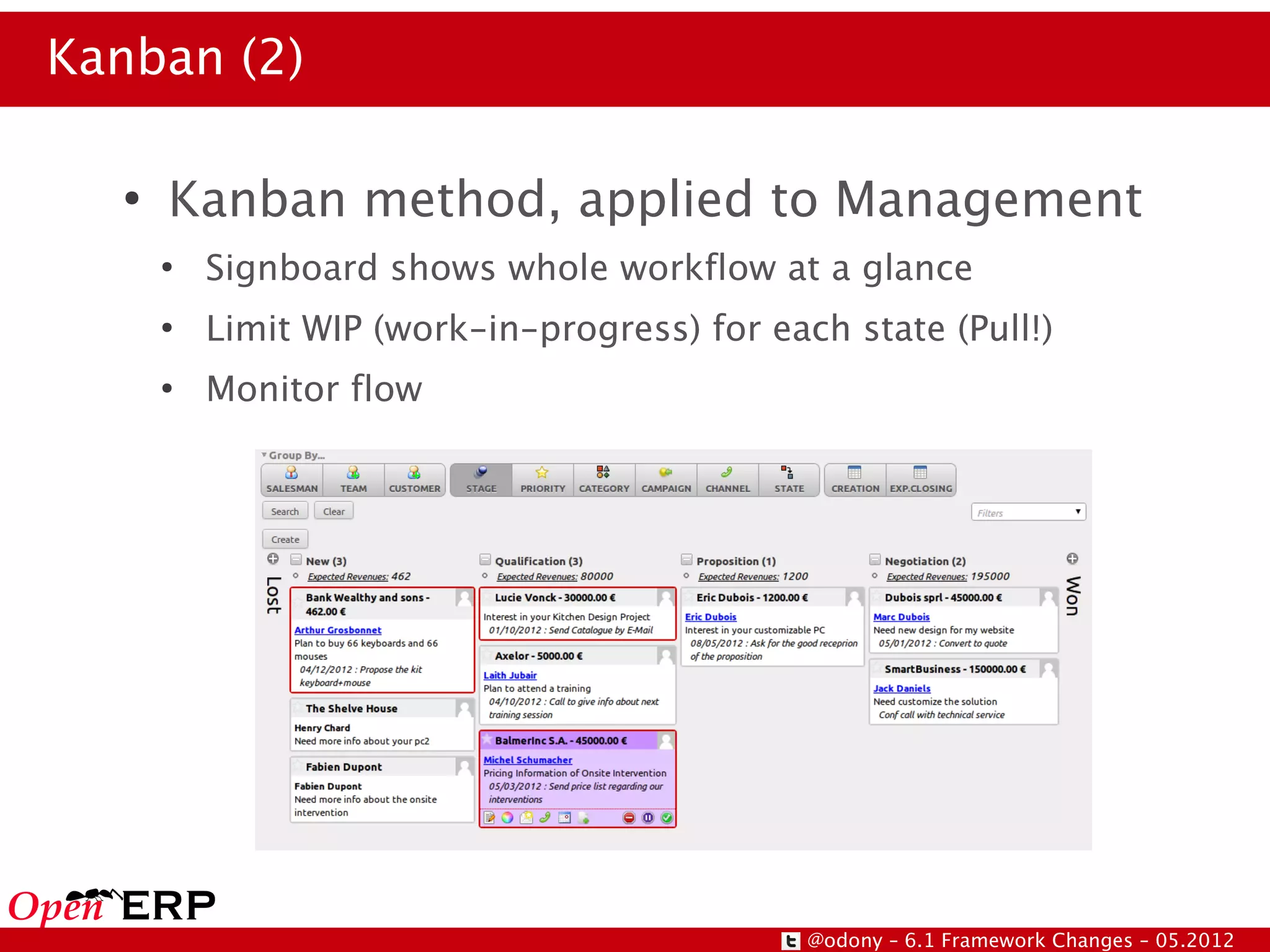
      Kanban method, applied to Management
      ●
          Signboard shows whole workflow at a glance
      ●
          Limit WIP (work-in-progress) for each state (Pull!)
      ●
          Monitor flow


                                              @odony – 6.1 Framework Changes – 05.2012
Kanban (3)

  ●
      kanban views are written in Qweb
  ●
      Automatic column layout with Group By
  ●
      Drag & Drop reassigns grouped column
  ●
      One mandatory template “kanban-box”
  ●
      Can use normal OpenERP fields
  ●
      Any CSS/HTML you like


                                @odony – 6.1 Framework Changes – 05.2012
Kanban (4)

  ●
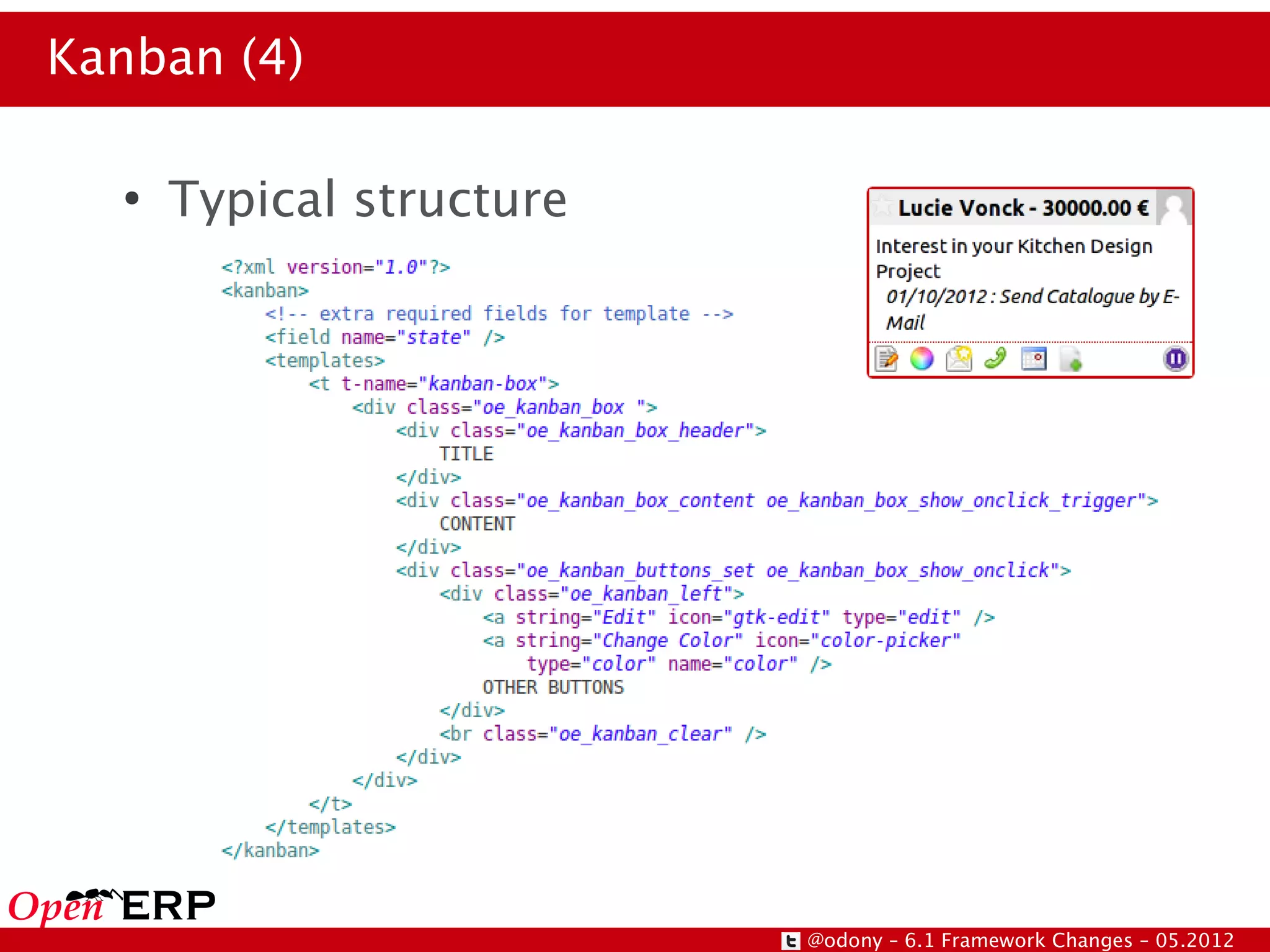
      Typical structure


                          @odony – 6.1 Framework Changes – 05.2012
Kanban (5)

  ●
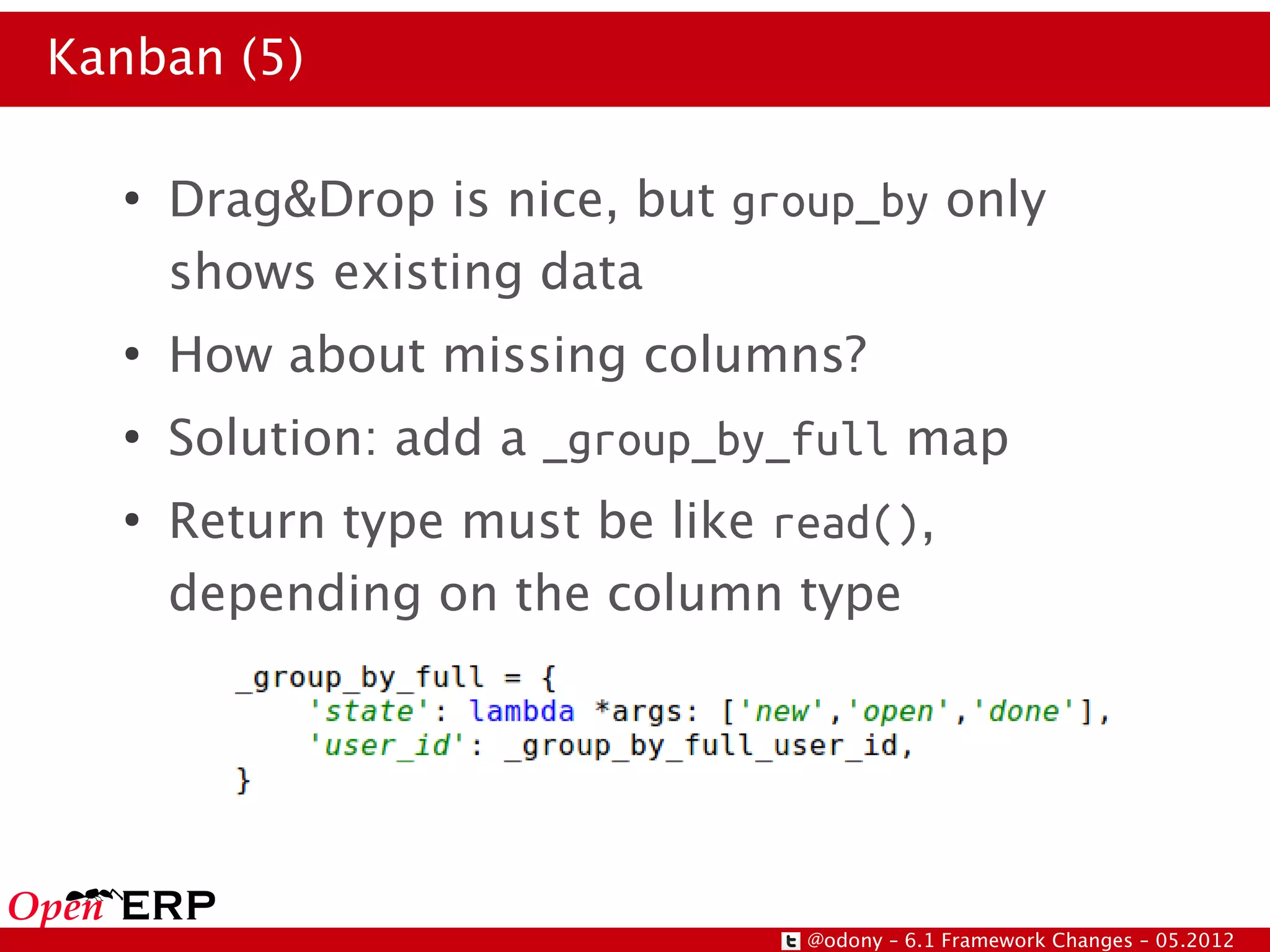
      Drag&Drop is nice, but group_by only
      shows existing data
  ●
      How about missing columns?
  ●
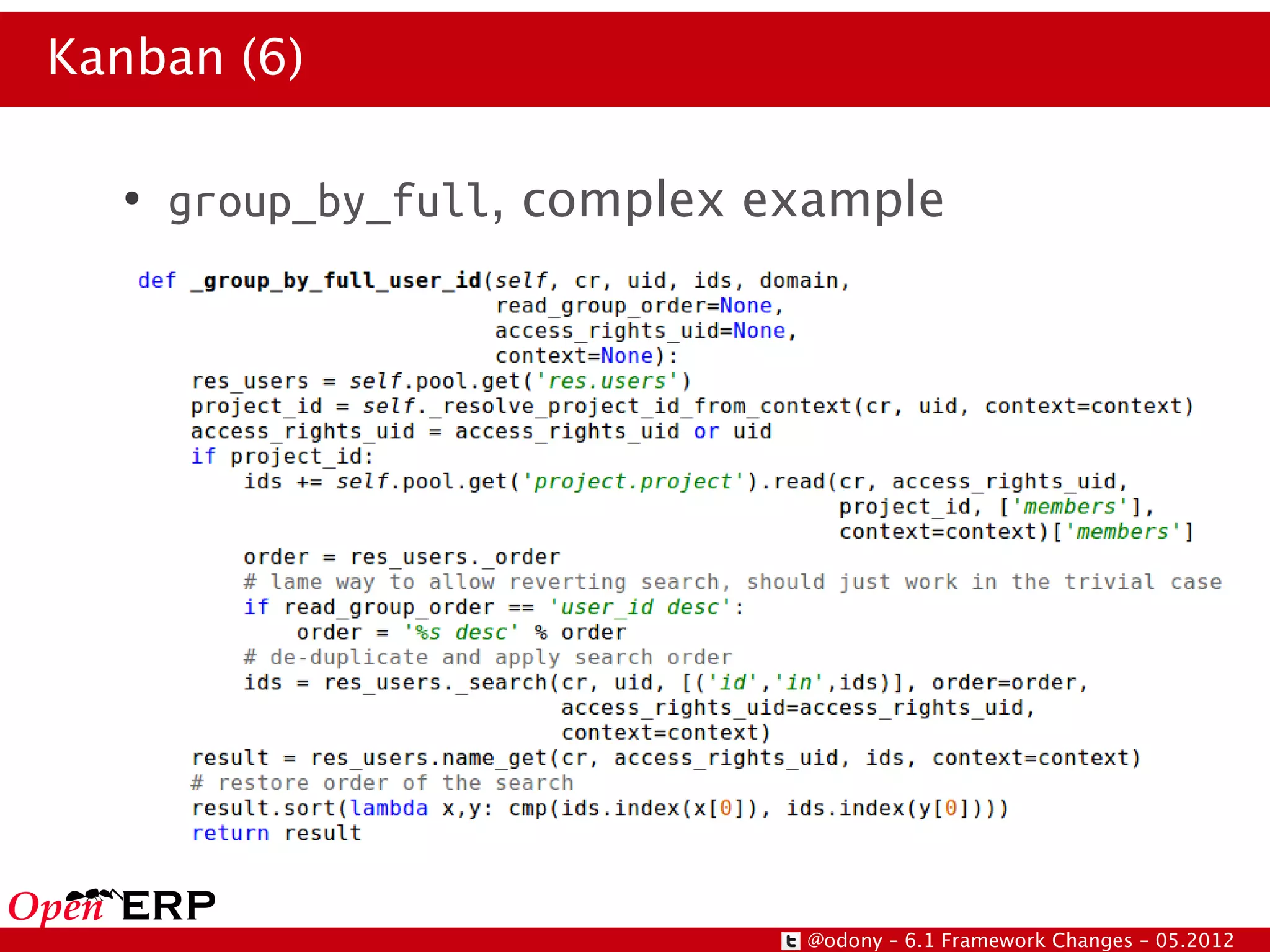
      Solution: add a _group_by_full map
  ●
      Return type must be like read(),
      depending on the column type


                                @odony – 6.1 Framework Changes – 05.2012
Kanban (6)

  ●
      group_by_full, complex example


                              @odony – 6.1 Framework Changes – 05.2012
Kanban (7)

    Exercise: add test kanban view for res.partner


                                   @odony – 6.1 Framework Changes – 05.2012
Kanban (8)

  ●
      More details about Kanban API:
      http://pad.openerp.com/kanban-api
      (temporary location)


                               @odony – 6.1 Framework Changes – 05.2012
Customizable dashboards

  ●
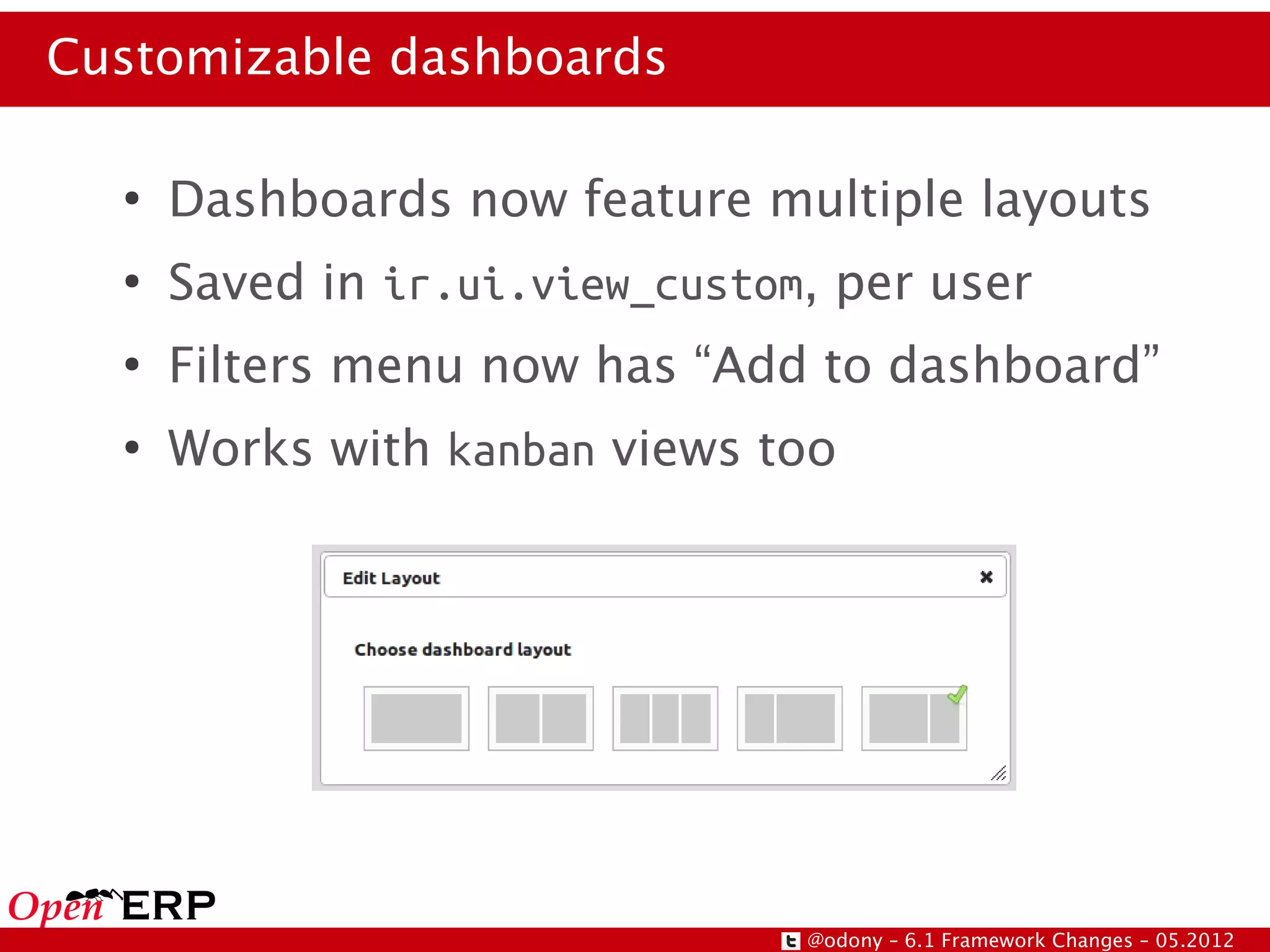
      Dashboards now feature multiple layouts
  ●
      Saved in ir.ui.view_custom, per user
  ●
      Filters menu now has “Add to dashboard”
  ●
      Works with kanban views too


                                @odony – 6.1 Framework Changes – 05.2012
New many2one widget

  ●
      Many2One fields = eternal UI problem
  ●
      6.1 widget:
      ●
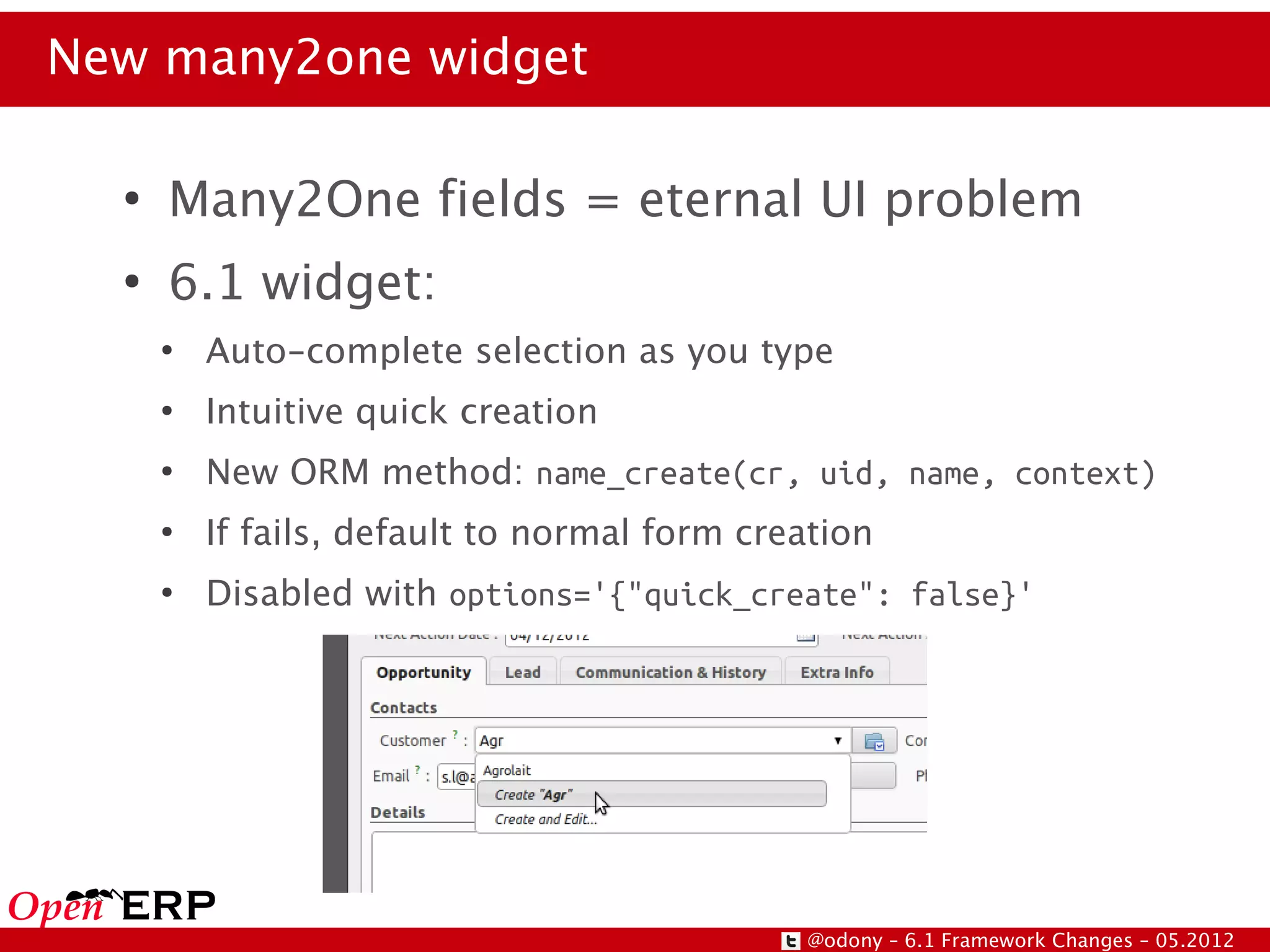
          Auto-complete selection as you type
      ●
          Intuitive quick creation
      ●
          New ORM method: name_create(cr, uid, name, context)
      ●
          If fails, default to normal form creation
      ●
          Disabled with options='{"quick_create": false}'


                                              @odony – 6.1 Framework Changes – 05.2012
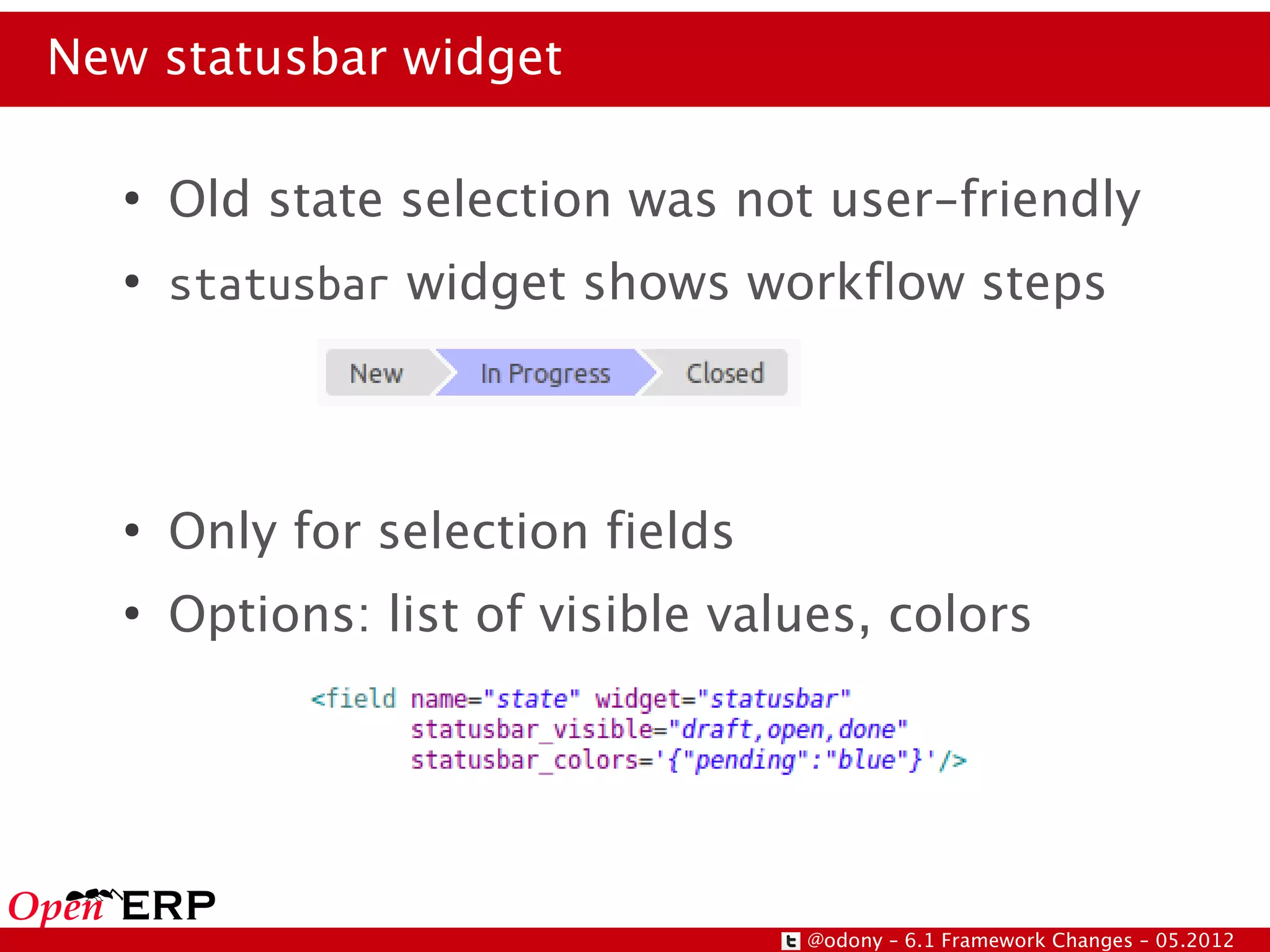
New statusbar widget

  ●
      Old state selection was not user-friendly
  ●
      statusbar widget shows workflow steps


  ●
      Only for selection fields
  ●
      Options: list of visible values, colors


                                  @odony – 6.1 Framework Changes – 05.2012
Agenda                                                                
  ●
      Framework & API
      ●
          Architecture changes
      ●
          API evolution
      ●
          New views and UI features
      ●
          Other important bits
      ●
          Exercises, Q&A


                                      @odony – 6.1 Framework Changes – 05.2012
Module Manifest changes

  ●   Web-related keys: js, css, qweb
  ●   active → auto_install (backwards-compat): 'depends' triggers!
  ●   complexity (easy|normal|expert)
  ●   application (bool): Application or Extra
  ●   sequence (integer): Application install screen order
  ●   New category: 'Hidden' – Technical, hidden by default
  ●   Module icon for install screen
          /static/src/img/icon.png

  ●   OpenERP Apps
      ●   Description in RST, one main section
      ●   'images': ['/path/to/screenshot.png', '/path/to/screenshot2.png']


                                                             @odony – 6.1 Framework Changes – 05.2012
EDI Subsystem (1)

   ●
       Goal: bring companies up to par with
       people and social network tools
   ●
       EDI module installed with Sales, Account
   ●
       EDI Setup
       ●
           Company Addres & Logo
       ●
           Outgoing Email Server (SMTP)
       ●
           User emails
       ●
           Customers/Contacts emails


                                          @odony – 6.1 Framework Changes – 05.2012
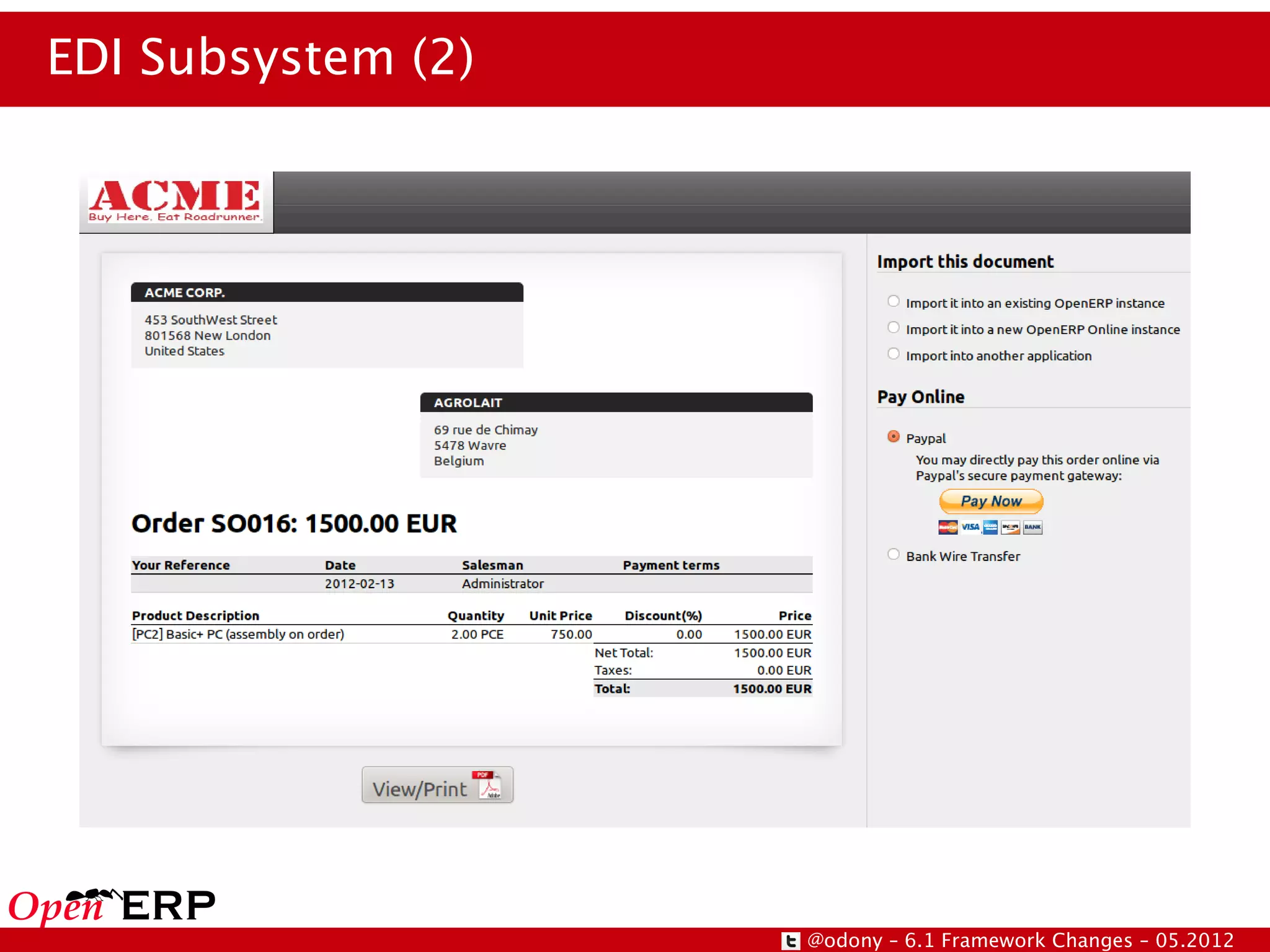
EDI Subsystem (2)


                    @odony – 6.1 Framework Changes – 05.2012
EDI Subsystem (3)

   ●
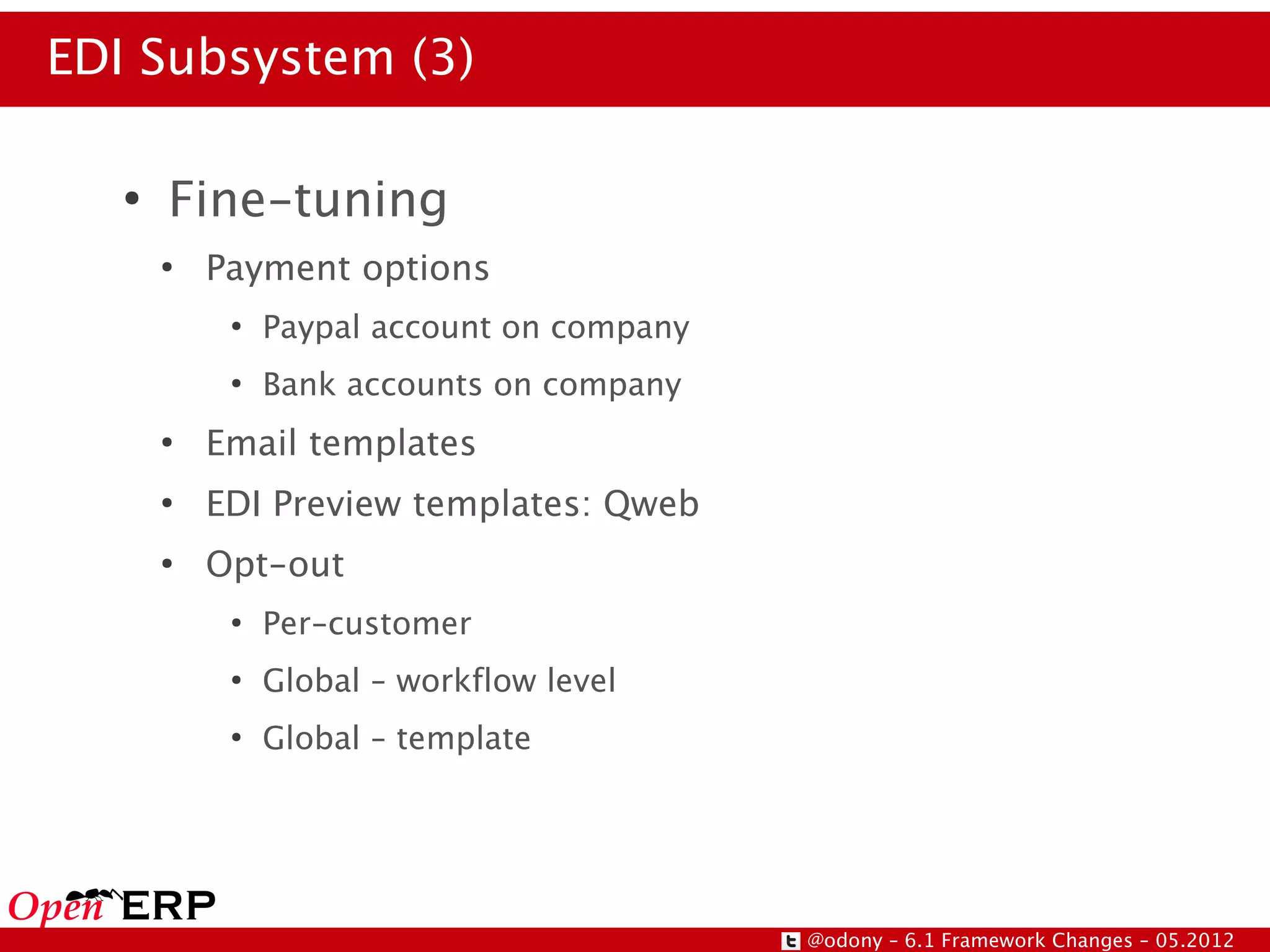
       Fine-tuning
       ●
           Payment options
            ●
                Paypal account on company
            ●
                Bank accounts on company
       ●
           Email templates
       ●
           EDI Preview templates: Qweb
       ●
           Opt-out
            ●
                Per-customer
            ●
                Global – workflow level
            ●
                Global – template


                                            @odony – 6.1 Framework Changes – 05.2012
EDI Subsystem (4)

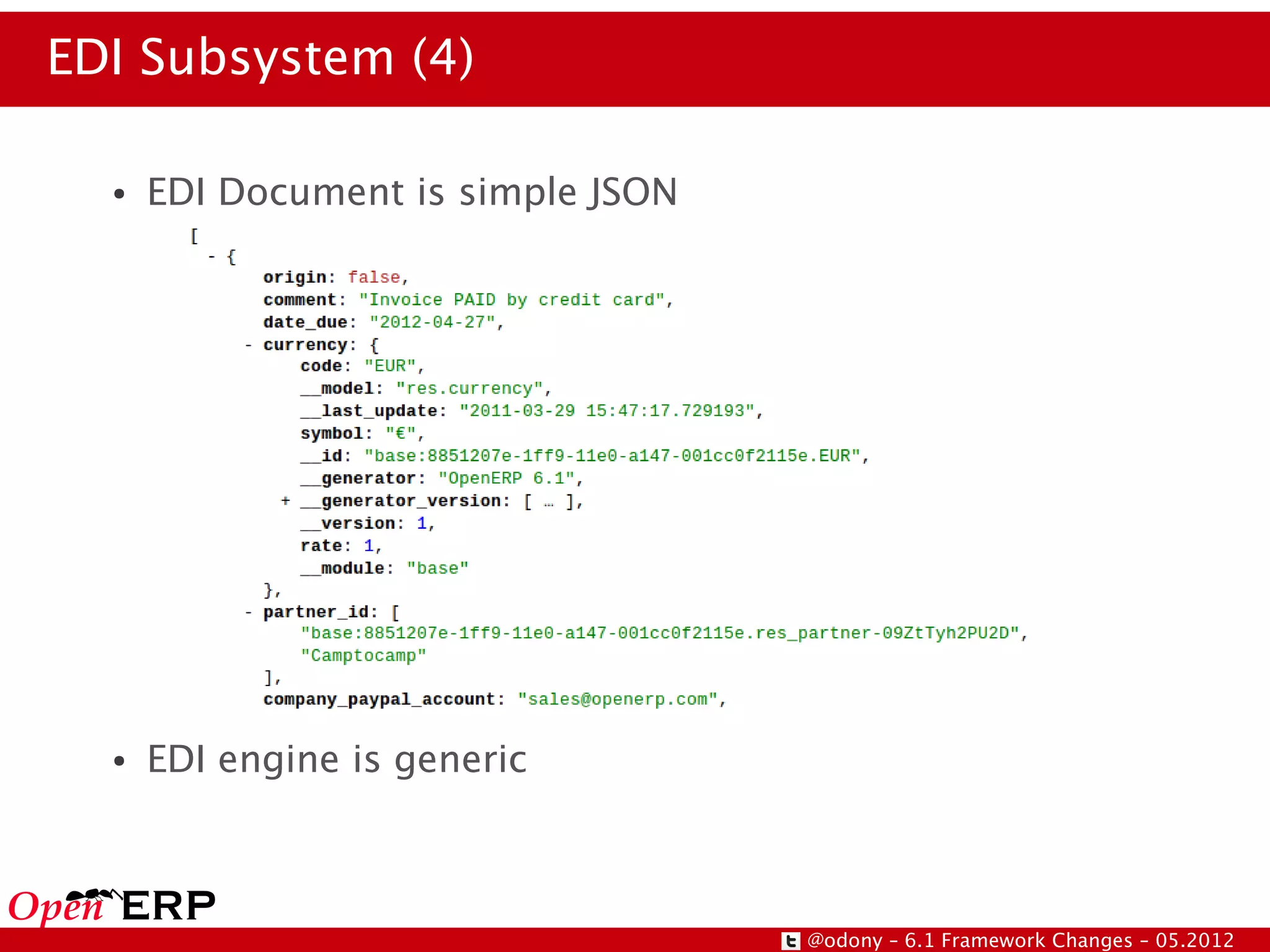
  ●   EDI Document is simple JSON


  ●   EDI engine is generic


                                    @odony – 6.1 Framework Changes – 05.2012
Agenda                                                                
  ●
      Framework & API
      ●
          Architecture changes
      ●
          API evolution
      ●
          New views and UI features
      ●
          Other important bits
      ●
          Exercises, Q&A


                                      @odony – 6.1 Framework Changes – 05.2012
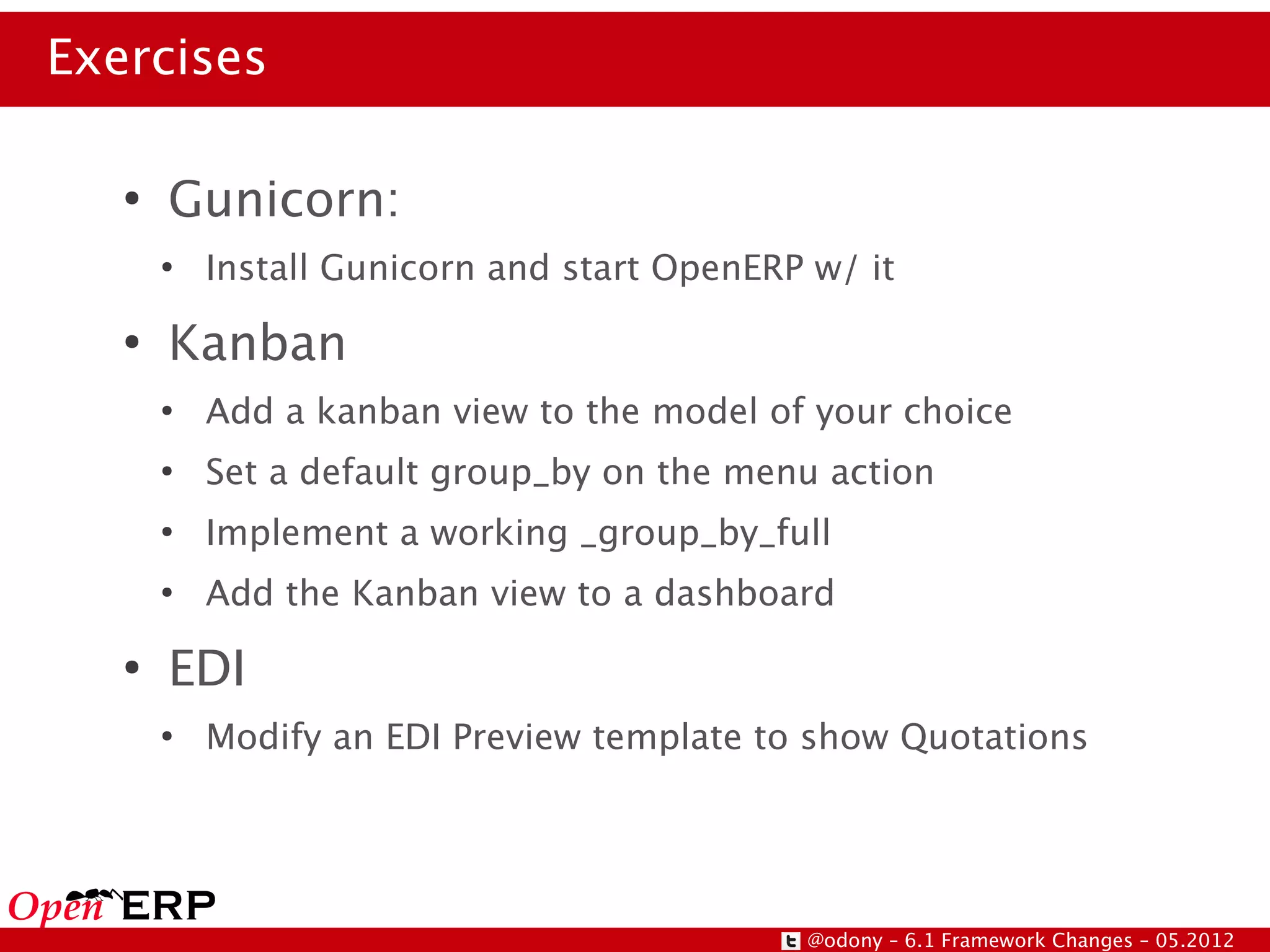
Exercises

   ●
       Gunicorn:
       ●
           Install Gunicorn and start OpenERP w/ it
   ●
       Kanban
       ●
           Add a kanban view to the model of your choice
       ●
           Set a default group_by on the menu action
       ●
           Implement a working _group_by_full
       ●
           Add the Kanban view to a dashboard
   ●
       EDI
       ●
           Modify an EDI Preview template to show Quotations


                                             @odony – 6.1 Framework Changes – 05.2012

OpenERP 6.1 Framework Changes

  • 1.
    OpenERP 6.1 Technical Changes at API/Framework level @odony – 6.1 Framework Changes – 05.2012
  • 2.
    OpenERP 6.1 ● Released February 2011 ● Normal release – non LTS = limited support ● Release Notes ● http://bit.ly/openerp61RN ● Focus ● Usability ● Social features ● New web client ● Cleanup @odony – 6.1 Framework Changes – 05.2012
  • 3.
    Agenda  ● Framework & API ● Architecture changes ● API evolution ● New views and UI features ● Other important bits ● Exercises, Q&A @odony – 6.1 Framework Changes – 05.2012
  • 4.
    Evolution: Architecture changes ● Unified server-side deployment ● Scalability through multi-processing ● Use all those cores on modern hardware ● Bypass Python GIL issues ● Reliability (cpu/memory/crashes) ● WSGI ● Standard Python solution – OpenERP 6.1 is compliant ● Gunicorn - a WSGI compliant HTTP server ● Statelessness ● Distributed scheduled tasks (cron) @odony – 6.1 Framework Changes – 05.2012
  • 5.
    Unified server-side deployment ● No more need to deploy web client ● Web client is now an OpenERP module ● Only one package to install ● Pre-loaded server-wide via –-load=web ● All modules in same place (addons_path) ● openerp-web still available stand-alone ● For testing/debugging purposes ● Needs to have copy of normal modules too! @odony – 6.1 Framework Changes – 05.2012
  • 6.
    Scalability through multi-processing ● Use all those cores on modern hardware ● Bypass Python GIL limitations ● Improve reliability (cpu/memory/crashes) → What does this all mean?? @odony – 6.1 Framework Changes – 05.2012
  • 7.
    Multi-processing and GIL(1) ● CPython has a Global Interpreter Lock/GIL ● Simplifies low-level memory management, C calls, etc. ● 1 Python thread = 1 OS thread ● Parallel execution of threads forbidden ● Cooperative multi-tasking on 1 CPU ● Worse performance on multi-CPU/core! ● Battle for GIL on the different virtual CPUs! @odony – 6.1 Framework Changes – 05.2012
  • 8.
    Multi-processing and GIL(2) ● Cooperative multi-tasking ● Release on I/O or every 100 ticks ● 1 tick ≈ 1 interpreter instruction @odony – 6.1 Framework Changes – 05.2012
  • 9.
    Scalability through multi-processing ● multiprocessing module was an option ● Using Unix tools and real processes was more flexible and easier to scale up ● Managing the processes was not necessary, many tools exist to do that (e.g. Gunicorn) ● Just had to make OpenERP WSGI-compliant @odony – 6.1 Framework Changes – 05.2012
  • 10.
    WSGI (1) ● Web Server Gateway Interface for Python ● WSGI applications can be embedded in WSGI-compliant web servers ● Many web frameworks support WSGI ● Django, CherryPy, … ● Many HTTP servers support WSGI ● Apache(+mod), nginx(+mod), tornado, gunicorn, … @odony – 6.1 Framework Changes – 05.2012
  • 11.
    WSGI (2) ● Very simple API: one method ● environ = HTTP environment map ● HTTP_HOST, REQUEST_METHOD, etc. ● start_response = callback(status,headers) ● Returns response as unicode string ● OpenERP's entry point: wsgi.core.application @odony – 6.1 Framework Changes – 05.2012
  • 12.
    Gunicorn (1) ● WGSI compliant HTTP Server ● Python port of Ruby Unicorn ● Pre-fork multi-process model ● Flexible and easily configurable ● UNIX only (fork support needed) ● See also gunicorn.org @odony – 6.1 Framework Changes – 05.2012
  • 13.
    Gunicorn (2) ● Master “Arbiter” process ● Starts and monitors workers (crash/timeout/...) ● Restarts killed workers → fork ● Increment/Decrement worker count (TTIN/TTOU signals) ● Doesn't speak HTTP → naive dispatch ● Forked worker processes ● Speak HTTP → Perform WSGI translation ● Dispatch to application entry point ● Can restart after given number of requests @odony – 6.1 Framework Changes – 05.2012
  • 14.
    Gunicorn (3) ● OpenERP can't use normal config file or command-line options ● Config has to be provided via Gunicorn ● gunicorn.conf, written in Python! ● Contains Gunicorn configuration (workers, limits, etc.) ● Contains OpenERP configuration ● Sets up requests/application hooks (pre/post request...) ● Arbiter controls max-requests limit ● Workers control memory/cpu limits @odony – 6.1 Framework Changes – 05.2012
  • 15.
    Gunicorn (4) CONF RUN $ gunicorn openerp:wsgi.core.application -c gunicorn.conf.py @odony – 6.1 Framework Changes – 05.2012
  • 16.
    Good to know(1) ● Gunicorn → must be used explicitly ● Linear speed-up for CPU-bound tasks, less for I/O or DB ● Werkzeug → built-in WSGI-compliant server ● openerp-server script ● multi-threaded mono-process ● Proxy mode specific handling (X-Forwarded..) ● When deploying behind reverse proxy (e.g. with ProxyPass) ● Gunicorn: wsgi.proxied.application entry point instead ● Werkzeug: --proxy_mode @odony – 6.1 Framework Changes – 05.2012
  • 17.
    Good to know(2) ● No cron job with Gunicorn ● Could be killed at any point! ● Start separate openerp-cron-worker job ● Anywhere! More about cron jobs in a minute... @odony – 6.1 Framework Changes – 05.2012
  • 18.
    OpenERP 6.0 deploymentmodel Requests OpenERP OpenERP PostgreSQL Web Client Server @odony – 6.1 Framework Changes – 05.2012
  • 19.
    OpenERP 6.1 deploymentmodel (1) OpenERP Worker Requests OpenERP Worker PostgreSQL OpenERP Worker OpenERP Worker @odony – 6.1 Framework Changes – 05.2012
  • 20.
    OpenERP 6.1 deploymentmodel (2) OpenERP Worker OpenERP Worker OpenERP Worker OpenERP Worker Requests Load Balancer PostgreSQL OpenERP Worker OpenERP Worker OpenERP Worker OpenERP Worker @odony – 6.1 Framework Changes – 05.2012
  • 21.
    Statelessness (1) ● OpenERP 6.0 was still partially stateful: 1) Model registry (pool) 2) Wizards (osv_memory) kept in-memory 3) Application caches – menus, perms, … ! 4) Background task processing: cron ● Not suitable for multi-processing @odony – 6.1 Framework Changes – 05.2012
  • 22.
    Caches and ModelRegistries ● Caches and Registries have state ● Must be cleared on all workers when invalidated – across multiple machines! ● Signaling works with 2 DB sequences ● base_registry_signaling ● base_cache_signaling ● Before each request, both are checked ● After each request, increment if changed @odony – 6.1 Framework Changes – 05.2012
  • 23.
    TransientModel ● osv_memory → TransientModel ● Real database-backed model ● Automatically vacuum-cleaned ● Based on size limit or time limit ● Default: 2 hours ● Has special and implicit access rights ● Everyone can perform CRUD ● But only access on your own records ● Can be used indifferently by multiple workers @odony – 6.1 Framework Changes – 05.2012
  • 24.
    Background Tasks (cron)(1) ● Problem: ● Each worker possibly runs a cron processor ● Must prevent duplicate run of same task ● Must benefit from multi-processing when multiple cron processors are running (each runs different tasks) ● Solution: ● Database row-level mutex using LOCK ● Cron processor can be run on any number of servers ● Disabled on Gunicorn workers by default ● Can be run separately with openerp-cron-worker script added in 6.1 ● Cron tasks can't be changed while running (locked) @odony – 6.1 Framework Changes – 05.2012
  • 25.
    Background Tasks (cron)(2) ● And by the way, cron tasks are executed in parallel in OpenERP 6.1 ● Also if running mono-process, up to number or thread specified with –-max-cron-threads (default: 4) ● Allows multiple tasks to be executed at the same time @odony – 6.1 Framework Changes – 05.2012
  • 26.
    Agenda  ● Framework & API ● Architecture changes ● API evolution ● New views and UI features ● Other important bits ● Exercises, Q&A @odony – 6.1 Framework Changes – 05.2012
  • 27.
    Date Storage andComputation (1) ● 6.0 stored timestamps in “server timezone” ● Worked well for small teams with only one TZ ● Database not portable, Reports incorrect for cross-TZ teams, DST issues! ● 6.1 stores timestamps as UTC always! ● Big change, but Right Thing to Do™ ● Database becomes portable ● Dates monotonically incremented in DB ● Simplifies conversion for display UTC ↔ Client TZ ● Timestamps computation works as before on server-side ● Watch out! ● “Dates” have no TZ ● Server-side dates must be initialized in client TZ @odony – 6.1 Framework Changes – 05.2012
  • 28.
    Date Storage andComputation (2) ● Server-side ● All computation in UTC ● PDF reports use client TZ from context/user ● Database ● All timestamps stored as TIMESTAMP WITHOUT TZ ● SELECT now() at time zone ‘UTC’ (should not need it) ● Client ● Converted back and forth between UTC and client TZ ● Web uses browser TZ for display (JS limitation) @odony – 6.1 Framework Changes – 05.2012
  • 29.
    Date Storage andComputation (3) @odony – 6.1 Framework Changes – 05.2012
  • 30.
    Date Storage andComputation (4) ● Be very careful with date (that)! ● Pure dates should be taken in user TZ ● It's very tempting to use datetime.date.today() ● But may be wrong for half of the planet! ● Use fields.date.context_today() instead @odony – 6.1 Framework Changes – 05.2012
  • 31.
    Unified Mail Subsystem ● 6.0 had 3+ independent mail stacks ● 6.1 has one unified mail stack (mail) ● Per-database SMTP settings (SSL, Priority, Debug) ● Single point of extension ir.mail_server ● Single mail queue/archive ● Common features mail.thread mail.message ● Scheduler scheduler composition ● Template (email_template) ● Composition wizard email_template @odony – 6.1 Framework Changes – 05.2012
  • 32.
    Many2Many auto-naming andinheritance ● What happens when you _inherit a model containing m2m field, w/ different _name? ● Problem more apparent with abstract osv_memory models ● In 6.1 many2many have auto names ● rel_table, rel_from, rel_to are automatically computed ● Simpler/Partial declaration, clean inherit ● rel_table override needed for multiple relationships @odony – 6.1 Framework Changes – 05.2012
  • 33.
    YAML improvements (1) ● 6.1 YAML tests: ● 65% coverage, 150 scenarios, 1800 test steps ● Simulating workflows works well ● But what about UI: views, on_change, … ? ● Done! YAML will now automatically use form views and on_change methods ● Better coverage ● Less code: on_change can fill in implicit values ● Can be overridden with view attribute @odony – 6.1 Framework Changes – 05.2012
  • 34.
    YAML improvements (2) @odony – 6.1 Framework Changes – 05.2012
  • 35.
    Simplified Configuration (1) ● Setup process streamlined – 1-click install ● Kanban module view – ordered by sequence ● Configuration Overview Dashboard ● Based on ir.action.todo and ir.actions.todo.category ● New ir.actions.todo ● Reminder: group_ids, action_id, and note ● States: Todo or Done ● Types: Manual, Manual Once, Automatic ● Most are Manual or Manual Once now ● New category_id for Configuration Overview @odony – 6.1 Framework Changes – 05.2012
  • 36.
    Simplified Configuration (2) @odony – 6.1 Framework Changes – 05.2012
  • 37.
    Logging ● Python has a decent logging system ● netsvc.notifyChannel() deprecated in 6.0 ● Convenience hierarchical loggers ● One _logger per file recommended _logger = logging.getLogger(__name__) ● New –-log-handler config parameter ● --log-handler=PREFIX:LEVEL ● --log-handler=openerp.netsvc.rpc.request:DEBUG ● --log-handler=werkzeug:CRITICAL @odony – 6.1 Framework Changes – 05.2012
  • 38.
    Agenda  ● Framework & API ● Architecture changes ● API evolution ● New views and UI features ● Other important bits ● Exercises, Q&A @odony – 6.1 Framework Changes – 05.2012
  • 39.
    Kanban (1) ● Kanban ( カンバン ): Japanese billboard ● Toyota's Lean/JIT production: “pull” or “demand-driven” SCM ● Kanban cards signal need to produce @odony – 6.1 Framework Changes – 05.2012
  • 40.
    Kanban (2) ● Kanban method, applied to Management ● Signboard shows whole workflow at a glance ● Limit WIP (work-in-progress) for each state (Pull!) ● Monitor flow @odony – 6.1 Framework Changes – 05.2012
  • 41.
    Kanban (3) ● kanban views are written in Qweb ● Automatic column layout with Group By ● Drag & Drop reassigns grouped column ● One mandatory template “kanban-box” ● Can use normal OpenERP fields ● Any CSS/HTML you like @odony – 6.1 Framework Changes – 05.2012
  • 42.
    Kanban (4) ● Typical structure @odony – 6.1 Framework Changes – 05.2012
  • 43.
    Kanban (5) ● Drag&Drop is nice, but group_by only shows existing data ● How about missing columns? ● Solution: add a _group_by_full map ● Return type must be like read(), depending on the column type @odony – 6.1 Framework Changes – 05.2012
  • 44.
    Kanban (6) ● group_by_full, complex example @odony – 6.1 Framework Changes – 05.2012
  • 45.
    Kanban (7) Exercise: add test kanban view for res.partner @odony – 6.1 Framework Changes – 05.2012
  • 46.
    Kanban (8) ● More details about Kanban API: http://pad.openerp.com/kanban-api (temporary location) @odony – 6.1 Framework Changes – 05.2012
  • 47.
    Customizable dashboards ● Dashboards now feature multiple layouts ● Saved in ir.ui.view_custom, per user ● Filters menu now has “Add to dashboard” ● Works with kanban views too @odony – 6.1 Framework Changes – 05.2012
  • 48.
    New many2one widget ● Many2One fields = eternal UI problem ● 6.1 widget: ● Auto-complete selection as you type ● Intuitive quick creation ● New ORM method: name_create(cr, uid, name, context) ● If fails, default to normal form creation ● Disabled with options='{"quick_create": false}' @odony – 6.1 Framework Changes – 05.2012
  • 49.
    New statusbar widget ● Old state selection was not user-friendly ● statusbar widget shows workflow steps ● Only for selection fields ● Options: list of visible values, colors @odony – 6.1 Framework Changes – 05.2012
  • 50.
    Agenda  ● Framework & API ● Architecture changes ● API evolution ● New views and UI features ● Other important bits ● Exercises, Q&A @odony – 6.1 Framework Changes – 05.2012
  • 51.
    Module Manifest changes ● Web-related keys: js, css, qweb ● active → auto_install (backwards-compat): 'depends' triggers! ● complexity (easy|normal|expert) ● application (bool): Application or Extra ● sequence (integer): Application install screen order ● New category: 'Hidden' – Technical, hidden by default ● Module icon for install screen /static/src/img/icon.png ● OpenERP Apps ● Description in RST, one main section ● 'images': ['/path/to/screenshot.png', '/path/to/screenshot2.png'] @odony – 6.1 Framework Changes – 05.2012
  • 52.
    EDI Subsystem (1) ● Goal: bring companies up to par with people and social network tools ● EDI module installed with Sales, Account ● EDI Setup ● Company Addres & Logo ● Outgoing Email Server (SMTP) ● User emails ● Customers/Contacts emails @odony – 6.1 Framework Changes – 05.2012
  • 53.
    EDI Subsystem (2) @odony – 6.1 Framework Changes – 05.2012
  • 54.
    EDI Subsystem (3) ● Fine-tuning ● Payment options ● Paypal account on company ● Bank accounts on company ● Email templates ● EDI Preview templates: Qweb ● Opt-out ● Per-customer ● Global – workflow level ● Global – template @odony – 6.1 Framework Changes – 05.2012
  • 55.
    EDI Subsystem (4) ● EDI Document is simple JSON ● EDI engine is generic @odony – 6.1 Framework Changes – 05.2012
  • 56.
    Agenda  ● Framework & API ● Architecture changes ● API evolution ● New views and UI features ● Other important bits ● Exercises, Q&A @odony – 6.1 Framework Changes – 05.2012
  • 57.
    Exercises ● Gunicorn: ● Install Gunicorn and start OpenERP w/ it ● Kanban ● Add a kanban view to the model of your choice ● Set a default group_by on the menu action ● Implement a working _group_by_full ● Add the Kanban view to a dashboard ● EDI ● Modify an EDI Preview template to show Quotations @odony – 6.1 Framework Changes – 05.2012