static void
_f_do_barnacle_install_properties(GObjectClass
*gobject_class)
{
GParamSpec *pspec;
/* Party code attribute */
pspec = g_param_spec_uint64
(F_DO_BARNACLE_CODE,
"Barnacle code.",
"Barnacle code",
0,
G_MAXUINT64,
G_MAXUINT64 /*
default value */,
G_PARAM_READABLE
| G_PARAM_WRITABLE |
G_PARAM_PRIVATE);
g_object_class_install_property (gobject_class,
F_DO_BARNACLE_PROP_CODE,
ARB_gl_spirv implementation
on Mesa: status update
Introduction
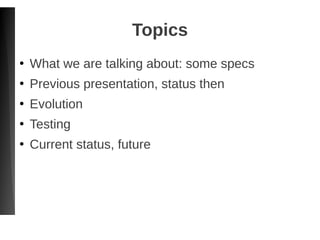
Topics
●
What we are talking about: some specs
●
Previous presentation, status then
●
Evolution
●
Testing
●
Current status, future
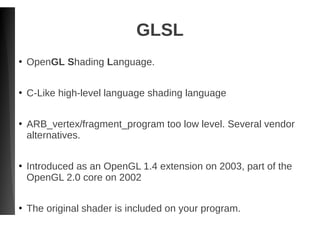
GLSL
●
OpenGL Shading Language.
●
C-Like high-level language shading language
●
ARB_vertex/fragment_program too low level. Several vendor
alternatives.
●
Introduced as an OpenGL 1.4 extension on 2003, part of the
OpenGL 2.0 core on 2002
●
The original shader is included on your program.
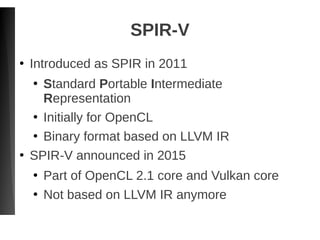
SPIR-V
●
Introduced as SPIR in 2011
●
Standard Portable Intermediate
Representation
●
Initially for OpenCL
●
Binary format based on LLVM IR
●
SPIR-V announced in 2015
●
Part of OpenCL 2.1 core and Vulkan core
●
Not based on LLVM IR anymore
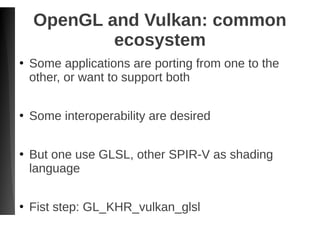
OpenGL and Vulkan: common
ecosystem
●
Some applications are porting from one to the
other, or want to support both
●
Some interoperability are desired
●
But one use GLSL, other SPIR-V as shading
language
●
Fist step: GL_KHR_vulkan_glsl
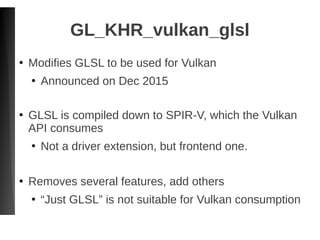
GL_KHR_vulkan_glsl
●
Modifies GLSL to be used for Vulkan
●
Announced on Dec 2015
●
GLSL is compiled down to SPIR-V, which the Vulkan
API consumes
●
Not a driver extension, but frontend one.
●
Removes several features, add others
●
“Just GLSL” is not suitable for Vulkan consumption
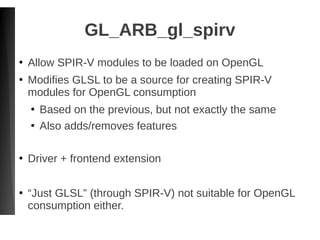
GL_ARB_gl_spirv
●
Allow SPIR-V modules to be loaded on OpenGL
●
Modifies GLSL to be a source for creating SPIR-V
modules for OpenGL consumption
●
Based on the previous, but not exactly the same
●
Also adds/removes features
●
Driver + frontend extension
●
“Just GLSL” (through SPIR-V) not suitable for OpenGL
consumption either.
Previous presentation: FOSDEM
2018
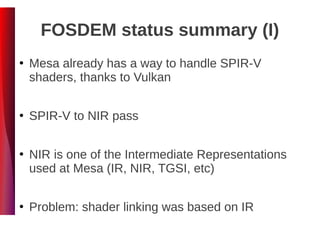
FOSDEM status summary (I)
●
Mesa already has a way to handle SPIR-V
shaders, thanks to Vulkan
●
SPIR-V to NIR pass
●
NIR is one of the Intermediate Representations
used at Mesa (IR, NIR, TGSI, etc)
●
Problem: shader linking was based on IR
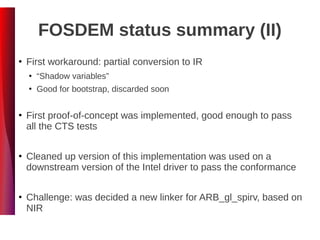
FOSDEM status summary (II)
●
First workaround: partial conversion to IR
●
“Shadow variables”
●
Good for bootstrap, discarded soon
●
First proof-of-concept was implemented, good enough to pass
all the CTS tests
●
Cleaned up version of this implementation was used on a
downstream version of the Intel driver to pass the conformance
●
Challenge: was decided a new linker for ARB_gl_spirv, based on
NIR
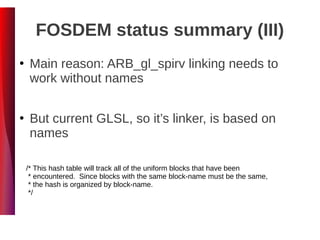
FOSDEM status summary (III)
●
Main reason: ARB_gl_spirv linking needs to
work without names
●
But current GLSL, so it’s linker, is based on
names
/* This hash table will track all of the uniform blocks that have been
* encountered. Since blocks with the same block-name must be the same,
* the hash is organized by block-name.
*/
Evolution: FAQ mode
The NIR linker is needing a lot of
time, do you regret starting it?
●
No.
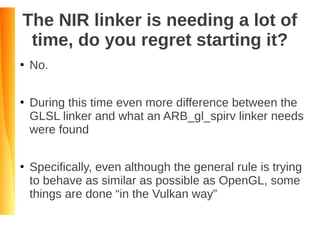
The NIR linker is needing a lot of
time, do you regret starting it?
●
No.
●
During this time even more difference between the
GLSL linker and what an ARB_gl_spirv linker needs
were found
●
Specifically, even although the general rule is trying
to behave as similar as possible as OpenGL, some
things are done “in the Vulkan way”
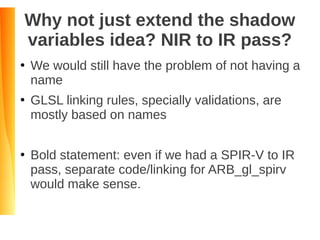
Why not just extend the shadow
variables idea? NIR to IR pass?
●
We would still have the problem of not having a
name
●
GLSL linking rules, specially validations, are
mostly based on names
●
Bold statement: even if we had a SPIR-V to IR
pass, separate code/linking for ARB_gl_spirv
would make sense.
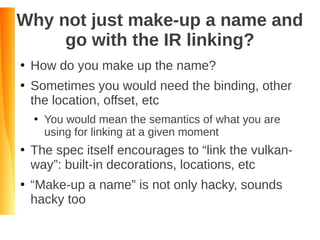
Why not just make-up a name and
go with the IR linking?
●
How do you make up the name?
●
Sometimes you would need the binding, other
the location, offset, etc
●
You would mean the semantics of what you are
using for linking at a given moment
●
The spec itself encourages to “link the vulkan-
way”: built-in decorations, locations, etc
●
“Make-up a name” is not only hacky, sounds
hacky too
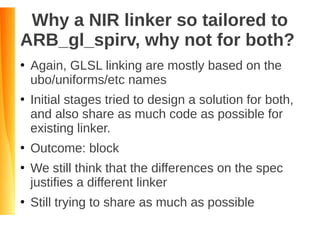
Why a NIR linker so tailored to
ARB_gl_spirv, why not for both?
●
Again, GLSL linking are mostly based on the
ubo/uniforms/etc names
●
Initial stages tried to design a solution for both,
and also share as much code as possible for
existing linker.
●
Outcome: block
●
We still think that the differences on the spec
justifies a different linker
●
Still trying to share as much as possible
But why it is taking so long? Isn't
SPIR-V more straight-forward?
●
In the end, it is needed to feed up the same
internal structures that with a GLSL linker
●
Uniforms need to be enumerated from their
block, among other things, to know how many
we have
●
Ditto for info related to them, like ubo/ssbo
buffer size
Wait there! Number of uniforms?
Buffer sizes? I thought that SPIRV
din’t require introspection?
●
That’s not inherent to SPIR-V
●
It is just how Vulkan uses it, or requires from it
Wait, I have read the spec, I found
several “no reflection required”.
●
Yes, issue (8) says “First start without reflection”
●
And then issue (12) says “No reflection
required”
Wait, I have read the spec, I found
several “no reflection required”.
●
Yes, issue (8) says “First start without reflection”
●
And then issue (12) says “No reflection
required”
●
But on those, it refers to “name reflection APIs”,
not any introspection at all (yes can be
confusing)
Wait, I have read the spec, I found
several “no reflection required”.
●
Yes, issue (8) says “First start without reflection”
●
And then issue (12) says “No reflection required”
●
But on those, it refers to “name reflection APIs”,
not any introspection at all (yes can be confusing)
●
From issue (19):
“C) Allow as much as possible to work "naturally". You
can query for the number of active resources, and for
details about them. Anything that doesn't query by
name will work as expected."
So this linker needs to re-
implement all what GLSL does?
●
No. The scope is really smaller.
●
Mesa GLSL linker need to support different
versions of GLSL, with several rules/features
added for years.
●
We can assume that the SPIR-V module has
been validated. Undefined behaviour allowed
for wrong SPIR-V
●
Several features were removed, or become
simpler (example: no specific memory layouts)
Testing
Testing
●
Passing CTS is not enough to be considered
production ready
●
Were good to test the ARB_gl_spirv specifics,
shallow for testing the full range of features
allowed
●
We use extensively Piglit
Piglit
●
Open-source test suite for OpenGL
implementations
●
Heavily used by Mesa developers
●
Several of their tests uses shader_runner
●
Individual test uses a text format
●
This includes the shader source, data values and
expected values
shader_test example
[require]
GL >= 3.3
GLSL >= 4.50
[vertex shader passthrough]
[fragment shader]
#version 450
layout(location = 0) uniform vec4 color;
layout(location = 0) out vec4 outcolor;
void main() {
outcolor = color;
}
[test]
clear color 1.0 0.0 0.0 0.0
clear
#color
uniform vec4 0 0.0 1.0 0.0 1.0
verify program_query GL_ACTIVE_UNIFORMS 1
draw rect -1 -1 2 2
probe all rgba 0.0 1.0 0.0 1.0
Piglit (barebone tests)
●
Nicolai added support for ARB_gl_spirv on
shader_runner
●
Also added a script that parses the shader_test,
and call glslang to create the SPIR-V source
●
This allowed to add tests for the extension
●
We are adding them as we implement features,
but even more is needed
Piglit (borrowed tests)
●
The script tries to be able to reuse tests written
originally for other specs
●
In some cases, it does some fixing
●
Like setting explicit location/binding etc
●
Also automatic filtering of tests that are not
compatible with ARB_gl_spirv
●
We got a lot of tests this way. Allowed a test-
based implementation since basically day 0.
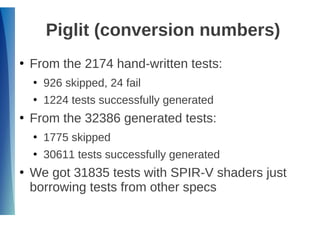
Piglit (conversion numbers)
●
From the 2174 hand-written tests:
●
926 skipped, 24 fail
●
1224 tests successfully generated
●
From the 32386 generated tests:
●
1775 skipped
●
30611 tests successfully generated
●
We got 31835 tests with SPIR-V shaders just
borrowing tests from other specs
Piglit (pass rate)
●
With our development branch:
●
[34561] skip: 5928, pass:28508, fail:114, crash: 11
●
Most crashes come from lack of multi-
dimensional ubo/ssbo
●
Most failures come from missing more validation
checks
●
Several of them are likely to be skipped
Current status
What we already have on master?
●
~80 Mesa patches, and ~30 patches are already on
their respective masters
●
Thanks to all reviewers, specially Timothy Arceri and
Jason Ekstrand
●
Those cover
●
Uniforms
●
Atomic counters
●
Transform feedback and geometry streams
●
64-bit and 64-bit vertex attribute
●
etc
What’s happening now?
●
Just this week we send a 26 patches series
with the ubo/ssbo support, and some extras
●
Minus multi-dimensional arrays
●
Those extras are mostly in order to get all the
ARB_gl_spirv CTS tests passing
What’s next? (mandatory)
●
Improve interface query support
●
A lot of work done on testing
●
Multidimensional ubo/ssbo
●
Validation
●
Enable extension
What’s next? (long term)
●
Shader cache support
●
Right now we disable on the ARB_gl_spirv path
●
Bring names if available
●
Test with real applications
Personal thoughts
Two worlds
●
The best of two worlds
●
SPIR-V on OpenGL!
●
But you can still use as much OpenGL API as
possible!
●
Two worlds
●
The best of two worlds
●
SPIR-V on OpenGL!
●
But you can still use as much OpenGL API as
possible!
●
The worst of two worlds:
●
OpenGL driver need to do more linking with
SPIR-V that the Vulkan driver
●
Just to provide a subset of the OpenGL
introspection
Shouldn’t it better to chose one?
●
Depends on the main use case
●
Transitional helper while people port to Vulkan?
Or a way to help to reduce the cost of having
two renderers?
●
On the former, “OpenGL way of things” make
more sense
●
On the latter, “Vulkan way of things” make more
sense
GLSL confusion
●
Two different specs defining the GLSL valid for
SPIR-V generation
●
Too many feature switching/tweaking
●
Although it is most a frontend problem, in the
end the driver needs to support a set of
features
●
Sometimes not so clear what is needed to be
supported
●
Likely a issue for applications too
Closing
Who is working on this?
●
Started by Nicolai Hänhle
●
Continued by Igalia
●
Supported by Intel
Questions?
ARB_gl_spirv implementation in Mesa: status update (XDC 2018)

ARB_gl_spirv implementation in Mesa: status update (XDC 2018)

  • 1.
    static void _f_do_barnacle_install_properties(GObjectClass *gobject_class) { GParamSpec *pspec; /*Party code attribute */ pspec = g_param_spec_uint64 (F_DO_BARNACLE_CODE, "Barnacle code.", "Barnacle code", 0, G_MAXUINT64, G_MAXUINT64 /* default value */, G_PARAM_READABLE | G_PARAM_WRITABLE | G_PARAM_PRIVATE); g_object_class_install_property (gobject_class, F_DO_BARNACLE_PROP_CODE, ARB_gl_spirv implementation on Mesa: status update
  • 2.
  • 3.
    Topics ● What we aretalking about: some specs ● Previous presentation, status then ● Evolution ● Testing ● Current status, future
  • 4.
    GLSL ● OpenGL Shading Language. ● C-Likehigh-level language shading language ● ARB_vertex/fragment_program too low level. Several vendor alternatives. ● Introduced as an OpenGL 1.4 extension on 2003, part of the OpenGL 2.0 core on 2002 ● The original shader is included on your program.
  • 5.
    SPIR-V ● Introduced as SPIRin 2011 ● Standard Portable Intermediate Representation ● Initially for OpenCL ● Binary format based on LLVM IR ● SPIR-V announced in 2015 ● Part of OpenCL 2.1 core and Vulkan core ● Not based on LLVM IR anymore
  • 6.
    OpenGL and Vulkan:common ecosystem ● Some applications are porting from one to the other, or want to support both ● Some interoperability are desired ● But one use GLSL, other SPIR-V as shading language ● Fist step: GL_KHR_vulkan_glsl
  • 7.
    GL_KHR_vulkan_glsl ● Modifies GLSL tobe used for Vulkan ● Announced on Dec 2015 ● GLSL is compiled down to SPIR-V, which the Vulkan API consumes ● Not a driver extension, but frontend one. ● Removes several features, add others ● “Just GLSL” is not suitable for Vulkan consumption
  • 8.
    GL_ARB_gl_spirv ● Allow SPIR-V modulesto be loaded on OpenGL ● Modifies GLSL to be a source for creating SPIR-V modules for OpenGL consumption ● Based on the previous, but not exactly the same ● Also adds/removes features ● Driver + frontend extension ● “Just GLSL” (through SPIR-V) not suitable for OpenGL consumption either.
  • 9.
  • 10.
    FOSDEM status summary(I) ● Mesa already has a way to handle SPIR-V shaders, thanks to Vulkan ● SPIR-V to NIR pass ● NIR is one of the Intermediate Representations used at Mesa (IR, NIR, TGSI, etc) ● Problem: shader linking was based on IR
  • 11.
    FOSDEM status summary(II) ● First workaround: partial conversion to IR ● “Shadow variables” ● Good for bootstrap, discarded soon ● First proof-of-concept was implemented, good enough to pass all the CTS tests ● Cleaned up version of this implementation was used on a downstream version of the Intel driver to pass the conformance ● Challenge: was decided a new linker for ARB_gl_spirv, based on NIR
  • 12.
    FOSDEM status summary(III) ● Main reason: ARB_gl_spirv linking needs to work without names ● But current GLSL, so it’s linker, is based on names /* This hash table will track all of the uniform blocks that have been * encountered. Since blocks with the same block-name must be the same, * the hash is organized by block-name. */
  • 13.
  • 14.
    The NIR linkeris needing a lot of time, do you regret starting it? ● No.
  • 15.
    The NIR linkeris needing a lot of time, do you regret starting it? ● No. ● During this time even more difference between the GLSL linker and what an ARB_gl_spirv linker needs were found ● Specifically, even although the general rule is trying to behave as similar as possible as OpenGL, some things are done “in the Vulkan way”
  • 16.
    Why not justextend the shadow variables idea? NIR to IR pass? ● We would still have the problem of not having a name ● GLSL linking rules, specially validations, are mostly based on names ● Bold statement: even if we had a SPIR-V to IR pass, separate code/linking for ARB_gl_spirv would make sense.
  • 17.
    Why not justmake-up a name and go with the IR linking? ● How do you make up the name? ● Sometimes you would need the binding, other the location, offset, etc ● You would mean the semantics of what you are using for linking at a given moment ● The spec itself encourages to “link the vulkan- way”: built-in decorations, locations, etc ● “Make-up a name” is not only hacky, sounds hacky too
  • 18.
    Why a NIRlinker so tailored to ARB_gl_spirv, why not for both? ● Again, GLSL linking are mostly based on the ubo/uniforms/etc names ● Initial stages tried to design a solution for both, and also share as much code as possible for existing linker. ● Outcome: block ● We still think that the differences on the spec justifies a different linker ● Still trying to share as much as possible
  • 19.
    But why itis taking so long? Isn't SPIR-V more straight-forward? ● In the end, it is needed to feed up the same internal structures that with a GLSL linker ● Uniforms need to be enumerated from their block, among other things, to know how many we have ● Ditto for info related to them, like ubo/ssbo buffer size
  • 20.
    Wait there! Numberof uniforms? Buffer sizes? I thought that SPIRV din’t require introspection? ● That’s not inherent to SPIR-V ● It is just how Vulkan uses it, or requires from it
  • 21.
    Wait, I haveread the spec, I found several “no reflection required”. ● Yes, issue (8) says “First start without reflection” ● And then issue (12) says “No reflection required”
  • 22.
    Wait, I haveread the spec, I found several “no reflection required”. ● Yes, issue (8) says “First start without reflection” ● And then issue (12) says “No reflection required” ● But on those, it refers to “name reflection APIs”, not any introspection at all (yes can be confusing)
  • 23.
    Wait, I haveread the spec, I found several “no reflection required”. ● Yes, issue (8) says “First start without reflection” ● And then issue (12) says “No reflection required” ● But on those, it refers to “name reflection APIs”, not any introspection at all (yes can be confusing) ● From issue (19): “C) Allow as much as possible to work "naturally". You can query for the number of active resources, and for details about them. Anything that doesn't query by name will work as expected."
  • 24.
    So this linkerneeds to re- implement all what GLSL does? ● No. The scope is really smaller. ● Mesa GLSL linker need to support different versions of GLSL, with several rules/features added for years. ● We can assume that the SPIR-V module has been validated. Undefined behaviour allowed for wrong SPIR-V ● Several features were removed, or become simpler (example: no specific memory layouts)
  • 25.
  • 26.
    Testing ● Passing CTS isnot enough to be considered production ready ● Were good to test the ARB_gl_spirv specifics, shallow for testing the full range of features allowed ● We use extensively Piglit
  • 27.
    Piglit ● Open-source test suitefor OpenGL implementations ● Heavily used by Mesa developers ● Several of their tests uses shader_runner ● Individual test uses a text format ● This includes the shader source, data values and expected values
  • 28.
    shader_test example [require] GL >=3.3 GLSL >= 4.50 [vertex shader passthrough] [fragment shader] #version 450 layout(location = 0) uniform vec4 color; layout(location = 0) out vec4 outcolor; void main() { outcolor = color; } [test] clear color 1.0 0.0 0.0 0.0 clear #color uniform vec4 0 0.0 1.0 0.0 1.0 verify program_query GL_ACTIVE_UNIFORMS 1 draw rect -1 -1 2 2 probe all rgba 0.0 1.0 0.0 1.0
  • 29.
    Piglit (barebone tests) ● Nicolaiadded support for ARB_gl_spirv on shader_runner ● Also added a script that parses the shader_test, and call glslang to create the SPIR-V source ● This allowed to add tests for the extension ● We are adding them as we implement features, but even more is needed
  • 30.
    Piglit (borrowed tests) ● Thescript tries to be able to reuse tests written originally for other specs ● In some cases, it does some fixing ● Like setting explicit location/binding etc ● Also automatic filtering of tests that are not compatible with ARB_gl_spirv ● We got a lot of tests this way. Allowed a test- based implementation since basically day 0.
  • 31.
    Piglit (conversion numbers) ● Fromthe 2174 hand-written tests: ● 926 skipped, 24 fail ● 1224 tests successfully generated ● From the 32386 generated tests: ● 1775 skipped ● 30611 tests successfully generated ● We got 31835 tests with SPIR-V shaders just borrowing tests from other specs
  • 32.
    Piglit (pass rate) ● Withour development branch: ● [34561] skip: 5928, pass:28508, fail:114, crash: 11 ● Most crashes come from lack of multi- dimensional ubo/ssbo ● Most failures come from missing more validation checks ● Several of them are likely to be skipped
  • 33.
  • 34.
    What we alreadyhave on master? ● ~80 Mesa patches, and ~30 patches are already on their respective masters ● Thanks to all reviewers, specially Timothy Arceri and Jason Ekstrand ● Those cover ● Uniforms ● Atomic counters ● Transform feedback and geometry streams ● 64-bit and 64-bit vertex attribute ● etc
  • 35.
    What’s happening now? ● Justthis week we send a 26 patches series with the ubo/ssbo support, and some extras ● Minus multi-dimensional arrays ● Those extras are mostly in order to get all the ARB_gl_spirv CTS tests passing
  • 36.
    What’s next? (mandatory) ● Improveinterface query support ● A lot of work done on testing ● Multidimensional ubo/ssbo ● Validation ● Enable extension
  • 37.
    What’s next? (longterm) ● Shader cache support ● Right now we disable on the ARB_gl_spirv path ● Bring names if available ● Test with real applications
  • 38.
  • 39.
    Two worlds ● The bestof two worlds ● SPIR-V on OpenGL! ● But you can still use as much OpenGL API as possible! ●
  • 40.
    Two worlds ● The bestof two worlds ● SPIR-V on OpenGL! ● But you can still use as much OpenGL API as possible! ● The worst of two worlds: ● OpenGL driver need to do more linking with SPIR-V that the Vulkan driver ● Just to provide a subset of the OpenGL introspection
  • 41.
    Shouldn’t it betterto chose one? ● Depends on the main use case ● Transitional helper while people port to Vulkan? Or a way to help to reduce the cost of having two renderers? ● On the former, “OpenGL way of things” make more sense ● On the latter, “Vulkan way of things” make more sense
  • 42.
    GLSL confusion ● Two differentspecs defining the GLSL valid for SPIR-V generation ● Too many feature switching/tweaking ● Although it is most a frontend problem, in the end the driver needs to support a set of features ● Sometimes not so clear what is needed to be supported ● Likely a issue for applications too
  • 43.
  • 44.
    Who is workingon this? ● Started by Nicolai Hänhle ● Continued by Igalia ● Supported by Intel
  • 45.