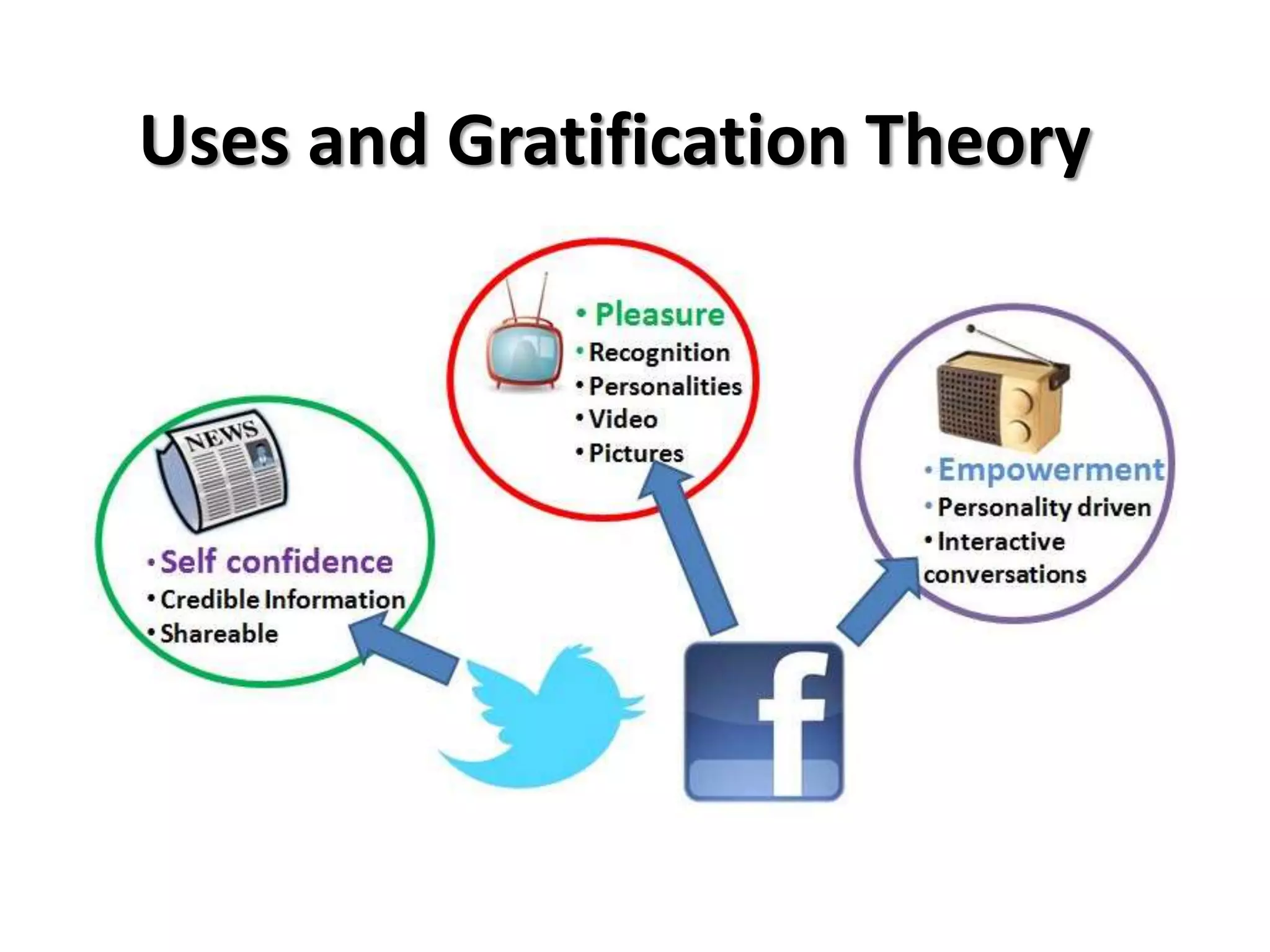
Uses and Gratification Theory
The theory believes that the members of the
audience are not passive but actually take an
active role in interpreting and participating
media into their own lives. The theory also
believes that audiences are responsible for
choosing media to meet their needs. The
approach suggests that people use the media
to fulfil specific gratifications. Also, this theory
would then be implying that the media
compete against other information sources for
viewers' gratification.
What is the Uses and Gratifications Theory About?
Uses and Gratifications Theory is an approach that is used to understand mass
communication. The theory places more focus on the audience and taking them into
more consideration rather than the actual message itself by asking “what people
do with media” rather than “what media does to people” - Katz, 1959
According to Katz, Blumler and Gurevitch's research there were five components
comprising the Uses and Gratifications Approach;
 The audience is conceived as active.
 In the mass communication process, much initiative in linking gratification and media
choice lies with the audience member.
 The media compete with other sources of satisfaction.
 Methodologically speaking, many of the goals of mass media use can be derived from
data supplied by individual audience members themselves.
 Value judgments about the cultural significance of mass communication should be
suspended while audience orientations are explored on their own terms.
According to the research, goals for
media use can be grouped into five uses.
The audience wants to:
 be informed or educated
 identify with characters of the
situation in the media environment
 simple entertainment
 enhance social interaction
 escape from the stresses of daily life
Katz, Blumler and Gurevitch
 Cognitive Needs: Acquiring information,
knowledge and understanding e.g.
Television (news), videos, movies
(documentaries or based on history)
 Affective Needs: Emotion, pleasure,
feelings e.g. Movies, television (soap
operas, sitcoms)
 Personal Integrative Needs: Credibility,
stability, status e.g. Video
 Social Integrative Needs: Family and
friends e.g. Internet (e-mail, instant
messaging, chat rooms, social media)
 Tension Release Needs: Escape and
diversion e.g. Television, movies, video,
radio, internet
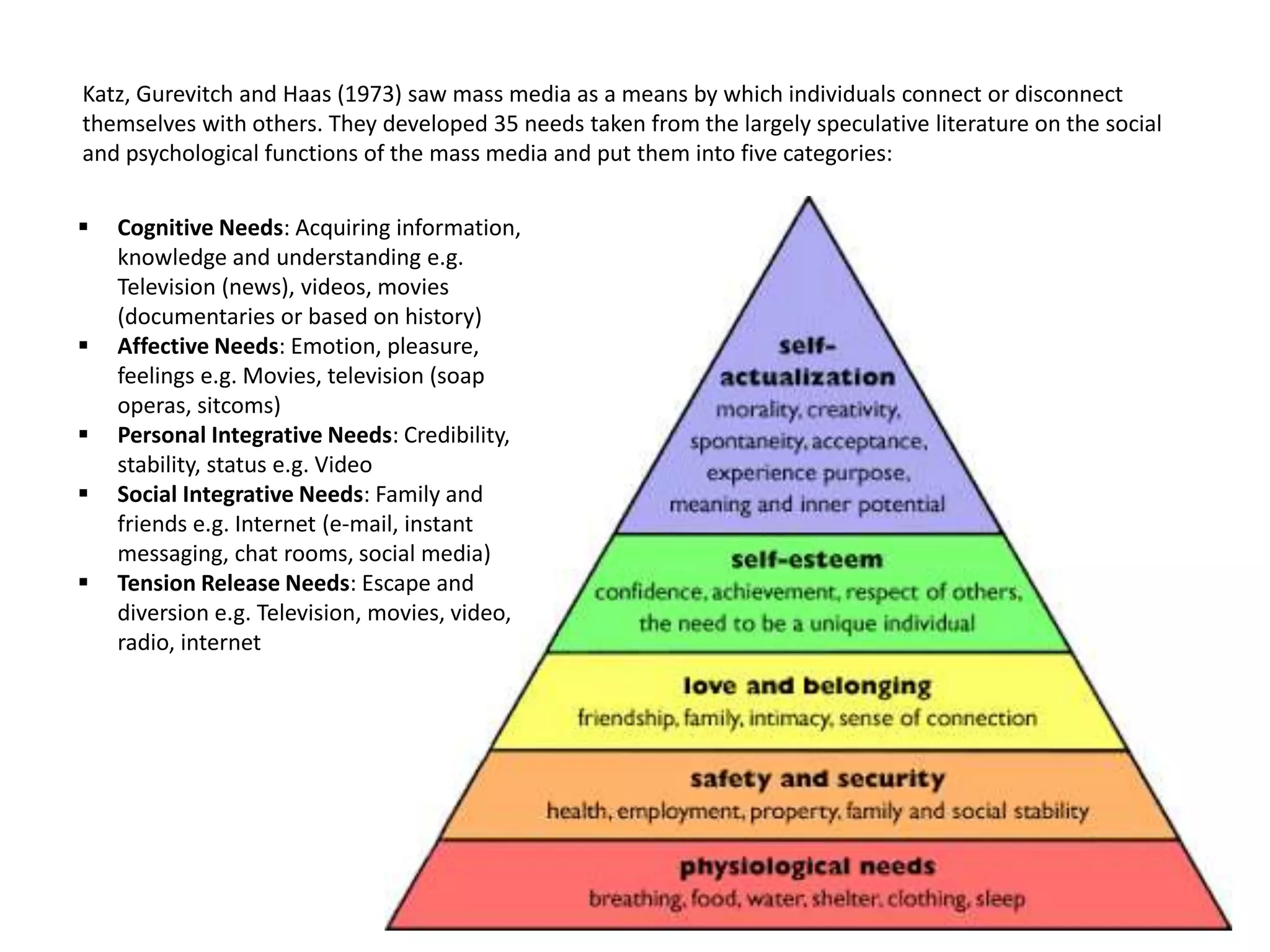
Katz, Gurevitch and Haas (1973) saw mass media as a means by which individuals connect or disconnect
themselves with others. They developed 35 needs taken from the largely speculative literature on the social
and psychological functions of the mass media and put them into five categories:
An Example of Modern Applications of Uses and
Gratifications
In general, people use mobile phones for the following uses and gratifications;
 Affection/sociability
 Entertainment
 Instrumentality
 Psychological reassurance
 Fashion/status
 Mobility
 Immediate access
• Internet usage- The Internet provides a new and deep field for exploring UGT
• Friend-networking sites- socialization might be finding old friends, making new friends, learning
about events, creating social functions, and feeling connected
• Twitter-positive correlation between active time spent on Twitter and the gratification of a need
for "an informal sense of camaraderie"—connection—with other users
• Instant messaging – Relaxation, Entertainment, Fashion, Inclusion, Affection, Sociability, Escape
• Online gaming- Achievement, enjoyment and social interaction are all motivations for starting to
play an online game

Uses and gratification theory

  • 1.
  • 2.
    The theory believesthat the members of the audience are not passive but actually take an active role in interpreting and participating media into their own lives. The theory also believes that audiences are responsible for choosing media to meet their needs. The approach suggests that people use the media to fulfil specific gratifications. Also, this theory would then be implying that the media compete against other information sources for viewers' gratification. What is the Uses and Gratifications Theory About? Uses and Gratifications Theory is an approach that is used to understand mass communication. The theory places more focus on the audience and taking them into more consideration rather than the actual message itself by asking “what people do with media” rather than “what media does to people” - Katz, 1959
  • 3.
    According to Katz,Blumler and Gurevitch's research there were five components comprising the Uses and Gratifications Approach;  The audience is conceived as active.  In the mass communication process, much initiative in linking gratification and media choice lies with the audience member.  The media compete with other sources of satisfaction.  Methodologically speaking, many of the goals of mass media use can be derived from data supplied by individual audience members themselves.  Value judgments about the cultural significance of mass communication should be suspended while audience orientations are explored on their own terms. According to the research, goals for media use can be grouped into five uses. The audience wants to:  be informed or educated  identify with characters of the situation in the media environment  simple entertainment  enhance social interaction  escape from the stresses of daily life Katz, Blumler and Gurevitch
  • 4.
     Cognitive Needs:Acquiring information, knowledge and understanding e.g. Television (news), videos, movies (documentaries or based on history)  Affective Needs: Emotion, pleasure, feelings e.g. Movies, television (soap operas, sitcoms)  Personal Integrative Needs: Credibility, stability, status e.g. Video  Social Integrative Needs: Family and friends e.g. Internet (e-mail, instant messaging, chat rooms, social media)  Tension Release Needs: Escape and diversion e.g. Television, movies, video, radio, internet Katz, Gurevitch and Haas (1973) saw mass media as a means by which individuals connect or disconnect themselves with others. They developed 35 needs taken from the largely speculative literature on the social and psychological functions of the mass media and put them into five categories:
  • 5.
    An Example ofModern Applications of Uses and Gratifications In general, people use mobile phones for the following uses and gratifications;  Affection/sociability  Entertainment  Instrumentality  Psychological reassurance  Fashion/status  Mobility  Immediate access • Internet usage- The Internet provides a new and deep field for exploring UGT • Friend-networking sites- socialization might be finding old friends, making new friends, learning about events, creating social functions, and feeling connected • Twitter-positive correlation between active time spent on Twitter and the gratification of a need for "an informal sense of camaraderie"—connection—with other users • Instant messaging – Relaxation, Entertainment, Fashion, Inclusion, Affection, Sociability, Escape • Online gaming- Achievement, enjoyment and social interaction are all motivations for starting to play an online game