Uses and Graftication Theory
Amy Coghlan
What is it?
    • Uses and Gratifications Theory is an approach to
  understanding why people actively seek out specific media
    outlets and content for gratification purposes. The theory
 discusses how users proactively search for media that will not
     only meet a given need but enhance knowledge, social
                  interactions and diversion .

• It assumes that members of the audience are not passive but
   take an active role in interpreting and integrating media into
     their own lives. The theory also holds that audiences are
     responsible for choosing media to meet their needs. The
  approach suggests that people use the media to fulfill specific
     gratifications. This theory would then imply that the media
      compete against other information sources for viewers'
                             gratification.
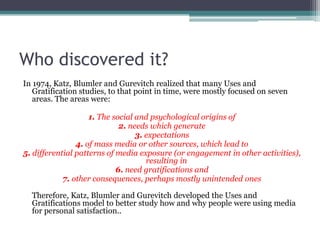
Who discovered it?
In 1974, Katz, Blumler and Gurevitch realized that many Uses and
   Gratification studies, to that point in time, were mostly focused on seven
   areas. The areas were:

                    1. The social and psychological origins of
                             2. needs which generate
                                  3. expectations
                4. of mass media or other sources, which lead to
5. differential patterns of media exposure (or engagement in other activities),
                                     resulting in
                            6. need gratifications and
            7. other consequences, perhaps mostly unintended ones

  Therefore, Katz, Blumler and Gurevitch developed the Uses and
  Gratifications model to better study how and why people were using media
  for personal satisfaction..
Katz, Blumler and Gurevitch's research
5 components comprising the Uses and
        Gratifications Model:

                   1
 “The audience is conceived as active.”
2
 “In the mass communication
   process much initiative in
linking gratification and media
  choice lies with the audience
            member.”
3


“The media compete with other
   sources of satisfaction.”
4
“Methodologically speaking, many of
 the goals of mass media use can be
   derived from data supplied by
   individual audience members
            themselves.”
5
“Value judgments about the cultural
 significance of mass communication
 should be suspended while audience
   orientations are explored on their
              own terms
Blumler & Katzin 1974 published a theory
stating that individuals may chose a text to
          „gratify‟ a range of needs
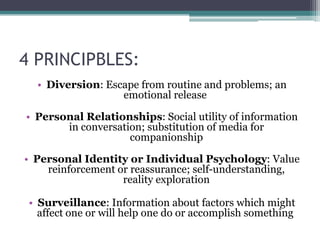
4 PRINCIPBLES:
  • Diversion: Escape from routine and problems; an
                  emotional release

• Personal Relationships: Social utility of information
       in conversation; substitution of media for
                    companionship

• Personal Identity or Individual Psychology: Value
    reinforcement or reassurance; self-understanding,
                   reality exploration

 • Surveillance: Information about factors which might
   affect one or will help one do or accomplish something
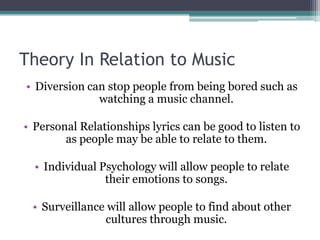
Theory In Relation to Music
• Diversion can stop people from being bored such as
              watching a music channel.

• Personal Relationships lyrics can be good to listen to
        as people may be able to relate to them.

  • Individual Psychology will allow people to relate
                their emotions to songs.

 • Surveillance will allow people to find about other
               cultures through music.
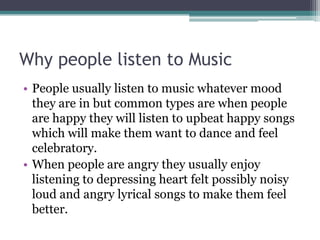
Why people listen to Music
• People usually listen to music whatever mood
  they are in but common types are when people
  are happy they will listen to upbeat happy songs
  which will make them want to dance and feel
  celebratory.
• When people are angry they usually enjoy
  listening to depressing heart felt possibly noisy
  loud and angry lyrical songs to make them feel
  better.
Criticisms:
• Most research relies on pure recollection of
  memory rather than data. This makes self-
  reports complicated and immeasurable.
• It is also based entirely around the consumer.
• People can get too emotional drawn in, revolving
  circle.

Uses and graftication theory

  • 1.
    Uses and GrafticationTheory Amy Coghlan
  • 2.
    What is it? • Uses and Gratifications Theory is an approach to understanding why people actively seek out specific media outlets and content for gratification purposes. The theory discusses how users proactively search for media that will not only meet a given need but enhance knowledge, social interactions and diversion . • It assumes that members of the audience are not passive but take an active role in interpreting and integrating media into their own lives. The theory also holds that audiences are responsible for choosing media to meet their needs. The approach suggests that people use the media to fulfill specific gratifications. This theory would then imply that the media compete against other information sources for viewers' gratification.
  • 3.
    Who discovered it? In1974, Katz, Blumler and Gurevitch realized that many Uses and Gratification studies, to that point in time, were mostly focused on seven areas. The areas were: 1. The social and psychological origins of 2. needs which generate 3. expectations 4. of mass media or other sources, which lead to 5. differential patterns of media exposure (or engagement in other activities), resulting in 6. need gratifications and 7. other consequences, perhaps mostly unintended ones Therefore, Katz, Blumler and Gurevitch developed the Uses and Gratifications model to better study how and why people were using media for personal satisfaction..
  • 4.
    Katz, Blumler andGurevitch's research 5 components comprising the Uses and Gratifications Model: 1 “The audience is conceived as active.”
  • 5.
    2 “In themass communication process much initiative in linking gratification and media choice lies with the audience member.”
  • 6.
    3 “The media competewith other sources of satisfaction.”
  • 7.
    4 “Methodologically speaking, manyof the goals of mass media use can be derived from data supplied by individual audience members themselves.”
  • 8.
    5 “Value judgments aboutthe cultural significance of mass communication should be suspended while audience orientations are explored on their own terms
  • 9.
    Blumler & Katzin1974 published a theory stating that individuals may chose a text to „gratify‟ a range of needs
  • 10.
    4 PRINCIPBLES: • Diversion: Escape from routine and problems; an emotional release • Personal Relationships: Social utility of information in conversation; substitution of media for companionship • Personal Identity or Individual Psychology: Value reinforcement or reassurance; self-understanding, reality exploration • Surveillance: Information about factors which might affect one or will help one do or accomplish something
  • 11.
    Theory In Relationto Music • Diversion can stop people from being bored such as watching a music channel. • Personal Relationships lyrics can be good to listen to as people may be able to relate to them. • Individual Psychology will allow people to relate their emotions to songs. • Surveillance will allow people to find about other cultures through music.
  • 12.
    Why people listento Music • People usually listen to music whatever mood they are in but common types are when people are happy they will listen to upbeat happy songs which will make them want to dance and feel celebratory. • When people are angry they usually enjoy listening to depressing heart felt possibly noisy loud and angry lyrical songs to make them feel better.
  • 13.
    Criticisms: • Most researchrelies on pure recollection of memory rather than data. This makes self- reports complicated and immeasurable. • It is also based entirely around the consumer. • People can get too emotional drawn in, revolving circle.