©BU´sMVMotors,Machines
MVmachines
22Feb,2007
Machines
for hazardous areas
Exp & Exd
BU Machines Update
February 24
G. Pedrinoni
©BU´sLVMotors,MachinesTraining
Flameproofmachines
According to European Directives 94/9/EC (ATEX), IEC 60079-10, EN 60079-10 and
NEC 505, hazardous environments are classified, relating to the presence probability of
flammable substances, in ZONES:
Zone “0” ( Gas presence > 1000Zone “0” ( Gas presence > 1000
hours/year)hours/year)
Area where an explosive gas
mixture is present continuously, for long
period or frequently
(Zone “20” for dust)
Zone “1” ( Gas presence 10 - 1000Zone “1” ( Gas presence 10 - 1000
hours/year)hours/year)
Area where an explosive gas mixture
is likely to occur under normal
operations
(Zone “21” for dust)
Zone “2” ( Gas presence < 10 hours/year)Zone “2” ( Gas presence < 10 hours/year)
Area where an explosive gas
mixture is unlikely to occur (or occur
only under abnormal conditions)
(Zone “22” for dust)
Hazardous environments - Group II
PRESENCE
DURING NORMAL
OPERATIONS
PRESENCE JUST IN
CASE OF FAILURE
OR ABNORMAL
OPERATIONS
CONTINUOUS
PRESENCE
©BU´sLVMotors,MachinesTraining
Flameproofmachines
Gas and Vapor Subdivisions
Subdivision
Max Experimental
Safe Gap (MESG)
IEC 60079-10
Products
A > 0. 9 mm
~120 gases and Vapors :
ethane-propane-butane
benzene-methanepetroleum
diesel oil-ethanethiol
B 0.55 mm - 0.9 mm
~30 gases and vapors :
ethylene-dimethyl ether
coke oven gas
C < 0.5 mm
3 gases
hydrogen H2 - acetylene C2H2
carbon disulphide CS2
Gases are classified by groups based on the maximum gap that still prevents
any transmission of an explosion in 10 tests made, the conditions specified in
the standards IEC and EN.
Three groups have been defined:
A - B - C according to the value of
Maximum Experimental Safety Gap (MESG).
25 mm
©BU´sLVMotors,MachinesTraining
Flameproofmachines
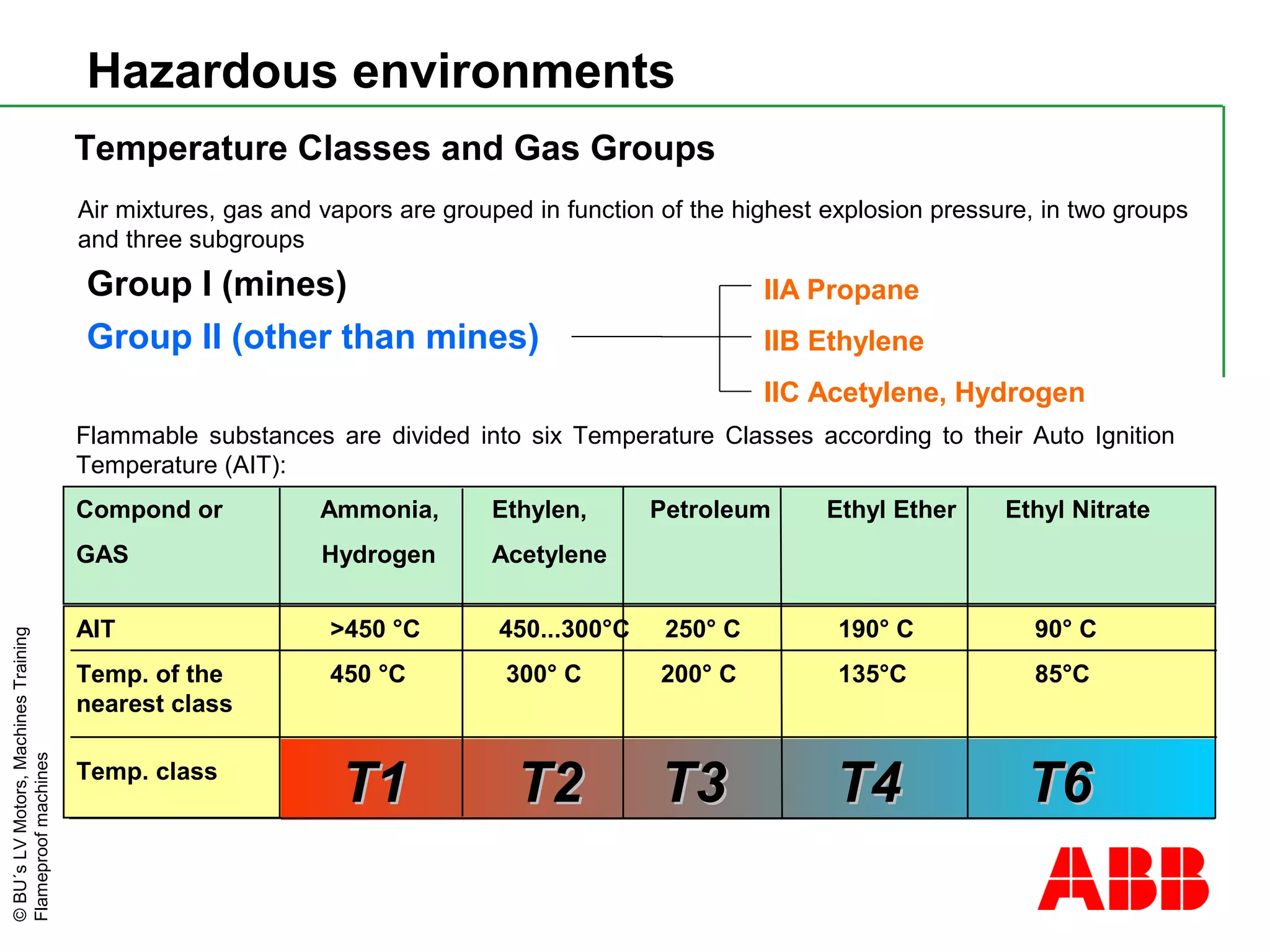
Temperature Classes and Gas Groups
Flammable substances are divided into six Temperature Classes according to their Auto Ignition
Temperature (AIT):
Air mixtures, gas and vapors are grouped in function of the highest explosion pressure, in two groups
and three subgroups
Group II (other than mines)
IIA Propane
IIB Ethylene
IIC Acetylene, Hydrogen
Hazardous environments
Group I (mines)
AIT >450 °C 450...300°C 250° C 190° C 90° C
Temp. of the 450 °C 300° C 200° C 135°C 85°C
nearest class
Temp. class
Compond or Ammonia, Ethylen, Petroleum Ethyl Ether Ethyl Nitrate
GAS Hydrogen Acetylene
T1 T2 T3 T4 T6T1 T2 T3 T4 T6
©BU´sLVMotors,MachinesTraining
Flameproofmachines
Hazardous environments
Based on these values the appropriate temperature class
will be determined for an equipment installed safely in the
area containing a combustable substance which does not
exceed the auto-ignition temperature of the substance. This
temperature class is mostly not exceeding 80% of the AIT,
and in many industries may be even lower to provide a
bigger safety margin.
Classification of gases and vapours
in explosion groups and temperature classes
T1 T2 T3 T4 T5 T6
I Methane -
IIA Acetone
Ethane
Ethylacetate
Ammonia
Benzol
Acetic Acid
Carbon monoxide
Methanol
Propane
Toluene
Ethylalcohol
I-amyl acetate
N-buthane
N-btylalcohol
Petrol
Diesel fuel
Aviation fuel
Heathing oil
N-hexane
Acetaldehyde -
IIB Town gas
(lamp gas)
Ethylen -
IIC Hydrogen Acethylene - Carbon
disulphide
Comparison between Division and Class Grouping
Typical Gas Dision System
NEC 505
Zone System
EN & IEC
Acetylene Group A
Hydrogen Group B
Group IIC
Ethylene Group C Group IIB
Propane Group D Group IIA
©BU´sLVMotors,MachinesTraining
Flameproofmachines
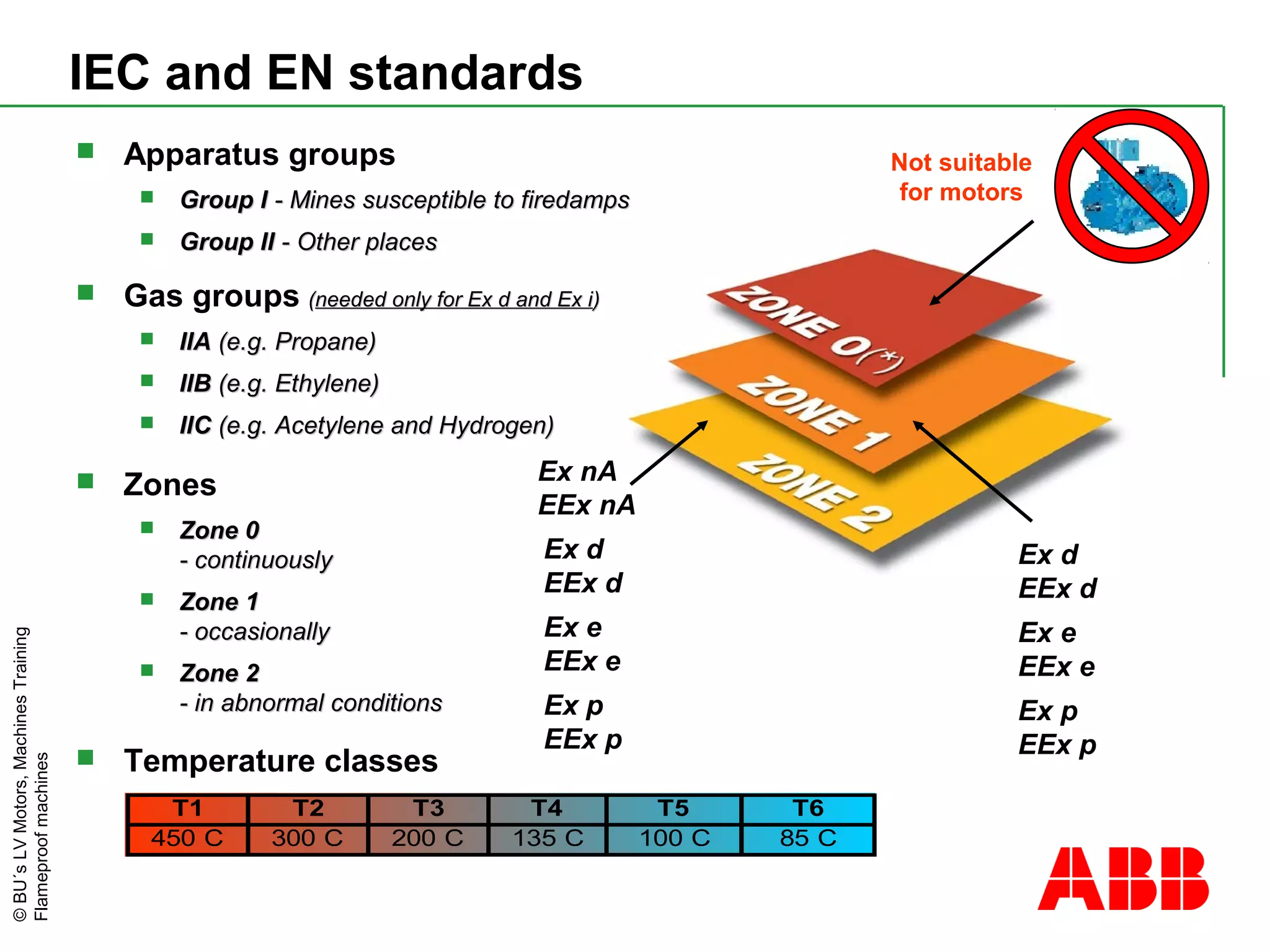
 Apparatus groups
 Group IGroup I - Mines susceptible to firedamps- Mines susceptible to firedamps
 Group IIGroup II - Other places- Other places
 Gas groups ((needed only for Ex d and Ex ineeded only for Ex d and Ex i))
 IIAIIA (e.g. Propane)(e.g. Propane)
 IIBIIB (e.g. Ethylene)(e.g. Ethylene)
 IICIIC (e.g. Acetylene and Hydrogen)(e.g. Acetylene and Hydrogen)
 Zones
 Zone 0Zone 0
- continuously- continuously
 Zone 1Zone 1
- occasionally- occasionally
 Zone 2Zone 2
- in abnormal conditions- in abnormal conditions
 Temperature classes
T1 T2 T3 T4 T5 T6
450 C 300 C 200 C 135 C 100 C 85 C
IEC and EN standards
Not suitable
for motors
Ex d
EEx d
Ex e
EEx e
Ex p
EEx p
Ex nA
EEx nA
Ex d
EEx d
Ex e
EEx e
Ex p
EEx p
©BU´sLVMotors,MachinesTraining
Flameproofmachines
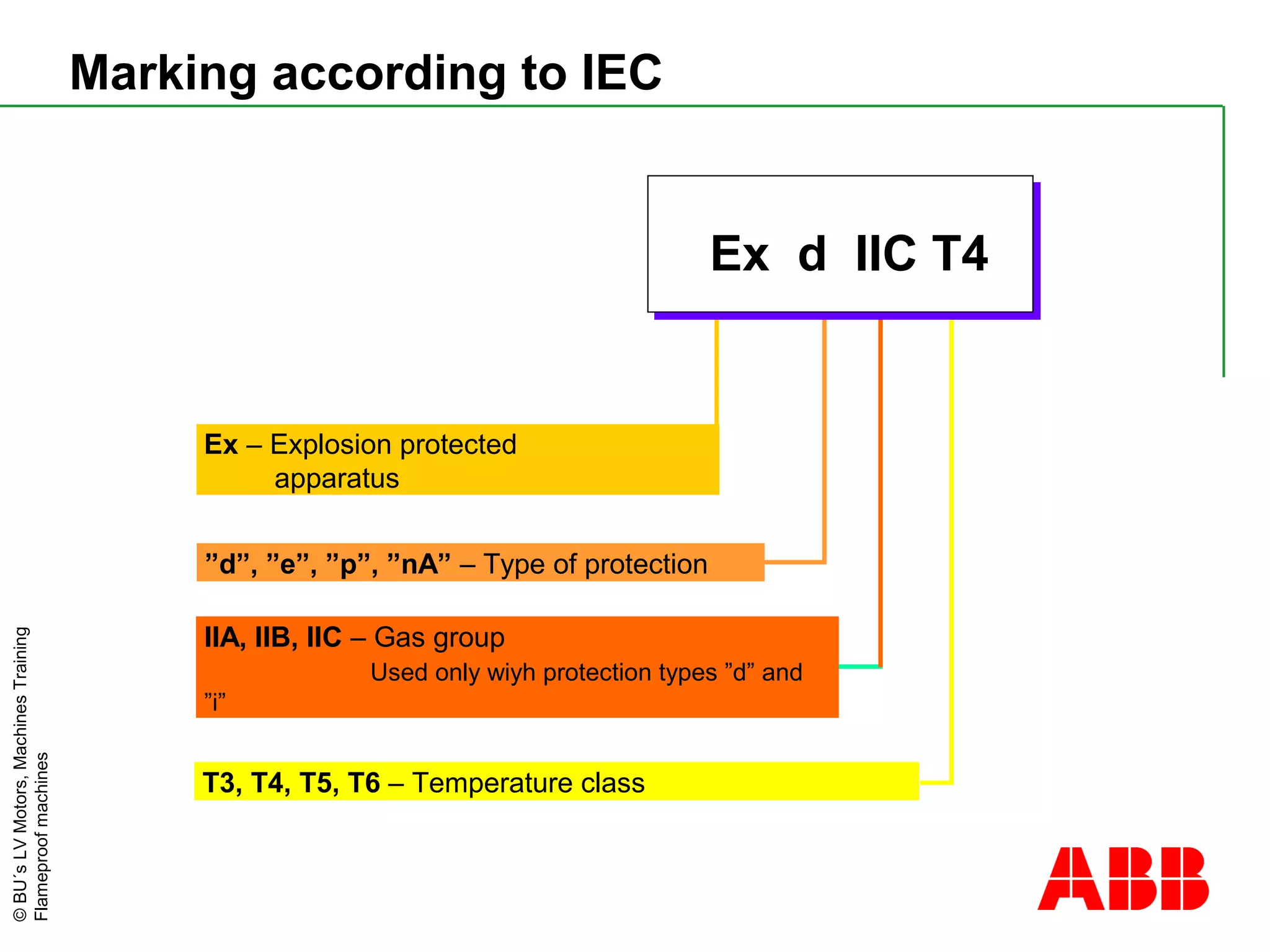
Marking according to IEC
Ex – Explosion protected
apparatus
”d”, ”e”, ”p”, ”nA” – Type of protection
IIA, IIB, IIC – Gas group
Used only wiyh protection types ”d” and
”i”
T3, T4, T5, T6 – Temperature class
Ex d IIC T4
©BU´sLVMotors,MachinesTraining
Flameproofmachines
NEMA / NECNEMA / NEC
CSA / CEC CodeCSA / CEC Code
JSIJSI
ENEN
National and International Standards
AS/NZSAS/NZS
©BU´sLVMotors,MachinesTraining
Flameproofmachines
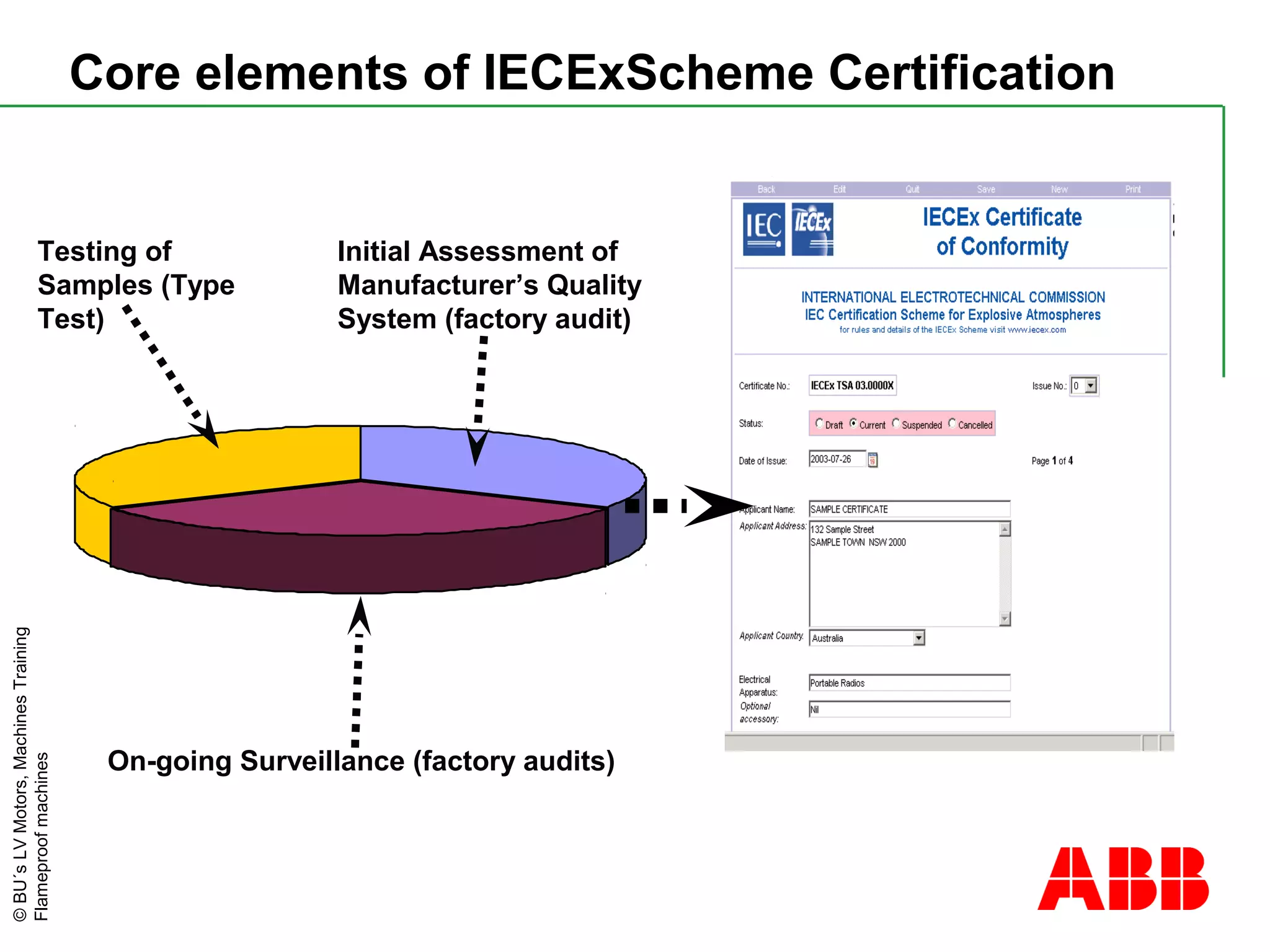
Testing of
Samples (Type
Test)
Initial Assessment of
Manufacturer’s Quality
System (factory audit)
On-going Surveillance (factory audits)
Core elements of IECExScheme Certification
©BU´sLVMotors,MachinesTraining
Flameproofmachines
Connection facilities and earthing or
bonding conductors
 Requirements of connection facilities are specified
in the std.
 All surfaces, which can charge electrically, shall be
earthed or equipotential bonded
General Requirements (IEC 60079-0 and EN50014)
Enclosures shall be designed that a
electrostatic charges are avoided
These rules are valid for all protection
modes
©BU´sLVMotors,MachinesTraining
Flameproofmachines
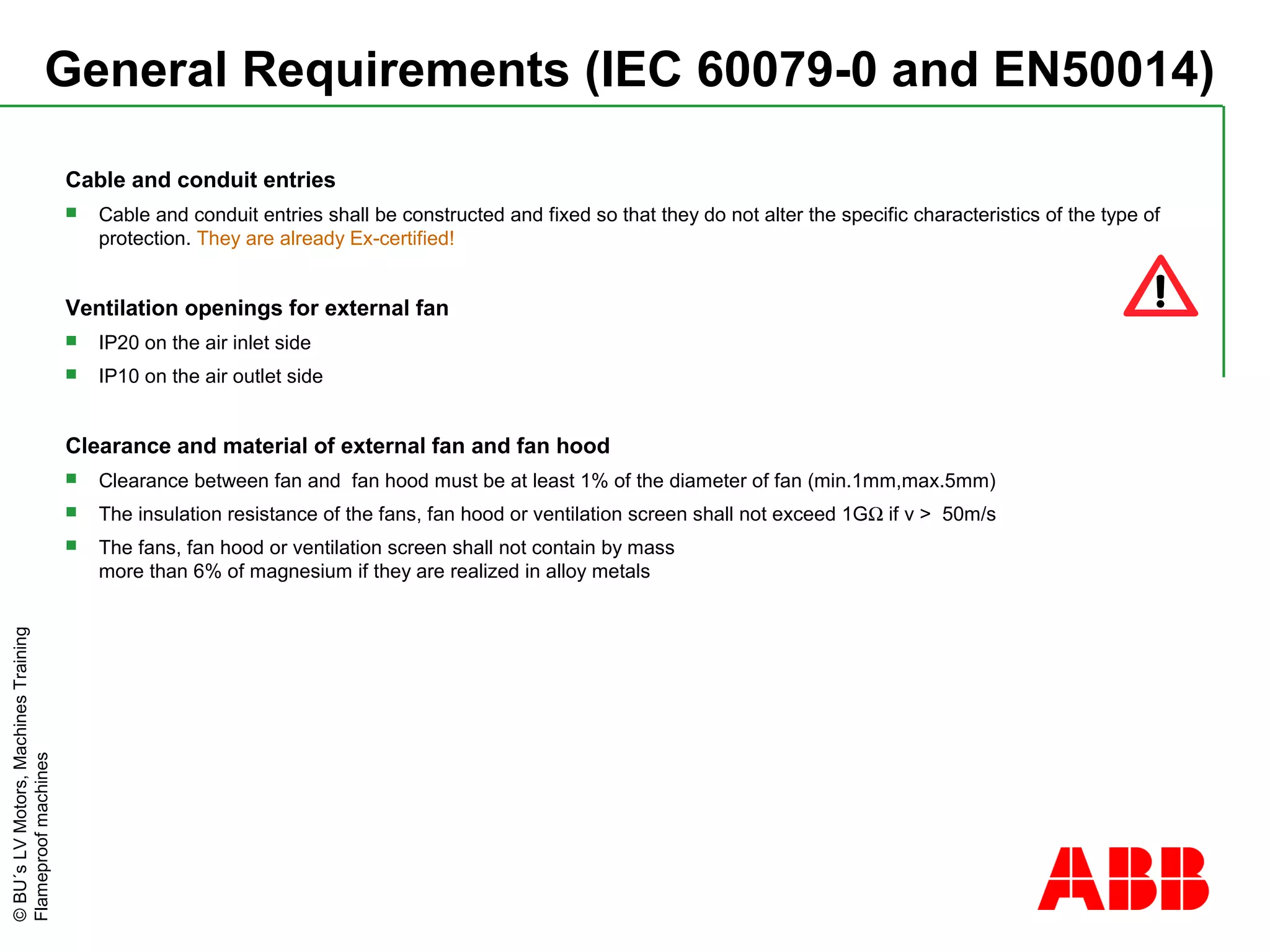
General Requirements (IEC 60079-0 and EN50014)
Cable and conduit entries
 Cable and conduit entries shall be constructed and fixed so that they do not alter the specific characteristics of the type of
protection. They are already Ex-certified!
Ventilation openings for external fan
 IP20 on the air inlet side
 IP10 on the air outlet side
Clearance and material of external fan and fan hood
 Clearance between fan and fan hood must be at least 1% of the diameter of fan (min.1mm,max.5mm)
 The insulation resistance of the fans, fan hood or ventilation screen shall not exceed 1GΩ if v > 50m/s
 The fans, fan hood or ventilation screen shall not contain by mass
more than 6% of magnesium if they are realized in alloy metals
©BU´sLVMotors,MachinesTraining
Flameproofmachines
What does it mean Pressurized enclosure ?
Parts which could ignite an explosive gas
mixture are housed in an enclosure which
is flushed and pressurized by a protective
gas, e.g. clean air.
Outlet inert
gas
Inlet
inert gas
Pressurized Motors – EEx p
po
p > po
©BU´sLVMotors,MachinesTraining
Flameproofmachines
Pressurised motors EEx p(e) II T1-T4
Induction motors
 Output up to 18 MW
 Frame sizes: 315 - 1120
Category 2 Equipment
Zone 1
Standards EN 50016
Synchronous motors
 Output: up to 55 MW
 Frame sizes: IEC 710 - 1250
©BU´sLVMotors,MachinesTraining
Flameproofmachines
Cooling type possible for Exp machines
©BU´sLVMotors,MachinesTraining
Flameproofmachines
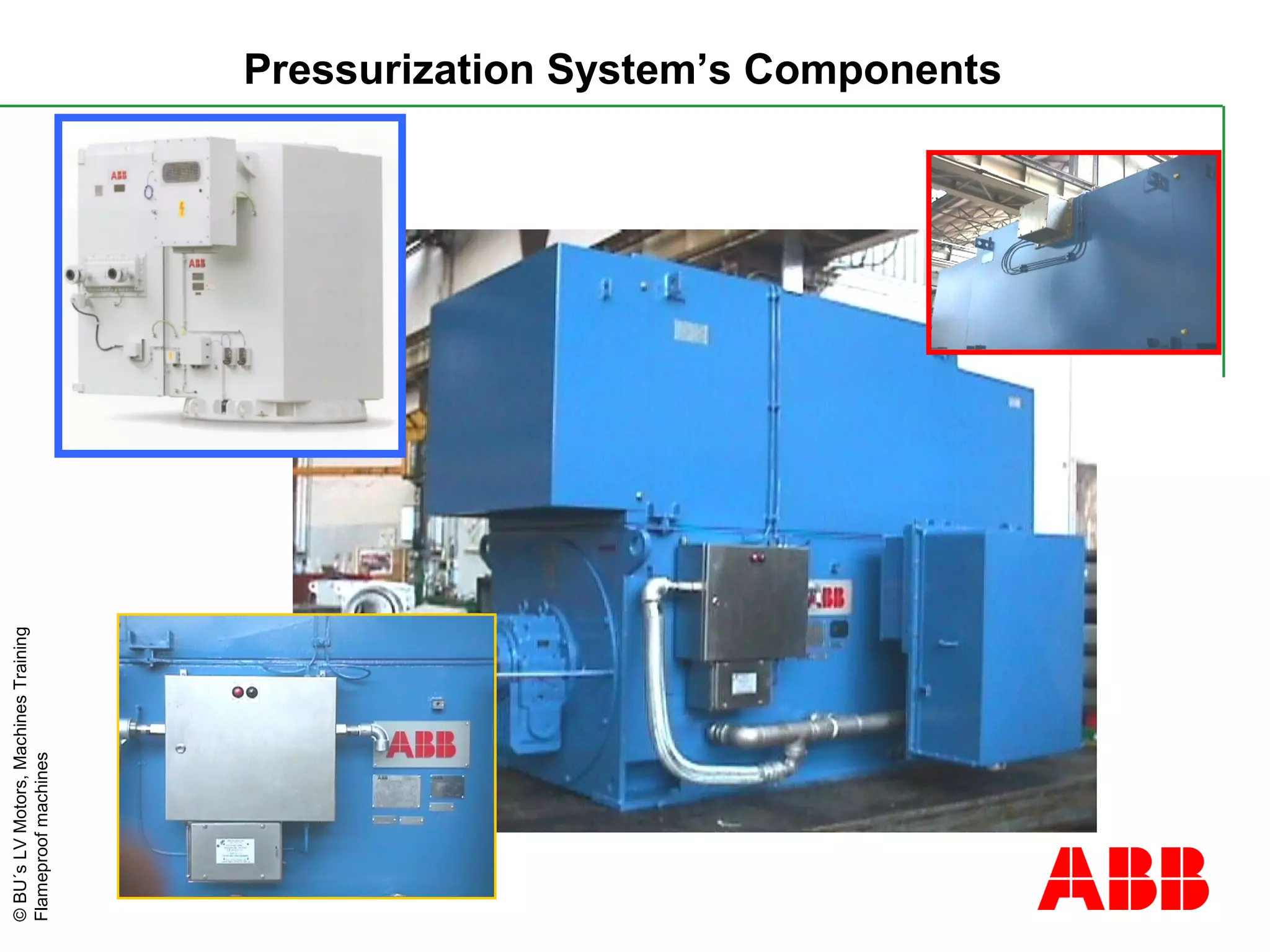
Pressurization System’s Components
©BU´sLVMotors,MachinesTraining
Flameproofmachines
EnclosureEnclosure
 Ingress protection shall
be at least IP40
 Shall withstand a pressure
equal to 1.5 times the
maximum over-pressure
Temperature limitsTemperature limits
 Temperature of the external surface shall not be over temperature
class limit during any operation
 Temperature of internal point shall not be over temperature class
limit during the normal service
Over-pressure and protective gasOver-pressure and protective gas
 The over-pressure shall be all the time at least 50 Pa
 The protective gas can be clean pressurized air, supplied from non-
hazardous area
Ex p / EEx p standardEx p / EEx p standard (IEC60079-2 / EN60079-2)(IEC60079-2 / EN60079-2)
©BU´sLVMotors,MachinesTraining
Flameproofmachines
PurgingPurging
 The basic idea is to remove an explosive gas mixtures before
starting of the motor
 Duration of purging shall be tested, so that concentration of
flammable gas after purging shall not exceed 25 % of the LEL
(Lower Explosion Limit)
Accessories and certificationAccessories and certification
 Internal accessories must be Ex-certified for zone 1 area, if they
can be switch on before motor is purged (e.g. space heater).
Other internal accessories can be non-certified.
 External accessories shall be always Ex-certified for zone 1
area
 Third party certificate is always required
Ex p / EEx p standardEx p / EEx p standard (IEC60079-2 / EN60079-2)(IEC60079-2 / EN60079-2)
©BU´sLVMotors,MachinesTraining
Flameproofmachines
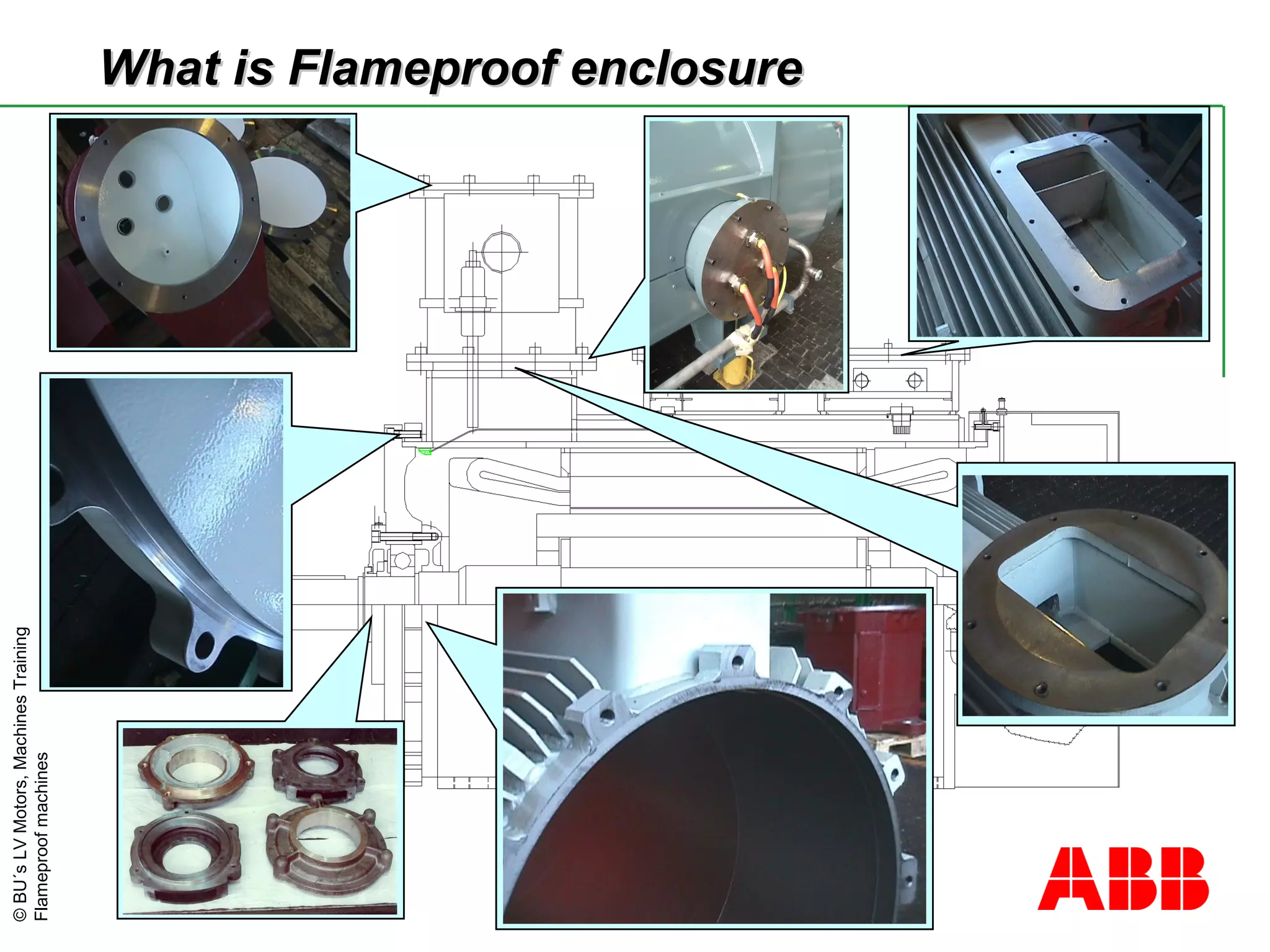
What does mean Flameproof enclosure ?
The enclosure is designed in such a way that
an explosion inside the motor will not cause
any permanent deformation and will prevent
the flame propagation outside
seals and
labyrinths
strong
housing
(frame and
shields)
Ex d or EEx d standards (IEC 60079-1 / EN50018)
©BU´sLVMotors,MachinesTraining
Flameproofmachines
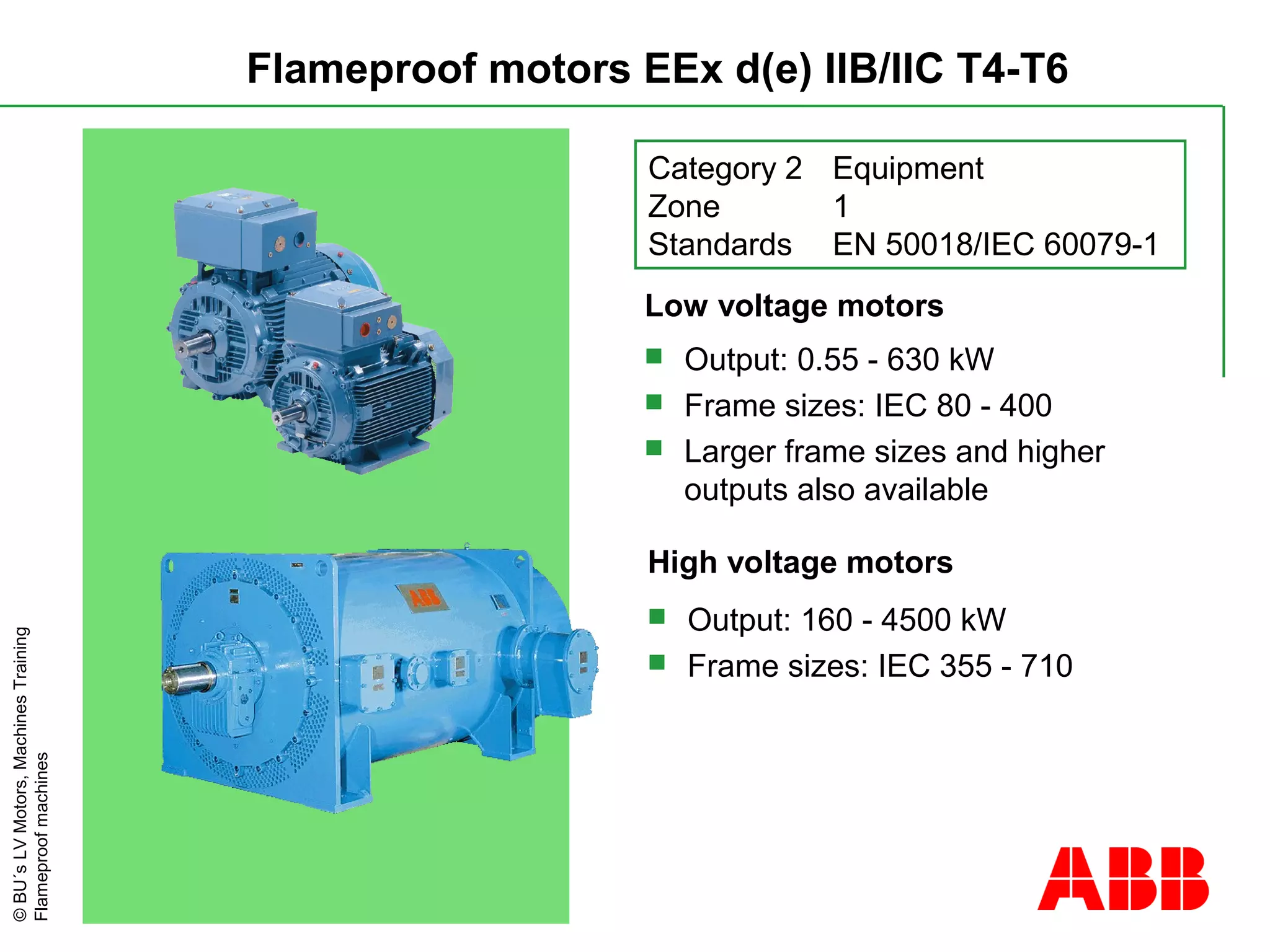
Flameproof motors EEx d(e) IIB/IIC T4-T6
Low voltage motors
 Output: 0.55 - 630 kW
 Frame sizes: IEC 80 - 400
 Larger frame sizes and higher
outputs also available
Category 2 Equipment
Zone 1
Standards EN 50018/IEC 60079-1
High voltage motors
 Output: 160 - 4500 kW
 Frame sizes: IEC 355 - 710
©BU´sLVMotors,MachinesTraining
Flameproofmachines
What is Flameproof enclosureWhat is Flameproof enclosure
©BU´sLVMotors,MachinesTraining
Flameproofmachines
Cooling type possible for Exd machines
IC411 IC511
©BU´sLVMotors,MachinesTraining
Flameproofmachines
Ex d machines are designed to guarantee the protectionx d machines are designed to guarantee the protection
in normal operation, in start and in fault conditions.in normal operation, in start and in fault conditions.
1. In case of an explosion inside the motor, the
explosion is not transmitted outside the enclosure
2. The maximum surface temperature outside the
motor lower than the temperature class
3. No sparks outside the enclosure
4. Hot gases can't pass to the outside, or when
occur, they have to be cool enough to be at a
temperature which is below the temperature class
limit.
Ex d / EEx d standardEx d / EEx d standard (IEC60079-1 / EN60079-1)(IEC60079-1 / EN60079-1)
©BU´sLVMotors,MachinesTraining
Flameproofmachines
Temperature limitsTemperature limits
 Temperature of the external surface shall not be over the
temperature class limit for which the motor is certified
Enclosures designEnclosures design
 Insulation resistance of the enclosure does not exceed
1GΩ (EN/IEC).
 All electrostatic charges are avoided. All surfaces, which
can charge electrically, shall be earthed or equipotential
bonded .(Requirements of connection facilities are
specified in the std.)
 Enclosures are designed and tested to withstand the
pressure in case of an internal explosion.
Ex d / EEx d standardEx d / EEx d standard (IEC60079-1 / EN60079-1)(IEC60079-1 / EN60079-1)
©BU´sLVMotors,MachinesTraining
Flameproofmachines
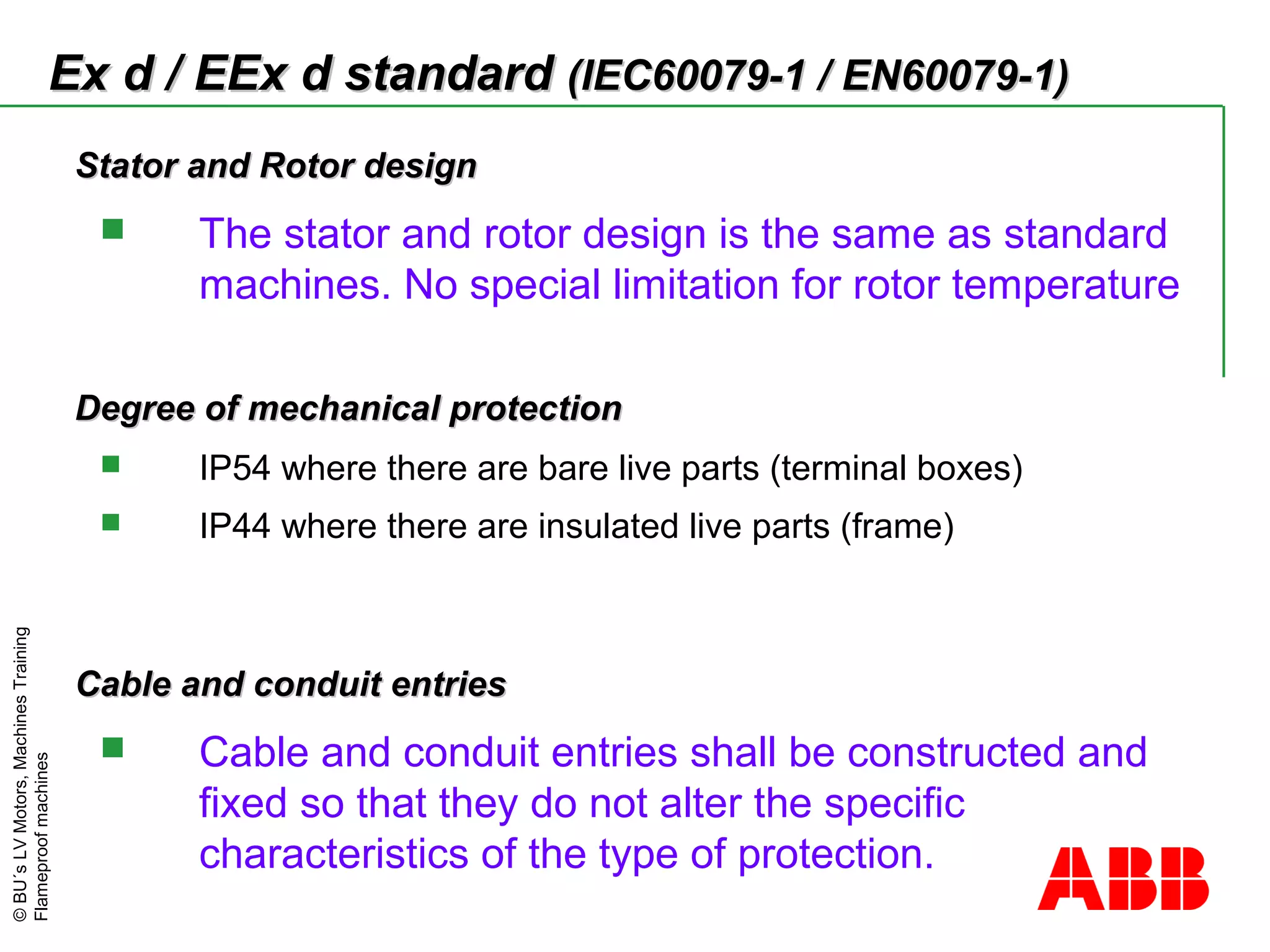
Stator and Rotor designStator and Rotor design
 The stator and rotor design is the same as standard
machines. No special limitation for rotor temperature
Degree of mechanical protectionDegree of mechanical protection
 IP54 where there are bare live parts (terminal boxes)
 IP44 where there are insulated live parts (frame)
Cable and conduit entriesCable and conduit entries
 Cable and conduit entries shall be constructed and
fixed so that they do not alter the specific
characteristics of the type of protection.
Ex d / EEx d standardEx d / EEx d standard (IEC60079-1 / EN60079-1)(IEC60079-1 / EN60079-1)
©BU´sLVMotors,MachinesTraining
Flameproofmachines
Clearance and material of external fan and fan hoodClearance and material of external fan and fan hood
 The prescription of the General Rules about the clearance, insulation
resistance of the materials and the material characteristics must be
followed.
 Fan is always Non-Sparking
Accessories and certificationAccessories and certification
 Internal accessories can be non-certified.
 External accessories shall be always certified.
 Third party certificate is required for motor series (prototype
tested only).
VSD ApplicationVSD Application
No need to carry out the system test for VSD application
Ex d / EEx d standardEx d / EEx d standard (IEC60079-1 / EN60079-1)(IEC60079-1 / EN60079-1)
©BU´sLVMotors,MachinesTraining
Flameproofmachines
FAQ
 Different way of protecting the motor...
 Which type of protection is better for
Main Terminal Box? Exe or Exd
 Sleeve bearings are not allowed by
international standards. for gas group IIC
 Why ABB cannot deliver motors with
sleeve bearings for gas group IIC?
 International standards do not set any limit
for tE time for Exp and Exd machines
 Is the tE time relevant for pressurized
or flameproof machines?
 The motor shall be “de-rated” to fulfill max.
80K temperature rise. Major attention shall
be paid to the bearings
 What happens if the ambient
temperature is above 40C
 Typically ca. 10 min for TEFC (IC411) and
ca. 30min for large TEAAC (IC611) and
TEWAC (IC81W) motors.
 Yes, the purging air can be supplied from
instrument air ntework
 What is typical purging time for Ex p
motor before starting.
 And, can the purging air be the
standard instrument air
©BU´sLVMotors,MachinesTraining
Flameproofmachines
 Apparatus groups
 Group IGroup I - Mines susceptible to firedamps- Mines susceptible to firedamps
 Group IIGroup II - Other places- Other places
 Gas groups ((needed only for Ex d and Ex ineeded only for Ex d and Ex i))
 IIAIIA (e.g. Propane)(e.g. Propane)
 IIBIIB (e.g. Ethylene)(e.g. Ethylene)
 IICIIC (e.g. Acetylene and Hydrogen)(e.g. Acetylene and Hydrogen)
 Zones
 Zone 0Zone 0
- continuously- continuously
 Zone 1Zone 1
- occasionally- occasionally
 Zone 2Zone 2
- in abnormal conditions- in abnormal conditions
 Temperature classes
T1 T2 T3 T4 T5 T6
450 C 300 C 200 C 135 C 100 C 85 C
IEC and EN standards
Not suitable
for motors
Ex d
EEx d
Ex e
EEx e
Ex p
EEx p
Ex d
EEx d
Ex e
EEx e
Ex p
EEx p
Ex nA
EEx nA
Machines for hazardous areas

Machines for hazardous areas

  • 1.
  • 2.
    ©BU´sLVMotors,MachinesTraining Flameproofmachines According to EuropeanDirectives 94/9/EC (ATEX), IEC 60079-10, EN 60079-10 and NEC 505, hazardous environments are classified, relating to the presence probability of flammable substances, in ZONES: Zone “0” ( Gas presence > 1000Zone “0” ( Gas presence > 1000 hours/year)hours/year) Area where an explosive gas mixture is present continuously, for long period or frequently (Zone “20” for dust) Zone “1” ( Gas presence 10 - 1000Zone “1” ( Gas presence 10 - 1000 hours/year)hours/year) Area where an explosive gas mixture is likely to occur under normal operations (Zone “21” for dust) Zone “2” ( Gas presence < 10 hours/year)Zone “2” ( Gas presence < 10 hours/year) Area where an explosive gas mixture is unlikely to occur (or occur only under abnormal conditions) (Zone “22” for dust) Hazardous environments - Group II PRESENCE DURING NORMAL OPERATIONS PRESENCE JUST IN CASE OF FAILURE OR ABNORMAL OPERATIONS CONTINUOUS PRESENCE
  • 3.
    ©BU´sLVMotors,MachinesTraining Flameproofmachines Gas and VaporSubdivisions Subdivision Max Experimental Safe Gap (MESG) IEC 60079-10 Products A > 0. 9 mm ~120 gases and Vapors : ethane-propane-butane benzene-methanepetroleum diesel oil-ethanethiol B 0.55 mm - 0.9 mm ~30 gases and vapors : ethylene-dimethyl ether coke oven gas C < 0.5 mm 3 gases hydrogen H2 - acetylene C2H2 carbon disulphide CS2 Gases are classified by groups based on the maximum gap that still prevents any transmission of an explosion in 10 tests made, the conditions specified in the standards IEC and EN. Three groups have been defined: A - B - C according to the value of Maximum Experimental Safety Gap (MESG). 25 mm
  • 4.
    ©BU´sLVMotors,MachinesTraining Flameproofmachines Temperature Classes andGas Groups Flammable substances are divided into six Temperature Classes according to their Auto Ignition Temperature (AIT): Air mixtures, gas and vapors are grouped in function of the highest explosion pressure, in two groups and three subgroups Group II (other than mines) IIA Propane IIB Ethylene IIC Acetylene, Hydrogen Hazardous environments Group I (mines) AIT >450 °C 450...300°C 250° C 190° C 90° C Temp. of the 450 °C 300° C 200° C 135°C 85°C nearest class Temp. class Compond or Ammonia, Ethylen, Petroleum Ethyl Ether Ethyl Nitrate GAS Hydrogen Acetylene T1 T2 T3 T4 T6T1 T2 T3 T4 T6
  • 5.
    ©BU´sLVMotors,MachinesTraining Flameproofmachines Hazardous environments Based onthese values the appropriate temperature class will be determined for an equipment installed safely in the area containing a combustable substance which does not exceed the auto-ignition temperature of the substance. This temperature class is mostly not exceeding 80% of the AIT, and in many industries may be even lower to provide a bigger safety margin. Classification of gases and vapours in explosion groups and temperature classes T1 T2 T3 T4 T5 T6 I Methane - IIA Acetone Ethane Ethylacetate Ammonia Benzol Acetic Acid Carbon monoxide Methanol Propane Toluene Ethylalcohol I-amyl acetate N-buthane N-btylalcohol Petrol Diesel fuel Aviation fuel Heathing oil N-hexane Acetaldehyde - IIB Town gas (lamp gas) Ethylen - IIC Hydrogen Acethylene - Carbon disulphide Comparison between Division and Class Grouping Typical Gas Dision System NEC 505 Zone System EN & IEC Acetylene Group A Hydrogen Group B Group IIC Ethylene Group C Group IIB Propane Group D Group IIA
  • 6.
    ©BU´sLVMotors,MachinesTraining Flameproofmachines  Apparatus groups Group IGroup I - Mines susceptible to firedamps- Mines susceptible to firedamps  Group IIGroup II - Other places- Other places  Gas groups ((needed only for Ex d and Ex ineeded only for Ex d and Ex i))  IIAIIA (e.g. Propane)(e.g. Propane)  IIBIIB (e.g. Ethylene)(e.g. Ethylene)  IICIIC (e.g. Acetylene and Hydrogen)(e.g. Acetylene and Hydrogen)  Zones  Zone 0Zone 0 - continuously- continuously  Zone 1Zone 1 - occasionally- occasionally  Zone 2Zone 2 - in abnormal conditions- in abnormal conditions  Temperature classes T1 T2 T3 T4 T5 T6 450 C 300 C 200 C 135 C 100 C 85 C IEC and EN standards Not suitable for motors Ex d EEx d Ex e EEx e Ex p EEx p Ex nA EEx nA Ex d EEx d Ex e EEx e Ex p EEx p
  • 7.
    ©BU´sLVMotors,MachinesTraining Flameproofmachines Marking according toIEC Ex – Explosion protected apparatus ”d”, ”e”, ”p”, ”nA” – Type of protection IIA, IIB, IIC – Gas group Used only wiyh protection types ”d” and ”i” T3, T4, T5, T6 – Temperature class Ex d IIC T4
  • 8.
    ©BU´sLVMotors,MachinesTraining Flameproofmachines NEMA / NECNEMA/ NEC CSA / CEC CodeCSA / CEC Code JSIJSI ENEN National and International Standards AS/NZSAS/NZS
  • 9.
    ©BU´sLVMotors,MachinesTraining Flameproofmachines Testing of Samples (Type Test) InitialAssessment of Manufacturer’s Quality System (factory audit) On-going Surveillance (factory audits) Core elements of IECExScheme Certification
  • 10.
    ©BU´sLVMotors,MachinesTraining Flameproofmachines Connection facilities andearthing or bonding conductors  Requirements of connection facilities are specified in the std.  All surfaces, which can charge electrically, shall be earthed or equipotential bonded General Requirements (IEC 60079-0 and EN50014) Enclosures shall be designed that a electrostatic charges are avoided These rules are valid for all protection modes
  • 11.
    ©BU´sLVMotors,MachinesTraining Flameproofmachines General Requirements (IEC60079-0 and EN50014) Cable and conduit entries  Cable and conduit entries shall be constructed and fixed so that they do not alter the specific characteristics of the type of protection. They are already Ex-certified! Ventilation openings for external fan  IP20 on the air inlet side  IP10 on the air outlet side Clearance and material of external fan and fan hood  Clearance between fan and fan hood must be at least 1% of the diameter of fan (min.1mm,max.5mm)  The insulation resistance of the fans, fan hood or ventilation screen shall not exceed 1GΩ if v > 50m/s  The fans, fan hood or ventilation screen shall not contain by mass more than 6% of magnesium if they are realized in alloy metals
  • 12.
    ©BU´sLVMotors,MachinesTraining Flameproofmachines What does itmean Pressurized enclosure ? Parts which could ignite an explosive gas mixture are housed in an enclosure which is flushed and pressurized by a protective gas, e.g. clean air. Outlet inert gas Inlet inert gas Pressurized Motors – EEx p po p > po
  • 13.
    ©BU´sLVMotors,MachinesTraining Flameproofmachines Pressurised motors EExp(e) II T1-T4 Induction motors  Output up to 18 MW  Frame sizes: 315 - 1120 Category 2 Equipment Zone 1 Standards EN 50016 Synchronous motors  Output: up to 55 MW  Frame sizes: IEC 710 - 1250
  • 14.
  • 15.
  • 16.
    ©BU´sLVMotors,MachinesTraining Flameproofmachines EnclosureEnclosure  Ingress protectionshall be at least IP40  Shall withstand a pressure equal to 1.5 times the maximum over-pressure Temperature limitsTemperature limits  Temperature of the external surface shall not be over temperature class limit during any operation  Temperature of internal point shall not be over temperature class limit during the normal service Over-pressure and protective gasOver-pressure and protective gas  The over-pressure shall be all the time at least 50 Pa  The protective gas can be clean pressurized air, supplied from non- hazardous area Ex p / EEx p standardEx p / EEx p standard (IEC60079-2 / EN60079-2)(IEC60079-2 / EN60079-2)
  • 17.
    ©BU´sLVMotors,MachinesTraining Flameproofmachines PurgingPurging  The basicidea is to remove an explosive gas mixtures before starting of the motor  Duration of purging shall be tested, so that concentration of flammable gas after purging shall not exceed 25 % of the LEL (Lower Explosion Limit) Accessories and certificationAccessories and certification  Internal accessories must be Ex-certified for zone 1 area, if they can be switch on before motor is purged (e.g. space heater). Other internal accessories can be non-certified.  External accessories shall be always Ex-certified for zone 1 area  Third party certificate is always required Ex p / EEx p standardEx p / EEx p standard (IEC60079-2 / EN60079-2)(IEC60079-2 / EN60079-2)
  • 18.
    ©BU´sLVMotors,MachinesTraining Flameproofmachines What does meanFlameproof enclosure ? The enclosure is designed in such a way that an explosion inside the motor will not cause any permanent deformation and will prevent the flame propagation outside seals and labyrinths strong housing (frame and shields) Ex d or EEx d standards (IEC 60079-1 / EN50018)
  • 19.
    ©BU´sLVMotors,MachinesTraining Flameproofmachines Flameproof motors EExd(e) IIB/IIC T4-T6 Low voltage motors  Output: 0.55 - 630 kW  Frame sizes: IEC 80 - 400  Larger frame sizes and higher outputs also available Category 2 Equipment Zone 1 Standards EN 50018/IEC 60079-1 High voltage motors  Output: 160 - 4500 kW  Frame sizes: IEC 355 - 710
  • 20.
  • 21.
  • 22.
    ©BU´sLVMotors,MachinesTraining Flameproofmachines Ex d machinesare designed to guarantee the protectionx d machines are designed to guarantee the protection in normal operation, in start and in fault conditions.in normal operation, in start and in fault conditions. 1. In case of an explosion inside the motor, the explosion is not transmitted outside the enclosure 2. The maximum surface temperature outside the motor lower than the temperature class 3. No sparks outside the enclosure 4. Hot gases can't pass to the outside, or when occur, they have to be cool enough to be at a temperature which is below the temperature class limit. Ex d / EEx d standardEx d / EEx d standard (IEC60079-1 / EN60079-1)(IEC60079-1 / EN60079-1)
  • 23.
    ©BU´sLVMotors,MachinesTraining Flameproofmachines Temperature limitsTemperature limits Temperature of the external surface shall not be over the temperature class limit for which the motor is certified Enclosures designEnclosures design  Insulation resistance of the enclosure does not exceed 1GΩ (EN/IEC).  All electrostatic charges are avoided. All surfaces, which can charge electrically, shall be earthed or equipotential bonded .(Requirements of connection facilities are specified in the std.)  Enclosures are designed and tested to withstand the pressure in case of an internal explosion. Ex d / EEx d standardEx d / EEx d standard (IEC60079-1 / EN60079-1)(IEC60079-1 / EN60079-1)
  • 24.
    ©BU´sLVMotors,MachinesTraining Flameproofmachines Stator and RotordesignStator and Rotor design  The stator and rotor design is the same as standard machines. No special limitation for rotor temperature Degree of mechanical protectionDegree of mechanical protection  IP54 where there are bare live parts (terminal boxes)  IP44 where there are insulated live parts (frame) Cable and conduit entriesCable and conduit entries  Cable and conduit entries shall be constructed and fixed so that they do not alter the specific characteristics of the type of protection. Ex d / EEx d standardEx d / EEx d standard (IEC60079-1 / EN60079-1)(IEC60079-1 / EN60079-1)
  • 25.
    ©BU´sLVMotors,MachinesTraining Flameproofmachines Clearance and materialof external fan and fan hoodClearance and material of external fan and fan hood  The prescription of the General Rules about the clearance, insulation resistance of the materials and the material characteristics must be followed.  Fan is always Non-Sparking Accessories and certificationAccessories and certification  Internal accessories can be non-certified.  External accessories shall be always certified.  Third party certificate is required for motor series (prototype tested only). VSD ApplicationVSD Application No need to carry out the system test for VSD application Ex d / EEx d standardEx d / EEx d standard (IEC60079-1 / EN60079-1)(IEC60079-1 / EN60079-1)
  • 26.
    ©BU´sLVMotors,MachinesTraining Flameproofmachines FAQ  Different wayof protecting the motor...  Which type of protection is better for Main Terminal Box? Exe or Exd  Sleeve bearings are not allowed by international standards. for gas group IIC  Why ABB cannot deliver motors with sleeve bearings for gas group IIC?  International standards do not set any limit for tE time for Exp and Exd machines  Is the tE time relevant for pressurized or flameproof machines?  The motor shall be “de-rated” to fulfill max. 80K temperature rise. Major attention shall be paid to the bearings  What happens if the ambient temperature is above 40C  Typically ca. 10 min for TEFC (IC411) and ca. 30min for large TEAAC (IC611) and TEWAC (IC81W) motors.  Yes, the purging air can be supplied from instrument air ntework  What is typical purging time for Ex p motor before starting.  And, can the purging air be the standard instrument air
  • 27.
    ©BU´sLVMotors,MachinesTraining Flameproofmachines  Apparatus groups Group IGroup I - Mines susceptible to firedamps- Mines susceptible to firedamps  Group IIGroup II - Other places- Other places  Gas groups ((needed only for Ex d and Ex ineeded only for Ex d and Ex i))  IIAIIA (e.g. Propane)(e.g. Propane)  IIBIIB (e.g. Ethylene)(e.g. Ethylene)  IICIIC (e.g. Acetylene and Hydrogen)(e.g. Acetylene and Hydrogen)  Zones  Zone 0Zone 0 - continuously- continuously  Zone 1Zone 1 - occasionally- occasionally  Zone 2Zone 2 - in abnormal conditions- in abnormal conditions  Temperature classes T1 T2 T3 T4 T5 T6 450 C 300 C 200 C 135 C 100 C 85 C IEC and EN standards Not suitable for motors Ex d EEx d Ex e EEx e Ex p EEx p Ex d EEx d Ex e EEx e Ex p EEx p Ex nA EEx nA

Editor's Notes

  • #3 &amp;lt;number&amp;gt;
  • #4 &amp;lt;number&amp;gt;
  • #5 &amp;lt;number&amp;gt;
  • #6 &amp;lt;number&amp;gt;
  • #7 &amp;lt;number&amp;gt;
  • #8 &amp;lt;number&amp;gt;
  • #9 &amp;lt;number&amp;gt;
  • #11 &amp;lt;number&amp;gt;
  • #12 &amp;lt;number&amp;gt;
  • #13 &amp;lt;number&amp;gt;
  • #15 &amp;lt;number&amp;gt;
  • #16 &amp;lt;number&amp;gt;
  • #17 &amp;lt;number&amp;gt;
  • #18 &amp;lt;number&amp;gt;
  • #19 &amp;lt;number&amp;gt;
  • #21 &amp;lt;number&amp;gt;
  • #22 &amp;lt;number&amp;gt;
  • #23 &amp;lt;number&amp;gt;
  • #24 &amp;lt;number&amp;gt;
  • #25 &amp;lt;number&amp;gt;
  • #26 &amp;lt;number&amp;gt;
  • #29 &amp;lt;number&amp;gt; 1.3.5 General requirements for Ex motor to be used with converter The CE marking must be done with the identification number of the Notified Body close to it, see example picture. The category of the equipment, the “G” or “D” for gas or dust application, and the complementary marking where double “E”, like EEx…, confirms the reference to European standards.
  • #30 &amp;lt;number&amp;gt; Applicable standards The list above shows the main requirements of the applicable standards for each protection type (“n”, “e”, “p”, “d”, “DIP”) and states whether they are the responsibility of the manufacturer through the Products Directive (ATEX 95), or of the end user through the Worker Protection Directive (ATEX 137) with its “minimum requirements”. For non-sparking, “n”, motors the manufacturer must perform a test with the associated converter unit. This means that the end user has minimum responsibility. To fulfill these requirements, ABB has in conjunction with the Notified Body carried out a series of tests on the converters in question to get them formally certified according to EN 50021. For increased safety motors, “e”, the manufacturer must perform a test with the associated converter to comply with EN 50019. However, this requires far more specifications than for the non-sparking design, as these motors are category 2 equipment and the te-time requirements have to be met. These additional requirements are fully justified from the safety point of view, but they are very difficult to meet in the case of certain low voltage motors where the rotor becomes critical. Depending on the application, the temperature of the rotor may be significantly higher than that of the stator. This implies a major de-rating of the motor, meaning that a non-cost-effective oversized motor should be used. This, however, will not prevent many other risks in the winding which may be accepted on category 3 equipment but not in category 2. The whole installation must be assessed according to EN 60079-14 and EN 60079-17 in order to prevent all risks due to over-voltage spikes, higher temperature and bearing currents. This ensures that the selected equipment can be safely used in the applications concerned. Even so, increased safety motors still cannot be rewound by a repair shop.
  • #31 &amp;lt;number&amp;gt; Applicable standards Motors protected by pressurization according to EN 50016, need no additional requirements from the Worker Protection Directive (ATEX 137). The case of the flame proof motors may be more complex than it initially appears. The corresponding standard, EN 50018, from the Products Directive (ATEX 95) has nearly no requirements, making it easy for all manufacturers to state that their flame proof motors are certified for this application. In making this statement, however, they transfer to the end users the entire responsibility for meeting the “minimum requirements” of the worker. Protection Directive (ATEX 137) as described in EN 60079-14. This standard proposes two solutions: Temperature sensors which cause the motor to be disconnected. This solution does not need to be tested as it shares all the responsibilities between the end user (who defines the application) and the manufacturer (who provides the sensors appropriate for the particular application). This solution is very useful for motors where the stator is critical, meaning that the temperature measured by the sensor in the stator reflects the hottest point. In cases where the rotor is critical in carrying the hot spots, it becomes difficult to specify the appropriate sensors, which may consequently limit the operating field of the motor. To type-test the entire combination of the motor, converter and protective device provided for this duty. In this case the end user can refer to representative tests which may have been carried out by the motor manufacturer, converter supplier or complete machine builder. ABB uses the first solution for high voltage motors and the second one for low voltage motors, because many of the low voltage motors are rotor critical and the presence of a number of temperature sensors increases the constraints on the end users but may not always improve the safety level. Notified Bodies may have requested such sensors in the motor certificates, however. The protective device must be selected according to the risk analysis, and thermal sensors are to be used where this makes sense. For motors with IP65 protection operating in areas where dust is present, the seals are to be inspected on a regular basis depending on the local conditions. In all cases the interior of the motors must remain clean.
  • #32 &amp;lt;number&amp;gt;
  • #33 &amp;lt;number&amp;gt;