

Presenters;
MEHWISH NOOR
RESEARCHING LANGUAGE AS A
COMPLEX ADAPTIVE SYSTEM
BACKGROUND
• Chaos/complexity theory
• Developed from ancient
Greek philosophy
• Modern views of
mathematics and the
physical world
• Explains the nature and
characteristics of complex
systems
• Defines different types of
change
PROGRESSING IDEAS
• Explores patterns of
nonlinearity

• Unpredictability in a
complex system
• Avoids marking this as a
hybrid state
• The bridging role of
complexity theory
• Framing research and
practice
CHAOS
• 'To some physicists chaos is a science of process
rather than state, of becoming rather than being'
(Gleick 1987 5)
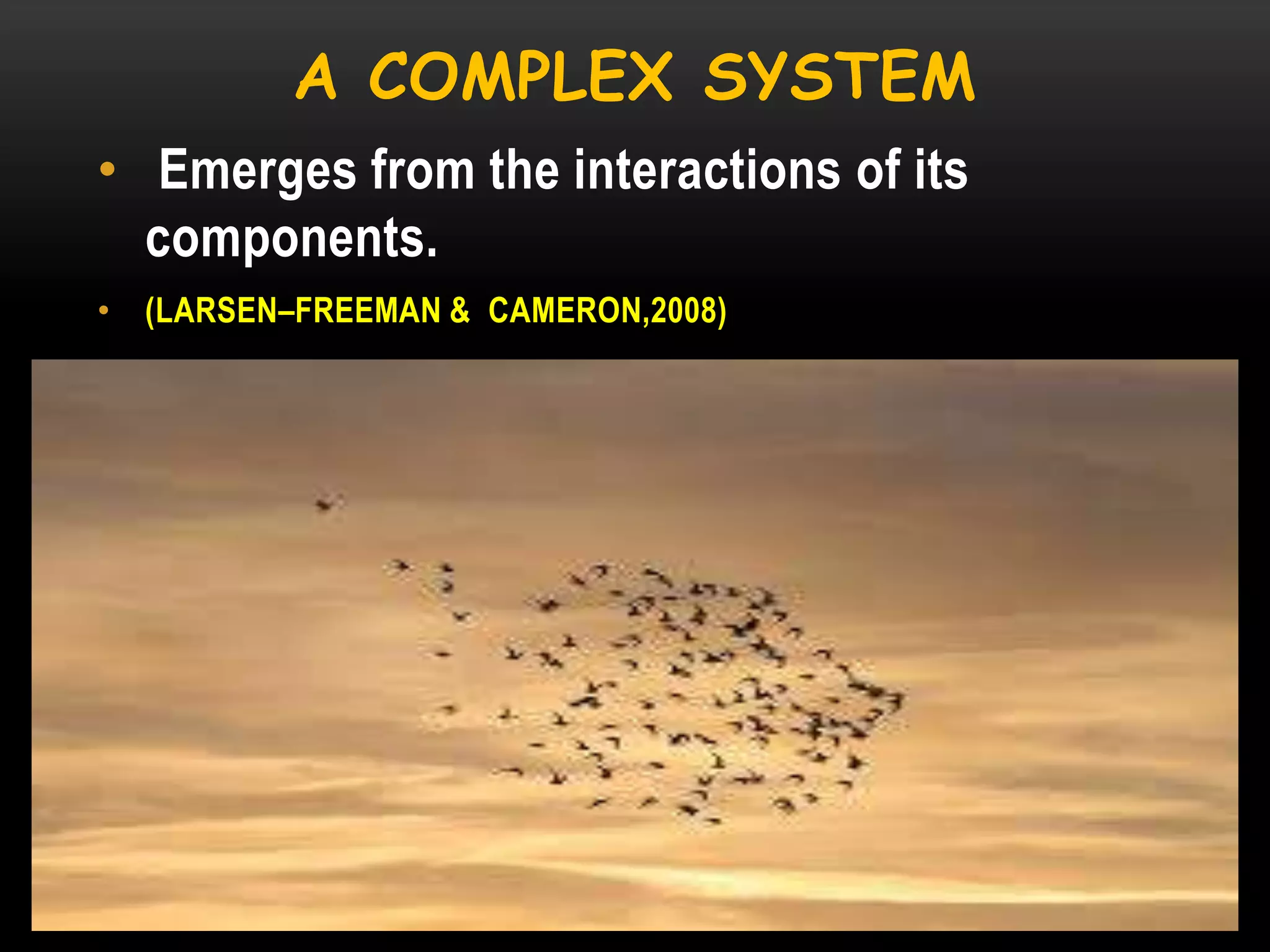
A COMPLEX SYSTEM
• Emerges from the interactions of its
components.
• (LARSEN–FREEMAN & CAMERON,2008)
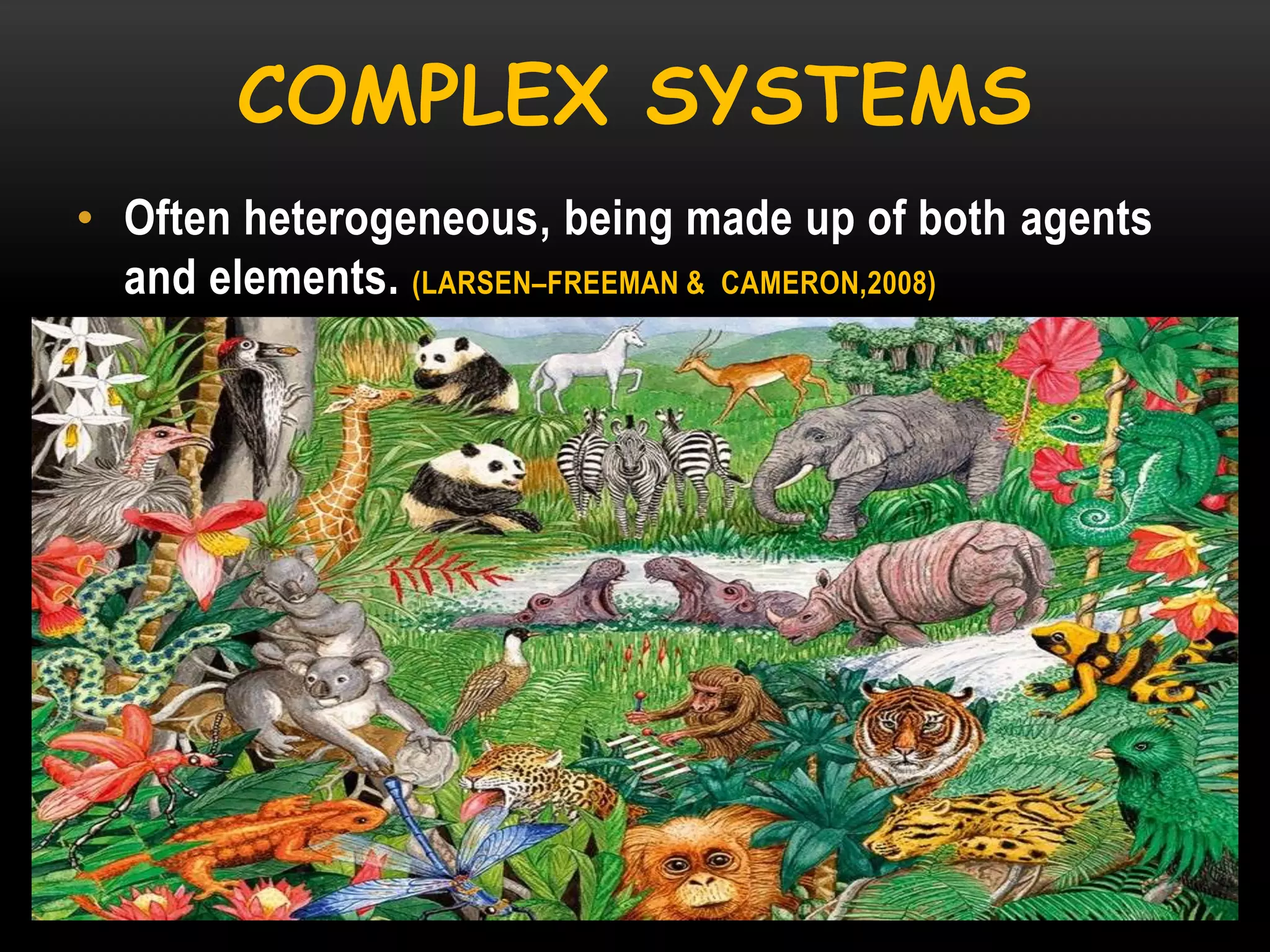
COMPLEX SYSTEMS
• Often heterogeneous, being made up of both agents
and elements. (LARSEN–FREEMAN & CAMERON,2008)
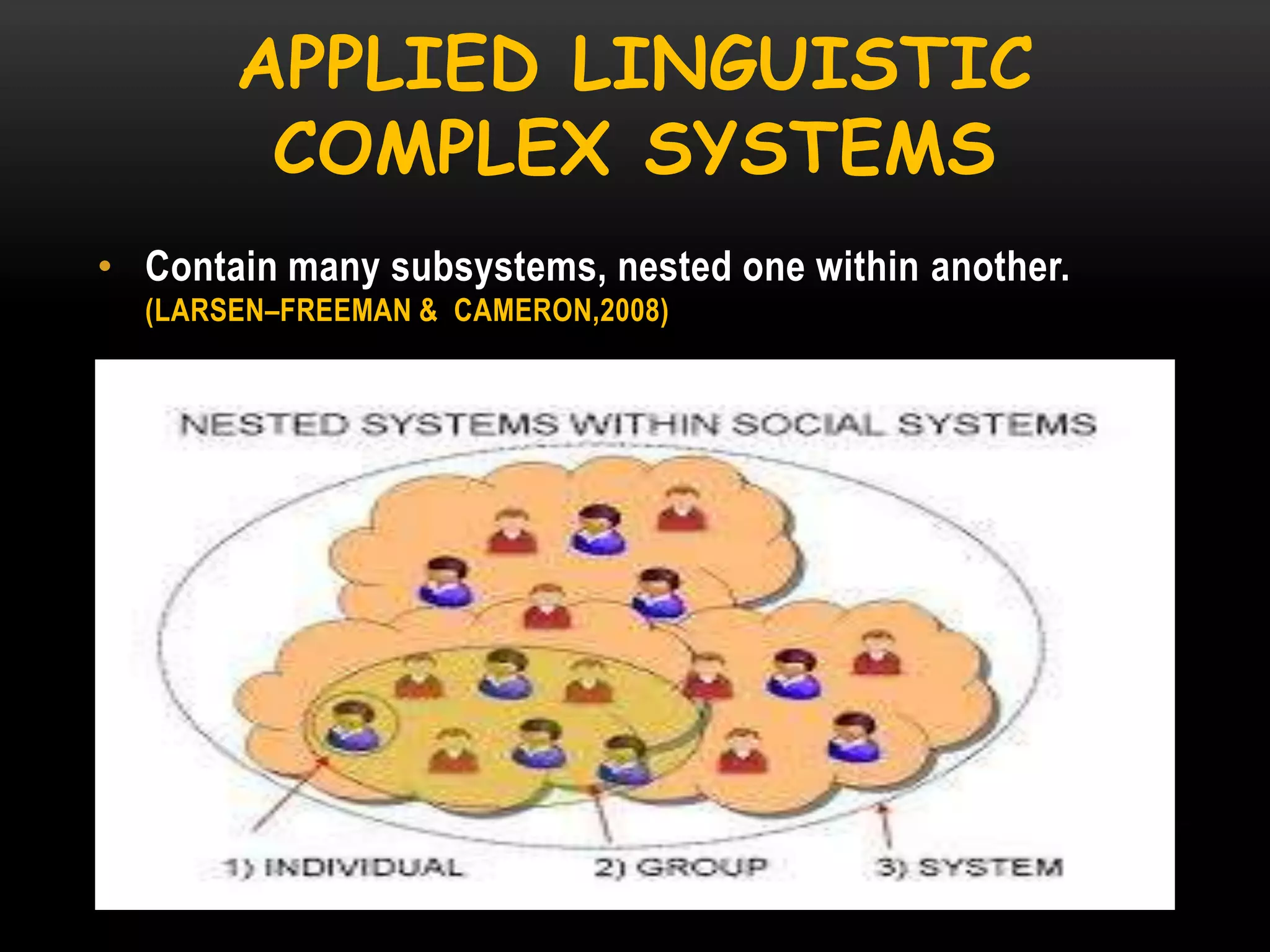
APPLIED LINGUISTIC
COMPLEX SYSTEMS
• Contain many subsystems, nested one within another.
(LARSEN–FREEMAN & CAMERON,2008)
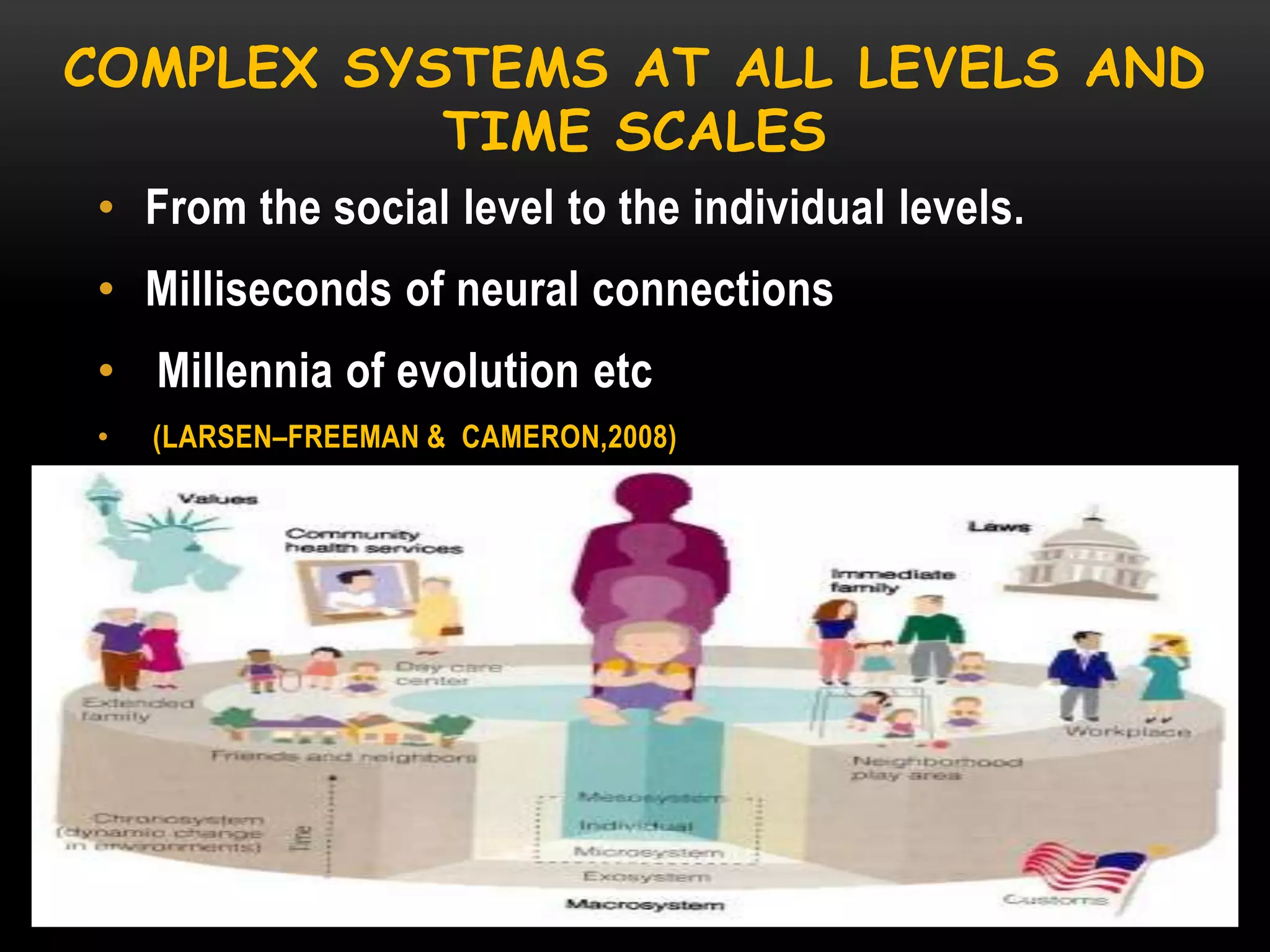
COMPLEX SYSTEMS AT ALL LEVELS AND
TIME SCALES
• From the social level to the individual levels.
• Milliseconds of neural connections
• Millennia of evolution etc
•

(LARSEN–FREEMAN & CAMERON,2008)

• va
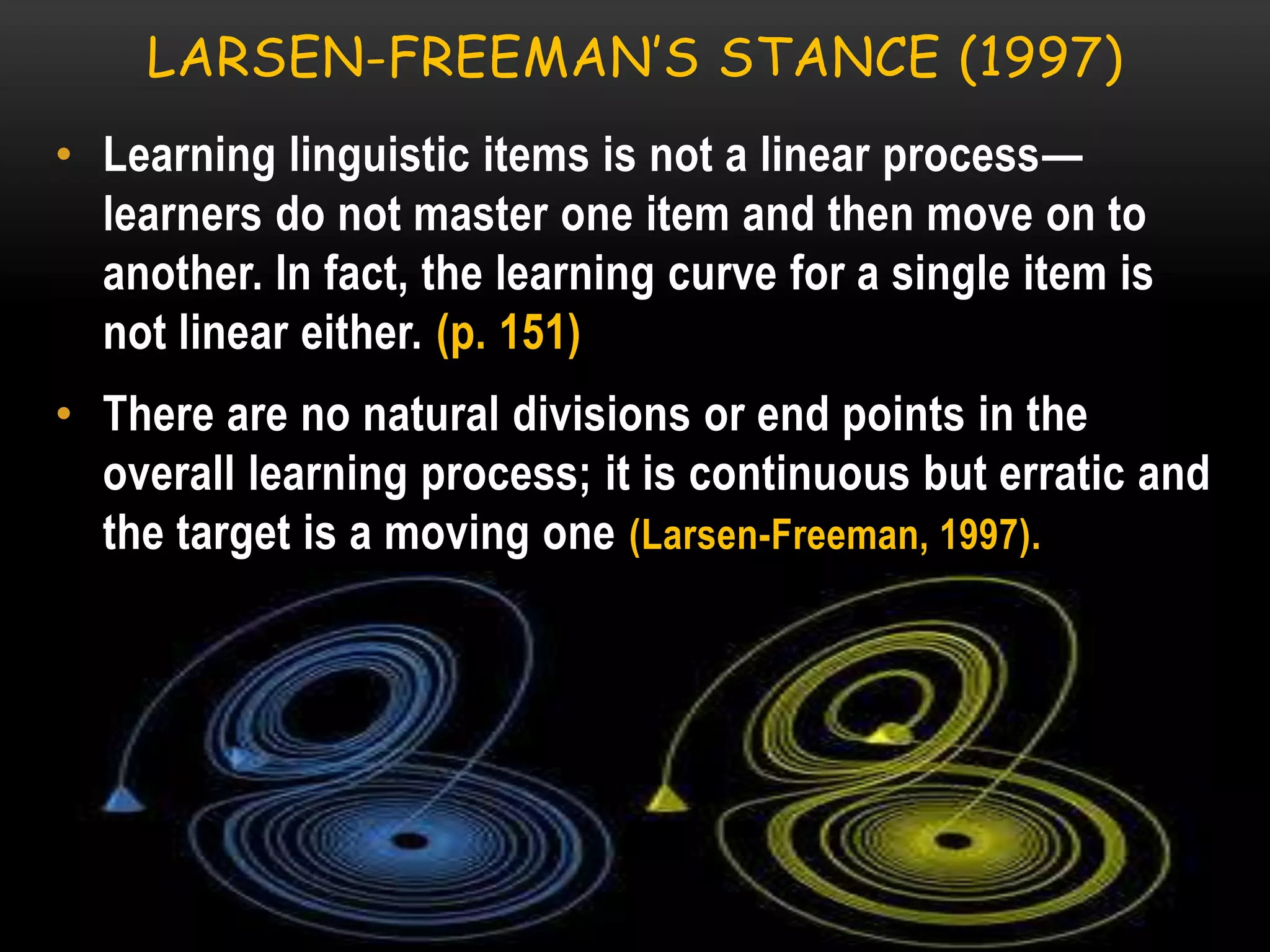
LARSEN-FREEMAN’S STANCE (1997)
• Learning linguistic items is not a linear process—
learners do not master one item and then move on to
another. In fact, the learning curve for a single item is
not linear either. (p. 151)
• There are no natural divisions or end points in the
overall learning process; it is continuous but erratic and
the target is a moving one (Larsen-Freeman, 1997).
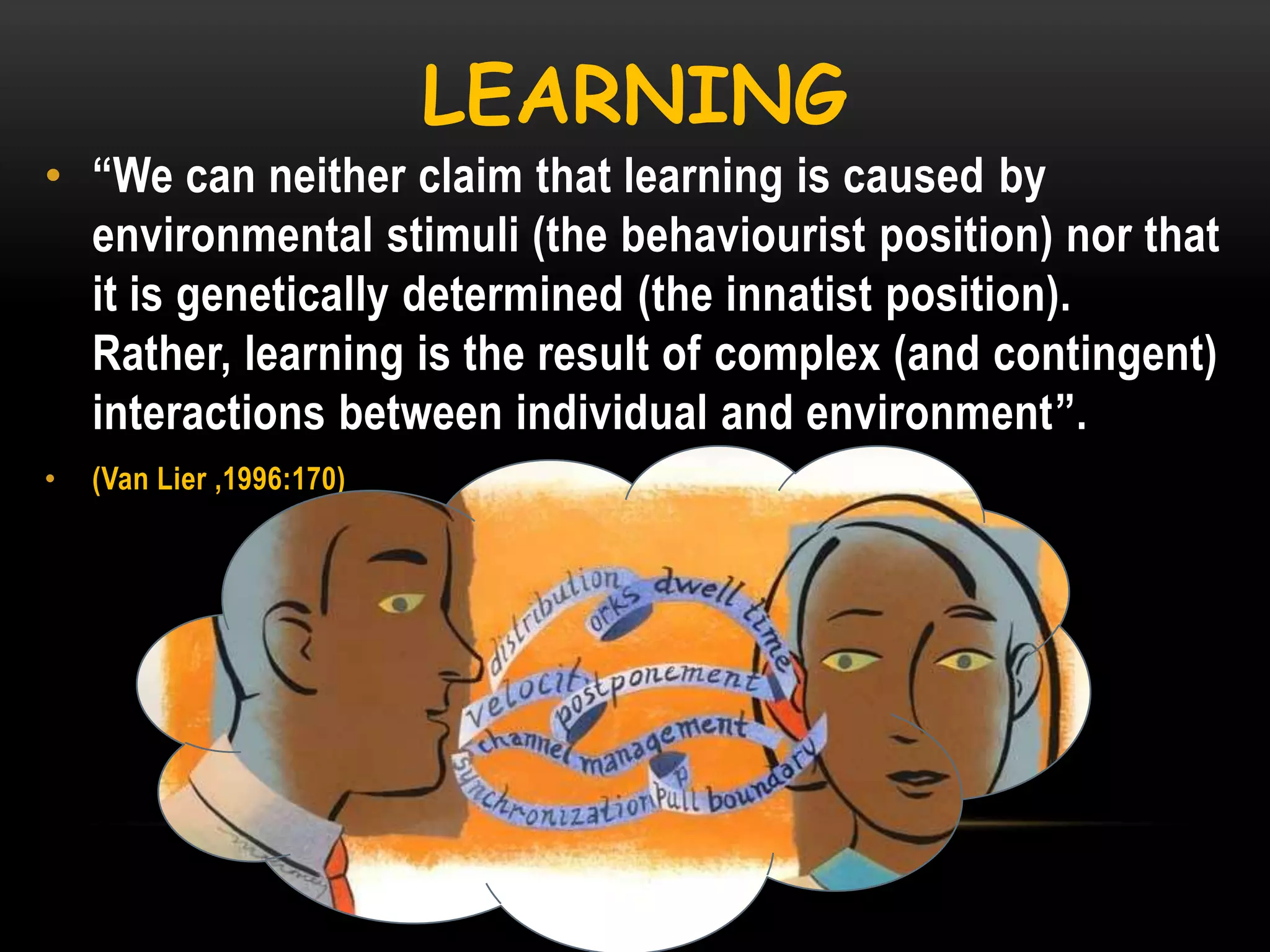
LEARNING
• ―We can neither claim that learning is caused by
environmental stimuli (the behaviourist position) nor that
it is genetically determined (the innatist position).
Rather, learning is the result of complex (and contingent)
interactions between individual and environment‖.
•

(Van Lier ,1996:170)
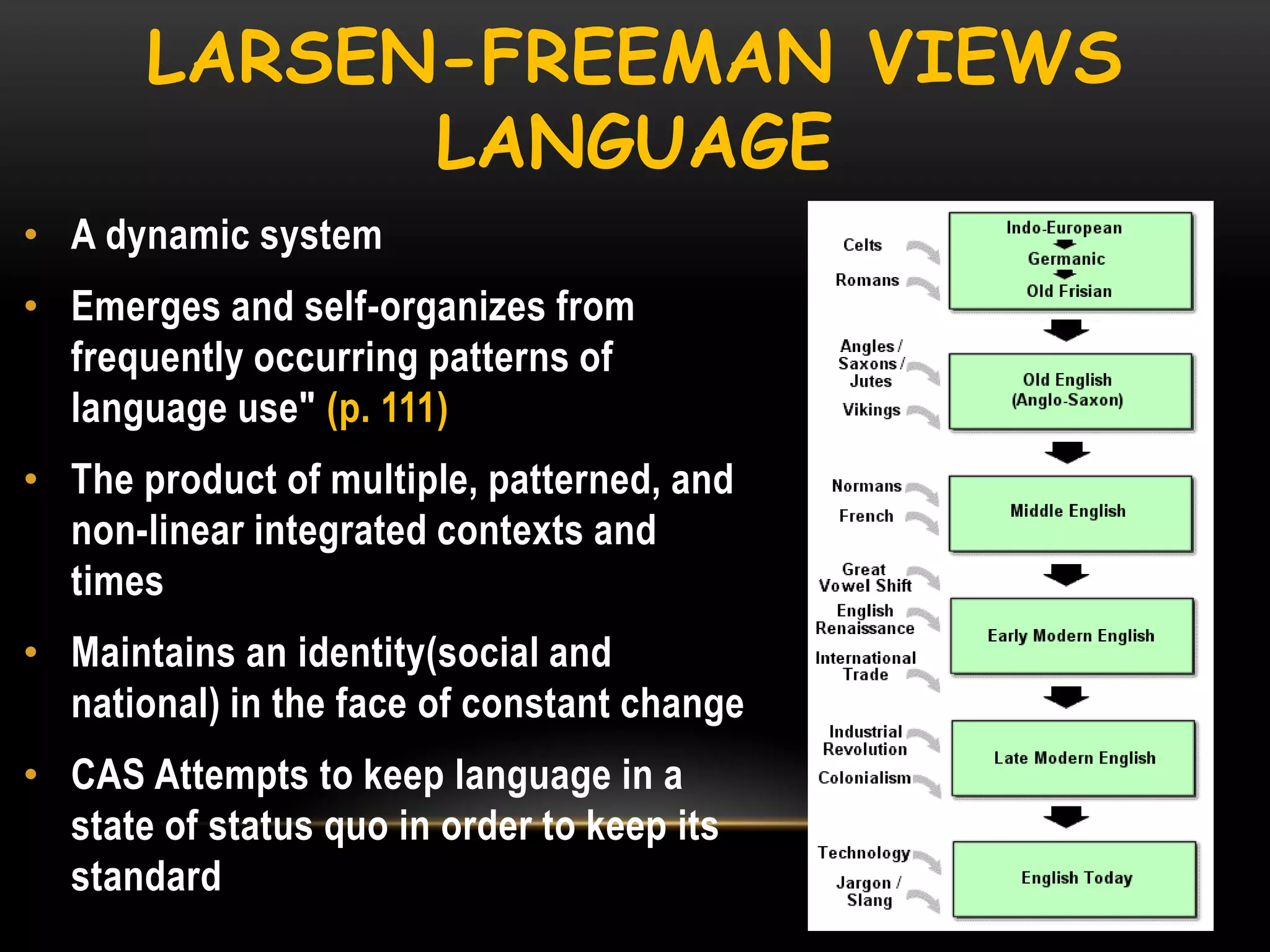
LARSEN-FREEMAN VIEWS
LANGUAGE
• A dynamic system
• Emerges and self-organizes from
frequently occurring patterns of
language use" (p. 111)
• The product of multiple, patterned, and
non-linear integrated contexts and
times
• Maintains an identity(social and
national) in the face of constant change

• CAS Attempts to keep language in a
state of status quo in order to keep its
standard
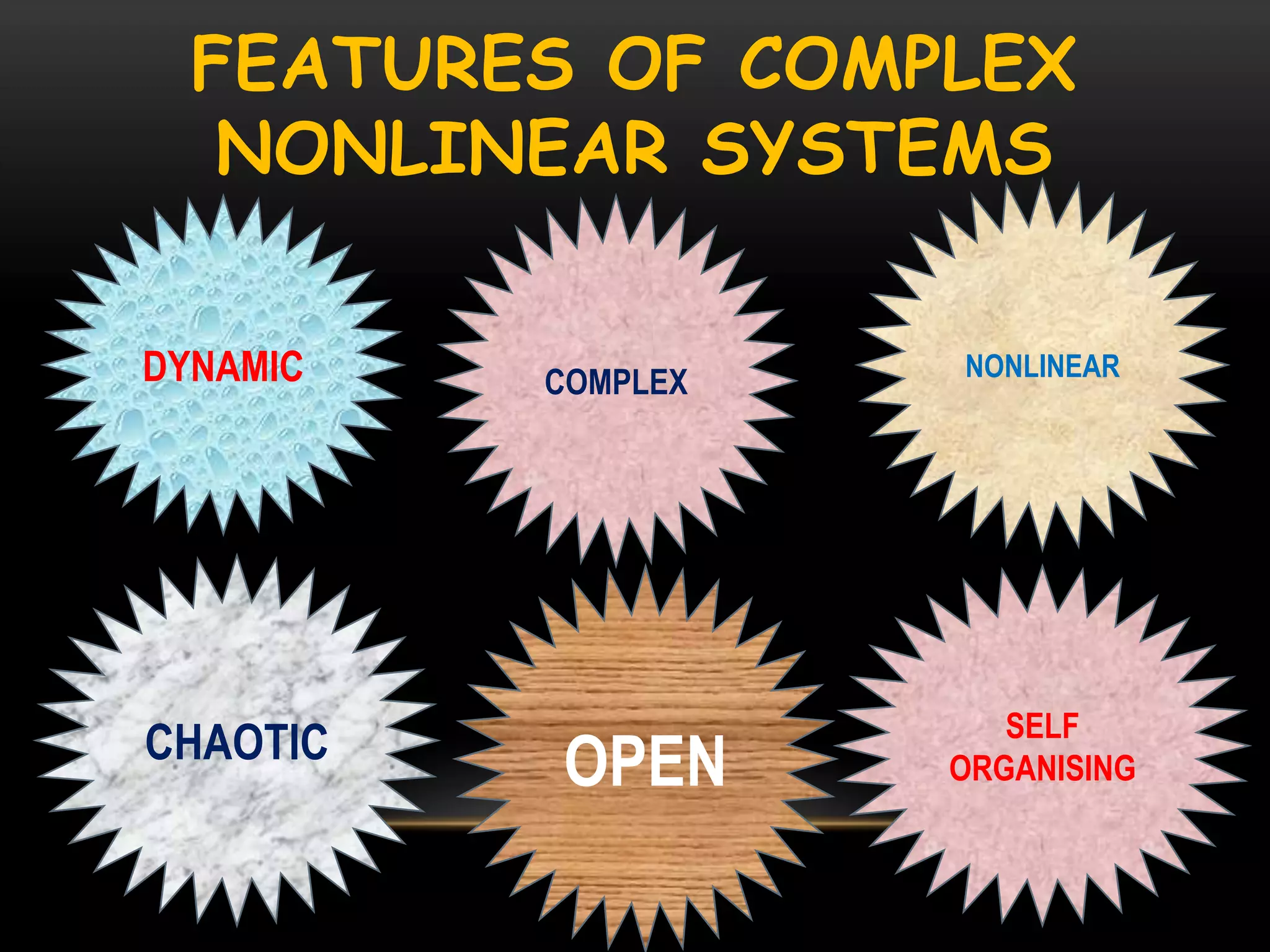
FEATURES OF COMPLEX
NONLINEAR SYSTEMS
DYNAMIC

CHAOTIC

COMPLEX

OPEN

NONLINEAR

SELF
ORGANISING
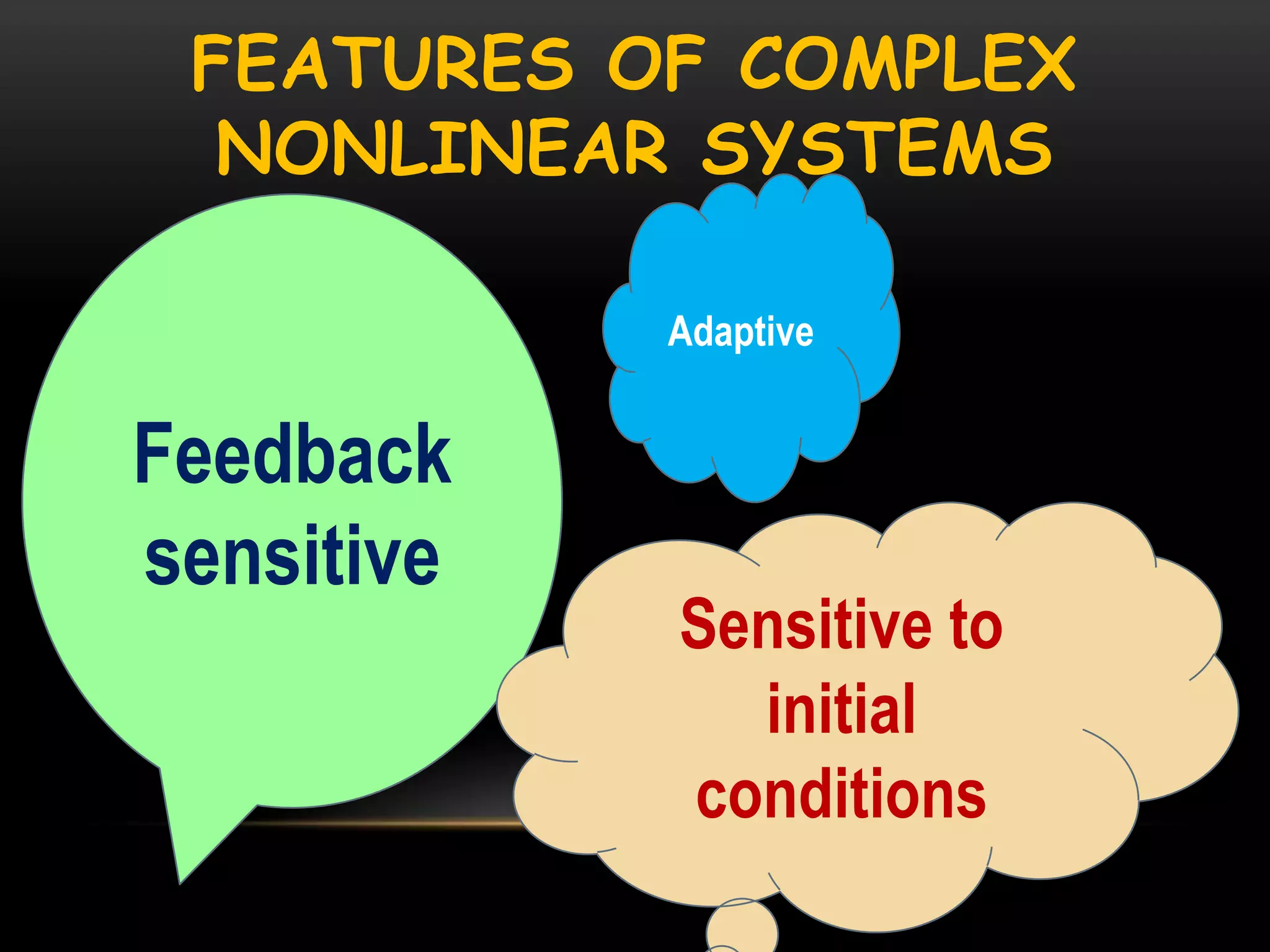
FEATURES OF COMPLEX
NONLINEAR SYSTEMS
Adaptive

Feedback
sensitive

Sensitive to
initial
conditions
UNPREDICTABILITY
• The weather is constantly changing
• Also stays within the boundaries of climate.
• The climate 'We can tell where the system cannot be, and
we can identify the states that the system is most likely to
be, but we cannot tell exactly where the system will be'
(Mohanan 1992 650)
SENSITIVE TO INITIAL
CONDITIONS
• UG the initial condition of human language

• —it contains certain substantive universal
principles that apply to constrain the shape of
human languages
• For instance, there are a small number of core
phonological patterns that apply to all
languages, e g voicing assimilation of obstruent
in all languages
• (Mohanan 1992)
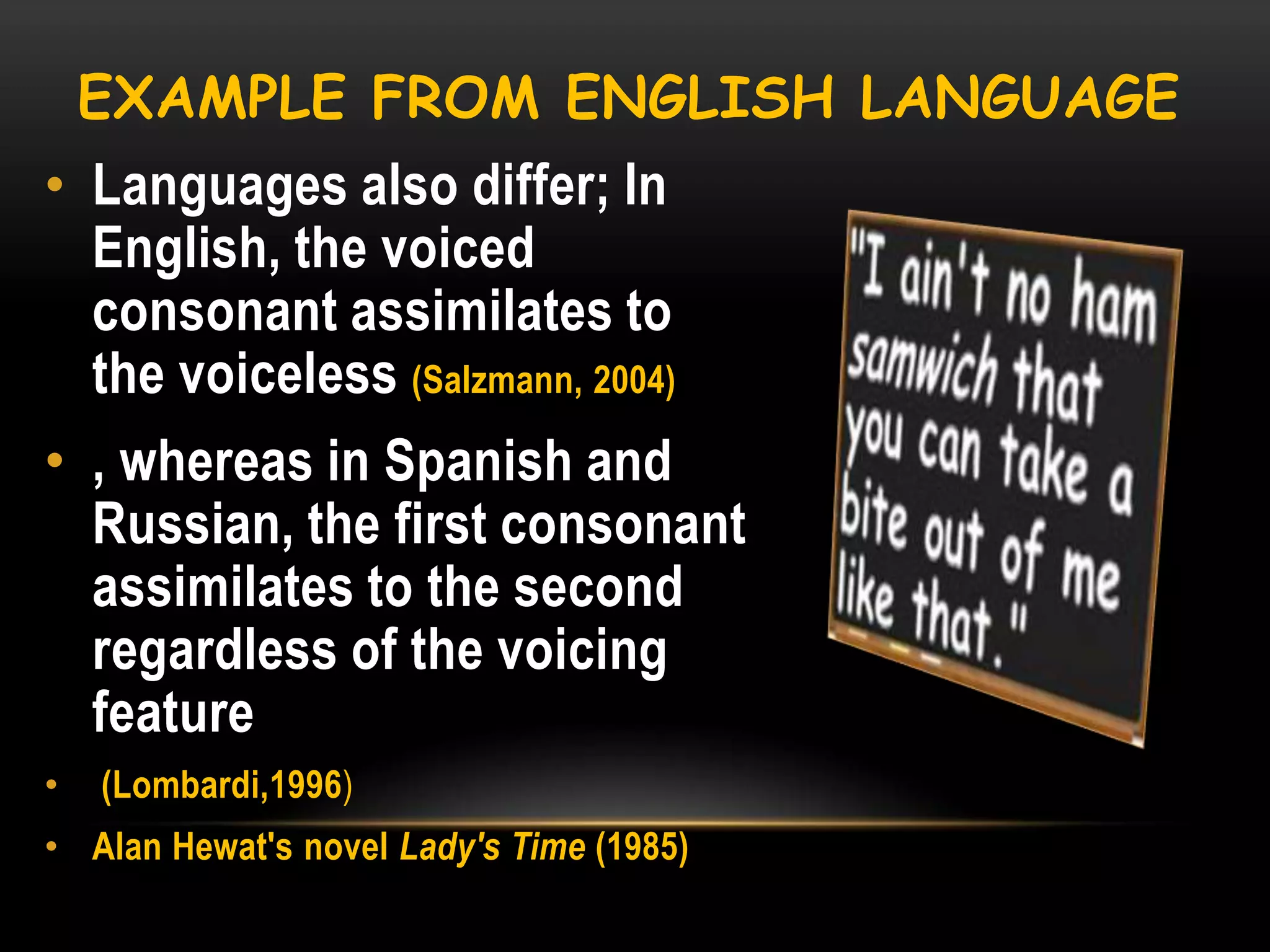
EXAMPLE FROM ENGLISH LANGUAGE

• Languages also differ; In
English, the voiced
consonant assimilates to
the voiceless (Salzmann, 2004)
• , whereas in Spanish and
Russian, the first consonant
assimilates to the second
regardless of the voicing
feature
•

(Lombardi,1996)

• Alan Hewat's novel Lady's Time (1985)
(DST) AS NONLINEAR CHANGE
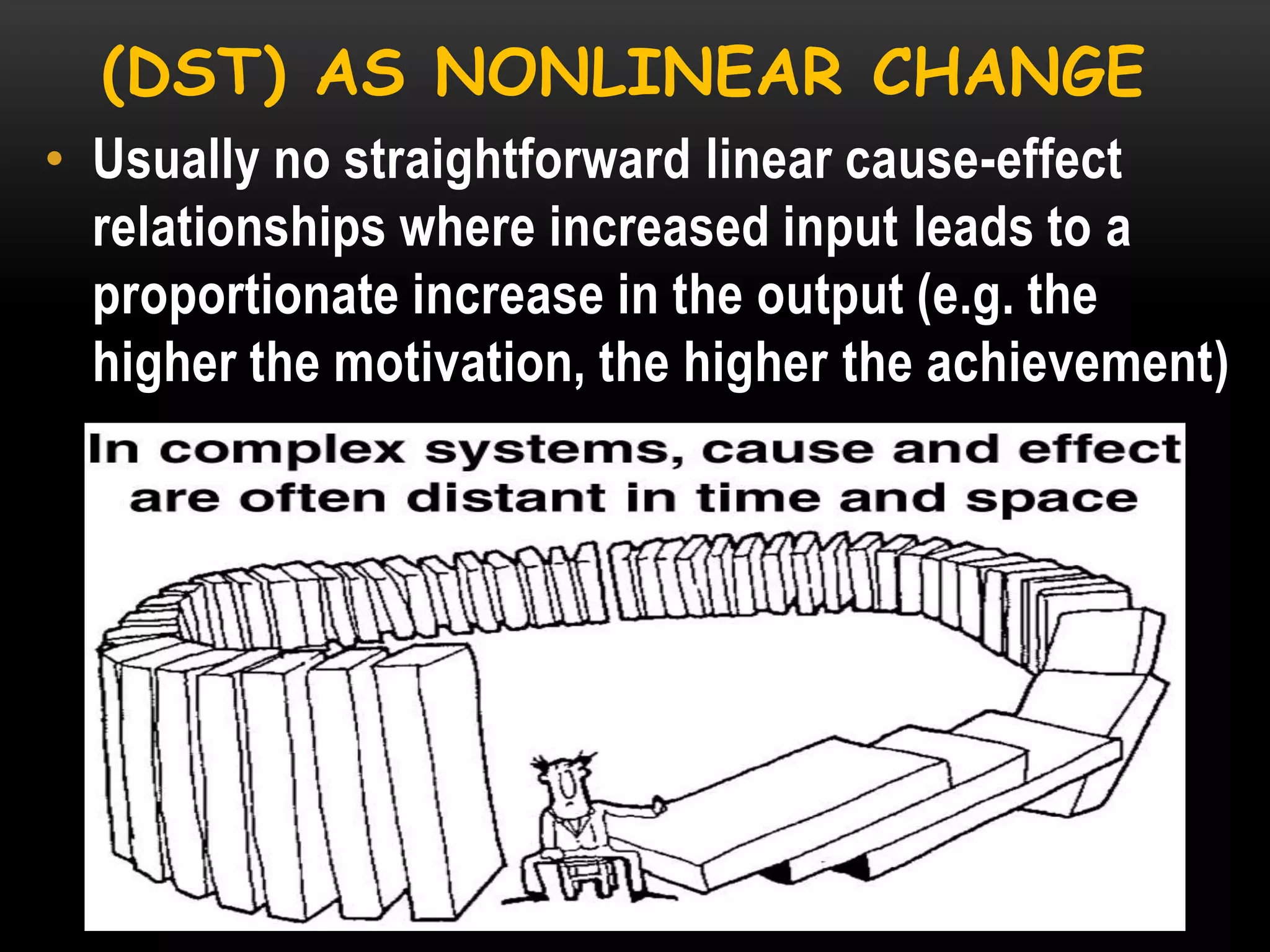
• Usually no straightforward linear cause-effect
relationships where increased input leads to a
proportionate increase in the output (e.g. the
higher the motivation, the higher the achievement)
BUTTERFLY EFFECT
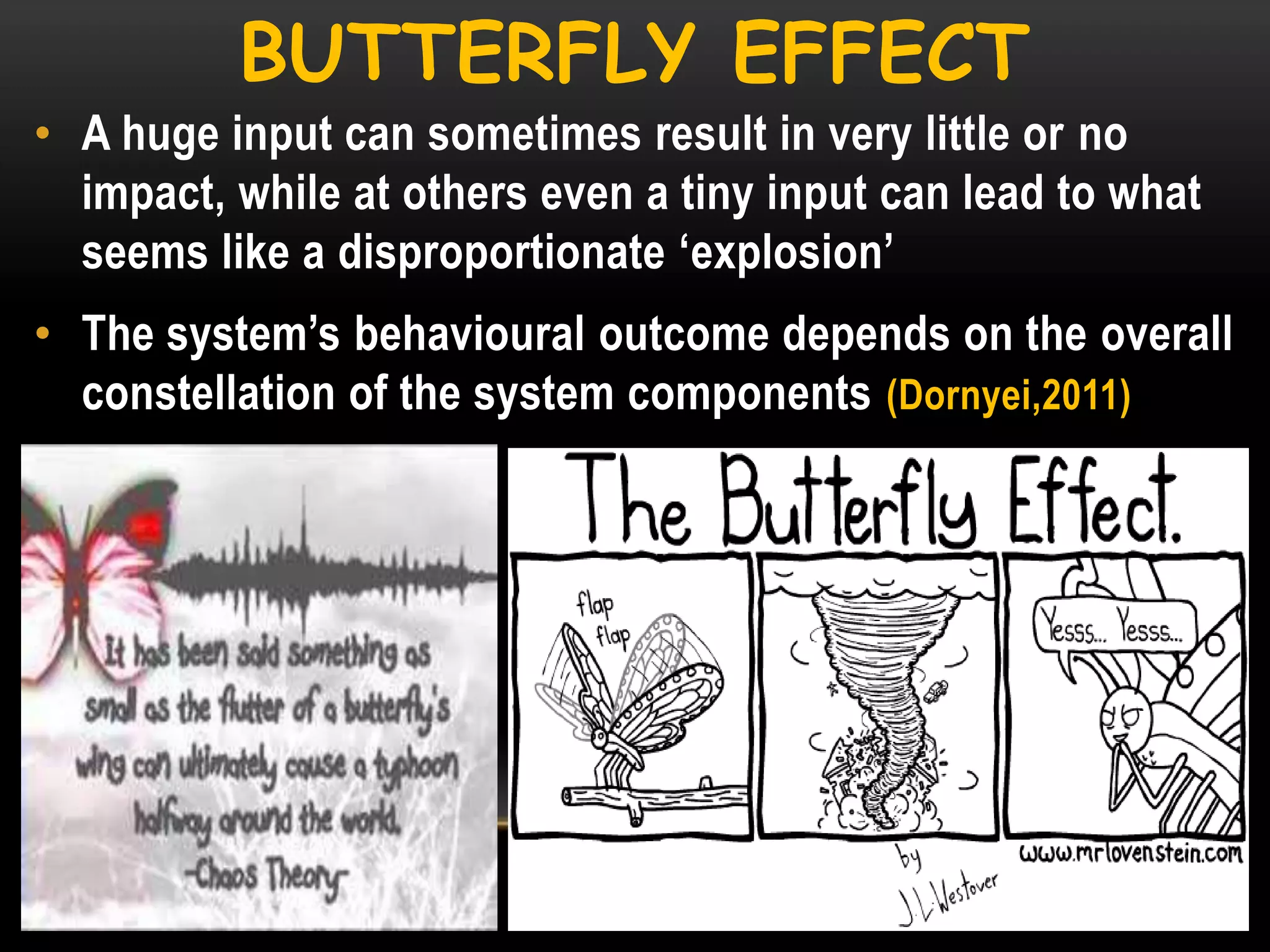
• A huge input can sometimes result in very little or no
impact, while at others even a tiny input can lead to what
seems like a disproportionate ‗explosion‘

• The system‘s behavioural outcome depends on the overall
constellation of the system components (Dornyei,2011)
BUTTERFLY EFFECT IN LANGUAGE
LEARNING
• The various interlinked components of the system can moderate
the impact of any input(both in a positive and negative way ).

• (Dornyei,2011)
LANGUAGE IS ALSO COMPLEX
•

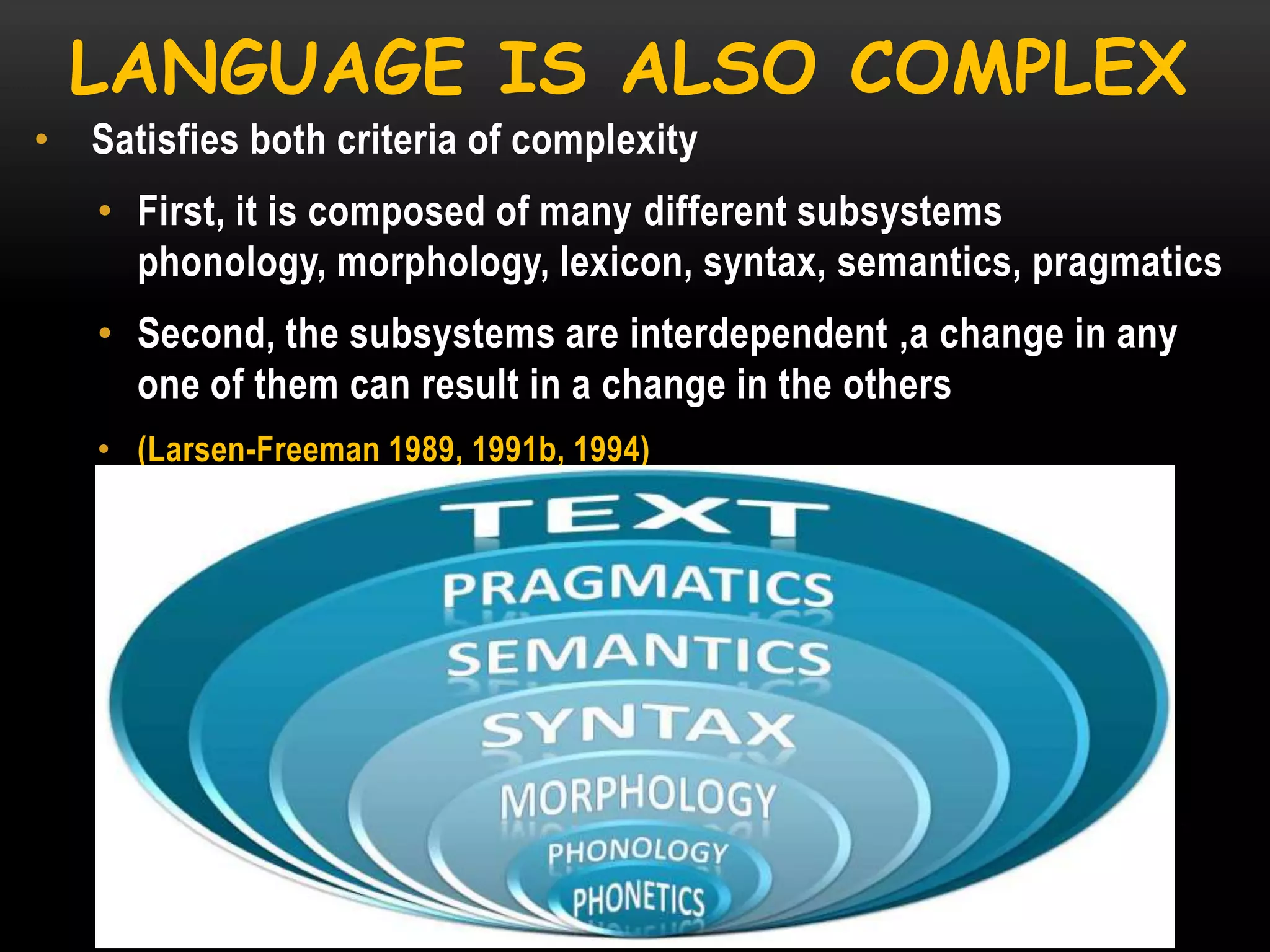
Satisfies both criteria of complexity
• First, it is composed of many different subsystems
phonology, morphology, lexicon, syntax, semantics, pragmatics

• Second, the subsystems are interdependent ,a change in any
one of them can result in a change in the others
• (Larsen-Freeman 1989, 1991b, 1994)
LARSEN-FREEMAN AND CAMERON
(2008:96)
• First and second languages are both live complex
systems which change over time.
• ―we change a language by using it‖.
FUNCTIONS OF L1 AND L2
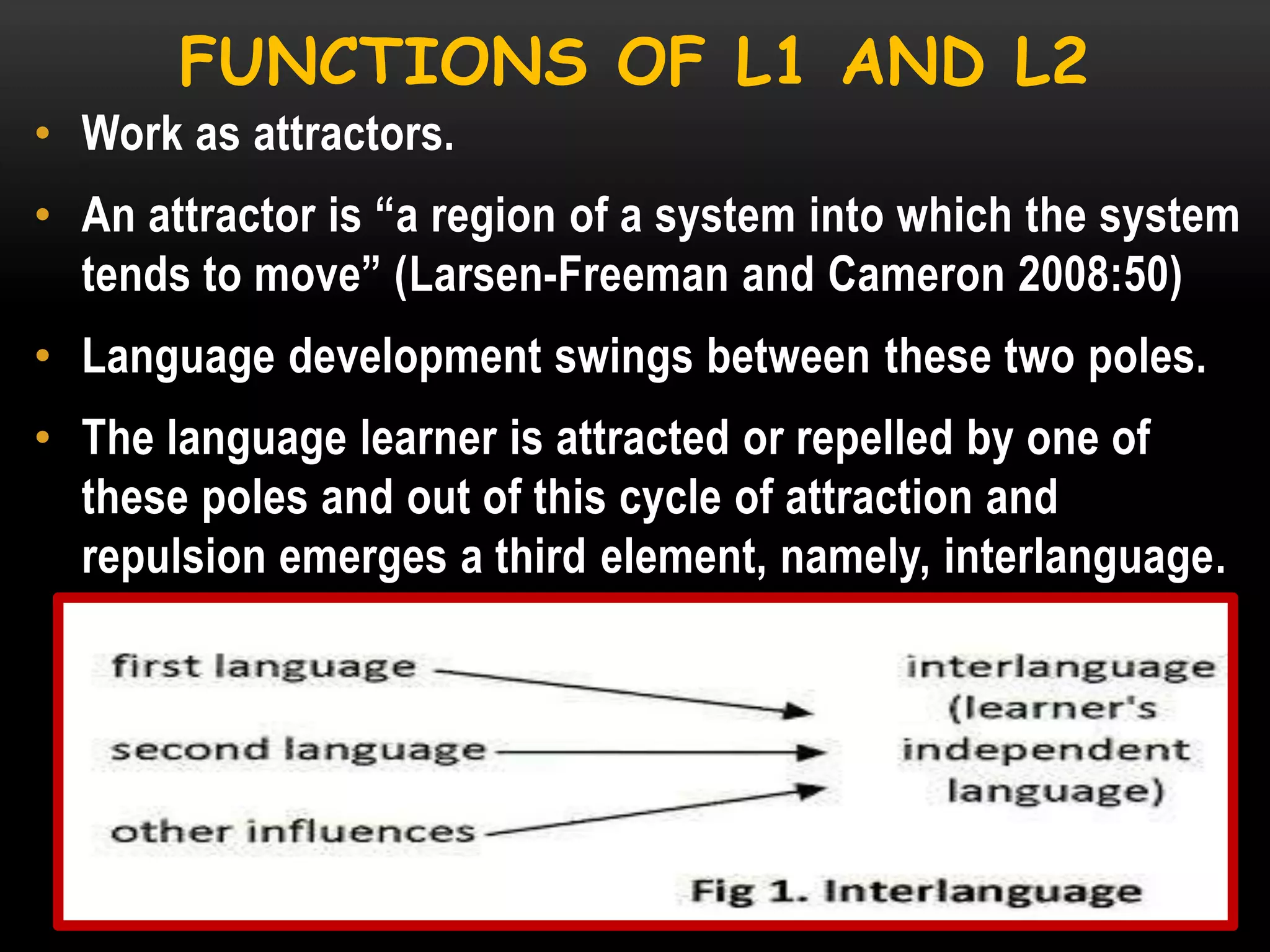
• Work as attractors.
• An attractor is ―a region of a system into which the system
tends to move‖ (Larsen-Freeman and Cameron 2008:50)

• Language development swings between these two poles.
• The language learner is attracted or repelled by one of
these poles and out of this cycle of attraction and
repulsion emerges a third element, namely, interlanguage.
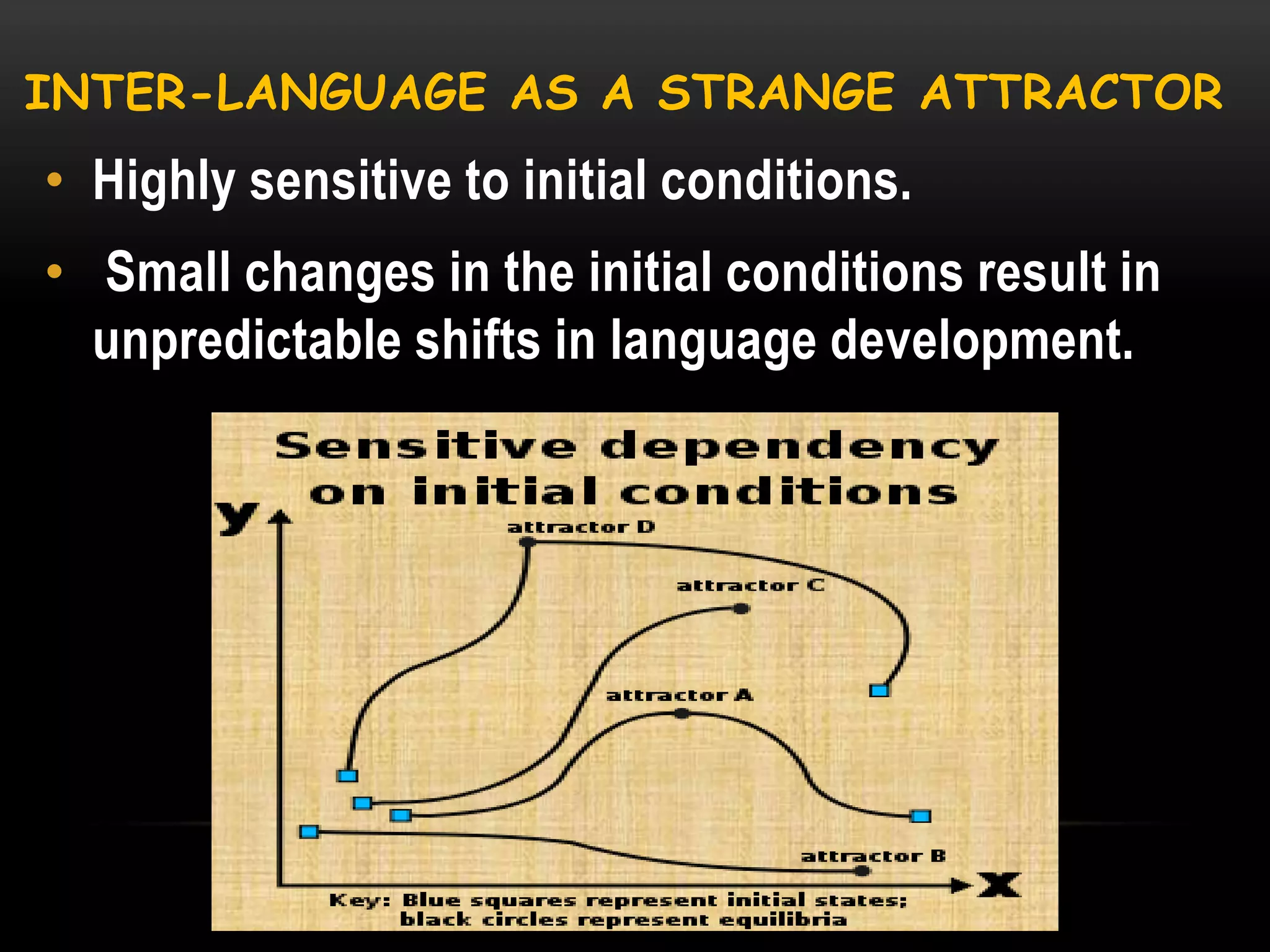
INTER-LANGUAGE AS A STRANGE ATTRACTOR

• Highly sensitive to initial conditions.
• Small changes in the initial conditions result in
unpredictable shifts in language development.
BYBEE’S, VIEW (2006)
• The fact is that language forms are being continually transformed
by use .
• Any linguistic representation in the learner‘s mind is strongly tied
to the experience that a speaker has had with language
•

May bear little resemblance to forms that NSs employ or that fit
linguists‘ categories.
POINT OF DIFFERENCE
The behavior of the whole emerges out of the interaction of the
subsystems. Thus, describing each subsystem tells us about the
subsystems, it does not do justice to the whole of language.
(Larsen-Freeman and Cameron ,2008)
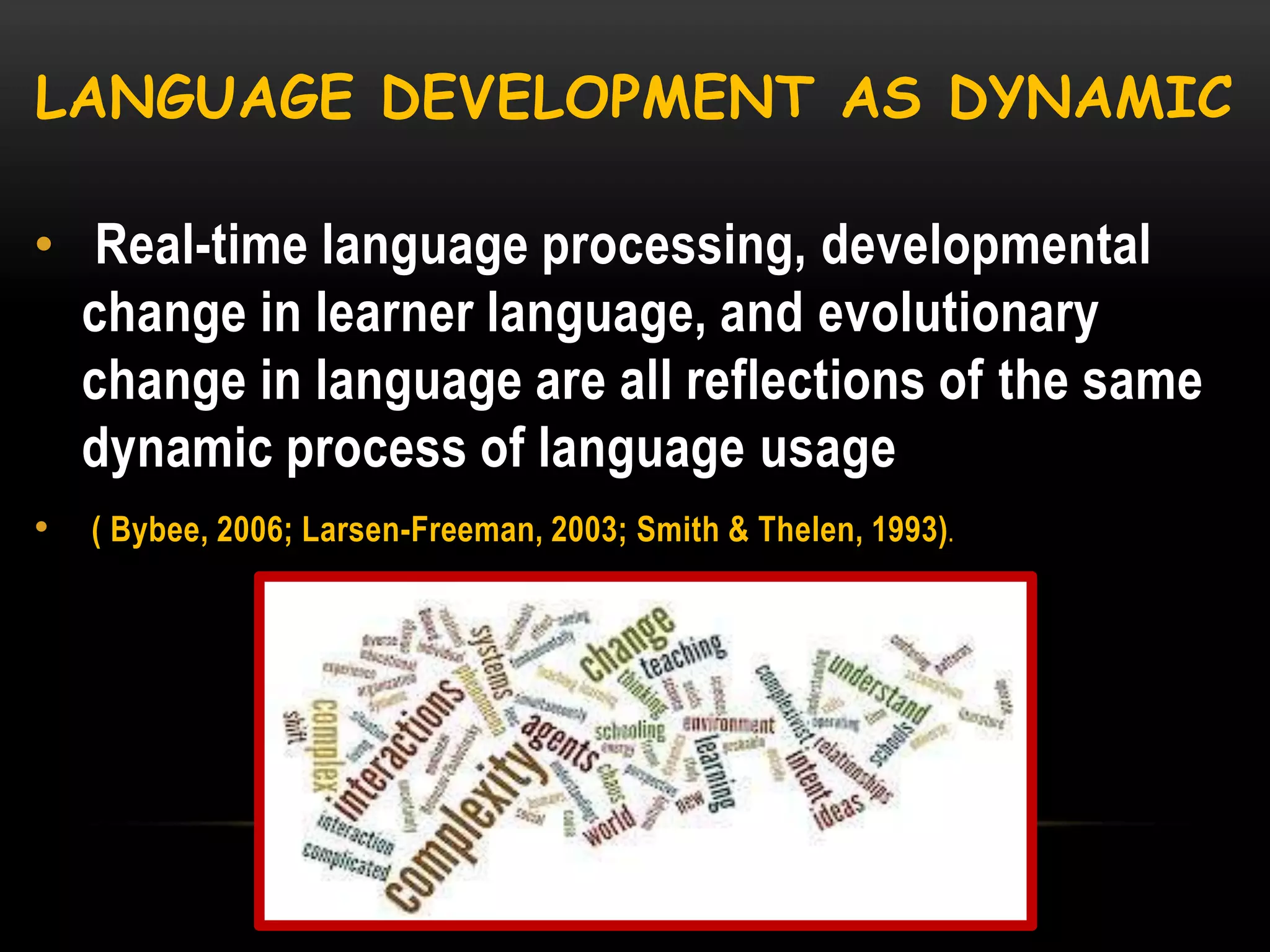
LANGUAGE DEVELOPMENT AS DYNAMIC
• Real-time language processing, developmental
change in learner language, and evolutionary
change in language are all reflections of the same
dynamic process of language usage
•

( Bybee, 2006; Larsen-Freeman, 2003; Smith & Thelen, 1993).
MAIN STANDPOINT

• Researchers' grammars
containing static rules do not
do justice to the everchanging character of
learners' internal L2
grammars.
CHANGES FROM TRADITIONAL
RESEARCH

• (1)The Nature of Hypotheses
• Many complex systems are interconnected
and coordinated
• Not always possible to explain behavior, and
changes in behavior, by detailing their
separate components and roles (Clark ,1997)
• Prediction (or forecasting (Traditional)

• Retrodiction (or retrocasting (CAS)
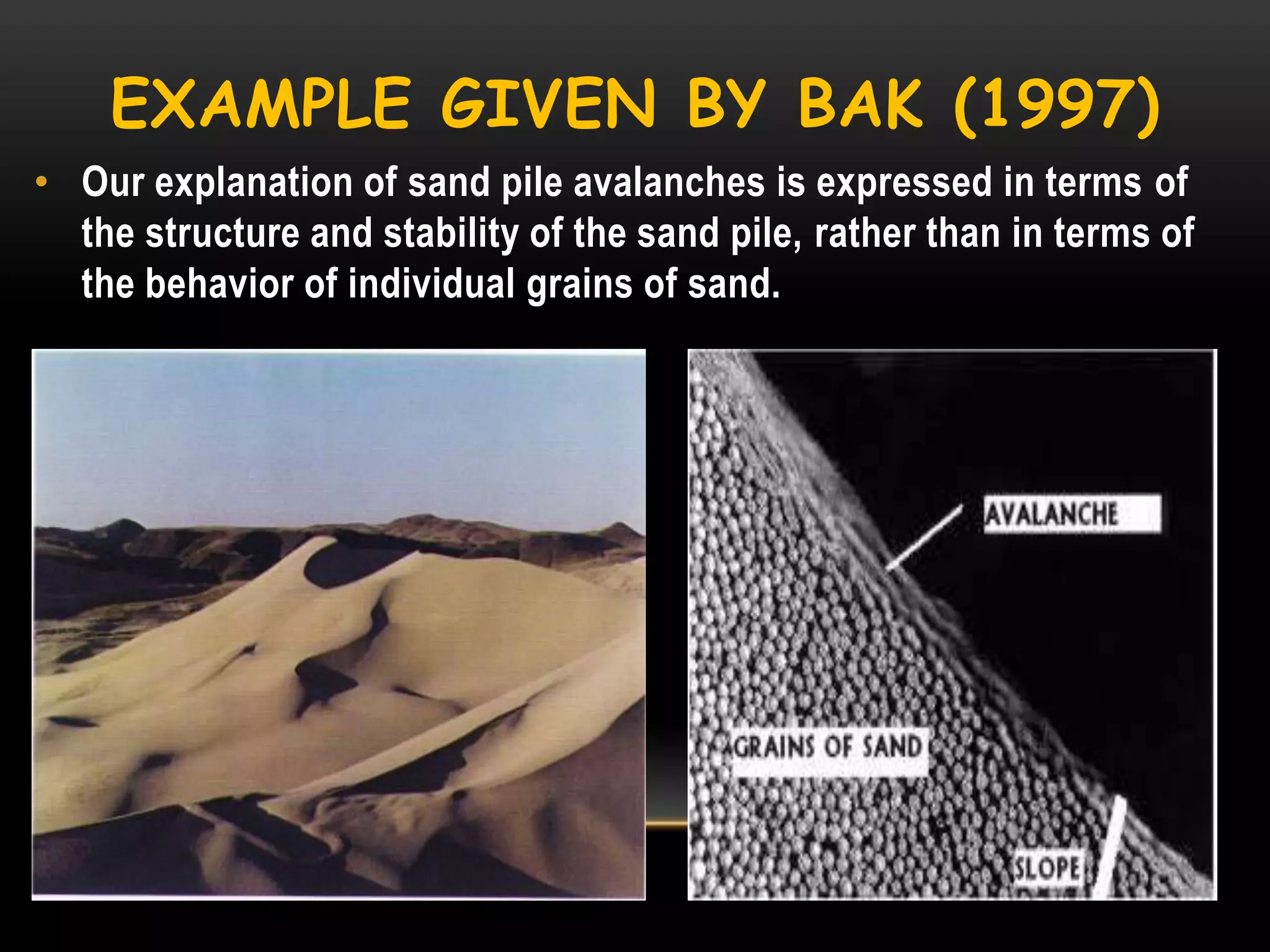
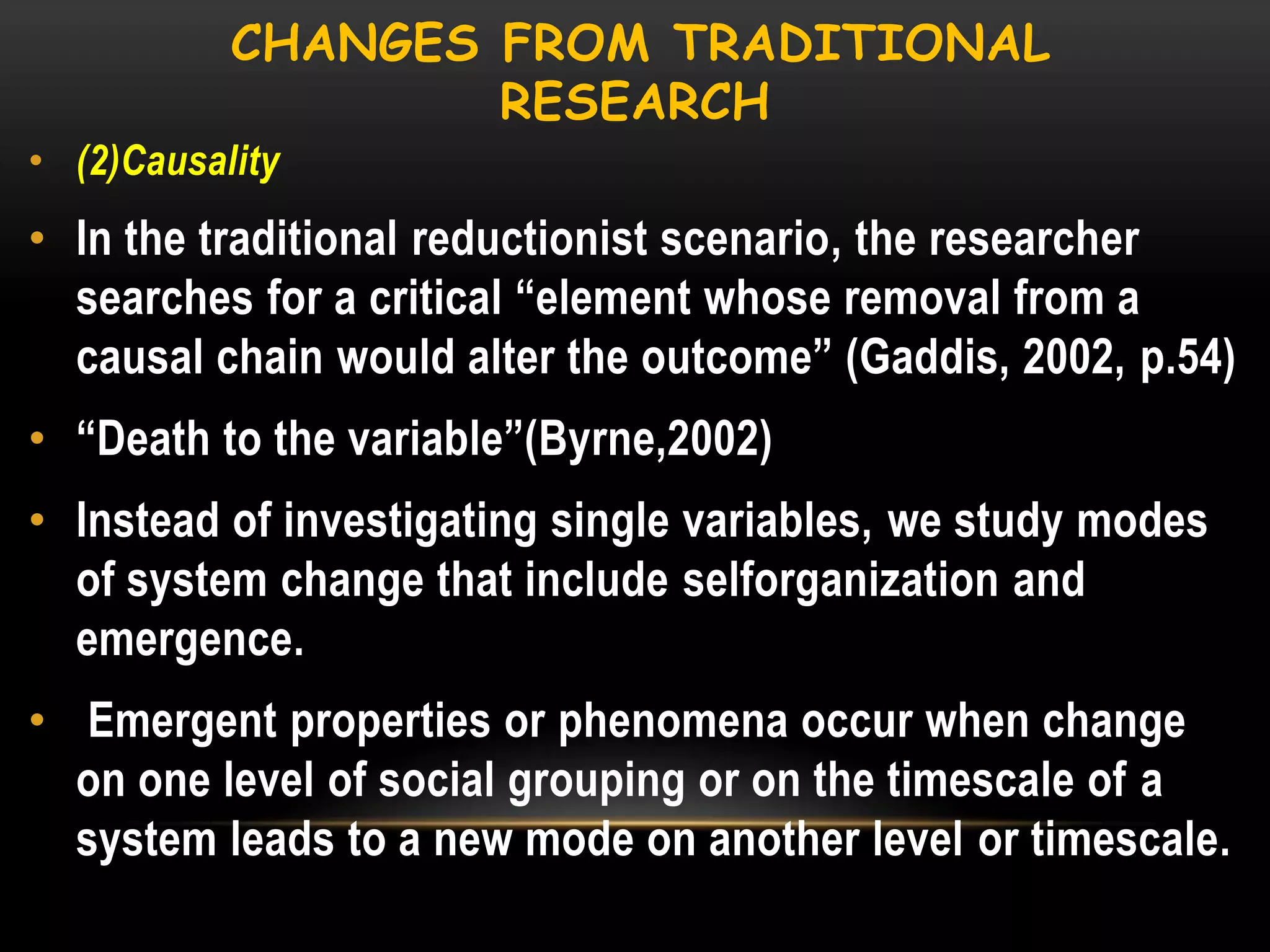
EXAMPLE GIVEN BY BAK (1997)
• Our explanation of sand pile avalanches is expressed in terms of
the structure and stability of the sand pile, rather than in terms of
the behavior of individual grains of sand.
CHANGES FROM TRADITIONAL
RESEARCH
• (2)Causality

• In the traditional reductionist scenario, the researcher
searches for a critical ―element whose removal from a
causal chain would alter the outcome‖ (Gaddis, 2002, p.54)
• ―Death to the variable‖(Byrne,2002)
• Instead of investigating single variables, we study modes
of system change that include selforganization and
emergence.
• Emergent properties or phenomena occur when change
on one level of social grouping or on the timescale of a
system leads to a new mode on another level or timescale.
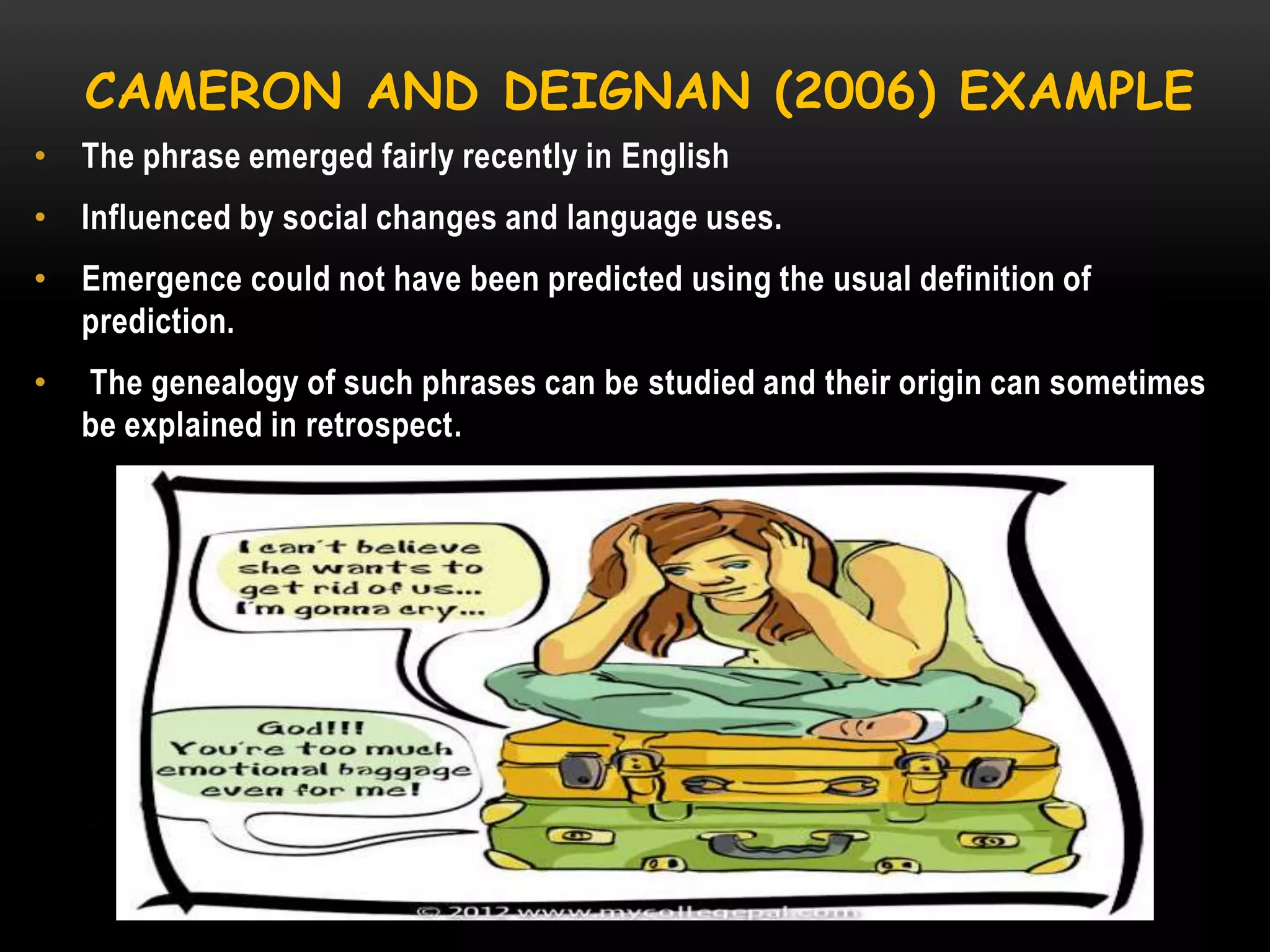
CAMERON AND DEIGNAN (2006) EXAMPLE
• The phrase emerged fairly recently in English
• Influenced by social changes and language uses.
• Emergence could not have been predicted using the usual definition of
prediction.
•

The genealogy of such phrases can be studied and their origin can sometimes
be explained in retrospect.
CHANGES FROM TRADITIONAL RESEARCH
• The Process of Co-adaptation
• In first language learning Dynamic alteration in both; child and the
caretaker language and behaviours
• In classroom between teacher and the students
•

The structure emerges; the lesson

• Multi subsystems at students individual levels
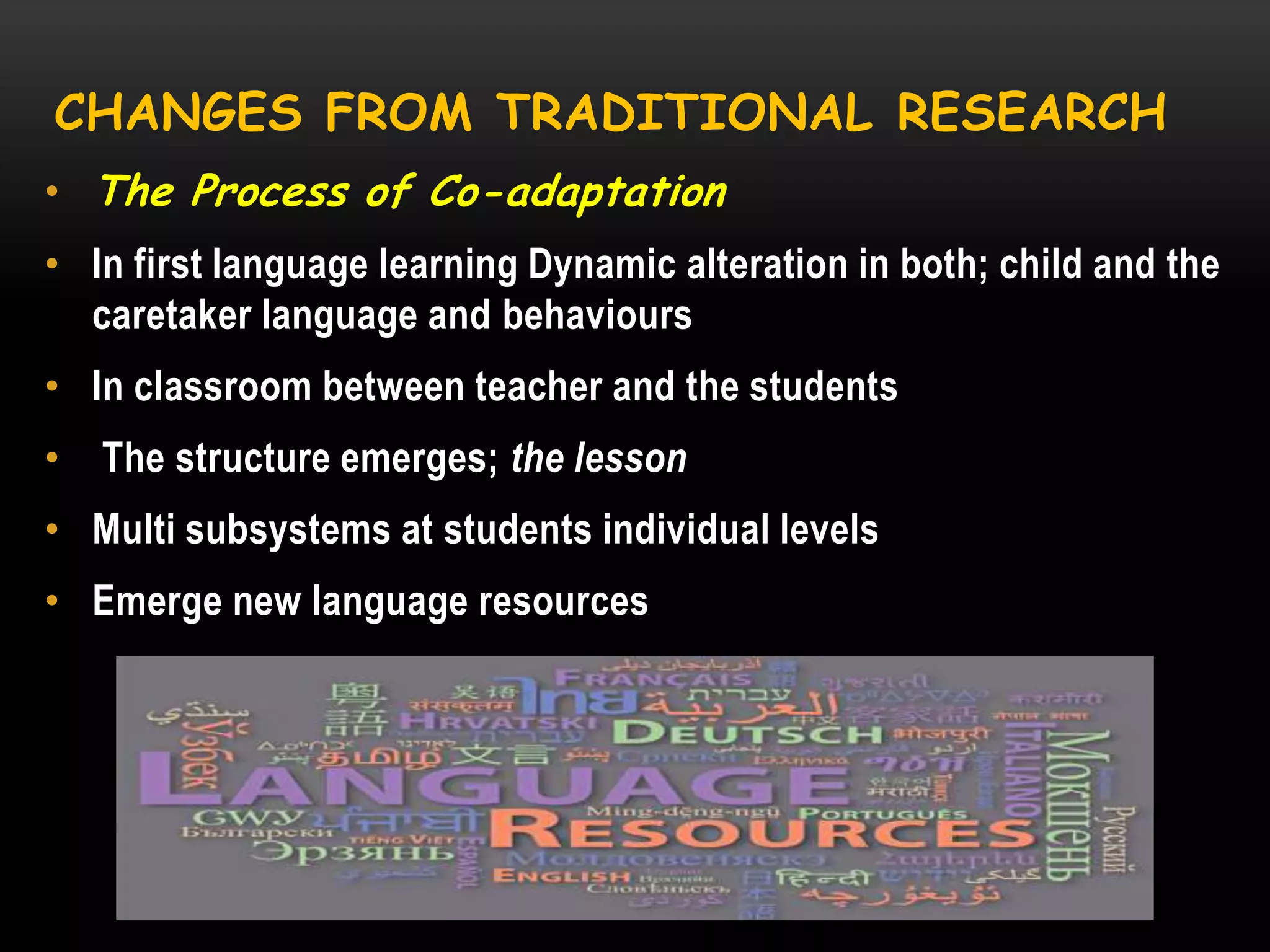
• Emerge new language resources
CHANGES FROM TRADITIONAL
RESEARCH

• No Single Independent Variable

• The relationships are reciprocal but not
symmetrical
• A web of interacting components

• Entertain Supportive, Competitive and conditional
relationships (Van Geert and Steenbeek,in press,p:9)
• Everything is connected to some way to
everything else (Gaddis,2002,p.64)
CHANGES FROM TRADITIONAL
RESEARCH

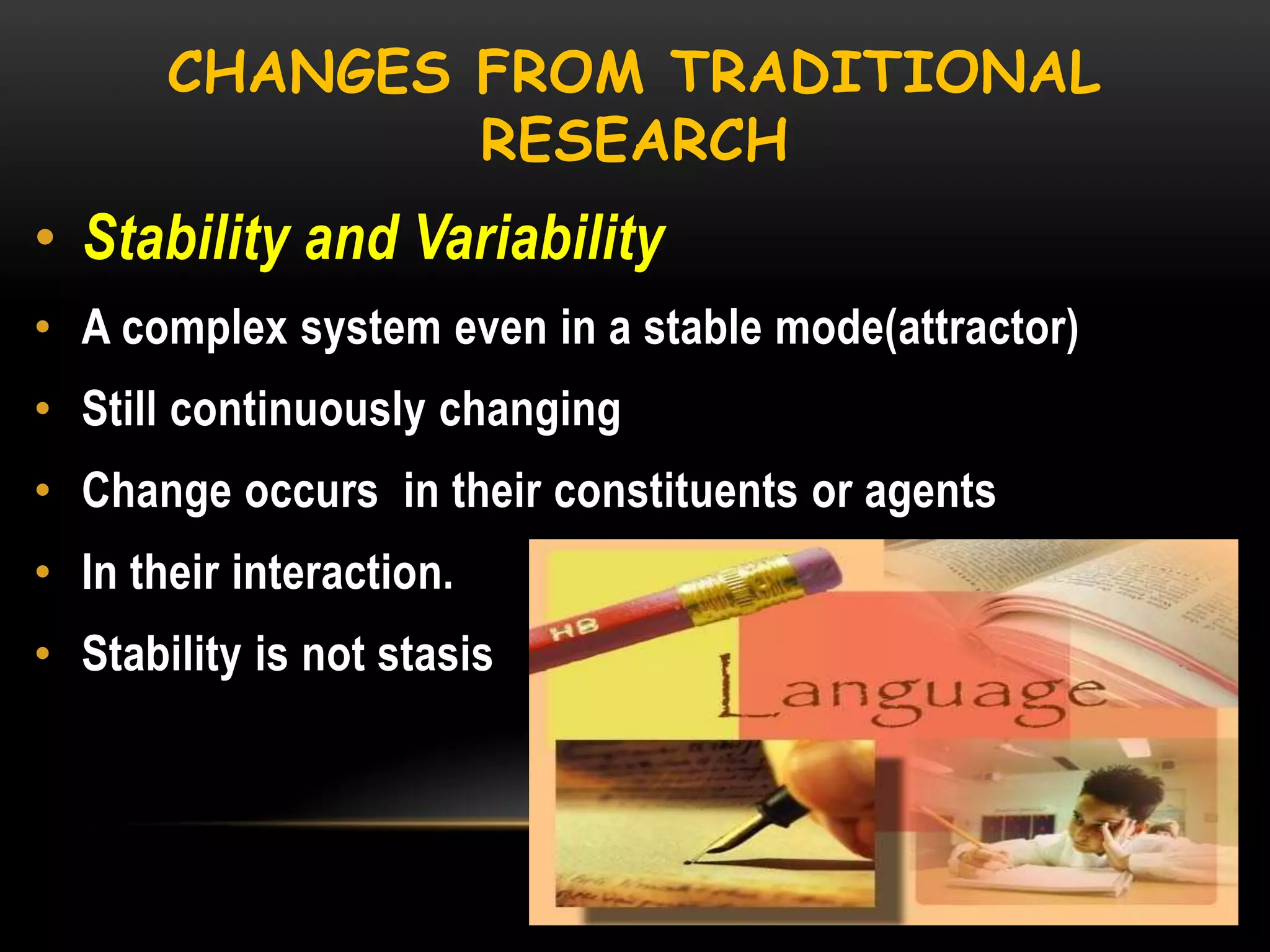
• Stability and Variability
• A complex system even in a stable mode(attractor)
• Still continuously changing
• Change occurs in their constituents or agents

• In their interaction.
• Stability is not stasis
CHANGES FROM TRADITIONAL
RESEARCH
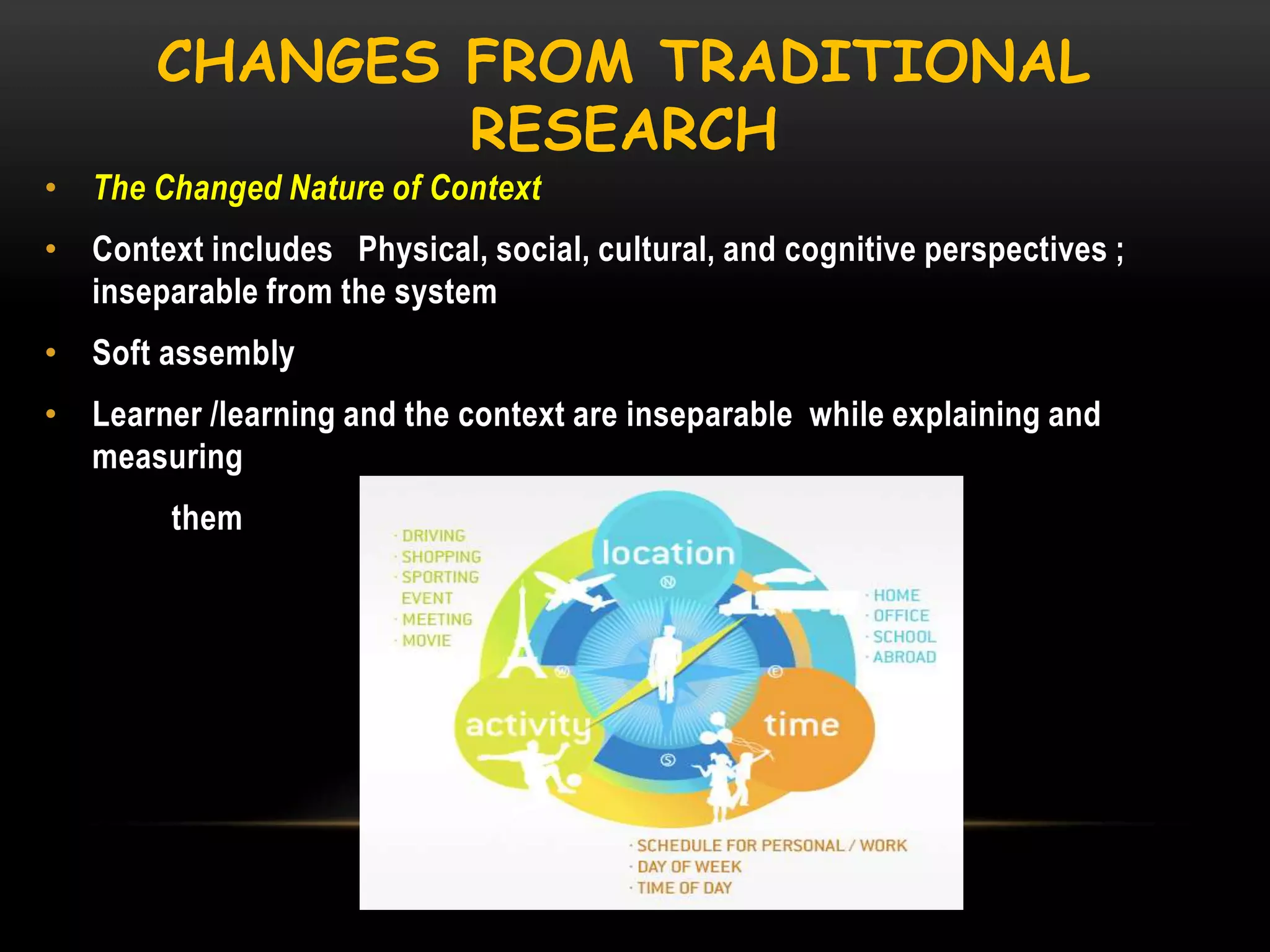
• The Changed Nature of Context
• Context includes Physical, social, cultural, and cognitive perspectives ;
inseparable from the system
• Soft assembly
• Learner /learning and the context are inseparable while explaining and
measuring
them
CHANGES FROM TRADITIONAL
RESEARCH
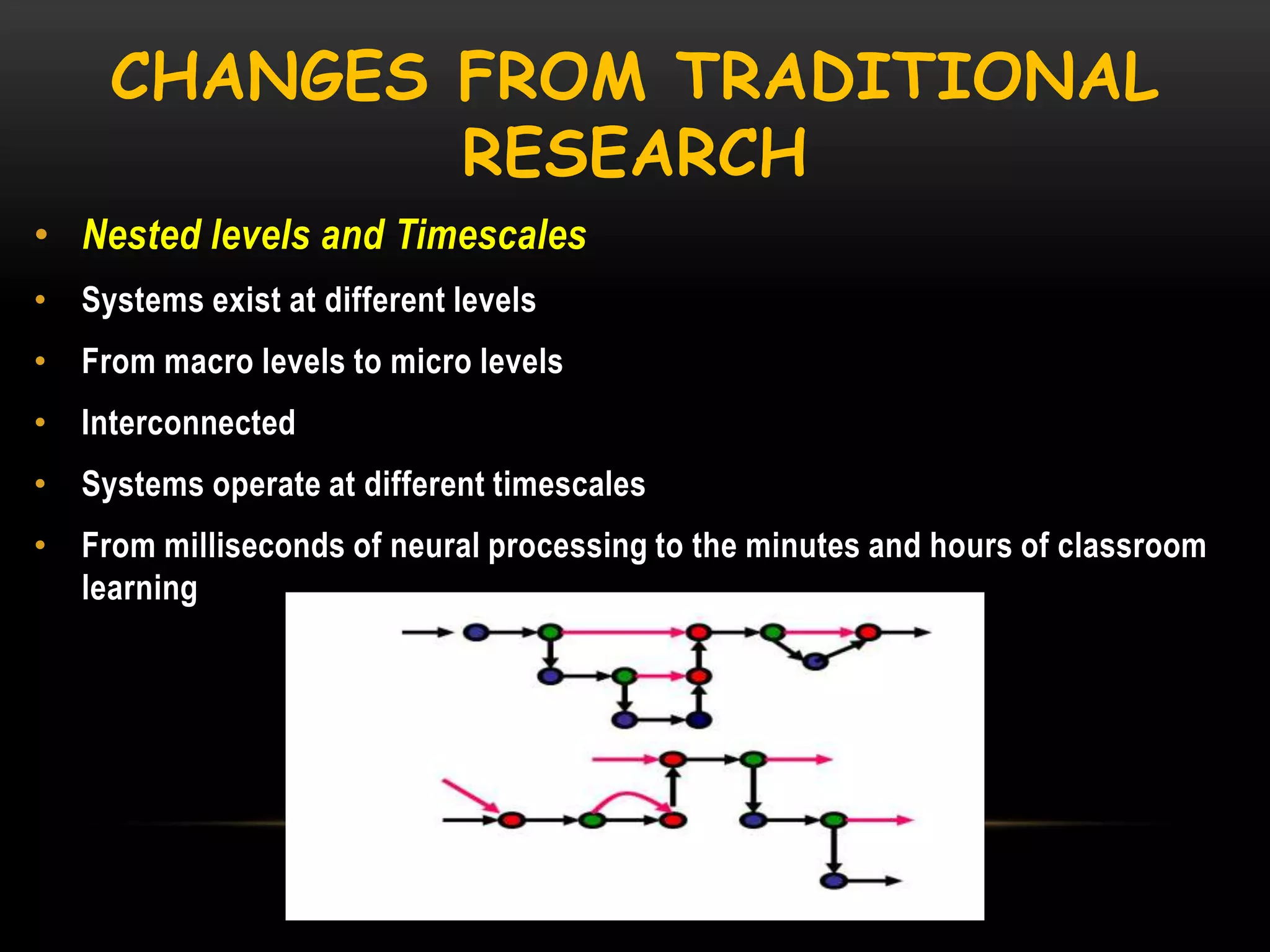
• Nested levels and Timescales
• Systems exist at different levels
• From macro levels to micro levels
• Interconnected
• Systems operate at different timescales

• From milliseconds of neural processing to the minutes and hours of classroom
learning
•

Lombardi, L. (1996). Restrictions on direction of voicing assimilation: an OT account. University
of Maryland Working Papers in Linguistics, 4, 84-102.

•

(Zdenek Salzmann, Language, Culture, and Society: An Introduction to Linguistic Anthropology.
Westview, 2004)

Researching language as a complex adaptive system

  • 1.
  • 2.
    RESEARCHING LANGUAGE ASA COMPLEX ADAPTIVE SYSTEM
  • 4.
    BACKGROUND • Chaos/complexity theory •Developed from ancient Greek philosophy • Modern views of mathematics and the physical world • Explains the nature and characteristics of complex systems • Defines different types of change
  • 5.
    PROGRESSING IDEAS • Explorespatterns of nonlinearity • Unpredictability in a complex system • Avoids marking this as a hybrid state • The bridging role of complexity theory • Framing research and practice
  • 6.
    CHAOS • 'To somephysicists chaos is a science of process rather than state, of becoming rather than being' (Gleick 1987 5)
  • 7.
    A COMPLEX SYSTEM •Emerges from the interactions of its components. • (LARSEN–FREEMAN & CAMERON,2008)
  • 8.
    COMPLEX SYSTEMS • Oftenheterogeneous, being made up of both agents and elements. (LARSEN–FREEMAN & CAMERON,2008)
  • 9.
    APPLIED LINGUISTIC COMPLEX SYSTEMS •Contain many subsystems, nested one within another. (LARSEN–FREEMAN & CAMERON,2008)
  • 10.
    COMPLEX SYSTEMS ATALL LEVELS AND TIME SCALES • From the social level to the individual levels. • Milliseconds of neural connections • Millennia of evolution etc • (LARSEN–FREEMAN & CAMERON,2008) • va
  • 11.
    LARSEN-FREEMAN’S STANCE (1997) •Learning linguistic items is not a linear process— learners do not master one item and then move on to another. In fact, the learning curve for a single item is not linear either. (p. 151) • There are no natural divisions or end points in the overall learning process; it is continuous but erratic and the target is a moving one (Larsen-Freeman, 1997).
  • 12.
    LEARNING • ―We canneither claim that learning is caused by environmental stimuli (the behaviourist position) nor that it is genetically determined (the innatist position). Rather, learning is the result of complex (and contingent) interactions between individual and environment‖. • (Van Lier ,1996:170)
  • 13.
    LARSEN-FREEMAN VIEWS LANGUAGE • Adynamic system • Emerges and self-organizes from frequently occurring patterns of language use" (p. 111) • The product of multiple, patterned, and non-linear integrated contexts and times • Maintains an identity(social and national) in the face of constant change • CAS Attempts to keep language in a state of status quo in order to keep its standard
  • 14.
    FEATURES OF COMPLEX NONLINEARSYSTEMS DYNAMIC CHAOTIC COMPLEX OPEN NONLINEAR SELF ORGANISING
  • 15.
    FEATURES OF COMPLEX NONLINEARSYSTEMS Adaptive Feedback sensitive Sensitive to initial conditions
  • 16.
    UNPREDICTABILITY • The weatheris constantly changing • Also stays within the boundaries of climate. • The climate 'We can tell where the system cannot be, and we can identify the states that the system is most likely to be, but we cannot tell exactly where the system will be' (Mohanan 1992 650)
  • 17.
    SENSITIVE TO INITIAL CONDITIONS •UG the initial condition of human language • —it contains certain substantive universal principles that apply to constrain the shape of human languages • For instance, there are a small number of core phonological patterns that apply to all languages, e g voicing assimilation of obstruent in all languages • (Mohanan 1992)
  • 18.
    EXAMPLE FROM ENGLISHLANGUAGE • Languages also differ; In English, the voiced consonant assimilates to the voiceless (Salzmann, 2004) • , whereas in Spanish and Russian, the first consonant assimilates to the second regardless of the voicing feature • (Lombardi,1996) • Alan Hewat's novel Lady's Time (1985)
  • 19.
    (DST) AS NONLINEARCHANGE • Usually no straightforward linear cause-effect relationships where increased input leads to a proportionate increase in the output (e.g. the higher the motivation, the higher the achievement)
  • 20.
    BUTTERFLY EFFECT • Ahuge input can sometimes result in very little or no impact, while at others even a tiny input can lead to what seems like a disproportionate ‗explosion‘ • The system‘s behavioural outcome depends on the overall constellation of the system components (Dornyei,2011)
  • 21.
    BUTTERFLY EFFECT INLANGUAGE LEARNING • The various interlinked components of the system can moderate the impact of any input(both in a positive and negative way ). • (Dornyei,2011)
  • 22.
    LANGUAGE IS ALSOCOMPLEX • Satisfies both criteria of complexity • First, it is composed of many different subsystems phonology, morphology, lexicon, syntax, semantics, pragmatics • Second, the subsystems are interdependent ,a change in any one of them can result in a change in the others • (Larsen-Freeman 1989, 1991b, 1994)
  • 23.
    LARSEN-FREEMAN AND CAMERON (2008:96) •First and second languages are both live complex systems which change over time. • ―we change a language by using it‖.
  • 24.
    FUNCTIONS OF L1AND L2 • Work as attractors. • An attractor is ―a region of a system into which the system tends to move‖ (Larsen-Freeman and Cameron 2008:50) • Language development swings between these two poles. • The language learner is attracted or repelled by one of these poles and out of this cycle of attraction and repulsion emerges a third element, namely, interlanguage.
  • 25.
    INTER-LANGUAGE AS ASTRANGE ATTRACTOR • Highly sensitive to initial conditions. • Small changes in the initial conditions result in unpredictable shifts in language development.
  • 26.
    BYBEE’S, VIEW (2006) •The fact is that language forms are being continually transformed by use . • Any linguistic representation in the learner‘s mind is strongly tied to the experience that a speaker has had with language • May bear little resemblance to forms that NSs employ or that fit linguists‘ categories.
  • 27.
    POINT OF DIFFERENCE Thebehavior of the whole emerges out of the interaction of the subsystems. Thus, describing each subsystem tells us about the subsystems, it does not do justice to the whole of language. (Larsen-Freeman and Cameron ,2008)
  • 28.
    LANGUAGE DEVELOPMENT ASDYNAMIC • Real-time language processing, developmental change in learner language, and evolutionary change in language are all reflections of the same dynamic process of language usage • ( Bybee, 2006; Larsen-Freeman, 2003; Smith & Thelen, 1993).
  • 29.
    MAIN STANDPOINT • Researchers'grammars containing static rules do not do justice to the everchanging character of learners' internal L2 grammars.
  • 30.
    CHANGES FROM TRADITIONAL RESEARCH •(1)The Nature of Hypotheses • Many complex systems are interconnected and coordinated • Not always possible to explain behavior, and changes in behavior, by detailing their separate components and roles (Clark ,1997) • Prediction (or forecasting (Traditional) • Retrodiction (or retrocasting (CAS)
  • 31.
    EXAMPLE GIVEN BYBAK (1997) • Our explanation of sand pile avalanches is expressed in terms of the structure and stability of the sand pile, rather than in terms of the behavior of individual grains of sand.
  • 32.
    CHANGES FROM TRADITIONAL RESEARCH •(2)Causality • In the traditional reductionist scenario, the researcher searches for a critical ―element whose removal from a causal chain would alter the outcome‖ (Gaddis, 2002, p.54) • ―Death to the variable‖(Byrne,2002) • Instead of investigating single variables, we study modes of system change that include selforganization and emergence. • Emergent properties or phenomena occur when change on one level of social grouping or on the timescale of a system leads to a new mode on another level or timescale.
  • 33.
    CAMERON AND DEIGNAN(2006) EXAMPLE • The phrase emerged fairly recently in English • Influenced by social changes and language uses. • Emergence could not have been predicted using the usual definition of prediction. • The genealogy of such phrases can be studied and their origin can sometimes be explained in retrospect.
  • 34.
    CHANGES FROM TRADITIONALRESEARCH • The Process of Co-adaptation • In first language learning Dynamic alteration in both; child and the caretaker language and behaviours • In classroom between teacher and the students • The structure emerges; the lesson • Multi subsystems at students individual levels • Emerge new language resources
  • 35.
    CHANGES FROM TRADITIONAL RESEARCH •No Single Independent Variable • The relationships are reciprocal but not symmetrical • A web of interacting components • Entertain Supportive, Competitive and conditional relationships (Van Geert and Steenbeek,in press,p:9) • Everything is connected to some way to everything else (Gaddis,2002,p.64)
  • 36.
    CHANGES FROM TRADITIONAL RESEARCH •Stability and Variability • A complex system even in a stable mode(attractor) • Still continuously changing • Change occurs in their constituents or agents • In their interaction. • Stability is not stasis
  • 37.
    CHANGES FROM TRADITIONAL RESEARCH •The Changed Nature of Context • Context includes Physical, social, cultural, and cognitive perspectives ; inseparable from the system • Soft assembly • Learner /learning and the context are inseparable while explaining and measuring them
  • 38.
    CHANGES FROM TRADITIONAL RESEARCH •Nested levels and Timescales • Systems exist at different levels • From macro levels to micro levels • Interconnected • Systems operate at different timescales • From milliseconds of neural processing to the minutes and hours of classroom learning
  • 39.
    • Lombardi, L. (1996).Restrictions on direction of voicing assimilation: an OT account. University of Maryland Working Papers in Linguistics, 4, 84-102. • (Zdenek Salzmann, Language, Culture, and Society: An Introduction to Linguistic Anthropology. Westview, 2004)