Module 4 Lesson 12  Distributing Expressions.notebook
1
March 23, 2015
Oct 8­8:53 AM
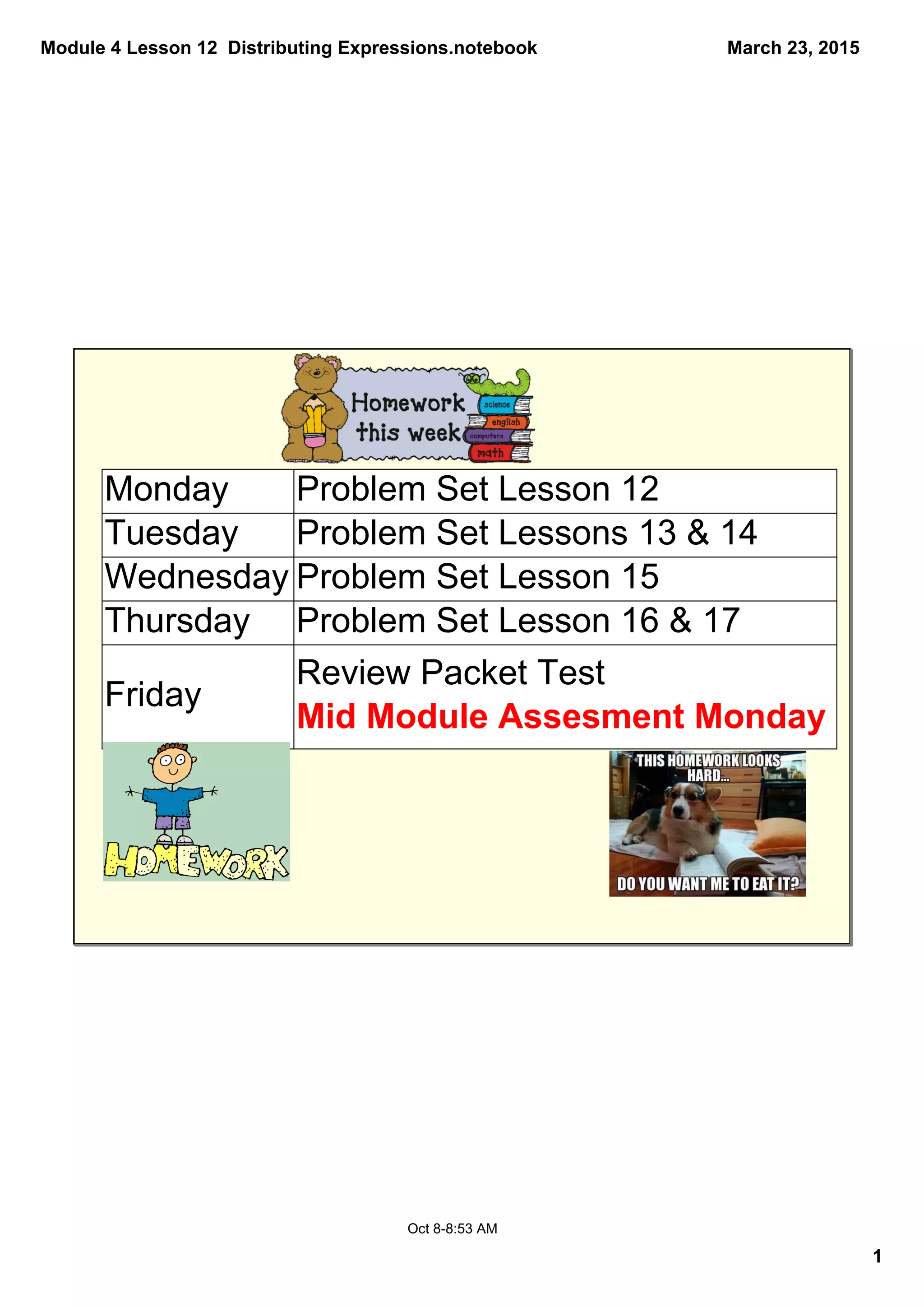
Monday Problem Set Lesson 12
Tuesday Problem Set Lessons 13 & 14
Wednesday Problem Set Lesson 15
Thursday Problem Set Lesson 16 & 17
Friday
Review Packet Test 
Mid Module Assesment Monday
Module 4 Lesson 12  Distributing Expressions.notebook
2
March 23, 2015
Nov 17­2:28 PM
Problem Set Lesson 11 Answers
Module 4 Lesson 12  Distributing Expressions.notebook
3
March 23, 2015
Aug 26­5:45 PM
 
MODULE 4 Expressions and Equations
Topic C: Replacing Letter and Numbers  
Lesson 12:  Distributing Expressions
Student Outcomes  
§ Students model and write equivalent expressions using the distributive property.  They move from a factored 
form to an expanded form of an expression.
Module 4 Lesson 12  Distributing Expressions.notebook
4
March 23, 2015
Nov 17­2:29 PM
Classwork 
Opening Exercise
a. Create a model to show 2 x 5.
b. Create a model to show 2 x b, or 2b.
Module 4 Lesson 12  Distributing Expressions.notebook
5
March 23, 2015
Nov 17­2:29 PM
Example 1
Write an expression that is equivalent to 2(a + b)
Create a model to represent (a + b).
The expression 2(a + b)  tells us that we have  2 of the (a + b)’s.  Create a model that 
shows 2  groups of  (a + b)
How many a’s and how many b’s do you see in the diagram?
Module 4 Lesson 12  Distributing Expressions.notebook
6
March 23, 2015
Nov 17­2:28 PM
How would the model look if we grouped together the a’s and then grouped 
together the b’s?
What expression could we write to represent the new diagram?
What conclusion can we draw from the models about equivalent expressions?
Module 4 Lesson 12  Distributing Expressions.notebook
7
March 23, 2015
Mar 23­3:08 PM
2(a + b) 2a + 2b Let a = 3 and b = 4
What happens when we double ( a + b)?
To prove that these two forms are equivalent, let’s plug in some 
values for a and b and see what happens.
Module 4 Lesson 12  Distributing Expressions.notebook
8
March 23, 2015
Mar 23­3:09 PM
Example 2
Write an expression that is equivalent to double (3x + 4y).
How can we rewrite double (3x + 4y)?
Is this expression in factored form, expanded form, or neither?
Module 4 Lesson 12  Distributing Expressions.notebook
9
March 23, 2015
Mar 23­3:09 PM
Let’s start this problem the same way that we started the first example.  What 
should we do?
How can we change the model to show 2(3x + 4y)?
Are there terms that we can combine in this example?
Module 4 Lesson 12  Distributing Expressions.notebook
10
March 23, 2015
Mar 23­3:09 PM
What is an equivalent expression that we can use to represent 2(3x + 4y)?
Summarize how you would solve this question without the model.
Module 4 Lesson 12  Distributing Expressions.notebook
11
March 23, 2015
Mar 23­3:09 PM
Example 3
Write an expression in expanded form that is equivalent to the model below.
What factored expression is represented in the model?
How can we rewrite this expression?
Module 4 Lesson 12  Distributing Expressions.notebook
12
March 23, 2015
Mar 23­3:09 PM
Example 4
Write an expression that is equivalent to 3(7d + 4e).
Module 4 Lesson 12  Distributing Expressions.notebook
13
March 23, 2015
Mar 23­3:22 PM
Exercises
Create a model for each expression below.  Then write another equivalent 
expression using the distributive property.
1.  3 (x + y)
Module 4 Lesson 12  Distributing Expressions.notebook
14
March 23, 2015
Mar 27­12:26 PM
2.  4(2h + g)
Create a model for each expression below.  Then write another equivalent expression 
using the distributive property.
Module 4 Lesson 12  Distributing Expressions.notebook
15
March 23, 2015
Mar 23­3:26 PM
Apply the distributive property to write an equivalent expression.
3.  8(h+3)
4.  3(2h + 7)
5.  5(3x + 9y)
6.  4(11h + 3g)
7.  
8.  a(9b + 13)
Module 4 Lesson 12  Distributing Expressions.notebook
16
March 23, 2015
Aug 26­8:21 PM
Closing
Please take out your exit ticket for Lesson 12, close your
binder, and complete the exit ticket. This will be collected.
Module 4 Lesson 12  Distributing Expressions.notebook
17
March 23, 2015
Mar 23­3:40 PM

Mod 4 lesson 12