Module 4 Lesson 10  Writing and Expanding Multiplication Expressions.notebook
1
March 25, 2014
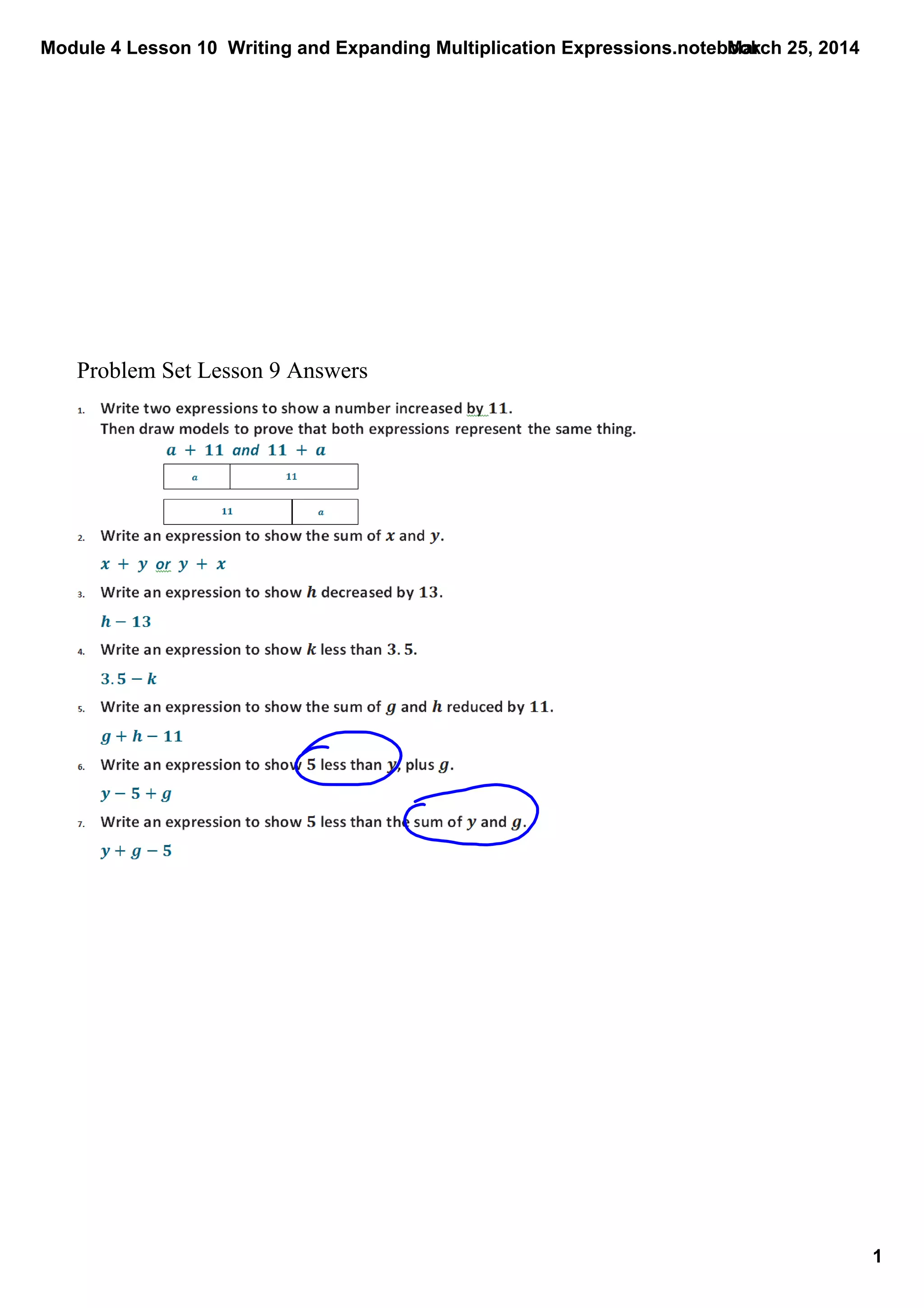
Problem Set Lesson 9 Answers
Module 4 Lesson 10  Writing and Expanding Multiplication Expressions.notebook
2
March 25, 2014
 
MODULE 4 Expressions and Equaons
Topic C: Replacing Leer and Numbers  
Lesson 10:  Wring and Expanding Mulplicaon 
Expressions 
Student Outcomes 
§ Students idenfy parts of an expression using mathemacal terms for 
mulplicaon.  They view one or more parts of an expression as a single 
enty. 
Module 4 Lesson 10  Writing and Expanding Multiplication Expressions.notebook
3
March 25, 2014
Classwork 
Discussion
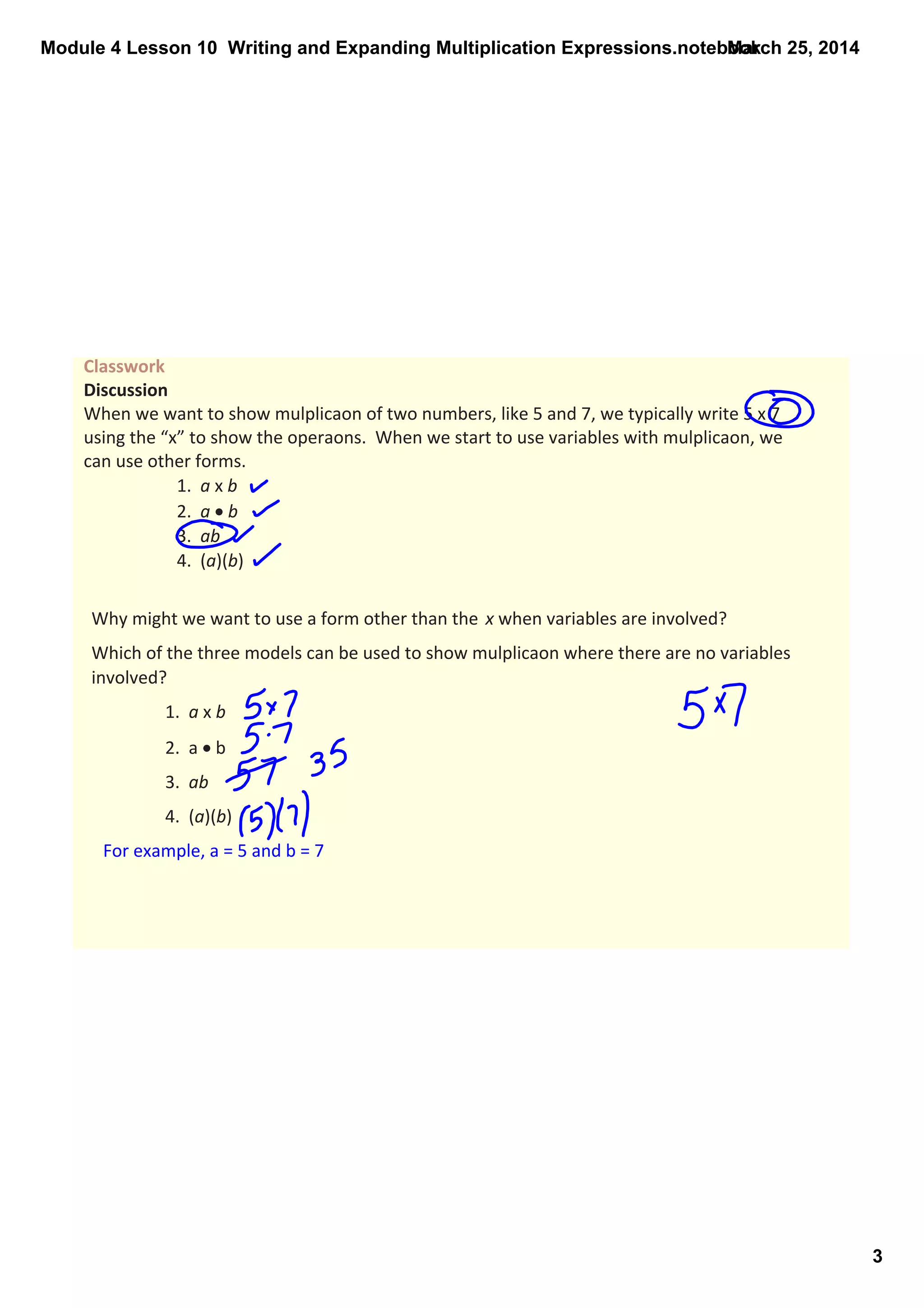
When we want to show mulplicaon of two numbers, like 5 and 7, we typically write 5 x 7 
using the “x” to show the operaons.  When we start to use variables with mulplicaon, we 
can use other forms.
1.  a x b
2.  a • b
3.  ab
4.  (a)(b)
Why might we want to use a form other than the  x when variables are involved?
Which of the three models can be used to show mulplicaon where there are no variables 
involved?
1.  a x b
2.  a • b
3.  ab
4.  (a)(b)
For example, a = 5 and b = 7
Module 4 Lesson 10  Writing and Expanding Multiplication Expressions.notebook
4
March 25, 2014
When wring expressions  using the fewest number of symbols, we will have to refrain 
from using the symbols x,• , or ( ) . 
We will also be using math terms to describe expressions and the parts of an 
expression.  We will be using words like factor, product, quoent, coefficient, and 
term.
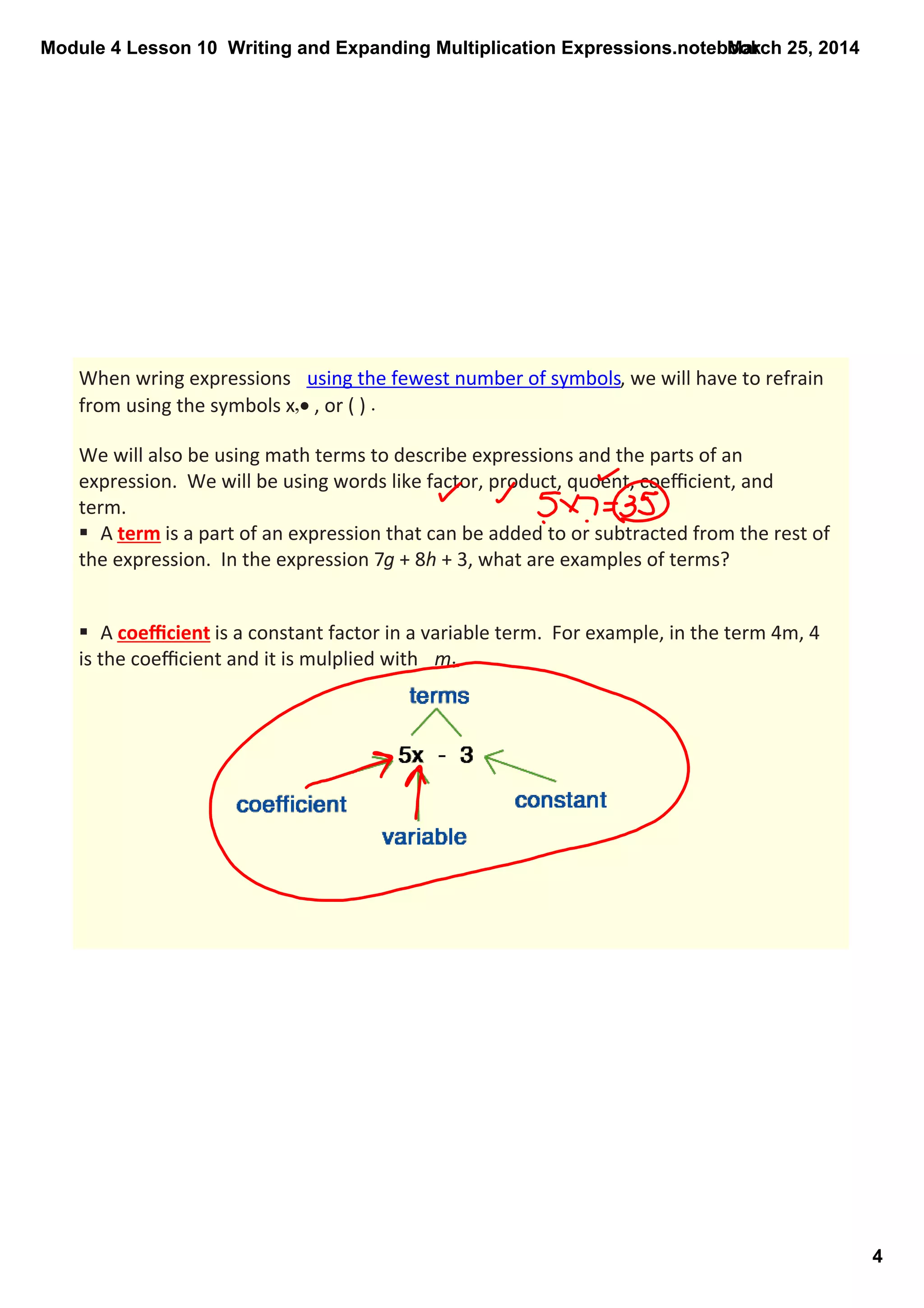
§  A term is a part of an expression that can be added to or subtracted from the rest of 
the expression.  In the expression 7g + 8h + 3, what are examples of terms?
§  A coefficient is a constant factor in a variable term.  For example, in the term 4m, 4 
is the coefficient and it is mulplied with  m.
Module 4 Lesson 10  Writing and Expanding Multiplication Expressions.notebook
5
March 25, 2014
factor
Classwork 
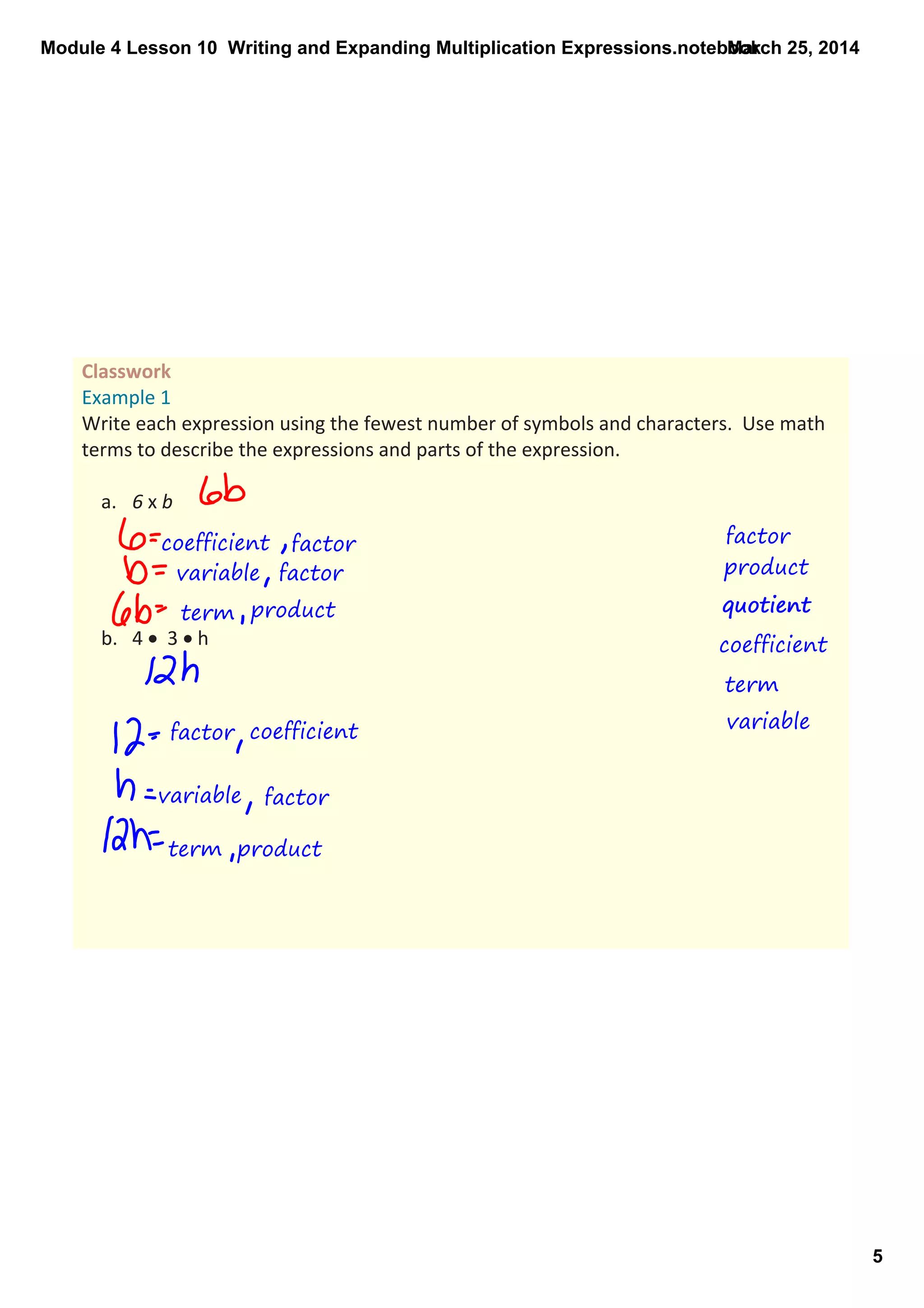
Example 1
Write each expression using the fewest number of symbols and characters.  Use math 
terms to describe the expressions and parts of the expression.  
a. 6 x b
b. 4 •  3 • h
product
quotient
coefficient
term
variable
coefficient factor
variable factor
term product
factor
quotient
coefficient
variable factor
term product
Module 4 Lesson 10  Writing and Expanding Multiplication Expressions.notebook
6
March 25, 2014
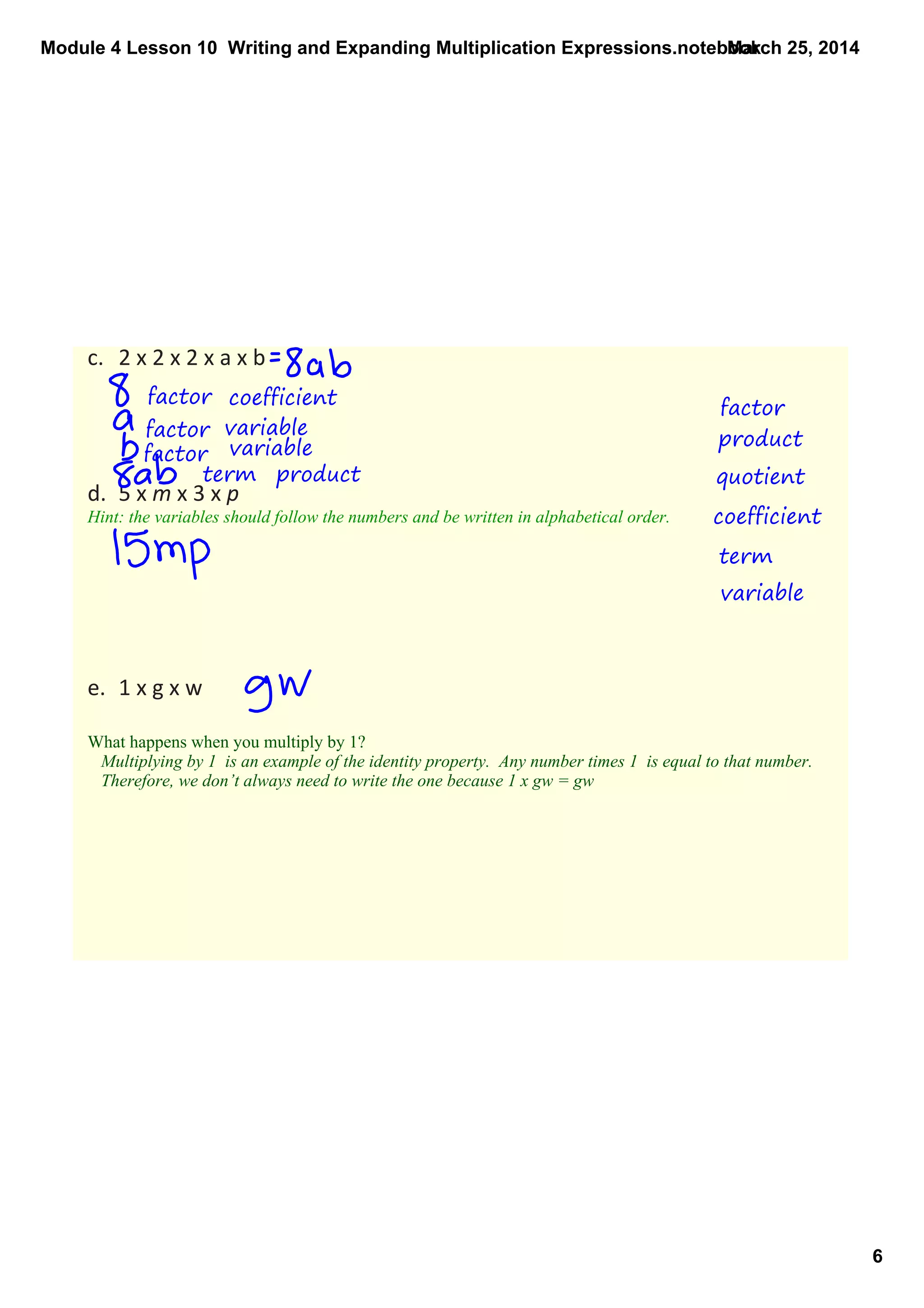
c. 2 x 2 x 2 x a x b 
d. 5 x m x 3 x p 
Hint: the variables should follow the numbers and be written in alphabetical order.
e. 1 x g x w
What happens when you multiply by 1?
Multiplying by 1  is an example of the identity property.  Any number times 1  is equal to that number. 
Therefore, we don’t always need to write the one because 1 x gw = gw
factor
product
quotient
coefficient
term
variable
factor coefficient
factor variable
factor variable
term product
Module 4 Lesson 10  Writing and Expanding Multiplication Expressions.notebook
7
March 25, 2014
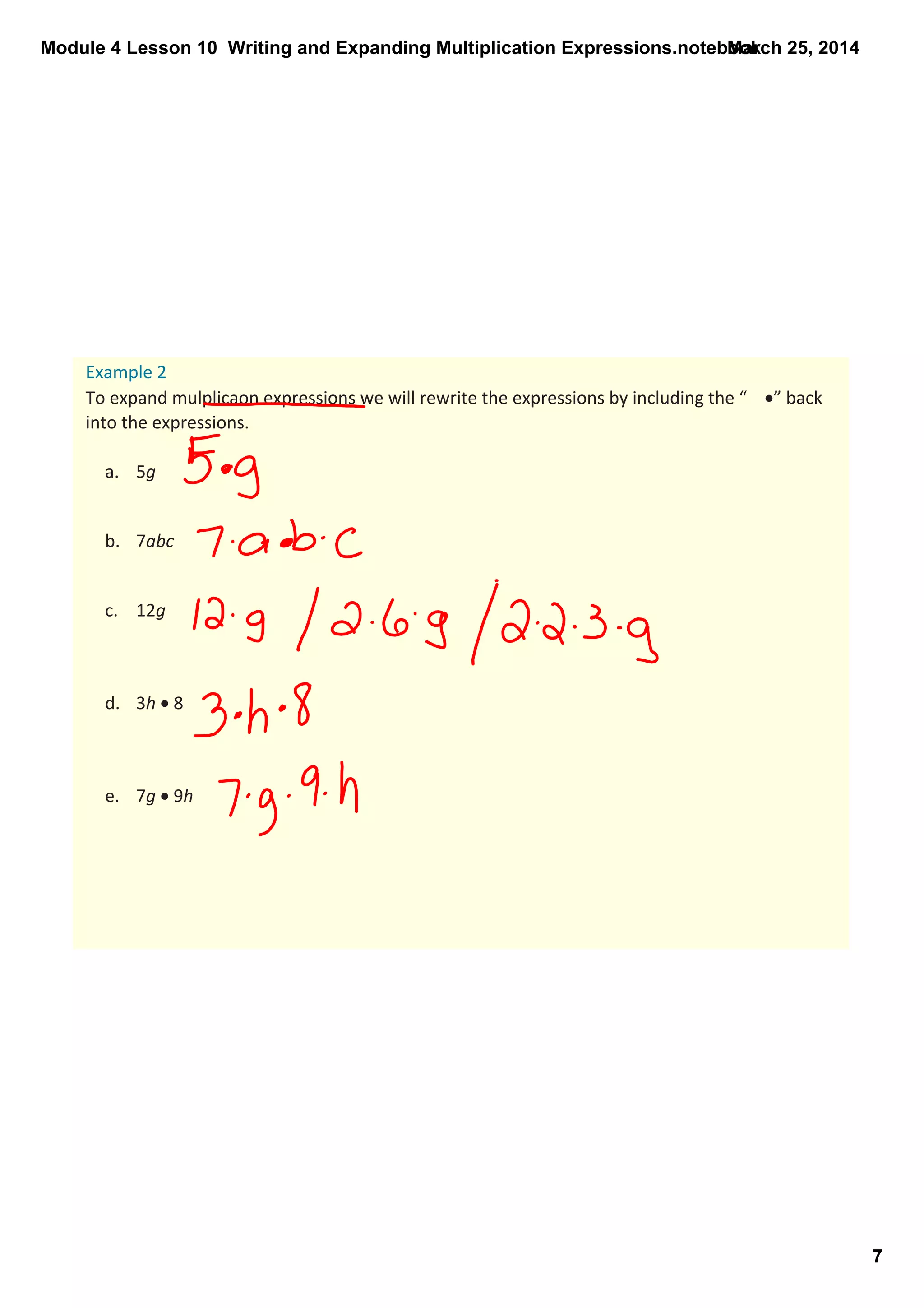
Example 2
To expand mulplicaon expressions we will rewrite the expressions by including the “ •” back 
into the expressions.
a. 5g
b. 7abc 
c. 12g
d. 3h • 8 
e. 7g • 9h 
Module 4 Lesson 10  Writing and Expanding Multiplication Expressions.notebook
8
March 25, 2014
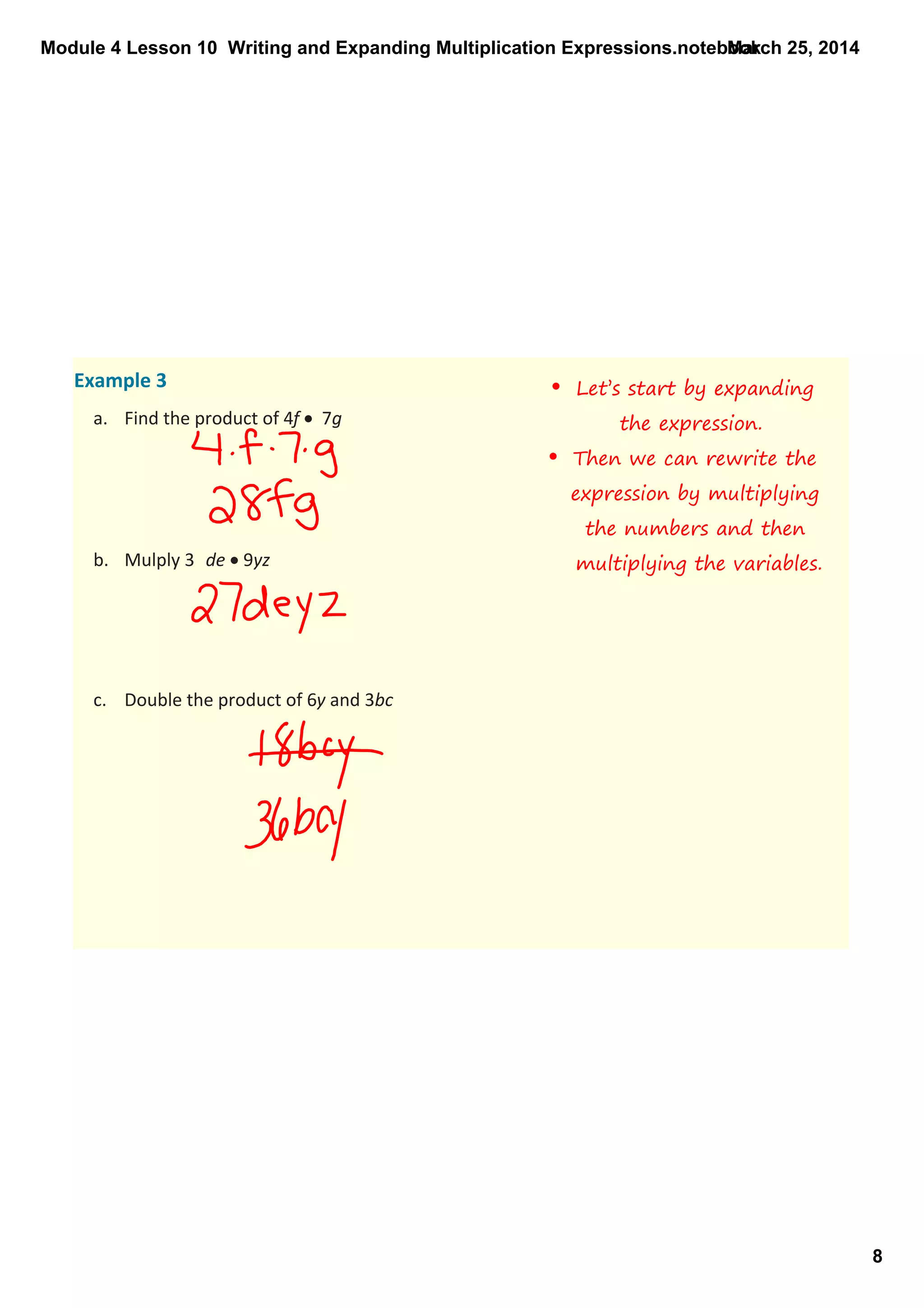
Example 3
a. Find the product of 4f •  7g
b. Mulply 3 de • 9yz 
c. Double the product of 6y and 3bc
• Let’s start by expanding
the expression.
• Then we can rewrite the
expression by multiplying
the numbers and then
multiplying the variables.
Module 4 Lesson 10  Writing and Expanding Multiplication Expressions.notebook
9
March 25, 2014
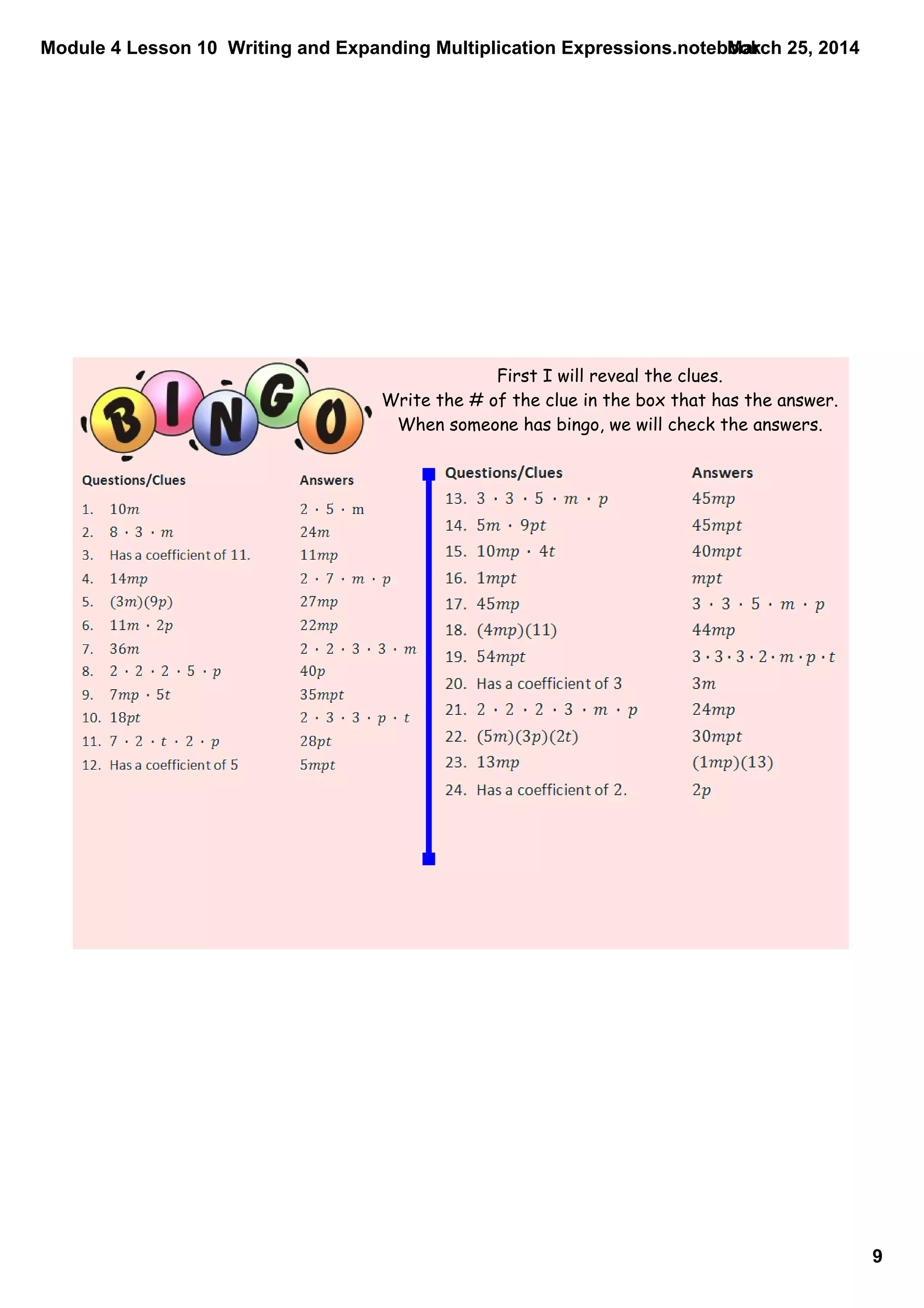
First I will reveal the clues.
Write the # of the clue in the box that has the answer.
When someone has bingo, we will check the answers.
Module 4 Lesson 10  Writing and Expanding Multiplication Expressions.notebook
10
March 25, 2014
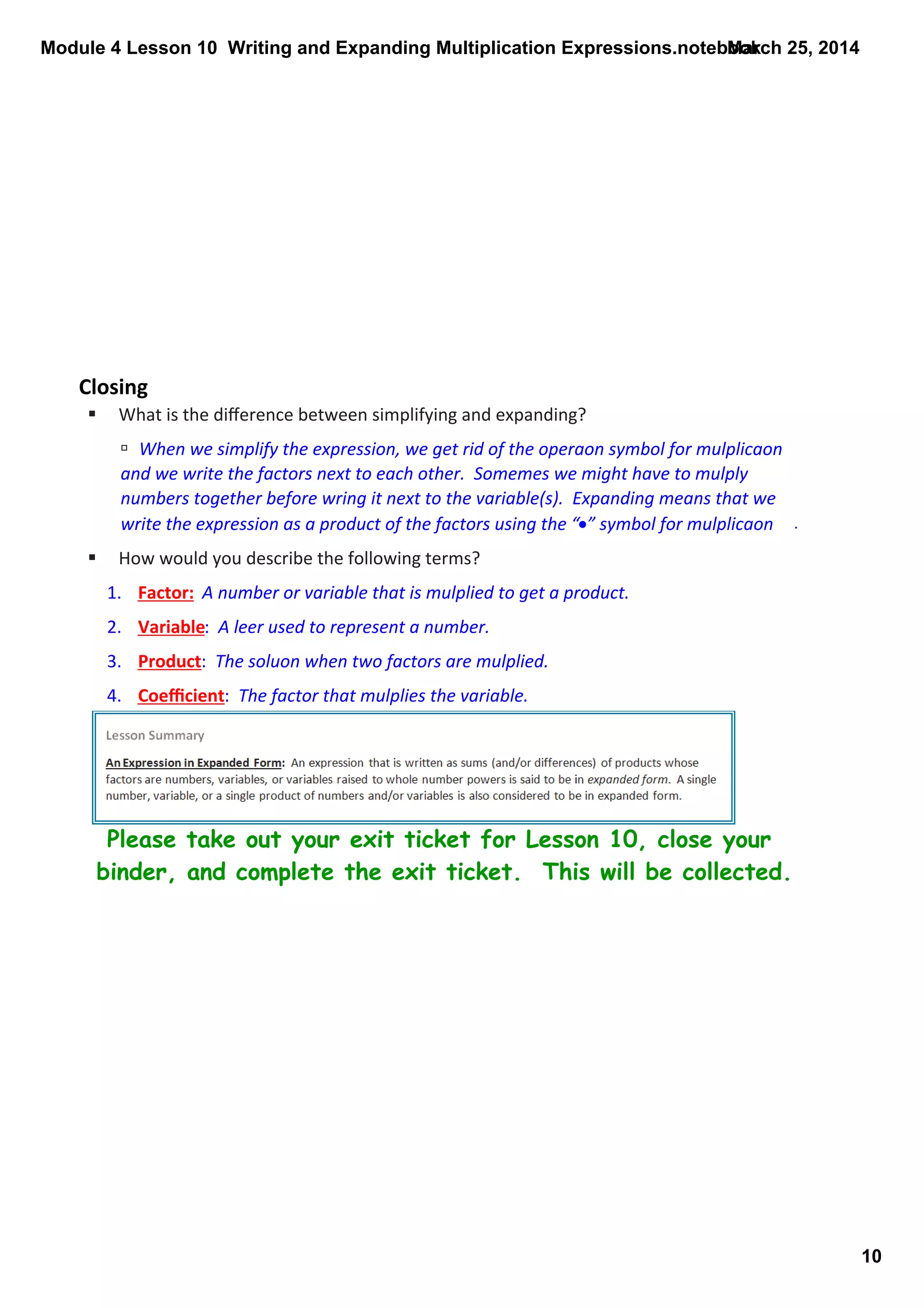
Closing
Please take out your exit ticket for Lesson 10, close your
binder, and complete the exit ticket. This will be collected.
§ What is the difference between simplifying and expanding?
ú  When we simplify the expression, we get rid of the operaon symbol for mulplicaon 
and we write the factors next to each other.  Somemes we might have to mulply 
numbers together before wring it next to the variable(s).  Expanding means that we 
write the expression as a product of the factors using the “•” symbol for mulplicaon .
§ How would you describe the following terms?
1. Factor:  A number or variable that is mulplied to get a product.
2. Variable:  A leer used to represent a number.
3. Product:  The soluon when two factors are mulplied.
4. Coefficient:  The factor that mulplies the variable.

Module 4 lesson 10