Lesson 2­4.notebook                                                         October 08, 2012


            Assignment:

            1­­>L2.4, pg. 100­101, #3­39 [thirds] ­ Due Wednesday (10/10)
            2­­>Test signed?? 


                                                                                               1
Lesson 2­4.notebook                                                  October 08, 2012


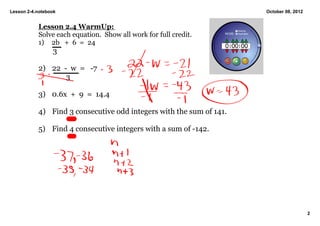
           Lesson 2.4 WarmUp:
           Solve each equation.  Show all work for full credit.
           1) 2b   +  6  =  24
                  3

           2) 22  ­  w  =   ­7
                          3

           3) 0.6x  +  9  =  14.4

           4) Find 3 consecutive odd integers with the sum of 141.

           5) Find 4 consecutive integers with a sum of ­142.


                                                                                        2
Lesson 2­4.notebook                                                                                October 08, 2012


           Lesson 2.4:
           FYI...
           *To solve an equation that has variables on each side of the equals sign, "move" the 
           variable terms so that they are all on one side.

           *To "move" them ­ use the addition or subtraction property of equality

           *When you move them to the new side...combine them with any other like terms.

           *Also, remember to "simplify" before moving anything!  

                *....   15  =  15  ....  this is an "Identity" type of equation (all real #'s)
                *....   15  =  17  ....  this is a "no solution" type of equation


                                                                                                                      3
Lesson 2­4.notebook                                           October 08, 2012


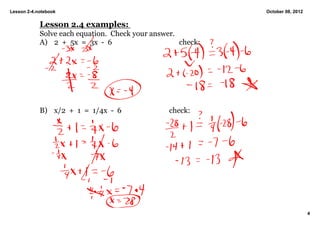
            Lesson 2.4 examples:
            Solve each equation.  Check your answer.
            A) 2  +  5x  =  3x  ­  6                 check:


            B) x/2  +  1  =  1/4x  ­  6          check:


                                                                                 4
Lesson 2­4.notebook                                           October 08, 2012


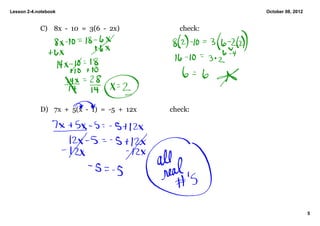
            C) 8x  ­  10  =  3(6  ­  2x)             check:


            D) 7x  +  5(x  ­  1)  =  ­5  +  12x   check:


                                                                                 5
Lesson 2­4.notebook                                   October 08, 2012


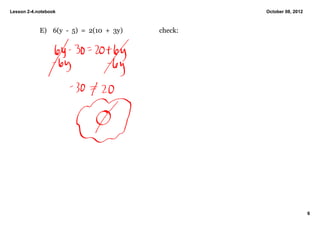
            E) 6(y  ­  5)  =  2(10  +  3y)   check:


                                                                         6
Lesson 2­4.notebook                                                                       October 08, 2012


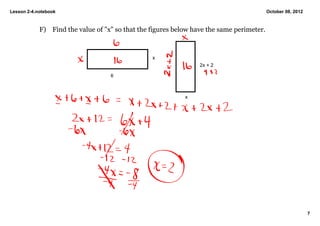
            F) Find the value of "x" so that the figures below have the same perimeter.


                                                 x
                                                                 2x + 2

                                   6


                                                            x


                                                                                                             7

8th alg -l2.4--oct8

  • 1.
    Lesson 2­4.notebook October 08, 2012 Assignment: 1­­>L2.4, pg. 100­101, #3­39 [thirds] ­ Due Wednesday (10/10) 2­­>Test signed??  1
  • 2.
    Lesson 2­4.notebook October 08, 2012 Lesson 2.4 WarmUp: Solve each equation.  Show all work for full credit. 1) 2b   +  6  =  24  3 2) 22  ­  w  =   ­7                3 3) 0.6x  +  9  =  14.4 4) Find 3 consecutive odd integers with the sum of 141. 5) Find 4 consecutive integers with a sum of ­142. 2
  • 3.
    Lesson 2­4.notebook October 08, 2012 Lesson 2.4: FYI... *To solve an equation that has variables on each side of the equals sign, "move" the  variable terms so that they are all on one side. *To "move" them ­ use the addition or subtraction property of equality *When you move them to the new side...combine them with any other like terms. *Also, remember to "simplify" before moving anything!   *....   15  =  15  ....  this is an "Identity" type of equation (all real #'s) *....   15  =  17  ....  this is a "no solution" type of equation 3
  • 4.
    Lesson 2­4.notebook October 08, 2012 Lesson 2.4 examples: Solve each equation.  Check your answer. A) 2  +  5x  =  3x  ­  6 check: B) x/2  +  1  =  1/4x  ­  6 check: 4
  • 5.
    Lesson 2­4.notebook October 08, 2012 C) 8x  ­  10  =  3(6  ­  2x) check: D) 7x  +  5(x  ­  1)  =  ­5  +  12x check: 5
  • 6.
    Lesson 2­4.notebook October 08, 2012 E) 6(y  ­  5)  =  2(10  +  3y) check: 6
  • 7.
    Lesson 2­4.notebook October 08, 2012 F) Find the value of "x" so that the figures below have the same perimeter. x 2x + 2 6 x 7