Module 4 Lesson 11 Factoring Expressions.notebook
1
March 26, 2014
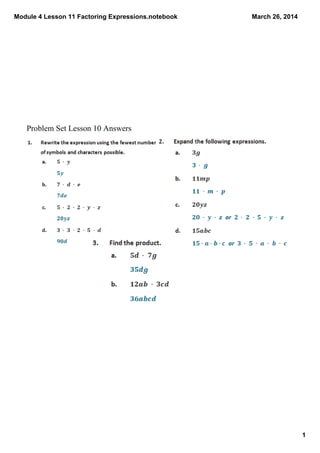
Problem Set Lesson 10 Answers
Module 4 Lesson 11 Factoring Expressions.notebook
2
March 26, 2014
 
MODULE 4 Expressions and Equaons
Topic C: Replacing Leer and Numbers  
Lesson 11 Factoring Expressions
Student Outcomes 
§ Students model and write equivalent expressions using the distribuve property.  They move from an 
expanded form to a factored form of an expression.
Turn to the sprints so we can review 
Greatest Common Factors
Module 4 Lesson 11 Factoring Expressions.notebook
3
March 26, 2014
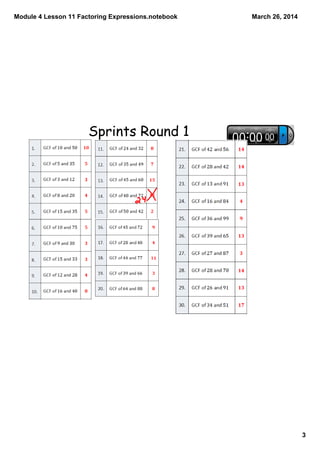
Sprints Round 1
Module 4 Lesson 11 Factoring Expressions.notebook
4
March 26, 2014
Sprints Round 2
Module 4 Lesson 11 Factoring Expressions.notebook
5
March 26, 2014
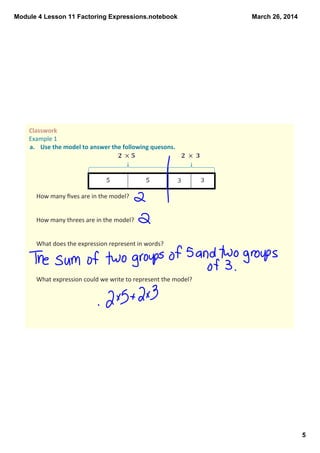
Classwork 
Example 1
a. Use the model to answer the following quesons.
How many fives are in the model?
How many threes are in the model?
What does the expression represent in words? 
What expression could we write to represent the model?
Module 4 Lesson 11 Factoring Expressions.notebook
6
March 26, 2014
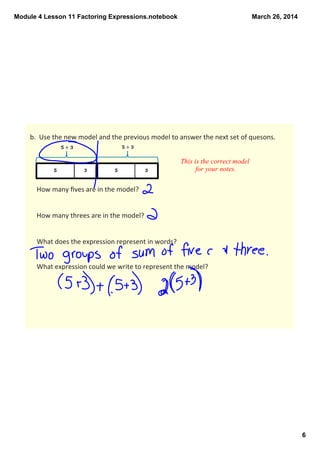
b.  Use the new model and the previous model to answer the next set of quesons.
How many fives are in the model?
How many threes are in the model?
What does the expression represent in words?
What expression could we write to represent the model? 
This is the correct model 
for your notes.
Module 4 Lesson 11 Factoring Expressions.notebook
7
March 26, 2014
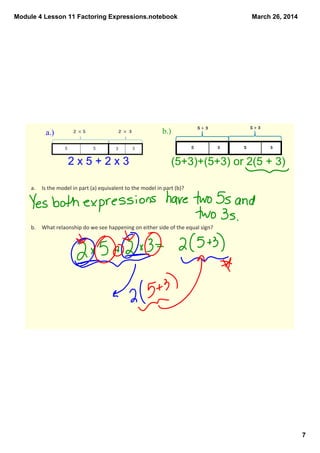
a. Is the model in part (a) equivalent to the model in part (b)? 
b. What relaonship do we see happening on either side of the equal sign?
a.) b.)
2 x 5 + 2 x 3 (5+3)+(5+3) or 2(5 + 3)
Module 4 Lesson 11 Factoring Expressions.notebook
8
March 26, 2014
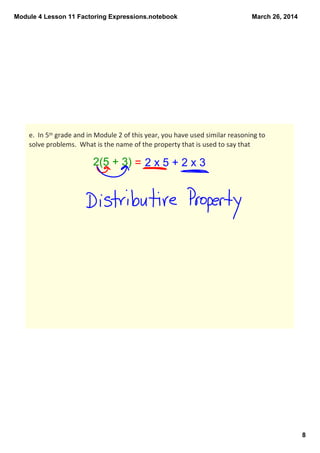
2 x 5 + 2 x 32(5 + 3) =
e.  In 5th grade and in Module 2 of this year, you have used similar reasoning to 
solve problems.  What is the name of the property that is used to say that
Module 4 Lesson 11 Factoring Expressions.notebook
9
March 26, 2014
Example 2
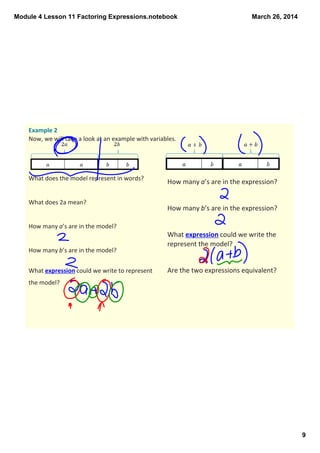
Now, we will take a look at an example with variables. 
What does the model represent in words?
What does 2a mean?
How many a’s are in the model?
How many b’s are in the model?
What expression could we write to represent
the model?
How many a’s are in the expression? 
How many b’s are in the expression? 
What expression could we write the 
represent the model? 
Are the two expressions equivalent?
Module 4 Lesson 11 Factoring Expressions.notebook
10
March 26, 2014
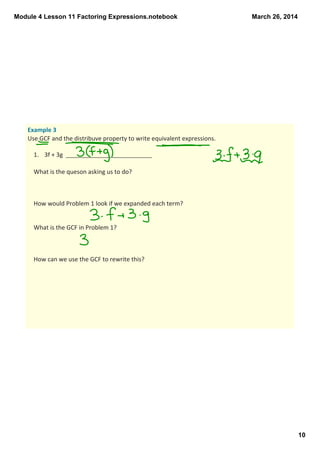
Example 3
Use GCF and the distribuve property to write equivalent expressions.
1. 3f + 3g
What is the queson asking us to do?
How would Problem 1 look if we expanded each term?
What is the GCF in Problem 1?
How can we use the GCF to rewrite this?
Module 4 Lesson 11 Factoring Expressions.notebook
11
March 26, 2014
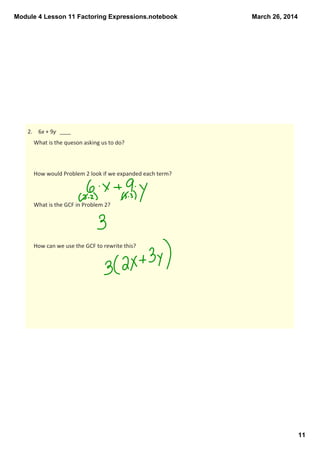
2. 6x + 9y
What is the queson asking us to do?
How would Problem 2 look if we expanded each term?
What is the GCF in Problem 2?
How can we use the GCF to rewrite this?
Module 4 Lesson 11 Factoring Expressions.notebook
12
March 26, 2014
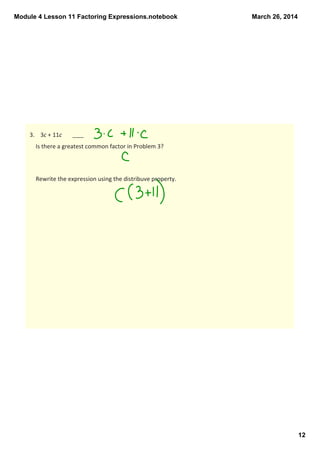
3. 3c + 11c 
Is there a greatest common factor in Problem 3?
Rewrite the expression using the distribuve property.
Module 4 Lesson 11 Factoring Expressions.notebook
13
March 26, 2014
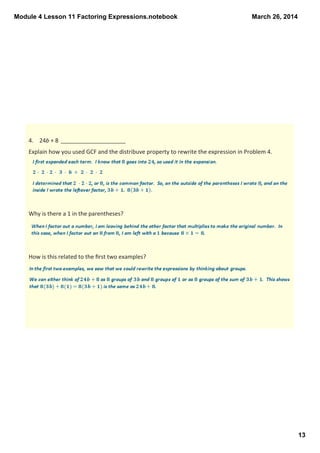
4. 24b + 8
Explain how you used GCF and the distribuve property to rewrite the expression in Problem 4.
Why is there a 1 in the parentheses? 
How is this related to the first two examples? 
Module 4 Lesson 11 Factoring Expressions.notebook
14
March 26, 2014
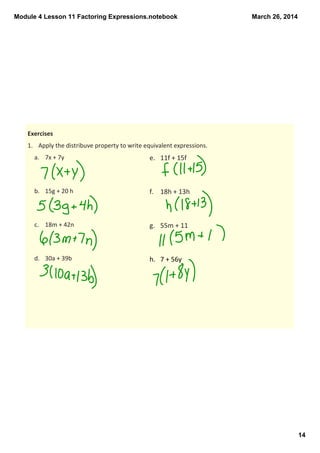
Exercises
1. Apply the distribuve property to write equivalent expressions.
a. 7x + 7y 
b. 15g + 20 h
c. 18m + 42n 
d. 30a + 39b
e. 11f + 15f
f. 18h + 13h
g. 55m + 11
h. 7 + 56y
Module 4 Lesson 11 Factoring Expressions.notebook
15
March 26, 2014
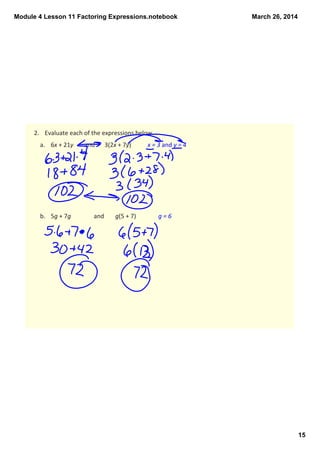
2. Evaluate each of the expressions below. 
a.   6x + 21y  and  3(2x + 7y) x = 3 and y = 4
b.   5g + 7g  and  g(5 + 7)  g = 6
Module 4 Lesson 11 Factoring Expressions.notebook
16
March 26, 2014
c.   14x + 2  and  2(7x + 1) x = 10
d.  Explain any paerns that you noce in the results to parts (a)–(c). 
e.  What would happen if other values were given for the variables? 
Module 4 Lesson 11 Factoring Expressions.notebook
17
March 26, 2014
Closing
Please take out your exit ticket for Lesson 11, close your
binder, and complete the exit ticket. This will be collected.
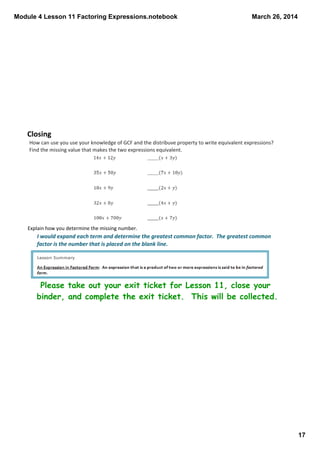
How can use you use your knowledge of GCF and the distribuve property to write equivalent expressions?
Find the missing value that makes the two expressions equivalent.
Explain how you determine the missing number.
I would expand each term and determine the greatest common factor.  The greatest common 
factor is the number that is placed on the blank line.
Module 4 Lesson 11 Factoring Expressions.notebook
18
March 26, 2014

Module 4 lesson 11