How to write a great research paperSimon Peyton JonesMicrosoft Research, Cambridge
Writing papers is a skillMany papers are badly writtenGood writing is a skill you can learnIt’s a skill that is worth learning:You will get more brownie points (more papers accepted etc)Your ideas will have more impactYou will have better ideasIncreasing importance
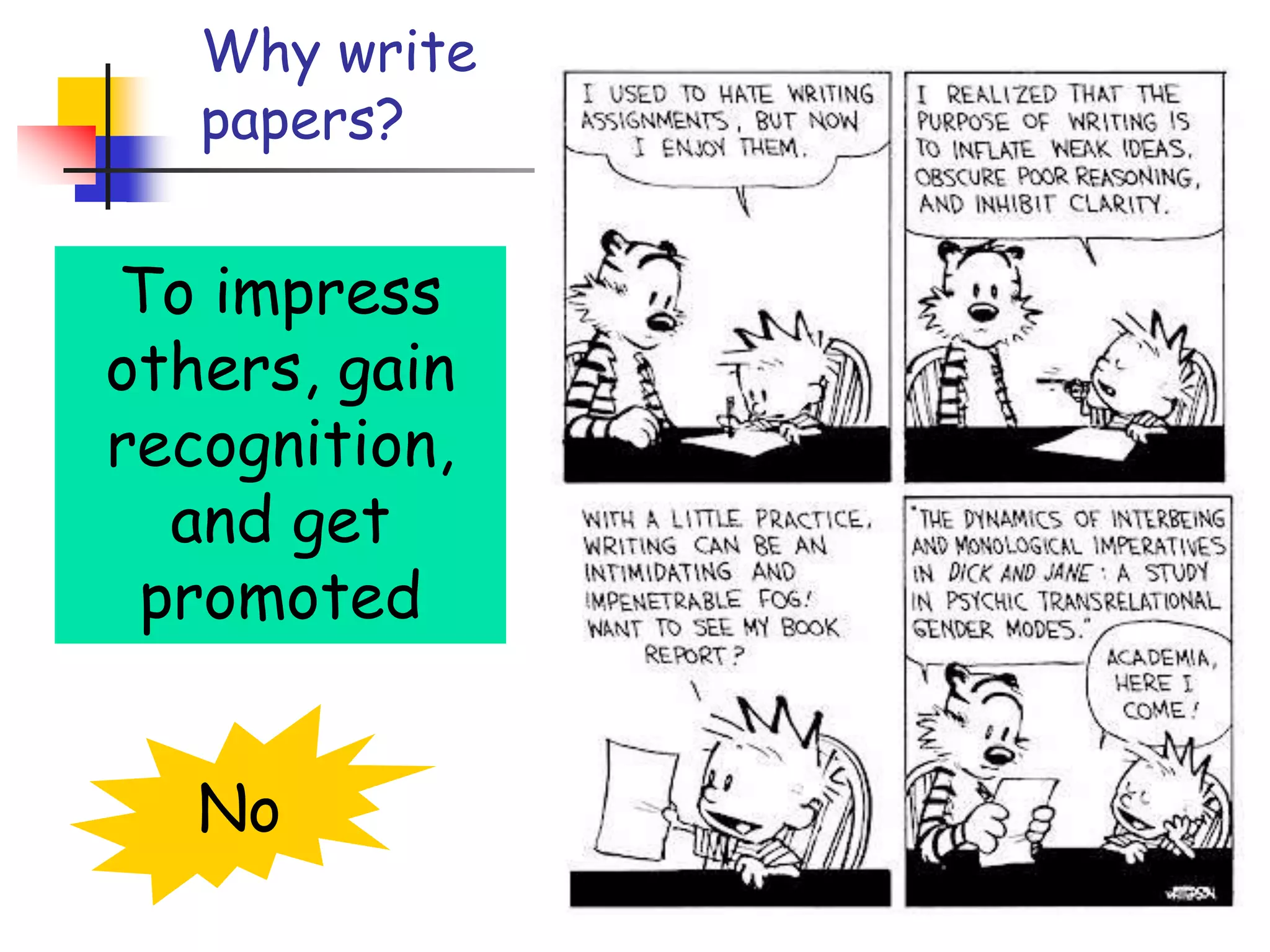
Why writepapers?Good papers and talks are a fundamental part of research excellenceTo impress others, gain recognition, and get promotedNo
Why write papers?NoTo describe what you have doneYour reader does not care about you
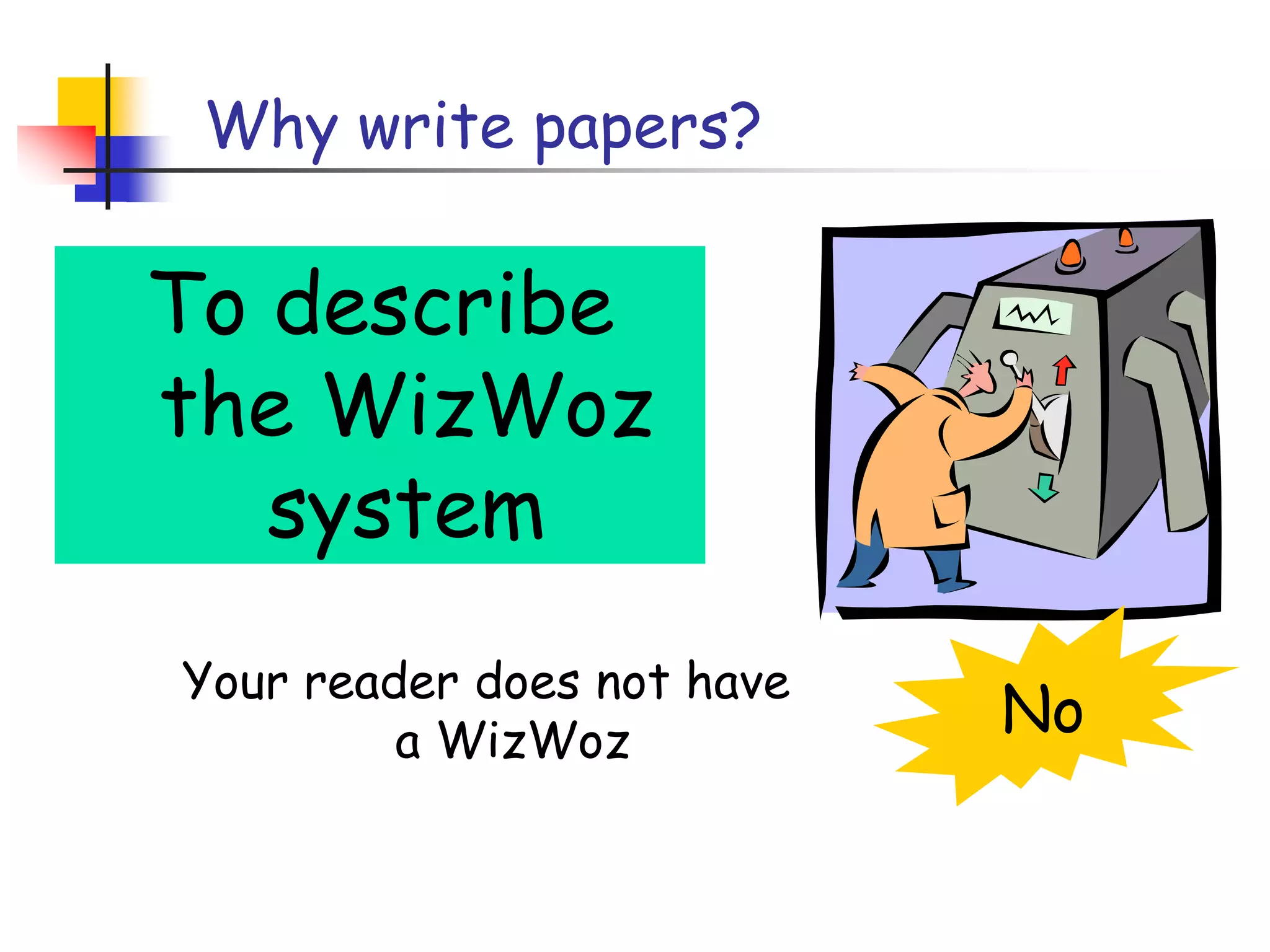
Why write papers?To describe the WizWoz systemNoYour reader does not have a WizWoz
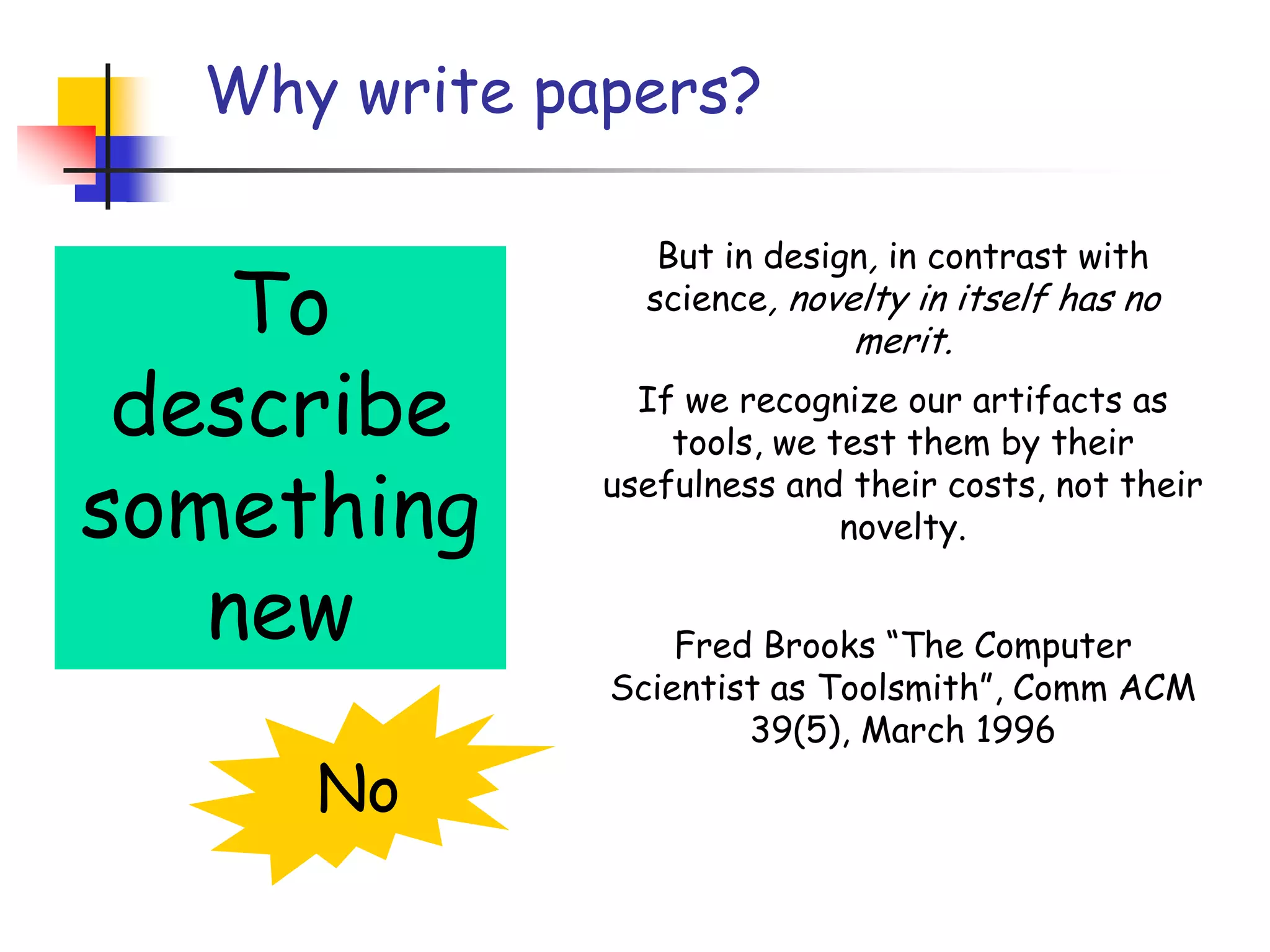
Why write papers?But in design, in contrast with science, novelty in itself has no merit.If we recognize our artifacts as tools, we test them by their usefulness and their costs, not their novelty.Fred Brooks “The Computer Scientist as Toolsmith”, Comm ACM 39(5), March 1996To describe something newNo
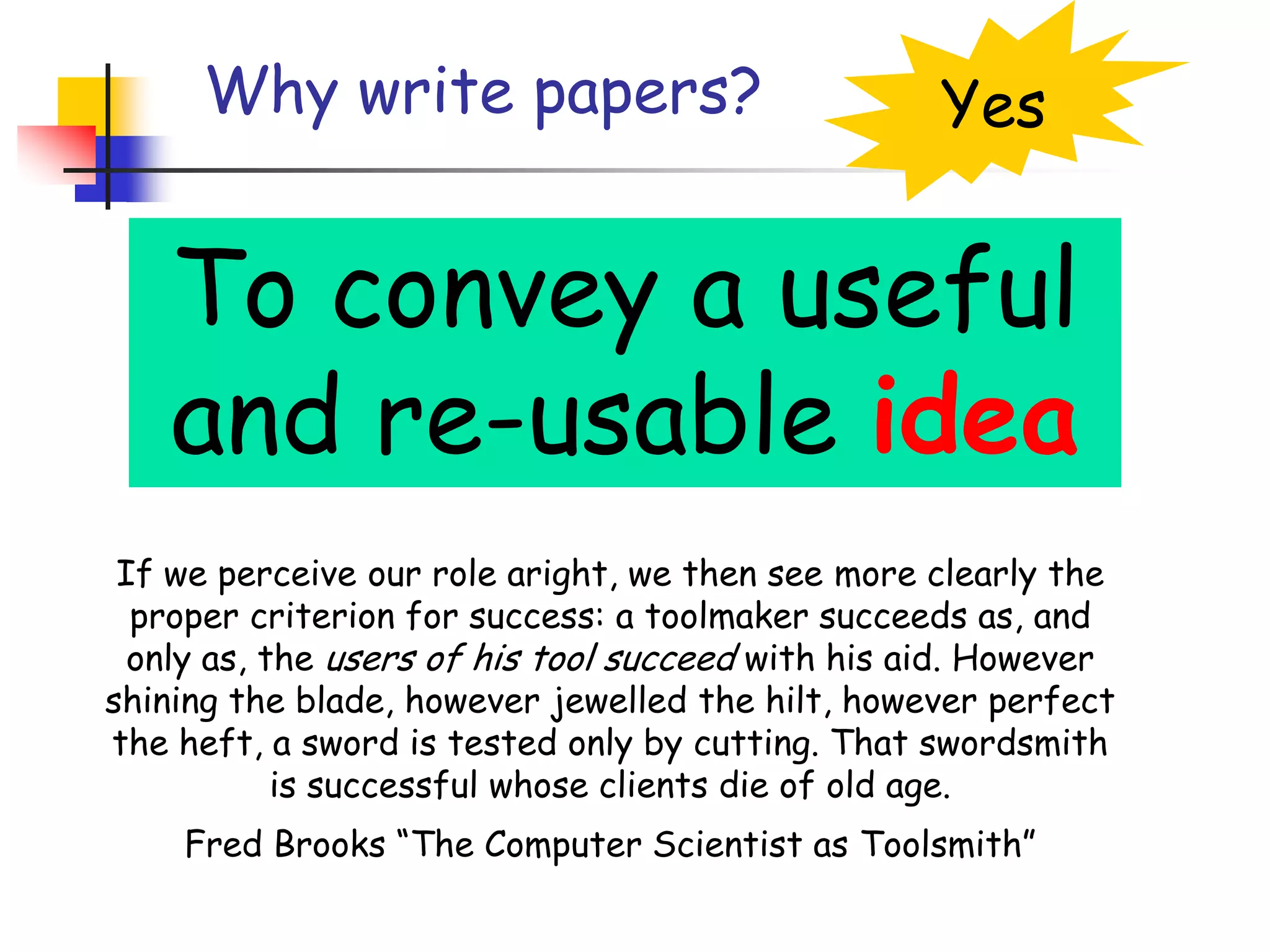
Why write papers?YesTo convey a useful and re-usable ideaIf we perceive our role aright, we then see more clearly the proper criterion for success: a toolmaker succeeds as, and only as, the users of his tool succeed with his aid. However shining the blade, however jewelled the hilt, however perfect the heft, a sword is tested only by cutting. That swordsmith is successful whose clients die of old age.Fred Brooks “The Computer Scientist as Toolsmith”
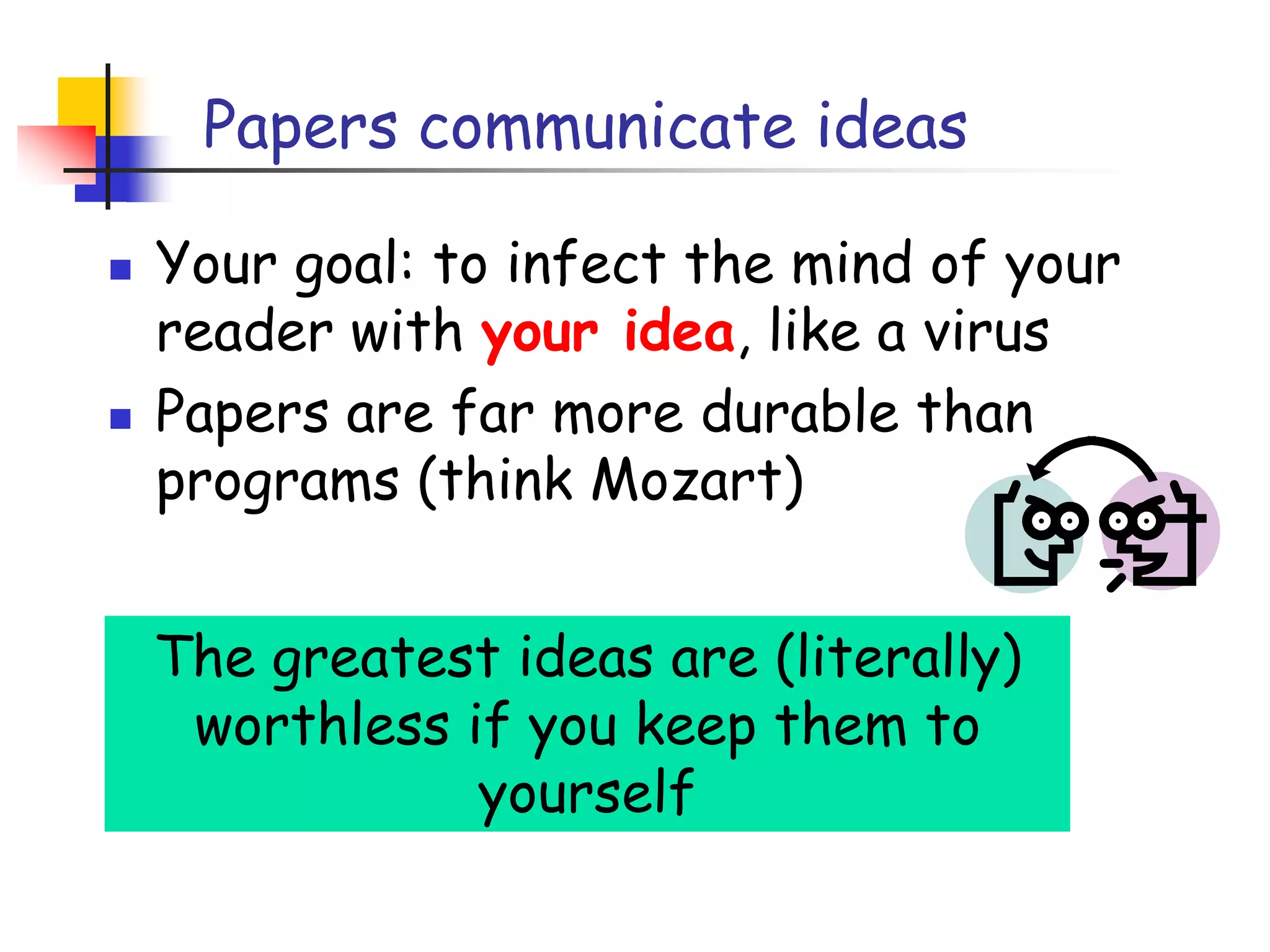
Papers communicate ideasYour goal: to infect the mind of your reader with your idea, like a virusPapers are far more durable than programs (think Mozart)The greatest ideas are (literally) worthless if you keep them to yourself
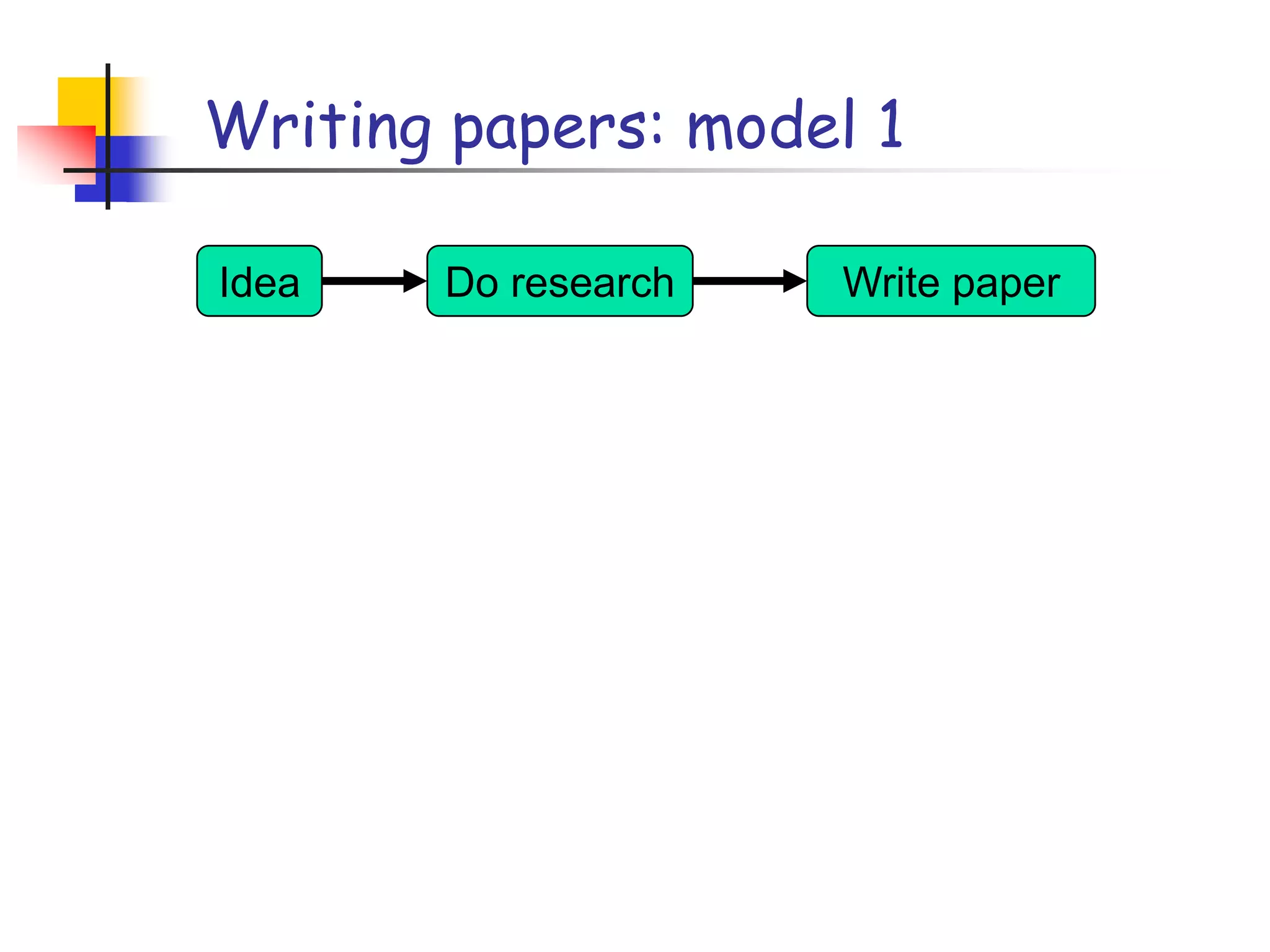
Writing papers: model 1IdeaDo researchWrite paper
Writing papers: model 2IdeaDo researchWrite paperIdeaWrite paperDo researchForces us to be clear, focusedCrystallises what we don’t understandOpens the way to dialogue with others: reality check, critique, and collaboration
Do not be intimidatedFallacy	You need to have a fantastic idea before you can write a paper.  (Everyone else seems to.)Write a paper, and give a talk, about any idea, no matter how weedy and insignificant it may seem to you
Do not be intimidatedWrite a paper, and give a talk, about any idea, no matter how insignificant it may seem to youWriting the paper is how you develop the idea in the first place
It usually turns out to be more interesting and challenging that it seemed at firstThe IdeaIdeaA re-usable insight, useful to the readerYour paper should have just one “ping”: one clear, sharp ideaYou may not know exactly what the ping is when you start writing; but you must know when you finishIf you have lots of ideas, write lots of papers
Can you hear the “ping”?Many papers contain good ideas, but do not distil what they are.Make certain that the reader is in no doubt what the idea is.  Be 100% explicit:“The main idea of this paper is....”“In this section we present the main contributions of the paper.”Thanks to Joe Touch for “one ping”
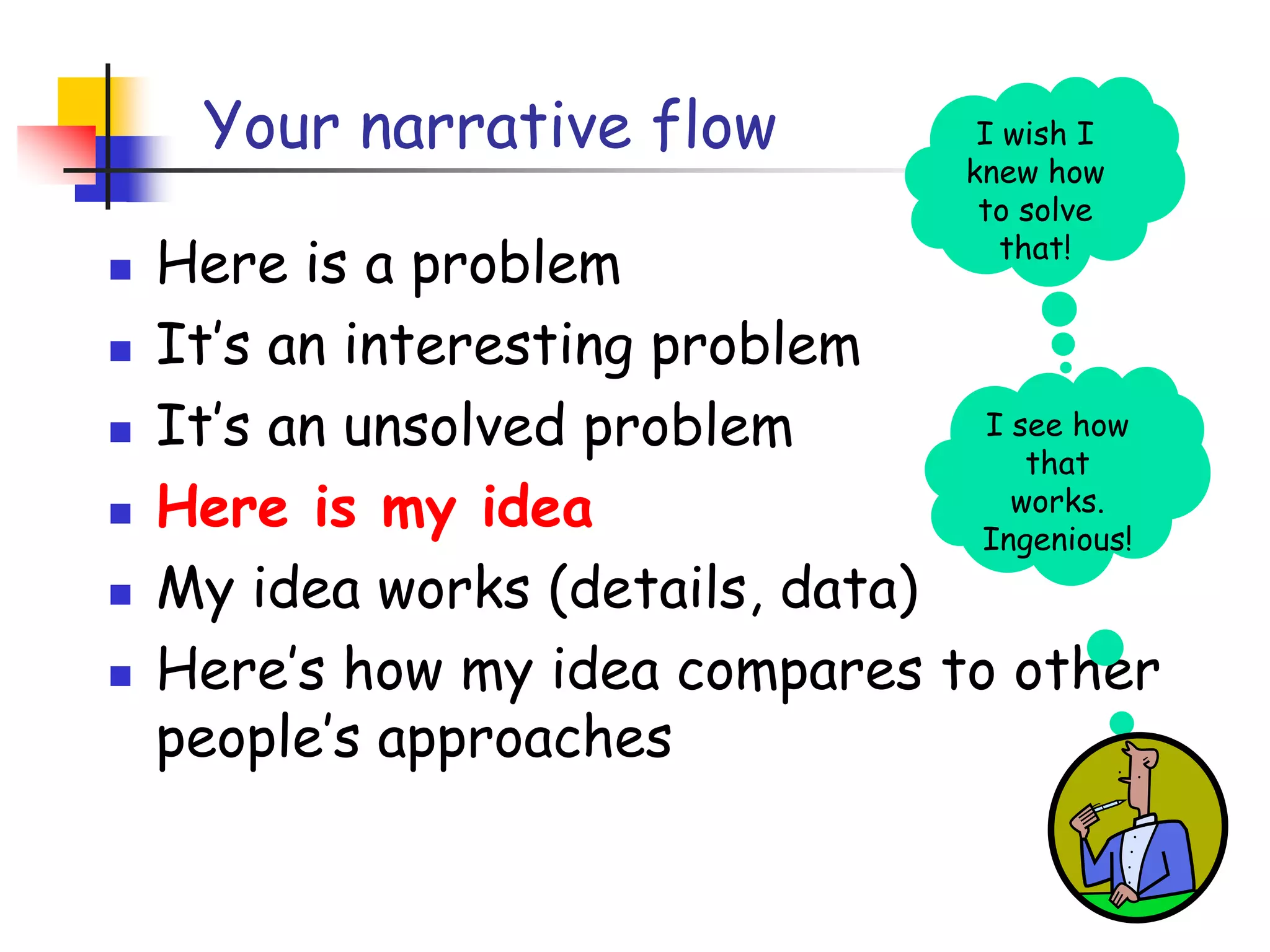
Your narrative flowHere is a problemIt’s an interesting problemIt’s an unsolved problemHere is my ideaMy idea works (details, data)Here’s how my idea compares to other people’s approachesI wish I knew how to solve that!I see how that works. Ingenious!
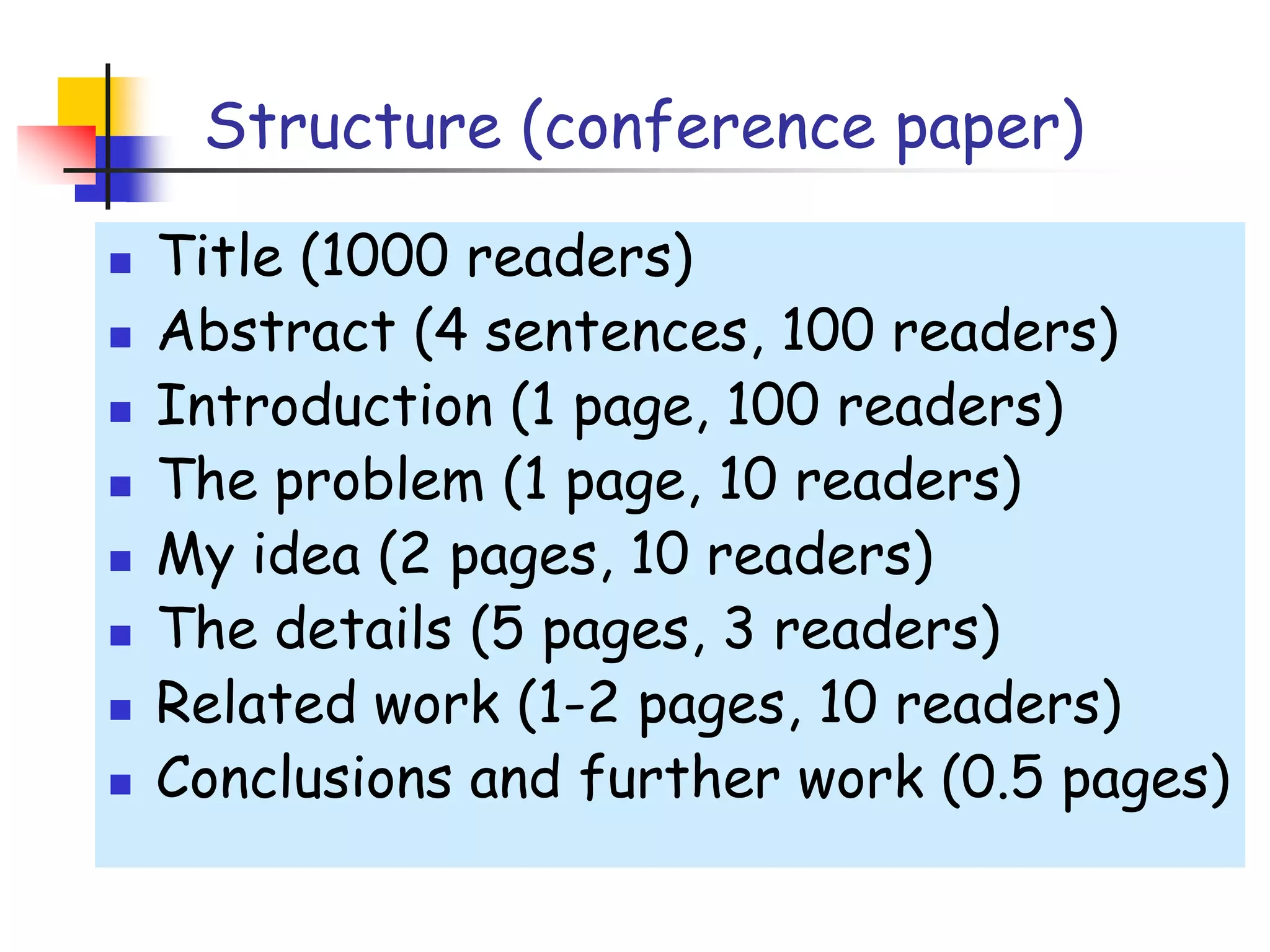
Structure (conference paper)Title (1000 readers)Abstract (4 sentences, 100 readers)Introduction (1 page, 100 readers)The problem (1 page, 10 readers)My idea (2 pages, 10 readers)The details (5 pages, 3 readers)Related work (1-2 pages, 10 readers)Conclusions and further work (0.5 pages)
The abstractI usually write the abstract lastUsed by program committee members to decide which papers to readFour sentences [Kent Beck]State the problemSay why it’s an interesting problemSay what your solution achievesSay what follows from your solution
ExampleMany papers are badly written and hard to understandThis is a pity, because their good ideas may go unappreciatedFollowing simple guidelines can dramatically improve the quality of your papersYour work will be used more, and the feedback you get from others will in turn improve your research
StructureAbstract (4 sentences)Introduction (1 page)The problem (1 page)My idea (2 pages)The details (5 pages)Related work (1-2 pages)Conclusions and further work (0.5 pages)
The introduction (1 page)Describe the problemState your contributions...and that is allONE PAGE!
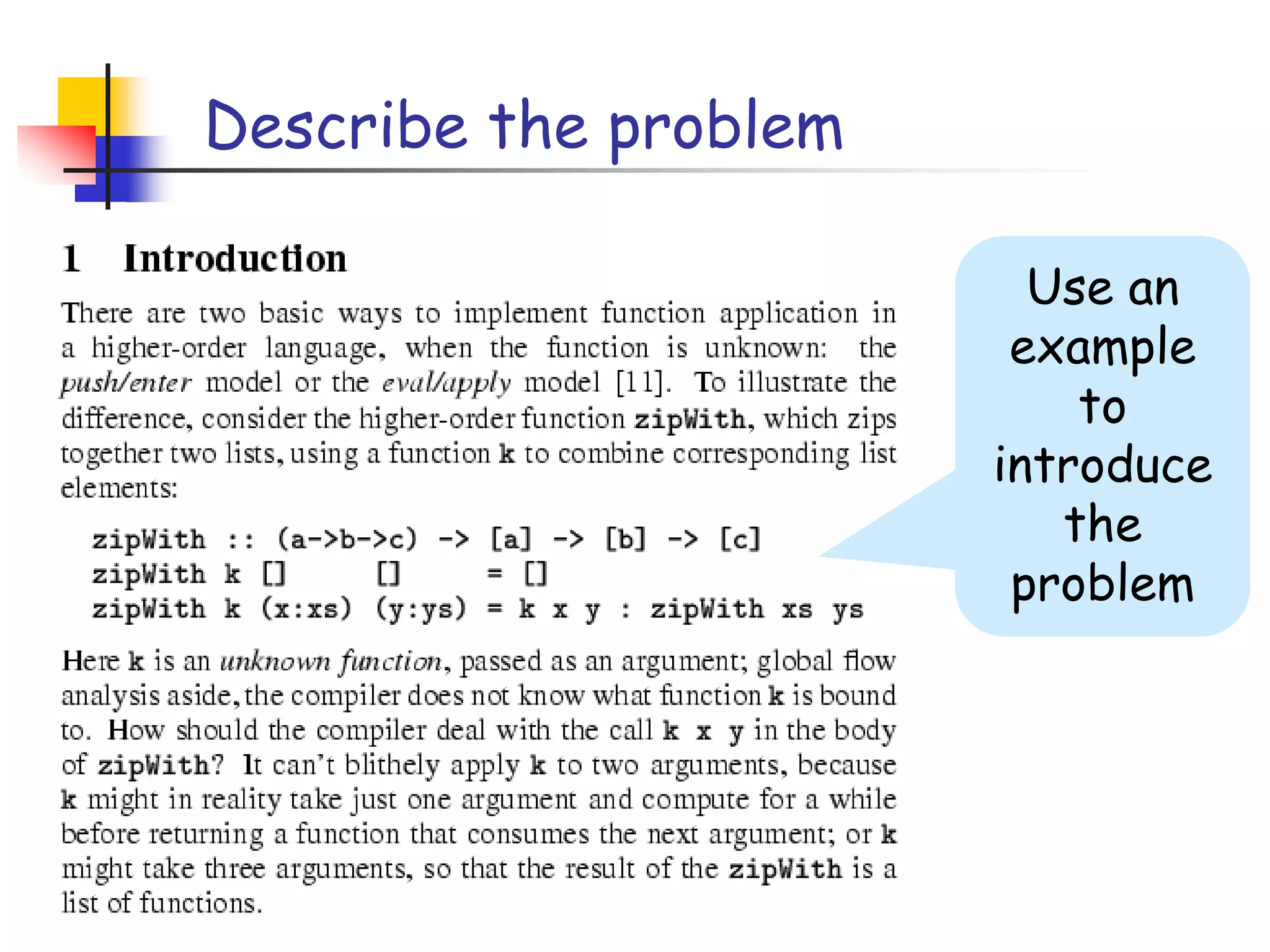
Describe the problemUse an example to introduce the problem
Molehills not mountains“Computer programs often have bugs.  It is very important to eliminate these bugs [1,2].  Many researchers have tried [3,4,5,6].  It really is very important.”“Consider this program, which has an interesting bug.  <brief description>.  We will show an automatic technique for identifying and removing such bugs”YawnCool!
State your contributionsWrite the list of contributions firstThe list of contributions drives the entire paper: the paper substantiates the claims you have madeReader thinks “gosh, if they can really deliver this, that’s be exciting; I’d better read on”
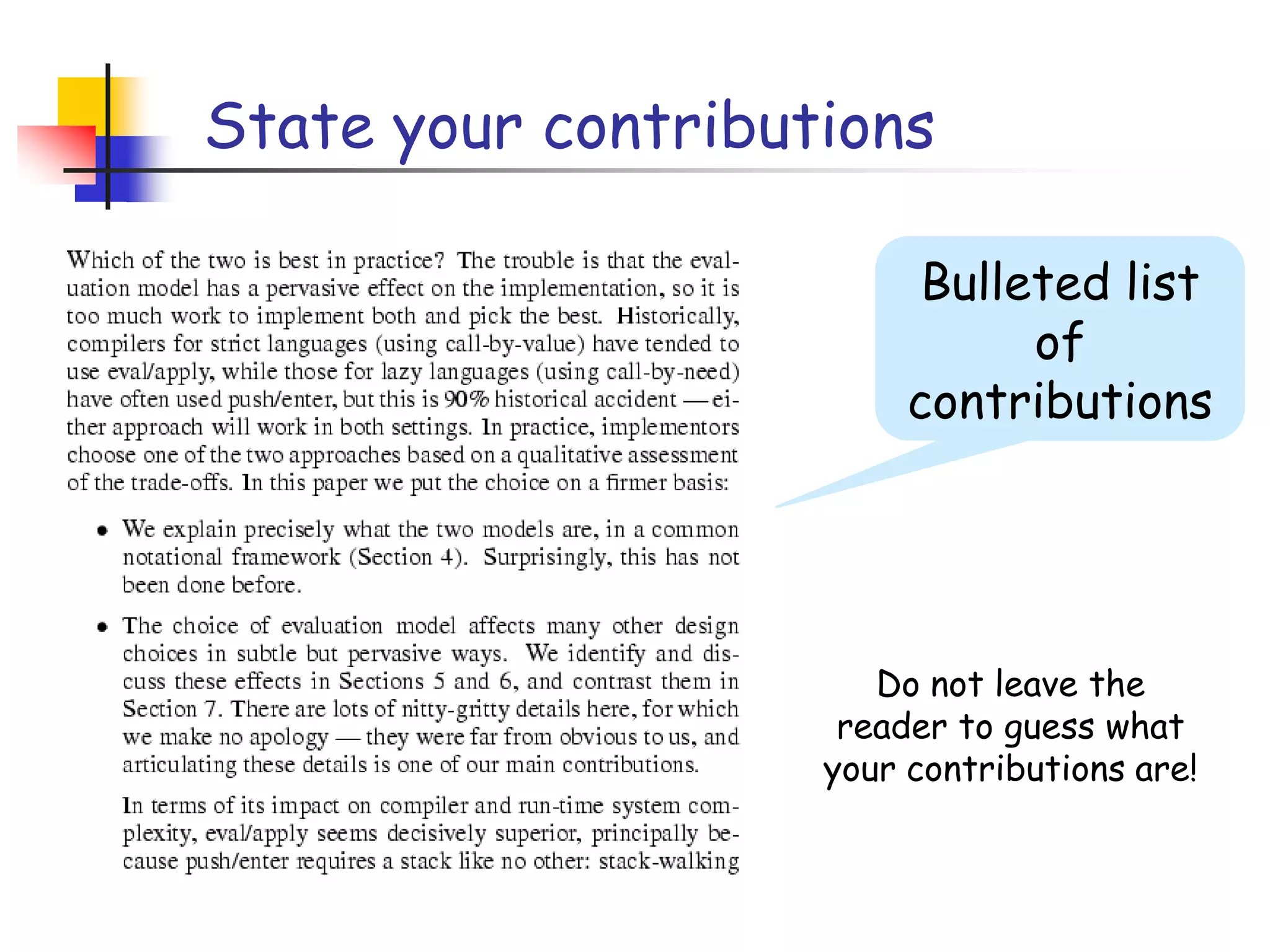
State your contributionsBulleted list of contributionsDo not leave the reader to guess what your contributions are!
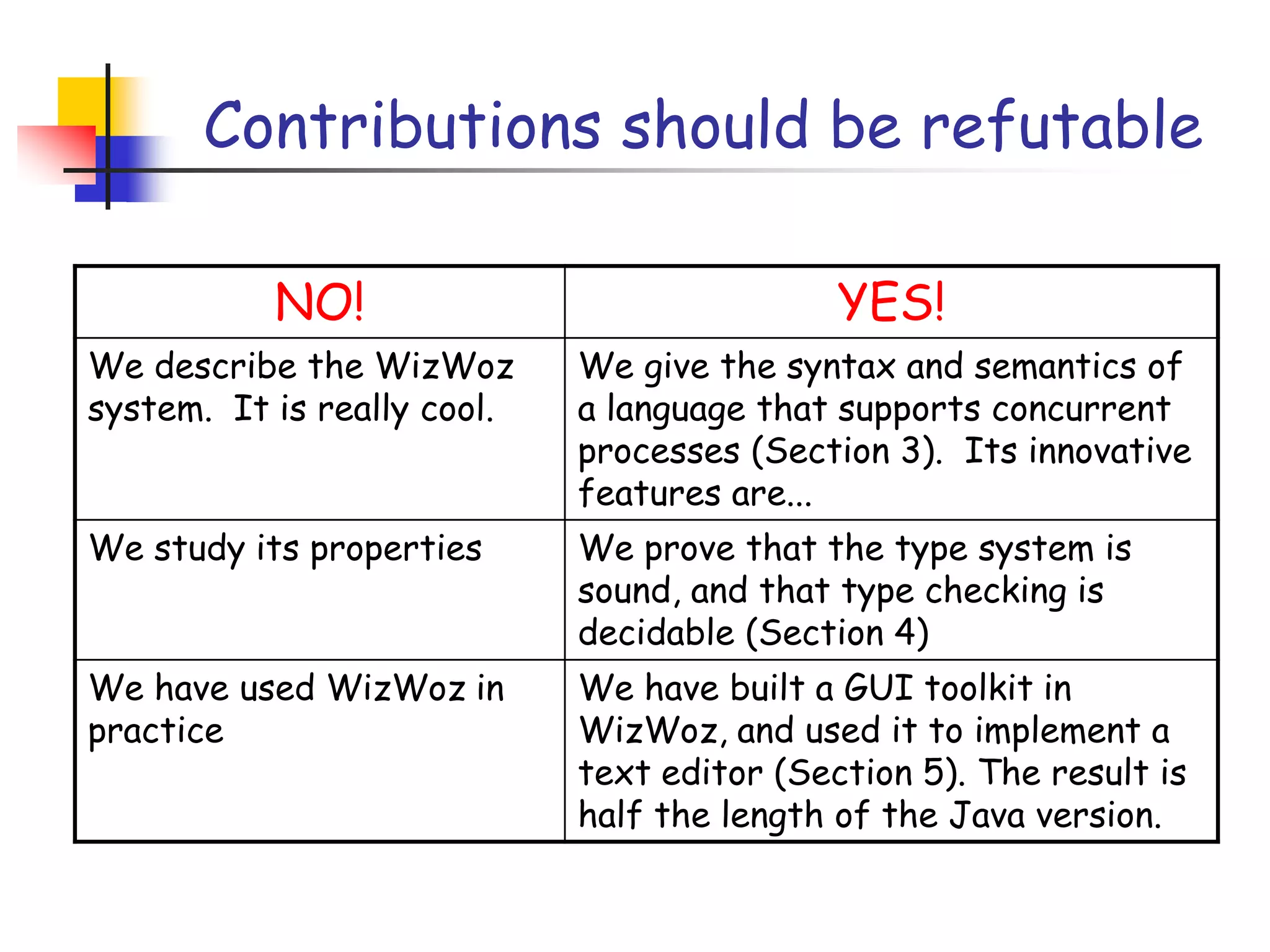
Contributions should be refutable
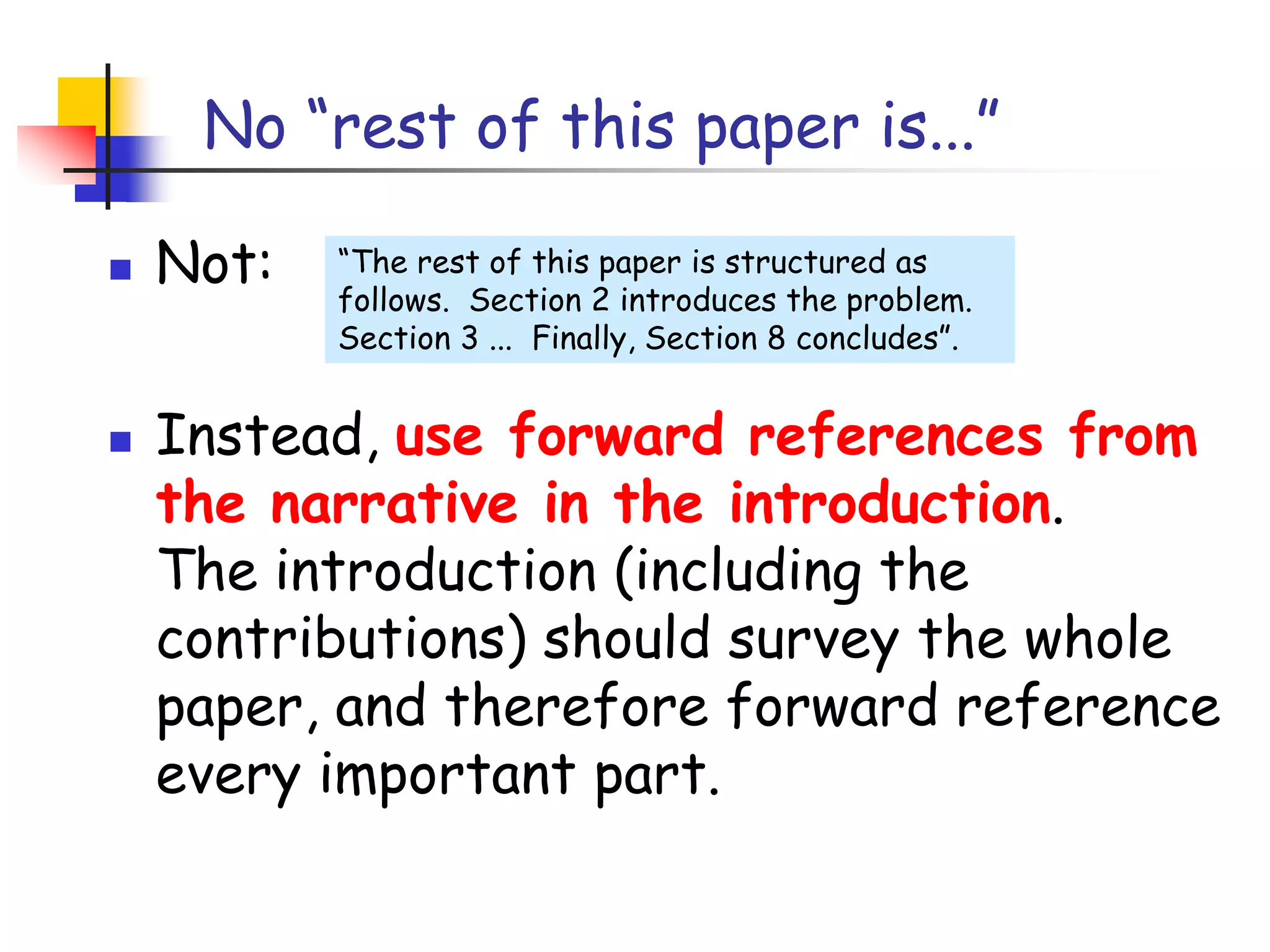
No “rest of this paper is...”Not:Instead, use forward references from the narrative in the introduction.  The introduction (including the contributions) should survey the whole paper, and therefore forward reference every important part.“The rest of this paper is structured as follows.  Section 2 introduces the problem.  Section 3 ...  Finally, Section 8 concludes”.
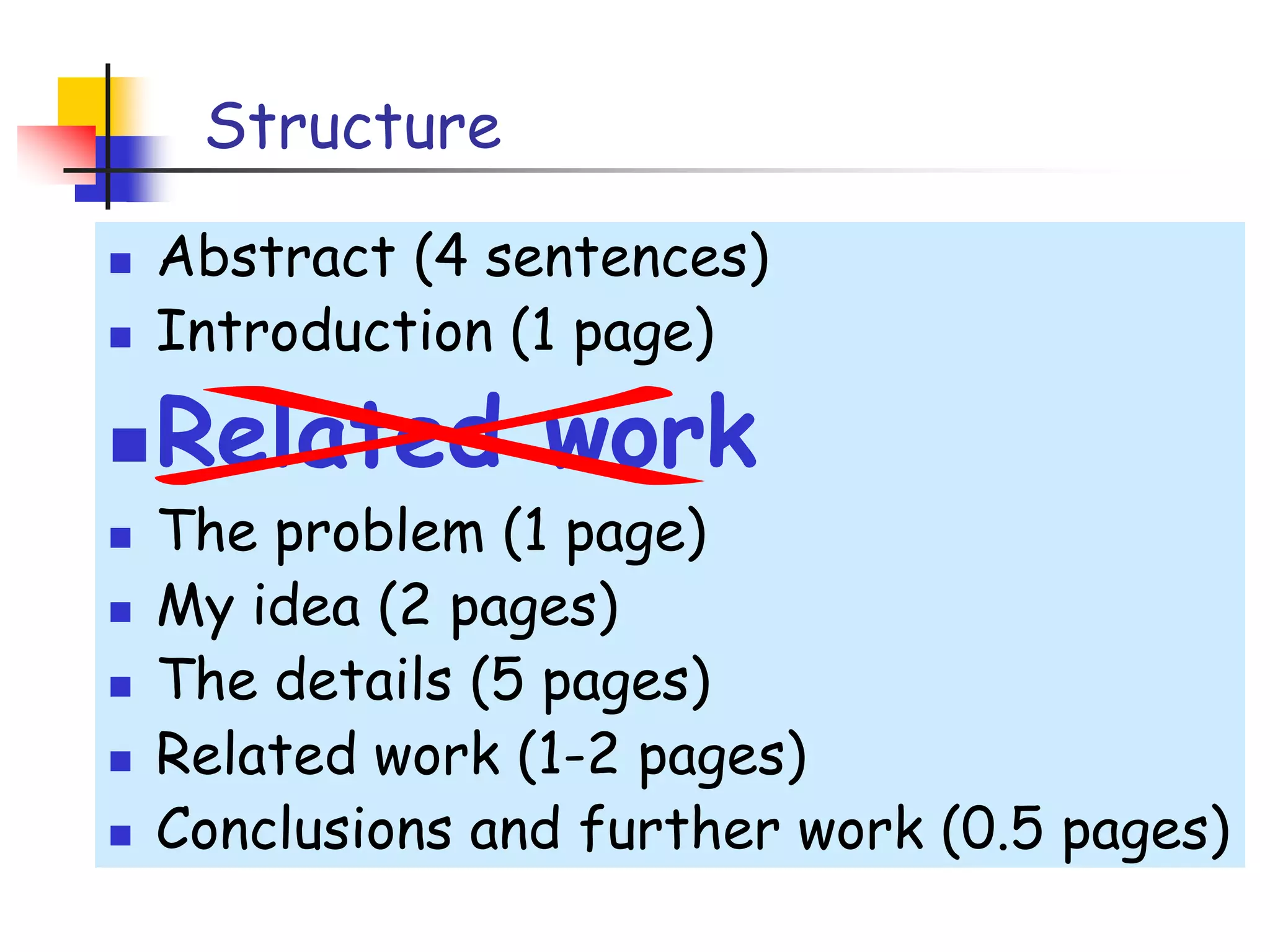
StructureAbstract (4 sentences)Introduction (1 page)Related workThe problem (1 page)My idea (2 pages)The details (5 pages)Related work (1-2 pages)Conclusions and further work (0.5 pages)
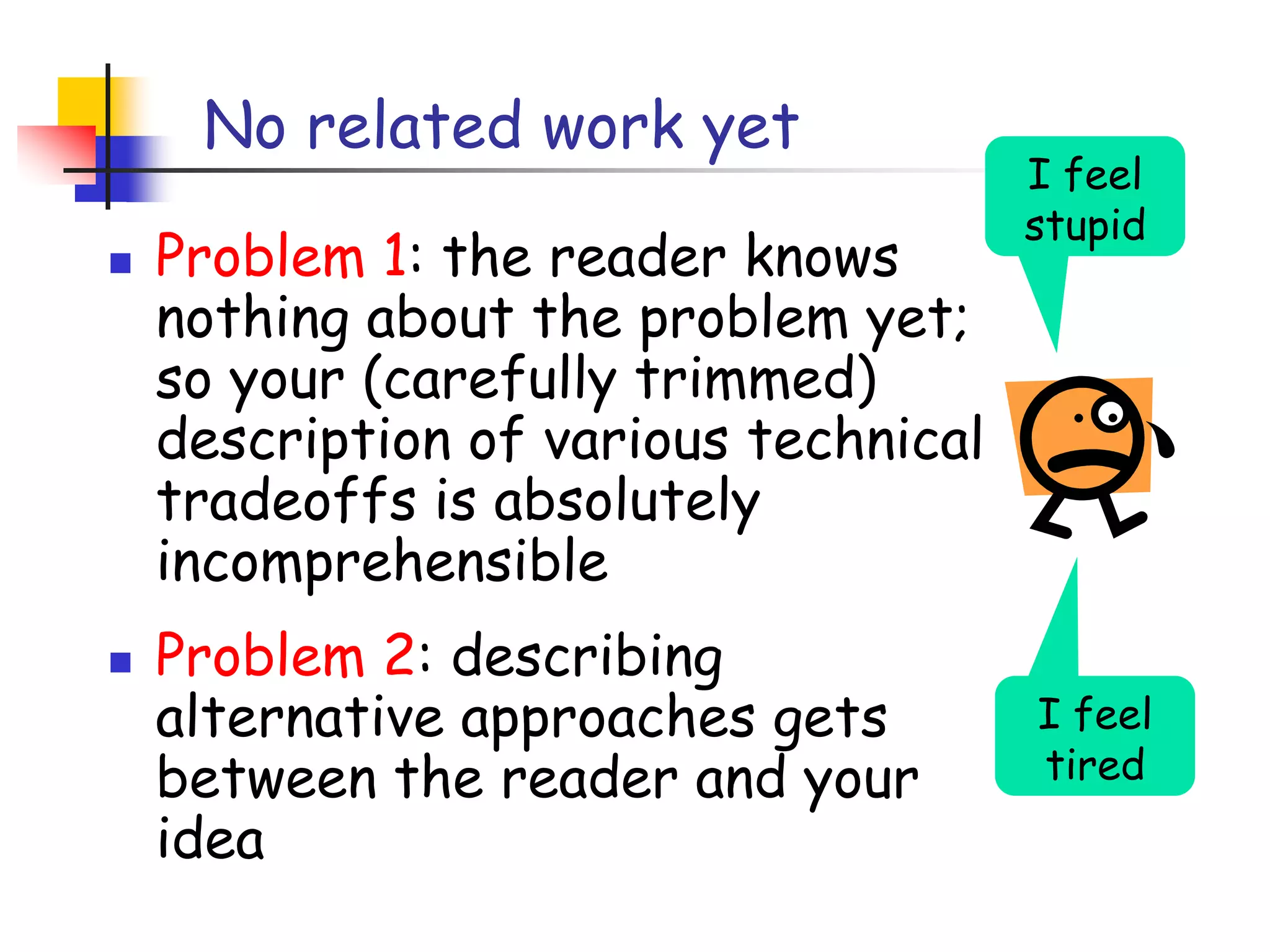
No related work yet!Related workYour readerYour ideaWe adopt the notion of transaction from Brown [1], as modified for distributed systems by White [2], using the four-phase interpolation algorithm of Green [3].  Our work differs from White in our advanced revocation protocol, which deals with the case of priority inversion as described by Yellow [4].
No related work yetI feel stupidProblem 1: the reader knows nothing about the problem yet; so your (carefully trimmed) description of various technical tradeoffs is absolutely incomprehensible Problem 2: describing alternative approaches gets between the reader and your ideaI feel tired
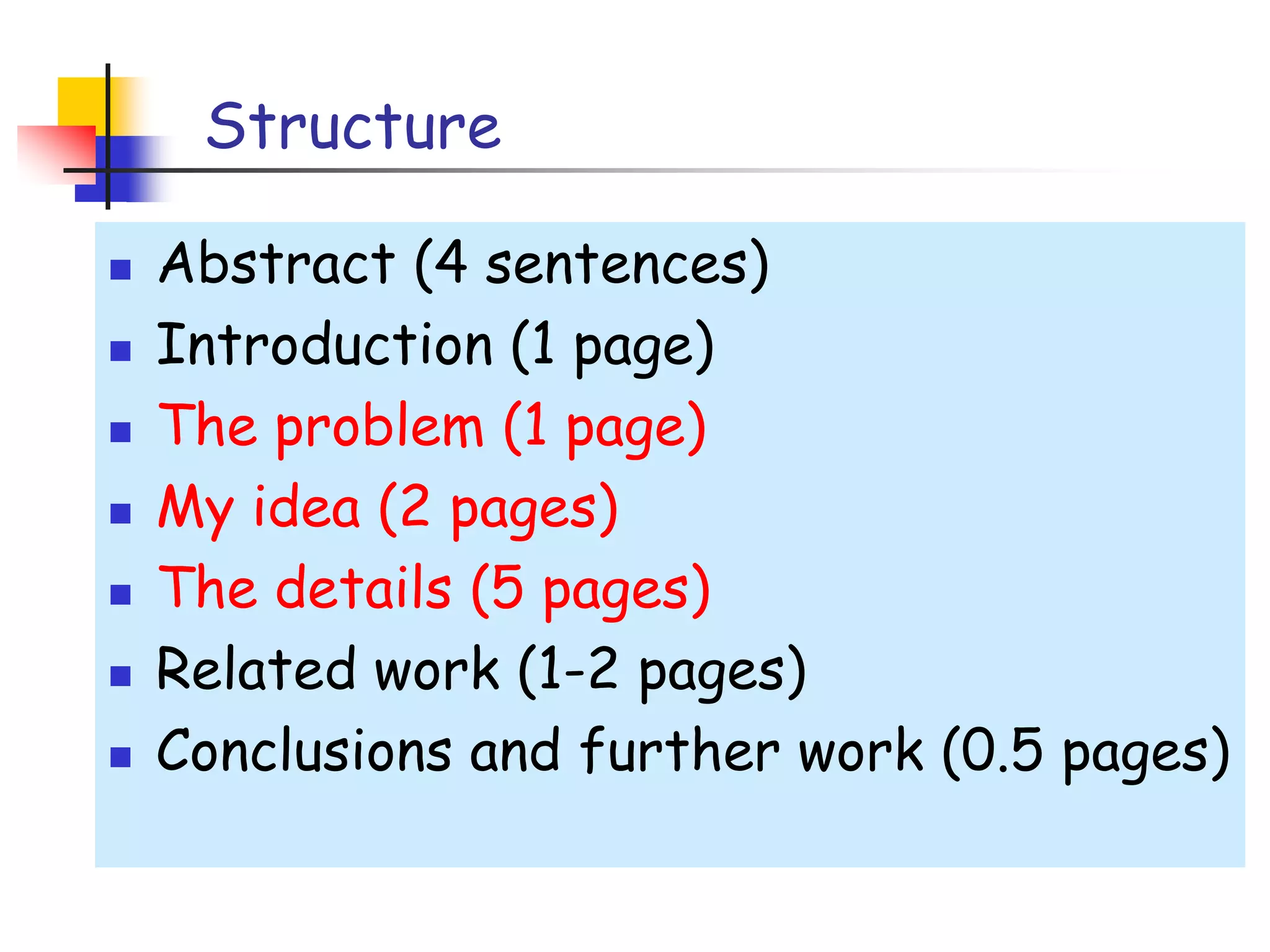
StructureAbstract (4 sentences)Introduction (1 page)The problem (1 page)My idea (2 pages)The details (5 pages)Related work (1-2 pages)Conclusions and further work (0.5 pages)
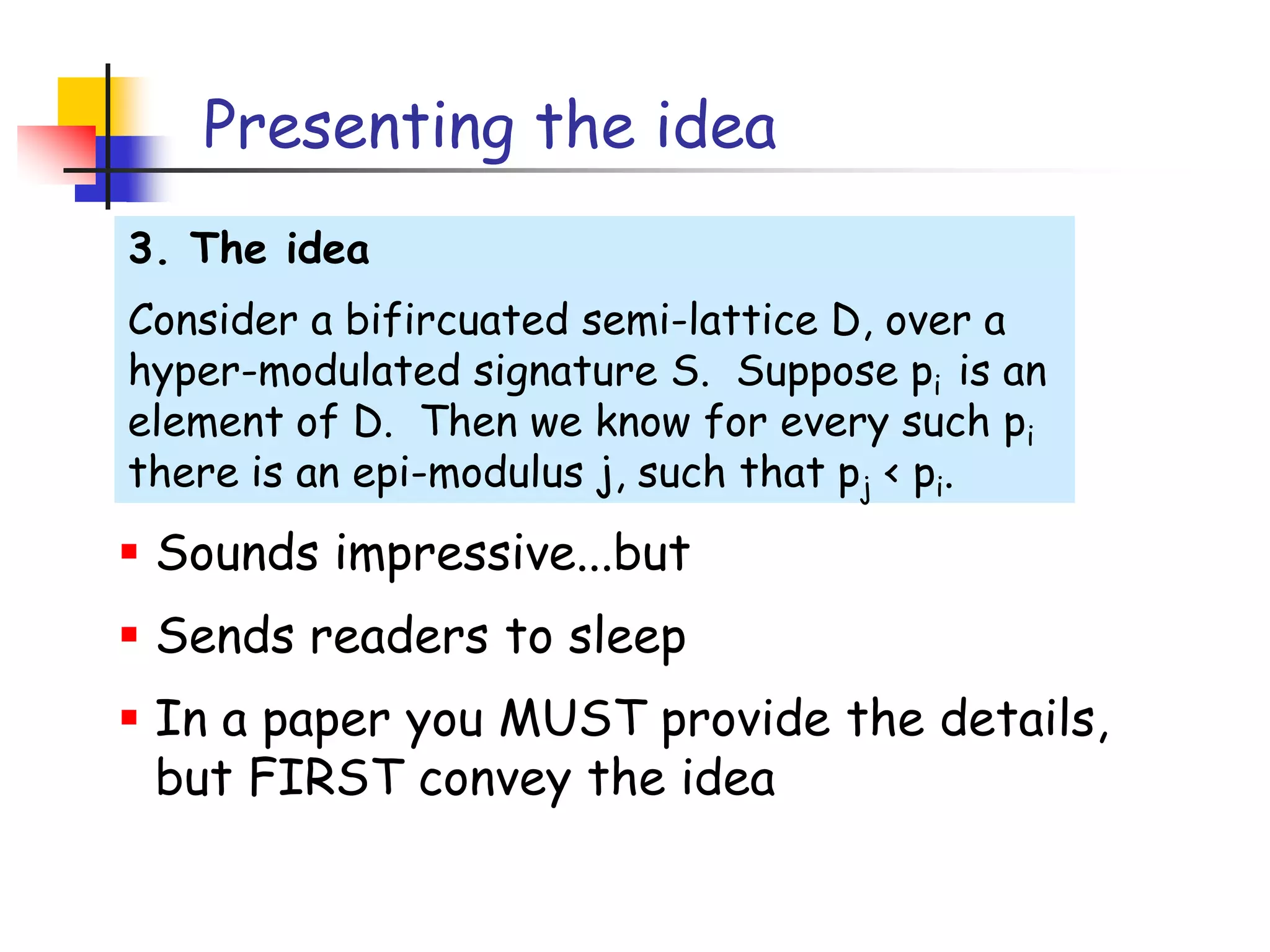
Presenting the idea3. The ideaConsider a bifircuated semi-lattice D, over a hyper-modulated signature S.  Suppose pi  is an element of D.  Then we know for every such pi there is an epi-modulus j, such that pj < pi.Sounds impressive...but
Sends readers to sleep
In a paper you MUST provide the details, but FIRST convey the ideaPresenting the ideaExplain it as if you were speaking to someone using a whiteboardConveying the intuition is primary, not secondaryOnce your reader has the intuition, she can follow the details (but not vice versa)Even if she skips the details, she still takes away something valuable
Putting the reader firstDo not recapitulate your personal journey of discovery.  This route may be soaked with your blood, but that is not interesting to the reader.Instead, choose the most direct route to the idea.
The payload of your paperIntroduce the problem, and your idea, usingEXAMPLESand only then present the general case
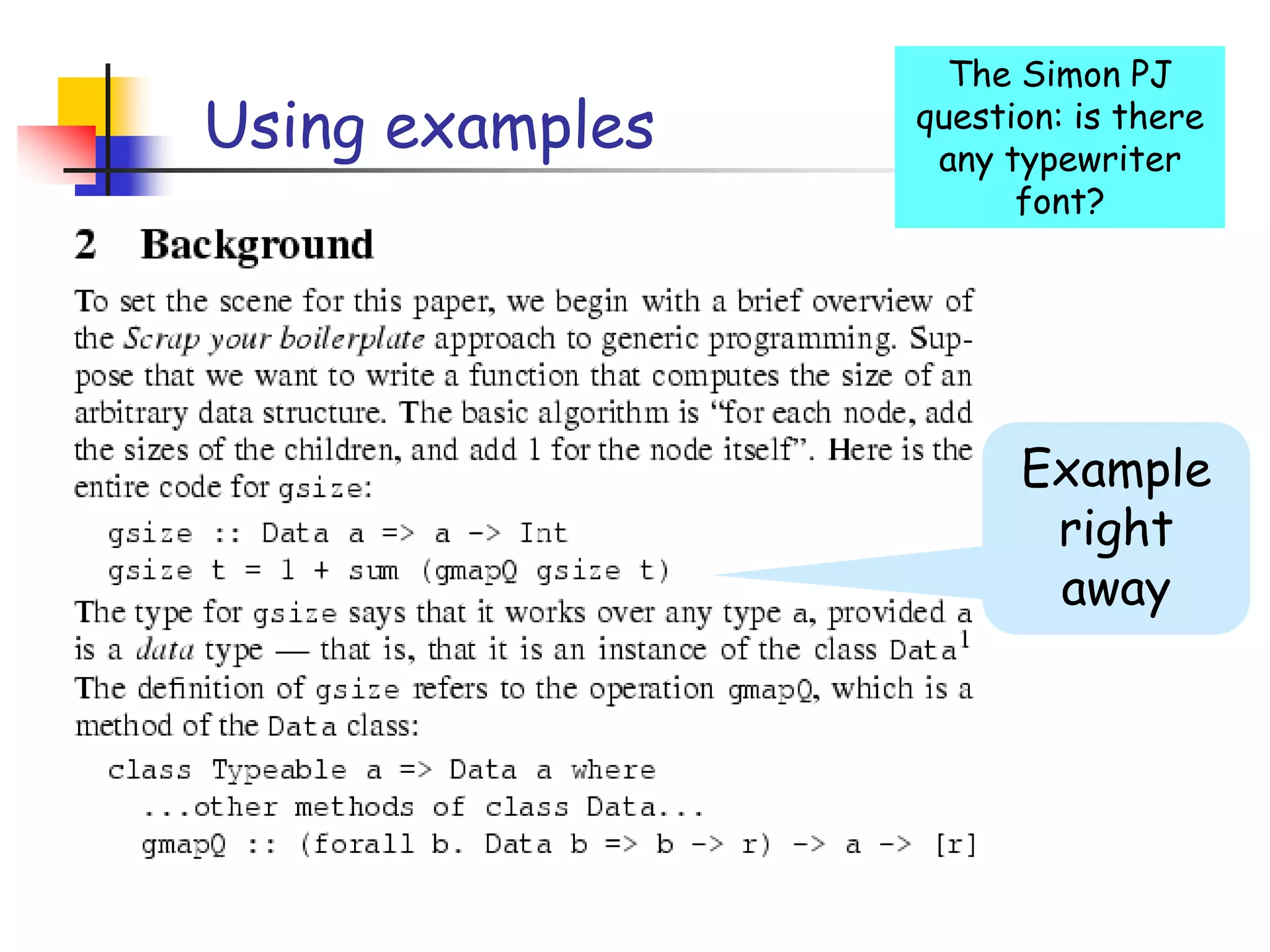
Using examplesThe Simon PJ question: is there any typewriter font?Example right away
The details: evidence	Your introduction makes claimsThe body of the paper provides evidence to support each claimCheck each claim in the introduction, identify the evidence, and forward-reference it from the claimEvidence can be: analysis and comparison, theorems, measurements, case studies
StructureAbstract (4 sentences)Introduction (1 page)The problem (1 page)My idea (2 pages)The details (5 pages)Related work (1-2 pages)Conclusions and further work (0.5 pages)
Related workFallacy	To make my work look good, I have to make other people’s work look bad
The truth: credit is not like moneyGiving credit to others does not diminish the credit you get from your paperWarmly acknowledge people who have helped you
Be generous to the competition.  “In his inspiring paper [Foo98] Foogle shows....  We develop his foundation in the following ways...”
Acknowledge weaknesses in your approachCredit is not like moneyFailing to give credit to others can kill your paperIf you imply that an idea is yours, and the referee knows it is not, then eitherYou don’t know that it’s an old idea (bad)
You do know, but are pretending it’s yours (very bad)StructureAbstract (4 sentences)Introduction (1 page)The problem (1 page)My idea (2 pages)The details (5 pages)Related work (1-2 pages)Conclusions and further work (0.5 pages)
Conclusions and further workBe brief.For future work, say what you intend to do. Don’t waste space on ambitious but unattractive developments.
The process of writing
The processStart early.  Very early.  Hastily-written papers get rejected.Papers are like wine: they need time to matureCollaborateUse CVS to support collaboration
Getting helpGet your paper read by as many friendly guinea pigs as possibleExperts are goodNon-experts are also very goodEach reader can only read your paper for the first time once!  So use them carefullyExplain carefully what you want (“I got lost here” is much more important than “Jarva is mis-spelt”.)
Getting expert helpA good plan: when you think you are done, send the draft to the competition saying “could you help me ensure that I describe your work fairly?”.  Often they will respond with helpful critique (they are interested in the area)They are likely to be your referees anyway, so getting their comments or criticism up front is Jolly Good.
Listening to your reviewersTreat every review like gold dustBe (truly) grateful for criticism as well as praiseThis is really, really, really hardBut it’s really, really, really, really, really, really, really, really, really, reallyimportant
Listening to your reviewersRead every criticism as a positive suggestion for something you could explain more clearlyDO NOT respond “you stupid person, I meant X”.  Fix the paper so that X is apparent even to the stupidest reader.Thank them warmly.  They have given up their time for you.
Language and style
Basic stuffSubmit by the deadlineKeep to the length restrictionsDo not narrow the marginsDo not use 6pt fontOn occasion, supply supporting evidence (e.g. experimental data, or a written-out proof) in an appendixAlways use a spell checker
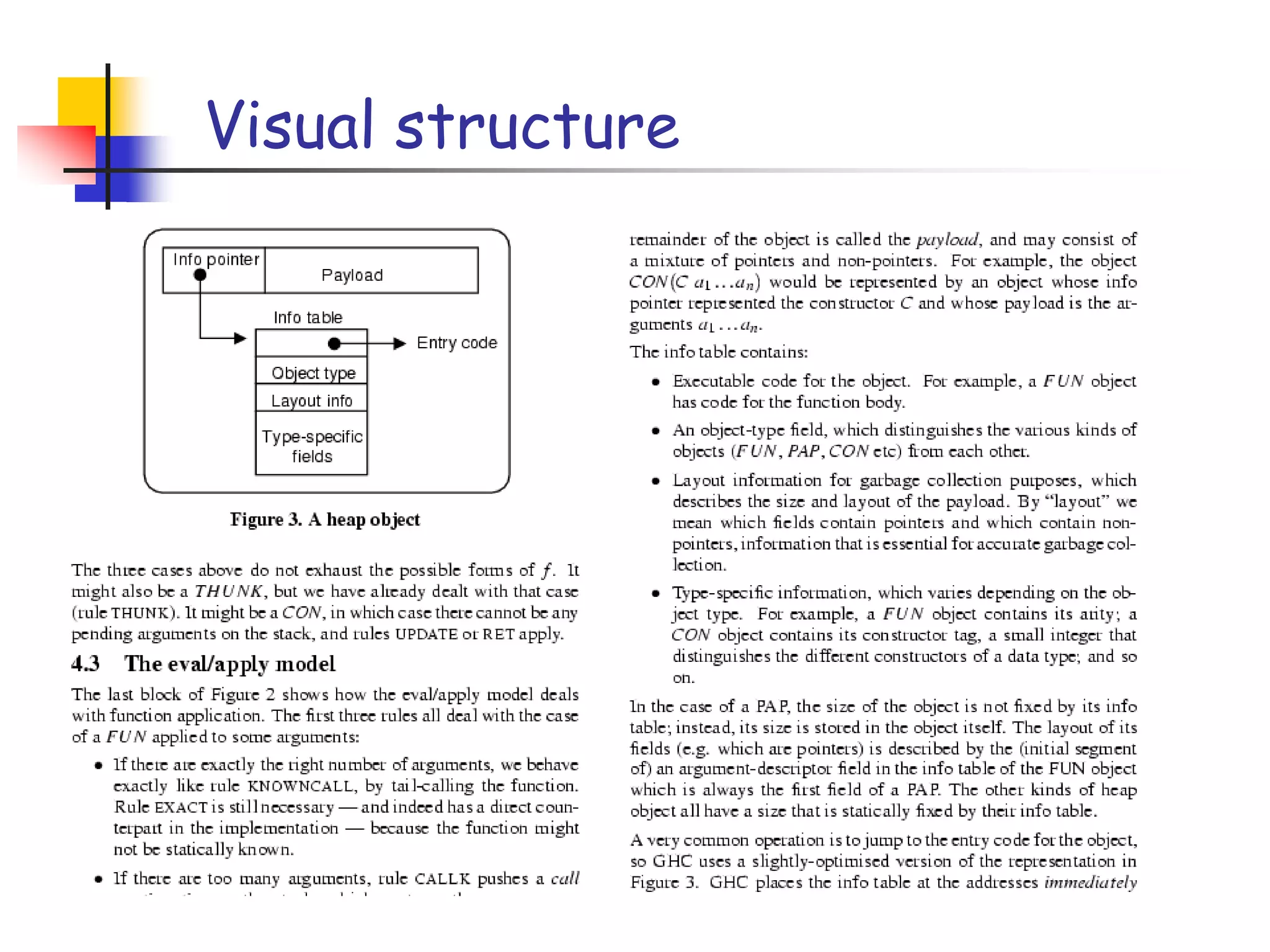
Visual structureGive strong visual structure to your paper using sections and sub-sectionsbulletsitalicslaid-out codeFind out how to draw pictures, and use them
Visual structure
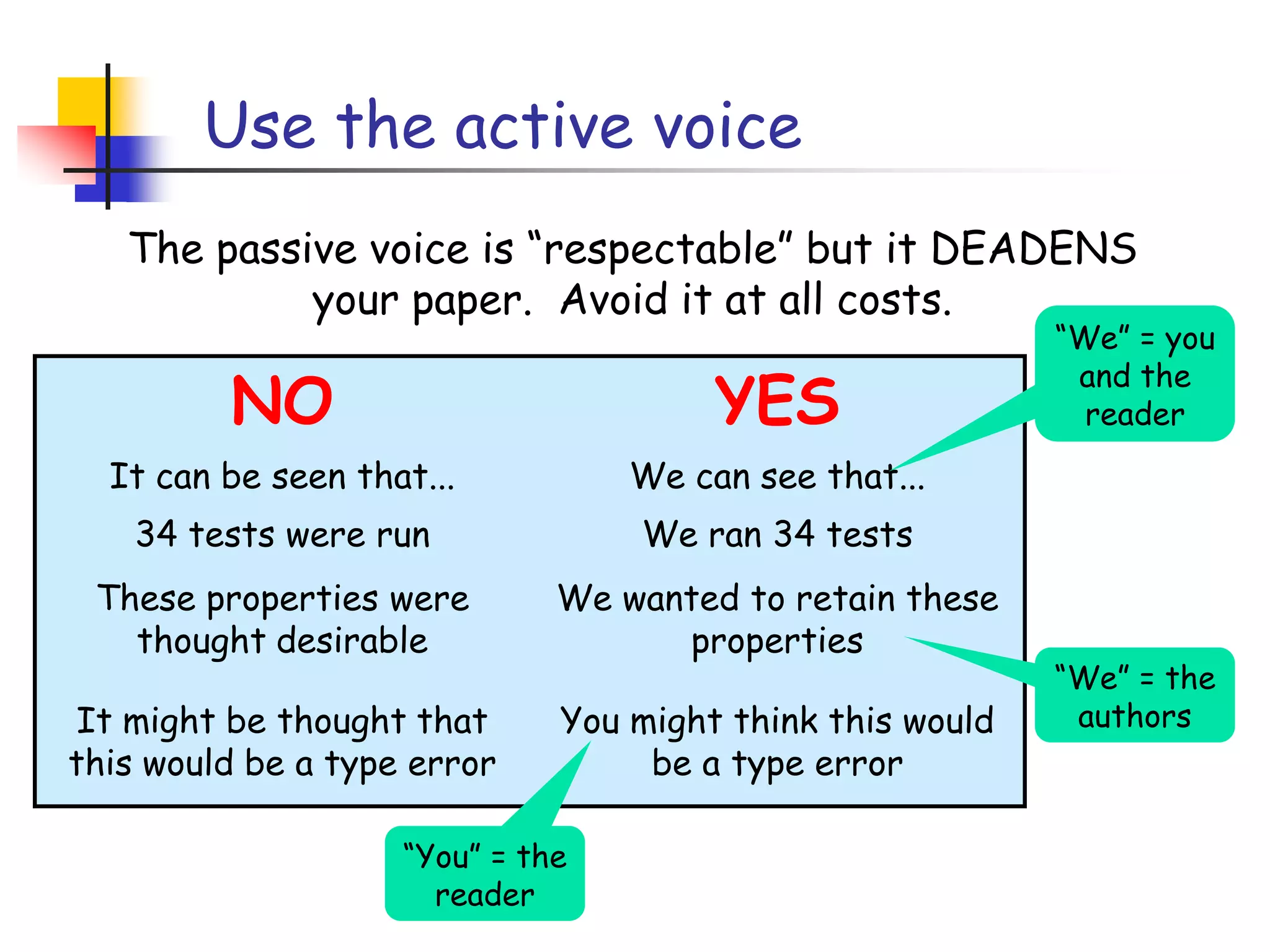
Use the active voiceThe passive voice is “respectable” but it DEADENS your paper.  Avoid it at all costs.“We” = you and the reader“We” = the authors“You” = the reader

20090720 writing a_paper

  • 1.
    How to writea great research paperSimon Peyton JonesMicrosoft Research, Cambridge
  • 2.
    Writing papers isa skillMany papers are badly writtenGood writing is a skill you can learnIt’s a skill that is worth learning:You will get more brownie points (more papers accepted etc)Your ideas will have more impactYou will have better ideasIncreasing importance
  • 3.
    Why writepapers?Good papersand talks are a fundamental part of research excellenceTo impress others, gain recognition, and get promotedNo
  • 4.
    Why write papers?NoTodescribe what you have doneYour reader does not care about you
  • 5.
    Why write papers?Todescribe the WizWoz systemNoYour reader does not have a WizWoz
  • 6.
    Why write papers?Butin design, in contrast with science, novelty in itself has no merit.If we recognize our artifacts as tools, we test them by their usefulness and their costs, not their novelty.Fred Brooks “The Computer Scientist as Toolsmith”, Comm ACM 39(5), March 1996To describe something newNo
  • 7.
    Why write papers?YesToconvey a useful and re-usable ideaIf we perceive our role aright, we then see more clearly the proper criterion for success: a toolmaker succeeds as, and only as, the users of his tool succeed with his aid. However shining the blade, however jewelled the hilt, however perfect the heft, a sword is tested only by cutting. That swordsmith is successful whose clients die of old age.Fred Brooks “The Computer Scientist as Toolsmith”
  • 8.
    Papers communicate ideasYourgoal: to infect the mind of your reader with your idea, like a virusPapers are far more durable than programs (think Mozart)The greatest ideas are (literally) worthless if you keep them to yourself
  • 9.
    Writing papers: model1IdeaDo researchWrite paper
  • 10.
    Writing papers: model2IdeaDo researchWrite paperIdeaWrite paperDo researchForces us to be clear, focusedCrystallises what we don’t understandOpens the way to dialogue with others: reality check, critique, and collaboration
  • 11.
    Do not beintimidatedFallacy You need to have a fantastic idea before you can write a paper. (Everyone else seems to.)Write a paper, and give a talk, about any idea, no matter how weedy and insignificant it may seem to you
  • 12.
    Do not beintimidatedWrite a paper, and give a talk, about any idea, no matter how insignificant it may seem to youWriting the paper is how you develop the idea in the first place
  • 13.
    It usually turnsout to be more interesting and challenging that it seemed at firstThe IdeaIdeaA re-usable insight, useful to the readerYour paper should have just one “ping”: one clear, sharp ideaYou may not know exactly what the ping is when you start writing; but you must know when you finishIf you have lots of ideas, write lots of papers
  • 14.
    Can you hearthe “ping”?Many papers contain good ideas, but do not distil what they are.Make certain that the reader is in no doubt what the idea is. Be 100% explicit:“The main idea of this paper is....”“In this section we present the main contributions of the paper.”Thanks to Joe Touch for “one ping”
  • 15.
    Your narrative flowHereis a problemIt’s an interesting problemIt’s an unsolved problemHere is my ideaMy idea works (details, data)Here’s how my idea compares to other people’s approachesI wish I knew how to solve that!I see how that works. Ingenious!
  • 16.
    Structure (conference paper)Title(1000 readers)Abstract (4 sentences, 100 readers)Introduction (1 page, 100 readers)The problem (1 page, 10 readers)My idea (2 pages, 10 readers)The details (5 pages, 3 readers)Related work (1-2 pages, 10 readers)Conclusions and further work (0.5 pages)
  • 17.
    The abstractI usuallywrite the abstract lastUsed by program committee members to decide which papers to readFour sentences [Kent Beck]State the problemSay why it’s an interesting problemSay what your solution achievesSay what follows from your solution
  • 18.
    ExampleMany papers arebadly written and hard to understandThis is a pity, because their good ideas may go unappreciatedFollowing simple guidelines can dramatically improve the quality of your papersYour work will be used more, and the feedback you get from others will in turn improve your research
  • 19.
    StructureAbstract (4 sentences)Introduction(1 page)The problem (1 page)My idea (2 pages)The details (5 pages)Related work (1-2 pages)Conclusions and further work (0.5 pages)
  • 20.
    The introduction (1page)Describe the problemState your contributions...and that is allONE PAGE!
  • 21.
    Describe the problemUsean example to introduce the problem
  • 22.
    Molehills not mountains“Computerprograms often have bugs. It is very important to eliminate these bugs [1,2]. Many researchers have tried [3,4,5,6]. It really is very important.”“Consider this program, which has an interesting bug. <brief description>. We will show an automatic technique for identifying and removing such bugs”YawnCool!
  • 23.
    State your contributionsWritethe list of contributions firstThe list of contributions drives the entire paper: the paper substantiates the claims you have madeReader thinks “gosh, if they can really deliver this, that’s be exciting; I’d better read on”
  • 24.
    State your contributionsBulletedlist of contributionsDo not leave the reader to guess what your contributions are!
  • 25.
  • 26.
    No “rest ofthis paper is...”Not:Instead, use forward references from the narrative in the introduction. The introduction (including the contributions) should survey the whole paper, and therefore forward reference every important part.“The rest of this paper is structured as follows. Section 2 introduces the problem. Section 3 ... Finally, Section 8 concludes”.
  • 27.
    StructureAbstract (4 sentences)Introduction(1 page)Related workThe problem (1 page)My idea (2 pages)The details (5 pages)Related work (1-2 pages)Conclusions and further work (0.5 pages)
  • 28.
    No related workyet!Related workYour readerYour ideaWe adopt the notion of transaction from Brown [1], as modified for distributed systems by White [2], using the four-phase interpolation algorithm of Green [3]. Our work differs from White in our advanced revocation protocol, which deals with the case of priority inversion as described by Yellow [4].
  • 29.
    No related workyetI feel stupidProblem 1: the reader knows nothing about the problem yet; so your (carefully trimmed) description of various technical tradeoffs is absolutely incomprehensible Problem 2: describing alternative approaches gets between the reader and your ideaI feel tired
  • 30.
    StructureAbstract (4 sentences)Introduction(1 page)The problem (1 page)My idea (2 pages)The details (5 pages)Related work (1-2 pages)Conclusions and further work (0.5 pages)
  • 31.
    Presenting the idea3.The ideaConsider a bifircuated semi-lattice D, over a hyper-modulated signature S. Suppose pi is an element of D. Then we know for every such pi there is an epi-modulus j, such that pj < pi.Sounds impressive...but
  • 32.
  • 33.
    In a paperyou MUST provide the details, but FIRST convey the ideaPresenting the ideaExplain it as if you were speaking to someone using a whiteboardConveying the intuition is primary, not secondaryOnce your reader has the intuition, she can follow the details (but not vice versa)Even if she skips the details, she still takes away something valuable
  • 34.
    Putting the readerfirstDo not recapitulate your personal journey of discovery. This route may be soaked with your blood, but that is not interesting to the reader.Instead, choose the most direct route to the idea.
  • 35.
    The payload ofyour paperIntroduce the problem, and your idea, usingEXAMPLESand only then present the general case
  • 36.
    Using examplesThe SimonPJ question: is there any typewriter font?Example right away
  • 37.
    The details: evidence Yourintroduction makes claimsThe body of the paper provides evidence to support each claimCheck each claim in the introduction, identify the evidence, and forward-reference it from the claimEvidence can be: analysis and comparison, theorems, measurements, case studies
  • 38.
    StructureAbstract (4 sentences)Introduction(1 page)The problem (1 page)My idea (2 pages)The details (5 pages)Related work (1-2 pages)Conclusions and further work (0.5 pages)
  • 39.
    Related workFallacy To makemy work look good, I have to make other people’s work look bad
  • 40.
    The truth: creditis not like moneyGiving credit to others does not diminish the credit you get from your paperWarmly acknowledge people who have helped you
  • 41.
    Be generous tothe competition. “In his inspiring paper [Foo98] Foogle shows.... We develop his foundation in the following ways...”
  • 42.
    Acknowledge weaknesses inyour approachCredit is not like moneyFailing to give credit to others can kill your paperIf you imply that an idea is yours, and the referee knows it is not, then eitherYou don’t know that it’s an old idea (bad)
  • 43.
    You do know,but are pretending it’s yours (very bad)StructureAbstract (4 sentences)Introduction (1 page)The problem (1 page)My idea (2 pages)The details (5 pages)Related work (1-2 pages)Conclusions and further work (0.5 pages)
  • 44.
    Conclusions and furtherworkBe brief.For future work, say what you intend to do. Don’t waste space on ambitious but unattractive developments.
  • 45.
  • 46.
    The processStart early. Very early. Hastily-written papers get rejected.Papers are like wine: they need time to matureCollaborateUse CVS to support collaboration
  • 47.
    Getting helpGet yourpaper read by as many friendly guinea pigs as possibleExperts are goodNon-experts are also very goodEach reader can only read your paper for the first time once! So use them carefullyExplain carefully what you want (“I got lost here” is much more important than “Jarva is mis-spelt”.)
  • 48.
    Getting expert helpAgood plan: when you think you are done, send the draft to the competition saying “could you help me ensure that I describe your work fairly?”. Often they will respond with helpful critique (they are interested in the area)They are likely to be your referees anyway, so getting their comments or criticism up front is Jolly Good.
  • 49.
    Listening to yourreviewersTreat every review like gold dustBe (truly) grateful for criticism as well as praiseThis is really, really, really hardBut it’s really, really, really, really, really, really, really, really, really, reallyimportant
  • 50.
    Listening to yourreviewersRead every criticism as a positive suggestion for something you could explain more clearlyDO NOT respond “you stupid person, I meant X”. Fix the paper so that X is apparent even to the stupidest reader.Thank them warmly. They have given up their time for you.
  • 51.
  • 52.
    Basic stuffSubmit bythe deadlineKeep to the length restrictionsDo not narrow the marginsDo not use 6pt fontOn occasion, supply supporting evidence (e.g. experimental data, or a written-out proof) in an appendixAlways use a spell checker
  • 53.
    Visual structureGive strongvisual structure to your paper using sections and sub-sectionsbulletsitalicslaid-out codeFind out how to draw pictures, and use them
  • 54.
  • 55.
    Use the activevoiceThe passive voice is “respectable” but it DEADENS your paper. Avoid it at all costs.“We” = you and the reader“We” = the authors“You” = the reader
  • 56.
  • 57.
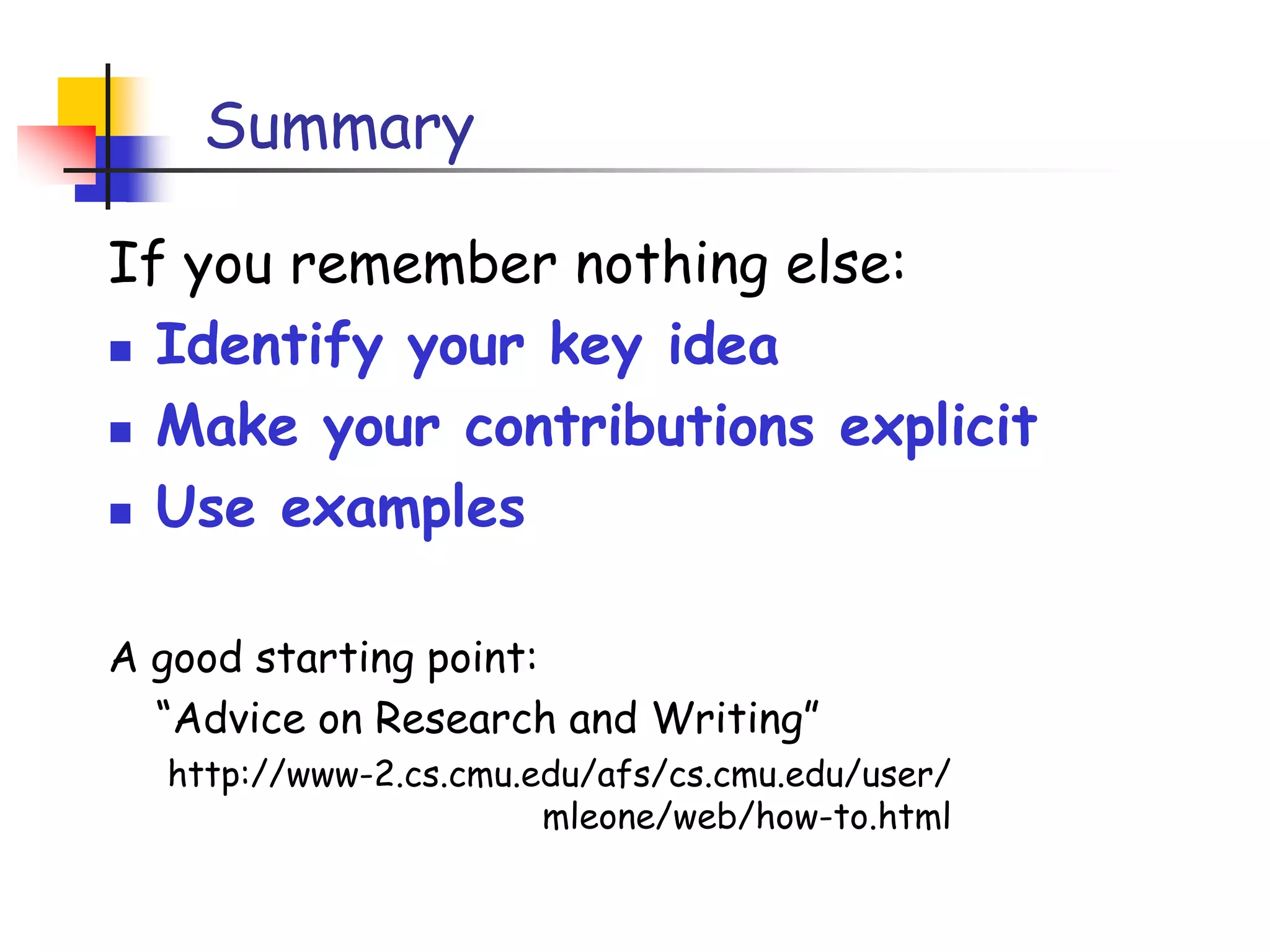
    SummaryIf you remembernothing else:Identify your key ideaMake your contributions explicitUse examplesA good starting point: “Advice on Research and Writing”http://www-2.cs.cmu.edu/afs/cs.cmu.edu/user/mleone/web/how-to.html