: STORIES  FROM THE FIELD ONLINE  FACILITATION :
Or how to be a successul online teacher….. Image courtesy of  homepage.mac.com/kristinwight /
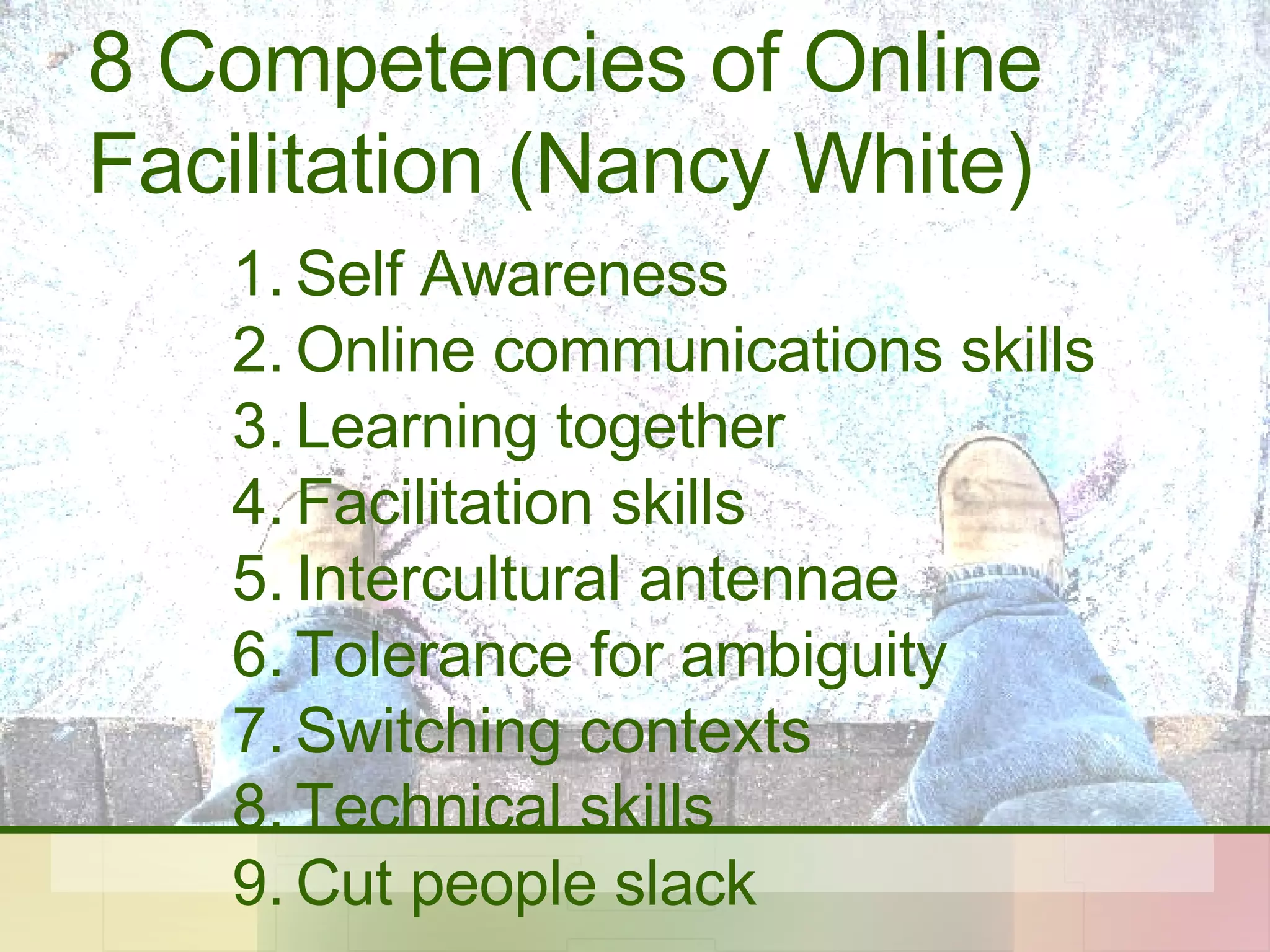
Self Awareness Online communication skills Learning together Facilitation skills Intercultural antennae Tolerance for ambiguity Switching contexts Technical skills Cut people slack 8 Competencies of Online Facilitation (Nancy White)
Models of Delivery Self-paced Facilitated
RHIZOMIC NATURE OF THE INTERNET
The teacher – centric model of teaching  is out the window
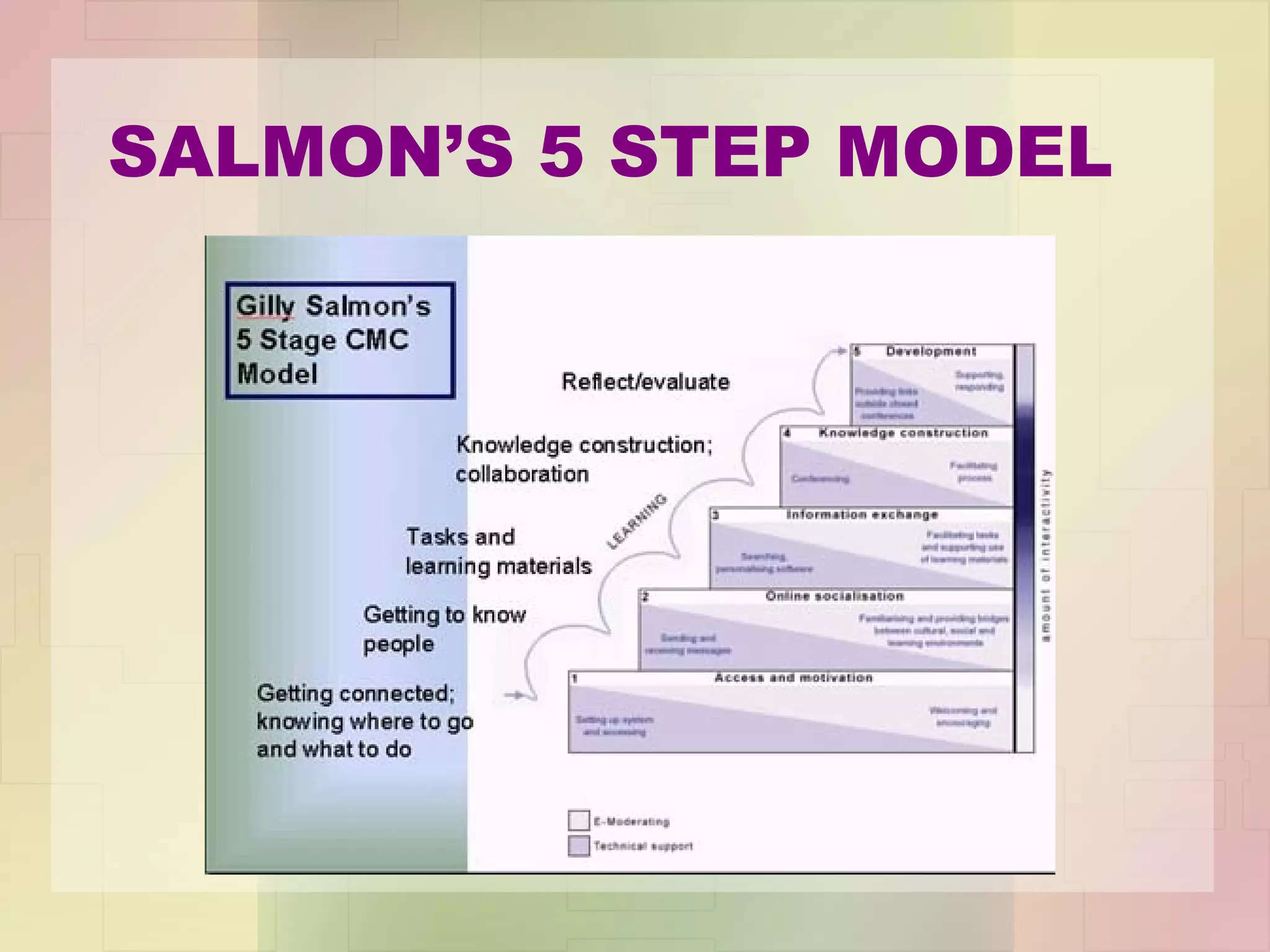
SALMON’S 5 STEP MODEL
Stage 2 (Familiarisation) Hi! My name is Annette W and this is definitely a new way of learning for me.  I'm not used to not seeing the people that I'm learning with in class. I'm looking forward to this new medium and hope you all feel the same. Hope to hear from you soon  Bye for now
Stage 4 (Knowledge Construction, Collaboration) “ We see clusters of course development here, too. Some of this is can be the support services in place in the department, and some of it can be explained by the "Diffusion of Innovations" work by Everett Rogers.Rogers says that there are five interrelated attributes that accompany the diffusion of technology: its relative advantage when compared with other methods; its compatibility with the existing culture; its complexity of use; if it can be experienced in a limited way; and there is the ability to observe how others have used it. The clustering of faculty in one department or college speaks to the latter attribute. Part of the strategy we employ to enhance this effect is a series of "Showcases" at which faculty speak to faculty about their experiences.”  - Catherine G
Roles of the Facilitator Published in Berge, Z. L. & Collins, M. P. (Eds.).(1995). Computer-mediated communication and the  on-line classroom in Distance Education; on the web at  http:// www.emoderators.com/moderators/morten.html
THE TOOLS: Chat Email Forum Instant Messaging The telephone Virtual Classrooms Blogs, wikis, Personal Learning Environments  (Social Software) 3D worlds, etc
Troubleshooting/Conflict Negotiation private email? phone? public discussion? peer resolution?
Rate of Response/Level of Involvement Respond within 24 hours unless otherwise specified, but  establish ground rules/expectations about this UPFRONT! DON’T RESPOND TO EVERYTHING – let the group assume some responsibility for the discussion.  (Again,  discuss this upfront .) Appropriate ratio: about 1:5 – 1:8
MODELLING Summarising discussions Communication skills Manner/ attitude /humour Attitudes  refer to the  affective domain : includes ‘ learner’s’ values, beliefs, biases, emotions, and  role expectations that may influence their disposition  towards the learning environment.
ENGAGEMENT: Motivate them, inspire them, annoy them, make them laugh, make them angry, but for goodness sake don’t bore them! (Thiagi) http://thiagi.com/
STUDENT EVALUATION: “ I think it was a blessing to strike you as the facilitator in the first unit in this course. You are  enthusiastic  about the subject and keep your commentary simple and to the point and I appreciated that. You also have a  sense of humour  and weren’t afraid to show it.”  “… thank you for  your input into my life .” LET PEOPLE KNOW  WHO YOU ARE
Self Awareness Online communications skills Learning together Facilitation skills Intercultural antennae Tolerance for ambiguity Switching contexts Technical skills Cut people slack 8 Competencies of Online Facilitation (Nancy White)
 
Michael Coghlan e:  [email_address] m 0417 899 912 http://users.chariot.net.au/~michaelc/

Online Facilitation (update)

  • 1.
    : STORIES FROM THE FIELD ONLINE FACILITATION :
  • 2.
    Or how tobe a successul online teacher….. Image courtesy of homepage.mac.com/kristinwight /
  • 3.
    Self Awareness Onlinecommunication skills Learning together Facilitation skills Intercultural antennae Tolerance for ambiguity Switching contexts Technical skills Cut people slack 8 Competencies of Online Facilitation (Nancy White)
  • 4.
    Models of DeliverySelf-paced Facilitated
  • 5.
    RHIZOMIC NATURE OFTHE INTERNET
  • 6.
    The teacher –centric model of teaching is out the window
  • 7.
  • 8.
    Stage 2 (Familiarisation)Hi! My name is Annette W and this is definitely a new way of learning for me. I'm not used to not seeing the people that I'm learning with in class. I'm looking forward to this new medium and hope you all feel the same. Hope to hear from you soon Bye for now
  • 9.
    Stage 4 (KnowledgeConstruction, Collaboration) “ We see clusters of course development here, too. Some of this is can be the support services in place in the department, and some of it can be explained by the "Diffusion of Innovations" work by Everett Rogers.Rogers says that there are five interrelated attributes that accompany the diffusion of technology: its relative advantage when compared with other methods; its compatibility with the existing culture; its complexity of use; if it can be experienced in a limited way; and there is the ability to observe how others have used it. The clustering of faculty in one department or college speaks to the latter attribute. Part of the strategy we employ to enhance this effect is a series of "Showcases" at which faculty speak to faculty about their experiences.” - Catherine G
  • 10.
    Roles of theFacilitator Published in Berge, Z. L. & Collins, M. P. (Eds.).(1995). Computer-mediated communication and the on-line classroom in Distance Education; on the web at http:// www.emoderators.com/moderators/morten.html
  • 11.
    THE TOOLS: ChatEmail Forum Instant Messaging The telephone Virtual Classrooms Blogs, wikis, Personal Learning Environments (Social Software) 3D worlds, etc
  • 12.
    Troubleshooting/Conflict Negotiation privateemail? phone? public discussion? peer resolution?
  • 13.
    Rate of Response/Levelof Involvement Respond within 24 hours unless otherwise specified, but establish ground rules/expectations about this UPFRONT! DON’T RESPOND TO EVERYTHING – let the group assume some responsibility for the discussion. (Again, discuss this upfront .) Appropriate ratio: about 1:5 – 1:8
  • 14.
    MODELLING Summarising discussionsCommunication skills Manner/ attitude /humour Attitudes refer to the affective domain : includes ‘ learner’s’ values, beliefs, biases, emotions, and role expectations that may influence their disposition towards the learning environment.
  • 15.
    ENGAGEMENT: Motivate them,inspire them, annoy them, make them laugh, make them angry, but for goodness sake don’t bore them! (Thiagi) http://thiagi.com/
  • 16.
    STUDENT EVALUATION: “I think it was a blessing to strike you as the facilitator in the first unit in this course. You are enthusiastic about the subject and keep your commentary simple and to the point and I appreciated that. You also have a sense of humour and weren’t afraid to show it.” “… thank you for your input into my life .” LET PEOPLE KNOW WHO YOU ARE
  • 17.
    Self Awareness Onlinecommunications skills Learning together Facilitation skills Intercultural antennae Tolerance for ambiguity Switching contexts Technical skills Cut people slack 8 Competencies of Online Facilitation (Nancy White)
  • 18.
  • 19.
    Michael Coghlan e: [email_address] m 0417 899 912 http://users.chariot.net.au/~michaelc/