   Lean Six
    Sigma
    Define
    Phase
    Project
    Charter
    Template
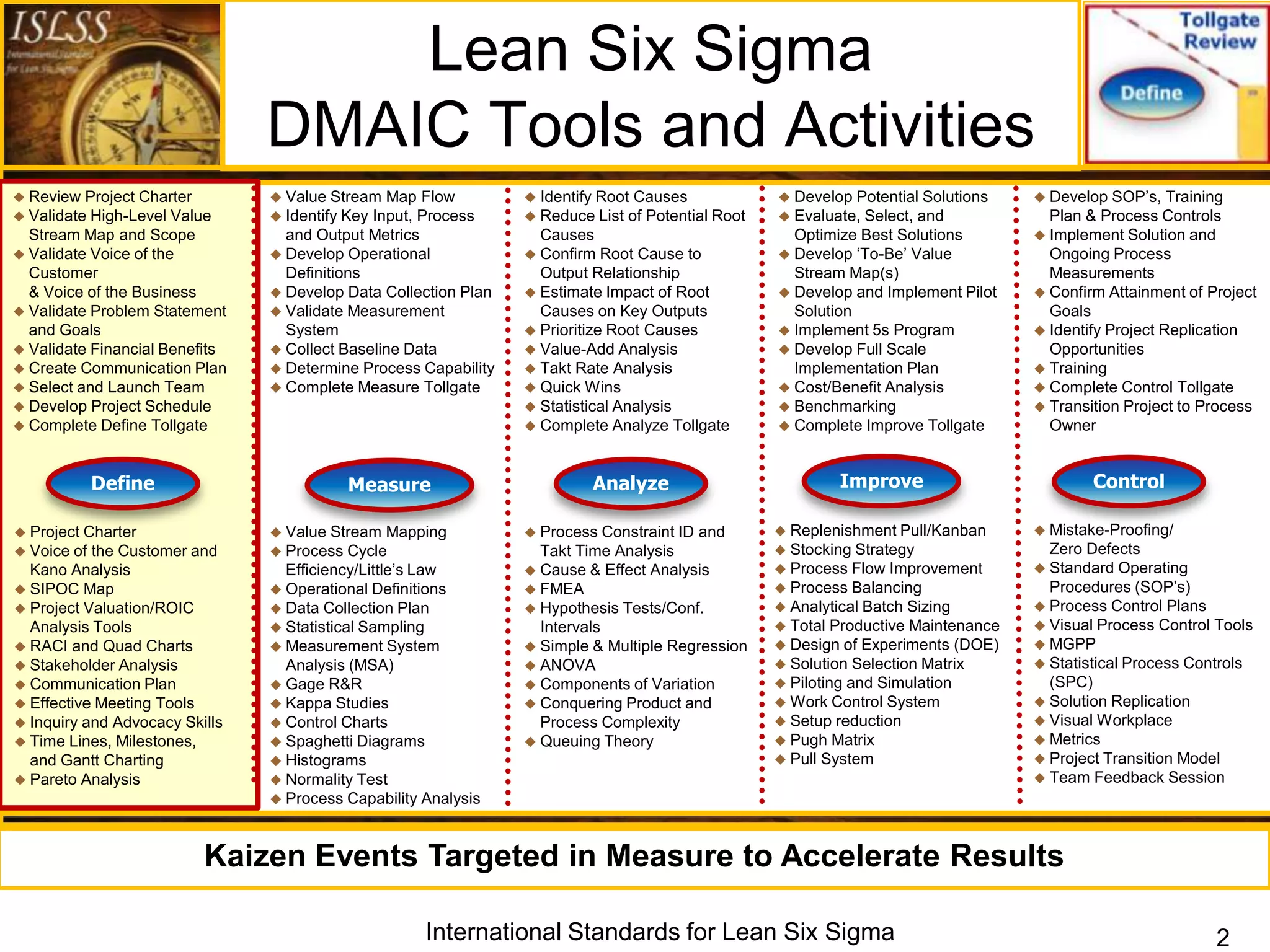
Lean Six Sigma
                                DMAIC Tools and Activities
 Review  Project Charter        Value  Stream Map Flow          Identify Root   Causes              Develop  Potential Solutions    Develop   SOP‟s, Training
 Validate High-Level Value      Identify KeyInput, Process      Reduce    List of Potential Root    Evaluate, Select, and            Plan & Process Controls
  Stream Map and Scope            and Output Metrics               Causes                               Optimize Best Solutions         Implement Solution and
 Validate Voice of the          Develop Operational             Confirm   Root Cause to             Develop „To-Be‟ Value            Ongoing Process
  Customer                        Definitions                      Output Relationship                  Stream Map(s)                    Measurements
  & Voice of the Business        Develop Data Collection Plan    Estimate Impact of Root             Develop and Implement Pilot     Confirm Attainment of Project
 Validate Problem Statement     Validate Measurement             Causes on Key Outputs                Solution                         Goals
  and Goals                       System                          Prioritize Root Causes              Implement 5s Program            Identify Project Replication
 Validate Financial Benefits    Collect Baseline Data           Value-Add Analysis                  Develop Full Scale               Opportunities
 Create Communication Plan      Determine Process Capability    Takt Rate Analysis                   Implementation Plan             Training
 Select and Launch Team         Complete Measure Tollgate       Quick Wins                          Cost/Benefit Analysis           Complete Control Tollgate
 Develop Project Schedule                                        Statistical Analysis                Benchmarking                    Transition Project to Process
 Complete Define Tollgate                                        Complete Analyze Tollgate           Complete Improve Tollgate        Owner


             Define                        Measure                        Analyze                             Improve                          Control

 Project Charter                Value Stream Mapping            Process   Constraint ID and         Replenishment Pull/Kanban       Mistake-Proofing/
 Voice  of the Customer and     Process Cycle                    Takt Time Analysis                  Stocking Strategy                Zero Defects
  Kano Analysis                   Efficiency/Little‟s Law         Cause & Effect Analysis             Process Flow Improvement        Standard   Operating
 SIPOC Map                      Operational Definitions         FMEA                                Process Balancing                Procedures (SOP‟s)
 Project Valuation/ROIC         Data Collection Plan            Hypothesis Tests/Conf.              Analytical Batch Sizing         Process Control Plans
  Analysis Tools                 Statistical Sampling             Intervals                           Total Productive Maintenance    Visual Process Control Tools
 RACI and Quad Charts           Measurement System              Simple & Multiple Regression        Design of Experiments (DOE)     MGPP
 Stakeholder Analysis            Analysis (MSA)                  ANOVA                               Solution Selection Matrix       Statistical Process Controls
 Communication Plan             Gage R&R                        Components of Variation             Piloting and Simulation          (SPC)
 Effective Meeting Tools        Kappa Studies                   Conquering Product and              Work Control System             Solution Replication
 Inquiry and Advocacy Skills    Control Charts                   Process Complexity                  Setup reduction                 Visual Workplace
 Time Lines, Milestones,        Spaghetti Diagrams              Queuing Theory                      Pugh Matrix                     Metrics
  and Gantt Charting             Histograms                                                           Pull System                     Project Transition Model
 Pareto Analysis                Normality Test                                                                                        Team Feedback Session
                                 Process Capability Analysis


                          Kaizen Events Targeted in Measure to Accelerate Results

                                                     International Standards for Lean Six Sigma                                                                 2
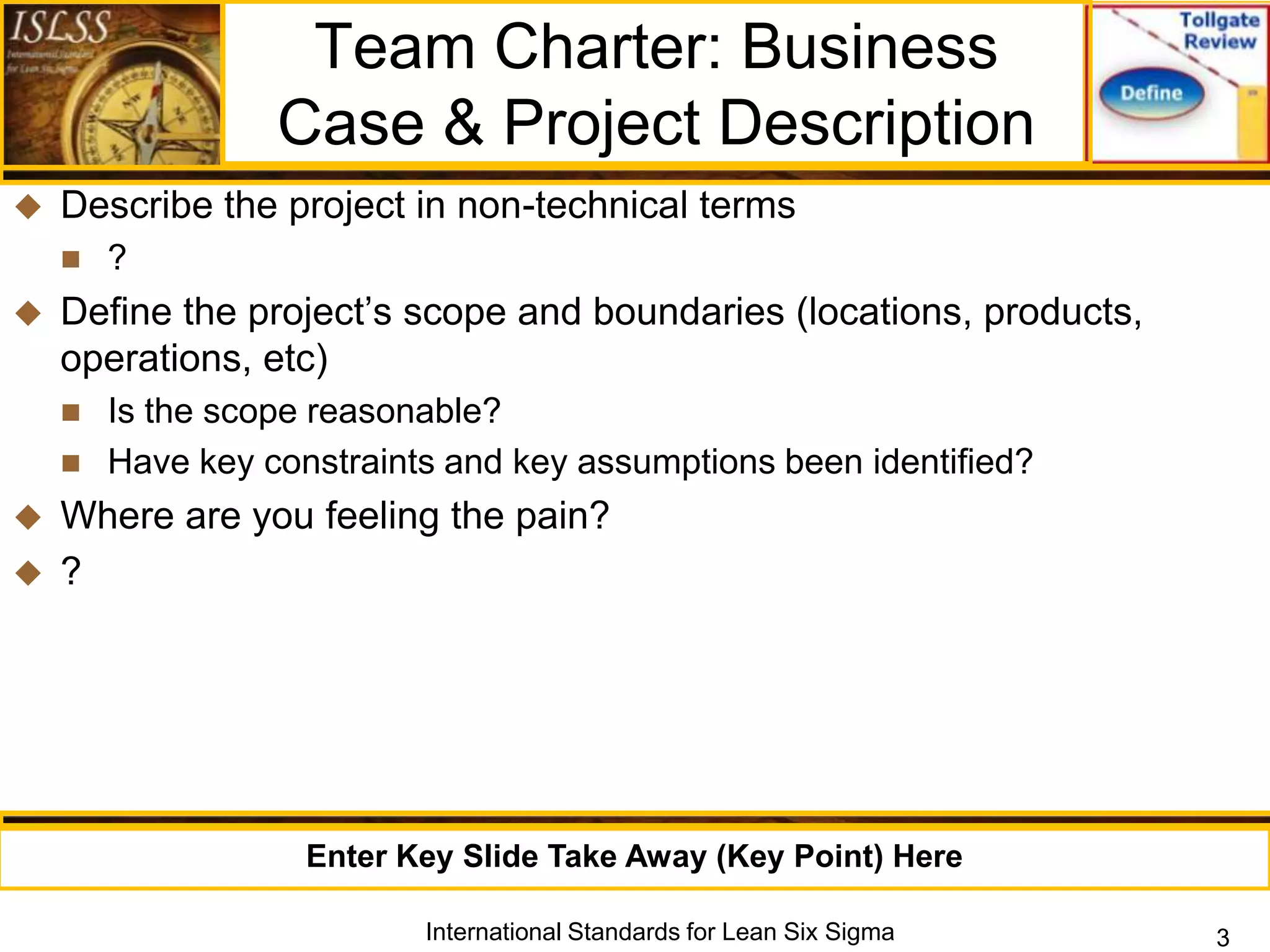
Team Charter: Business
                  Case & Project Description
   Describe the project in non-technical terms
       ?
   Define the project‟s scope and boundaries (locations, products,
    operations, etc)
       Is the scope reasonable?
       Have key constraints and key assumptions been identified?
 Where are you feeling the pain?
 ?


                    Enter Key Slide Take Away (Key Point) Here

                           International Standards for Lean Six Sigma   3
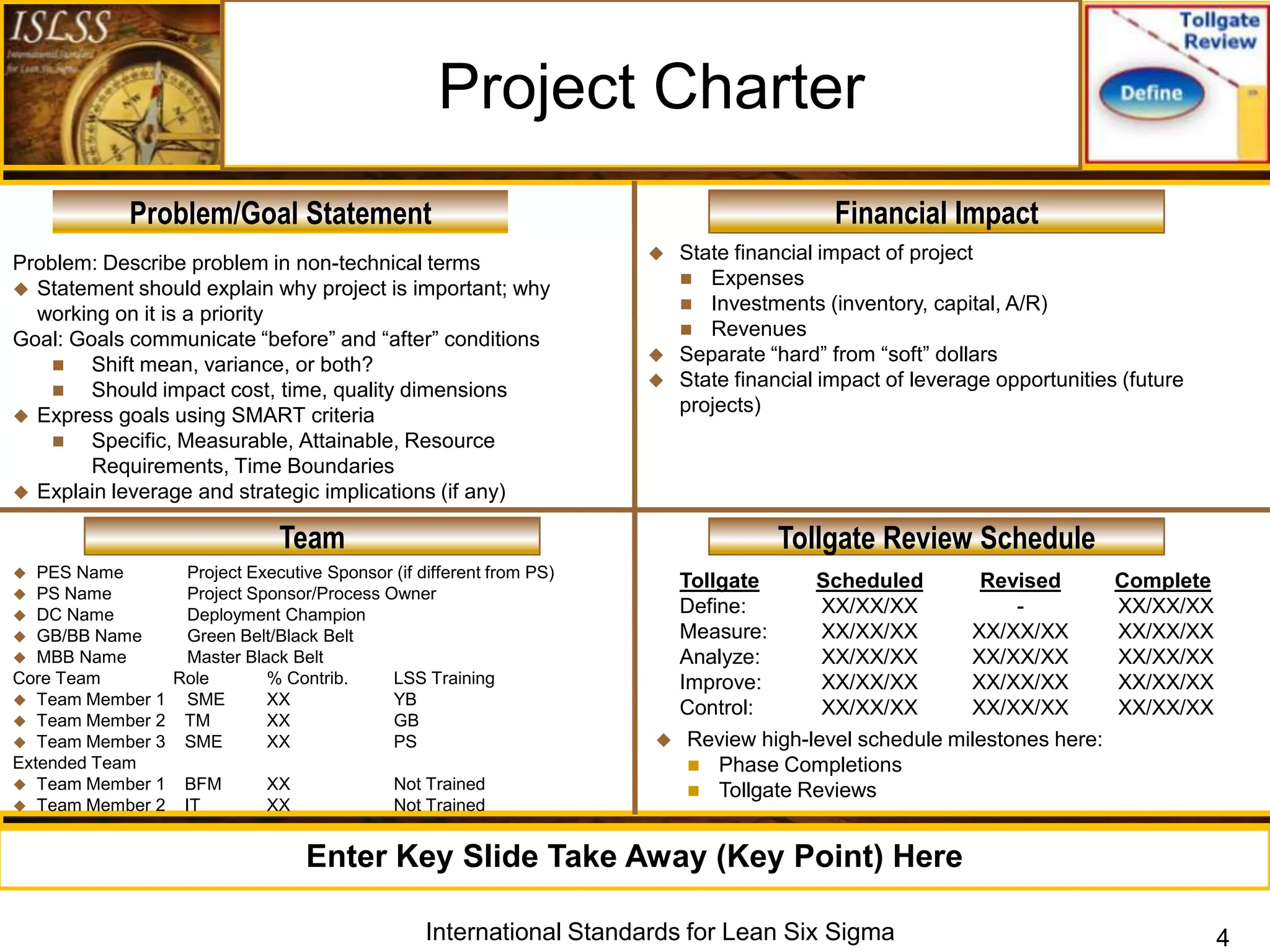
Project Charter
              Problem/Goal Statement                                                      Financial Impact
                                                                        State financial impact of project
Problem: Describe problem in non-technical terms
                                                                          Expenses
 Statement should explain why project is important; why
                                                                          Investments (inventory, capital, A/R)
  working on it is a priority
                                                                          Revenues
Goal: Goals communicate “before” and “after” conditions
       Shift mean, variance, or both?                                  Separate “hard” from “soft” dollars
                                                                        State financial impact of leverage opportunities (future
       Should impact cost, time, quality dimensions
 Express goals using SMART criteria
                                                                         projects)
       Specific, Measurable, Attainable, Resource
        Requirements, Time Boundaries
 Explain leverage and strategic implications (if any)

                               Team                                                Tollgate Review Schedule
  PES Name      Project Executive Sponsor (if different from PS)
                                                                         Tollgate      Scheduled        Revised          Complete
  PS Name       Project Sponsor/Process Owner
  DC Name       Deployment Champion                                     Define:        XX/XX/XX            -            XX/XX/XX
  GB/BB Name    Green Belt/Black Belt                                   Measure:       XX/XX/XX       XX/XX/XX          XX/XX/XX
  MBB Name      Master Black Belt                                       Analyze:       XX/XX/XX       XX/XX/XX          XX/XX/XX
Core Team       Role       % Contrib.     LSS Training                   Improve:       XX/XX/XX       XX/XX/XX          XX/XX/XX
 Team Member 1  SME       XX             YB
                                                                         Control:       XX/XX/XX       XX/XX/XX          XX/XX/XX
 Team Member 2 TM         XX             GB
 Team Member 3 SME        XX             PS                             Review high-level schedule milestones here:
Extended Team                                                              Phase Completions
 Team Member 1 BFM        XX             Not Trained                      Tollgate Reviews
 Team Member 2 IT         XX             Not Trained


                                   Enter Key Slide Take Away (Key Point) Here

                                                 International Standards for Lean Six Sigma                                         4

Lean six-sigma-project-charter-template

  • 1.
    Lean Six Sigma Define Phase Project Charter Template
  • 2.
    Lean Six Sigma DMAIC Tools and Activities  Review Project Charter  Value Stream Map Flow  Identify Root Causes  Develop Potential Solutions  Develop SOP‟s, Training  Validate High-Level Value  Identify KeyInput, Process  Reduce List of Potential Root  Evaluate, Select, and Plan & Process Controls Stream Map and Scope and Output Metrics Causes Optimize Best Solutions  Implement Solution and  Validate Voice of the  Develop Operational  Confirm Root Cause to  Develop „To-Be‟ Value Ongoing Process Customer Definitions Output Relationship Stream Map(s) Measurements & Voice of the Business  Develop Data Collection Plan  Estimate Impact of Root  Develop and Implement Pilot  Confirm Attainment of Project  Validate Problem Statement  Validate Measurement Causes on Key Outputs Solution Goals and Goals System  Prioritize Root Causes  Implement 5s Program  Identify Project Replication  Validate Financial Benefits  Collect Baseline Data  Value-Add Analysis  Develop Full Scale Opportunities  Create Communication Plan  Determine Process Capability  Takt Rate Analysis Implementation Plan  Training  Select and Launch Team  Complete Measure Tollgate  Quick Wins  Cost/Benefit Analysis  Complete Control Tollgate  Develop Project Schedule  Statistical Analysis  Benchmarking  Transition Project to Process  Complete Define Tollgate  Complete Analyze Tollgate  Complete Improve Tollgate Owner Define Measure Analyze Improve Control  Project Charter  Value Stream Mapping  Process Constraint ID and  Replenishment Pull/Kanban  Mistake-Proofing/  Voice of the Customer and  Process Cycle Takt Time Analysis  Stocking Strategy Zero Defects Kano Analysis Efficiency/Little‟s Law  Cause & Effect Analysis  Process Flow Improvement  Standard Operating  SIPOC Map  Operational Definitions  FMEA  Process Balancing Procedures (SOP‟s)  Project Valuation/ROIC  Data Collection Plan  Hypothesis Tests/Conf.  Analytical Batch Sizing  Process Control Plans Analysis Tools  Statistical Sampling Intervals  Total Productive Maintenance  Visual Process Control Tools  RACI and Quad Charts  Measurement System  Simple & Multiple Regression  Design of Experiments (DOE)  MGPP  Stakeholder Analysis Analysis (MSA)  ANOVA  Solution Selection Matrix  Statistical Process Controls  Communication Plan  Gage R&R  Components of Variation  Piloting and Simulation (SPC)  Effective Meeting Tools  Kappa Studies  Conquering Product and  Work Control System  Solution Replication  Inquiry and Advocacy Skills  Control Charts Process Complexity  Setup reduction  Visual Workplace  Time Lines, Milestones,  Spaghetti Diagrams  Queuing Theory  Pugh Matrix  Metrics and Gantt Charting  Histograms  Pull System  Project Transition Model  Pareto Analysis  Normality Test  Team Feedback Session  Process Capability Analysis Kaizen Events Targeted in Measure to Accelerate Results International Standards for Lean Six Sigma 2
  • 3.
    Team Charter: Business Case & Project Description  Describe the project in non-technical terms  ?  Define the project‟s scope and boundaries (locations, products, operations, etc)  Is the scope reasonable?  Have key constraints and key assumptions been identified?  Where are you feeling the pain?  ? Enter Key Slide Take Away (Key Point) Here International Standards for Lean Six Sigma 3
  • 4.
    Project Charter Problem/Goal Statement Financial Impact  State financial impact of project Problem: Describe problem in non-technical terms  Expenses  Statement should explain why project is important; why  Investments (inventory, capital, A/R) working on it is a priority  Revenues Goal: Goals communicate “before” and “after” conditions  Shift mean, variance, or both?  Separate “hard” from “soft” dollars  State financial impact of leverage opportunities (future  Should impact cost, time, quality dimensions  Express goals using SMART criteria projects)  Specific, Measurable, Attainable, Resource Requirements, Time Boundaries  Explain leverage and strategic implications (if any) Team Tollgate Review Schedule  PES Name Project Executive Sponsor (if different from PS) Tollgate Scheduled Revised Complete  PS Name Project Sponsor/Process Owner  DC Name Deployment Champion Define: XX/XX/XX - XX/XX/XX  GB/BB Name Green Belt/Black Belt Measure: XX/XX/XX XX/XX/XX XX/XX/XX  MBB Name Master Black Belt Analyze: XX/XX/XX XX/XX/XX XX/XX/XX Core Team Role % Contrib. LSS Training Improve: XX/XX/XX XX/XX/XX XX/XX/XX  Team Member 1 SME XX YB Control: XX/XX/XX XX/XX/XX XX/XX/XX  Team Member 2 TM XX GB  Team Member 3 SME XX PS  Review high-level schedule milestones here: Extended Team  Phase Completions  Team Member 1 BFM XX Not Trained  Tollgate Reviews  Team Member 2 IT XX Not Trained Enter Key Slide Take Away (Key Point) Here International Standards for Lean Six Sigma 4