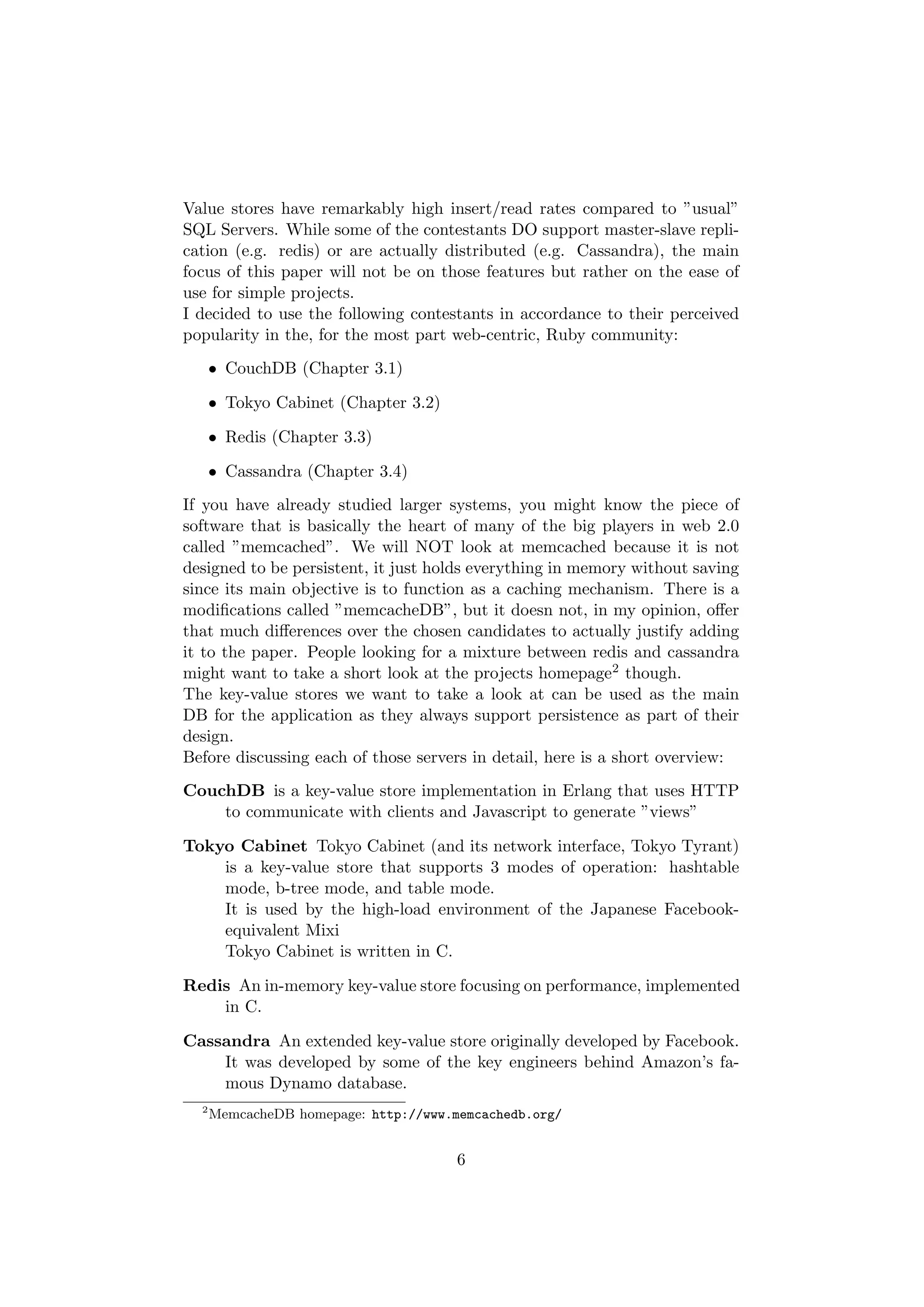
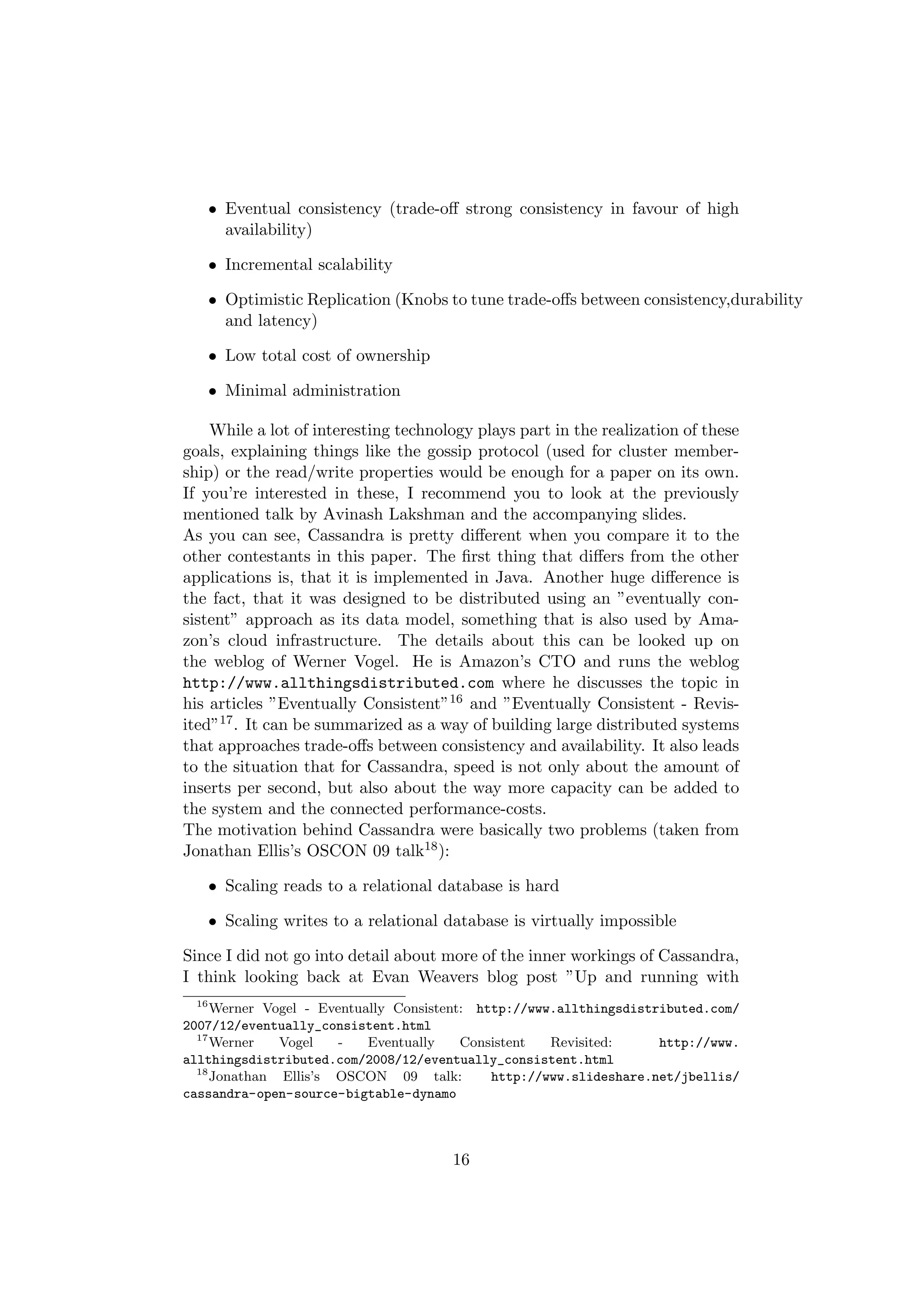
![databases is a large amount of normalization that leads to complex hier-
archies of tables and completely steers against the main idea behind object
oriented programming. Servers that adhere to the SQL standard also have
to implement a large portion of code that is of no use to simple data storage
what so ever and only inflates the memory footprint, security risks and has
performance hits as a result.
The fact that SQL allows for arbitrary dynamic queries for complex sets of
data is being rendered useless by using an SQL Database only for persistent
storage of object oriented data, which is what basically most applications
do these days.
This is where Key Value stores come into play. Key value stores allow the
application developer to store schema-less data. This data is usually con-
sisting of a string which represents the key and the actual data which is
considered to be the value in the ”key - value” relationship. The data itself
is usually some kind of primitive of the programming language (a string,
an integer, an array) or an object that is being marshalled by the program-
ming languages bindings to the key value store. This replaces the need for
fixed data model and makes the requirement for properly formatted data
less strict.
To make this more clear, here’s a short example (using ruby and the simple
but limited ”pstore” standard library) that should make that concept clear
to any programmer.
require "pstore"
store = PStore.new("data-file.pstore")
store.transaction do # begin transaction
# load some data into the store...
store[:single_object] = "Lorem ipsum dolor sit amet..."
store[:obj_heirarchy] = { "Marc Seeger" => ["ruby", "nosql"],
"Rainer Wahnsinn" => ["php", "mysql"] }
end # commit changes to data store file
In this short example, we have created a key-value store on disk called
”data file.pstore” and added two objects.
The object with the key ”:single object” is basically a simple string, ”:obj hierarchy”
on the other hand is a more complex datatype. It is a Hash which contains
arrays of strings.
Accessing those objects would be as simple as e.g. assigning the object to a
variable, exactly the same way we’d usually interact with hashes in Ruby:
my_var = store[:single_object]
Syntax for different key-value stores will obviously differ, but they all func-
tion in a conceptually similar manner.
4](https://image.slidesharecdn.com/ultralargesitesss09-seegerkeyvaluestores-090921092606-phpapp02/75/Key-Value-Stores-a-practical-overview-4-2048.jpg)
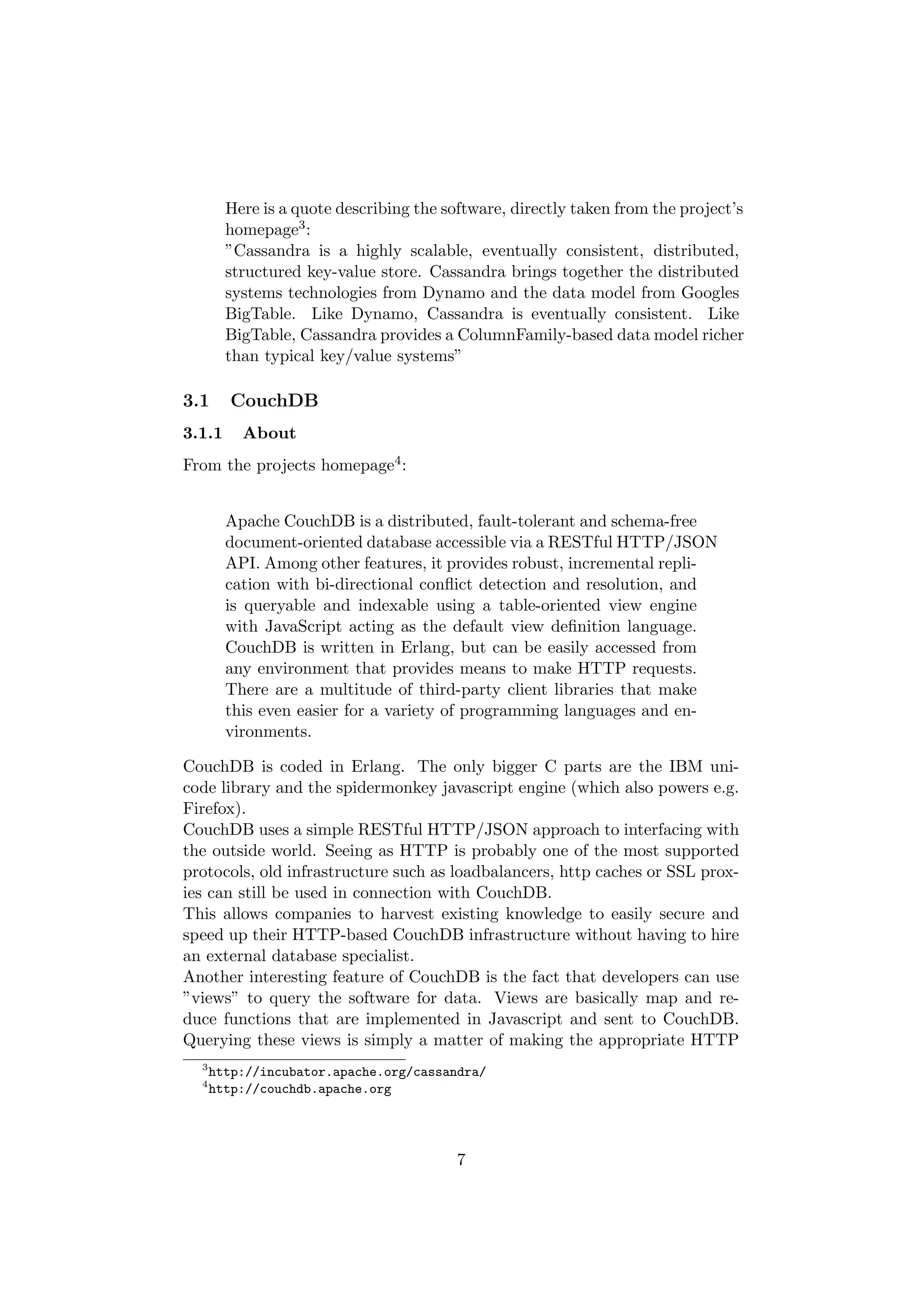
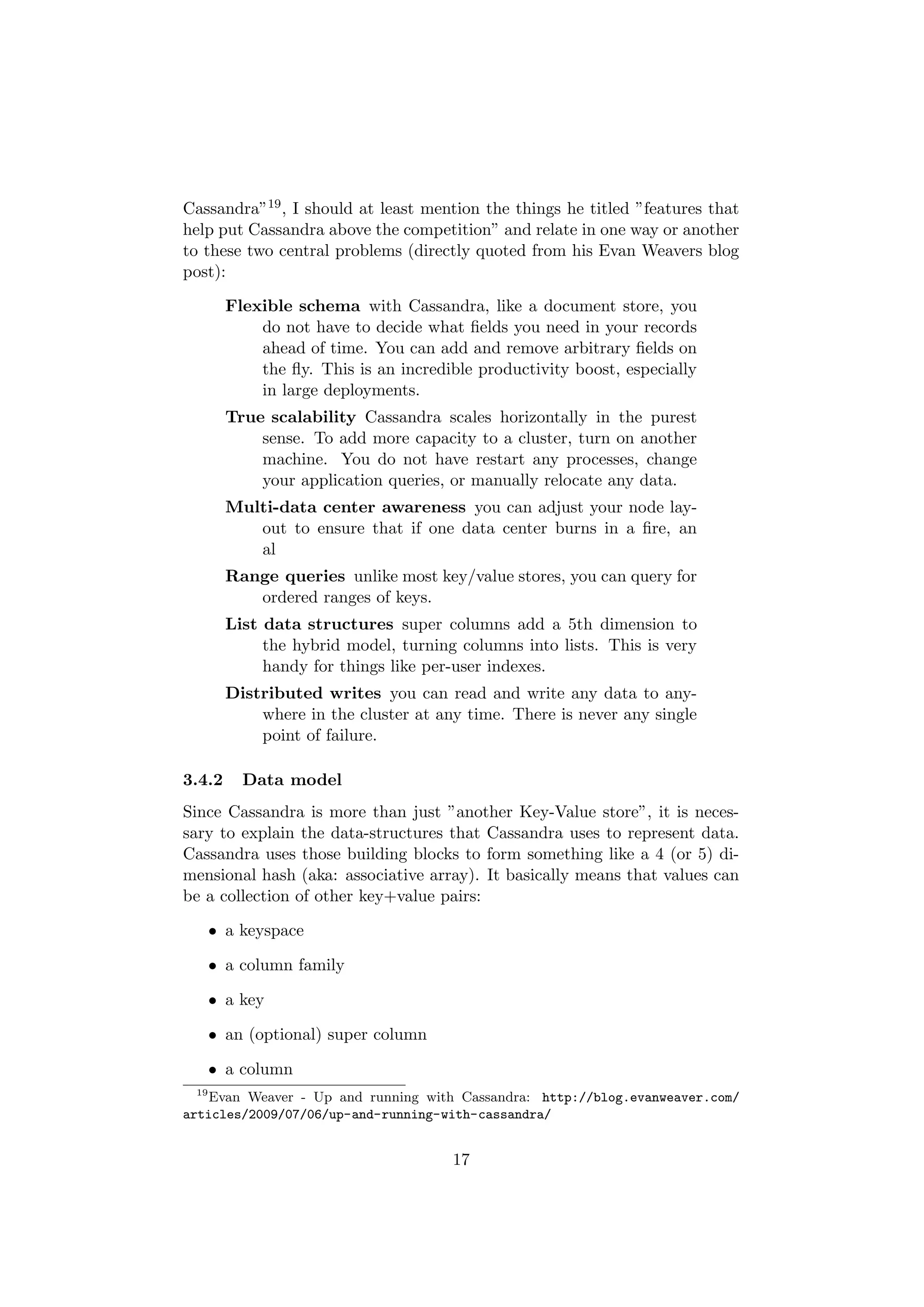
![in something more Ruby-like. Here’s a quote from the previously mentioned
CouchDB wiki:
For a simple Ruby wrapper around CouchDB’s RESTful API,
see CouchRest, which keeps you fairly close the metal, as well as
having a few helpful wrappers, like a builtin view pager and com-
panion libraries like CouchModel (for document id and lifecycle
management) and Slipcover (for parallel query execution).
We will now take a short look at CouchRest, which is available as a gem on
github (gem install jchris-couchrest -s http://gems.github.com).
This is the description as given in CouchRest’s Readme file:
CouchRest is based on CouchDB’s couch.js test library, which I
find to be concise, clear, and well designed. CouchRest lightly
wraps CouchDB’s HTTP API, managing JSON serialization,
and remembering the URI-paths to CouchDB’s API endpoints
so you do not have to.
CouchRest is designed to make a simple base for application and
framework-specific object oriented APIs. CouchRest is Object-
Mapper agnostic, the parsed JSON it returns from CouchDB
shows up as subclasses of Ruby’s Hash. Naked JSON, just as it
was mean to be.
As the way CouchREST interacts with CouchDB is nothing out of the
ordinary and as I am generally a fan of code examples, I decided to simply
use the ”quick start” example taken from the CouchRest Readme file to
show the basic interaction with the library:
# with !, it creates the database if it doesn’t already exist
@db = CouchRest.database!("http://127.0.0.1:5984/couchrest-test")
response = @db.save_doc({:key => ’value’, ’another key’ => ’another value’})
doc = @db.get(response[’id’])
puts doc.inspect
This is how you save more than one entry to the store:
@db.bulk_save([
{"wild" => "and random"},
{"mild" => "yet local"},
{"another" => ["set","of","keys"]}
])
Another way of using CouchDB that might be interesting for legacy ap-
plications is the fact, that Datamapper (the ORM used e.g. with the merb
webframework) and Active Record (the ORM that is used with the Rails
9](https://image.slidesharecdn.com/ultralargesitesss09-seegerkeyvaluestores-090921092606-phpapp02/75/Key-Value-Stores-a-practical-overview-9-2048.jpg)
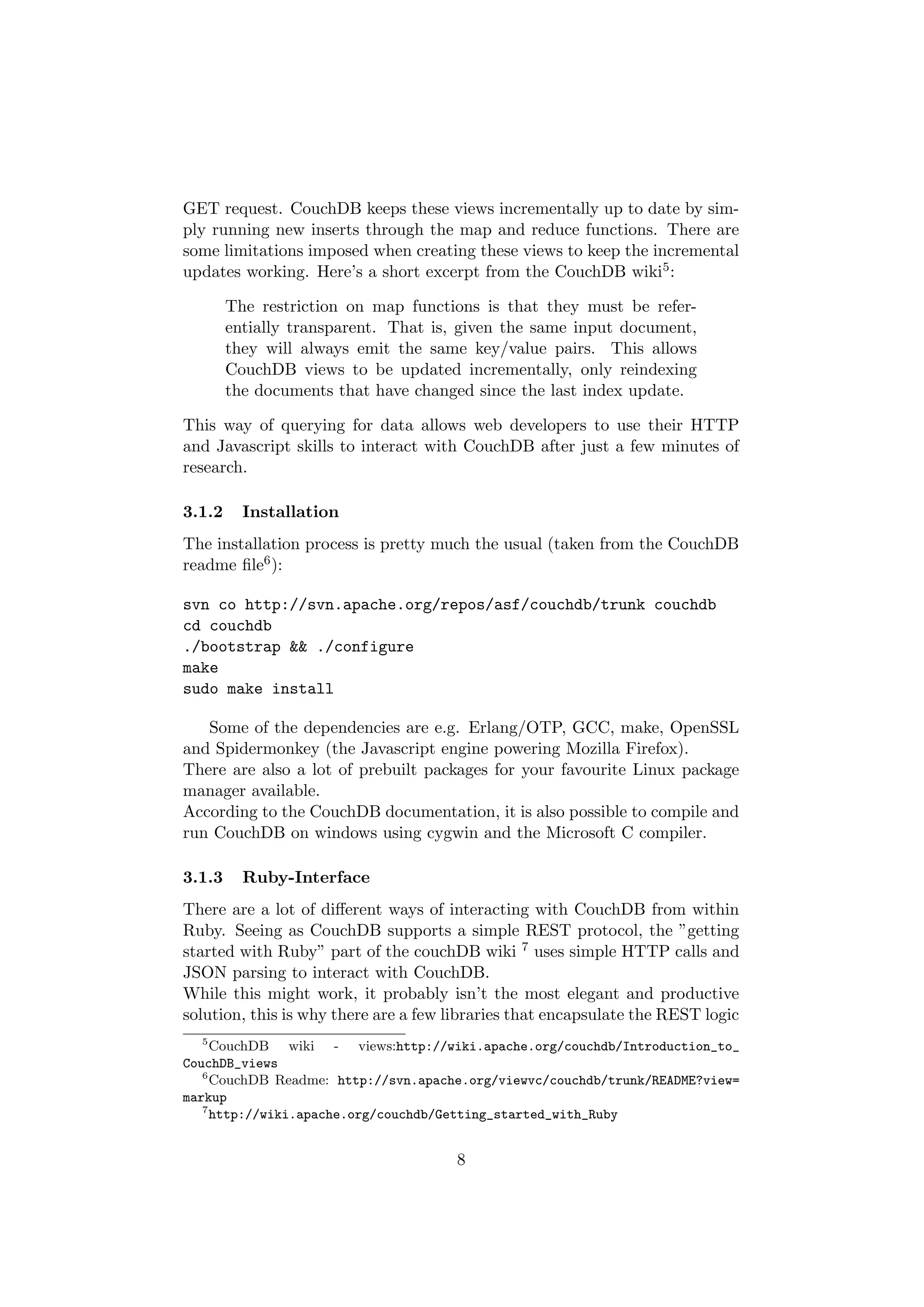
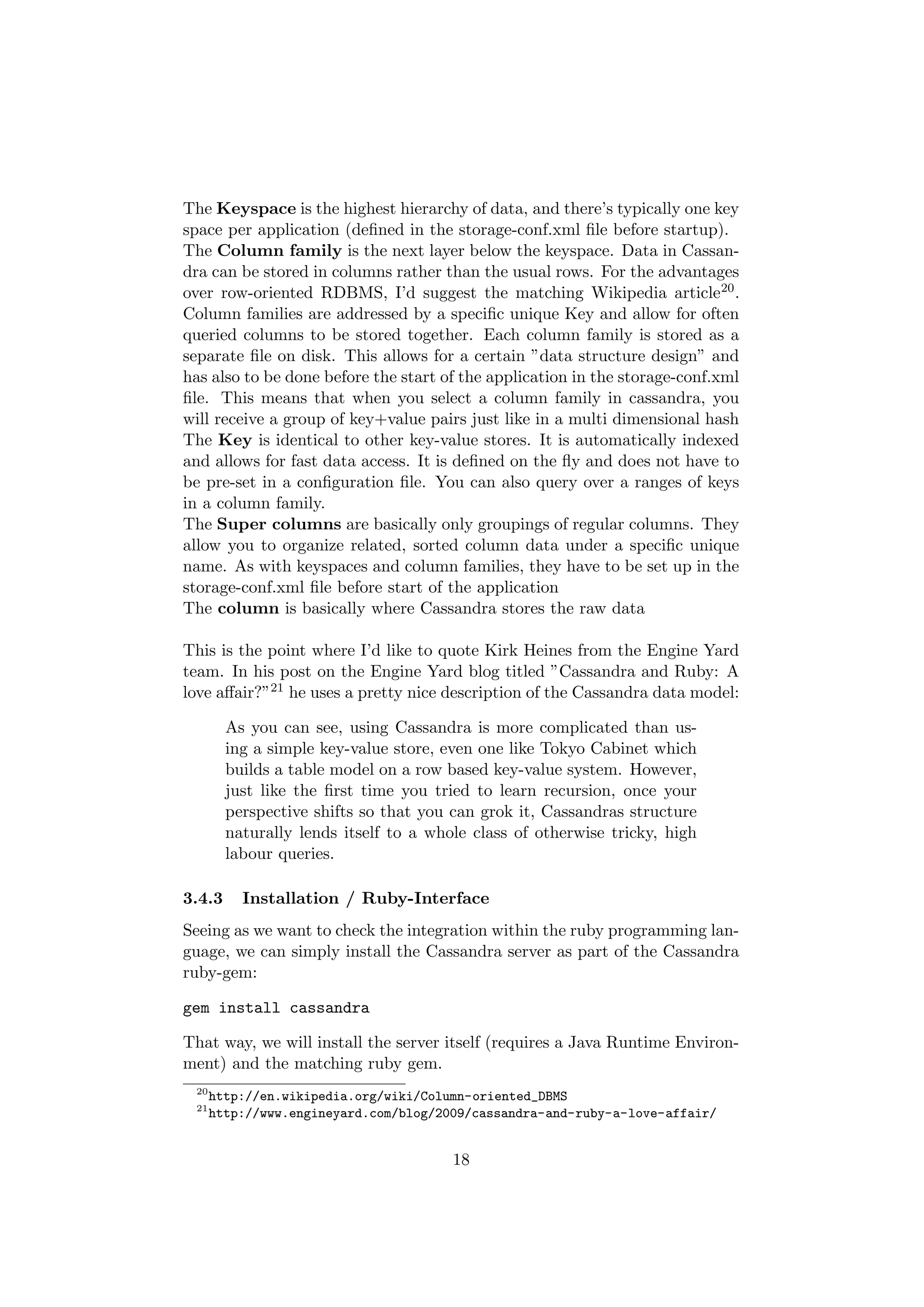
![r["first_key"] = "hello world"
puts "The value of ’first_key’ is:"
puts r["first_key"]
One of the nice things is, that redis is able to work with a plaintext
protocol using telnet:
$ telnet localhost 6379
Trying 127.0.0.1...
Connected to localhost.
Escape character is ’^ ]’.
SET foo 3
bar
+OK
GET foo
$3
bar
What all of this means:
Command Meaning
SET foo 3 set the key ”foo” to the next 3 characters
bar these are the 3 bytes followed by a newline character
+OK the server tells us that it will insert the data (asynchronously)
GET foo get the value for the key ”foo”
$3 the value will be the next 3 bytes
bar our result
Some other interesting server-side atomic operations are pretty much
self explanatory. Having these operations allows redis to do concurrent ac-
cess without having to deal with a lot of the most common locking problems:
SET key value set a key to a string value
GET key return the string value of the key
GETSET key value set a key to a string returning the old value of the key
MGET key1 key2 ... keyN multi-get, return the strings values of the
keys
SETNX key value set a key to a string value if the key does not exist
INCR key increment the integer value of key
INCRBY key integer increment the integer value of key by integer
DECR key decrement the integer value of key
14](https://image.slidesharecdn.com/ultralargesitesss09-seegerkeyvaluestores-090921092606-phpapp02/75/Key-Value-Stores-a-practical-overview-14-2048.jpg)


The document provides an overview of key-value stores and discusses CouchDB, Tokyo Cabinet, Redis, and Cassandra as alternatives to relational databases for web applications. It describes each system's features and interface to the Ruby programming language. CouchDB uses JavaScript for generating views and stores schema-less data accessed via HTTP/JSON. Tokyo Cabinet supports hashtable, B-tree, and table modes and is used by Mixi, a Japanese social network. Redis is an in-memory key-value store focused on performance. Cassandra is a distributed, structured key-value store developed by Facebook based on Amazon's Dynamo database.


