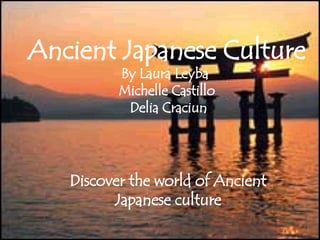
Ancient Japanese Culture

Loading...

Flash Player 9 (or above) is needed to view presentations.
We have detected that you do not have it on your computer. To install it, go here.

1 comments

Comments 1 - 1 of 1 previous next Post a comment

Post a comment
Embed Video
Edit your comment Cancel

1 Favorite

Ancient Japanese Culture - Presentation Transcript

  1. Ancient Japanese Culture By Laura Leyba Michelle Castillo Delia Craciun Discover the world of Ancient Japanese culture
  2. Japanese Foods
    • Sushi
    • Tempura
    • Yakitori
    • Katsudon
    • Sukiyaki
  3. Sushi
    • Consists of thin slices of raw fish or seafood
    • In Japan, is served with spicy Japanese horseradish sauce
    • Famous for its delicious taste
    • Plays an important role in Japanese kitchens
  4. Tempura
    • Seafood or vegetables dipped in batter and deep fried
    • Comes from the Portuguese“tempero” meaning gravy or sauce
    • Can be served with a side bowl of rice and soup
  5. Yakitori
    • Means broiled chicken
    • Cuts of chicken including heart, liver, and cartilage
    • Cooked on skewers over a charcoal grill
    • Flavored by using a tangy sauce
  6. Katsudon
    • Is a bowl of rice topped with a deep- fried pork cutlet, egg, condiments
    • Became a modern ritual tradition for Japanese students to eat this the night before taking a test
    • Common lunch dish
  7. Sukiyaki
    • Stew of vegetables and beef
    • Dipped in a bowl of beaten raw egg
    • Vegetables used are green onion shiitake mushrooms, and leaves
    • cooked with soy sauce
  8. Festival the of New Year
    • Most important festival on the Chinese Calendar
    • Looked as the rebirth of spring itself
    • Called the Japanese New Year
    • Would celebrate, rituals
  9. Children’s day
    • Celebrated May,5th and 3rd
    • Stresses importance that each child has their own character, stresses their health, and their happiness.
    • Childrens day is split up;boys are the guetss of their sister’s festivals or girl festivals and girls are guets to their brothers on May 5 or boys day.
  10. Ancient Japanese Religion
    • Shintoism
    • Buddhism
    • Confucianism
  11. Shintoism
    • Native Religion
    • Worship of Kami spirits
    • Translated as “The Way of the Gods”
    • Shrine dedicated to a specific Kami
    • Practices that show their beliefs
  12. Buddhism
    • More to do with afterlife
    • Means “Teaching of the Awaken One”
    • A significant religious and cultural force
    • Originally started in India
  13. Confucianism
    • Moral, social, political, and religious thought
    • Championed familial loyalty
    • Ancestor worship
    • Respect of elders
    • No specific god
    • Did not believe in afterlife
  14.  
  15. Bibliography
    • http://hkuhist2.hku.hk/nakasendo/shinto.htm (Shinto) Date visited: May 4, 2007
    • http://www.cs.indiana.edu/~port/teach/relg/shinto.sketch.html (Shinto Religion) Date visited: May 4, 2007
    • http://en.wikipedia.org/wiki/Confucianism (Confucianism) Date visited: May 4, 2007
    • http://www.jcch.com/jt.htm (Japanese Tradition) Date visited: May 4, 2007

+ lolipoplolipop, 3 years ago

custom

5287 views, 1 favs, 3 embeds more stats

Take a look into the world of Ancient Japan. Their more

More info about this document

© All Rights Reserved

Go to text version

  • Total Views 5287
    • 5279 on SlideShare
    • 8 from embeds
  • Comments 1
  • Favorites 1
  • Downloads 196
Most viewed embeds
  • 4 views on http://www.cirip.ro
  • 3 views on http://dianitamh7.blogspot.com
  • 1 views on http://www.fachak.com

more

All embeds
  • 4 views on http://www.cirip.ro
  • 3 views on http://dianitamh7.blogspot.com
  • 1 views on http://www.fachak.com

less

Flagged as inappropriate Flag as inappropriate
Flag as inappropriate

Select your reason for flagging this presentation as inappropriate. If needed, use the feedback form to let us know more details.

Cancel
File a copyright complaint
Having problems? Go to our helpdesk?

Categories