by
Heny Dwi Astutik
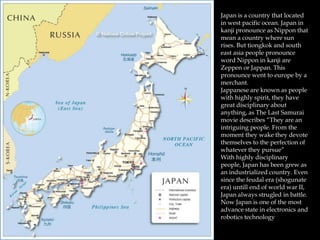
Japan is a country that located
in west pacific ocean. Japan in
kanji pronounce as Nippon that
mean a country where sun
rises. But tiongkok and south
east asia people pronounce
word Nippon in kanji are
Zeppen or Jappan. This
pronounce went to europe by a
merchant.
Jappanese are known as people
with highly spirit, they have
great disciplinary about
anything, as The Last Samurai
movie describes “They are an
intriguing people. From the
moment they wake they devote
themselves to the perfection of
whatever they pursue”
With highly disciplinary
people, Japan has been grew as
an industrialized country. Even
since the feudal era (shogunate
era) untill end of world war II,
Japan always strugled in battle.
Now Japan is one of the most
advance state in electronics and
robotics technology
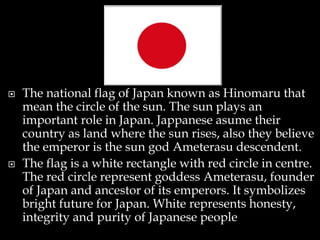
 The national flag of Japan known as Hinomaru that
mean the circle of the sun. The sun plays an
important role in Japan. Jappanese asume their
country as land where the sun rises, also they believe
the emperor is the sun god Ameterasu descendent.
 The flag is a white rectangle with red circle in centre.
The red circle represent goddess Ameterasu, founder
of Japan and ancestor of its emperors. It symbolizes
bright future for Japan. White represents honesty,
integrity and purity of Japanese people
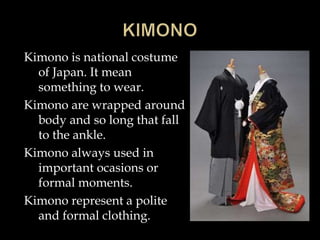
Kimono is national costume
of Japan. It mean
something to wear.
Kimono are wrapped around
body and so long that fall
to the ankle.
Kimono always used in
important ocasions or
formal moments.
Kimono represent a polite
and formal clothing.
Political system of Japan runs a constitutional
monarchy whereby emperor acts as head of state
and limited on ceremonial duties only. The head of
government lies on the prime minister’s hand, with
help of the cabinet. the prime minister direct the
executive power. As commonly a constitutional
state, the political system of Japan divided by trias
politica: the executive power, the legislative power
and the judicial power.
 Japanese is an constitutional monarchy
government.
 They have an emperor as a head of state but has
no powers. The emperor only do the ceremonial
duties and appointed an prime minister that
designated by the parliament.
 Prime minister whom run and control
government with his/her cabinet. Like other
constitutional state, Japanese have three division
of power (the executive, the legislative, and the
judicial)
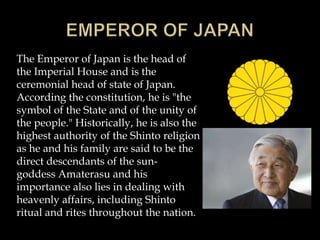
The Emperor of Japan is the head of
the Imperial House and is the
ceremonial head of state of Japan.
According the constitution, he is "the
symbol of the State and of the unity of
the people." Historically, he is also the
highest authority of the Shinto religion
as he and his family are said to be the
direct descendants of the sun-
goddess Amaterasu and his
importance also lies in dealing with
heavenly affairs, including Shinto
ritual and rites throughout the nation.
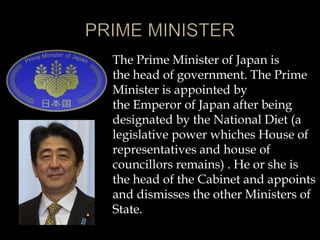
The Prime Minister of Japan is
the head of government. The Prime
Minister is appointed by
the Emperor of Japan after being
designated by the National Diet (a
legislative power whiches House of
representatives and house of
councillors remains) . He or she is
the head of the Cabinet and appoints
and dismisses the other Ministers of
State.
 Free market/Liberalism/Laissez Faire
 adoption from England and USA capitalism
model.
 Industrial sector in Japan: banking, insurance,
transportation, telecommunication, &
construction.
 Manufacturing focuses: high tech & precision
goods (optical instruments, hybrid vehicles, &
robotics)
 The religious practices of these early Japanese
were later given name Shinto “the way of the
God”.
 Below the emperor, the Japanese borrowed the
Chinese organs of a centralized state.
 The Chinese law codes were taken over almost
verbatim.
 At the capital, an elaborate bureaucratic form
of government was created, thought with
innovations on the Chinese model to fit it better
to Japanese conditions.
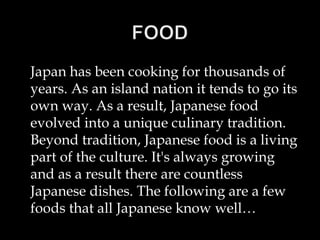
Japan has been cooking for thousands of
years. As an island nation it tends to go its
own way. As a result, Japanese food
evolved into a unique culinary tradition.
Beyond tradition, Japanese food is a living
part of the culture. It's always growing
and as a result there are countless
Japanese dishes. The following are a few
foods that all Japanese know well…
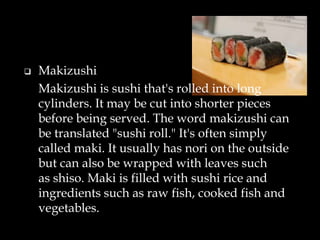
 Makizushi
Makizushi is sushi that's rolled into long
cylinders. It may be cut into shorter pieces
before being served. The word makizushi can
be translated "sushi roll." It's often simply
called maki. It usually has nori on the outside
but can also be wrapped with leaves such
as shiso. Maki is filled with sushi rice and
ingredients such as raw fish, cooked fish and
vegetables.
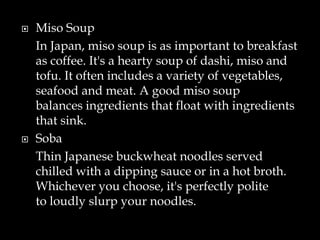
 Miso Soup
In Japan, miso soup is as important to breakfast
as coffee. It's a hearty soup of dashi, miso and
tofu. It often includes a variety of vegetables,
seafood and meat. A good miso soup
balances ingredients that float with ingredients
that sink.
 Soba
Thin Japanese buckwheat noodles served
chilled with a dipping sauce or in a hot broth.
Whichever you choose, it's perfectly polite
to loudly slurp your noodles.
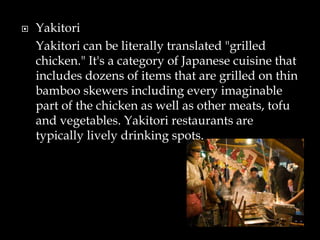
 Yakitori
Yakitori can be literally translated "grilled
chicken." It's a category of Japanese cuisine that
includes dozens of items that are grilled on thin
bamboo skewers including every imaginable
part of the chicken as well as other meats, tofu
and vegetables. Yakitori restaurants are
typically lively drinking spots.
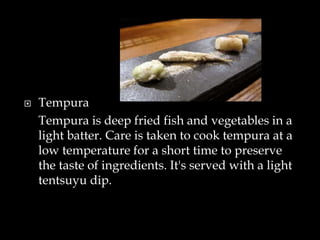
 Tempura
Tempura is deep fried fish and vegetables in a
light batter. Care is taken to cook tempura at a
low temperature for a short time to preserve
the taste of ingredients. It's served with a light
tentsuyu dip.
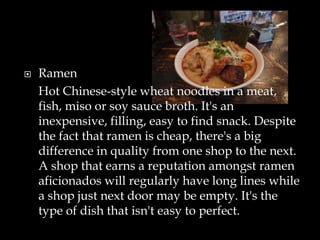
 Ramen
Hot Chinese-style wheat noodles in a meat,
fish, miso or soy sauce broth. It's an
inexpensive, filling, easy to find snack. Despite
the fact that ramen is cheap, there's a big
difference in quality from one shop to the next.
A shop that earns a reputation amongst ramen
aficionados will regularly have long lines while
a shop just next door may be empty. It's the
type of dish that isn't easy to perfect.
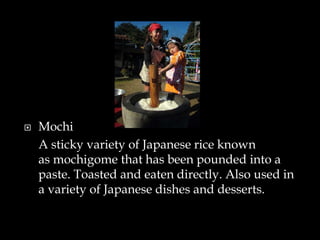
 Mochi
A sticky variety of Japanese rice known
as mochigome that has been pounded into a
paste. Toasted and eaten directly. Also used in
a variety of Japanese dishes and desserts.
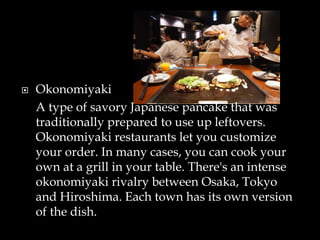
 Okonomiyaki
A type of savory Japanese pancake that was
traditionally prepared to use up leftovers.
Okonomiyaki restaurants let you customize
your order. In many cases, you can cook your
own at a grill in your table. There's an intense
okonomiyaki rivalry between Osaka, Tokyo
and Hiroshima. Each town has its own version
of the dish.
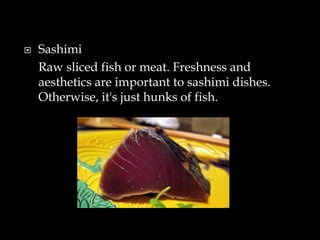
 Sashimi
Raw sliced fish or meat. Freshness and
aesthetics are important to sashimi dishes.
Otherwise, it's just hunks of fish.
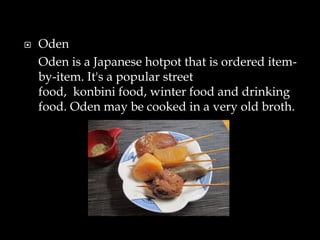
 Oden
Oden is a Japanese hotpot that is ordered item-
by-item. It's a popular street
food, konbini food, winter food and drinking
food. Oden may be cooked in a very old broth.
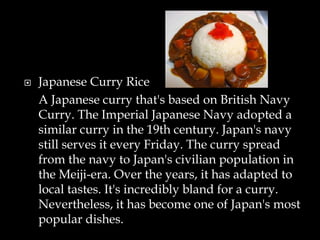
 Japanese Curry Rice
A Japanese curry that's based on British Navy
Curry. The Imperial Japanese Navy adopted a
similar curry in the 19th century. Japan's navy
still serves it every Friday. The curry spread
from the navy to Japan's civilian population in
the Meiji-era. Over the years, it has adapted to
local tastes. It's incredibly bland for a curry.
Nevertheless, it has become one of Japan's most
popular dishes.
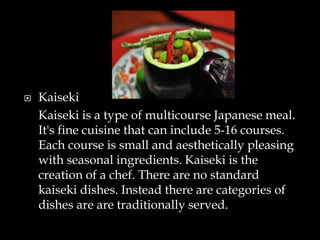
 Kaiseki
Kaiseki is a type of multicourse Japanese meal.
It's fine cuisine that can include 5-16 courses.
Each course is small and aesthetically pleasing
with seasonal ingredients. Kaiseki is the
creation of a chef. There are no standard
kaiseki dishes. Instead there are categories of
dishes are are traditionally served.
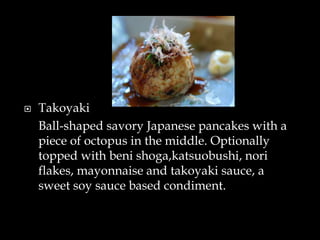
 Takoyaki
Ball-shaped savory Japanese pancakes with a
piece of octopus in the middle. Optionally
topped with beni shoga,katsuobushi, nori
flakes, mayonnaise and takoyaki sauce, a
sweet soy sauce based condiment.
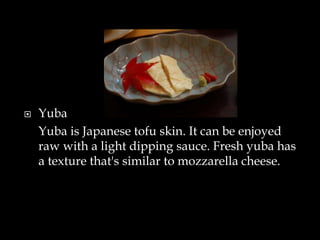
 Yuba
Yuba is Japanese tofu skin. It can be enjoyed
raw with a light dipping sauce. Fresh yuba has
a texture that's similar to mozzarella cheese.
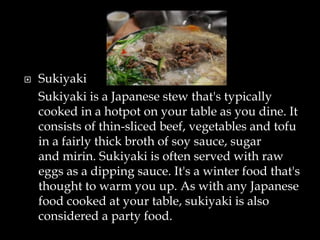
 Sukiyaki
Sukiyaki is a Japanese stew that's typically
cooked in a hotpot on your table as you dine. It
consists of thin-sliced beef, vegetables and tofu
in a fairly thick broth of soy sauce, sugar
and mirin. Sukiyaki is often served with raw
eggs as a dipping sauce. It's a winter food that's
thought to warm you up. As with any Japanese
food cooked at your table, sukiyaki is also
considered a party food.
 The origins of the Japanese people is not
entirely clear yet. It is common for Japanese
people to think that Japan is not part of Asia
since it is an island, cut off from the continent.
This tells a lot about how they see themselves
in relation to their neighbours. But in spite of
what the Japanese may think of themselves,
they do not have extraterrestrial origins, and
are indeed related to several peoples in Asia
 The Ainu came from Siberia and settled in
Hokkaido and Honshu some 15,000 years ago,
just before the water levels started rising again.
Nowadays the Ryukuyans, the Ainus and the
Japanese are considered three ethnically
separate groups.
 Japanese Gardens
The original Japanese gardens were inspired by
Buddhist and Chinese philosophy and later
evolved to have their own distinct Japanese
identity. The gardens found in Japanese
temples and shrines are inspired by the Shinto
religion and the belief in an ideal state of
harmony.
 Japanese Architecture
Traditional Japanese Architecture has a distinct
style deeply influenced by Buddhism and
Shintoism. The use of lightweight wood and
bamboo to create Fusuma (sliding doors) and
straw or woven grass to create Tatami (mats)
are other unique features of Japanese
architectural design.
 Japanese Tea Ceremony
The Japanese ceremony of preparing and
offering tea to revered guests is a formal and
stylized ritual, almost like a meditative
performance. The art or skill of preparing tea
and all the elements of the tea ceremony have
special and symbolic meaning.
 Japanese Cuisine
Japan is an island nation and seafood plays an
important role in Japanese cuisine. Japanese
food such as Sushi (rice flavored with vinegar
and combined with seafood or seaweed and
sometimes vegetables) and Sashimi (cut and
sliced raw meat, usually seafood) are forms of
Japanese cuisine that have become famous
worldwide. Sake or Japanese rice wine is also
drunk at traditional meals as a toast to the
health and long life of one's dining
companions.
 Japanese Festivals
The Japanese people celebrate many festivals,
most of which are of the Buddhist and Shinto
religions. Different temples or shrines across
Japan have their own specific Matsuri or festive
holiday. These include Aomori Nebuta
Festival, the Hadaka Matsuri Festival and the
Cherry Blossom Festivals, which are an integral
part of Japanese culture.
 Cherry Blossom Festivals
Every year in spring the Japanese people take
time out to appreciate the beauty of nature as
the Cherry trees burst into full bloom and their
lovely pink flowers offer a wonderfully
appealing sight. The natural beauty of the
Cherry blossom season is celebrated by the
Japanese in their art and music, and even in the
designs of their traditional clothing, the
Kimono.
 Japanese Kimono
The traditional Japanese costume, the Kimono,
is a graceful full-length robe that falls from the
wearer's shoulders to the ankles. Kimonos for
special occasions were made of rich fabric such
as silk, satin and brocade and feature designs
inspired by nature such as Cherry blossoms,
autumn leaves, butterflies and pine trees.
Kimonos are now worn mostly for ceremonial
occasions and events such as festivals and
marriages.
 Japanese Painting
Japan has a long tradition of painting and
woodblock printing. Some of the famous
Japanese painters are Utagawa Hiroshige
(1797-1858) who is famous for the Ukiyo-e or
woodblock printing style of art. Another
famous Japanese painter is Katsushika Hokusai
(1760-1849) who is famous for a series of
woodblock prints depicting Mount Fuji.
 Japanese Calligraphy
The Japanese script consists of characters
which were traditionally painted using smooth
brushstrokes on handmade paper. The fine art
of calligraphy requires many years of practice
and was considered essential learning for an
accomplished person in Japanese society.
 Ikebana
The Japanese cultural practice of flower
arrangement is a fine art that encompasses the
ideas of aesthetics, spirituality, discipline and
harmony with nature. The emphasis on
minimalism, attention to the line and form of
the plants or flowers used in an arrangement
and the harmony of the overall arrangement
exemplify this Japanese tradition.
Japan heny

Japan heny

  • 1.
  • 2.
    Japan is acountry that located in west pacific ocean. Japan in kanji pronounce as Nippon that mean a country where sun rises. But tiongkok and south east asia people pronounce word Nippon in kanji are Zeppen or Jappan. This pronounce went to europe by a merchant. Jappanese are known as people with highly spirit, they have great disciplinary about anything, as The Last Samurai movie describes “They are an intriguing people. From the moment they wake they devote themselves to the perfection of whatever they pursue” With highly disciplinary people, Japan has been grew as an industrialized country. Even since the feudal era (shogunate era) untill end of world war II, Japan always strugled in battle. Now Japan is one of the most advance state in electronics and robotics technology
  • 4.
     The nationalflag of Japan known as Hinomaru that mean the circle of the sun. The sun plays an important role in Japan. Jappanese asume their country as land where the sun rises, also they believe the emperor is the sun god Ameterasu descendent.  The flag is a white rectangle with red circle in centre. The red circle represent goddess Ameterasu, founder of Japan and ancestor of its emperors. It symbolizes bright future for Japan. White represents honesty, integrity and purity of Japanese people
  • 6.
    Kimono is nationalcostume of Japan. It mean something to wear. Kimono are wrapped around body and so long that fall to the ankle. Kimono always used in important ocasions or formal moments. Kimono represent a polite and formal clothing.
  • 7.
    Political system ofJapan runs a constitutional monarchy whereby emperor acts as head of state and limited on ceremonial duties only. The head of government lies on the prime minister’s hand, with help of the cabinet. the prime minister direct the executive power. As commonly a constitutional state, the political system of Japan divided by trias politica: the executive power, the legislative power and the judicial power.
  • 8.
     Japanese isan constitutional monarchy government.  They have an emperor as a head of state but has no powers. The emperor only do the ceremonial duties and appointed an prime minister that designated by the parliament.  Prime minister whom run and control government with his/her cabinet. Like other constitutional state, Japanese have three division of power (the executive, the legislative, and the judicial)
  • 9.
    The Emperor ofJapan is the head of the Imperial House and is the ceremonial head of state of Japan. According the constitution, he is "the symbol of the State and of the unity of the people." Historically, he is also the highest authority of the Shinto religion as he and his family are said to be the direct descendants of the sun- goddess Amaterasu and his importance also lies in dealing with heavenly affairs, including Shinto ritual and rites throughout the nation.
  • 10.
    The Prime Ministerof Japan is the head of government. The Prime Minister is appointed by the Emperor of Japan after being designated by the National Diet (a legislative power whiches House of representatives and house of councillors remains) . He or she is the head of the Cabinet and appoints and dismisses the other Ministers of State.
  • 11.
     Free market/Liberalism/LaissezFaire  adoption from England and USA capitalism model.  Industrial sector in Japan: banking, insurance, transportation, telecommunication, & construction.  Manufacturing focuses: high tech & precision goods (optical instruments, hybrid vehicles, & robotics)
  • 12.
     The religiouspractices of these early Japanese were later given name Shinto “the way of the God”.  Below the emperor, the Japanese borrowed the Chinese organs of a centralized state.  The Chinese law codes were taken over almost verbatim.
  • 13.
     At thecapital, an elaborate bureaucratic form of government was created, thought with innovations on the Chinese model to fit it better to Japanese conditions.
  • 14.
    Japan has beencooking for thousands of years. As an island nation it tends to go its own way. As a result, Japanese food evolved into a unique culinary tradition. Beyond tradition, Japanese food is a living part of the culture. It's always growing and as a result there are countless Japanese dishes. The following are a few foods that all Japanese know well…
  • 15.
     Makizushi Makizushi issushi that's rolled into long cylinders. It may be cut into shorter pieces before being served. The word makizushi can be translated "sushi roll." It's often simply called maki. It usually has nori on the outside but can also be wrapped with leaves such as shiso. Maki is filled with sushi rice and ingredients such as raw fish, cooked fish and vegetables.
  • 16.
     Miso Soup InJapan, miso soup is as important to breakfast as coffee. It's a hearty soup of dashi, miso and tofu. It often includes a variety of vegetables, seafood and meat. A good miso soup balances ingredients that float with ingredients that sink.  Soba Thin Japanese buckwheat noodles served chilled with a dipping sauce or in a hot broth. Whichever you choose, it's perfectly polite to loudly slurp your noodles.
  • 17.
     Yakitori Yakitori canbe literally translated "grilled chicken." It's a category of Japanese cuisine that includes dozens of items that are grilled on thin bamboo skewers including every imaginable part of the chicken as well as other meats, tofu and vegetables. Yakitori restaurants are typically lively drinking spots.
  • 18.
     Tempura Tempura isdeep fried fish and vegetables in a light batter. Care is taken to cook tempura at a low temperature for a short time to preserve the taste of ingredients. It's served with a light tentsuyu dip.
  • 19.
     Ramen Hot Chinese-stylewheat noodles in a meat, fish, miso or soy sauce broth. It's an inexpensive, filling, easy to find snack. Despite the fact that ramen is cheap, there's a big difference in quality from one shop to the next. A shop that earns a reputation amongst ramen aficionados will regularly have long lines while a shop just next door may be empty. It's the type of dish that isn't easy to perfect.
  • 20.
     Mochi A stickyvariety of Japanese rice known as mochigome that has been pounded into a paste. Toasted and eaten directly. Also used in a variety of Japanese dishes and desserts.
  • 21.
     Okonomiyaki A typeof savory Japanese pancake that was traditionally prepared to use up leftovers. Okonomiyaki restaurants let you customize your order. In many cases, you can cook your own at a grill in your table. There's an intense okonomiyaki rivalry between Osaka, Tokyo and Hiroshima. Each town has its own version of the dish.
  • 22.
     Sashimi Raw slicedfish or meat. Freshness and aesthetics are important to sashimi dishes. Otherwise, it's just hunks of fish.
  • 23.
     Oden Oden isa Japanese hotpot that is ordered item- by-item. It's a popular street food, konbini food, winter food and drinking food. Oden may be cooked in a very old broth.
  • 24.
     Japanese CurryRice A Japanese curry that's based on British Navy Curry. The Imperial Japanese Navy adopted a similar curry in the 19th century. Japan's navy still serves it every Friday. The curry spread from the navy to Japan's civilian population in the Meiji-era. Over the years, it has adapted to local tastes. It's incredibly bland for a curry. Nevertheless, it has become one of Japan's most popular dishes.
  • 25.
     Kaiseki Kaiseki isa type of multicourse Japanese meal. It's fine cuisine that can include 5-16 courses. Each course is small and aesthetically pleasing with seasonal ingredients. Kaiseki is the creation of a chef. There are no standard kaiseki dishes. Instead there are categories of dishes are are traditionally served.
  • 26.
     Takoyaki Ball-shaped savoryJapanese pancakes with a piece of octopus in the middle. Optionally topped with beni shoga,katsuobushi, nori flakes, mayonnaise and takoyaki sauce, a sweet soy sauce based condiment.
  • 27.
     Yuba Yuba isJapanese tofu skin. It can be enjoyed raw with a light dipping sauce. Fresh yuba has a texture that's similar to mozzarella cheese.
  • 28.
     Sukiyaki Sukiyaki isa Japanese stew that's typically cooked in a hotpot on your table as you dine. It consists of thin-sliced beef, vegetables and tofu in a fairly thick broth of soy sauce, sugar and mirin. Sukiyaki is often served with raw eggs as a dipping sauce. It's a winter food that's thought to warm you up. As with any Japanese food cooked at your table, sukiyaki is also considered a party food.
  • 29.
     The originsof the Japanese people is not entirely clear yet. It is common for Japanese people to think that Japan is not part of Asia since it is an island, cut off from the continent. This tells a lot about how they see themselves in relation to their neighbours. But in spite of what the Japanese may think of themselves, they do not have extraterrestrial origins, and are indeed related to several peoples in Asia
  • 30.
     The Ainucame from Siberia and settled in Hokkaido and Honshu some 15,000 years ago, just before the water levels started rising again. Nowadays the Ryukuyans, the Ainus and the Japanese are considered three ethnically separate groups.
  • 31.
     Japanese Gardens Theoriginal Japanese gardens were inspired by Buddhist and Chinese philosophy and later evolved to have their own distinct Japanese identity. The gardens found in Japanese temples and shrines are inspired by the Shinto religion and the belief in an ideal state of harmony.
  • 32.
     Japanese Architecture TraditionalJapanese Architecture has a distinct style deeply influenced by Buddhism and Shintoism. The use of lightweight wood and bamboo to create Fusuma (sliding doors) and straw or woven grass to create Tatami (mats) are other unique features of Japanese architectural design.
  • 33.
     Japanese TeaCeremony The Japanese ceremony of preparing and offering tea to revered guests is a formal and stylized ritual, almost like a meditative performance. The art or skill of preparing tea and all the elements of the tea ceremony have special and symbolic meaning.
  • 34.
     Japanese Cuisine Japanis an island nation and seafood plays an important role in Japanese cuisine. Japanese food such as Sushi (rice flavored with vinegar and combined with seafood or seaweed and sometimes vegetables) and Sashimi (cut and sliced raw meat, usually seafood) are forms of Japanese cuisine that have become famous worldwide. Sake or Japanese rice wine is also drunk at traditional meals as a toast to the health and long life of one's dining companions.
  • 35.
     Japanese Festivals TheJapanese people celebrate many festivals, most of which are of the Buddhist and Shinto religions. Different temples or shrines across Japan have their own specific Matsuri or festive holiday. These include Aomori Nebuta Festival, the Hadaka Matsuri Festival and the Cherry Blossom Festivals, which are an integral part of Japanese culture.
  • 36.
     Cherry BlossomFestivals Every year in spring the Japanese people take time out to appreciate the beauty of nature as the Cherry trees burst into full bloom and their lovely pink flowers offer a wonderfully appealing sight. The natural beauty of the Cherry blossom season is celebrated by the Japanese in their art and music, and even in the designs of their traditional clothing, the Kimono.
  • 37.
     Japanese Kimono Thetraditional Japanese costume, the Kimono, is a graceful full-length robe that falls from the wearer's shoulders to the ankles. Kimonos for special occasions were made of rich fabric such as silk, satin and brocade and feature designs inspired by nature such as Cherry blossoms, autumn leaves, butterflies and pine trees. Kimonos are now worn mostly for ceremonial occasions and events such as festivals and marriages.
  • 38.
     Japanese Painting Japanhas a long tradition of painting and woodblock printing. Some of the famous Japanese painters are Utagawa Hiroshige (1797-1858) who is famous for the Ukiyo-e or woodblock printing style of art. Another famous Japanese painter is Katsushika Hokusai (1760-1849) who is famous for a series of woodblock prints depicting Mount Fuji.
  • 39.
     Japanese Calligraphy TheJapanese script consists of characters which were traditionally painted using smooth brushstrokes on handmade paper. The fine art of calligraphy requires many years of practice and was considered essential learning for an accomplished person in Japanese society.
  • 40.
     Ikebana The Japanesecultural practice of flower arrangement is a fine art that encompasses the ideas of aesthetics, spirituality, discipline and harmony with nature. The emphasis on minimalism, attention to the line and form of the plants or flowers used in an arrangement and the harmony of the overall arrangement exemplify this Japanese tradition.