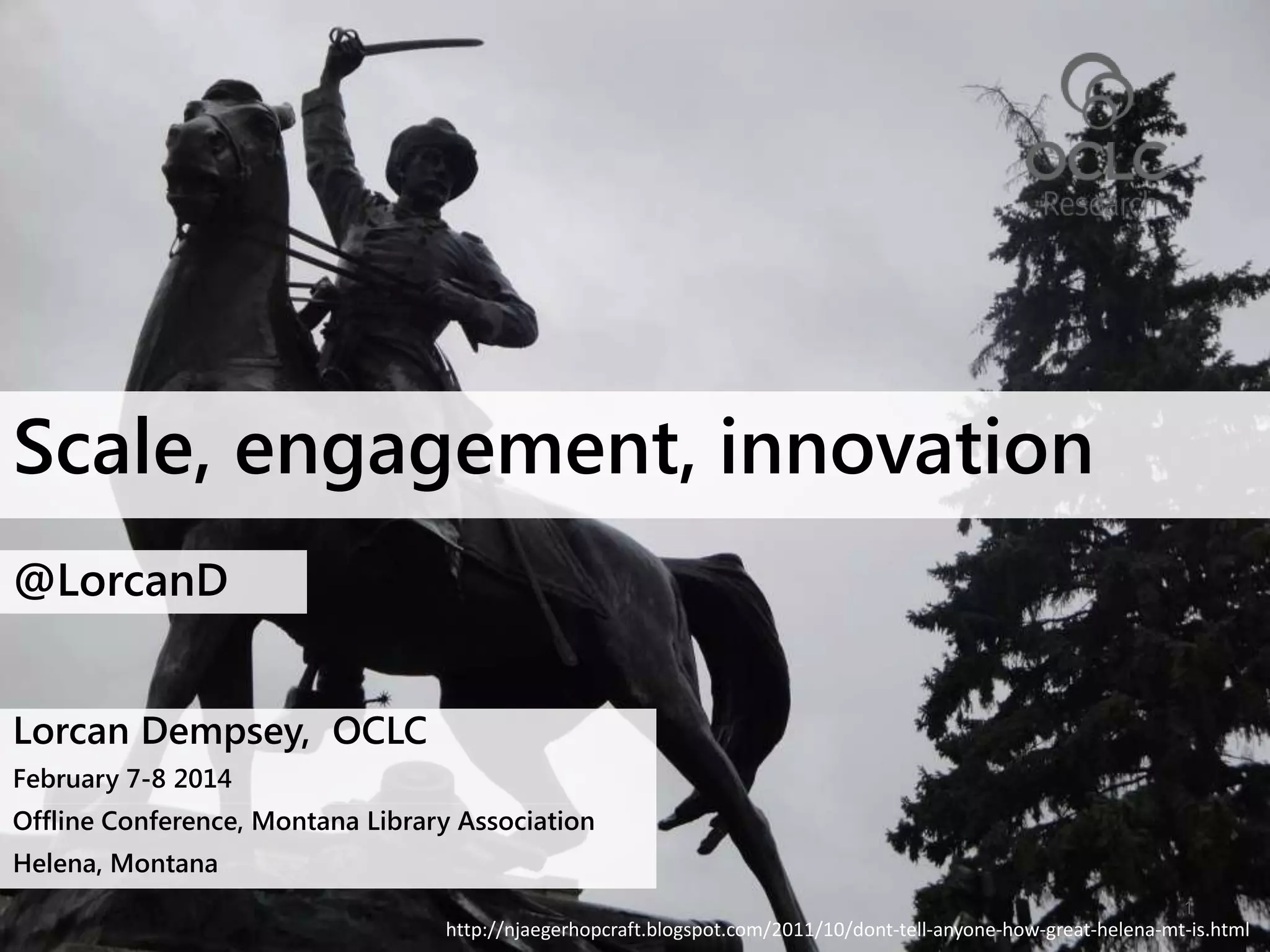
Scale, engagement, innovation:
library directions
@LorcanD
Lorcan Dempsey, OCLC
February 7-8 2014
Offline Conference, Montana Library Association
Helena, Montana
1

http://njaegerhopcraft.blogspot.com/2011/10/dont-tell-anyone-how-great-helena-mt-is.html
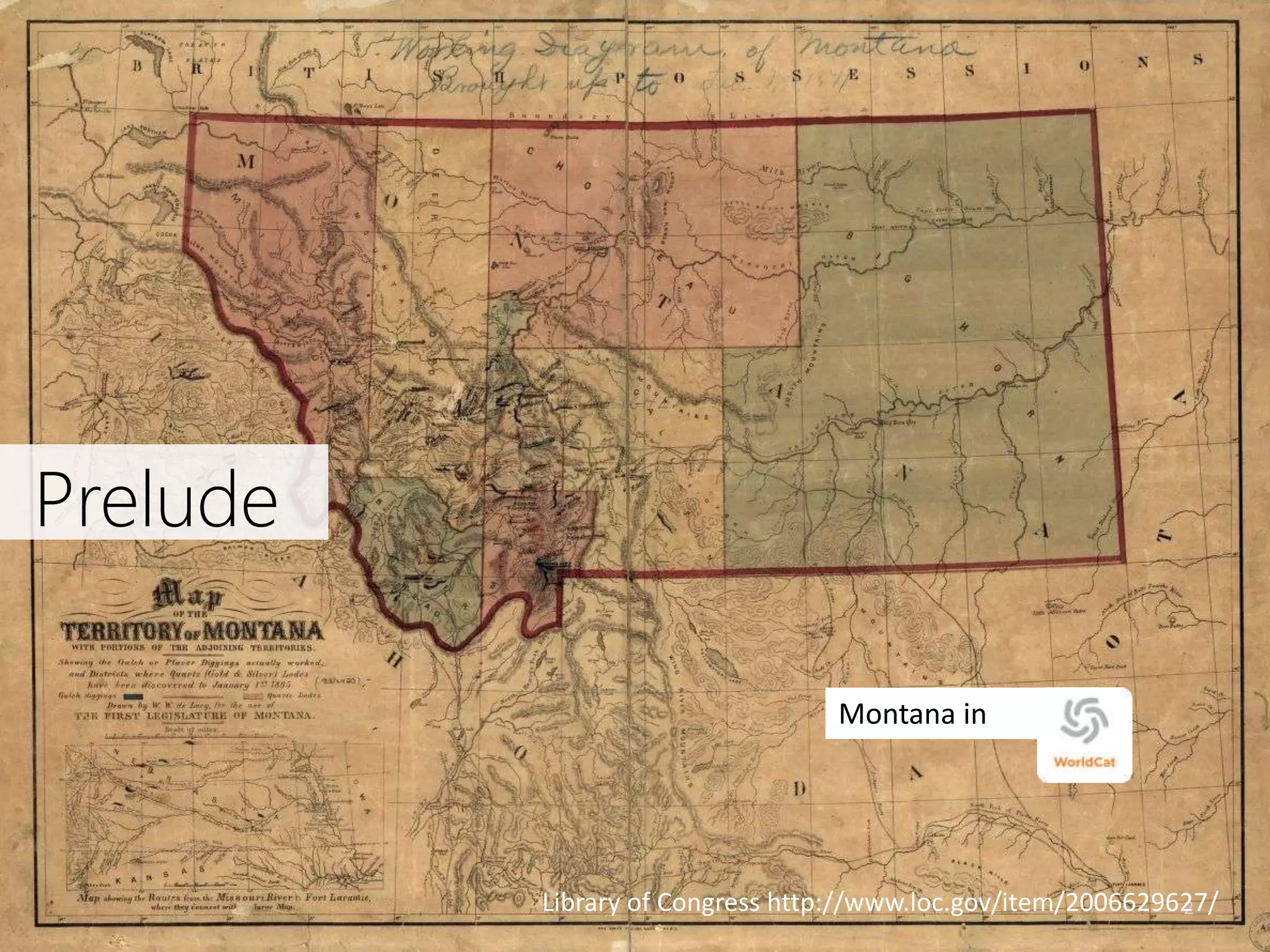
Prelude
Montana in

Library of Congress http://www.loc.gov/item/2006629627/
2
Thomas Francis Meagher (1823-1867)
25 top collections …

Total related works in WorldCat = 99
HATHITRUST DIGITAL LIBR
MONTANA STATE UNIV
BOZEMAN PUB LIBR
UNIV OF MICHIGAN LIBR
MICHIGAN STATE UNIV
NEW YORK HISTL SOC LIBR
PRINCETON UNIV
CARROLL COL LIBR
DUKE UNIV LIBR
UCLA
COLUMBIA UNIV
BOSTON COL
GREAT FALLS PUB LIBR
AM.ANTIQUARIAN SOC
UNIV OF MONTANA
UNIV OF CHICAGO
NATIONAL LIBR OF IRELAND
HARVARD UNIV
ALIBRIS
UNIV OF NOTRE DAME
NATIONAL LIBR OF AUSTRALIA
BAKER & TAYLOR INC
YALE UNIV LIBR
LIBRARY OF CONGRESS
MONTANA HIST SOC LIBR

Montana libraries
National libraries
Vendors
Digital

0%

5%

10%

15%

20%

By Thorpfletcher (Own work) [CC-BY-SA-3.0 (http://creativecommons.org/licenses/by-sa/3.0)], via Wikimedia Commons

25%
4
5
Montana in the cultural record
Concepts
Frontier and pioneer life
Indians of North America

Ranch life
Dakota Indians
Cowboys

number of titles (avg. holdings)

Form/genre
1,946 (41)
1,767 (23)
1,029 (101)
754 (49)
744 (52)

People
George A. Custer (1839-76) 1,529 (45)
Janet Dailey (1944-2013)
196 (160)
Ivan Doig (1939-)
155 (166)
Tracie Peterson (1959-)
140 (156)
Nicholas Evans (1950)
148 (131)

History
Biography
Juvenile works

5,384 (23)
2,323 (35)
629 (124)

Domestic fiction 270 (233)

Events
Battle of Little (1876) 3,544 (40)
Bighorn
Indian Wars (1876) 515 (60)

By Thorpfletcher (Own work) [CC-BY-SA-3.0 (http://creativecommons.org/licenses/by-sa/3.0)], via Wikimedia Commons
Wilderness areas
Montana--Missoula
Wilderness areas--Law and legislation
Rocky Mountains Region
Ponderosa pine
Montana--Lolo National Forest
Montana--Flathead Indian Reservation
Wild and scenic rivers--Law and
legislation
Mines and mineral resources-Environmental aspects

Trout fishing
Trout
Montana--Gallatin County
Biofilms
Cutthroat trout
United States--Yellowstone River
Watershed
Brown trout
Fly fishing--Equipment and supplies
Aquatic invertebrates

Distinctive collection strengths
By Lumpytrout (Own work) [CC-BY-SA-3.0 (http://creativecommons.org/licenses/by-sa/3.0)], via Wikimedia Commons
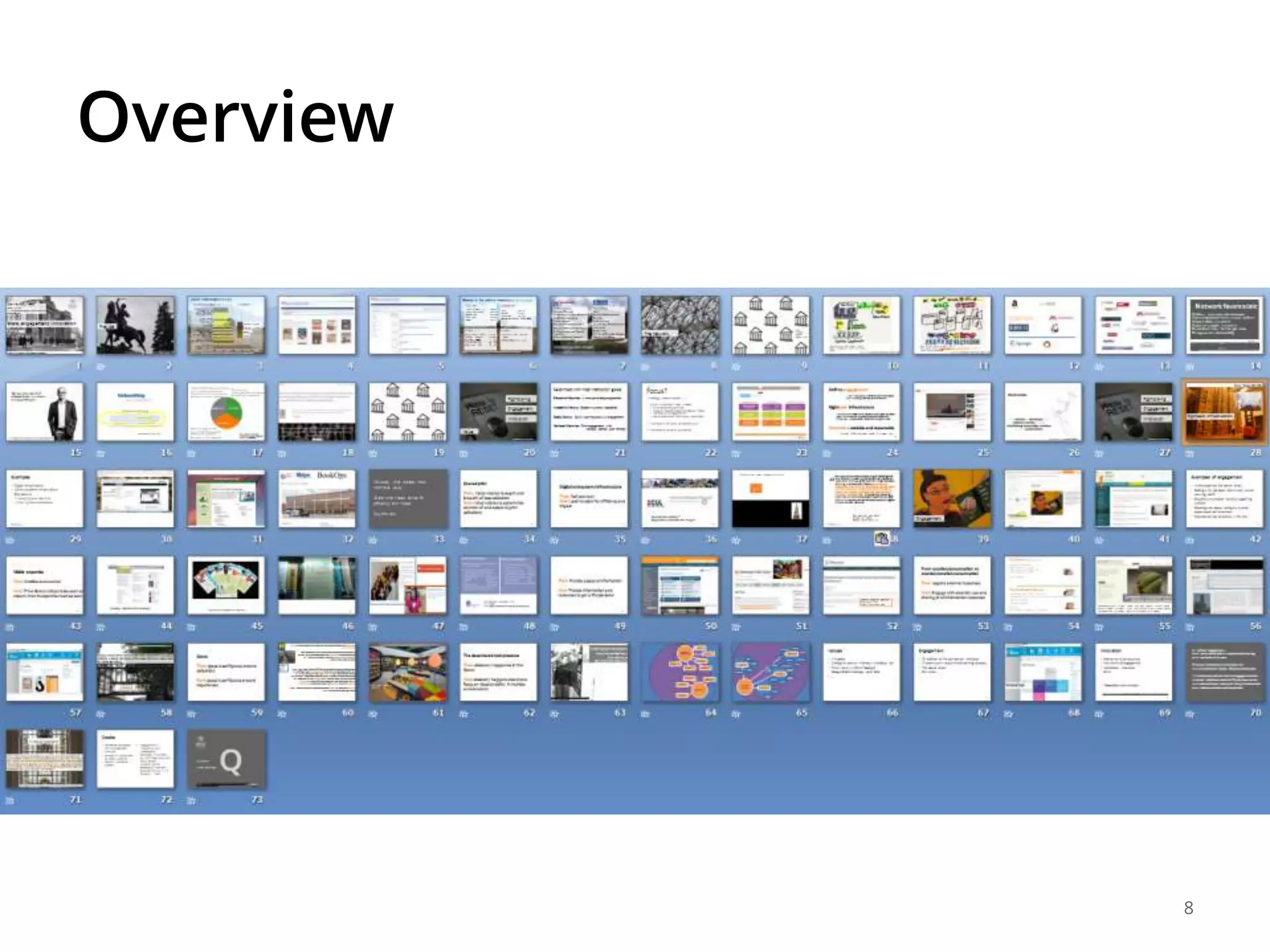
Overview

8
The network
Locally
assembled
collections.
The place to go.
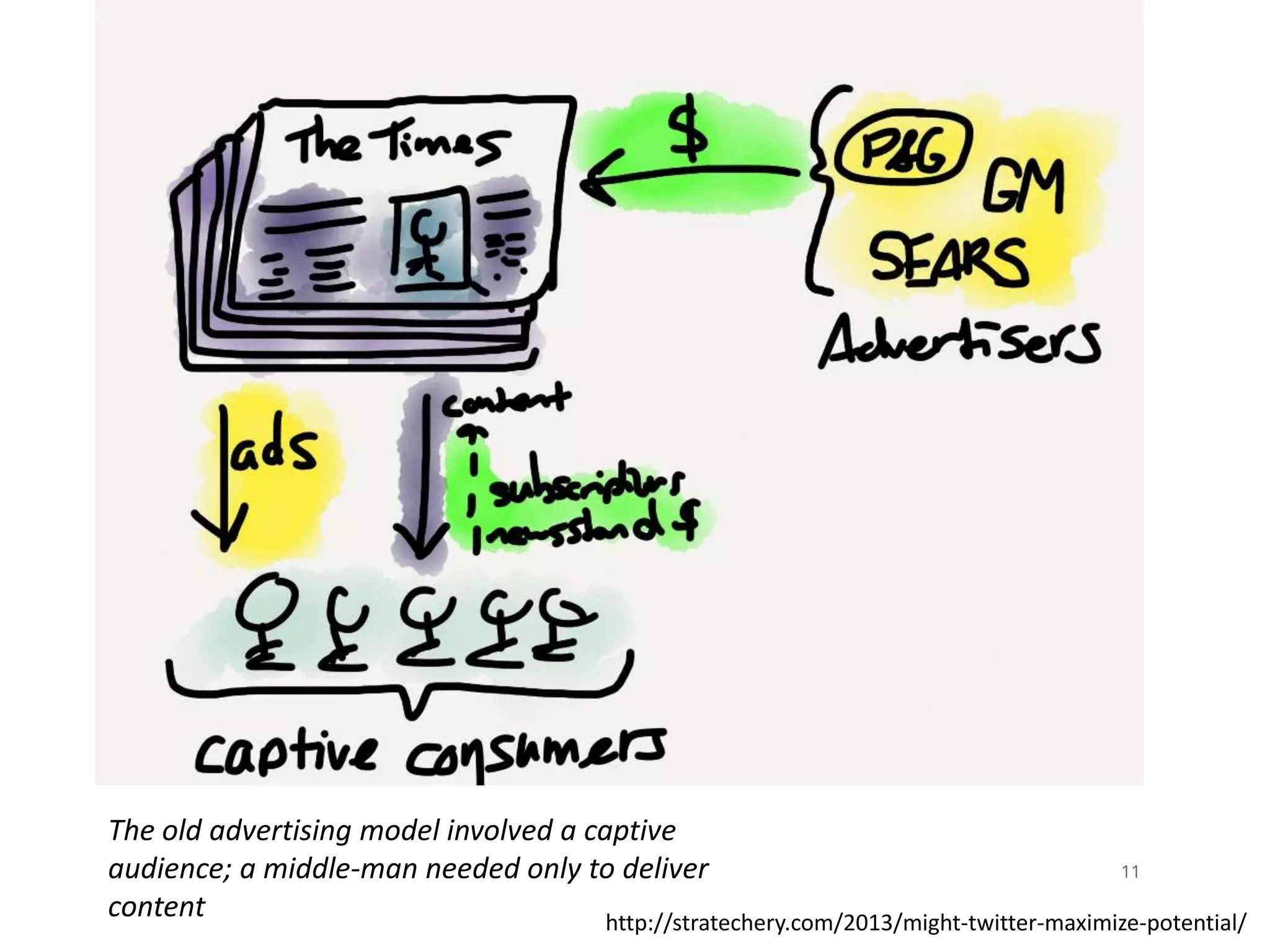
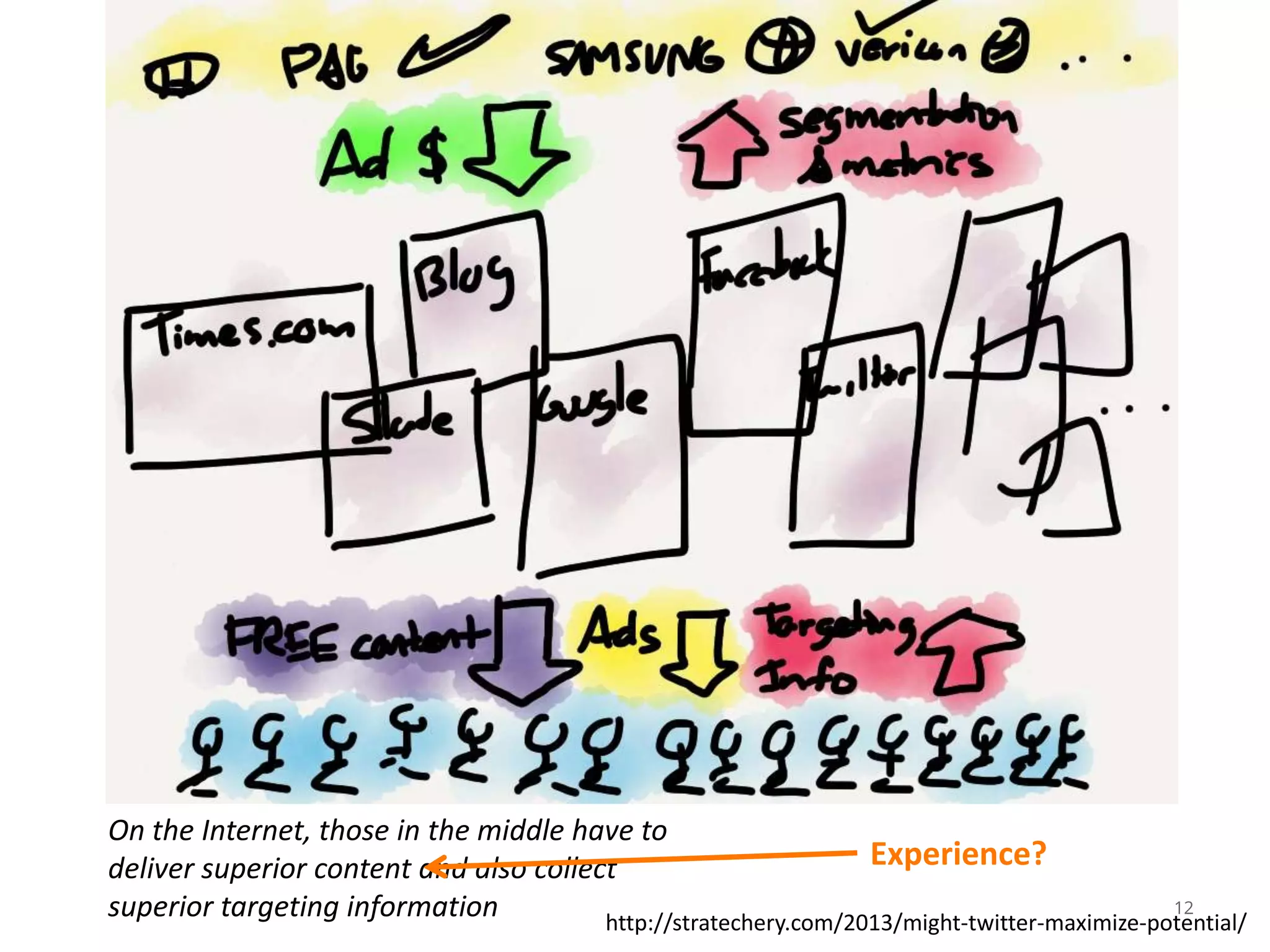
The old advertising model involved a captive
11
audience; a middle-man needed only to deliver
content
http://stratechery.com/2013/might-twitter-maximize-potential/
On the Internet, those in the middle have to
Experience?
deliver superior content and also collect
12
superior targeting information
http://stratechery.com/2013/might-twitter-maximize-potential/
13
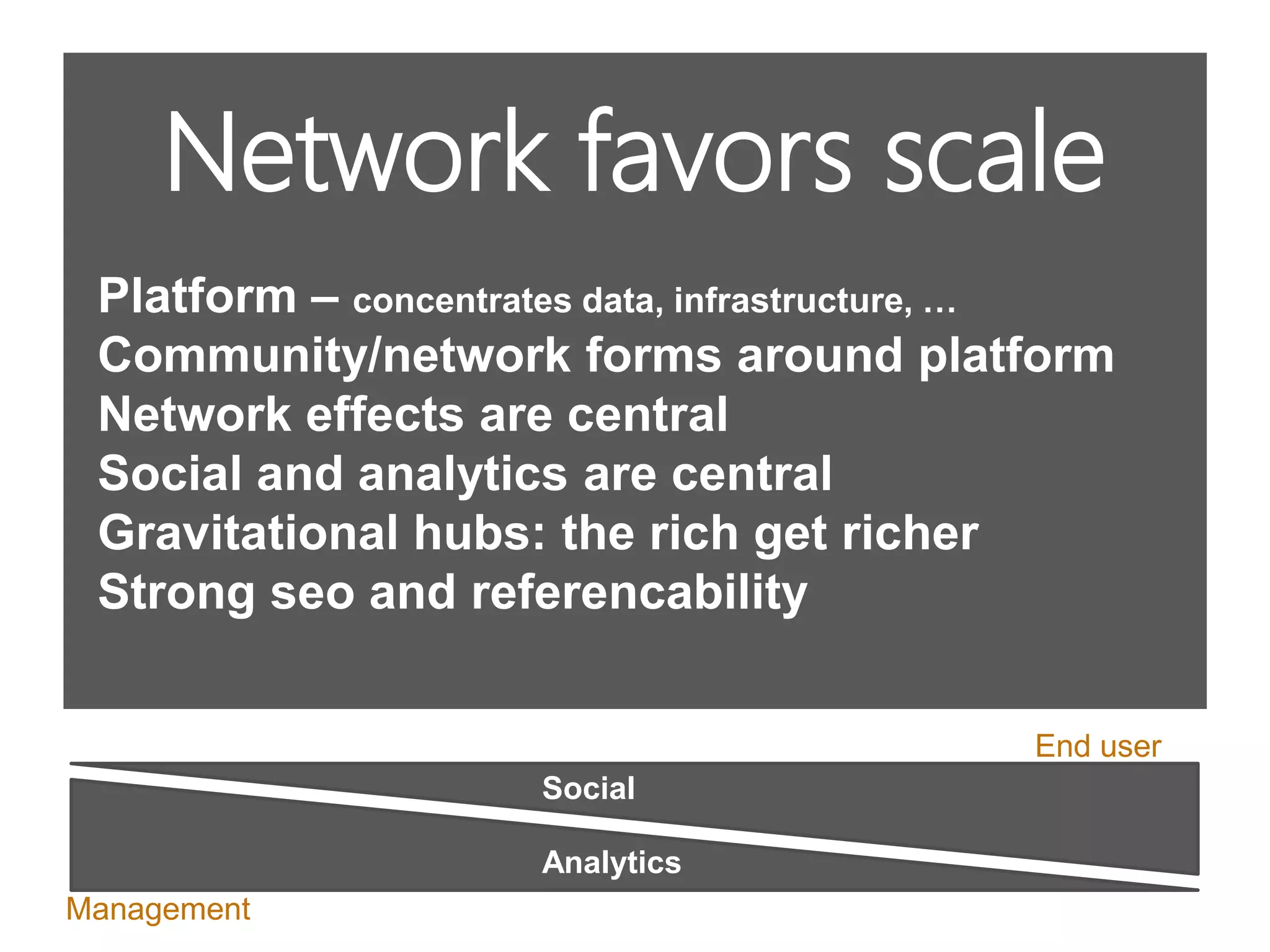
Network favors scale
Platform – concentrates data, infrastructure, …
Community/network forms around platform
Network effects are central
Social and analytics are central
Gravitational hubs: the rich get richer
Strong seo and referencability
End user
Social
Analytics
Management
“Our job is to ensure that
Microsoft thrives in a mobile
and cloud-first world.”

http://www.theverge.com/2014/2/4/5377318/microsoft-ceo-satya-nadella-first-letter-to-employees
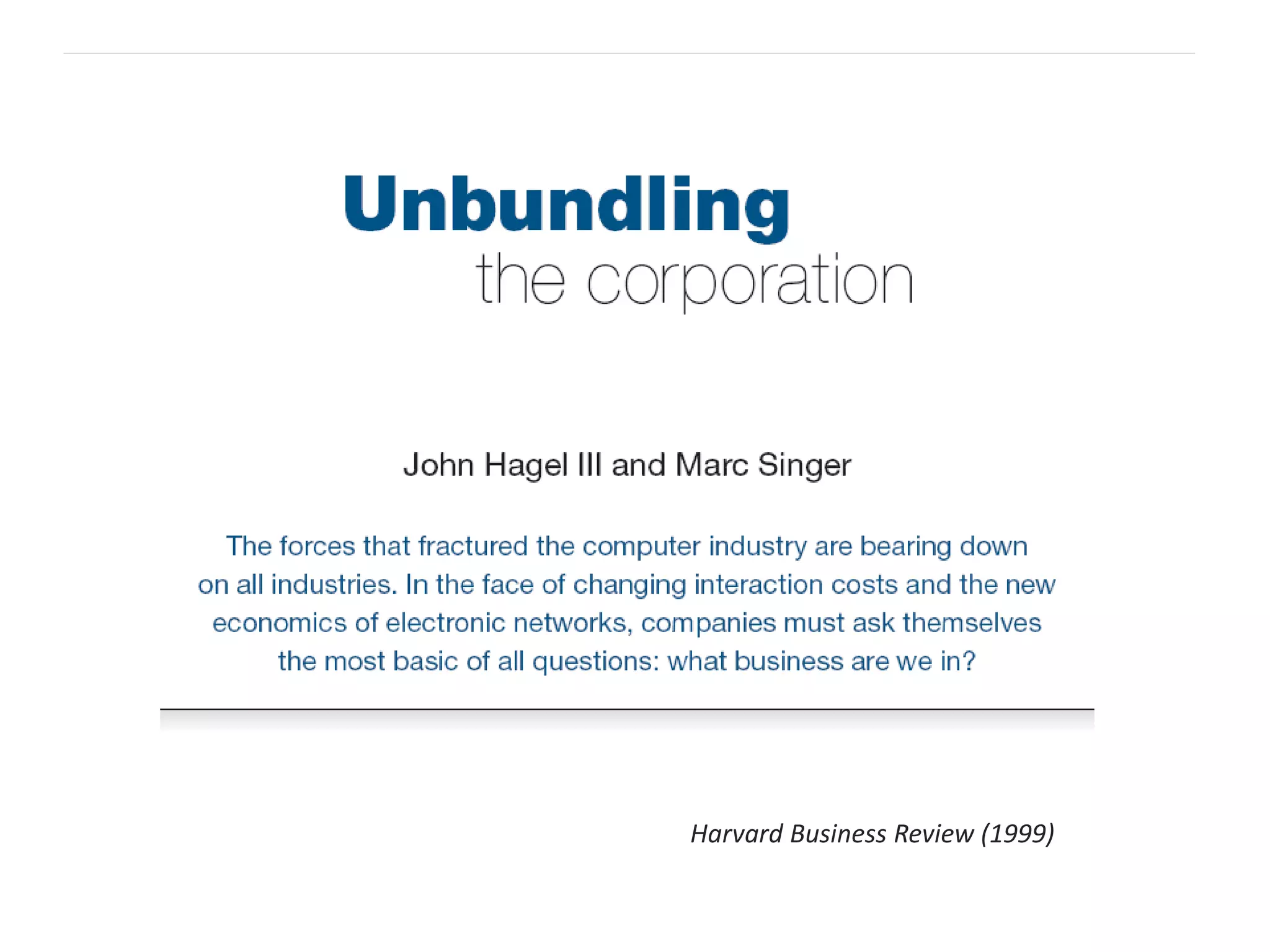
Harvard Business Review (1999)
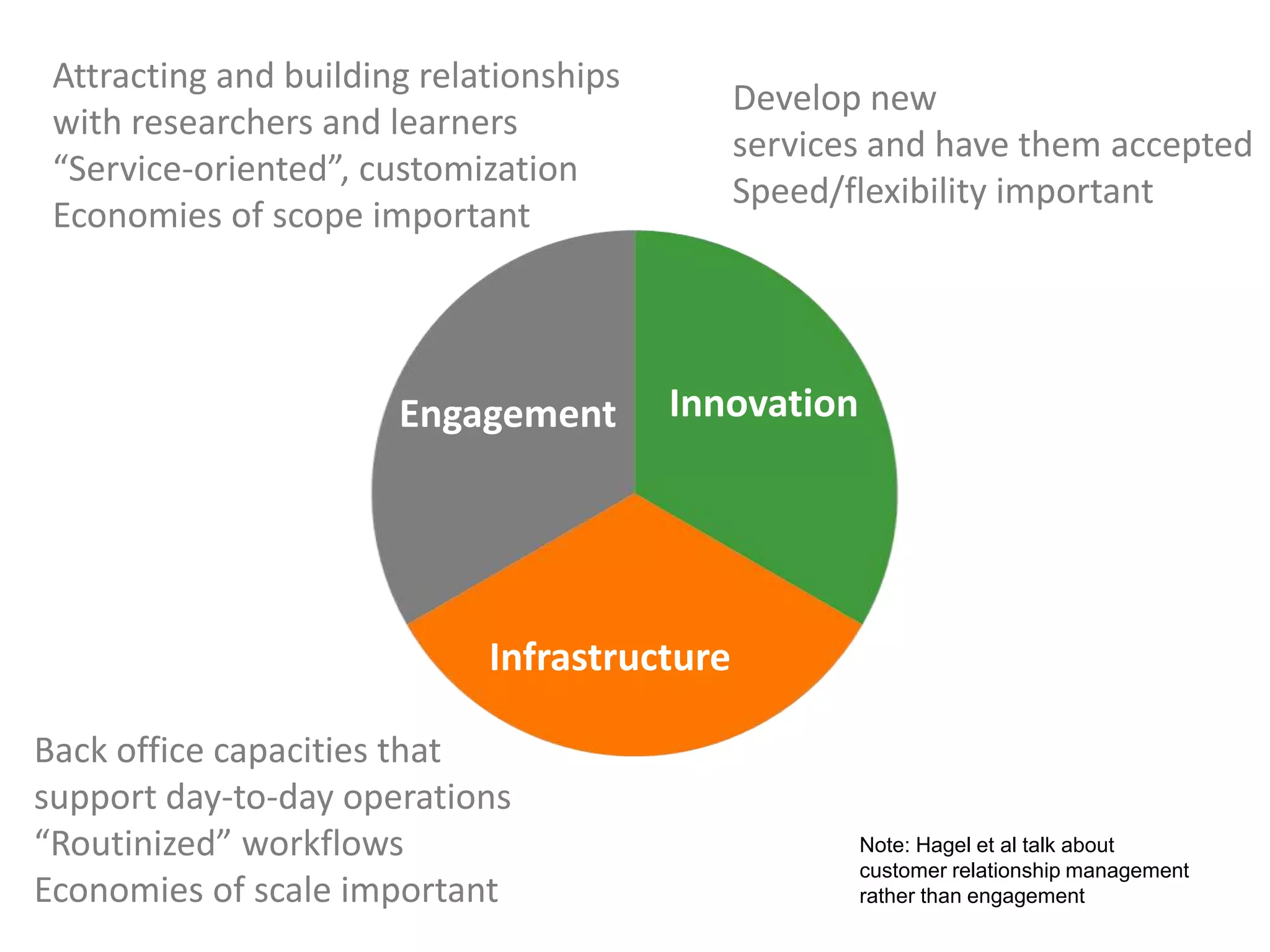
Attracting and building relationships
with researchers and learners
“Service-oriented”, customization
Economies of scope important

Engagement

Develop new
services and have them accepted
Speed/flexibility important

Innovation

Infrastructure
Back office capacities that
support day-to-day operations
“Routinized” workflows
Economies of scale important

Note: Hagel et al talk about
customer relationship management
rather than engagement
Locally
assembled
collections.
The place to go.
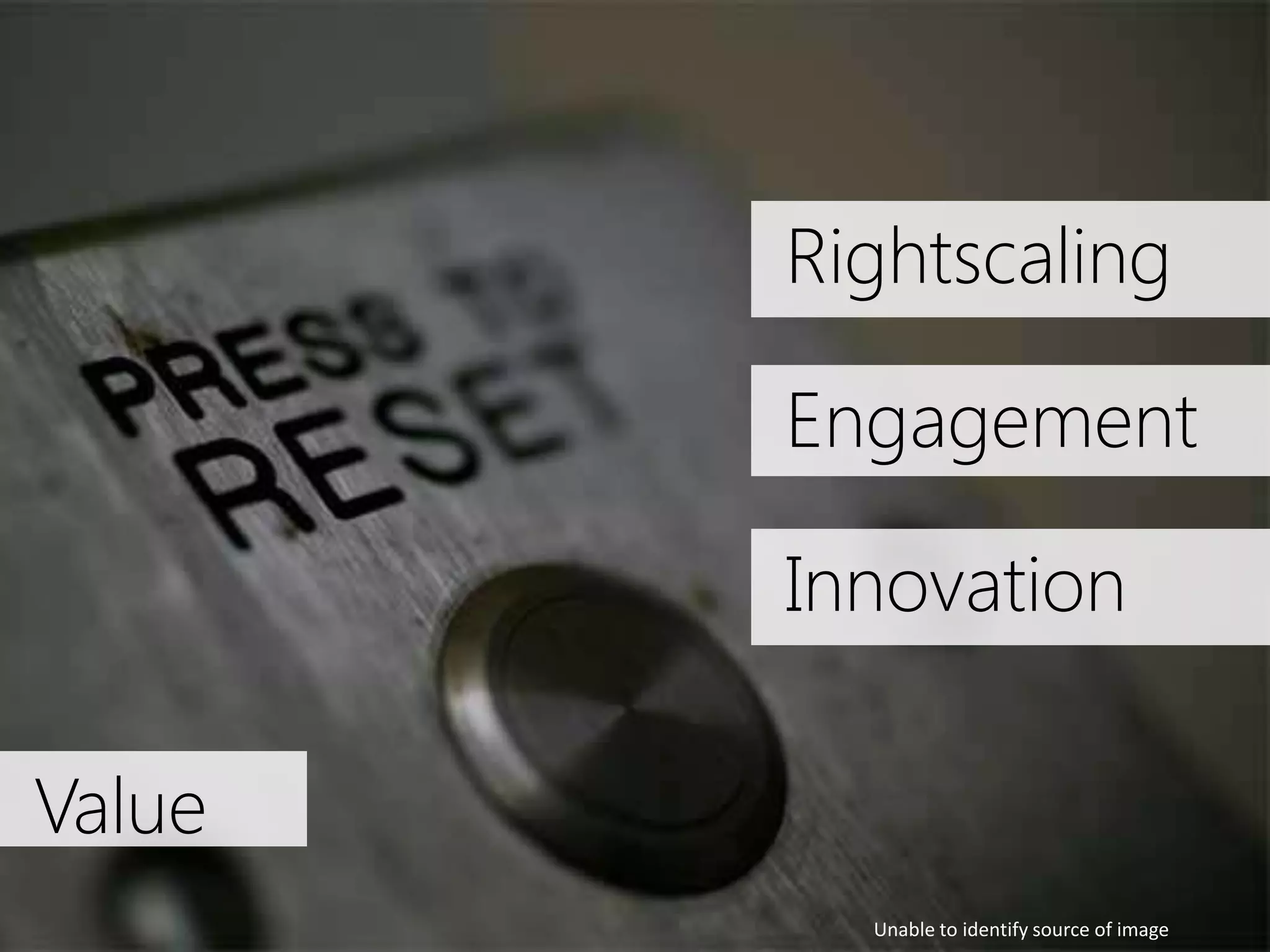
Rightscaling
Engagement
Innovation
Value
Unable to identify source of image
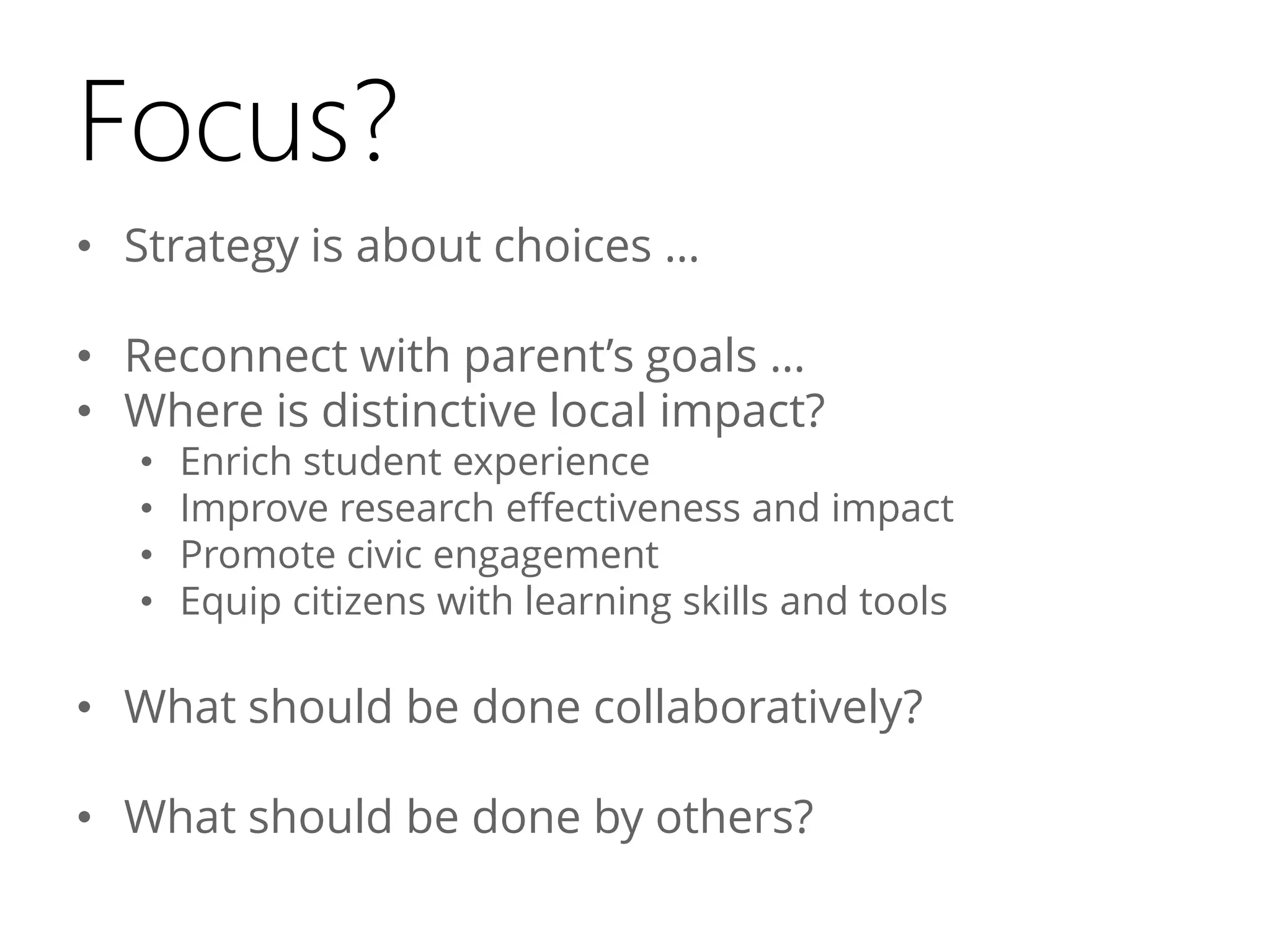
Focus?
• Strategy is about choices …
• Reconnect with parent’s goals …
• Where is distinctive local impact?
•
•
•
•

Enrich student experience
Improve research effectiveness and impact
Promote civic engagement
Equip citizens with learning skills and tools

• What should be done collaboratively?
• What should be done by others?
23
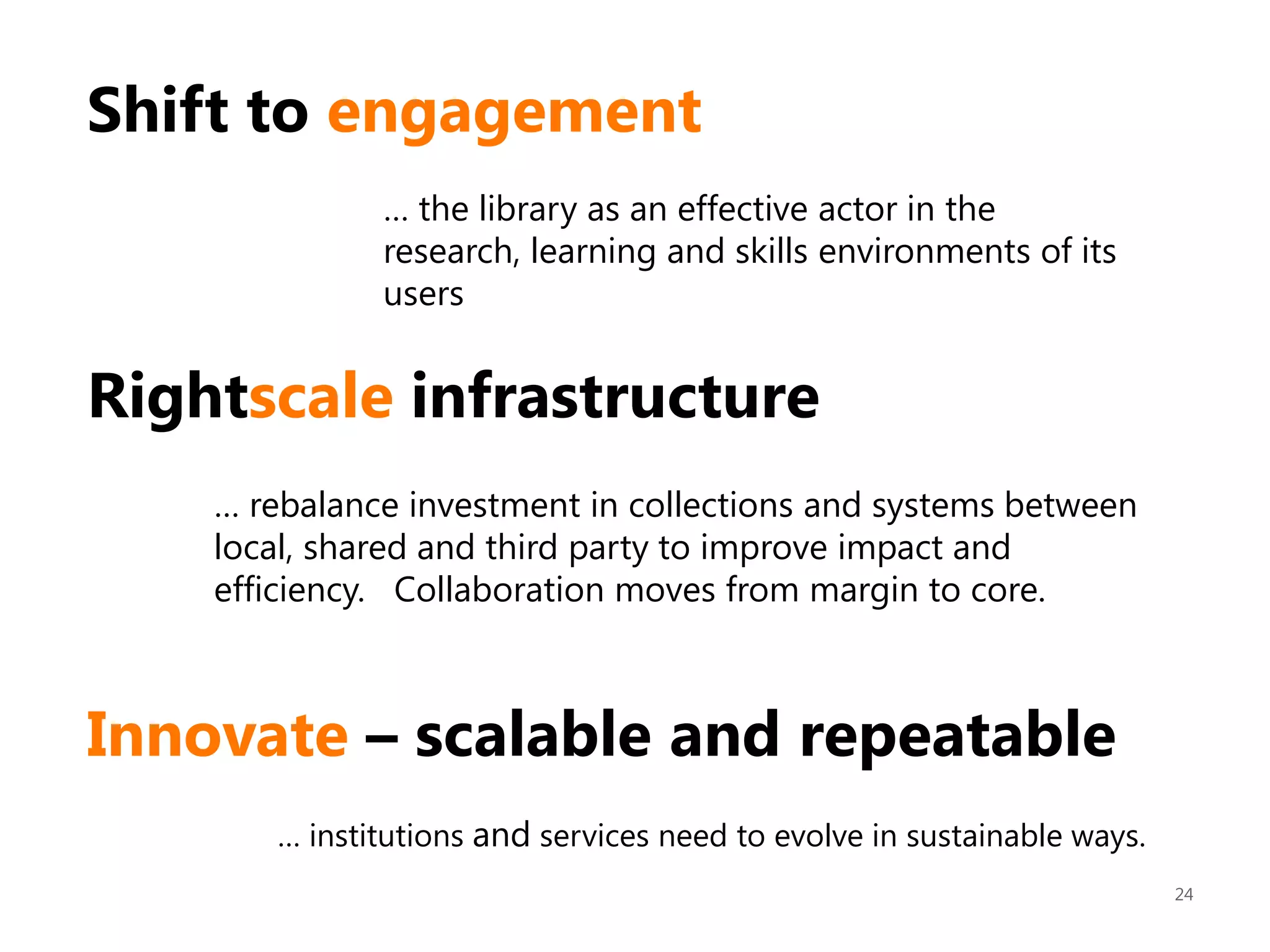
Shift to engagement
… the library as an effective actor in the
research, learning and skills environments of its
users

Rightscale infrastructure
… rebalance investment in collections and systems between
local, shared and third party to improve impact and
efficiency. Collaboration moves from margin to core.

Innovate – scalable and repeatable
… institutions and services need to evolve in sustainable ways.
24
25
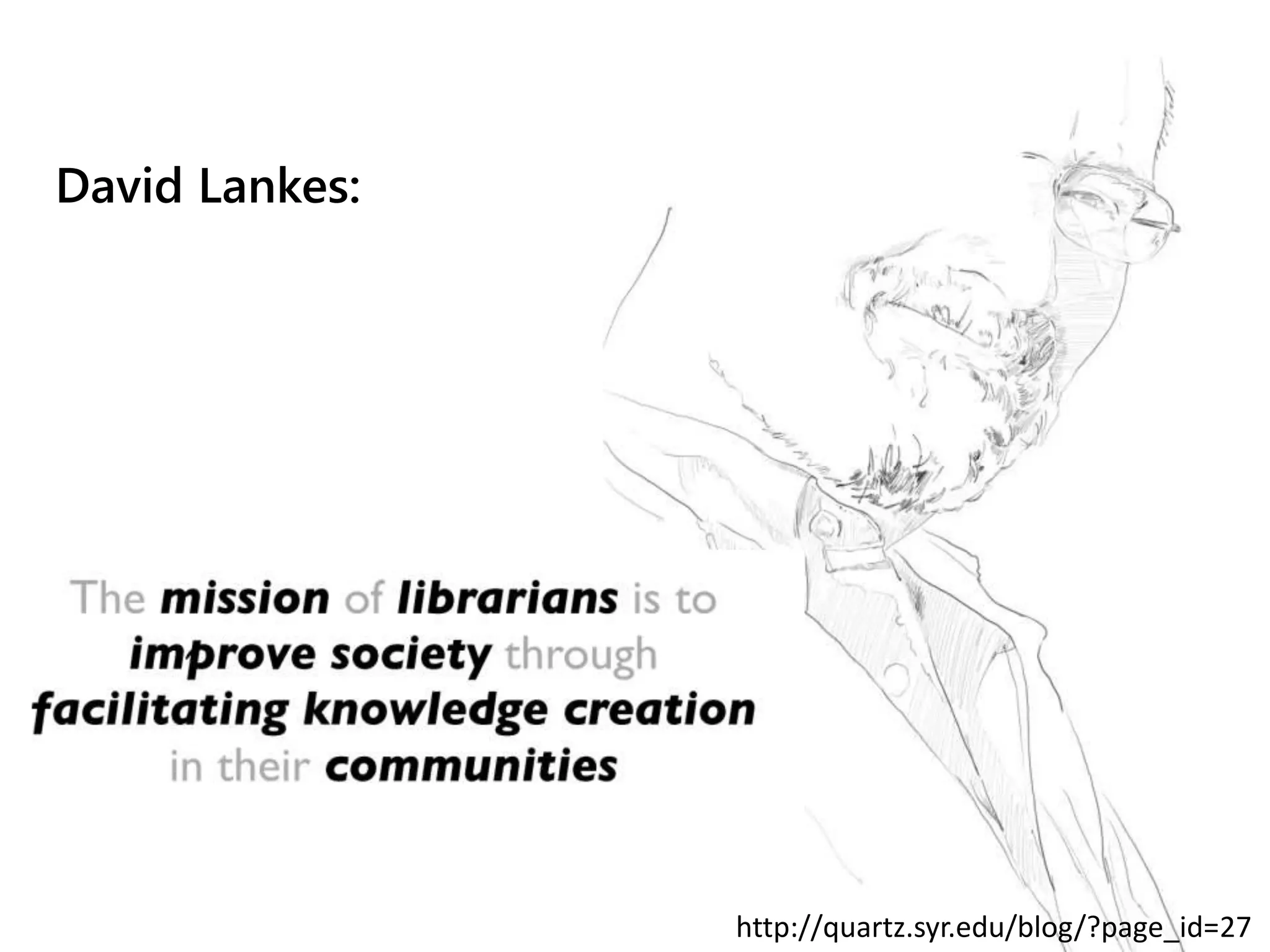
David Lankes:

26

http://quartz.syr.edu/blog/?page_id=27
Rightscaling
Engagement
Innovation

Unable to identify source of image
„Cloud‟ storage (Ohio State)

Rightscale infrastructure

/

http://library.osu.edu/blogs/cartoons/2012/02/28/blog-launch-and-the-construction-of-our-new-home-in-sullivant-hall
Examples
• Negotiation and licensing
• Library systems infrastructure
• Digital infrastructure
• Processing capacity
• Shared print
– Managing down local print
– Evolving shared approaches.

29
Do locally what creates most distinctive
value.
Share what makes sense for efficiency
and impact.
Buy the rest.
Shared print

Then: Value relates to depth and
breadth of local collection.
Now: Value relates to systemwide
curation of and access to print
collections.

33
Digital and systems infrastructure
Then: Local build or control.
Now: Look to scale for efficiency and
impact.

34
Collaborative sourcing –
cooperation moves from the margins
35
“aggregate and scale towards a common infrastructure”
“

Colleges and universities have long competed against
one another, measuring themselves in comparison to
each other and holding tightly to their idiosyncrasies as
defining elements of their status. But today, the
distribution and reuse of information digitally via the
Internet is rapidly changing the game, rewarding
those who instead aggregate and scale toward a
common infrastructure. It is becoming increasingly
clear that neither the challenges that confront colleges
and universities nor the solutions to those challenges are
unique to each institution.

Chuck Henry and Brad Wheeler
The game has changed
Educause Review, March 2012
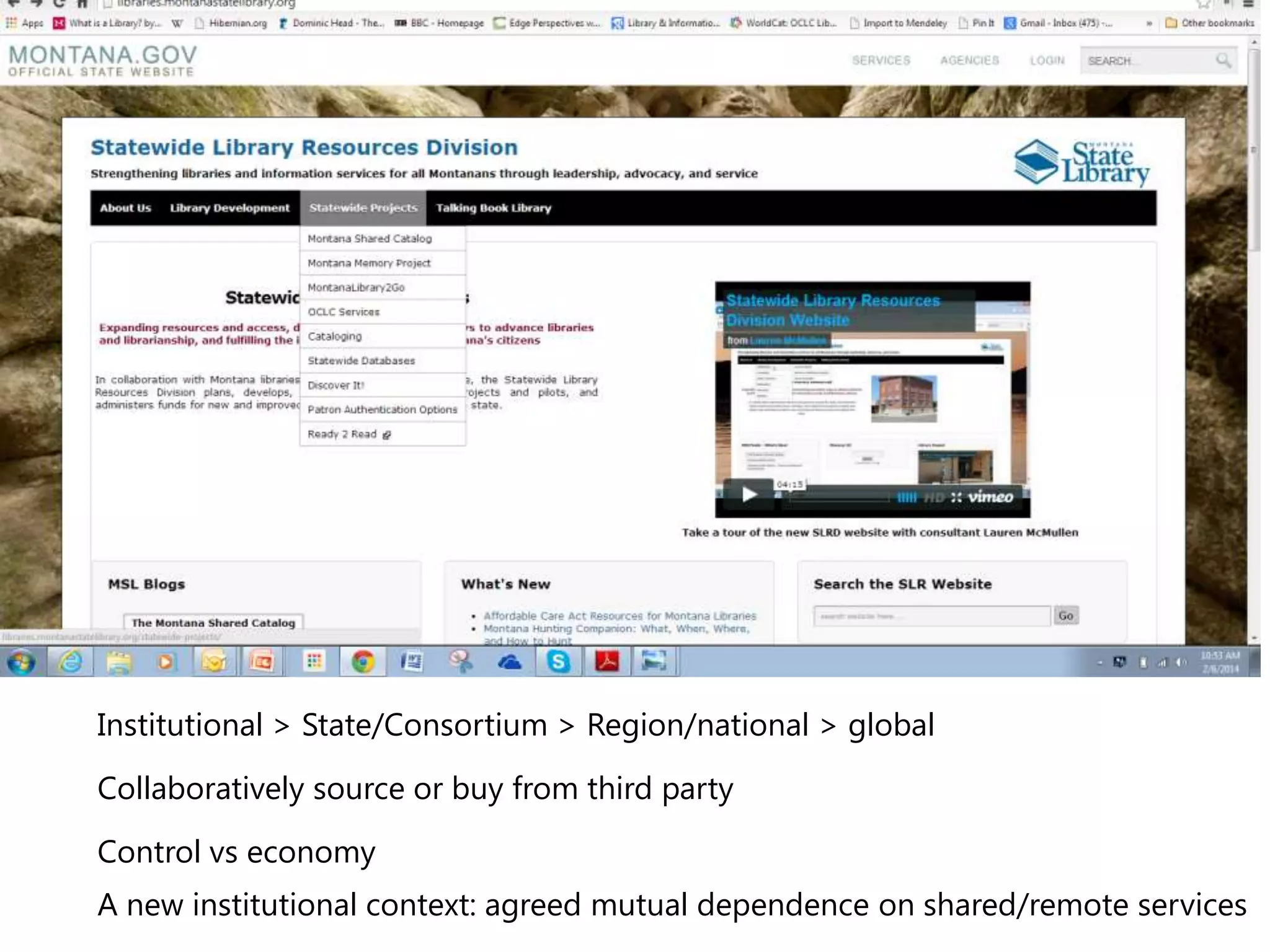
Institutional > State/Consortium > Region/national > global
Collaboratively source or buy from third party
Control vs economy
A new institutional context: agreed mutual dependence on shared/remote services
Engagement
39
40
41
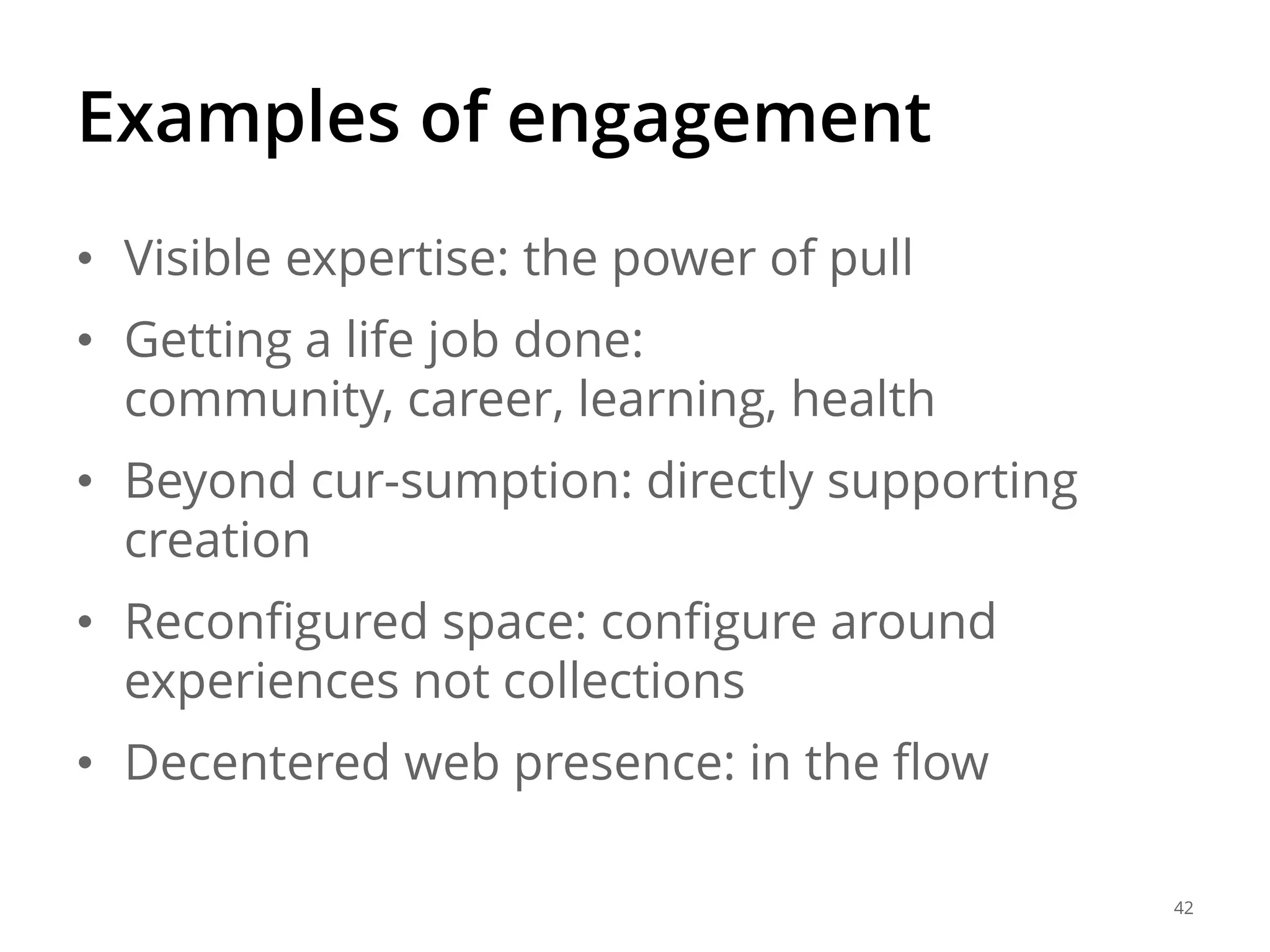
Examples of engagement
• Visible expertise: the power of pull

• Getting a life job done:
community, career, learning, health
• Beyond cur-sumption: directly supporting
creation
• Reconfigured space: configure around
experiences not collections

• Decentered web presence: in the flow
42
Visible expertise
Then: Invisible and neutral.

Now: If the library wishes to be seen as
expert, then its expertise must be seen.

43
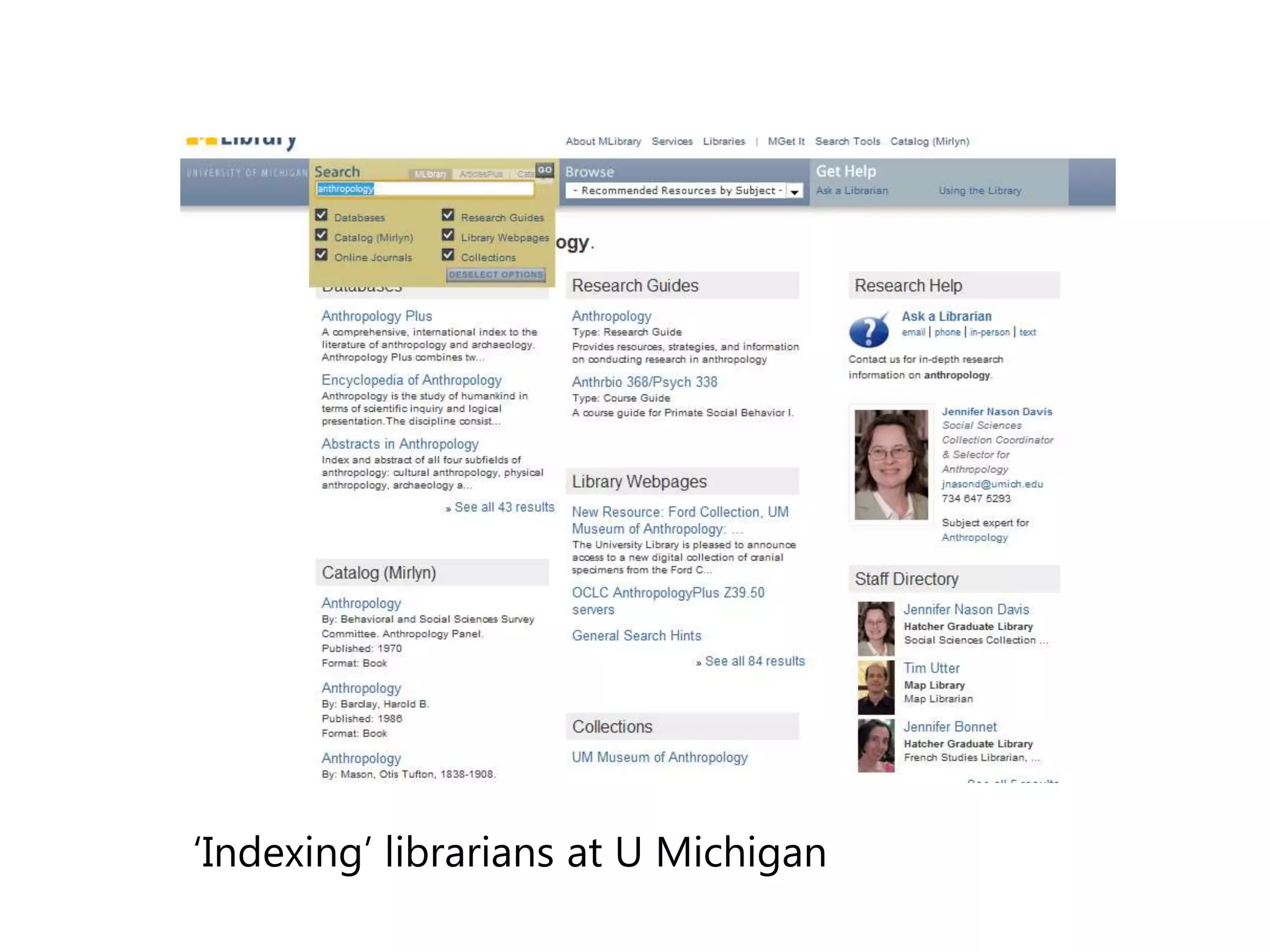
„Indexing‟ librarians at U Michigan
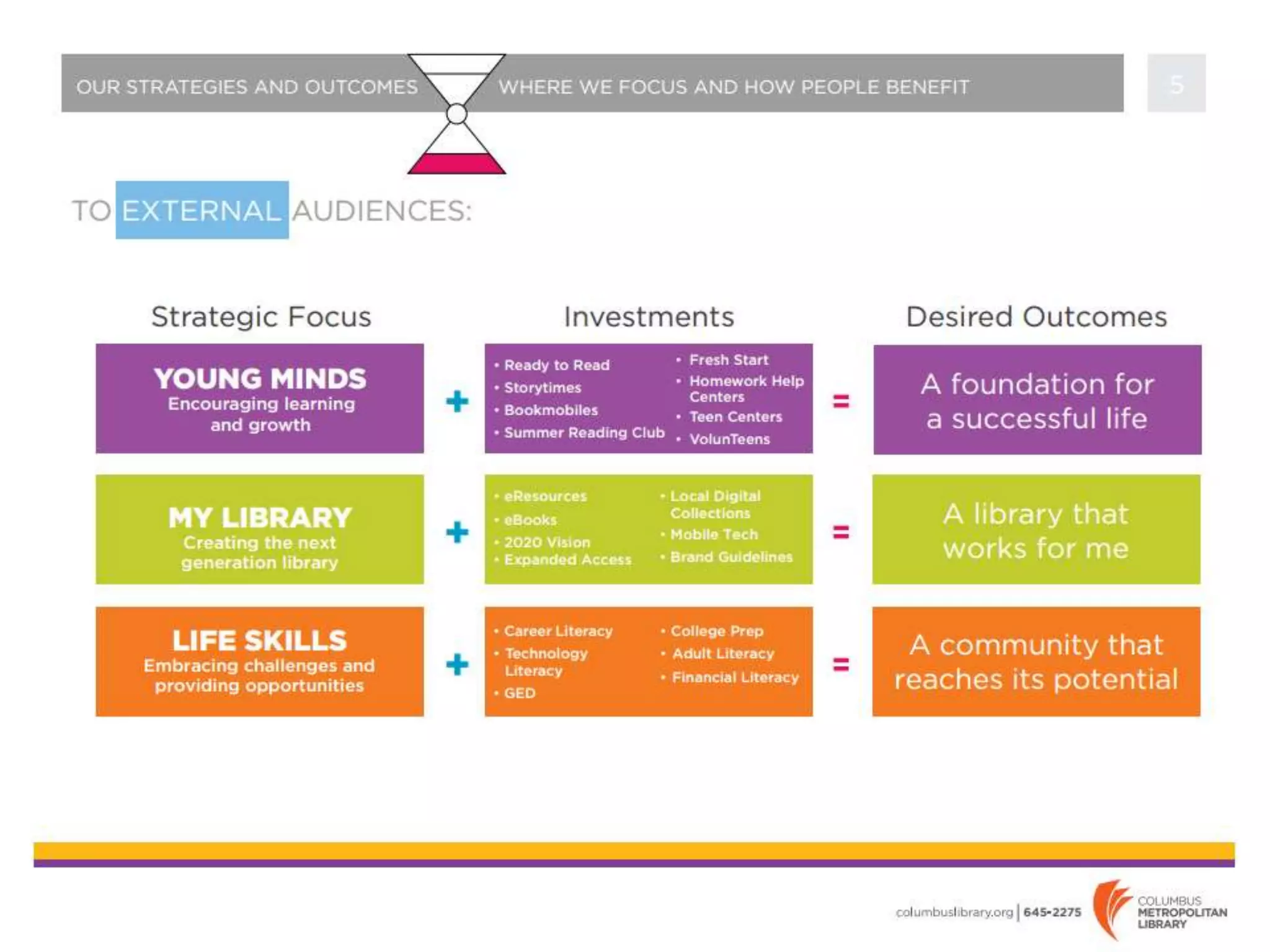
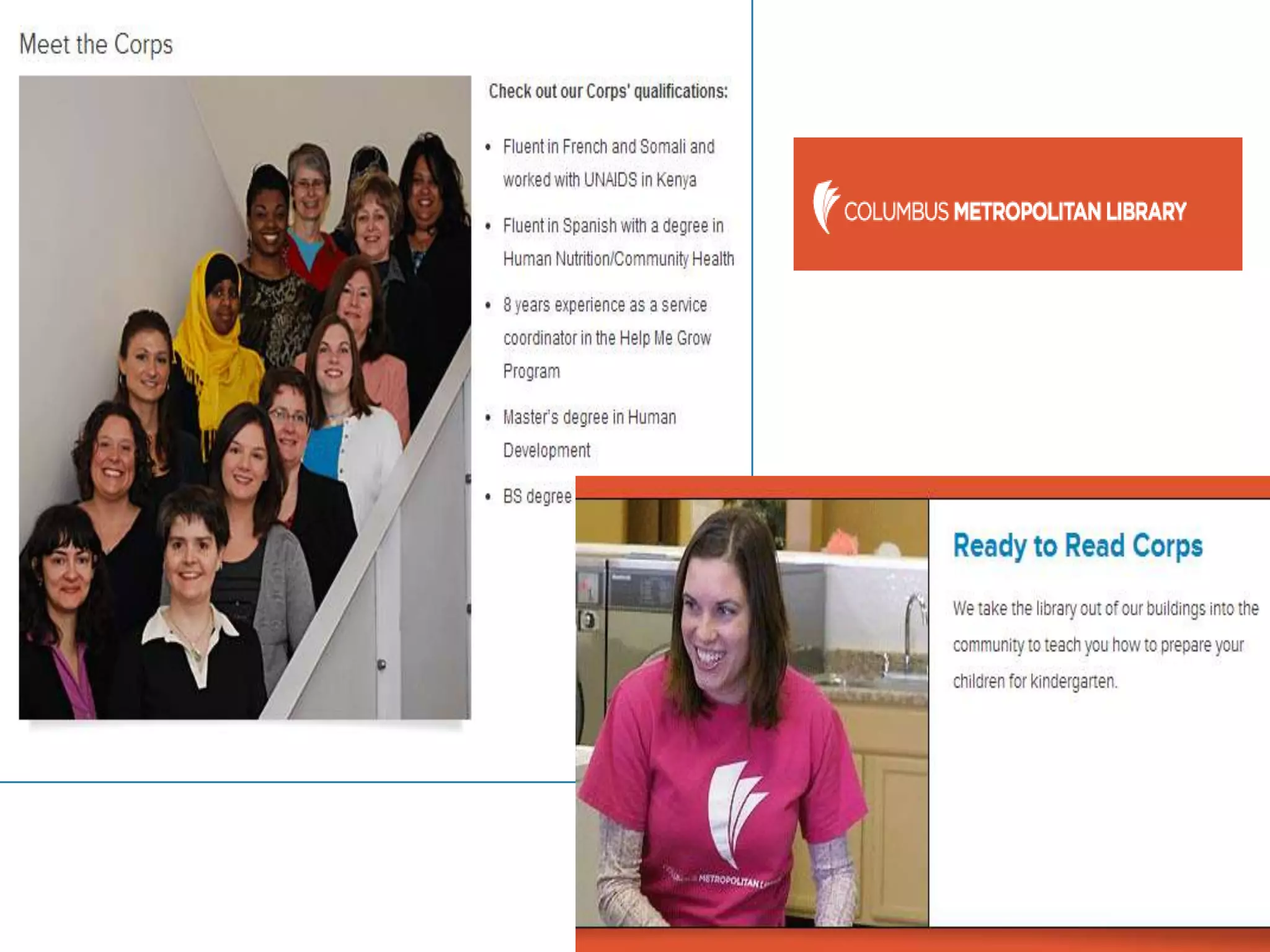
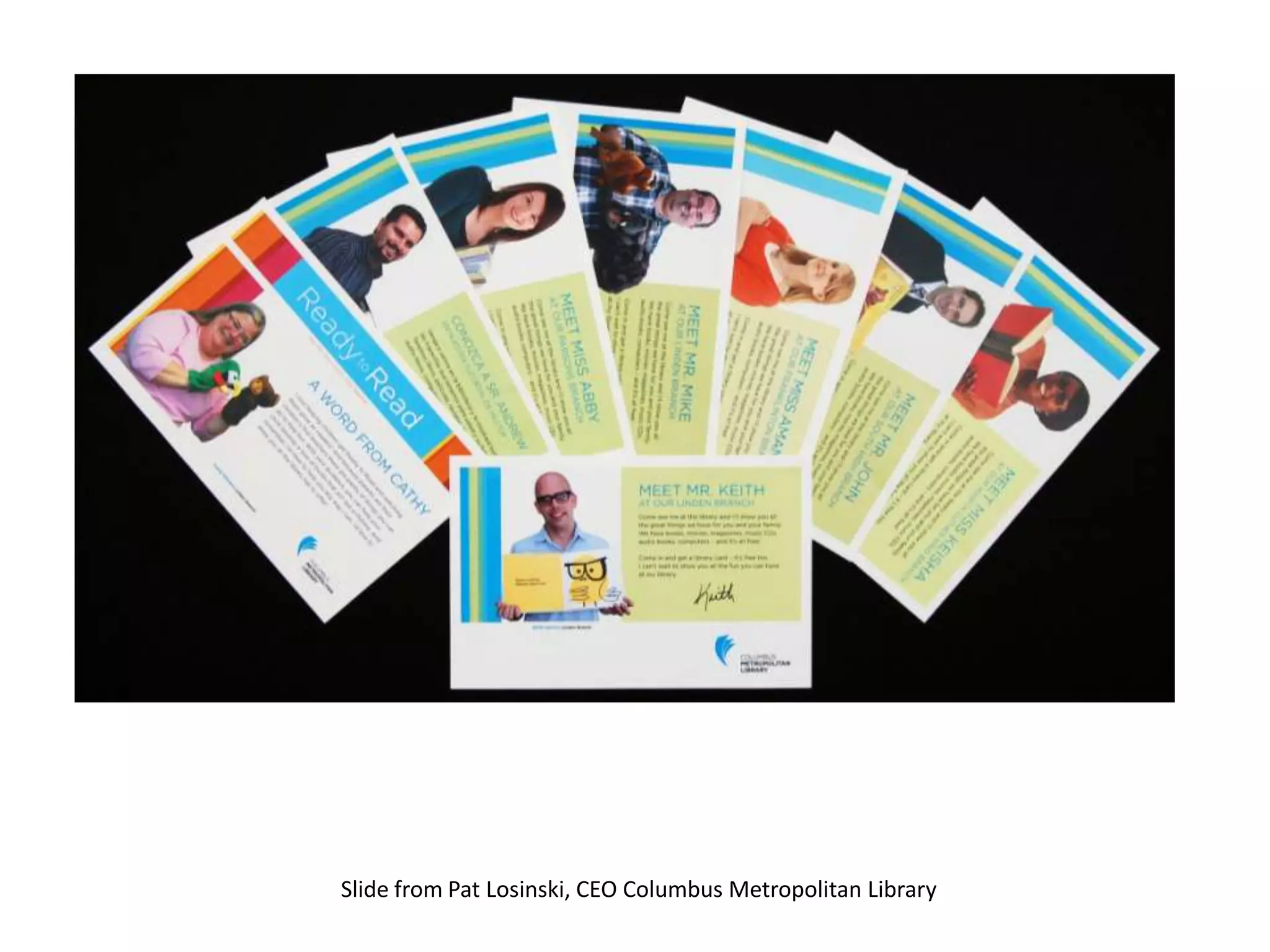
Slide from Pat Losinski, CEO Columbus Metropolitan Library
in
46
47
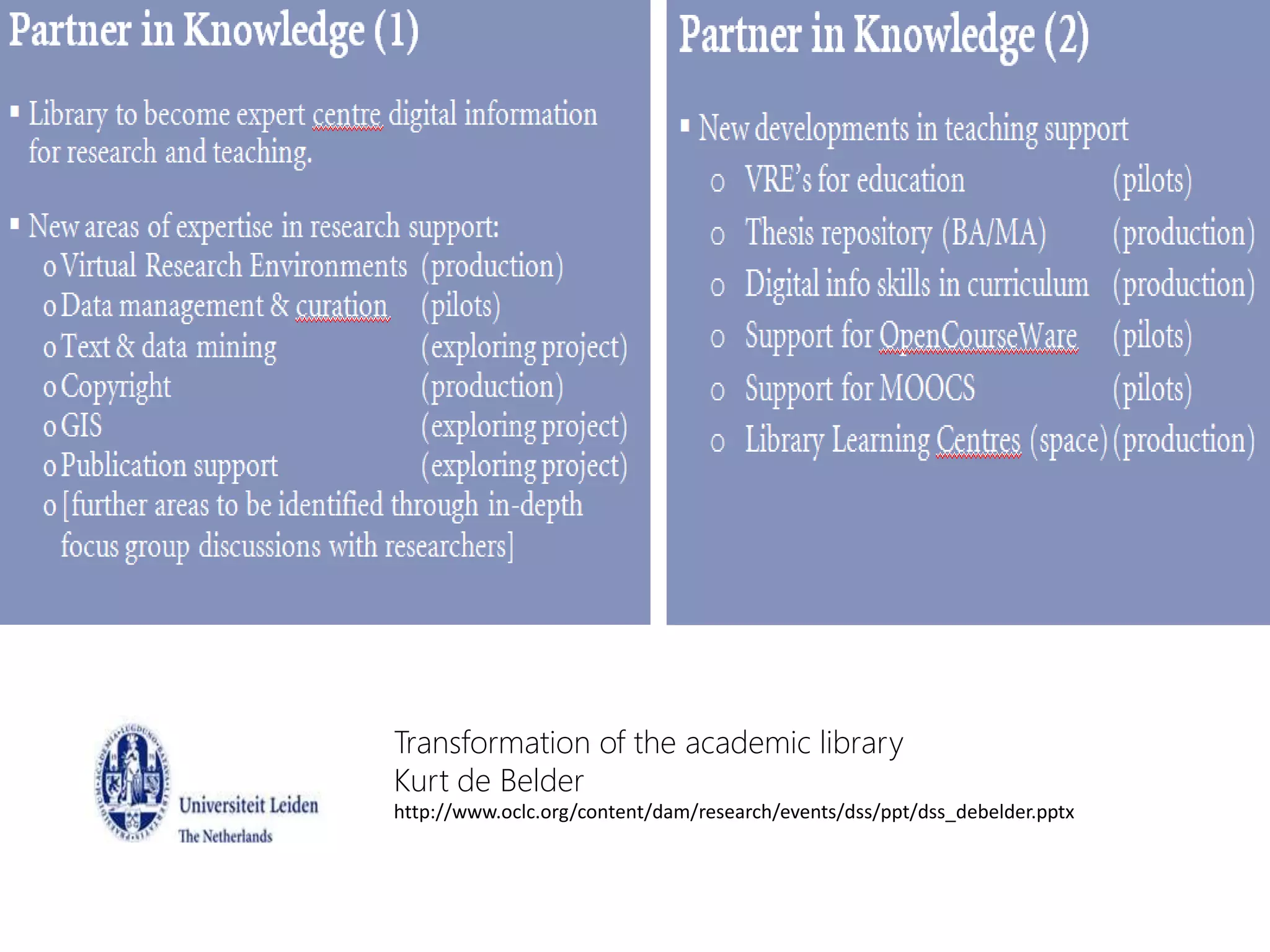
Transformation of the academic library
Kurt de Belder
http://www.oclc.org/content/dam/research/events/dss/ppt/dss_debelder.pptx

48
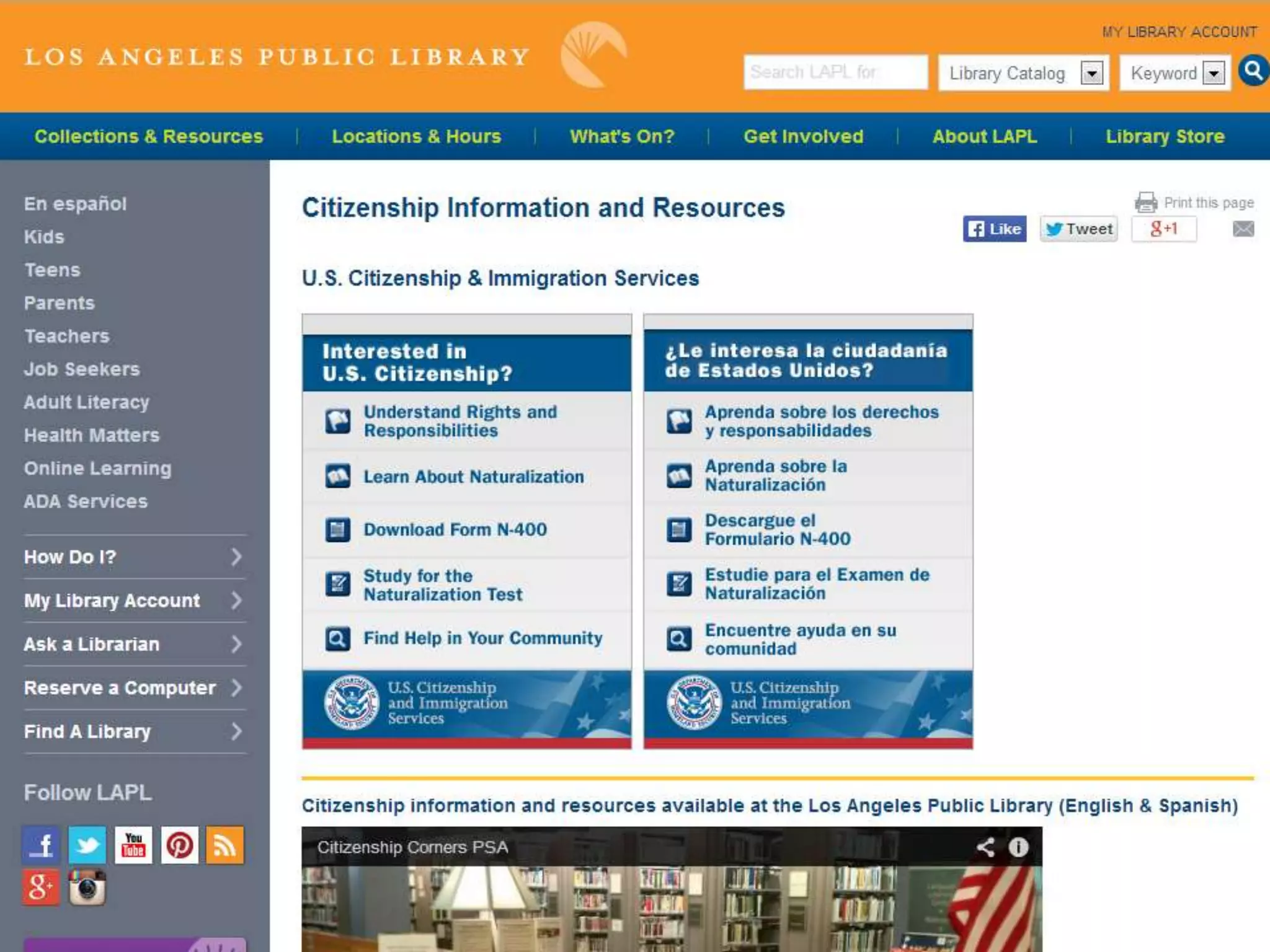
Skills to get a life job done
Then: Provide access to information
Now: Provide information and
resources to get a life job done.

49
50
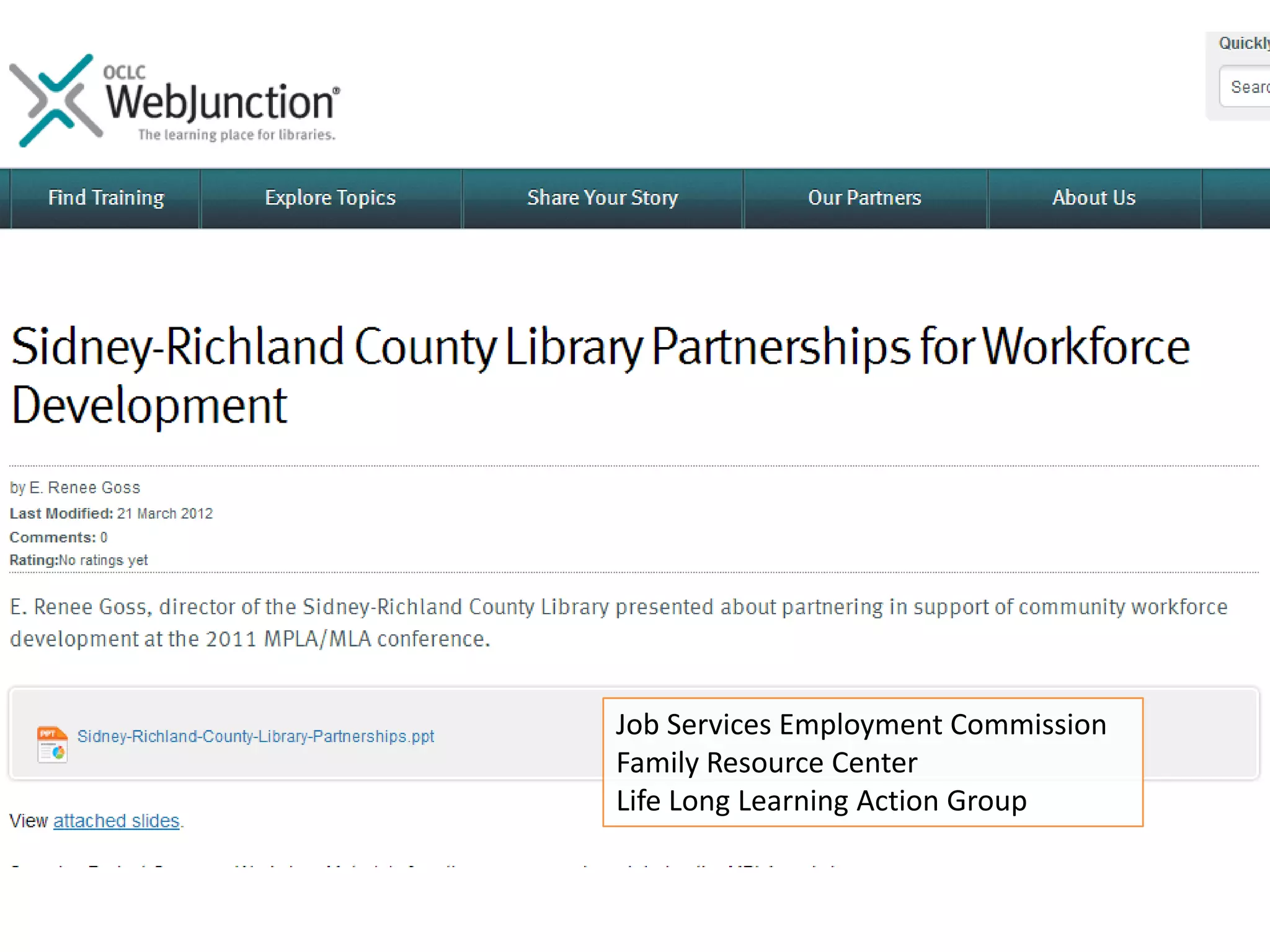
Job Services Employment Commission
Family Resource Center
Life Long Learning Action Group
From curation/consumption to
creation/curation/consumption
Then: Acquire external resources
Now: Engage with creation, use and
sharing of all information resources.

53
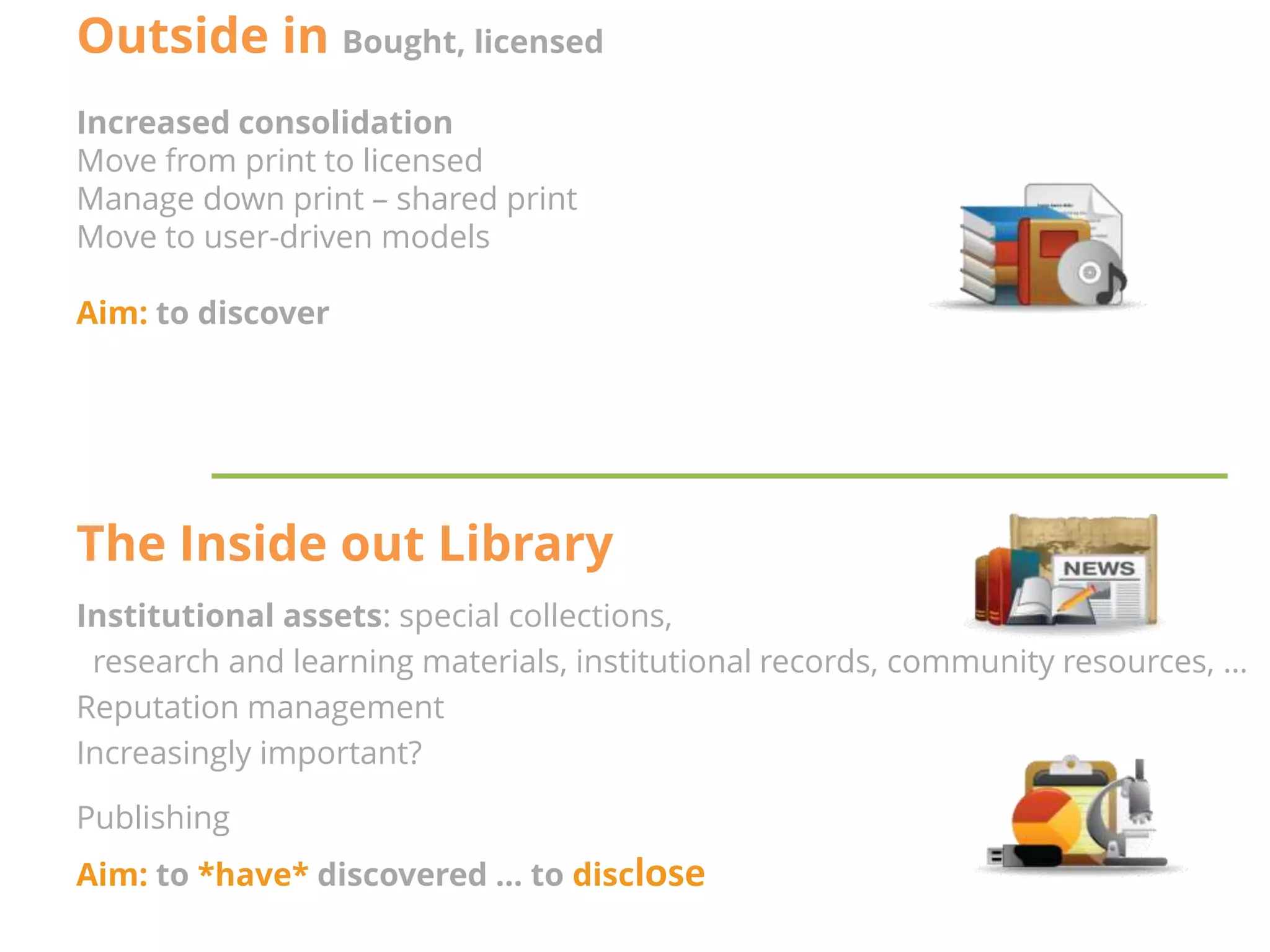
Outside in Bought, licensed
Increased consolidation
Move from print to licensed
Manage down print – shared print
Move to user-driven models

Aim: to discover

The Inside out Library
Institutional assets: special collections,
research and learning materials, institutional records, community resources, …
Reputation management
Increasingly important?
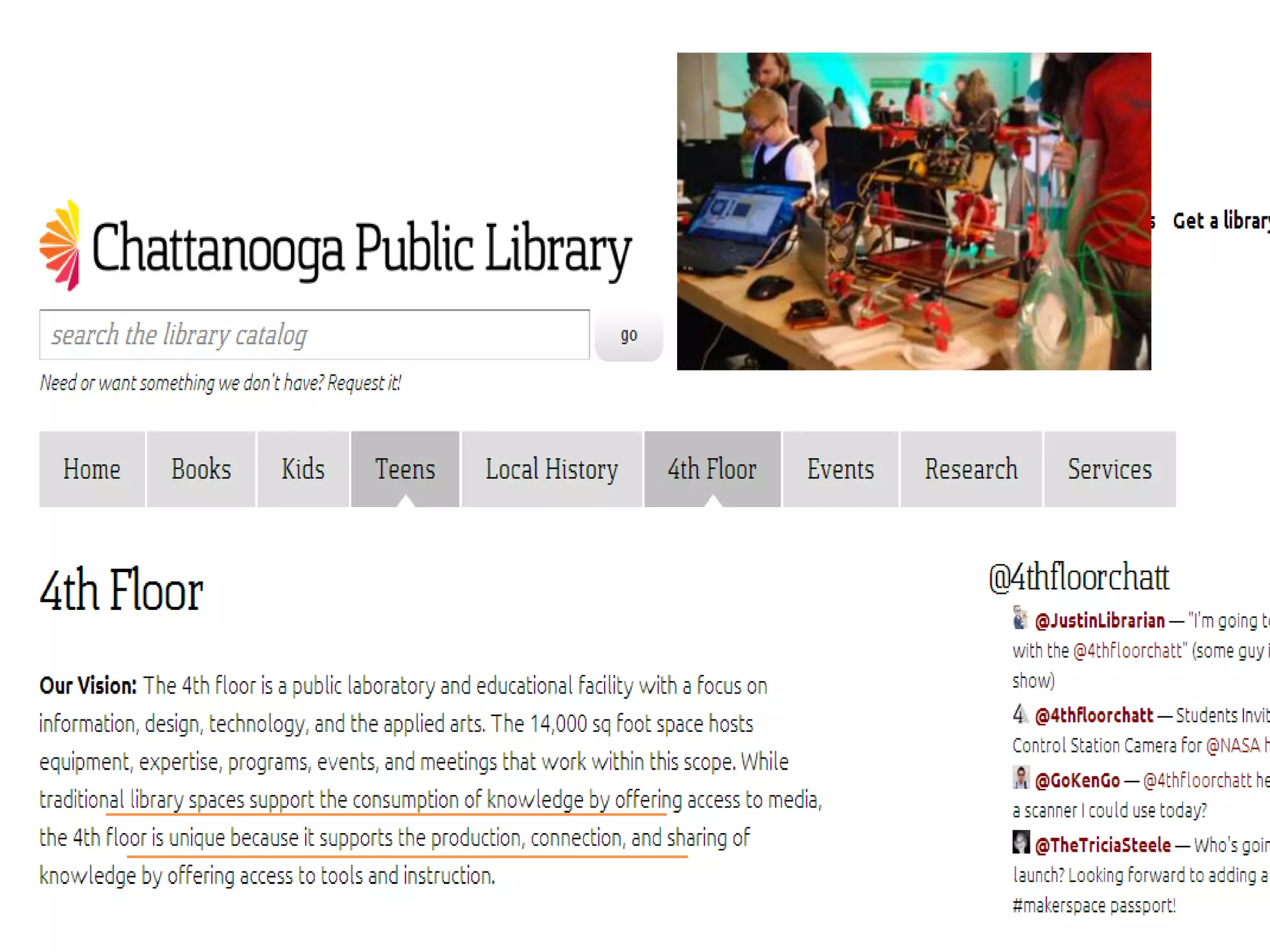
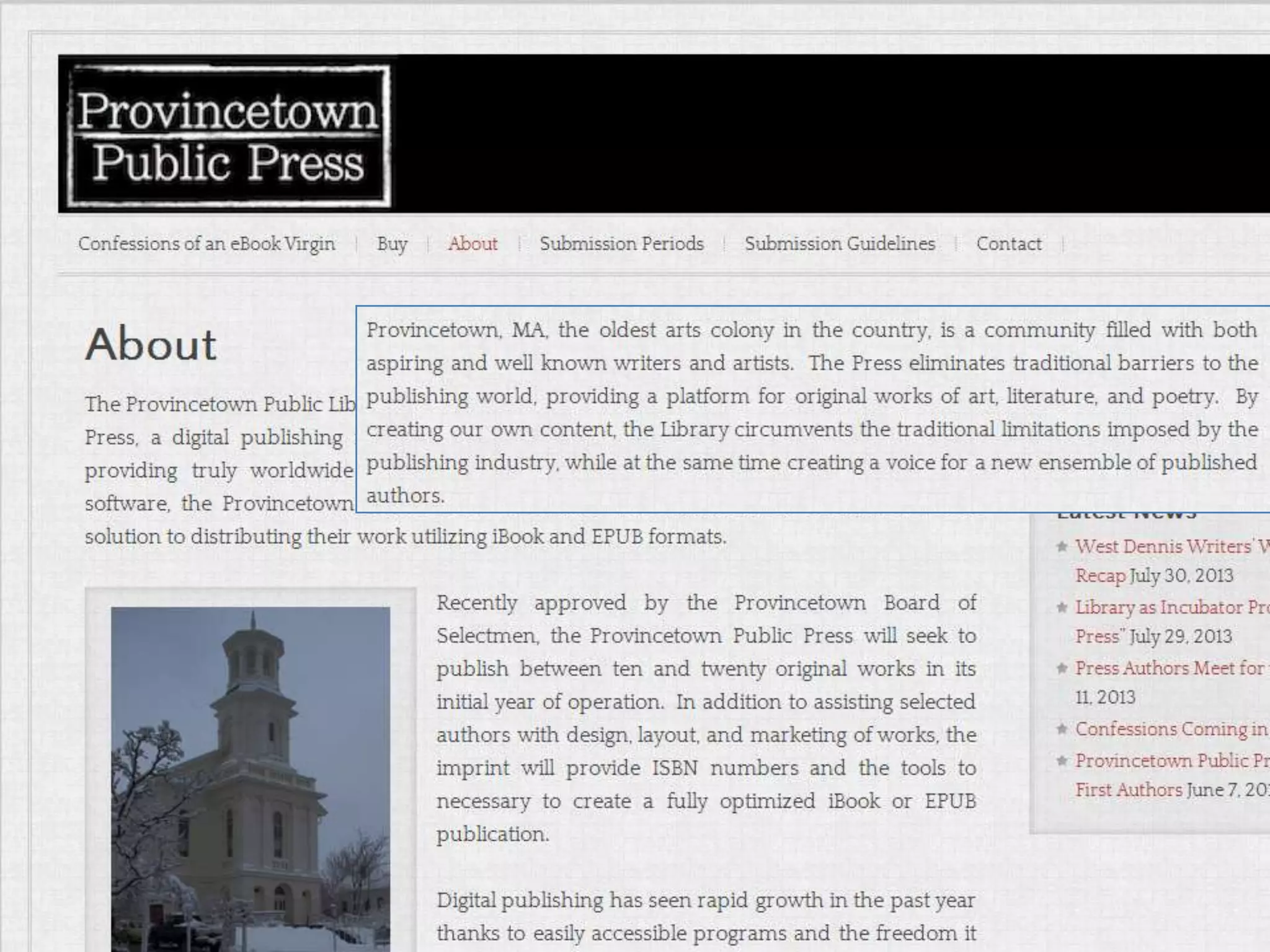
Publishing
Aim: to *have* discovered … to disclose
Collaboration with department around
community and learning resource
accessCeramics merges a traditional academic digital image collection's metadata capabilities
with Flickr's openness and flexibility. It seeks to take advantage of Flickr's software tools and
social network while also providing a web interface customized to this collection.
By Ardfern (Own work) [CC-BY-SA-3.0 (http://creativecommons.org/licenses/by-sa/3.0) via Wikimedia Commons

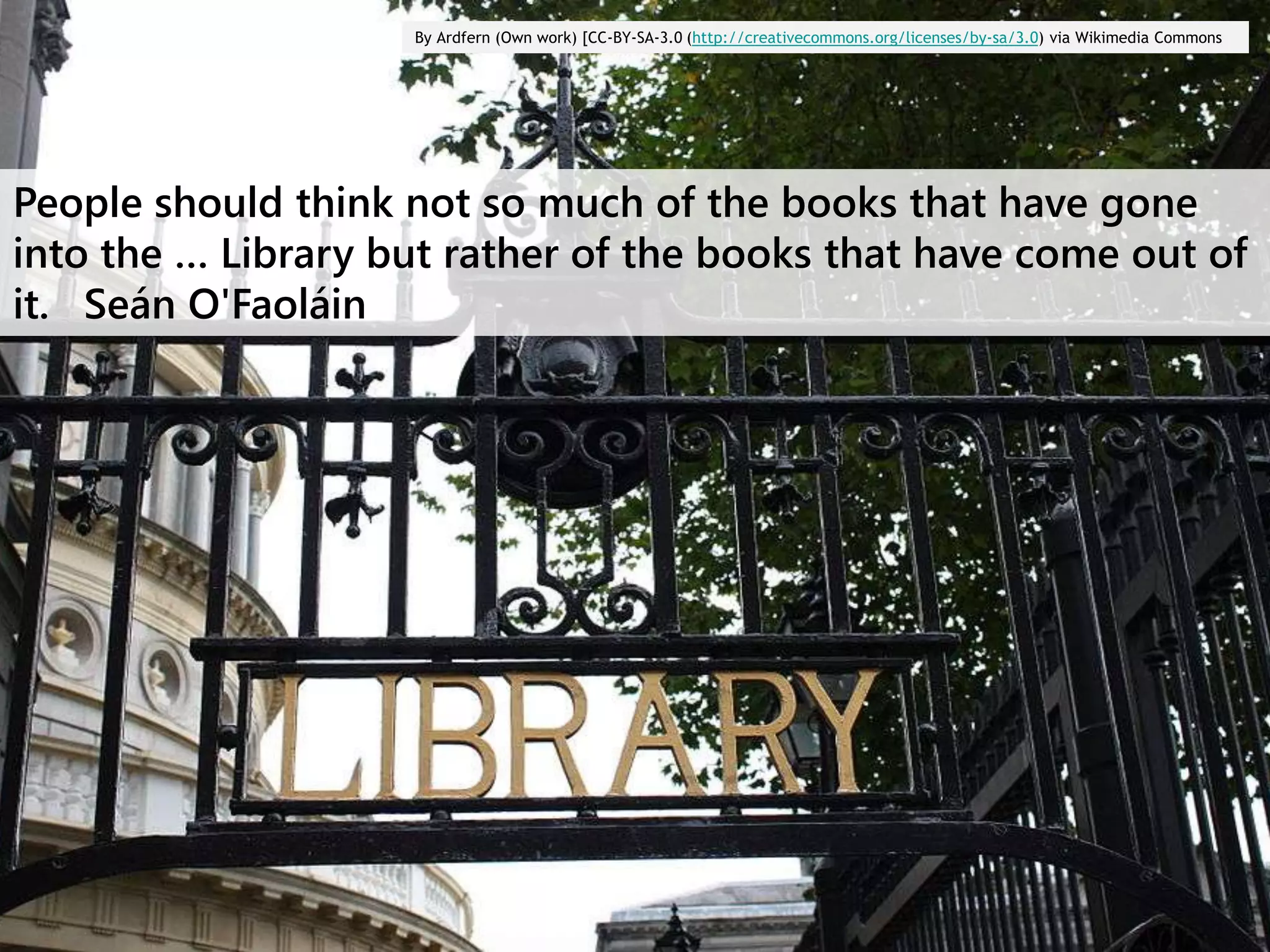
People should think not so much of the books that have gone
into the … Library but rather of the books that have come out of
it. Seán O'Faoláin
Space
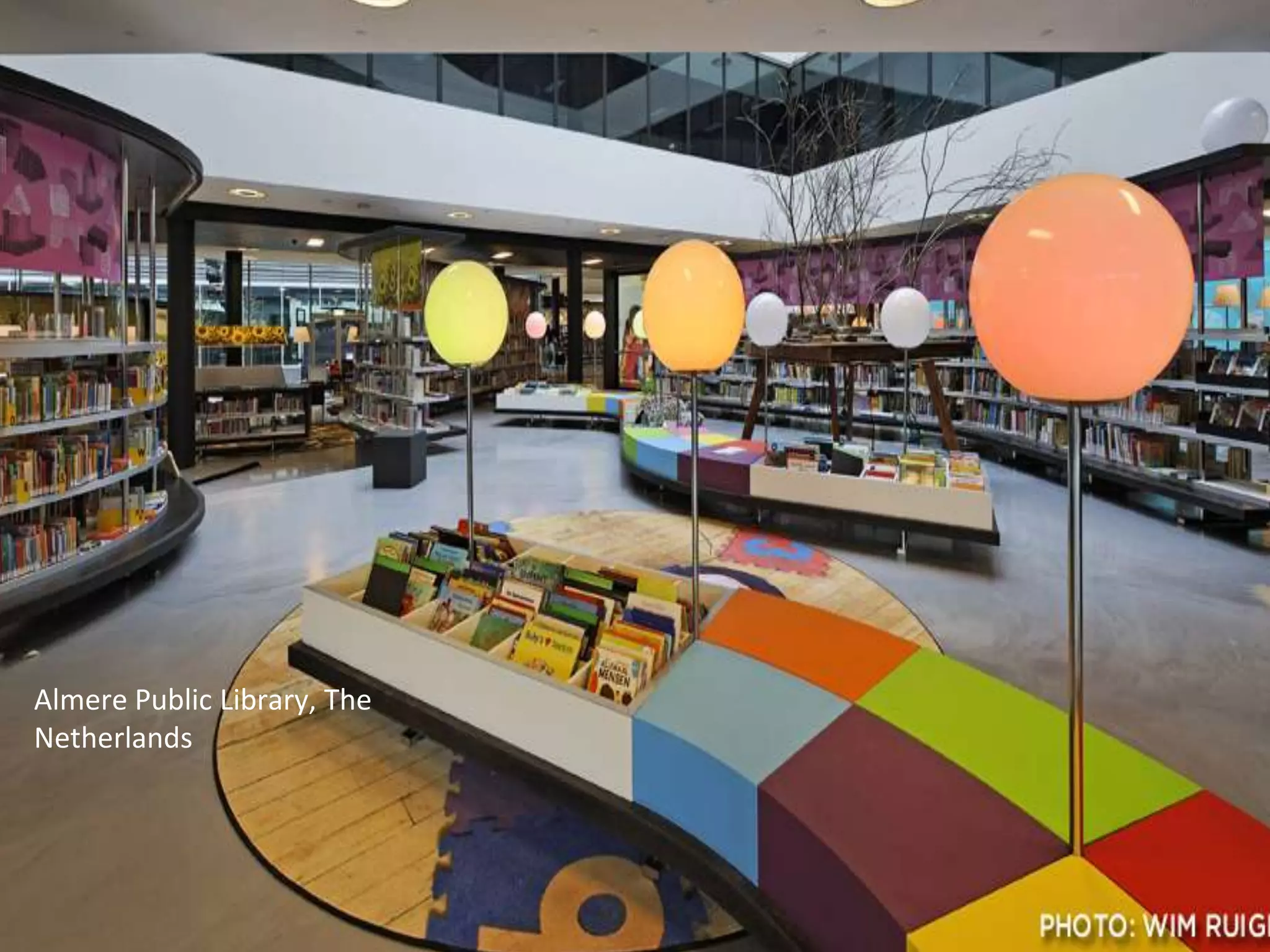
Then: space is configured around
collections
Now: space is configured around
experiences

59
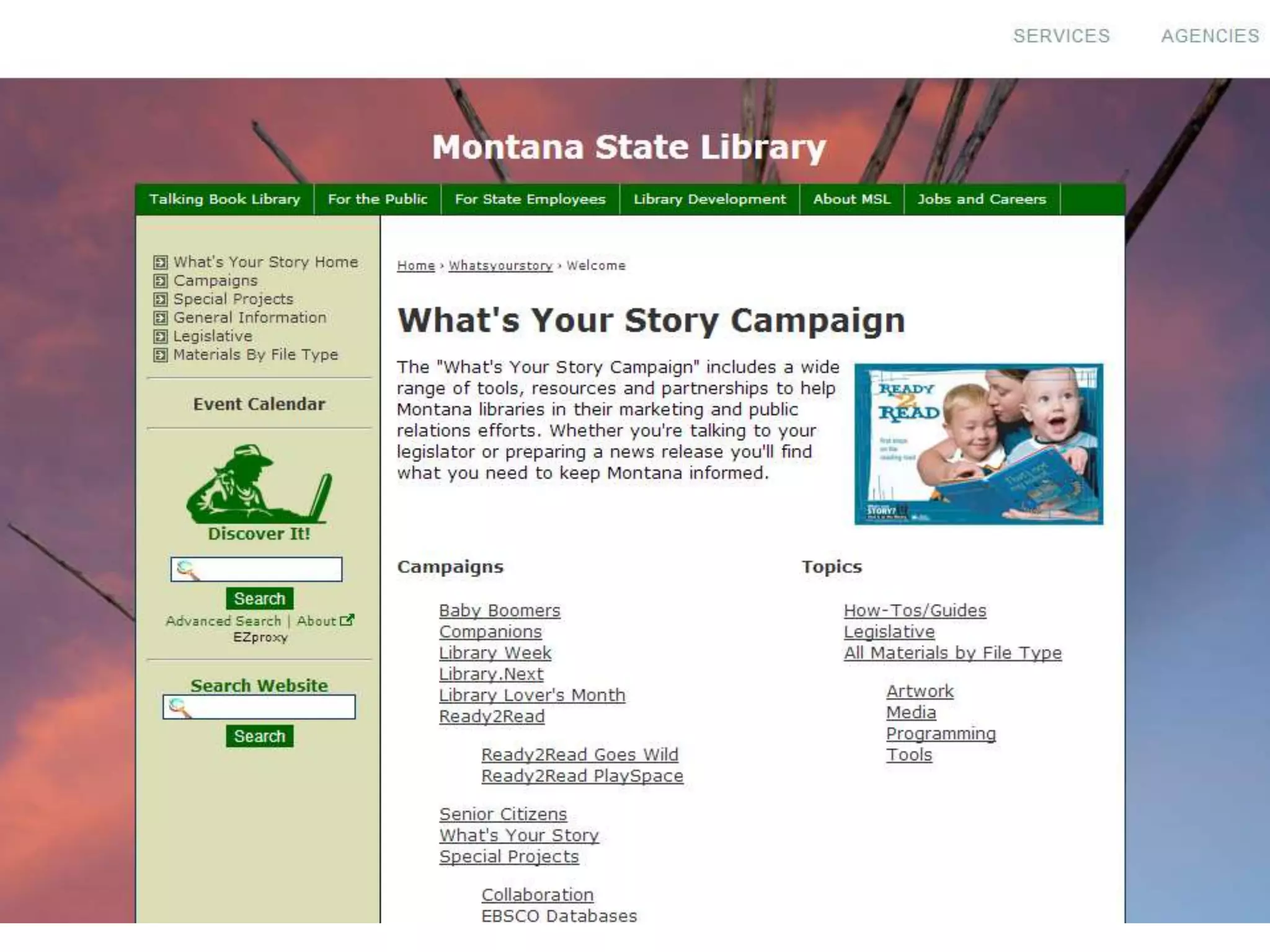
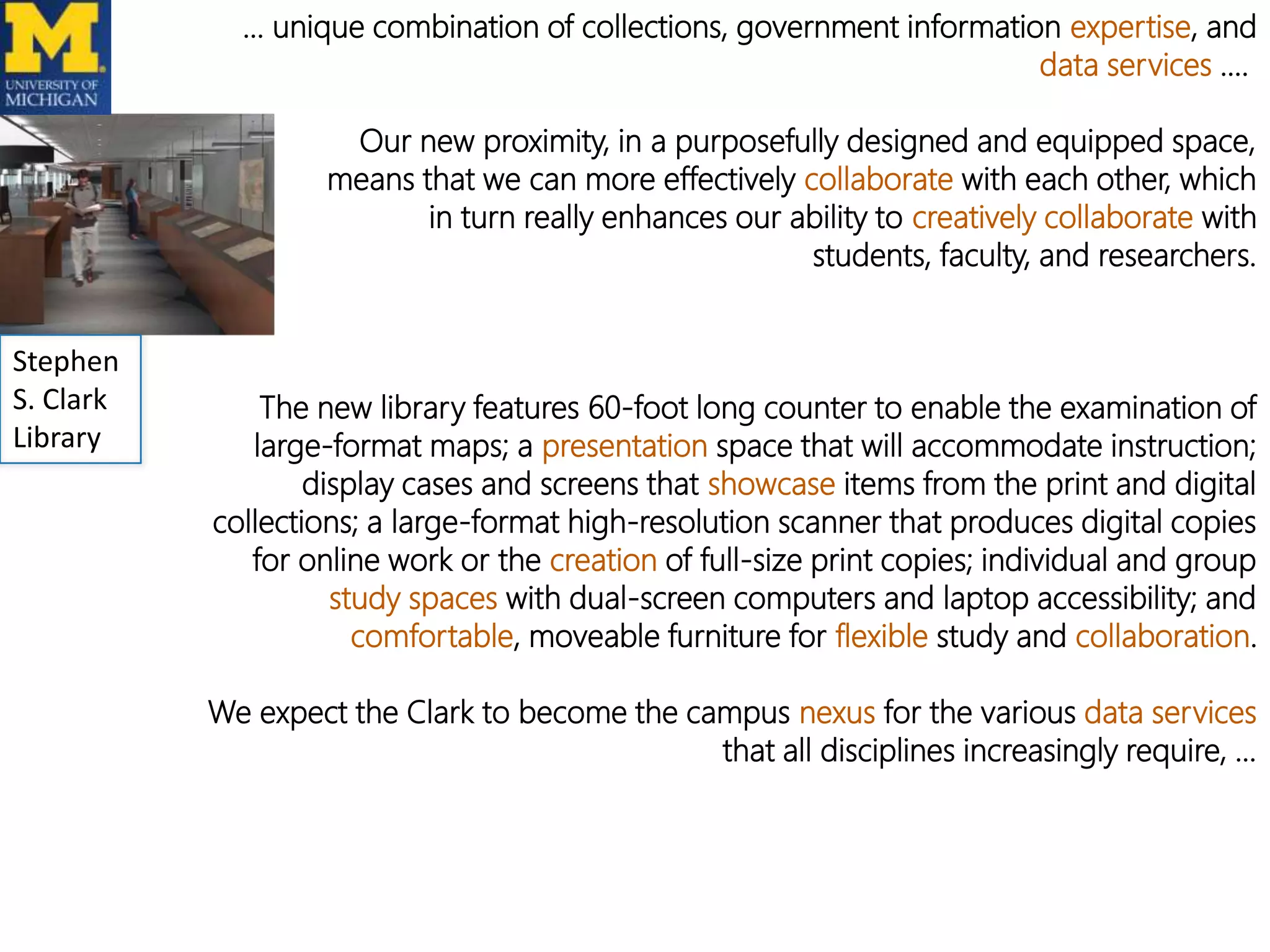
… unique combination of collections, government information expertise, and
data services ….
Our new proximity, in a purposefully designed and equipped space,
means that we can more effectively collaborate with each other, which
in turn really enhances our ability to creatively collaborate with
students, faculty, and researchers.
Stephen
S. Clark
Library

The new library features 60-foot long counter to enable the examination of
large-format maps; a presentation space that will accommodate instruction;
display cases and screens that showcase items from the print and digital
collections; a large-format high-resolution scanner that produces digital copies
for online work or the creation of full-size print copies; individual and group
study spaces with dual-screen computers and laptop accessibility; and
comfortable, moveable furniture for flexible study and collaboration.
We expect the Clark to become the campus nexus for the various data services
that all disciplines increasingly require, …
Almere Public Library, The
Netherlands

61
The decentered web presence
Then: discovery happened at the
library
Now: discovery happens elsewhere.
Focus on „discoverability‟ in multiple
environments.
62
Creating conversations
around collections:
Sleevefacing at
Bowling Green State Univ

http://blogs.bgsu.edu/librarysleevefacing/2012/08/15/bookends/
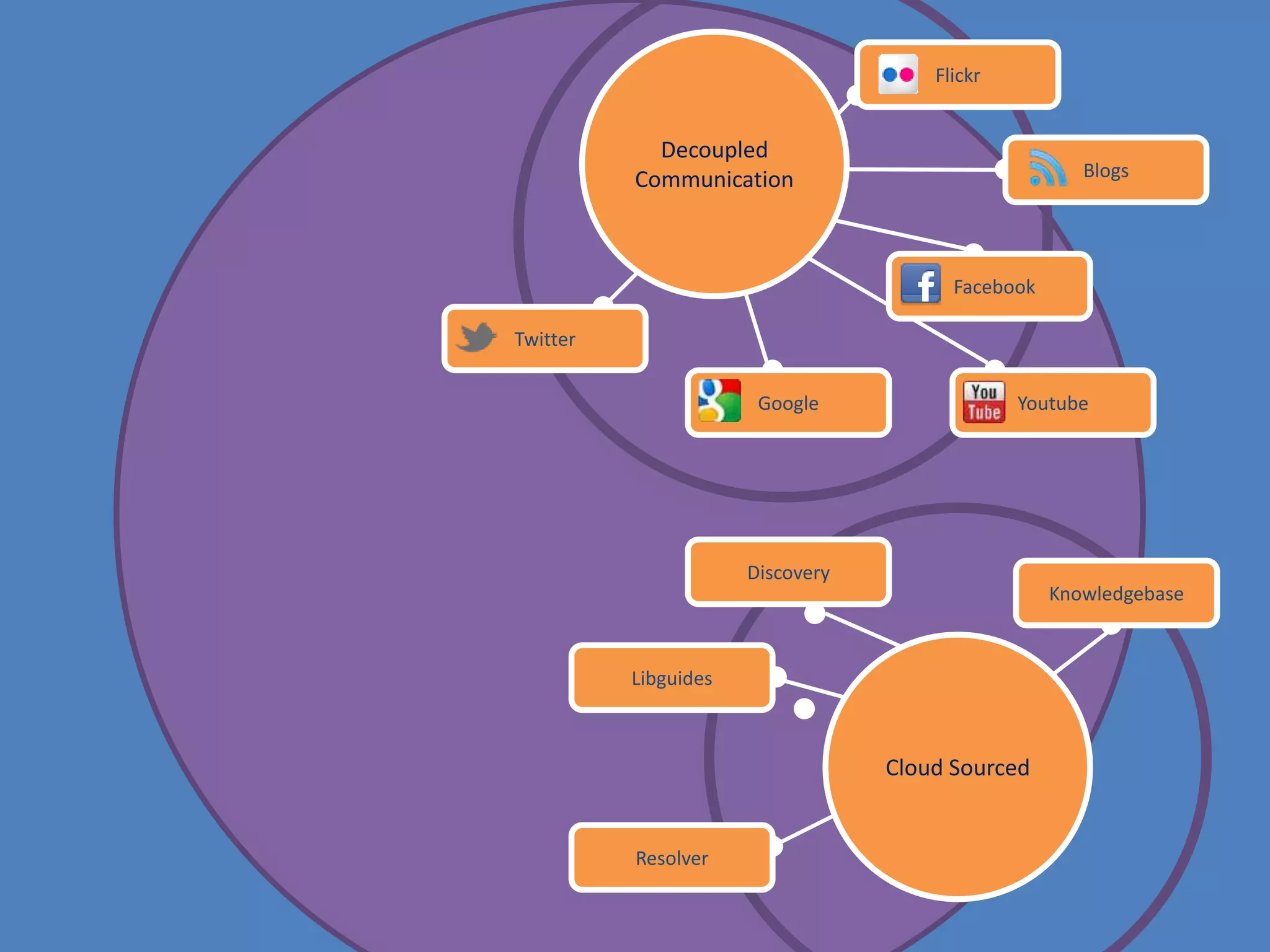
Flickr

Decoupled
Communication

Blogs

Facebook
Twitter
Google

Youtube

Discovery
Knowledgebase

Libguides

Cloud Sourced

Resolver
WorldCat
ArchivesGrid
Summon

Metadata
Scirus
Blogs
Suncat
Catalogue

RSS

Mobilepp

Ethos
Proxy Toolbar
OAI-PMH
(Dspace)

Linked Data
(Catalog)
Dspace
Discovery

Services
Proxy
Widgets

Library APIs
Z39.50

External
Syndication

Data
Jorum
Digital
Archive

Europeana
Venues
•
•
•
•
•

Wikipedia
Configure resolver in Scholar, Mendeley, etc
Claim library in OCLC Spotlight
Google Books (holdings up to date)
SEO – best practice for websites and repositories
Engagement
•
•
•
•

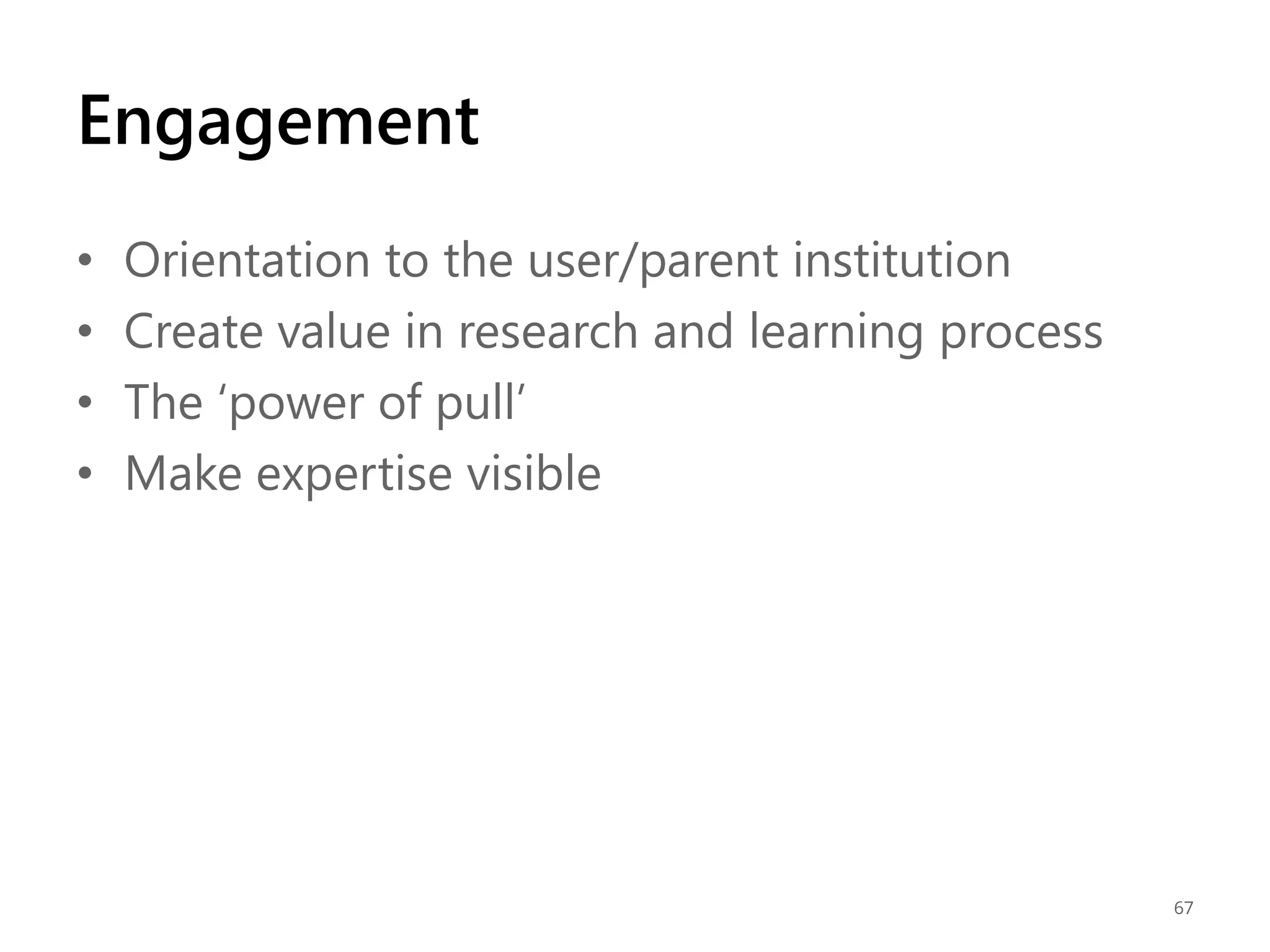
Orientation to the user/parent institution
Create value in research and learning process
The „power of pull‟
Make expertise visible

67
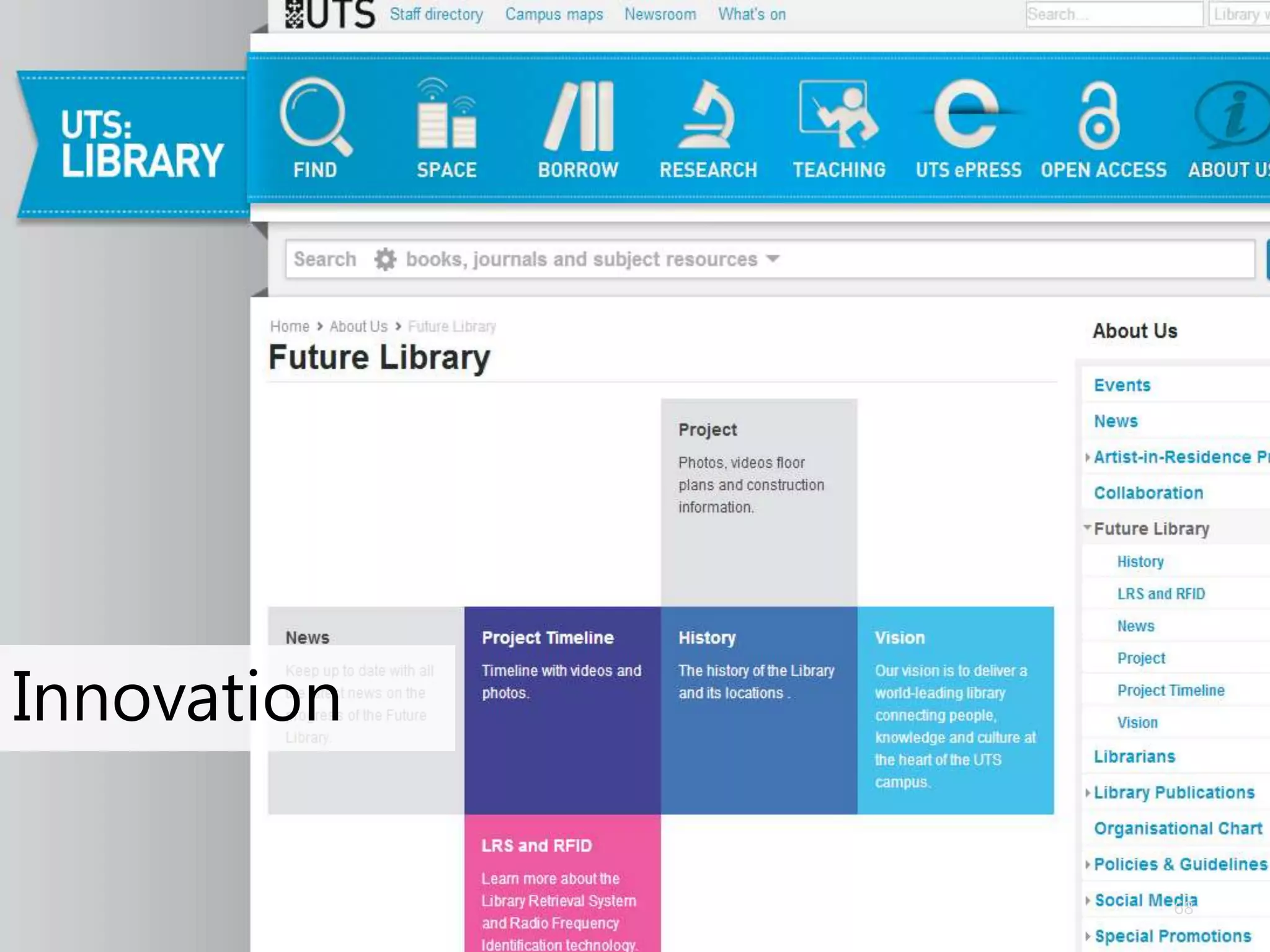
Innovation
68
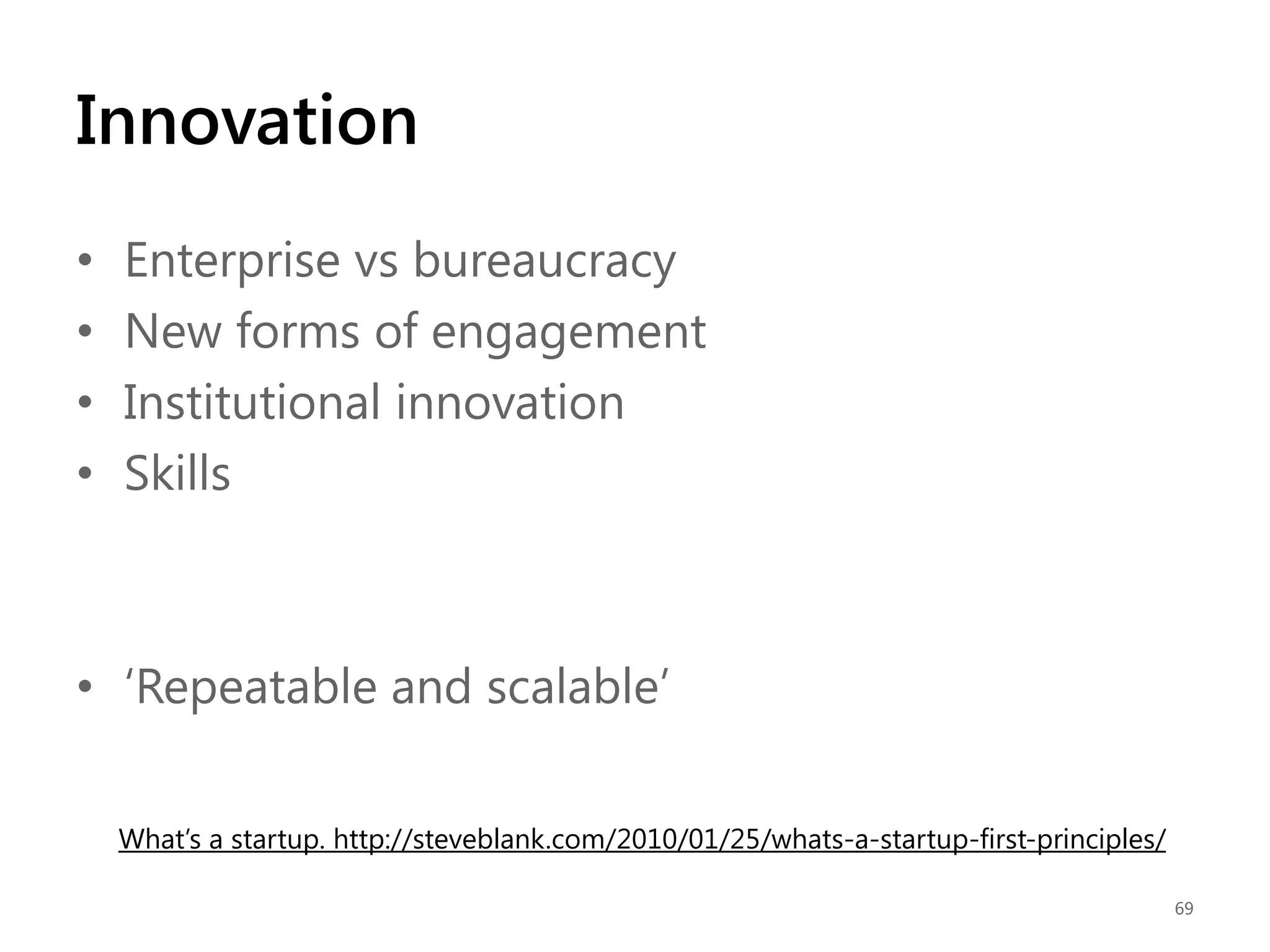
Innovation
•
•
•
•

Enterprise vs bureaucracy
New forms of engagement
Institutional innovation
Skills

• „Repeatable and scalable‟
What‟s a startup. http://steveblank.com/2010/01/25/whats-a-startup-first-principles/
69
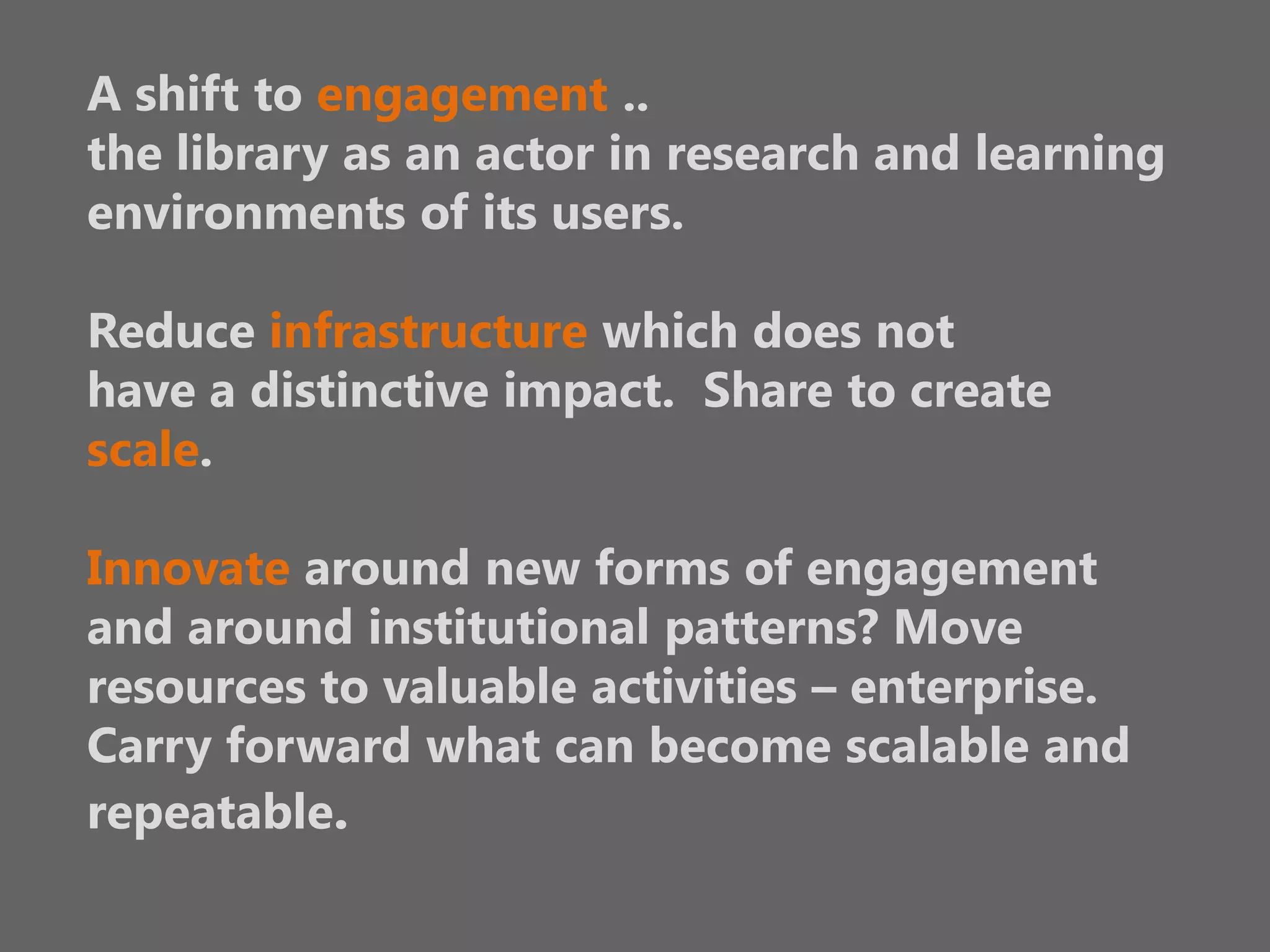
A shift to engagement ..
the library as an actor in research and learning
environments of its users.
Reduce infrastructure which does not
have a distinctive impact. Share to create
scale.
Innovate around new forms of engagement
and around institutional patterns? Move
resources to valuable activities – enterprise.
Carry forward what can become scalable and
repeatable.
A reset moment

The library should not provide an argument for a particular case, but
demonstrate that there is always another case to be made. The notion that
the library is a place that has no agenda other than allowing people to
invent their own agendas is what makes it an indispensable resource for
a democracy. It is where we can learn not just to be readers, but to be the
authors of our own destiny. Fintan O’Toole

Dublin City Public Libraries, Flickr: http://www.flickr.com/photos/dublincitypubliclibraries/6029467474/in/set-72157594513778442
Credits
• Constance Malpas for the
Worldcat data analysis
and text on slide 33.
• Chrystie Hill and Jennifer
Peterson for some
suggestions of library
examples.
• J.D. Shipengrover for the
decentered web presence
pics.

• Engagement, innovation,
and infrastructure
framework influenced by:
John Hagel and John
Seely Brown. “Unbundling
the corporation.” Harvard
Business Review, 77, 2.
January 1, 1999
@LorcanD
Lorcan Dempsey

©2013 OCLC. This work is licensed under a Creative Commons Attribution 3.0 Unported License. Suggested attribution:
“This work uses content from [presentation title] © OCLC, used under a Creative Commons Attribution license:
http://creativecommons.org/licenses/by/3.0/”

73

Infrastructure, engagement, innovation: library directions

  • 1.
    Scale, engagement, innovation: librarydirections @LorcanD Lorcan Dempsey, OCLC February 7-8 2014 Offline Conference, Montana Library Association Helena, Montana 1 http://njaegerhopcraft.blogspot.com/2011/10/dont-tell-anyone-how-great-helena-mt-is.html
  • 2.
    Prelude Montana in Library ofCongress http://www.loc.gov/item/2006629627/ 2
  • 3.
    Thomas Francis Meagher(1823-1867) 25 top collections … Total related works in WorldCat = 99 HATHITRUST DIGITAL LIBR MONTANA STATE UNIV BOZEMAN PUB LIBR UNIV OF MICHIGAN LIBR MICHIGAN STATE UNIV NEW YORK HISTL SOC LIBR PRINCETON UNIV CARROLL COL LIBR DUKE UNIV LIBR UCLA COLUMBIA UNIV BOSTON COL GREAT FALLS PUB LIBR AM.ANTIQUARIAN SOC UNIV OF MONTANA UNIV OF CHICAGO NATIONAL LIBR OF IRELAND HARVARD UNIV ALIBRIS UNIV OF NOTRE DAME NATIONAL LIBR OF AUSTRALIA BAKER & TAYLOR INC YALE UNIV LIBR LIBRARY OF CONGRESS MONTANA HIST SOC LIBR Montana libraries National libraries Vendors Digital 0% 5% 10% 15% 20% By Thorpfletcher (Own work) [CC-BY-SA-3.0 (http://creativecommons.org/licenses/by-sa/3.0)], via Wikimedia Commons 25%
  • 4.
  • 5.
  • 6.
    Montana in thecultural record Concepts Frontier and pioneer life Indians of North America Ranch life Dakota Indians Cowboys number of titles (avg. holdings) Form/genre 1,946 (41) 1,767 (23) 1,029 (101) 754 (49) 744 (52) People George A. Custer (1839-76) 1,529 (45) Janet Dailey (1944-2013) 196 (160) Ivan Doig (1939-) 155 (166) Tracie Peterson (1959-) 140 (156) Nicholas Evans (1950) 148 (131) History Biography Juvenile works 5,384 (23) 2,323 (35) 629 (124) Domestic fiction 270 (233) Events Battle of Little (1876) 3,544 (40) Bighorn Indian Wars (1876) 515 (60) By Thorpfletcher (Own work) [CC-BY-SA-3.0 (http://creativecommons.org/licenses/by-sa/3.0)], via Wikimedia Commons
  • 7.
    Wilderness areas Montana--Missoula Wilderness areas--Lawand legislation Rocky Mountains Region Ponderosa pine Montana--Lolo National Forest Montana--Flathead Indian Reservation Wild and scenic rivers--Law and legislation Mines and mineral resources-Environmental aspects Trout fishing Trout Montana--Gallatin County Biofilms Cutthroat trout United States--Yellowstone River Watershed Brown trout Fly fishing--Equipment and supplies Aquatic invertebrates Distinctive collection strengths By Lumpytrout (Own work) [CC-BY-SA-3.0 (http://creativecommons.org/licenses/by-sa/3.0)], via Wikimedia Commons
  • 8.
  • 9.
  • 10.
  • 11.
    The old advertisingmodel involved a captive 11 audience; a middle-man needed only to deliver content http://stratechery.com/2013/might-twitter-maximize-potential/
  • 12.
    On the Internet,those in the middle have to Experience? deliver superior content and also collect 12 superior targeting information http://stratechery.com/2013/might-twitter-maximize-potential/
  • 13.
  • 15.
    Network favors scale Platform– concentrates data, infrastructure, … Community/network forms around platform Network effects are central Social and analytics are central Gravitational hubs: the rich get richer Strong seo and referencability End user Social Analytics Management
  • 17.
    “Our job isto ensure that Microsoft thrives in a mobile and cloud-first world.” http://www.theverge.com/2014/2/4/5377318/microsoft-ceo-satya-nadella-first-letter-to-employees
  • 18.
  • 19.
    Attracting and buildingrelationships with researchers and learners “Service-oriented”, customization Economies of scope important Engagement Develop new services and have them accepted Speed/flexibility important Innovation Infrastructure Back office capacities that support day-to-day operations “Routinized” workflows Economies of scale important Note: Hagel et al talk about customer relationship management rather than engagement
  • 20.
  • 21.
  • 22.
    Focus? • Strategy isabout choices … • Reconnect with parent’s goals … • Where is distinctive local impact? • • • • Enrich student experience Improve research effectiveness and impact Promote civic engagement Equip citizens with learning skills and tools • What should be done collaboratively? • What should be done by others?
  • 23.
  • 24.
    Shift to engagement …the library as an effective actor in the research, learning and skills environments of its users Rightscale infrastructure … rebalance investment in collections and systems between local, shared and third party to improve impact and efficiency. Collaboration moves from margin to core. Innovate – scalable and repeatable … institutions and services need to evolve in sustainable ways. 24
  • 25.
  • 26.
  • 27.
  • 28.
    „Cloud‟ storage (OhioState) Rightscale infrastructure / http://library.osu.edu/blogs/cartoons/2012/02/28/blog-launch-and-the-construction-of-our-new-home-in-sullivant-hall
  • 29.
    Examples • Negotiation andlicensing • Library systems infrastructure • Digital infrastructure • Processing capacity • Shared print – Managing down local print – Evolving shared approaches. 29
  • 32.
    Do locally whatcreates most distinctive value. Share what makes sense for efficiency and impact. Buy the rest.
  • 33.
    Shared print Then: Valuerelates to depth and breadth of local collection. Now: Value relates to systemwide curation of and access to print collections. 33
  • 34.
    Digital and systemsinfrastructure Then: Local build or control. Now: Look to scale for efficiency and impact. 34
  • 35.
    Collaborative sourcing – cooperationmoves from the margins 35
  • 36.
    “aggregate and scaletowards a common infrastructure”
  • 37.
    “ Colleges and universitieshave long competed against one another, measuring themselves in comparison to each other and holding tightly to their idiosyncrasies as defining elements of their status. But today, the distribution and reuse of information digitally via the Internet is rapidly changing the game, rewarding those who instead aggregate and scale toward a common infrastructure. It is becoming increasingly clear that neither the challenges that confront colleges and universities nor the solutions to those challenges are unique to each institution. Chuck Henry and Brad Wheeler The game has changed Educause Review, March 2012
  • 38.
    Institutional > State/Consortium> Region/national > global Collaboratively source or buy from third party Control vs economy A new institutional context: agreed mutual dependence on shared/remote services
  • 39.
  • 40.
  • 41.
  • 42.
    Examples of engagement •Visible expertise: the power of pull • Getting a life job done: community, career, learning, health • Beyond cur-sumption: directly supporting creation • Reconfigured space: configure around experiences not collections • Decentered web presence: in the flow 42
  • 43.
    Visible expertise Then: Invisibleand neutral. Now: If the library wishes to be seen as expert, then its expertise must be seen. 43
  • 44.
  • 45.
    Slide from PatLosinski, CEO Columbus Metropolitan Library
  • 46.
  • 47.
  • 48.
    Transformation of theacademic library Kurt de Belder http://www.oclc.org/content/dam/research/events/dss/ppt/dss_debelder.pptx 48
  • 49.
    Skills to geta life job done Then: Provide access to information Now: Provide information and resources to get a life job done. 49
  • 50.
  • 51.
    Job Services EmploymentCommission Family Resource Center Life Long Learning Action Group
  • 53.
    From curation/consumption to creation/curation/consumption Then:Acquire external resources Now: Engage with creation, use and sharing of all information resources. 53
  • 54.
    Outside in Bought,licensed Increased consolidation Move from print to licensed Manage down print – shared print Move to user-driven models Aim: to discover The Inside out Library Institutional assets: special collections, research and learning materials, institutional records, community resources, … Reputation management Increasingly important? Publishing Aim: to *have* discovered … to disclose
  • 55.
    Collaboration with departmentaround community and learning resource accessCeramics merges a traditional academic digital image collection's metadata capabilities with Flickr's openness and flexibility. It seeks to take advantage of Flickr's software tools and social network while also providing a web interface customized to this collection.
  • 58.
    By Ardfern (Ownwork) [CC-BY-SA-3.0 (http://creativecommons.org/licenses/by-sa/3.0) via Wikimedia Commons People should think not so much of the books that have gone into the … Library but rather of the books that have come out of it. Seán O'Faoláin
  • 59.
    Space Then: space isconfigured around collections Now: space is configured around experiences 59
  • 60.
    … unique combinationof collections, government information expertise, and data services …. Our new proximity, in a purposefully designed and equipped space, means that we can more effectively collaborate with each other, which in turn really enhances our ability to creatively collaborate with students, faculty, and researchers. Stephen S. Clark Library The new library features 60-foot long counter to enable the examination of large-format maps; a presentation space that will accommodate instruction; display cases and screens that showcase items from the print and digital collections; a large-format high-resolution scanner that produces digital copies for online work or the creation of full-size print copies; individual and group study spaces with dual-screen computers and laptop accessibility; and comfortable, moveable furniture for flexible study and collaboration. We expect the Clark to become the campus nexus for the various data services that all disciplines increasingly require, …
  • 61.
    Almere Public Library,The Netherlands 61
  • 62.
    The decentered webpresence Then: discovery happened at the library Now: discovery happens elsewhere. Focus on „discoverability‟ in multiple environments. 62
  • 63.
    Creating conversations around collections: Sleevefacingat Bowling Green State Univ http://blogs.bgsu.edu/librarysleevefacing/2012/08/15/bookends/
  • 64.
  • 65.
  • 66.
    Venues • • • • • Wikipedia Configure resolver inScholar, Mendeley, etc Claim library in OCLC Spotlight Google Books (holdings up to date) SEO – best practice for websites and repositories
  • 67.
    Engagement • • • • Orientation to theuser/parent institution Create value in research and learning process The „power of pull‟ Make expertise visible 67
  • 68.
  • 69.
    Innovation • • • • Enterprise vs bureaucracy Newforms of engagement Institutional innovation Skills • „Repeatable and scalable‟ What‟s a startup. http://steveblank.com/2010/01/25/whats-a-startup-first-principles/ 69
  • 70.
    A shift toengagement .. the library as an actor in research and learning environments of its users. Reduce infrastructure which does not have a distinctive impact. Share to create scale. Innovate around new forms of engagement and around institutional patterns? Move resources to valuable activities – enterprise. Carry forward what can become scalable and repeatable.
  • 71.
    A reset moment Thelibrary should not provide an argument for a particular case, but demonstrate that there is always another case to be made. The notion that the library is a place that has no agenda other than allowing people to invent their own agendas is what makes it an indispensable resource for a democracy. It is where we can learn not just to be readers, but to be the authors of our own destiny. Fintan O’Toole Dublin City Public Libraries, Flickr: http://www.flickr.com/photos/dublincitypubliclibraries/6029467474/in/set-72157594513778442
  • 72.
    Credits • Constance Malpasfor the Worldcat data analysis and text on slide 33. • Chrystie Hill and Jennifer Peterson for some suggestions of library examples. • J.D. Shipengrover for the decentered web presence pics. • Engagement, innovation, and infrastructure framework influenced by: John Hagel and John Seely Brown. “Unbundling the corporation.” Harvard Business Review, 77, 2. January 1, 1999
  • 73.
    @LorcanD Lorcan Dempsey ©2013 OCLC.This work is licensed under a Creative Commons Attribution 3.0 Unported License. Suggested attribution: “This work uses content from [presentation title] © OCLC, used under a Creative Commons Attribution license: http://creativecommons.org/licenses/by/3.0/” 73

Editor's Notes

  • #4 Irish rebel, stint in prison in Australia, first governor of Montana Identity is visible/present in global library system – his strong regional ties are reflected in holdings in Montana libraries
  • #7 I.e. fictional accounts of ranch life have a dominant influence on Montana’s presence First count is a measure of the volume of literature produced; second count is a proxy for impact or popularity (degree to which libraries have acquired the content) – so one could make the point that the literature related to frontier life in Montana is sizeable (>1900 titles) but that other topics (like Cowboys) have greater ‘presence’ in libraries.Authors listed under People are mostly popular fiction – Dailey is a romance novelist; Peterson is a ‘Christian’ novelist, Evans (who is English) is author of The Horse Whisperer and other novels set in Montana; Doig is a native Montanan and the most ‘serious’ of the bunch with something of a literary careerRe: Idaho….Montana originally part of Idaho territory
  • #8 Topics for which these institutional collections are especially strong/sizeable – distinctive, complementary character? Strong environmental focus in each place