ERROR MANAGEMENT

 There are three steps in error
   management:
  Prevention of errors;

  Detection of errors; and

  Rectification of errors.
TYPES OF ERRORS

   Errors of Omission
   Errors of Commission
   Errors of Principle
   Compensating Errors
PREVENTION OF ERRORS
   Two principal reasons
    unintentional errors:
        (i) Ignorance
        (ii) Carelessness
   Development of internal control
    system
DETECTION OF ERRORS…
   Classification of errors
     (a) Two-sided errors:
          Errors which do not affect the
          agreement of Trial Balance
     (b) One-sided errors: Errors which
         affect the agreement of Trial
         Balance
DETECTION OF ERRORS…
   Types of Trial Balance:
        (i) Trial Balance
        (ii) Adjusted Trial Balance
        (iii) Post Trial Balance
   Locate errors
Rectification
          on the basis of
          types of errors:

   Rectification of two-sided
    errors.

   Rectification of one-sided
    errors.
Rectification of two-sided errors

These errors do not affect the
 agreement of Trial Balance and are
 rectified by passing journal entries
 which are known as Rectification
 Entries. Thus, Rectification entries
 are entries passed to correct the
 errors committed and set right the
 accounting records.
Rectification of one-sided errors
   These errors which affect the
    agreement of Trial Balance, e.g.
    undercasting/overcasting, non-
    inclusion of an account, wrong
    posting, etc. These errors can be
    corrected by entering the correct
    amount in the affected
    account/place.
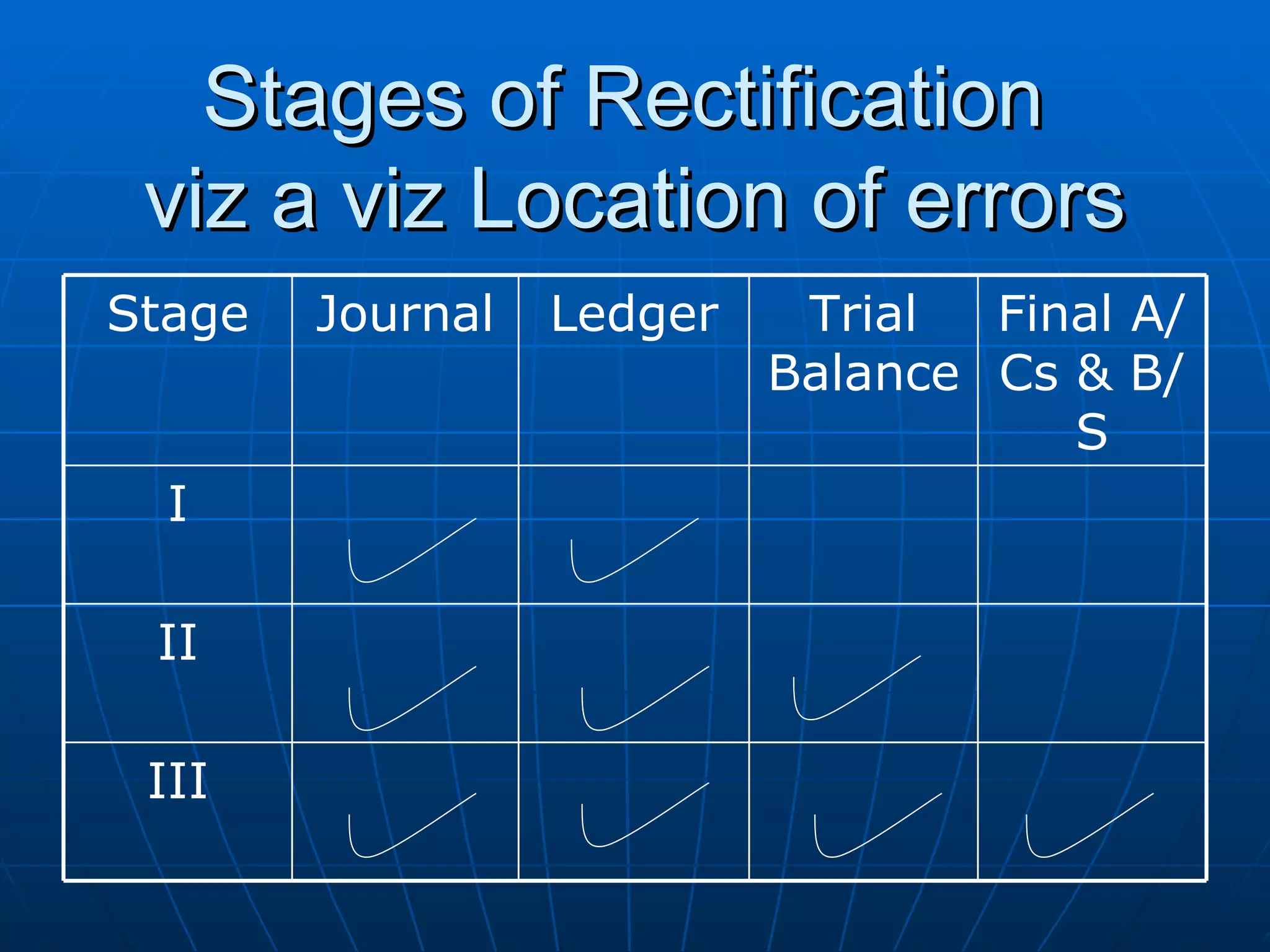
Stages of Rectification
 viz a viz Location of errors
Stage   Journal   Ledger    Trial  Final A/
                           Balance Cs & B/
                                      S
  I

 II

 III
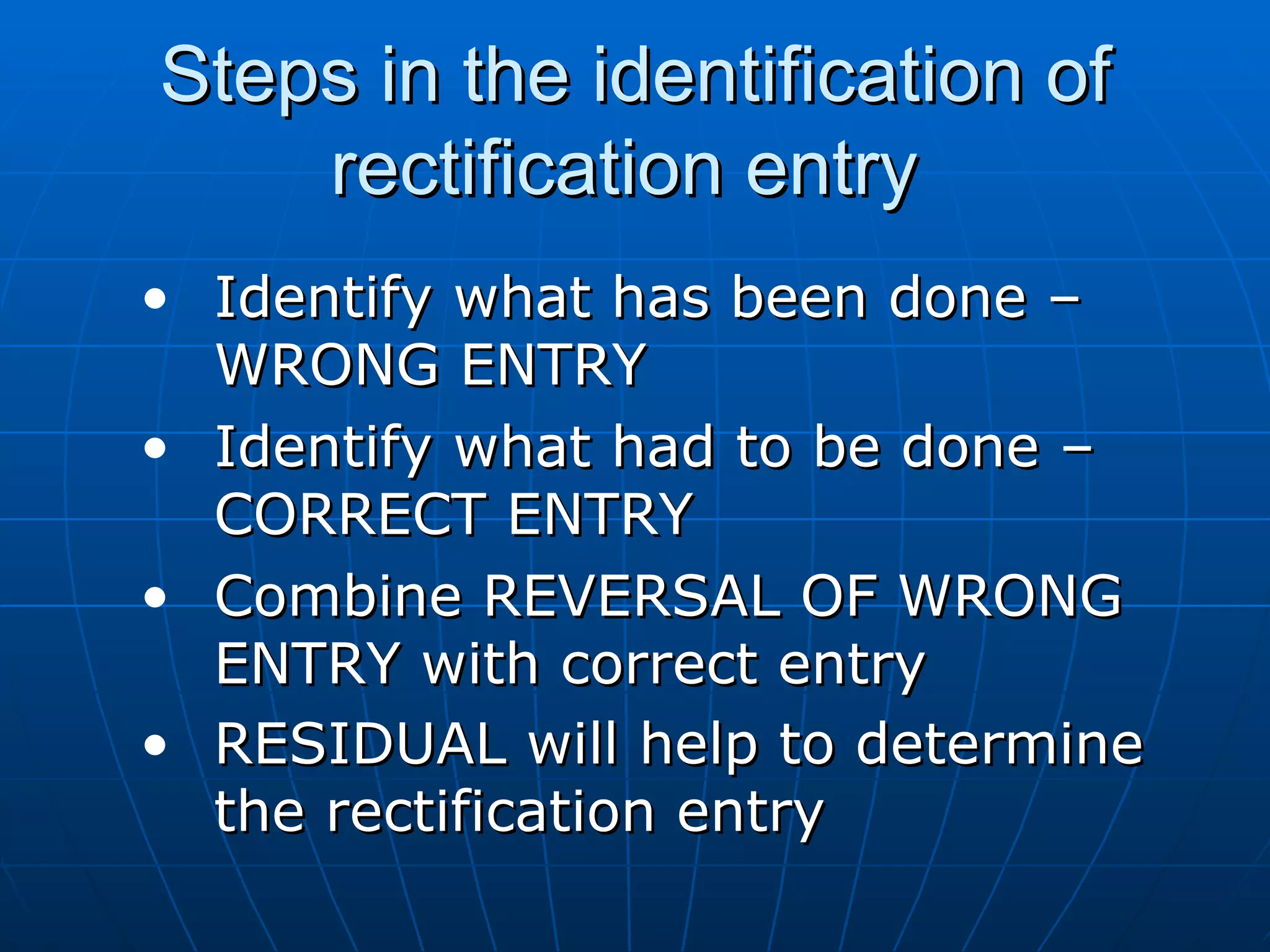
Steps in the identification of
    rectification entry
• Identify what has been done –
  WRONG ENTRY
• Identify what had to be done –
  CORRECT ENTRY
• Combine REVERSAL OF WRONG
  ENTRY with correct entry
• RESIDUAL will help to determine
  the rectification entry
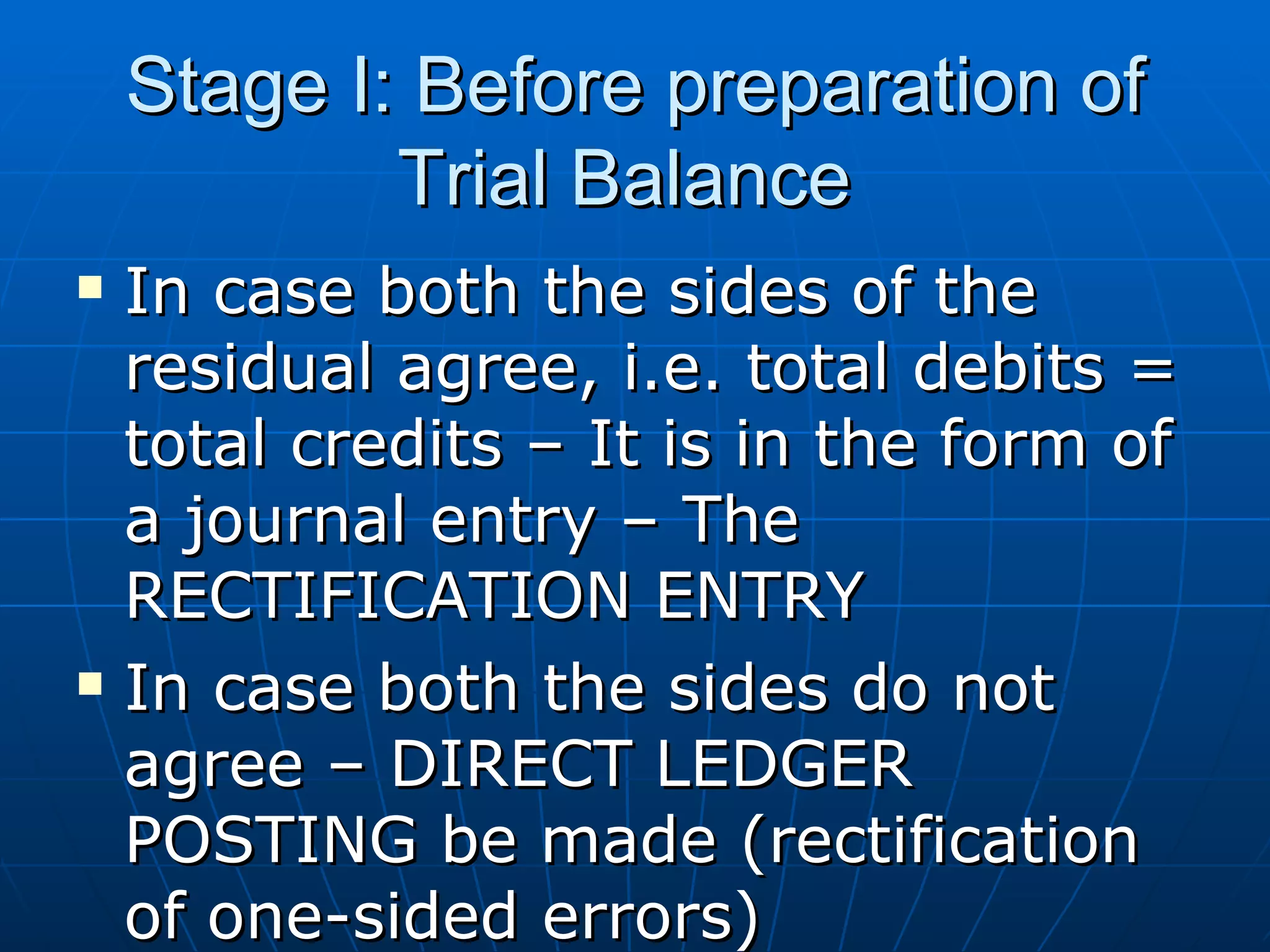
Stage I: Before preparation of
            Trial Balance
   In case both the sides of the
    residual agree, i.e. total debits =
    total credits – It is in the form of
    a journal entry – The
    RECTIFICATION ENTRY
   In case both the sides do not
    agree – DIRECT LEDGER
    POSTING be made (rectification
    of one-sided errors)
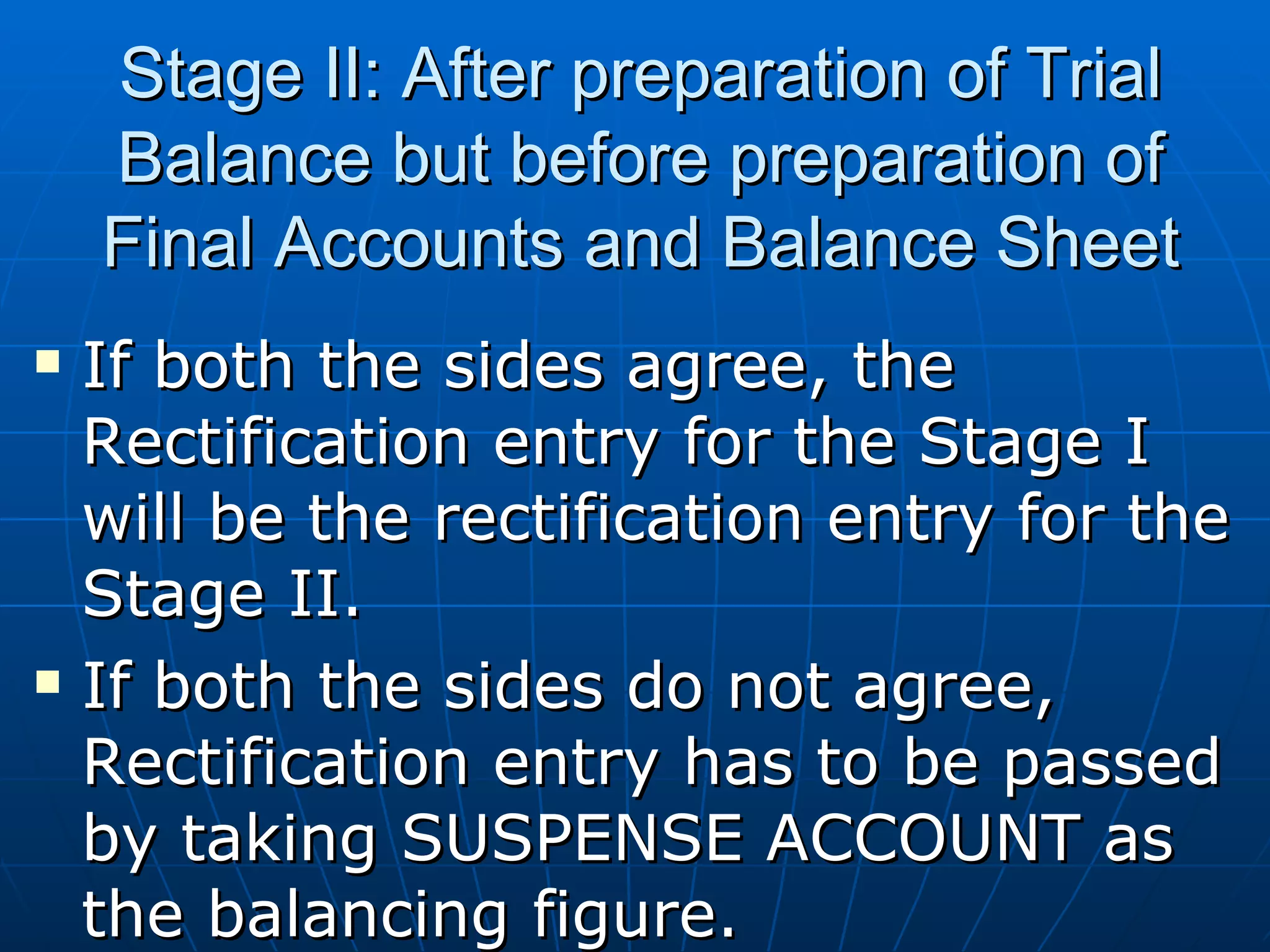
Stage II: After preparation of Trial
    Balance but before preparation of
    Final Accounts and Balance Sheet
   If both the sides agree, the
    Rectification entry for the Stage I
    will be the rectification entry for the
    Stage II.
   If both the sides do not agree,
    Rectification entry has to be passed
    by taking SUSPENSE ACCOUNT as
    the balancing figure.
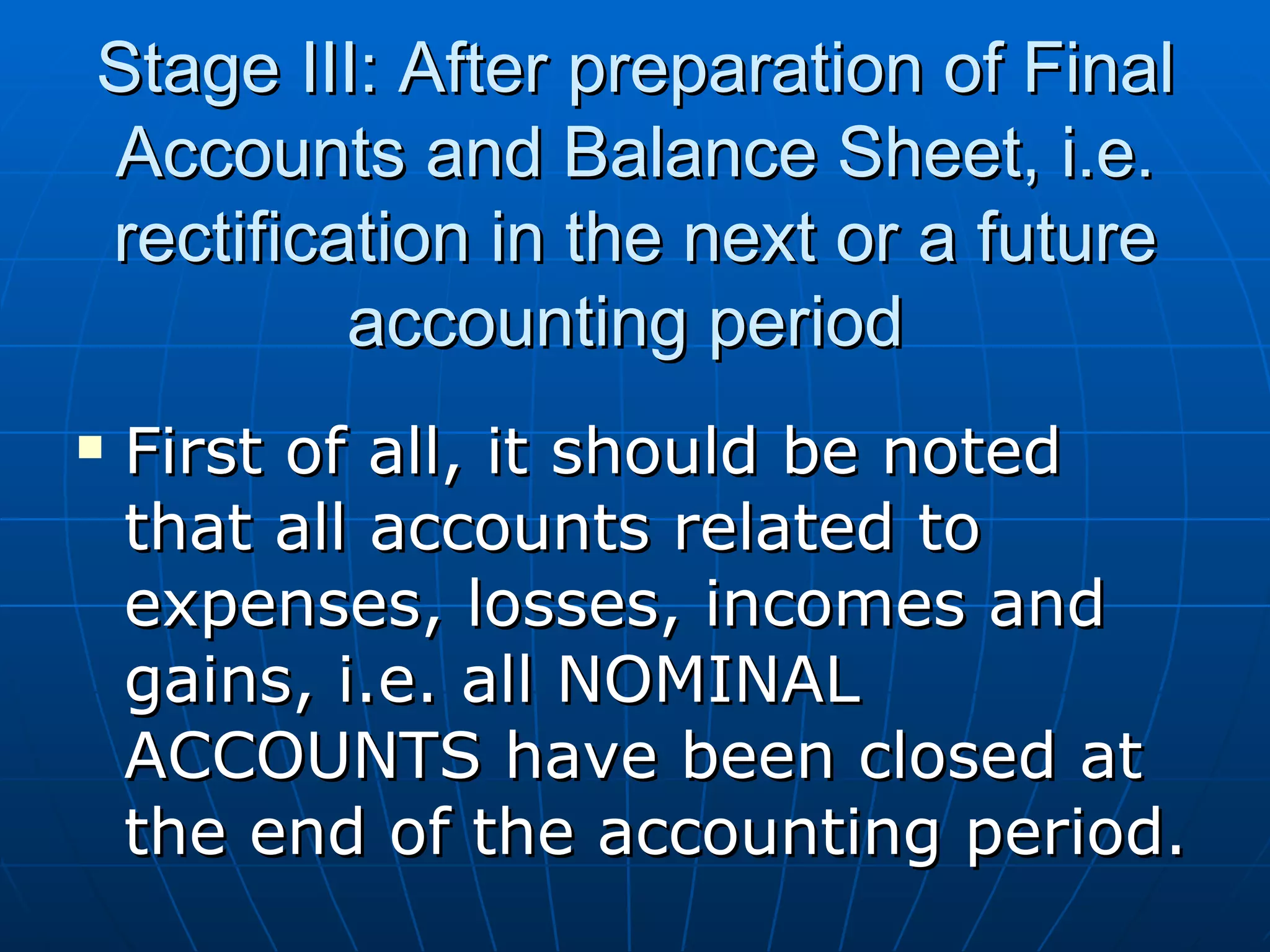
Stage III: After preparation of Final
Accounts and Balance Sheet, i.e.
rectification in the next or a future
         accounting period
   First of all, it should be noted
    that all accounts related to
    expenses, losses, incomes and
    gains, i.e. all NOMINAL
    ACCOUNTS have been closed at
    the end of the accounting period.
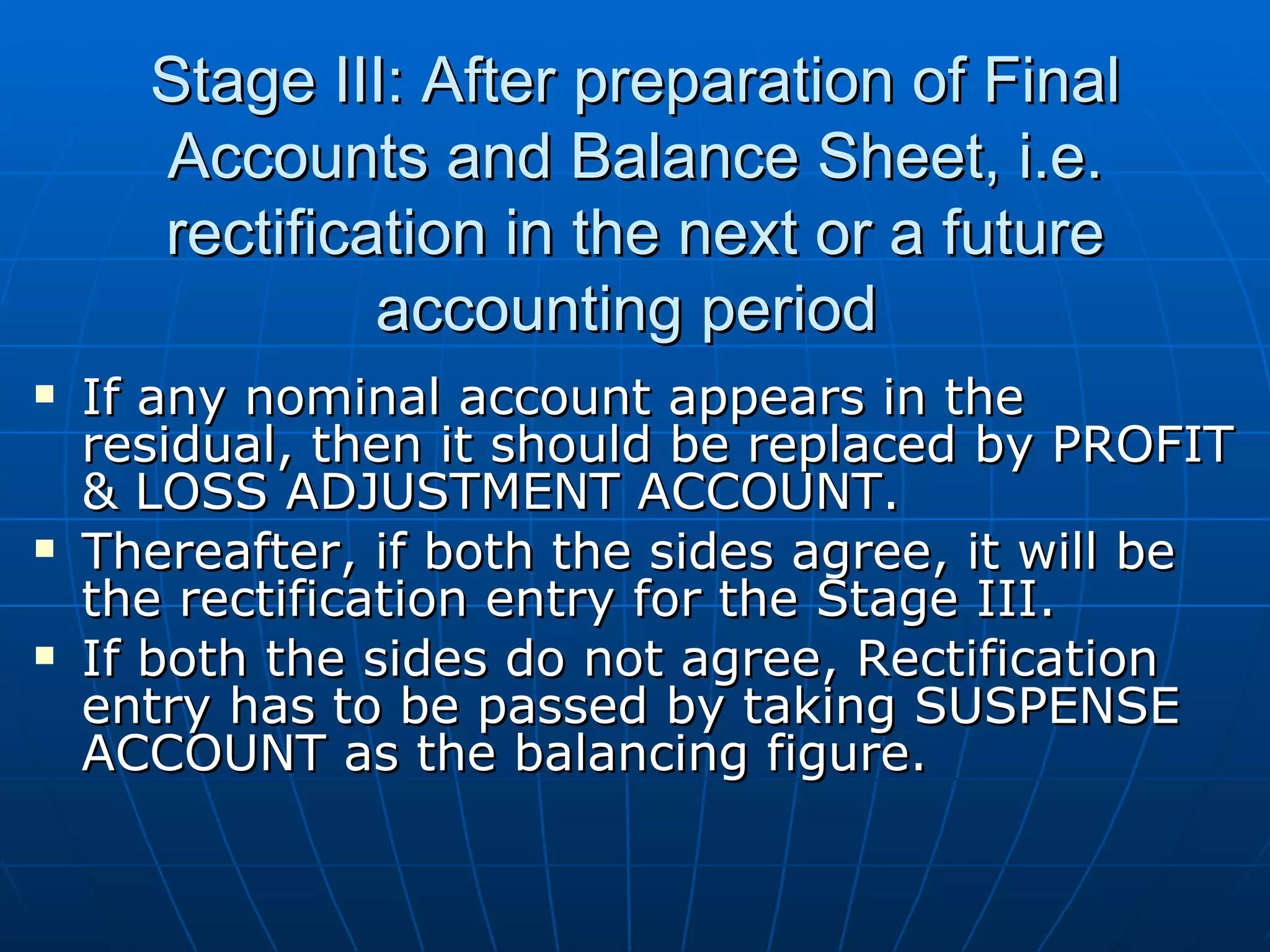
Stage III: After preparation of Final
      Accounts and Balance Sheet, i.e.
      rectification in the next or a future
               accounting period
   If any nominal account appears in the
    residual, then it should be replaced by PROFIT
    & LOSS ADJUSTMENT ACCOUNT.
   Thereafter, if both the sides agree, it will be
    the rectification entry for the Stage III.
   If both the sides do not agree, Rectification
    entry has to be passed by taking SUSPENSE
    ACCOUNT as the balancing figure.
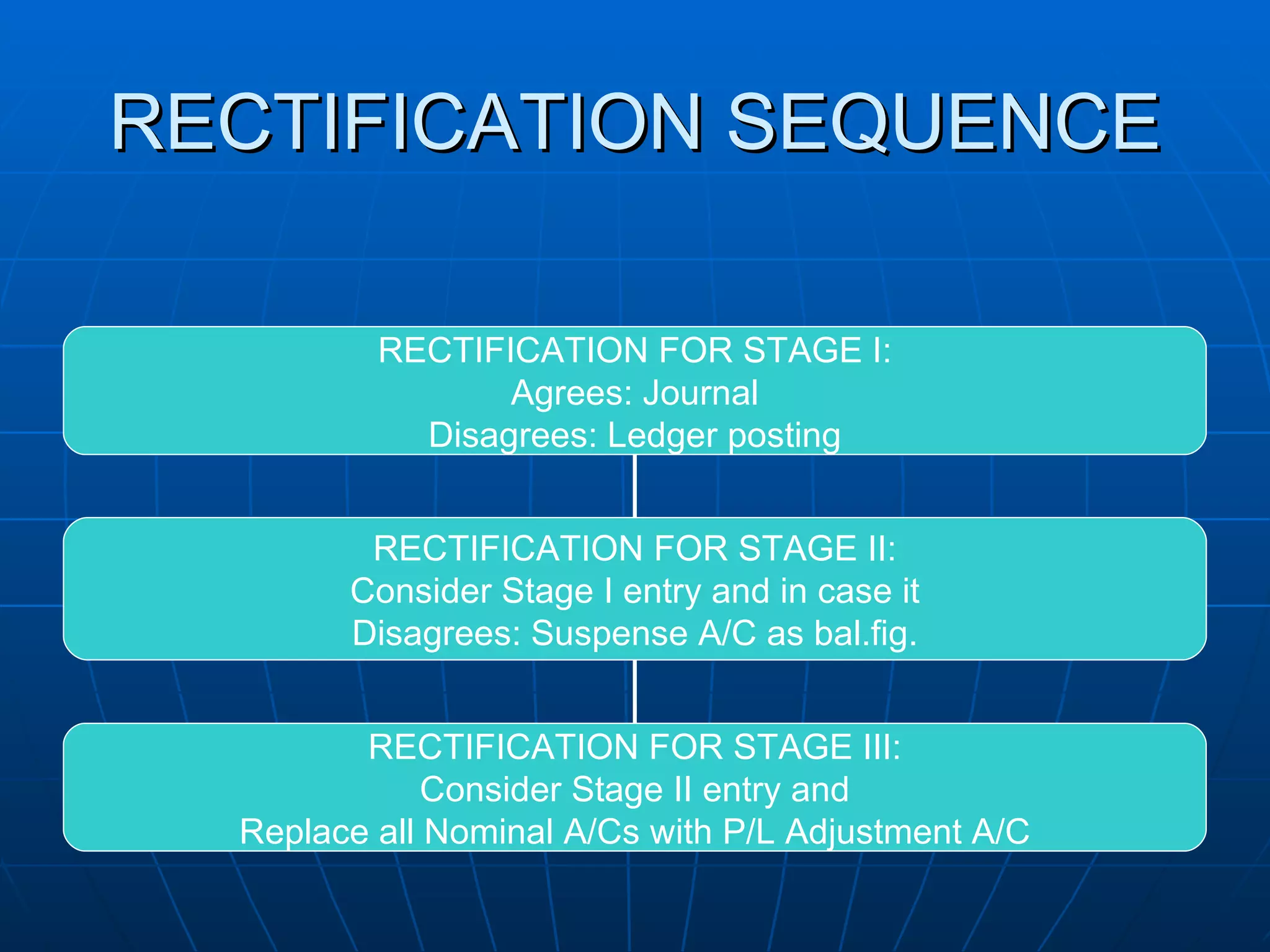
RECTIFICATION SEQUENCE

          RECTIFICATION FOR STAGE I:
                 Agrees: Journal
            Disagrees: Ledger posting


         RECTIFICATION FOR STAGE II:
        Consider Stage I entry and in case it
        Disagrees: Suspense A/C as bal.fig.


         RECTIFICATION FOR STAGE III:
              Consider Stage II entry and
  Replace all Nominal A/Cs with P/L Adjustment A/C
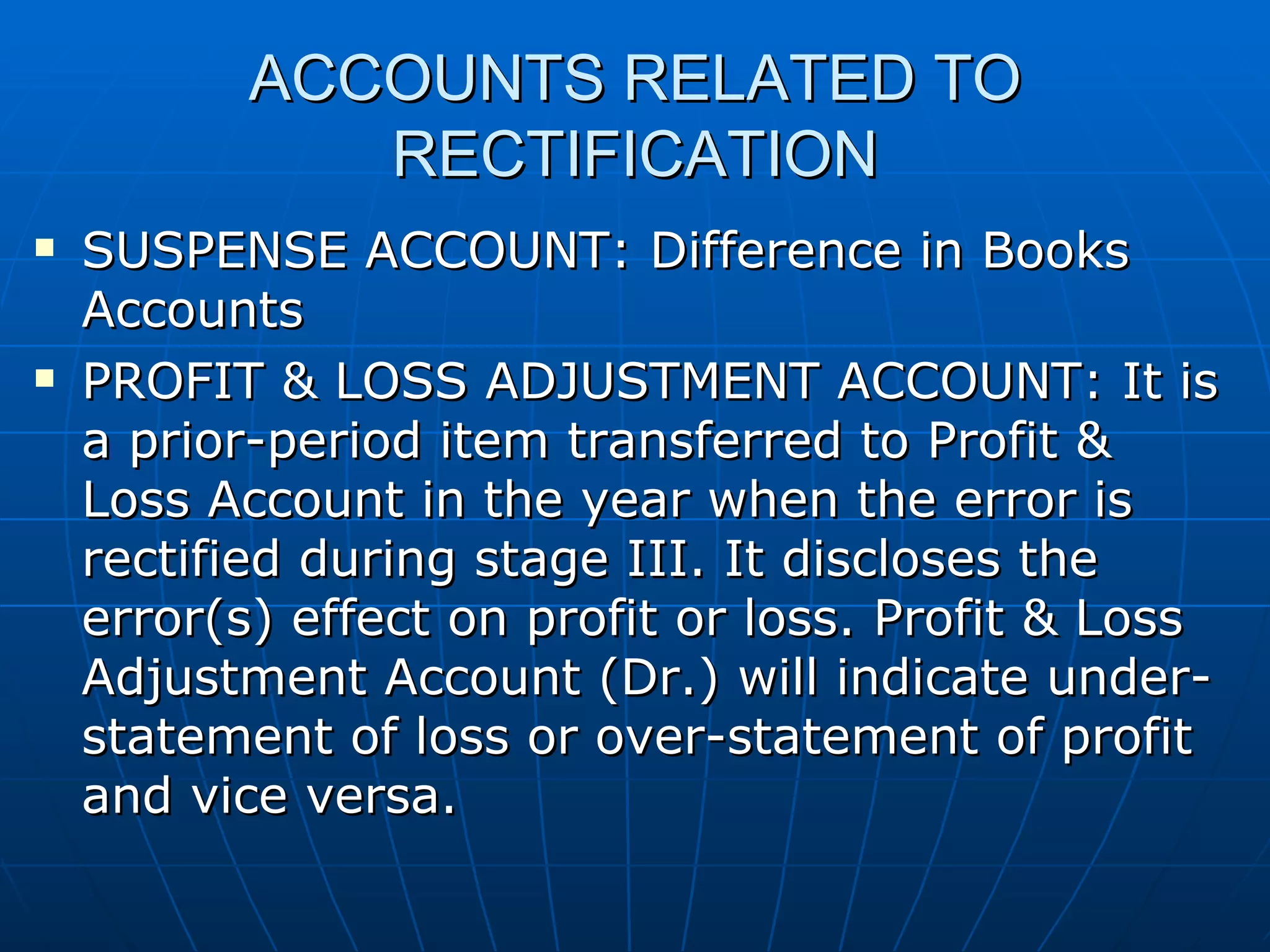
ACCOUNTS RELATED TO
              RECTIFICATION
   SUSPENSE ACCOUNT: Difference in Books
    Accounts
   PROFIT & LOSS ADJUSTMENT ACCOUNT: It is
    a prior-period item transferred to Profit &
    Loss Account in the year when the error is
    rectified during stage III. It discloses the
    error(s) effect on profit or loss. Profit & Loss
    Adjustment Account (Dr.) will indicate under-
    statement of loss or over-statement of profit
    and vice versa.
ATTENTION COMMERCE
      STUDENTS
    ACCOUNTING(FINANCIAL & COST) OF
  ICMAP STAGE 1,2,3,4 (CRASH CLASSES)
             CA..MODULE A,B,C,D
PIPFA (FOUNDATION,INTERMEDIATE,FINAL)
                ACCA-F1,F2,F3
                  BBA,MBA
            B.COM(FRESH),M.COM
         MA-ECONOMICS..O/A LEVELS
         KHALID AZIZ…..0322-3385752
            KARACHI, PAKISTAN.
http://finance.groups.yahoo.com/group/cost-
                 accountants

Error management

  • 1.
    ERROR MANAGEMENT Thereare three steps in error management:  Prevention of errors;  Detection of errors; and  Rectification of errors.
  • 2.
    TYPES OF ERRORS  Errors of Omission  Errors of Commission  Errors of Principle  Compensating Errors
  • 3.
    PREVENTION OF ERRORS  Two principal reasons unintentional errors: (i) Ignorance (ii) Carelessness  Development of internal control system
  • 4.
    DETECTION OF ERRORS…  Classification of errors (a) Two-sided errors: Errors which do not affect the agreement of Trial Balance (b) One-sided errors: Errors which affect the agreement of Trial Balance
  • 5.
    DETECTION OF ERRORS…  Types of Trial Balance: (i) Trial Balance (ii) Adjusted Trial Balance (iii) Post Trial Balance  Locate errors
  • 6.
    Rectification on the basis of types of errors:  Rectification of two-sided errors.  Rectification of one-sided errors.
  • 7.
    Rectification of two-sidederrors These errors do not affect the agreement of Trial Balance and are rectified by passing journal entries which are known as Rectification Entries. Thus, Rectification entries are entries passed to correct the errors committed and set right the accounting records.
  • 8.
    Rectification of one-sidederrors  These errors which affect the agreement of Trial Balance, e.g. undercasting/overcasting, non- inclusion of an account, wrong posting, etc. These errors can be corrected by entering the correct amount in the affected account/place.
  • 9.
    Stages of Rectification viz a viz Location of errors Stage Journal Ledger Trial Final A/ Balance Cs & B/ S I II III
  • 10.
    Steps in theidentification of rectification entry • Identify what has been done – WRONG ENTRY • Identify what had to be done – CORRECT ENTRY • Combine REVERSAL OF WRONG ENTRY with correct entry • RESIDUAL will help to determine the rectification entry
  • 11.
    Stage I: Beforepreparation of Trial Balance  In case both the sides of the residual agree, i.e. total debits = total credits – It is in the form of a journal entry – The RECTIFICATION ENTRY  In case both the sides do not agree – DIRECT LEDGER POSTING be made (rectification of one-sided errors)
  • 12.
    Stage II: Afterpreparation of Trial Balance but before preparation of Final Accounts and Balance Sheet  If both the sides agree, the Rectification entry for the Stage I will be the rectification entry for the Stage II.  If both the sides do not agree, Rectification entry has to be passed by taking SUSPENSE ACCOUNT as the balancing figure.
  • 13.
    Stage III: Afterpreparation of Final Accounts and Balance Sheet, i.e. rectification in the next or a future accounting period  First of all, it should be noted that all accounts related to expenses, losses, incomes and gains, i.e. all NOMINAL ACCOUNTS have been closed at the end of the accounting period.
  • 14.
    Stage III: Afterpreparation of Final Accounts and Balance Sheet, i.e. rectification in the next or a future accounting period  If any nominal account appears in the residual, then it should be replaced by PROFIT & LOSS ADJUSTMENT ACCOUNT.  Thereafter, if both the sides agree, it will be the rectification entry for the Stage III.  If both the sides do not agree, Rectification entry has to be passed by taking SUSPENSE ACCOUNT as the balancing figure.
  • 15.
    RECTIFICATION SEQUENCE RECTIFICATION FOR STAGE I: Agrees: Journal Disagrees: Ledger posting RECTIFICATION FOR STAGE II: Consider Stage I entry and in case it Disagrees: Suspense A/C as bal.fig. RECTIFICATION FOR STAGE III: Consider Stage II entry and Replace all Nominal A/Cs with P/L Adjustment A/C
  • 16.
    ACCOUNTS RELATED TO RECTIFICATION  SUSPENSE ACCOUNT: Difference in Books Accounts  PROFIT & LOSS ADJUSTMENT ACCOUNT: It is a prior-period item transferred to Profit & Loss Account in the year when the error is rectified during stage III. It discloses the error(s) effect on profit or loss. Profit & Loss Adjustment Account (Dr.) will indicate under- statement of loss or over-statement of profit and vice versa.
  • 17.
    ATTENTION COMMERCE STUDENTS ACCOUNTING(FINANCIAL & COST) OF ICMAP STAGE 1,2,3,4 (CRASH CLASSES) CA..MODULE A,B,C,D PIPFA (FOUNDATION,INTERMEDIATE,FINAL) ACCA-F1,F2,F3 BBA,MBA B.COM(FRESH),M.COM MA-ECONOMICS..O/A LEVELS KHALID AZIZ…..0322-3385752 KARACHI, PAKISTAN. http://finance.groups.yahoo.com/group/cost- accountants