Publishing Ada
A Retrospective Look at the First Three Years
of an Open Peer Review Multi-modal Journal
Karen Estlund, kestlund@uoregon.edu
Sarah Hamid, shamid@uoregon.edu
Bryce Peake, bpeake@uoregon.edu
http://adanewmedia.org
Outline
• Review Goals from 2011/12 - Karen
• What we learned: Open Access, open peer review, multimodal
• Production Lessons - Sarah
• Assessment - Bryce
• Cost / labor estimates - Karen
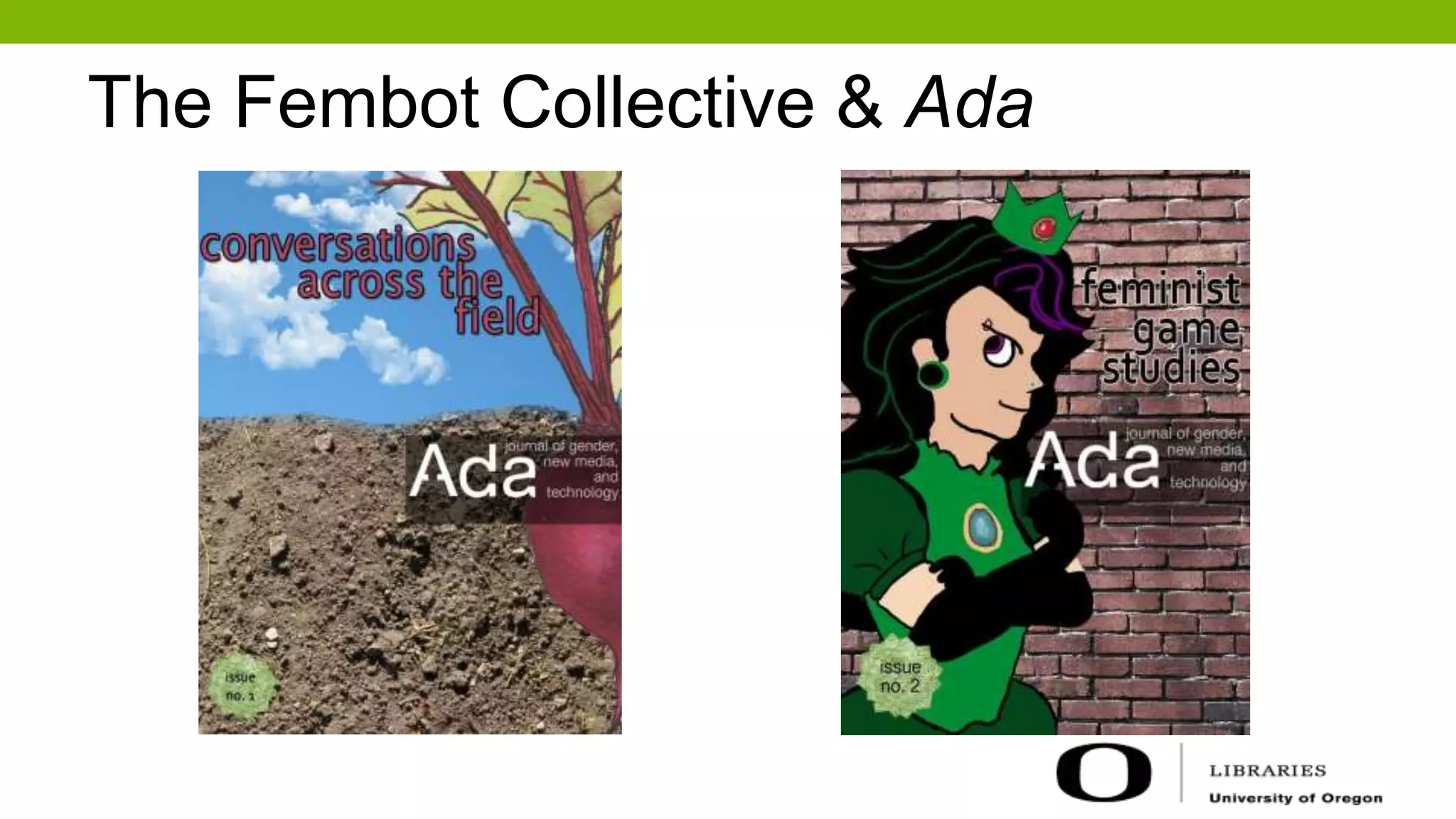
The Fembot Collective & Ada
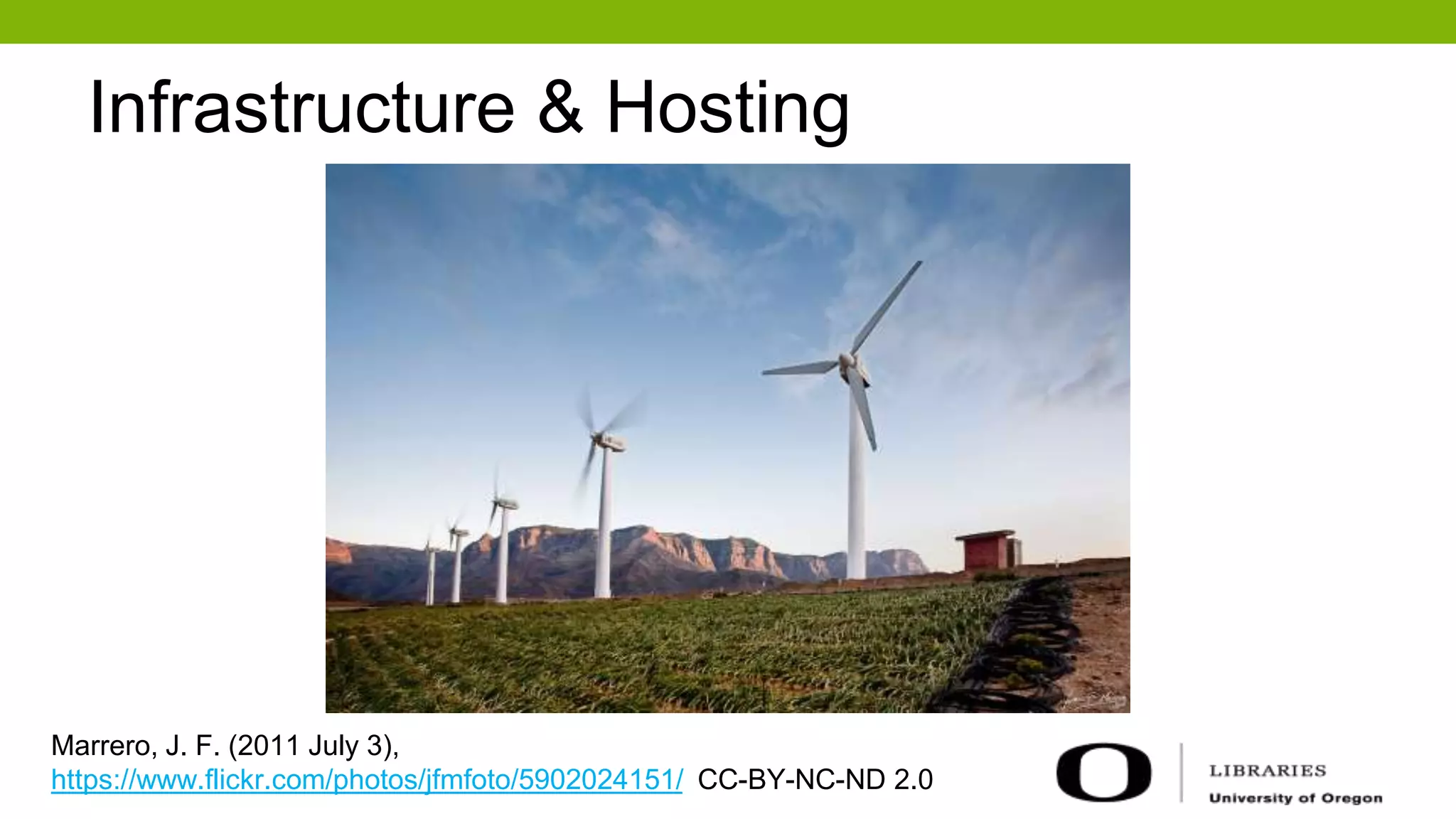
Infrastructure & Hosting
Marrero, J. F. (2011 July 3),
https://www.flickr.com/photos/jfmfoto/5902024151/ CC-BY-NC-ND 2.0
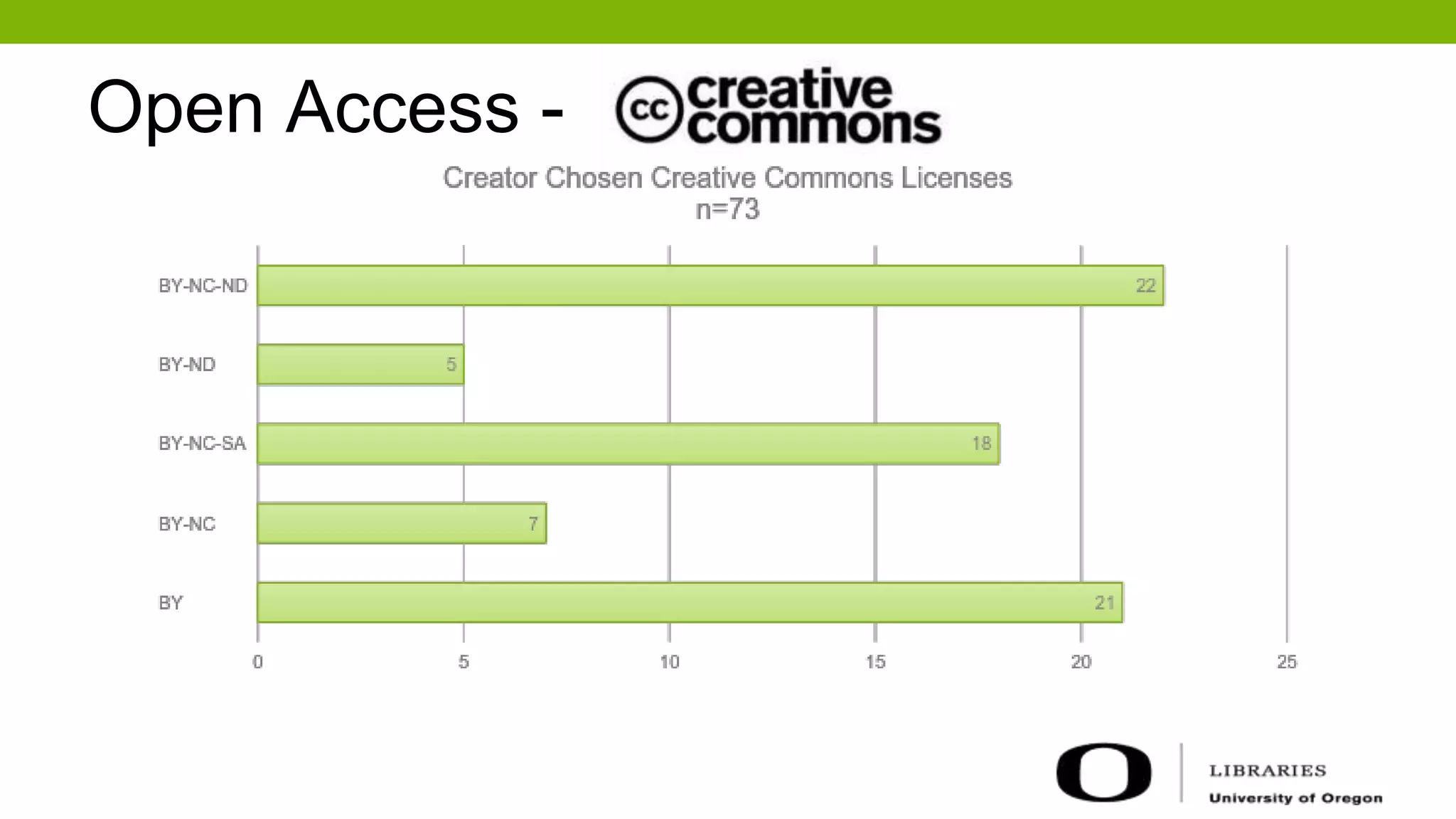
Open Access -
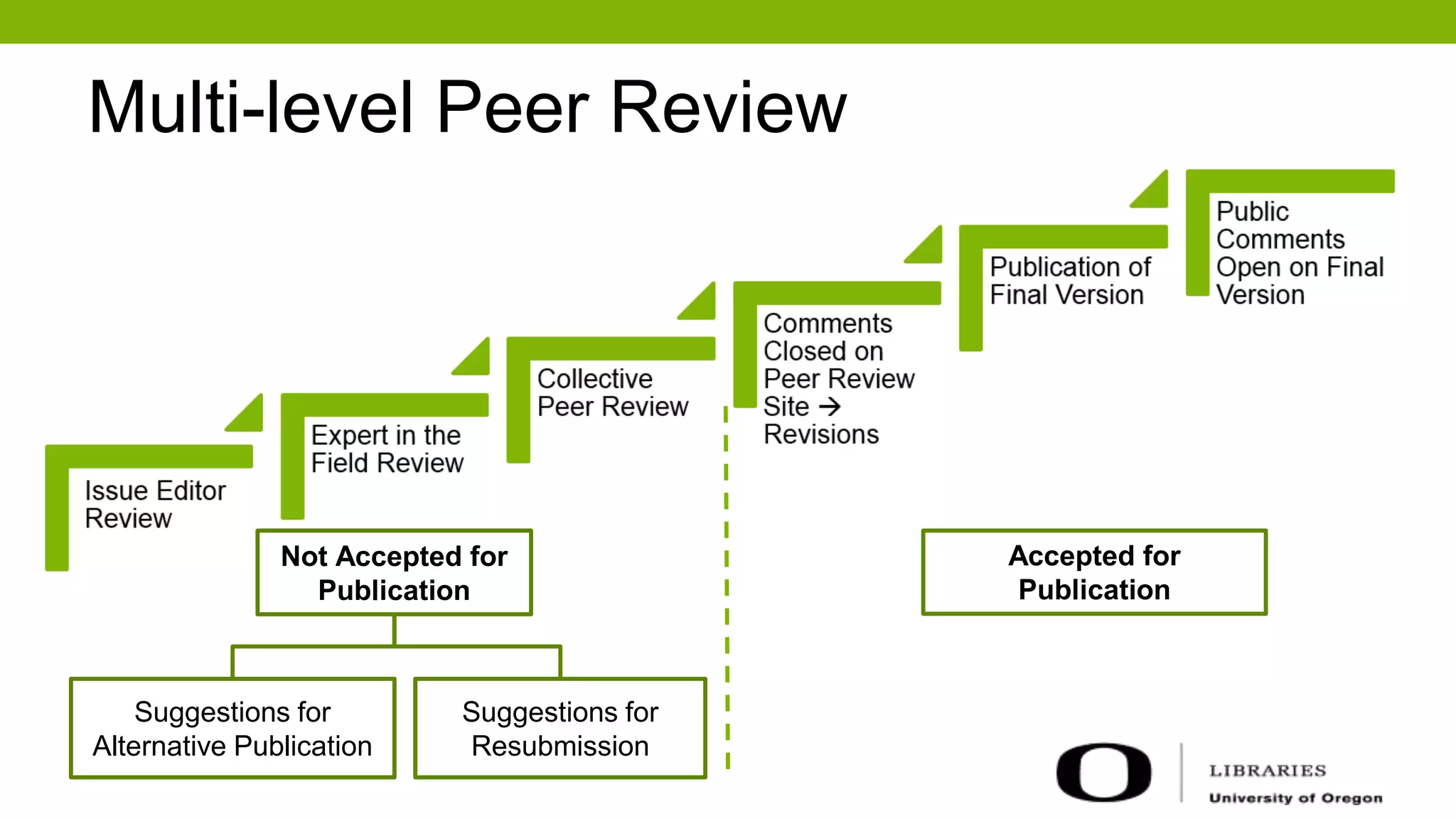
Multi-level Peer Review
Accepted for
Publication
Suggestions for
Alternative Publication
Suggestions for
Resubmission
Not Accepted for
Publication
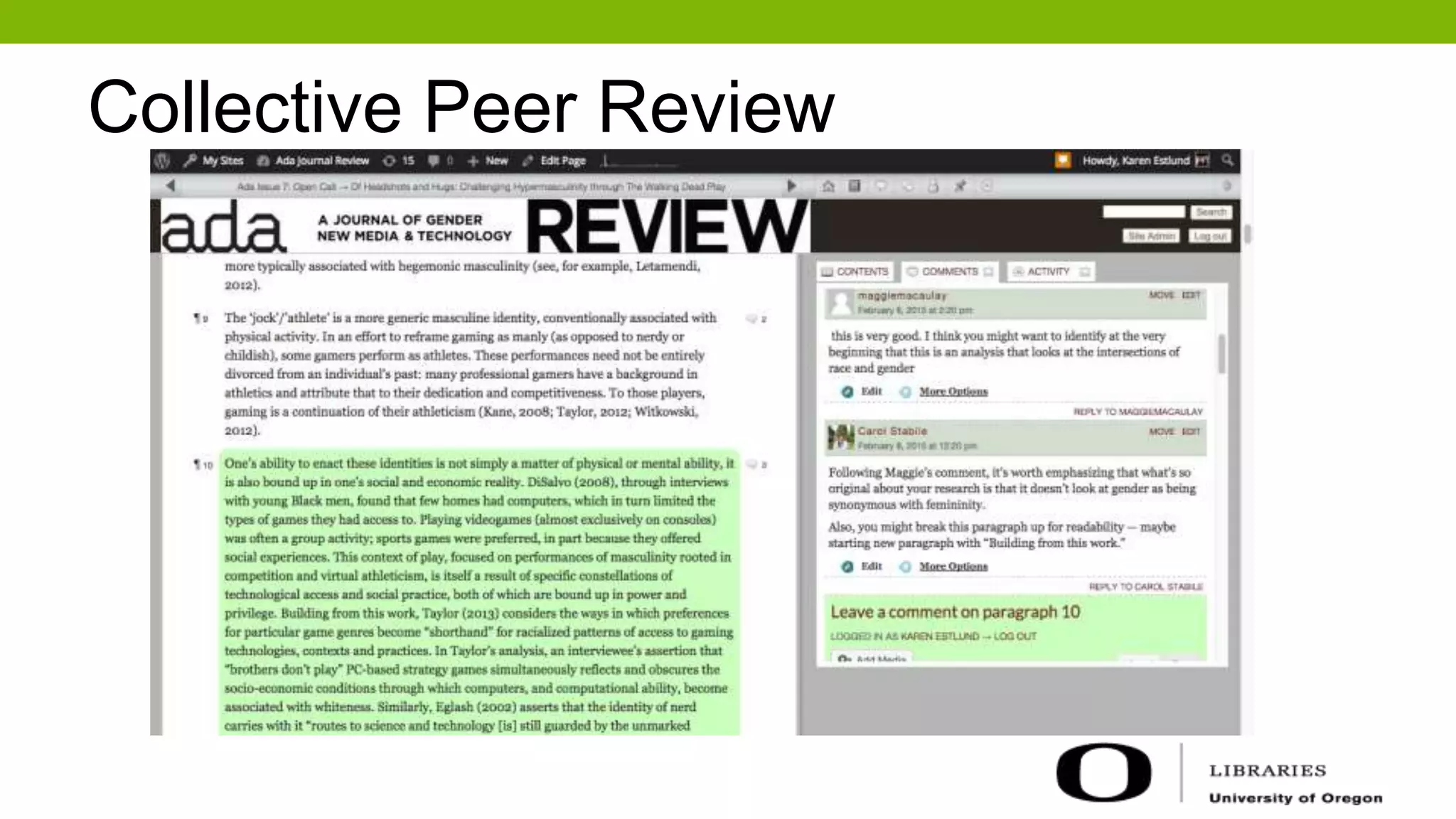
Collective Peer Review
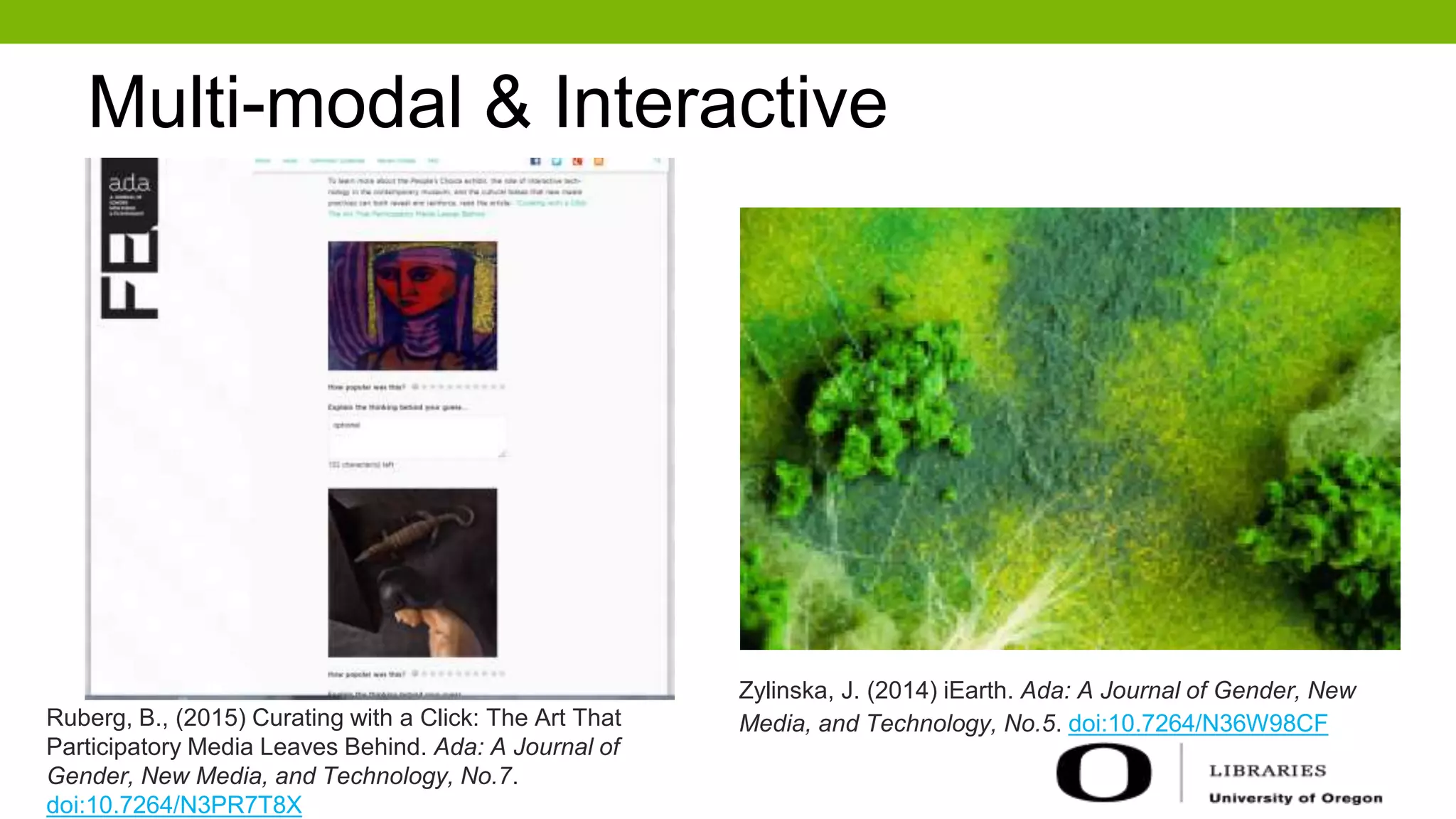
Multi-modal & Interactive
Zylinska, J. (2014) iEarth. Ada: A Journal of Gender, New
Media, and Technology, No.5. doi:10.7264/N36W98CFRuberg, B., (2015) Curating with a Click: The Art That
Participatory Media Leaves Behind. Ada: A Journal of
Gender, New Media, and Technology, No.7.
doi:10.7264/N3PR7T8X
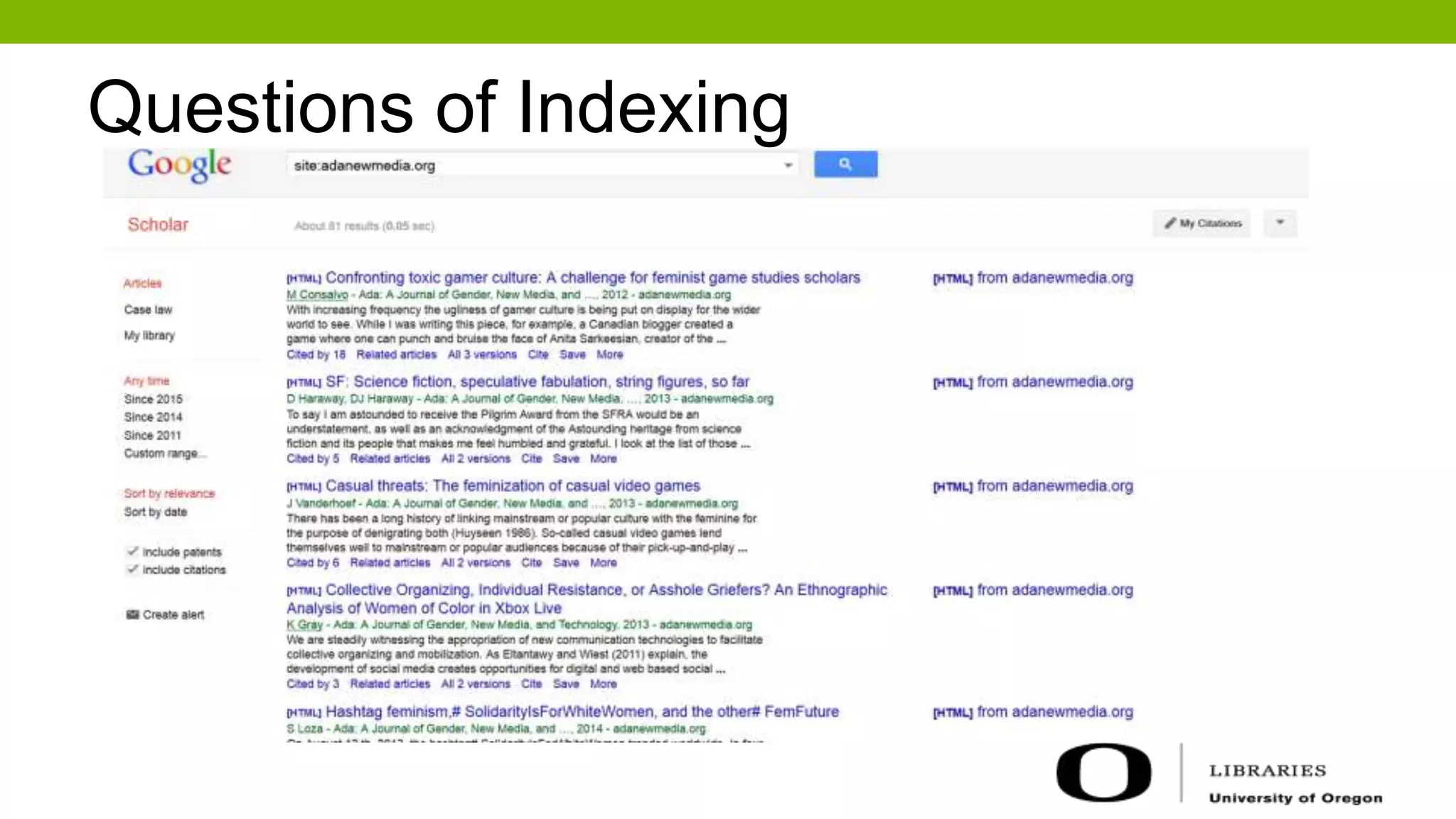
Questions of Indexing
Production Process
Sarah Hamid
Inter-personal
Challenges
● Demands of
production in an
era of
smartphones.
● Coordinating
meetings.
● Screen
communication.
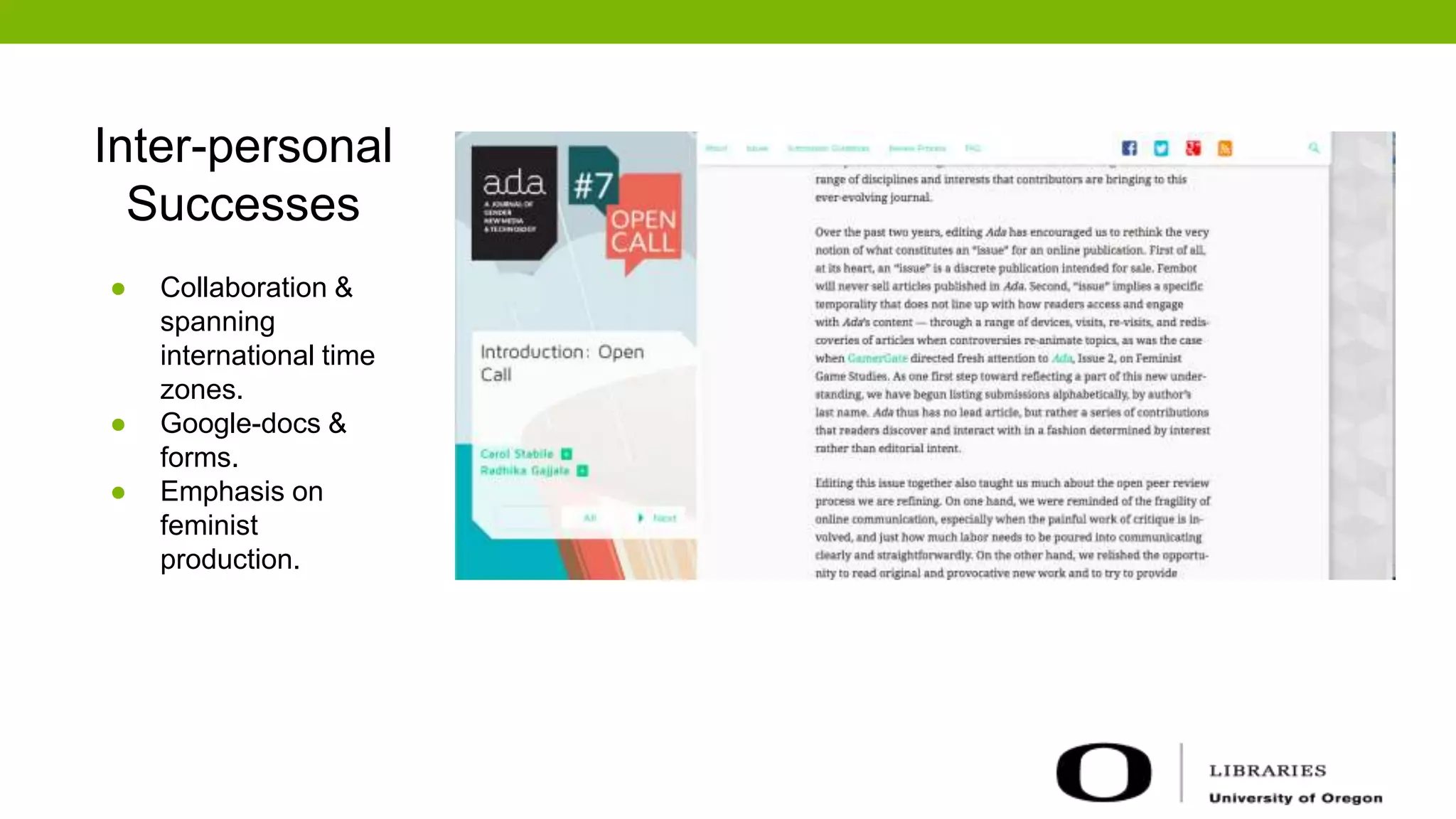
Inter-personal
Successes
● Collaboration &
spanning
international time
zones.
● Google-docs &
forms.
● Emphasis on
feminist
production.
Personal-Medial
Challenges
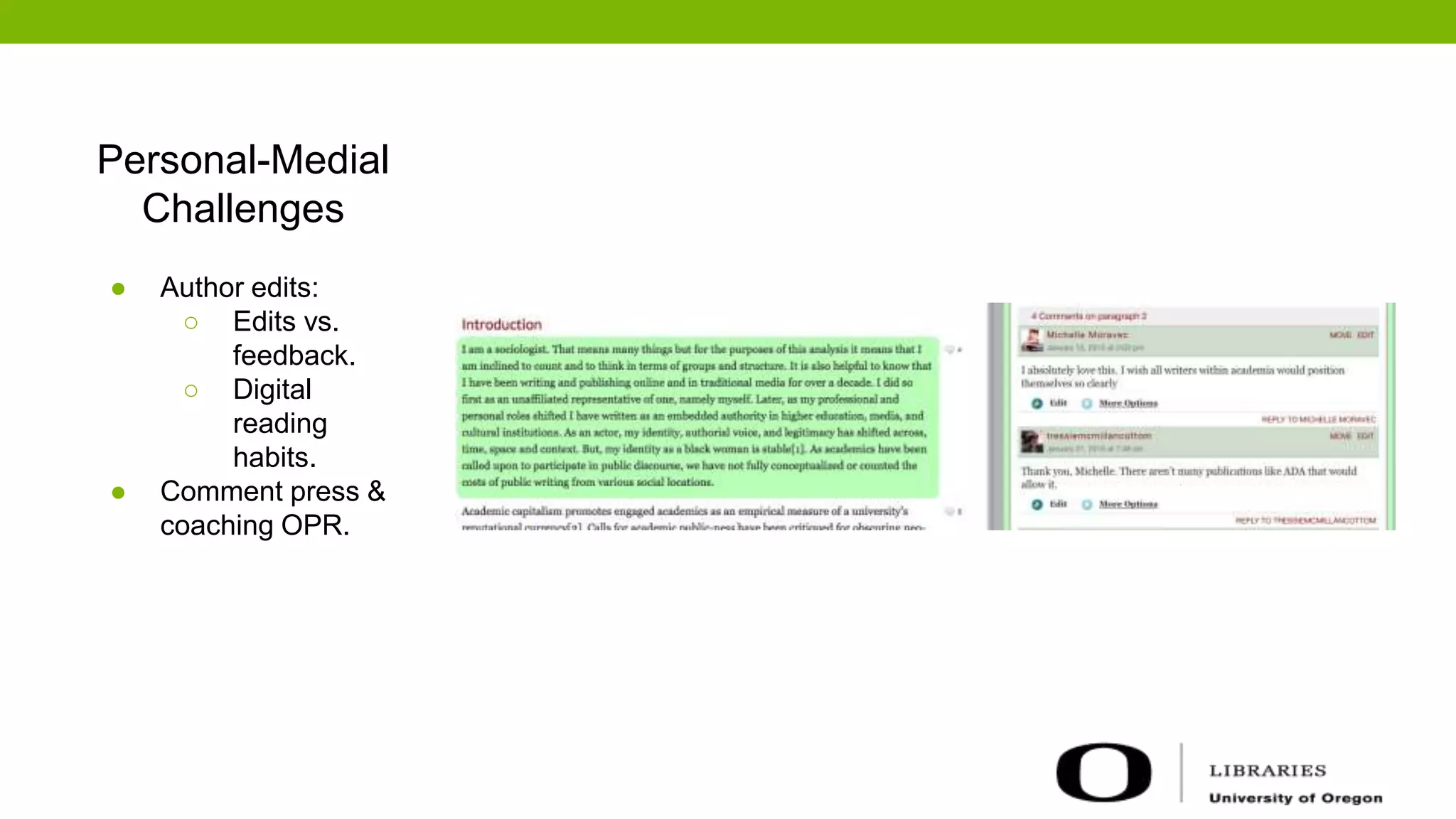
● Author edits:
○ Edits vs.
feedback.
○ Digital
reading
habits.
● Comment press &
coaching OPR.
Personal-Medial
Successes
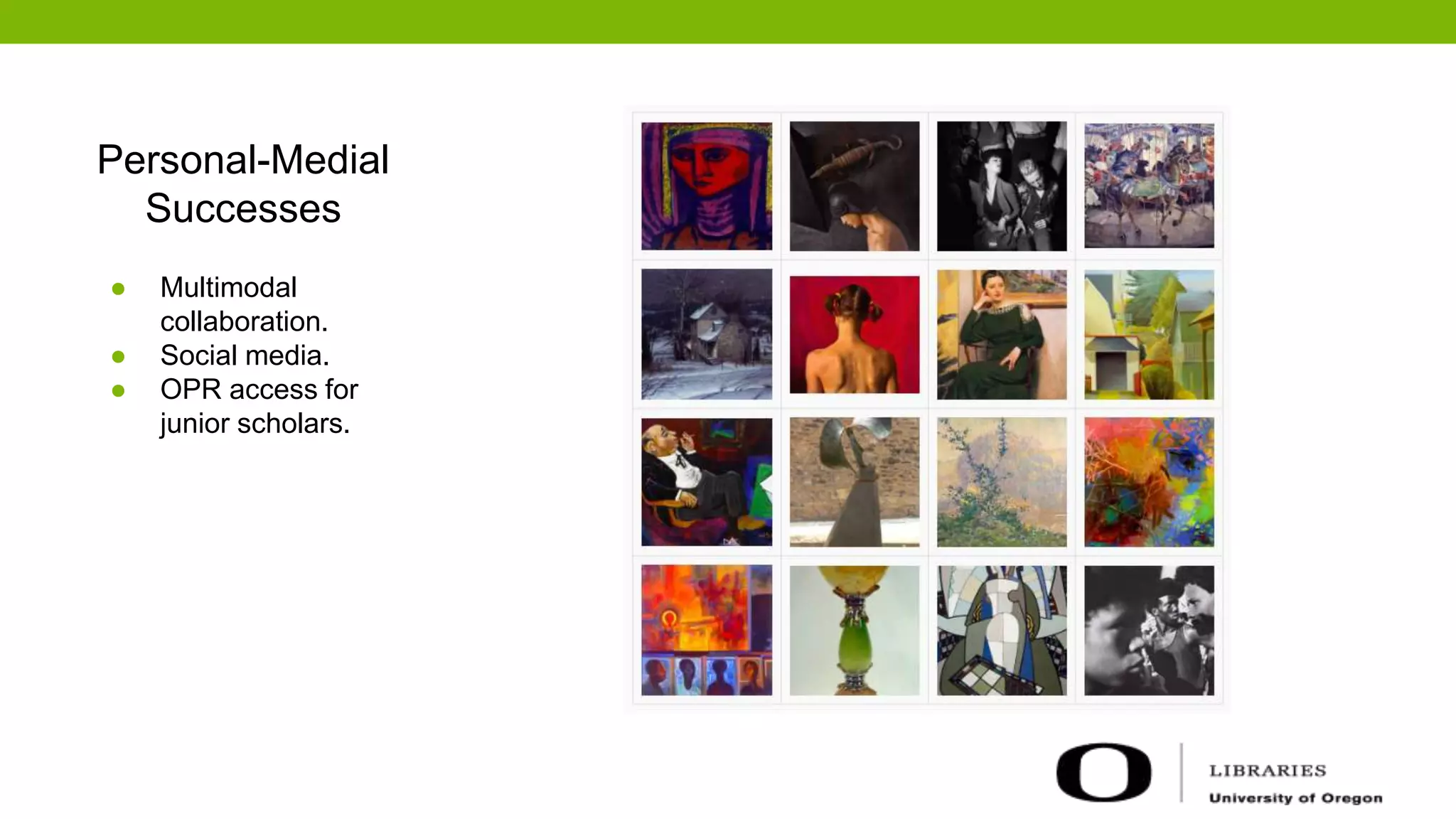
● Multimodal
collaboration.
● Social media.
● OPR access for
junior scholars.
Media-Infrastructural
Challenges
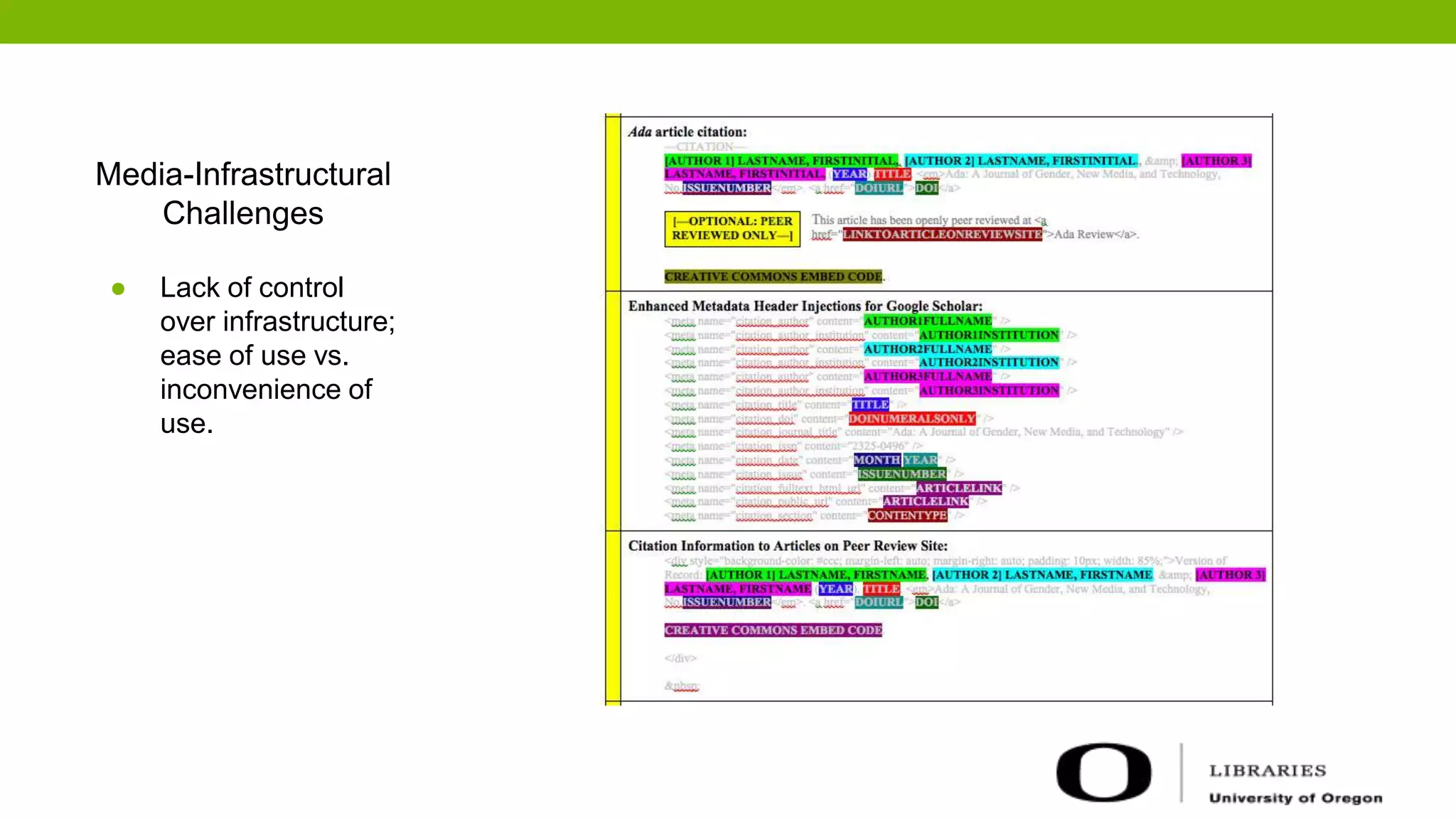
● Lack of control
over infrastructure;
ease of use vs.
inconvenience of
use.
Media-Infrastructural
Successes
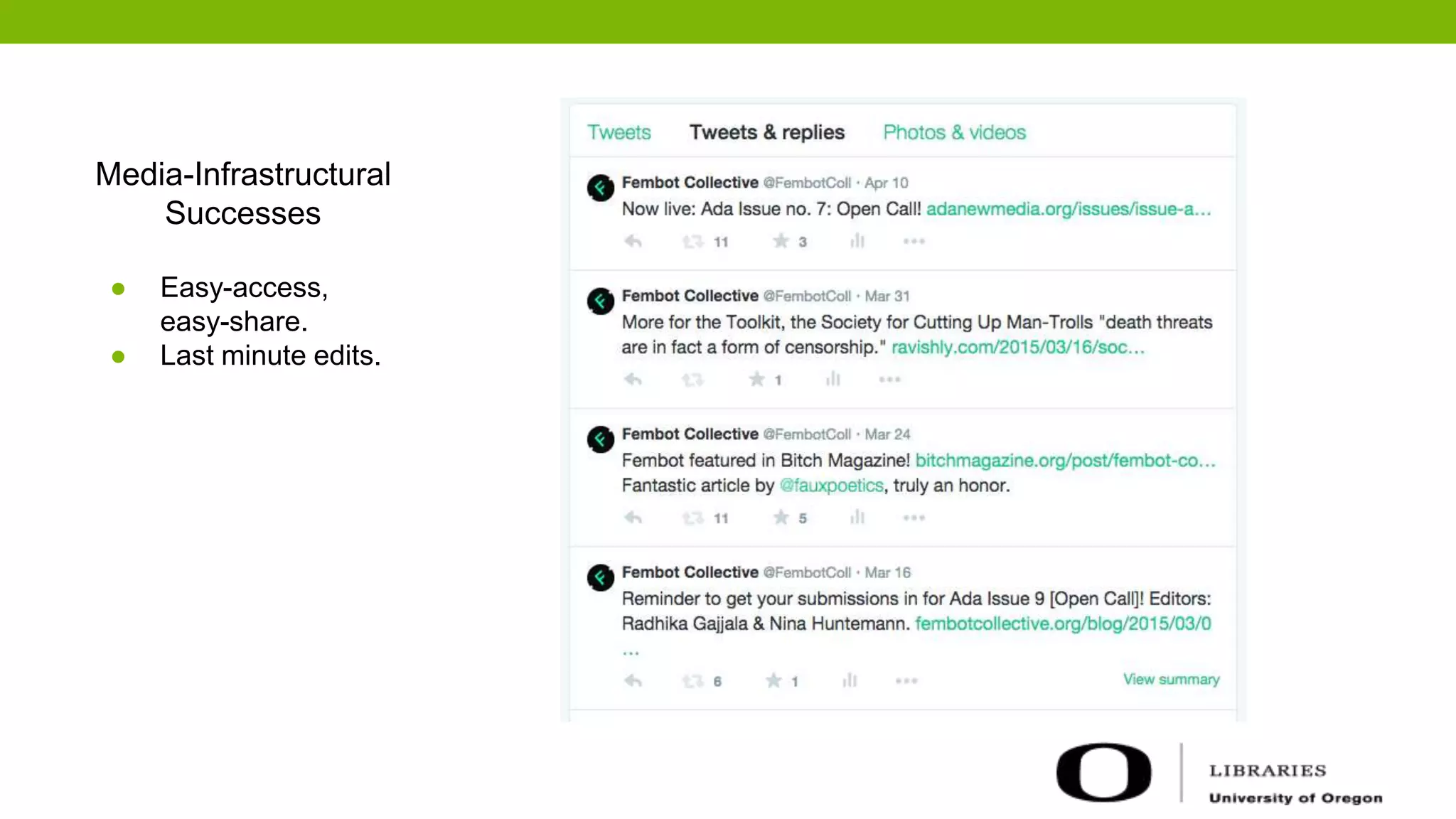
● Easy-access,
easy-share.
● Last minute edits.
Assessment
Bryce Peake
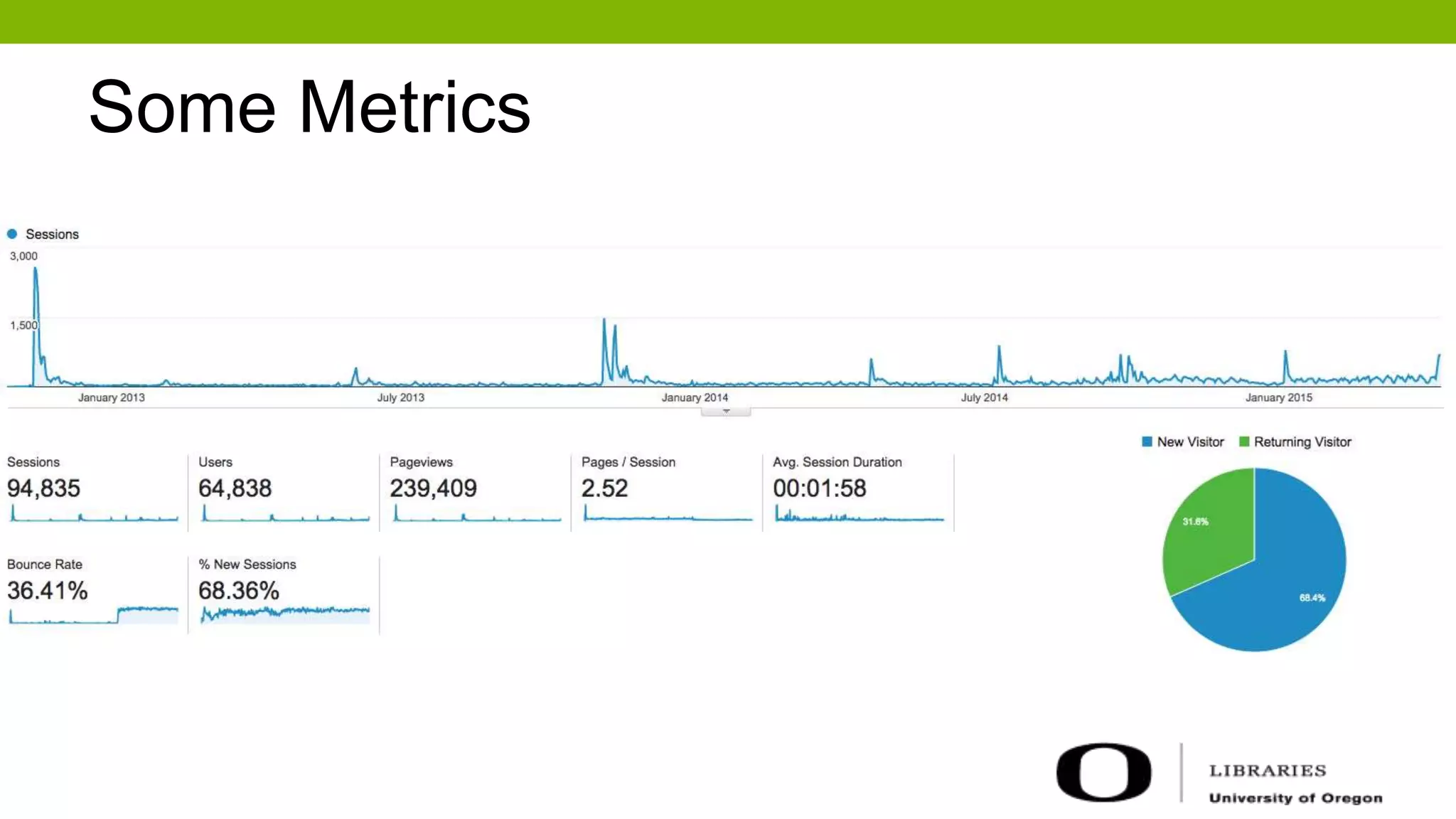
Some Metrics
Metric-driven writing + building
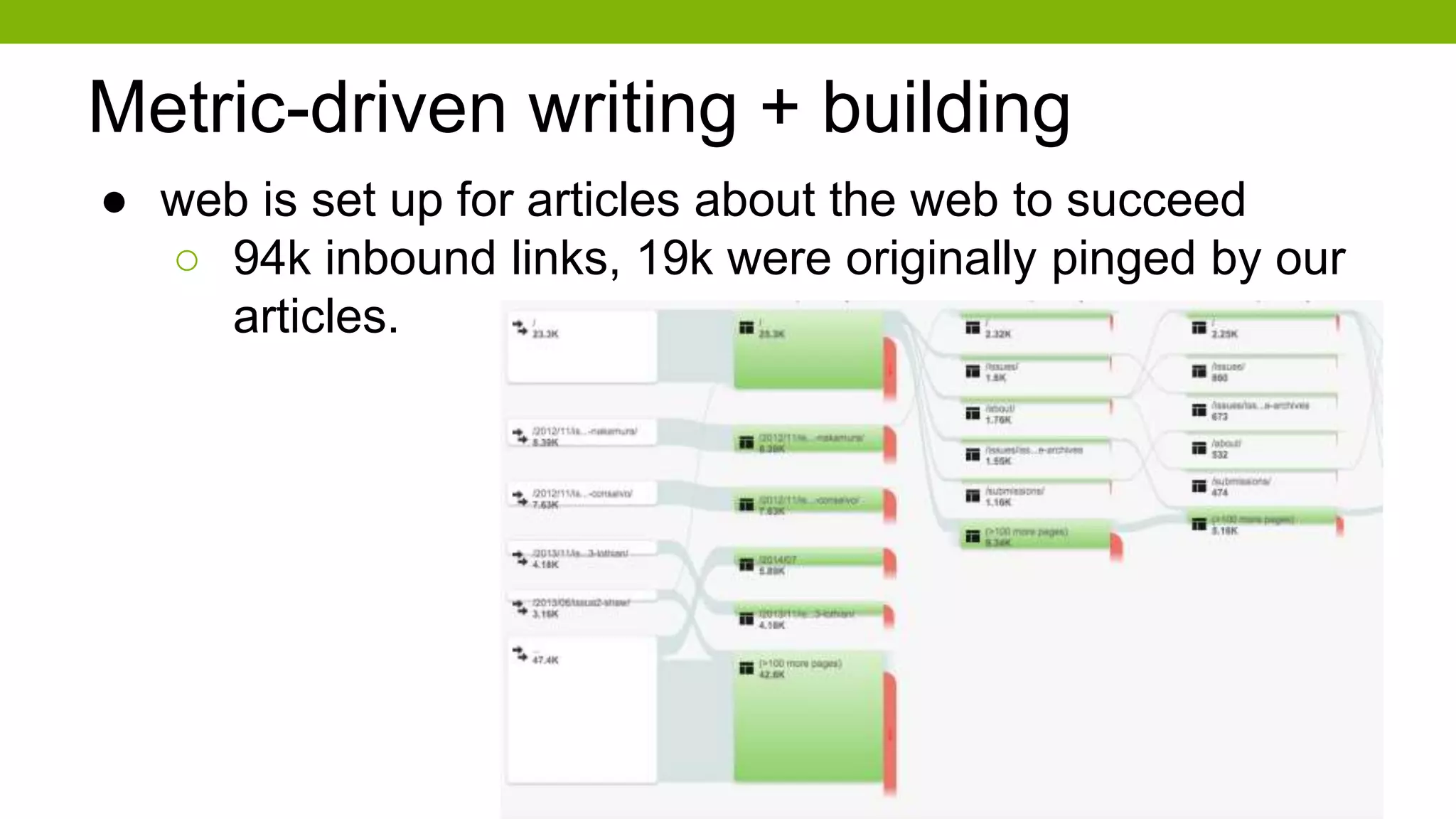
● web is set up for articles about the web to succeed
○ 94k inbound links, 19k were originally pinged by our
articles.
Metric-driven writing + building
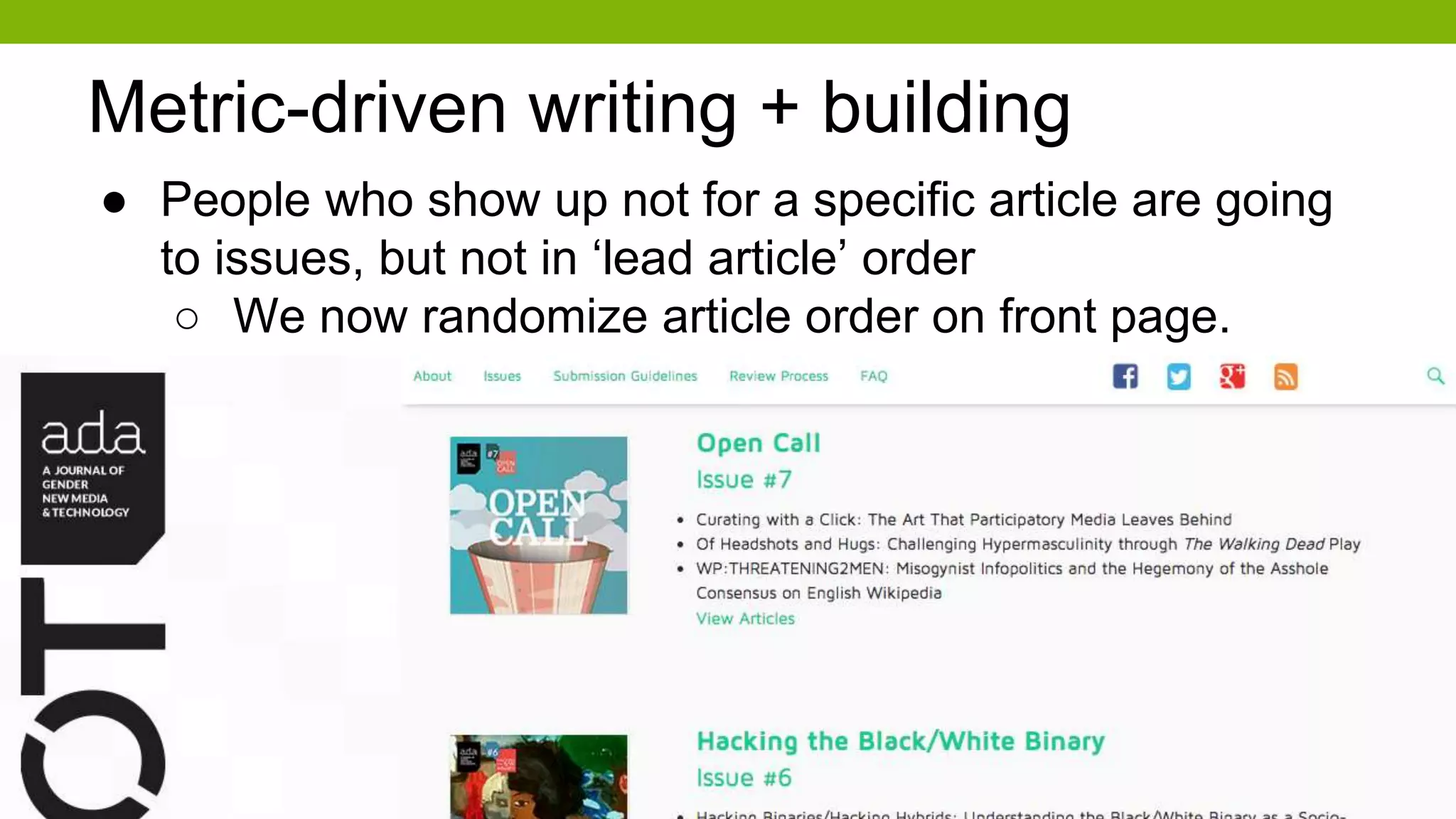
● People who show up not for a specific article are going
to issues, but not in ‘lead article’ order
○ We now randomize article order on front page.
Processual Assessments
● Special Issue Editor
○ 1 special issue a year, proposed 2-3 years in
advance
○ 8 month turn around from end of cfp to production
○ guided by process document built by webmistress at
acceptance of SI.
○ Shifting from ‘flexible’ to ‘set’
Processual Assessments
● Author perspective
○ Easy submission to author
○ Peer review is time intensive, requires responses
during peer review
■ “There aren’t enough hours in the day to keep up with the
conversation. If I didn’t have other things to do (other articles to
write/submit) then maybe I could be active in the peer review
process. It’s just unreasonable to expect academics to put that
work into review in the current job climate.”
○ Process is “fast,” but not rapid like news/editorial/
blogging norms.
Processual Assessments
● Production perspective
○ Team labor - SI Editor, Ada Editors, DSC,
Webmistress
○ Review - Invite Expert Reviewers - Format and
Posting - Send Formatted, Post-Review Version to
Editors, Editors Summarize Comments + Send to
Author - Copy Edit Revised Version - Post to Ada -
Advertise - Analytics Follow-ups (6mo, yearly)
Processual Assessments
● Peer Review Perspective
● “I like that it’s mentorship focused. I get to ask myself ‘how can I help make
this piece publishable,’ rather than acting as some kind of gatekeeper for a
competition-driven scarcity that is traditional journals.”
● “Anonymity is the bane of peer review. I’ve gotten reviews that are
insulting. Like this recent one from ______ “Impaling himself on the pole
arm of Marxist feminism, the author mistakes “gendered classed”
implications for “gendered classed” intentions. Removing the gender
dimensions of the analysis, we have the same old, reductive Marxist
understanding of telecommunications infrastructure.’ Thanks, that’s
absolutely helpful for understanding why you don’t like it. What’s scholarly
about this review, though?!”
Personnel Successes
● Graduate Students
○ Chelsea Bullock (early proj. manager) - Marion Brittain Postdoc Fellow
@ Georgia Institute of Technology
○ Mél Hogan (first Fembot Advisory Board member) - Asst. Prof. of
Media Studies, Illinois Institute of Tech
○ Brian Reece (DSC graduate student) - Assoc. Dir. for Assessment +
Communication, Toppel Career Center @ University of Miami
○ Bryce Peake (first Webmistress) - Intel fellowship, Asst. Prof. of Media
+ Communication Studies @ University of Maryland Baltimore County
Personnel Successes
● Faculty
○ Carol Stabile - ACLS
○ Radhika Gajjala - Fulbright Fellow, Norway
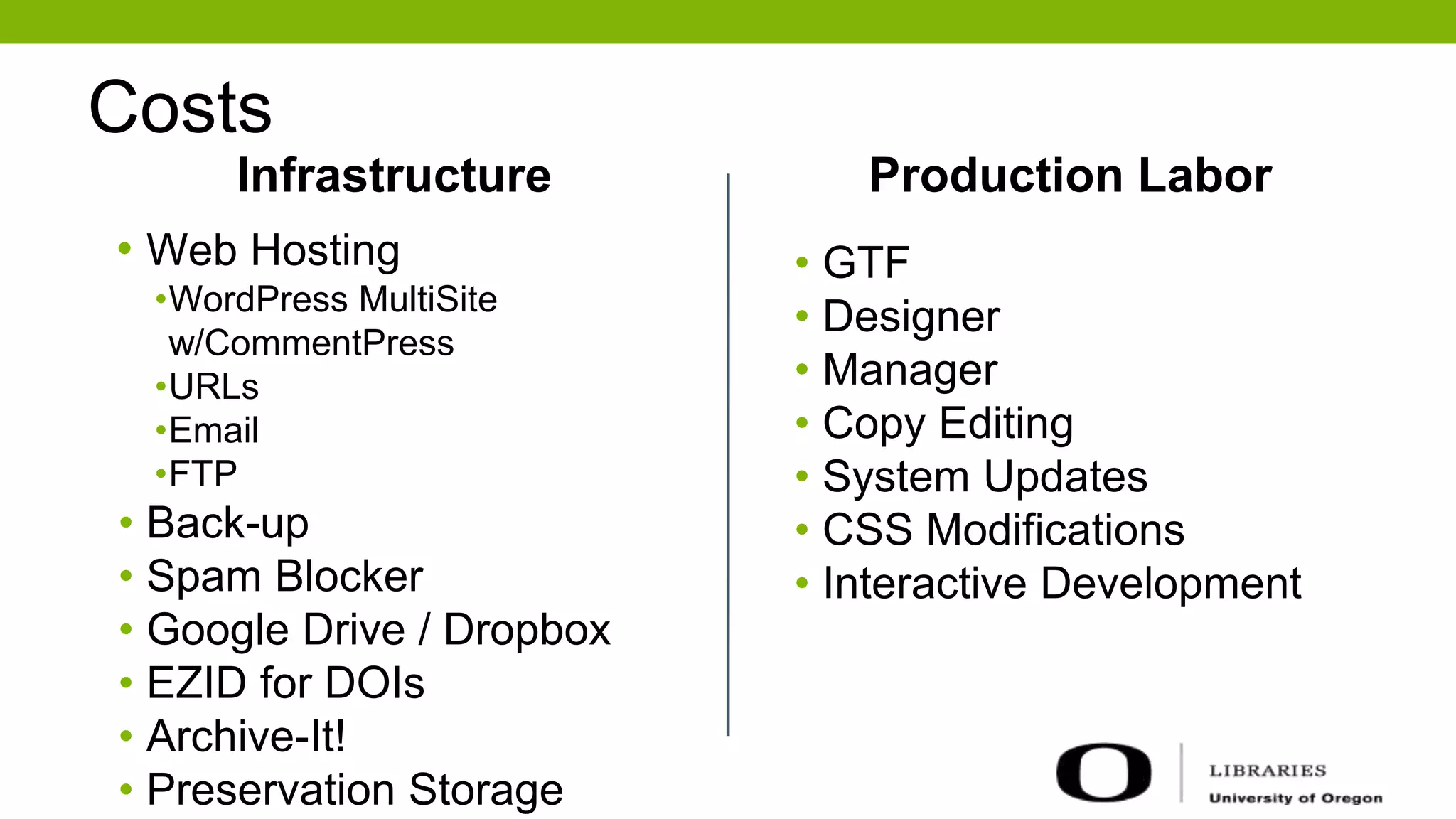
Costs
Infrastructure
• Web Hosting
•WordPress MultiSite
w/CommentPress
•URLs
•Email
•FTP
• Back-up
• Spam Blocker
• Google Drive / Dropbox
• EZID for DOIs
• Archive-It!
• Preservation Storage
Production Labor
• GTF
• Designer
• Manager
• Copy Editing
• System Updates
• CSS Modifications
• Interactive Development
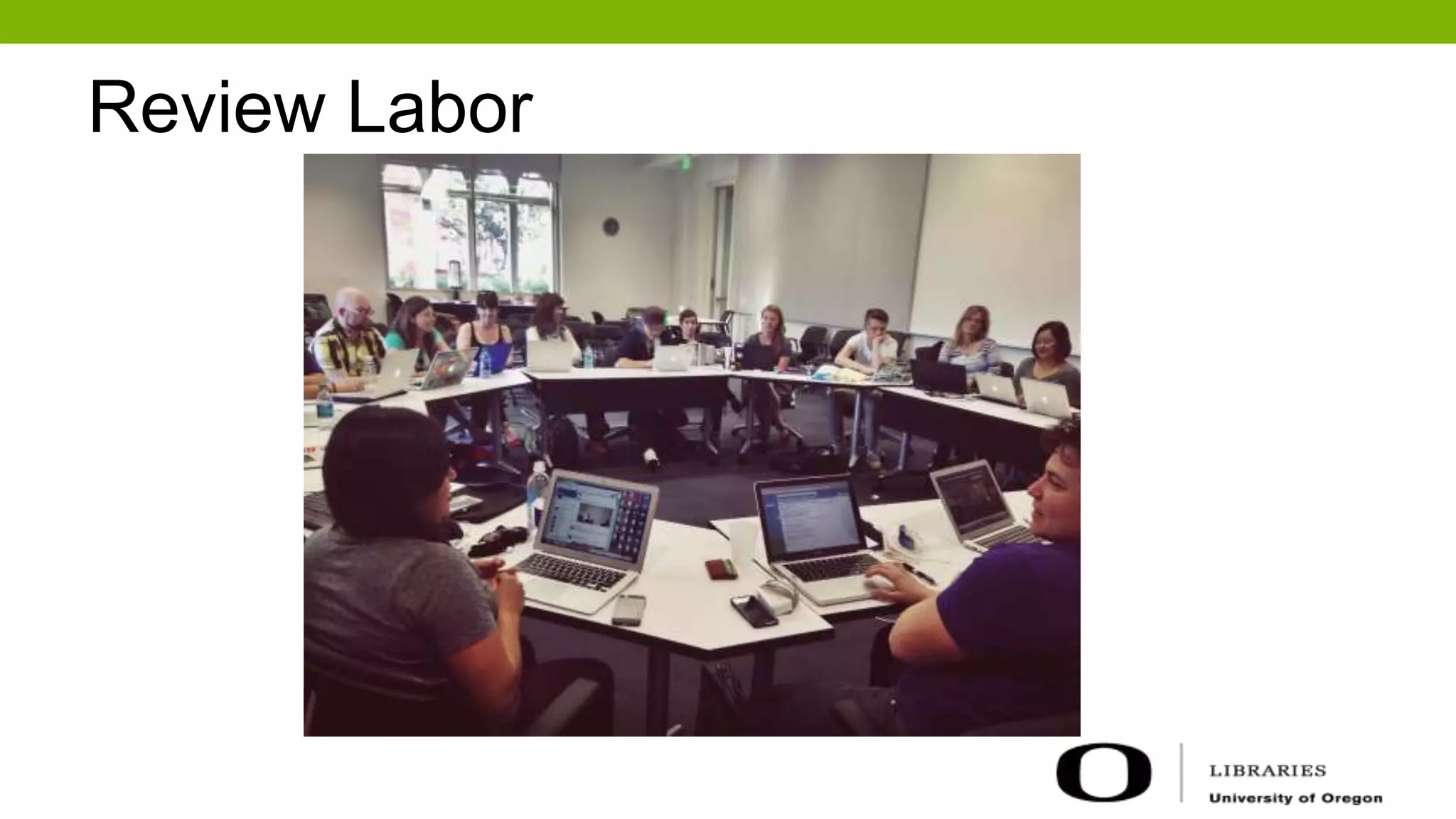
Review Labor
Sponsors
http://adanewmedia.org

Publishing Ada: A Retrospective Look at the First Three Years of an Open Peer Review Multi-modal Journal

  • 1.
    Publishing Ada A RetrospectiveLook at the First Three Years of an Open Peer Review Multi-modal Journal Karen Estlund, kestlund@uoregon.edu Sarah Hamid, shamid@uoregon.edu Bryce Peake, bpeake@uoregon.edu http://adanewmedia.org
  • 2.
    Outline • Review Goalsfrom 2011/12 - Karen • What we learned: Open Access, open peer review, multimodal • Production Lessons - Sarah • Assessment - Bryce • Cost / labor estimates - Karen
  • 3.
  • 4.
    Infrastructure & Hosting Marrero,J. F. (2011 July 3), https://www.flickr.com/photos/jfmfoto/5902024151/ CC-BY-NC-ND 2.0
  • 5.
  • 6.
    Multi-level Peer Review Acceptedfor Publication Suggestions for Alternative Publication Suggestions for Resubmission Not Accepted for Publication
  • 7.
  • 8.
    Multi-modal & Interactive Zylinska,J. (2014) iEarth. Ada: A Journal of Gender, New Media, and Technology, No.5. doi:10.7264/N36W98CFRuberg, B., (2015) Curating with a Click: The Art That Participatory Media Leaves Behind. Ada: A Journal of Gender, New Media, and Technology, No.7. doi:10.7264/N3PR7T8X
  • 9.
  • 10.
  • 11.
    Inter-personal Challenges ● Demands of productionin an era of smartphones. ● Coordinating meetings. ● Screen communication.
  • 12.
    Inter-personal Successes ● Collaboration & spanning internationaltime zones. ● Google-docs & forms. ● Emphasis on feminist production.
  • 13.
    Personal-Medial Challenges ● Author edits: ○Edits vs. feedback. ○ Digital reading habits. ● Comment press & coaching OPR.
  • 14.
  • 15.
    Media-Infrastructural Challenges ● Lack ofcontrol over infrastructure; ease of use vs. inconvenience of use.
  • 16.
  • 17.
  • 18.
  • 19.
    Metric-driven writing +building ● web is set up for articles about the web to succeed ○ 94k inbound links, 19k were originally pinged by our articles.
  • 20.
    Metric-driven writing +building ● People who show up not for a specific article are going to issues, but not in ‘lead article’ order ○ We now randomize article order on front page.
  • 21.
    Processual Assessments ● SpecialIssue Editor ○ 1 special issue a year, proposed 2-3 years in advance ○ 8 month turn around from end of cfp to production ○ guided by process document built by webmistress at acceptance of SI. ○ Shifting from ‘flexible’ to ‘set’
  • 22.
    Processual Assessments ● Authorperspective ○ Easy submission to author ○ Peer review is time intensive, requires responses during peer review ■ “There aren’t enough hours in the day to keep up with the conversation. If I didn’t have other things to do (other articles to write/submit) then maybe I could be active in the peer review process. It’s just unreasonable to expect academics to put that work into review in the current job climate.” ○ Process is “fast,” but not rapid like news/editorial/ blogging norms.
  • 23.
    Processual Assessments ● Productionperspective ○ Team labor - SI Editor, Ada Editors, DSC, Webmistress ○ Review - Invite Expert Reviewers - Format and Posting - Send Formatted, Post-Review Version to Editors, Editors Summarize Comments + Send to Author - Copy Edit Revised Version - Post to Ada - Advertise - Analytics Follow-ups (6mo, yearly)
  • 24.
    Processual Assessments ● PeerReview Perspective ● “I like that it’s mentorship focused. I get to ask myself ‘how can I help make this piece publishable,’ rather than acting as some kind of gatekeeper for a competition-driven scarcity that is traditional journals.” ● “Anonymity is the bane of peer review. I’ve gotten reviews that are insulting. Like this recent one from ______ “Impaling himself on the pole arm of Marxist feminism, the author mistakes “gendered classed” implications for “gendered classed” intentions. Removing the gender dimensions of the analysis, we have the same old, reductive Marxist understanding of telecommunications infrastructure.’ Thanks, that’s absolutely helpful for understanding why you don’t like it. What’s scholarly about this review, though?!”
  • 25.
    Personnel Successes ● GraduateStudents ○ Chelsea Bullock (early proj. manager) - Marion Brittain Postdoc Fellow @ Georgia Institute of Technology ○ Mél Hogan (first Fembot Advisory Board member) - Asst. Prof. of Media Studies, Illinois Institute of Tech ○ Brian Reece (DSC graduate student) - Assoc. Dir. for Assessment + Communication, Toppel Career Center @ University of Miami ○ Bryce Peake (first Webmistress) - Intel fellowship, Asst. Prof. of Media + Communication Studies @ University of Maryland Baltimore County
  • 26.
    Personnel Successes ● Faculty ○Carol Stabile - ACLS ○ Radhika Gajjala - Fulbright Fellow, Norway
  • 27.
    Costs Infrastructure • Web Hosting •WordPressMultiSite w/CommentPress •URLs •Email •FTP • Back-up • Spam Blocker • Google Drive / Dropbox • EZID for DOIs • Archive-It! • Preservation Storage Production Labor • GTF • Designer • Manager • Copy Editing • System Updates • CSS Modifications • Interactive Development
  • 28.
  • 29.

Editor's Notes

  • #4 Original goals
  • #5 Sponsorship: CSWS, SOJC, Libraries move-able
  • #6 First issue BY-NC-ND (not included in above numbers); website content default options for which license, open culture issues
  • #7 Not accepted items not made public
  • #8 in-person sessions
  • #10 Library indexing issues; MLA Bibliography Google Scholar Wordpress and Metadata issues
  • #30 Questions