Converting Metadata to 
Linked Data 
Hydra Connect 
October 2, 2014 
Special thanks to Tom Johnson, 
formerly of Oregon State University, 
(tom@dp.la) 
Karen Estlund, 
Head, Digital Scholarship Center 
Director, Oregon Digital Newspaper Program 
kestlund@uoregon.edu
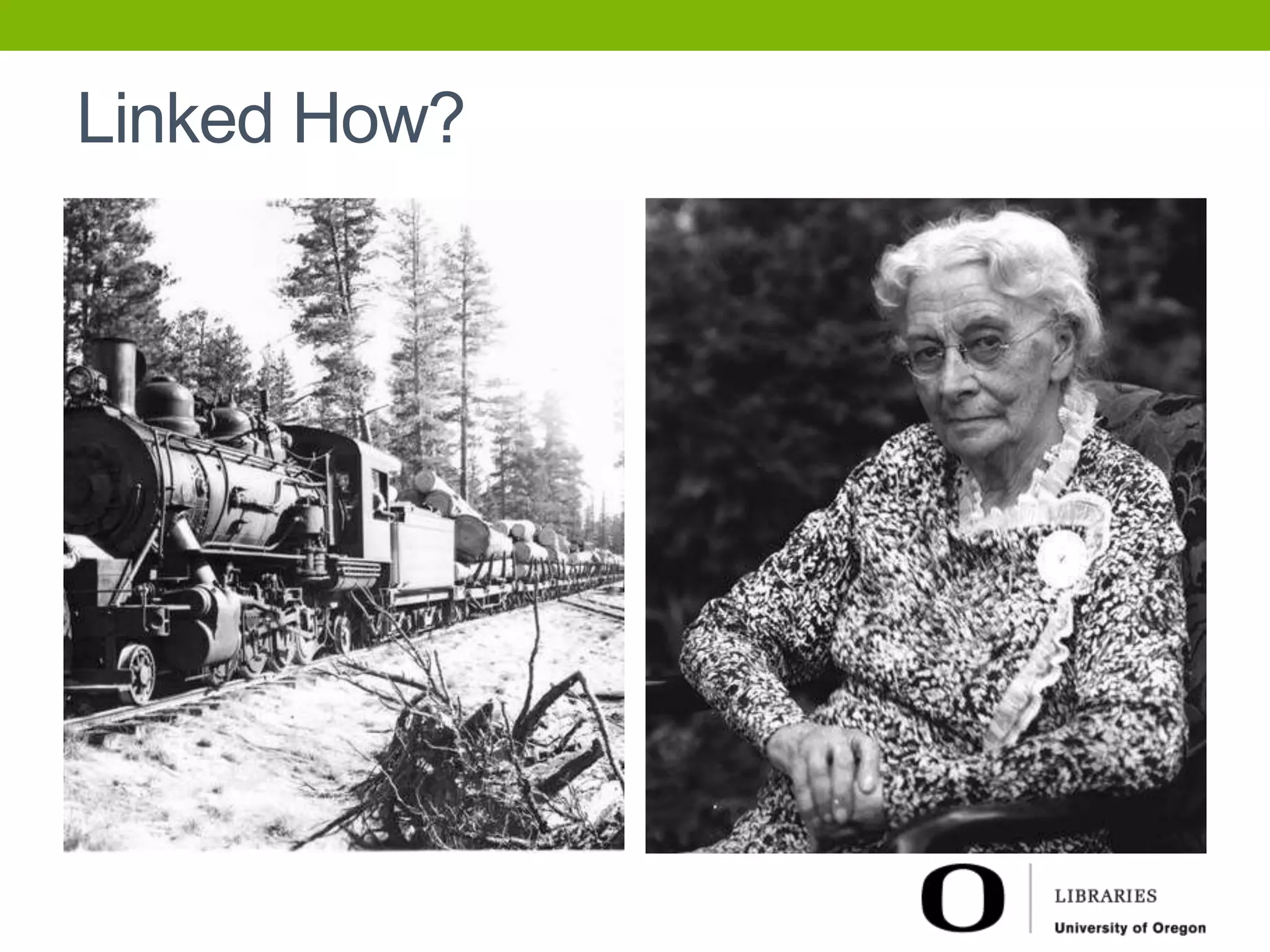
Linked How?
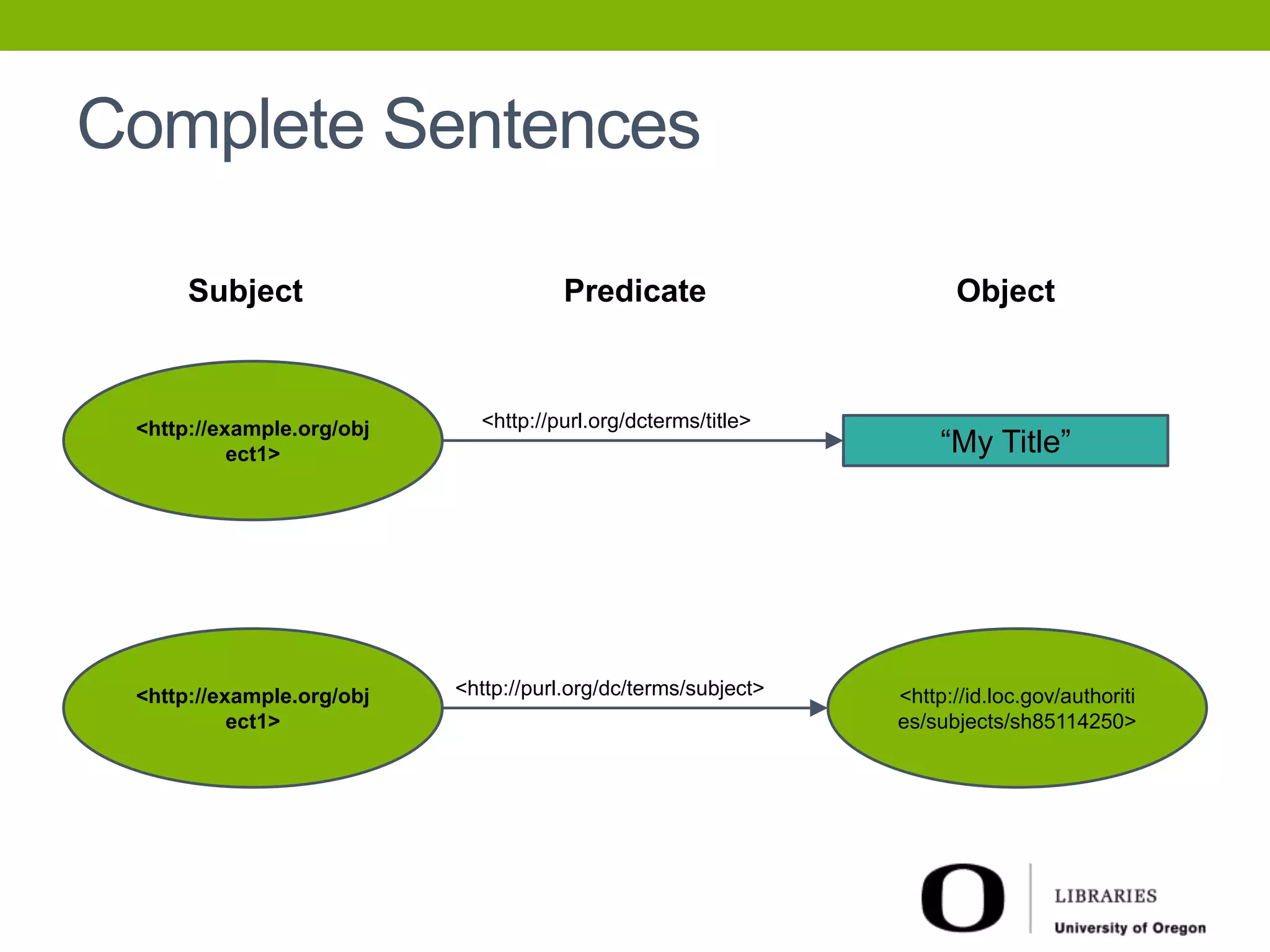
Complete Sentences 
Subject Predicate Object 
<http://example.org/obj 
ect1> 
“My Title” 
<http://id.loc.gov/authoriti 
es/subjects/sh85114250> 
<http://example.org/obj 
ect1> 
<http://purl.org/dcterms/title> 
<http://purl.org/dc/terms/subject>
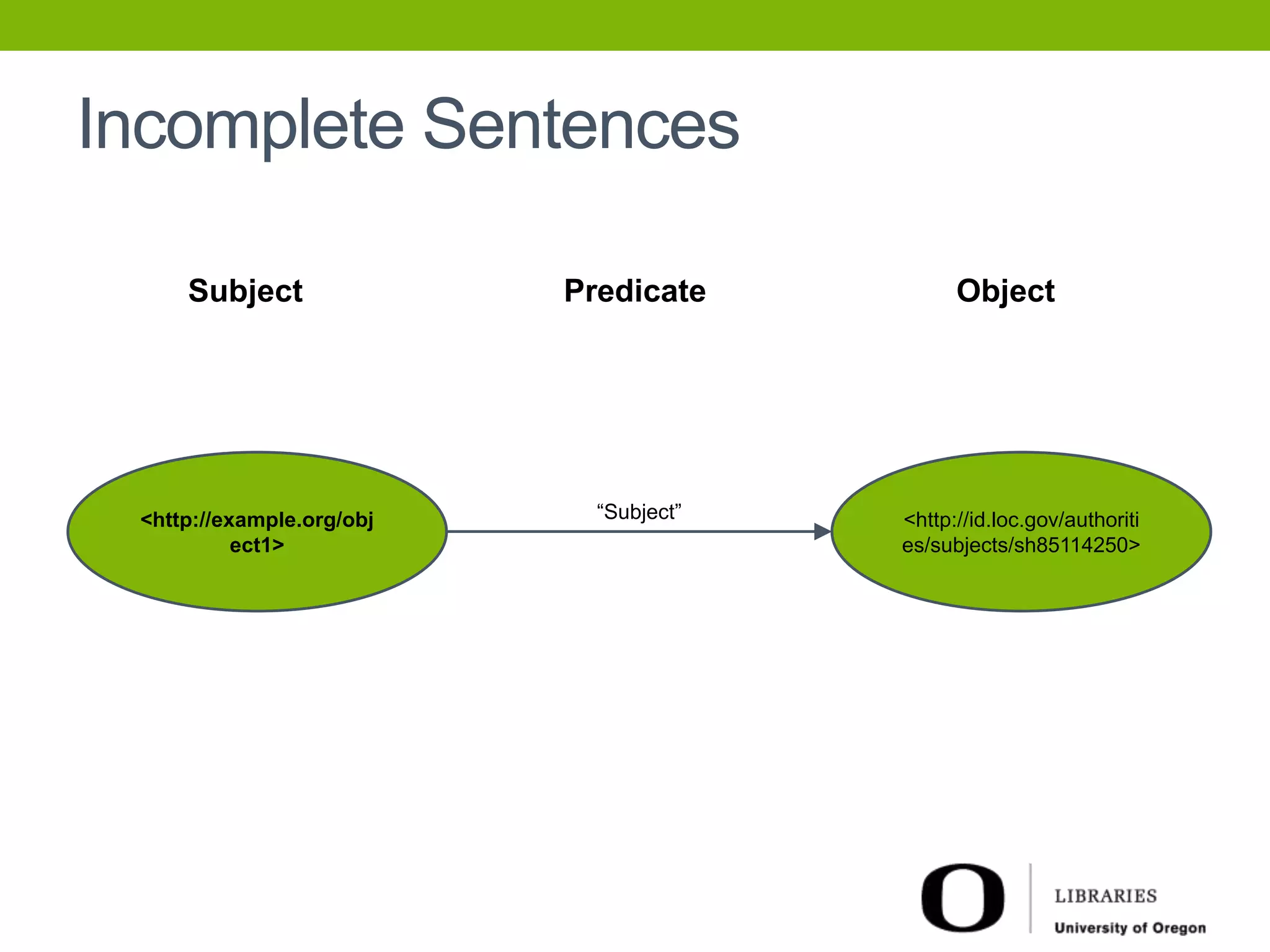
Incomplete Sentences 
Subject Predicate Object 
<http://id.loc.gov/authoriti 
es/subjects/sh85114250> 
<http://example.org/obj 
ect1> 
“Subject”
New Tools for Catalogers 
• Git and Github shared 
collaboration 
• YML 
• JSONLD 
• Using range and 
domain 
• VIM 
• Bash 
• Python validations
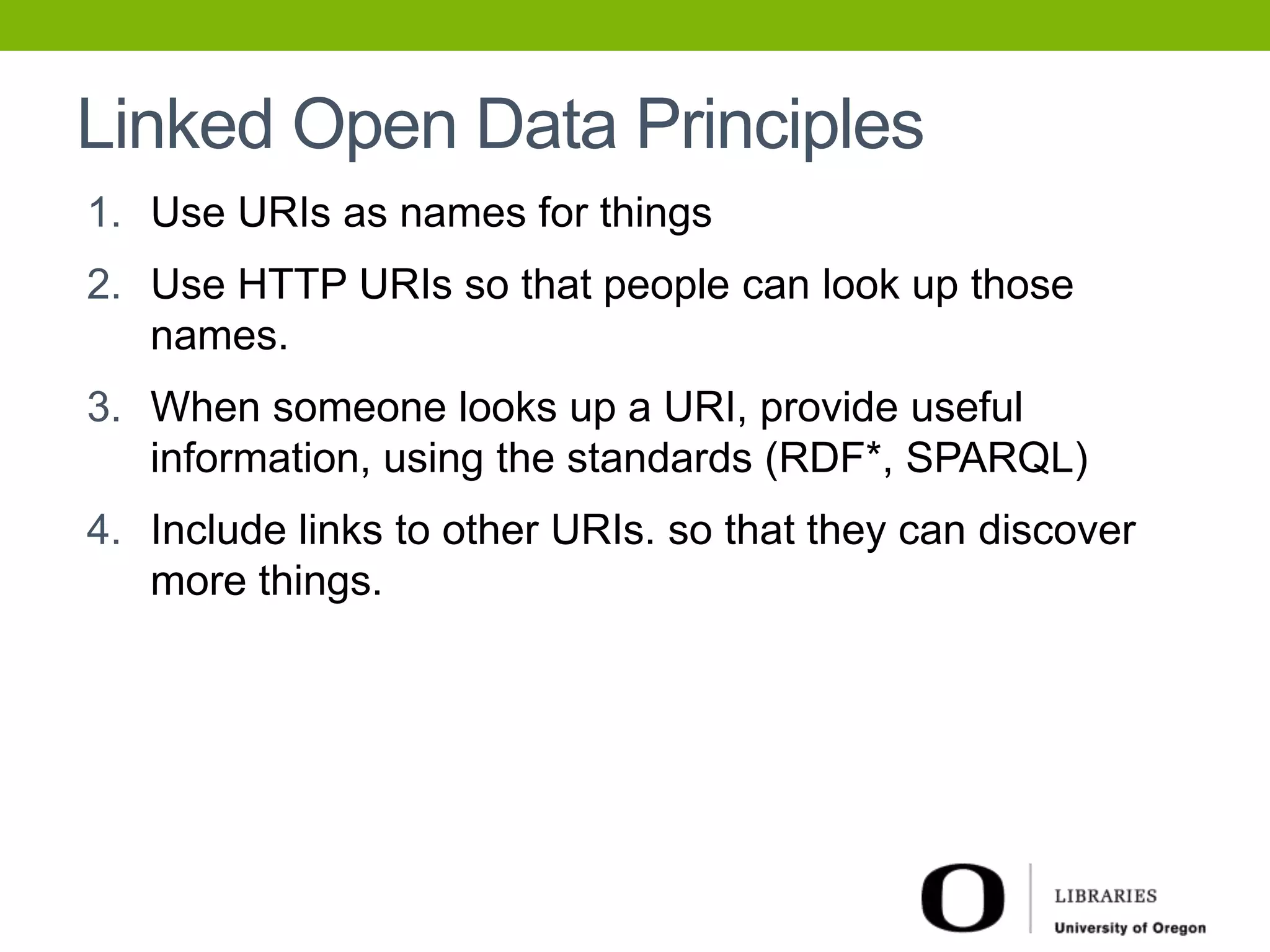
Linked Open Data Principles 
1. Use URIs as names for things 
2. Use HTTP URIs so that people can look up those 
names. 
3. When someone looks up a URI, provide useful 
information, using the standards (RDF*, SPARQL) 
4. Include links to other URIs. so that they can discover 
more things.
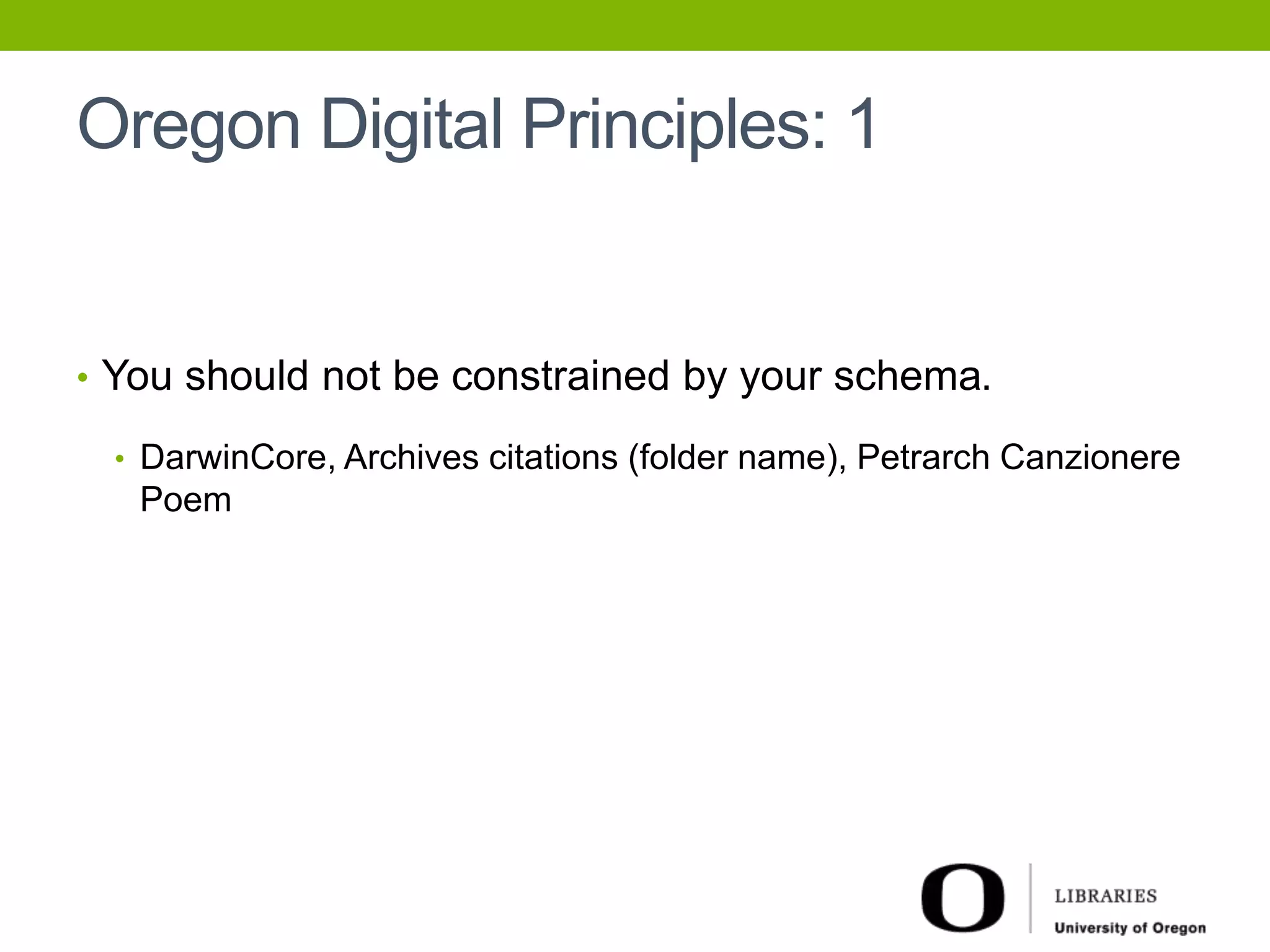
Oregon Digital Principles: 1 
• You should not be constrained by your schema. 
• DarwinCore, Archives citations (folder name), Petrarch Canzionere 
Poem
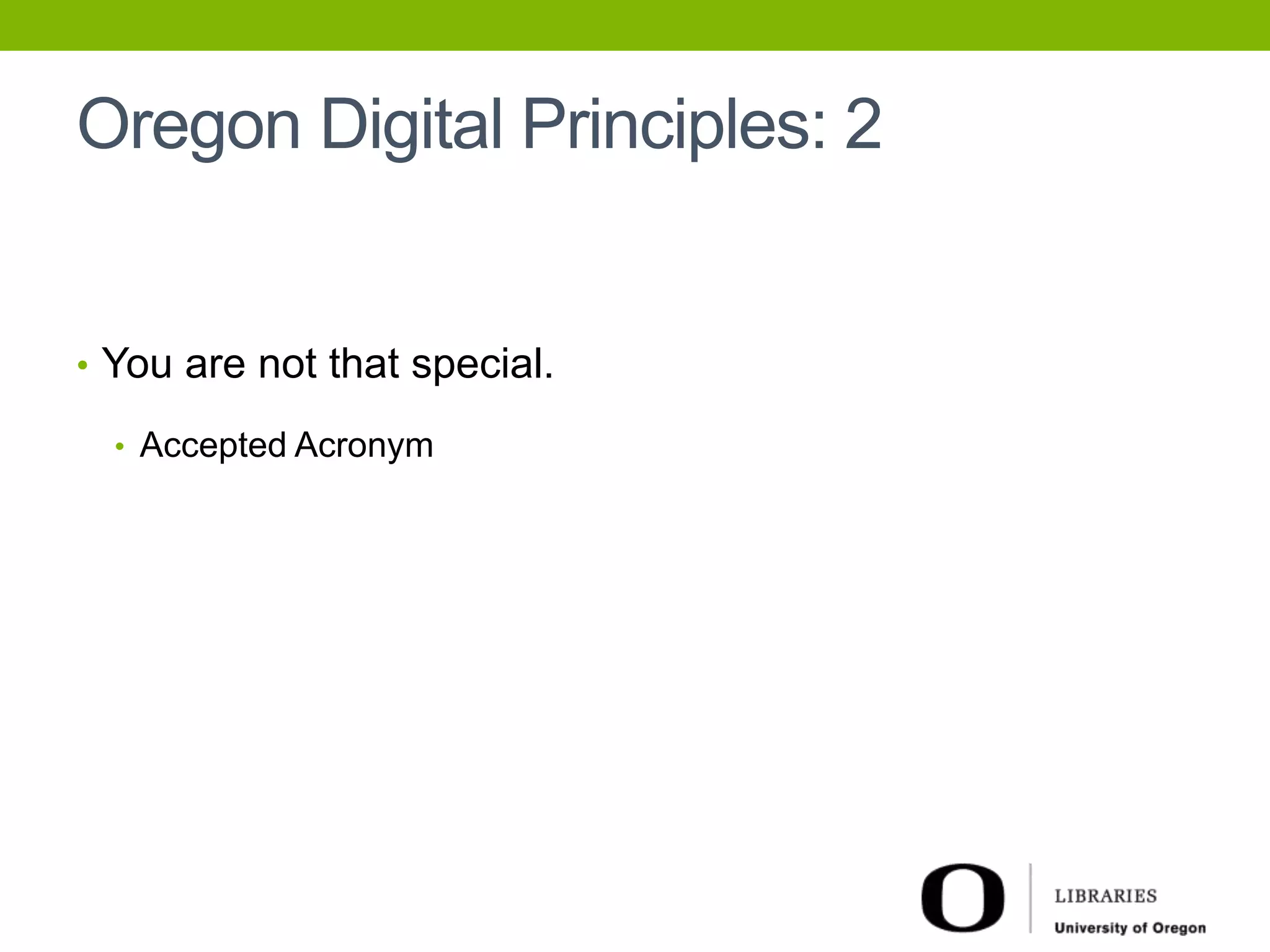
Oregon Digital Principles: 2 
• You are not that special. 
• Accepted Acronym
Oregon Digital Principles: 3 
• You do not know everything. 
• Ask the communities, contact within OD collaboration and 
dictionary owners (so many PDF schemas out there)
Oregon Digital Principles: 4 
• If your data isn’t reusable, shareable, and machine 
readable, then you’re not doing good enough.* 
• Follow linked open data principles
Oregon Digital Principles: 5 
• Use exemplary behavior and reuse from others so that 
they may also reuse from you. 
• We do not need to create an oregon:title predicate
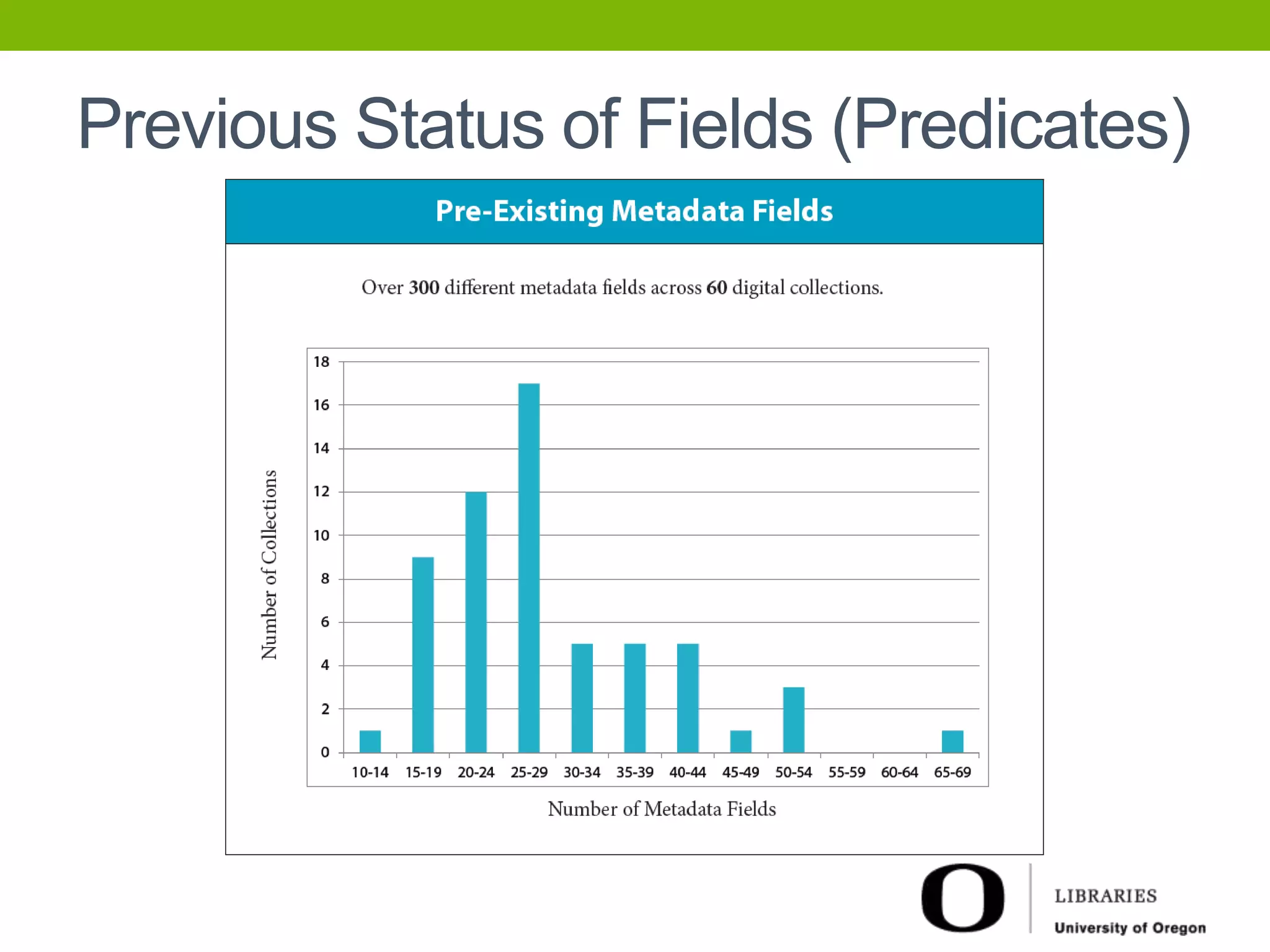
Previous Status of Fields (Predicates)
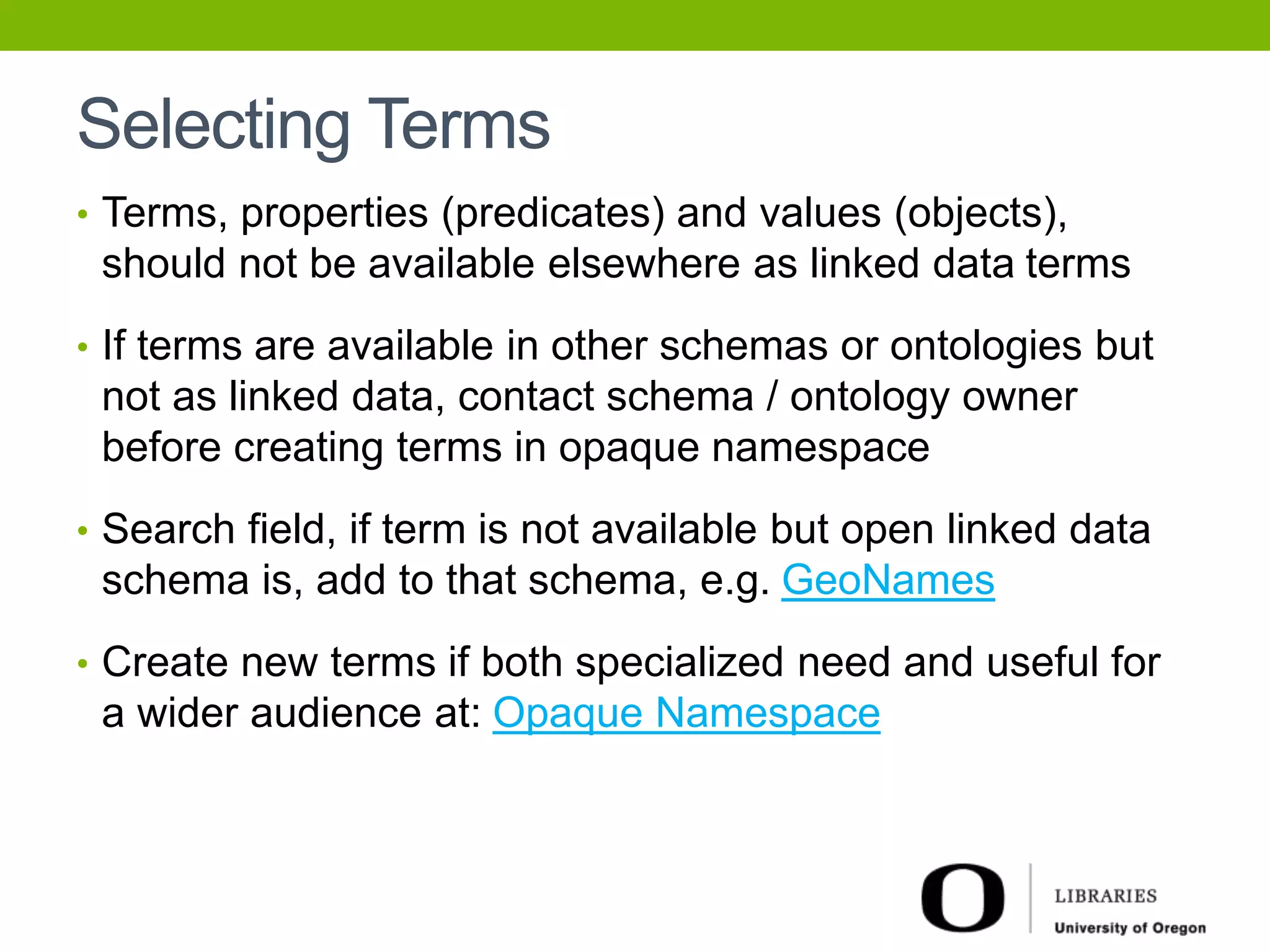
Selecting Terms 
• Terms, properties (predicates) and values (objects), 
should not be available elsewhere as linked data terms 
• If terms are available in other schemas or ontologies but 
not as linked data, contact schema / ontology owner 
before creating terms in opaque namespace 
• Search field, if term is not available but open linked data 
schema is, add to that schema, e.g. GeoNames 
• Create new terms if both specialized need and useful for 
a wider audience at: Opaque Namespace
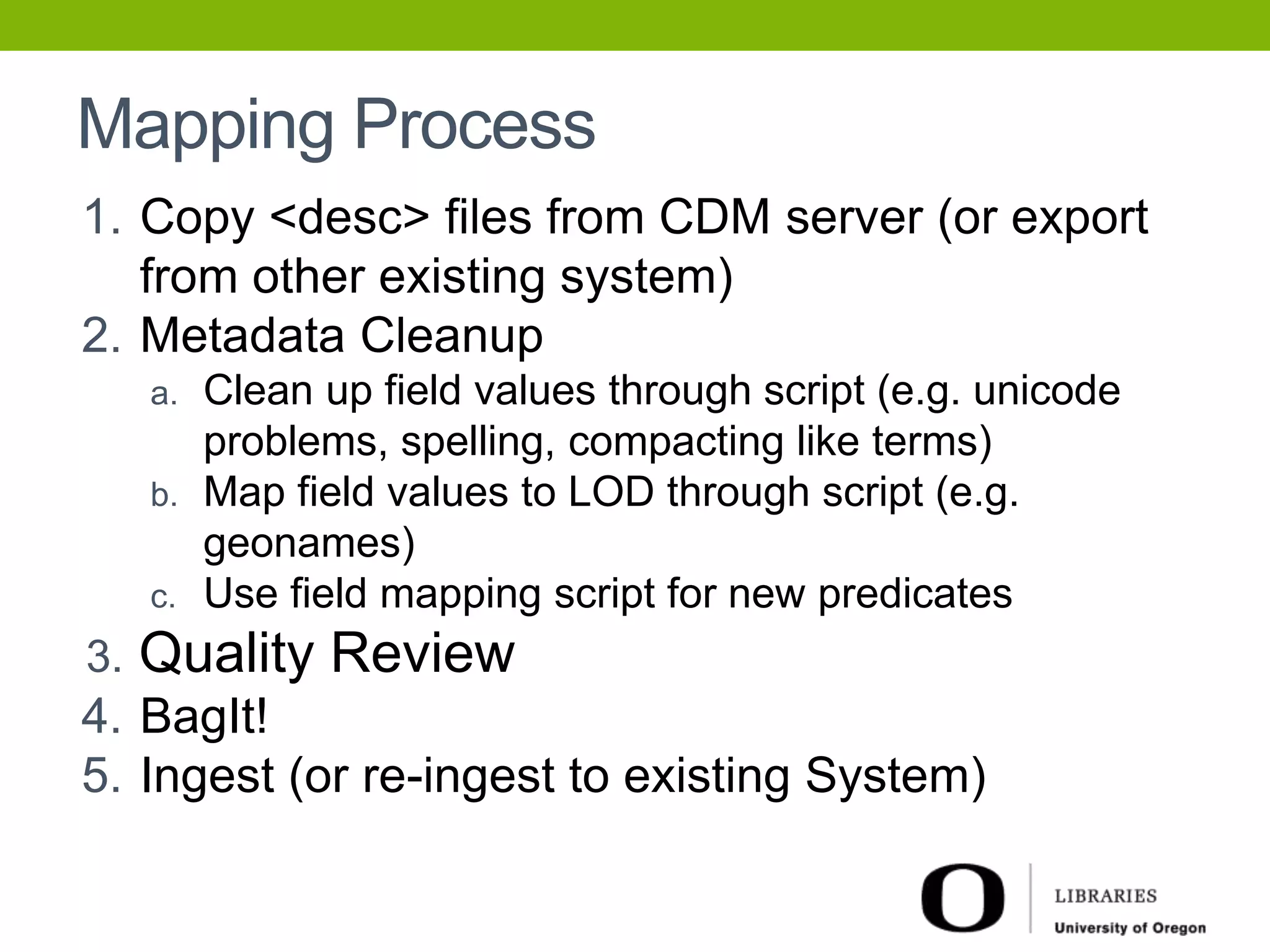
Mapping Process 
1. Copy <desc> files from CDM server (or export 
from other existing system) 
2. Metadata Cleanup 
a. Clean up field values through script (e.g. unicode 
problems, spelling, compacting like terms) 
b. Map field values to LOD through script (e.g. 
geonames) 
c. Use field mapping script for new predicates 
3. Quality Review 
4. BagIt! 
5. Ingest (or re-ingest to existing System)
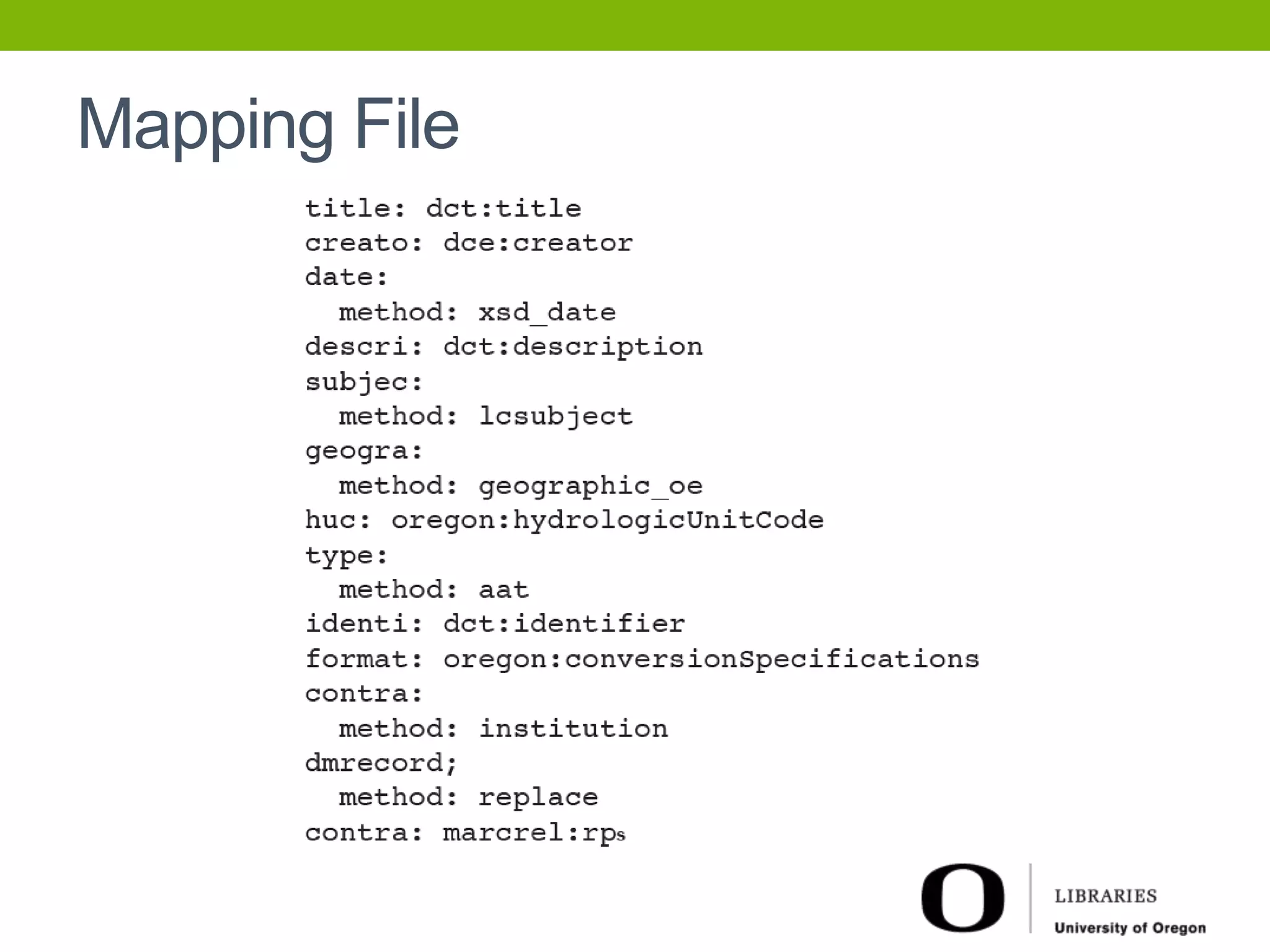
Mapping File
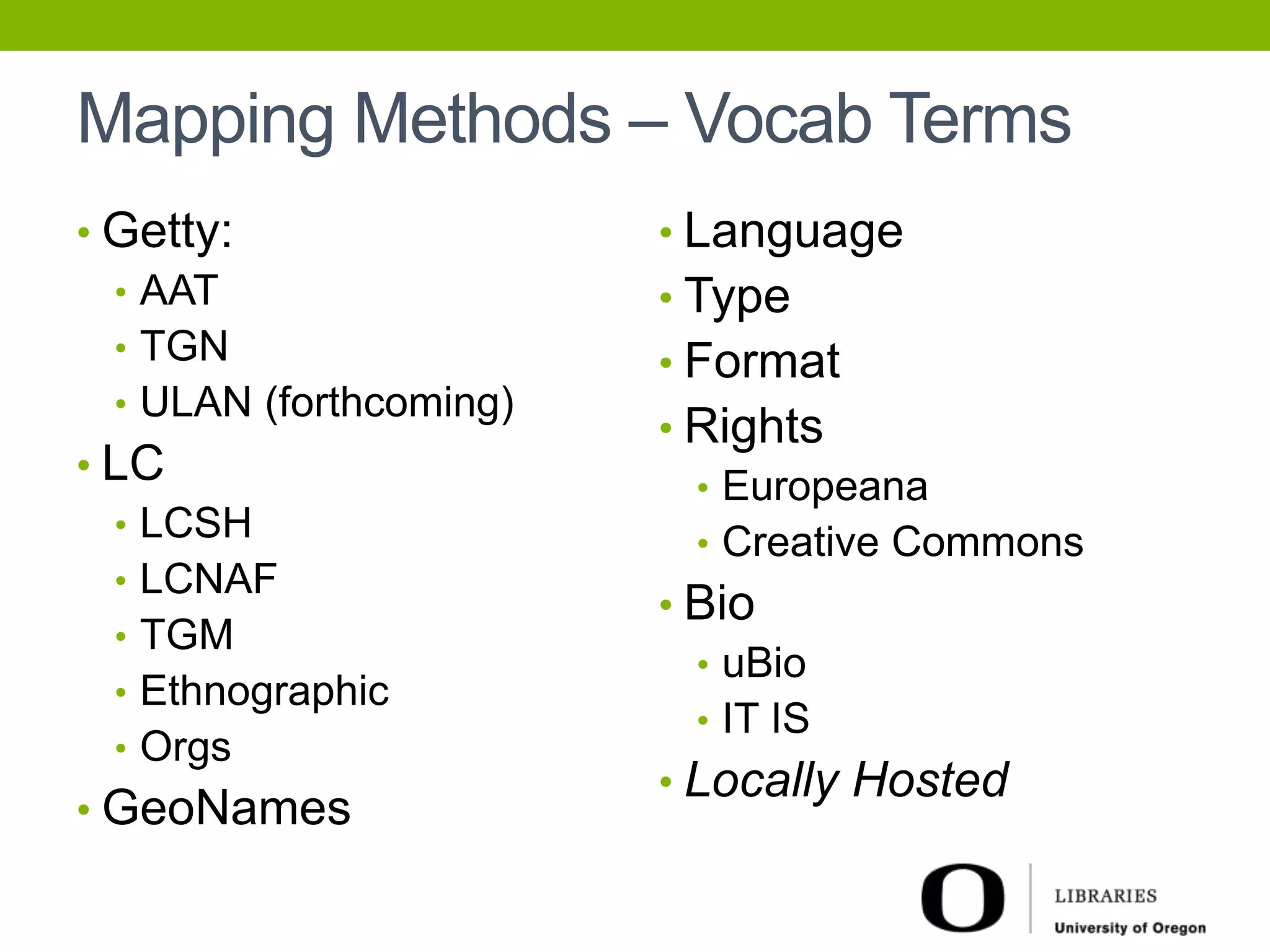
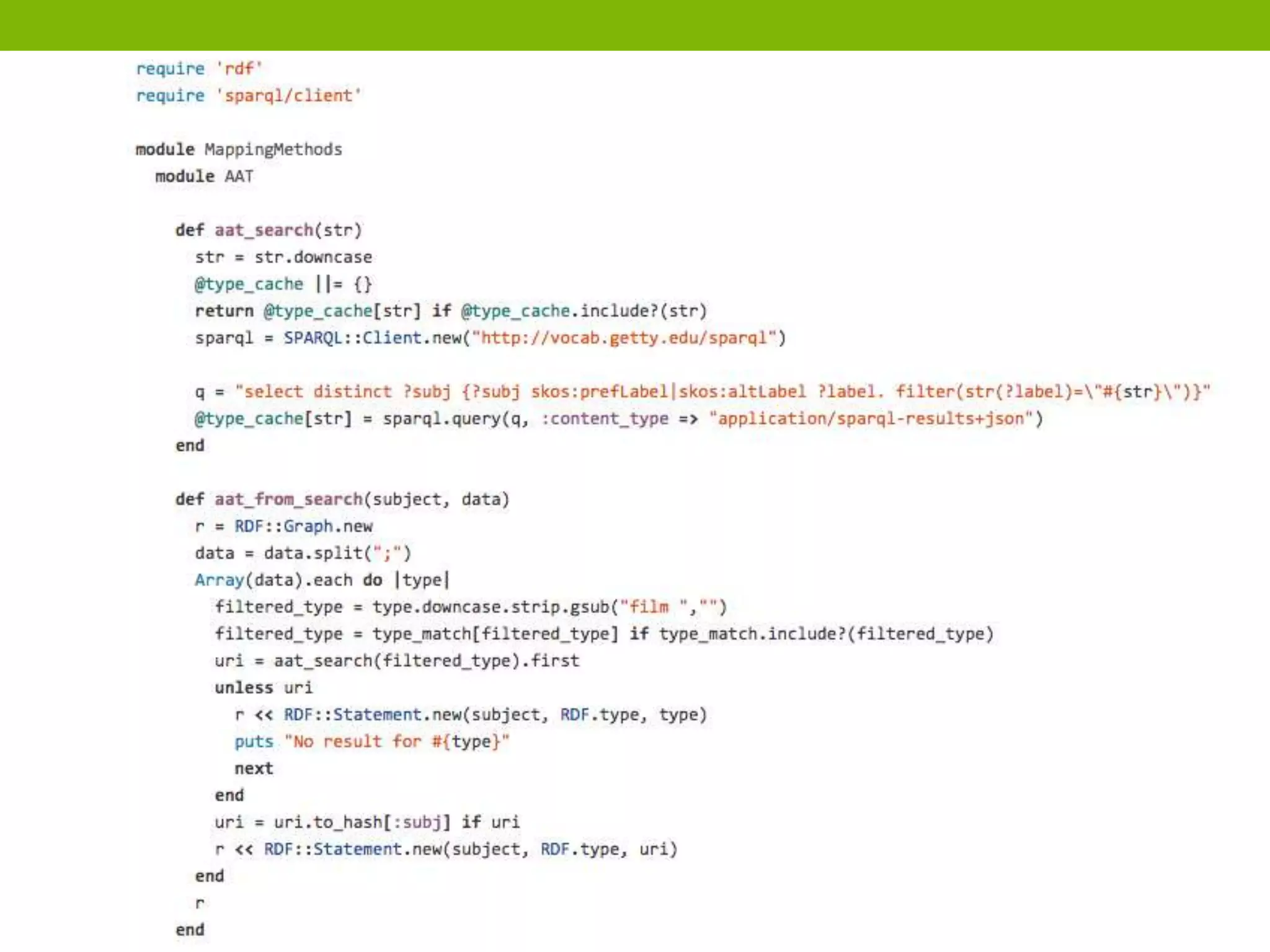
Mapping Methods – Vocab Terms 
• Getty: 
• AAT 
• TGN 
• ULAN (forthcoming) 
• LC 
• LCSH 
• LCNAF 
• TGM 
• Ethnographic 
• Orgs 
• GeoNames 
• Language 
• Type 
• Format 
• Rights 
• Europeana 
• Creative Commons 
• Bio 
• uBio 
• IT IS 
• Locally Hosted
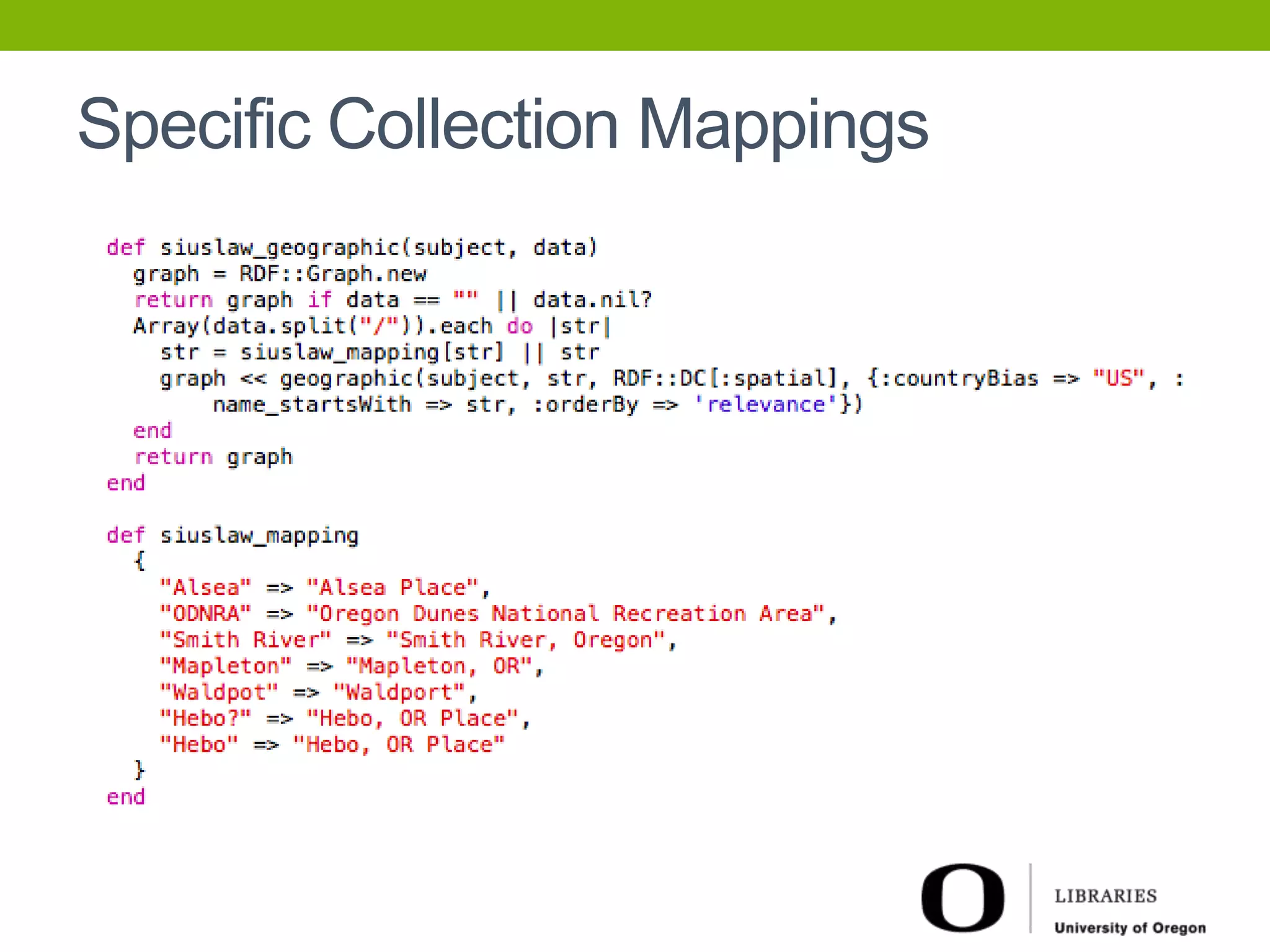
Specific Collection Mappings
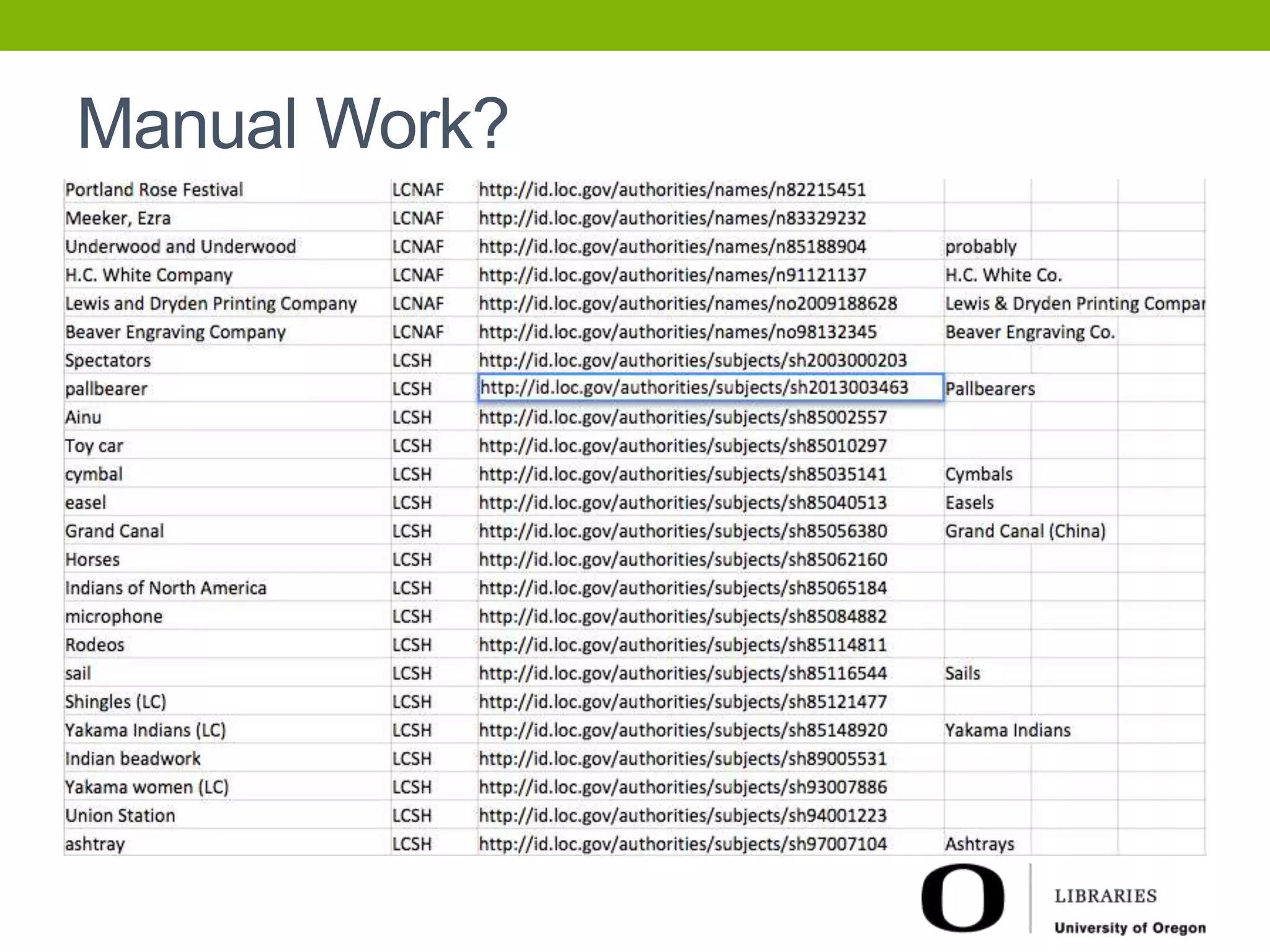
Manual Work?
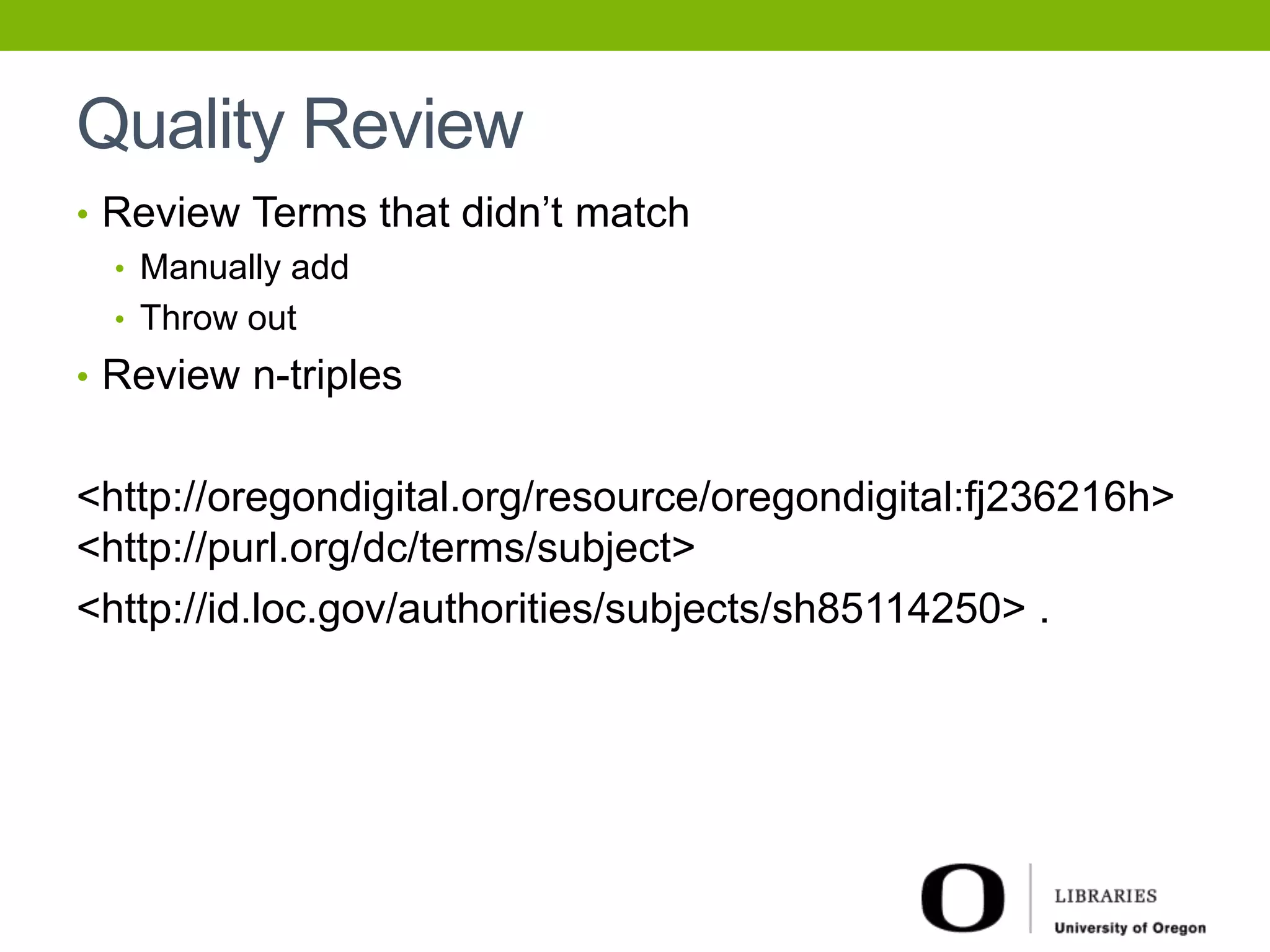
Quality Review 
• Review Terms that didn’t match 
• Manually add 
• Throw out 
• Review n-triples 
<http://oregondigital.org/resource/oregondigital:fj236216h> 
<http://purl.org/dc/terms/subject> 
<http://id.loc.gov/authorities/subjects/sh85114250> .
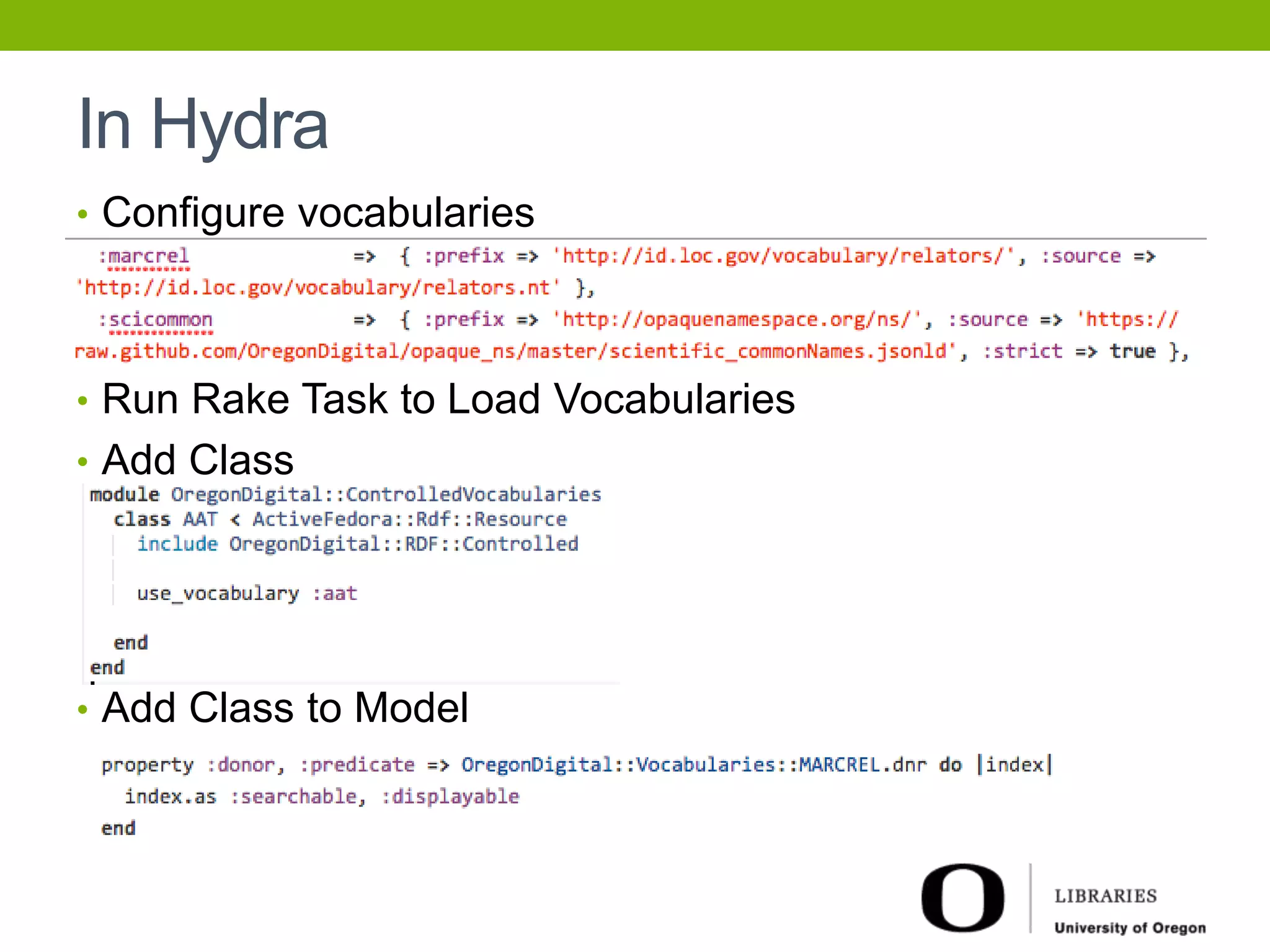
In Hydra 
• Configure vocabularies 
• Run Rake Task to Load Vocabularies 
• Add Class 
• Add Class to Model
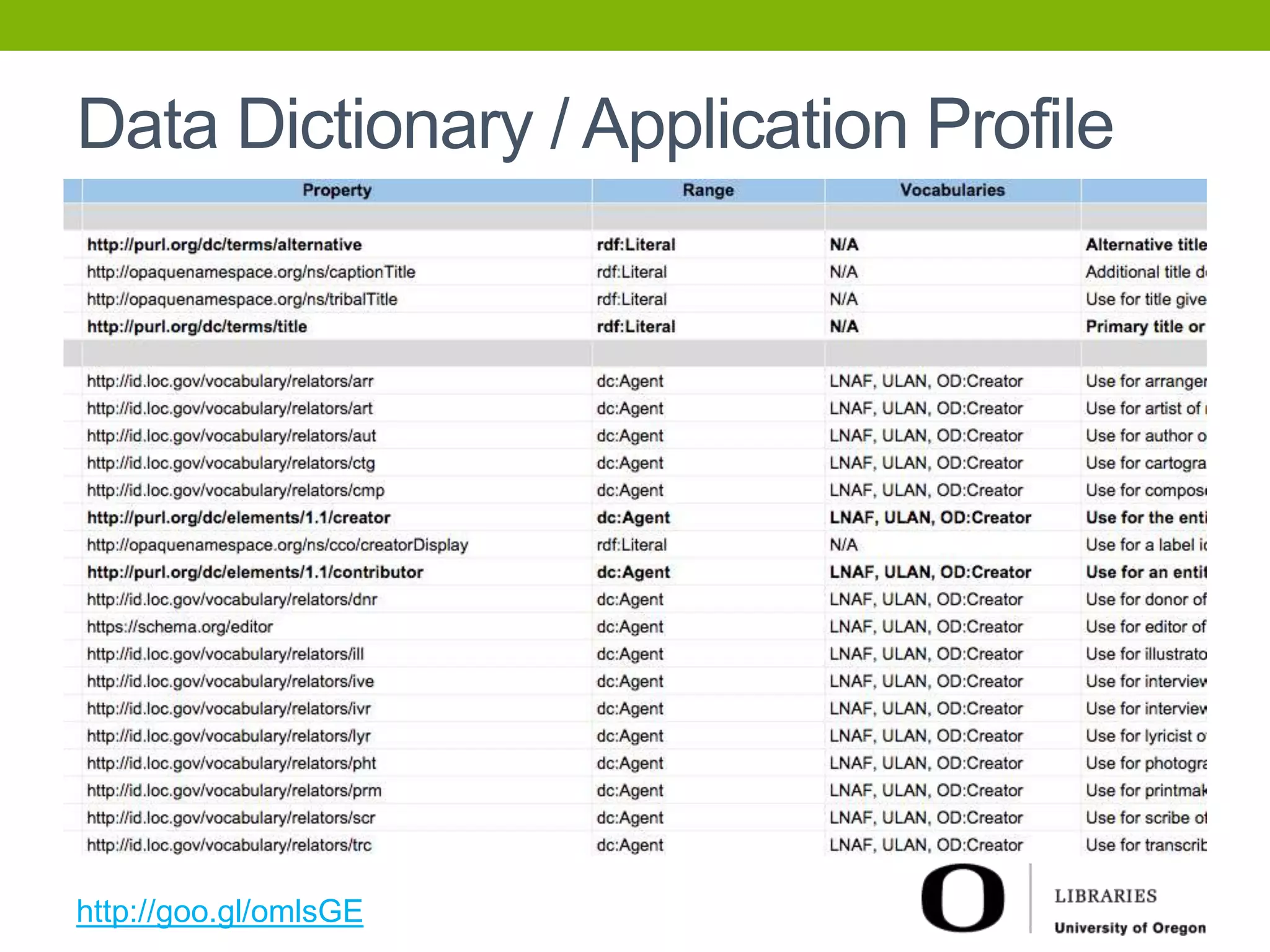
Data Dictionary / Application Profile 
http://goo.gl/omlsGE
Next Steps 
• Easy entry for new terms 
• Adding further definitions, enriching locally 
created terms 
• Making terms resolvable / hosting terms

Converting Metadata to Linked Data

  • 1.
    Converting Metadata to Linked Data Hydra Connect October 2, 2014 Special thanks to Tom Johnson, formerly of Oregon State University, (tom@dp.la) Karen Estlund, Head, Digital Scholarship Center Director, Oregon Digital Newspaper Program kestlund@uoregon.edu
  • 2.
  • 3.
    Complete Sentences SubjectPredicate Object <http://example.org/obj ect1> “My Title” <http://id.loc.gov/authoriti es/subjects/sh85114250> <http://example.org/obj ect1> <http://purl.org/dcterms/title> <http://purl.org/dc/terms/subject>
  • 4.
    Incomplete Sentences SubjectPredicate Object <http://id.loc.gov/authoriti es/subjects/sh85114250> <http://example.org/obj ect1> “Subject”
  • 5.
    New Tools forCatalogers • Git and Github shared collaboration • YML • JSONLD • Using range and domain • VIM • Bash • Python validations
  • 6.
    Linked Open DataPrinciples 1. Use URIs as names for things 2. Use HTTP URIs so that people can look up those names. 3. When someone looks up a URI, provide useful information, using the standards (RDF*, SPARQL) 4. Include links to other URIs. so that they can discover more things.
  • 7.
    Oregon Digital Principles:1 • You should not be constrained by your schema. • DarwinCore, Archives citations (folder name), Petrarch Canzionere Poem
  • 8.
    Oregon Digital Principles:2 • You are not that special. • Accepted Acronym
  • 9.
    Oregon Digital Principles:3 • You do not know everything. • Ask the communities, contact within OD collaboration and dictionary owners (so many PDF schemas out there)
  • 10.
    Oregon Digital Principles:4 • If your data isn’t reusable, shareable, and machine readable, then you’re not doing good enough.* • Follow linked open data principles
  • 11.
    Oregon Digital Principles:5 • Use exemplary behavior and reuse from others so that they may also reuse from you. • We do not need to create an oregon:title predicate
  • 12.
    Previous Status ofFields (Predicates)
  • 13.
    Selecting Terms •Terms, properties (predicates) and values (objects), should not be available elsewhere as linked data terms • If terms are available in other schemas or ontologies but not as linked data, contact schema / ontology owner before creating terms in opaque namespace • Search field, if term is not available but open linked data schema is, add to that schema, e.g. GeoNames • Create new terms if both specialized need and useful for a wider audience at: Opaque Namespace
  • 14.
    Mapping Process 1.Copy <desc> files from CDM server (or export from other existing system) 2. Metadata Cleanup a. Clean up field values through script (e.g. unicode problems, spelling, compacting like terms) b. Map field values to LOD through script (e.g. geonames) c. Use field mapping script for new predicates 3. Quality Review 4. BagIt! 5. Ingest (or re-ingest to existing System)
  • 15.
  • 16.
    Mapping Methods –Vocab Terms • Getty: • AAT • TGN • ULAN (forthcoming) • LC • LCSH • LCNAF • TGM • Ethnographic • Orgs • GeoNames • Language • Type • Format • Rights • Europeana • Creative Commons • Bio • uBio • IT IS • Locally Hosted
  • 18.
  • 19.
  • 20.
    Quality Review •Review Terms that didn’t match • Manually add • Throw out • Review n-triples <http://oregondigital.org/resource/oregondigital:fj236216h> <http://purl.org/dc/terms/subject> <http://id.loc.gov/authorities/subjects/sh85114250> .
  • 21.
    In Hydra •Configure vocabularies • Run Rake Task to Load Vocabularies • Add Class • Add Class to Model
  • 22.
    Data Dictionary /Application Profile http://goo.gl/omlsGE
  • 23.
    Next Steps •Easy entry for new terms • Adding further definitions, enriching locally created terms • Making terms resolvable / hosting terms

Editor's Notes

  • #2 See: https://github.com/OregonDigital/cdm2bag, https://github.com/OregonDigital/opaque_ns, http://goo.gl/omlsGE
  • #3 Misunderstandings on hand coding Type-ahead vs. direct look-up Human & Human Machine vs. Human Machine & Human
  • #7 Not quite there, yet.
  • #8 Note: we’re not doing good enough yet, either You should not be constrained by your schema. DarwinCore, Archives citations (box), Petrarch Canzionere Poem You are not that special. Accepted Acronym You do not know everything. Ask the communities, contact within OD collaboration and dictionary owners (so many PDF schemas out there) If your data isn’t reusable, shareable, and machine readable, then you’re not doing good enough.* Follow linked open data principles Use exemplary behavior and reuse from others so that they may also reuse from you. We do not need to create an oregon:title predicate
  • #15 2. Map to full resolution files (if applicable) – in migration process
  • #20 (old environment to new)
  • #22 https://github.com/OregonDigital/oregondigital/wiki/Add-Controlled-Vocabularies-&-Properties
  • #23 150+ terms