
Lecture 5
Factors of Production
What is Production?
• Production is sometimes defined as
  – The creation of want-satisfying goods and services
  – But this is not a scientifically correct definition as
    to produce as thing which has utility but not value
    is not production in economic sense

• Production therefore, should be defined as
  – Creation or addition of value

• Production essentially means transformation
  of one set of goods into another
Factors of Production
• Productive resources required to produce a given
  product are called factors of production

• These productive resources may be raw materials or
  services of the various categories of workers or of
  entrepreneurs (assembling the factors and organizing
  the work of production)

• The factors of production are traditionally classified as
  Land, Labour, Capital and Organization (or Enterprise)
   – These factors are complementary in the sense that their
     cooperation or combination is essential in production
     process
Land
• The term ‘land’ has special meaning in
  Economics
  – It does not mean soil a in the ordinary speech
  – According to Marshall, land means
     • The materials and forces which nature gives freely for
       man’s aid

     • Land stands for all natural resources which yield an
       income or which have exchange value
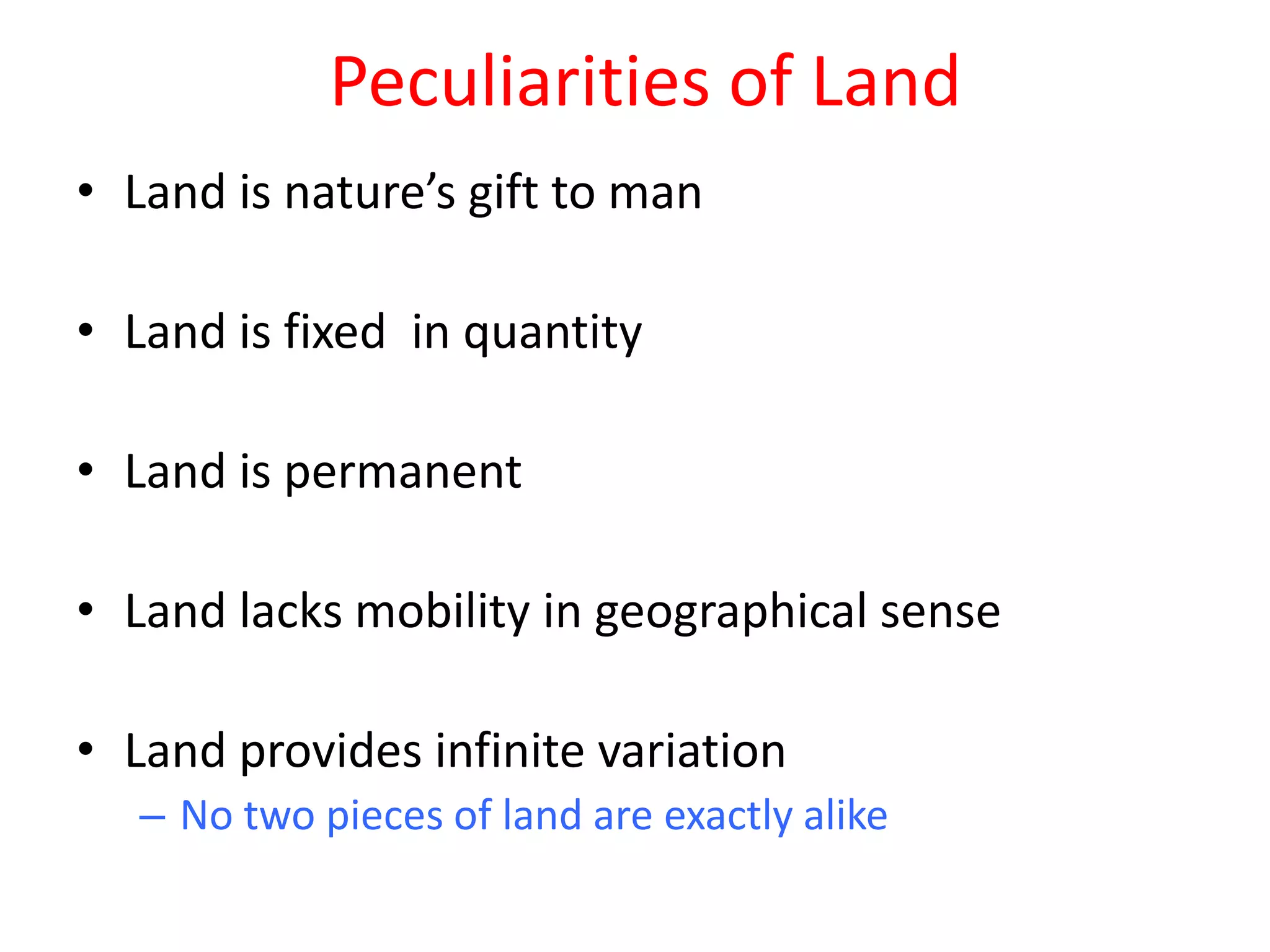
Peculiarities of Land
• Land is nature’s gift to man

• Land is fixed in quantity

• Land is permanent

• Land lacks mobility in geographical sense

• Land provides infinite variation
   – No two pieces of land are exactly alike
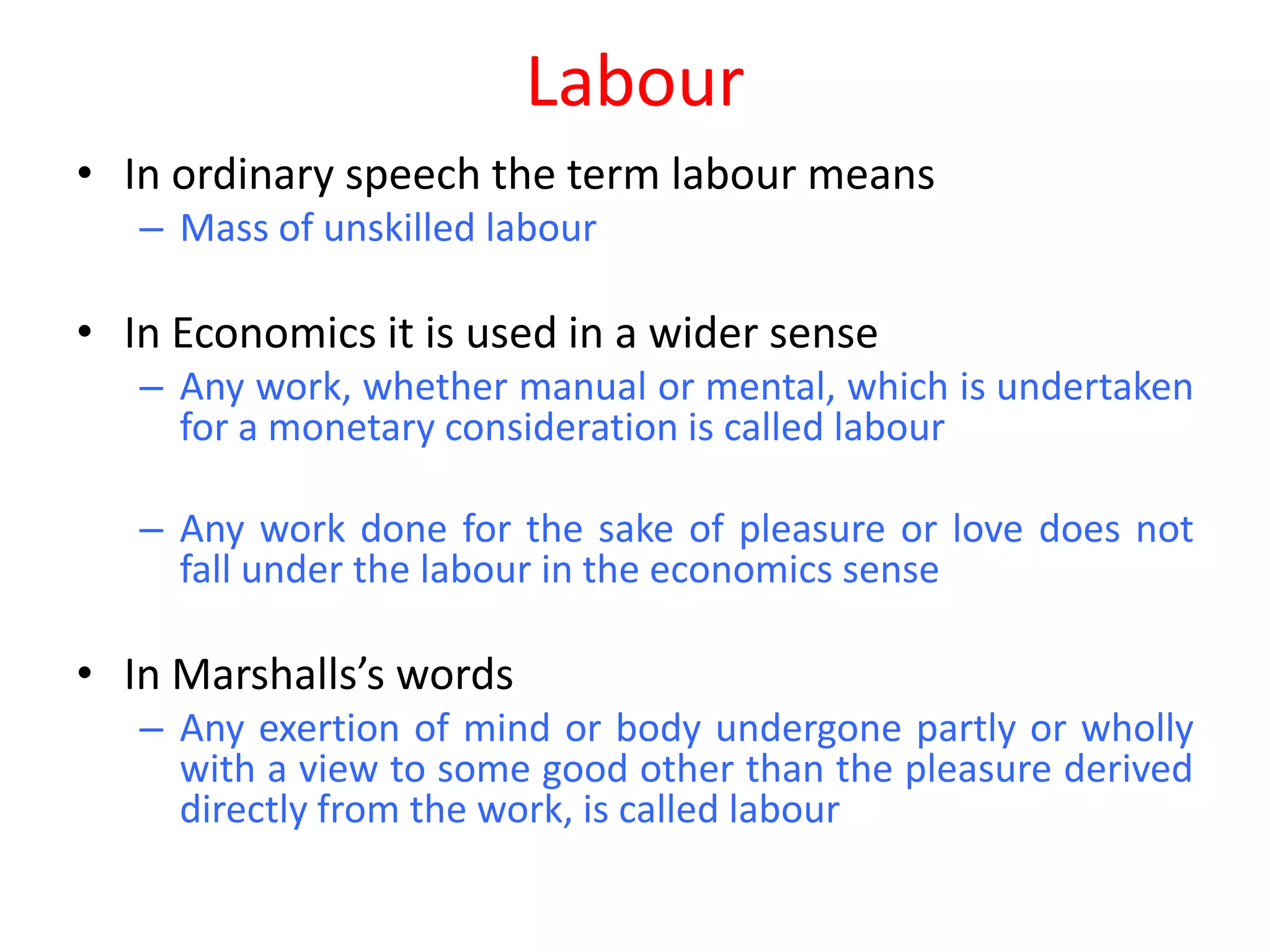
Labour
• In ordinary speech the term labour means
   – Mass of unskilled labour

• In Economics it is used in a wider sense
   – Any work, whether manual or mental, which is undertaken
     for a monetary consideration is called labour

   – Any work done for the sake of pleasure or love does not
     fall under the labour in the economics sense

• In Marshalls’s words
   – Any exertion of mind or body undergone partly or wholly
     with a view to some good other than the pleasure derived
     directly from the work, is called labour
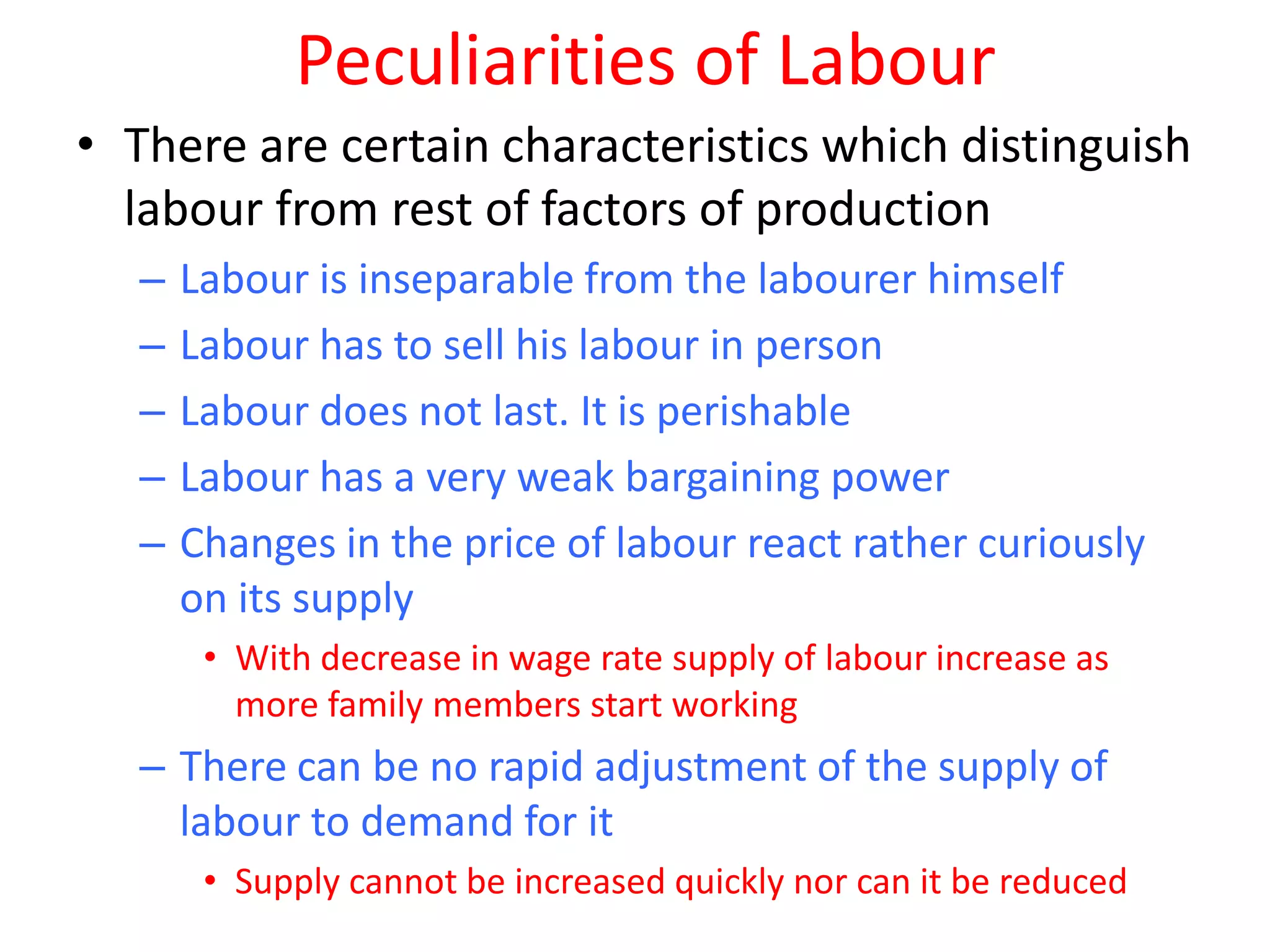
Peculiarities of Labour
• There are certain characteristics which distinguish
  labour from rest of factors of production
   –   Labour is inseparable from the labourer himself
   –   Labour has to sell his labour in person
   –   Labour does not last. It is perishable
   –   Labour has a very weak bargaining power
   –   Changes in the price of labour react rather curiously
       on its supply
        • With decrease in wage rate supply of labour increase as
          more family members start working
   – There can be no rapid adjustment of the supply of
     labour to demand for it
        • Supply cannot be increased quickly nor can it be reduced
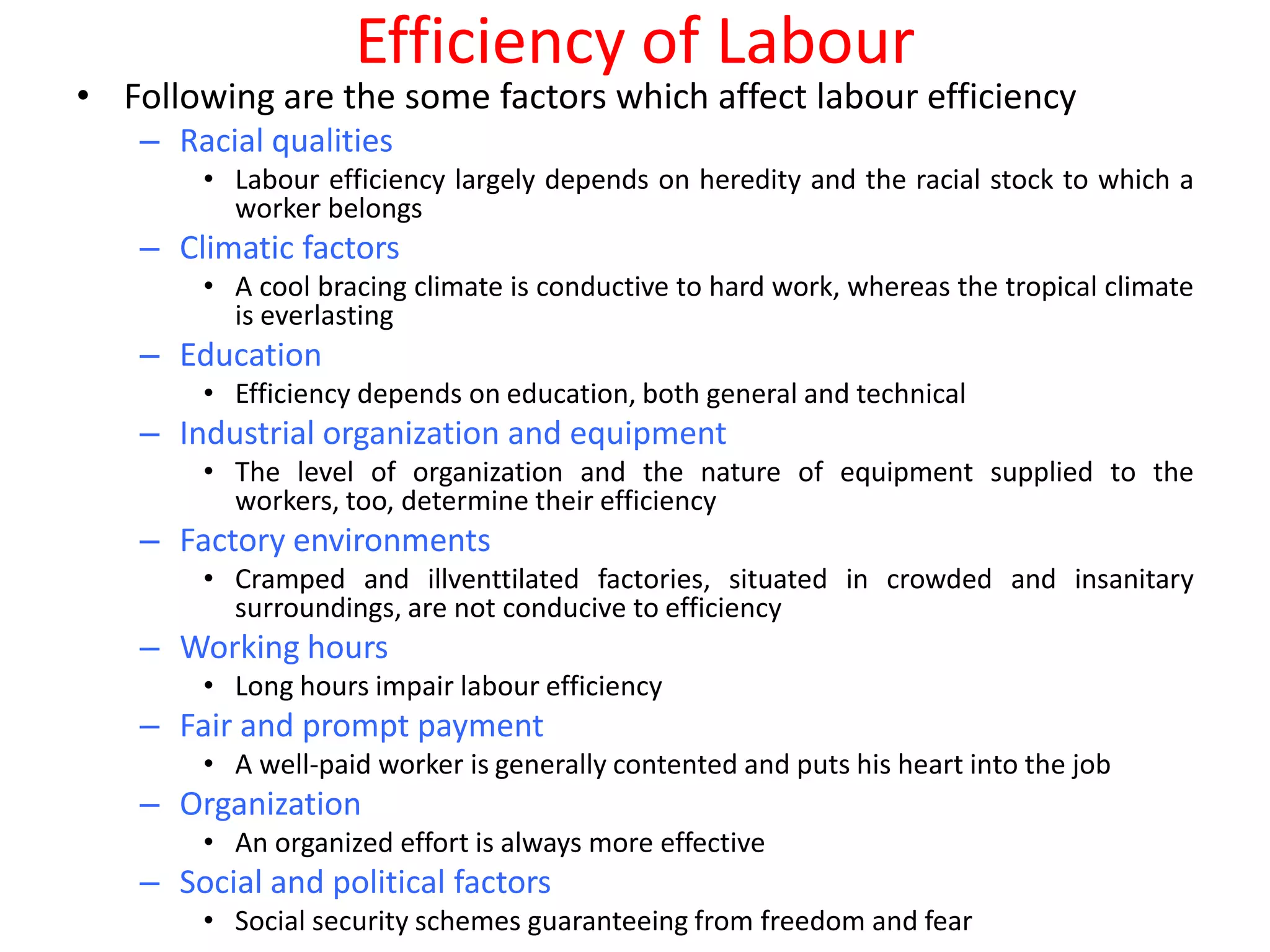
Efficiency of Labour
• Following are the some factors which affect labour efficiency
   – Racial qualities
       • Labour efficiency largely depends on heredity and the racial stock to which a
         worker belongs
   – Climatic factors
       • A cool bracing climate is conductive to hard work, whereas the tropical climate
         is everlasting
   – Education
       • Efficiency depends on education, both general and technical
   – Industrial organization and equipment
       • The level of organization and the nature of equipment supplied to the
         workers, too, determine their efficiency
   – Factory environments
       • Cramped and illventtilated factories, situated in crowded and insanitary
         surroundings, are not conducive to efficiency
   – Working hours
       • Long hours impair labour efficiency
   – Fair and prompt payment
       • A well-paid worker is generally contented and puts his heart into the job
   – Organization
       • An organized effort is always more effective
   – Social and political factors
       • Social security schemes guaranteeing from freedom and fear
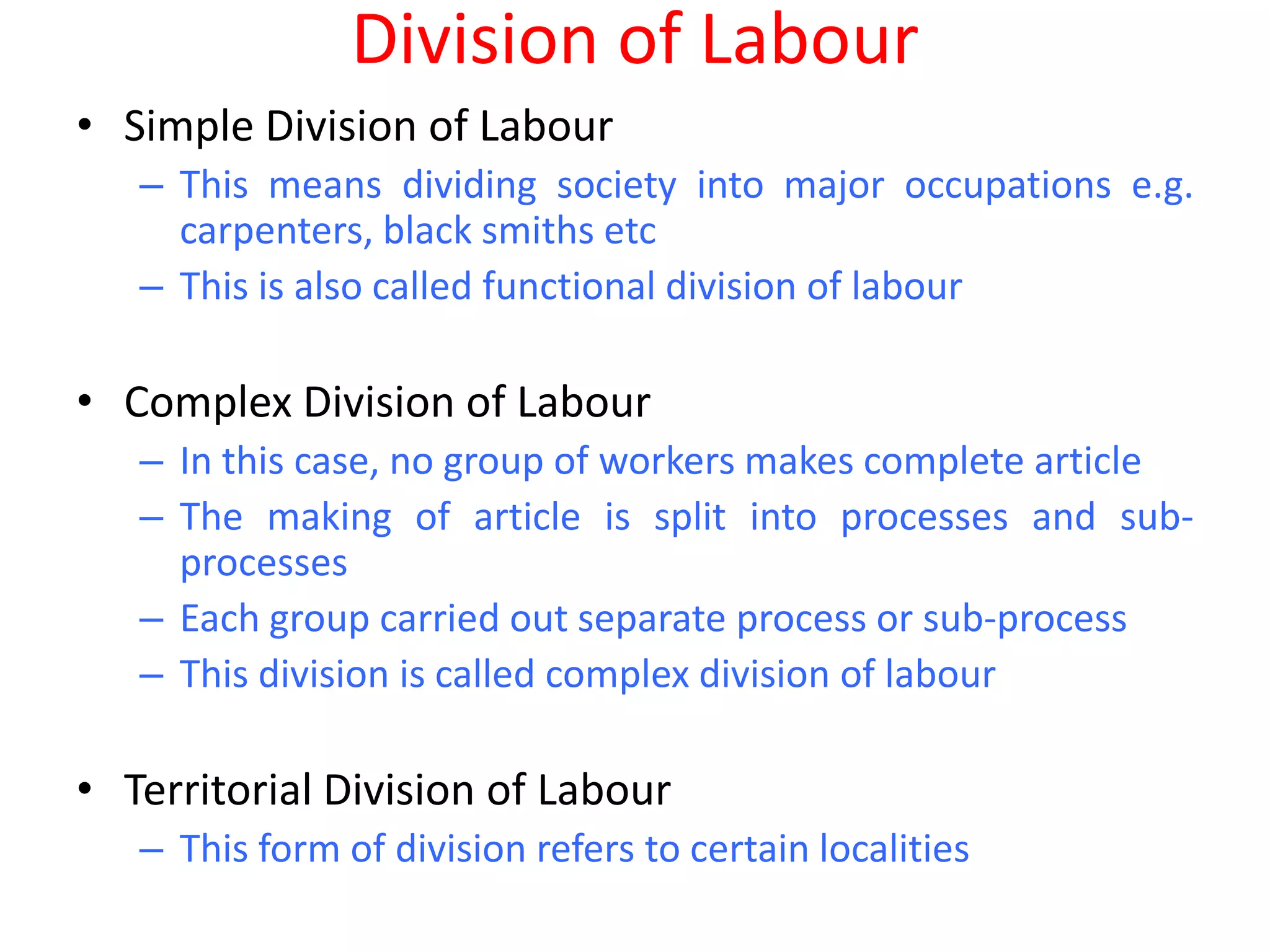
Division of Labour
• Simple Division of Labour
   – This means dividing society into major occupations e.g.
     carpenters, black smiths etc
   – This is also called functional division of labour

• Complex Division of Labour
   – In this case, no group of workers makes complete article
   – The making of article is split into processes and sub-
     processes
   – Each group carried out separate process or sub-process
   – This division is called complex division of labour

• Territorial Division of Labour
   – This form of division refers to certain localities
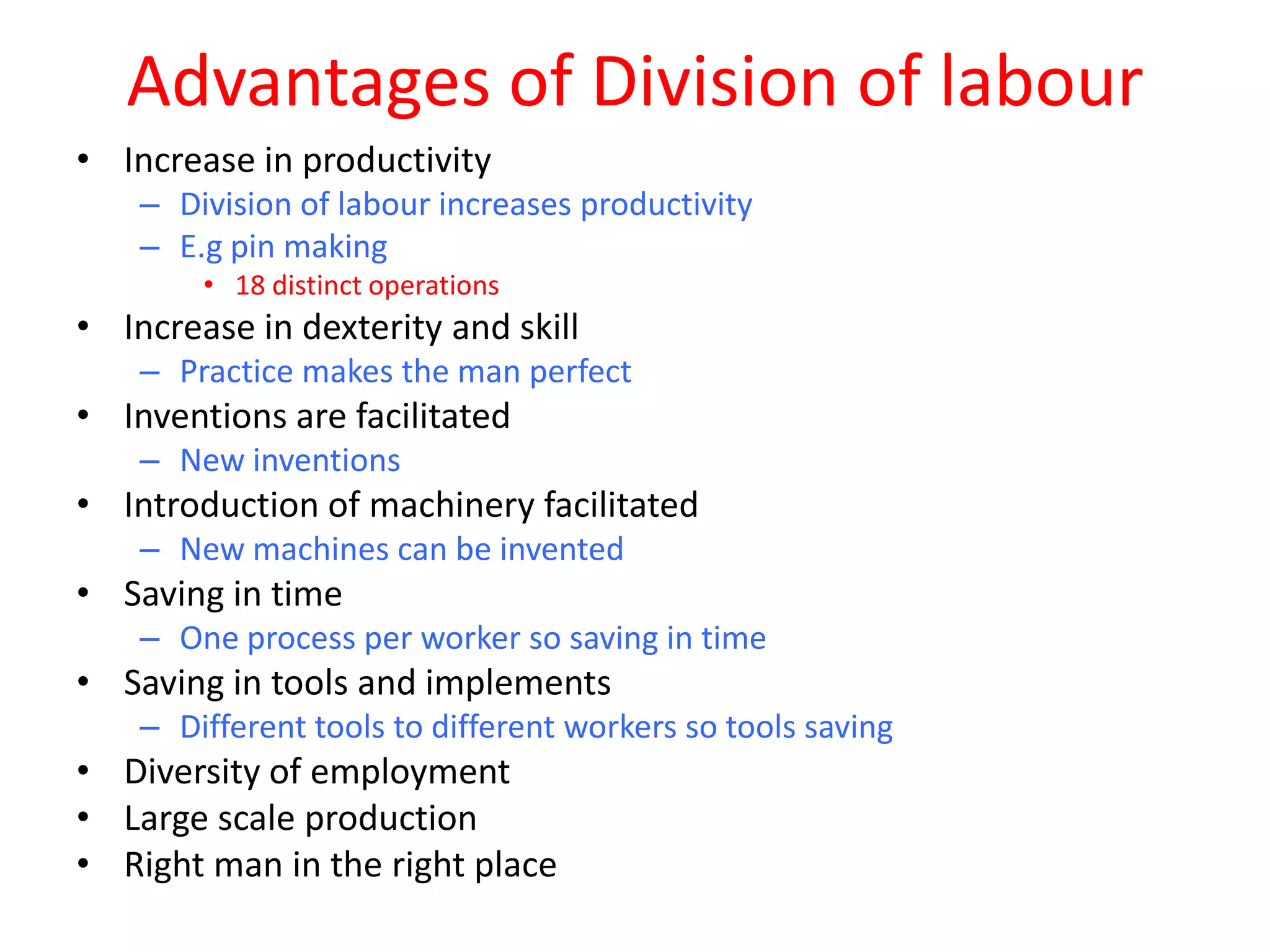
Advantages of Division of labour
• Increase in productivity
    – Division of labour increases productivity
    – E.g pin making
        • 18 distinct operations
• Increase in dexterity and skill
    – Practice makes the man perfect
• Inventions are facilitated
    – New inventions
• Introduction of machinery facilitated
    – New machines can be invented
• Saving in time
    – One process per worker so saving in time
• Saving in tools and implements
    – Different tools to different workers so tools saving
• Diversity of employment
• Large scale production
• Right man in the right place
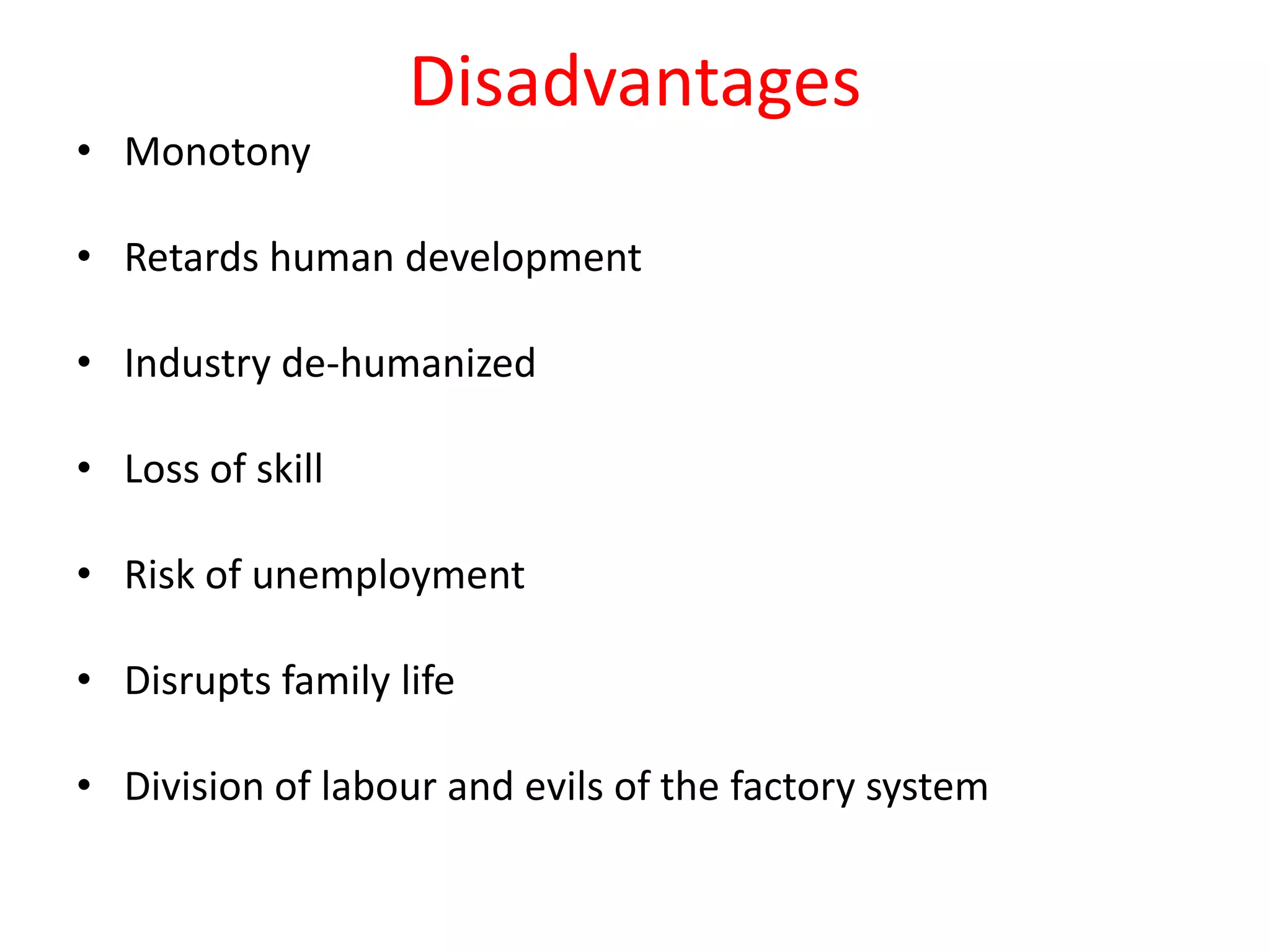
Disadvantages
• Monotony

• Retards human development

• Industry de-humanized

• Loss of skill

• Risk of unemployment

• Disrupts family life

• Division of labour and evils of the factory system
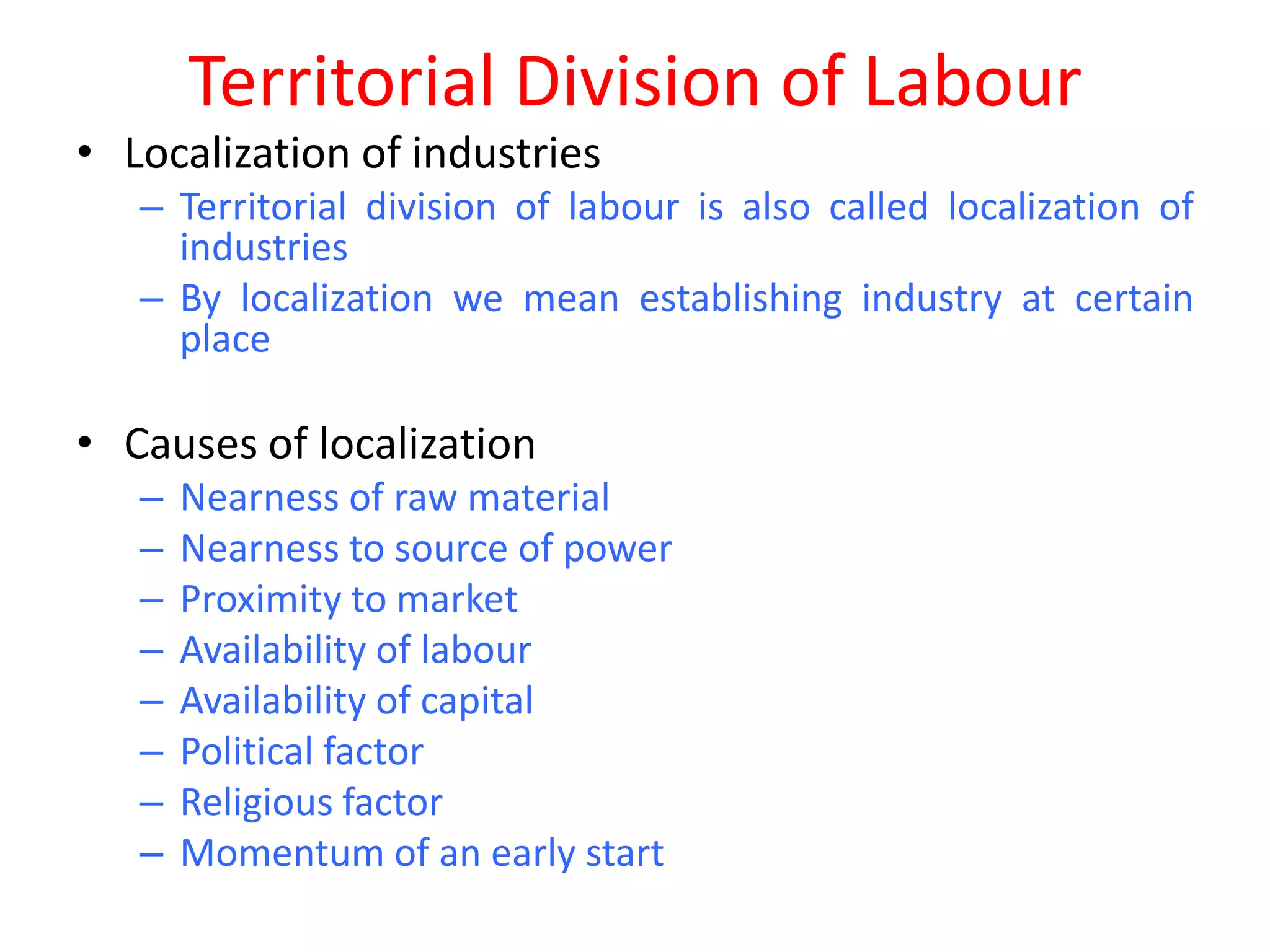
Territorial Division of Labour
• Localization of industries
   – Territorial division of labour is also called localization of
     industries
   – By localization we mean establishing industry at certain
     place

• Causes of localization
   –   Nearness of raw material
   –   Nearness to source of power
   –   Proximity to market
   –   Availability of labour
   –   Availability of capital
   –   Political factor
   –   Religious factor
   –   Momentum of an early start
Capital
• Capital refers to that part of the man’s wealth
  which is used to produce further wealth or
  which yields income

• The term capital is used generally for capital
  goods
  – Plant and machinery
  – Tools and accessories
  – Raw material
  – fuel
Capital Formation
• Capital formation means
  – Increase in the stock of real capital in a country

• In other words
  – capital formation involves making of more capital
    goods such as machines, tools, factories, transport
    facilities

• It means that
  – society does not apply the whole of its current
    productive activity to the desires of immediate
    consumption
  – but directs part of it to the making of capital goods
Stages of Capital Formation
• Creation of savings
  – Depends on power to save and will to save
  – Further depends on level of national income


• Mobilization of savings
  – Mobilizing saving for investment by entrepreneurs


• Investment of savings on real capital
  – Incentive to invest on real capital
Enterprise
• Entrepreneur's Role
  – Coordinating and correlating the other factors of
    production
  – Organizing and risk-taking or uncertainty bearing

• Functions of Entrepreneurs
  – Initiating a business enterprise by mobilizing and
    harnessing the necessary productive resources
  – Taking the final responsibility of the business
    enterprise – risk taking and uncertainty bearing
  – The entrepreneur’s role as innovator
Population Theories
Population Theories
• An economy supports population,             but
  population too support the economy
  – It is the aim of an economy to supply people’s
    wants for goods and services
  – but the people too make an important
    contribution to the productive capacity of an
    economy

• There are two well-known theories
  – Malthusian Theory
  – Optimum Theory
Malthusian Theory
• Thomas Robert Malthus wrote his “Essay on
  Principle of Population” in 1798 and modified
  some of his conclusions in 1803.

• The rapidly increasing population of England
  feared him and he tried to warn his countrymen

• By nature human food increases in a slow
  arithmetical ratio; man himself increases with
  quick geometrical ratio unless want and vice stop
  him
Four Propositions
• The theory propounded by Malthus can be reduced                               to the
  following four proposition:
   – Food is necessary to the life of man and therefore, exercises a strong
     check on population.
       • Greater the food greater would be the population
   – Human population increases faster than food production
       • Malthus asserted that the population of a country tends to be double every
         twenty five years but the food supply could be increased much less rapidly
   – Population always increases when the means of subsistence increase
     unless prevented by some powerful and obvious checks
       • As the supply of food increases people will more children
   – There are two types of checks
       • Preventive checks
            – Bringing down the birth rate
       • Positive checks
            – Increasing death rates
       • If preventive checks will not be adopted then positive checks will be there
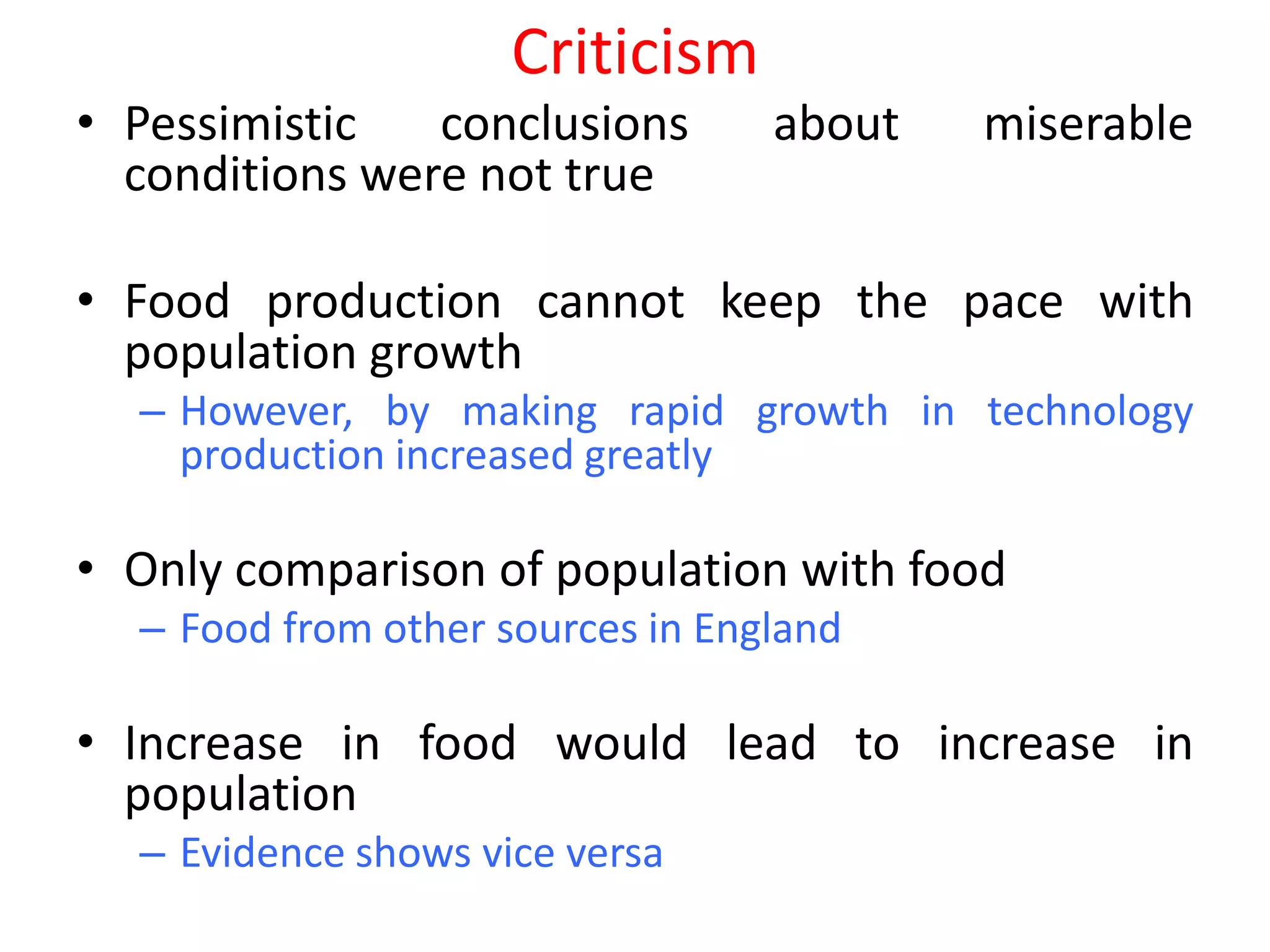
Criticism
• Pessimistic   conclusions       about   miserable
  conditions were not true

• Food production cannot keep the pace with
  population growth
  – However, by making rapid growth in technology
    production increased greatly

• Only comparison of population with food
  – Food from other sources in England

• Increase in food would lead to increase in
  population
  – Evidence shows vice versa
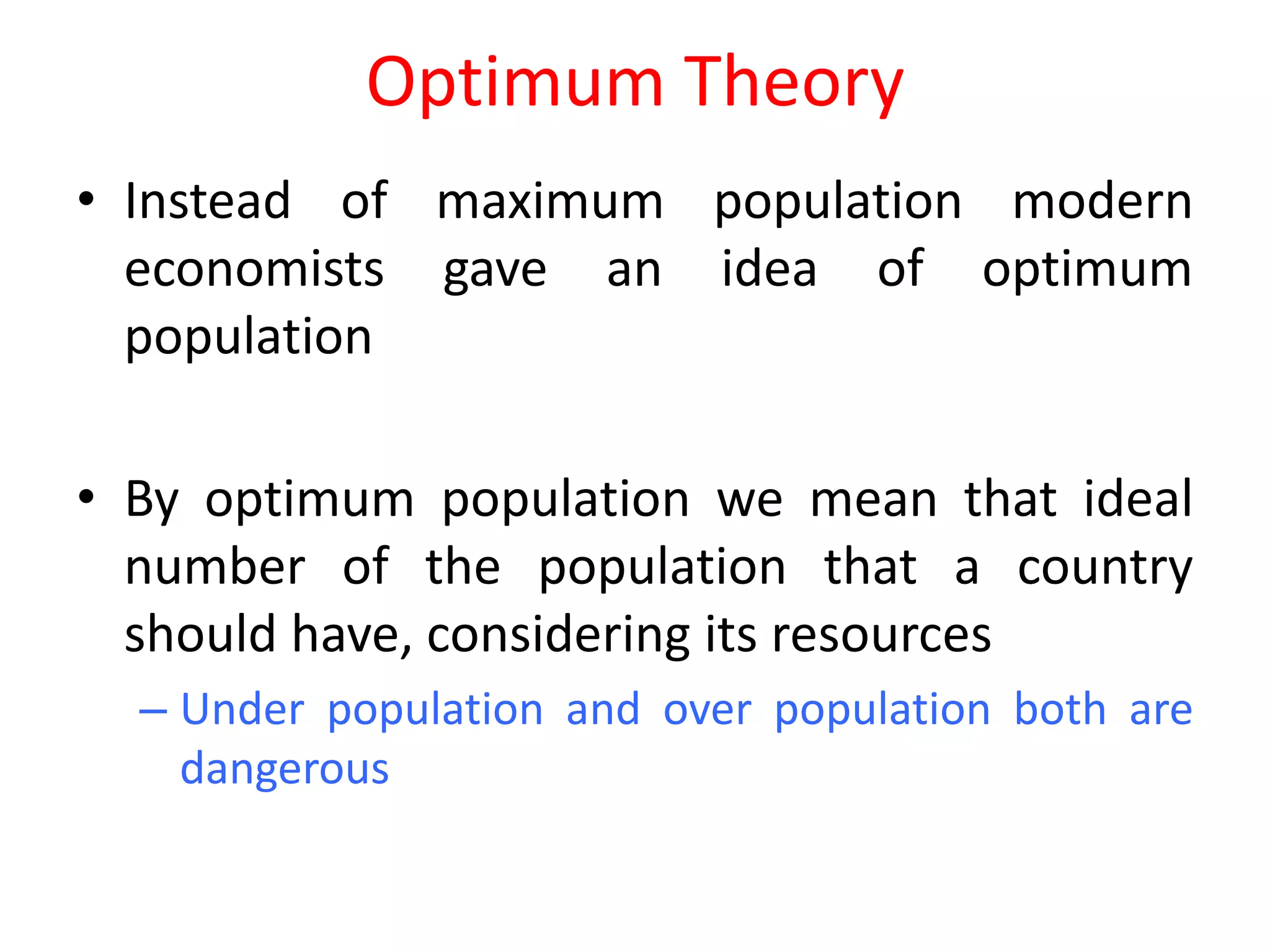
Optimum Theory
• Instead of maximum population modern
  economists gave an idea of optimum
  population

• By optimum population we mean that ideal
  number of the population that a country
  should have, considering its resources
  – Under population and over population both are
    dangerous
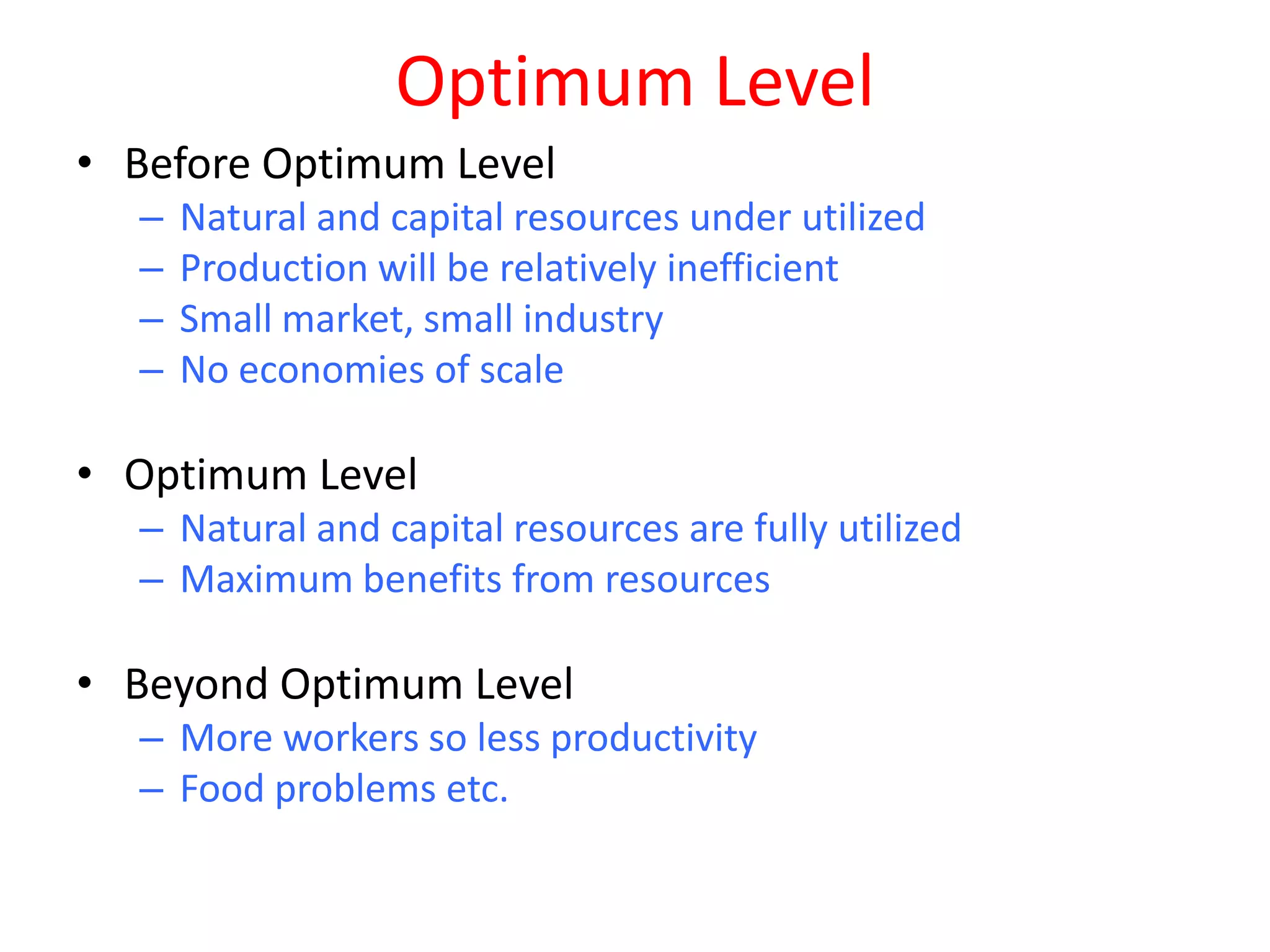
Optimum Level
• Before Optimum Level
  –   Natural and capital resources under utilized
  –   Production will be relatively inefficient
  –   Small market, small industry
  –   No economies of scale

• Optimum Level
  – Natural and capital resources are fully utilized
  – Maximum benefits from resources

• Beyond Optimum Level
  – More workers so less productivity
  – Food problems etc.
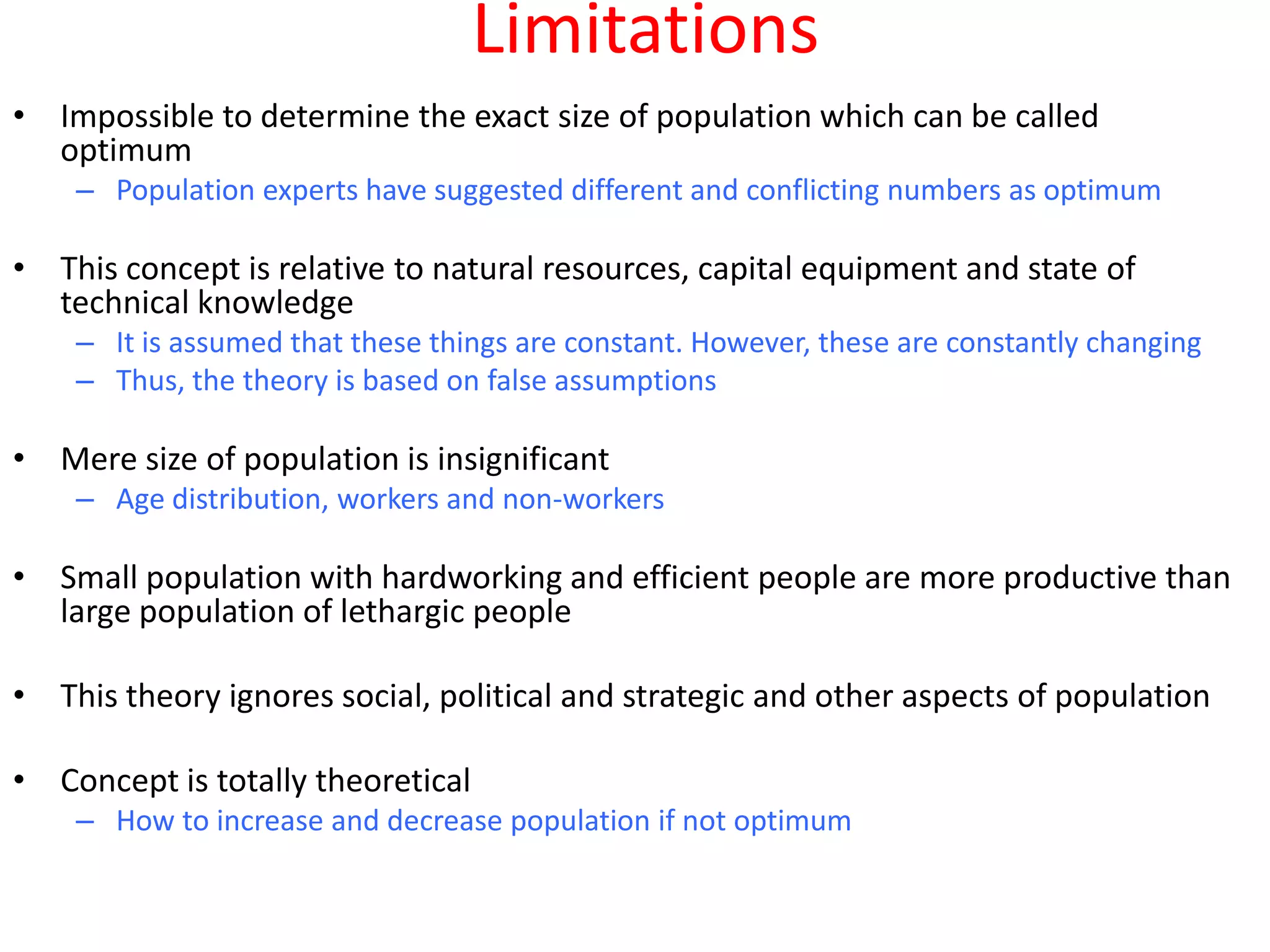
Limitations
• Impossible to determine the exact size of population which can be called
  optimum
    – Population experts have suggested different and conflicting numbers as optimum

• This concept is relative to natural resources, capital equipment and state of
  technical knowledge
    – It is assumed that these things are constant. However, these are constantly changing
    – Thus, the theory is based on false assumptions

• Mere size of population is insignificant
    – Age distribution, workers and non-workers

• Small population with hardworking and efficient people are more productive than
  large population of lethargic people

• This theory ignores social, political and strategic and other aspects of population

• Concept is totally theoretical
    – How to increase and decrease population if not optimum
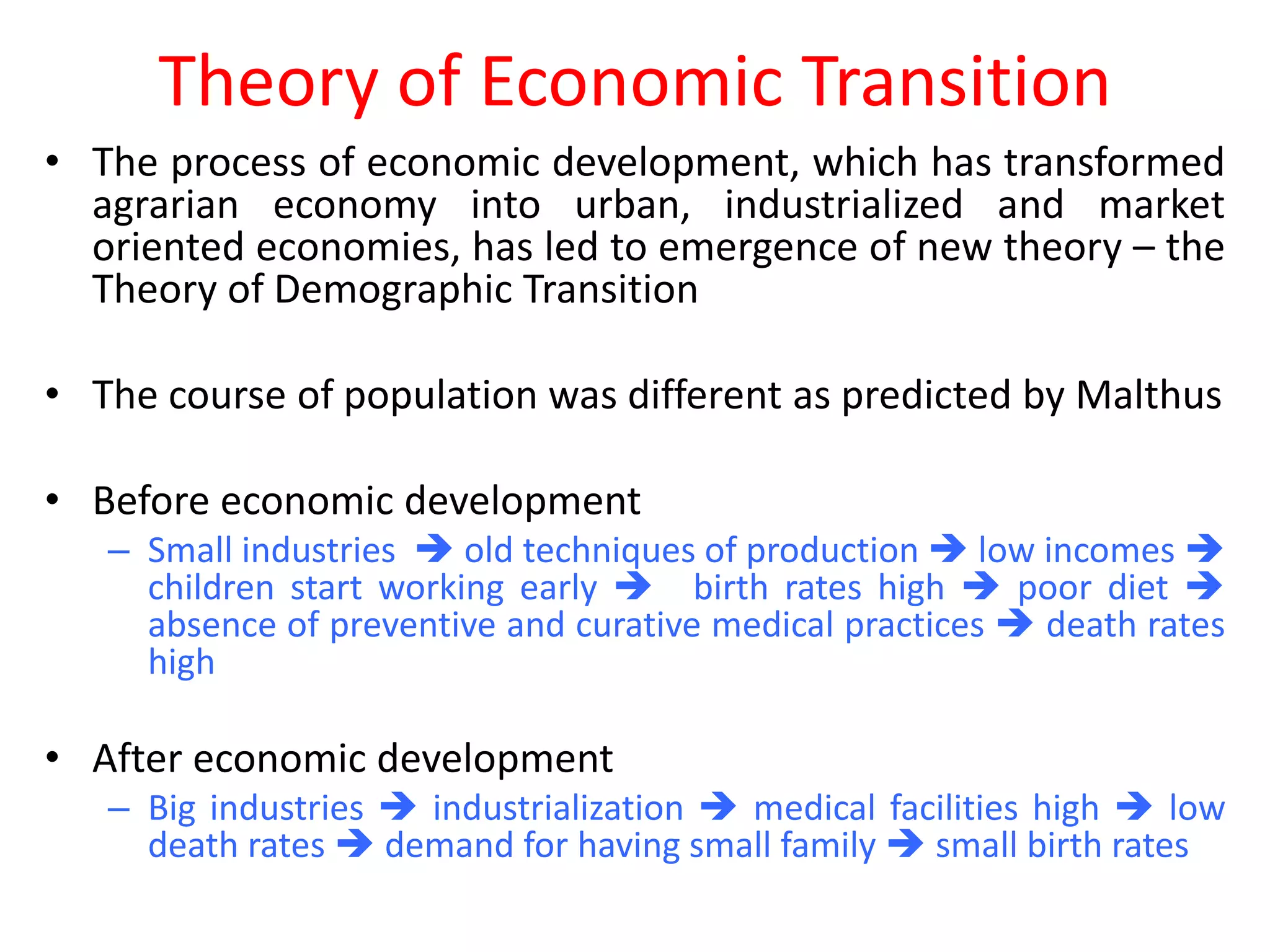
Theory of Economic Transition
• The process of economic development, which has transformed
  agrarian economy into urban, industrialized and market
  oriented economies, has led to emergence of new theory – the
  Theory of Demographic Transition

• The course of population was different as predicted by Malthus

• Before economic development
   – Small industries  old techniques of production  low incomes 
     children start working early  birth rates high  poor diet 
     absence of preventive and curative medical practices  death rates
     high

• After economic development
   – Big industries  industrialization  medical facilities high  low
     death rates  demand for having small family  small birth rates
Thank you


      QUIZ
   in Next class
Chapter 6, 7 and 11

Lecture 5

  • 1.
  • 2.
    What is Production? •Production is sometimes defined as – The creation of want-satisfying goods and services – But this is not a scientifically correct definition as to produce as thing which has utility but not value is not production in economic sense • Production therefore, should be defined as – Creation or addition of value • Production essentially means transformation of one set of goods into another
  • 3.
    Factors of Production •Productive resources required to produce a given product are called factors of production • These productive resources may be raw materials or services of the various categories of workers or of entrepreneurs (assembling the factors and organizing the work of production) • The factors of production are traditionally classified as Land, Labour, Capital and Organization (or Enterprise) – These factors are complementary in the sense that their cooperation or combination is essential in production process
  • 4.
    Land • The term‘land’ has special meaning in Economics – It does not mean soil a in the ordinary speech – According to Marshall, land means • The materials and forces which nature gives freely for man’s aid • Land stands for all natural resources which yield an income or which have exchange value
  • 5.
    Peculiarities of Land •Land is nature’s gift to man • Land is fixed in quantity • Land is permanent • Land lacks mobility in geographical sense • Land provides infinite variation – No two pieces of land are exactly alike
  • 6.
    Labour • In ordinaryspeech the term labour means – Mass of unskilled labour • In Economics it is used in a wider sense – Any work, whether manual or mental, which is undertaken for a monetary consideration is called labour – Any work done for the sake of pleasure or love does not fall under the labour in the economics sense • In Marshalls’s words – Any exertion of mind or body undergone partly or wholly with a view to some good other than the pleasure derived directly from the work, is called labour
  • 7.
    Peculiarities of Labour •There are certain characteristics which distinguish labour from rest of factors of production – Labour is inseparable from the labourer himself – Labour has to sell his labour in person – Labour does not last. It is perishable – Labour has a very weak bargaining power – Changes in the price of labour react rather curiously on its supply • With decrease in wage rate supply of labour increase as more family members start working – There can be no rapid adjustment of the supply of labour to demand for it • Supply cannot be increased quickly nor can it be reduced
  • 8.
    Efficiency of Labour •Following are the some factors which affect labour efficiency – Racial qualities • Labour efficiency largely depends on heredity and the racial stock to which a worker belongs – Climatic factors • A cool bracing climate is conductive to hard work, whereas the tropical climate is everlasting – Education • Efficiency depends on education, both general and technical – Industrial organization and equipment • The level of organization and the nature of equipment supplied to the workers, too, determine their efficiency – Factory environments • Cramped and illventtilated factories, situated in crowded and insanitary surroundings, are not conducive to efficiency – Working hours • Long hours impair labour efficiency – Fair and prompt payment • A well-paid worker is generally contented and puts his heart into the job – Organization • An organized effort is always more effective – Social and political factors • Social security schemes guaranteeing from freedom and fear
  • 9.
    Division of Labour •Simple Division of Labour – This means dividing society into major occupations e.g. carpenters, black smiths etc – This is also called functional division of labour • Complex Division of Labour – In this case, no group of workers makes complete article – The making of article is split into processes and sub- processes – Each group carried out separate process or sub-process – This division is called complex division of labour • Territorial Division of Labour – This form of division refers to certain localities
  • 10.
    Advantages of Divisionof labour • Increase in productivity – Division of labour increases productivity – E.g pin making • 18 distinct operations • Increase in dexterity and skill – Practice makes the man perfect • Inventions are facilitated – New inventions • Introduction of machinery facilitated – New machines can be invented • Saving in time – One process per worker so saving in time • Saving in tools and implements – Different tools to different workers so tools saving • Diversity of employment • Large scale production • Right man in the right place
  • 11.
    Disadvantages • Monotony • Retardshuman development • Industry de-humanized • Loss of skill • Risk of unemployment • Disrupts family life • Division of labour and evils of the factory system
  • 12.
    Territorial Division ofLabour • Localization of industries – Territorial division of labour is also called localization of industries – By localization we mean establishing industry at certain place • Causes of localization – Nearness of raw material – Nearness to source of power – Proximity to market – Availability of labour – Availability of capital – Political factor – Religious factor – Momentum of an early start
  • 13.
    Capital • Capital refersto that part of the man’s wealth which is used to produce further wealth or which yields income • The term capital is used generally for capital goods – Plant and machinery – Tools and accessories – Raw material – fuel
  • 14.
    Capital Formation • Capitalformation means – Increase in the stock of real capital in a country • In other words – capital formation involves making of more capital goods such as machines, tools, factories, transport facilities • It means that – society does not apply the whole of its current productive activity to the desires of immediate consumption – but directs part of it to the making of capital goods
  • 15.
    Stages of CapitalFormation • Creation of savings – Depends on power to save and will to save – Further depends on level of national income • Mobilization of savings – Mobilizing saving for investment by entrepreneurs • Investment of savings on real capital – Incentive to invest on real capital
  • 16.
    Enterprise • Entrepreneur's Role – Coordinating and correlating the other factors of production – Organizing and risk-taking or uncertainty bearing • Functions of Entrepreneurs – Initiating a business enterprise by mobilizing and harnessing the necessary productive resources – Taking the final responsibility of the business enterprise – risk taking and uncertainty bearing – The entrepreneur’s role as innovator
  • 17.
  • 18.
    Population Theories • Aneconomy supports population, but population too support the economy – It is the aim of an economy to supply people’s wants for goods and services – but the people too make an important contribution to the productive capacity of an economy • There are two well-known theories – Malthusian Theory – Optimum Theory
  • 19.
    Malthusian Theory • ThomasRobert Malthus wrote his “Essay on Principle of Population” in 1798 and modified some of his conclusions in 1803. • The rapidly increasing population of England feared him and he tried to warn his countrymen • By nature human food increases in a slow arithmetical ratio; man himself increases with quick geometrical ratio unless want and vice stop him
  • 20.
    Four Propositions • Thetheory propounded by Malthus can be reduced to the following four proposition: – Food is necessary to the life of man and therefore, exercises a strong check on population. • Greater the food greater would be the population – Human population increases faster than food production • Malthus asserted that the population of a country tends to be double every twenty five years but the food supply could be increased much less rapidly – Population always increases when the means of subsistence increase unless prevented by some powerful and obvious checks • As the supply of food increases people will more children – There are two types of checks • Preventive checks – Bringing down the birth rate • Positive checks – Increasing death rates • If preventive checks will not be adopted then positive checks will be there
  • 21.
    Criticism • Pessimistic conclusions about miserable conditions were not true • Food production cannot keep the pace with population growth – However, by making rapid growth in technology production increased greatly • Only comparison of population with food – Food from other sources in England • Increase in food would lead to increase in population – Evidence shows vice versa
  • 22.
    Optimum Theory • Insteadof maximum population modern economists gave an idea of optimum population • By optimum population we mean that ideal number of the population that a country should have, considering its resources – Under population and over population both are dangerous
  • 23.
    Optimum Level • BeforeOptimum Level – Natural and capital resources under utilized – Production will be relatively inefficient – Small market, small industry – No economies of scale • Optimum Level – Natural and capital resources are fully utilized – Maximum benefits from resources • Beyond Optimum Level – More workers so less productivity – Food problems etc.
  • 24.
    Limitations • Impossible todetermine the exact size of population which can be called optimum – Population experts have suggested different and conflicting numbers as optimum • This concept is relative to natural resources, capital equipment and state of technical knowledge – It is assumed that these things are constant. However, these are constantly changing – Thus, the theory is based on false assumptions • Mere size of population is insignificant – Age distribution, workers and non-workers • Small population with hardworking and efficient people are more productive than large population of lethargic people • This theory ignores social, political and strategic and other aspects of population • Concept is totally theoretical – How to increase and decrease population if not optimum
  • 25.
    Theory of EconomicTransition • The process of economic development, which has transformed agrarian economy into urban, industrialized and market oriented economies, has led to emergence of new theory – the Theory of Demographic Transition • The course of population was different as predicted by Malthus • Before economic development – Small industries  old techniques of production  low incomes  children start working early  birth rates high  poor diet  absence of preventive and curative medical practices  death rates high • After economic development – Big industries  industrialization  medical facilities high  low death rates  demand for having small family  small birth rates
  • 26.
    Thank you QUIZ in Next class Chapter 6, 7 and 11