Secondary storage devices are non-volatile memory that stores large amounts of data at lower costs than primary memory. There are two main types of secondary storage devices: sequential access devices like magnetic tapes that are very fast for sequential data but slow for random access, and direct access storage devices (DASDs) like hard disks that allow for high-capacity random access storage. Magnetic disks are the most widely used secondary storage, offering high storage capacity, reliability, and the ability to directly access stored data.
SECONDARY STORAGE
DEVICES
Secondary storage is a non-volatile
memory (does not lose the data when the device
is powered down) that it is not directly
accessible by the CPU, because is not accessed
via the input/output channels.
It is used to store a large amount of data at
lesser cost per byte than primary memory, it is
two orders of magnitude less expensive than
primary storage.
2.
TYPES OF SECONDARYSTORAGE DEVICES
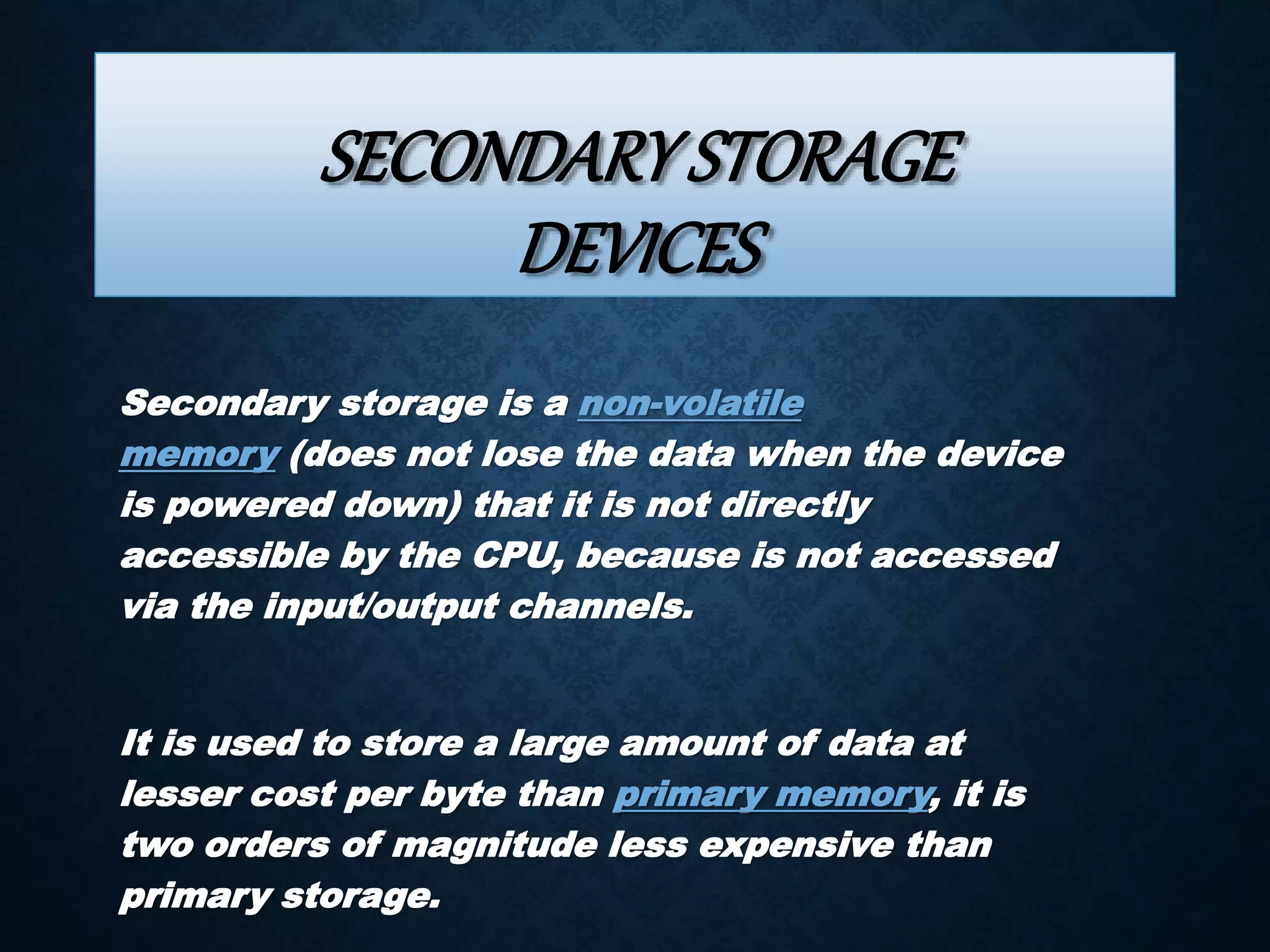
Types include:
Hard disks.
Floppy disks.
CD ROMs.
DVDs.
Pen drives.
Blue Ray
Disks
SECONDARY STORAGE DEVICES
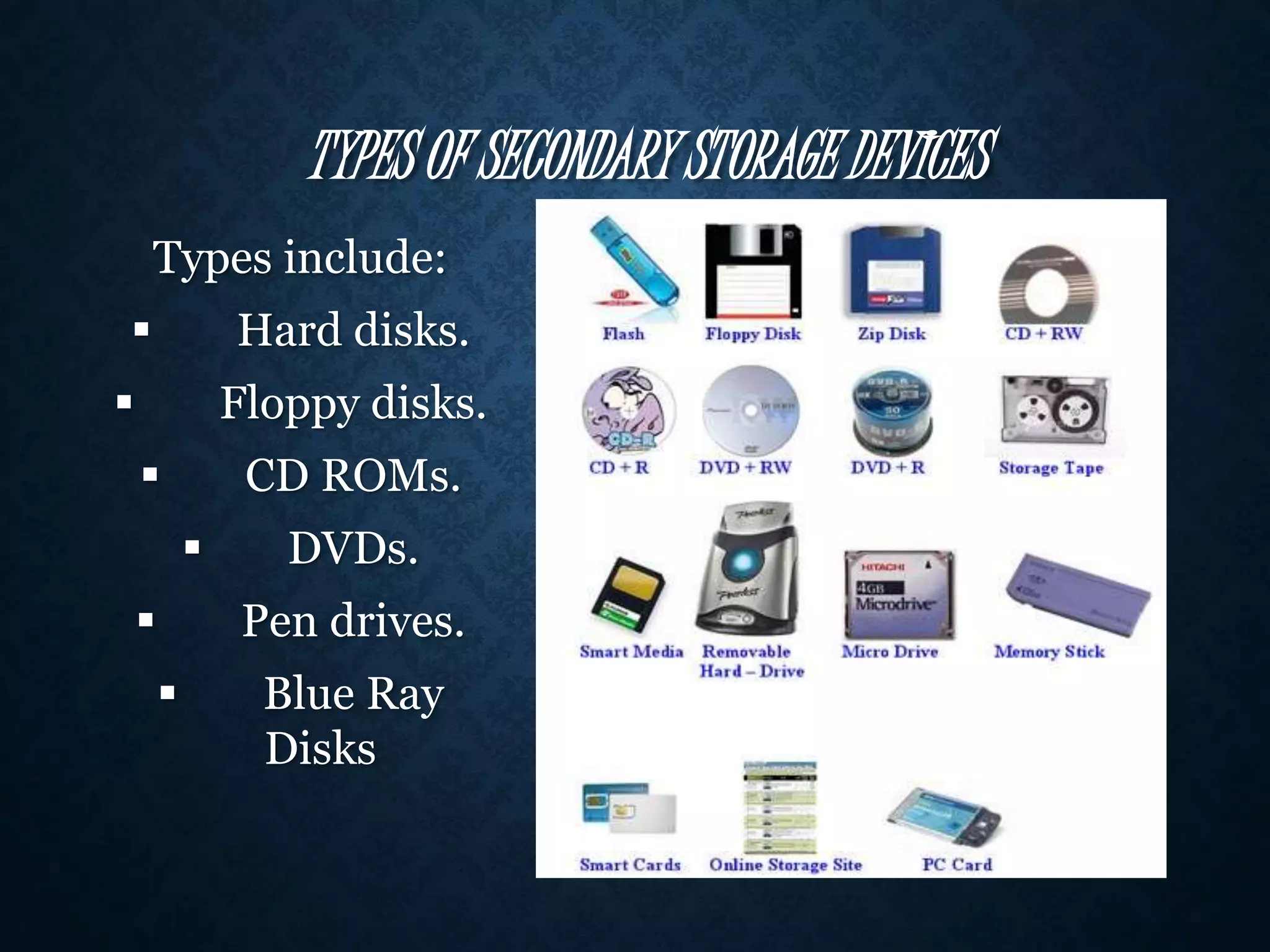
Two major types of storage devices:
1. sequential access devices
Magnetic tapes (very fast sequential access)
2. Direct Access Storage Devices (DASDs)
Magnetic Disks
Hard disks (high capacity, low cost per bit)
Floppy disks (low capacity, slow, cheap)
Optical Disks
CD-ROM = (Compact disc, read-only memory)
Memory Storage device
Flash drive
Memory card
5
6.
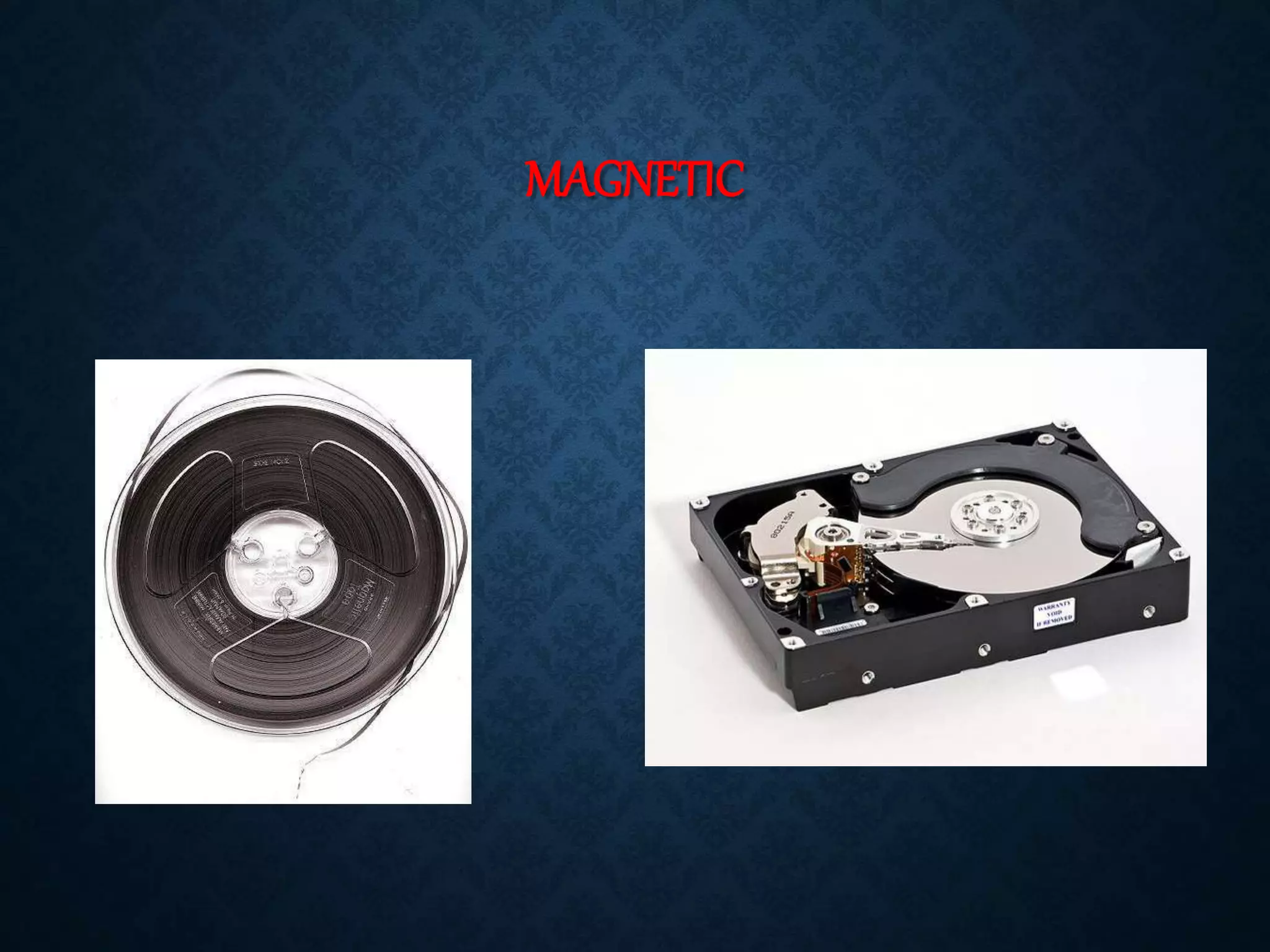
MAGNETIC TAPE STORAGE:
- is a 1/4 inch or 1/2 inch ribbon
of plastic material on which data is recorded. It reads,
writes and erases data on tapes.
-Magnetic tapes are erasable, reusable and durable
and made to store large quantities of data.
Magnetic Disk Storage:
- Magnetic disks are the most widely used storage
medium for computers.
- It offers high storage capacity, reliability, and the
capacity to directly access stored data while holding
more data.
7.
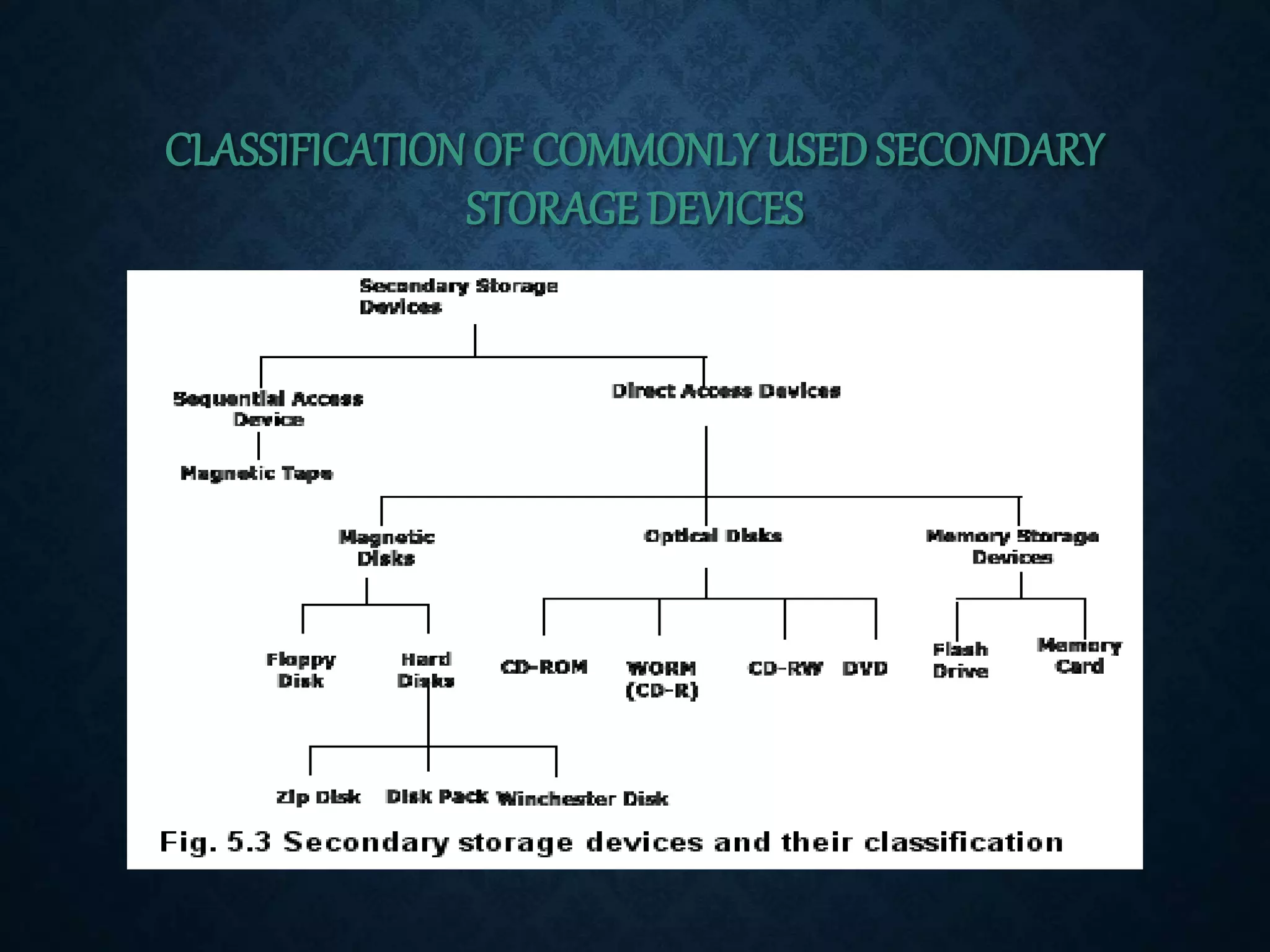
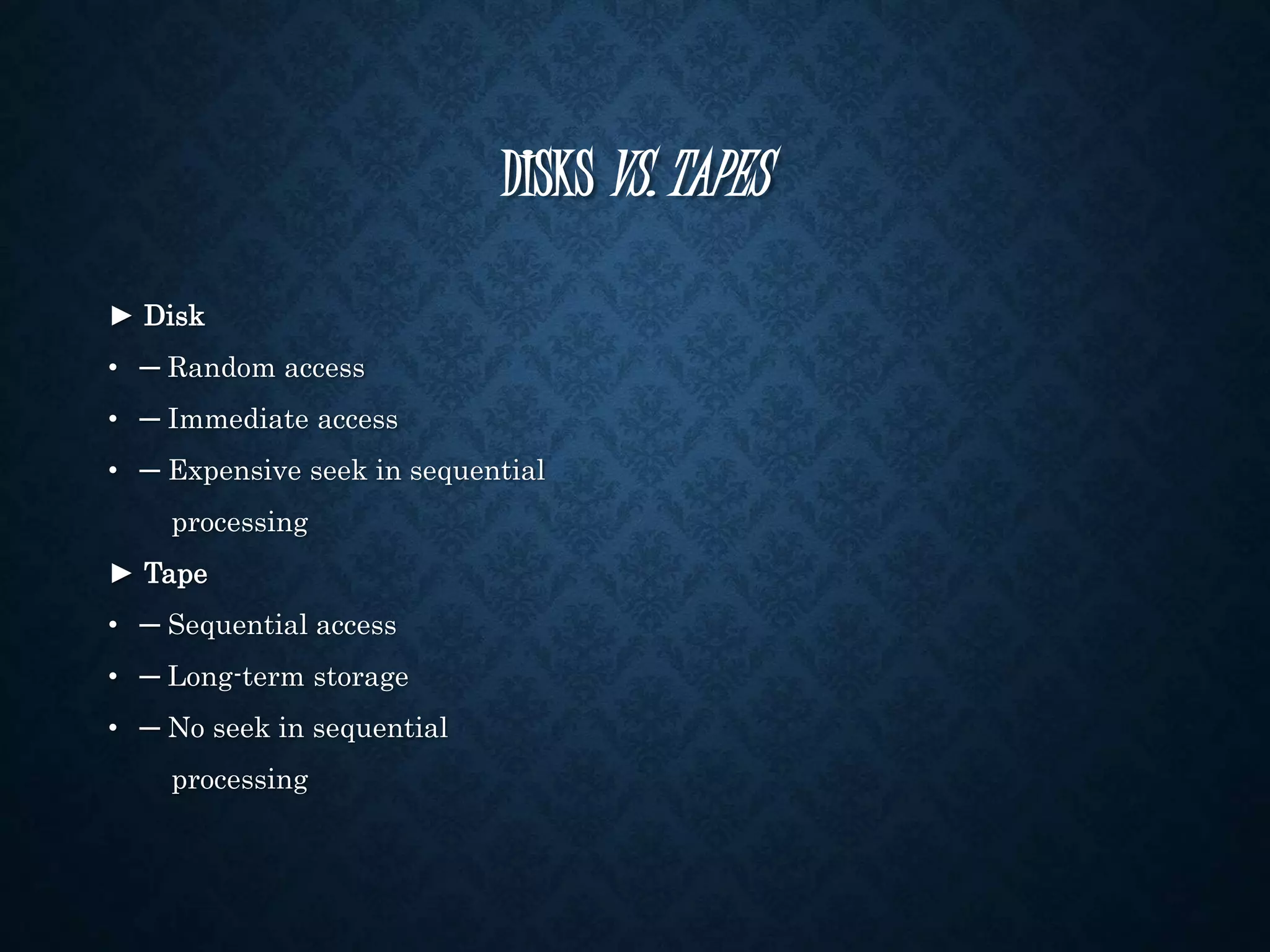
DISKS VS. TAPES
► Disk
• ─ Random access
• ─ Immediate access
• ─ Expensive seek in sequential
processing
► Tape
• ─ Sequential access
• ─ Long-term storage
• ─ No seek in sequential
processing
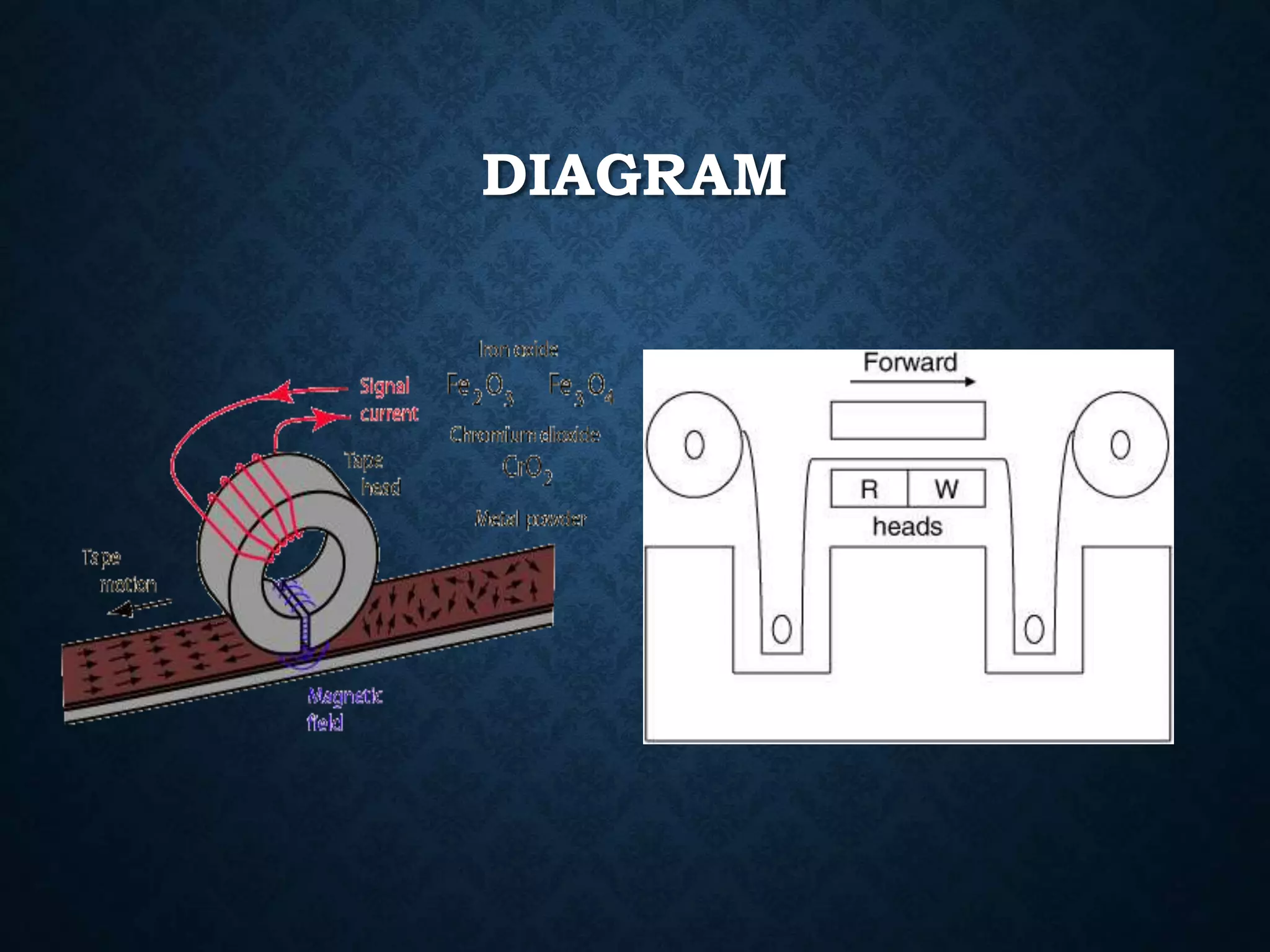
Magnetic Tape
•What is magnetic tape?
• Thin layer of material capable of storing a magnetic
signal
• Usually contains Iron Oxide
• Protected by backing
layer called the
“Substrate”
10.
MAGNETIC TAPE
Advantages
• Probably the cheapest form of
storage per megabyte of storage.
• Can store large amounts of data
- up to 1 Terabyte per tape
cartridge.
• Can be set up to do the back up
overnight or over the weekend.
Disadvantages
• Serial access so can be quite slow to
access data.
• Need a special piece of equipment to
record and read the data on the tape.
• The data may be corrupted if the tape
is placed near a strong magnetic field
e.g. a large speaker or magnet.
11.
CHARACTERISTICS OF MAGNETICTAPES
• No direct access, but very fast sequential access.
• Resistant to different environmental conditions.
• Easy to transport, store, cheaper than disk.
• Before, it was widely used to store application data; nowadays,
• it's mostly used for backups or archives (tertiary storage).
12.
ESTIMATING TAPE LENGTH
►There is an interblock gap for each
data block
►Space requirement s
s = n × ( b + g )
• b is the physical length of a data
block
• g is the length of an interblock gap
• n is the number of data blocks
►Tape density
►Tape speed
►Size of interblock gap
Performance of tape drives can be
measured in terms of 3
quantities:
Tape density = 6250 bpi (bits per
inch per track)
Tape speed = 200 inches per
second (ips)
Size of interblock gap = 0.3 inch
File characteristics:
Number of records = 1,000,000
Size of record = 100 bytes
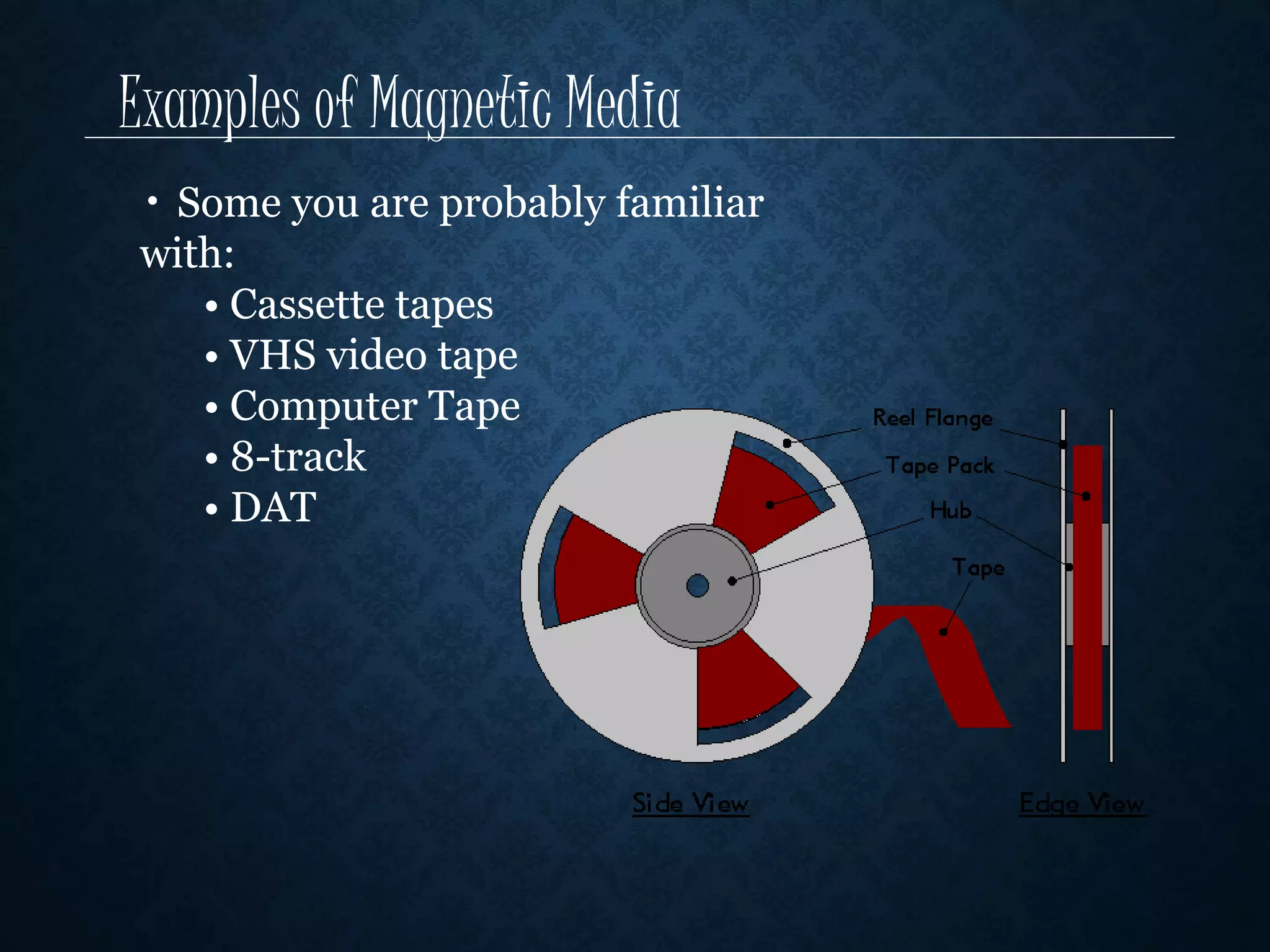
Examples of MagneticMedia
• Some you are probably familiar
with:
• Cassette tapes
• VHS video tape
• Computer Tape
• 8-track
• DAT
15.
Magnetic Tape UsesToday
• Today, tape based systems are usually used for backup
purposes only.
• Tape still provides the most cost effective method of
storing larger amounts of backup information
• Reliable as long as temperature is kept low and
humidity conditions are kept right.
• Although hard disks are increasingly used as a backup
mechanism, tapes are portable.
• Backups can be taken off-site for greater risk
prevention
16.
MAGNETIC
DISK
Magneticdisk is a direct access secondary storage device
. It is a thin plastic or metallic circular plate coated with
magnetic oxide and encased in a protective cover . Data
is stored on magnetic disk as a magnetized spots . The
presence of a magnetic spot represent the bit 1 and its
absence represent the bit 0 .
17.
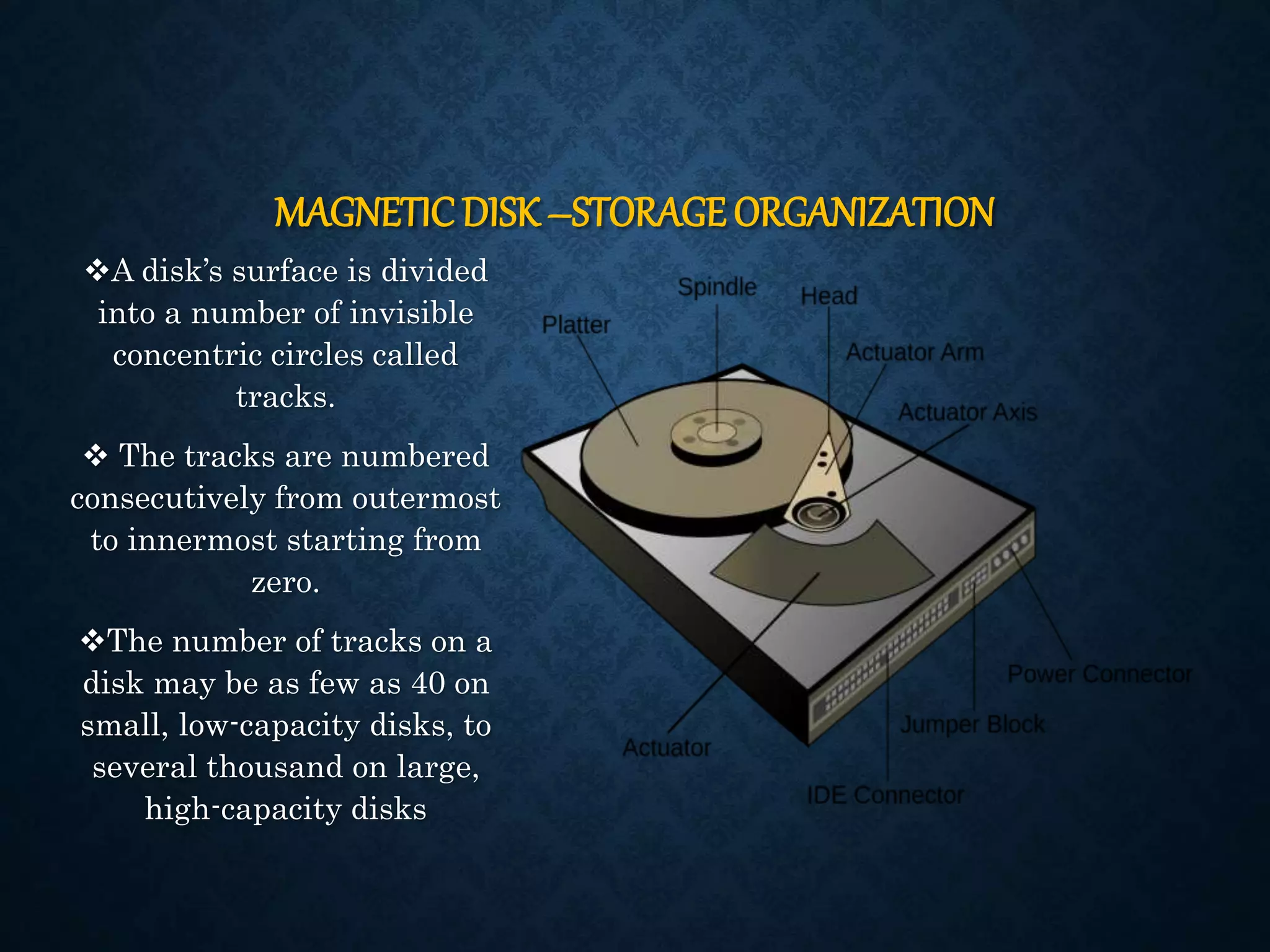
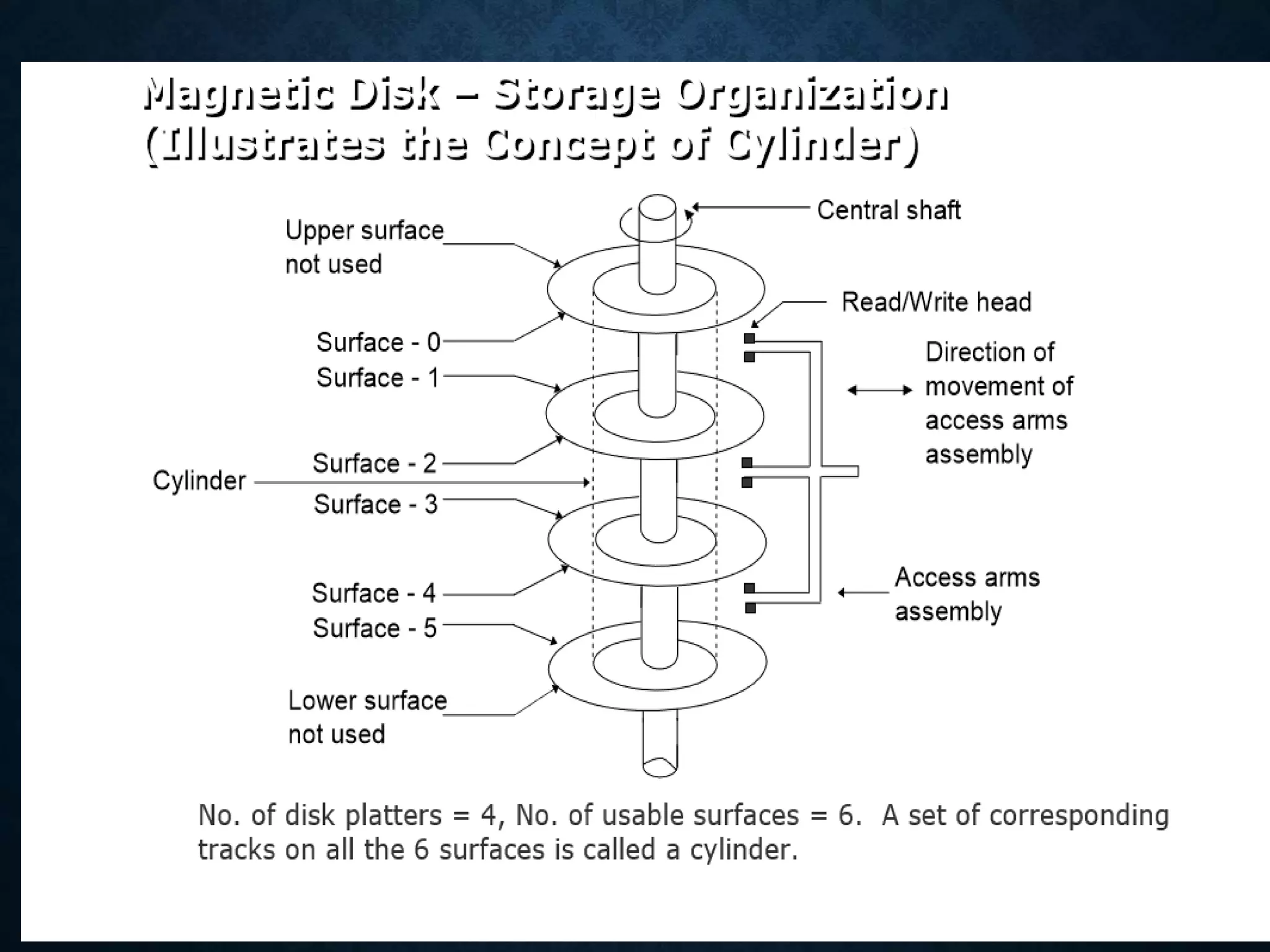
MAGNETIC DISK –STORAGEORGANIZATION
A disk’s surface is divided
into a number of invisible
concentric circles called
tracks.
The tracks are numbered
consecutively from outermost
to innermost starting from
zero.
The number of tracks on a
disk may be as few as 40 on
small, low-capacity disks, to
several thousand on large,
high-capacity disks
ADVANTAGES OF MAGENETICDISKS
More suitable than magnetic tapes for a wider range of applications because they
support direct access of data.
Random access property enables them to be used simultaneously by multiple users as a
shared device. A tape is not suitable for such type of usage due to its sequential-access
property.
Suitable for both on-line and off-line storage of data.
Except for the fixed type Winchester disks, the storage capacity of other magnetic disks
is virtually unlimited as many disks can be used for storing very large data set.
Due to their low cost and high data recording densities, the cost per bit of storage is low
for magnetic disks.
An additional cost benefit is that magnetic disks can be erased and reused many times.
Floppy disks and zip disks are compact and light in weight. Hence they are easy to
handle and store.
Very large amount of data can be stored in a small storage space.
21.
LIMITATIONS OF MAGNETICDISKS
Although used for both random processing and sequential
processing of data, for applications of the latter type, it may be
less efficient than magnetic tapes.
More difficult to maintain the security of information stored on
shared, on-line secondary storage devices, as compared to
magnetic tapes or other types of magnetic disks.
For Winchester disks, a disk crash or drive failure often results
in loss of entire stored data. It is not easy to recover the lost data.
Suitable backup procedures are suggested for data stored on
Winchester disks .
Some types of magnetic disks, such as disk packs and Winchester
disks, are not so easily portable like magnetic tapes.
On a cost-per-bit basis, the cost of magnetic disks is low, but the
cost of magnetic tapes is even lower
22.
USES OF MAGNETICDISKS
For applications that are based on random data processing .
As a shared on-line secondary storage device. Winchester disks
and disk packs are often used for this purpose.
As a backup device for off-line storage of data. Floppy disks, zip
disks, and disk packs are often used for this purpose.
Archiving of data not used frequently, but may be used once in a
while. Floppy disks, zip disks, and disk packs are often used for
this purpose.
Transferring of data and programs from one computer to another
that are not linked together. Floppy disks and zip disks are often
used for this purpose.
Distribution of software by vendors. Originally sold software or
software updates are often distributed by vendors on floppy disks
and zip disks